A Bus For The Twenty-First Century
What puzzles me, is why bus drivers in London, seem to be suffering more from COVID-19 infection, than drivers elsewhere!
In London, all buses have two or three doors and contactless ticketing, whereas in many parts of the UK, there is often only one door and no contactless ticketing.
This must mean, that there is generally less interaction between the driver and passengers in the capital. So logic would say, that outside of London, there should be more passing of infections between everybody on the bus.
An Observation In Manchester
Ten years ago, I observed behaviour on a single-door Manchester bus going to Oldham, with a union rep for bus drivers, who by chance happened to be sitting beside me.
The scrum as passengers entered and left the bus by the same door was horrific and the rep told me, that the local riff-raff were always trying to nick the driver’s money.
He told me, that a London system based on contactless ticketing was union policy and would cut attacks on staff, which he said had virtually stopped in London.
A Bus For The Twenty-First Century
The government has said that millions will be available for new zero-carbon buses, powered by hydrogen. I doubt that batteries will be able to provide enough power for many years.
It is my belief that given the new circumstances, that the bus should also have the following features.
- It should be as infection-unfriendly as possible, as COVID-19 won’t be the last deadly infection.
- Contactless ticketing by credit card or pass.
- Full CCTV to identify non-payers or those with stolen cards.
- Two doors with one in the middle for entry and one at the back for exit.
- It would be possible on some routes for both doors to be used for entry and exit.
- Wheelchairs would enter and leave by the middle door, where the ramp would be fitted.
I would put the stairs to the top deck on the left hand side of the bus, with the foot of the stairs leading directly into the lobby by the middle door.
The Van Hool ExquiCity
The Van Hool ExquiCity is an alternative solution, that is already running in Belfast, where it is named Glider.
It is probably best described as a double-ended articulated bus, that runs on rubber tyres, that thinks it’s a tram.
This press release from Ballard is entitled Ballard-Powered Fuel Cell Tram-Buses From Van Hool Now in Revenue Service in France, describes the latest hydrogen-powered version of the Exquicity, which is now in service in Pau in France.
- Each bus appears to be powered by a 100 kW hydrogen fuel cell.
- The buses are over eighteen metres long.
- Twenty-four metre double-articulated tram-buses are available.
- The buses seat 125 passengers
- The buses have a range of 300 kilometres between refuelling.
I like the concept, as it brings all the advantages of a tram at a lower cost.
Here’s a video.
It certainly seems a quiet bus.
I desperately need to get to Pau to see these vehicles.
Conclusion
We could design a new bus for the twenty-first century, that tackles the problems facing the bus industry.
- Climate change and global warming.
- Control of deadly infections like COVID-19.
- Efficient, fast ticketing.
- Attacks on staff.
- Petty crime.
- Access to public transport for the disabled, the elderly and those with reduced mobility.
We certainly have the skills to design and manufacture a suitable bus.
The New Generation Of Pumped Storage Systems
This excellent article on GreenTechMedia is entitled The 5 Most Promising Long-Duration Storage Technologies Left Standing.
One of the technologies the article discusses is pumped storage, which in the UK is used at the massive Electric Mountain in Snowdonia, which can hold 9.1 GWh of electricity and supply up to 1,800 MW of electricity when needed. That’s not bad for 1970s engineering!
The GreenTechMedia article introduces pumped storage like this.
Midcentury modern design is hot again, so why not midcentury storage technology? This gravity-based concept physically moves water from a low to a high reservoir, from which the water descends, when needed, to generate electricity. This dates from way before lithium-ion’s heyday and still provides some 95 percent of U.S. grid storage, according to the U.S. Department of Energy.
The largest pumped storage system in the US is Bath County Pumped Storage Station, which is described as the biggest battery in the world. With a storage capacity of 24 GWh of electricity and a generating capacity of 3,003 MW, it dwarfs Electric Mountain. But then the Americans have bigger mountains.
Pumped storage is a good partner for intermittent renewables like wind and solar, but in a country like the UK, the US and other countries with strong planning laws getting permission to build a large pumped storage system is not easy. We tried to build one on Exmoor, but that was abandoned.
Note that the country building the most new pumped storage systems is China, where they have mountains and planning laws, that would not be acceptable anywhere else.
But engineers have come up with a new design, described in this paragraph from the GreenTechMedia article.
The new school of pumped hydro focuses on isolated reservoirs that don’t disrupt river ecosystems; this simplifies permitting, but projects still face a decade-long development timeline and billion-dollar price tags.
It then gives two examples of proposed systems.
Gordon Butte Pumped Storage Project
The operation of the Gordon Butte Pumped Storage Project is described like this in Wikipedia.
Gordon Butte will be located on a 177 acres (0.72 km2) site, and will have access to water from Cottonwood Creek, a tributary of the Musselshell River. The facility will operate as a closed system, without actively drawing or discharging water into the watershed. It will have a 4,000 acre-foot capacity reservoir, located 1,000 feet (300 m) above the base, with a power generation capacity of about 400 MW
The smaller size must make it easier to get it built.
How much energy will Gordon Butte hold in GWh?
- A 4,000 acre-foot reservoir has a capacity of 4,933,927.42128 cubic metres.
- As a cubic metre of water weighs a tonne, the reservoir can hold 4,933,927.42128 tonnes of water at an altitude of 300 metres.
- Using Omni’s Potential Energy Calculator, this gives a potential energy of 4,032,108 KWh.
This is just over 4 GWh.
Ths facility could supply 400 MW for ten hours or 4 MW for a thousand hours!
It should be noted that Electric Mountain has an efficiency of 74-76%.
Eagle Mountain Pumped Storage Facility
Eagle Mountain Pumped Storage Facility is introduced like this on its web site.
The pumped storage hydropower project at Eagle Mountain, CA will transform a scarred brownfield site into a 1,300 Megawatt generator of green electricity that can light one million homes. The site is in a remote part of the Mojave Desert, more than 50 miles from the nearest city, Blythe, CA, and more than 60 miles from Palm Springs and the Coachella Valley. The construction of the project will create thousands of jobs and add millions of dollars to the local economy while adhering to the most rigorous environmental standards.
Note that it is turning an eyesore of the worst kind into a pumped storage facility. It’s surely better than using it for landfill!
Conclusion
Systems like these may have applications in the UK!
Could some of those massive quarries in the Peak District be converted into pumped storage systems, using the technology of my two examples?
This Google Map shows the quarries surrounding the town of Buxton.
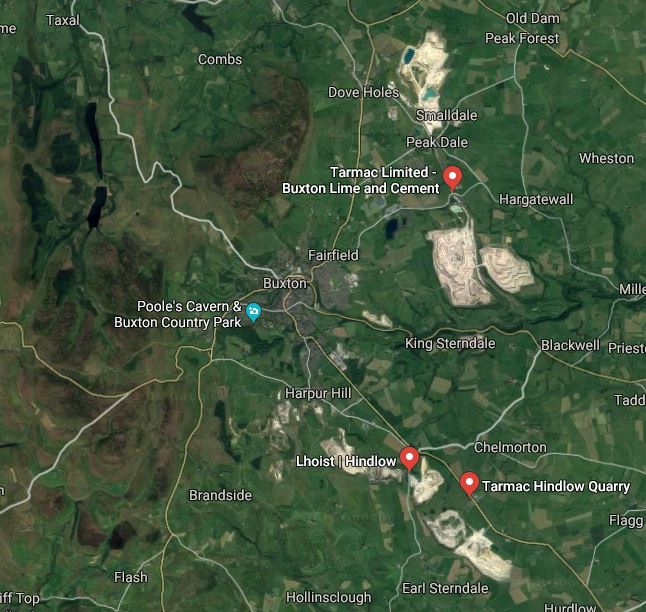
Note.
- The white areas looking almost like clouds are quarries.
- Buxton has an altitude of three hundred metres, which is the altitude of the Gordon Butte Storage Project.
- The vast Tunstead Quarry, which is four kilometres East of Buxton has an area of over one square mile.
- Tunstead Quarry has a red arrow above it marked Buxton Lime and Cement.
Could we not extract as much limestone as is possible from Tunstead and then convert it into a pumped storage system like Gordon Butte? It could have an area of 2.5 square kilometres and an altitude of nearly a thousand feet. A rough estimate, based on Gordon Butte, indicates it could store over 10 GWh.
Hopefully, better hydro-electric power engineers than myself, are looking at the quarries in the Peak District, with eyes flashing like cash registers.
There is one pumped storage project under development in the UK at the present time; Snowdonia Pumped Hydro, which obtained planning permission in 2017.
These are some characteristics.
- Situated in Snowdonia in old slate quarries at Glyn Rhonwy.
- 99.9 MW of power
- 700 MWh of storage capacity.
- 2 reversible turbines
- Start to full power in 12 seconds
- Cycle efficiency of around 81%
- Project lifespan of 125 years
- Estimated carbon saving of 50,000 tonnes per year
It is under a tenth the size to Electric Mountain, but every little helps.
I would also feel that with a 125 year life, it could be the sort of investment, that would appeal to a Pension Fund.
The 5 Most Promising Long-Duration Storage Technologies Left Standing
The title of this post is the same as that of this article on GreenTechMedia.
This is the sub-title of the article.
Low-carbon grids need longer-duration storage, but few technologies have succeeded at scale. Here’s the current roster of best bets.
I won’t steal their thunder, by saying too much more.
- Pumped storage, like Electric Mountain, is making a comeback.
- My favourite; Highview Power is on the list!
- One great thing about their Famous Five, is that perhaps only one uses an exotic material.
- I also think, that all five could be funded by a Pension Fund to give a return to pay pensions.
But you should read the article!
We’re not going to run out of energy!
Battery Storage Paves Way For A Renewable-Powered Future
The title of this post is the same as that of this article on Modern Diplomacy.
This is the introductory paragraph.
Battery storage systems are emerging as one of the key solutions to effectively integrate high shares of solar and wind renewables in power systems worldwide. A recent analysis from the International Renewable Energy Agency (IRENA) illustrates how electricity storage technologies can be used for a variety of applications in the power sector, from e-mobility and behind-the-meter applications to utility-scale use cases.
The article then goes on to outline a good summary of the uses and expected growth of battery storage.
History And Future Of The Compressed Air Economy
A reader in Canada has sent me a link to this article on Low Tech Magazine, which has the same title as this post.
This is the introductory sub-title.
Historical compressed air systems hold the key to the design of a low-tech, low-cost, robust, sustainable and relatively energy efficient energy storage medium.
As regular readers of this blog, will have noticed, I regularly post about a company called Highview Power.
This is the introduction from the Wikipedia entry for Highview Power.
Highview Power is a long-duration energy storage pioneer, specialising in cryogenic energy storage. It is based in the United Kingdom and the United States. It has permission for a commercial-scale 50 Megawatt/250 Megawatt-hour plant in England, building upon its earlier 5 Megawatt and 350 Kilowatt pilot plants. It plans to develop a 50MW plant/400MWh (eight hours of storage) in Vermont.
It has over 30 patents developed in partnership with British universities and has won technology funding from the British Government.
In February 2020 Sumitomo Heavy Industries invested $46m in the company.
The article on Low Tech Magazine gives the history of compressed air energy storage (CAES) and is a good background to the subject.
Australia’s New Community Solar, Solar-Storage, ‘Solar Hydro’ And Solar Hydrogen Projects
The title of this post is the same as that of this article on Energy Storage News.
This is the introductory paragraph.
In the past couple of weeks, national and state government organisations in Australia have announced various stages of consideration for solar projects with a range of advanced and innovative storage solutions attached.
The article then goes on to describe some projects.
RayGen’s PV Ultra System
This paragraph describes the PV Ultra system.
The fully dispatchable power plant would use RayGen’s own technology PV Ultra, which is a combination of photovoltaic (PV) solar generation with the more expensive and engineering-intensive concentrated solar technology using angled mirror towers (heliostats). The PV Ultra system would generate both electricity and heat.
It’s obviously using what Australia has a lot of; sun to advantage.
RayGen’s Innovative Thermal Storage
This paragraph outlines the principle of RayGen’s thermal method of storage.
This generation technology would in turn be co-located and connected to a ‘Thermal Hydro’ energy storage facility, with 17 hours of storage, which again is based on a technology RayGen is developing. Unlike pumped hydro energy storage which uses two reservoirs at different heights, relying on gravity to drive turbines, the Thermal Hydro plant would use a hot reservoir and a cold reservoir, linked together.
The principle of operation is described in this second paragraph.
The PV Ultra solution will therefore cool one reservoir using photovoltaic power and grid power when needed, while also heating the other reservoir using the heliostats. The difference in temperature would then generate electricity, via an Organic Rankine Cycle engine, a device which uses thermodynamic cycles to convert steam into mechanical energy and is widely used for biomass, waste incinerators and other existing generation types.
The article states that an Organic Rankine cycle engine has an efficiency of about seventy percent. I have linked to Wikipedia, which gives a good explanation of the Organic Rankine cycle, which is typically used in waste heat recovery and biomass power plants.
RayGen’s Flagship Project
RayGen’s flagship project will be rated at 4 MW, with a storage capacity of 50 MWh. It will be used to provide power in the West Murray region.
New South Wales Community Projects
The article then describes a group of community projects that are being set up in New South Wales.
This is the introductory paragraph
Elsewhere in Australia, the government of New South Wales approved grants earlier this month to assist the development of seven solar projects, all but one of which will include energy storage. Notably, five out of the seven will also be community distributed energy projects, including one standalone shared battery energy storage site.
Some points from the article include.
- The total solar power is rated at 17.2 MW.
- The energy storage is rated at 39.2 MWh
- One site is co-located with hydrogen electrolysis and storage,
New South Wales has certainly launched an ambitious plan.
Conclusion
I like RayGen’s system and the New South Wales initiative.
I also think, that both projects could find applications in some of the hotter places in the world.
Could solar power systems like these solve power supply problems in Africa, India and other sun-rich places>
Thoughts On The Actual Battery Size In Class 756 Trains And Class 398 Tram-Trains
A Freedom of Information Request was sent to Transport for Wales, which said.
Please confirm the battery capacity and maximum distance possible under battery power for the Tram/Train, 3 & 4 Car Flirts.
The reply was as follows.
The batteries on the new fleets will have the following capacities: –
- Class 756 (3-car) Flirt – 480 kWh
- Class 756 (4-car) Flirt – 600 kWh
- Class 398 tram-trains – 128 kWh
I will now have thoughts on both vehicles separately.
Class 756 Trains
In More On Tri-Mode Stadler Flirts, I speculated about the capacity of the batteries in the tri-mode Stadler Flirts, which are now called Class 756 trains, I said this.
I wonder how much energy storage you get for the weight of a V8 diesel, as used on a bi-mode Flirt?
The V8 16 litre diesel engines are made by Deutz and from their web site, it looks like they weigh about 1.3 tonnes.
How much energy could a 1.3 tonne battery store?
The best traction batteries can probably store 0.1 kWh per kilogram. Assuming that the usable battery weight is 1.2 tonnes, then each battery module could store 120 kWh or 360 kWh if there are three of them.
I also quoted this from the July 2018 Edition of Modern Railways.
The units will be able to run for 40 miles between charging, thanks to their three large batteries.
Since I wrote More On Tri-Mode Stadler Flirts in June 2018, a lot more information on the bi-mode Stadler Class 755 Flirt has become available and they have entered service with Greater Anglia.
Four-car trains weigh around 114 tonnes, with three-car trains around a hundred. I can also calculate kinetic energies.
How Good Was My Battery Size Estimate?
These are my estimate and the actual values for the three batteries in Class 756 trains
- My estimate for Class 756 (3- & 4-car) – 120 kWh
- Class 756 (3-car) Flirt – 160 kWh
- Class 756 (4-car) Flirt – 200 kWh
So have Stadler’s battery manufacturer learned how to squeeze more kWh into the same weight of battery?
In Sparking A Revolution, I talked about Hitachi’s bullish plans for battery-powered trains, in a section called Costs and Power.
In that section, I used Hitachi’s quoted figures, that predicted a five tonne battery could hold a massive 15 MWh in fifteen years time.
If Stadler can get the same energy density in a battery as Hitachi, then their battery trains will have long enough ranges for many applications.
Class 398 Tram-Trains
In Sheffield Region Transport Plan 2019 – Tram-Trains Between Sheffield And Doncaster-Sheffield Airport, I showed this map of the route the trams would take.
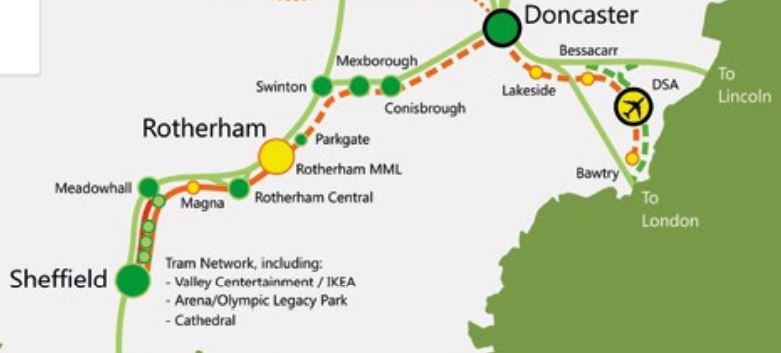
I also said this about the tram-trains.
The distance between Rotherham Parkgate and Doncaster is under twelve miles and has full electrification at both ends.
The Class 399 tram-trains being built with a battery capability for the South Wales Metro to be delivered in 2023, should be able to reach Doncaster.
But there are probably other good reasons to fully electrify between Doncaster and Sheffield, via Meadowhall, Rotherham Central and Rotherham Parkgate.
The major work would probably be to update Rotherham Parkgate to a through station with two platforms and a step-free footbridge.
Currently, trains take twenty-three minutes between Rotherham Central and Doncaster. This is a time, that the tram-trains would probably match.
If you adopt the normal energy consumption of between three and five kWh per vehicle mile on the section without electrification between Rotherham Parkgate and Doncaster, you get a battery size of between 108 and 180 kWh.
It looks to me, that on a quick look, a 128 kWh battery could provide a useful range for one of Stadler’s Class 398/399 tram-trains.
Class 398 Tram-Trains Between Cardiff Bay and Cardiff Queen Street Stations
The distance between these two stations is six chains over a mile,
Adding the extra bit to the flourish might make a round trip between Cardiff Queen Street and The Flourish stations perhaps four miles.
Applying the normal energy consumption of between three and five kWh per vehicle mile on the section without electrification between Cardiff Queen Street and The Flourish, would need a battery size of between 36 and 60 kWh.
Conclusion
The battery sizes seem to fit the routes well.
Novel Long-Duration Energy Storage System Installed At World’s Largest CSP Plant
The title of this post is the same as that of this article on Recharge.
This is the sub-title.
Technology that stores power in molten aluminium inaugurated at 580MW Noor Ouarzazate solar complex in Morocco.
Other points from the original article.
- The idea is from Swedish start-up; Azelio.
- The the Noor Ouarzazate solar complex is rated at 580MW
- Noor is Arabic for light.
- Energy is stored as heat in molten recycled aluminium at 600 °C.
- When energy is needed, a Stirling engine is used to generate energy.
- Waste heat can also be captured and used to heat buildings.
- The system has a 90 % round-trip efficiency.
I feel this could be a winner in the long term.
Blackstone Acquires Battery Energy Storage Firm NRStor
The title of this post is the same as that as this article in IPE Real Assets.
The Blackstone Group is on of the largest alternative investment firms in the world, so the title of the post says it all.
I believe that we need masses of energy storage to fight global warming and it looks like Blackstone are building a portfolio.
Northern’s Battery Plans
The title of this post, is half of the title of an article in the March 2020 Edition of Modern Railways.
It appears that CAF will convert some three-car Class 331 trains into four-car battery-electric trains.
- A three-car Class 331 train has a formation of DMSOL+PTS+DMSO.
- A fourth car with batteries will be inserted into the train.
- Batteries will also be added to the PTS car.
- The battery-electric trains would be used between Manchester and Windermere.
It looks like a round trip would take three hours including turnarounds, thus meaning three trains would be needed to run the service.
The article says this.
The branch was due to be electrified, but this was cancelled in 2017, and as a result 3×3-car Class 195 trains were ordered. As well as the environmental benefits, introduction of the battery ‘331s’ on Windermere services would free-up ‘195s’ for cascade elsewhere on the Northern network.
Note that the total length or the route is 98 miles of which only the ten miles of the Windermere Branch Line are not electrified.
What Battery Capacity Would Be Needed?
I reckon it will be fine to use a figure of 3 kWh per vehicle-mile to give a rough estimate of the power needed for a return trip from Oxenholme to indermere.
- Two x Ten Miles x Four Cars x 3 kWh would give 240 kWh.
- There would also be losses due to the seven stops, although the trains have regenerative braking, to limit losses.
Remember though that CAF have been running battery trams for several years, so I suspect that they have the experience to size the batteries appropriately.
In Thoughts On The Actual Battery Size In Class 756 Trains And Class 398 Tram-Trains, I say that four-car Class 756 trains will have 600 kWh of batteries and a range of 40 miles. I wouldn’t be surprised to find that a four-car Class 331 train had similar battery size and range on batteries, as the two trains are competing in the same market, with similar weights and passenger capacities.
Charging The Batteries
The Modern Railways article says this about charging the train’s batteries.
Northern believes battery power would be sufficient for one return trip along the branch without recharging, but as most diagrams currently involve two trips, provision of a recharge facility is likely, with the possibility that this could be located at Windermere or that recharging could take place while the units are in the platform at Oxenholme.
The bay platform 3 at Oxenholme station is already electrified, as this picture shows.
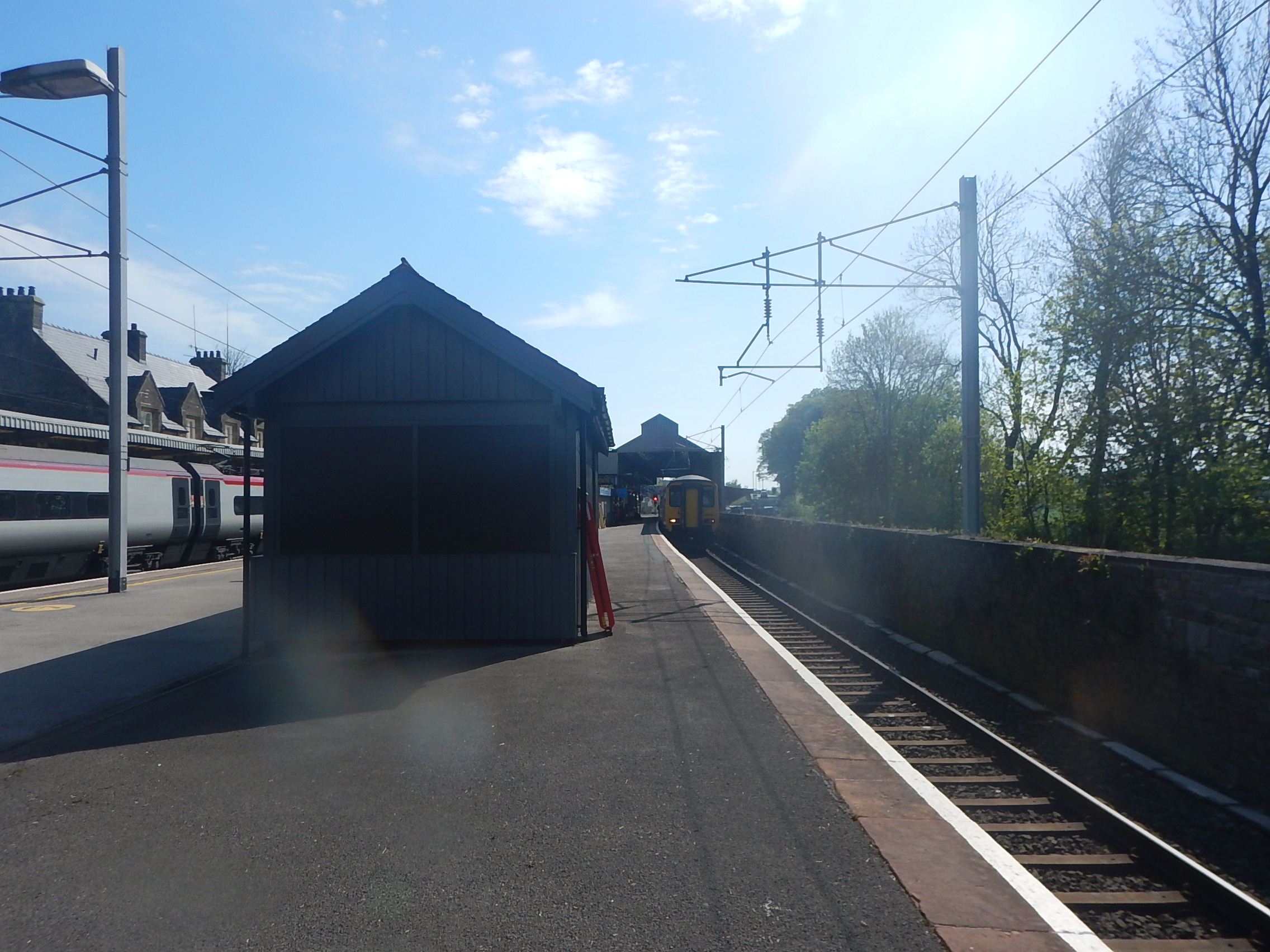
I particularly like Vivarail’s Fast Charge system based on third-rail technology.
A battery bank is connected to the third-rail and switched on, when the train is in contact, so that battery-to-battery transfer can take place.
It’s just like jump-starting a car, but with more power.
This form of charging would be ideal in a terminal station like Windermere.
- The driver would stop the train in Windermere station in the correct place, for passengers to exit and enter the train.
- In this position, the contact shoe on the train makes contact with the third-rail, which is not energised..
- The Fast Charge system detects a train is connected and connects the battery bank to the third-rail.
- Energy flows between the Fast Charge system’s battery bank and the train’s batteries.
- When the train’s batteries are full, the Fast Charge system switches itself off and disconnects the third-rail.
- The third-rail is made electrically dead, when the train has left, so that there is no electrical risk, if someone should fall from the platform.
Note that the only time, the third-rail used to transfer energy is live, there is a four-car train parked on top of it.
When I was eighteen, I was designing and building electronic systems using similar principles to control heavy rolling mills, used to process non-ferrous metals.
Changing Between Overhead Electrification And Battery Power
All trains running between Manchester Airport and Windermere, stop in Platform 3 at Oxenholme station to pick up and put down passengers.
- Trains going towards Windermere would lower the pantograph and switch to battery power.
- Trains going towards Mabchester Airport would raise the pantograph and switch to overhead electrification power.
Both changes would take place, whilst the train is stopped in Platform 3 at Oxenholme station.
 The Anonymous Widower