Beeching Reversal – Goodrington and Churston Stations
This is one of the Beeching Reversal projects that the Government and Network Rail are proposing to reverse some of the Beeching cuts.
I wrote about a similar project, that had been proposed by the Association of Train Operating Companies in Between Exeter And Paignton. after I visited Devon, three years ago.
The basic idea is described in a section called Plans in the Wikipedia entry for the Riviera Line, where this is said.
In 2009 the Association of Train Operating Companies identified Brixham as one of fourteen towns for which the provision of a new railway service would have a positive benefit-cost ratio. This would be an extension of the Great Western Railway service beyond Paignton to Churston station on the Paignton and Dartmouth Steam Railway, which would then act as a railhead for Brixham. It would also serve other housing developments in the area since the opening of the steam railway, and may require the doubling of that line between Paignton and Goodrington Sands.
This Google Map shows between Paignton and Goodrington Sands stations.
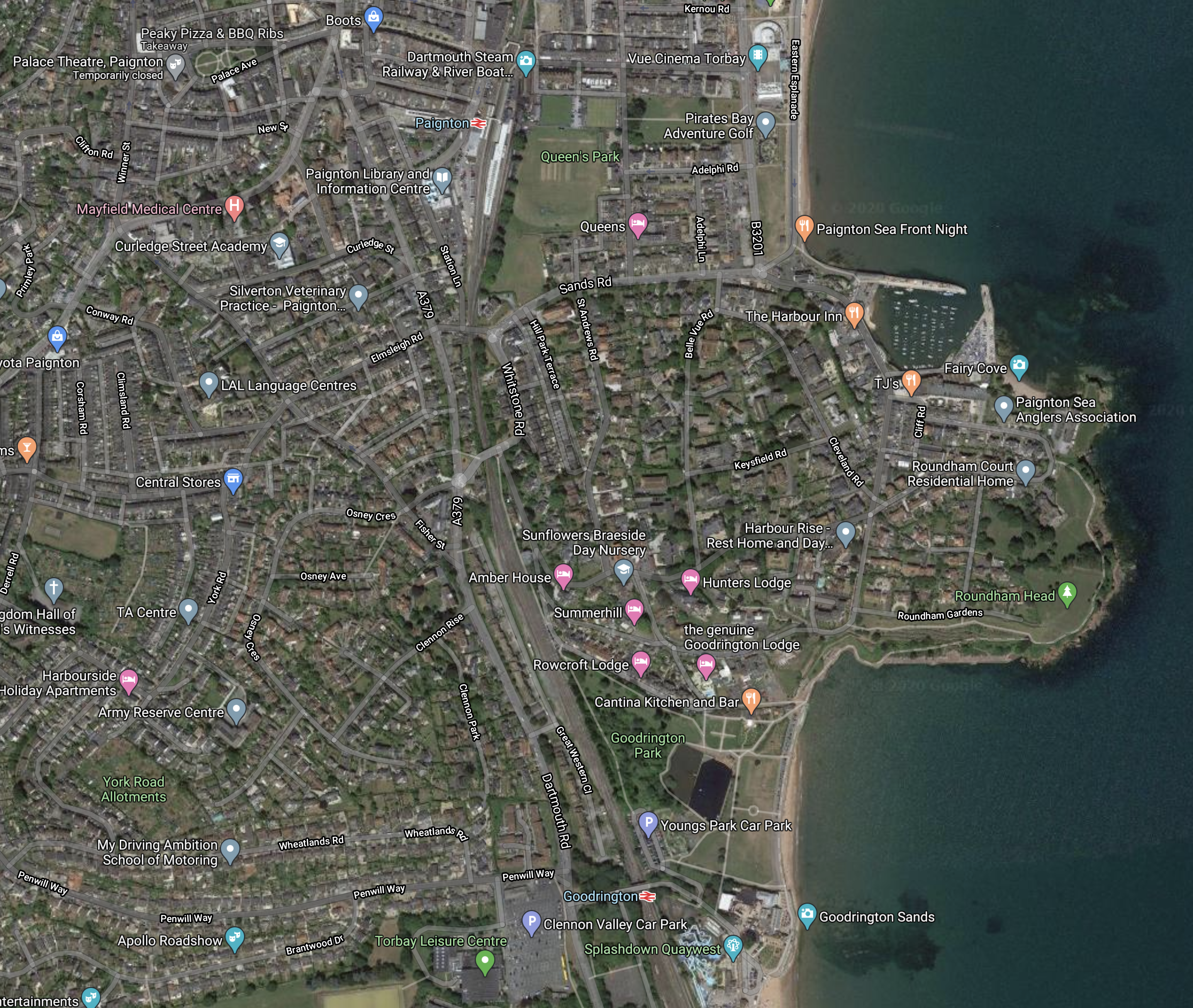
Note.
- Paignton station is marked by a station sign towards the top of the map.
- Goodrington Sands station is towards the bottom of the map.
The two stations seem well placed to serve the serve the town of Paignton and its beaches.
This second Google Map shows the Goodrington Sands and Churston stations in relation to Brixham and Berry Head.
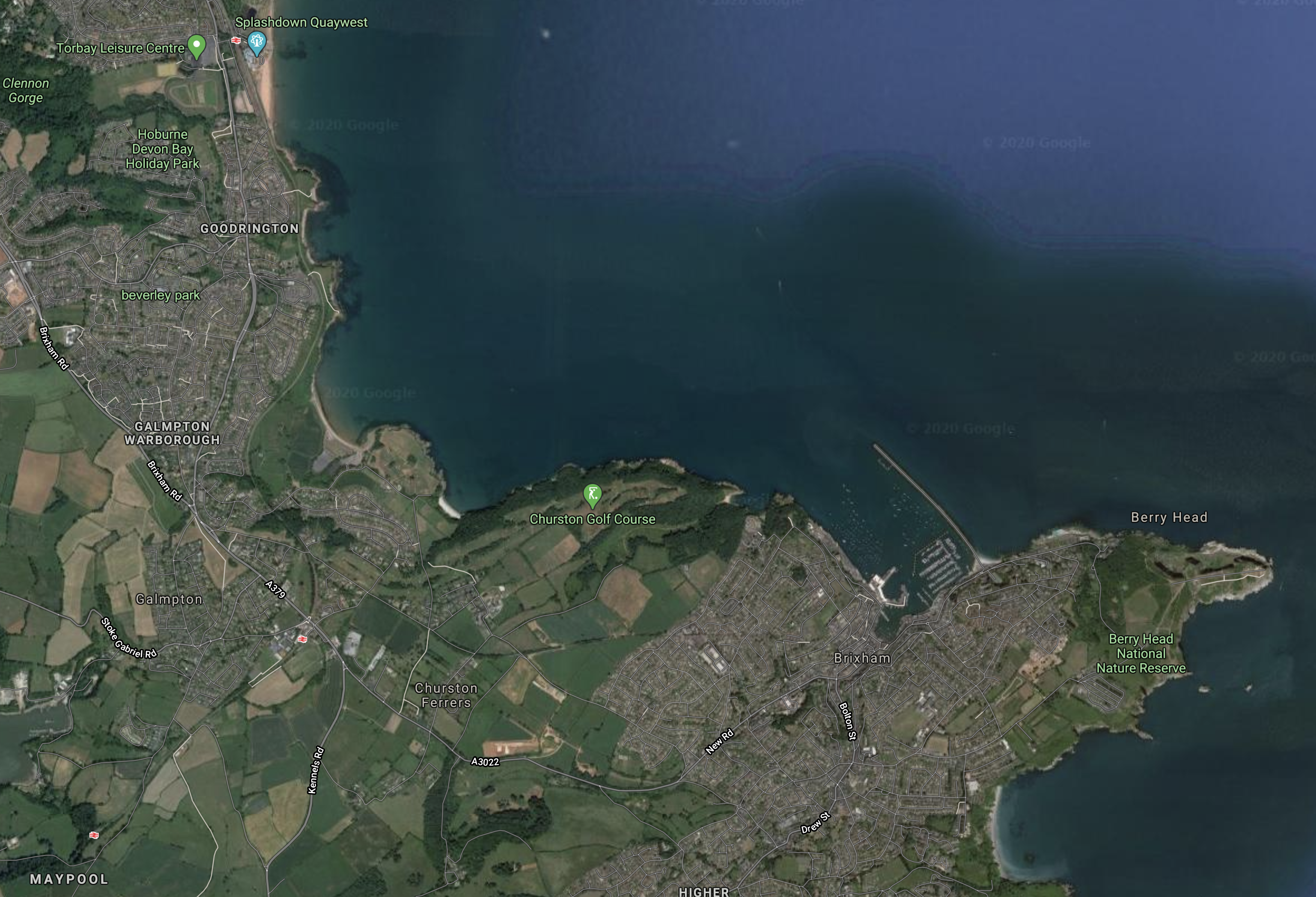
Note.
- Goodrington Sands station is at the top of the map.
- Two other stations on the Dartmouth Steam Railway are shown; Greenway Halt and Churston.
- Churston station is the most Northerly of the pair.
Churston station looks well-placed for Brixham.
These are my thoughts.
The Current Train Service
The train service between Paignton and Exeter St. Davids is run by Great Western Railway.
There are basically two services,
- A two train per hour (tph) service between Paignton and Exmouth via Torquay and Exeter St. Davids. I have used it and it is a useful local service for commuters, shoppers and visitors, although it could do with some modern trains.
- Occasional trains during the day to London Paddington.
There are also some CrossCountry trains going to and from Manchester Piccadilly.
The Dartmouth Steam Railway also runs trains between Paignton and via Goodrington Sands and Churston.
Hitachi’s Regional Battery Train
This train is described in this infographic from Hitachi.

I believe it will revolutionise rail travel in the South West of England, as shorter lengths of electrification, will enable this train based on current Class 800 and Class 802 trains to run all-electric services between London Paddington and Exeter St. Davids, Newquay, Paignton, Penzance and Plymouth.
Exeter St. Davids As A Hub For Battery Electric Trains
Exeter St. Davids station could become a major hub for battery electric trains.
These are distances to various stations.
- Barnstaple – 39 miles
- Exmouth – 11 miles
- Paignton – 28 miles
- Plymouth – 52 miles
- Taunton – 32 miles
- Yeovil Junction – 49 miles
All of these would be in range of a Hitachi Regional Battery Train or any battery electric train with sufficient range, that was fully-charged at Exeter St. Davids station.
The station has plenty of space and several long platforms, so I believe it would make an ideal hub for battery electric trains.
Could Battery Electric Trains Work The Riviera Line?
The Riviera Line was designed by Brunel for atmospheric power. Perhaps, he had observed the weather and felt the massive seas would make it difficult for for the steam locomotives of the day?
As an Electrical Engineer, I certainly couldn’t recommend electrifying through Dawlish with 25 KVAC overhead wires.
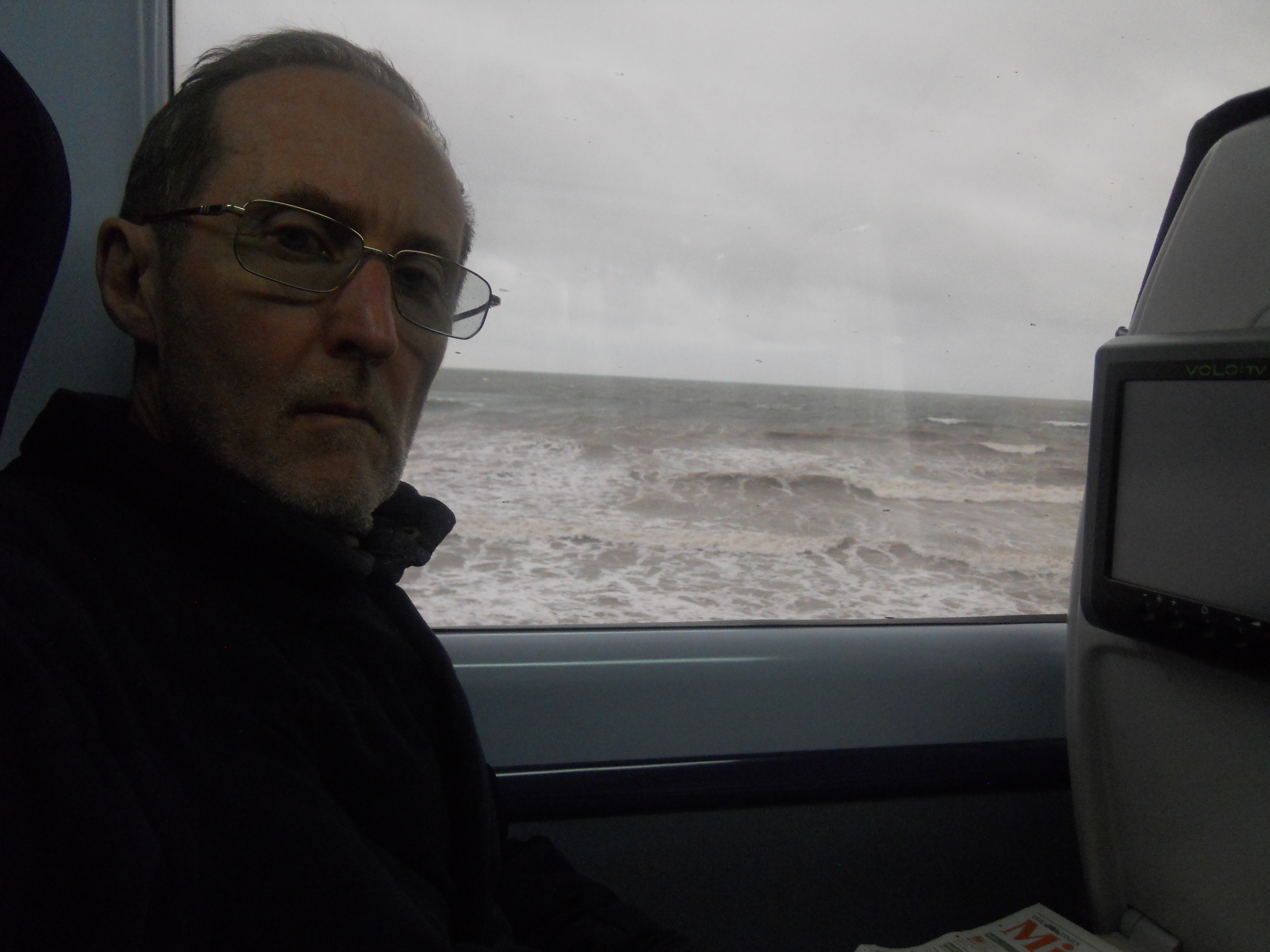
I took the picture from an InterCity 125 in 2011 and the seas seem to have got worse. Remember, that the line was washed away at Dawlish in February 2014.
But Hitachi’s Class 802 trains, seem to be handling the route on diesel power, without too much trouble.
I would expect that if one or more of the diesel engines are swapped for battery packs that the performance in heavy seas will not be worse.
But the biggest advantage of battery electric trains on the Riviera Line would surely be one of marketing.
And not just of the environmentally-friendly train service by Great Western Railway and CrossCountry, but by Hitachi in the marketing of their trains all over the world.
The only minor problem, I can see, could be the provision of charging at Paignton, as a 28 mile journey twice might be on the limit of the range of a battery electric train. Unless of course, bigger batteries were fitted!
A Splash-and-Dash At Newton Abbott
Newton Abbott station is roughly halfway between Plymouth and Exeter St. Davids and might be needed to give a Splash-and-Dash to trains between Devon’s two cities.
Some trains terminate at the station and others seem to take a leisurely stop at the station, so it could be a valuable calling point in a discontinuous electrification strategy.
Edginswell Station
Wikipedia has an entry for a new Edginswell station.
This is said.
Edginswell railway station is a proposed station in the Edginswell area of Torquay, Devon. The station would be located on the Riviera Line between Newton Abbot and Torre stations. Edginswell will be the location of employment and housing development and the new station will support this development. The station would also serve Torbay Hospital, The Willows retail park and the Torquay Gateway development area.
Plans for the station are being developed by Network Rail and Devon County Council.
This Google Map shows the area, where I think the station could be built.

Note.
- The large red dot indicates Edginswell.
- The main road across the map, was built on the North side of the Riviera Line.
- The Willows retail park lies to the North of the Hospital on the other side of the road and the railway.
- Torbay Hospital lies in the bend of the road and the railway.
This second Google Map shows an enlargement of the area to the North of the large red dot in the previous map.

Note.
- The A380 or South Devon Expressway leaving the map to the North-West. This road connects Torquay and the neighbouring towns and villages to the A38 and M5, which connect to the rest of the UK Motorway network.
- The Riviera Line passing across the North-East corner of the map.
Could this be the position to build a large Park-and-Ride station?
- It is a sizeable site, with good rail and road connections.
- I would estimate that the distance between Edginswell and Churston is under ten miles.
- Frequent electric shuttle buses could take people to the hospital and the nearby retail parks.
- Battery electric shuttle trains with a frequency of up to four tph could run between Exeter St. Davids and Paignton or another suitable terminal.
- Shuttle trains could charge at Edginswell and probably manage two round trips in an hour.
- This article on DevonLive is entitled Gridlocked Devon: Pollution – The Invisible Killer On Devon’s Roads, says a lot in the title.
- Long distance trains run by Great Western Railway or CrossCountry could call.
- Could some heritage trains terminate at Edginswell station?
- Would a Park-and-Ride station allow some of the land taken up by car parking along the coast, to be released for other purposes, more in tune with today’s mood?
It would be very interesting to see what would happen, if Edginswell station was built as a Park-and-Ride station with a Turn-Up-and-Go service to Torquay and Paignton and their beaches.
Paignton Station
This Google Map shows Paignton station.
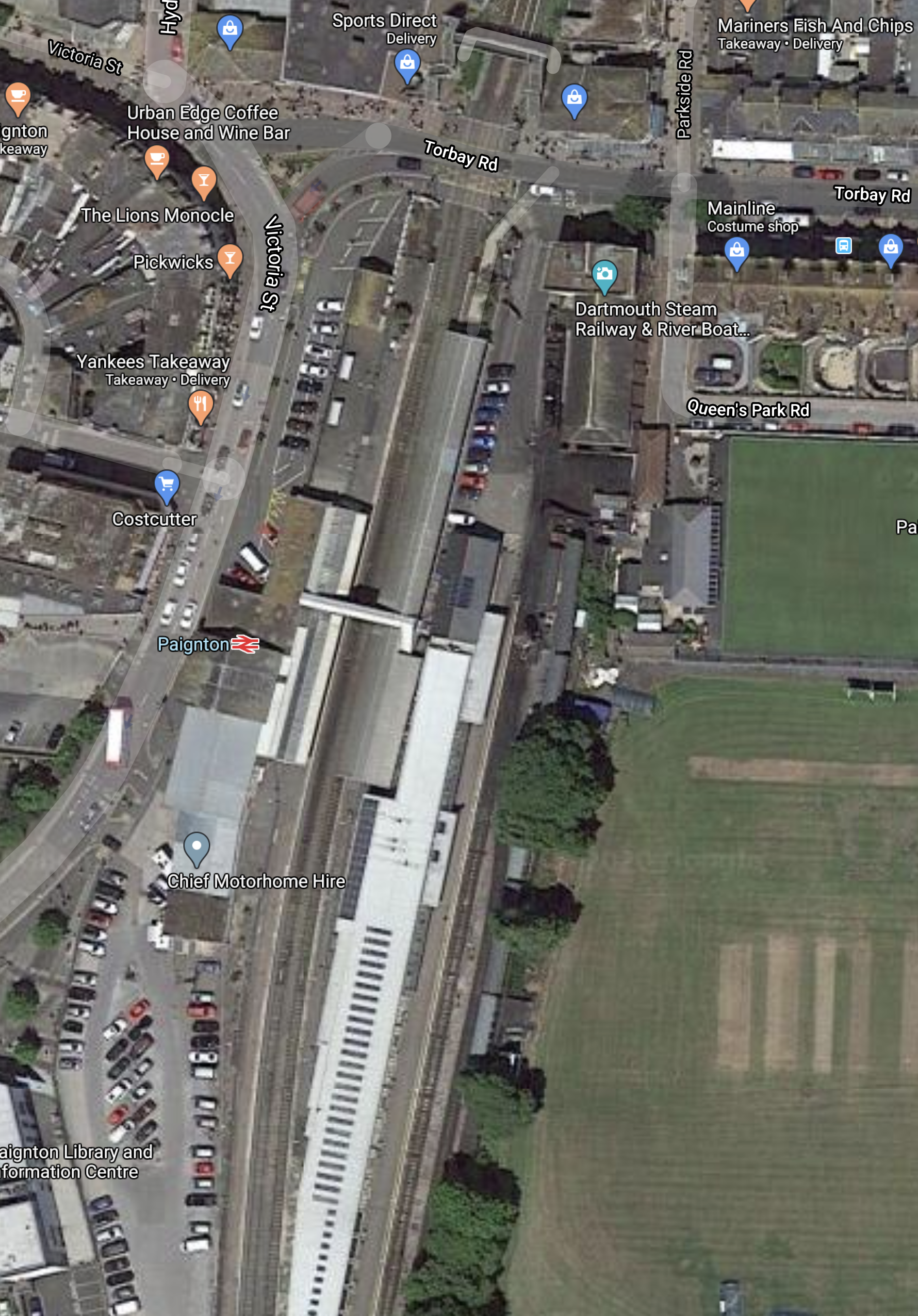
Note.
- The station has three National Rail platforms and one heritage platform for the Dartmouth Steam Railway.
- There is also a level crossing at the Northern end of the station, where Torbay Road crosses the railway.
Obviously, I don’t know the definitive answer, but would fitting a Fast Charge system to charge battery trains into the station be difficult because of the lack of space.
Goodrington Sands Station
This Google Map shows Goodrington Sands station.
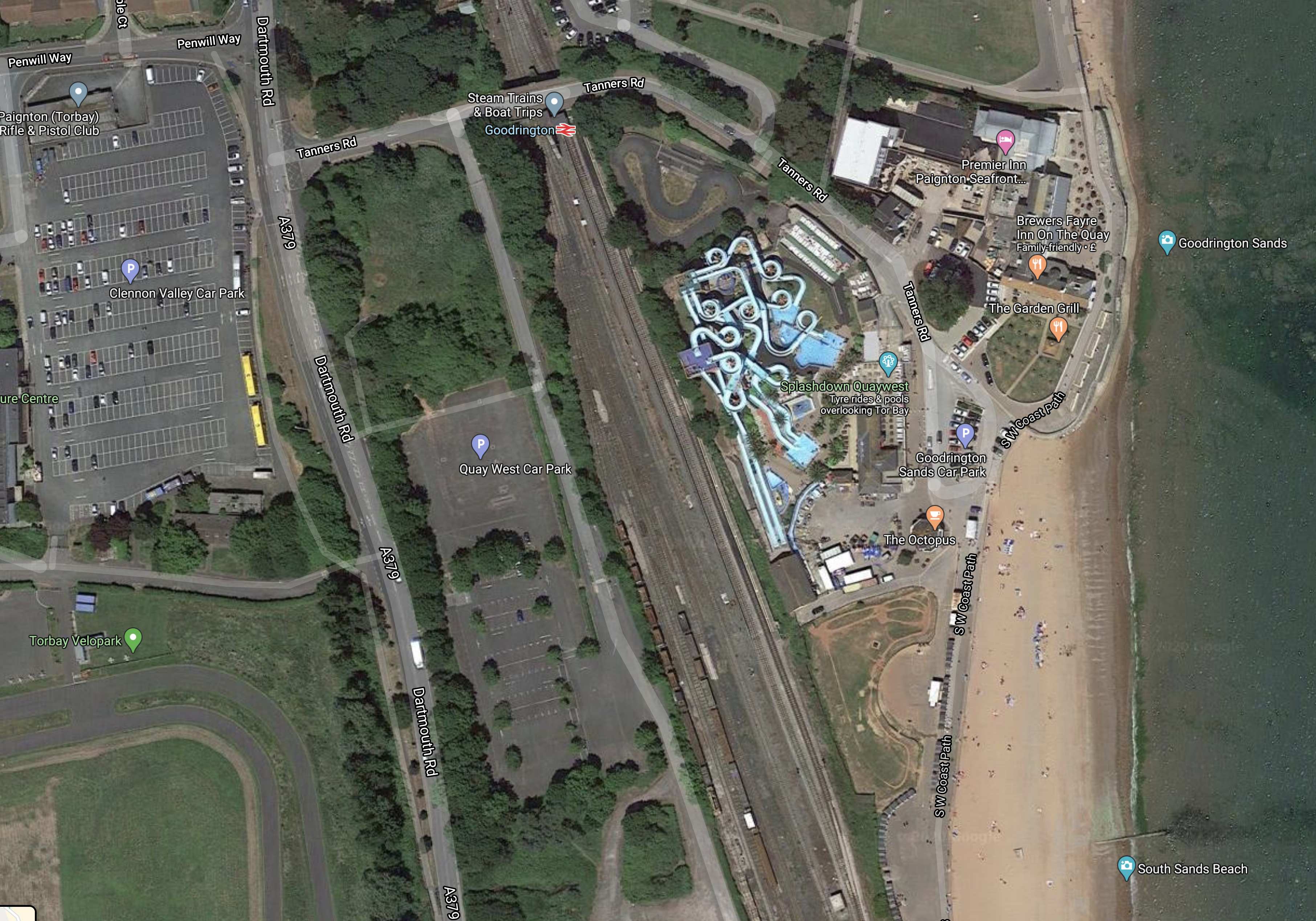
Note.
- Goodrington Sands station has two platforms.
- There is a comprehensive track layout between Paignton and Goodrington Sands stations.
- South of Goodrington Sands station, the line becomes single-track
- Goodrington Sands station appears to be surrounded by car parks.
- The only bridge across the railway appears to be at the North end of the station.
I think that a well-designed Goodrington Sands station could feature the following.
- Charging for battery trains.
- There might be a bay platform to turn and charge trains.
- A step-free bridge across the tracks.
- Easy walking routes to the nearby attractions.
- At least four tph to and from Edginswell, if that is built as a Park-and-Ride station.
Churston Station
This Google Map shows Churston station.
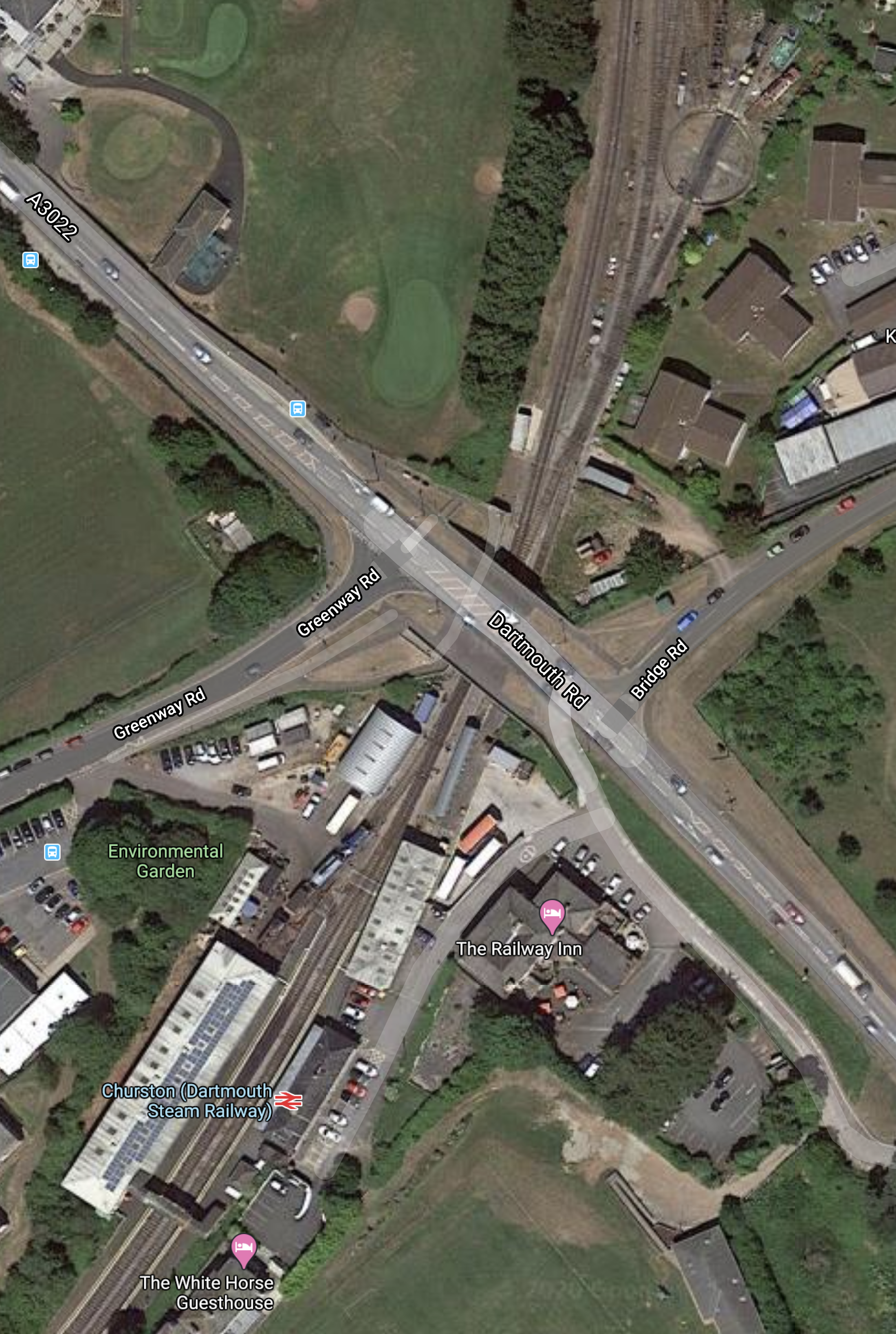
Note.
- Churston station is towards the South-West corner of the map.
- The station has two platforms.
Until I see the station, I am inclined to think, that the site would be a difficult one, in which to fit a Fast Charge system.
Conclusion
I can see the addition of Goodrington Sands and Churston turning the Riviera Line into a Coastal Metro between Exmouth and Churston.
I do think, the following would make it the ultimate rail line for the area.
- A Park-and-Ride station at Edginswell.
- Battery electric operation.
- A Turn-Up-and-Go frequency of four tph, between Exeter St. Davids and Churston.
- Two tph between Exmouth and Churston.
- One tph between London Paddington and Churston.
- One tph between Manchester Piccadilly and Churston.
It may be that some trains will turn back at Paignton or Goodrington Sands.
There are certainly a lot of possibilities.
Replacement Of South Western Railway’s Class 158/159 Trains
South Western Railway use Class 158 and Class 159 trains on the following routes.
- London Waterloo and Salisbury (and Yeovil Pen Mill)
- London Waterloo and Exeter St Davids
- Romsey and Salisbury
- Salisbury and Bristol Temple Meads
The two types of train are very similar, with the Class 159 trains being converted from Class 158 trains.
- There are ten two-car Class 158 trains in service with South Western Railway. which have a capacity of around 140 seats
- There are thirty three-car Class 159 trains in service with South Western Railway, which have a capacity of 196 seats
- Each car has a diesel engine driving two axles through a hydraulic transmission.
- Both trains have an operating speed of 90 mph.
- The trains are all around thirty years old.
I took these pictures on my trip to Basingstoke station on Friday, when I rode in nine-car formation of three Class 159 trains both ways.

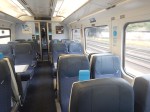
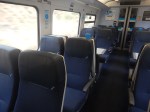
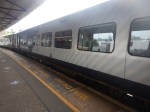

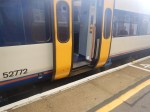
Note.
- For much of the route between Clapham Junction and Basingstoke, the trains were doing just a few mph short of ninety on the 100 mph route.
- The interiors are fairly spacious and I got a table seat both ways.
As diesel multiple units go, there are worse ones in service in the UK. And I don’t mean Pacers.
Replacement Possibilities
Ideally, these trains should be replaced with zero-carbon trains.
As most of the routes, on which the trains run are not-electrified, there must either be a lot of new third-rail electrification or battery electric trains must be used.
These are my thoughts for the various trains.
Two-Car Class 158 Train
These trains have the following specification.
- Length – 46 metres
- Seats – 140
- Operating Speed – 90 mph
In Converting Class 456 Trains Into Two-Car Battery Electric Trains, I stated that these Class 456 battery electric trains would have the following specification.
- Seats – 113
- Range on Battery Power – 30-40 miles
- Operating Speed – 75 mph
I also felt that as the trains would receive a new AC traction system, that the operating speed could be increased to perhaps 90 mph.
I wouldn’t be surprised to find, that a professional conversion capitalising on Alstom’s work to create the Class 600 hydrogen train, could turn a Class 456 train into a battery electric replacement for a two-car Class 158 train.
Three-Car Class 159 Train
These trains have the following specification.
- Length – 69 metres
- Seats – 196
- Operating Speed – 90 mph
Could these be replaced with a three-car Class 456 battery electric train, lengthened by the addition of a Trailer Car from a Class 321 train, that has been converted to a Class 600 hydrogen train?
As most Class 159 trains probably work in longer formations, this could be a possibility, to replace units working alone.
Two Three-Car Class 159 Trains Working As A Six-Car Formation
These trains have the following specification.
- Length – 138 metres
- Seats – 392
- Operating Speed – 90 mph
This formation would be impossible for Class 456 battery electric trains, so it must be a case for calling up the heavy brigade, in the shape of Hitachi’s Regional Battery Train, which is described in this Hitachi infographic.
A five-car version of this train could have the following specification.
- Length – 130 metres
- Seats – 326
- Range on battery power – 56 miles
- Operating Speed – 100 mph
- It would probably be able to work with both 25 KVAC overhead and 750 VDC third-rail electrification.
Note.
- More seats could probably be fitted if needed.
- Platforms where the trains would work can already accept nine-car Class 159 trains, which are 207 metres long.
- The trains would charge the batteries using the electrification between London Waterloo and Basingstoke.
- Fast Charge facilities would also be needed at some intermediate and terminal stations like Bristol Temple Meads, Exeter St. Davids, Salisbury, Westbury and Yeovil Junction.
- These trains would be ten mph faster than the Class 159 trains and this may enable the saving of a few minutes between London Waterloo and Basingstoke stations.
A six-car version would be possible, if more capacity is needed.
Three Three-Car Class 159 Trains Working As A Nine-Car Formation
These trains have the following specification.
- Length – 207 metres
- Seats – 588
- Operating Speed – 90 mph
An eight-car version of Hitachi’s Regional Battery Train could have the following specification.
- Length – 208 metres
- Seats – 522
- Range on battery power – 56 miles
- Operating Speed – 100 mph
- It would probably be able to work with both 25 KVAC overhead and 750 VDC third-rail electrification.
Note.
- More seats could probably be fitted if needed.
- Platforms where the trains would work can already accept nine-car Class 159 trains, which are 207 metres long.
- The trains would charge the batteries using the electrification between London Waterloo and Basingstoke.
- Fast Charge facilities would also be needed at some intermediate and terminal stations like Bristol Temple Meads, Exeter St. Davids, Salisbury, Westbury and Yeovil Junction.
- These trains would be ten mph faster than the Class 159 trains and this may enable the saving of a few minutes between London Waterloo and Basingstoke stations.
A nine-car version would be possible, if more capacity is needed.
More Capacity Between London Waterloo And Basingstoke
London Waterloo and Basingstoke was very busy before COVID-19 and it needed more capacity.
- All the express passenger trains are capable of 100 mph, with the exception of the diesel Class 158 and Class 159 trains, which can only do 90 mph.
- If these diesel trains were to be replaced by Hitachi’s Regional Battery Trains, these trains will be able to do 100 mph on battery power.
This speed increase will enable faster journey times and increase capacity.
- But between London Waterloo and Basingstoke, they will be using the third-rail electrification.
- Class 800 and Class 801 trains, which are cousins of the Regional Battery Train are currently able to do 125 mph between London Paddington and Swindon and London Kings Cross and Doncaster.
- London and Doncaster is being upgraded to 140 mph running.
So will we see 125 mph running between London Waterloo and Basingstoke? I will be very surprised if we didn’t, before 2030.
Charging The Batteries
Much of the charging of batteries will be performed whilst running on electrified lines.
But as I indicated there will need to be Fast Charge facilities at intermediate and terminal stations.
The Need For A Universal Fast Charge Facility For All Battery Electric Trains
If you look at Salisbury for example, the facility would need to be able handle all types of battery electric trains. So the Government, Network Rail and the Office of Road and Rail must come up with a universal design of charging facility that can be used by all battery electric trains.
Standard UK electrification, which can be either 25 KVAC overhead or 750 VDC third-rail, can obviously be used, as all battery electric trains will be designed to be able to charge the batteries, whilst running on electrified lines.
But a Universal Fast Charge system is surely needed, that can charge every battery electric train running on the UK rail network.
Splash-and-Dash At Yeovil Junction Station
But I believe that trains like Hitachi’s Regional Battery Train, when working long routes like Salisbury and Exeter will need the equivalent of Formula One’s Splash-and-Dash, where a fast pit-stop enabled cars to complete the race in the most economic manner.
If you look at timings between Salisbury and Exeter on Real Time Trains, you find the following.
- Salisbury and Exeter is 88.5 miles
- Salisbury and Yeovil Junction is 39 miles
- Yeovil Junction and Exeter St. Davids is 50 miles
- Trains seem to be timed to wait between 8-14 minutes at Yeovil Junction station.
- At several times during the day the Westbound and Eastbound services pass at Yeovil Junction station.
I would assume the wait and the passing, are so that trains can safely navigate the sections of single-track line, that are a legacy of British Rail’s policy of saving money, that affectively ruined the efficiency of sections of the network.
It would appear that a well-designed Universal Fast Charge facility at Yeovil Junction station could enable battery electric trains to run between Salisbury and Exeter St Davids stations, without any adjustment to the existing timetable.
This Google Map shows Yeovil Junction station.
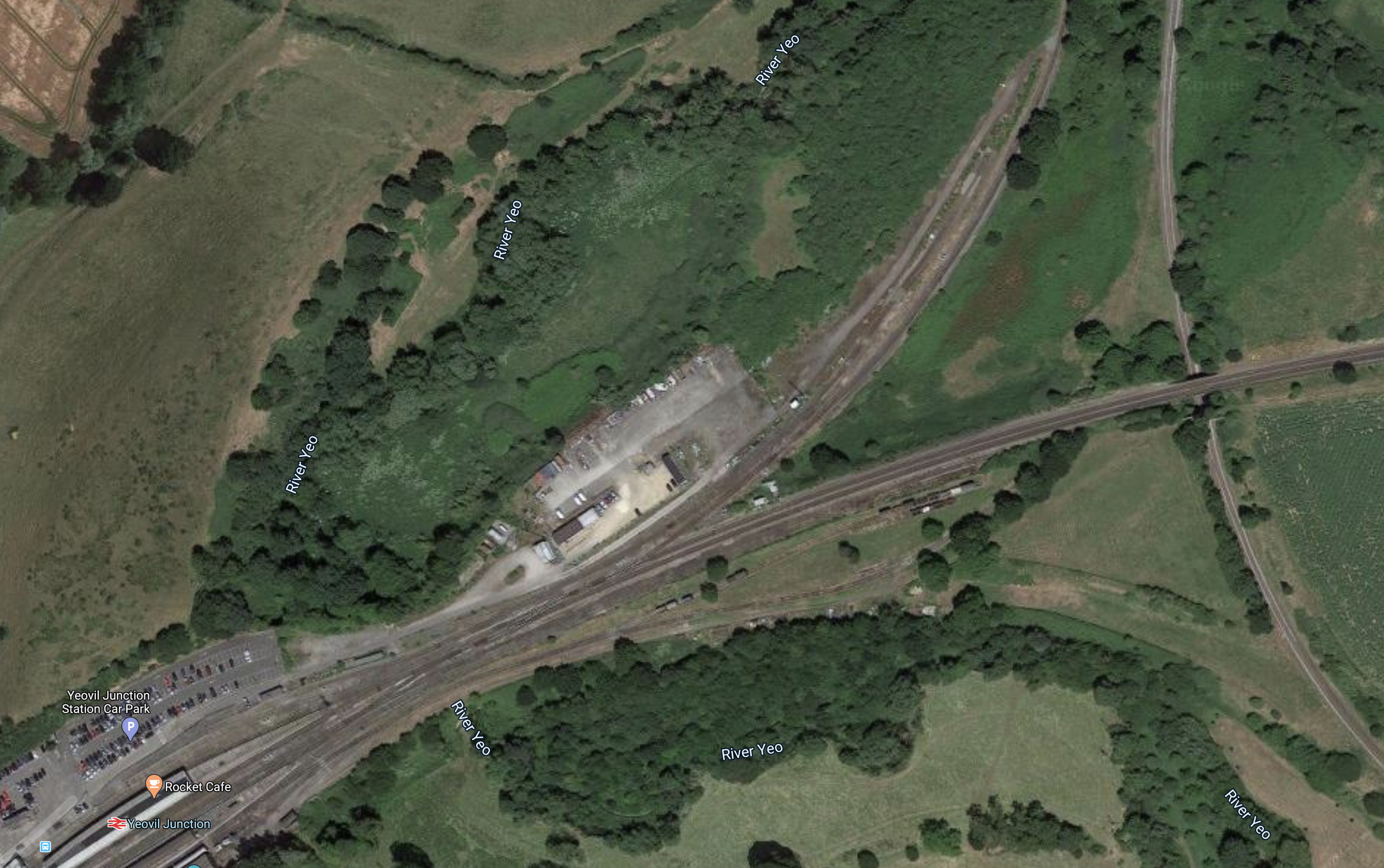
Note.
- Yeovil Junction station is in the South West corner of the map.
- The West of England Main Line passes East-West through the station.
- The station has two platforms.
- The two lines running North to Yeovil Pen Mill and Westbury stations.
- The line running between the North side and the South-East corner of the map is the Heart of Wessex Line, between Yeovil Pen Mill in the North and Weymouth in the South.
- Most links between the West of England Main Line and the Heart of Wessex Line have been removed.
The station doesn’t appear short of space.
Great Western Railway’s Gloucester And Weymouth Service
If a link between Yeovil Junction station and the Heart of Wessex Line towards Weymouth, this would enable Great Western Railway’s Gloucester and Weymouth service to call at both Yeovil stations, with a reverse at Yeovil Junction.
It would surely, improve the train service for the town of Yeovil.
If in the future, it was desired to run the Gloucester and Weymouth service using a battery electric train, Yeovil Junction station could be used to charge the train’s batteries.
Vivarail’s Fast Charge System
Vivarail’s Fast Charge system has been patented and demonstrated and this could be used with both the battery electric Class 456 train and Hitachi’s Regional Battery Train.
So it could be used as an initial design for a Universal Fast Charge system.
Conclusion
A mix of these battery electric trains could probably replace the Class 158 and 159 trains.
- Two-car Class 456 train
- Three-car Class 456 train
- Five-car Hitachi Regional Battery Train
- Eight-car Hitachi Regional Battery Train
Note.
- Universal Fast Charge facilities would also be needed at some intermediate and terminal stations like Bristol Temple Meads, Exeter St. Davids, Romsey, Salisbury, Westbury and Yeovil Junction.
- Services between London Waterloo and Basingstoke could be faster.
These rebuilt and new trains would fully decarbonise South Western Railway.
Funding To Develop Geothermal Energy Plans For Disused Flooded Coal Mines
The title of this post, is the same as that of this page on the University of Strathclyde web site.
This is the introductory paragraph.
Researchers at the University of Strathclyde have won early stage funding to develop plans to tap into the geothermal energy contained within disused, flooded coal mines in Scotland.
I have talked about this technique before in Can Abandoned Mines Heat Our Future?, which I wrote after I attended a public lecture at The Geological Society.
This page on the Geological Society web site, gives a summary of the lecture and details of the speaker; Charlotte Adams of Durham University.
This paragraph indicates the scale of the Scottish project, which has been called HotScot.
Heat trapped in 600 km3 of disused mine-workings in the Central Belt of Scotland could meet up to 8% of Scotland’s domestic heating demand.
It looks to be a very comprehensive project.
Conclusion
As this appears to be the second project where disused coal mines are used as a source of heat, after one in Spennymoor, that I wrote about in Exciting Renewable Energy Project for Spennymoor. I wouldn’t be surprised to see other projects starting in other mining areas.
And not just in the UK, as techniques developed by engineers and scientists get more efficient and more affordable.
Converting Class 456 Trains Into Two-Car Battery Electric Trains
Mark Hopwood is the interim Managing Director of South Western Railway and in Special Train Offers A Strong Case For Reopening Fawley Line, I quote him as saying the following about the trains for the Fawley Branch Line.
However, SWR’s Mark Hopwood favours a much bolder plan. “We’d have to take a decision, once we knew the line was going ahead. But my personal belief is that we should be looking for a modern environmentally-friendly train that can use third-rail electricity between Southampton and Totton and maybe operate on batteries down the branch line.”
Pressed on whether that would mean Vivarail-converted former-London Underground stock, Hopwood ads. “It could be. Or it could be a conversion of our own Class 456, which will be replaced by new rolling stock very shortly. But I don’t think this is the time to use old diesels.
Mark Hopwood is so right about using old diesels.
- Where possible new and refurbished trains should be zero-carbon.
- Diesel is to be banned by 2035 in Scotland and 2040 in England and Wales.
- Diesel trains and hydrogen trains for that matter need to refuelled.
- Get the diagrams right and battery electric trains can be charged on existing electrification or automatic Fast Charging systems, when they turn back at terminal stations.
- Electric trains attract passengers.
- Battery electric trains are mouse-quiet!
Who would use anything else other than electric trains with a battery option for sections without electrification?
The Class 456 Train
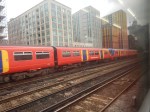
These pictures show some of the twenty-four Class 456 trains, that are in South Western Railway’s fleet.
This is the specification of a Class 456 train.
- Two cars
- Operating speed – 75 mph.
- Capacity – 152 seats – Although the plate on the train says 113!
- Built 1990-1991
- Ability to work in pairs.
Most trains seem to be used to lengthen trains from eight to ten cars, as some of the pictures shows. As these 4+4+2 formations will be replaced with new 10-car Class 701 trains or pairs of five-car Class 701 trains, the trains will be looking for a new role.
Does this explain Mark Hopwood’s statement?
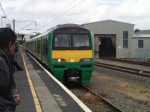
It should be noted that the Class 456 trains are members of the Mark 3 family, and bare a strong resemblance to the Class 321 train, which are shown in these pictures.
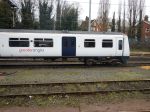
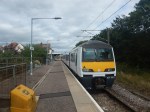
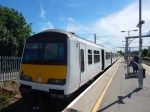
Note that I have included the side view, as it shows the amount of space under these trains.
Some Class 321 trains are being converted to Class 600 hydrogen trains, by Alstom at Widnes. Others have been given a life-extending Renatus upgrade.
Are The Driver Cars Of Class 456 and Class 321 Trains Identical?
The trains may look similar, but does the similarity go deeper?
Could Alstom Use Class 600 Hydrogen Train Technology To Create A Class 456 Train With a Battery Capability?
Consider.
- Alstom are positioning themselves as Train Upgrade Specialists in the UK. They have already signed a near billion pound deal to upgrade and maintain Avanti West Coast’s fleet of Class 390 trains.
- Alstom are creating the Class 600 hydrogen train from withdrawn Class 321 trains.
- A hydrogen-powered train is basically a battery electric train with a hydrogen tank and fuel cell to charge the batteries.
- The Class 600 train doesn’t appear to be making fast progress and is still without an order.
- One possible hydrogen route must surely be London Waterloo and Exeter, so I suspect Alstom are talking to South Western Railway.
- The Class 456 trains are owned by Porterbrook, who would probably like to extend the useful life of the trains.
Could it be that the battery core and AC traction package of Alstom’s hydrogen system for the Class 600 train can turn old British Rail-era electric multiple units into battery electric multiple units with a useful range?
It is certainly a possibility and one that is also within the capability of other companies in the UK.
Could The Class 456 Trains Receive a Class 321 Renatus Interior And Traction Package?
As Class 321 and Class 456 trains were built around the same time, the two trains must share components.
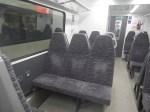
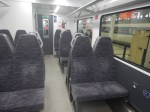
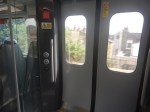
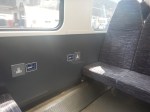
These pictures show the current interior of a Class 456 train.
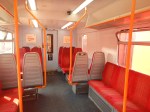
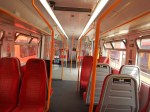
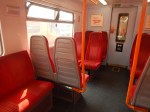
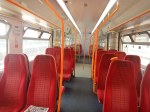
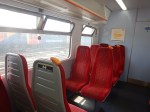
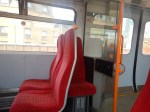
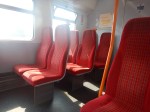
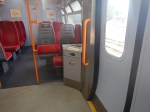
This is excellent for a two-car electric multiple unit, built thirty years ago! Although, the refurbishment is more recent from 2014-15.
- Note the wheelchair space and the copious rubbish bins.
- I also spotted a stowed wheel-chair ramp on the train. It can be seen if you look hard in the picture that shows the wheelchair space.
- Some might feel that toilets should be provided.
These pictures show the interior of a Class 321 train, that has been given the Renatus upgrade.
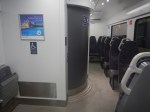
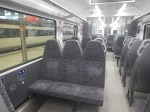


What is not shown is the more efficient AC traction package.
I have been told or read, that the Renatus interior will be used in the conversion of a Class 321 train to an Alstom Class 600 or Breeze hydrogen train.
On the other hand, the current Class 456 interior would probably be ideal for a branch line, where one of initial aims would be to attract passengers.
Could A Class 456 Train Have a Lightweight Traction Package?
Consider.
- The Class 456 train will access electrification that is only 750 VDC third-rail.
- Batteries work in DC.
- The new traction motors will work in AC, if they follow the practice in the Class 321 Renatus and the Class 600 train.
- Regenerative braking will charge the batteries in both trains.
- Air-conditioning and other hotel services can work in DC.
Some components needed to run from 25 KVAC like a transformer could be left out to save weight and improve acceleration.
I would suspect that a Class 456 train with batteries could use a slimmed-down traction system from the Class 600 train.
On both Class 456 and 600 trains a core system, that would power the train, might contain.
- The traction battery or batteries.
- The traction motors that both drive and brake the train,
- Third-rail electrification shoes, so that the batteries could be charged in a station, as required.
- A clever computer system, that controls the acceleration, braking and charging as required.
On the Class 600 train, there would also be the following.
- Hydrogen tanks and fuel cells to provide an independent power source to charge the batteries.
- A pantograph to access 25 KVAC overhead electrification.
- Extra electrical gear to access the electrification.
I think it would be possible to design the Class 456 train with batteries as the basic train and just add the extra hydrogen and electrical gubbins to make it a Class 600 train.
Could A Class 456 Train Be Modified To Use 25 KVAC Overhead Electrification?
As I said, there are a lot of similarities between Class 456 trains and Class 321 trains.
As the Class 321 trains are equipped to use 25 KVAC Overhead Electrification, I suspect train modification specialists could create a Class 456 train, that could use overhead electrification.
What Battery Range And Size Would Be Needed In A Class 456 Train?
These are typical branch line lengths for South Western Railway.
- Fawley Branch – 8 miles
- Wareham and Swanage – 11 miles
- Lymington Branch – 5.6 miles
- Reading and Basingstoke – 15.5 miles
I would suspect that a range of thirty miles on battery power would be sufficient for a Class 456 train with batteries.
In an article in the October 2017 Edition of Modern Railways, which is entitled Celling England By The Pound, Ian Walmsley says this in relation to trains running on the Uckfield Branch, which is not very challenging.
A modern EMU needs between 3 and 5 kWh per vehicle mile for this sort of service.
So applying that formula gives battery capacity of between 180 kWh and 300 kWh.
In Issue 864 of Rail Magazine, there is an article entitled Scotland High Among Vivarail’s Targets for Class 230 D-Trains, where this is said.
Vivarail’s two-car battery units contains four 100 kWh lithium-ion battery rafts, each weighing 1.2 tonnes.
If 200 kWh can be placed under the floor of each car of a rebuilt London Underground D78 Stock, then I think it is reasonable that up to 200 kWh can be placed under the floor of each car of the proposed train.
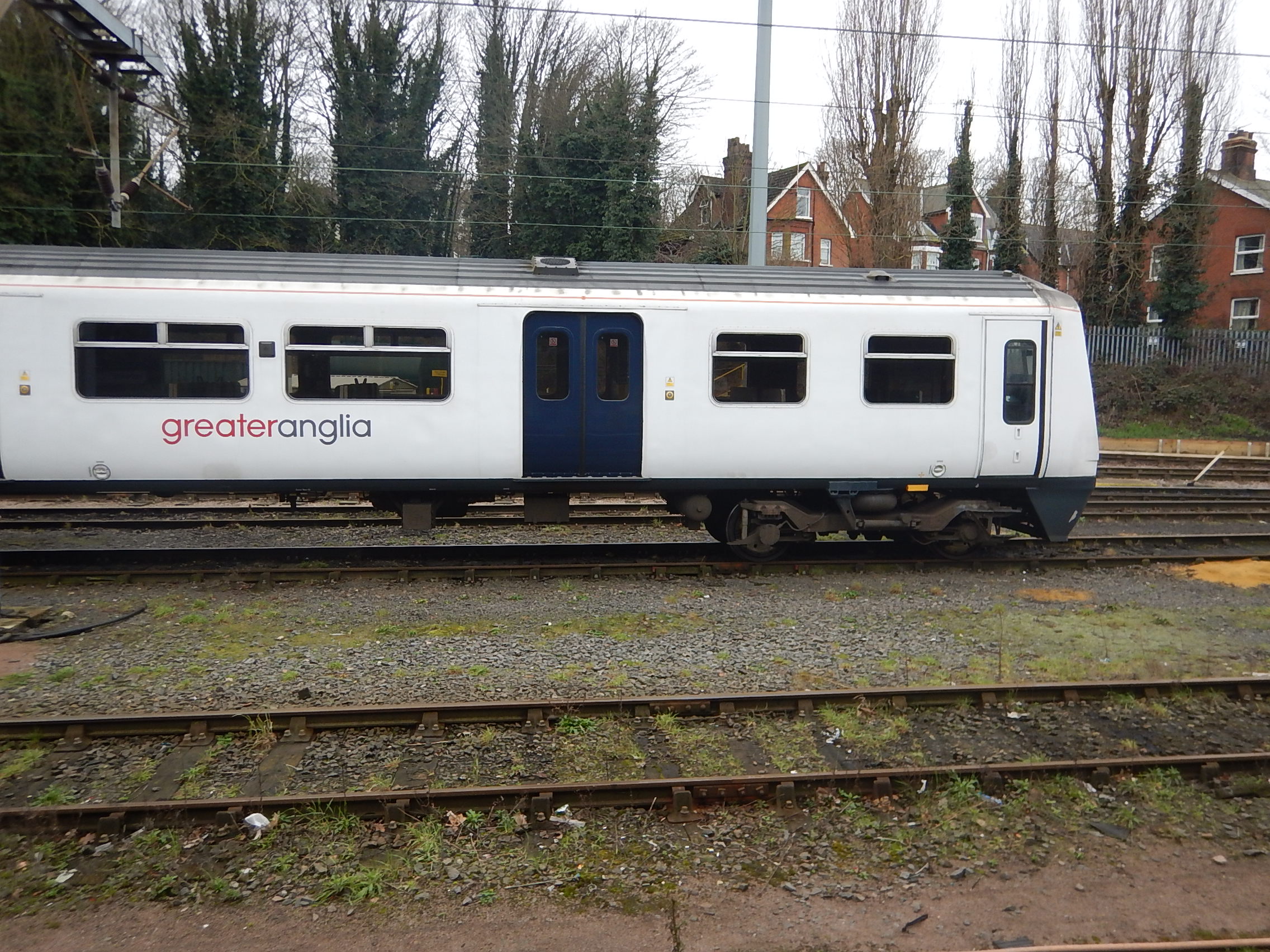
This picture of the Driver Car of a Class 321 train, shows that there is quite a bit of space under those trains.
Are the Class 456 trains similar? This is the best picture I have got so far.
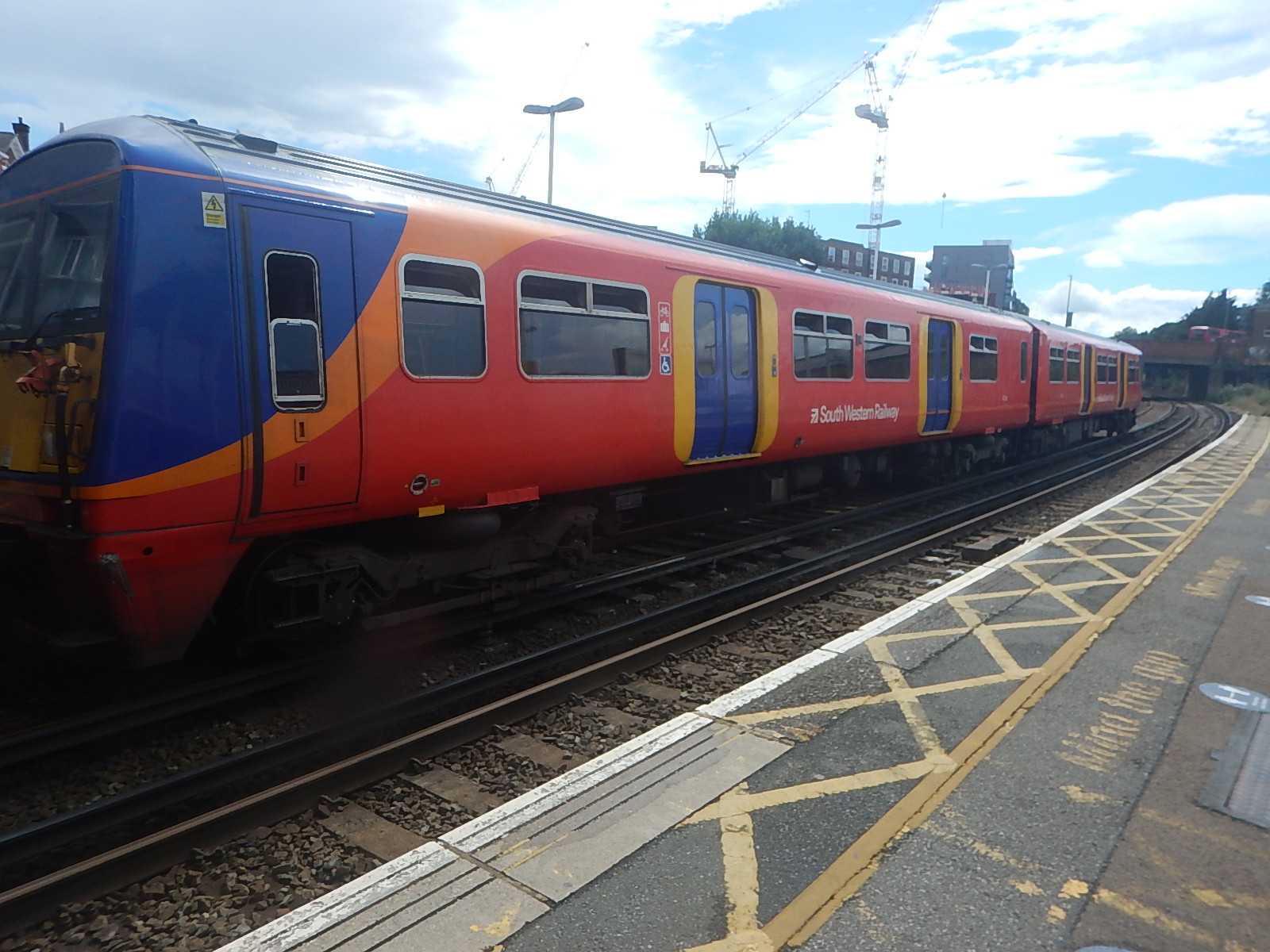
It does appear that space is similar to that under a Class 321 train.
If we assume that the Class 456 train can have the following specification.
- Battery capacity of 200 kWh in both cars.
- Regenerative braking to battery.
- Power consumption of 4 kWh per vehicle mile.
I think we could be approaching a range of fifty miles on a route without too many energy-consuming stops.
Charging The Batteries
I like the Vivarail’s Fast Charge concept of using third-rail equipment to charge battery trains.
This press release from the company describes how they charge their battery electric Class 230 trains.
- The system is patented.
- The system uses a trickle-charged battery pack, by the side of the track to supply the power.
- The first system worked with the London Underground 3rd and 4th rail electrification standard.
As the length of rails needed to be added at charging points is about a metre, installing a charging facility in a station, will not be the largest of projects.
Under How Does It Work?, the press release says this.
The concept is simple – at the terminus 4 short sections of 3rd and 4th rail are installed and connected to the electronic control unit and the battery bank. Whilst the train is in service the battery bank trickle charges itself from the national grid – the benefit of this is that there is a continuous low-level draw such as an EMU would use rather than a one-off huge demand for power.
The train pulls into the station as normal and the shoe-gear connects with the sections of charging rail. The driver need do nothing other than stop in the correct place as per normal and the rail is not live until the train is in place.
That’s it!
As an electrical engineer, I’m certain the concept could be adapted to charge the batteries of a conventional third-rail train.
Vivarail’s press release says this about modification to the trains.
The train’s shoe-gear is made of ceramic carbon so it is able to withstand the heat generated during the fast charge process.
That wouldn’t be a major problem to solve.
Class 456 Train With Batteries And Class 600 Train Compared
The following sub-sections will compare the trains in various areas.
Lightweight Design
As I suspect that the basic structure of the Class 456 and Class 600 trains are similar, systems like toilets, air-conditioning, traction motors and seats will be chosen with saving weight in mind.
Every kilogram saved will mean faster acceleration.
Operating Speed
The current Class 321 train is a 100 mph train, whilst the current Class 456 train is only a 75 mph train.
I wonder if applying the modern traction package of the Class 321 Renatus to the Class 456 train could speed the shorter train up a bit?
Range Away From Electrification
Alstom have quoted ranges of hundreds of miles for the Class 600 train on one filling of hydrogen, but I can’t see the Class 456 train with batteries doing much more than fifty miles on a full charge.
But using a Fast Charge system, I can see the Class 456 train with batteries fully-charging in under ten minutes.
Fast Charge systems at Romsey and Salisbury stations would surely enable the Class 456 trains with batteries to run the hourly service over the thirty-eight mile route between the two stations.
Passenger Capacity
The current Class 456 trains have a capacity of 152 seats.
In Orders For Alstom Breeze Trains Still Expected, I said this.
The three-car Alstom Breeze is expected to have a similar capacity to a two-car diesel multiple unit.
But until I see one in the flesh, I won’t have a better figure.
If South Western Railway were wanting to replace a two-car diesel Class 158 train, they’d probably accept something like 180 seats.
Increasing Passenger Capacity
There are compatible trailer cars around from shortening Class 321 trains from four to three cars and there may be more from the creation of the Class 600 trains.
I suspect that these could be added to both Class 456 and Class 600 trains to increase capacity by fifty percent.
As a two-car train, the Class 456 train might be a bit small, but putting in a third car, which had perhaps slightly more dense seating and possibly a toilet and even more batteries could make the train anything the operator needed.
Suitability For London Waterloo and Exeter via Salisbury
This is South Western Railway’s big need for a zero emission train.
- It is around 170 miles
- Only 48 miles are electrified.
- It is currently worked by three-car Class 159 trains working in pairs.
- Class 159 trains are 90 mph trains.
I have believed for some time, that with fast charging, a battery electric train could handle this route.
But, I would feel that.
- Class 456 trains would be too slow and too small for this route.
- Class 600 trains would be too small for this route.
On the other hand, I believe that Hitachi’s Class 800 train with a battery electric capability or Regional Battery Train, which is described in this infographic from the company, could be ideal for the route.
The proposed 90 km or 56 mile range could even be sufficient take a train between Salisbury and Exeter with a single intermediate charge at Yeovil Junction station, where the trains wait up to ten minutes anyway.
There are other reasons for using Hitachi’s Regional Battery Train rather than Class 600 trains.
- First Group have a lot of experience of running Hitachi Class 80x trains, through their various subsidiaries.
- They could share depot facilities at Exeter.
- No specialist facilities would be needed.
- A five-car Class 801 with batteries would have a convenient 300 seats.
- I suspect they could be delivered before Alstom’s Class 600 train.
As the only new infrastructure required would be Fast Charge facilities at Salisbury and Yeovil Junction stations, I feel that Hitachi’s Regional Battery Train, should be a shoe-in for this route.
First Delivery
The Wikipedia entry for the Class 600 train, says introduction into traffic could be in 2024. Given, the speed with which Greater Anglia’s Class 321 trains were updated to the Renatus specification, we could see Class 456 trains with a battery capability and new interiors running well before 2024.
A Few Questions
These questions have occurred to me.
Could The Technology Be Used To Create A Class 321 Battery Electric Train?
I don’t see why not!
I believe a Class 321 battery electric train could be created with this specification.
- Three or four cars. Remember the Class 320 train is a three-car Class 321 train.
- 100 mph operating speed.
- Regenerative braking to the batteries.
- Renatus or operator-specified interior.
- Toilet as required.
- Electrification as required.
- Battery range of around sixty miles.
- Ability to use a Fast Charge system, that can easily be installed in a terminal platform.
Trains could be tailored to suit a particular route and/or operator.
Any Other Questions?
If you have any other questions, send them in and I’ll add them to this section.
Conclusion
It does appear that if the Class 456 trains, were to be fitted with a battery capability, that they would make a very useful two-car battery electric train, with the following specification.
- Two cars
- Operating speed – 75 mph. This might be a bit higher.
- Capacity – 152 seats
- Ability to work in pairs.
- Modern interior
- Range of 45-50 miles on batteries.
- Ability to charge batteries in ten minutes in a station.
- Ability to charge batteries on any track with 750 VDC third-rail electrification.
This is the sort of train, that could attract other operators, who don’t have any electrification, but want to electrify short branch lines.
A Residential Vanadium Flow Battery
The title if this post is rgw same as that of this article on PV Magazine.
This is the introductory sub-title.
Flow battery manufacturers typically pursue utility scale storage projects but German start-up VoltStorage is targeting the household market.
The article gives a good summary of the flow batteries, that are available.
It also gives the size of the battery as having a continuous power rating of 1.5 kW and nominal energy of 6.2 kWh. It also comes with a ten year warranty.
I think VoltStorage, could be one to watch.
40GW Of Battery Storage And Longer Durations Could Help Smash UK Net Zero Targets
The title of this post, is the same as that of this article on Energy Storage News.
This is the introductory paragraph.
More electricity storage and longer durations of storage will be needed for the UK to meet net zero targets, according to electricity system operator National Grid ESO’s latest modelling.
The article is very much a must-read.
Germany Builds The World’s First Hydrogen Train Filling Station
The title of this post, is the same as that of this article on electrek.
Hydrogen Trains In Germany
The hydrogen filling station for trains is described under this heading.
This is the introductory paragraph.
The town of Bremervörde in Lower Saxony, Germany, has broken ground on the world’s first hydrogen filling station for passenger trains. Chemical company Linde will construct and operate the hydrogen filling station for the Lower Saxony Regional Transport Company.
It will provide approximately 1600 Kg of hydrogen per day.
The Supergroup Of ‘Green Energy’
This is a second section, which I find an interest sting concept.
These are the introductory paragraphs.
Oil giant Shell and Dutch utility Eneco have won the tender to build a super-hybrid offshore wind farm in the Netherlands. It will consist of two sites located 11.5 miles (18.5 km) off the west coast, near the town of Egmond aan Zee.
The Shell/Eneco consortium, CrossWind, will build the Hollandse Kust (noord) project. They will pair the offshore wind farms with floating solar facilities and short-duration batteries. It will also generate green hydrogen via an electrolyzer, according to GreenTech Media.
It will be operational in 2023 and have an output of 759 MW.
Westbury Station – 30th July 2020
I went to Westbury station today and took these pictures.
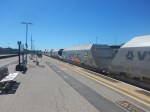
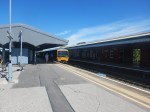


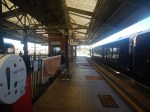
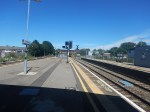
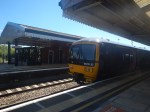
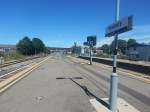
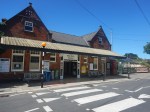

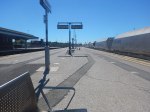
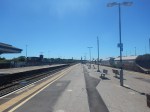
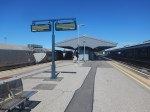
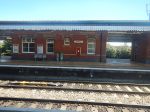
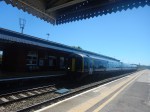
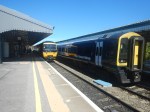
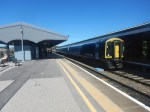

I found Westbury station to be a station in extremely good condition.
It also had a buffet, where I was able to purchase a delicious ice cream.
Passenger Services Through Westbury Station
I was at the station for about an hour and several trains passed through.
Great Western Railway services through the station include.
- One train per two hour (tp2h) – London Paddington and Exeter St. Davids – Stops
- One tp2h – London Paddington and Penzance – Passes through
- One tp2h – London Paddington and Plymouth – Passes through
- One train per hour (tph) – Cardiff Central and Portsmouth Harbour – Stops
- One tp2h – Great Malvern and Westbury
- One tp2h – Gloucester and Weymouth – Stops
- One tp2h – Swindon and Westbury
Train classes included Class 800 trains and Class 166 trains.
South Western Railway services through the station include.
- Five trains per day – Salisbury and Bristol Temple Meads – Stops
Train classes include Class 159 trains.
Battery Trains Through Westbury
Hitachi’s Class 800 train with a battery electric capability or Regional Battery Train, is described in this infographic from the company.
The proposed 90 km or 56 mile range could even be sufficient take a train between Westbury and Bristol Temple Meads stations on a return trip.
Many of the trains through Westbury go to the same stations.
Distances are as follows.
- Bristol Temple Meads – 28 miles
- Newbury – 42 miles
- Salisbury – 24 miles
- Swindon – 32.5 miles
- Taunton – 47 miles
It looks like all of these places should be in range of an electric train with a battery capability, providing there is a charging facility at the other end.
An Electrification Island At Westbury Station
I have been advocating an island of electrification around Westbury station for some time and feel about a dozen miles of electrification through the station would be sufficient for Class 800 trains with a battery capability to bridge the gap.
- At Newbury, trains would access the current electrification into London Paddington.
- Between Exeter and Taunton, the rail route runs alongside the M5, so why not electrify this stretch, as the wires will not be so noticeable?
Looking at Westbury, to my untrained eye, it would appear that a short section of electrification around the station, would not be the most challenging of projects.
I believe that discontinuous electrification between Newbury and Exeter would be possible and could gradually be extended across Devon and Cornwall.
It should also be noted that one of Hitachi’s Regional Battery Trains has a range of 56 miles, so that these places from Westbury could be an return trip on batteries, with a well-driven train with excellent energy management.
- Bath Spa – 17 miles
- Bradford-on-Avon – 7 miles
- Bristol Temple Meads – 28 miles
- Chippenham – 16 miles
- Frome – 6 miles
- Salisbury – 24 miles
- Trowbridge – 4 miles
- Warminster – 9 miles
Obviously, the number of stops and the terrain will play a part.
Freight Might Drive Full Electrification Through Westbury Station
As the pictures show, there are heavy freight trains going through the area, which bring long and weighty loads of stone from the Mendips to London.
- There are regularly two or three stone trains in an average hour of the day.
- Like in the picture, I suspect they are usually hauled by a noisy, smelly, polluting and carbon-dioxide emitting Class 66 Locomotive. Not all of these, are as clean and well-maintained, as the one in the picture.
- Some trains start at Merehead Quarry, which is about fifteen miles from Westbury station.
I believe that we must decarbonise freight trains.
But freight and electric haulage is not a simple subject.
- I once had extensive talks with a Senior Crane Driver at the Port of Felixstowe during an Ipswich Town Away match. Ports don’t like overhead wires, as containers do get dropped and fall off rail wagons.
- Suppose a historic line without electrification, like the Settle and Carlisle has a serious land-slip, which it did a couple of years ago. How do you haul in the materials for repair?
- Because freight can be of a random and unpredictable nature, to electrify freight, you probably need to electrify the whole rail network.
For these and other reasons, we need independently-powered freight locomotives and I feel that a new freight locomotive will develop, that will be needed by the rail industry all over the world.
There are several solutions.
Biodiesel
Biodiesel is the simplest solution and would mean that the current diesel locomotives could be used.
In Grant Shapps Announcement On Friday, I talked about Government support for an industrial process, that has been developed by Oxford University and their spin-off company; Velocys, from the the Fischer-Tropsch Process, which can produce, the following fuels from household and industrial waste.
- Aviation biofuel.
- Biodiesel.
A plant to process 500,000 tonnes per year of Lincolnshire finest waste is now being built at Immingham to create 50,000,000 litres of fuel, by Altalto, which is a partnership between Velocys, British Airways and Shell.
If nothing else, waste-to-fuel is the interim solution to the decarbonisation of tricky sectors like heavy rail freight, rail construction, large diesel-powered machines, ships or long-distance aviation.
This fuel could be ideal to haul the heavy stone trains from the Mendips.
Hydrogen
I did think, it would be hydrogen powered, but I’m not so sure now, as hydrogen trains and locomotives seem to have a slow development cycle.
Although, there is one factor, that might influence the use of hydrogen as a fuel, which I wrote about in Thirsty High-Rollers … Mining’s Heavy Haulers Prime Candidates For Hydrogen Conversion.
Mining and quarrying don’t have a good green image, but converting mines and quarries to hydrogen power, would surely have operational and good public relational advantages.
It would also ensure a plentiful and convenient supply of hydrogen, for any hydrogen-powered locomotives.
Hydrogen-powered locomotives, with their electric transmissions, would probably be able to use electrification for traction power, so they would put pressure on the Government to electrify between Westbury and Newbury stations, so that there was a fully-electrified route between the Mendips and London.
Rolls-Royce’s Staggering Development
Staggering is not my word, but that of Paul Stein, who is Rolls-Royce’s Chief Technology Officer.
He used the word in a press release, which I discuss in Our Sustainability Journey.
To electrify aviation, Rolls-Royce has developed a 2.5 MW generator, based on a small gas-turbine engine, which Paul Stein describes like this.
Amongst the many great achievements from E-Fan X has been the generator – about the same size as a beer keg – but producing a staggering 2.5 MW. That’s enough power to supply 2,500 homes and fully represents the pioneering spirit on this project.
This generator is designed for flight and the data sheet for the gas-turbine engine is available on the Internet.
- It has a weight of under a couple of tonnes compared to the thirteen tonnes of the diesel engine and generator in a Class 68 locomotive.
- It is also more powerful than the diesel.
- It looks to be as frugal, if not more so!
- Rolls-Royce haven’t said if this gas-turbine can run on aviation biofuel, but as many of Rolls-Royce’s large engines can, I would be very surprised if it couldn’t!
Rolls-Royce’s German subsidiary is a large producer of rail and maritime diesel engines, so the company has the expertise to customise the generator for rail applications.
I can see this generator ending up in a high-powered heavy independently-powered electric locomotive for hauling stone and inter-modal container trains.
As with hydrogen-powered locomotives, this new breed of gas-turbine locomotive with its electric transmission, will be able to use electrification, where it exists.
So would locomotive developments drive the electrification through Westbury and especially between Westbury and Newbury?
I would rate is likely, that in the future, increasingly rail locomotives will have sophisticated electric transmissions, between their prime motive power of diesel, hydrogen, gas-turbine or whatever and their traction system. All of these locomotives will have pantographs and/or third-rail shoes to access electrification, where it exists.
These locomotives will surely add to pressure to electrify between Westbury and Newbury.
Biodiesel is surely the interim freight solution, if one is needed.
Future Zero-Carbon Passenger Services
Passenger services through Westbury can be divided into three groups.
Great Western Railway’s Services Between London Paddington And Devon And Cornwall
From Beeching Reversal projects put forward over the last few months, it looks like these services will increase and stop at several new and refurbished stations.
I can see discontinuous electrification being used to create a series of electrification islands to allow Class 800 trains, with a battery capability reach the Far South West of Cornwall.
Electrification islands could be at places like
- Around Westbury station.
- Between Taunton and Exeter St. Davids stations alongside the M5.
- Between Plymouth station and the Royal Albert bridge.
- Around Bodmin Parkway station
- Around Truro station
- At Newquay station
- At Penzance station
Obviously, the number and type of the various installations will depend on the methods used and the engineering required.
I do believe that with Hitachi trains, that meet their specification, that trains will be able to travel between Paddington and Penzance without touching a drop of diesel.
Great Western Railway’s Cardiff Central And Portsmouth Harbour Service
The service can be split into the following legs.
- Cardiff Central and Filton Junction – 33 miles – Electrified
- Filton Junction and Bristol Temple Meads – 5 miles – Not Electrified
- Bristol Temple Meads and Westbury – 28 miles – Not Electrified
- Westbury and Salisbury – 24 miles – Not Electrified
- Salisbury and Southampton Central – 15 miles – Not Electrified
- Southampton Central and Portsmouth Harbour – 26 miles – Electrified
It would appear that a train with the performance and range on batteries of Hitachi’s Regional Battery Train should be able to handle the route, provided the following conditions are met.
- It can leave the Great Western Main Line at Filton Junction with a full battery.
- It can leave the electrification at Westbury station with a full battery.
- It can leave Southampton Central station with a full battery.
- Third-rail shoes are fitted for working between Southampton Central and Portsmouth Harbour stations.
Recharging batteries at Bristol Temple Meads and Salisbury stations, although probably welcome, are not necessary.
I can envisage Hitachi Class 800 and Class 385 trains being able to fulfil this role, along with Bombardier Electrostars and Aventras and Siemens Desiros.
As Great Western Railway have forty-five Class 387 trains, conversion of some of these to battery electric operation must be a possibility.
Great Western Railway’s Gloucester and Weymouth Service
The service can be split into the following legs.
- Gloucester and Bristol Temple Meads – 39 miles – Not Electrified
- Bristol Temple Meads and Westbury – 28 miles – Not Electrifield
- Westbury and Dorchester Junction – 52 miles – Not Electrified
- Dorchester Junction and Weymouth – 4 miles – Electrified
It would appear that a train with the performance and range on batteries of Hitachi’s Regional Battery Train should be able to handle the route, provided the following conditions are met.
- It can leave Gloucester station with a full battery.
- It can leave Bristol Temple Meads with a full battery.
- It can leave Westbury with a full battery.
- It can leave the South Western Main Line at Dorchester Junction with a full battery.
It would be a tight trip for a battery electric train and I suspect, that there would be some extra electrification between Westbury and Dorchester Junction or perhaps charging facilities at Frome or Yeovil Pen Mill stations.
The alternative would be to fit larger batteries on the train.
As to the train to be used, a Class 387 train with a battery capability would surely be ideal.
Great Western Railway’s Swindon and Westbury Service
The service can be split into the following legs.
- Swindon and Chippenham – 16 miles – Electrified
- Chippenham and Westbury- 16 miles – Not Electrified
It would appear that a train with the performance and range on batteries of Hitachi’s Regional Battery Train should be able to handle the route, provided the following conditions are met.
- It can leave Chippenham station with a full battery.
This would have sufficient charge to do the thirty-two mile round trip from Chippenham to Westbury and back.
As to the train to be used, a Class 387 train with a battery capability would surely be ideal.
South Western Railway’s Bristol Temple Meads and Salisbury Service
The service can be split into the following legs.
- Bristol Temple Meads and Westbury – 28 miles – Not Electrified
- Westbury and Salisbury- 24 miles – Not Electrified
t would appear that a train with the performance and range on batteries of Hitachi’s Regional Battery Train should be able to handle the route, provided the following conditions are met.
- It can leave Bristol Temple Meads station with a full battery.
- It can leave Westbury with a full battery.
- It can leave Salisbury with a full battery.
But, I do wonder, if with a slightly larger battery, a well-driven train could work the route with only charging the battery at Westbury station?
Conclusion
Could Westbury station develop into a zero-carbon rail transport hub for Wiltshire?
- It has an hourly train service between London Paddington and Exeter St. Davids.
- It has an hourly service between Bristol Temple Meads and Weymouth.
- There are hourly services to stations like Bath Spa, Bradford-on-Avon, Bristol Temple Meads, Chippenham, Dorchester, Frome, Swindon, Taunton, Trowbridge and Yeovil
It could be electrified to charge battery electric trains as they pass through.
Beeching Reversal – South Fylde Line Passing Loop
This is one of the Beeching Reversal projects that the Government and Network Rail are proposing to reverse some of the Beeching cuts.
The Project
This project is described on this page on the web site of the Fylde MP; Mark Menzies, which is entitled Improving The South Fylde Rail Line.
The page lists that these improvements are needed.
Track And Stations
These improvements are listed for track and stations.
The bid involves laying around three miles of track between Lytham and St Annes stations, the creation of a new rail platform at Ansdell and Fairhaven Station, the installation of signalling along the line, and potential platform changes at Preston Station. There is scope for improvements to St Annes and Lytham Stations, should Network Rail decide it would rather include those stations within the passing loop – but that would be decided further along the process.
Services
The objective is to be able to run two trains per hour (tph) between Preston and Blackpool South stations.
Trains
Better trains are needed.
It certainly looks like the Pacers have already gone.
The Route
I shall describe the current route in this section.
Blackpool South Station
The Google Map shows Blackpool South station.
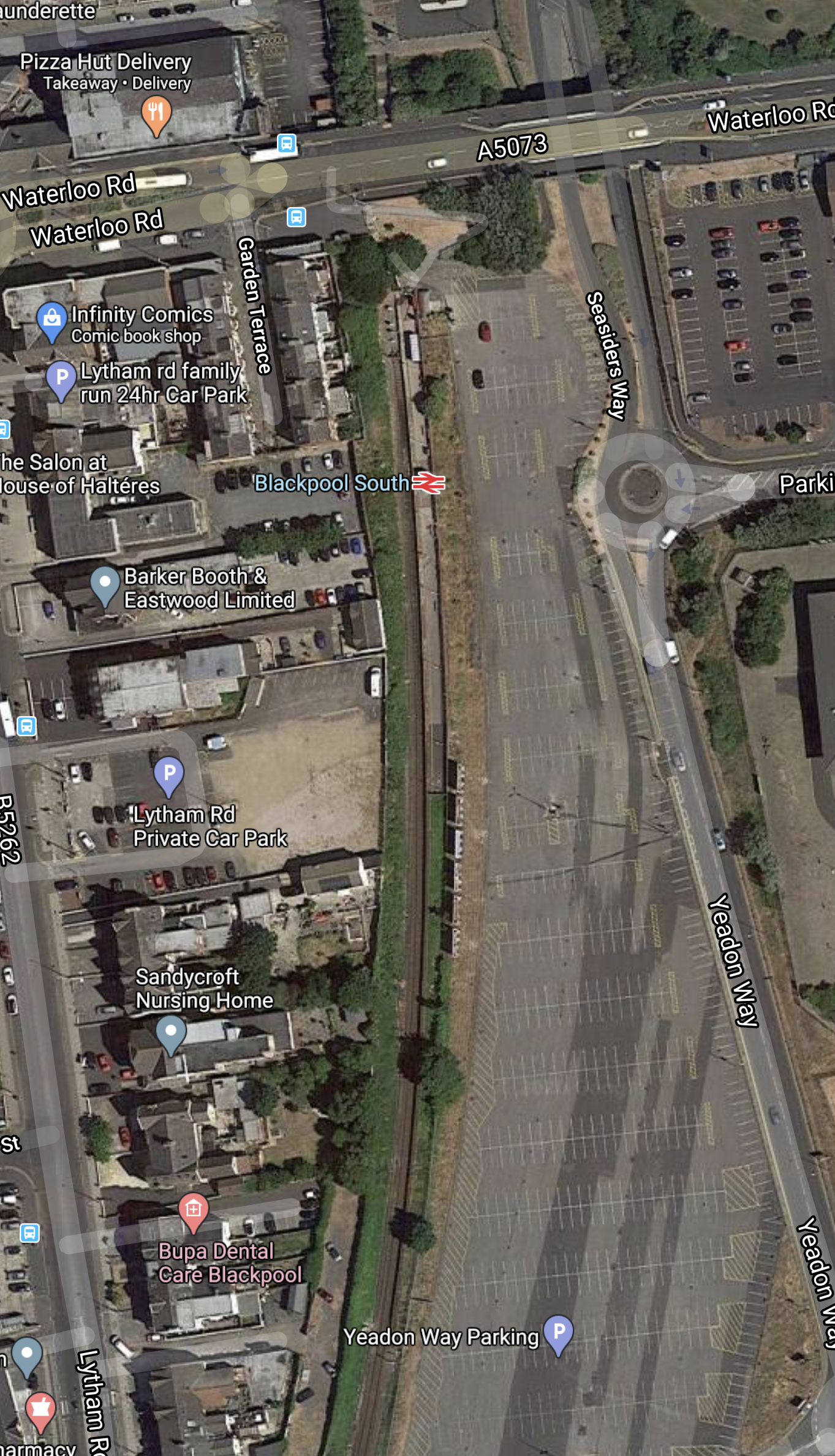
Note.
- Entrance to the station is from Waterloo Road, which runs East-West across the map.
- There are a pair of bus stops by the station entrance.
- There is a lot of car parking close to the station.
- I suspect that the single platform can hold a modern eighty-metre four-car train.
- This seventy-year-old has no difficulty waking to the football ground or the Blackpool trams from the station.
With two tph and some updated facilities, this would be a very useful station.
I suspect there is even space to add a second platform in the future, if that were felt to be necessary.
Blackpool Pleasure Beach Station
This Google Map shows Blackpool Please Beach station and the nearby Pleasure Beach.
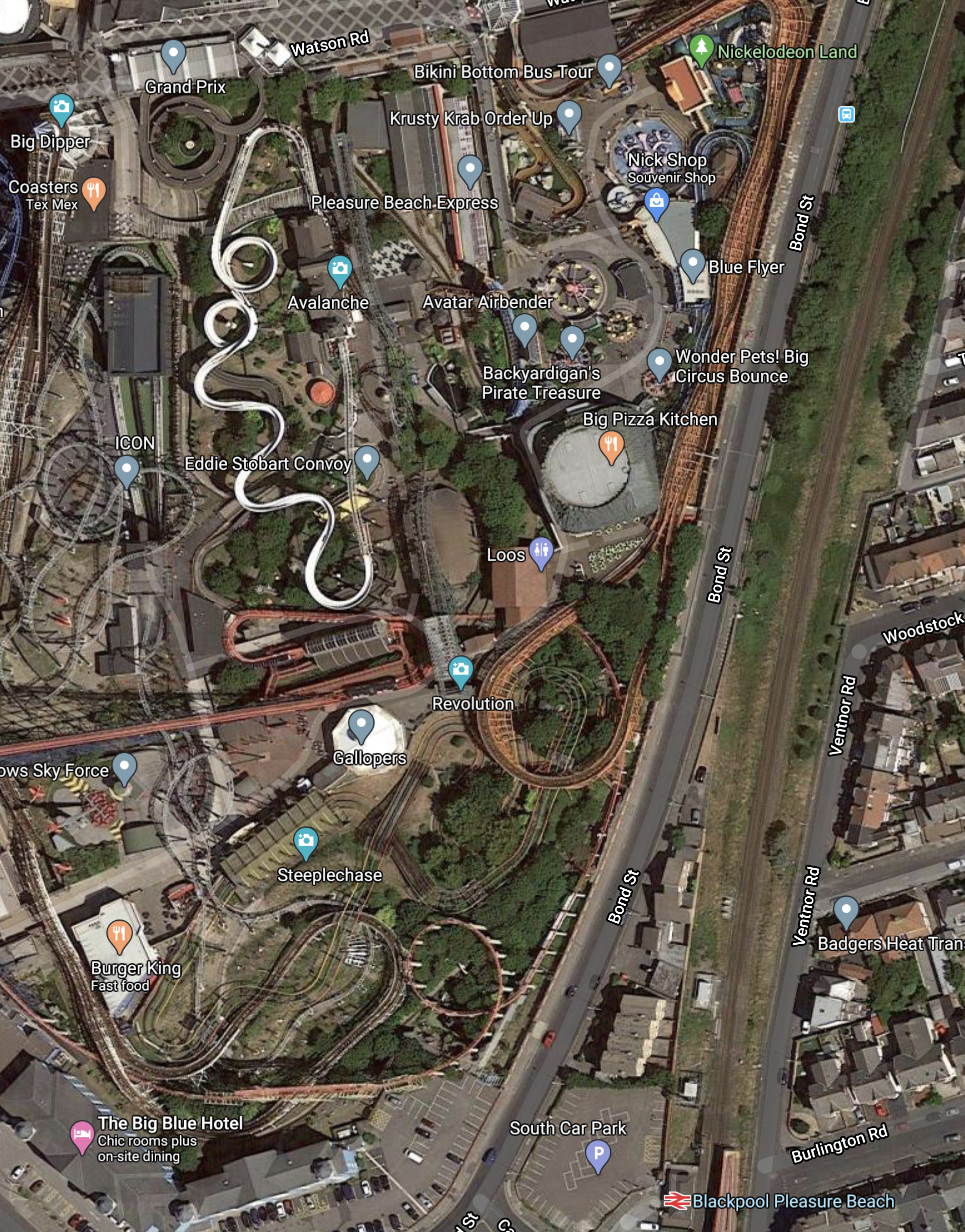
We shouldn’t underestimate the importance of this station. One beautiful late summer Saturday, I was going to see Ipswich play at Blackpool and out of curiosity I had explored the train to Colne station. In those days a decade ago, Colne and Blackpool South was one service and the train from Colne was full of families, by the time it got to Preston. A large proportion, left the train at the Pleasure Beach.
The conductor told me, that the crowds, I had witnessed weren’t untypical.
Squires Gate Station and Blackpool Airport
This Google Map shows Squires Gate station and the nearby Blackpool Airport.
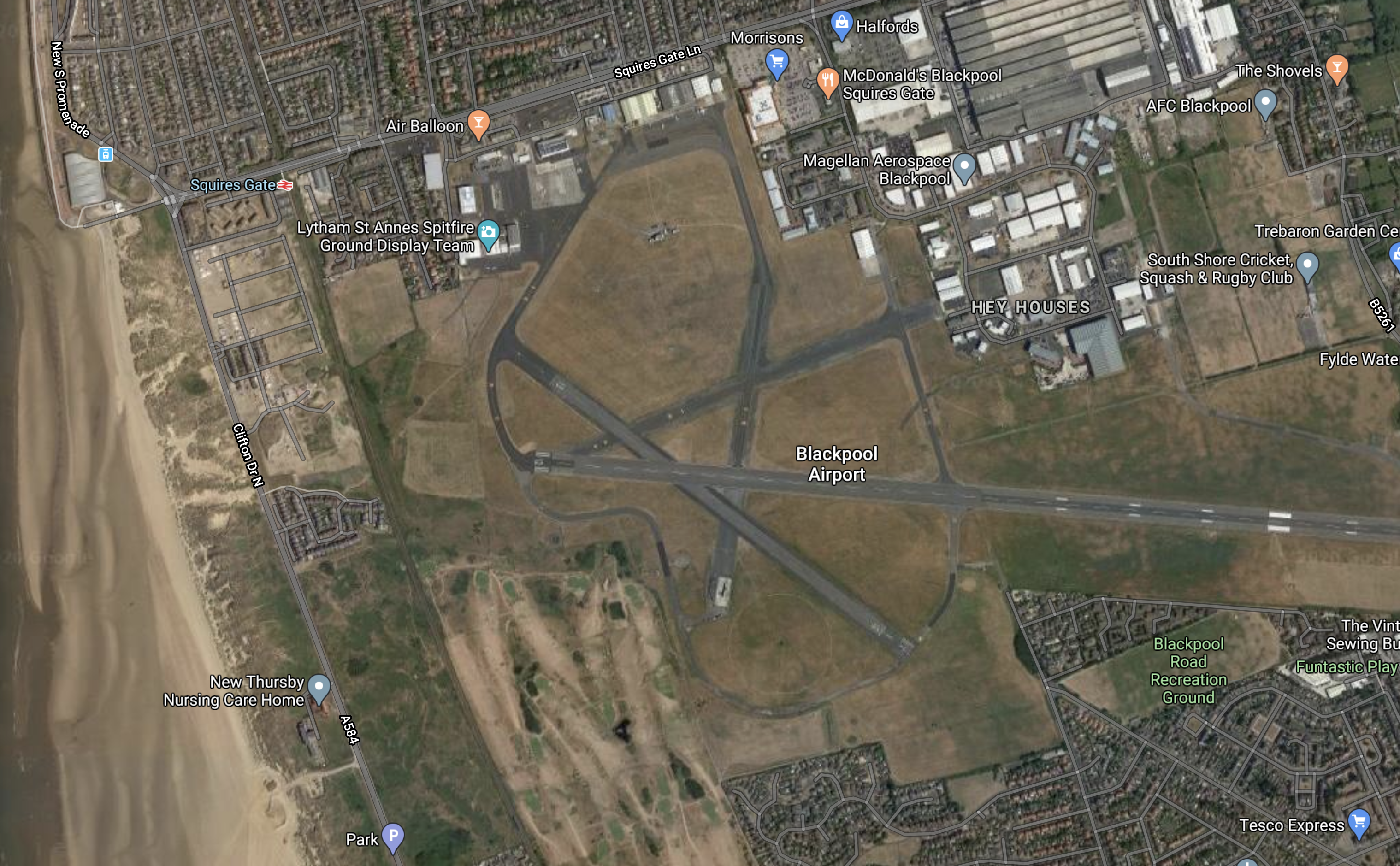
Blackpool Airport after a troubled few years seems to be finding a niche market, with a few business, commercial, offshore and training flights.
But I believe that airports like Blackpool in the future can develop another large niche – electric aviation.
Getting to places like Ireland, Northern Ireland, the Isle of Man and Wales by a nineteen-seat electric airliner will need the following.
- As short a flight as possible.
- Close to the coast would help.
- Good public transport links. Blackpool Airport has both tram and train.
- Space for aircraft to be parked, whilst charging.
- Plentiful supplies of renewable electricity. The over-300 MW Burbo Bank Wind Farm is not far away in Liverpool Bay and it will only be joined by more and larger wind farms.
- Frequent public transport.
Blackpool Airport could tick all these boxes, with a thick green marker.
Some example direct distances from Blackpool include
- Aberdeen – 238 miles
- Amsterdam Schipol – 340 miles
- Belfast City – 128 miles
- Cardiff – 165 miles
- Dublin – 134 miles
- Edinburgh – 150 miles
- Exeter – 211 miles
- Geneva – 661 miles
- Glasgow – 155 miles
- London Gatwick – 220 miles
- London Heathrow – 192 miles
- London Southend – 219 miles
- Newcastle – 89 miles
- Paris Orly – 422 miles
- Isle of Man Ronaldsway – 68 miles
- Southampton – 208 miles
These distances fit nicely with the range of the nine-seater Eviation Alice electric aircraft, which is predicted to be 620 miles.
St. Annes-on-the-Sea Station
This Google Map shows St. Annes-on-the-Sea station.
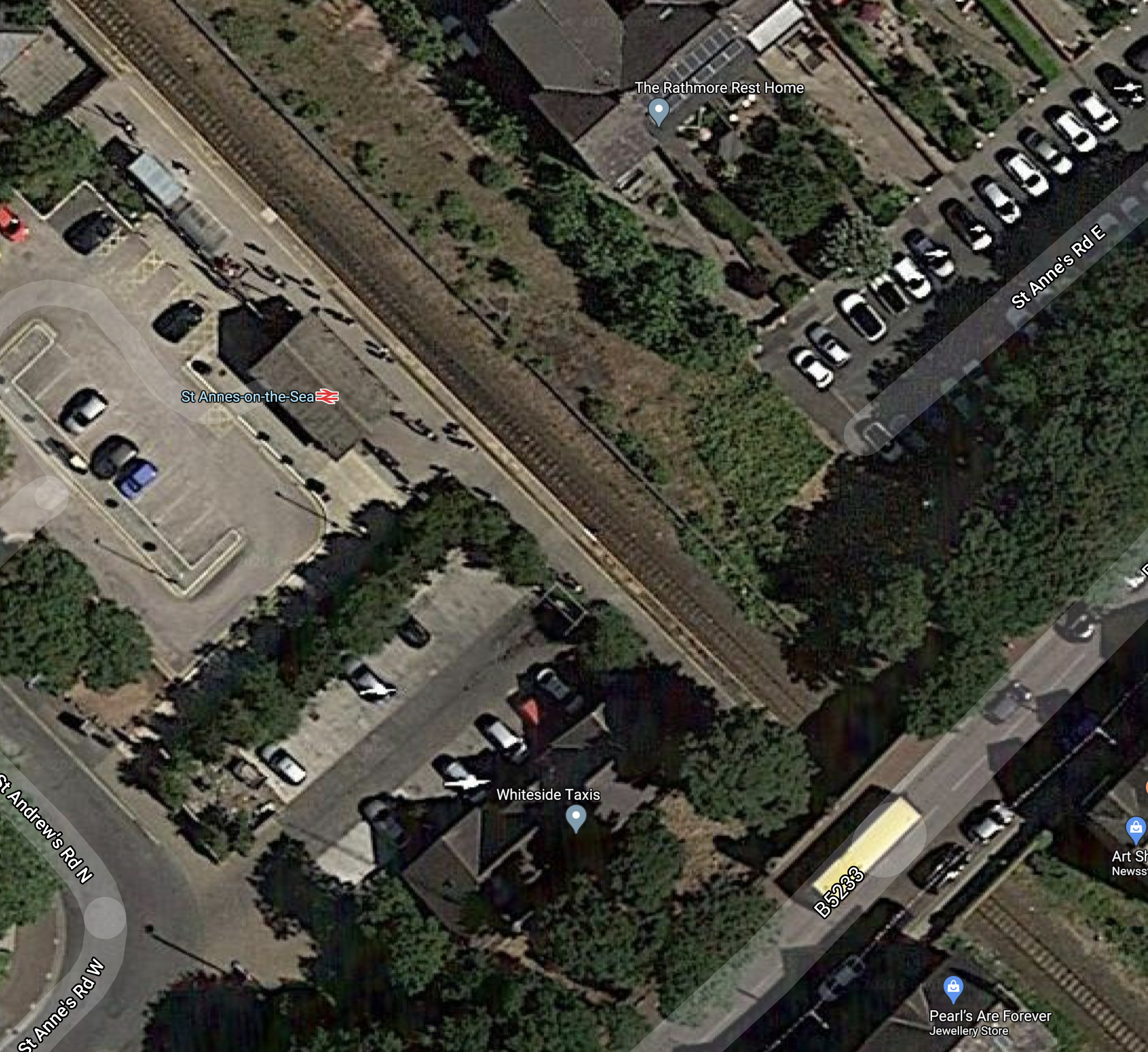
Note.
- Blackpool is to the North-West and Preston is to the South-East
- St. Annes-on-the-Sea is one of those convenient single-platform stations, where you just walk in-and-out on the level.
- The passing loop would start on the Preston side of the bridge.
There would need to be no major infrastructure work at the station, although I would expect the facilities could do with a makeover.
Ansdell And Fairhaven Station
In Should The Blackpool South Branch Be Electrified?, I said this about improvements to Ansdell and Fairhaven station.
Ansdell and Fairhaven station is nearest to the course at Royal Lytham.
-
- The Open Championship is a very important event on the golfing calendar.
- Other important golfing events are also held on the course
- Royal Lytham and St.Annes, last held the Open in 2012 and 2001. So it might come back to Royal Lytham in the mid-2020s.
Ansdell and Fairhaven station used to have two platforms, as described in Wikipedia.
The station was set out as an island platform with tracks on both faces until the singling of the line in the 1980s. Trains now only use the southern face. A disabled access ramp now covers the northern part of the station.
So could a rebuild of the station do the following?
-
- Restore two platforms on an island at the station.
- Put in full disabled access.
- Create a passing loop.
- Longer platforms might be a good idea.
This Google Map shows the station.
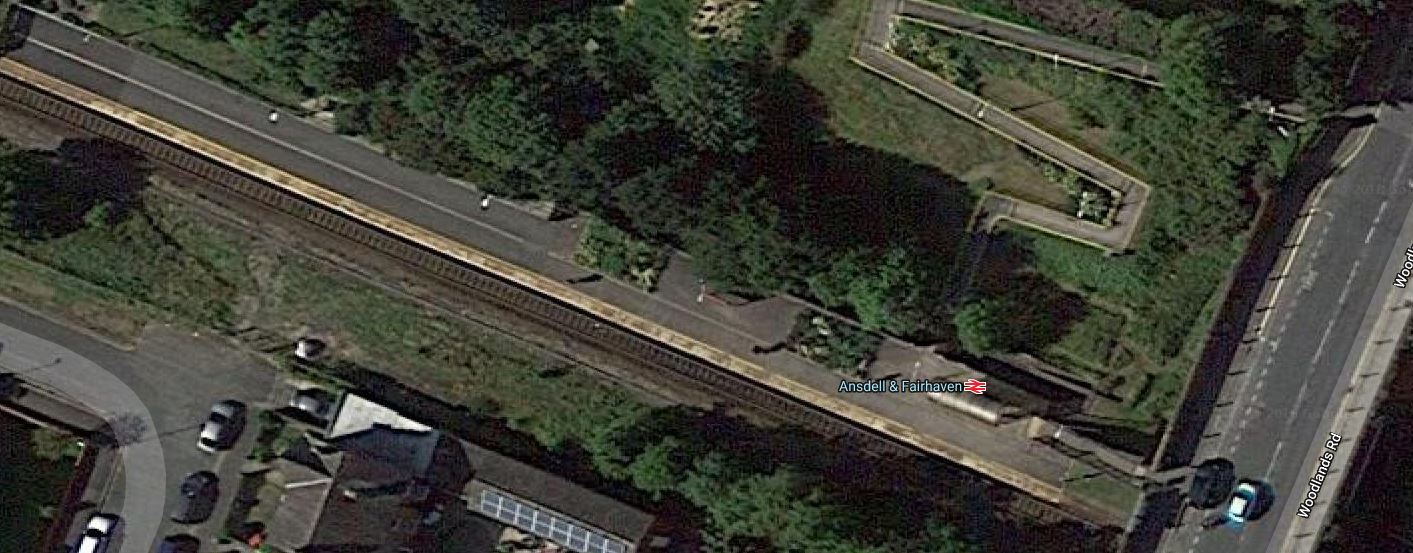
Note.
-
- The disabled ramp winding away.
- The platform is probably about a hundred metres long.
- It would appear that there is space at the far end to extend the platform.
I suspect that an ambitious architect with vision, could design a station that met all objectives.
It could be the best Championship Golf Course railway station in the world.
Lytham Station
This Google Map shows Lytham station.
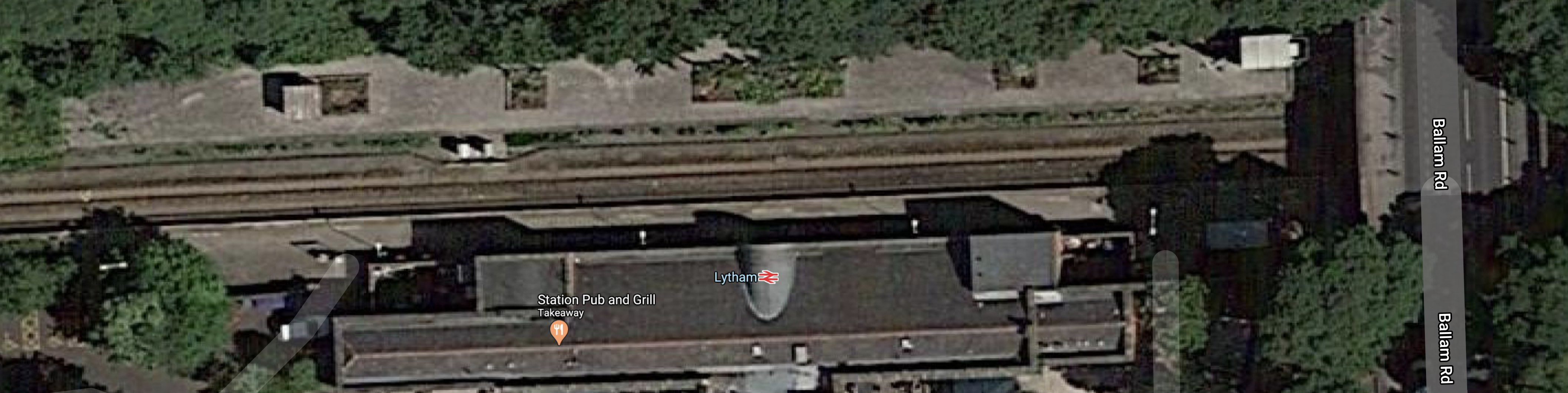
Lytham station will be the Eastern end of the loop and it is likely, that the single-track will change to double at the Western end of the station.
As with St. Annes-on-the-Sea station, I suspect that a good makeover, will be all that will be needed.
Moss Side Station
This Google Map shows Moss Side station.
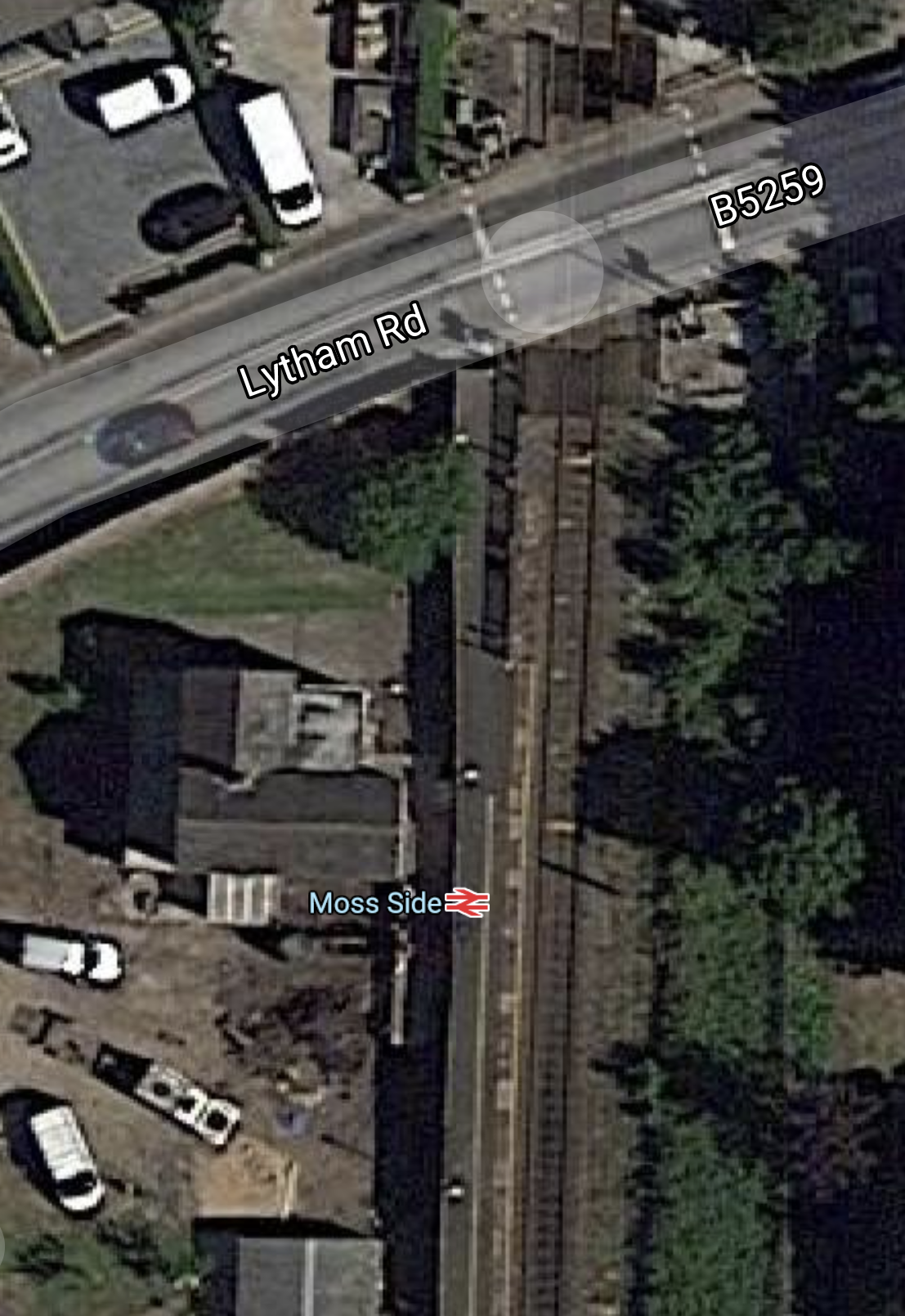
The only problem here is the level crossing, so do Network Rail want to remove it?
Kirkham And Wesham Station
This Google Map shows Kirkham and Wesham station.
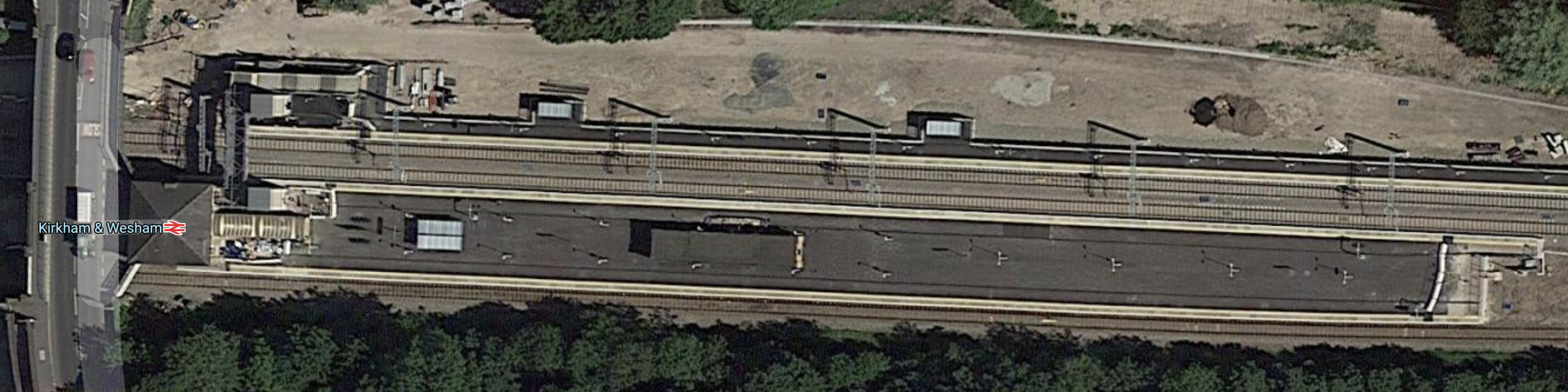
There are three platforms, which from bottom to top on the map are.
- Platform 1 – Trains to Blackpool South
- Platform 2 – Trains to Blackpool North
- Platform 3 – Trains to Preston
All platforms seem to be being electrified in these pictures. that I took during construction.


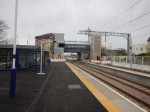
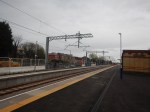
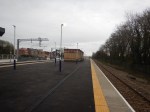
Note.
- It can’t be described as a station, built down to a small budget.
- In the captions to the pictures, I’ve numbered the platforms from left to right.
- The last picture looks down Platform 1 and there is an electrification gantry at the Preston end.
Could this comprehensive electrification be so that trains to Blackpool North can use both Platforms 1 and 2?
- This would allow overtaking of say a local train by a London express.
- Trains could also be turned back in Platform 1, before the end of its journey, if there was a problem.
- The electrification is also substantial enough for the longest Class 390 trains.
- It could even accommodate a classic compatible High Speed Two train.
So does the last point, mean that Blackpool North station is a possible High Speed Two destination? Provided, the platforms at Blackpool North station are long enough, I think it does!
This Google Map shows Kirkham West Junction, where trains to Blackpool North and Blackpool South stations diverge.
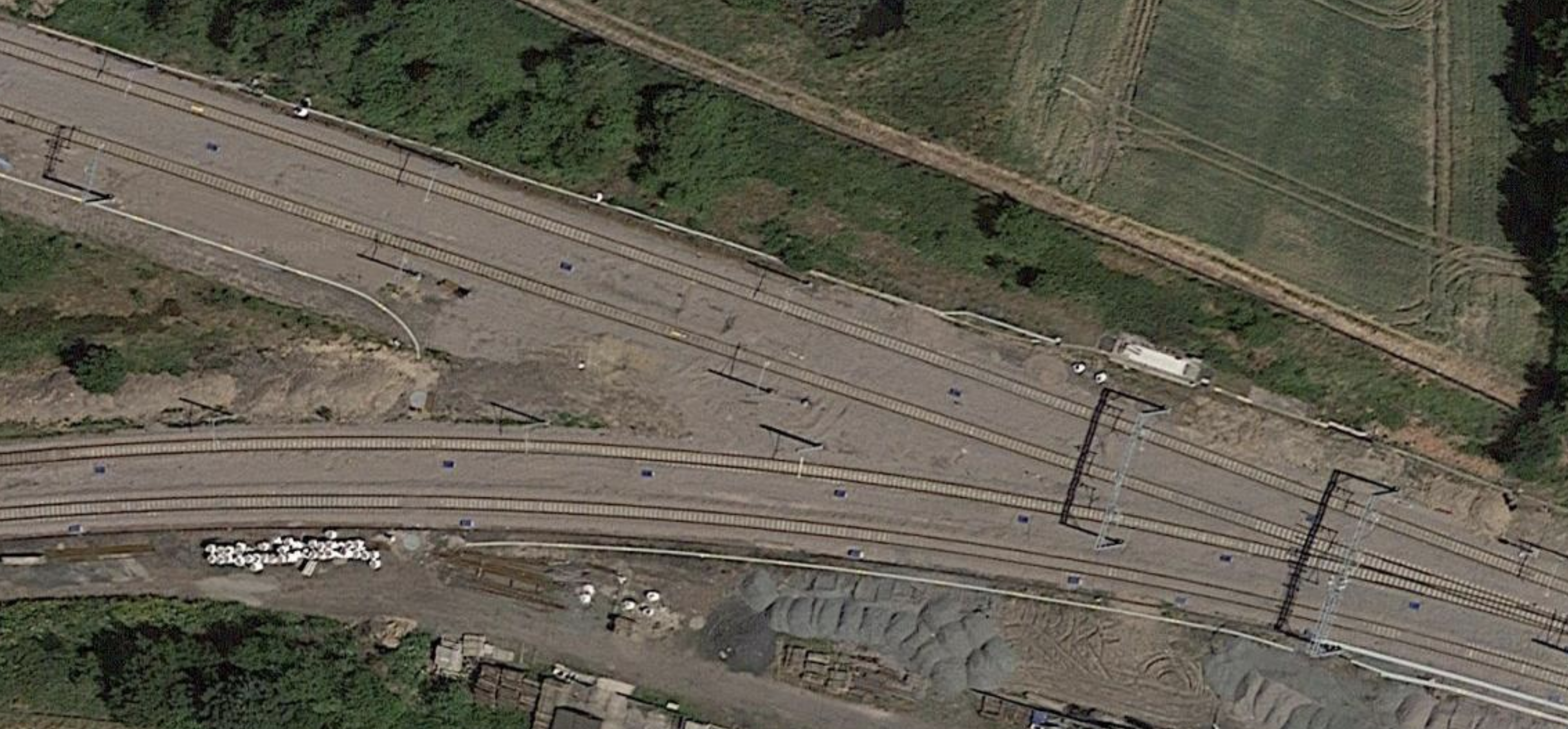
Note.
- The electrification gantries and their shadows can be seen.
- Preston is to the South-East and the route is fully-electrified.
- Blackpool North is to the North-West and the route is fully-electrified.
- Blackpool South is to the West. The double-track becomes single before Moss Side station.
This picture shows the route going off to Blackpool South.
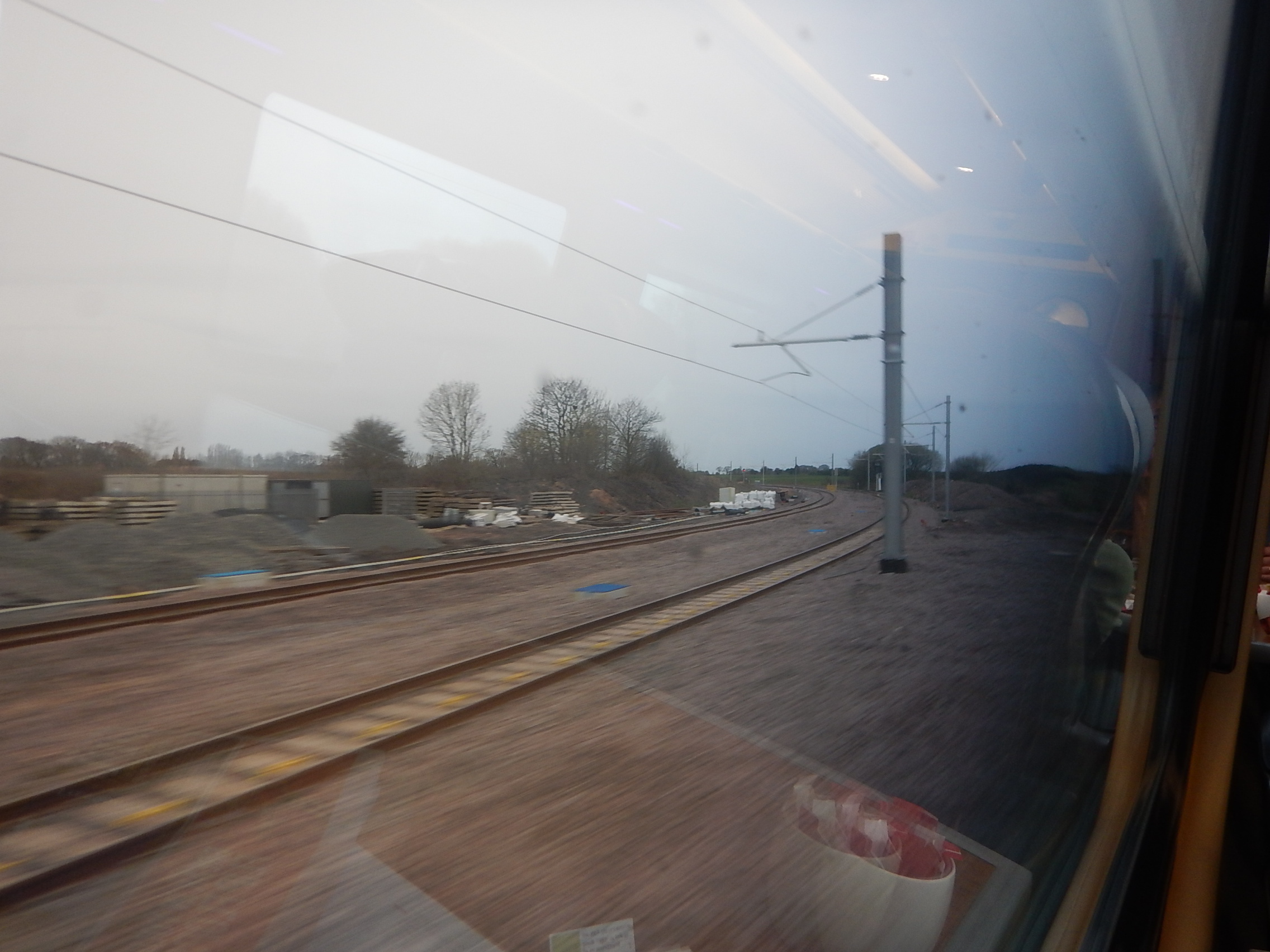
I took the picture from a train going to Blackpool North station.
So why are wires being run along the first few hundred metres of the Blackpool South Branch?
The Timetable
Currently, trains take the following times to do these journey legs.
- Run between Ansdell and Fairhaven and Blackpool South stations – 12 minutes
- Turnback at Blackpool South station – 3 minutes
- Run between Blackpool South and Ansdell and Fairhaven stations – 11 minutes
As the trains will be running every thirty minutes and the three legs total twenty-six minutes, that means there’s four minutes float.
So hopefully, it should be easily stainable, by an experienced rail timetable creator.
The Trains
I have remarked that I find the electrification at Kirkham & Wesham station, both comprehensive and slightly unusual.
Could The Electrification Have Been Designed For Battery Electric Trains To Blackpool South Station?
But there is one very plausible reason for the electrification layout – The Blackpool South Branch has been designed, so that services on the branch can be rum using battery trains.
- The distance between Kirkham & Wesham and Blackpool South stations is just over eleven miles.
- So for a round trip a range of perhaps twenty-five miles on battery power would suffice.
- There would also be a need for a few minutes of hotel power, whilst waiting at Blackpool South station.
These power needs are well within the capabilities of the average battery train.
- Trains could be charged on the nine minute run between Preston and Kirkham & Wesham stations.
- Changeover between electrification and battery power would take place in Kirkham & Wesham station.
An ideal train would surely be CAF’s four-car battery electric version of the Class 331 train, which I wrote about in Northern’s Battery Plans.
- According to an article in the March 2020 Edition of Modern Railways, with the same name, these trains will be working between Manchester Airport and Windermere.
- Class 331 trains without batteries will be running to and from Blackpool North station.
- Four-car trains are probably the right size for the route.
There would also probably be no need for a charging station at Blackpool South station, if trains could leave Kirkham & Wesham station with a full battery.
Where Would The Trains Terminate In The East?
These would be the obvious choices.
- Blackburn – Where there is a convenient bay platform.
- Colne – Where they used to terminate!
- Liverpool – Merseyrail has the trains and Liverpool has lots of punters and the imagination.
- Preston – Where they do now!
- Skipton – If the Skipton-Colne Link is built!
My money would be on Skipton, using a new Skipton-Colne Link, for the following reasons.
- Politicians of all colours and roses are in favour.
- Skipton has an electrified route to Leeds.
- Skipton-Colne would be a valuable by-pass route during the building of Northern Powerhouse Rail.
- Battery-powered trains would be ideal for Skipton-Colne.
Would A Battery Electric Train Be Feasible Between Blackpool South And Liverpool?
Consider.
- An all-stations service would complement the fast service between Liverpool Lime Street and Blackpool North stations via St. Helens, Wigan North Western and Preston.
- The service could either go between Liverpool and Preston via Ormskirk or Southport and a reinstated Burscough Chord.
- The Ormskirk route is 15 miles of unelectrified line and the Southport route is just four miles further.
- A service via Southport would need to reverse at Southport station.
- The service would be run using dual-voltage Class 777 trains fitted with batteries.
- 25 KVAC overhead electrification, is already installed between Preston and Kirkham & Wesham stations,
- Using existing electrification, trains would leave Kirkham & Wesham, Ormskirk, Preston and Southport stations with full batteries.
- A coastal service between Blackpool and Liverpool would surely attract visitors.
- Liverpool and Blackpool are the two biggest urban areas on the coast.
- There are several golf courses on the route, including three courses that have held the Open; Royal Birkdale, Royal Liverpool and Royal Lytham & St. Annes.
It may be a bit fanciful. But.
- Merseyrail will have the trains.
- Liverpool has the potential passengers.
- I believe the route could handle a two tph service.
- In Reopen Midge Hall Station, I showed that it was possible to run a two tph service between Liverpool and Preston, with one tph via each of Ormskirk and Southport.
Liverpool also has bags of ambition and imagination.
Would A Battery Electric Train Handle Preston And Skipton?
I estimate that this route is forty-one miles, with a stiff rise from Rose Grove to Colne station.
So would a battery electric train be able to handle this distance?
Hitachi are talking 56 miles for their Regional Battery Train, so I suspect CAF would want and need to be competitive with a similar specification.
Perhaps the logical service would be to run between Leeds and Blackpool South.
- The service would go via Preston, Blackburn, Burnley Central, Colne and Skipton.
- Leeds and Skipton is electrified.
- Preston and Kirkham & Wesham is electrified.
- No extra chargers for trains would be needed.
The only new infrastructure needed would be the Skipton and Colne Link.
Electrification Between Preston And Blackburn
Consider.
- In Colne – Skipton Reopening Moves Closer, I talked about the proposed Huncoat Rail Fright Terminal, that could be built North of Blackburn on the East Lancashire Line.
- Blackburn is a major hub for passenger services.
- An electrified Blackburn would allow Manchester and Clitheroe to be run by battery electric trains. Clitheroe is ten miles and Bolton is thirteen.
- An electrified Blackburn would allow Blackburn and Manchester Victoria via the Todmorden Curve to be run by battery electric trains. The whole route is 39.5 miles.
- It may be possible for battery electric trains to reach Leeds via Hebden Bridge, as it is only fifty miles away, which is within Hitachi’s range.
- As the Blackburn area grows, there will be more pressure for a daily London service.
- Some think, the Calderdale route should be electrified.
- Preston and Blackburn stations are just twelves miles apart.
- There is a multiple unit depot at Blackburn.
- I also feel that battery electric trains fanning out from Blackburn, wouldn’t do the town’s image any harm.
For all these reasons, I wouldn’t be surprised to see a short stretch of electrification added between Preston and Blackburn.
Conclusion
I like this proposal and it could be a big asset to trains across the Pennines.
Gore Street Energy Welcomes Green Light For Larger Battery Projects In England And Wales
The title of this post, is the same as that of this article on Proactive Investors.
These are the introductory paragraphs..
Gore Street Energy Fund has welcomed legal changes to allow battery projects larger than 50MW in England and 350MW in Wales.
The new legislation removes energy storage, except pumped hydro, from the Nationally Significant Infrastructure Projects regime in England and Wales, said the fund.
This will allow larger projects to receive planning permission without government approval.
I can see why they are pleased, as it removes a level of bureaucracy.
I suspect companies like Highview Power will also be pleased as 50 MW is at the lower end of their battery range.

