BOEM Links Up With US Department of Defense On Offshore Wind
The title of this post, is the same as that of this article on offshoreWIND.biz.
This is the sub-heading.
The US Bureau of Ocean Energy Management (BOEM) and the Department of Defense (DOD) have signed a memorandum of understanding (MoU) to support the coordinated development of offshore wind on the US Outer Continental Shelf (OCS).
These three paragraphs give more details of the agreement.
The agreement calls for DOD and BOEM to find mutual solutions that support renewable energy in a manner compatible with essential military operations.
The MoU also requires the organizations to collaborate early in the offshore wind leasing process and maintain regular communication at all levels.
Additionally, the agreement calls for DOD and BOEM to determine what areas should be deferred from leasing to enable the performance of DOD activities on the OCS.
I feel this is a very sensible agreement, as time progress, I’m sure that the co-operation will lead to several joint projects.
- Support boats ensuring safety, like the deal between Ørsted and the RNLI, that I talked about in Ørsted Evolves Long-Standing Partnership With RNLI,
- Offshore structures like electrolysers and substations could have a secondary use as military training facilities.
- Smaller ships, like minehunters, coastguard cutters and fishery protection vessels could go electric and the wind farms could provide charging facilities.
If the United States Navy are hanging around the wind farms, it might discourage Putin’s friends.
Wind farms and the US military could be good neighbours.
Brendan Owens, who is the Assistant Secretary of Defense for Energy, Installations, and Environment, said this.
We will continue to work with BOEM and our other interagency partners, to find solutions that enable offshore wind development while ensuring long-term compatibility with testing, training, and operations critical to our military readiness.
Other nations with large amounts of continental shelf and ambitions to install large amounts of offshore wind like Australia, Belgium, Canada, Denmark, France, Germany, the Netherlands, Portugal, Spain and the UK could do worse that follow the American strategy.
Ørsted Evolves Long-Standing Partnership With RNLI
The title of this post, is the same as this news item from Ørsted.
This is the sub-heading.
Ørsted, the global leader in offshore wind power and one of the largest renewable energy companies in the world, has announced the latest phase of its long-standing partnership with the Royal National Lifeboat Institution (RNLI).
These three paragraphs give a few more details of the partnership.
Over the next two years, Ørsted will provide more than £140,000 to help the charity in its mission to save lives at sea.
The RNLI is the charity that saves lives at sea and its volunteers provide a 24-hour search and rescue service across the British Isles.
Established in 2015, the partnership previously focused on supporting seven individual lifeboat stations in areas where Ørsted operates its offshore windfarms and is now evolving to support even more lifeboat stations.
Little is said about what benefits Ørsted get from the partnership.
Although, this is said.
Previously focused on supporting seven individual lifeboat stations in areas where Ørsted operates its offshore windfarms.
Does this mean, that for small incidents, the RNLI can do the rescue or perhaps tow a broken-down workboat to the shore?
In a busy area, the RNLI might even act as backup to Ørsted’s own safety boat, if a second incident occurred.
It might be a more affordable way to ensure safe operation, which is obviously paramount.
Conclusion
As the partnership is being extended, it must surely have been working well.
Centrica And European Energy Sign Agreement On Måde Green Hydrogen Facility
The title of this post, is the same as that of this press release from Centrica.
This is the sub-heading.
Centrica Energy and European Energy have signed a balancing and optimisation agreement for the Måde green hydrogen facility located at Port Esbjerg. Under the agreement, Centrica Energy will manage power production from co-located wind turbines, designating excess power production to green hydrogen production.
These two introductory paragraphs give more details.
Powering the 12MW green hydrogen facility are two wind turbines, part of the Måde Wind Turbine Test Center, developed by European Energy with a total installed capacity of 16MW. The turbines will provide renewable electricity, which is used to produce green hydrogen through electrolysis with demineralised water.
Expected to produce approximately 1,500 tonnes of green hydrogen every year, European Energy has secured an agreement with Port Esbjerg and a world-class industrial gases company for the offtake from the facility. As the production of hydrogen is a heat-intensive process, the excess heat from production will be fed into the local district heating network, demonstrating sector coupling across the electricity, fuel, and heating domains.
These are my thoughts,
Hydrogen Production
The hydrogen production uses a standard electrolysis method, but excess heat will be fed into the local district heating network.
AquaVentus And Denmark
I introduced AquaVentus in this post called AquaVentus.
This video shows the structure of AquaVentus.
I clipped this map from the video.

Note.
- The thick white line running North-West/South-East is the spine of AquaVentus, that delivers hydrogen to Germany.
- There is a link to Esbjerg in Denmark.
- There appears to be an undeveloped link to Norway.
- There appears to be an undeveloped link to Peterhead in Scotland.
- There appears to be a link to just North of the Humber in England.
- Just North of the Humber are the two massive gas storage sites of Aldbrough owned by SSE and Brough owned by Centrica.
- There appear to be small ships sailing up and down the East Coast of the UK. Are these small coastal tankers, that are distributing the hydrogen to where it is needed?
In the last century, the oil industry, built a substantial oil and gas network in the North Sea.
It appears now the Germans are leading the building of a substantial hydrogen network in the North Sea, that will bring the hydrogen they need to their country.
I also suspect that any spare hydrogen produced in Esbjerg can be added to the AquaVentus network.
- Hydrogen could be sent to Brough and Aldbrough in the UK for storage.
- Hydrogen could be sent to any country in the network that needs it.
Countries will pay for the hydrogen they use.
Optimising AquaVentus
AquaVentus is a complex network.
- Hydrogen could be produced offshore in British, Danish, Dutch, English, German, Norwegian, Orcadian, Scottish and Shetland waters.
- Hydrogen could be sent to Brough and Aldbrough in the UK for storage.
- Hydrogen can be sent to Belgium, Denmark, Germany, Norway, The Netherlands and the UK.
A company like Centrica has the expertise and the software to control the various hydrogen flows to the best advantage of hydrogen producers and users.
The MailOnline’s View Of Pumped Storage Hydroelectricity
The MailOnline gives their view on Pumped Storage Hydroelectricity on the front page of their web site today.
This is the bold title.
Scotland is littered with windfarms. Now the impact of billion-pound hydro projects to store energy they produce threatens our scenic landscapes… and led critics to brand the plans – The Loch Ness Monstrosity
To my mind, the site’s language leaves no doubt that they are not keen on either windfarms or the hydro projects to store energy.
Calling the plans the Loch Ness Monstrosity, is an insult to the engineers, who have devised the plans.
The journalist, who wrote the article has made the same mistake, that many do when they write about any form of energy storage – They only give the output of the battery and not the output and the storage capacity.
Thus Red John Pumped Hydro is described in the article like this.
The £550million Loch na Cathrach venture (formerly known as Red John, after a popular local lochan), is one of the biggest renewable energy projects in the North and was granted consent by the Scottish Government in June 2021 despite strong objections from campaigners and Highland Council but has yet to be built in the hills near Dores.
The 450MW project owned by Norwegian state firm Statkraft hopes to start construction next year and be operational by 2030.
Note.
- Red John is a 450 MW project with a storage capacity of 2,800 MWh, which is conventionally shown as a 450 MW/2,800 MWh battery.
- A battery of this size can supply 450 MW for 6.2 hours, which is more than a lithium-ion battery of the same cost could manage.
- 450 MW is about the average size of a gas-fired power station.
Where the geography is suitable, pumped storage hydroelectric stations may be able to replace gas-fired power stations.
- There would be no cooling towers.
- There would be no chimneys or associated pollution.
- The electrical gubbins to connect to the grid would be the same and could probably be refurbished.
The new lake could be used for water-based activities like fishing, sailing skiing and swimming.
Conclusion
Obviously, playing the Nimby-card sells newspapers.
Hydrogen Energy Explained
The title of this post, is the same as this story on Centrica.
This is the sub-heading.
Hydrogen is a clean alternative to natural gas, when it’s burnt it doesn’t produce carbon dioxide, which is a harmful greenhouse gas. It has the potential to play a significant role in achieving net-zero and decarbonising various sectors.
The story is a good introduction to hydrogen.
In the 1960s, when I first worked in a hydrogen electrolyser at ICI in Runcorn, I would have found a document like this one from Centrica invaluable.
Energy Dome Pens Contract For First US Project
The title of this post is the same as that as this article on Energy Storage News.
I like Energy Dome, as it makes one of the causes of global warming; carbon dioxide help with the storage of energy, which many argue is part of the solution of the problem.
This press release gives more details.
- The project is a 20MW/200MWh Battery.
- The battery will be located in Wisconsin.
- In parallel, the construction of Energy Dome’s first-of-a-kind standard CO2 Battery plant in Sardinia, Italy, is also proceeding at full speed.
As Energy Dome is an Italian company, the solution is also more about finesse than brute force.
Team GB And ParalympicsGB Athletes Find New Career Pathway At Centrica
The title of this post, is the same as that of this press release from Centrica.
This is the sub-heading.
Over the summer, billions of people from across the world tuned in to the Paris 2024 Olympic and Paralympic Games to get behind their nation’s most talented athletes, and Centrica has launched a new employment initiative to help sportspeople transition into a different career once they retire.
These first three paragraphs outline the scheme.
Elite sports professionals are highly skilled and have a lot to offer the world of work, although it can often be challenging for them to know where to start, especially when entering into a new sector.
To help adjust to life after sport, Centrica has created a new scheme – the Centrica Athletes Leadership Placement Programme – to find high performance athletes rewarding careers in the energy sector.
Made available to athletes thanks to Team GB and ParalympicsGB’s landmark five-year partnership with British Gas – a subsidiary of Centrica – the programme will give former sportspeople the chance to transfer their skills to new roles within the wider group.
The scheme appears to be similar to a successful scheme for armed forces personnel, outlined in this paragraph.
The scheme falls under the same umbrella as Centrica’s Armed Forces Pathway, which aims to hire at least 500 ex-forces leavers by 2026.
I wish Centrica and their new employees the best of luck.
But it looks to me, that it should succeed.
Could Liverpool Develop A Massive Zero-Carbon Data Centre?
There is an article in The Sunday Times today, which is entitled Google Signs Nuclear Deal To Power AI Data Centres.
These are the first three paragraphs of the article.
Google has struck a deal with a nuclear power start-up to provide low-carbon energy for its data centres and AI operations, marking a world-first in the tech industry.
The California-based company said the agreement to buy energy from multiple small modular reactors developed by Kairos Power could help spur a nuclear revival in America.
The first reactor is scheduled to come online in America by 2030, followed by additional deployments through 2035.
I am not against nuclear-powered data centres, but could Liverpool build a massive zero-carbon data centre?
This Google Map shows Liverpool Bay, which is a vast expanse of water that stretches along the North Wales coast to Anglesey and all the way to the Isle of Man.
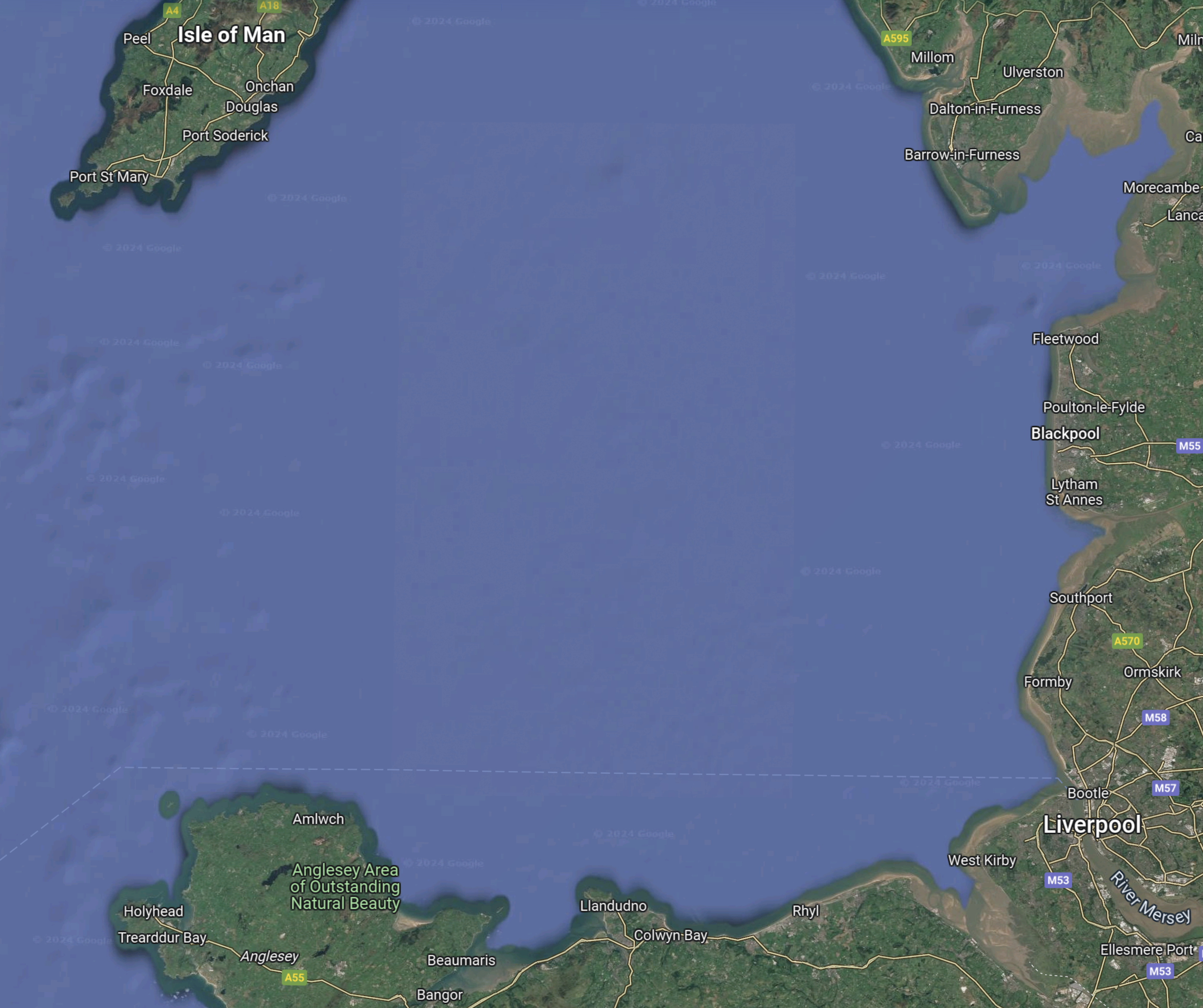
Note.
- The Isle of Man in the North-West corner.
- Liverpool, Birkenhead and the River Mersey in the South-East corner.
- Anglesey in the South-West corner.
- Blackpool with Morecambe Bay to its North in the North-East corner.
Liverpool Bay could be one of Europe’s zero-carbon energy powerhouses.
Wind Farms In Liverpool Bay
At the present time, these wind farms are producing electricity or planned in Liverpool Bay.
- Barrow – 90 MW – Commissioned in 2006
- Burbo Bank – 90 MW – Commissioned in 2007
- Burbo Bank Extension – 258 MW – Commissioned in 2017
- Gwynt y Môr – 576 MW – Commissioned in 2015
- North Hoyle – 60 MW – Commissioned in 2003
- Ormonde – 150 MW – Commissioned in 2012
- Rhyl Flats – 90 MW – Commissioned in 2009
- Walney – 367 MW – Commissioned in 2010
- Walney Extension – 659 MW – Commissioned in 2018
- West if Duddon Sands – 389 MW – Commissioned in 2014
- Awel y Môr – 500 MW – Planned
- Morecambe – 480 MW – Planned
- Mona – 1500 MW – Planned
- Morgan – 1500 MW – Planned
Note.
- 2509 MW has been commissioned.
- 3980 MW is being planned.
- That is a total of 6489 MW
I suspect more space in Liverpool Bay could be developed with wind farms.
Mersey Tidal Power
The Mersey Tidal Power project has a web site.
If it is built, it will probably be built by the South Korean company; K-Water and use some of the design principles of the Sihwa Lake Tidal Power Station.
It will likely have an output of around 1 GW and take ten years to build.
In the 1970s, I did some project management consultancy for Frederick Snow and Partners, and they showed me their plans for a Severn Barrage.
Their futuristic vision for the Severn Estuary was never built, as the Prime Minister of the time; Harold Wilson, felt coal was the future. See Last Of The Many!
I suspect that the Mersey Tidal Power project will be another variation on a proven theme.
Morecambe Bay Bridge And Tidal Barrage Proposal
In the Wikipedia entry for Morecambe Bay, there is a proposal for a bridge and tidal barrage across the bay, where this is said.
In 2004, a proposal was made to build a bridge across the bay flanked by wind turbines and using tidal power. Proposals from Northern Tidal Power Gateways in 2019 outlined a tidal barrage with a road running along on top.
If the Mersey Tidal Power project is a success, then why wouldn’t one across Morecambe Bay, be one too?
500 MW of zero-carbon tidal power would do nicely!
Nuclear Sites At Calder Hall, Heysham And Wylfa
These three nuclear stations have supplied electricity to the North-West of England.
- Calder Hall was the original Magnox site, which the Wikipedia entry says had a nameplate capacity of 240 MW and was decommissioned in 2003, after running for 47 years.
- Heysham is a powerful site which the Wikipedia entry says has a nameplate capacity of 2452 MW and will be decommissioned in 2028.
- Wylfa is an older, smaller Magnox site which the Wikipedia entry says had a nameplate capacity of 1190MW and was decommissioned in 2015.
As the sites are cleared, I am sure that we’ll see more nuclear power stations built on the sites.
How Much Electricity Does A Data Centre Use?
I found this paragraph in an NESO document.
Regardless of this, if we were to use existing market data and modelling projections, this could point to annual data centre electricity consumptions of between 3.6 TWh in 2020 to as much as 35 TWh by 2050.
Dividing by the hours in a year, indicates that an individual data centre could use between 0.4 and 4 GW of electricity.
Using my rough figures here from wind, tidal and nuclear, I suspect that the power on the Mersey will generate enough power for at least one data centre.
Liverpool Is On The Right Side Of The Country For Cables To North America
Cables will go straight out of Liverpool Bay, pass to the North of Ireland and across the Atlantic to somewhere like Puget Sound.
Liverpool has a superb location for a Transatlantic data centre, that connects to networks on both sides of the pond.
Could Underwater Data Centres Be Developed In Liverpool Bay?
This page on the Microsoft web site is entitled Microsoft Finds Underwater Datacenters Are Reliable, Practical And Use Energy Sustainably
These three paragraphs detail the research.
Earlier this summer, marine specialists reeled up a shipping-container-size datacenter coated in algae, barnacles and sea anemones from the seafloor off Scotland’s Orkney Islands.
The retrieval launched the final phase of a years-long effort that proved the concept of underwater datacenters is feasible, as well as logistically, environmentally and economically practical.
Microsoft’s Project Natick team deployed the Northern Isles datacenter 117 feet deep to the seafloor in spring 2018. For the next two years, team members tested and monitored the performance and reliability of the datacenter’s servers.
I would assume that Microsoft have continued the research, as with something like this you can’t be too careful.
But it would appear, that data centres and their servers could be submerged under the waters of Liverpool Bay.
London And Liverpool Will Be Under Two Hours By Train Within A Year
New Class 807 trains, which will be delivered within a year, will improve the train service between the two cities.
- Train times will be brought to around or even below two hours.
- , The extra trains will allow a second hourly service to be added.
- The extra service will additionally stop at Liverpool South Parkway station, for the airport.
- High Speed Two is claiming one hour and fifty minutes, between London and Liverpool.
Liverpool already has one of the best rail terminals in the North of England, as these pictures show.
































































With these service improvements, it will have a service to London and the South, that will be second to no other Northern station.
Liverpool Has A Refurbished Partly-Underground Suburban Railway With New Trains
Liverpool’s Metro is one of the best in Europe for a medium-sized city.
The Metro is also expanding with new routes and stations.















These pictures show the new Headbolt Lane station, which is swerved by the UK’s first battery-electric trains.
Liverpool Has Easy Access To Two International Airports
There are two international airports close by; Liverpool John Lennon and Manchester International.
- For Liverpool Airport, it’s a bus from Liverpool South Parkway station or an express bus from Liverpool city centre.
- For Manchester Airport, it’s a train from Lime Street station.
I am fairly sure, that a hydrofoil could connect Liverpool’s Waterfront and the Tidal Barrier to the airport.
North-West England Has A Rich University Tradition
Liverpool, Manchester and the surrounding area has several world-class universities and research establishments.
Some like The Pandemic Institute would be able to find uses for all the computing power and artificial intelligence on offer at a powerful data centre.
Liverpool Is A World City
Liverpool is a World City, where there is plenty of sport, entertainment and things to do.
Conclusion
Liverpool is installing the power infrastructure for a very large data centre, that will be able to handle the world’s largest and most difficult problems.

