Are These Turbines An Alternative To Solar Panels?
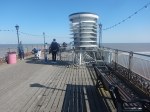
I took this picture yesterday of the Ventum Dynamics turbine on Skegness Pier.
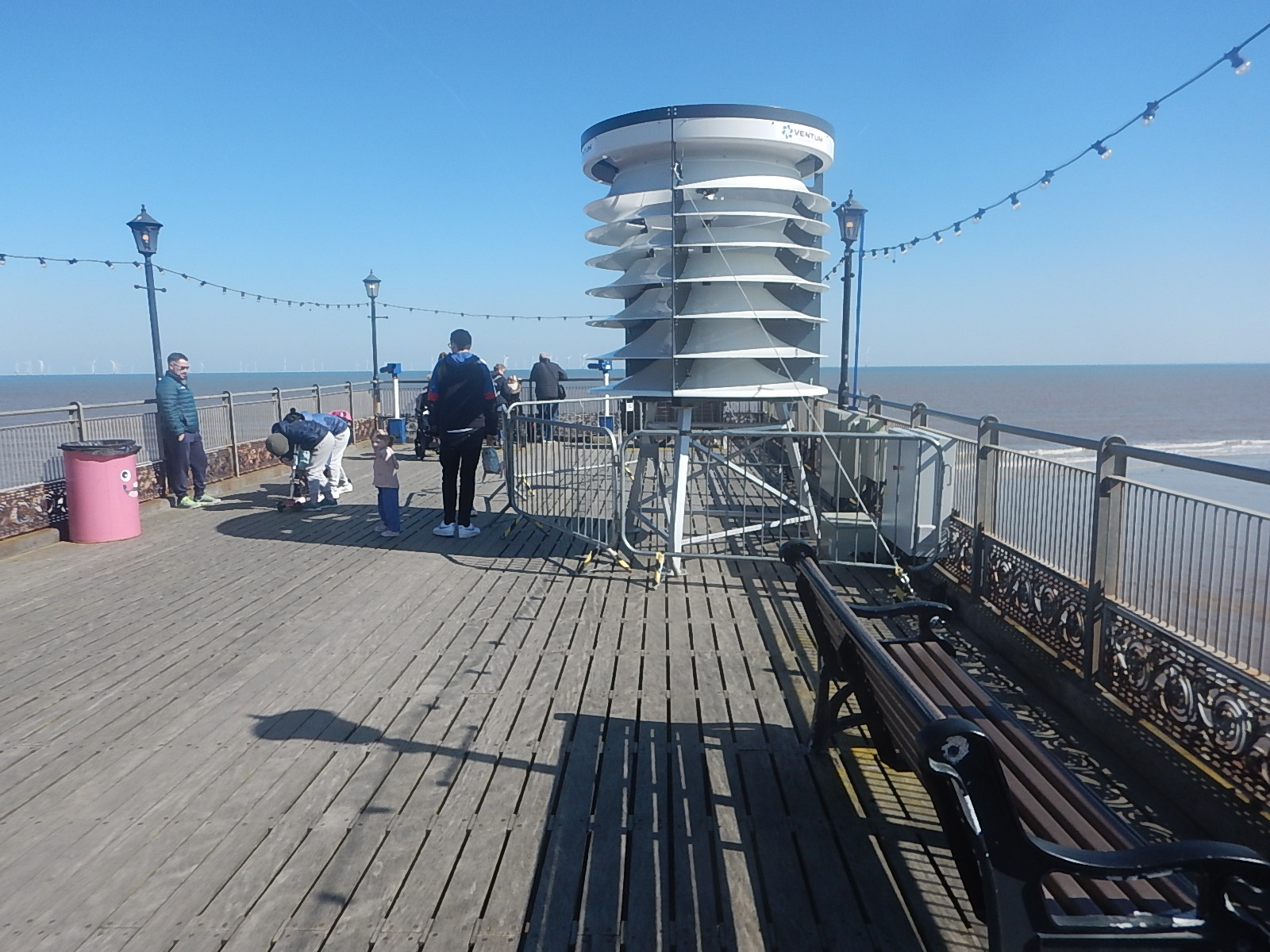
On the Ventum Dynamics web site, there are several pictures of buildings with flat roofs, that have several turbines on each.
I have some thoughts.
Connecting The Turbines
The Skegness turbine has been installed to light up the pier, but it doesn’t seem to have masses of cabling!
So can one of these turbines or a whole fleet of them be connected up by a qualified electrician, who is familiar with connecting up solar panels?
It would certainly, be a positive feature if they could, as these turbines could be another string to the bow of a solar power company.
I would design them to be electrically interchangeable with solar panels, so that roofs could be covered by a mixture of both solar and wind power.
Will We See more Hybrid Systems?
Cleve Hill Solar Park in Kent is being built as a solar park with a battery close to the London Array offshore wind farm.
I can see batteries and Ventum’s turbines being added to solar farms.
Conclusion
Ventum’s turbines are both an alternative and a partner to solar panels.
Windeed’s Floater Solution Gets Bureau Veritas Nod
The title of this post, is the same as that of this article on offshoreWIND.biz.
This is the sub-heading.
Bureau Veritas has granted Approval in Principle (AiP) to Sweden-based Windeed for its low-weight and low-acceleration floater solution for offshore wind turbines.
These three paragraphs fill in more details.
The AiP is a significant milestone in the development of Windeed’s technology, which could offer competitive prices and lower levelised cost of energy (LCOE) compared to other solutions on the market due to its industrialised manufacturing process, the developer said.
Bureau Veritas provided testing and assessment to ensure the solution is safe, reliable, and ready for deployment.
The approval in principle is a testament to the quality and innovation of the company’s technology.
I have been waiting some months for a new more efficient float for offshore wind turbines and then Gazelle Power Systems and Windeed turn up with designs on the same day.
Pictures of Gazelle’s design are available on their web site, but Windeed’s web site is text only, although it does say this.
Our purpose is to provide superior technology and industrialization of floating offshore wind power, lowering costs and environmental impact, to meet the need of more and clean energy.
I wouldn’t be surprised to see other designs!
SSE Thermal Secures 10-year Contracts For Two New Low-Carbon Power Stations In Ireland
The title of this post, is the same as that of this press release from SSE.
These first two paragraphs outline the two projects.
SSE Thermal, as part of SSE plc, has provisionally secured 10-year capacity agreements for its two proposed new-build power stations in Ireland which would run on sustainable biofuel.
The proposed low-carbon units at Tarbert in Co. Kerry and Platin in Co. Meath received the contracts in the T-4 Capacity Auction to commence in the 2026/27 delivery year.
Note.
- Both plants would help to protect security of supply and provide flexible backup to Ireland’s growing renewables sector.
- This Wikipedia entry is entitled Renewable Entry In Ireland and states that by the end of 2021, Ireland had 4.4 GW of onshore wind, with the intention of adding 5 GW of offshore wind, by 2030.
- The proposed units will initially run on Hydrotreated Vegetable Oil (or HVO), which is produced by processing waste oils to create a fossil-free alternative to diesel in accordance with EU sustainability standards.
- It looks like the two new-build HVO-powered station will back up the renewables.
- It is intended that the two new power stations will be in operation in 2026.
The two new power stations will be convertible to hydrogen in the future.
As at Keadby in Lincolnshire, which I wrote about in SSE Thermal Charts Path To Green Hydrogen Future With First-Of-A-Kind Project. it looks like SSE have developed a comprehensive plan to keep the electricity at full power, even when the wind isn’t blowing.
Conclusion
SSE Thermal are showing that in addition to gas, nuclear and pumped storage hydroelectric, renewables can also be backed up by biomass.
Irish Floating Wind Tech Developer Unveils Pilot Project In Portugal
The title of this post, is the same as that of this article on offshoreWIND.biz.
This is the sub-heading.
Dublin-based floating wind technology company Gazelle Wind Power (Gazelle) has partnered with the Portuguese renewable energy developer WAM Horizon to accelerate the development of a pilot project in Aguçadoura, Portugal, which will use Gazelle’s floating wind platform.
And this is the first paragraph.
Within the partnership, WAM will provide Gazelle with strategic advisory to implement the pilot project.
There is also a picture, which does not look like any other float for a wind turbine, that I’ve seen.
Gazelle Wind Power’s home page, has a series of pictures and an explanation of how it works.
The web site claims the technology is Light, Agile and Fast and gives a few details in this paragraph.
Introducing Gazelle’s hybrid attenuated mooring platform, an evolutionary step-change in the design of floating platforms. Lighter, smaller and more agile than current designs, the Gazelle delivers unmatched stability and capacity. Moreover, our design benefits from modularisation, time-tested manufacturing processes, and can easily be assembled at port facilities worldwide.
From my experience of modelling floating structures in the 1970s, I believe that there a lot more permutations and combinations of components, that will work as floats for wind turbines.
Gazelle Wind Power’s design, is one of the first of a new generation of designs.
If anybody comes up with an unusual design and needs someone to criticise or model its floating behaviour, I’d be happy to help.
Skegness Pier With Wind Turbines
These pictures were taken today from Skegness pier.












Note.
- The wind turbines on the horizon in the first seven pictures are the 270 MW of the Lincs wind farm and the 194 MW Lynn and Inner Dowsing wind farm.
- All wind turbines are just a few miles offshore.
- All turbine in these wind farms has a capacity of 3.6 MW.
The small cylindrical object actually on the pier in the last five pictures is also a wind turbine.
It is a vertical-axis turbine from Ventum Dynamics of Norway.
In Skegness Wind Turbine Trial To Light Up Pier In UK First, I wondered if it is noisy! It is not!
Green Hydrogen to Flow From Denmark To Germany From 2028
The title of this post, is the same as that of this article on Hydrogen Central.
These are the two introductory paragraphs.
Green hydrogen to flow from Denmark to Germany from 2028.
The climate minister, Lars Aagaard, and the German economy and climate minister, Vice Chancellor Robert Habeck, signed an agreement in Copenhagen to build a land-based hydrogen pipeline from Denmark to Germany, which will commence operations in 2028.
The article also says this about the hydrogen infrastructure to Germany.
An underground hydrogen pipeline from western Jutland will probably be used to transfer the hydrogen to northern Germany. The capacity of the new pipeline was not confirmed.
I can see the UK having the means to export hydrogen to Europe.
Green Hydrogen Roundup: Statera Eyes ‘Critical’ 3GW Project In Scotland; UK Government Provides Support To Carlton Power And Octopus Hydrogen
The title of this post, is the same as that of this article on Current News.
This is the first heading.
Statera to develop ‘critical’ 3GW green hydrogen project in Scotland
These two paragraphs outline the project.
Energy generation and storage company Statera has released plans to develop a 3GW green hydrogen project in Scotland capable of supplying the UK with up to 30% of its 10GW by 2030 hydrogen target.
The major green hydrogen project is set to harness surplus Scottish wind power to power an electrolyser facility. The green hydrogen is expected to supply Statera’s power generating facilities and the UK’s carbon intensive industrial clusters via existing gas transmission pipelines.
This project will be built in Kintore.
This Google Map shows Kintore sub station.
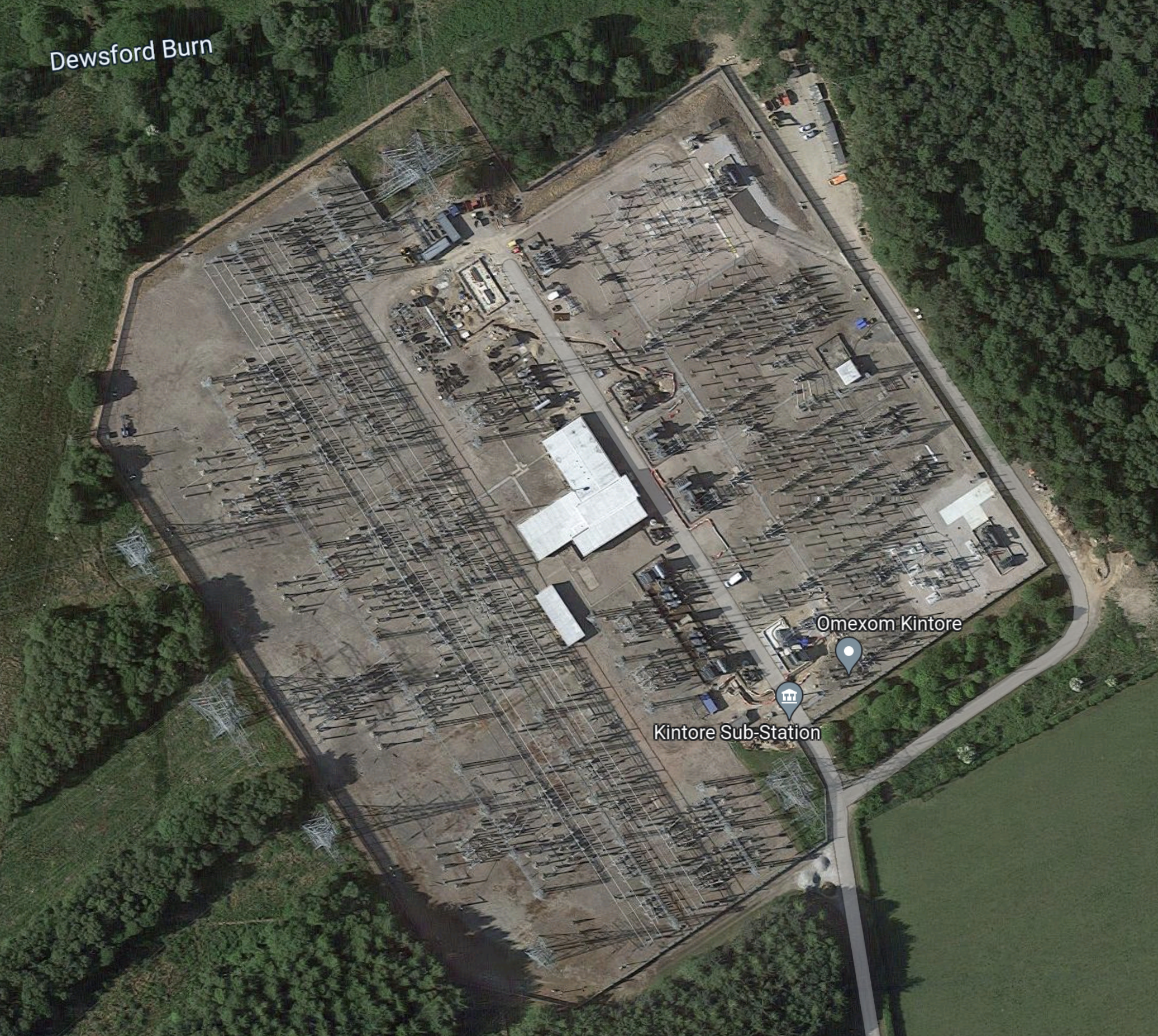
As this substation features on the home page of Kintore Hydrogen’s informative web site, I would assume, the electrolyser will be built nearby.
Statera’s web site is also informative.
This is the second heading.
Carlton Power receives UK government backing for three green hydrogen projects
These two paragraphs outline the projects.
Energy infrastructure development company Carlton Power has received UK government backing for three green hydrogen projects in Greater Manchester, Cumbria and Devon.
The backing has been received via the first round of the government’s Hydrogen Business Model (HBM)/Net Zero Hydrogen Fund process, which is worth up to £240 million. Around 15 projects in total will receive financial backing via this allocation.
The three projects will have a total capacity of 240 MW.
This article is very much one to read fully and thoroughly.
These are my thoughts.
Hydrogen Will Be Used To Bring Energy South From Scotland
This is part of a quote from Statera’s Managing Director.
The use of green hydrogen in the project has various perks. Firstly, it will utilise excess green energy that is generated from the vast Scottish wind sector and thus provide an additional basis to decarbonise sectors.
In doing so, Statera has said this will reduce the need for more costly transmission grid reinforcements to convey excess electricity in Scotland to other parts of the UK – in particular large industrial clusters.
Extracting Hydrogen From The Hydrogen/National Gas Blend
It’s all very well bringing the hydrogen South from Scotland blended with natural gas in the existing gas network, but how do you deliver pure hydrogen to those that need it?
In New Device Separates Hydrogen From Natural Gas When The Two Gases Are Blended In Pipelines, I wrote about such a device that has been developed by HyET Hydrogen in the Netherlands.
It is claimed to be silent and to create 99.9 % pure hydrogen.
Conclusion
This is an important milestone in cutting the UK’s carbon emissions.
Largest Offshore Wind Project In UK Reaches Development Milestone
The title of this post, is the same as that of this article on offshoreWIND.biz.
This is the sub-heading.
An application to build the up to 4.1 GW Berwick Bank, the UK’s largest offshore wind farm, capable of providing enough electricity to power more than five million homes, has commenced determination, SSE Renewables said.
These two paragraphs outline the current status of the project.
Located roughly 38 kilometers off the East Lothian coast of Scotland, Berwick Bank is the largest offshore wind farm planning application to be submitted in the UK to date and one of the largest globally.
The consent process for the onshore elements of the project has now opened, which is being considered by East Lothian Council.
This process runs alongside the offshore consent process, which kicked off in December 2022 and is being considered by the Scottish Government. A final decision by authorities is expected later in 2023.
SSE Renewables hope to deliver first power by 2027.
Centrica And UK Infrastructure Bank Announce Significant Investment Into Sustainable Electricity Funds
The title of this post is the same as that of this press release from Centrica.
This is the sub-heading.
Funds set to help supercharge UK’s transition to cleaner, greener energy
These four paragraphs outline the investment.
Centrica and UK Infrastructure Bank have today announced they are investing up to £265 million in sustainable energy storage to help drive the country’s transition to a cleaner, greener and more resilient electricity network.
The proposed investment will support the development of new energy storage, following the Bank’s expression of interest to find innovative ways to fund and increase the nation’s storage capacity.
The Bank will invest £75 million on a match funding basis into the Gresham House Secure Income Renewable Energy & Storage LP (SIRES) alongside a £65 million investment from Centrica.
UK infrastructure Bank has committed to invest £125 million on a match-funding basis into Equitix UK Electricity Storage Fund.
Note.
- Centrica describes itself on its web site, as an energy services and solutions company.
- The Wikipedia entry for the UK Infrastructure Bank, says it is a British state-owned development bank.
- The Equitix web site has a mission statement sating it is a responsible investor, investing in, developing and managing global infrastructure assets, which materially contribute to the lives of the communities they serve.
By supporting two energy storage funds, it is to be hoped that more electricity storage is added to the UK electricity network.
This is a paragraph in the press release.
Currently National Grid forecasts show that up to 29 GW of total storage could be needed by 2030 and up to 51 GW by 2050. This is a huge increase on the 5 GW currently available and means there is a clear need to accelerate deployment of capital and investment in new storage projects.
I doubt there will be any problems deploying new energy storage.
The press release then has a paragraph on what each fund will do with the money.
Gresham House Secure Income Renewable Energy & Storage LP (SIRES)
I will pick these important points from the paragraph.
- Centrica and the UK Investment Bank will invest on a matched funding basis.
- Centrica will be a cornerstone investor, and this marks the first time the business has invested in such a fund.
- Collocation of renewable generation and short duration electricity storage facilities to help maximise grid connections.
- The seed asset will be a collocated solar and battery energy storage project in Hartlepool, County Durham, with 50 MWp solar capacity and 75 MWh of battery energy storage.
- Centrica will seek to provide a route-to-market for the assets in the fund once they become operational.
You could almost consider this a When the wind doesn’t blow and the sun doesn’t shine fund.
Equitix UK Electricity Storage Fund
I will pick these important points from the paragraph.
- The Bank will support the launch of the fund by committing to invest up to £125million on a match-funding basis.
- The fund will focus on a combination of innovative business models across both short and long duration storage. Short duration strategies may include installation in households and at underutilised commercial premises, as well as co-location.
- The fund will also aim to deploy a range of long duration storage technologies, such as pumped-hydro.
Does a range of technologies mean that they will support new storage technologies?
Hulam Farm, Hartlepool
This page on the Lightsource-BP web site is entitled Proposed Solar Installation At Hulam Farm.
This is the first paragraph.
The proposal involves Lightsource bp funding the development of a solar installation that will connect into the local electricity network, with an output power capacity of 49.9MW (Megawatts).
Could this be the solar part of the Hartlepool project mentioned in the press release?
- Lightsource BP are experienced funders of solar farms.
- Gresham House have built many batteries of the size needed.
- I don’t think technically, there will be too many problems.
I shall watch this development with interest.
What’s In It For Centrica?
I have to ask this question.
Consider.
- Centrica is part-owner of the 270 MW Lincs offshore wind farm, which was commissioned in September 2013.
- Centrica is half-owner of the 194 MW Lynn and Inner Dowsing wind farm, which was commissioned in March 2009.
- Both these wind farms have separate substations in Lincolnshire.
- Centrica also have interests in two onshore wind farms in Scotland, that have a combined capacity of 98 MW.
I wonder how many times these wind farms have been shut down because of too much electricity?
Will Gresham House pit batteries on these sites?
UK Launches GBP 160 Million Floating Wind Funding Round, Industry Not Satisfied With Investment
The title of this post, is the same as that of this article on offshoreWIND.biz.
This is the sub-heading.
The UK Government has announced that up to GBP 160 million in grant funding will be made available for certain investments for the floating offshore wind sector
These three paragraphs outline the scheme,
The Department of Energy Security and Net Zero (DESNZ) has established the Floating Offshore Wind Manufacturing Investment Scheme (FLOWMIS) to distribute GBP 160 million in funding to support critical port infrastructure that could enable the delivery of floating offshore wind.
Through this scheme, the government hopes to enable the delivery of the country’s 5 GW 2030 deployment ambition by securing additional suitable port capacity necessary to scale up and accelerate floating offshore wind deployment in the UK, as well as to increase capability in the UK floating wind supply chain, drive cost reduction, and the commercialisation of floating offshore wind technology.
In addition, the government hopes that this scheme will deliver industrial growth and associated regional economic and social benefits (for example, quality jobs and increased GVA).
Note.
- The scheme is called FLOWMIS.
- It seems to be geared to improve port infrastructure.
- It looks like some of these projects will be needed to support ScotWind and INTOG.
- This page on the Government web site, gives the latest state of FLOWMIS.
FLOWMIS could bring forward some interesting projects.

