Wrightbus: Ballymena Company Gets Order For 117 Buses
The title of this post, is the same as that of this article on the BBC.
This is the sub-heading.
County Antrim firm Wrightbus has secured a £25.3m order to build 117 zero-emission buses for use in England
And this is the first paragraph.
Operated by First Bus, the vehicles will be used in Yorkshire, Norfolk, Portsmouth and Hampshire.
They don’t say, whether the buses are battery or hydrogen powered.
TfL Considers Replacing Over Half Of London Overground Trains Within The Next 4 Years
The title of this post, is the same as that of this article on MyLondon.
This is the sub-heading.
The trains were specially built for the dimensions of the Overground network
This paragraph outlines, why the trains may be replaced.
The 57 Class 378 ‘Capitalstar’ trains which provide the majority of services on London Overground could disappear as soon as June 2027, as Transport for London (TfL) officials decide what to do with them as their leases expire. The five carriage walkthrough trains have helped revolutionise the Overground network, being built to special dimensions to fit the unique profile of the suburban routes they run on – notably the East London line, where trains use the narrow single-bore Thames Tunnels.
Note.
- The Class 378 trains, which I use regularly, still seem to be performing well!
- They could do with a lick of paint and a tidying up in places.
- Would it be too much to ask for power sockets and wi-fi?
- The other London Overground trains, the Class 710 trains can’t run through the Thames Tunnel on the East London Line, as they have no means to evacuate passengers in the tunnel in an emergency.
- More Class 378 trains are needed for the East London Line to increase services, but these can be obtained by transferring trains from the North London Line and replacing those with new Class 710 trains.
I live near the two Dalston stations on the London Overground and the thing we need most is more capacity.
I have some thoughts on London Overground’s future trains.
Increased Services On The Current Network
Plans exist to increase the frequency on various London Overground services and this graphic sums up what was planned a few years ago.
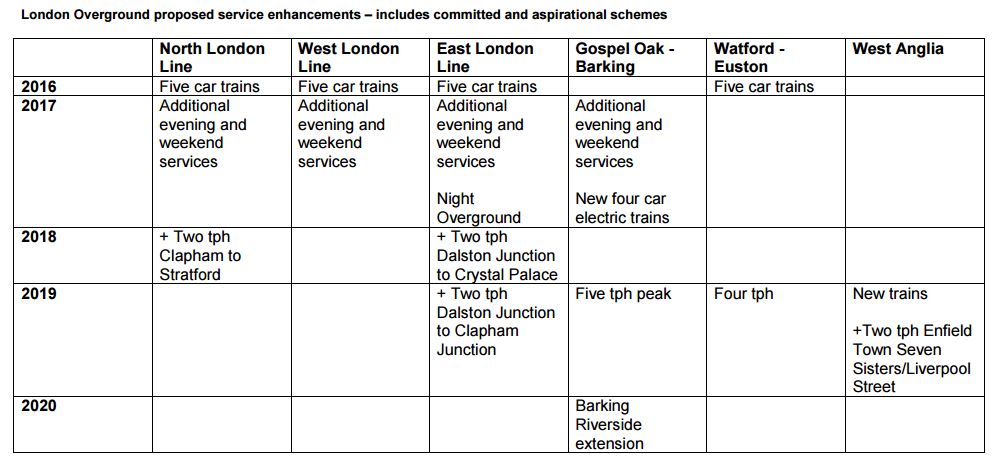
Note the extra two trains per hour (tph) between the following stations.
- Clapham Junction and Stratford
- Dalston Junction and Crystal Palace
- Dalston Junction and Clapham Junction
- Enfield Town and Liverpool St. via Seven Sisters
I think only Route 1 services have been increased.
I know signalling updates are holding up the extra trains on the East London Line, but are more trains needed to fully implement the extra services?
- Routes 2 and 3 services will need Class 378 trains because of the tunnel and these would be transferred from the North London Line.
- Route 4 would need Class 710 trains, as the service already uses them.
So there may be a need for more Class 710 trains.
West London Orbital Railway
The graphic doesn’t mention the West London Orbital Railway.
- There would be two routes between West Hampstead and Hounslow and Hendon and Kew Bridge using the Dudding Hill Line.
- The tracks already exist.
- Some new platforms and stations would be needed.
- The route would probably need improved signalling.
- Four tph on both routes would probably be possible.
- The West London Orbital Railway would connect to the Great Western Railway, the North London and Elizabeth Lines and High Speed Two at Old Oak Common station.
I believe it could be run by battery-electric versions of either the Class 378 or Class 710 trains. This would avoid electrification.
As some commentators have suggested that the West London Orbital Railway and the Gospel Oak and Barking Line would be connected, I would expect that new battery-electric Class 710 trains would be used.
Adding On-board Energy Storage To The Class 378 Trains
In Will London Overground Fit On-board Energy Storage To Class 378 Trains?, I asked whether it would be worthwhile.
I finished with these two sentences.
I have no idea how much electricity would be saved by regenerative braking on the London Overground, but various applications of regenerative braking technology talk of electricity savings of between ten and twenty percent.
I think it is only a matter of time before the technology is proven to be sufficiently reliable and the numbers add up correctly for the Class 378 trains to be fitted with on-board energy storage.
What would be the advantages from fitting on-board energy storage?
- There would be the savings of electricity by the use of regenerative braking to the batteries.
- Trains could be rescued from the Thames Tunnel, if there was a power failure.
- Hotel power would be maintained, if there was a power failure.
- Trains can be moved in depots and sidings without power.
- Trains would be able to move in the event of cable theft.
- Short route extensions might be possible.
- Could battery power be used to serve Euston during the rebuilding process for High Speed Two?
- Do Network Rail want to remove third-rail electrification from Euston station for safety or cost reasons?
There could be a saving in train operating costs.
We know the trains are coming up for a new lease.
Suppose the leasing company fitted them with new batteries and some other customer-friendly improvements like new seat covers, better displays, litter bins, power sockets and wi-fi.
- The leasing company would be able to charge more, as they have added value to the trains.
- TfL would be saving money due to less of an electricity bill.
- The passenger numbers might increase due to the extra customer-friendly features.
- Electrification might be removed from places where theft is a problem.
- Third-rail electrification could be removed from Euston station. It’s only 2.8 miles to South Hampstead station, where third-rail electrification already exists.
Get it right and passengers, TfL, Network Rail and the leasing company would all be winners.
TfL’s First Brand New £8million DLR Train Trashed And Covered In Graffiti At London Depot
The title of this post, is the same as that of this article on MyLondon.
This is the sub-heading.
Not a single passenger has even been able to ride the new train yet, but it has already been entirely tagged with graffiti
This is so sickening.
Transport for London, must have known the train was a target after what happened to Merseyrail’s first Class 777 train whilst it was parked up in Tonbridge on the way to Liverpool, according to this article in the Liverpool Echo.
It should be noted that Liverpool’s trains, don’t suffer from these morons in the city and even their forty-year-old Class 508 trains are untouched.
Conclusion
Where were the Police?
First-Of-Its-Kind Electriq Powder Manufacturing Plant To Be Built In Amsterdam
The title of this post, is the same as that of this article on Hydrogen Fuel News.
This is the sub-heading.
The powder plant can provide a safe end-to-end hydrogen solution.
The home page of their web site has this bold statement.
Meet the Safe & Practical Hydrogen Powder
Underneath is this explanation.
Electriq is a hydrogen carrier that acts like coffee powder for a coffee machine – simplifying storage, transport, and use of hydrogen in off-grid applications and long-term storage.
Similar processes have been proposed for hydrogen in the past, but no-one has compared them to coffee before.
This Technology page gives a lot more details.
These two paragraphs outline the chemistry used.
Electriq’s Fuel and Release technologies turn hydrogen into a coffee-like powder form, then back into electricity through a proprietary catalyst and release system.
Our hydrogenation process reacts hydrogen gas with KBO2 to produce a powdery coffee-like compound (KBH4), ready for easy storage and transportation. Our dehydrogenation process releases the hydrogen – and KBO2 as a by-product – thus forming a full cycle.
The Electriq Release system uses a proprietary catalyst to release hydrogen from the Electriq Fuel, after mixing it with water. The dehydrogenation (release) process provides fuel-cell grade hydrogen and zero-emissions electricity.
Note.
- KBO2 is a chemical compound formed of one potassium, one boron and two oxygen atoms.
- KBH4 is a chemical compound formed of one potassium, one boron and four hydrogen atoms.
- As is with often the case with these processes, It appears that there may be a clever catalyst doing some hard work.
The Technology page finishes with a comparison with other methods of transporting hydrogen.
This Press & Insights page has more information on the company and some interesting videos.
It would certainly be something new, if you filled up your electric bike with a canister of dry powder.
But they have a video of that!
We’re Increasing Capacity At Oxford Station To Accommodate Additional Services From 2024
The title of this post, is the same as that of this news item on the Network Rail web site.
This is the sub-heading.
The rail infrastructure in the Oxford Station area is close to full capacity and currently wouldn’t support the start of East West Rail services from the end of 2024. Through Oxfordshire Connect, the station is being expanded and the wider area upgraded, bringing a range of benefits to passengers and residents alike.
I have a few thoughts,
East West Rail Services
East West Rail is aiming to get these services up and running. for Phase 2 of the project.
- Oxford and Milton Keynes Central via Oxford Parkway, Bicester Village, Winslow and Bletchley – two trains per hour (tph)
- Oxford and Bedford via Oxford Parkway, Bicester Village, Winslow, Bletchley, Woburn Sands and Ridgmont – one tph
- Aylesbury and Milton Keynes Central via Aylesbury Vale Parkway, Winslow and Bletchley – one tph.
I suspect not all services will be delivered by the end of 2024. But extra platforms may be needed at Oxford station to accommodate services on East West Rail.
Direct Services Between Oxford And London
There are two direct services in each hour, between Oxford and London Paddington.
- One service terminates at Oxford and the other service terminates at either Great Malvern, Hereford or Worcester.
- Both services stop at Slough and Reading.
- Both services are run by Class 800 electro-diesel trains.
Distances without electrification are as follows.
- Hereford – 96.9 miles
- Great Malvern – 76.1 miles
- Worcester Shrub Hill – 67.6 miles
- Oxford – 10.5 miles
Hitachi are developing a series of battery-electric Intercity trains, which I described in Hitachi Rail And Angel Trains To Create Intercity Battery Hybrid Train On TransPennine Express.
This Hitachi infographic shows the Hitachi Intercity Battery Hybrid Train.
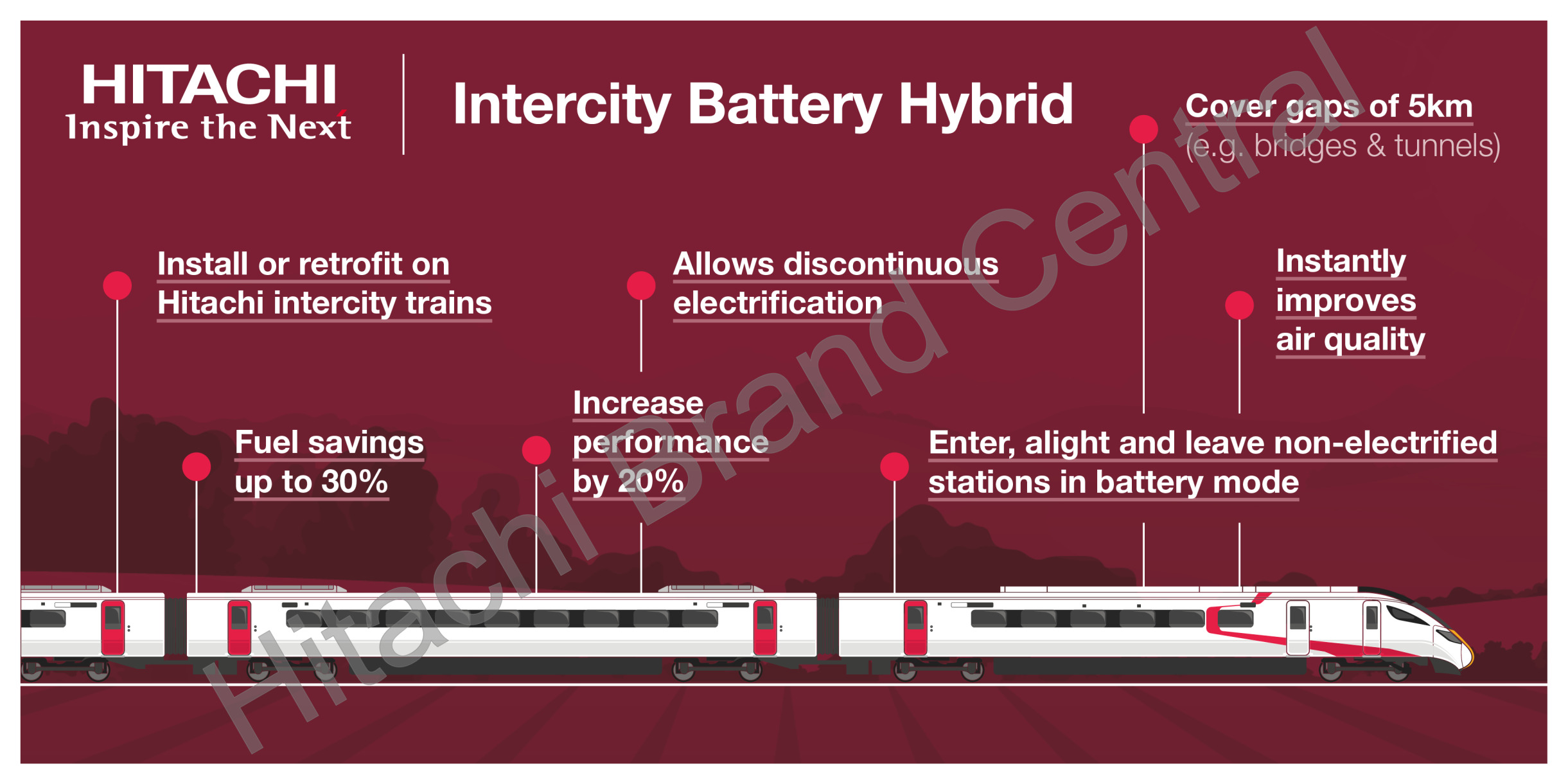
And this Hitachi infographic shows the Hitachi Intercity Battery Hybrid Train.

It looks to me, that one or both of these trains could work some or all of the the four routes to and through Oxford.
A battery train with a range of 21 miles would certainly be able to go between Paddington and Oxford, with battery charging to the East of Didcot.
These trains could be running services by the end of 2024.
Could The Fenchurch Street And Grays Service Be Handed Over To The Elizabeth Line?
Before I discuss the suggestion in the title of this post, I will write down some thoughts.
The Capacity And Connection Problems At Fenchurch Street Station
If you read the Wikipedia entry for Fenchurch Street station, this paragraph sums up some of the problems of the station.
Fenchurch Street is one of the smallest railway terminals in London in terms of platforms, but one of the most intensively operated. It is the only London terminal with no direct interchange with the London Underground. Plans to connect it stalled in the early 1980s because of the lack of progress on the Jubilee line, but it is close to Tower Hill on the Underground and to Tower Gateway on the Docklands Light Railway.
I live in Dalston and if I want to use the services out of Fenchurch Street station to get anywhere it is a struggle.
As all services out of Fenchurch Street station stop at Limehouse, West Ham and Barking stations on the approach into London, I will usually go via either West Ham or Barking stations. As the three services out of Fenchurch Street are each two trains per hour (tph), this can mean a near-thirty minute wait at either West Ham or Barking stations, which at some times of the year are not the most customer-friendly of stations.
More services out of Fenchurch Street station would help to ease the problem, but the station is at capacity and nothing short of a complete rebuild of the station will solve the problems the capacity and connectivity..
There is a section called Future in the Wikipedia entry, where this is said.
There have been proposals to move the station 380 yards to the east to allow the station to expand to 6 platforms, (up from the current 4) and would be built partly on the site of Tower Gateway DLR station, which would likely be permanently closed.
The new station could be built with direct interchange with Tower Hill tube station, which could also have a replacement DLR station for Tower Gateway as Transport for London have looked into closing Tower Gateway and constructing a replacement on the Bank branch to increase capacity.
This project sounds like it would take a long time and cause a lot of disruption and inconvenience. But it would add capacity and connectivity.
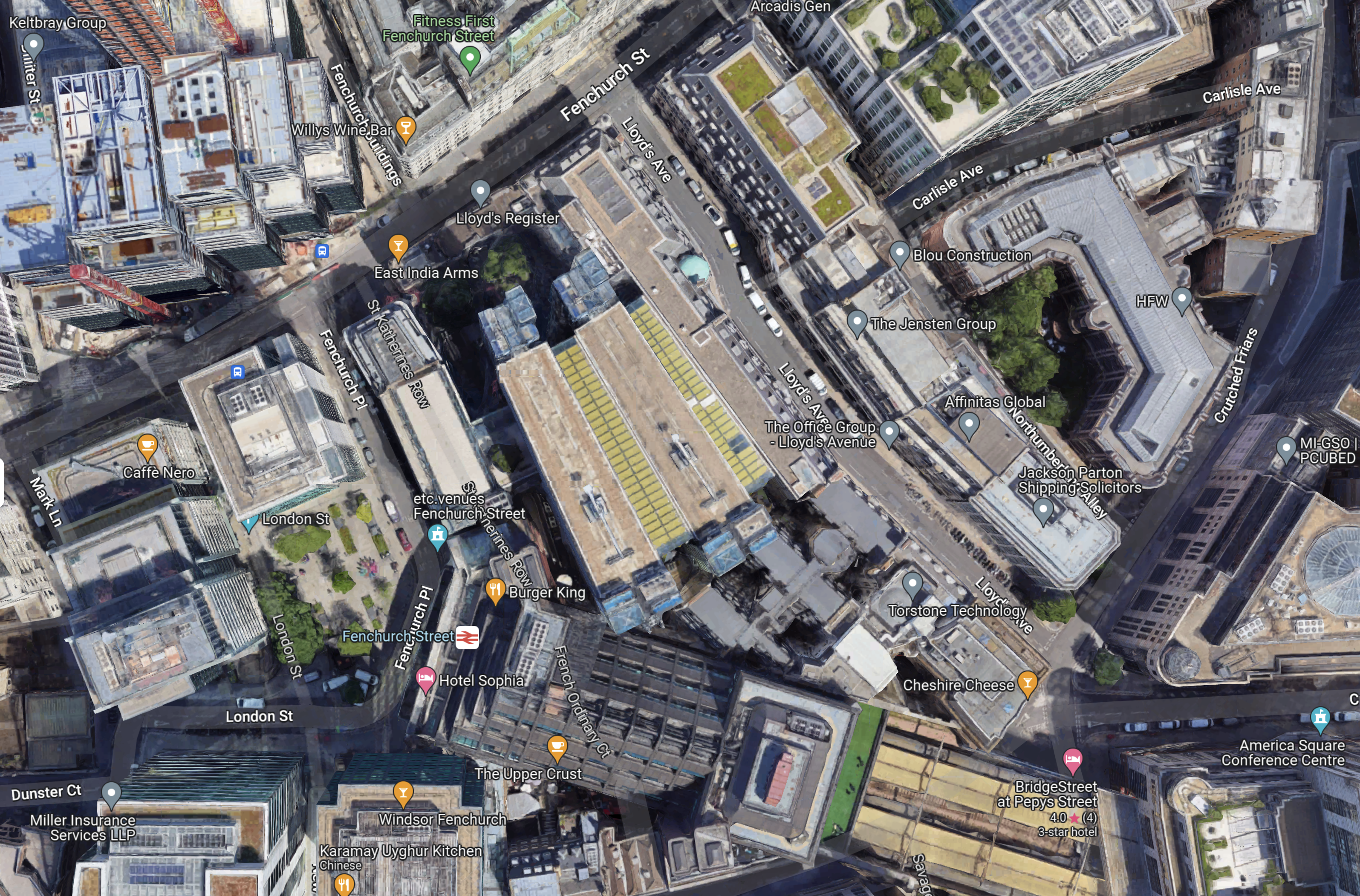
This Google Map shows the location of the station.
Note.
- Fenchurch Street station is towards the bottom of the map in the centre.
- It is completely hemmed in by buildings.
- There is just a small square in front.
I feel it would be very difficult to rebuild a larger station in the same place.
Services Into Fenchurch Street Station
Currently, there are three services into Fenchurch Street station.
- Fenchurch Street and Shoeburyness via Limehouse, West Ham, Barking, Upminster, West Horndon, Laindon, Basildon, Pitsea, Leigh-on-Sea, Chalkwell, Westcliff, Southend Central, Southend East and Thorpe Bay.
- Fenchurch Street and Southend Central via Limehouse, West Ham, Barking, Upminster, Ockendon, Chafford Hundred Lakeside, Grays, Tilbury Town, East Tilbury, Stanford-le-Hope, Pitsea, Leigh-on-Sea, Chalkwell and Westcliff
- Fenchurch Street and Grays via Limehouse, West Ham, Barking, Dagenham Dock, Rainham and Purfleet.
Note.
- All services are two tph.
- All services call at Limehouse, West Ham and Barking.
Each station gets the following frequency of trains.
- Barking – 6 tph
- Basildon – 2 tph
- Benfleet – 2 tph
- Chafford Hundred Lakeside – 2 tph
- Chalkwell – 4 tph
- Dagenham Dock – 2 tph
- East Tilbury – 2 tph
- Grays – 4 tph
- Laindon – 2 tph
- Leigh-in-Sea – 4 tph
- Limehouse – 6 tph
- Ockendon – 2 tph
- Pitsea – 4 tph
- Purfleet – 2 tph
- Rainham – 2 tph
- Southend Central – 4 tph
- Southend East – 2 tph
- Stanford-le-Hope – 2 tph
- Thorpe Bay – 2 tph
- Tilbury Town – 2 tph
- Upminster – 4 tph
- Westcliff – 4 tph
- West Ham – 6 tph
- West Horndon – 2 tph
c2c would appear to be offering a service, that is well-balanced about the stations it serves.
Can Elizabeth Line Trains Reach Barking?
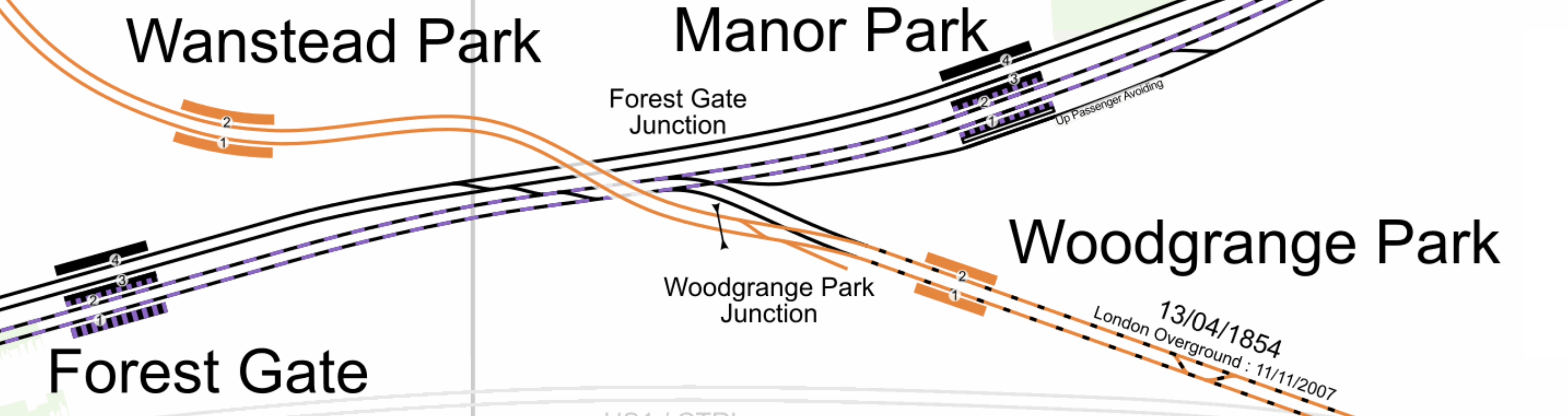
This map from cartometro.com shows Woodgrange Park junction, where the Gospel Oak and Barking Line crosses over the Great Eastern Main Line.
Note.
- The Gospel Oak and Barking Line is shown in orange.
- Gospel Oak station is to the North-West and Barking is to the South-East.
- The Elizabeth Line tracks are shown with a dash of purple.
- It looks to me, that a train on the Elizabeth Line going East could come through Platform 2 in Forest Gate station and then take the Gospel Oak and Barking Line through Platform 2 at Woodgrange Park station.
- It also looks as if trains could go through Platform 1 at both Woodgrange Park and Forest Gate stations to go West on the Elizabeth Line.
I don’t know whether they still do, but c2c trains used to use Woodgrange Park junction to access Liverpool Street station, when Fenchurch Street was closed or at weekends.
At Barking station, they would take the flyover over the station call in Platforms 7 and 8 in the station.
From the Eastern ends of Platforms 7 and 8, trains can use one of three routes.
- The London Overground route to Barking Riverside station.
- The c2c route to Grays via Purfleet.
- The c2c route to Upminster.
Note.
- The platforms at Barking Riverside station are probably too short for the Elizabeth Line trains.
- The Class 345 trains would fit into the bay platforms at Grays and Southend Central.
The simplest thing to do would probably be to divert the two tph between Fenchurch Street and Grays to either Liverpool Street or Paddington at the London end.
Each station would now get the following frequency of trains.
- Barking – 6 tph
- Basildon – 2 tph
- Benfleet – 2 tph
- Chafford Hundred Lakeside – 2 tph
- Chalkwell – 4 tph
- Dagenham Dock – 2 tph
- East Tilbury – 2 tph
- Grays – 4 tph
- Laindon – 2 tph
- Leigh-in-Sea – 4 tph
- Limehouse – 4 tph
- Ockendon – 2 tph
- Pitsea – 4 tph
- Purfleet – 2 tph
- Rainham – 2 tph
- Southend Central – 4 tph
- Southend East – 2 tph
- Stanford-le-Hope – 2 tph
- Thorpe Bay – 2 tph
- Tilbury Town – 2 tph
- Upminster – 4 tph
- Westcliff – 4 tph
- West Ham – 4 tph
- West Horndon – 2 tph
Only Limehouse and West Ham would get fewer trains.
But there would surely, be an extra pair of paths between Fenchurch Street and Barking.
I have also looked at trains through Pitsea, Upminster and Westcliff it appears that nearly all of the traffic is c2c’s passenger trains.
So would it be possible, with perhaps improved signalling to add an extra two trains between Fenchurch Street and Shoeburyness?
Each station would now get the following frequency of trains.
- Barking – 8 tph
- Basildon – 4 tph
- Benfleet – 4 tph
- Chafford Hundred Lakeside – 2 tph
- Chalkwell – 6 tph
- Dagenham Dock – 2 tph
- East Tilbury – 2 tph
- Grays – 4 tph
- Laindon – 4 tph
- Leigh-in-Sea – 6 tph
- Limehouse – 6 tph
- Ockendon – 2 tph
- Pitsea – 6 tph
- Purfleet – 2 tph
- Rainham – 2 tph
- Shoeburyness – 4 tph
- Southend Central – 6 tph
- Southend East – 4 tph
- Stanford-le-Hope – 2 tph
- Thorpe Bay – 2 tph
- Tilbury Town – 2 tph
- Upminster – 4 tph
- Westcliff – 6 tph
- West Ham – 6 tph
- West Horndon – 4 tph
More stations are getting four and six tph.
Conclusion
There are certainly possibilities to improve c2c by running services on the Elizabeth Line route.
9 Energy, House And Rail Projects Planned For Norfolk
The title of this post, is the same as that of this article on the Eastern Daily Press.
The article is a survey of major projects across Norfolk.
Projects in the article with my thoughts will now be detailed.
Railway Village
This is described as follows in the article.
Plans to build a new 5,000-home town north of Dereham could take a significant step forward in 2023.
The proposals have been dubbed a ‘railway village’ and would lie close to the Mid Norfolk Railway at North Elmham.
The 1,278-acre site has been put forward by its owners as a potential area for development included in Breckland Council’s forthcoming local plan – a document detailing how the district should grow over the next two decades.
This map from OpenRailwayMap shows North Elmham and the Mid-Norfolk Railway.
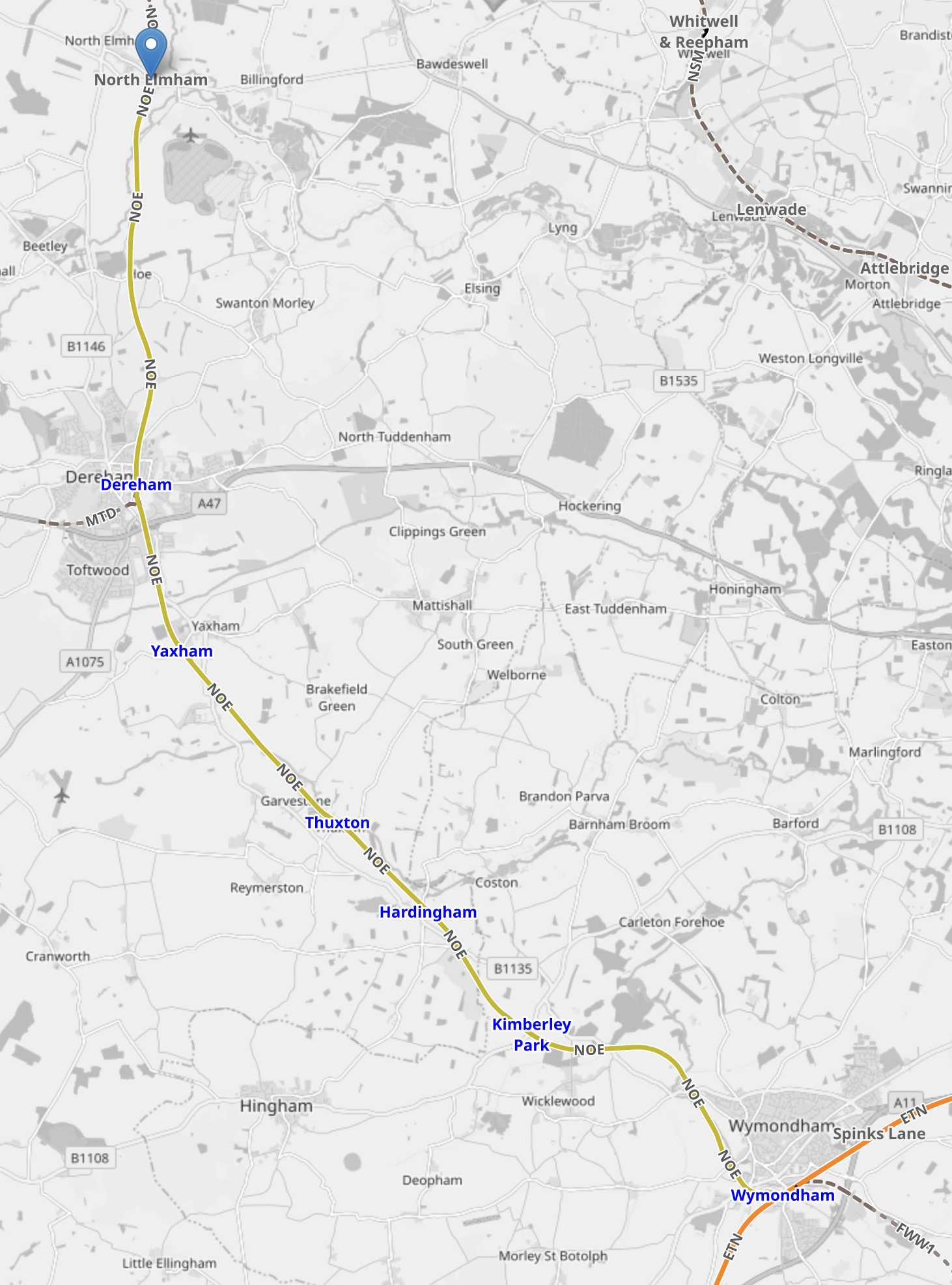
Note.
- The yellow line is the Mid-Norfolk Railway.
- The site of the former North Elmham station is shown by the blue arrow at the top of the map.
- The orange line across the South-East corner of the map is the Breckland Line between Cambridge and Norwich.
- Wymondham station is on the Breckland Line, but trains between the Mid-Norfolk Railway and Norwich would be able to call at Wymondham station.
Wymondham station could be converted into a proper connection between the Breckland Line and the Mid-Norfolk Railway, with services being run between Norwich and North Elmham via Dereham.
In the Wikipedia entry for the Mid-Norfolk Railway, there is a section, which is entitled Community Railway, where this is the first paragraph.
The Mid-Norfolk Railway was established as a multi-functional line, with an intention to operate a community service in addition to tourist and freight services. The railway has also stated their belief that a commuter service between Dereham and Norwich remains a viable proposition, with the MNR either running the service themselves or working with an existing train operator. One obstacle on the MNR to running such services is the requirement to operate five manual gated level crossings between Dereham and Wymondham, although level crossing automation is a possibility in the future.
Later the section indicates that the Mid-Norfolk Railway could be extended to Fakenham.
This map from OpenRailwayMap shows the original route between North Elmham and Fakenham.
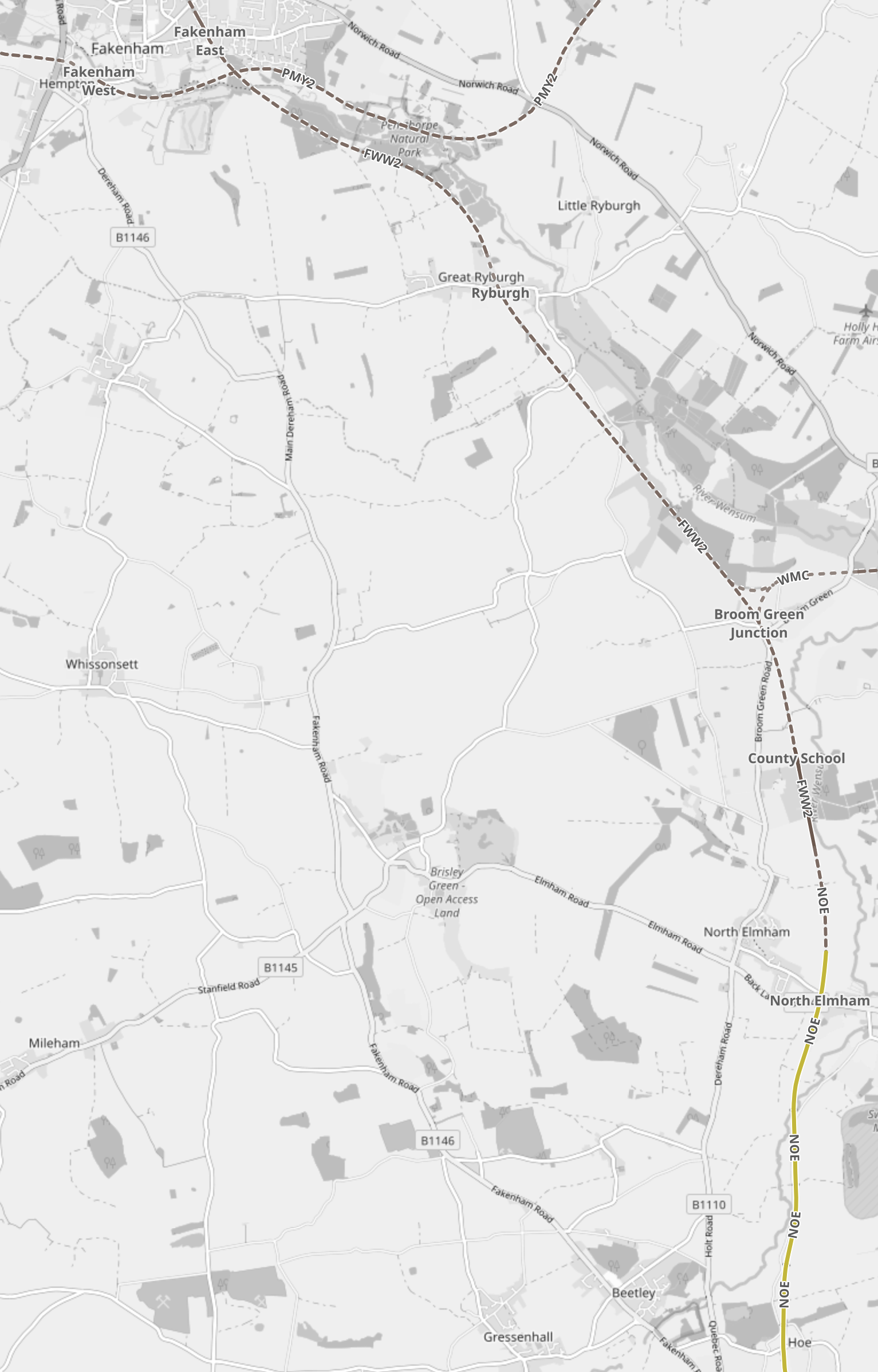
Note.
- The yellow line is the Mid-Norfolk Railway.
- North Elmham station is at the top of the yellow.
- Fakenham is at the top of the map.
Adding Fakenham to the passenger service from Norwich would surely increase its viability.
There have been ambitions in the past to create a Norfolk Orbital Railway, that would connect the National Rail stations at Sheringham and Wymondham, using the tracks of the North Norfolk Railway and Mid-Norfolk Railway, and some new and relaid track.
This map from OpenRailwayMap shows North Norfolk from Fakenham and North Elmham in the West to Sheringham in the East.

Note.
- Fakenham is on the Western edge of the map about halfway up.
- North Elmham is in the South-West corner of the map, on the yellow line, what indicates the Mid-Norfolk Railway.
- The railway shown in the North-West corner is the Wells and Walsingham Light Railway. which is a 260 mm. gauge railway.
- Sheringham station, which has an hourly service to Norwich via Cromer, is in the North-East corner of the map.
- The Eastern terminus of the North Norfolk Railway is a short walk from Sheringham station.
- The blue arrow to the West of Sheringham station, indicates the Western terminus of the North Norfolk Railway at Holt station.
The Norfolk Orbital Railway would need to connect Fakenham and Holt, which doesn’t appear to be easy.
But if the connection could be made, Greater Anglia could run a combined service around the county, which would allow those living in the houses at North Elmham to get easily to the coast or the City of Norwich.
Wash Barrage
This is described as follows in the article.
A bid to build a tidal barrage stretching from Norfolk to Lincolnshire was unveiled at the end of last year.
While the scheme has seen objections from conservation groups, proponents say it would help protect the Fens from flooding, generate tidal power and would allow a new deep-sea container port to be built.
A planning application has yet to be submitted for the scheme, which Centre Port, the group behind the proposal, said could be operational by the end of the decade if given the go-ahead.
The Wash Barrier has a web site, but I doubt the RSPB will like it.
New Reservoir
The article says that the proposed site is between Chatteris and March in Cambridgeshire.
Long Stratton Bypass
This is described as follows in the article.
The Long Stratton Bypass has been mooted for decades and finally looked like it was going to get underway after funding was approved in 2021.
The scheme will mean motorists can avoid passing through the centre of the town.
It was needed, when C regularly commuted to Norwich in the 1980s.
Norwich Western Link
This is described as follows in the article.
The flagship infrastructure project has been thrown into doubt after County Hall announced an indefinite delay earlier this month.
The 3.9-mile road is designed to link the A47 with the NDR to the west of the city and has been hailed as a council priority for several years.
Climate protestors are mounting a High Court challenge.
Windfarms
These are described as follows in the article.
There are a series of major windfarms planned for the Norfolk coast.
These include Swedish energy giant Vattenfall’s Boreas and Vanguard projects, which could be some of the largest in the world.
The company was granted development consent for its Norfolk Vanguard windfarm in 2022, pledging to get underway early this year.
The two schemes could power more than 3.9m homes in the UK.
Hornsea Three, another major scheme which could power another 3.2m homes, is set to start being built in March.
Note.
- The author missed out the Sheringham Shoal and Dudgeon Extension windfarms.
- Total wind power that will be developed is around 6 GW, which would supply around a quarter of the UK.
The only problem is that Norfolk is protesting against the cables to connect the wind farms to the National Grid.
I suspect they will have to be put under the sea. I wrote about this in Is There A Need For A Norfolk-Suffolk Interconnector?
New Rail Junctions
The problems around Ely station are described as follows in the article.
A key rail junction, which could help to boost growth across the region, could steam ahead this year.
Ely Junction is important because it links five lines connecting Norwich, Ipswich, Cambridge, Peterborough and King’s Lynn.
It is currently operating at full capacity, which limits the opportunity for growth of routes for passenger and cross-country freight services.
It would also enable more frequent passenger services, including between King’s Lynn and London.
An outline business case was submitted to the Department for Transport last year to seek money for the next stage of the design process – but the government has yet to make a decision.
There are also problems at Haughley Junction.
Hospitals Rebuild
The article also puts the case for developing both King’s Lynn and Great Yarmouth hospitals.
Conclusion
Norfolk is going to be busy.
Five New Railway Stations Considered For West Midlands
The title of this post, is the same as that of this article on Rail Advent.
This is the first paragraph.
Transport authorities in the West Midlands are considering the case for building five new stations at Balsall Heath, Coventry East (Binley), Foleshill, Castle Bromwich and Tettenhall.
The location of the stations is as follows.
- Balsall Heath station is on the Camp Hill Line and was formerly known as Brighton Road station, which was shut in 1941 as a wartime economy measure.
- Castle Bromwich station, will be between Birmingham and Water Orton.
- Coventry East station will be on the main line between Coventry and Rugby.
- Foleshill station will be on the Coventry-Nuneaton Line, between Coventry and Coventry Arena stations.
- Tettenhall station will be to the west of Wolverhampton on the Wolverhampton Shrewsbury Line.
Note.
- Balsall Heath station would require construction of the Bordesley Chords and extra capacity at Moor Street Station.
- Coventry East station will benefit from the opening of High Speed Two, will will allow more local services.
- Castle Bromwich station would also benefit from the extra capacity from High Speed Two and the Midland Rail Hub.
Railways in Central Birmingham appear to be having a big sort out.
The article also says this about other stations, being planned in the West Midlands.
These planned new stations will add to expansion of the region’s rail network that is already underway, with new stations being built on the Camp Hill line in south Birmingham at Moseley Village, Kings Heath and Pineapple Road, and on the Walsall to Wolverhampton line serving Darlaston and Willenhall. A new station is also planned at Aldridge, with funding allocated subject to business case. The City of Wolverhampton, South Staffordshire District and Staffordshire County councils have also looked at the case for a new station at Brinsford, which will be considered alongside the case for nearby Tettenhall Station.
In the last part of the article, Andy Street talks about the funding secured.
It certainly looks like station builders in the West Midlands will have lots of work to do.
Moorgate To Charlton Via Cannon Street
I needed to go to Charlton station this morning to take a couple of photographs for a possible blog post.
- I had had my usual breakfast in LEON on Moorgate, so I started from Moorgate station.
- I took the Northern Line one stop to Bank station.
- It was then straight up the double escalators.
- I followed this by a brisk walk along Cannon Street.
The total time between entering Moorgate station and sitting on my train at Cannon Street station was about ten minutes.
One of London’s more difficult stations to access now has a North-South Underground line, to go with its East-West line.
A Quality Takeaway With A Station And A Large Garden
It was cold today and on walking from the Hanover Square entrance to Bond Street station to the Marks and Spencer store on Oxford Street, I came across this Leon, where I had a hot chocolate.


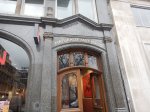
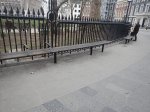
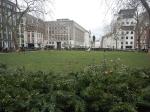

Is this the ultimate pit-stop on the Elizabeth Line?
 The Anonymous Widower