Tees Valley Wins £1.3million Project To Bring Hydrogen Vehicles To The Region
The title of this post, is the same as that as this article on the Tees Valley Combined Authority web site.
This is the introductory paragraph.
Hydrogen vehicles and refuelling stations will soon be coming to Tees Valley after it was today (February 5) announced that a £1.3million bid to Government had been successful.
The next two paragraphs give more detail.
Tees Valley Mayor Ben Houchen welcomed the result of a Government competition that will see two refuelling stations built in Middlesbrough and Redcar, plus a fleet of cars which use hydrogen technology for long-range travel (300+ miles) and fast refuelling capability.
The new refuelling stations could allow cars, buses, bin lorries and even trains to be powered by the super fuel.
This later paragraph details the expected economic benefits.
Figures from a draft report commissioned by the Combined Authority and produced by KPMG suggest that exploiting the opportunities of the hydrogen economy could add up to £7billion to the region’s economy by 2050, with the creation of as many as 1,000 jobs.
These figures seem to say hydrogen is good for the economy and jobs.
Will The Railway Between Buxton And Matlock Be Reopened?
In Issue 901 of Rail Magazine in an article about reopening the Northern route between Exeter and Plymouth, this is said, about possible rail re-opening of Beeching cuts.
Although not yet confirmed, they are believed by RAIL to include bids to reinstate the former Midland Railway route from Matlock-Buxton, and the line between Lostwithiel and Fowey.
I have found this news story on the Matlock Mercury, which is entitled Quarry Firms And Heritage Operator Consider Peak District Railway Line.
This is the introductory paragraph.
Proposals to revive a disused rail line through the Peak District have moved a step forward, but not the passenger service some have called for.
The reasons for the reinstatement are given in the story.
- There is an enormous demand for stone from projects like Crossrail 2, High Speed Two and Heathrow Expansion and Derbyshire is a major source.
- Currently, stone trains between Derbyshire and the South-East take a roundabout route via the congested and unsuitable Hope Valley Line and Sheffield.
- A route via Matlock would join the Midland Main Line nearly thirty miles further South.
It should be noted that the original track-bed still exists and part is used for the double-track Peak Rail, with much of the rest being used for the cycling and walking route; the Monsal Trail.
Thoughts About The Design Of The Railway
In the June 2017 Edition of Modern Railways, there is an excellent article, which is entitled Connecting The Powerhouses, that was written by Colin Boocock.
I wrote a post with the same name, based on his article, from which a lot of the following thoughts are taken.
Colin Boocock’s Thoughts On The Design
I said this in my previous post.
The track bed of the Peak Main Line is still intact and the author of the article suggests that there could be two ways of rebuilding the railway.
- As a 75 mph single-track railway sharing the track-bed with the Monsal Trail.
- As a 90 mph double-track railway, after moving the Monsal Trail to a more picturesque route.
Four or five, reopened or new stations could be built with passing loops to enable the minimum service frequency to be achieved, which the author suggests should be the following in both directions in every hour.
- One fast passenger train
- One stopping passenger train.
- One freight train; full or empty.
But there are possible problems.
- The A6 has to be crossed.
- One local landowner didn’t allow consultants access to the line for an inspection.
- Severn Trent Water are digging a large pipe into the track-bed.
- Peak Rail have plans to extend their heritage line to Bakewell. Could both groups co-exist?
It sounds to me that everybody should find a good hostelry and thrash out a comprehensive co-operation agreement on the backs of engineering envelopes, fuelled by some excellent real ale.
But various improvements to the route and railway technology in general, in the last few years have probably made the reinstatement less challenging.
Ambergate Station And Junction
Ambergate station and the associated junction is where trains for Matlock station, leave the Midland Main Line and take the Derwent Valley Line.
This article on the BBC is entitled Major Rail Works To Affect Derbyshire Train Services and it describes work done to improve Ambergate Junction.
It is to be hoped, that the updating of the junction is at least well-documented, so that it can be updated easily to accept stone trains to and from the Derwent Valley Line.
Improved Handling Of Freight Trains At Buxton
In £14m Peak District Rail Freight Extension Unveiled, I indicated that the improvements at Buxton had been completed.
- There are now two long sidings, that can each take a 26 wagon stone train and allow them to reverse.
- Capacity has increased by 44 %
- No more trains will be running.
According to this document on the Network Rail web site, the sidings operate on a 24 hour basis and on average, accommodate 6-10 freight trains every 24 hour period.
I’m not sure, but it looks like the sidings also allow all stone trains to access the following.
- All quarries in the area with a rail connection.
- The Great Rocks Freight Line to access the Hope Valley Line and Sheffield
- The proposed reopened rail line to Matlock, Derby and the South.
The track layout at Buxton station would appear to allow trains to go between Manchester and Derby, once the Matlock and Buxton railway is reinstated.
Ambergate Station And Junction
Ambergate station and the associated junction is where trains for Matlock station, leave the Midland Main Line and take the Derwent Valley Line.
This article on the BBC is entitled Major Rail Works To Affect Derbyshire Train Services and it describes work done to improve Ambergate Junction.
It is to be hoped, that the updating of the junction is at least well-documented, so that it can be updated easily to accept stone trains to and from the Derwent Valley Line.
Signalling Improvements
One of Colin Boocock’s options for the route, is a 75 mph single-track railway sharing the track-bed with the Monsal Trail.
Single-track railways running an intense schedule could be a challenging signalling problem in the past, but with in-cab digital signalling, as used on Thameslink and the London Underground, it is much less onerous.
It should be possible to handle Colin Boocock’s desired minimum frequency of three trains per hour (tph) in both directions.
Colin Boocock’s second option of a 90 mph double-track railway, after moving the Monsal Trail to a more picturesque route, would be very much easier to signal to a very high degree of safety.
Electrification
Electrification would surely, be the best way to get heavy freight trains in and out of the area.
But I suspect the line could not be electrified in a traditional manner, as heavy gantries in the Peak District would not go down well!
But what about a design something like this?
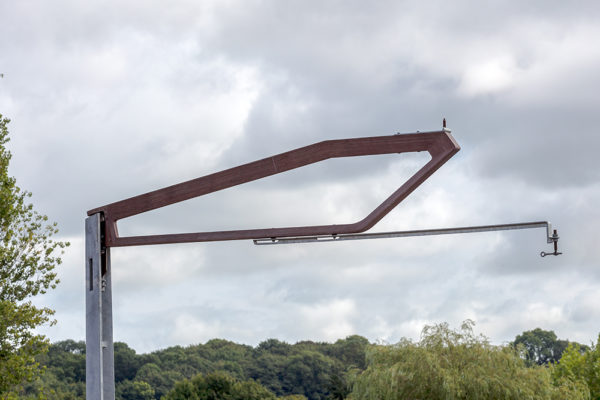
I talk about this design in Prototype Overhead Line Structure Revealed.
It does seem to be a good attempt to reduce the clutter of girders, gantries and wires!
Freight Locomotives
If electrification is not possible, which is probably the case, as the locomotives will need access to large amounts of freight sidings, then diesel power will be needed,
The current Class 66 locomotives are not the most environmentally-friendly locomotives, but hopefully in a sensitive area like the Peak District, some more advanced locomotives could be used.
Passenger Trains
Quiet battery-electric or hydrogen-powered trains would be ideal for the route.
How Many Stone Trains Will Use The Route?
With the current lockdown because of COVID-19, it’s a bit difficult to ascertain how many stone trains are currently going into and out of the quarries in an hour.
But from the Network Rail figures, I have found and Colin Boocock’s minimum figure, it looks like one tph would be a frequency for which to aim.
Could this frequency be handled between Matlock And Buxton?
Even if the route was single-track with passing loops, Colin Boocock’s minimum timetable could be achieved.
Note that the Great Rocks Freight Line will still be capable of handling trains via the Hope Valley Line and Sheffield.
Conclusion
I think that this scheme could be feasible, if engineers used modern signalling and other designs to blend in with the scenery.
Nottingham Targets Multimillion-Pound Tram Extensions
The title of this post is the same as that of an article in Issue 901 of Rail Magazine.
The Nottingham Express Transit (NET) is a quality tram system and seems to have been taken to the heart of the people of the city.
Three separate extensions are proposed.
Clifton Pastures
Clifton Pasures is a proposed development of 3,000 houses and 2,000 jobs to the South of the Clifton South Park and Ride stop on the NET.
This Google Map shows the area, bounded in the West by the A453.
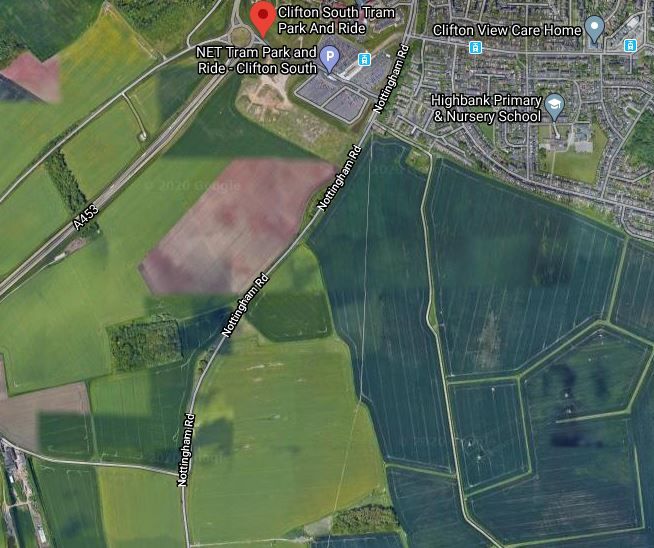
Note.
- The red arrow marks the vehicle entrance to the Park-and-Ride from the A 453.
- A short extension of the NET will be built, which has been costed at £49 million.
It looks to be a well-thought out extension.
Toton Lane Park and Ride To East Midlands Hub Station
This extension from Toton Lane Park-and-Ride stop to the East Midlands Hub station for High Speed Two was first proposed in 2015.
This Google Map shows the area.
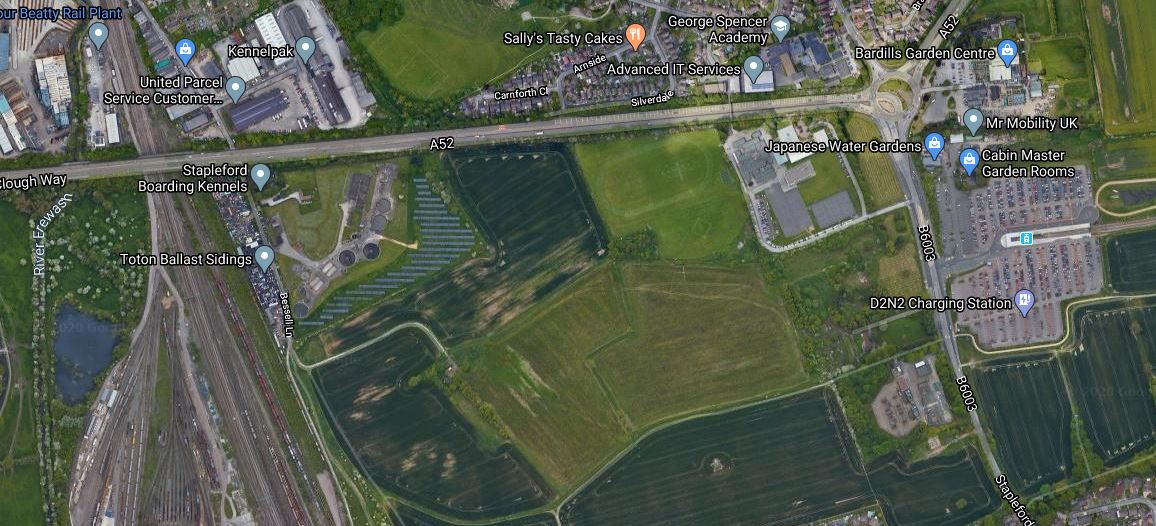
Note.
- Toton Lane Park-and-Ride is on the Eastern side of the map.
- East Midlands Hub station will be built on the Western side of the map on Toton sidings.
- It doesn’t look like there is any serious construction problems in between. There would probably be bridges or tunnels over the B6003 and the railway.
- Would the NET cross the East Midlands Hub station on a bridge at right-angles, as it does at Nottingham station?
This extension of the NET has been costed at £106 million.
The original plans discussed here in Wikipedia, envisaged continuing to Derby.
Nottingham Racecourse And Gedling
The Rail Magazine article describes this extension as follows.
The third (and the longest) proposed route would involve construction of a new route towards Nottingham’s eastern suburbs via Meadow Lane, the Cattle Market, Daleside Road and Nottingham Racecourse.
It is hoped this route could one day stretch as far as a new Park & Ride site planned near Gedling Country Park, although this is not included in the current plans.
This Google Map shows Central Nottingham.
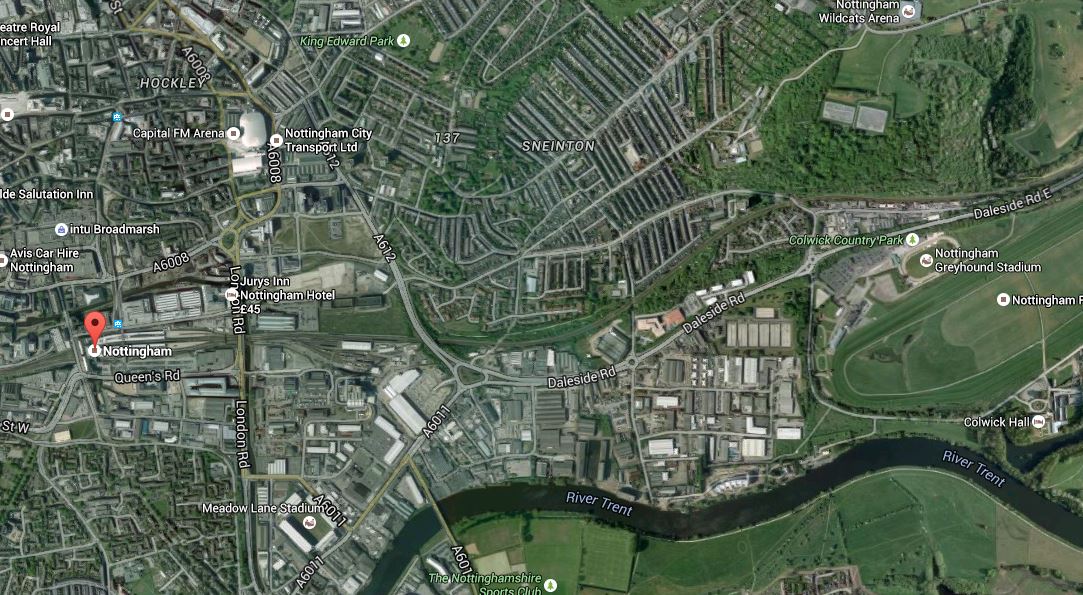
Note.
- The red arrow shows Nottingham station.
- Nottingham Racecourse is at the Eastern side of the map.
- The A6011 is Meadow Lane, which passes Notts County football ground.
- Daleside Road connects Meadow Lane to Nottingham Racecourse.
- The estimated cost of this extension is quoted at between £96 million and £116 million.
It appears to me, that the branch will break East from the main route going South to Clifton South and Toton Lane tram stops and then on the streets along Meadow Lane and Daleside Road to Nottingham Racecourse.
Points And Questions
I have some points and questions on the route.
Access To The Football And Cricket Grounds
Will the Nottingham Racecourse extension improve access to the two football grounds and Trent Bridge cricket ground?
It would be much closer to the sports grounds, than any current tram stop.
Access To Holme Pierrepoint
Will the Nottingham Racecourse extension have a stop at the Holme Pierrepoint National Watersports Centre?
Will There Be A Park-and-Ride At Nottingham Racecourse?
I think there already is one, so will the NET connect it to the City Centre?
Would it be useful to connect this Park-and-Ride to the Queen’s Medical Centre on the Toton Lane branch?
Will There Be Opposition To All The Street-Running?
Every time, I’ve driven near Meadow Lane, Daleside Road and Nottingham Racecourse in the past, it’s been very congested.
Will voters allow these roads to have street-running trams?
Will Trams Be Able To Go Between All Branches?
After the completion of these three new branches, there will be five branches; Clifton Pastures, East Midlands Hub, Hucknall, Nottingham Racecourse and Phoenix Park. All branches will have one or more Park-and-Ride sites.
I can see that there are arguments for these connections.
- Between the Nottingham Racecourse extension with all its major sporting venues and the other branches.
- Between the Queen’s Medical Centre on the Toton Lane branch and the Nottingham Racecourse extension.
I can see that the junction between the Nottingham Racecourse extension and the current NET network being rather complicated, as it must allow these connections.
- East to North
- East to South
- South to East
- North to East
This junction will need a lot of space and get increasingly expensive.
My Daily Exercise
My father always said I was born lucky!
When I bought this house in Dalston after my stroke, I bought it because of the location.
- There are four London Overground stations within walking distance.
- Four bus stops are within a hundred metres, which are served by five bus routes, one of which goes to King’s Cross, St. Pancras and Euston
- There are more than ten bus routes within walking distance.
- I have three bus routes to and from the Angel for the shops and Chapel Market, where my paternal grandmother, used to shop before the First World War.
- If I walk the other way, there was the rather run down Kingsland Road with a Sainsbury’s and lots of unhealthy takeaways.
But then Marks and Spencer opened a Simply Food store in the Kingsland Road by Dalston Kingsland station.
- It is about a fifteen minute walk from my house.
- It has a full range of their gluten-free food.
- It stocks everything I need regularly.
It was certainly my luck, that they opened this store.
Today, I took my daily exercise by walking to the store and bringing home enough food for a couple of days.
- Is this killing two birds with one stone?
- The walk along the Balls Pond Road was notable because there was only little traffic and few pedestrians on one of East London’s main arteries.
- A sizeable proportion of the shops were shut.
It was also very breezy and was this good to protect me from COVID-19, by blowing it away?
The Fastest Ambulance In The World
This article on CityLab is entitled To Fight a Fast-Moving Pandemic, Get a Faster Hospital.
This is the introductory paragraph.
To move Covid-19 patients from the hardest-hit areas, authorities in France turned one of the nation’s famous TGV trains into a very fast ambulance.
It appears that French COVID-19 outbreaks are as patchy, as they are in the UK, where some towns and cities like Hull, Blackpool and Middlesbrough have only a few COVID-19 patients and major hospitals.
Evening up the numbers is probably a good idea.
Could we see a spare InterCity 125 train fitted out as an ambulance train to move patients around the country?
Will Avanti West Coast’s New Trains Be Able To Achieve London Euston and Liverpool Lime Street In Two Hours?
Note that I have rewritten this post to take account of this information from the January 2020 and December 2022 Editions of Modern Railways, in an article, which is entitled Hitachi Trains For Avanti.
This is said about the ten all-electric AT-300 trains for Birmingham, Blackpool and Liverpool services, which have now been numbered as Class 807 trains.
The electric trains will be fully reliant on the overhead wire, with no diesel auxiliary engines or batteries.
It may go against Hitachi’s original design philosophy, but not carrying excess weight around, must improve train performance, because of better acceleration.
Currently, Avanti West Coast‘s trains between London Euston and Liverpool Lime Street stations are timetabled as follows.
- The journey takes two hours and thirteen or fourteen minutes.
- There are three stops at Stafford, Crewe and Runcorn.
- The stops with the current Class 390 trains seem to take around a minute.
- There is one train per hour (tph)
- A second hourly service with a stop at Liverpool South Parkway is planned to be introduced in December 2022.
In 2022, a new fleet of Hitachi AT-300 trains will be introduced on the route. I believe, it would be reasonable to assume, that these Class 807 trains will have similar or better performance, than the current Class 390 trains.
- Acceleration and braking are likely to be better.
- Regenerative braking energy may well be handled more efficiently.
- The trains may well be equipped with in-cab digital signalling and be able to travel in excess of 125 mph in places, where the track allows.
I would expect, that these trains could be running near to or at 125 mph for most of the journey.
London Euston and Liverpool Lime Street are 193.5 miles apart, so if a train could be running at 125 mph all the way, a train would take 93 minutes.
Extra time must be added for the following.
- Acceleration from a standing start to 125 mph at London Euston, Stafford, Crewe and Runcorn.
- Deceleration from 125 mph to a stop at Stafford, Crewe, Runcorn and Liverpool Lime Street.
- Dwell time in the platforms at Stafford, Crewe and Runcorn.
This page on the Eversholt Rail web site, has a data sheet for a Class 802 train, which is a bi-mode AT-300 train with three diesel engines.
The data sheet shows that a five-car train can accelerate to 125 mph and then decelerate to a stop in six minutes in electric mode. As Avanti West Coast’s Class 807 trains will be all-electric seven-car trains with no heavy engine or battery, I doubt they will be slower than a Class 802 train in electric mode. So four accelerations/deceleration cycles to 125 mph should take no more than twenty-four minutes.
I will assume two minutes for each of the three stops.
I can now give an estimate for the journey.
- Base journey time – 93 minutes
- Acceleration from and deceleration to stops – 24 minutes
- Station dwell time – 6 minutes
This gives a journey time between London Euston and Liverpool Lime Street of two hours and three minutes.
The journey time can probably be improved in the following ways.
- Take full advantage of the track improvements on the approach to Liverpool Lime Street station and at Norton Bridge Junction.
- Better train pathing, as has been done on London Liverpool Street and Norwich services to create the fast Norwich-in-Ninety services.
- Track and signal improvements to pinch a minute here and a minute there.
- As Runcorn now has an hourly Liverpool Lime Street and Chester service, will the Runcorn stop be dropped to save time?
- Reduction in station dwell time.
- Better driver aids.
- Better staff operating procedures at stops and whilst turning the train.
It should be born in mind, that a two hour journey between London Euston and Liverpool Lime Street would be a start-stop average speed of 97 mph on a 125 mph route. Intriguingly, this means the trains would run at 77 % of the maximum operating speed of the route, which is the same figure for Norwich-in-Ninety services.
Some of these improvements may enable the Class 390 trains to go a bit faster.
It has to be considered, that Avanti West Coast’s Marketing Department would be ecstatic, when told that London and Liverpool were less than two hours apart.
How Many Trains Would Be Needed?
Currently, this is a typical train round trip to Liverpool Lime Street.
- 07:07 – Leave London Euston
- 09:20 – Arrive Liverpool Lime Street
- 09:47 – Leave Liverpool Lime Street
- 12:02 – Arrive London Euston
The five-hour round-trip would indicate that five trains would be needed for the one tph service.
This train didn’t return to Liverpool, but went off to the Wembley Depot.
After their Liverpool trip, there is no real pattern of where the train will go next, as this table shows.
- 06:41 – 6 – 33 minutes – Wembley Depot
- 07:48 – 2 – 36 minutes – Manchester Piccadilly
- 08:47 – 1 – 40 minutes – Manchester Piccadilly
- 09:47 – 7 – 30 minutes – Wembley Depot
- 10:47 – 4 – 42 minutes – Preston
- 11:47 – 4 – 37 minutes – Preston
- 12:47 – 1 – 34 minutes – Preston
- 13:47 – 15 – 13 minutes – Birmingham New Street
- 16:47 – 6 – 16 minutes – Glasgow Central
- 17:47 – 1 – 42 minutes – Manchester Piccadilly
Note.
- The time is departure time from Liverpool Lime Street, the number is the platform and the minutes are the turnround time in Euston.
- I have left out a couple of trains as there was a very late train.
- There doesn’t seem to be any regular pattern.
- It looks like trains can be turned in under fifteen minutes.
- I think there was a time, when Liverpool couldn’t accept eleven-car trains, but the new longer platforms appear to accept them.
- Trains appear to be running services to Glasgow Central and Manchester Piccadilly, who seem to usually get eleven-car trains.
I almost think, that they’re allocating trains as they go.
With the new Class 807 trains, I suspect the following is possible.
- London Euston to Liverpool Lime Street – Two hours
- Turnround – Fifteen minutes
- Liverpool Lime Street to London Euston – Two hours
- Turnround – Fifteen minutes
This means it’s a four-and-a-half hour round trip.
- Journey times of two hours.
- Time enough for well-drilled staff to turn the trains.
- Dedicated platforms at London Euston and Liverpool Lime Street.
- It would be a very attractive customer-friendly service.
Two tph would need nine trains.
It would be everything the Marketing Department wanted!
Thoughts On The Current Class 390 Timings
As the Class 390 trains are a 125 mph train, their base timing of 93 minutes, between London and Liverpool should still be the same.
As their doors and lobbies are similar in design to those of the Hitachi AT-300 trains, I would allow the same two minutes of dwell time at each station.
Current timings of services on the route vary between 132 and 134 minutes. I’ll take the average of 133 minutes.
So the current services take thirty-four minutes to perform the four accelerate and decelerate sequences on the route.
It would appear that this sequence would take eight-and-a-half minutes in comparison with the six minutes of the new Hitachi AT-300 trains.
I have a feeling, if Class 390 trains cut out a couple of stops, given the other improvements, that they could achieve the magic two hour timing.
Plans For The Second Hourly Service From December 2023
These have been announced in the December 2022 Edition of Modern Railways.
- The Class 807 trains would take over the current service and will stop at Stafford, Crewe and Runcorn.
- There will be an additional call at Liverpool South Parkway on the Class 807 service.
- Class 390 trains will run the second hourly service to Euston.
- This service will stop at Lichfield Trent Valley and Tamworth.
The Class 807 service will stop four times and the Class 390 service will stop twice. I suspect the lesser number of stops from the Class 390 train, is to allow the train to match the timing of the Class 807 train.
I wouldn’t be surprised to see both trains take two hours.
An Improved London Euston and Blackpool North Service
The new AT-300 trains will also be running to Blackpool.
- London Euston and Blackpool North takes between two hours and forty-four minutes and two hours and fifty-nine minutes.
- Journey times are not very consistent, probably due to timetabling difficulties.
- Trains stop between four and five times on the West Coast Main Line.
Would the faster stops of the new AT-300 trains mean that Avanti West Coast could run a more regular timetable, with all services under three hours?
It should also be noted, that Grand Central will start a London Euston and Blackpool North service in Spring 2020.
As the rolling stock for this new service will be Class 90 locomotives hauling rakes of Mark 4 coaches, that will be limited to 110 mph, are Avanti West Coast making sure, that they have the fastest trains on the route?
Would AT-300 Trains Save Time To Other Avanti West Coast Destinations?
If we assume that AT-300 trains can save two-and-a-half minutes per accelerate and decelerate sequence times could change as follow.
- Birmingham New Street – One hour and twenty-two minutes – Three stops – One hour and twelve minutes
- Coventry – One hour – Two stops – Fifty-five minutes
- Crewe – One hour and thirty-four minutes – One stop – One hour and thirty minutes
- Glasgow – As services stop six or thirteen times, there may be substantial savings to be achieved.
- Manchester – Between two hours and seven minutes and two hours and thirteen minutes – Three stops – Between one hour and fifty-seven minutes and two hours and three minutes.
Note.
- The number of accelerate and decelerate sequences is one more than the number of stops.
- Coventry services would be under an hour.
- Two out of three Manchester services would be under two hours.
This analysis illustrates how fast train performance is important in more customer-friendly services.
Conclusion
I believe the following will be possible.
- A two hour service between London Euston and Liverpool Lime Street will be possible with Avanti West Coast’s new Class 807 trains.
- The current Class 390 trains could go a bit faster and if they cut out a couple of stops could probably break two hours.
- I estimate that a Class 807 train could save as much as two-and-a-half-minutes at each stop.
- Blackpool North and London times will be comfortably under three hours.
- Coventry and London times will be comfortably under an hour.
The performance of these Class 807 trains will improve the West Coast Main Line.
Get Set For Max Return, Says Boeing
The title of this post is the same as this article in The Times.
This is the introductory paragraph.
Boeing is to fire up its 737 Max production line by May as it seeks to return the aircraft to service by the middle of the year.
Two points from the article.
- Some suppliers have been asked to start shipping parts from April.
- Boeing’s share price has risen, by 34.3%
But given the shadow over air travel caused by COVID-19, is restarting production a wise move?
I certainly don’t trust the Boeing 737 MAX!
But then if you live in London, I don’t think, you will need to fly in one, as there are a good selection of short haul trains and airlines that fly the smaller Airbuses.
I probably won’t fly short-haul again, until an airline starts flying electric aircraft.
Network Rail Consults On Reigate Turnback Platform Plans
The title of this post, is the same as that of an article in Rail Magazine.
This is the introductory paragraph.
Network Rail is consulting with the public over plans to build a 12-car turnback platform at Reigate.
The third paragraph says this.
NR says “Reigate is hampered by platforms that are four-car in length. This means that Southern trains must split/join at Redhill, adding time to journeys and limiting capacity”
Other points are also made.
- Thameslink’s Class 700 trains which are fixed formations of eight or twelve cars can’t call at Reigate station.
- Power is poor at Reigate limiting the length of trains.
- Passengers from Reigate to London Bridge and beyond need to change at Redhill or East Croydon.
This Google Map shows the station.
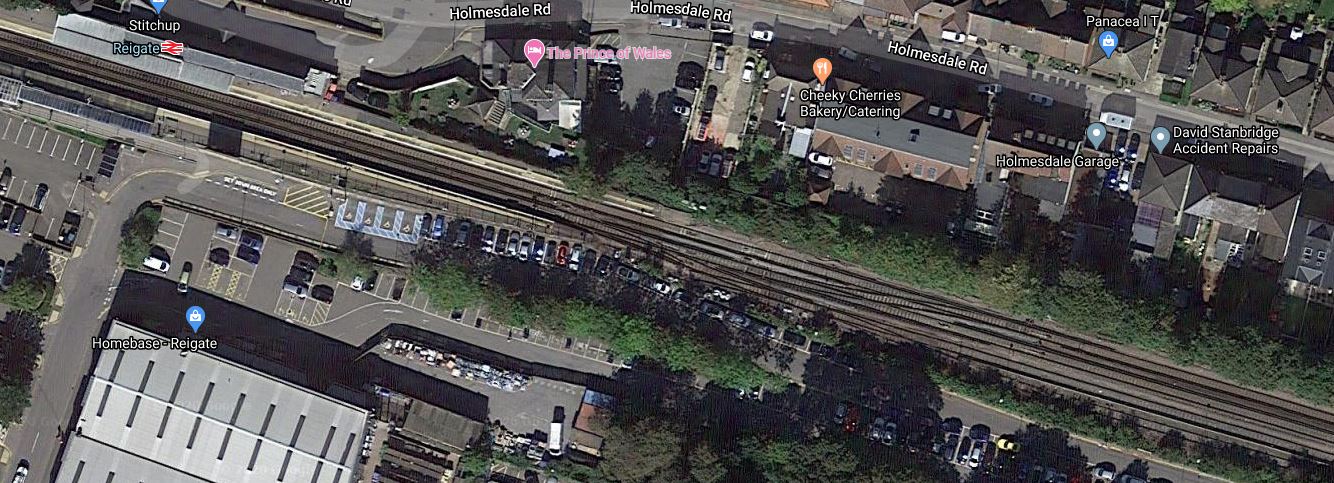
The new bay platform, which will be numbered 3, will go on the South side of the tracks at the East end of the station, where the car-park currently is situated.
Future Services At Reigate Station
In the Wikipedia entry for Reigate station, under Future, this is said.
In 2020, Network Rail announced that they are planning to upgrade Reigate station, which includes constructing a new 12-carriage bay platform (number 3) on the south side of the station, and extending the existing platform 2 to also accommodate 12-car trains. Currently the track layout just east of the station forces Southern to turn its trains around on platform 2, and since this platform is not long enough to accommodate 8-car sets, Southern services to and from Reigate are limited to 4 carriages in length. The upgrade would enable longer trains to serve the station, and the new bay platform would allow trains to/from London to terminate there instead of occupying the through westbound track, thus improving reliability on the whole line.
Once the upgrade is delivered, there are further proposals to introduce Thameslink services running to London Bridge, London St Pancras and beyond to destinations north of London, replacing the current Southern services to London Victoria.
In some ways, this work at Reigate is all part of a larger series of projects, that are aiming to improve reliability and create more capacity on the Brighton Main Line.
The Brighton Main Line Improvement Project
This £300 million project is described on this page on the Network Rail web site.
The improvement project focussed on the southern end of the Brighton Main Line between Three Bridges and Brighton / Lewes. Major engineering work was planned for the Victorian-era tunnels at Balcombe, Clayton, Haywards Heath and Patcham and the railway which runs through them.
We stemmed leaks into the tunnels and improved drainage, while the third rail power supply and signalling were replaced or upgraded.
Elsewhere on the closed section, we replaced the track and sets of points, which enable trains to switch between tracks.
The project is now complete and won an award at the Railway Innovation Awards 2019.
Upgrading Gatwick Airport StationThis £150 million project is described on this page on the Network Rail web site.The size of Gatwick Airport station will be doubled to improve the journey between train and plane.Benefits will include.
- Improved Accessibility
- A better journey experience
- Improved train performance
Works will include.
- Doubling the size of the station concourse.
- Eight new lifts, five new escalators and four new stairways.
- Widened platforms 5 and 6.
- Upgraded connections to the terminal.
The works will start in May 2020 and finish in 2023.
Access for All At Crawley Station
This £3.9 million project is described on this page of the Network Rail web site.
Crawley station is being upgraded to full step-free access, which should be complete in Autumn 2020.
It looks like a second bridge is being installed over the tracks.
I do wonder, if Crawley station is being upgraded, so that it can be used as a back-up access to Gatwick Airport, if some of the construction work at Gatwick Airport station means that the station will be closed.
The dates certainly fit and the station has two trains per hour (tph) to both London Bridge and Victoria stations.
Unblocking The Croydon Bottleneck
This £300 million project is described on this page of the Network Rail web site.
This is the introductory paragraph.
We are proposing an upgrade to the Brighton Main Line, to provide more reliable, more frequent and faster services for the 300,000 passengers who rely on it each weekday, and to provide the capacity needed for future growth.
There is also what looks to be a fairly frank video.
Platform 0 At Redhill Station
Redhill station gained a new Platform 0 a couple of years ago.
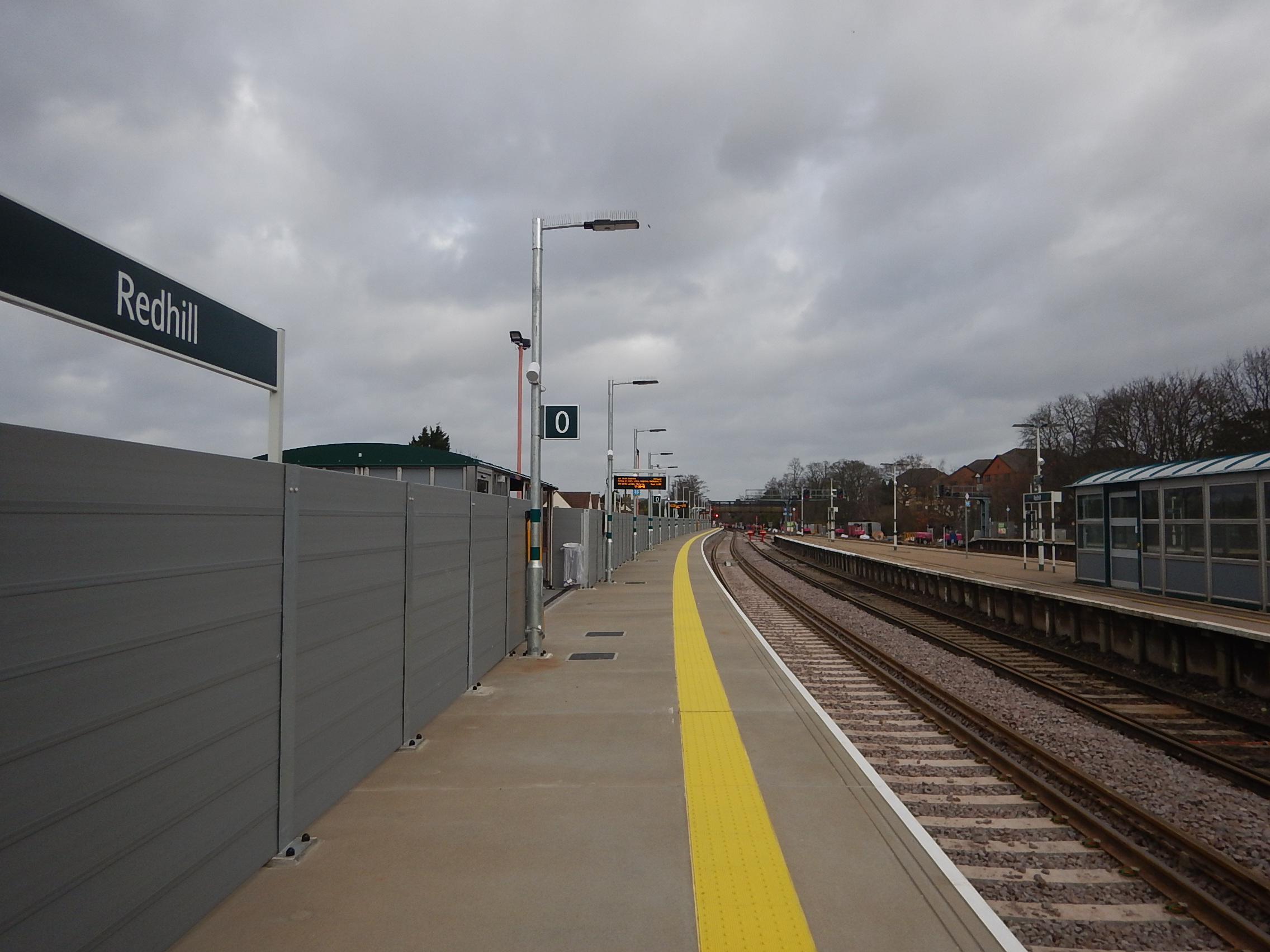
This long platform must help the operation of the station.
Thoughts On The Reigate Scheme
These are my thoughts on the building of two twelve-car platforms at Reigate station.
Thameslink To Reigate
This document on the Network Rail web site is entitled Connecting Reigate To Thameslink.
Currently, train services to the Reigate/Gatwick Airport/Crawley area are as follows.
- Southern – Two tph – London Victoria and Reigate via East Croydon, Purley, Coulsdon South, Merstham and Redhill.
- Southern – Two tph – London Victoria and Southampton/Portsmouth via East Croydon, Gatwick Airport, Three Bridges, Crawley and Horsham
- Thameslink – Two tph – Peterborough and Horsham via East Croydon, Purley, Coulsdon South, Merstham, Redhill, Horley, Gatwick Airport, Three Bridges and Crawley
- Thameslink – Two tph – Bedford and Gatwick Airport via East Croydon, Purley, Coulsdon South, Merstham, Redhill, Earlswood, Salfords and Horley.
- Thameslink – Two tph – Cambridge and Brighton via East Croydon and Gatwick Airport
- Thameslink – Two tph – Bedford and Brighton via East Croydon and Gatwick Airport
- Gatwick Express – Two tph – London Victoria and Brighton via Gatwick Airport
- Gatwick Express – Two tph – London Victoria and Gatwick Airport
- Great Western Railway – One tph – Reading and Gatwick Airport via Reigate and Redhill
Stations around Gatwick will get the following services from London
- Coulsdon South – Six tph
- Crawley – Four tph
- Earlswood – Two tph
- Gatwick Airport – Sixteen tph
- Horley – Four tph
- Merstham – Six tph
- Redhill – Six tph
- Reigate – Two tph
- Salfords – Two tph
I can see good reasons for terminating the Bedford and Gatwick Airport service at Reigate.
- Gatwick Airport has sixteen tph to Central London.
- During the rebuilding of Gatwick, it might be a good idea not to have trains terminating at Gatwick.
- Reigate is under seven miles from Gatwick Airport and a coach service would take under twelve minutes.
This would mean that, train services to the Reigate/Gatwick Airport/Crawley area are as follows.
- Southern – Two tph – London Victoria and Southampton/Portsmouth via East Croydon, Coulsdon South, Merstham, Redhill, Earlswood, Salfords, Horley, Gatwick Airport, Three Bridges, Crawley and Horsham
- Thameslink – Two tph – Peterborough and Horsham via East Croydon, Purley, Coulsdon South, Merstham, Redhill, Horley, Gatwick Airport, Three Bridges and Crawley
- Thameslink – Two tph – Bedford and Reigate via East Croydon and Redhill
- Thameslink – Two tph – Cambridge and Brighton via East Croydon and Gatwick Airport
- Thameslink – Two tph – Bedford and Brighton via East Croydon and Gatwick Airport
- Gatwick Express – Two tph – London Victoria and Brighton via Gatwick Airport
- Gatwick Express – Two tph – London Victoria and Gatwick Airport
- Great Western Railway – One tph – Reading and Gatwick Airport via Reigate and Redhill
Stations around Gatwick will get the following services from London
- Coulsdon South – Four tph
- Crawley – Four tph
- Earlswood – Two tph
- Gatwick Airport – Fourteen tph
- Horley – Four tph
- Merstham – Four tph
- Redhill – Six tph
- Reigate – Two tph
- Salfords – Two tph
Note.
- I have adjusted calling patterns to what is shown in the document called Connecting Reigate to Thameslink.
- Southern and Gatwick Express services will go to Victoria
- Thameslink services will go via London Bridge and St. Pancras.
- Passengers will be able to change at Redhill or East Croydon to swap their London terminal between Victoria and London Bridge/St. Pancras.
Obviously, Network Rail must have their own and better plans to run the services.
Will Platform 3 At Reigate Be Used As An Emergency Platform?
With the right track layout and signalling a bay platform can easily handle four tph, as platforms on the London Overground do at Clapham Junction, Crystal Palace, Dalston Junction, Highbury & Islington, New Cross and West Croydon stations. Some of these platforms will be going to six tph within a couple of years.
Over the next three years, Gatwick Airport station is being rebuilt.
Surely, Reigate would make an ideal station to turn trains, if the Brighton Main Line was blockaded.
- Passengers could be taken by bus to Gatwick.
- The two twelve-car platforms would be able to handle the longest trains on the Brighton Main Line.
- The car park could be used as a bus terminal.
It looks to me, like Network Rail are planning for the worst.
Electrification To Guildford?
Consider.
- One of the sub-projects of the rebuilding of the platforms at Reigate station will be boosting the power supply.
- Within two years, Great Western Railway will be running Class 769 trains with a third-rail capability between Reading and Redhill/Gatwick.
- All passenger trains running between Redhill and Reigate will have a third-rail capability.
- There is a 750 VDC electricity supply for electrification at Guildford.
So why, shouldn’t the line be electrified to Guildford station?
Thameslink To Guildford?
Consider.
- Trains between Reigate and Guildford take twenty-five minutes to do the twenty miles on the North Downs Line.
- I have read somewhere, that Guildford station is to be rebuilt.
- The North Downs Line passes through the sizeable town of Dorking.
- Two tph between Reading and Gatwick and two tph between Guildford and Redhill could surely share tracks between Guildford and Redhill.
If the line between Reigate and Guildford had been electrified, would it be worthwhile extending Thameslink from Reigate to Guildford?
Conclusion
I like this scheme at Reigate, but I do think there’s more behind it than has been disclosed.
LNER To Keep Class 91s Until 2023
The title of this post is the same as that of this article on Rail Magazine.
This is the two introductory paragraphs.
Class 91s hauling Mk 4s will remain with London North Eastern Railway until 2023.
Ten rakes of coaches and ten ‘91s’ will be used, with two additional spare ‘91s’ and a handful of spare Mk 4s also retained.
It looks like LNER are keeping enough Class 91 locomotives and Mark 4 coaches to guarantee having ten trains in service.
Why 2023?
The answer to this question is probably contained in an article in Issue 901 of Rail Magazine, which is entitled ORR Approves New Hitachi Inter-Car Connector Design, which has these two statements.
- All inter-car connectors will have been updated by Summer 2022.
- Hitachi has deals for a further 61 trains for three operators and all will be in traffic by the end of 2022.
It looks like Hitachi could have production capability from 2023.
The original Rail Magazine article also says this.
The extension is until the end of 2023 while LNER sources brand new trains, which would take a minimum of around two years to build and deliver. The operator has previously told RAIL it needs around six new trains.
It appears the difference between retaining ten InterCity 225 trains and adding six new trains to the fleet, is to cover for the retrofit of the inter-car connectors.
The Performance Of A Class 91 Locomotive And Five Mark 4 Coaches
I have seen in mentioned that Virgin East Coast were intending to run shortened rakes of Mark 4 coaches.
In the Wikipedia entry for the Class 91 locomotive, there is a section called Speed Record, where this is said.
A Class 91, 91010 (now 91110), holds the British locomotive speed record at 161.7 mph (260.2 km/h), set on 17 September 1989,[ just south of Little Bytham on a test run down Stoke Bank with the DVT leading. Although Class 370s, Class 373s and Class 374s have run faster, all are EMUs which means that the Electra is officially the fastest locomotive in Britain. Another loco (91031, now 91131), hauling five Mk4s and a DVT on a test run, ran between London King’s Cross and Edinburgh Waverley in 3 hours, 29 minutes and 30 seconds on 26 September 1991. This is still the current record. The set covered the route in an average speed of 112.5 mph (181.1 km/h) and reached the full 140 mph (225 km/h) several times during the run.
When you consider, this was nearly forty years ago, there can’t be much wrong with British Rail’s train engineering.
What Average Speed Do You Need To Achieve London And Edinburgh In Four Hours?
The rail distance between London and Edinburgh is 393 miles, so four hours needs an average speed of 98 mph.
Consider.
- I have travelled in InterCity 125 and InterCity 225 trains, where I have measured the speed at around 125 mph for perhaps thirty or forty miles.
- In Norwich-In-Ninety Is A Lot More Than Passengers Think!, I travelled to Norwich and back, at around 100 mph most of the way.
- Continuous 125 mph running is just as much about the track as the train.
- I have watched a driver in an InterCity 125 at work and these guys and girls know the route and their charges, like the backs of their hands.
I think it is possible to arrange train pathing, so that trains could run between London and Edinburgh in excess of 100 mph.
I believe, that this would enable London and Edinburgh in under four hours.
Will LNER Run Faster Services With Short Sets?
Virgin East Coast’s original plan, was to run short sets between London and Edinburgh.
Would these short sets have been faster, than full size sets?
- The power-to-weight ratio is higher, so acceleration would be better.
- A five-car train would probably need half the power of a ten-car train to cruise at a given speed.
- It might be possible to save weight to increase performance.
- There would be no intermediate stops.
- They know that the Kings Cross and Edinburgh record is three-and-a-half hours, which was set by a five-car train.
- In-cab digital signalling and other improvements could be fitted.
It should also be noted, that a short set would probably do significantly less damage to the track than a full-size set at 140 mph.
Possible Short InterCity 225 Routes
LNER have only six fully-electrified routes, where they could run short InterCity 225 sets.
- Kings Cross and Leeds
- Kings Cross and Doncaster
- Kings Cross and York
- Kings Cross and Newcastle
- Kings Cross and Edinburgh
- Kings Cross and Stirling
Note.
- All routes are fully-electrified, which is a pre-requisite, as InterCity 225 sets have no self-power capability.
- Kings Cross and Leeds will probably be run by pairs of Class 800 trains, as LNER looks like it will split trains at Leeds and serve two destinations.
- Do Doncaster, York and Newcastle generate enough traffic for a fast service?
- The Edinburgh route will have direct competition from East Coast Trains, who will be running five-car Class 803 trains.
- The Stirling route at over five hours is probably too long.
It looks to me, that the preferred route for InterCity 225 sets,; short or full-size will be Kings Cross and Edinburgh.
How Many Trains Would Be Needed To Run An Edinburgh Service?
A flagship service between London and Edinburgh might have the following timetable.
- One tph perhaps leaving at a fixed time in every hour.
- A timing of under four hours.
- Minimal numbers of intermediate stops.
- The service would not be extended past Edinburgh, as the trains need electrified lines.
Suppose, the trains could do a round trip in eight hours, this would mean that eight trains would be needed to provide a service.
Ten trains would allow one train in maintenance and one ready to be brought into service at a moment’s notice.
Does this explain, why ten InterCity 225 sets are being retained.
Would In-Cab Signalling Be Needed?
I suspect that under current rules, in-cab digital signalling might be needed! But as I observed in Partners On Board For In-Cab Signalling Project On East Coast Main Line, this is on its way!
But, as the average speed needed to do London and Edinburgh in four hours is only 98 mph, I wonder what time could be achieved by one of the top drivers, using the following.
- All their route knowledge and driving skill.
- A five-car train.
- Maximum acceleration.
- A well-thought out pathing structure.
- A clear track
- No hold-ups
- A non-stop run.
If the train were to run at 125 mph all the way without stopping, the journey time would be around three hours and ten minutes.
Wikipedia says this about in-cab digital signalling on the East Coast Main Line.
The line between London King’s Cross and Bawtry, on the approach to Doncaster, will be signalled with Level 2 ERTMS. The target date for operational ERTMS services is December 2018 with completion in 2020.
- I estimate that that this will mean that 145 miles of the route will have full in-cab digital signalling.
- Currently, the fastest London and Doncaster times are around 90 minutes, with many taking 97-98 minutes for the 155 miles.
This means the fast train takes 84 minutes between King’s Cross and Bawtry, at an average speed of 103 mph.
Suppose this fast train could go at 125 mph for all but twenty of the distance between King’s Cross and Bawtry, how much time would this save?
- 125 miles at 125 mph would take 60 minutes.
- 125 miles at 103 mph would take 72 minutes.
This means that just by running at 125 mph continuously for all but twenty miles could save up to twelve minutes.
If 140 mph running could be maintained on this section, another six minutes would be saved.
As they say, every little helps!
Lessons From Norwich-in-Ninety
In Norwich-In-Ninety Is A Lot More Than Passengers Think!, I travelled to Norwich and back, at around 100 mph most of the way.
Liverpool Street and Norwich is 114 miles and a ninety minute journey is an average of just 76 mph, which is 24 mph below the maximum cruise of a Class 90 locomotive and a rake of eight Mark 3 coaches. Compare this with an average speed of 98 mph needed for London and Edinburgh in four hours and the 125 mph maximum certified cruise of an InterCity 225 train, without in-cab digital signalling.
It should also be noted that Greater Anglia, run an additional stopping train after the Norwich-in-Ninety expresses, that call at several important stations and not just Ipswich.
Will LNER use a similar strategy? It was working well and successfully for Greater Anglia, until services were decimated by COVID-19!
Will LNER Increase Frequency Between London And Edinburgh To Three Trains Per Hour?
It would seem that the current two tph service running nine- or ten-car trains, runs with a high level of occupancy, so to replace some of these trains with faster and shorter trains might cause capacity problems.
But to add, a third faster train in the hour might be possible. Especially, if the Norwich-in-Ninety strategy were to be used. The timetable in both directions could be something like.
- XX:00 – Four hour express
- XX:06 – Four-hour plus train to current timing
- XX:30 – Four-hour plus train to current timing
LNER’s Marketing Department would like it.
Could Hitachi Trains Achieve London and Edinburgh In Four Hours?
The all-electric Class 801 trains most certainly have a performance to match an InterCity 225 in terms of acceleration and maximum operating speed without in-cab digital signalling. After all, the Japanese train was designed as a direct replacement for British Rail’s last high performance train!
So I believe that with a well-designed timetable, electric Hitachi trains will be able to run between London and Edinburgh in under four hours, with a small number of stops.
Note that LNER will have a fleet of thirty nine-car and twelve five-car all-electric Class 801 trains.
But East Coast Trains will have a fleet of five five-car all-electric Class 803 trains, which could get near to a four-hour timing, despite their four stops at Stevenage, Durham, Newcastle and Morpeth.
- I have timed a Class 800 train leaving Kings Cross and they get up to 125 mph fairly fast, by about Potters Bar, which is reached in eleven minutes.
- Stops at Stevenage, Durham and Morpeth will probably each add two minutes to the timing, with Newcastle adding five minutes.
- 125 mph all the way from Kings Cross to Edinburgh would be a timing of three hours and ten minutes.
Add up the stationary times at the stops (2+2+2+5) and that gives a journey time of three hours and twenty-one minutes, which leaves thirty-nine minutes for the five decelerations and accelerations between stationary and 125 mph.
This page on the Eversholt Rail web site, has a data sheet for a Class 802 train, which is a Class 800 train with larger engines.
The data sheet shows that a five-car train can accelerate to 125 mph and then decelerate to a stop in six minutes in electric mode. So five accelerations/deceleration cycles to 125 mph would take thirty minutes. This gives a journey time between London and Edinburgh of three hours and fifty-one minutes.
Note that Class 801 trains, which don’t lug diesel engines about will have better acceleration, due to the lower weight, so should have better acceleration and deceleration.
Does this time seem reasonable? First Group with their extensive experience of running Class 800 trains on the Great Western Main Line will know the capabilities of the trains, down to the last mph.
I doubt, they’d have bought the trains for East Coast Trains, if they couldn’t do London and Edinburgh in four hours.
I believe that both InterCity 225 and Class 801/803 trains can do London and Edinburgh in four hours and any train company that doesn’t offer this timing, will come second!
A Possible Hitachi-Based Timetable For LNER
I would be very surprised if a service pattern like this wouldn’t be possible.
- XX:00 – Four hour express – Class 801 train
- XX:06 – Four-hour plus train to current timing – Class 801 train or InterCity 225
- XX:30 – Four-hour plus train to current timing – Class 801 train or InterCity 225
Note.
- As there is only one extra train per hour, ten extra trains would be the addition to the fleet, needed to run this service pattern.
- Class 801 trains could be five-car or nine-car sets as passenger numbers require.
- InterCity 225 trains could be as long as are needed.
InterCity 225 trains would only be doing the job, they’ve done for many years.
Targeting The Airline Market
In Trains Ordered For 2021 Launch Of ‘High-Quality, Low Fare’ London – Edinburgh Service, which described the launch of First East Coast Trains, I said this about their target market.
First East Coast Trains is targeting the two-thirds of passengers, who fly between London and Edinburgh. The company are also targeting business passengers, as the first train arrives in Edinburgh at 10:00. Trains will take around four hours.
Note that currently, LNER’s first train arrives at 11:12. In the future, I would envisage that LNER intend to go for four hour journeys.
It would seem to me, that both train companies will be attempting to take passengers from the airlines.
Conclusion
It looks to me that ten InterCity 225 trains could add a third train in each hour between London and Edinburgh for LNER, that would do the journey in under four hours.
The third train could either be an InterCity 225 or a Class 801 train.
Flying Taxi Start-Up Raises $240m From Existing Investors Led By Tencent
The title of this post, is the same as that as this article on the Financial Times.
This is the introductory paragraph.
Lilium, a German flying taxi start-up, has raised $240m from existing investors led by Chinese technology group Tencent to fund the next stage of its growth.
The article has a picture of the Lilium Jet, which looks to be an interesting design.
- It is an electric VTOL aircraft.
- Power comes from no less than thirty-six electric motors driving ducted fans.
- The fans will tilt for take-off and landing.
- Maximum speed will be 190 mph, with a cruise of 170 mph.
- Range will be 300 kilometres or 186 miles
- Total installed power is 320 kW.
- Less than 150 kW will be needed for cruise.
- A MW (?) battery will be fitted according to Wikipedia. Do they mean MWh?
- It can carry two passengers with five from 2025.
- Empty weight is 440 Kg.
- Maximum take-off is 640 Kg.
- Initially, it will have a pilot, but the aim is for a completely autonomous aircraft.
Lilium aims to run a city-to-city taxi service starting in 2025.
I have a few thoughts.
Aerodynamics
There have been a lot of developments in aerodynamics in the last few years and the Lilium Jet and other electric aircraft like the Eviation Alice take full advantage of the developments.
So don’t expect electric aircraft to look convectional, unless perhaps they are an electric-engined conversion of an existing conventional aircraft!
Structure
The structure of aircraft is getting lighter and Airbus and Boeing with the 787 Dreamliner are showing what is possible.
Will an empty weight of 440 Kg be possible? Especially, if that includes the battery.
The Wikipedia figures allow a payload of 200 Kg. That must be only two passengers.
Power
Wikipedia talks about a one MW battery, but I suspect they mean one MWh, as this is the unit of battery capacity.
In Sparking A Revolution, I quoted Hitachi’s predictions and suggested that they could have a five-tonne battery, that held 15 MWh by 2035.
This would mean that a one MWh battery would weigh 333 Kg.
This must be near to the target weight of the battery needed to power a Lilium Jet.
But a one MWh battery that weighs just 333 Kg. would be a tough ask given the limitations of today’s battery chemistry.
Fire
Wikipedia says this about a fire.
The first prototype was destroyed by fire during maintenance on 27 February 2020.
As the Eviation Alice also suffered a fire, are these aircraft pushing batteries too hard.
Conclusion
I am sceptical about some of the figures quoted for the Lilium Jet in Wikipedia.
When I see the following.
- A Lilium Jet in the air, taking-off and landing.
- Two passengers flying in the aircraft.
- A Lilium Jet on a set of scales.
I’ll revise my opinion.
There is this video.
Obviously, I’m doing something wrong in my calculations.
 The Anonymous Widower