A Trading Update From ITM Power
ITM Power issued a Press Release entitled Trading Update, this morning.
It is a document, that is a must-read about the future of hydrogen.
There are some interesting statements on various topics.
The Future Of Hydrogen Production
The Press Release says this.
Alongside the predicted growth trajectory for electrolysis, the cost outlook for green hydrogen is also positive. The Hydrogen Council expects green hydrogen to become cost competitive with grey hydrogen by 2025 assuming a €50 per ton CO2 price. An 80GW electrolyser target for Europe by 2030 has been proposed, where electrolysers feed into a hydrogen transmission network that interconnects the renewable energy resources of the North Sea, Morocco and Ukraine with the demand centres of Europe. Further afield, Australia is actively pursuing opportunities to export green hydrogen and has estimated that 69 per cent of the 2025 global market for hydrogen will lie in its four target markets of China, Japan, Korea and Singapore.
Note.
- Green hydrogen is produced by a zero-carbon process like electrolysis using renewable electricity.
- Grey hydrogen is produced by a process that releases carbon-dioxide like steam reforming of methane.
It looks like green hydrogen will be the future.
Governments And Green Hydrogen
The Press Release says this.
Governments are increasingly recognising the role of green hydrogen as a decarbonisation tool. The U.K. government has introduced an overarching net zero target and placed an early focus on decarbonising industrial clusters that will lead to progressively larger deployments of electrolysers. In the Netherlands, the Dutch government has recently presented its green hydrogen vision for achieving a sustainable energy system that is reliable, clean and affordable. A total of three European governments have now stated explicit electrolyser targets for 2030: Germany 5GW, Holland 3-4GW and Portugal 2GW.
It looks like a lot of electrolysers will be built.
The Germans And Hydrogen
The Press Release says this.
The German government announced in its stimulus package of 3 June 2020 that it will present a national hydrogen strategy in the short term. Accordingly, a programme for the development of hydrogen production plants will be developed to demonstrate industrial-scale production of up to 5GW total output in Germany, operational by 2030. For the period up to 2035, but until 2040 at the latest, an additional 5 GW will be added if possible. To implement all these measures, the German government will invest €7bn.
Not only is hydrogen zero-carbon, it also means they will buy less of Putin’s gas.
Conclusion
Hydrogen has a very long term future.
Understanding Floatovoltaics
Floatovoltaics is mounting panels on floats, on an appropriate stretch of water.
This video, which I think from some of the words in the commentary, is shown to visitors who visit the floating solar farm at Yamakura Dam.
It describes all the advantages of floating solar and shows how this 13.7 MW solar farm was constructed.
We’ve even got a couple of these floating solar farms in the UK.
This Google Map shows the farm in the Queen Elizabeth II Reservoir, near Walton-on-Thames.
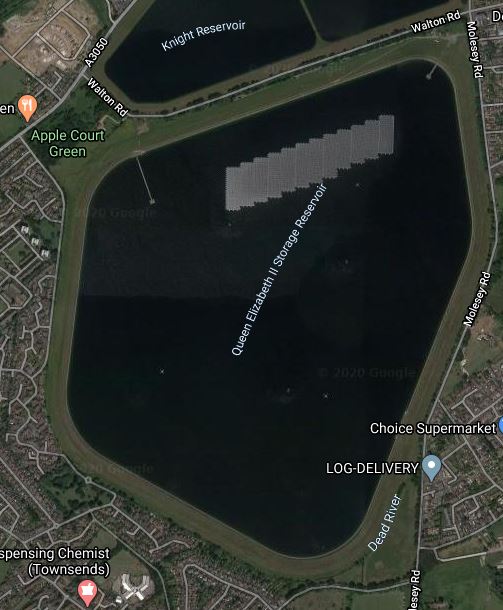
There is also this article in the Guardian, which is entitled World’s Biggest Floating Solar Farm Powers Up Outside London. It gives a good description of the project.
The article also states that unlike large solar arrays on land, no planning permission is required.
United Utilities have also installed a system at Godley Reservoir in Hyde, near Manchester, as this Google Map shows.
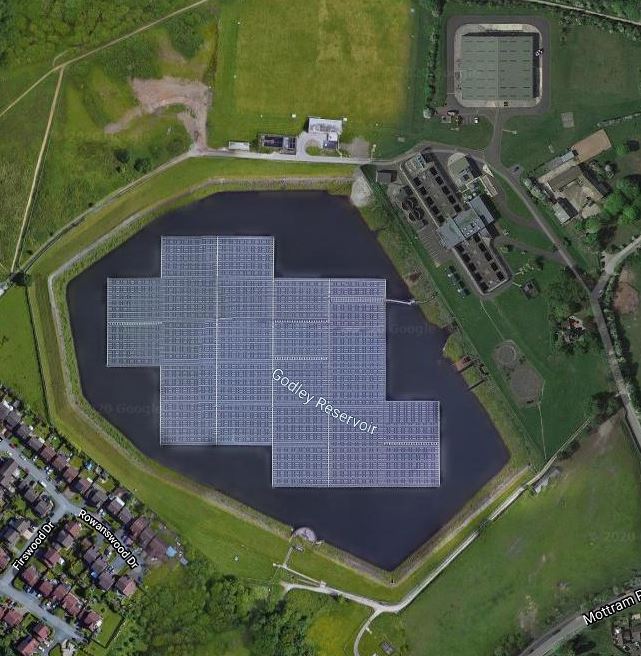
They must like the first installation, as this Press Release from United Utilities indicates that they are now building a second floating solar farm at Langthwaite Reservoir near Lancaster.
Some points from the Press Release.
- The floats are made locally.
- Godley is three times the size of Langthwaite.
- Godley can generate up to 3 GWh per year.
- It is thought that the panels help to stop the growth of algae in the water.
- United Utilities already has 45 MW of installed solar and intends to add 22 more sites in the next two years.
In some ways, this embracing of solar is a bit surprising, as the North West, is England’s wettest region.
Conclusion
If my excellent physics teacher in the 1960s had said that it will be commonplace by 2020 to generate electricity using solar panels floating on water, I would not have believed him!
‘Chernobyl’ Fears Dismissed As Herne Bay Hydrogen Plant Bid Approved
The title of this post, is the same as that of this article on Kent Online.
it would appear that Kent Online got their prediction right. that I wrote about in Hydrogen Power Plant Bid In Herne Bay Set For Green Light From Canterbury City Council.
After Coronavirus, What’s Next? China: More Coal, US: More Oil, EU: More Renewables
The title of this post, is the same as that of this article on CleanTechnica.
The title says it all, but read the article to get the detail.
Hydrogen Pilot Projects Could Eventually Boost Nuclear Plants’ Bottom Lines
The title of this post, is the same as that of this article on Energy News Network.
The article discusses in depth. how producing hydrogen can help to improve the economics of nuclear power plants in the Mid-West, with particular reference to a plant called Davis-Besse at Oak Harbor, Ohio.
UK Energy Production
This web site, seems to ask a lot of my questions about UK Energy Production.
Joint Venture With Linde AG And £38M Strategic Investment
The title of this post, is the same as that as this Press Release from ITM Power.
This is the first paragraph.
ITM Power plc is pleased to announce its intention to raise at least £52.0 million (before expenses) through (i) a strategic investment of £38.0 million at 40 pence per share by Linde UK Holdings No. 2 Limited, a member of the Linde AG group (Linde) (the Share Subscription); and (ii) a conditional placing of £14.0 million at 40 pence per share (the Firm Placed Shares) with certain existing and new institutional investors (the Firm Placing). The Group has also entered into a 50/50 joint venture with Linde (the Joint Venture) which will focus on delivering green hydrogen to large scale industrial projects, principally those with an installed electrolyser capacity of 10 Megawatts (“MW”) and above.
There is all the usual financial stuff and these sentences.
The net proceeds of the fundraising will be used principally to enhance the manufacturing capabilities of the Group, particularly for the development and production of large scale 5MW electrolysers, to facilitate product standardisation and manufacturing cost reduction.
The Joint Venture will focus on delivering green hydrogen to large scale industrial projects (generally being opportunities with installed electrolyser capacities of 10 Megawatts and above)
As ITM Power are constructing the largest electrolyser factory in the world, at Bessemer park in Sheffield, it appears to me that ITM Power are going for the larger scale hydrogen market.
Recently, I wrote these three posts.
- Funding Award to Supply An 8MW Electrolyser
- Surplus Electricity From Wind Farms To Make Hydrogen For Cars And Buses
- H2OzBus Project: Deploying Hydrogen Fuel Cell Bus Fleets For Public Transport Across Australia
News stories generated about the company or the production of hydrogen seem to require large electrolysers in excess of 5 MW.
It looks like ITM Power are setting themselves up to tap this market substantially.
How Much Hydrogen Would A 5 MW Electrolyser Create In A Day?
I found the key to the answer to this question on this page of the Clean Energy Partnership web site.
To produce hydrogen by electrolysis directly at the filling station, the CEP currently requires about 55 kWh/kg H2 of electricity at an assumed rate of efficiency of > 60 percent.
To produce 1 kg of hydrogen, nine times the amount of water is necessary, i.e. nine litres.
I will use that figure in the calculation.
- A 5MW electrolyser will consume 120 MWh in twenty-four hours.
- This amount of electricity will produce 2,182 Kg or 2.182 tonnes of hydrogen.
- It will also consume 19.64 tonnes of water.
In Surplus Electricity From Wind Farms To Make Hydrogen For Cars And Buses, I described how Jo Bamford and his company; Ryze Hydrogen, have applied for planning permission to build the UK’s largest electrolyser at Herne Bay in Kent.
- It will produce ten tonnes of hydrogen a day.
- The hydrogen will be sent by road to London to power buses.
So could the electrolyser be a 25 MW unit built of five 5 MW modular electrolysers?
Linde and their UK subsidiary; BOC, must have a lot of knowledge in transporting tonnes of hydrogen by road. I can remember seeing BOC’s trucks behind ICI’s Castner-Kellner works in the 1970s, where they collected hydrogen to see to other companies.
Hydrogen Gas From Biogas
The title of this post, is the same as that of this article on Finance News Network.
This is the introductory paragraph.
Managing Director and CEO Geoff Ward talks about the Hazer process for low emissions hydrogen gas and high purity graphite production from biogas, CAPEX approval to proceed with the company’s commercial demonstration plant and offtake discussions.
The process doesn’t create any CO2, as it extracts the carbon as a crystalline graphite. So are there two worthwhile products from the biogas?
According to this page on Graphene Info, the graphite can be made to create graphene.
Is There A Link Between Historic Coal Mining And COVID-19?
In Air Pollution May Be ‘Key Contributor’ To Covid-19 Deaths – Study, I wrote about the link between current pollution and COVID-19, that had been shown by European researchers.
Today, in The Times, there is an article, which is entitled Pressure To Free London From Lockdown As Cases Fall.
It talks about the areas, that are recording the most new cases of confirmed COVID-19 in the last fortnight.
The article says this.
Only one area south of Birmingham is in the 20 local authorities with the most coronavirus cases in the past two weeks, while those with fewest are clustered in the south, an analysis of official figures by The Times shows.
That local authority in the top twenty is Ashford.
i have looked at all the data in The Times and this table shows the number of cases in the last fortnight in decreasing order.
- Birmingham – 266
- County Durham – 209
- Manchester – 184
- Bradford – 168
- Sandwell – 164
- Wigan – 156
- Shropshire – 155
- Cheshire West and Chester – 151
- Sheffield – 144
- Cheshire East – 135
- Leeds – 138
- East Riding Of Yorkshire 129
- Barnsley – 126
- Tameside – 124
- Doncaster – 121
- Ashford – 118
- Stoke – 117
- Wirral – 107
- Trafford – 102
- Folkestone and Hythe – 99
- Leicester – 99
- Bolton – 94
- North Somerset – 94
- Oldham – 93
- Stockton-on-Tees – 93
- Oxford – 90
Note.
- Why is Cheshire in the top half of the list?
- There seem to be a lot of coal mining areas on the list.
- Ashford and Folkestone and Hythe are even close to the former Kent coalfield.
I’d love to see Welsh, Scottish and Northern Irish data added to this list!
Is Coal A Factor?
Given the large number of coal-mining areas featuring in my list, I very much feel that there should be a serious analysis to see if working in the mines or growing up in a coal-mining area, is a factor related to the chances of catching COVID-19.
I should say, that my only personal memories of British coal mines working, was to see the mines in Kent, as we drove to see by uncle in Broadstairs. They were filthy places.
The Cheshire Paradox
Cheshire doesn’t have any coal mining, but it does have a lot of chemical works and oil refineries along the Mersey, many of which use Cheshire’s most valuable natural resource – salt.
When I worked at ICI, I was told that there was enough salt underneath the green fields of Cheshire to last several thousand years, at the current rate of extraction.
There was also the ICI office joke about pensions.
You would get a good pension from ICI, as the pension scheme was well-funded and also because so many pensioners, after a lifetime of working amongst all the smells and dusts of a chemical works, which gave the lungs a good clear out, didn’t live long in the fresh air of normal life and caught every cold, cough and flu doing the rounds.
The three Cheshire areas have these numbers of total confirmed cases per 100,000 residents.
- Cheshire East – 304
- Cheshire West and Chester – 312
- Wirral – 378
These compare closely to nearby Liverpool with 319.
But look at these figures of a similar county around London, that from personal experience is similar to Cheshire.
- East Hertfordshire – 176
- North Hertfordshire – 171
So have all the chemicals in the historic Cheshire air, softened up the population for COVID-19?
I used the word historic, as pollution in the seventies in Cheshire/Merseyside was much higher, than it is today.
Hydrogen Powered Tractors Could Be The Green Answer In That Industry
The title of this post, is the same as that of this article on Hydrogen Fuel News.
I agree with the title and the article is worth a read.
For some time, I’ve felt that hydrogen would be ideal to power a tractor and other agricultural machinery.
- Now that companies like ITM Power have developed efficient electrolysers, the accessibility of the fuel is a lot easier.
- Many farmers would have their own electrolyser.
- Diesel is always getting nicked, but stealing hydrogen would probably be more difficult.
- Hydrogen could also power the farmer’s cars.
Energy use on the farm could be very different.
 The Anonymous Widower