Is Spain Looking Both Ways On Brexit?
This article on the BBC is entitled Spain Brexit: PM Sánchez Threatens To Vote No Over Gibraltar.
The title says it all.
On the other hand, Spanish rail companies seem to be very keen to invest in the UK and also create new and innovative trains for the British market.
- Amey, which is a subsidiary of the Spanish public company Ferrovial is heavily involved in big projects all over the UK, including the South Wales Metro.
- The train builder; CAF, is supplying lots of trains and coaches for UK operators and building a factory at Newport in South Wales.
- Another train builder; Talgo, is on the short list to build the trains for High Speed Two and is proposing to open a factory at Longannet in Scotland and a research centre at Chesterfield
It does appear, that big Spanish companies see the UK as a place to do business.
In connection with the Longannet factory, there is a feature article about the factory in Issue 866 of Rail Magazine.
This is the last paragraph.
As for Brexit, which is known to be a concern for other firms, Talgo said in a statement that its plans were “Brexit-free”, claiming there is a huge potential UK market as well as export opportunities.
The article also says that Talgo need more manufacturing capacity and the brownfield Longannet site, with its space and excellent access by rail and sea, fits their needs.
I also suspect that manufacturing in Scotland will help them secure sales in important English-speaking markets for their innovative high speed trains.
Like Norman Foster’s Gherkin? Meet His Cocktail Cornichon
The title of this post is the same as that of this article in The Guardian.
It has the following sub-title.
The Tulip, Foster’s strange proposal for a Mini-Me Gherkin on a stick, is a parody of architectural hubris he’s hoping will get the billionaire owner out of a pickle.
The article is the best I can find about The Tulip, which if it gets planning permission could be a new addition to the skyline of the City of London.
I’ve been to the top of the Gherkin and I took this picture.

The View From The Gherkin At Night
If someone else is paying, I recommend you go!
Lord Foster is 83 and like David Hockney, who is a couple of years younger, they have built their reputation and are at an age, where they can do things that amuse them and have fun!
And if someone pays them for it, it’s a bonus.
I would certainly like to see The Tulip erected in the City of London.
But I doubt, it will get through the planning process.
My Ruined Saturday Mornings!
Since, I moved to Dalston in 2010, my Saturday morning routine has been something like this.
- Take a 30 Bus to St. Mary’s Church.
- Visit the Carluccio’s and have a gluten-free breakfast, like a full English or an eggs benedict.
- Visit Waitrose for half my shopping.
- Visit Marks and Spencer for my gluten-free shopping.
But things have changed.
Egyptian Buses On Route 30
A few weeks ago, new buses started on route 30.
I don’t use them, except as a last resort.
They were built in Egypt. Now, I’ve nothing against Egyptians or their country, but we make very good buses in this country and we should have British buses for British bottoms!
The new company running the route seems to not provide the same frequency anyway, so catching a 30 bus, would often involve a longer wait.
Carluccio’s Has Closed
But the need to take a 30 bus decreased, a few weeks ago, when Carluccio’s in Islington closed.
As there is no other place in Islington to get a quick gluten-free breakfast, that put a big hole in my Saturday mornings. I could go to Bill’s or Cote, but they take a lot longer and are much more expensive.
Waitrose
Waitrose too, are annoying me.
They have redone their self-service tills and they are useless for my way of shopping.
I have a large reusable M & S bag, that folds into my man-bag and although it was fine for their original tills, it’s too big for their new tills.
So to shop in Waitrose, I put the bag in the trolley, load my purchases onto the till without a bag and then after payment move them into my shopping bag. How inefficient is that?
I now limit my purchases at Waitrose by using the much-more customer friendly Sainsburys next door.
Anyway, Sainsburys have a much better gluten-free selection, than the terrible range in Waitrose, where no care is taken to make ranges of foods like sausages and burgers gluten-free.
In fact, I wouldn’t trust Waitrose on their allergen philosophy. The labelling might be correct, but it’s all about how different product types and ranges are handled.
You wouldn’t shop in Waitrose if you were a family with one member who was coeliac or gluten-free!
Marks And Spencer
Marks and Spencer at the Angel carry on as normal, as they have done since my paternal grandmother shopped there ibefore the First World War and, when C and I used to shop there in the 1970s.
But they have competition in that I am ringed by others of their stores in Dalston, Finsbury Pavement, Kings Cross, Liverpool Street and London Bridge.
Yesterday, I ate breakfast in Leon at Kings Cross and then roamed the shops before doing my Saturday shopping in their Finsbury Pavement store. That one is now opening on Saturdays and I can get two buses directly from the store to the zebra crossing by my house.
Conclusion
All of these factors are combining to make me use Islington less.
What the Angel needs is a Leon, so I can have a fast gluten-free breakfast on the go.
One of the great things about breakfast in Leon, is that there is often time and space to layout your tabloid-sized newspaper and eat a leisurely breakfast.
Huge Solar Farm Plan
The title of this post is the same as that of a small article in today’s copy of The Times.
This is said.
Plans for Britain’s largest solar farm have been submitted to the government. Cleeve Hill Solar Park between Whitstable and Faversham in Kent would be five times bigger than the present largest solar farm, in Wiltshire, and provide enough clean energy to power more than 91,000 homes. A ruling is expected by the end of 202.
According to this page on the OVO Energy web site, the average household in the UK used 3,940 kWh in 2014.
This is 0.45 kWh per hour.
On this figure, the 91,000 houses would use 358.4 GWH
Compare this output with the 240 MW of the world’s first nuclear power station at Calder Hall, which opened in 1956, which in a year would generate 2104 GWH
Cleeve Hill Solar Park has a web site, which together with other sites gives more details of the project.
- The project has an area of 360 hectares.
- The project will be connected to the grid using an existing sub-station, that is used to connect the London Array wind farm in the Thames Estuary to the grid.
- The solar panels are laid close together to create the maximum amount of electricity.
On this information it looks like a solar farm in the UK, which is the size of 360 football pitches, can generate a sixth of the power of the world’s first and admitted small nuclear power station.
The web site also includes this informative schematic of a typical solar farm.
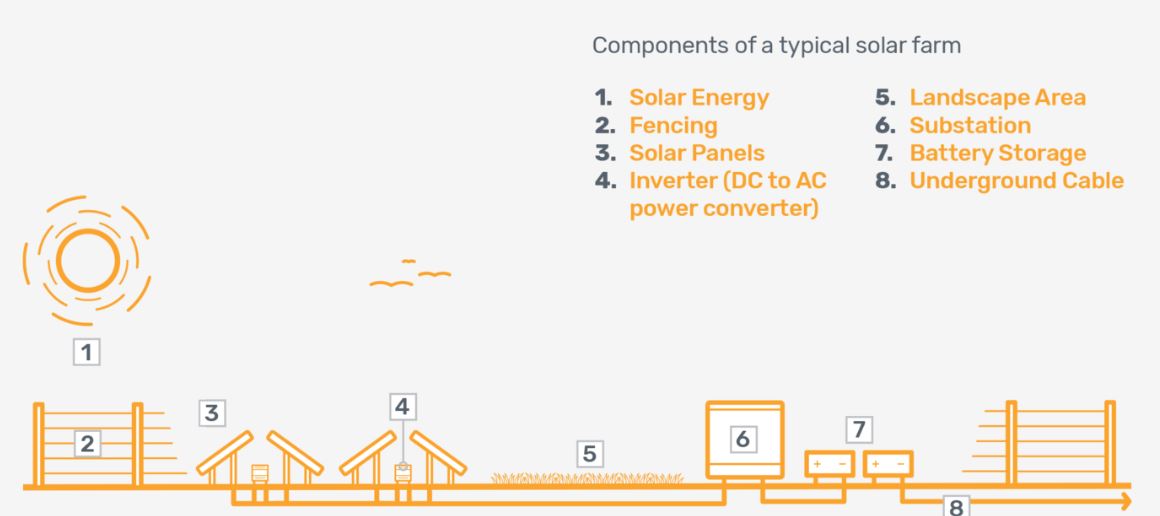
Note that battery storage is included, which I find significant.
- Battery or some other form of energy storage would be used to smooth the peaks and troughs of generation and use.
- Is it significant that it shares a sub-station that is used to connect wind turbines to the grid?
- So will the solar panels charge the batteries and then this energy will be sent to the grid, when the wind isn’t blowing?
The battery would be sized accordingly and calculating the size required is a the sort of problem that needs some comprehensive mathematical modelling.
- Using past sun and wind data, it would be possible to predict likely weather on a day-to-day basis.
- This data would be fed into a mathematical model of the wind and solar farms, with different sizes of batteries.
- A battery size would be chosen, that didn’t allow 91,000 houses in Kent to be without power.
But don’t worry, if you live in Kent, as there are other power stations nearby that could step in.
Having run mathematical models for complicated systems since the late 1960s, I know that this problem is within the capabilities of today’s mathematicians and computers.
The Potential Power Of The Cleeve Hill Solar Farm
The Internet entry for Solar Power In The UK has a section called Solar Potential, where this is said.
London receives 0.52 and 4.74 kWh/m² per day in December and July, respectively. While the sunniest parts of the UK receive much less solar radiation than the sunniest parts of Europe, the country’s insolation in the south is comparable with that of central European countries, including Germany, which generates about 7% of its electricity from solar power. Additionally, the UK’s higher wind speeds cool PV modules, leading to higher efficiencies than could be expected at these levels of insolation.
I’ll start by looking at December.
The solar array at Cleeve Hill will be 360 hectares, which need to be converted to square metres. A hectare is roughly the size of a football pitch like Wembley or 100 metres x 100 metres.
So I can say the following.
- The area of the Cleeve Hill solar farm is 3,600,000 square metres.
- If I assume that Cleeve Hill gets the same amount of sunlight as London, I can say that on each day in December the solar farm will receive an average of 0.52 * 3,600,000 kWh or 1872 MWh of solar energy.
- I have found web sites that say that the best solar panels are twenty percent efficient, which means that on an average December day 374.4 MWh will be generated.
- This is 4.11 kWh for each of the 91,000 households.
Looking at July, I can say the following.
- If I assume that Cleeve Hill gets the same amount of sunlight as London, I can say that on each day in July the solar farm will receive an average of 4.74 * 3,600,000 kWh or 17064 MWh of solar energy.
- Using the same twenty percent efficiency, which means that on an average July day 3412.8 MWh will be generated.
- This is 37.5 kWh for each of the 91,000 households.
I have created an Excel Workbook, that shows the energy generation for a 360 hectare solar farm, through a year.
- I obtained the insolation rates from this page on the Contemporary Energy web site.
- Other data came from Cleeve Hill Solar Farm.
- All parameters can be changed are and at the first part of the workbook.
- It is in Word 97 format
Click this link to download.
A Detailed Look At The Space Between Farringdon Station And The New Museum Of London Site
I took these pictures as I walked up Charterhouse Street beside the new site of the Museum of London.








Note.
- The buildings to be used for the museum need a lot of work.
- The two buildings which could both be cold stores on the railway side of Charterhouse Street wouldn’t appear to have much architectural merit.
- Once Crossrail works are finished, there will be two big gaps leading to the railway lines and Farringdon station.
This picture from Crossrail says it is the Chaterhouse Street ticket hall.

So it looks like that box in the third picture is an entrance to the station and it’s bang opposite the museum.
This Google Map shows the space on the railway side of Charterhouse Street.
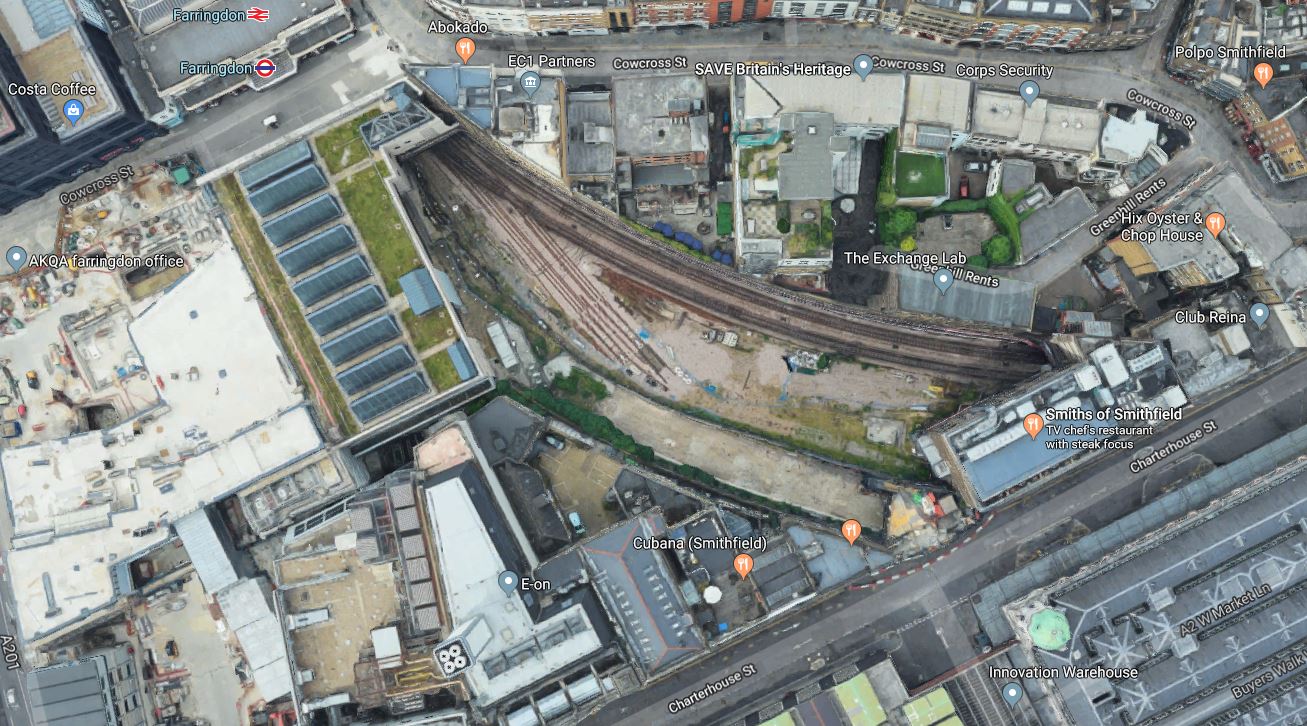
Note.
- Farringdon station at the top of the map towards the left.
- To the left of the station is the site I talked about in TfL Gives Go Ahead To Build Above Farringdon Station.
- Below that site, is another site on the corner of Charterhouse Street and Farringdon Road, that could either be developed in conjunction with the site above it or on its own.
- The Circle, Hammersmith & City and Metropolitan Lines curving between Farringdon and Barbican stations.
- What appear to be a couple of sidings are the remains of the Widened Lines, which used to lead to Moorgate.
- There is also a large curved space, which used to be which was used by services between Bedford and Moorgate, before Thameslink was created.
There’s a lot of space in the area to create a building or series of buildings that provide.
- A worthwhile amount of office space.
- A landmark hotel on one of the best-connected sites in London.
- The right amount of retail space, bars, cafes and restaurants.
But above all a short and pleasant walking route between Farringdon station and the new Museum of London could be designed.
Google Grabs The Best Site In London For Its Massive Groundscraper
This Google Map the site where the massive groundscraper is being built.

Note.
- Kings Cross station, which is on the right of the map, has extensive connections to the North-East of England and Scotland.
- St. Pancras station, which is on the left of the map, has extensive connections to the Midlands and Belgium, France and the Netherlands, with more services to come including Germany, Switzerland and Western France.
- Thameslink runs North-South beneath St. Pancras station, has extensive connections to Bedfordshire, Herfordshire, Kent, Surrey and Sussex.
- There are also six Underground Lines.
- Gatwick and Luton Airports have direct connections and City, Heathrow and Southend Airports only need a step-free change.
- Improvements in the next few years could mean that HS2 and all of London’s five airports will have a fast direct connection to the area.
In the middle of all these railway lines, sits Google’s groundscraper, which shows as a white structure towards the top of the map.
These pictures show the area between the two stations, the under-construction groundscraper and the new blocks.






And these pictures show the progress on the site.



There is not much that is visible yet!
More Pictures!
But the building will be more visible soon! For those who can’t wait, this article from the Daily Mail has a lot of visualisations.
You Are A Rude Terrible President!
Yesterday, Trump showed his bullying side as he dealt with a CNN reporter.
This report on CNN gives their side of the story.
I always remember at a meeting in Cambridge with John Major, where he dealt with press criticism in a polished, barbed and very funny way, such that everybody laughed.
But then Trump is the sort of person, who ignores the general courtesies of life, the freedom of the press and scientific correctness!
But then there are too many Trumps in this world!
Putin’s Only Aircraft Carrier Out Of Action
The title of this post is the same as that of an article in today’s copy of The Times.
This is the first two paragraphs.
Russia could lose its only aircraft carrier after an accident left a five-metre hole in the flight deck.
Admiral Kuznetsov was in the Arctic for repairs when the floating dock underneath it sank, causing a 70-tonne crane to crash on to the carrier killing one person and injuring two.
Enough said!
Is Philip Green Going To Suffer The Same Fate As Gerald Ratner?
Gerald Ratner‘s misdemeanour was that he described some of his company’s product as crap, in a rather elaborate way, in a speech to the Institute of Directors.
The company’s share value dropped and he eventually left the company.
But he obviously has a lot of good qualities as he has been successful since.
Philip Green on the other hand, hasn’t had the best of publicity in recent years and especially in the last few months.
How long will it be before he suffers an enforced retirement?
The City Of London Reaches For The Sky And Keeps More Feet On The Ground
This article on Construction News is entitled City of London To ‘Encourage’ New Skyscrapers.
This is the first two paragraphs.
The City of London Corporation has opened the door to a new wave of towers and an overhaul of one of its main routes as part of draft new local and transport plans.
The local authority wants to encourage the development of new towers able to provide an “iconic image of the City” that will enhance its global standing in the finance, professional services and commerce sectors.
The main route to be upgraded will be Bishopsgate between Liverpool Street station and London Bridge.
- Pedestrians will have more priority.
- Cycling and walking will be improved.
- The public realm will be upgraded.
It the Peak hours, it could become one the busiest walking and cycling routes in the world.
- At the Northern End, there is Liverpool Street station and Crossrail.
- At the Southern End, there is London Bridge, London Bridge station, Southwark Cathedral and the River Thames.
- Just to the West, is the massive Bank station complex.
- Just to the East, is the soon-to-be-redeveloped Fenchurch Street station.
In addition, the road is fringed on either side with alleys, side streets and the impressive Leadenhall Market, many of which are full of restaurants, cafes, pubs and retail outlets.
Conclusion
In the article, Brexit wasn’t mentioned once, but a large increase in employment wasn’t.
Has the City of London, just put several handfuls of fingers up to the selfish plans of others?
 The Anonymous Widower