Drilling Starts For ‘Hot Rocks’ Power In Cornwall
The title of this post is the same as that of this article on the BBC.
For as long as I can remember, there have been plans to tap the ‘hot rocks’ under Cornwall for heat and convert it into electricity.
Geothermal power is used in many places around the world.
The Wikipedia entry is worth a read and the Utility-Grade Stations section has this paragraph.
The largest group of geothermal power plants in the world is located at The Geysers, a geothermal field in California, United States. As of 2004, five countries (El Salvador, Kenya, the Philippines, Iceland, and Costa Rica) generate more than 15% of their electricity from geothermal sources.
This is also said.
Enhanced geothermal systems that are several kilometres in depth are operational in France and Germany and are being developed or evaluated in at least four other countries.
As the Cornish project appears to have a degree of EU funding, it looks like Cornwall is one of the four other countries.
The BBC also had a report on the Cornish drilling this morning. They made a point to say that this project has nothing to do with fracking.
Fracking is an emotive project, but we seem to forget that a lot of the engineering and drilling techniques used in the process are also used in other applications, like obtaining fresh water and drilling very deep holes, as is proposed in Cornwall.
It is also enlightening to look at this Wikipedia entry, which describes geothermal power in Germany.
This is said about the sustainability of the power source in Germany.
n the same year (2003) the TAB (bureau for technological impact assessment of the German Bundestag) concluded that Germany’s geothermal resources could be used to supply the entire base load of the country. This conclusion has regard to the fact that geothermal sources have to be developed sustainably because they can cool out if overused.
Based on this, I can understand the enthusiasm for using the technique in Cornwall.
On the BBC this morning, it was said that the Cornish borehole could produce enough electricity for 3,000 homes.
A page on the OVO Energy website, says this.
Household electricity use in the UK dropped under 4,000kWh for the first time in decades in 2014. At an average of 3,940kWh per home, this was about 20% higher than the global average for electrified homes of 3,370kWh.
At 4,000 kWh a year, a home would use an average of 0.46 kW per hour.
This means that to run 3,000 houses needs 1.4 MW per hour.
A typical price of a kWh of electricity is thirteen pence excluding VAT, which means that this plant could earn around £178 per hour or £1.6million a year.
A Project Video
Access the project video here.
Conclusion
I feel that geothermal power could have a promising future in Cornwall.
Large Hydropower Dams ‘Not Sustainable’ In The Developing World
The title of this post is the same as that of this article on the BBC.
This is the first four paragraphs.
A new study says that many large scale hydropower projects in Europe and the US have been disastrous for the environment.
Dozens of these dams are being removed every year, with many considered dangerous and uneconomic.
But the authors fear that the unsustainable nature of these projects has not been recognised in the developing world.
Thousands of new dams are now being planned for rivers in Africa and Asia.
I think the report has a sound basis and we should think much deeper before we build a large dam.
Storing energy and preventing of floods are probably good reasons, whereas others are not, considering, that solar and wind power are becoming more affordable.
Tomorrow’s World To Return For One-Off Show
The title of this post is the same as that of this article on the BBC.
This is the first paragraph.
Science and technology show Tomorrow’s World is set to return for the first time in 15 years.
The edition will be shown on BBC4 on November 22nd.
I shall be watching, just as I often did in the 1960s
Where The City Of London Leads The Rest Will Follow!
The City of London is a unique Local Authotity, in that very few people live in its area.
C and I used to live in the Barbican with our three boys. It was a very different experience to living anywhere else I’ve lived.
It still functions today as housing and many have lived in the Estate for longer than forty years.
It was one of the first high-quality Local Authority housing schemes in London and it showed if you built quality it worked.
From what I’ve seen elsewhere, other Local Authorities and Housing Associations are building high quality homes for rent.
The City is now tacking another problem in a radical way.
This article on the BBC is entitled The Politics Of Pedestrianisation.
Read the article, of which this is an extract.
Next week, the local authority will take another step towards a bold, radical plan to change the streets in the Square Mile over the next 25 years.
Some streets could be closed to motor vehicles during rush hour and there could be zero emission zones.
There will also be a 15mph speed limit across the district.
The local authority wants to cut the number of vehicles by a quarter by 2030.
The City has consulted workers and residents.
The article says this about the survey.
It found 98% of people travel to the area by walking, cycling or public transport, while 84% think pavements are too crowded.
Four in five people think traffic levels in the City are too high, with 67% saying it contributes to poor air quality, while 59% said it creates an unpleasant street environment.
The authority said it listened to workers and businesses and has to deliver what they want to remain competitive – especially in a post-Brexit world.
It also said it must improve the area to appeal to business and wants to change the priority completely, giving more space to pedestrians and cyclists.
But black cab drivers don’t like it. Surprise! Surprise!
Steve McNamara of the Licensed Taxi Drivers’ Association (LTDA) says pedestrianisation is being dreamt up by middle-class blokes who don’t realise how the milk for their caramel lattes is delivered.
“They are strangling the best city in the planet and they don’t realise people need to have goods and services delivered,” he said.
He thinks the march to pedestrianisation will kill The City.
But I do like it! Look at these pictures I took in the City at about two in the afternoon.
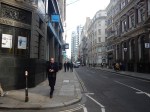




The banning of all vehicles except cyclists and buses has cleared the area around Bank, where it is now a pleasure to walk.
I was actually walking to and from Bank to Leadenhall Market, where I go sometimes for a pleasant lunch in Leon
A year ago, walking would have required a lot of traffic-dodging!
It looks to me, that in a few years time, the City of London will be a square mile of tower blocks and historic alleys and buildings.
- It will be criss-crossed by cycle and pedestrians routes.
- Two or three major routes, will survive for buses and taxis.
- Around the City will be the ring of stations; Aldgate, Bank, Barbican, Blackfriars, Cannon Street, City Thameslink, Fenchurch Street, Liverpool Street, Monument, Moorgate, St. Pauls and Tower Hill.
- The massive Bank and Moorgate/Liverpool Street stations in the heart of the action, will be two of the largest Metro stations in the World.
The City of London will become the Gold Standard for historic cities.
Other UK cities and parts of London like Oxford Street will surely follow.
I do find it strange that the other two big cities in the UK, where walking is pleasant in the centre are Glasgow and Liverpool. Like the City of London, they have underground railways and a river
Morecambe Eden Project Gains Chancellor’s Backing
The title of this post is the same as that of this article in the Westmoreland Gazette.
This is the first paragraph.
Plans for an Eden Project in Morecambe have received official backing from the Chancellor today as he pledged £100,000 in today’s budget to support the development of the proposals being led by Eden Project International.
This is surely good news for the project.
My Preparations For Brexit
My Dalstonian grandmother was caught out by WW1, so she had a hundredweight each of jam and sugar in her cellar for WW2.
I shall be storing my money in Zopa, as it should ride out any storms, as it has done in the past.
How Many Believe The Saudis About The Death Of Jamal Khashoggi?
I certainly don’t!
But Donald Trump does!
But then Trummkopf likes dictators like Putin and Fatty The Third!
HyperSolar Granted Critical Patent for Producing Low Cost Renewable Hydrogen
The title of this post is the same as that as this article on Global News Wire.
It looks to me that a company call HyperSolar is working on producing hydrogen direct from solar power from any water source.
This is technology to watch. Pending full development, you can always watch this video on the HyperSolar web site.
Is This The Most Important Door In My Life?
In some ways this is the most important door in my life.
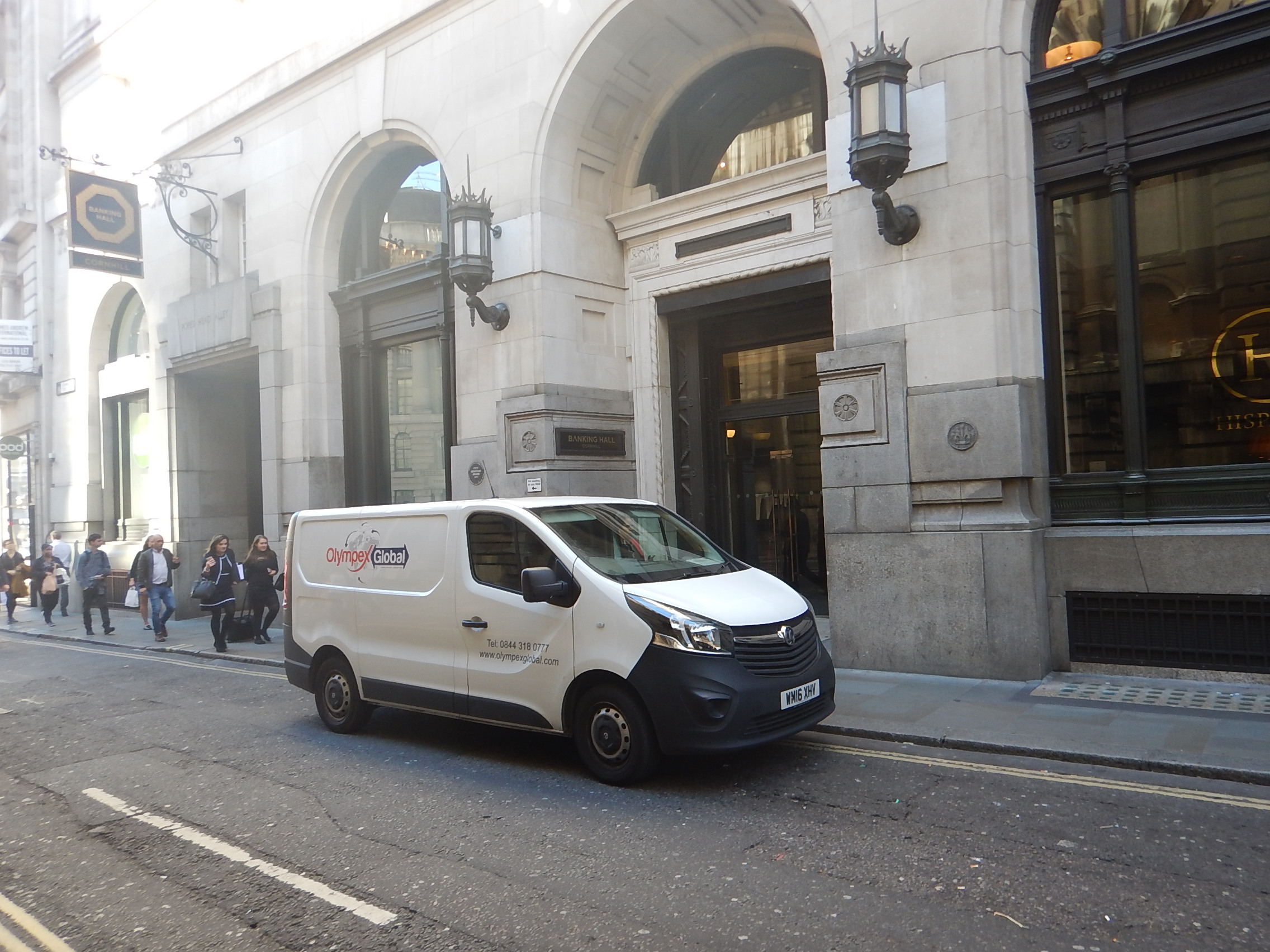
It used to lead through into the superb banking hall of Lloyds Bank.
In the early 1970s, I was doing some programming for the bank as a consultant to a company called Time Sharing Ltd.
The purpose of the software was to take the banks costs and expenses and calculate how much each of the various actions cost the Bank, by branch,area and region.
I was working for one of the Managers; Mike Spicer, who worked under the Chief Management Accountant; C. R. C. Wesson, who I later knew as Bob.
I’d never met Bob and as Mike was away, Bob phoned me up one morning and asked me to run the software, as they’d just uploaded a new batch of data.
I duly did this from home, and checked that it had run successfully after cycling to Time Sharing at Great Portland Street. They then asked, if I could take the results to the Bank on my way home to the Barbican.
I was worried that I was not dressed for visiting the Head Office of one of the UK’s big banks. I was painting our flat and wearing a pair of ice blue jeans and a short-sleeved shirt. . Luckily, I had a carrier on my bike, for the couple of inches of fan-folded green-striped print-out.
I had been told to ring the bell by the side of the door in the photograph and despite the banking hall being closed, I would be let in.
I arrived safely about six and rang the bell.
Perhaps a minute or two later, the ornate and extremely heavy door slid aside and a footman appeared, immaculately dressed in the Lloyds uniform of green tail-coat and top hat. He said. “You must be Mr. Miller!”
When I affirmed, he ushered me through and I offered him the printout. He then said, that Mr. Wesson would like to see me. I protested about my clothes, but he firmly showed me to the lift and pressed the appropriate floor. He added that Mr. Wesson would meet me at the lift.
It was the start of a very firm friendship.
Together we developed the software and produced loads of copious tables and graphs.
I learned a tremendous amount from dealing with the only innovative accountant I have ever met.
A lot of his philosophy found its way into Artemis.
One thing he told is that bankers when given a table of figures, always add them up to make sure there are no mistakes.
So I developed a technique in the Lloyds Bank software, where if money was allocated between various rows in a table, the total was always correct. If you round each row, this isn’t always the case.
I used this technique in the aggregation of resources and costs in Artemis.
Sadly, Bob died of I think cancer, a few years later!
I owe him a great debt!
A Fast Food Restaurant With Gluten-Free Beer In An Iconic Location
Leadenhall Market is one of the City of London’s iconic locations.

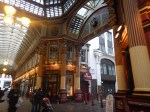
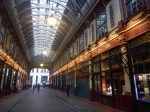
Leon have an outlet and I was surprised to find that it sells Estrella Damm Daura, a very reasonable Spanish gluten-free beer.
I’ll experiment one day, to see how a beer goes with Lean’s excellent gluten-free chicken nuggets.
The restoration of the market was done in 1990 by students, as I posted in No Budget; Employ Students.
I actually walked through at eleven o’clock on a Sunday morning, and it was good to see the City more open at that time.
In a couple of years, the City will become one of the must-see places to go in London and the best time will be the weekend.
 The Anonymous Widower