Ozzy Puts The Bull Into New Street Station
I went to Birmingham New Street station today to see Ozzy, the Birmingham Bull in his new home.
























I don’t think we’ve seen such a camera frenzy in the UK, since the days of Princess Diana.
In The Birmingham Bull – 5th August 2022, there are pictures of the Bull a year ago. Ozzy has changed, but a year ago, he wasn’t intended to be permanent.
This picture is from last year.

There are differences. Note the loader underneath to give the artwork movement.
A year ago, I said this in the post.
This wonderful work of engineering art, is far too good and is now too well-loved to be scrapped.
As it needs to go inside, why not bring it inside High Speed Two’s new Curzon Street station, to greet passengers visiting Birmingham?
Ozzy has found a new permanent home in Birmingham New Street station, but I wouldn’t rule out a move to Curzon Street station, for several decades.
West Midlands Metro – Eastside Extension – 26th July 2023
These pictures show the current state of the Eastside Extension of the West Midlands Metro.




























Note.
There is a triangular junction, where the lines split to the South of the Bull Street tram stop.
The Eastside Extension will run past Curzon Street station and then on to somewhere around Digbeth Coach station.
There is a triangular junction, where the lines split to the South of the Bull Street tram stop.
Through Birmingham City Centre On A Tram – 26th July 2023
When I get to a new city, I like to take a tram across the City Centre taking pictures.
I realised, that I’d never done this in Birmingham before, so I did it today on the West Midlands Metro.




























Note.
It will be better, when the gaps are filled in.
- I got on at Brindleyplace.
- I got off at Grand Central.
This was my all-day Zone 1 ticket, that I used to go up and down all day.

For just £2.80 all day, you can go between Edgbaston Village and Jewellery Quarter, as much as you need.
Centrica Signs UK Biomethane Agreement With Yorkshire Water And SGN Commercial Services
The title of this post, is the same as that of this news item from Centrica.
These three paragraphs outline the story.
Yorkshire Water, an essential water and wastewater services provider for the Yorkshire Region, and Centrica Energy Trading, have today announced signing a 15-year agreement to offtake biomethane production and manage shipping, trading, and balancing of production from two plants developed by SGN Commercial Services.
SGN, a leading manager of natural gas and green gas distribution networks in Scotland and the south of England will design, develop and operate the biomethane gas-to-grid sites, which once operational, will produce approximately 125GWh of biomethane annually — enough to heat more than 10,000 UK households.
Biogas will be produced as a by-product of Yorkshire Water’s sewage wastewater treatment processes, where Centrica will offtake production from the site and subsequently manage shipping, trading, and balancing of the green gas. Biomethane will be injected into the UK grid to displace natural gas, providing cleaner and more resilient gas supplies that reduces dependency on outside energy imports.
SGN Commercial Services are a wholly-owned subsidiary of SGN.
This mission statement is on the home page of their web site.
Our safety-first culture provides bespoke commercial solutions and green gas services to our clients, allowing them to better meet their business needs today and in the future.
In an energy market which is prioritising de-carbonisation and net-zero solutions, we can help navigate a clear pathway for your business to achieve its goals both responsibly and cost-effectively.
It looks to me, that SGN Commercial Services will design, develop and operate the biomethane gas-to-grid sites, so that the biomethane from the sewage works can be fed into Centrica’s main UK gas grid.
You could argue, that every sewage works and landfill producing large amounts of methane, should have one of these connections.
What would be the repercussions if SGN Commercial Services were asked to connect all these sites to the gas grid?
- How much gas would be collected?
- How many houses could be heated?
- How much of the greenhouse gas; methane would not be released into the atmosphere?
This is a cunning plan, that is worthy of Baldrick at his best.
Over a period of time, domestic gas consumption will fall as houses are fitted with heat pumps and other green methods for heating.
Could this mean, that as time goes on, more and more of our domestic consumption of gas is satisfied by net-zero gas from waste sources?
Does HiiROC Fit In Anywhere?
This article on UKTN is entitled Meet HiiROC, The Startup Making Low-Cost Hydrogen Free From Emissions.
There is a section, which is called How Does HiiROC Work?, where this is said.
The company’s hydrogen generation units use feedstock gases such as methane, flare gas or biomethane at high pressure and with a very high electrical field between an anode and cathode.
This dissembles the tightly bound molecules into hydrogen and carbon atoms, with both coming out as a plasma (like a gas). The carbon is instantly cooled and solidified as pure carbon, which means no carbon dioxide is formed, in a quenching process to stop it from reforming back into the input gas.
The end product is hydrogen and carbon black, a material used in rubber tires, inks and paint.
It’s a material that has wide industrial use, but current production methods create large amounts of CO2 and other environmentally harmful biproducts.
“Our process is emission-free,” says HiiROC co-founder and CEO Tim Davies. “Because all you’ve got is hydrogen and solid carbon – they are the two products.”
For every kilogram of hydrogen produced using HiiROC units, you’re left with three kilograms of carbon black. This, however, is a potentially valuable, clean solid by-product and does not contribute to global warming unlike processes that create carbon dioxide gas.
Read the full article on UKTN, as it is full of very interesting information.
It says this about distributing hydrogen to a number of industries.
Lots of industries need hydrogen, which means HiiROC has a broad range of potential customers.
Their smallest machine can produce up to 100 kilograms of hydrogen per day. But due to their modular design and small size, they can easily be stacked up to increase output, making them scalable for businesses requiring large-scale industrial hydrogen production.
So at one end of the scale, it could support a hydrogen filling station, or a farmer wanting to use hydrogen to go carbon-free and at the other, it could support an energy intensive process like hydrogen steelmaking. All that is needed is a suitable hydrocarbon gas feed.
Last night on the BBC, a program called What They Really Mean For You, was about electric cars.
The program flagged up a shortage of graphite for making the batteries for electric cars.
So seeing that HiiROC hydrogen systems, could be producing tonnes of carbon black could this be converted into battery-grade graphite?
Google says yes!
This article on Sciencing is entitled How To Turn Carbon Into Graphite.
Conclusion
As Centrica own a substantial portion of HiiROC and are lending the company a gas-fired power station for full scale trials, I believe that Centrica is up to something, that will have three strong benefits for the British public.
- They will be able to keep their gas boilers for longer.
- Hydrogen supplied by HiiROC’s devices will provide hydrogen in the required quantities to where it is needed.
- The carbon black produced by HiiROC’s devices, when turned into graphite will be a valuable feedstock for giga-factories making batteries.
Engineering is the science of the possible, whereas politics is dreams of the impossible.
Sussex Will Be Leader In Hydrogen Energy Production
The title of this post, is the same as that of this article on The Argus.
These are the first three paragraphs.
The county is today launching its bid to become a pioneer for use and production of hydrogen energy.
Experts will unveil Brighton’s hydrogen strategy this morning showing how the city and surrounding areas are championing a clean energy infrastructure.
With plans for a Worthing crematorium to become the first in the world powered entirely by hydrogen, development of a green energy production facility in Shoreham, and a growing fleet of hydrogen-powered buses in Crawley, the region is already breaking ground in the hydrogen industry – and shows no sign of stopping.
These are my thoughts.
The Plan Is Comprehensive
This document of the Council website, is entitled the Greater Brighton Hydrogen Strategy.
It is very comprehensive and discusses hydrogen in Sussex from all angles.
Every Council in the UK needs to have their own comprehensive strategy like this.
The Report Cautions That Greater Brighton May Need More Renewable Energy
Consider.
- The Rampion wind farm, with a capacity of 400 MW is already operating in the sea South of Brighton.
- This should be joined by the 1200 GW rampion 2 wind farm in the next few years.
It is unlikely substantial onshore wind and solar farms will be built in the area.
Gatwick Airport Is Expected To Need A Hydrogen Supply
The strategy says this about Gatwick and the two Rampion wind farms.
The offshore wind farm Rampion is large enough to be considered nationally significant infrastructure. There
is a second development for this wind farm planned for 2025-6, which will connect into Bolney substation as
per the existing wind farm.The GBEB energy plan suggested that an electrolyser could be sited there, although there are no identified demand locations nearby other than potential refuelling of passing traffic on the A23.
However, considering the relative distance to Gatwick airport, which is expected to be a significant future
demand, there may be an opportunity for a direct pipeline. This would be further into the future and requires
further analysis and bilateral engagement between Rampion and Gatwick. Engagement with Rampion found
that, given the large population supplied by the Rampion wind farms, and the relative lack of other large-scale
renewables locally, these wind farms are unlikely to face significant curtailment and will fully contribute to
decarbonising the local electricity grid. Therefore, using Rampion to produce hydrogen by electrolysis is not
seen as the best use case in the near term.
It looks to me, that because of the electricity demand in the Brighton and Gatwick area, that a big decision needs to be made to create some more renewable capacity.
Could this mean a Rampion 3 or perhaps a fleet of small modular nuclear reactors at Dungeness?
An Electrolyser At Bolney Substation
This Google map shows the position of Bolney substation.
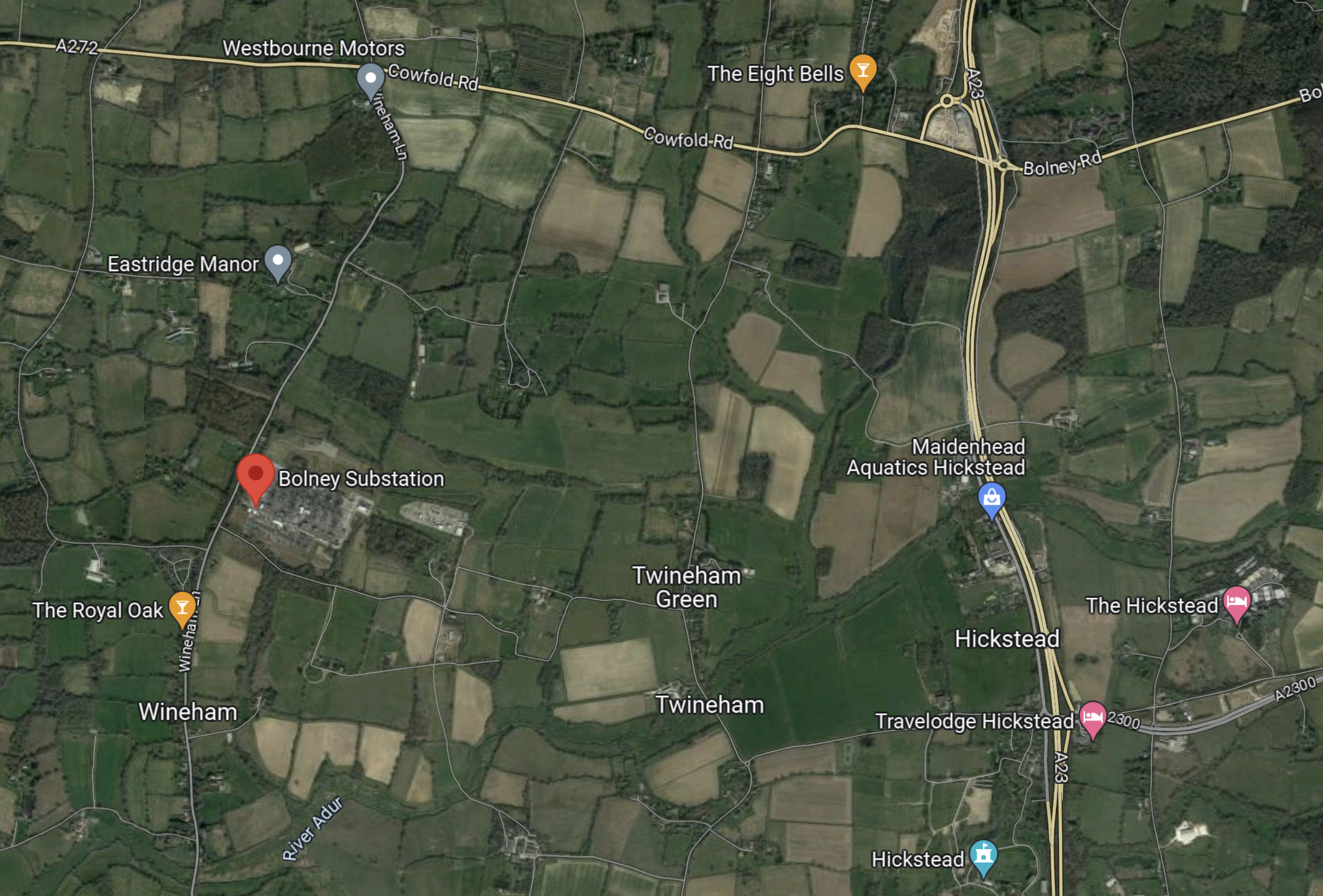
Note.
- The A23 is the main London-Brighton road.
- Bolney substation is indicated by the red arrow.
- The substation doesn’t have very good road access.
- I also suspect that the locals wouldn’t like an electrolyser in their midst.
On a brief look, I suspect that an electrolyser at Bolney substation will be a non-starter.
Shoreham Port As A Hydrogen Hub
The strategy mentions Shoreham Port several times, but gives the impression that progress is slow.
This Google Map shows Shoreham Port.
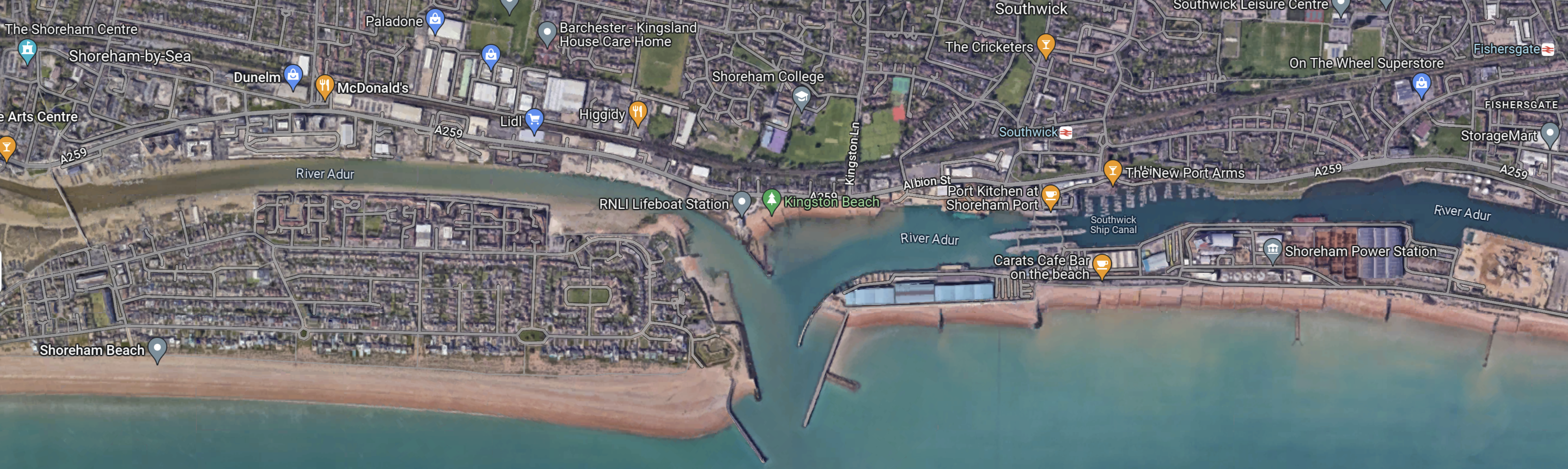
Note.
- Shoreham is in the West.
- The port reaches a long way to the East.
- The 420 MW gas-fired Shoreham Power station, is at the Eastern end of the port, close to the sea.
There appears to be spaces along the water for developing hydrogen infrastructure.
This page on the H2Green web site is entitled Agreement to Develop Clean Energy Hub for Shoreham Port, Sussex, starts with this paragraph.
Getech, the geoscience and geospatial technology provider and data-led energy asset developer, is pleased to announce that its wholly owned hydrogen subsidiary, H2 Green, has signed a Collaboration Agreement (the “Agreement”) with Shoreham Port.
It lists these three highlights.
- H2 Green granted a two-year legally binding exclusive right to develop a renewable energy hub (the “Hub”) at the Port of Shoreham, West Sussex.
- Under plans submitted by H2 Green to Shoreham Port, the Hub will initially focus on the provision of green hydrogen and renewable electricity to the Port’s fleet of 39 heavy forklift trucks and 12 heavy goods vehicles.
- Green Hydrogen will be sourced by a scalable green hydrogen production, storage and refuelling facility – the economics of which will be optimised by its integration with new solar and wind electricity generation capacity.
- The Hub will then be expanded to facilitate the decarbonisation of more than 800 heavy goods vehicles that enter Shoreham Port daily, and to provide fuel to port and coastal marine vessels.
That is all good stuff, but I do wonder, where the renewable electricity is going to come from.
In Further Thoughts On BP’s Successful INTOG Bid, I looked at BP’s plan for a 50 MW wind farm.
- It will be about twenty miles offshore from Aberdeen.
- With an appropriate electrolyser 50 MW of electricity would produce twenty tonnes of hydrogen per day.
- The electrolyser could be onshore or even offshore.
- The technology has all been developed.
Could H2Green be thinking of developing a similar hydrogen production facility?
Octopus Energy To Pour Billions In Offshore Wind Globally By 2030
The title of this post, is the same as that of this article on offshoreWIND.biz.
This is the sub-heading.
UK green energy supplier Octopus Energy Group has announced that it will invest, through its generation arm, USD 20 billion (about GBP 15 billion) into offshore wind by 2030.
These three paragraphs outline the investment.
The company said that this will go towards the generation of 12 GW of renewable electricity a year, enough to power 10 million homes.
Octopus is targeting projects across the globe, with a focus on Europe, and already has several deals in the pipeline.
It will back developers of new offshore wind farms as well as projects that are under construction operational, according to the press release.
Note.
- This is the original press release from Octopus Energy, which is entitled Making Waves: Octopus Energy To Unleash $20bn Of Investment In Offshore Wind By 2030.
- According to the press release, Octopus Energy also backs Simply Blue, a developer of innovative floating offshore wind projects, a type of offshore wind technology that taps into strong winds deeper out at sea.
- I will be interested to see how much capacity, Octopus Energy builds in the UK and how the capacity relates to their electricity sales in the UK.
Octopus Energy seem to have their tentacles into several worthwhile projects.
They will certainly need a lot of finance.
In World’s Largest Wind Farm Attracts Huge Backing From Insurance Giant, I describe Aviva’s philosophy about investing in renewable electricity infrastructure, based on an article in The Times.
I suspect other reputable companies and funds will follow Aviva’s lead. Provided, that the infrastructure is top-notch and well-managed.
A Walk Over Wandsworth Bridge – 25th July 2023
This article on the BBC is entitled Wandsworth Bridge Closes For 10 Weeks Of Repairs.
This is the sub-heading.
A 10-week closure of Wandsworth Bridge for “essential safety repairs” has begun, Wandsworth Council says.
These are the first three paragraphs.
The authority added that the work was needed “to safeguard the long-term future of this key river crossing”.
Transport for London (TfL) has warned passengers that bus services which use Wandsworth Bridge will be diverted or stop short of normal destinations.
It added that the bridge would remain open for pedestrians, while cyclists can cross if they dismount.
So I went to have a look, starting at Wandsworth Town station.








It is a station, that needs a single lift and perhaps a small amount of refurbishment.
I walked from the station and over Wandsworth Bridge and along Wandsworth Bridge Road.




































Note.
- There were several restaurants and cafes.
- It was a level walk.
- It looks like the Council was taking the chance to resurface the bridge.
- Along Wandsworth Bridge Road, drivers were not keeping to the 20 mph speed limit.
Some cyclists were still cycling on the bridge.
Il Pagliaccio Restaurant
I had lunch in the Il Pagliaccio Restaurant.





It was a typical friendly Italian restaurant, that served gluten-free food.
Ørsted Divests Remaining Stake In London Array For EUR 829 Million
The title of this post, is the same as that of this article on offshoreWIND.biz.
This is the sub-heading.
Ørsted has signed an agreement with funds managed by Schroders Greencoat to divest its remaining 25 per cent minority interest in the London Array offshore wind farm in the UK.
These first three paragraphs outline the deal and give Ørsted reasons.
The total value of the transaction is GBP 717 million (approximately EUR 829 million).
Ørsted originally owned 50 per cent of the project and divested an initial 25 per cent of London Array to Caisse de dépôt et placement du Québec (CDPQ) in 2014.
The company does not have operations and maintenance (O&M) responsibility at the 630 MW London Array, and as the firm only holds a minority interest, Ørsted said it considers the asset non-strategic.
Note.
- Ørsted is the world’s largest developer of offshore wind power by number of built offshore wind farms.
- Schroders Greencoat LLP is a specialist manager dedicated to the renewable energy infrastructure sector.
This is a typical transaction, which is enabled between companies in the world’s financial centres all the time.
- Company A has an asset, which generates a predictable cash flow and needs money to invest in similar assets.
- Fund B has lots of money, but needs a predictable cash flow to pay interest to its investors.
So it is not surprising, that Fund B buys the asset from Company A.
I should say that the project management computer system, that I designed; Artemis was leased to the end users.
This eased the process of funding the sales.
In later years, I seem to remember, that we took bundles of leases with companies like BAe, BP, Shell, Texaco and sold them to banks, who needed a safe investment.
Carlton Power Secures Planning Consent For World’s Largest Battery Energy Storage Scheme
The title of this post, is the same as that of this news story from Carlton Power.
This is the sub-heading.
£750m 1GW Battery Project To Be Built At Carlton Power’s Trafford Low Carbon Energy Park In Greater Manchester
These three paragraphs outline the project.
Carlton Power, the UK independent energy infrastructure development company, has secured planning permission for the world’s largest battery energy storage scheme (BESS), a 1GW (1040MW / 2080MWh) project located at the Trafford Low Carbon Energy Park in Greater Manchester. The £750m BESS scheme will strengthen the security and resilience of the energy system in the North West of England, and support the energy transition and the growth of renewable power generation in the region.
Planning permission for the BESS was granted by Trafford Council, the local planning authority.
Subject to a final investment decision, construction of the battery storage scheme is expected to begin in the first quarter of next year (2024) with it entering commercial operation in the final quarter of 2025. Carlton Power is in advanced talks with companies to finance, build and operate the Trafford BESS.
I have a few thoughts.
It’s A Monster
This Wikipedia entry, lists the World’s Largest Grid Batteries.
- The current largest is Vistra Moss Landing battery in the United States, which has a capacity of 1600 MWh and an output of 400 MW.
- The Trafford BESS will have a capacity of 2080 MWh and an output of 1040 MW.
By both measures the Trafford BESS is larger.
Where Will It Get The Energy?
Consider.
- In Liverpool and Morecambe Bays there is over 5 GW of offshore wind farms either operational, under construction or planned.
- Carrington gas-fired power station has a capacity of 884 MW.
- The Western HVDC Link is a 2250 MW link between Scotland and Connah’s Quay in North Wales.
- I wrote about the proposed Mersey Barrage in Mersey Tidal Project And Where It Is Up To Now.
I can see enough renewable energy being generated to replace Carrington gas-fired power station.
Who Will Finance, Build And Operate The Trafford BESS?
There are two major Energy Storage Funds in the UK.
- Gore Street with 27 projects totalling 1.17 GW.
- Gresham House with 17 projects totalling 425 MW.
Note.
- There are other smaller funds.
- The figures given are cumulative outputs for the portfolios.
- Sourcing the large number of batteries might be a problem.
- As the maths of these batteries are now well-known, I would expect that finance shouldn’t be too much of a problem.
- Local companies like Liverpool Victoria or Peel Holdings could even take a position.
A large American contractor backed by US money could swallow the whole project.
That happened with North Sea oil and gas in the last century.
Is Highview Power’s CRYOBattery Still Planned?
Carlton Power’s news story says this about Highview Power’s plans.
In addition to Carlton Power’s two projects, Highview Power Storage Inc. is planning to build and operate the world’s first commercial liquid air storage system – a £250m 250MWh long duration, cryogenic energy storage system – on the Trafford Low Carbon Energy Park, which was until 1991 the site of the Carrington coal-fired power station. The Low Carbon Energy Park is located close to Manchester Ship Canal and the £750m Carrington flexible gas-fired power station which entered operation in 2016.
It seems that the CRYOBattery is still planned.
Conclusion
Manchester is getting a powerful zero-carbon hub.
Asbestos In M&S Killed My Wife — Gove’s Ruling Is A Disgrace
The title of this post, is the same as that of this article in The Sunday Times.
It is in a section of the paper, which is entitled Act Now In Asbestos, where the paper has a campaign.
These are the first three paragraphs.
Janice Allen met and fell in love with her husband, Stuart, when they worked together at Marks & Spencer’s flagship store in London’s Marble Arch.
The shop would end up killing her.
Janice died of mesothelioma, a cancer she got from exposure to asbestos. The M&S store was constructed using the toxic building material and it was found in several locations where she worked. The department store would award her substantial damages before she died at a hospice in Kent in June 2018.
I have only worked with asbestos once.
This picture shows my father’s printing works in Station Road, Wood Green.
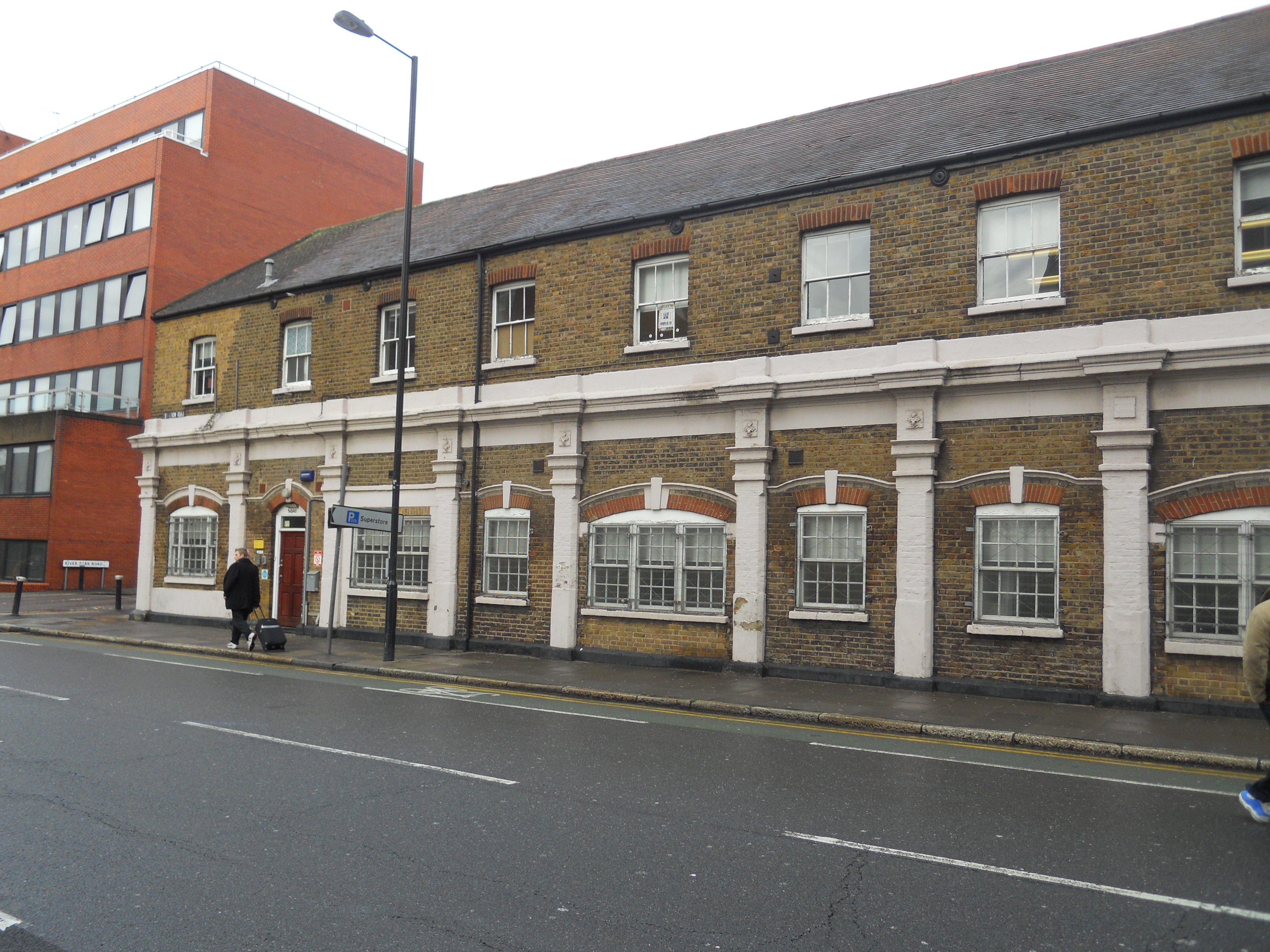
They were not the most salubrious of premises and my father was always making improvements.
My father was a very good practical carpenter and an accomplished painter and decorator.
The back wall of the building was covered on the inside with damp and mould, which even in the 1950s, he thought could be a health hazard, so he decided to do something about it.
- Above a certain height he cleaned the wall and painted it with a standard magnolia paint.
- About two metres above the ground, he fixed a two-by-two batten piece of wood to the wall.
- He also fixed another one to the wall, perhaps halfway up.
- To cover all the damp and mould, he then fixed corrugated asbestos cement sheeting to the two battens with galvanised roofing nails.
- To finish it off he screwed a piece of slatting to the top batten, which he painted a fetching blue colour.
The damp and mould was now out of sight and out of mind.
I remember how this construction was done, as I was my father’s ten-year-old assistant.
Although we’d used asbestos cement sheeting, I don’t think either my father or myself inhaled any asbestos dust, although we weren’t wearing masks, as no-one did in those days.
ICI And Asbestos
My next encounter with asbestos was at ICI in the late 1960s.
- A lot of chemical plants, built before the Second World War were riddled with it.
- But ICI, knew of the problems, and I was given strong warnings about asbestos.
- As I was only putting instruments on plants, with experienced plant fitters, I didn’t have an real encounters with it.
But why if ICI were so anti, were builders still using it and otherwise sensible companies not removing it from their buildings?
This is the large paragraph in The Times article.
An M&S spokesman said: “Like many older buildings, Marble Arch dates back to the interwar era when asbestos was commonly used in construction, and sadly our former colleague Janice Allen worked in the store over 40 years ago, before the consequences of asbestos use were known. Today we rigorously manage asbestos where it is present and ensure the store is safe for every colleague and customer.”
If ICI were worried about asbestos in the late 1960s, why weren’t Marks & Spencer worried about asbestos in the late 1970s.
A Barn In Suffolk
In the 1980s, I put up a new barn, where we lived.
Often, in those days, asbestos was still used for roofing, but I was recommended to use a new British Steel product, where steel was covered in a coloured weatherproof coating.
I Sneeze A Lot
These days, I sneeze a lot, but I didn’t sneeze this much before I was diagnosed as coeliac and went gluten-free.
Could it be that my immune system is so much stronger and when there is something in the air, it is only giving it a good kicking?
I’ve been sneezing a lot for the past few days, as the Council removed a dead tree from outside my house.
But we do know, that Nottingham University have shown, coeliacs on a gluten-free diet have a 25 % lower cancer rate than the general population.
Could this be due to a stronger immune system?
My Coeliac Son Died From Cancer
I believe my youngest son was an undiagnosed coeliac and he lived the rock-n-roll lifestyle on a diet of ciggies, cannabis and Subways, as he was a sound engineer in the music business. He died virtually out of the blue of pancreatic cancer at just thirty-seven.
So on the one hand being a diagnosed coeliac on a gluten-free diet gives you a certain immunity to cancer and other diseases and on the other hand undiagnosed coeliacs are prey to all the nasties we have to live with.
To return to the tragic story in The Times, which gives Stuart’s age as 62, so that places him as being born around 1960 and his late wife; Janice looks about the same age.
I think it is true to say, that in the 1960s, medicine started to change dramatically.
- Serious heart operations and kidney transplants became commonplace.
- The first heart transplant was performed in 1967.
- Drugs were improving.
- Vaccination was stopping polio and other diseases.
- The first test for coeliac disease in children was developed. Sadly, it wasn’t used on me.
But we had little inkling of the role of genes in diseases.
Incidentally, I didn’t come across my first coeliac, until 1972, when a neighbour had a coeliac baby son called Nicholas.
So was the poor lady in The Times story, in some ways a victim of her time?
- Asbestos was wrongly ignored by Marks & Spencer.
- Medicine hadn’t advanced enough to be able to identify, those susceptible to cancer.
- I have heard so many stories of bad use of asbestos.
Sadly, the dangers of asbestos are still ignored by many companies and organisations today and that includes the NHS.
One of my colleagues at ICI in 1968 will be livid at how we are ignoring asbestos.
Is This A Possible Scenario?
Consider.
- Someone is born coeliac and they are not diagnosed.
- If they were born before 1960, there was no test for coeliac disease in children.
- The simple genetic blood test came in around the turn of the century.
- They work with asbestos in their twenties.
- Their immune system is not good enough to protect them.
Just like my son, will they get a serious cancer?
Coeliac Disease And Covid-19
In Risk Of COVID-19 In Celiac Disease Patients, I look at a pier-reviewed paper from the University of Padua.
This sentence, sums up the study.
In this analysis we report a real life “snapshot” of a cohort of CeD patients during the SARS-CoV-2 outbreak in Italy, all followed in one tertiary centre in a red area of Northern Italy. Our data show, in accordance with Emmi et al., the absolute absence of COVID-19 diagnosis in our population, although 18 subjects experienced flu-like symptoms with only one having undergone naso-pharyngeal swab.
There were 138 coeliac disease subjects in the study and they had been gluten-free for an average of 6.6 years.
The downside of this, is how many undiagnosed coeliacs, suffered a severe dose of Covid-19.
Conclusion
Given the pain coeliac disease has inflicted on my family over the years, I believe that all children should be tested for coeliac disease.
I would also recommend, that anybody thinking of working with asbestos or taking a job with a high cancer risk, should get themselves tested for coeliac disease.
Being found to suffer from coeliac disease will not in itself kill you, and with the right diet, it might even prolong your life.
 The Anonymous Widower