Centrica Tackles Difficult Terrain To Deliver Sustainable Solar Solution For Derbyshire Manufacturer
The title of this post is the same as that of this press release from Centrica.
This is the sub-heading.
Centrica Business Solutions has successfully completed a bespoke solar farm for Carpenter Ltd, a Glossop based manufacturer, overcoming significant terrain challenges to help the business take a major step towards a sustainable future.
These two paragraphs add some more detail.
- Built on a 14.62% sloped bank – a location once considered unsuitable for development – the project required careful planning, specialist machinery, and adaptive engineering techniques to ensure safe, efficient installation in mud-heavy winter months. Most solar farms are installed on flat ground; this project demanded a fully customised approach.
- The new solar array comprises 1,666 panels generating 1,025 MWh of renewable energy per year. This will help Carpenter Ltd cut carbon emissions by 116,150 kg CO₂ in the first year alone, reduce energy costs, and strengthen local economic resilience by supporting sustainable manufacturing jobs in the region.
This is a picture of the site from Centrica.
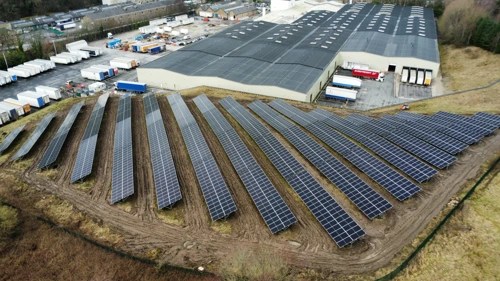
Google AI says the array is around a MW.
How many other difficult solar installations can be developed using good old-fashioned construction and engineering techniques?
How Far Will A Class 897 Train Travel Without Using The Electrification?
I have not seen this question answered, so out of curiosity, I asked Google AI and received this answer.
LNER’s upcoming Class 897 “tri-mode” trains are designed to travel approximately 120 miles (around 193 km) on battery power alone when not using 25 kV overhead electrification. These 10-car Civity UK trains, ordered from CAF, are expected to operate on electric, diesel, or battery, with the latter used for sustainable, emission-free, quiet running near stations and on non-electrified sections.
Key details regarding the Class 897, as highlighted by LNER’s announcement and related news, include:
Operational Capability: They are designated as tri-mode, capable of running on 25 kV AC overhead electric, onboard battery power, or diesel.
Intended Usage: The battery power is primarily intended for use on the approach to and departure from stations.
Range: The batteries are reported to offer a range of roughly 120 miles.
Introduction: The units are expected to be delivered from 2027 to serve the East Coast Main Line.
Branding: The trains will operate under the new Great British Railways (GBR) branding.
Most of the information used by Google AI came from an article in Railway Gazette International in early 2026.
It certainly looks like Great British Railways will have at least one 125 mph, 120 mile range express away from the wires.
I also asked Google”Do Hitachi Battery Electric InterCity Trains Have Problems?” and received this answer.
While Hitachi’s battery-powered intercity trains have shown promising results in trials, particularly regarding fuel savings and emissions reduction, there are some potential challenges and considerations. These include safety concerns related to lithium battery fires, especially in the event of a crash or derailment, as well as range limitations for longer journeys. However, the technology is continuously evolving, and Hitachi is actively working to address these issues.
That seems fairly positive.
There is also this article on the BBC, which everybody should read, which is entitled Will New Battery-Powered Trains Replace Diesel, And Are They Safe?.
In The Data Sheet For Hitachi Battery Electric Trains, I look at the data sheet, that Hitachi published in late 2023.
These were my conclusions about the data sheet.
These are my conclusions about Hitachi’s battery packs for Class 80x trains, which were written in November 2023.
- The battery pack has a capacity of 750 kWh.
- A five-car train needs three battery-packs to travel 100 miles.
- A nine-car train needs five battery-packs to travel 100 miles.
- The maximum range of a five-car train with three batteries is 117 miles.
- The maximum range of a nine-car train with five batteries is 121 miles.
As battery technology gets better, these distances will increase.
Hitachi have seen my figures.
They also told me, that they were in line with their figures, but new and better batteries would increase range.
It looks like Great British Railways will have at least two 125 mph, 120 mile range express trains away from the wires.
125 mph trains with a 120 mile range on batteries, will revolutionise UK train travel.
LNER’s Class 897 Trains
In the Wikipedia entry for LNER, this is said about LNER’s new ten CAF tri-mode trains.
In November 2023, LNER placed an order for 10 ten-car tri-mode (electric, diesel and battery power) Civity trains from CAF. In August 2024, it was announced that the units will be designated Class 897 under TOPS.
According to their Wikipedia entry, it appears the Class 897 trains will be delivered from 2027.
Can I Build A Schedule For The Introduction Of New Trains, Services and Batteries?
I think that I can from the information that is out there.
- East Coast Main Line – December 2025 – Introduction of Lumo between London King’s Cross and Glasgow
- West Coast Main Line – Spring 2026 – Introduction of Lumo between London Euston and Stirling
- Midland Main Line – 2026-2027 – Introduction of EMR Class 810 trains between London St. Pancras and Leicester, Derby, Nottingham and Sheffield.
- East Coast Main Line – From 2027 – Introduction of LNER Class 897 trains between London King’s Cross and Yorkshire.
Note.
- The two Lumo services use trains already in service.
- The Class 810 trains for EMR are being debugged and introduced at the present time.
- The only new trains are the Class 897 trains for LNER.
- The introduction of the Class 897 trains will allow LNER to withdraw some trains for refurbishment and fitting of batteries.
This would mean that before the next general election, almost the full timetable between London and the North of England and Scotland would have been implemented using diesel-electric technology.
Is it a low-risk start to the full electrification of services to the North?
The second-phase would see battery-electric trains introduced.
I believe that Grand Central’s new trains would be brought into service first.
- The new trains are scheduled to be introduced in 2028.
- Grand Central will still have the diesel trains for backup.
- Their new trains would be similar to the other Hitachi trains.
- It looks like they could be doing some splitting and joining.
After the Grand Central trains had been introduced successfully, the trains for the other Hitachi operators would have batteries fitted.
I suspect short routes like Lincoln would be electrified with battery-electric trains first.
There might also need to be short lengths of electrification erected, so that trains could be charged to send them on their way.
Other routes could also be electrified in the same way.
- Basingstoke and Exeter
- Shrewsbury and Aberystwyth – 81.5 miles
- Bristol and Penzance
- Cardiff and Swansea – 45.7 miles
- Crewe and Holyhead – 105.5 miles
- Edinburgh and Aberdeen – 130.5 miles
- Edinburgh and Inverness – 175 miles
- Reading and Bristol Temple Meads – 82.4 miles
- Reading and Cheltenham Spa – 84.5 miles
- Reading and Exeter – 137.5 miles
- Reading and Penzance – 269 miles
- Reading and Plymouth – 189.5 miles
- Reading and Taunton – 128:15 miles
- Reading and Western Super Mare – 101.4 miles
- Reading and Worcester Shrub Hill – 84.5 miles
- St. Pancras and Chesterfield – 146.1 miles
- St. Pancras and Derby – 128.3 miles
- St. Pancras and Doncaster – 157.3 miles
- St. Pancras and Leeds – 187.2 miles
- St. Pancras and Nottingham – 126.4 miles
- St. Pancras and Sheffield – 160.0 miles
If this technique could work for main lines, surely a scaled-down version with smaller trains would work for branch lines.
Conclusion
Consider.
- It looks to me, that someone has planned this thoroughly.
- There will be a lot of 125 mph trains with a 120 mile range on batteries, running before the next election.
It all fits together extremely well.
It could be the first phase of a cunning plan to use battery-electric trains to electrify the UK’s railways.
Passengers will also see benefits, from when Lumo runs its first train into Glasgow Queen Street station.
I don’t think Hitachi’s trains have any problems, but there is enough float in this plan to make sure, it can be implemented on time and on budget.
Do Less Numbers Of Knives In A Kitchen Cut Knife Crime?
I’ve thought this might be possible, so I asked Google AI and I received this answer.
Yes, reducing the number of kitchen knives, particularly by replacing pointed-tip knives with safer, rounded-tip alternatives, is considered an effective, evidence-based method to cut knife crime. Research indicates that kitchen knives are used in at least half of all stabbings, making them a primary weapon in both domestic and public violence.
Here is a breakdown of how reducing the number or type of kitchen knives impacts knife crime:
The Impact on Knife Crime
Reduced Lethality: Studies in Crime Science and by De Montfort University found that round-tipped knives do not pierce clothing in the same way as pointed knives, significantly reducing the potential for fatal injuries in stabbing incidents.
Lowered Availability: Because many violent attacks are impulsive, reducing the availability of lethal kitchen knives—by limiting ownership, changing the design, or having fewer in the home—can stop them from being used as weapons of convenience.
Preventing Domestic Homicides: Pointed kitchen knives are involved in over 50% of stabbing homicides in the UK. Removing them is seen as a key way to reduce fatalities in domestic altercations.
Proposed Strategies to Reduce Knife Numbers
Phasing Out Pointed Tips: Researchers are calling for the phasing out of traditional pointed kitchen knives, replacing them with rounded-tip knives, as they still function fully for cooking but are far less effective as weapons.
“Pointless” Campaigns: Police units, such as those in Kent and Nottinghamshire, have launched “Safer Knife Replacement Schemes” that offer families rounded knives in exchange for their pointed ones.
Restricting Sales: Proposals include banning the sale of long-pointed kitchen knives, which are identified as a primary weapon and are not considered essential by many chefs for daily food preparation.
Limitations
Complex Issue: While reducing access to dangerous knives is a major step,experts believe it cannot be the only solution; it must be accompanied by education, youth support, and other crime-prevention initiatives.
Replacement Effects: There is debate over whether offenders will simply switch to other weapons if long, pointed knives are restricted, though studies on similar interventions (like reducing access to paracetamol) suggest that reducing the easiest means of violence still saves lives.
In summary, reducing the number of pointed, easily accessible knives in the kitchen is not just about having fewer knives, but changing the type of knives available, which is deemed a highly practical step in reducing violent injuries.
I wondered if the answer for a household would be the same.
Repeating the question with household, I received the following answer.
Yes, research suggests that reducing the number of easily accessible, pointed kitchen knives in households—or replacing them with safer, rounded-tip alternatives—can cut knife crime and reduce the severity of injuries.
Kitchen knives are the most common weapon used in stabbings and homicides, particularly in domestic violence situations, because they are readily available and often taken from the home.
Here is an analysis of how reducing household knife availability impacts crime:
The “Weapon of Choice” Problem
High Prevalence: Statistics from England and Wales show that pointed kitchen knives are involved in over 50% of homicides where the weapon type is known.
Impulsive Crime: Many knife offenses are spontaneous acts, often influenced by alcohol or drugs. When a weapon is not immediately available, the chance of the altercation escalating to a killing drops significantly.
Accessibility: Unlike illegal weapons like zombie knives or machetes, traditional kitchen knives are available in every home, making them a common choice for both teenagers and domestic abusers.
Evidence-Based Solutions
Replacing Pointed Knives: Research from De Montfort University found that round-tipped kitchen knives do not penetrate clothing in stab tests, whereas pointed ones do. Swapping pointed tips for rounded tips could significantly reduce the lethality of attacks.
Safer Knife Initiatives: Pilot projects, such as the “Pointless” scheme by the Kent and Medway Violence Reduction Unit, have successfully replaced pointed kitchen knives with round-ended knives in homes with residents at risk of violence.
Targeted Reduction: Experts recommend that a reduction in household knife crime can be achieved without restricting legitimate cooking activities by simply phasing out the long, pointed-tip knife in favor of safer designs.
Impact on Crime Rates
Lowering Lethality: While reducing the sheer number of knives is a factor, the primary focus is on reducing the lethality of the knives available, which is argued to reduce the overall homicide rate rather than just causing offenders to “switch” to other tools.
Preventing Domestic Tragedy: Because a large number of, specifically female, homicides occur in domestic settings, restricting access to sharp kitchen knives is viewed as a key preventative measure for this type of violent crime.
In summary, reducing the number of pointed knives in a household, or changing the standard design of kitchen knives to safer alternatives, is considered a practical, evidence-based intervention to cut knife-related deaths.
We Can Also Apply Delia’s Little Chopper
My picture has no knives visible, only this device.




It is difficult to deliberately cut yourself with this device. Especially as it needs to be plugged in.
Perhaps we need a lot more clever, safe machines and robots in the kitchen?
Alstom And Cummins Make A Deal On Hydrogen Rail Technology
I asked Google AI about this deal and receive this reply.
On April 2, 2026, Alstom announced the acquisition of Cummins’ hydrogen fuel cell activities specifically dedicated to the rail sector. This strategic move brings the technology and manufacturing capabilities for Alstom’s Coradia iLint hydrogen trains in-house, following a period where Cummins looked to wind down its wider hydrogen business amid losses in its Accelera energy transition segment.
Here are the key details of the deal:
Scope of the Acquisition
Fuel Cell Technology In-House: Alstom acquired the engineering, product, and support capabilities for the fuel cells used in its existing hydrogen train fleets, specifically the Coradia iLint.
Manufacturing Facilities: The deal includes the transfer of Cummins’ fuel cell manufacturing and assembly site in Herten, Germany, which has been producing for Alstom since 2021.
Targeted Support: The acquisition allows Alstom to strengthen its ability to maintain, improve, and provide support for existing hydrogen fleets in Germany, Italy, and France.
Context and Strategy
Securing Supply Chain: After facing maintenance issues with the fuel cells, which previously required sourcing parts from North America, this move gives Alstom direct control over its key technology.
Strategic Pivot: While Cummins moves to pivot away from the wider hydrogen market following losses in its Accelera unit, Alstom continues to focus on hydrogen as a critical solution for replacing diesel trains on non-electrified, long-haul lines.
Commitment to Hydrogen: Despite a 2025 announcement by Alstom that it would pause “further development” of new hydrogen technology due to funding cuts, this acquisition proves that the company remains committed to supporting and enhancing its current, contracted hydrogen train programs.
Future Impact
Reliability Improvements: Alstom plans to leverage this acquisition to accelerate development work, improve the energy management, durability, and reliability of the Coradia iLint fleet, and ensure the success of projects in Germany, Italy, and France.
Market Position: This acquisition solidifies Alstom’s position as a leader in sustainable rail alternatives, even as battery technology has advanced.
I would agree strongly with the future impact.
My First Ride In An Alstom Coradia iLint
In March 2019 in My First Ride In An Alstom Coradia iLint, I said this.
I’m finally, riding in a hydrogen-powered Alstom Coradia iLint train through the German countryside.

Not as quiet as the two battery trains, I’ve ridden, but that’s because It feels to me that the traction motors are crudely under the passengers and cardan shafts are used to drive the wheels!
Battery electric trains with regenerative braking should be virtually free of any mechanical noise. Both the Class 379 and Class 230 battery demonstrators were almost silent. As electricity generated from hydrogen doesn’t appear to generate much noise, then a hydrogen-powered train can also be almost silent.
From talking to fellow passengers on my German trip, it would appear that the train has been very reliable in service.
Conclusion
Alstom are proving hydrogen would work well in a train designed for that purpose, but updating a DMU with a noisy mechanical transmission, possibly isn’t the best to go.
I now believe that Alstom have everything they need to create a 125 mph tri-mode multiple unit.
Adding in today’s article about hydrogen, I have written enough about Bombardier, which is now Alstom, and their future plans, so that they can build an Alstom 125 mph tri-mode Aventra, with with electric, battery or hydrogen power.
It could be the ultimate train.
The Bombardier Aventra And Brexit
The Batteries for Bombardier Electrostar
Parallel Thinking From Bombardier
Bombardier’s Battery Technology
Have Bombardier Got A Cunning Plan For Voyagers?
Bombardier Bi-Mode Aventra To Feature Battery Power
Stadler Flirt And Bombardier Aventra Tri-Modes Compared
Bombardier’s Plug-and-Play Train
Bombardier’s 125 Mph Electric Train With Batteries
Do Bombardier Aventras Have Remote Wake-Up?
Hexicon Sells UK TwinHub Floating Wind Project After CfD Termination
The title of this post, is the same as that of this article on Renewables Now.
This is the sub-heading.
Floating wind developer Hexicon AB (STO:HEXI) announced it has divested its 32-MW TwinHub offshore wind project in the UK’s Celtic Sea waters, which recently had its contract for difference (CfD) terminated.
These first three paragraphs add some details.
The Swedish firm said it had entered into and completed a sales and purchase agreement (SPA) related to the TwinHub project company, Wave Hub Ltd. The buyer is an unnamed “leading global provider of advanced maritime and offshore engineering solutions.” Financial details were not provided.
Hexicon bought Wave Hub Ltd in 2021, when the site was permitted for wave energy, and later repurposed it for a floating offshore wind project. The scheme secured a 15-year CfD in the fourth allocation round in 2022, which was a first for a development of this type.
Earlier this month, the UK government confirmed that the CfD for TwinHub had been terminated.
It appears that the new owners will be continuing the project.
Getting To Know More About TwinHub
I like the design of the TwinHub and this link will give you all my posts on the technology.
This link will give you all my
What Is Putin’s Attitude To Rail Baltica?
Rail Baltica is a railway that the EU is building between Warsaw in Poland and Helsinki in Finland.
This is the first paragraph of the railway’s Wikipedia entry, which gives an outline of the route.
Rail Baltica is an under-construction rail infrastructure project that is intended to integrate the Baltic states in the European rail network. The project envisages a continuous rail link for passenger and freight services with stations from Tallinn (Estonia) to Warsaw (Poland), via Pärnu (Estonia), Riga (Latvia) and Kaunas (Lithuania), with two branches extending from the main line towards Riga International Airport and Vilnius (Lithuania). Its total length in the Baltic states is 870 kilometres (540 mi), with 213 kilometres (132 mi) in Estonia, 265 kilometres (165 mi) in Latvia, and 392 kilometres (244 mi) in Lithuania.
The second paragraph explains the history of the railway gauge in the area
Rail Baltica will build the first large-scale mainline standard gauge railway in the region. Rail networks in Estonia, Latvia and Lithuania mainly use Russian gauge (1,520 mm). These countries’ first railways were built in the second half of the 19th century as part of the Russian Empire rail network. While some railways were built or converted to narrow or standard gauge in the Interwar period between World War I and World War II in the independent or German-occupied Baltic states, these were later converted back to Russian gauge under Soviet occupation rule after 1945.
The Russians do seem to be protective of their gauge.
The third paragraph gives the current status of the project.
As of 2025, the completion of the phase 1 single-track railway from Tallinn through Latvia (Riga) to the Lithuania-Poland border is scheduled for 2030, with completion of the double track railway to follow dependent on funding. Rail Baltica is one of the priority projects of the European Union (EU). It is part of the North Sea–Baltic Corridor of the Trans-European Transport Networks (TEN-T) and it is also intended as a catalyst for building the economic corridor in Northeastern Europe. It has also been proposed to extend Rail Baltica to include an undersea railway tunnel between Tallinn and Helsinki. By 2024, the estimated cost of the project had increased from €5.8 billion in 2017 to €23.8 billion (at 2023 prices).
These are some characteristics of the railway.
Terminals: Warsaw and Helsinki.
Countries Served: Poland, Lithuania, Latvia, Estonia and Finland
Intermediate Stations: 8.
Electrification: 25 kV 50 Hz AC overhead line.
Operating Speed: Passenger – 145 mph.
Freight – 75 mph.
Signalling: ERTMS – L2
Putin’s Attitude To Rail Baltica
Although, I can’t talk to Putin about this, I’m sure Google AI can give us a good idea.
I asked Google AI,”What Is Putin’s Attitude To Rail Baltica?” and received this answer.
Vladimir Putin’s attitude toward Rail Baltica is one of deep hostility, viewing the 500-mile high-speed railway as a strategic, military, and infrastructural threat to Russian influence in the region.
The project, which aims to integrate the Baltic States (Estonia, Latvia, and Lithuania) with the European rail network, is seen by Moscow as an effort to sever ties with the former Soviet bloc and solidify NATO’s presence on Russia’s border.
Key Aspects of Putin’s Opposition:
Military Threat Assessment: The Kremlin views Rail Baltica not just as a civilian project, but as a crucial logistical tool for NATO to swiftly transport troops and equipment to the Baltic region, strengthening the “eastern flank” that Russia challenges.
Destabilizing Russian Sphere of Influence: Moscow perceives the integration of the Baltic States into the European infrastructure system as a direct challenge to its influence and an “imperial project” aiming to detach them further from the post-Soviet space, which Putin seeks to keep within Russia’s sphere of influence.
“Putin-Proofing” the Baltics: The project is explicitly recognized by Baltic officials as a way to “Putin-proof” their countries against Russian aggression by reinforcing their security and economic autonomy, a move the Kremlin strongly opposes.
Infrastructure Isolation: The project enables the Baltic States to shift away from the Russian gauge track (1520mm) to the European standard (1435mm), decreasing their dependency on Russian logistical infrastructure.
While the Russian state has not issued daily commentary on the railway, its overarching aggressive posture toward the Baltics, including threats to Lithuania over transit to the exclave of Kaliningrad and the use of hybrid operations in the region, indicates a fundamental opposition to projects that deepen Western integration, such as Rail Baltica.
Willenhall And Darlaston Stations – 8th April 2026
These two stations opened this week in Walsall between Birmingham New Street and Wolverhampton stations.
This OpenRailwayMap shows the location of the stations.
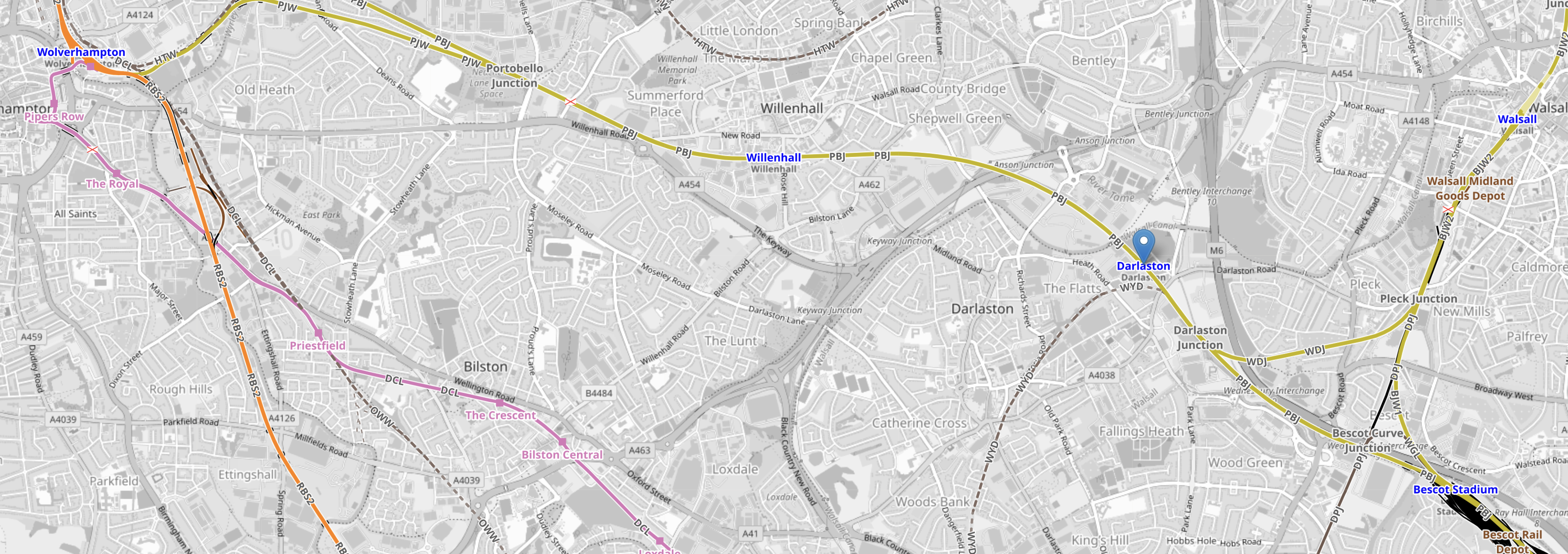
Note.
- Wolverhampton station is in the North-West corner of the map.
- Darlaston station is marked with an arrow in the middle of the map.
- Willenhall station is between Wolverhampton and Darlaston stations
- Bescot Stadium station is in the South-East corner of the map.
- Tame Valley Parkway is the first station South-East of Bescot Stadium station on the way to Birmingham New Street station.
- Walsall FC play in the Bescot Stadium.
- Walsall station is in the North-East corner of the map.
Trains between Wolverhampton and Birmingham New Street stations, run the following service.
- Trains start in the West at Shrewsbury.
- There are four trains per hour (4 tph).
- 2 tph have one stopping pattern and the other 2 tph have another.
These pictures show Willenhall station.





























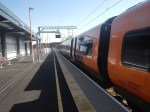


















Note.
The two stations seem to share a simple design.
Both stations have a step-free bridge with lifts.
Darlaston station has a good-sized car park.
Willenhall station’s car park appears to be still being landscaped.
Neither station appears to have solar roofs. On roofs like these at Denmark Hill Station, they have been fitted, which I wrote about in Denmark Hill Station – 4th September 2021.
What Offshore Wind Turbine Components Can Be Transported By RORO Ferries?
I asked Google AI, the title of this post and received this answer.
Roll-on/Roll-off (RORO) ferries, specifically specialized vessels like the Rotra class (Rotra Vente, Rotra Mare, Rotra Futura), are used to transport major, oversized offshore wind turbine components. These vessels allow large parts to be rolled directly on and off the deck using hydraulic ramps, mitigating the need for heavy-lift cranes in some cases.
Wind Turbine Blades: Modern RORO vessels can transport massive rotor blades—sometimes over 100 meters long—stowed in tiers (up to 12 or more blades per trip).
Nacelles: RORO vessels can carry multiple complete nacelles for large-scale direct-drive wind turbines.
Tower Sections: These vessels can accommodate large tower sections, often transporting multiple sections at once.
Hubs: Hub components can be transported via RORO, especially when loaded onto specialized trucks.
Drivetrains and Transformers: Internal components and large drivetrain assemblies are transported in the holds.
Floating Substructures/Substructures: In addition to the turbine itself, specialized RORO systems can transport components of floating substructures, such as secondary steel, inverters, and mooring equipment.
Advantages of RORO for Wind Components
Reduced Handling: Eliminates the need for cranes to lift heavy items, reducing the risk of damage during transport.
High Efficiency: Allows rapid loading and unloading of numerous large items simultaneously.
Protection: Specialized RORO vessels often feature telescopic roofs to protect sensitive nacelles from saltwater spray.
Efficiency for Large Projects: Specifically designed for handling large-scale offshore wind projects, such as the North Sea developments.
Specialized vessels, such as the Rotra Futura and Rotra Horizon, are designed to handle even larger, heavier components for next-generation offshore wind farms, and they often include cranes to complement their RORO loading method.
This article on offshoreWIND.biz is entitled RoRo Offshore Vessel Rotra Futura Hits the Water, and gives a full description of the vessel and her sister; Rotra Horizon.
This is the sub-heading.
The first of two offshore wind Roll-on/Roll-off (RoRo) vessels, the Rotra Future, designed to transport wind turbine components, has been launched at Jiangsu Zhenjiang Shipyard in China.
These four paragraphs give details of the design, financing, construction and ownership of the two vessels.
Concordia Damen has collaborated with Amasus, deugro Denmark, Siemens Gamesa, and DEKC Maritime in the development and construction of two RoRo vessels, namely Rotra Futura and Rotra Horizon.
The vessels, of which the first one was launched recently at the shipyard in China, are designed for the transport of large, and ever growing, wind turbine components.
The design of the two RoRo vessels builds on the previous ships in the Rotra concept, the Rotra Mare and Rotra Vente, which were also developed by Concordia Damen and have been operating since 2016.
These vessels are designed with a RO/RO (Roll-On/Roll-Off) system and an innovative ramp, allowing for the safe and efficient transport of larger loads.
‘Our Wind Farm Won’t Discourage Bronte Tourists’
The title of this post, is the same as that of this article on the BBC.
This is the sub-title.
The developers of England’s largest wind farm have claimed that the turbines will not discourage visitors to moors once loved by the Bronte sisters.
These three paragraphs add more detail.
Calderdale Energy Park is applying to construct 34 turbines on Walshaw Moor, between Hebden Bridge and Haworth – the village associated with Bronte tourism.
As a nine-week public consultation begins, chief executive Christian Egal told objectors that the development would provide “cheap, reliable and stable” energy.
Campaigners who oppose the plans for the West Yorkshire moorland said that the wind farm would turn the scenic area into an “industrial complex”.
It is worth reading the whole BBC article as it gives a lot of detail and if you are worried about this sort of development, you should visit.
I have some thoughts.
Saint Brieuc Wind Farm
This wind farm has a web site.
Christian Egal says this about this wind farm of the coast of Brittany in France.
“There are thousands of visitors every day taking a boat to visit the wind farm, it has been demonstrated that at similar sites the balance is not negative, there are lots of circumstances where wind farms attract a lot of interest.”
The developers should make the wind farm visitor-friendly.
Peat
I know that peat on these and other moors is a sensitive subject and this is said about it.
Access roads will be built over the moor but Egal said: “We avoid deep peat, each turbine is located where the peat is shallow and any peat that is removed will be reinstated locally so the net balance will be zero loss of peat.
That looks to be the right attitude!
Will There Be A Battery?
This Google Map shows Haworth.
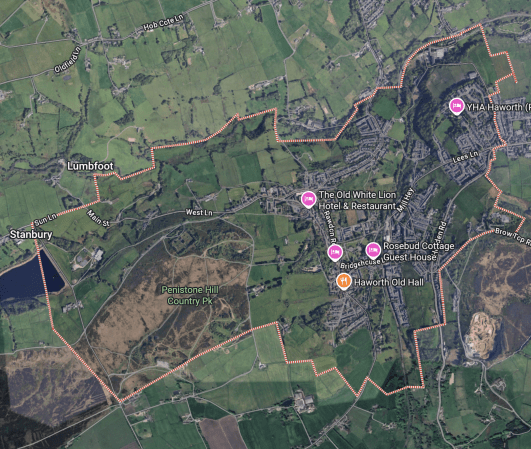
Note.
- Haworth is outlined in red.
- There appears to be something like a quarry on the Eastern edge of the map.
I wouldn’t be surprised if a suitable space for on of the new technology batteries can be found.
Rheenergise is one company that comes to mind.

