Do Some People Have Skin That Leaks Excessive Amounts Of Water And Makes Their Hands And Feet Go Red?
That’s what seems to have happened to me over the last few days.
- I also seem to be producing excessive amounts of phlegm, which I’ve dealt with by drinking bottles of Adnams Ghost Ship Alcohol Free Pale Ale, which was recommended to me by Google AI in Does Zero-Alcohol Beer Help Phlegm?. It works well!
- I slept very badly last night.
- My teeth are painful too.
- I am taking a couple of paracetamol tablets each day for the pain.
I asked Google AI, the title of this post and received this answer.
Yes, some people experience conditions where their skin—particularly on the hands and feet—becomes red, hot, and appears to “leak” fluid or sweat excessively. These symptoms are often associated with rare or chronic conditions, most commonly Erythromelalgia, Dyshidrotic Eczema, or severe Hyperhidrosis (excessive sweating).
Here are the primary conditions that cause these symptoms:
1. Erythromelalgia (Red, Hot, Painful Skin)
This is a rare condition characterized by intense burning pain, severe redness, and increased skin temperature, most commonly affecting the feet, but often the hands as well.
The “Leakage”: While it is technically a vascular issue, the severe inflammation and heat can lead to secondary sweating or fluid-like sensations.
Trigger: It is triggered by warmth, exercise, or stress.
Characteristics: It can be primary (inherited) or secondary (linked to other conditions like blood disorders or nerve damage).
2. Dyshidrotic Eczema (Pompholyx)
This is a skin condition that produces small, intense, fluid-filled blisters on the palms of the hands, soles of the feet, and sides of the fingers.
The “Leakage”: These blisters can leak serum (a clear fluid), making the skin look wet or “weeping”.
Symptoms: Severe itching and burning typically precede the appearance of the blisters, followed by dry, cracked, and red skin.
Causes: Triggers include stress, allergies, and hot, sweaty conditions.
3. Hyperhidrosis (Excessive Sweating)
This condition involves overactive sweat glands that produce far more moisture than is needed for cooling.
The “Leakage”: Hands and feet can be constantly dripping or damp.
Redness: While hyperhidrosis itself causes wetness, the chronic dampness and resulting irritation can cause the skin to appear red and irritated.
4. Other Potential Causes
Weeping Eczema: A complication of eczema where intense inflammation causes skin to ooze fluid.
Infected Skin (Cellulitis): A bacterial infection that causes red, hot, swollen skin, which may sometimes blister or leak fluid.
Lymphedema: Chronic fluid buildup can sometimes result in fluid leaking directly through the skin in severe cases.
Note: If you or someone else is experiencing these symptoms—specifically red, painful, or leaking skin—it is important to consult a healthcare professional, as some of these conditions require specific treatments to prevent complications like infections or skin damage.
Does Zero-Alcohol Beer Help Phlegm?
As a child, I suffered badly from phlegm and regularly had days off school. Sometimes, it was even whole terms.
How I passed the 11-plus is probably a mystery!
But my father also had breathing problems, which he controlled with catarrh tablets and strong peppermints. That remedy never worked for me!
My father’s father died at around fifty of acute pneumonia and asthma. Although most of my father’s descriptions of my grandfather include the fact that he was a drunk.
Which leads me to my first question for Google AI – Can Storms Bring On Phlegm?
Google AI gave me this answer.
Yes, storms and the associated weather shifts can bring on increased phlegm, congestion, and respiratory issues. Stormy weather often causes a rapid decrease in barometric pressure, high humidity, and increased wind, all of which can trigger excess mucus production.
Here is how storms affect your respiratory system:
Thunderstorm Asthma & Allergies: Thunderstorms can rupture pollen grains and mold spores, spreading tiny, easily inhalable particles in the air. These microscopic particles travel deeper into the lungs, triggering allergic reactions, phlegm, and asthma-related symptoms.
Barometric Pressure Shifts: When a storm approaches, air pressure drops, causing the air-filled sinuses to expand. This can cause sinus membranes to swell and produce extra mucus, leading to congestion and post-nasal drip.
High Humidity and Mold: High humidity and rainy weather create ideal conditions for mold growth, which is a major allergen that can trigger phlegm and respiratory congestion.
Wind and Pollen: Strong winds before or during a storm can stir up pollen and dust, triggering symptoms even in people who do not have chronic allergies.
If you notice increased coughing, wheezing, or phlegm during storms, it is often due to these environmental changes forcing the airways to narrow and produce more mucus.
Some of that may apply to me.
Note.
- My father and grandfather used to go to Biarritz for the winter, when the family had money.
- The only time, I went to Biarritz, I felt wonderful.
- I love being at altitude.
- I never had phlegm living in Liverpool or Suff0lk or with C.
- I felt better last week in South Wales, despite the rain.
My breathing was probably best, when I worked on chemical plants.
Zero-Alcohol Beer seems to help and I drink a lot of it, which leads me to my second question for Google AI – Does Zero-Alcohol Beer Help Phlegm?
Google AI gave me this answer.
Yes, zero-alcohol (non-alcoholic) beer can potentially help with phlegm and respiratory issues, primarily due to its anti-inflammatory properties, rather than acting as a direct cough suppressant.
Here is how it can help, based on research:
Reduces Inflammation and Respiratory Illness: Studies on marathon runners found that non-alcoholic beer, rich in polyphenols (natural plant compounds), reduced inflammation and lowered the incidence of upper respiratory tract infections.
Anti-inflammatory and Antiviral Properties: The polyphenols found in non-alcoholic beer offer anti-inflammatory and antiviral properties that can help manage inflammation in the airways.
Hydration: Unlike alcoholic beer, which can dehydrate you and make phlegm thicker, non-alcoholic beer acts as an isotonic, hydrating beverage. Staying hydrated is essential for thinning mucus and making it easier to clear.
Immune System Support: Regular consumption of non-alcoholic beer has been shown to improve immune response and reduce the severity of colds.
Could the fact that most zero-alcohol beers are also gluten-free help with the last point?
I Hope The American Army Doesn’t Navigate Using Google Maps
There is an article in The Times today, which is entitled As The World Watches Kharg Island, Iran Gets Oil Out Another Way.
This is the sub-heading.
Satellite imagery reveals millions of barrels have been shipped from the ‘forgotten’ port of Jask — used only once before
The only Jask, that Google Maps can find is a marketing agency in Solihull. At least Jask,Iran finds it.
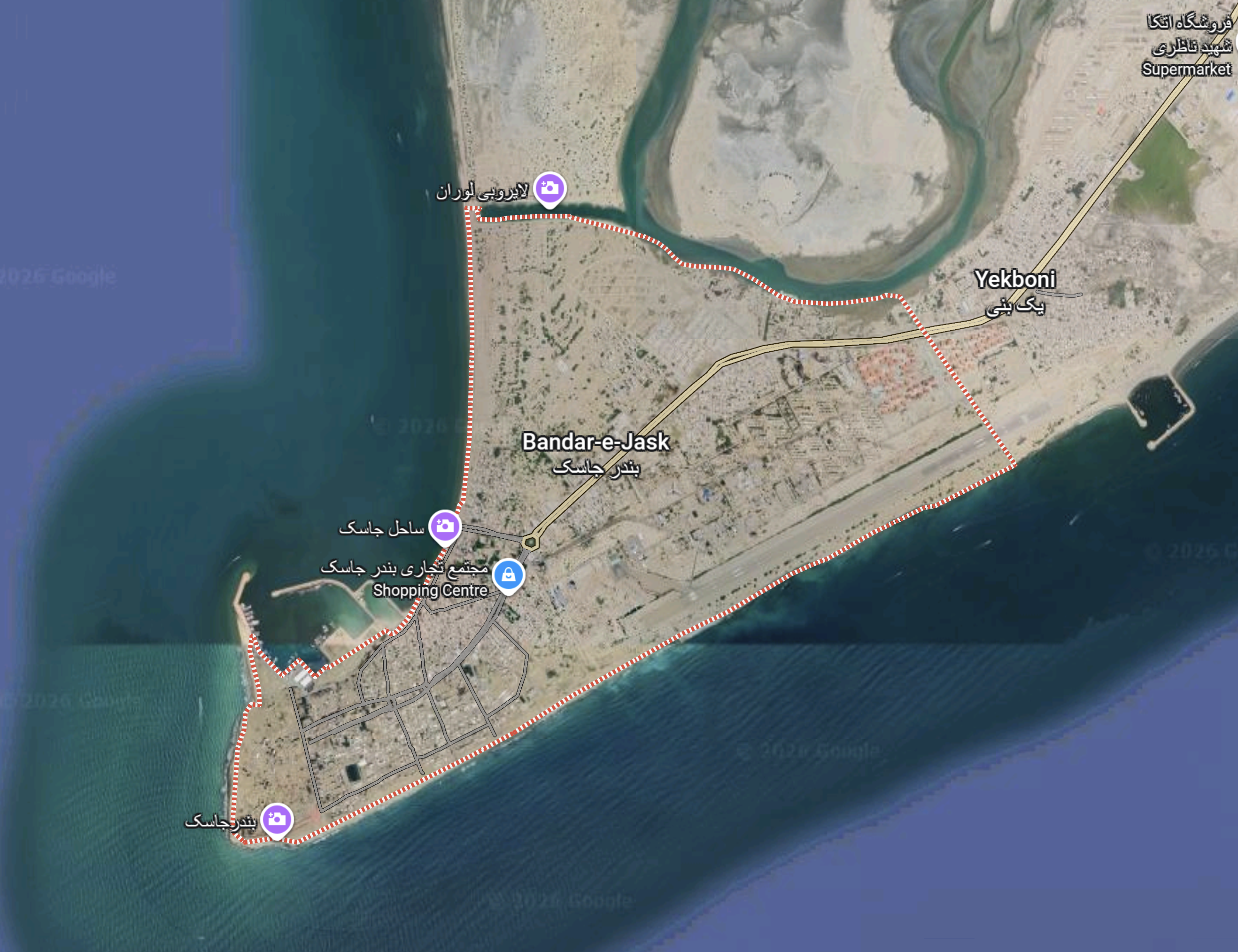
Looks a bit deserty to me!
I just had to ask Google AI if the US Army has a Camel Corps and I received this answer.
Yes, the U.S. Army operated a “Camel Corps” experiment between 1856 and 1866, using camels for logistics and supply transport in the Southwest, particularly Texas and California. While considered hardy and effective, the corps was never an official unit and was abandoned due to the Civil War, soldier preference for mules, and lack of long-term support.
Key Facts about the U.S. Army Camel Experiment:
Origin: Proposed by Jefferson Davis (then Secretary of War) and approved by Congress with a $30,000 budget.
Acquisition: Around 70 camels were imported from the Mediterranean (Egypt, Turkey, Tunisia) in two shipments.
Operation: The camels were based primarily at Camp Verde, Texas, transporting cargo across desert terrains.
Key Leaders: Major Henry C. Wayne directed the experiment, and Lt. Edward F. Beale praised the camels’ endurance in reports.
End of Project: The program was abandoned during the Civil War. Confederate forces captured some camels, and the remaining herd was sold at auction in 1864-1866.
While the camels themselves were durable, they were often disliked by soldiers due to their difficult temperament compared to mules. Some camels were sold to miners or escaped, leading to reports of wild camels in the Southwest for decades following the experiment.
Can Low Atmospheric Pressure Suck Water Out Of Your Skin?
I asked Google AI, the title of this post and received this answer.
Yes, low atmospheric pressure can cause water to be removed from your skin, primarily by facilitating rapid evaporation and disrupting the body’s ability to hold moisture in its tissues.
While it does not “suck” water out with mechanical force like a vacuum cleaner in normal environments, low pressure triggers several physical processes that dehydrate the skin.
How Low Pressure Removes Skin Moisture
Increased Evaporation (Transepidermal Water Loss): Low pressure reduces the barrier function of the skin, leading to higher levels of transepidermal water loss (TEWL)—the process of water passing from inside the body through the epidermis and evaporating into the atmosphere.
Low Humidity Factor: Low pressure environments (like high altitude or airplane cabins) are often accompanied by low humidity, which works in tandem with the low pressure to draw moisture out of the upper layers of the skin, leading to dryness, tightness, and flakiness.
“Boiling” Moisture (Extreme Scenarios): In extreme low-pressure scenarios approaching a vacuum (such as high-altitude exposure, nearly 70,000 feet), the pressure becomes so low that the moisture in the skin, mouth, and eyes can actually vaporize (boil) at normal body temperature.
Scenarios Where This Occurs
Airplane Cabins: The air pressure inside an airplane is lower than sea level, and combined with low humidity, this causes significant dehydration of the skin and mucous membranes.
High Altitudes: Mountaineers often experience extremely dry, cracked, and damaged skin due to the low pressure and low humidity at high altitudes.
Vacuum Chambers: In experimental settings, placing an arm in a vacuum chamber results in moisture evaporation and the sensation of the skin being “sucked,” causing immediate surface drying and potential skin damage.
Visible Effects
Dryness and Flakiness: The skin becomes dry and rough.
Tightness and Itching: Decreased elasticity leads to a feeling of tightness.
Reduced Elasticity: In severe cases, the skin loses its ability to “bounce back” quickly, a sign of dehydration.
In addition to dry air, low pressure often causes swelling or puffiness because fluids shift out of cells and into the spaces between them, which, combined with the dryness, can make the skin feel irritated.
I certainly felt like that last night, as the UK waited for Storm Dave to arrive.
Ocasio-Cortez, Markey Ask Trump Admin To Explain Paying TotalEnergies USD 1 Billion ‘In Taxpayer Money’ To Drop Offshore Wind Projects
The title of this post, is the same as that of this article on offshoreWIND.biz.
This is the sub-heading.
US lawmakers Alexandria Ocasio-Cortez and Ed Markey have sent a letter to Secretary of the Interior Doug Burgum on the plan by the Trump administration to pay nearly USD 1 billion to TotalEnergies to cancel offshore wind projects off the US East Coast, calling on the administration to stop the payment and explain the legal basis and funding source for the proposed transfer.
These four paragraphs add detail to the story.
As reported recently, the US government’s agreement with TotalEnergies concerns the company’s exit from offshore wind development in the country by relinquishing leases for projects off New York/New Jersey and North Carolina, for which the administration intends to pay approximately USD 928 million.
The agreement also stipulates that TotalEnergies would redirect that money to oil & gas projects in the US. The company, in a press release issued after signing the agreement with the government, indicated that it would invest proceeds from the payment into a liquefied natural gas export facility in Texas and other oil and gas activities in the US that will support both domestic supply and the demand in Europe.
As reported recently, the US government’s agreement with TotalEnergies concerns the company’s exit from offshore wind development in the country by relinquishing leases for projects off New York/New Jersey and North Carolina, for which the administration intends to pay approximately USD 928 million.
The agreement also stipulates that TotalEnergies would redirect that money to oil & gas projects in the US. The company, in a press release issued after signing the agreement with the government, indicated that it would invest proceeds from the payment into a liquefied natural gas export facility in Texas and other oil and gas activities in the US that will support both domestic supply and the demand in Europe.
Trump may have got what he wanted and stopped development of wind farms, but at what cost to US taxpayers?
Out of curiosity, I asked Google AI, “Which LNG Terminal In Texas Have TotalEnergies Agreed To Develop”, And Received This Answer.
TotalEnergies has agreed to develop and invest in the Rio Grande LNG (RGLNG) project located in South Texas.
Key details regarding TotalEnergies’ involvement include:
Partnership: In June 2023, TotalEnergies signed a framework agreement with NextDecade Corporation to participate in the development of the Rio Grande LNG project.
Ownership and Phase 1: TotalEnergies holds a 16.67% stake in the first phase of the project, which includes three liquefaction trains with an annual capacity of 17.5 million tons per annum (Mtpa).
Offtake Agreement: TotalEnergies has agreed to purchase 5.4 million tons per annum (Mtpa) of LNG from Phase 1 for 20 years.
Expansion (Train 4): As of September 2025, TotalEnergies has reached a Final Investment Decision (FID) for a 10% stake in the joint venture developing Train 4 of the Rio Grande LNG facility.
NextDecade Stake: TotalEnergies also acquired a 17.5% stake in NextDecade Corporation, the developer of the project.
The Rio Grande LNG project is located in Brownsville, Texas, and is expected to contribute to TotalEnergies’ goal of expanding its U.S. LNG export capacity to 15 million tons annually by 2030.
I shall be watching this project. Especially, as several new techniques have come forward in the last few months.
Easter Disruption For Europe’s Busiest Train Line
The title of this post, is the same as that of this article on the BBC.
This is the sub-heading.
Thousands of Easter train journeys will be disrupted by a six-day shutdown on the West Coast Main Line (WCML).
These two paragraphs add more details.
Engineering work means no intercity services will run between London Euston and Milton Keynes from Good Friday to Wednesday, 8 April, Network Rail said.
The Easter work is part of a £400m project to boost reliability, which WCML said was Europe’s busiest railway line used for passenger and freight trains.
This graphic from London Northwestern Railway, shows the Rail Replacement Bus routes around the blockade.
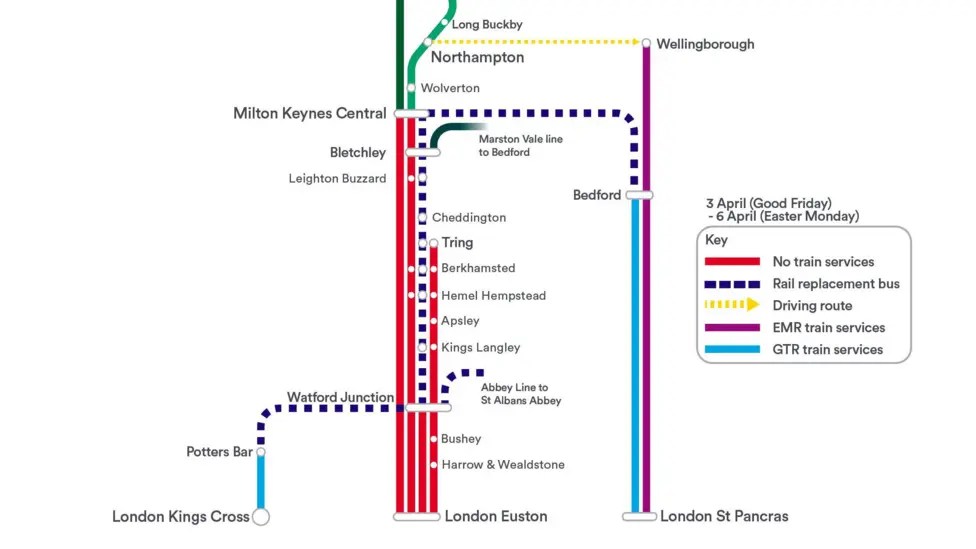
Note.
- There are no trains South of Milton Keynes Central
- There is a Rail Replacement Bus between Milton Keynes Central and Bedford.
- There is a Rail Replacement Bus between Milton Keynes Central and Watford Junction
This OpenRailwayMap , shows the Marston Vale Line between Milton Keynes Central and Bedford.
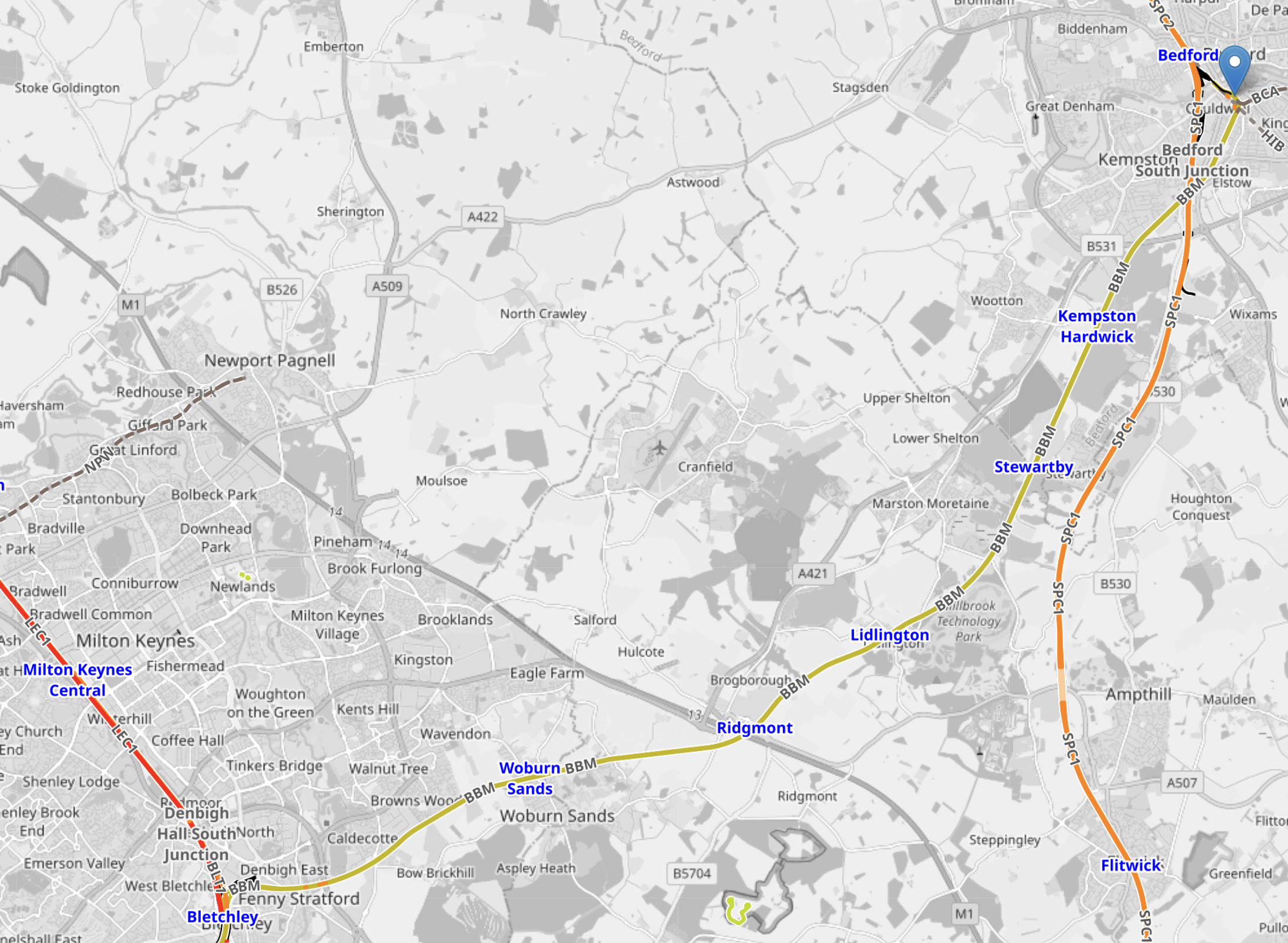
Note.
- The two Bedford stations ; Bedford and Bedford St. Johns are in the North East corner of the map.
- Milton Keynes Central station is on the Western edge of the map.
- The Marston Vale Line, which is shown in yellow, links Milton Keynes Central and the two Bedford stations.
- The track shown in red, going through Milton Keynes Central is the West Coast Main Line.
- The track shown in orange, going North South through Bedford is the Midland Main Line.
- The Midland Main Line appears to be running normally between Bedford and St. Pancras. This is according to Real Time Trains.
- The Marston Vale Line should be running new Class 196 trains, but it is not due to a door opening dispute with the trains.
- The Marston Vale Line appears to be running normally between Milton Keynes Central and Bedford. This is according to Real Time Trains.
This OpenRailwayMap shows Bletchley station and the flyover on the East side of the station.

Note.
- The West Coast Main Line is on the West side of the map.
- Bletchley station is indicated by the blue arrow at the bottom of the map.
- To the East of the station is Bletchley flyover, which is labelled “Summit of Bletchley Flyover.
- The flyover splits with one branch going North to Milton Keynes and the other East to Bedford.
It does appear, that no train can go between Milton Keynes Central and Bedford stations, without a reverse at Bletchley station.
But you can go between Milton Keynes Central and Oxford stations, without a reverse at Bletchley station, as you stop on the flyover.
To check, I read the tracks right, I asked Google AI, “Can Trains Go Between Bedford And Milton Keynes Central Without A Reverse At Bletchley and received this answer.
Currently, no. Trains running between Bedford and Milton Keynes Central cannot bypass a reversal (reversing direction) at Bletchley because the Marston Vale line terminates at Bletchley station. Trains must enter Bletchley and then change direction to join the West Coast Main Line to reach Milton Keynes Central.
Key Details:
Current Routing: The Marston Vale line connects Bedford and Bletchley. Services from Bletchley to Milton Keynes Central operate as a separate connection.
The Reversal: Passengers currently must change trains or experience a driver change/reversal at Bletchley to continue.
Future Changes: The East West Rail project aims to improve these connections, but as of early 2026, the direct link remains through Bletchley.
Conclusion
Does this explain, why there is a Rail Replacement Bus rather than a shuttle train between Bedford And Milton Keynes Central stations?
Toyota Won’t Give Up On Hydrogen, Teams Up With Truck Giants
The title of this post, is the same as that of this article on TorqueCafe.
This is the sub heading.
Japanese car giant Toyota has signed a non-binding MoU to collaborate with Daimler Truck and Volvo Group on hydrogen fuel cells.
These three paragraphs add more details.
Toyota just won’t let its hydrogen-fuelled dreams die, this week announcing it wants to further develop fuel cell technology with two big players in the heavy vehicle market.
Daimler Truck (makers of Mercedes-Benz, Freightliner, Western Star and Fuso trucks) and the Volvo Group (responsible for Volvo, Mack and Renault trucks), already have a joint venture, cellcentric, which Toyota has signed a non-binding Memorandum of Understanding to join.
Split between equal shareholding, a joint press release said “the combination of the parties’ complementary experience and know-how will support and advance their joint objective to develop, produce and commercialise fuel cell systems for heavy-duty vehicles and other heavy-duty applications with comparable requirements”.
The rest of the article gives a summary of where Toyota are with hydrogen.
It is worth a thorough read.
Backing hydrogen you have Centrica, Ceres, Cummins, Daimler, Hyundai, JCB, INEOS, Kia, Ryse, Volvo, Wrightbus and a few others.
Will they prevail against a cynical world?
I think it will be one iconic vehicle, that excites the world. I will nominate.
- A 1000 km. range hydrogen-powered coach from Mercedes, Solaris, Volvo or Wrightbus.
- A large American-style pickup from Dodge with a Cummins engine or from Toyota.
- A large American-style truck.
- A remodelling of the iconic London new Routemaster bus with a hydrogen Cummins engine by Wrightbus.
- A small affordable hydrogen hatchback from the French, Toyota or the Koreans, based on a fuel cell and an electric transmission.
When I was a child the icon was a dragline called Big Geordie, who is shown in this video.
I suspect for some of the mining projects in the world today, a hydrogen-powered Big Geordie would make a good fist of it.
Condor Celebrates Inaugural Flight Of New Frankfurt–London Gatwick Route
The title of this post is the same as that of this press release from Condor.
This is the sub-heading.
Condor today launched its new city connection between Frankfurt am Main (FRA) and London Gatwick (LGW). With the inaugural flight, the British capital is now officially part of Condor’s city network. The route will be operated three times daily with a schedule designed to appeal equally to business travellers and city tourists. Flights are operated using Condor’s Airbus A320 aircraft, offering capacity for 180 passengers in a two-class configuration, including Business Class and Economy Class with the standard 3-3 seating layout. In addition, Condor cooperates with partner airlines on this route.
These three paragraphs add more details.
With this new connection, Condor is expanding its city network to include one of Europe’s most important metropolitan hubs, thereby strategically strengthening its presence in the European market. To mark the inaugural flight from London Gatwick, departing passengers on the fully booked service were welcomed with a small reception and gifts before the flight departed punctually for Frankfurt am Main.
David Carlisle, Director Network and Partnerships at Condor, said: “Today’s inaugural flight to London Gatwick marks another important milestone in the expansion of our European route network. London is one of Europe’s most sought-after destinations, both for business travellers and short city breaks. We are delighted to offer our guests up to three daily frequencies, providing maximum flexibility as well as convenient access to our long-haul network to Africa and Asia.”
Jonny Macneal, Head of Aviation Development at London Gatwick, added: “We are delighted to welcome Condor to London Gatwick and to offer our passengers even greater choice with this new, frequently operated service to Frankfurt. Whether travelling for business, leisure or to visit friends and family, the route provides excellent flexibility and connectivity. Condor’s arrival marks another important milestone during a period of significant growth for the airport.”
The press release also has these two last paragraphs, which give more information about the airline.
London is one of Europe’s leading economic and financial centres and also one of the most popular destinations for city travel. The new connection offers business travellers excellent access to the Greater London area as well as flexible options for day trips. Leisure travellers benefit from convenient flight times for weekend getaways.
In addition to the launch of London Gatwick, Condor continues to expand its network. From May, Barcelona, Budapest and Venice will be added as new destinations, bringing the total number of city destinations in the Condor network to 13. With these additions, Condor is further strengthening its presence in high growth markets and continuing to expand its European route network. Flights can be booked online at http://www.condor.com, via telephone or through travel agencies.
It is certainly one of the best-written and information-rich press releases, that I have seen.
If the attention to detail is as good in the way the airline is run is half as good, Condor will be worth giving a try.
This page is their TripAdvisor reviews.
Gatwick Airport Is Expanding
I picked up the news of Condor Airlines new service from one of my Google Alerts about Gatwick Airport’s proposed new runway.
These were the titles of the news articles in the alert.
- Simple Flying – Unbelievable! The UK’s 2nd-Busiest Airport Welcomes 5th New Airline In 11 Days
- MSN – London Gatwick confirms 9th new airline in massive 2026 shakeup
- Aviation A2Z – Condor Begins First UK Route with 3 New Daily Flights to This Airport
- Yahoo News UK – Airline launches first-ever UK route from Gatwick Airport to popular European city
- AviationSource News – Condor Launches New Frankfurt to London Gatwick Route
- Aviation24.be – Condor launches Frankfurt–London Gatwick route with three daily flights, marking UK debut
- Travel Wires – Condor launches first UK route with Gatwick–Frankfurt service
- Travel And Tour World – Frankfurt & London: New Condor Flights Spark Hope and Joy at London Gatwick Airport, UK
There is also this headline about Air France.
- Aviation24.be – Air France returns to London Gatwick with new twice-daily Paris CDG service
Gatwick seems to be doing well to be welcoming nine new airlines in 2026 and five in the last eleven days.
Perhaps, some honest accounting have convinced those nine airlines, that Gatwick’s new runway, won’t raise charges as much as Heathrow’s.
It’s Nearly Ten Years Since I Wrote The Streatham Virtual Tube
In the June 2016 Edition of Modern Railways, there was an article entitled Turning South London Orange.
One of the proposals in the article is to create a virtual tube through Streatham.
So I wrote The Streatham Virtual Tube.
My curiosity has been aroused, as to why the article is one of my top posts.
Does anybody have any ideas?
Or could it just be that someone is promoting the Streatham Virtual Tube In The Local Elections?
TenneT, National Grid Ink Joint Development Agreement For LionLink Offshore Wind Interconnector
The title of this post, is the same as that of this article on offshoreWIND.biz.
This is the sub-heading.
Transmission system operators (TSOs) TenneT and National Grid Ventures (NGV) have signed a Joint Development Agreement (JDA) to advance LionLink, a hybrid interconnector linking the UK and the Netherlands via a future offshore wind farm in the Dutch North Sea.
These three paragraphs add more details.
The agreement sets out how the two partners will jointly develop LionLink towards a final investment decision (FID), including arrangements on procurement, governance, and planning, while also aiming to increase transparency on project costs ahead of construction.
LionLink is designed to integrate cross-border electricity interconnection with offshore wind by establishing a direct connection between the two countries through a grid link to the planned Nederwiek 3 offshore wind farm. According to the developers, this approach will maximise the use of offshore wind, provide additional system flexibility, and reduce the overall amount of required offshore infrastructure.
The LionLink project was launched in April 2023, when the Netherlands and the UK unveiled their plan to build the interconnector, a first-of-its-kind electricity link to connect offshore wind between the two countries via interconnections.
The same article also said these two paragraphs about the operation of the BritNed interconnector.
While the companies move forward with LionLink, their existing BritNed interconnector is marking 15 years of operation. Since entering service in 2011, the 1 GW subsea link has enabled nearly 93 TWh of electricity trading between Great Britain and the Netherlands.
Over the past five years, BritNed has exchanged enough electricity annually to power around 1.4 million households. The 260-kilometre interconnector remains a key part of both countries’ energy systems and has generated around EUR 1 billion in auction revenues on the Dutch side during its operational lifetime, TenneT said in a press release on 1 April.
It looks like BritNed has been a good investment for all stakeholders.
Note.
- LionLink will be a 2 GW interconnector.
- LionLink will land at Walberswick in Suffolk.
- LionLink has a web site.
- BritNed is a 1 GW interconnector.
- BritNed lands at the Isle of Grain in Kent.
- BritNed has a web site.
- NemoLink is an interconnector between Kent and Belgium.
- NeuConnect will be a 1.4 GW interconnector between the Isle of Grain and Wilhelmshaven, which will be operational by 2028.
- There are two actual and two proposed interconnectors between the UK and France.
The List of high-voltage transmission links in the United Kingdom in Wikipedia is growing.
The Wikipedia entry says this about the Rise of UK Interconnection.
The Department for Energy Security and Net Zero’s Digest of UK Energy Statistics reports that the UK was a net importer of electricity in 2024, with net imports of 33.4 TWh, up 40% from 2023.
Interconnectors allow the trade of electricity between countries with excess generation (for example, intermittent renewable) and those with high demand. Interconnectors play a key part in balancing variable renewable generation, for example the 1.4 GW North Sea Link allows the UK to export excess power to Norway during windy periods to conserve Norwegian hydro stocks, and import Norwegian hydro power on less windy days.
During the 2022 energy crisis, the UK exported record amounts of power to mainland Europe, helping to alleviate the effects of the Russian invasion of Ukraine on European security of supply.
As of 12 November 2024, Great Britain had nine operational international electricity interconnectors.
The UK is becoming an offshore energy substation on Europe’s North-West coast.

