The Immense Potential Of Solar Panels Floating On Dams
The title of this post, is the same as that of this article on the Anthropocene.
The article reviews the practice of floating solar panels on ponds, lakes and reservoirs.
I like the practice, as the two technologies are compatible.
- The panels reduce evaporation and help to curb algae growth.
- Floating panels are cooled by the environment and more efficient.
- Solar and hydro power can share electricity transmission systems.
But best of all. they use land twice.
The article claims that as much as forty percent of the world’s power can be generated this way.
The article is certainly an interesting read.
Record Levels Of Lithium In Geothermal Water At United Downs Project
The title of this post, is the same as that of this article on Think Geoenergy.
This paragraph explains it all.
Geothermal Engineering Ltd (GEL), the company behind the UK’s first deep geothermal electricity power plant, is today announcing record levels of lithium in its geothermal waters. Recent, third party tests have revealed that there are more than 250 milligrams per litre (‘mg/L’) in the fluid which is the highest concentration ever discovered in geothermal fluids anywhere in the world.
The article also says.
- The magnesium levels are low, which eases processing.
- Up to four thousand tonnes of lithium could be produced per year locally.
The article is certainly worth a read.
Crossrail Or Heathrow Express?
I have a friend, who lives in Walthamstow and used to fly out of Heathrow quite frequently.
He usually goes to Heathrow using Heathrow Express, but after looking up the times by using the Overground to Liverpool Street and then Crossrail direct to Heathrow, I suspect he’ll change his route.
Current Route
- Walthamstow Central to Paddington – 24 mins by Underground
- Paddington to Heathrow Central – 17 mins by Heathrow Express
Total – 41 mins – 2 changes
Crossrail Route
- Walthamstow Central to Liverpool Street – 15 mins by Overground
- Liverpool Street to Heathrow Central – 33 mins by Crossrail
Total – 48 mins – 1 change
It looks to me, that the Crossrail route has one less train change and less walking. And a cheaper ticket!
Conclusion
I wouldn’t be surprised to see a large drop in passengers on Heathrow Express.
Essex Councillors Call For Underground Link
The title of this post, is the same as that of this article on Railnews.
This is the first paragraph.
Councillors in Harlow are calling for a new Underground link, saying that they are examining ‘all possibilities for improving and modernising transport connections’.
I’ve tackled this subject before in Does Harlow Need An Improved Train Service?, but this time I’m starting with what is possible and working backwards.
Harlow’s Current Train Service
Currently, these trains serve Harlow Town station.
- Stratford and Bishops Stortford – 2 tph – via Lea Bridge, Tottenham Hale, Waltham Cross, Cheshunt, Broxbourne and Sawbridgeworth
- London Liverpool Street and Cambridge North – 1 tph – via Tottenham Hale, Cheshunt, Broxbourne, Bishop’s Stortford, Audley End, Whittlesford Parkway and Cambridge
- London Liverpool Street and Cambridge North – 1 tph – via Tottenham Hale, Cheshunt, Broxbourne, Roydon, Sawbridgeworth, Bishop’s Stortford, Stansted Mountfitchet, Elsenham, Newport, Audley End, Great Chesterford, Whittlesford Parkway, Shelford and Cambridge
- London Liverpool Street and Stansted Airport – 1 tph – via Tottenham Hale
- London Liverpool Street and Stansted Airport – 1 tph – via Tottenham Hale and Stansted Mountfitchet
In addition these services run through Harlow Town station without stopping.
- London Liverpool Street and Stansted Airport – 2 tph – via Tottenham Hale
Note.
- tph is trains per hour
- The Stansted services are fast services and take 29 minutes between London Liverpool Street and Harlow Town.
- The other services seem to take a few minutes longer.
Summarising the services gives the following.
- Eight tph pass through the station of which six tph stop.
- Cambridge and Cambridge North has a 2 tph service.
- London Liverpool Street has a 4 tph service.
- Stansted Airport has a 2 tph service.
- Stratford has a 2 tph service.
- Tottenham Hale has a 6 tph service.
Each of Greater Anglia’s new Class 720 trains, when working as a ten-car formation can carry well over a thousand passengers.
Harlow Town station has a fairly good service, but it could probably be improved.
What Are Harlow’s Councillors Suggesting
This paragraph in the Railnews article gives the councillors wish list.
Harlow Councillor Michael Hardware is portfolio holder for strategic growth. He said: ‘With Harlow’s close proximity to London our plans include investigating the potential for the extension of the central line to Harlow, lobbying to extend London Transport Zones to Harlow, examining connectivity to Crossrail 2 and promoting four tracking of the main line to Stansted Airport as well as improving existing public transport links in and out of the town.
I’ll look at each proposal in turn.
Extending The Central Line To Harlow
Epping and Harlow are about nine miles apart.
This Google Map shows the two towns and the M11 that runs to the East of both towns.
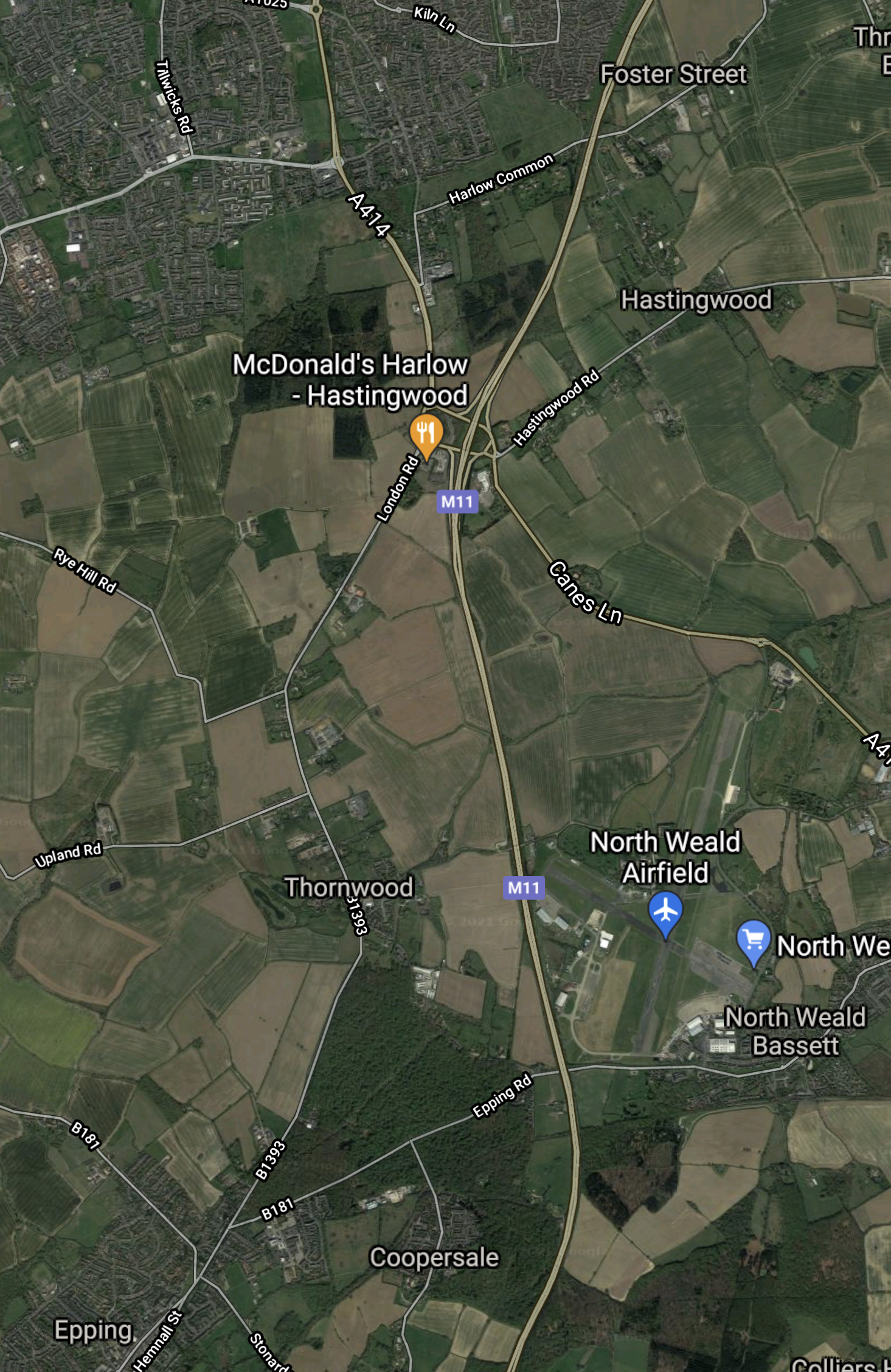
Note.
- Epping is in the South-West corner of the map.
- Harlow, which is a large town of nearly 90,000 residents is at the top of the map.
- The M11 runs North-South across the map to the East of both towns.
- North Weald Airfield lies to the East of the motorway.
Would it be possible to run an extension of the Central Line from Epping to Harlow?
It could run up the West side of the motorway.
- The terminus could be in South-East Harlow close to Junction 7 of the M11.
- Any plans for the development of North Weald Airfield could have a big effect on any plans.
This Google Map shows the location of Epping station with respect to the motorway.
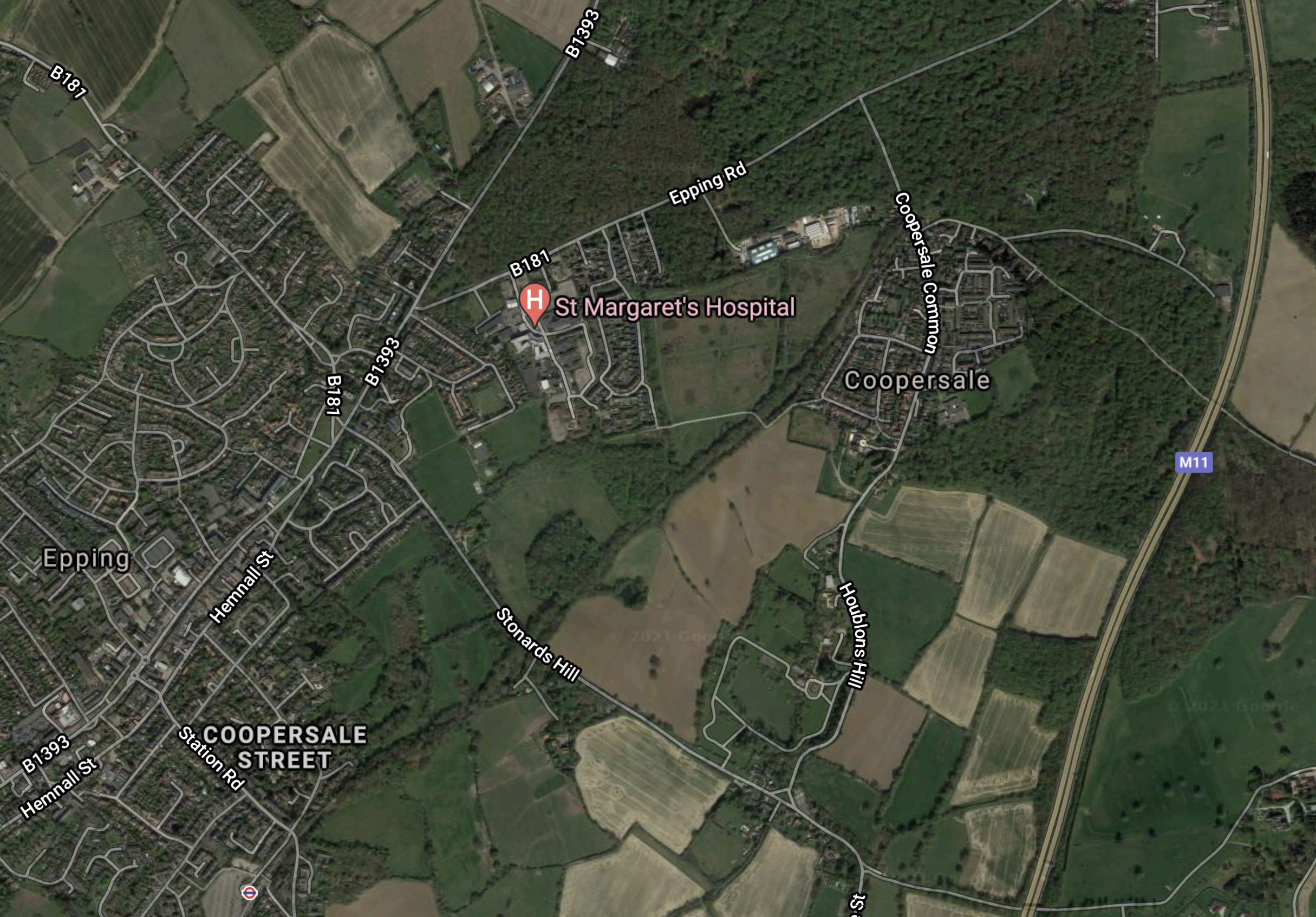
Note Epping station is in the South-West corner of the map.
Running North-East from the station, the dark green scar of the single-track Epping Ongar Railway can be picked out, as it runs between St. Margaret’s Hospital and the village of Coopersale.
This third Google Map shows the railway as it passes under the M11.

Would it be possible to use the route of this line to connect to a new line alongside the motorway?
This fourth Google Map shows Epping tube station.
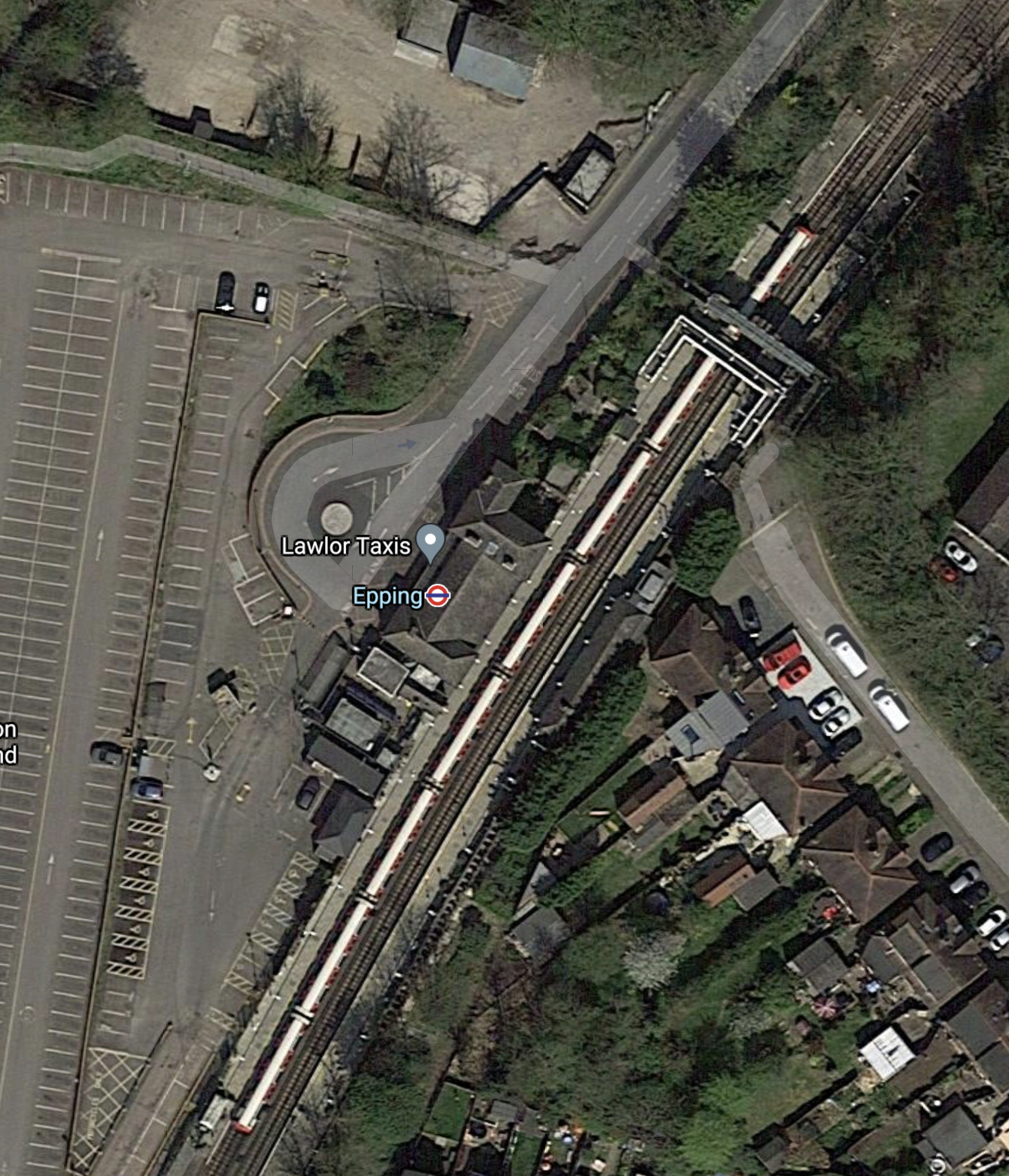
Note.
- The station has two platforms, but is not step-free.
- It has a large car-park.
- Trains take thirty-seven minutes between Epping and Liverpool Street stations.
- Trains have a frequency of nine tph.
This map from cartometro.com shows the track layout at Epping station and the interface with the Epping Ongar Railway.
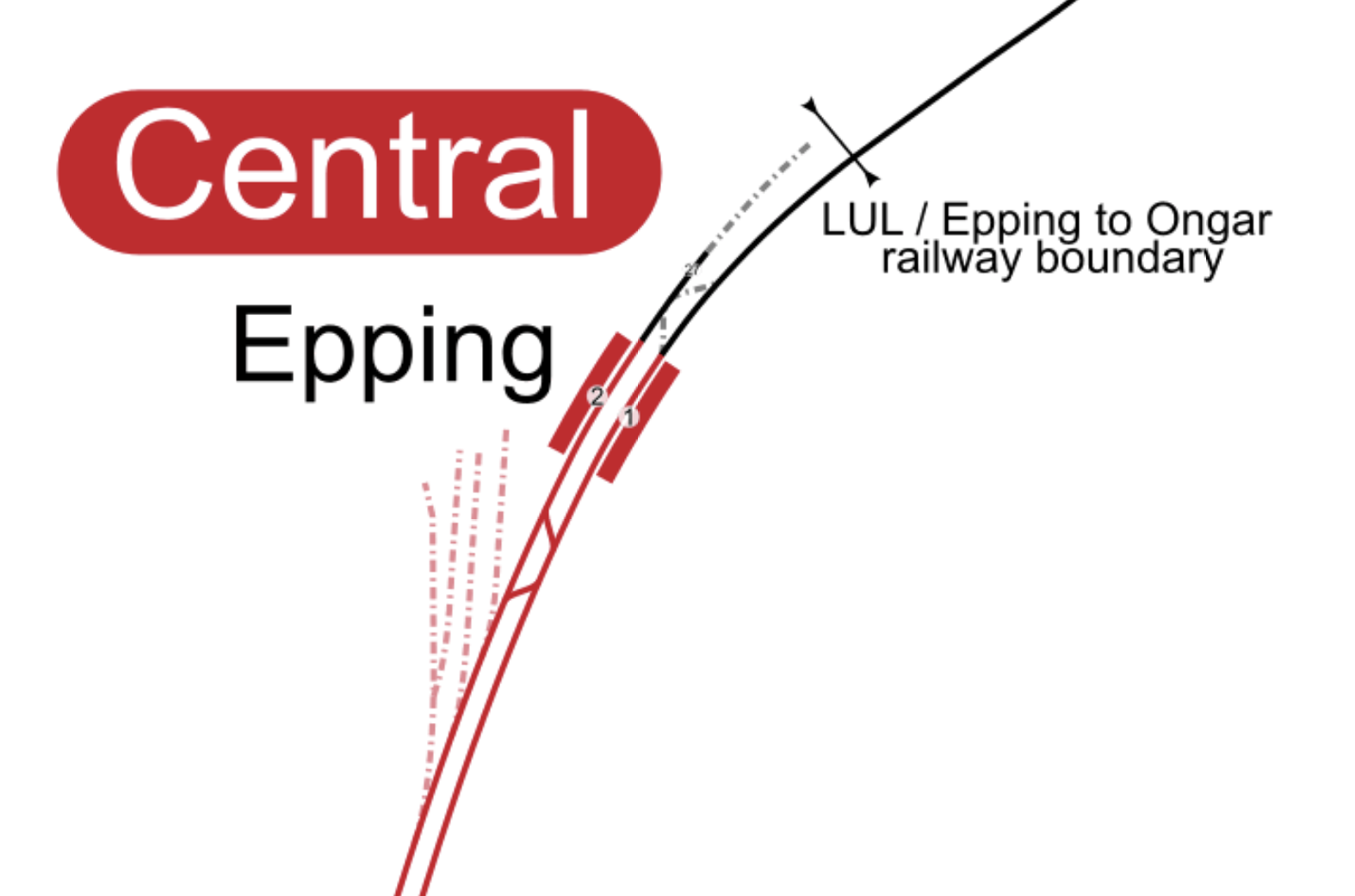
Note.
- The Epping Ongar Railway has always been single track.
- The crossovers to the South of Epping station allow either platform to be used for Central Line services.
- When the Central Line ran to Ongar, it looks like all services used Platform 1 at Epping.
I feel that it might be possible to create an extension to Harlow, by doing something like the following.
- Add a second bi-directional track alongside the Epping Ongar Railway between Epping station and the M11.
- Extend Platform 1 to the North, so that the heritage trains can load and unload passengers at Epping station.
- The Central Line platforms would be unaltered, so could still handle the nine tph they currently handle.
- Trains to and from Harlow would always use Platform 2.
At the M11, the new bi-directional track would turn North and become double-track to Harlow.
- The double-track would allow trains to pass.
- If the rolling stock for the Central Line has been renewed, it might be possible to run the extension on battery power.
- If Harlow had a single platform, it would be possible to run four tph to Harlow.
- The current 2012 Stock trains have a capacity of around a thousand passengers.
- I estimate that trains would take about ten minutes between Epping station and the new Harlow station.
I feel something is possible, but building the line might be easier if new battery-electric trains were available, as this would probably allow the extension to be built without electrification.
On the other hand, it might not have the greatest financial case.
- It could be difficult to add large numbers of passengers to the Central Line.
- At around forty-seven minutes, the Central Line service will be slower than the main line trains, which currently take around a dozen minutes less.
I’ll be interested to see what the professionals say.
Extending London Transport Zones To Harlow
Harlow Town station has ticket barriers, but I don’t think it is part of London’s contactless card zone.
Adding Harlow Town and all stations between Harlow Town and the zone could be very beneficial to passengers and train companies.
Examining Connectivity To Crossrail 2
I think that in the current economic situation this should be discounted.
- It is a very expensive project.
- Building it will cause tremendous disruption on the West Anglia Main Line.
- It is only planned to go as far as Broxbourne station.
But I don’t think politicians from outside London and the South-East would sanction another massive project for London.
I don’t think Crossrail 2 will ever be build in its currently proposed form.
Four Tracking Of The Main Line To Stansted Airport
Consider.
- Currently, the numbers of trains on the West Anglia Main Line is under twelve tph.
- Modern double-track railways with the latest digital in-cab signalling like Thameslink and Crossrail can handle twice this number of trains.
- The West Anglia Main Line will be getting new trains with better acceleration.
Four-tracking is mainly needed to cut times to Cambridge and Stansted Airport, but I suspect that with some clever design and improved signalling, the current double-track can be improved significantly.
Improving Existing Public Transport Links In And Out Of The Town
I think that this could be a fruitful area.
- As I said earlier, Harlow has only 6 tph trains stopping in the station.
- I believe this could be increased to at least 10 tph, if the West Anglia Main Line were to be modernised.
- Extending London Transport Zones To Harlow, which I discussed earlier would surely help.
- Is there enough car parking?
- Are there enough buses to the stations?
- Would a fleet of zero-carbon buses tempt people to use them?
- Would it be possible to run a hydrogen commuter bus service up and down the M11 between say Harlow and Ilford for Crossrail?, as is being done in Dublin, that I wrote about in Three Hydrogen Double Decker Buses Set For Dublin.
Hopefully, Harlow’s councillors would have a few good ideas.
A Few Thoughts On What Is Possible
These are a few of my thoughts on what is possible.
Digital Signalling Could Increase The Number of Trains Per Hour Significantly
Consider.
- Currently, the West Anglia Main Line handles ten tph between Liverpool Street and Bishops Stortford.
- Thameslink handles 24 tph with digital signalling.
- Crossrail will handle 24 tph with digital signalling.
- High Speed Two will handle eighteen tph.
I certainly believe that another four tph could be easily handled through the two Harlow stations, with full digital signalling.
Perhaps a frequency of eight tph, that would match TfL Rail between London Liverpool Street and Shenfield would be ideal.
If it works for Shenfield it should work for Harlow!
Rebuild Cheshunt Station
Cheshunt station with its level crossing is a bottleneck and any increase in the number of trains through the station will need the level crossing to be replaced by a bridge.
But developers are talking of high class housing in the area and removal of the level crossing appears to be in their plans.
New High-Capacity Class 720 Trains
Pairs of five-car Class 720 trains are coming to the West Anglia Main Line and each pair will carry over a thousand passengers.
These will be used on four tph, that call at Harlow Town station.
Turn Trains In The High Meads Loop at Stratford Station
The single-track Wirral Line Loop under Liverpool handles up to sixteen tph.
Network Rail built a double-track loop under the Eastfield Shopping Centre, which calls at Platforms 11 and 12 in Stratford.
If this loop was used to turn trains it could probably handle at least twelve tph on one platform.
Liverpool Street currently handles these trains that go up the West Anglia Main Line or the Lea Valley Lines.
- 6 tph – Greater Anglia
- 6 tph – London Overground
It looks to me that the terminal capacity in London could be as high as 20 tph.
Run More Trains On A Digitally-Signalled Route Through Seven Sisters
Just four tph run on the London Overground route through Seven Sisters station.
Compare that with the East London Line of the London Overground, where sixteen tph run between Dalston Junction and Surrey Quays stations.
The London Overground has ambitions to run four tph to Cheshunt and Enfield Town, as they do to Chingford, but that would only up the frequency through Seven Sisters to eight tph.
The tracks in the area also allow trains from Stratford to use the lines through Seven Sisters stations to go North.
Run West Anglia And Lea Valley Services Together
Currently, Greater Anglia and London Overground seem to do their own things, but surely properly integrated and with the moving of more services to the London Overground, I suspect that everything could be more efficient.
I believe that by using Liverpool Street and Stratford as twin London terminals for Lea Valley services, that upwards of twenty tph can on digitally-signalled West Anglia Main Line and the Lea Valley Lines.
These are the current trains.
- Bishops Stortford – 2 tph
- Cambridge North – 2 tph
- Cheshunt – 2 tph
- Chingford – 4 tph
- Enfield Town – 2 tph
- Hertford East – 2 tph
- Stansted Airport – 4 tph
Note.
- This is a total of eighteen tph
- The pinch point is surely the stretch between Bethnal Green and Clapton stations, which handles 14 tph including a mix of fast expresses and London Overground services.
- On the other hand the route through Seven Sisters is handling just four tph.
- Ten tph run between Tottenham Hale and Cheshunt stations on the West Anglia Main Line.
- Only two tph terminate in Stratford.
If the Cheshunt and Enfield Town services are increased to 4 tph, as is London Overground’s aspirations we get the following.
- Bishops Stortford – 2 tph
- Cambridge North – 2 tph
- Cheshunt – 4 tph
- Chingford – 4 tph
- Enfield Town – 4 tph
- Hertford East – 2 tph
- Stansted Airport – 4 tph
Note.
This is a total of twenty-two tph.
But there is still plenty of spare capacity at Stratford and through Seven Sisters.
If our objective is more trains through Harlow, why not double up the Stratford and Bishops Stortford service.
- Bishops Stortford – 4 tph
- Cambridge North – 2 tph
- Cheshunt – 4 tph
- Chingford – 4 tph
- Enfield Town – 4 tph
- Hertford East – 2 tph
- Stansted Airport – 4 tph
Note.
- This is a total of twenty-four tph.
- Harlow will have eight tph to and from London.
- There will be 8 tph through Seven Sisters.
- There will be twelve tph between Tottenham Hale and Cheshunt stations on the West Anglia Main Line.
- Four tph will terminate at Stratford.
Perhaps to reduce the trains on the West Anglia Main Line, the Hertford East trains could go via Seven Sisters.
But that would mean that stations like Brimsdown and Ponders End would lose a lot of their service.
So why not add extra stops to the Bishops Stortford services?
Conclusion
I believe that by doing the following.
- Adding digital signalling to all lines.
- Turning more trains at Stratford.
- Using the route through Seven Sisters at a much higher frequency.
- Rebuilding Cheshunt station and level crossing.
- Reorganising stops on the West Anglia Main Line.
That it would be possible to create a high-frequency Metro up the Lea Valley.
Except for the digital signalling and Cheshunt station, there is not much work to do on the infrastructure.
Northumberland Railway Line: Test Train Runs On Planned Route
The title of this post, is the same as that of this article on the BBC.
This is the first four paragraphs.
A test train has travelled along part of a new Northumberland line ahead of the reintroduction of passenger services.
Six new stations are to be built and 18 miles (29km) of track upgraded between Newcastle and Morpeth.
The test train contained dignitaries and rail officials, with full services expected to start in 2024.
Northern said it was looking at running two trains an hour six days a week and hourly services on Sundays.
It very much sounds to be a good start.
The article certainly has a good picture of one of the bridges on the line.
Morpeth?
Note that the article says that the first phase goes to Morpeth. I had thought it was going to Ashington.
Or could it be that Network Rail want to open up Newcastle and Morpeth to take some local services off the East Coast Main Line.
Middlesbrough To London LNER Trains To Run From 13 December
The title of this post, is the same as that of this article on the BBC.
The title is clear and these paragraphs give details of the train service.
The daily weekday service in each direction will also connect nearby Thornaby with London King’s Cross.
The services will depart Middlesbrough at 07:08 and Thornaby at 07:15, arriving at King’s Cross at 10:22.
Northbound from London will leave at 15:25, stopping at York, to Thornaby at 18:08 and Middlesbrough at 18:18.
This is obviously not a complete service.
- It will be impossible to use direct trains to spend a day on Teesside from London, as I have done many times over the years, usually with a change at Darlington station.
- It needs to run seven days a week.
But as the article says, more work needs to be done at Middlesbrough to turn the trains.
Currently, LNER run one train per two hours (1tp2h) to York, which alternates with a service to Lincoln at the same frequency.
LNER have said, that the Middlesbrough service will be an extension of the York service.
- As York trains can be nine-car trains, this could explain the need for works at Middlesbrough station.
- As York and Middlesbrough are 51 miles and an hour apart, it looks to me, that once Middlesbrough station has been updated, LNER can extend services to Middlesbrough according to passenger demand.
I suspect that eventually, the London and Middlesbrough service will have a similar frequency as the Harrogate and Lincoln services of five trains per day (tpd).
What Real Time Trains Says About The Service
Although it’s exactly four months before the service starts, it has already been entered into Real Time Trains.
The following information is given about the services.
- One seven-minute stop at York going South and a five-minute stop going North.
- Changeover between diesel and electric at Longlands junction, where the Teesside trains leave and join the East Coast Main Line.
- Services do not appear to pass through Northallerton station.
Train times are as given by the BBC.
Splitting And Joining At Newark
I think it would be possible to combine the Lincoln, Middlesbrough and York services into one service.
- A pair of five-car Azumas would run between Kings Cross and Newark North Gate, with stops at Stevenage, Peterborough and Grantham.
- They would split at Newark North Gate station.
- The front train would continue Northwards to Middlesbrough, with stops at Retford, Doncaster, York and Thornaby.
- The rear train would continue Eastwards to Lincoln, with a possible extension to Grimsby Town and Cleethorpes.
Returning South the trains would join at Newark North Gate.
Note.
- As TransPennine Express services to and from Middlesbrough, call at Northallerton, LNER services could do the same.
- As with splitting and joining at Newark, only a five-car train runs to and from Middlesbrough, this could be used before the new platform at Middlesbrough is constructed.
- if this service ran at a frequency of 1tp2h, there would be space in the timetable for a new 1tp2h service to perhaps Newcastle and Edinburgh.
There are a lot of possibilities.
Battery-Electric Trains Between London And Middlesbrough
Only the twenty miles between Northallerton and Middlesbrough on the route are without electrification.
Hitachi have announced the Hitachi Intercity Tri-Mode Battery Train, which is described in this Hitachi infographic.

I believe that a version of this train could be given sufficient battery range to be able to achieve a round trip to Middlesbrough station from the electrification of the East Coast Main Line, without any need for charging at Middlesbrough.
It could be one of the first InterCity services in the world, run by battery-electric trains.
Whitechapel Station Reopens On August 23rd
I have been told that Whitechapel station will reopen on Monday, the 23rd of August.
Apparently the station has put it out on Twitter.
When I visited this week and wrote Whitechapel Station – 10th August 2021, I did think that reopening wouldn’t be too far away.
As the station is closed this weekend, I shall be going on Monday to observe the progress.
If Whitechapel station gets handed over to Transport for London in the next few weeks, that will leave just Bond Street and Canary Wharf stations still to be completed.
For a few years now Crossrail have talked about opening without Bond Street station, so will TfL just lock the platform edge doors shut and go for as early opening of Crossrail as possible?
Canary Wharf station could also be treated in the same way.
It would certainly be an option to open Crossrail earlier than expected.
Prototype Revolution Very Light Rail Vehicle Ready For Testing
The title of this post, is the same as that of this article on Rail Business UK.
It is very much a complete article, which gives full information on the current status of the Revolution VLR very light rail prototype railcar.
- The railcar is an eighteen metre long bi-directional vehicle.
- It has capacity for 56 seated passengers and 40 standees. This is more than a double-deck bus load.
- It has a Cummins diesel-electric power-train.
- Maximum speed is 65 mph.
- There is regenerative braking to a battery, which can be used for traction in built-up areas.
I must admit that I am surprised that Revolution VLR is not fully zero-carbon, but as this is a prototype, that is probably a sensible move, as it will be able to test the concept and show the railcar to potential customers.
However, as Cummins are a member of the consortium and they are now embracing hydrogen as an alternative fuel, a zero-carbon hydrogen power-train may be under development, that would be suitable for the Revolution VLR.
When the Revolution VLR consortium was in its early stages I wrote Very Light Rail Research On Track, based on a Railway Gazette article with the same title.
That earlier article did talk about a problem.
However, the drawback of a lightweight vehicle is that its lower crashworthiness could make it unsuitable for mixed traffic lines.
But the consortium felt that the limitation could be overcome by better traffic management and digital signalling.
Mixed traffic running was also flagged up as a problem by the tram-trains running in Sheffield, but touch wood, they seem to be working well!
Hopefully extensive testing of this prototype will identify any limitations of the concept.
The Crossrail Tunnel Portal At Pudding Mill Lane
This 3D Google Map shows the Crossrail tunnel portal at Pudding Mill Lane.
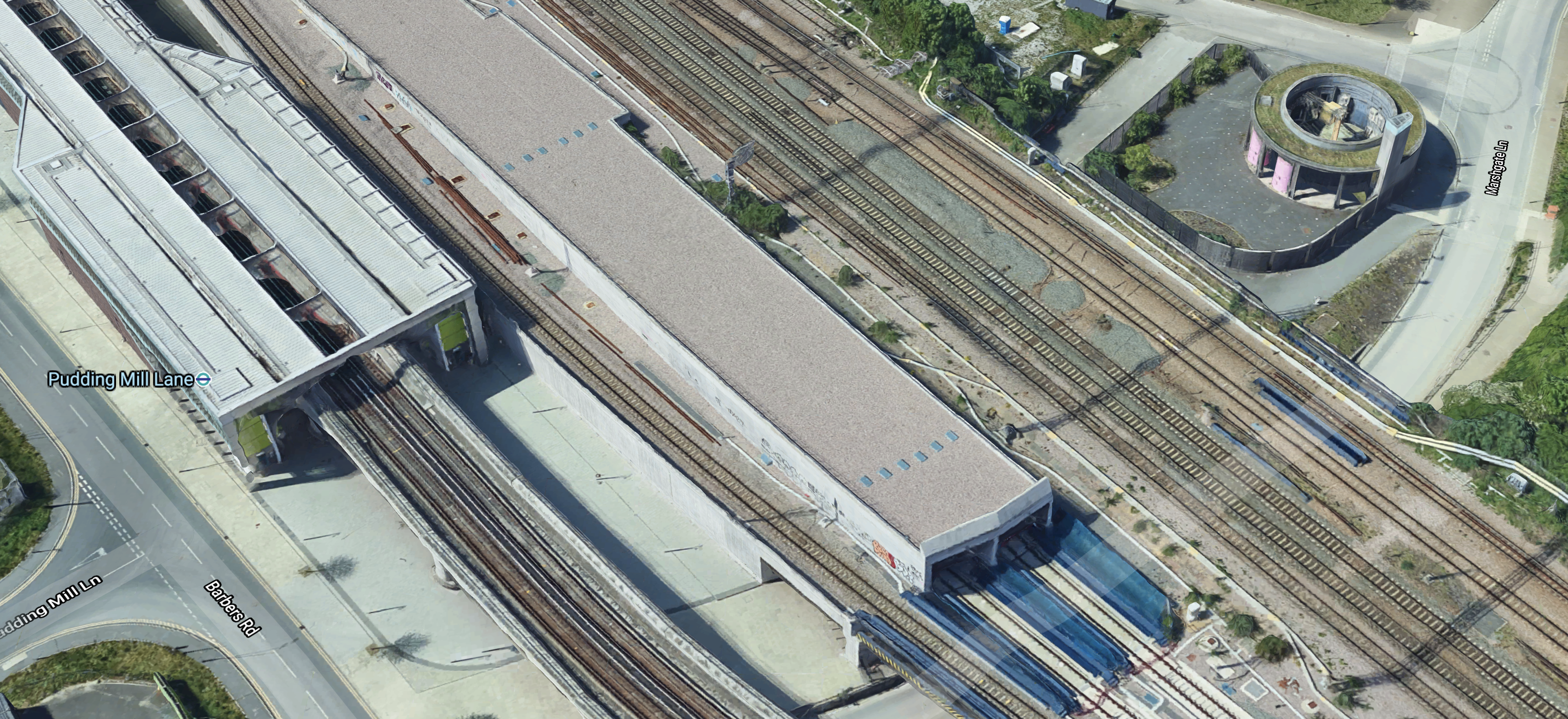
The Crossrail tunnel portal is in the middle of the image.
- Pudding Mill Lane station on the DLR is in the top-left corner of the image.
- The tracks to the right of the portal lead to and from Liverpool Street station.
- The circular building in the top right of the image is the sewage pumping station for the Queen Elizabeth Olympic Park.
Note the single track on the left side of the portal, which allows Crossrail trains to go to Liverpool Street station.
Th
Innovation Funding Awarded
The title of this post, is the same as that of a short article in the August 2021 Edition of Modern Railways.
This is the first paragraph.
Developments in passenger information, cutting carbon emissions and electrification are amongst the 30 winners of the latest round of the Department for Transport/Innovate UK’s First Of A Kind (FOaK) competition.
I particularly liked the first innovation mentioned.
Furrer+Frey is proposing a movable overhead conductor rail system for freight terminals which allows electric locomotives to enter them while providing obstruction-free loading and unloading of freight. It says this will remove the current barrier of end-to-end rail freight electrification and end the reliance on diesel traction.
Some years ago, I sat next to a crane driver from the Port of Felixstowe at a football match. At half-time we talked for a few minutes about the problems of overhead wires in ports and freight terminals. As he said “Accidents do happen!”
Furrer+Frey’s idea might be just what is needed to help decarbonise ports and freight terminals.
There is a good description of the project in this article on Rail Business UK, which is entitled Movable Overhead Electrification Aims To Eliminate The Need For Diesel Shunting Locomotives.
This link shows a picture of a similar Furrer + Frey system in a workshop or train shed.
It appears to be based on proven technology and will be tested at a Tarmac depot in Dunbar.
Furrer+Frey also got a second funding award.
It has also won funding for its innovative composite Mast for Greener Electrification, which could reduce the mass of overhead line electrification masts, as well as the size of foundations, depth of piling and lifting capability of installation machinery.
That sounds like a classic application of Buckminster Fuller’s More With Less Syndrome.
I shall add other awards later.
 The Anonymous Widower