Lumo Will Extend Its King’s Cross And Edinburgh Service To Glasgow
This article on the BBC is entitled New Train Services Approved On East Coast Main Line.
This is the sub-heading.
Additional train services will run on the East Coast Main Line from December, the rail regulator has said.
This will be the additional services for Lumo according to this document from the Office of Road and Rail.
- Lumo (Newcastle): one additional return service between London King’s Cross and Newcastle on weekdays and one additional service in opposing directions on a Saturday and Sunday.
- Lumo (Glasgow extensions): the extension of existing London King’s Cross-Edinburgh services so that Lumo can provide two northbound services and one southbound service between London King’s Cross and Glasgow on weekdays and one in each direction on Sundays.
I have some thoughts.
Train Lengths
The Office of Road and Rail document doesn’t mention train lengths.
- Hull Trains have been running most services as five-car trains, with some running as ten-car trains.
- In Ten-Car Hull Trains, I talked about Hull Trains and their mixing of 5- and 10-car trains and how it increased the number of seats on the route by 16.7 %.
I suspect that Lumo will use pairs of trains on some services to increase and also balance the number of seats.
A Possible Timetable
Consider.
- Currently, there are five Northbound trains every day with five Southbound trains on Monday to Saturday and four on Sunday.
- Lumo seem to run a reliable service.
- Would it be a safe and sensible idea to base the new timetable on the current timetable?
- Perhaps, the Glasgow services could be add-ons to the current timetable.
So it looks to me, that the extra trains will be scheduled using an innovative timetable.
- I wouldn’t be surprised if the Glasgow to London King’s Cross train was a pair of trains in the evening to balance the service and get two trains to London King’s Cross for the start of the next day’s services.
- This would also give travellers as long a day as possible in Glasgow.
- Would the two London King’s Cross to Glasgow trains, start as a pair of trains at London King’s Cross that split at Edinburgh, with one train returning to London King’s Cross and the other going on to Glasgow?
- Glasgow gets ten cars per day from London King’s Cross and sends ten cars back to London King’s Cross.
- Could the Sunday services both be a pair of trains?
The only new paths needed for the service, would be.
- Two between Edinburgh and Glasgow.
- One Southbound between Glasgow and London King’s Cross at the end of the day.
Otherwise the main timetable is as it is now.
How Long Will London King’s Cross and Glasgow Take?
Consider.
- The fastest Lumo trains take around 4 hours and 23 minutes between London and Edinburgh.
- The fastest ScotRail trains take around 50 minutes between Edinburgh and Glasgow Queen Street stations.
I would expect a time of around 5 hours and 13 minutes is possible.
This is slower than the typical 4 hours and 31 minutes of Avanti West Coast between Euston and Glasgow Central stations, but improvements to the signalling may reduce the time that Lumo takes between London and Edinburgh.
What Time Are The Last Train From Glasgow and Edinburgh To London?
These would appear to be the last trains from Glasgow and Edinburgh to London.
- The last Avanti West Coast train would appear to be the 18:40 from Glasgow Central, which gets in to London Euston at 23:40.
- The Caledonian Sleeper leaves at 23:40 from Glasgow Central, which gets in to London Euston at 07:00.
- The last LNER train for London King’s Cross, would appear to be the 19:37 from Edinburgh, which gets in to London King’s Cross at 01:14.
- The last LNER train for Leeds, would appear to be the 21:00 from Edinburgh, which gets in to Leeds at 00:42.
- The last LNER train for Newcastle, would appear to be the 22:00 from Edinburgh, which gets in to Newcastle at 01:14.
- The Caledonian Sleeper leaves at 23:40 from Edinburgh, which gets in to London Euston at 07:00.
Note.
- The timetable seems to assume, that if you are spending a day in Edinburgh or Glasgow and need to return to London, you will use the Caledonian Sleeper.
- Unless you use the Sleeper, you can’t see an evening football match and easily go home to anywhere South of Edinburgh.
- One of the last trains to arrive in London King’s Cross station is the 19:58 Lumo service from Edinburgh, which arrives at 01:00 in London King’s Cross station.
- Surprisingly, London King’s Cross station seems to have several trains moving in and out all night.
There’s certainly a large gap in the evening, where an extra service could run between Glasgow and London King’s Cross.
I wonder how late Lumo could bring a train into King’s Cross station?
- I came in once to King’s Cross at about 01:30 and still got a taxi home.
- There are also lots of 24-hour buses.
- There is little or no car parking.
I still think Lumo will operate a train as late as Network Rail will allow them.
Could Passengers Sleep In Lumo’s Seats?
I’ve certainly managed it. But then I’ve never had a problem falling asleep.
Does The Extended Service To Glasgow Pass The Granny’s Birthday Test?
Suppose it’s your granny’s birthday and you want to go to her family party, which is in the afternoon.
You should be able to take a morning train up to Glasgow and then take the late train back afterwards.
Conclusion
Lumo have spotted a gap in the timetable and they intend to fill it.
Every High Street Should Have One!
The pictures show the latest shop to open on City Road between Old Street and Moorgate stations.












As it is by a 141 bus stop on my way home from the Elizabeth Line, next time I need something, I can just get off the bus, buy what I need and catch the next bus home.
It’s even open on Sundays.
I See My First Driverless Car
The pictures show the first driverless car, that I’ve seen.




It was happily going along the Balls Pond Road, where it stopped immaculately at the lights, at the junction with Southgate Road.
Recently, a pedestrian was killed at those lights by a truck. It looks like he didn’t understand the sequence of the lights and stepped out, when he shouldn’t.
As a Control Engineer, I have a feeling, that driverless cars will never live up to the hype.
HMP Highpoint Launches Rail Engineering Apprenticeships To Reduce Reoffending And Address Skills Gap
The title of this post, is the same as that of this article on Railway Gazette.
This is the sub-heading.
A programme of railway engineering apprenticeships has been launched at Highpoint prison in Suffolk in partnership with The Co-operative Group retail and consumer services business and the City & Guilds Foundation.
These first two paragraphs add more detail.
From August, the training programme will allow prisoners to complete full apprenticeships and end-point assessments before release.
The initiative has been set up partly in response to Co-op members’ requests at its AGM for the business to focus on reducing re-offending and supporting prisoner rehabilitation. It is intended to give offenders the chance to earn a Level 2 qualification as Rail Engineering Operatives, with the aim that they can move straight into employment and into trackside roles on release.
I should say, that I know HMP Highpoint well, as it was close to where I lived in Suffolk and I had the occasional drink with some of the prison staff at a local pub. One even encouraged me to apply to be a member of the Internal Monitoring Board for the prison. Sadly, I had the stroke and was unable to follow it through.
I am all for this initiative, especially as it seems to offer employment on release. A similar train and employ policy doesn’t seem to have done Timpsons any commercial harm.
The only problem of running this course at HMP Highpoint, is that the prison, is not near a railway line.
In the selection process for the Internal Monitoring Board, I had a tour of the prison.
One member of staff, who ran a course on recycling told me that his course was the most popular in the prison.
- The main part of the course was about sorting rubbish into what can be recycled and what couldn’t.
- The course was popular, as most companies, who were involved in recycling, needed operatives who do this efficiently, so it helped getting employment on release.
It also had a big side effect, in that the prison was very clear of litter.
This course surely had similar objectives to the new Rail Engineering Operatives course and the Timpsons training.
We need more initiatives like this in our prisons.
Council Invests £16m In Hydrogen Buses
The title of this post, is the same as that of this article on the BBC.
This is the sub-heading.
There are now 34 hydrogen buses on the streets of Surrey, the council has announced.
These two paragraphs add more details.
Surrey County Council (SCC) said it has invested £16m and partnered with Metrobus to provide greener commuting options.
The fleet is now made up of 23 single-deck buses and 11 double-deckers, the council said.
I wrote about a ride on one of these buses to Gatwick Airport in Sutton Station To Gatwick Airport By Hydrogen-Powered Bus.
From the comments in the article, by a Surrey County Council councillor, the council seems very pleased with their hydrogen buses.
Singapore’s First Hydrogen-Powered Data Center Launched By DayOne Using SOFC Technology
The title of this post, is the same as that of this article on Fuel Cell Works.
These two bullet points act as sub-headings.
- DayOne has broken ground on its first AI-ready hyperscale data center in Singapore, a 20MW facility set to be operational in 2026. The project integrates 100% renewable energy, SOFC-based hydrogen power generation, and cutting-edge hybrid cooling technologies.
- Strategic partnerships with Sembcorp and NUS will drive green energy adoption and R&D in sustainable tropical data center innovation, aligning with Singapore’s AI and digital infrastructure goals.
This data centre and the companies and the technologies behind it, are certainly ones to watch.
The R & D and innovation behind it could allow data centres to be built in more tropical places than is currently possible.
Yarmouth Harbour To Be ‘Completed’ In £60m Project
The title of this post, is the same as that of this article on the BBC.
This is the sub-heading.
A major port is set to expand to prepare for construction work linked to several national infrastructure projects.
These first two paragraphs, which give more details.
Peel Ports said it would invest between £50m and £60m in Great Yarmouth’s Outer Harbour by developing the southern terminal, creating a roll-on roll-off (RORO) lift ramp and a large storage area.
Port director Richard Goffin said the construction work, which is set to begin in 2026, would “complete” the port as laid out in a business case in the early 2000s.
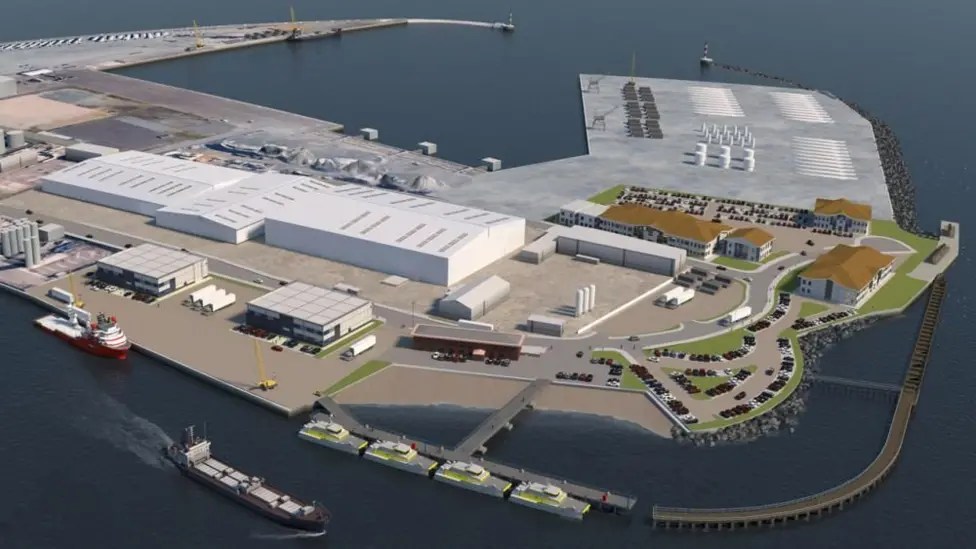
This image from Peel Ports Group shows how the Port of Great Yarmouth will look after the the proposed development.
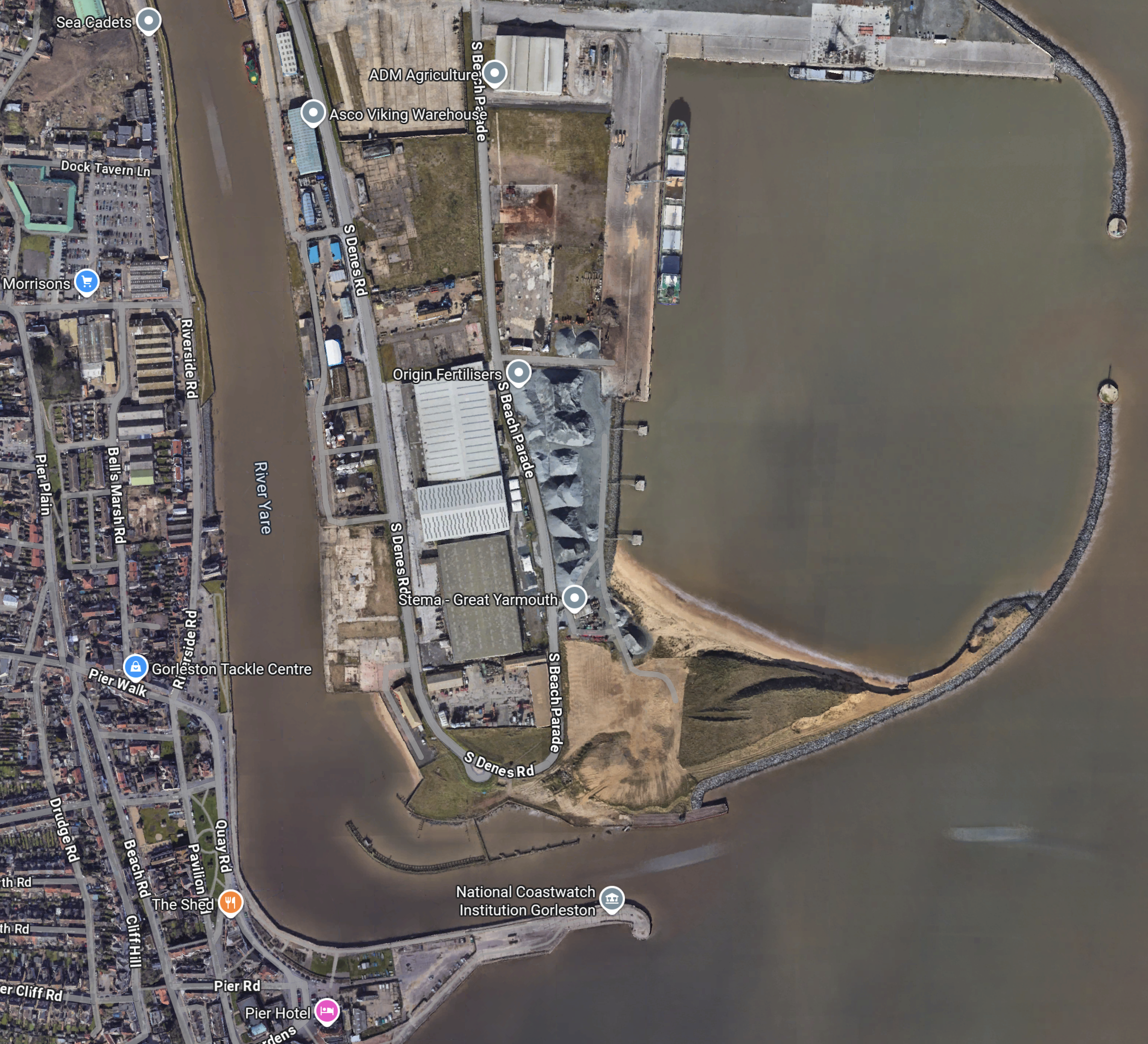
And this Google Map shows the port as it is today.
Note.
- The large triple shed, with the cross-wise middle section can be picked out in both the image and the map.
- The label by the shed says Origin Fertilisers, so I suspect the three objects on the quayside, which are visible in both the image and the map could be conveyors for loading and unloading ships with fertiliser.
- The two breakwaters are visible in both the image and the map.
It looks like the development would mainly involve filling in the Southern part of the current harbour.
With only a quick look and scant details, it looks to me, that it is a development that could be easily realised.
I have some thoughts.
Rail Access To The Port
There is no rail access to the port and I couldn’t see how it could be provided, without demolishing half of the town.
But there are carriage sidings at Great Yarmouth station, which are described in this Wikipedia entry like this.
New sidings were provided at the western end of the station to cope with the additional services operating into the station, following the closure of the M&GN system. It is a crescent-shaped site between the A47 road and Wherryman’s Way at the northernmost point of the River Yare, about 1⁄4 mi (400 m) north-west of the station. It had fallen out of use in the 1980s when Norwich Crown Point depot was built.
In 2010, the unused sidings were purchased by Great Yarmouth Borough Council; they were intended for use as a freight terminal, despite the lack of rail connection to the town’s port. It was hoped that 10,000 tonnes of sugar cane per week would be carried from Yarmouth to Cantley. The need to use a lorry shuttle between the docks and the rail yard, along with a £3.2 million quote for replacing the sidings at Cantley, saw the plan dropped.[19]
In May 2020, Eastern Rail Services commenced a lease with Norfolk County Council and Network Rail for Yarmouth Vauxhall sidings. Managing director James Steward said the siding “matched ERS’s requirement for an East Anglian site to base its rolling stock.” Following extensive de-vegetation works, Direct Rail Services 37402 became the first locomotive in 19 years to run into the sidings on 26 May 2020, followed the next day by it delivering five former Greater Anglia Mark 3 coaches for storage. On 6 July 2020, ERS was authorised a licence exemption permitting them to operate trains within the site
The Port of Great Yarmouth appears to be keen to do its part in the construction of Sizewell C. Could components for the power station, be brought into the port through the new roll-on/roll-off berth and then transferred to rail in the former carriage sidings?
This 3D Google Map shows the carriage sidings.
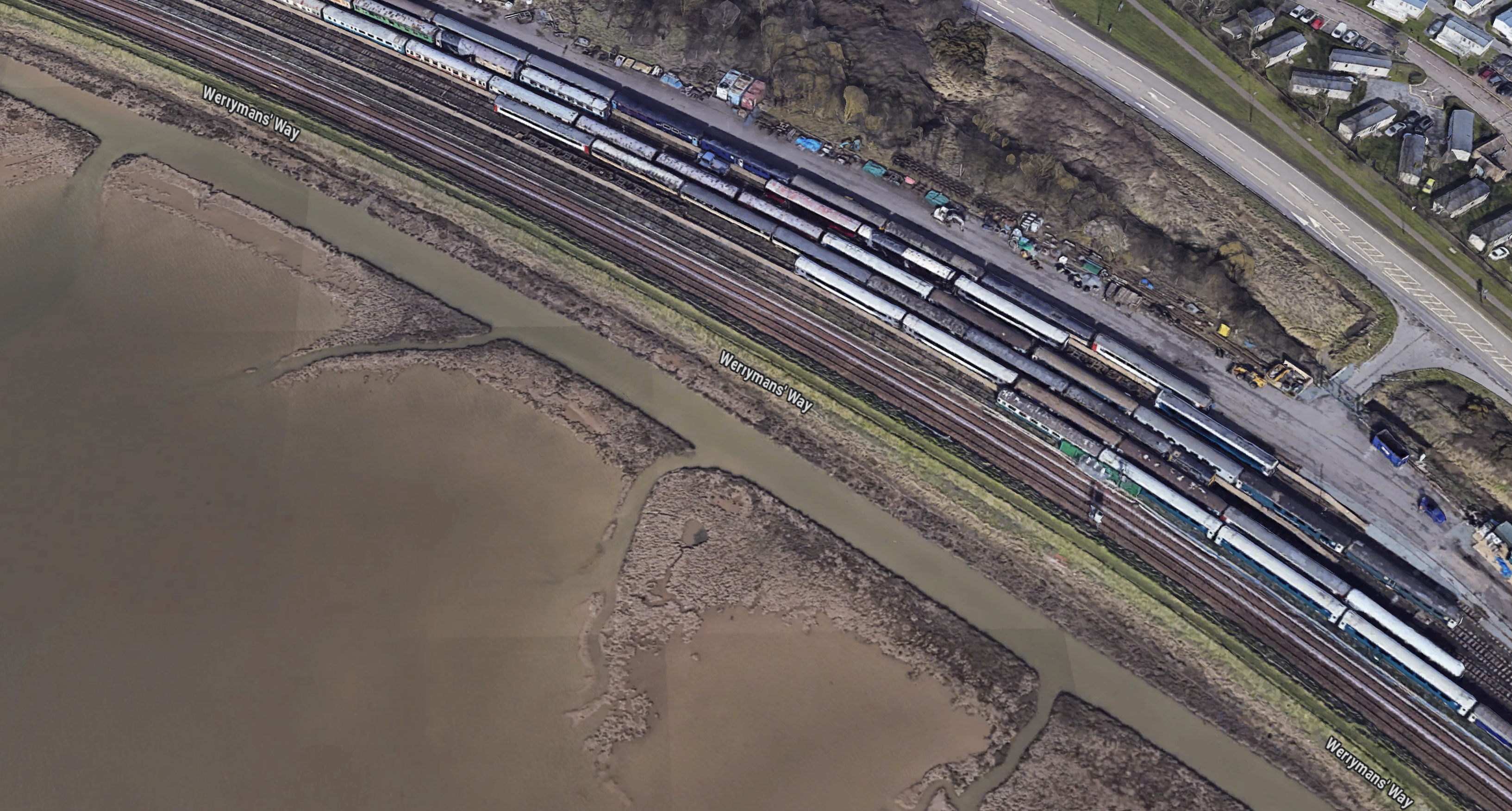
Most of the rolling stock appears to be retired Mark 2 and M3 coaches.
Road Access To The Port
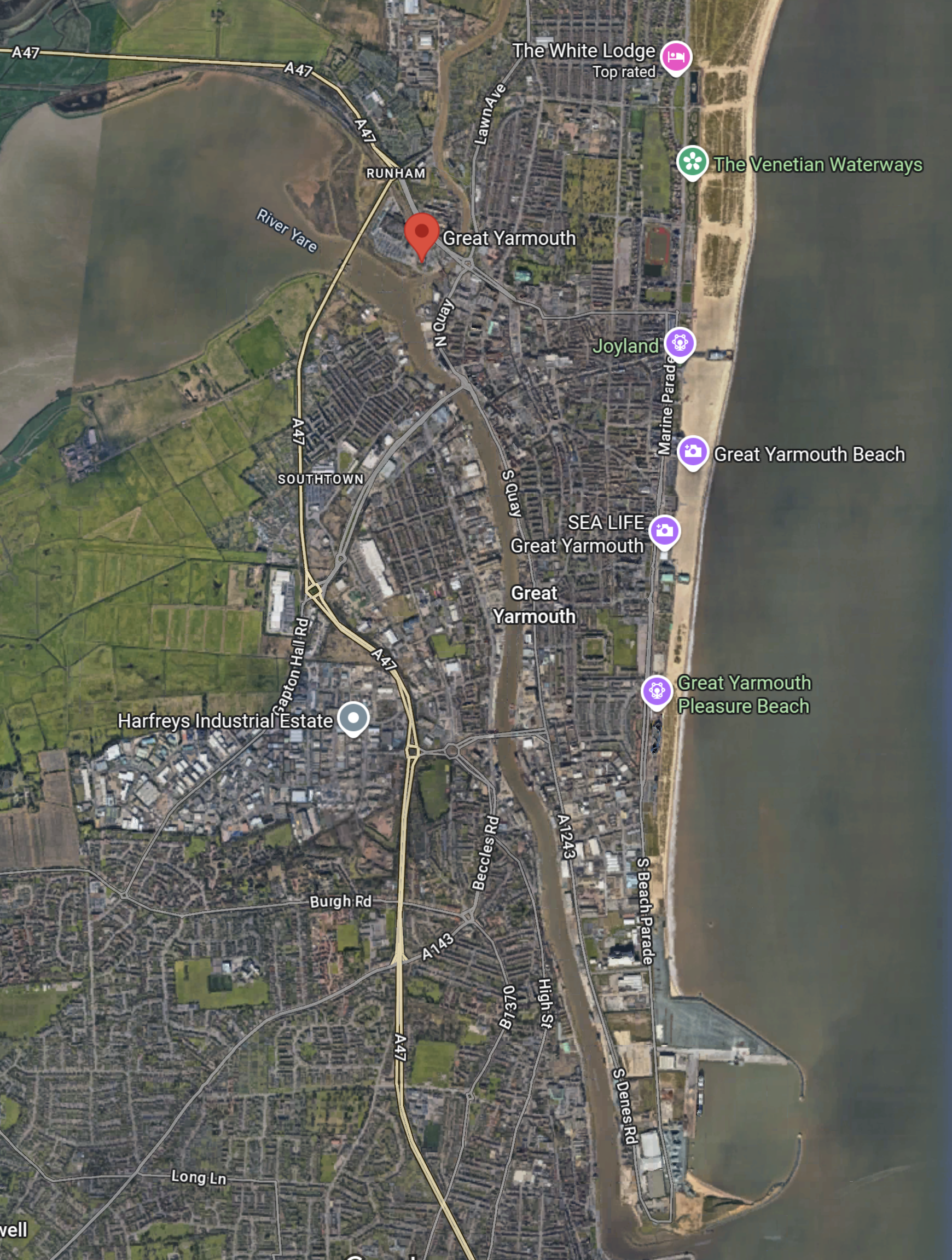
This Google Map shows Great Yarmouth and the Port and roads in the area.
Note.
- The red arrow indicates Great Yarmouth station.
- The Port of Great Yarmouth is in the South-East corner of the map.
- The A 47 runs down the West side of the town.
- The River Yare runs from the railway station to the sea, just below the port.
There is a road on the East bank of the River Yare, that connects to the A 47 and could easily connect to a rail cargo terminal to the North-West of the station in the derelict carriage sidings.
I can certainly see Nimbies not liking the new roll-on/roll-off ferry creating traffic in the town.
The Construction Of Sizewell C
Sizewell C is very similar to Hinckley Point C and this extract from the Wikipedia entry for Hinckley Point C describes some of that power station’s construction.
In March 2017, EDF, after the Office for Nuclear Regulation (ONR) gave approval to start building, the building of the first parts of the plant proper began with a network of tunnels to carry cabling and piping. Work was also under way on a jetty to land building materials, a seawall, and accommodation blocks.
In January 2018, EDF said that they were on track to start generating electricity by 2025 and that they planned to start constructing above-ground structures for the power station by June 2019.
The approximate 2,000 cubic metres (71,000 cu ft) concrete pour for the first reactor started on 11 December 2018. It was completed over a 30-hour period, creating the first part of the unit one 4,500 tonne base, a platform 3.2 metres (10 ft 6 in) thick. The reactor building will be built on the (to be completed) platform. This construction start marks the first new reactor build in the UK after a 30-year break, and the second PWR in the UK, after Sizewell B.
Completion of the base for the first reactor, the final 8,954 cubic metres (316,200 cu ft) of concrete, was achieved in June 2019. Completion of the base for the second reactor, 8,991 cubic metres (317,500 cu ft) of concrete, was achieved in June 2020.
Construction utilises the world’s largest crane, the Sarens SGC-250 double ring crane, which is responsible for lifting Hinkley Point C’s heaviest components. More than 600 heavy fabrications, including the five major parts of each unit’s steel containment liner and dome, are positioned by the SGC-250. The crane, named Big Carl, was delivered in modular form, consisting of over 400 deliveries.
In February 2023, the first nuclear reactor pressure vessel was delivered to site via the Bristol Channel Hinkley-dedicated wharf at Combwich. The pressure vessel was built in France in 2022 by Framatome.
In May 2024, the first of the 520 tonne steam generators was delivered to site in the same manner as the reactor pressure vessel.
Note.
- A good proportion of the power station and the materials to build it were brought in by sea.
- The size of everything is huge.
- Big Carl seems to make appearances in all big projects.
- According to the BBC, Peel Ports are spending £60million on a new roll-on/roll-off terminal, 350 metres of quay and ten hectares of high quality storage space.
I wouldn’t be surprised, if they have the contract for Sizewell C’s logistics, that Peel Ports will be laughing all the way to the bank.
If nothing else, after Sizewell C is completed, they will have a high-class port facility at the end of the A 47 from Birmingham, Leicester, Peterborough and Norwich, which could open up possible ferry routes to Europe.
Between Great Yarmouth And Sizewell
If the components come in to Great Yarmouth on trailers on the RORO ferries from France, they could be taken to Sizewell on the A 12 road.
Smaller components may be taken by road, but I wouldn’t rule out a transfer to rail in the carriage sidings at Great Yarmough, as I indicated earlier.
British Gas Owner Mulls Mini-Nuke Challenge To Rolls-Royce
The title of this post, is the same as that of this article in The Telegraph.
This is the sub-heading.
Centrica is looking to follow Rolls-Royce in developing small modular reactors
These are the first three paragraphs.
The owner of British Gas is considering investing in mini nuclear power plants in the UK as it seeks to cash in on burgeoning demand for the technology.
Centrica is in early talks with the Government about a potential future deal that could see the energy giant participate in the development of so-called small modular reactors (SMRs).
It comes after Ed Miliband, the Energy Secretary, last month announced billions of pounds in funding for SMRs, which will form part of a new “golden age” for atomic energy.
In Centrica Really Can’t Lose At Sizewell, I looked at Centrica’s involvement in Sizewell C and in particular the financing of the nuke and what Centrica would do with their share of the electricity, that the nuke will produce.
I listed these uses for hydrogen in the East of England.
- Transport – Buses, Coaches and Trucks
- Large Construction Projects
- Rail
- Ports
- Airports
- Agriculture And The Rural Economy
- Exports
I do wonder, if Centrica made the investment in Sizewell C, when they realised that there were a lot of uses for hydrogen and producing hydrogen using the electricity from a nuclear power station was a good way to generate hydrogen.
- Sizewell B is a 1.2 GW nuclear powerstation.
- Sizewell C is a 3.2 GW nuclear powerstation.
- Their investment in HiiROC surely gives them access to the technology to generate hydrogen.
- Centrica have a lot of experience of selling natural gas to customers, who need energy.
- There were also substantial government guarantees involved.
- Hydrogen made by a nuclear reaxtor is generally referred to as pink hydrogen.
- In Westinghouse And Bloom Energy To Team Up For Pink Hydrogen, I describe how two American companies have formed a partnership to make pink hydrogen.
Before they invested in Sizewell C, they would have done detailed financial and technical due diligence.
Did Centrica then scale the calculations to see if funding a Small Modular Reactor (SMR) to make hydrogen was a viable deal?
- SMRs are typically around 400-500 MW.
- The article mentions Rolls-Royce, but other companies are developing SMRs.
- Centrica use Rolls-Royce mtu generators for some of their installations.
- Some SMR/HiiROC systems could be built close to steelworks or other high energy users.
This is a very interesting development in taking the UK to net-zero.
Scotland’s 450 MW Neart na Gaoithe Offshore Wind Farm Fully Operational
The title of this post, is the same as that of this article on offshoreWIND.biz.
This is the sub-heading.
The 450 MW Neart na Gaoithe (NnG) offshore wind farm has become fully operational, with Scotland’s First Minister John Swinney visiting Eyemouth on 24 July to mark the launch of the country’s newest offshore wind project.
These first three paragraphs give more details.
Located 15.5 kilometres off the coast of Fife, NnG is co-owned by EDF power solutions UK and Ireland and ESB. The wind farm’s 54 turbines are now generating up to 450 MW of clean electricity, which is enough to power around 375,000 homes and will offset over 400,000 tonnes of CO2 emissions each year, according to the developer.
The installation of Siemens Gamesa 8 MW turbines was completed in April 2025, while the project produced its first power in October 2024.
Electricity generated by Neart na Gaoithe is transmitted via the subsea export cable from the offshore substation to Thorntonloch Beach, where the underground onshore export cable feeds it to the national grid.
This Google Map shows the mouth of the Firth of Forth.

Note.
- The red arrow indicates Torness power station.
- The Fife Coast is at the top of the map.
- The most Easterly island is the Isle of May.
- The wind farm is located 15.5 kilometres off the Fife Coast.
This second Google Map shows the Fife Coast and the Isle of May.

Note.
- The red arrow indicates Fife Ness lighthouse.
- The island in the South-East corner of the map is the Isle of May.
- Leven station is in the South-West corner of the map, which I described in Leven Station – 15th May 2025.
From this map, I estimated that Fife Ness lighthouse and the Isle of May are around ten kilometres apart.
This third Google Map shows Torness nuclear power station on the other side of the Firth of Forth.

Note.
- Torness nuclear powerstation is indicated by the red arrow.
- The A1 road between Edinburgh and the South crossing the map diagonally.
- The East Coast Main Line following a similar route to the A1.
- The beach below the power station is Tgortonlock, where the cable from Neart na Gaoithe wind farm comes ashore.
Consider.
- Torness nuclear powerstation was built in 1988.
- It has a capacity of 1290 MW.
- Neart na Gaoithe wind farm has a capacity of 450 MW.
This is said in the Wikipedia entry for the Torness nuclear powerstation about its closure.
In December 2024, in response to concerns over energy security following delays to the opening of Hinkley Point C, EDF announced that the life of Torness would be extended two years until March 2030.
In January 2025, EDF stated that “their ambition is to generate beyond these dates [of March 2030], subject to plant inspections and regulatory oversight”
It looks like more power is needed at Torness to cover the closure of the nuclear powerstation.
I asked Google to give me an AI Overview of what wind farms will connect to the grid at Torness and I was given this answer.
Several wind farms are planned to connect to the grid near Torness, with the largest being the Berwick Bank Wind Farm. This offshore wind farm, located 40km off the coast, will connect to the National Grid at Branxton, near Torness. Another project, Eastern Green Link 1 (EGL1), will also connect to the grid near Torness, specifically at the Torness substation, and then link to Hawthorn Pit in County Durham. Additionally, the Neart na Gaoithe offshore wind farm is also being developed in the area.
As Berwick Bank wind farm and EGL1 have capacities of 4.1 and 2 GW respectively, I am fairly sure that Torness can be safely decommissioned.
Heathrow Willing To Build Shorter Runway After Airline Outcry Over Cost
The title of this post, is the same as that of this article in The Telegraph.
This is the sub-heading.
BA and Virgin have objected to expansion plan that could see departure fees swell to as much as £100
These are the first two paragraphs.
Heathrow has said it is willing to build a shorter, cheaper third runway following an outcry from airlines over cost.
Europe’s busiest airport will indicate its readiness to negotiate with carriers over runway options when it submits a formal pitch to ministers next week, said Thomas Woldbye, the airport’s chief executive.
This is a map of the new proposal from the DfT.
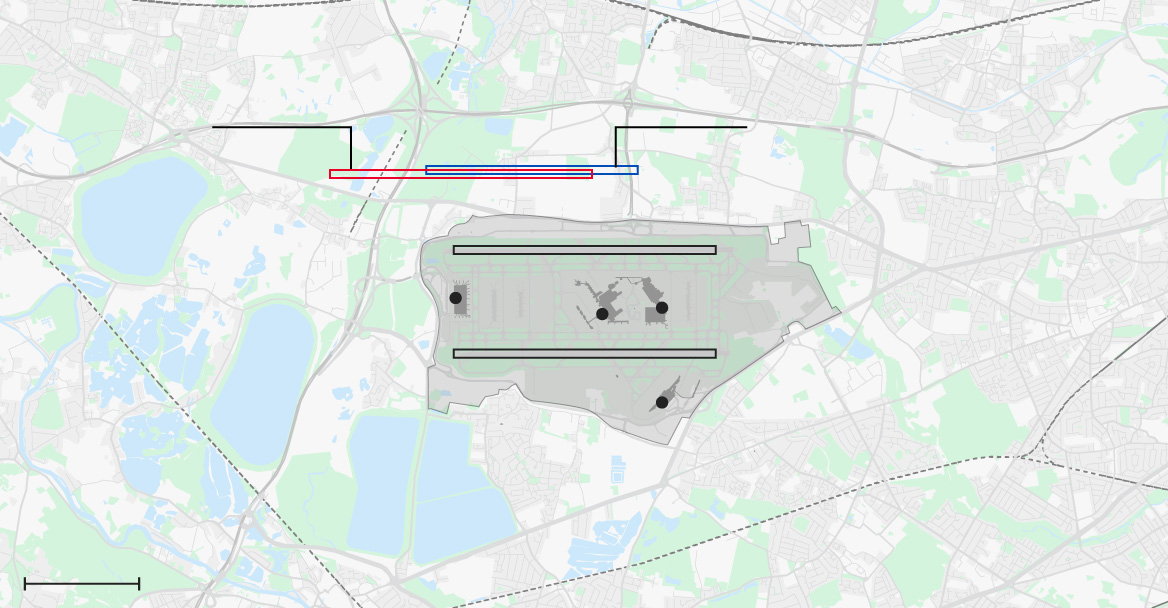
Note.
- The current Northern and Southern runways, with terminals 5, 3 and 2 between them from West to East.
- Terminal 4 is South of the Southern runway.
- The runway shown in red to the North of the Northern runway is the current proposal for a full-length new runway.
- The runway shown in blue to the North of the Northern runway is the new proposal for a shorter-length new runway.
- The M25 can be picked out going North-South to the West of the current runways and the new shorter runway.
- But the M25 is crossed by the full-length new runway.
It would appear that the proposal for the new shorter runway will avoid putting the M25 in a tunnel.
So hopefully, it would reduce the cost and disruption incurred, by building the new shorter runway.
 The Anonymous Widower