Centrica Really Can’t Lose At Sizewell
The title of this post, is the same as that of this article in The Times.
This is the sub-heading.
Centrica’s £1.3 billion investment in Sizewell C guarantees substantial returns, even with cost overruns.
These two-and-a-half paragraphs explain the funding.
Now we know what Ed Miliband means by his “golden age of nuclear” — golden for the companies putting their money into Sizewell C. Yes, reactor projects have a habit of blowing up private investors. But maybe not this one. It looks more like an exercise in transferring risk to consumers and the taxpayer.
Sure, nobody builds a £38 billion nuke on a Suffolk flood plain without a frisson of danger. But the energy secretary and his Treasury chums have done their bit to make things as safe as possible for the companies putting in equity alongside the government’s 44.9 per cent stake: Canada’s La Caisse with 20 per cent, British Gas-owner Centrica (15 per cent), France’s EDF (12.5 per cent) and Amber Infrastructure (7.6 per cent).
For starters, nearly all the debt for the 3.2 gigawatt plant, three-quarters funded by loans, is coming from the state-backed National Wealth Fund. It’s bunging in up to £36.6 billion, with £5 billion more guaranteed by a French export credit agency.
It looks to me that between them the British and French governments are providing £41.5 billion of loans to build the £38 billion nuke.
These are my thoughts.
Hydrogen And Sizewell C
This page on the Sizewell C web site is entitled Hydrogen And Sizewell C.
Under a heading of Hydrogen Buses, this is said.
At Sizewell C, we are exploring how we can produce and use hydrogen in several ways. We are working with Wrightbus on a pilot scheme which, if successful, could see thousands of workers transported to and from site on hydrogen double decker buses. You can read more about the pilot scheme in our press release
Firstly, it could help lower emissions during construction of the power station. Secondly, once Sizewell C is operational, we hope to use some of the heat it generates (alongside electricity) to make hydrogen more efficiently.
This would appear to be a more general statement about hydrogen and that the following is planned.
- Hydrogen-powered buses will be used to bring workers to the site. A press release on the Sizewell C web site, talks about up to 150 buses. That would probably be enough buses for all of Suffolk.
- Hydrogen-powered construction equipment will be used in the building of the power station.
- It also talks about using the excess heat from the power station to make hydrogen more efficiently. I talk about this process in Westinghouse And Bloom Energy To Team Up For Pink Hydrogen.
This is a substantial investment in hydrogen.
Centrica And Electricity From Sizewell C
The article in The Times, also says this.
Even so, there’s a fair bit of protection for the likes of Centrica, which has also agreed a 20-year offtake deal for its share of Sizewell’s electricity. The price of that is not yet known.
Nothing is said in the article about the size of Centrica’s electricity offtake.
- If they get 15 % of Sizewell C, that would by 480 MW.
- If they get 15 % of Sizewell B + C, that would by 660 MW.
If they use their share to generate hydrogen, Suffolk would have a massive hydrogen hub.
To power the buses and construction of Sizewell C, Sizewell B could be used to provide electricity to create the hydrogen.
How Would The Hydrogen Be Produced?
Centrica, along with other companies, who include Hyundai and Kia, are backers of a company in Hull called HiiROC, who use a process called Thermal Plasma Electrolysis to generate hydrogen.
On their web site, they have this sub-heading.
A Transformational New Process For Affordable Clean Hydrogen
The web site also describes the process as scalable from small modular units up to industrial scale. It also says this about the costs of the system: As cheap as SMR without needing CCUS; a fraction of the energy/cost of water electrolysis.
If HiiROC have achieved their objective of scalability, then Centrica could grow their electrolyser to meet demand.
How Would The Hydrogen Be Distributed?
Consider.
- Currently, the Sizewell site has both road and rail access.
- I can still see in my mind from the 1960s, ICI’s specialist articulated Foden trucks lined up in the yard at Runcorn, taking on their cargoes of hydrogen for delivery all over the country.
- As that factory is still producing hydrogen and I can’t remember any accidents in the last sixty years, I am fairly sure that a range of suitable hydrogen trucks could be developed to deliver hydrogen by road.
- The road network to the Siewell site is being updated to ensure smooth delivery of workers and materials.
- The rail access to the Sizewell site is also being improved, for the delivery of bulk materials.
I believe there will be no problems delivering hydrogen from the Sizewell site.
I also believe that there could be scope for a special-purpose self-propelled hydrogen tanker train, which could both distribute and supply the hydrogen to the vehicles, locomotives and equipment that will be using it.
Where Will The Hydrogen Be Used?
I have lived a large part of my life in Suffolk and know the county well.
In my childhood, there was quite a lot of heavy industry, but now that has all gone and employment is based on agriculture, the Port of Felixstowe and service industries.
I can see hydrogen being used in the following industries.
Transport
Buses and heavy trucks would be powered by hydrogen.
The ports in the East of England support a large number of heavy trucks.
Large Construction Projects
Sizewell C is not the only large construction project in the East of England, that is aiming to use low-carbon construction involving hydrogen. In Gallagher Group Host Hydrogen Fuel Trial At Hermitage Quarry, I talked about a hydrogen fuel trial for the Lower Thames Crossing, that involved JCB and Ryse Hydrogen.
Hydrogen for the Lower Thames Crossing could be delivered from Sizewell by truck, down the A12.
Rail
We may not ever see hydrogen-powered passenger trains in this country, but I do believe that we could see hydrogen-powered freight locomotives.
Consider.
- The latest electro-diesel Class 99 locomotives from Stadler have a Cummins diesel engine.
- The diesel engine is used, when there is no electrification.
- Cummins have developed the technology, that allows them to convert their latest diesel engines to hydrogen or natural gas power, by changing the cylinder head and the fuel system.
- Access to the Port of Felixstowe and London Gateway needs a locomotive with a self-powered capability for the last few miles of the route.
A Class 99 locomotive converted to hydrogen would be able to run with out emitting any carbon dioxide from Felixstowe or London Gateway to Glasgow or Edinburgh.
Ports
Ports have three main uses for hydrogen.
- To power ground-handing equipment, to create a pollution-free atmosphere for port workers.
- To fuel ships of all sizes from the humblest work-boat to the largest container ships.
- There may need to be fuel for hydrogen-powered rail locomotives in the future.
There are seven ports with excellent road and/or rail connections to the Sizewell site; Felixstowe, Great Yarmouth, Harwich, Ipswich, London Gateway, Lowestoft and Tilbury.
The proposed Freeport East is also developing their own green hydrogen hub, which is described on this page on the Freeport East web site.
Airports
Airports have two main uses for hydrogen.
- To power ground-handing equipment, to create a pollution-free atmosphere for airport workers.
- In the future, there is likely to be hydrogen-powered aircraft.
There are three airports with excellent road and/or rail connections to the Sizewell site; Norwich, Southend and Stansted.
Agriculture And The Rural Economy
Agriculture and the rural economy would be difficult to decarbonise.
Consider.
- Currently, most farms would use diesel power for tractors and agricultural equipment, which is delivered by truck.
- Many rural properties are heated by propane or fuel oil, which is delivered by truck.
- Some high-energy rural businesses like blacksmiths rely on propane, which is delivered by truck.
- Electrification could be possible for some applications, but ploughing the heavy land of Suffolk, with the added weight of a battery on the tractor, would probably be a mathematical impossibility.
- JCB are developing hydrogen-powered construction equipment and already make tractors.
- Hydrogen could be delivered by truck to farms and rural properties.
- Many boilers can be converted from propoane to run on hydrogen.
I feel, that hydrogen could be the ideal fuel to decarbonise agriculture and the rural economy.
I cover this application in detail in Developing A Rural Hydrogen Network.
Exports
Consider.
- Sizewell B and Sizewell C nuclear powerstations have a combined output of 4.4 GW.
- A rough calculation shows that there is a total of 7.2 GW of wind farms planned off the Suffolk coast.
- The East Anglian Array wind farm alone is said in Wikipedia to be planned to expand to 7.2 GW.
- The Sizewell site has a high capacity connection to the National Grid.
Nuclear plus wind should keep the lights on in the East of England.
Any excess electricity could be converted into hydrogen.
This Google Map shows the location of Sizewell B in relation to Belgium, Germany and The Netherlands.
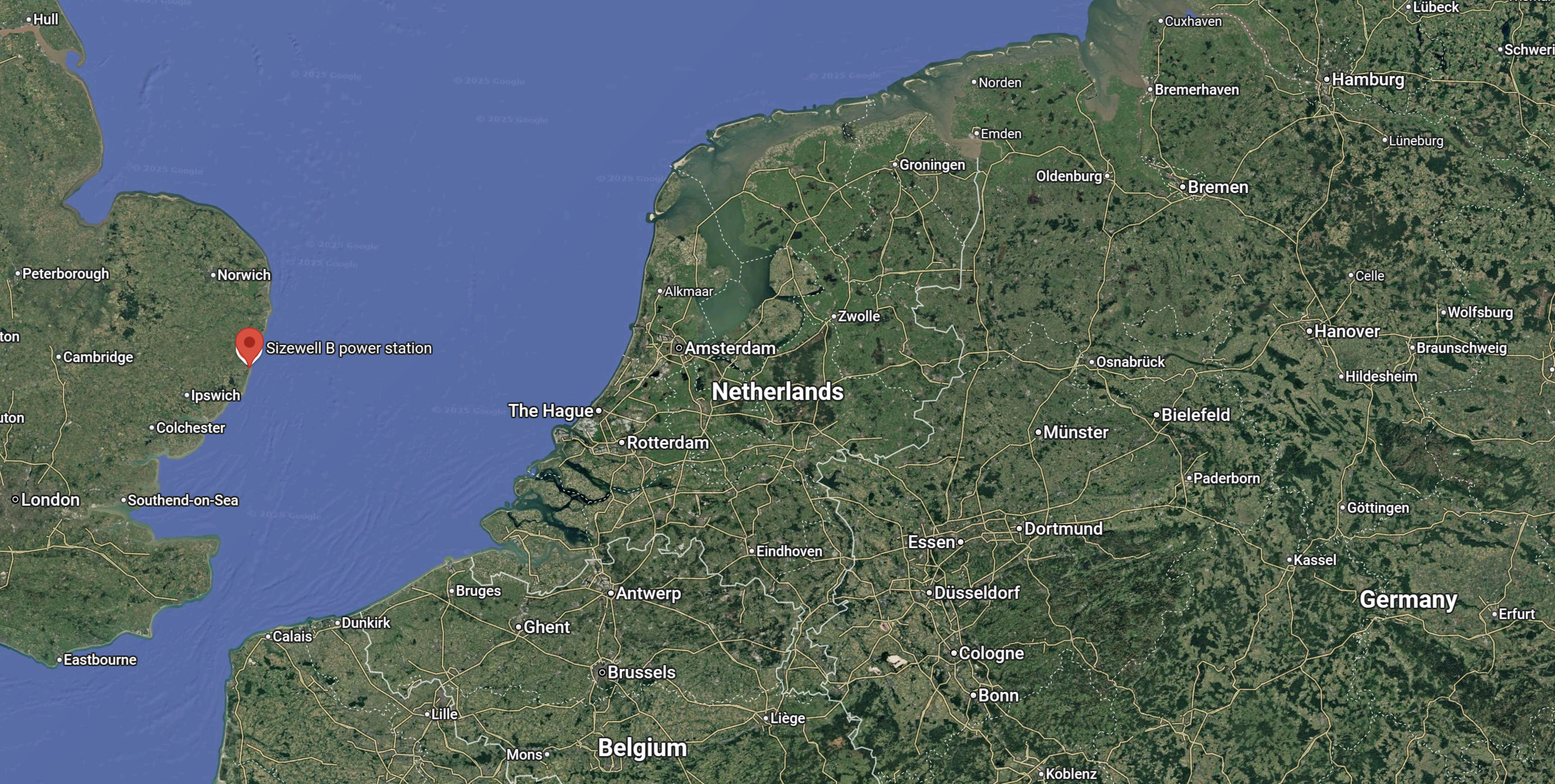
The Sizewell site is indicated by the red arrow.
The offshore oil and gas industry has used technology like single buoy moorings and coastal tankers to collect offshore natural gas for decades.
I don’t see why coastal hydrogen tankers couldn’t export excess hydrogen to places around the North Sea, who need the fuel.
It should be born in mind, that Centrica have a good reputation in doing natural gas trading. This expertise would surely be useful in hydrogen trading.
Conclusion
I believe that a hydrogen hub developed at Sizewell makes sense and I also believe that Centrica have the skills and technology to make it work.
Labour’s Great Rail Revival Has Already Hit The Buffers
The title of this post, is the same as that of this article in The Telegraph.
This is the sub-heading.
The decision to relaunch just one defunct train line has sparked anger and frustration across Britain
These four paragraphs summary the article.
Labour came to power with a pledge to improve Britain’s creaking railways, spearheaded by a headline-grabbing commitment to renationalisation.
But a year on, the Government stands accused of blocking the resurrection of dozens of routes across England, most of them mothballed since the Beeching cuts of the 1960s.
The decision to relaunch just one defunct train line out of dozens was announced by the Government earlier this month.
In doing so, it has sparked anger in communities across the country, many of which were given hope by ministers who pledged to reconsider a fleet of reopenings, despite scrapping Boris Johnson’s Restoring Your Railway programme last year.
I find this particularly disappointing.
- The two railways, that have been reopened in England in the last few years; the Dartmoor Line and the Northumberland Line have done very well.
- The Levenmouth Link in Scotland appears to be going the same way.
- Merseyrail Extension to Headbolt Lane appears to be well-used.
- The government wants to build lots of Starmer’s semis.
Surely, a few more rail reopenings will help the last objective.
Three Applications Submitted In Malta’s First Offshore Wind Tender
The title of this post, is the same as that of this article on offshoreWIND.biz.
This is the sub-heading.
The Maltese government has received three submissions in the pre-qualification period for the country’s first offshore wind tender, which will award a concession for a floating wind project with an installed capacity of around 300 MW.
These first two paragraphs add more detail.
The Ministry for the Environment, Energy, and Public Cleanliness said on 22 July that the submission phase for the Preliminary Qualification Questionnaire (PQQ), launched in December 2024, had concluded, with three companies and consortia looking to participate in the process: Code Zero Consortium, led by SEP (Malta) Holding; Atlas Med Wind, a consortium led by Italy’s GreenIT SpA; and MCKEDRIK Sole Member, a sole applicant based in Greece.
In December last year, Malta opened the PQQ period, seeking to pre-qualify potential developers who will then be invited to participate in the next stage(s) of the tender to build Malta’s first floating wind farm. The project is planned to have an installed capacity of between 280 MW and 320 MW
Note.
- Despite being Malta’s first offshore wind farm, it will be a floating wind farm.
- It is a medium-sized wind farm, which will probably give the Maltese chances to supply some services.
- The consortia seem to have some local involvement.
Malta appears to be taking a sensible route.
I asked Google AI, what was Malta’s electricity generating capacity and got this reply.
Malta’s total electricity generation capacity is approximately 0.83 million kilowatts, according to TheGlobalEconomy.com. This value represents the latest data from 2023. The majority of this capacity comes from conventional power plants, with a smaller but growing contribution from renewable sources.
As 0.83 million kilowatts is 830 MW, these offshore wind farms could replace up to 36 % of Malta’s current generating capacity.
From my experience of the island Malta is not a bad place to live, so recruiting the specialist engineers, that are needed shouldn’t be a problem.
I can also see other small countries following a similar route to Malta.
The Power Of Buildings To Come
I took this picture on Bishopsgate in London.
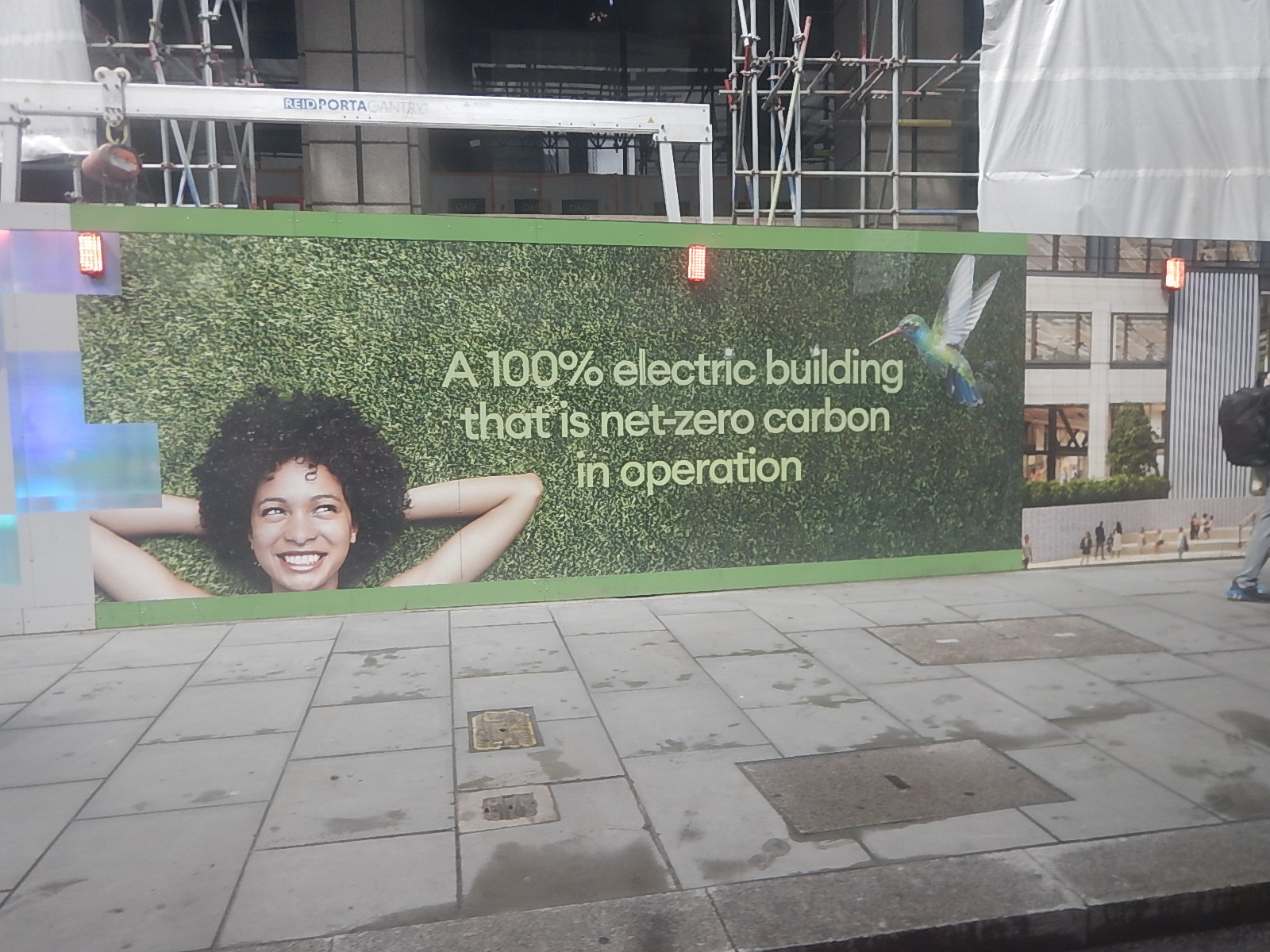
It’s advertising the building, which is being built behind the hoarding called One Exchange Square.
Buses On London Route 141 Now Go In Convoy
I took these pictures at the Balls Pond Road stop on the route.







Sometimes you wait as long as twenty minutes for one to come along, but here were three in a similar number of minutes.
When I was at school, there were stories from the Second World War, when after a bus was hit by a German bomb, that buses on one route went in convoy for protection.
Perhaps, the buses are practicing for when Putin decides to attack London?
Or is it just another manifestation of the service on the worst bus route in London?
One Of The Five Large Buses Sold In Korea This Year Is Hydrogen-Powered
The title of this post, is the same as that of this article in Pulse.
These are the first three paragraphs.
Nearly one in five large buses sold in South Korea in 2025 to date has been a hydrogen fuel cell electric vehicle (FCEV). In response, Hyundai Motor Co. is increasingly focusing on hydrogen-powered commercial transport amid sluggish demand for hydrogen-powered passenger cars.
According to data from the Korea Automobile & Mobility Association (KAMA) and Hyundai Motor, 380 hydrogen-powered buses were sold in the first five months of 2025, out of 1,923 large buses sold overall. The market share stood at 19.8 percent, indicating a significant increase from 6 percent in 2023 and 14.4 percent the previous year.
Analysts say hydrogen power is better suited for commercial vehicles than for passenger cars. While electric vehicles work well for lighter, smaller vehicles, hydrogen-powered systems offer key advantages for larger vehicles, including longer range, shorter refueling times, and greater payload capacity.
Korea and Germany certainly have more hydrogen-powered buses than the UK.
But then we are rather lagging behind other countries in the use of hydrogen. I am certainly writing fewer hydrogen stories since the change of government.
The Hindenberg has done a wonderful job, in convincing politicians that hydrogen is dangerous.
St. Pancras And Leicester Via Corby
This OpenRailwayMap shows the route between Kettering and Leicester via Corby.
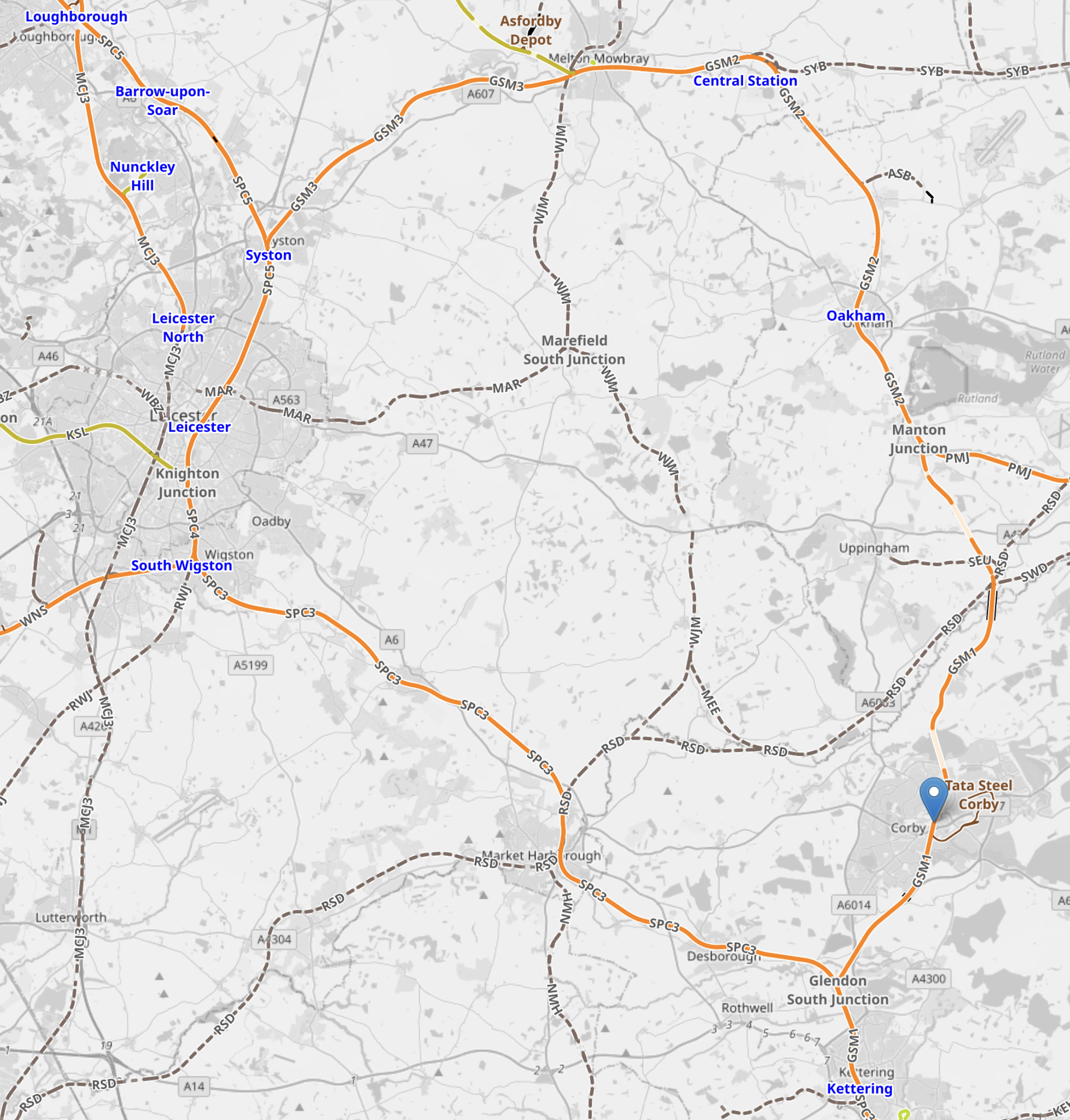
Note.
- Kettering station is in the bottom right corner of the map.
- Kettering is on the Midland Main Line from St. Pancras.
- North of Kettering the route splits into two.
- The Midland Main Line goes North-West through Market Harborough to Wigston junction and Leicester.
- The Midland Main Line is electrified to Wigston junction.
- The Corby branch goes North-East to Corby, which is indicated by a blue arrow.
- The Corby branch is electrified to Corby.
On Saturday, I went to Leicester and because there were engineering works at Market Harborough, the train went via Corby.
Over The Welland Viaduct
After Corby, the train went over the Welland Viaduct and I took these pictures.
















It is an impressive viaduct and is the longest viaduct across a valley in the United Kingdom.
I have some further thoughts.
Could The Corby Service Be Extended to Leicester?
Consider.
- Between Corby and Leicester is 40.8 miles of track without electrification.
- Trains could call at Oakham, Melton Mowbray and Syston stations.
- Oakham, Melton Mowbray and Syston stations, could be given an appropriate number of trains every day to Leicester, Corby, Kettering, Wellingborough, Bedford, Luton, Luton Airport Parkway and London St. Pancras International stations.
- No new infrastrructure would be needed.
- I suspect an hourly service would be sufficient.
I am fairly sure that a Class 810 train fitted with batteries could work the route.
Leicester, Oakham, Melton Mowbray And Syston Stations Would Get A Direct Connection To Luton Airport
Some travellers might find this very useful.
Leicester Station Would Have A Neat Passenger Drop-Off For Luton Airport
I wrote about this in Busiest UK Airports Raise Kiss-and-Fly Fees, Says RAC.
Every rail station needs a passenger drop-off as good and affordable as the one at Leicester station.
Busiest UK Airports Raise Kiss-and-Fly Fees, Says RAC
The title of this post, is the same as that of this article on the BBC.
This is the sub-heading.
More than half of Britain’s busiest airports have raised “kiss-and-fly” fees for cars dropping off passengers close to terminals, according to research from the RAC.
These two paragraphs add details.
The motoring group found 11 out of 20 UK airports had put up prices since last July, with Gatwick, Bristol, Leeds Bradford and Southampton joining Stansted in charging the top rate of £7 to park for a matter of minutes.
In contrast, at nine of the 10 busiest airports in the European Union there are no drop-off fees.
I don’t drive and these days I can’t walk very far, but I travel around the UK and Europe without any difficulty.
Here are a few tips.
Use James Cameron’s Packing Method
James Cameron was one of BBC’s most famous and much-travelled journalists and his life is documented in this Wikipedia entry.
The Wikipedia entry says nothing about his packing method, which my late wife and myself used after hearing him describe it in one of his excellent documentaries.
Sort everything you think you’ll need into two piles. Each pile contains half the shirts, trousers, swimwear, underwear etc. that you think you’ll need.
Pack each pile in a separate case and leave one case behind.
As to money he said, work out the most you’ll need and double it. These days with credit cards, that is probably not so relevant.
Choose An Airport With Good Step-Free Public Transport
I’m lucky in London, in that I can get a bus within a hundred metres of my house, that takes me to Moorgate, Bank or London Bridge stations, which give me direct access to City, Gatwick, Heathrow, Luton, Southend or Stansted Airports.
Step-free access to some airports in the UK is abysmal.
Use A Train From A Station With a Properly Designed Drop-Off Area
These pictures show the taxi rank and drop off area at Leicester station.








The building would appear to have a Grade II Listed taxi rank and free twenty-minute car park.
How many other stations have well-designed facilities like these?
According to this article on the BBC, Preston station has an innovative solution.
If you spot any others, let me know!
Service Your Car Near The Airport
For three or so years, we had a car, where there was a main dealer a couple of stops on the Piccadilly Line from Heathrow.
So we dropped the car in, walked a short distance to the Underground and started our holiday with a tube ride.
It just needs a bit of research.
I don’t drive anymore after a stroke, but if I did, my car would be serviced by a garage, I could get to on public transport.
Nigel Farage Speech: Persistent Offenders Would Face Life Sentences
The title of this post, is the same as that of this article in The Times.
This is the sub-heading.
The Reform UK leader pledged more prison spaces, deportation of criminals and zero-tolerance policing as part of a six-week Lawless Britain campaign drive.
These three paragraphs give more detail about what criminals can expect and how much it will cost.
Every shoplifter would be prosecuted and stop and search powers used to “saturation point” under Nigel Farage’s pledge to make Reform UK the “toughest party on law and order this country has ever seen”.
He said that a Reform government would crack down on prolific offending by imposing life sentences on those who commit three or more offences.
The Reform leader set out plans to spend £17.4 billion to cut crime by half in the first five years if the party wins the next general election — an annual cost of £3.5 billion.
At least hanging and flogging aren’t mentioned. But he does suggest sending one of our worst child murderers to El Salvador and that Britain would leave the European Convention on Human Rights.
This paragraph says how he will pay for this law and order policy.
Farage said Reform would pay for the £17.4 billion law and order crackdown by ditching HS2 and net zero policies — money which has also been pledged for other policies.
I have just done a little calculation about how much offshore wind power should be commissioned by January 2029, which will likely be before the expected 2029 General Election.
- In October 2023, there was 15,581 MW of operational offshore wind.
- Currently there are 10,842 MW under construction, that should be commissioned by January 2029.
- There is also 2,860 MW of smaller wind farms, which have yet to be started that should be commissioned by January 2029.
- That all totals up to 29, 285 MW or 29.3 GW.
- Another 12 GW of offshore wind is scheduled to be commissioned in 2029 and 2030.
Currently, as I write this we are generating 29.3 GW from all sources.
I asked Google AI how much solar energy we will have in January 2029 and got this answer.
In January 2029, the UK is projected to have a significant amount of solar energy capacity, with the government aiming for 45-47 GW of total solar power by 2030.
Let’s assume the sun only shine half the time and say 20 GW on average.
We’ll also have 4.4 GW from Hinckley Point C and Sizewell B, as all other nuclear will have been switched off.
I asked Google AI how much energy storage we’ll have by January 2029 and got this answer.
In January 2029, the UK is projected to have around 120 GWh of battery energy storage capacity, according to a European report. This is part of a broader goal to reach 400 GWh by 2029 for the EU-27, with the UK contributing significantly to this total.
If there’s say another Great Storm, the dozens of interconnectors between the UK and Europe should keep us all going.
It looks to me that by January 2029, we’ll be substantially on the way to being powered by renewables.
Most of the net zero money will have been spent and we’ll be almost at net zero.
Phase One of High Speed Two has a target date of 2030, and I suspect that the engineers working on the project will get trains running between Old Oak Common and Birmingham Curzon Street stations before the General Election, just because if NF’s going to cancel the project, they might as well do their best to get him to lose the election.
So at best he might get a year’s savings from stopping High Speed Two, but an unfinished High Speed Two, will be a joke on NF and make him look a complete laughing stock!
UK Among Tri-Axle Zero-Emission Wrightbus StreetDeck Prospects
The title of this post, is the same as that of this article on routeone.
This is the sub-heading.
Orders for new product ‘already lined up’ in Europe and the Far East, the manufacturer has said
These are the first two paragraphs.
Wrightbus sees UK sales opportunity for its new tri-axle zero-emission StreetDeck double-deck bus platform in addition to core Far Eastern markets for that class of vehicle, it says.
That was noted by CEO Jean-Marc Gales (pictured) when debuting prototype examples of the 6×2 bus that it says are “simultaneously” coming off production lines in Northern Ireland and Malaysia. The manufacturer adds that orders are “already lined up” for the product in Europe and the Far East.
I seem to remember that London’s electric trolleybuses used to have three axles.
So I asked Google AI if London’s trolleybuses did have three axles and got this reply.
Yes, London’s trolleybuses were predominantly three-axle vehicles. To accommodate their length and the power of their electric motors, most London trolleybuses, designed to replace trams, were built with three axles. This design allowed them to be larger and carry more passengers, similar to the trams they replaced.
So my memory was correct.
Where I live in De Beauvoir Town, the main North-South bus route is the 141 between London Bridge and Palmers Green.
- They are ten-year-old diesel hybrid buses.
- The route is busy and the buses are far too small.
- During my childhood, the route was the 641 trolleybus, which I used regularly.
- Southgate Road, where the trolleybuses ran is wider than most roads in London.
It would be ironic, if our inadequate 141 buses were to be replaced by new three-axle buses following some of the design rules of trolleybuses.
Is A Three-Axle Bus Better At Climbing Hills Than A Two-Axle?
In the UK, Bradford, Brighton and Sheffield are cities with hills.
If a three-axle bus is better at climbing hills, then this could be a big selling point.
The Chinese Won’t Be Pleased
This is said in the article.
The manufacturer adds that orders are “already lined up” for the product in Europe and the Far East
The Chinese won’t like Wrightbus stealing their markets.
 The Anonymous Widower