Work Underway On Gravitricity Storage Demo
The title of this post, is the same as that of this article on renews.biz.
This is the introductory paragraph.
Winch specialists Huisman have begun on the fabrication of Gravitricity’s €1.1m energy storage demonstrator, which is due for trial in Edinburgh early next year.
The article also gives a few details of the system.
- It uses a 16 metre lattice tower.
- Two twenty-five tonne weights are raised and lowered.
- An output of 250 kW is quoted.
Unless they are using a deep hole to increase the height, Omni’s Potential Energy Calculator says that the stored energy is only 2.18 kWh.
So it will only supply 250 kW for about half a minute.
But as it’s a demo, that is probably enough to validate the concept.
Coal mines with shafts around a thousand metres deep are not unknown in the UK and a system with two twenty-five tonne weights would be able to store a very useful 136 kWh.
But that is still very small compared to Highview Power‘s liquid air battery being build in Manchester, that I wrote about in Climate Emission Killer: Construction Begins On World’s Biggest Liquid Air Battery. That battery has these characteristics.
- The size of the battery is 250 MWh.
- It can delivery up to 50 MW of power. which translates to five hours at full power, if the battery is full.
- If it was already working, it would be the ninth biggest battery of all types, except for pumped storage, in the world.
- It will be double the size of the largest chemical battery, which was built by Tesla in South Australia.
Both Gravitricity and Highview Power technologies are being backed by the UK government.
Conclusion
I don’t believe that the two battery systems will compete directly.
In terms of size in Explaining Gravitricity, I state that in the UK, 2.2 MWh of storage might be possible for Gravitricity. This is very small compared with Highview Power’s 250 MWh in Manchester.
I suspect though, that capital and running costs may well be in Gravitricity’s favour and the system will be ideal for some applications, where space is limited.
Gravitricity’s systems may also be an innovative way of capping dangerous mine shafts.
Air In Scotland’s Prisons 90% Cleaner, Due To Smoke-Free Policy
The title of this post, is the same as that of this article on the University of Stirling web site.
This is the introductory paragraph.
Scotland’s smoke-free prisons policy is protecting the health of prison staff and those in custody – with the majority no longer exposed to second-hand tobacco smoke, according to a new study.
My late wife, who probably visited Holloway Prison around two hundred times, would probably agree with Scotland’s smoke-free prisons regime.
As I do!
It should be introduced into the rest of the UK, as soon as possible.
And why shouldn’t prisons have regular drug-testing?
Care Homes In England Had Greatest Increase In Excess Deaths At Height Of The COVID-19 Pandemic
The title of this post, is the same as that of this article on the University of Stirling web site.
This is the introductory paragraph.
Care homes in England experienced the highest increase in excess deaths at the height of the COVID-19 pandemic compared to those in the rest of the UK, according to new research.
The actual figures are as follows.
- England – 79 %
- Northern Ireland – 46 %
- Scotland – 62 %
- Wales – 66 %
So why are the three Celtic nations, doing better than England?
In A Thought On Deaths Of The Elderly From Covid-19, I said this.
How many undiagnosed coeliacs are there in those over seventy, who because they are coeliacs, have a compromised immune system?
I would be undiagnosed but for that elderly locum!
How many other coeliacs are there in the UK population?
-
- Age UK has a figure of twelve million who are over 65 in the UK.
- If 1-in-100, as stated by Coeliac UK, in the UK are coeliac, that is 120,000 undiagnosed coeliacs over 65.
Will these 120,000 people have a compromised immune system, that makes them more susceptible to Covid-19?
It has been said, that a good immune system helps you fight Covid-19!
If those 120,000 elderly undiagnosed coeliacs have a compromised immune system, how many are in poor health with cancer, arthritis and general poor health and have decided that a care home is best.
Coeliac Disease And The Celts
The Irish have a history of coeliac disease, which I have heard suggested goes back to the potato famine.
Certainly, the whole island of Ireland is a coeliac friendly place compared to some parts of England. Although, Liverpool with its strong Irish heritage is an exception.
Conclusion
I do wonder, if understanding of coeliac disease in the three Celtic nations is better than it is in England and a higher proportion of elderly coeliacs have been diagnosed.
Any younger coeliac born after about 1980, has probably been picked up, for the simple reason, that most GPs these days take regular blood tests and do seem to be more knowledgeable about the disease than GPs were before about 1980.
According to my GP, to test a child, is normally just a simple blood test and an analysis at a lab. Only a few cases, will need an endoscopy.
So do we have this population of undiagnosed coeliacs with compromised immune systems in English care homes?
Perhaps, everybody in a care home, should be tested for coeliac disease?
If nothing else, it may save money on cancer care, as diagnosed coeliacs on a gluten-free diet are 25 % less likely to suffer from cancer.
The Weekend Read: Hydrogen And The Energy Transition
The title of this post, is the same as that of this article on pv Magazine.
This is the introductory paragraph.
Researchers are now simulating how the energy transition can be as successful and cost-effective as possible. As part of the simulation, they are also calculating how much hydrogen will be needed and where it could come from. In Germany, a recent study by Fraunhofer ISE showed that the cost is so low that the nation could gift itself the energy transition as a Christmas present.
The last sentence is a very powerful statement.
The article makes these and many other points.
- Hydrogen is ideal to produce process heat about five hundred degrees centigrade.
- Hydrogen can be used to power some cars, trucks, trains, ships, and aircraft
- In Germany ten million cars could be powered by hydrogen, as opposed to forty million by batteries.
- Consumer choice will play a big part in how much hydrogen is needed.
It is very much a must-read article.
Bi-Modes Offered To Solve Waterloo-Exeter Constraints
The title of this post is the same as an article by Richard Clinnick in Issue 912 of Rail Magazine.
The article is in turn based on this Continuous Modular Strategic Planning document from Network Rail, which is entitled West of England Line Study 2020.
The document is probably best described, as a document, that will need a lot of digestion for a full reading, but it does provide the reasons for what is said by Richard Clinnick.
The Need For Bi-Mode Trains
This is the a slightly edited version of the start of the Rail Magazine article.
Bi-mode trains should be ordered as part of a scheme to improve the service offered on the West of England route between London Waterloo and Exeter St, Davids, according to Network Rail.
In their extensive study, NR explains that additional capacity could be achieved on the route not only through infrastructure improvements, but also through lengthening some services.
The Network Rail report says.
This cannot be achieved using the current rolling stock fleet currently in operation; which are coming to end of life. Therefore, in the medium term, the opportunity to introduce new,
potentially bi-mode, rolling stock capable of achieving faster journey times and providing more capacity should be considered.
The report also suggests that electric, battery and hydrogen are mentioned as possible power.
South Western Railway’s Short Term Solution
In the short term, South Western Railway (SWR) have reorganised the service to meet short term objectives, which are described fully in the Network Rail report, but can be summed up as follows.
- There is a need for a capacity increase between London Waterloo and Basingstoke and Salisbury.
- There is a need for a capacity increase between Axminster and Exeter St. Davids.
SWR’s solution has probably been strongly driven by the needs of COVID-19, which means that a greater amount of space must be provided for each occupied seat. In the last couple of weeks, I’ve made six journeys in SWR’s Class 159 trains and like most other travellers, I’ve had four seats to myself. The trains may be thirty years old, but like most British Rail trains of that era, they keep giving valuable service.
For most of the day, SWR seem to offer the following solution.
- Nine-car formations of Class 159 trains work between London Waterloo and Salisbury stations at a frequency of two trains per hour (tph)
- Six-car formations of Class 159 trains work between Salisbury and Exeter St. Davids stations, at a frequency of one train per two hours (tp2h)
- Passengers use a one-way system at Salisbury to walk between the two trains.
Yesterday, I took SWR’s trains between Clapham Junction and Yeovil Junction stations to observe the working of the route and take a few pictures.
My Observations
These are my observations.
Salisbury Station
This Google Map shows Salisbury station and the nearby Salisbury Depot.

These are some pictures I took at the station.






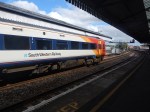





Note that the train in the platform is a nine-car formation which is 207 metres long. I would estimate that the platforms are around 220-240 metres long.
Yeovil Junction Station
This Google Map shows Yeovil Junction station.

These are some pictures I took at the station.








Note that the two trains in the platforms are six-car formations which are 138 metres long. I would estimate that the platforms are around 140-50 metres long.
Replacement Of The Current Class 159 Trains With Bi-Mode Trains
Consider the following train lengths and capacities.
- A nine-car formation of Class 159 trains – 207 metres – 588 seats
- A six-car formation of Class 159 trains – 138 metres – 392 seats
- A nine-car Class 802 train – 234 metres – 647 seats
- A five-car Class 802 train – 130 metres – 326 seats
- A pair of five-car Class 802 trains – 260 metres – 652 seats
The figures for Class 802 trains are taken from the trains that are in service for Great Western Railway (GWR).
The following timings should also be noted.
- London Waterloo and Salisbury – One hour and thirty minutes
- Turnback time at Salisbury – Up to thirty minutes
- Salisbury and Exeter St. Davids – Two hours and six minutes
- Turnback time at Exeter St. Davids – Trains appear to go to Exeter New Yard for refuelling.
- Wait at Yeovil Junction – Fourteen minutes
Note.
- The wait at Yeovil Junction station is so that trains can fit in with the large lengths of single-track on the West of England Main Line.
- The need to refuel the diesel trains would appear to be a major constraint on running more services on the route.
- Both legs of the journey have convenient times of one-and-a-half and two hours respectively.
Overall, I think the timings are helpful.
Hitachi’s Regional Battery Train
Hitachi have recently released details of their new Battery Regional train, which are summarised in this Hitachi infographic.

They have also signed an agreement with Hyperdrive Innovation to develop battery packs for their Class 80x trains, as I wrote about in Hyperdrive Innovation And Hitachi Rail To Develop Battery Tech For Trains.
Looking at the length and capacity table, I displayed earlier, it would appear there are several ways to run the service between London Waterloo and Exeter St. Davids using Regional Battery Trains.
- Run nine-car trains between London Waterloo and Exeter St. Davids
- Run five-car trains between London Waterloo and Exeter St. Davids
- Run nine-car trains between London Waterloo and Salisbury and five-car trains between Salisbury and Exeter St. Davids
- Run a pair of five-car trains between London Waterloo and Salisbury and a single five-car train between Salisbury and Exeter St. Davids, with selective splitting and joining at Salisbury.
Alternatively, the route could be electrified. But that has a few obstacles and disadvantages.
- Would the various jobsworths allow this substantial length of third-rail electrification?
- Would there be serious objections to using overhead electrification?
- Would the travellers on the route, be prepared for all the disruption?
- There is also the excessive cost of electrification.
I also believe, that only limited small infrastructure improvements would be needed to replace the current diesel trains with battery electric bi-mode trains like the Regional Battery Trains.
Regional Battery Trains Between London Waterloo And Salisbury
Consider.
- London Waterloo and Salisbury stations are 83.5 miles apart.
- The fifty miles between London Waterloo and Worting Junction is fully electrified.
- Only the 33.5 miles between Salisbury and Worting Junction are not electrified.
- In the infographic, Hitachi are claiming a 90 kilometre or 56 mile battery range and a static charging time of between 10-15 minutes.
It would certainly appear, that if a train from London passed Worting Junction with full batteries, it would reach Salisbury. Also a train leaving Salisbury with full batteries would certainly reach Worting Junction and the electrification.
There would be three ways of charging the Regional Battery Trains at Salisbury.
- Fit a number of charging stations on the platforms.
- Install 25 KVAC overhead electrification.
- Install 750 VDC third-rail electrification.
I prefer Option 3 in a station like Salisbury.
- It would be easy to install and British Rail probably drew up detailed plans several times, when full third-rail electrification was under consideration.
- The trains will be fitted with third-rail shoes to access the third-rail electrification on the way to London.
- Because of the depot, there’s probably a good power supply.
- For increased safety, modern electrical design, could mean that power was only switched on when a train is connected.
As trains currently wait for some time in Salisbury, it would be likely, that trains would leave the station with a full battery.
Regional Battery Trains Between London Salisbury And Exeter St Davids
Consider.
- Salisbury and Exeter St. Davids stations are 88.5 miles apart.
- There is no electrification.
- Yeovil Junction station is approximately half way and is 49.5 miles from Exeter St. Davids and 39 miles from Salisbury.
- Typically, trains wait at Yeovil Junction station for up to fourteen minutes, to get through the single-track sections.
I believe that a similar method of charging to that at Salisbury could be used at Yeovil Junction.
There would also need to be charging at Exeter St. Davids station.
This Google Map shows Exeter St. Davids station.

Services from London Waterloo and Salisbury currently turnback at Exeter St. Davids station in the following manner.
- They arrive from the track running to the station from the South East.
- They unload passengers in Platform 1 which is the long platform on the East side of the station.
- It seems that they then continue through the station to New Yard, where they refuel and do other things, that Class 159 trains do after a long journey.
- At the appropriate time, they return to Platform 1, where they load up with passengers and leave by the way they arrived.
If a charging system or electrification, were to be added to Platform 1, the trains would be able to fill up in the station.
- Currently, it appears that the Class 159 trains take over an our to do this complicated manoeuvre.
- Hitachi are quoting a charging time of 10-15 minutes for their Regional Battery Train.
Could valuable minutes be saved, that would enable a more passenger-friendly timetable?
Charging Regional Battery Trains At Yeovil Junction Station
Currently, the timetable is arranged like this.
- The Salisbury to Exeter St. Davids train and the Exeter St. Davids to Salisbury trains pass at Yeovil Junction station.
- Both trains wait in the station for nearly fifteen minutes, which is an adequate time to fully-charge the batteries.
The picture shows the two trains in the platform together.

Currently, the timetable would seem to be ideal for battery electric train operation between Salisbury and Exeter St. Davids stations.
A Possible Timetable Between London Waterloo And Exeter St. Davids
It did occur to me, that South Western Railway might be running a timetable, that could possibly be designed for Regional Battery Trains.
- A nine-car formation between London Waterloo and Salisbury could be replaced with a nine-car or a pair of five-car Regional Battery Trains.
- A six-car Salisbury and Exeter St. Davids could be replaced by a five-car Regional Battery Train.
- Trains could pass at Gillingham station between Salisbury and Yeovil Junction, as it is a two-platform station about half-way.
- Trains could pass at Honiton station between Yeovil Junction and Exeter St. Davids, as it is a two-platform station about half-way.
I think if it was needed, that two tph would be possible not only between London Waterloo and Salisbury, but also between London Waterloo and Exeter St. Davids.
I also think that the following detailed service pattern would be possible.
- A pair of five-car Regional Battery Trains would leave London Waterloo at a frequency of two tph.
- The front train would be for passengers for all stations between London Waterloo and Exeter St. Davids.
- The rear train would only be for passengers for all stations between London Waterloo and Salisbury.
- On arrival at Salisbury, both trains would charge their batteries.
- When the batteries were fully-charged, the two trains would split.
- The front train would continue on its journey to Exeter St. Davids, leaving the rear train in the platform.
- The Exeter St. Davids to London Waterloo service would arrive at Salisbury and join to the train in the platform.
- The pair of trains would then run to London Waterloo.
This service pattern has the big advantage that passengers travelling between a station East of Salisbury and one to the West of Salisbury, will not have to change trains
- All stations on the line also get a two tph service.
- Services would be the same or better on the whole route, to the pre-COVID-19 timetable.
- There would be extra capacity between London and Basingstoke.
Schlumberger New Energy And Thermal Energy Partners Form Geothermal Development Company STEP Energy
The title of this post, is the same as that of this article on World Oil.
This is the introductory paragraph.
Schlumberger New Energy, a new Schlumberger business, and Thermal Energy Partners (TEP) have entered into an agreement to create STEP Energy, a geothermal project development company. STEP Energy will leverage its partners’ expertise to develop efficient and profitable geothermal power generation projects, providing an opportunity to support a reliable supply of clean energy.
Schlumberger are one of the big beasts of the oil industry and are generally described as an oilfield services company.
This agreement could be significant as from my knowledge of the geothermal and oil extraction businesses, they have a lot of technology in common.
The last paragraph of the article is definitely significant.
The new company’s first project is the 10-MW Nevis Geothermal Power Project on the Caribbean island of Nevis, which will enable the island to transition to 100% zero-emission renewable energy for its power supply. STEP Energy has additional opportunities to expand production in the Eastern Caribbean and in North and South America.
How many other places in the world can follow the example of Nevis?
Geothermal Power
The Wikipedia entry for Geothermal Power is worth a read.
These points are from the first paragraph.
- Geothermal electricity generation is currently used in 26 countries.
- Geothermal heating is in use in 70 countries
- As of 2015, worldwide geothermal power capacity amounts to 12.8 GW.
- 3.55 GW are installed in the United States.
- Countries generating more than 15 percent of their electricity from geothermal sources include El Salvador, Kenya, the Philippines, Iceland, New Zealand, and Costa Rica.
- The greenhouse gas emissions of geothermal electric stations are on average 45 grams of carbon dioxide per kilowatt-hour of electricity, or less than 5 percent of that of conventional coal-fired plants.
- As a source of renewable energy for both power and heating, geothermal has the potential to meet 3-5% of global demand by 2050.
- With economic incentives, it is estimated that by 2100 it will be possible to meet 10% of global demand.
There is also an informative section on the Economics of geothermal power, where this is said.
Drilling accounts for over half the costs, and exploration of deep resources entails significant risks.
That sounds like areas, where Schlumberger have lots of expertise and experience.
Geothermal Power In The UK
The Wikipedia entry for Geothermal Energy In The United Kingdom is also worth a read.
In a section named Potential, these points are made.
- The resource is widely spread around the UK with ‘hotspots’ in Cornwall, Weardale, Lake District, East Yorkshire, Lincolnshire, Cheshire, Worcester, Dorset, Hampshire, Northern Ireland and Scotland;
- Cost reduction potential is exceptionally high;
- Deep geothermal resources could provide 9.5GW of baseload renewable electricity – equivalent to nearly nine nuclear power stations – which could generate 20% of the UK’s current annual electricity consumption;
- Deep geothermal resources could provide over 100GW of heat, which could supply sufficient heat to meet the space heating demand in the UK;
- Despite this significant potential, the UK support regime is uncompetitive with other European countries.
Perhaps, we should get our act together?
Conclusion
It looks to me, that Schlumberger are doing the right thing for the planet.
Will they be followed by the other oilfield services companies, who in the next decades could see their traditional market shrinking?
Long-Duration Energy Storage Makes Progress But Regulation Lags Technology
The title of this post, is the same as that of this article on pv Magazine.
It is a detailed summary of around twenty long-term energy storage systems.
It gives a paragraph or a mention to the following.
- Pintail Power – California, US
- Highview Power – UK
- Malta – US
- Brayton Energy – US
- Echogen – US
- Azwlio – Sweden
- 1414 Degrees – Australia
- Alumina – US
- Antora Energy – US
- Primus – US
- Invinity – US/UK
- Sumitomo – Japan
- UET – US
- ESS
- ViZn – US
- Form Energy – US
- Range Energy – US
- Mitsuibishi Power Systems – Japan
- Gravity Power – US
- Ares Power – US
- Energy Vault -US (?)
- Quidnet Energy – US
The article links to many of the company web sites.
There are some others, that the author has missed including the Gravitricity, which is Scottish, Siemens Ganesa ETES, which is German and Zinc8, which is Canadian.
There are a large number of competitors, lining up to compete in a large market.
The article finishes with some notes on the role of regulators, saying this.
Storage and long-duration storage technologies are here today – but regulators and utility commissions at the federal and state level are still adjusting.
William Conlon, president of thermal storage startup, Pintail Power is quoted with an example.
Long-duration storage technology in California is locked out because of the nature of California’s resource adequacy (RA) requirements. “Four hours is what California wants for RA. If you provide eight hours you only get paid for four hours. We’re at four hours today because that’s what you get paid for.
Regulators must get it right.
Conclusion
Is UK regulation up to scratch, as we certainly have masses of renewable energy.
High Speed Train Seats Used To Deliver Fresh Fish
The title of this post, is the same as that of this article on Railway Gazette.
This is the introductory paragraph.
East Japan Railway is testing the use of high speed passenger trains to move fresh fish from Sendai to Tokyo.
The last paragraph explains the title.
These services do not use passenger accommodation, unlike JR East’s latest test programme where the No 1 car is closed to passengers so that the seats can be used to transport the containers of fish.
But then the idea isn’t new as Great Western Railway ran a trial in 2015, with the fish travelling in the back of the locomotive on an Intercity 125. That story is also in Railway Gazette.
Innovative Battery Delivered To Portsmouth International Port
The title of this post, is the same as that of this article on Renewable Energy Magazine.
This is the introductory paragraph.
A 20-foot container sized battery that can charge four electric cars simultaneously has been safely delivered to Portsmouth International Port in the UK this week as part of the Port Energy Systems Optimization project.
It looks like another case of battery-to-battery transfer to fast-charge one or more battery-powered vehicles or trains.
Linde And RVK Unveil New Hydrogen Station For Buses
The title of this post, is the same as that of this article on H2 View.
This is the introductory paragraphs.
Linde and regional transport company Regionalverkehr (RVK) today presented an innovative hydrogen station for fuel cell buses to the public.
With a capacity of up to 20 refills per day, the new station located near Cologne, Germany features, for the first time, a new high-pressure storage technology developed by Linde: constant pressure tubes ensure that the refuelling pressure always remains at a constant level, even as the storage tank volume decreases.
It does appear that Linde is going to be big in hydrogen, as they already are an investor in electrolyser company;ITM Power.
 The Anonymous Widower