The Ultimate Open Access Service
London and Windermere are 223 miles away by train with a single change at Oxenholme Lake District.
In a straight line the distance between Amsterdam and Hamburg is 227 miles.
I’ve done both journeys by train and the continental journey was a pain.
- In From Amsterdam To Hamburg The Hard Way, I describe a typical journey between the two cities.
- In From Hamburg To Osnabruck By Train, I describe how I only got halfway.
I’ve also tried splitting the route at Groningen.
- The first leg was a train to Groningen, where I spent the night.
- I spent the second day exploring and wrote about my experiences in The Train Station At The Northern End Of The Netherlands.
- On the third day, I started by going between Groningen and Leer in Germany.
- This section of the route at present is under repair after a ship destroyed the swing bridge over the River Ems.
- I describe its rebuilding in From Groningen To Leer By Train.
Once at Leer, you’re on the German main line and the route is electrified all the way to Bremen and Hamburg.
I believe that the route would be within the scope of a battery-electric high speed train, such as both Hitachi and Siemens are developing.
Some thoughts on the route.
The Competition
The trains need a change at Osnabruck to go between Amsterdam and Hamburg.
I suspect many travellers fly, as there are thirty-nine flights per week.
The service could be better.
Why Would I Run It As An Open Access Route?
Consider.
- If what I have experienced on the current Amsterdam and Hamburg via Osnabruckservice, then surely an experienced open access operator using trains designed for the route could do much better.
- This service could be run almost as a shuttle between two terminal stations. Several open access services like Hull Trains, Lumo and Grand Central are run this way.
- If a government service fails, governments get the blame, but if an open access service fails, the government gets no blame.
So would some governments, prefer open access operators to take the risk?
Would Any New Infrastructure Be Needed?
Very little if any!
Although, I do feel, that some of the level crossings and bridges could be improved or removed.
Where Is The Route Not Electrified?
The section without electrification is at the Dutch end.
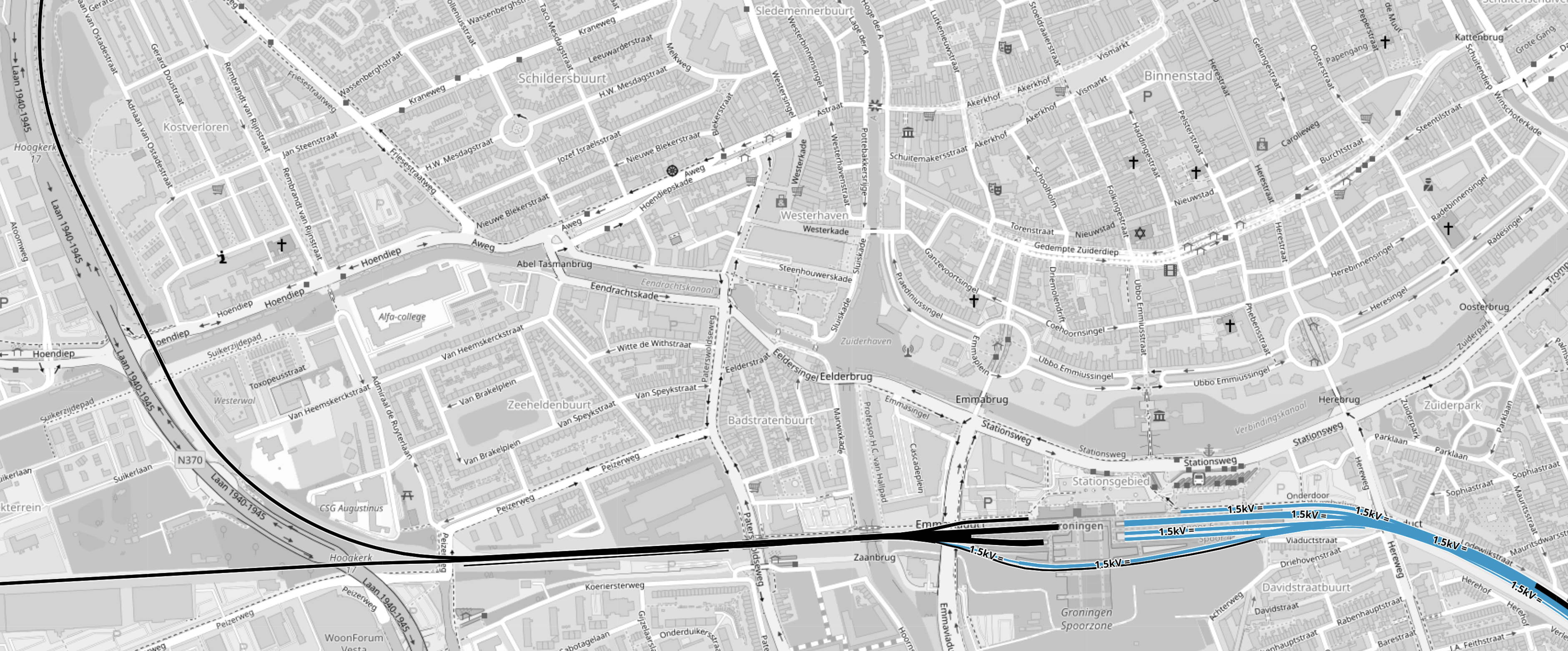
This OpenRailwayMap shows the lines around Groningen station.
Note.
- Lines in black are not electrified.
- Lines in blue are electrified at 1.5 KVDC overhead.
- The mass of blue lines is Groningen station.
- Hamburg is to the East.
- Eemshaven us to the North.
- Harbinger is to the West.
Amsterdam trains use the electrified lines to the East.
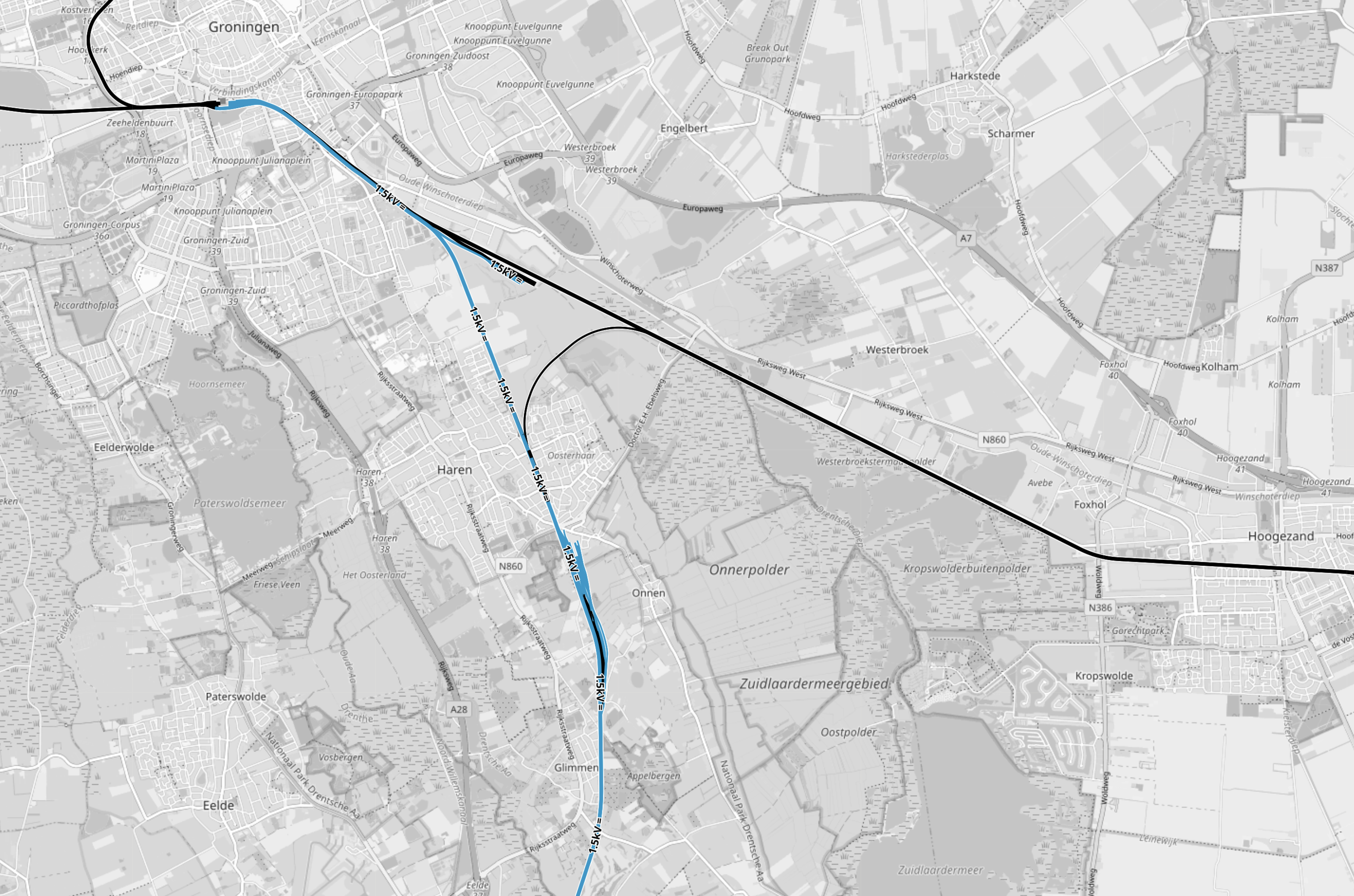
This second OpenRailwayMap shows a wider view of the lines around Groningen.
Note.
- Lines in black are not electrified.
- Lines in blue are electrified at 1.5 KVDC overhead.
- Groningen is in the North-West corner of the map.
- Trains between Groningen and Amsterdam use the electrified line to the South via Zwolle.
- Trains between Groningen and Bremen and Hamburg use the unelectrified line to the East.
- There is a single track chord, that would allow trains to go between Amsterdam and Germany.
I suspect that a battery-electric high speed train could be fully recharged before leaving Groningen for Germany.
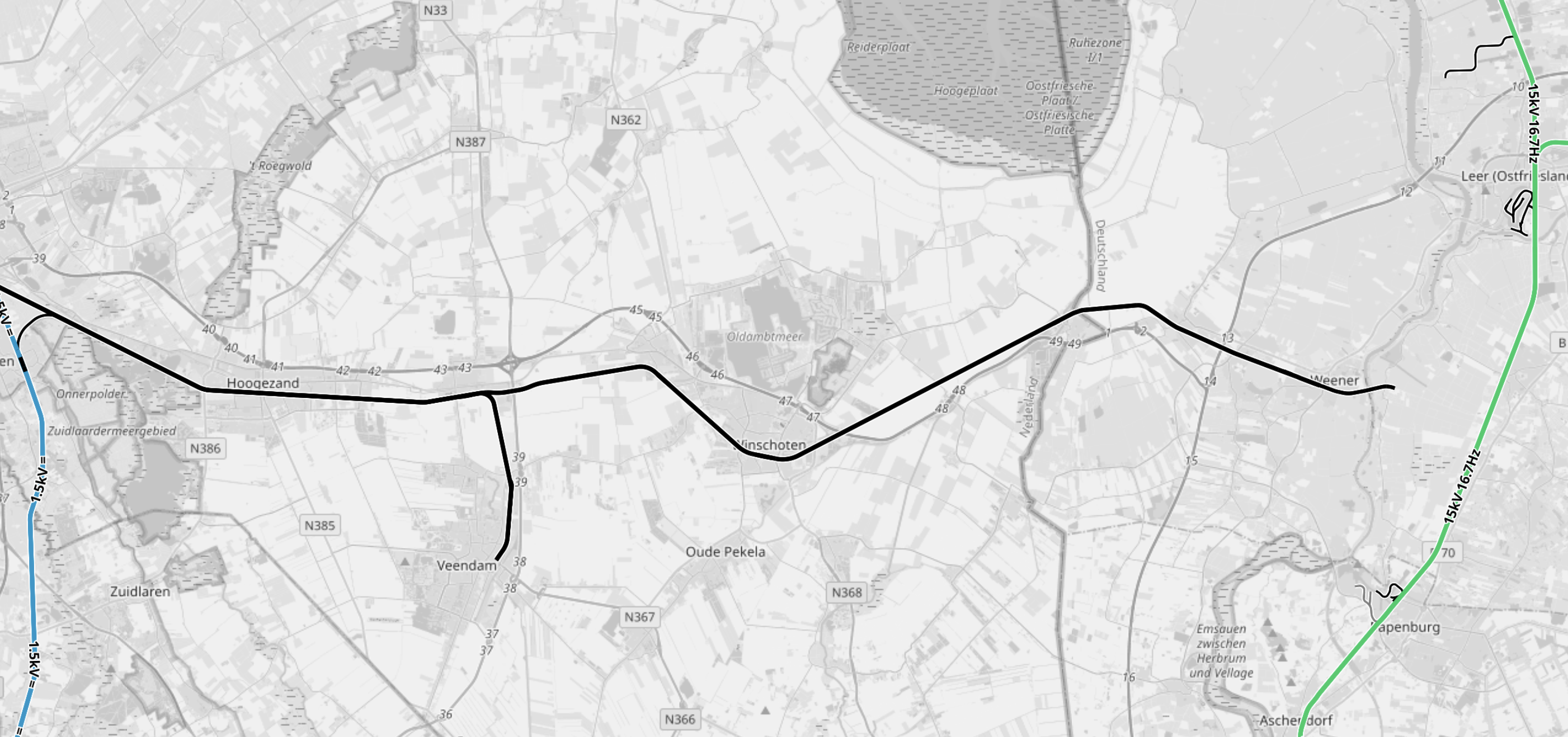
This third OpenRailwayMap shows between the chord to the East of Groningen and the German railway system at Leer.
Note.
- Lines in black are not electrified.
- Lines in blue are electrified at 1.5 KVDC overhead.
- Lines in green are electrified at 15 KVAC overhead.
- Groningen is off the Western side of the map.
- The chord connecting the Amsterdam and German lines from Groningen can be picked out.
- The unelectrified line East from Groningen seems to end in the middle of nowhere.
- The green lines in the East of the map are the electrified German railway system.
- Leer station, which is indicated by the tangle of lines in the North-East cornet of the map, has services to Bremen and Hamburg.
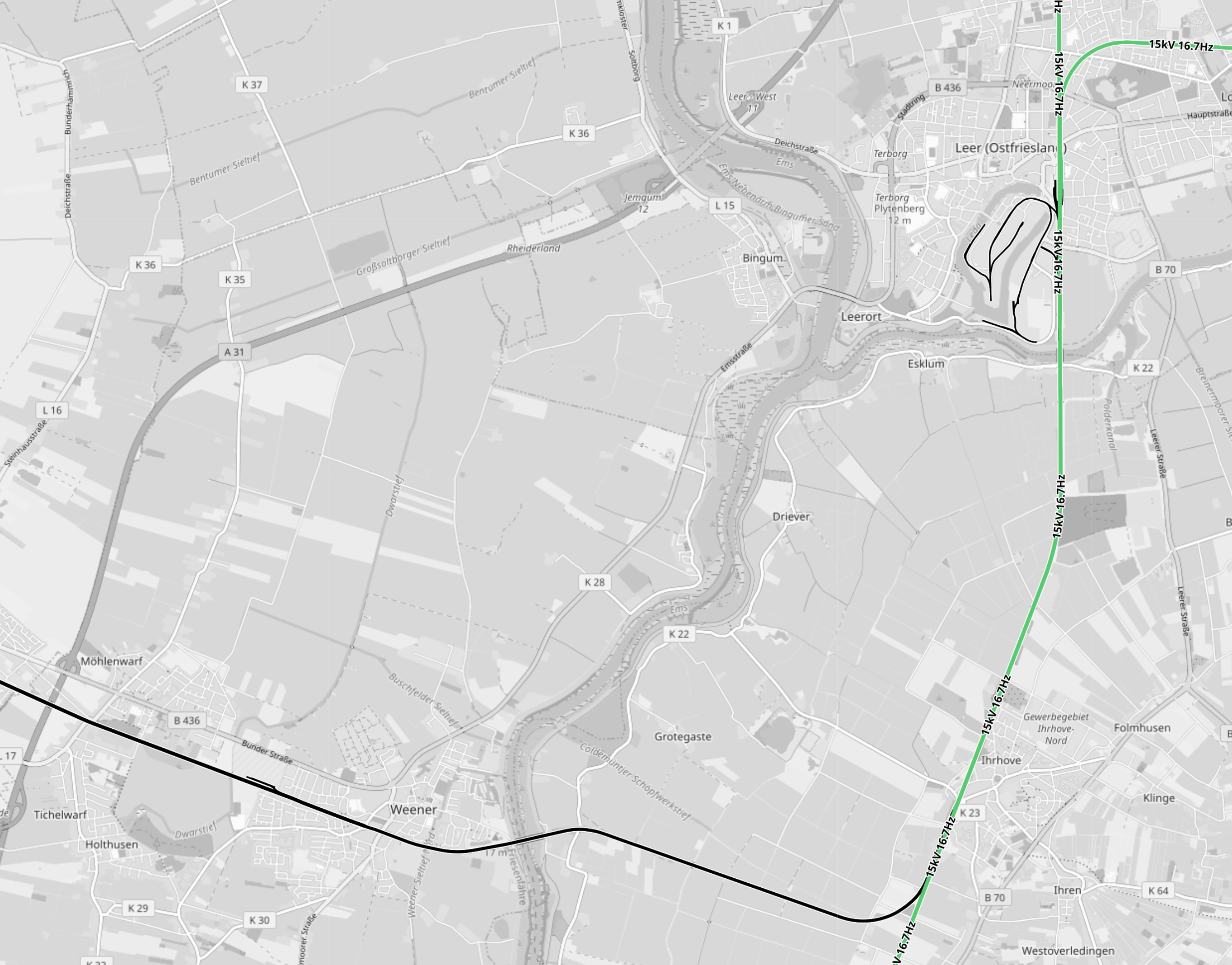
This forth OpenRailwayMap shows the Dutch and German railways at Leer.
Note.
- Lines in black are not electrified.
- Lines in green are electrified at 15 KVAC overhead.
- Leer station is in the North-East corner of the map.
- The green lines in the East of the map are the electrified German railway system.
- The River Ems runs down the middle of the map.
The unelectrified line East from Groningen seems to link up with the German railway system.
It used to link up until a German freighter called the Emsmoon demolished the Freisenbrücke over the River Ems.
In From Groningen To Leer By Train, I link to two videos and give the history of the accident.
The Freisenbrücke should be rebuilt in the next few months.
It looks like less than fifty miles of the route between Groningen and Leer is not electrified.
As all the other sections of Amsterdam and Hamburg are electrified, a battery-electric train with a range of less than fifty miles would be needed,
But the train would need to be compatible with both the Dutch and German electrification systems.
What Mode Of Trains Would Be Needed?
Trains would need three methods of operation.
- Using 15 KVAC overhead.
- Using 1.5 KVDC overhead.
- On battery power.
Batteries would be charged using regenerative braking or overhead wires, where they exist.
Lumo’s recently ordered Hitachi trains will probably work the same way.
Conclusion
This could be an open access service that could work.
Nicki Minaj Freed After Arrest At Amsterdam Airport
The title of this post, is the same as that of this article on the BBC,
This is the sub-heading.
American rapper Nicki Minaj has been freed by police after being detained at Amsterdam’s Schiphol Airport.
These three paragraphs give more details.
Dutch police posted on X: “We have just released a 41-year-old American woman whom we arrested this afternoon at Schiphol on suspicion of exporting soft drugs.”
“The suspect was fined and can continue her journey.”
The artist had been due to fly to Manchester for a concert at the Co-op Live venue on Saturday evening.
Note.
- I think, she has been very lucky.
- She has been very disrespectable to her fans.
- As someone, who lost his son, partly because he smoked both cannabis and tobacco, I find her behaviour disgusting.
Let’s hope the Border Force send her back to Amsterdam, so that she realises the consequences of her stupid behaviour.
Could A Mega-Station Be Built For The Channel Tunnel?
This article on Railway Gazette International, is entitled Start-Up Announces Amsterdam To London And Paris High Speed Train Ambitions.
It talks about how Dutch start-up; Heuro wants to run fifteen trains per day (tpg) between London and Amsterdam.
The article then has this paragraph, which details other operators, who are wanting to run services between London and the near Continent.
Heuro’s announcement comes after Spanish start-up Evolyn announced plans in October for a Paris – London service, while on November 11 British newspaper The Daily Telegraph reported that Sir Richard Branson and Phil Whittingham, former head of Virgin Trains and Avanti West Coast, were also drawing up plans to compete with Eurostar and had held discussions with infrastructure managers.
This leads me to the conclusion, that there will be a need for more capacity for trains and/or passengers at some time in the future.
- There are six International platforms at St. Panvcras International station, which can each probably handle four trains per hour (tph), so I suspect the station could handle 24 International tph.
- As a modern high speed train can carry over 500 passengers, that is 12000 passengers per hour.
- Visit St. Pancras station in the morning and it is often crammed with travellers coming from and going to Europe.
I suspect that the number of trains may not be a problem, but the number of passengers will.
We could always join Shengen, but then that would be an open door to all the would-be migrants to the UK.
This Google Map shows Stratford International station.
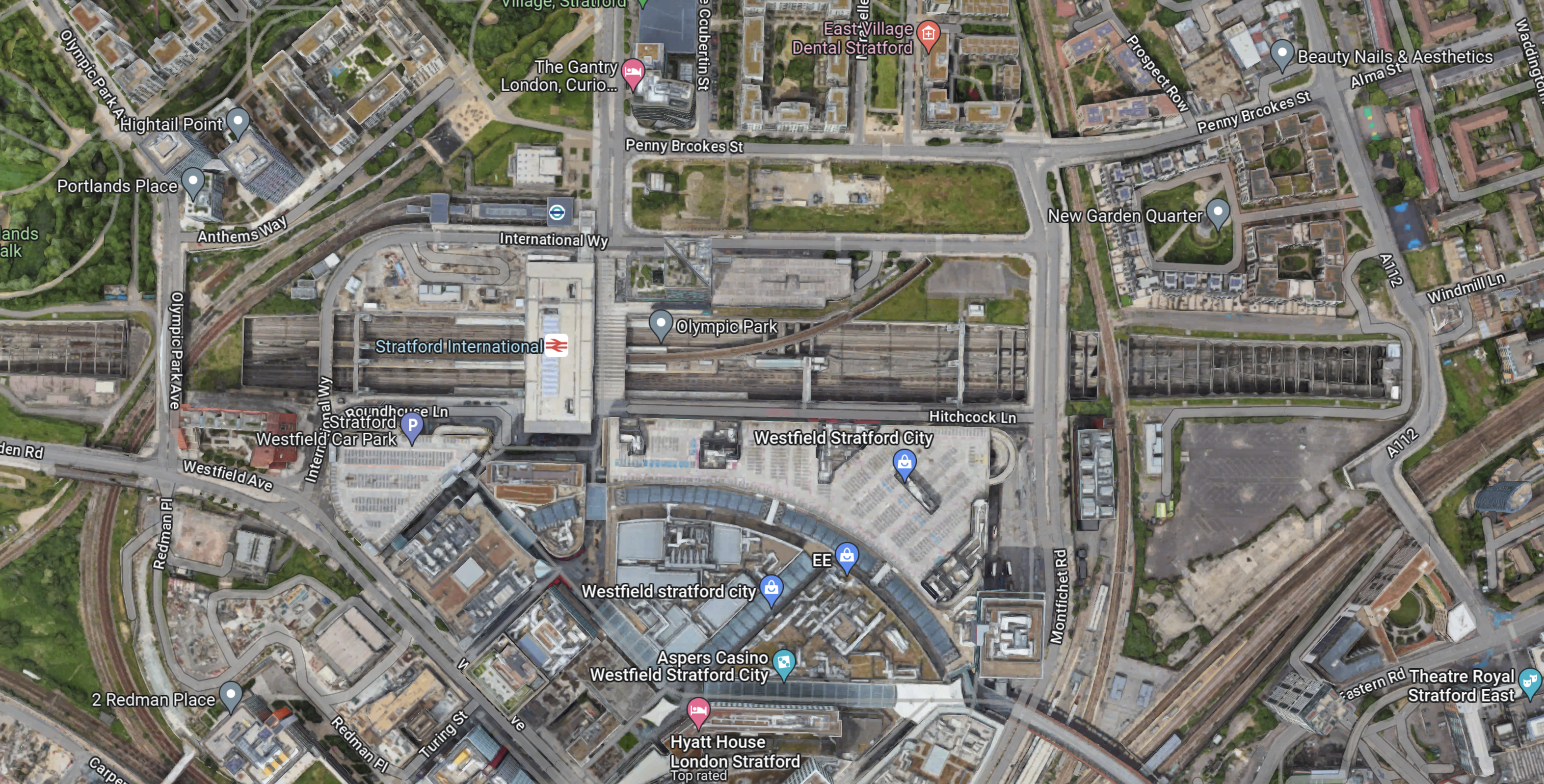
Stratford International station is in a soulless concrete cavern, that lies across the middle of the map.
In Platforms 1 And 4 At Stratford International Station, there are a lot of pictures of the station.
I think it would be extremely difficult to add extra platforms and passenger facilities to the station.
This Google Map shows Ebbsfleet International station.
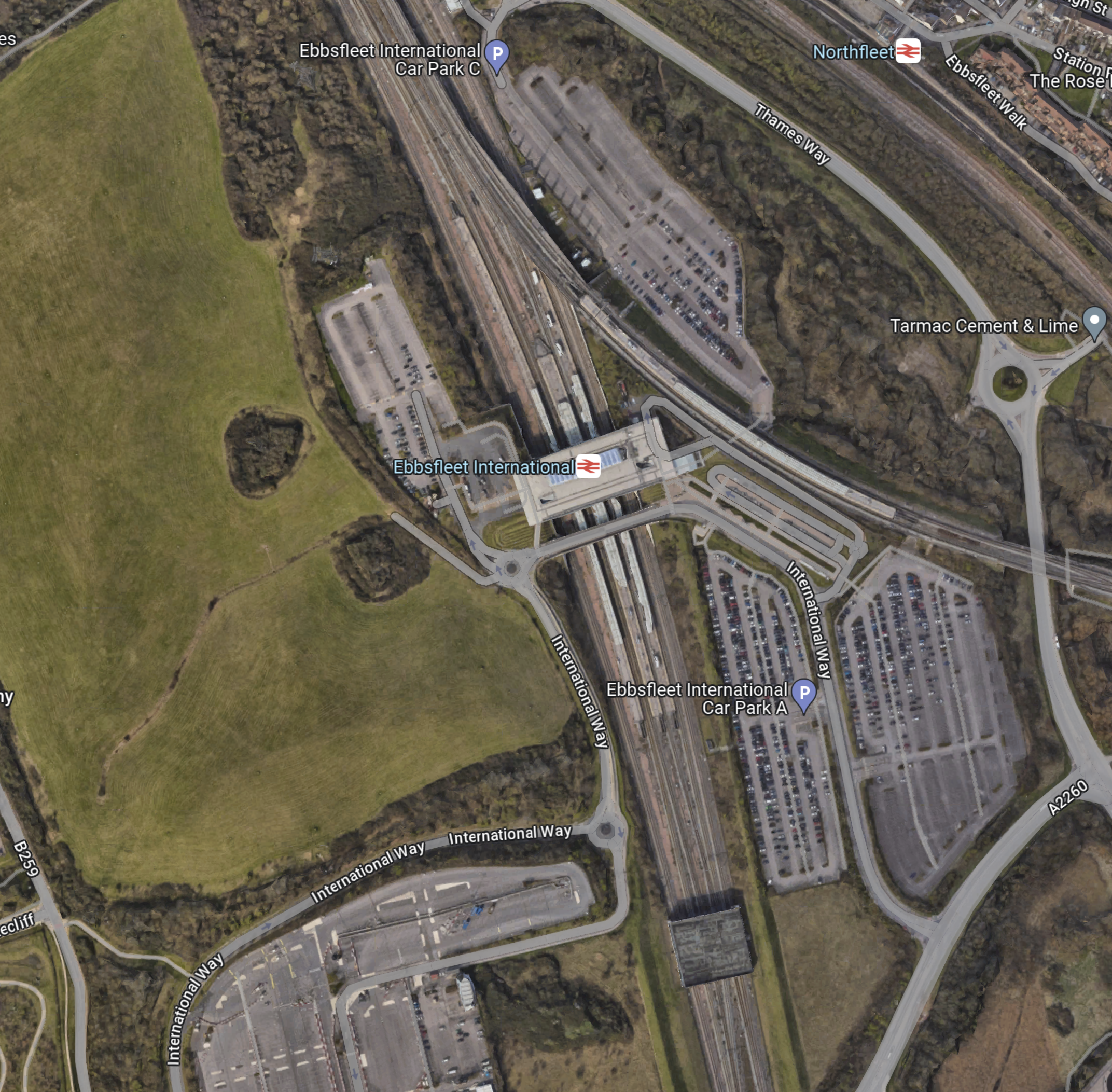
Note.
- Ebbsfleet International station, with its two International and four domestic platforms is in the middle of the map.
- The station is surrounded by car parks with a total of 5,000 spaces.
- Northfleet station is in the North-East corner of the map.
There is a lot of land, without any buildings on it.
These are my thoughts.
Enough Extra Bay Platforms To Handle The Additional Trains
There would appear to be space for perhaps two bay platforms to terminate trains.
But would passengers we happy being dumped outside Central London?
Would An Elizabeth Line Extension To Ebbsfleet Be Needed?
There are various plans to link the Elizabeth Line tp Ebbsfleet International.
In Elizabeth Line To Ebbsfleet Extension Could Cost £3.2 Billion, I showed this map from the Abbeywood2Ebbsfleet consultation.
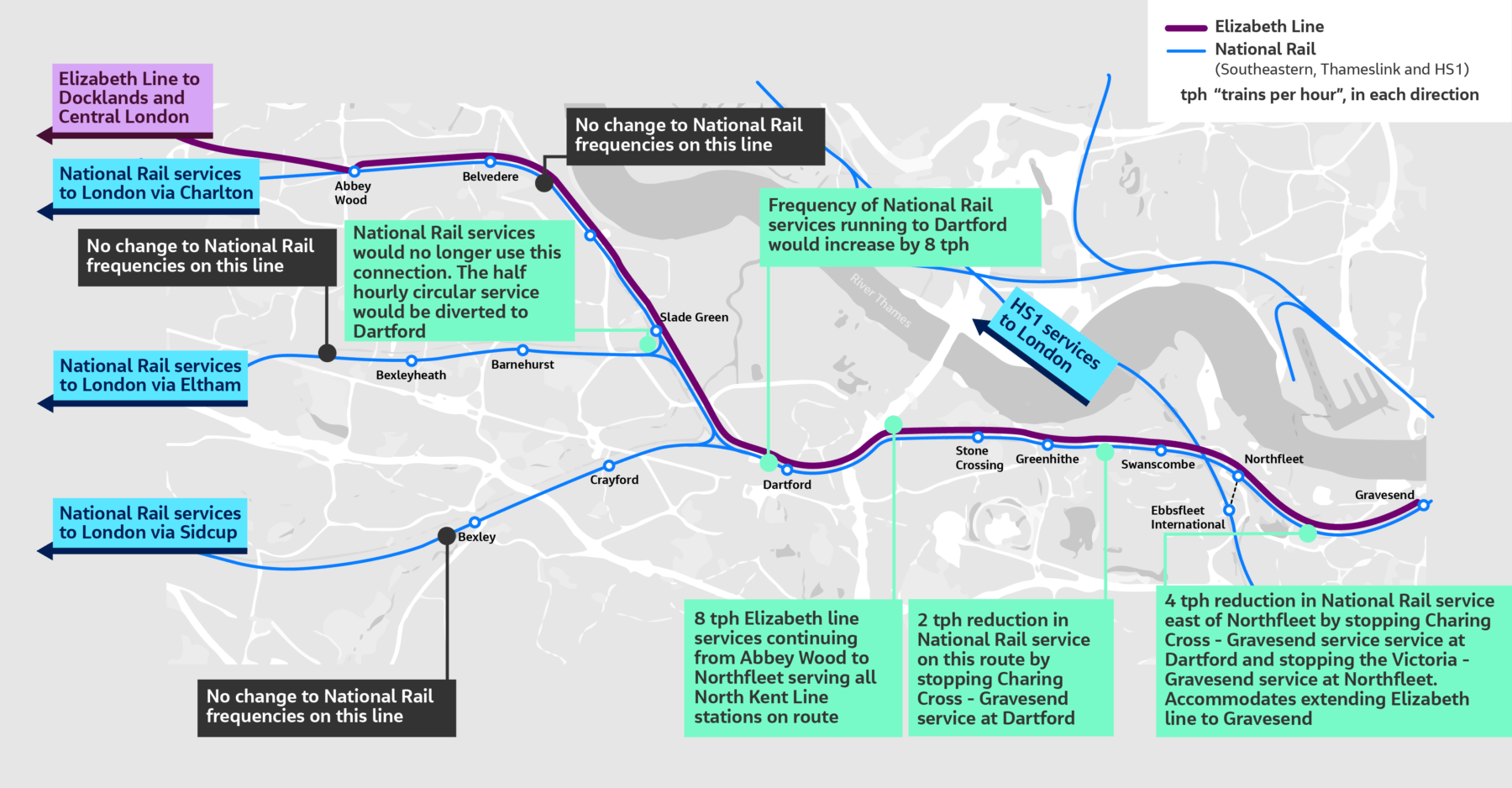
There doesn’t appear to be too much new infrastructure, except for a proper connection between Northfleet and Ebbsfleet stations. References on the Internet, say that the similar-sized Luton DART connection at Luton Airport, cost around £225 million.
The Elizabeth Line connects to the following.
- Bond Street
- Canary Wharf
- City of London
- Farringdon for Thameslink
- Heathrow Airport
- Old Oak Common for High Speed Two
- Liverpool Street station
- Oxford Street
- Paddington station
- Slough for Windsor
- Tottenham Court Road for the British Museum, Oxford Street, Soho, Theatreland and the Underground.
- West End of London
- Whitechapel for the Overground and Underground
For many people like me, the Elizabeth Line at Ebbsfleet will provide one of the quickest ways to get to and from European trains.
Ebbsfleet Has Space For A Bus Station
A bus station with comprehensive routes could be built at Ebbsfleet station, which I don’t think will be possible at St. Pancras.
It would also be possible to provide an easy route to Gatwick Airport along the M25.
Hotel Accommodation
This is surely necessary.
It would make an ideal base for tourists and business people, who wanted to visit several of the large cities connected to Ebbsfleet.
A Very Large Car Park
Consider.
- Heathrow Airport is looking at providing upwards of 50,000 car parking spaces.
- Some travellers are seriously allergic to public transport and will always use their car.
- Many travellers these days want to take a severely outside case with them, when they’re only having a weekend in Paris.
I feel that a mega-station for Europe will need upwards of 10,000 car parking spaces. All of them with vehicle-to-grid chargers.
A Very Large Storage Battery
According to this page on the E-on web site, the average size of the battery in an electric vehicle is 40 kWh.
If 5,000 car parking spaces were to be fitted with vehicle-to-grid charging (V2G), that would be 2 MWh of energy storage, that could be used by National Grid, to store surplus electricity.
Get V2G right and it could make a serious contribution to your parking costs.
Pictures Of Ebbsfleet Station
These are some pictures I took at Ebbsfleet station today.

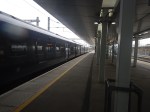



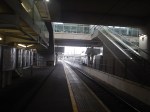







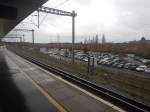

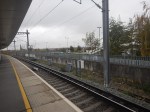



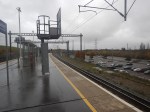
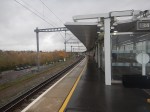
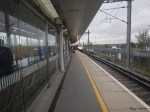
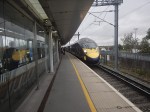
Note.
- The station is a fairly boring concrete, glass and steel construction.
- The SouthEastern HighSpeed services also go to St. Pancras, so they don’t offer any different connectivity towards the capital.
In addition, the SouthEastern HighSpeed Class 395 trains aren’t step-free at the platforms, as these pictures shows.

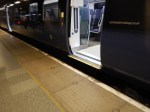
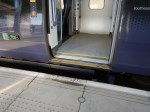
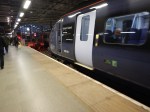
As I came back into St. Pancras International station, staff were struggling to load a wheelchair onto a train using a ramp.
Would A Two-Station Solution Increase Capacity?
High Speed Rail lines have high capacity trains and there are examples of more than one station at the end of a route.
- The London end of High Speed Two will have stations at Old Oak Common and Euston.
- The Manchester end of High Speed Two will have stations at Manchester Airport and Manchester Piccadilly.
- The Edinburgh end of the East Coast Main Line has stations at Waverley and Haymarket.
- The Amsterdam end of Eurostar and Thalys has stations at Rotterdam, Schipol Airport and Amsterdam.
A selection of stations gives choice and convenience for travellers.
Conclusion
I believe that selective development of Ebbsfleet International station could be used to take the pressure away from St. Pancras International station.
These developments could include.
- A comprehensive bus station
- Elizabeth Line to Northfleet
- Hotel Accommodation
- Lots Of Car Parking
Europe’s Next High-Speed Train Operator
I was alerted to Heuro Train, by this article in Railway Gazette International, which has this opening paragraph.
A proposal to launch high speed train services from Amsterdam to London and from Groningen to Paris has been announced by Dutch start-up Heuro, while Virgin founder Sir Richard Branson is also reported to be looking at competing with Eurostar on cross-Channel routes.
The Heuro Train web site was easily found and the title of this post, was part of their mission statement on the home page.
I have read the web site and have a few initial thoughts.
Technology-Driven Excellence
This is their first sub heading and this is the text.
In a world where technology defines possibilities, Heuro develops the latest innovations into every aspect of our service. From advanced train systems to intuitive in-seat features that cater to your needs, our technology is the driving force behind a seamless, state-of-the-art travel experience.
We’ve all written things like that in the past.
Meeting The Human Need
This is their second sub heading and this is the text.
Heuro emerged from human desires, informed by analyses from Marveltest.
There’s been a 32% annual increase in online interest for train travel over five years. High-Speed Trains are 98% full at peak times. Over half of Europeans prefer train travel under 2 hours as a greener option. Introducing High-Speed Operators in train monopolies boosts demand by 45%.
They appear to have done their research and those are interesting figures.
Lightning Speed Connectivity
This is their third sub heading and this is the text.
In our digital age, both work and leisure have found a substantial home on the internet for urban humans. Whether sealing a business deal, streaming a favorite show, or connecting with loved ones, online interactions have become integral to our daily lives. At Heuro, we don’t just commit—we guarantee the best internet experience.
This is actually irrelevant these days, as there will be a high standard of Internet experience on all modes of transport in a few years, although some will get it earlier than others.
Planned Routes
This is their sixth sub heading and this is the text.
We will connect Amsterdam with Brussels, Paris, and London with intermediate stops at Schiphol Airport, Rotterdam Central, Antwerp Central & complimentary services to Groningen, Assen, Zwolle and Almere (continuing to Paris, 2 times per day)
This route map is shown.
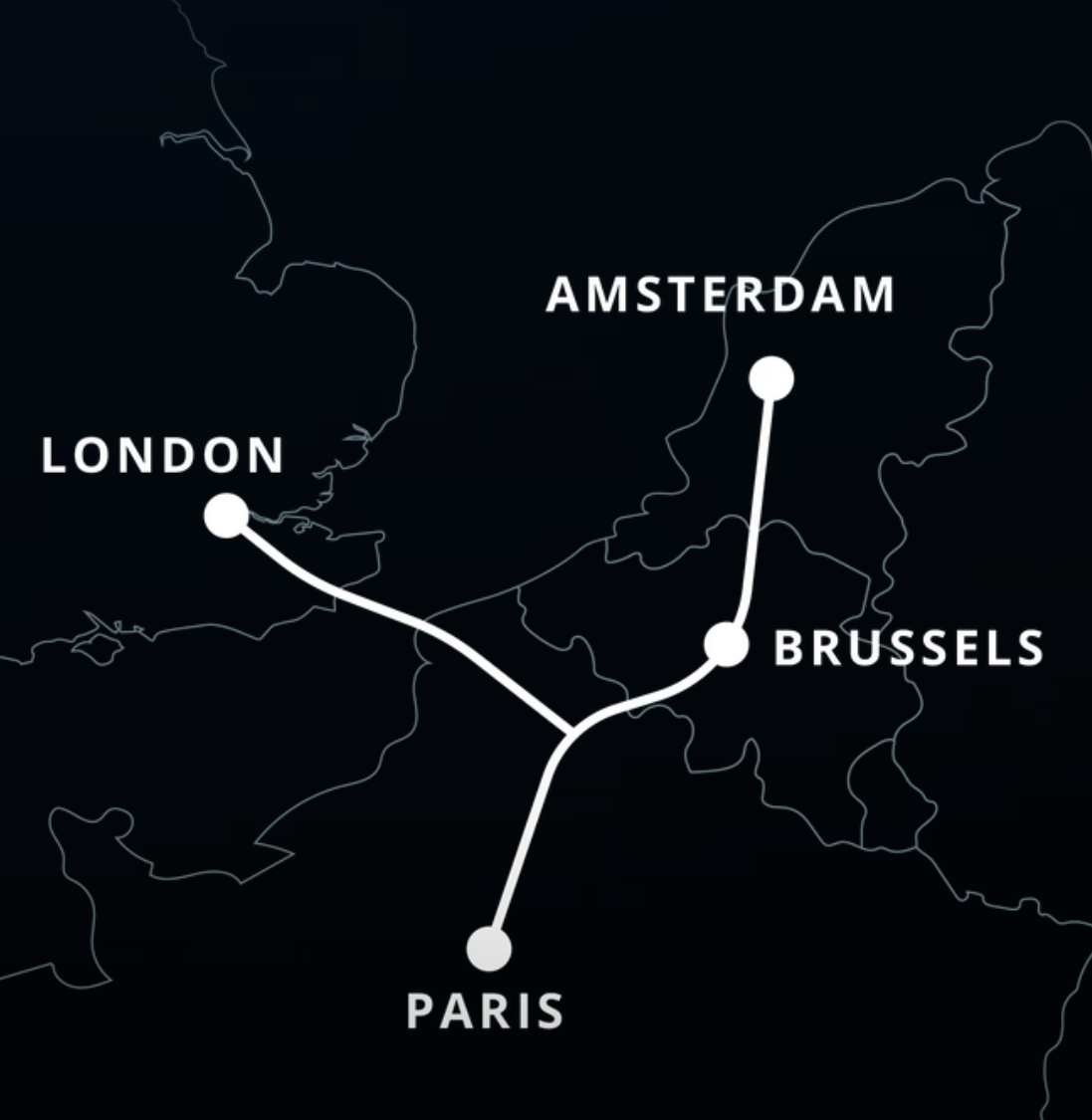
Note.
- It is not a large network.
- It makes a lot of use of the Dutch high speed line; HSL-Zuid, that runs between Amsterdam and the Belgian border.
- I suspect it has been designed to be extended.
The Railway Gazette Article has these two paragraphs, which give more information on services and Heuro’s thinking.
On November 15 Heuro told Railway Gazette International that it aims to launch in 2028, offering 16 Amsterdam – Paris and 15 Amsterdam – London trains each day with intermediate stops at Schiphol Airport, Rotterdam Centraal, Antwerpen Centraal and Brussels. Two of the Paris trains would run to and from Groningen via Assen, Zwolle and Almere.
The company said ‘every day, 55 planes fly from Amsterdam to London, while only four trains make this journey. Heuro intends to change that, aiming for more trains to depart from Amsterdam than flights’.
With other train companies wanting to serve London, will St. Pancras International be able to incorporate another fifteen trains per day from Amsterdam?
Web Site Language
Everything is in English! It also appears to be English English.
Les français ne seront pas amusés.
Extensions From London
Much of Central and Eastern England, and Eastern Scotland can be reached from St. Pancras International station, by a hundred metre walk to change platforms.
There is even a signed walking route between St. Pancras International and Euston stations, that isn’t the most arduous of walks.
The St. Pancras International and Euston stations connection could also be handled by a frequent electric shuttle bus.
Extensions From Amsterdam
Heuro are already indicating their intention to extend to Almere, Zwolle, Assen and Groningen.
I have taken that route and extended it via Leer, Oldenburg and Bremen to Hamburg.
Could this be in Heuro’s long term thinking?
Extensions From Paris
The French probably have ideas.
Conclusion
I like Heuro’s philosophy and starter kit.
First-Of-Its-Kind Electriq Powder Manufacturing Plant To Be Built In Amsterdam
The title of this post, is the same as that of this article on Hydrogen Fuel News.
This is the sub-heading.
The powder plant can provide a safe end-to-end hydrogen solution.
The home page of their web site has this bold statement.
Meet the Safe & Practical Hydrogen Powder
Underneath is this explanation.
Electriq is a hydrogen carrier that acts like coffee powder for a coffee machine – simplifying storage, transport, and use of hydrogen in off-grid applications and long-term storage.
Similar processes have been proposed for hydrogen in the past, but no-one has compared them to coffee before.
This Technology page gives a lot more details.
These two paragraphs outline the chemistry used.
Electriq’s Fuel and Release technologies turn hydrogen into a coffee-like powder form, then back into electricity through a proprietary catalyst and release system.
Our hydrogenation process reacts hydrogen gas with KBO2 to produce a powdery coffee-like compound (KBH4), ready for easy storage and transportation. Our dehydrogenation process releases the hydrogen – and KBO2 as a by-product – thus forming a full cycle.
The Electriq Release system uses a proprietary catalyst to release hydrogen from the Electriq Fuel, after mixing it with water. The dehydrogenation (release) process provides fuel-cell grade hydrogen and zero-emissions electricity.
Note.
- KBO2 is a chemical compound formed of one potassium, one boron and two oxygen atoms.
- KBH4 is a chemical compound formed of one potassium, one boron and four hydrogen atoms.
- As is with often the case with these processes, It appears that there may be a clever catalyst doing some hard work.
The Technology page finishes with a comparison with other methods of transporting hydrogen.
This Press & Insights page has more information on the company and some interesting videos.
It would certainly be something new, if you filled up your electric bike with a canister of dry powder.
But they have a video of that!
Eurostar Plans To Start Direct Amsterdam – London Trains In October
The title of this post, is the same as that of this article on Railway Gazette International.
This is the introductory paragraph.
Cross-Channel high speed operator Eurostar has confirmed its intention to launch direct Amsterdam – London St Pancras services from October 26, complementing the London – Amsterdam trains which have run since April 2018.
The article then goes on to give more details of the service.
- Security checks will be undertaken at Amsterdam CS and Rotterdam Centraal stations.
- Amsterdam to London will be nine minutes over four hours.
- There will initially be two trains per day.
- There was a hint of more next year.
- It will carry Shengen area passengers between Amsterdam and Brussels.
Eurostar says it will offer flexible booking options to help, if the Government changes COVID-19 quarantine regulations.
Conclusion
It looks a sensible offering and as I’ve used it between London and Amsterdam three times, I will be trying to fit in a trip before the end of the year.
Eurostar Amsterdam To London Treaty Formally Signed
The title of this post, is the same as that of this article on Railnews.
The first paragraph says it all.
The treaty allowing full customs and security procedures for Eurostar passengers at Amsterdam and Rotterdam has been formally signed, said the Department for Transport.
Perhaps, next time I go to Amsterdam, I’ll come back by train.
Eurostar Confirms Start Date For Amsterdam – London Through Services
The title of this post is the same as that of this article on Railway Gazette.
Points made in the article include.
- A preview service ran on February 4th.
- Two services a day will run from Amsterdam Centraal to London from April 30th.
- Journey times will be around four hours.
- Through journeys from Rotterdam to London will be possible from May 18th.
- Tickets will be available from February 11th.
I’m fairly sure that after the success of the London to Amsterdam Centraal service, which will be four trains per day (tpd), by the end of this year and five tpd by the end of 2021, that this could be the start of something similar.
- Five tpd would mean a capacity of 4,500 passengers or about the same as eleven Ryanair 737 Max 8 aircraft.
- Four hours between city centres.
- Current prices for a trip this month are under fifty pounds or under ninety for Premium Economy.
As Paris has sixteen tpd and Brussels has seven tpd, I could see that five tpd will be increased.
- All London to Amsterdam Centraal services stop at Brussels to pick up passengers.
- I’m sure that a method will be found to allow Amsterdam Centraal to London trains to drop passengers at Brussels.
- If Rotterdam will get direct services, surely Antwerp and Schipol Airport should as well.
- Thalys between Paris and Amsterdam Centraal runs at 10 tpd.
- Thalys and Eurostar are merging and surely Eurostar between London and Amsterdam Centraal and Thalys between Paris and Amsterdam Centraal should be combined between the Belgian and Dutch capitals.
Get the Brussels and Amsterdam Centraal route right, after the merger of Thalys and Eurostar and I can see the following.
- Two trains per hour (tph) between Amsterdam Centraal and Brussels.
- One tph starting in London and the other in Paris.
- Ability to pick up and set down International and domestic passengers at the intermediate stations; Antwerp, Rotterdam and Schipol Airport.
Surely, if a two tph service works between London and Edinburgh is highly successful, two tph between Brussels and Amsterdam Centraal would be the same.
The same philosophy could then be applied to the London/Paris routes via Brussels to Cologne/Frankfurt.
- Eurostar has stated it wants to serve the two German cities.
- Thalys runs services between Paris and Dortmund via Brussels, Liege, Cologne and Essen.
- The Thalys frequency between Paris and Cologne is five tpd.
The London and Paris services could combine to run a joint service into Germany.
- Destinations could be Cologne, Dortmund and Frankfurt with stops at Liege and Aachen.
- London and Germany could probably sustain the currently proposed Amsterdam frequency of five tpd.
I’m looking forward to taking a direct train from London to Cologne.
More Eurostar Services Between London And Amsterdam Are On The Way
This article on NL Times is entitled NS, Eurostar To Run 5 Trains Daily Between Netherlands & London; More Sustainable Than Flying, Says NS.
The article contains these points.
- Five trains per day between London and the Netherlands.
- This is a total of 4,500 p-assengers in both directions.
- The train only creates twenty percent of the carbon emissions per passenger journey.
- Currently, twenty-three percent of passengers between London and the Netherlands use rail.
- A fourth train will be added in 2020, with a fifth in 2021.
- Eliminating the Customs check in Brussels when travelling to the UK, should bring Amsterdam to London times to around four hours.
NS or Dutch Railways seem fairly bullish about expanding the services between London and the Netherlands.
I believe that NS are right.
- The British and especially Londoners are very used to taking four hour journeys on a train to Edinburgh and Glasgow.
- The British with their poor language skills, don’t consider the Netherlands to be as foreign as Belgium, France and Germany
- The Dutch will surely develop better rail connections from Amsterdam into Northern Germany.
- Will the Dutch persuade Austrian Railways to run NightJet services from Amsterdam to Central Europe?
I also feel that just as people cruise from port-to-port, there will be a parallel development of rail cruising from city-to-city. Surely, Amsterdam would be a place for the cautious to start.
Conclusion
NS seem to be thinking of more than five trains per day and I wouldn’t be surprised to see around ten trains per day before 2030.
NightJet Expands To Amsterdam And Brussels
The title of this post is the same as that of this article on the Railway Gazette.
The Amsterdam Service
This is said about the NightJet service to Amsterdam.
- It will run daily.
- It will run between Amsterdam and Vienna via Munich.
- Service will start in December 2020.
- Journey time will be fourteen hours.
- The Dutch government is supporting the service with €6.7million.
The Dutch Minister for Infrastructure is also quoted as saying that International rail traffic to and from The Netherlands has increased by 13% this summer and that they are targeting intra-European journeys of up to six hours.
Given that it has recently been announced that the Customs and Immigration problems on the Amsterdam to London services will soon be resolved, I can shhe the following happening in the next couple of years.
- Tourists taking Eurostar from London to Amsterdam and then exploring the City before taking a NightJet to Vienna, after a night or two in Amsterdam.
- More tourists exploring Europe by rail.
- Eiurostar needing to run four daily services between London and Amsterdam.
I feel the Dutch Government are backing an obvious winner.
The Brussels Service
This is said about the NightJet service to Brussels.
- ÖBB will trial a service to Brussels from January 2020
- It will run between Brussels and Vienna via Dusseldorf and Innsbruck.
- It will initially run two days per week.
The aim would be to go daily, at the same time as the start of the Amsterdam service.
Everything said about the Amsterdam service would apply to the Brussels service, but would it be used by European politicians going to and from their home countries.
Conclusion
These two services will open up Central Europe to civilised comfortable train travel for passengers starting in the Benelux countries, Northern France and South-East England.
Vienna is a hub for other NightJet services going further East, so after a day or two the options to travel further are many and varied.
Will we ever see a London and Vienna sleeper?
We might!
But consider!
- The last Eurostar from London to Brussels leaves at 18:04 and arrives at arrives at 21:05
- The last |Eurostar from London to Paris leaves at 20:01 and arrives at 23:17
- You can get a good meal in the two top classes; Standard Premier and Business Premier.
It may be a better idea to run a later service from London to Brussels to connect with the NightJet
 The Anonymous Widower