The Crystal Palace Bus Charger – 19th September 2023
I went to see the new charger at Crystal Palace for the new Irizar ie trams that will be introduced on route 358.
I took these pictures.
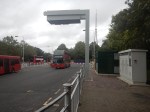
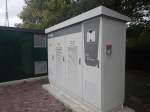
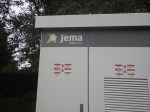
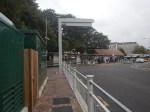

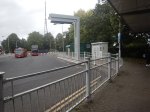
Note.
- It is not finished yet or someone has nicked the pantograph.
- Irizar seem to make their own chargers.
- It looks a well-designed installation.
This Spanish video shows the bus inside and outside.
I have a few thoughts.
The Specification Of The Bus
This document on the Irizar web site is the specification of the ie trams, that London are buying.
Passenger Capacity
According to the specification, these twelve metre long buses have a capacity of 97-99 passengers, with 21-28 seated, depending on layout.
Is that a bit tight? Especially, if people are carrying large cases.
Climbing Anerley Hill
I wonder how these buses will manage to climb Anerley Hill.
- This page on a cycling blog, rates the hill as the fourth stiffest in London.
- A typical Wrightbus or AlexanderDennis single-decker diesel bus has a kerb weight of 13-14 tonnes.
- The ie tram gives maximum front and rear axle loadings which total 21.2 tonnes. But that includes the passengers, which at 60 Kg each account for a lot of the difference in weight with the diesel buses.
- Anerley Hill has a rise of upwards of 30 metres.
Using Omni’s Potential Energy Calculator gives a figure of less than 2 KWh of energy needed to get up the hill.
That should be possible!
News Of The Bus
But there has been very little news on the Internet of these buses and their chargers, with the last story dated a year ago. Given Sadiq Khan’s love of publicity, does that mean anything?
Conclusion
It seems that Irizar have pulled out all the stops in the design of this bus.
Exploring London Bus Route 132
London Bus Route 132, is run by battery-electric buses and it the first in London to use opportunity charging.
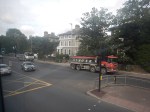
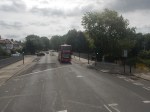
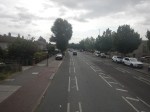
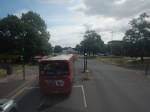
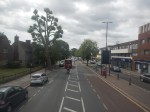
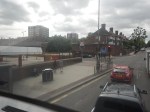
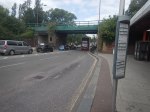
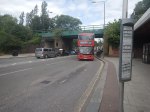
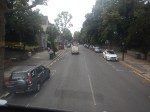
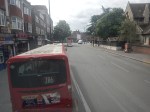
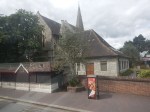
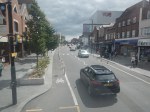
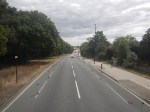
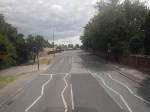
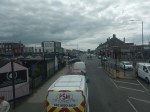
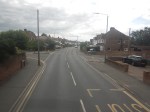
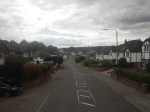
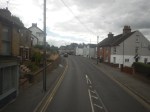
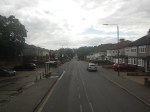
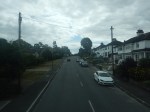
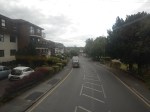
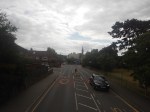
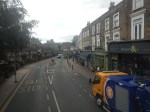
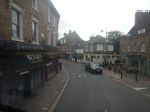
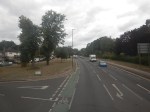
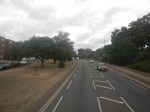
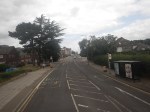
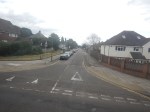
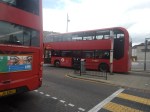
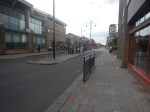
These pictures show the route from North Greenwich to Bexleyheath Shopping Centre.
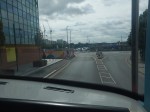
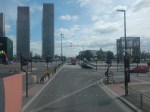
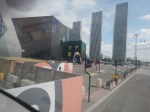

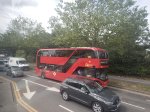
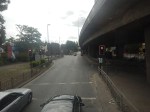

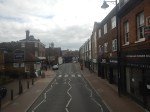
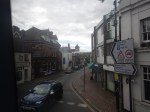

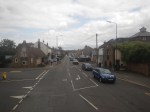
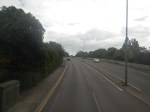
Note.
- These pictures were shot in two sections on the 3rd and the 6th of July 2023.
- The break was at Eltham station.
- Some sections of the route had a lot of cars.
- Some side roads were full of parked cars.
- There were large numbers of cars parked in front of houses.
There are my thoughts.
More will appear here over the next couple of days.
The Buses
The buses used on the route are Alexander Dennis Enviro400EV, which are built on a BYD Auto chassis.
They have a range of 160 miles.
The Route
The route has several inclines both ways and I estimate it is just under ten miles.
At North Woolwich, the bus didn’t appear to have a charge, but I can’t be sure.
But it disappear at Bexleyheath Shopping Centre and I was certain it went for a charge.
So is the operational philosophy to fill, the bus up overnight and then top the battery up every time, that it needs it at Bexleyheath.
A Comparison With A Similar Route In Birmingham That Has Hydrogen-Powered Buses
As the bus ran between North Woolwich and Bexleyheath Shopping Centre, I was comparing it, with the trip, I made across Birmingham, in hydrogen-powered buses, that I wrote about in Riding Birmingham’s New Hydrogen-Powered Buses.
Both were quality buses, but I felt the hydrogen bus had more power.
Opportunity Charging At Bexleyheath
If, buses need to be charged at the Bexleyheath Shopping Centre end of the route, where will they go?
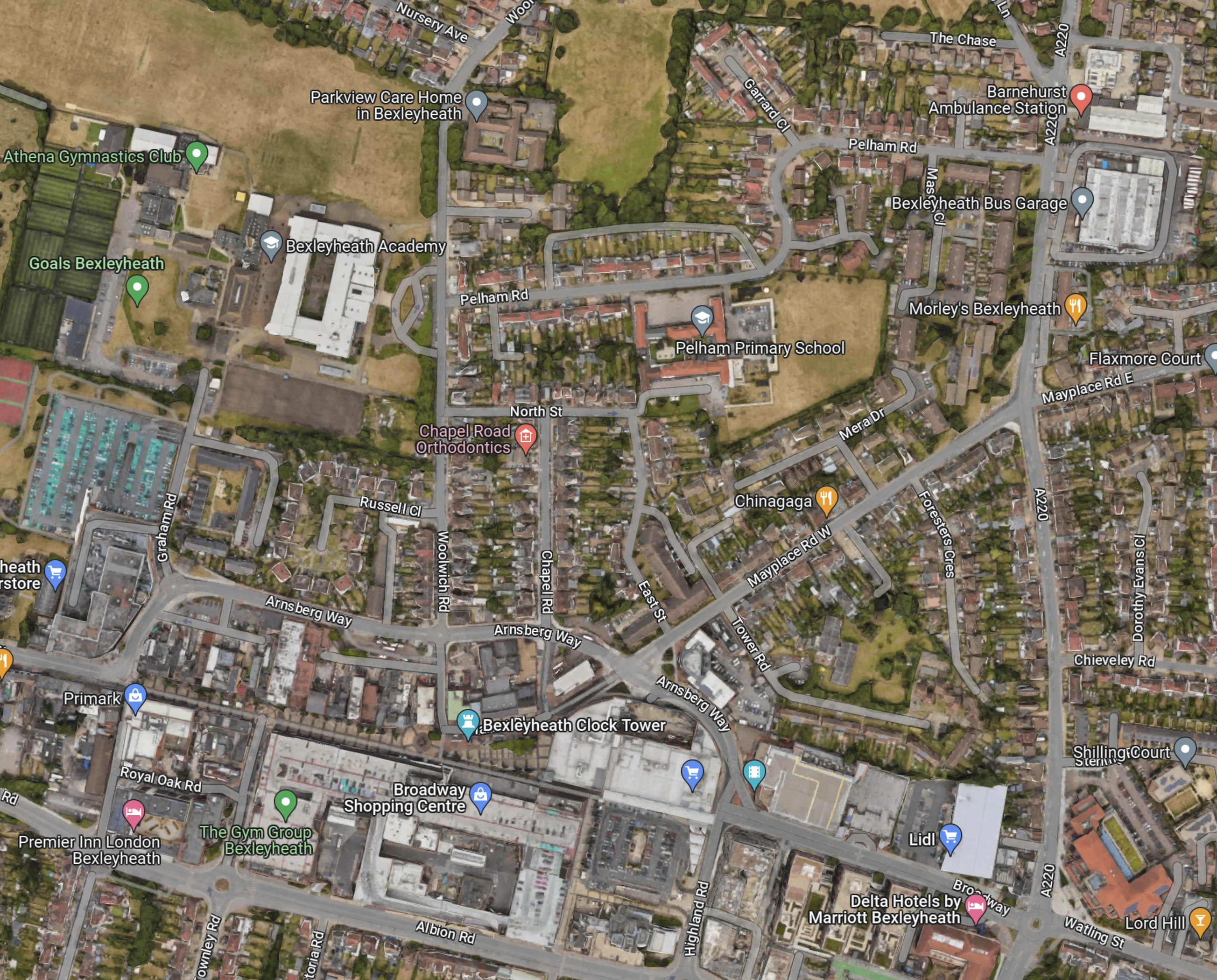
This Google Map shows Bexleyheath Bus Garage in relation to the Shopping Centre.
Note.
- Bexleyheath Bus Garage is in the North-East corner of the map.
- It looks like it shares a site with Bexley Fire Station and Barnehurst Ambulance station.
- So the garage is well located for any future lithium-ion battery fires.
- In the middle of the map at the bottom, is Bexleyheath Clock Tower, in the middle of the town centre.
- I estimate it’s less than two kilometres between Bexleyheath Bus Garage and the Shopping Centre.
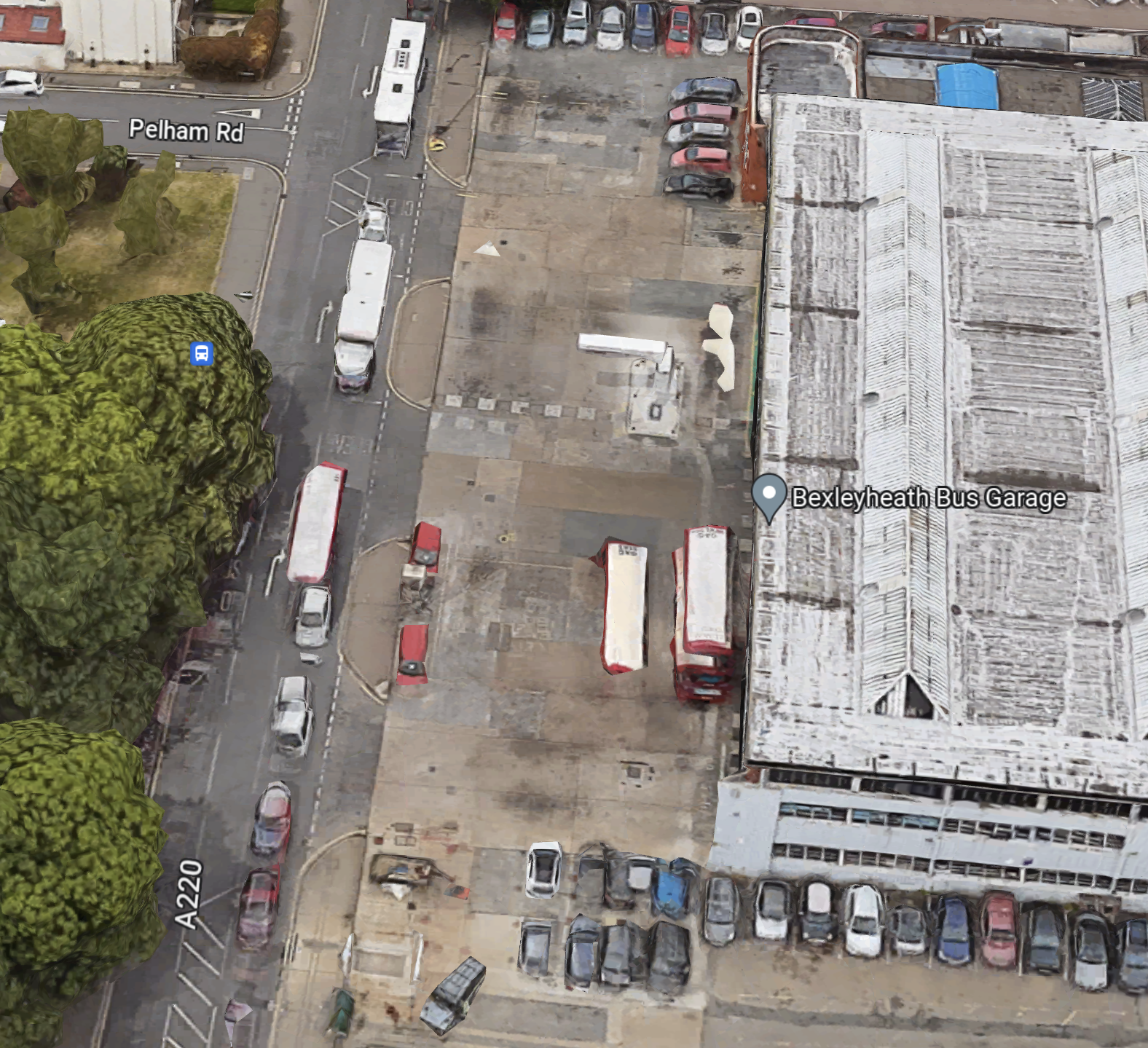
This Google Map shows a close-up of the Western side of the Bexleyheath Bus Garage.
Note.
- The two buses parked by the side of the garage.
- Behind them a white arm reaches over towards the road.
- This is the charger and buses connect using a pantograph on the roof.
It could be an All-In-One Fast Charging Station AIO from Furrer+Frey.
The Electrical Connection At Bexleyheath Bus Garage
Consider.
- The bus garage shares a site with a fire station and an ambulance station, which surely must need a reliable power source.
- This is London’s first application of opportunity charging.
- There are improvements constantly happening to London’s struggling power network.
- It is a large site and I suspect there is space for a battery to boost power.
I would assume that Transport for London wouldn’t have chosen a bus garage with a dodgy power supply.
Could The Charger Be Solar-Powered?
This Google Map shows the roof of Bexleyheath Bus Garage.
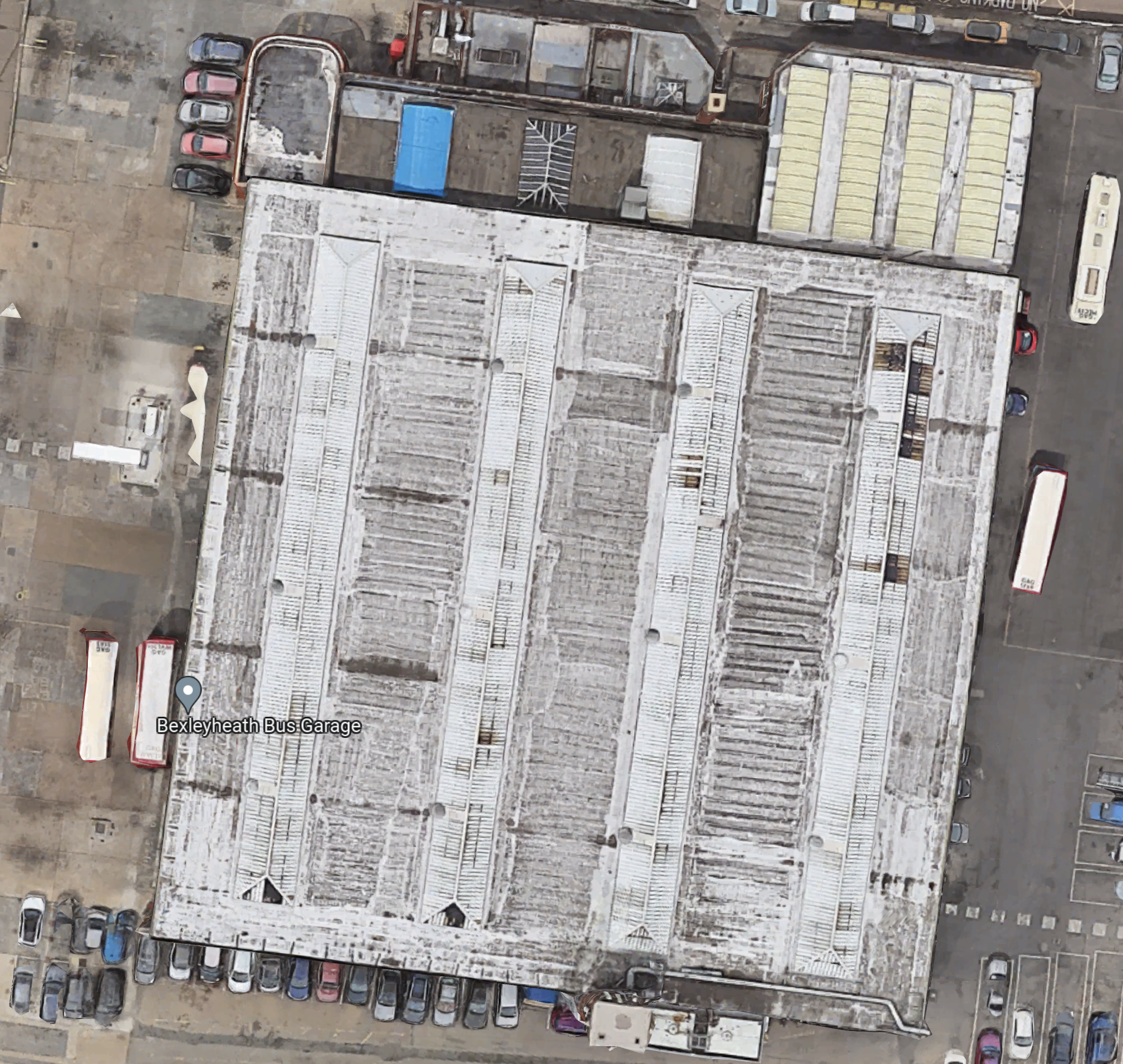
Note.
- It appears to be a square with a length of about six buses.
- It looks rather dirty.
I suspect that the roof could be replaced with a modern solar roof.
Hydrogen Or Electric
This article on RouteOne is entitled Enviro400FCEV Hydrogen Bus Fleet For Liverpool Debuts.
This paragraph describes the performance.
Alexander Dennis has chosen the heavy-duty variant of VEDS. It is designed to deliver up to 410kW of power, but the vehicle OEM says that in the Enviro400FCEV, output is limited to 350kW. Such an approach will maximise fuel economy while still enabling a high road speed and good hill climbing ability. Expected range is up to 300 miles.
So the range on hydrogen is nearly doubled.
Wrightbus’s outwardly similar electric and hydrogen buses have ranges of 200 and 280 miles, but filling times of 2.5 hours and 8 minutes.
The problem with hydrogen in London, is that the Mayor and Transport for London, don’t appear to have a hydrogen policy.
But I think, that hydrogen will win out in cities and areas, where hydrogen can be supplied.
I also believe that hydrogen has other advantages.
- There is likely to be significant progress in improving hydrogen-powered heavy vehicles.
- Hydrogen internal combustion engines are coming and could promise more affordable hydrogen buses.
- Better and more affordable methods to create green hydrogen are being developed.
- Some existing diesel buses will be able to be converted to buses powered by hydrogen internal combustion engines.
- Lithium-ion batteries have a high environmental footprint.
Hydrogen is also likely to be the fuel of choice for heavy trucks.
Goodyear Releases New EV Tire For Electric Metro Buses
The title of this post, is the same as that of this article on The Buzz EV News.
This is the sub-heading.
The new Urban Max BSAEV tire was designed in partnership with heavy-duty transit bus manufacturer Gillig.
This is the first paragraph.
The Goodyear Tire & Rubber Company has introduced its newest EV-ready tire for buses and transit fleets. The new Urban Max BSAEV (bus service all-position) tire was designed in partnership with Gillig, a manufacturer of American-built heavy-duty transit buses. The Urban Max BSAEV is the first Goodyear tire engineered specifically with low rolling resistance for EV transit and metro buses to help extend range and handle the increased load capacity, the company says.
This is an idea that could roll a long way.
Does your EV have low rolling resistance tyres?
Riding The X140 Bus Between Heathrow Airport And Harrow Bus Station
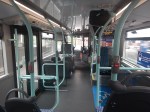
I did this journey, which will be part of the Superloop, in better weather than yesterday, and was able to take these better pictures.


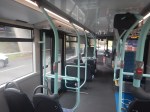
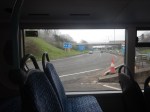
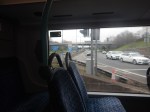
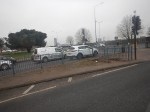
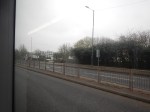
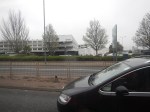
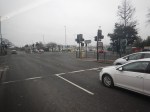


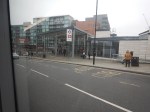
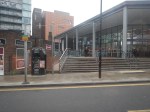

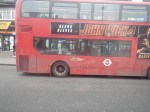
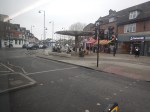
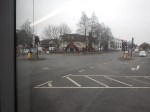
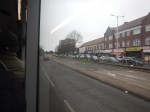
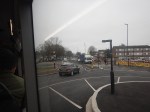
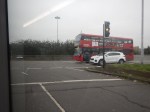
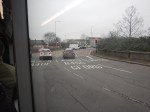

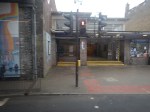
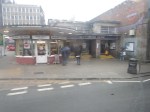


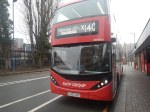
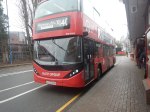
Note.
- The roads were much better than yesterday’s trip and were mostly two lanes each way, with large roundabouts at junctions.
- I suspect the bus was going at between 30 and 40 mph most of the way.
- There was still quite a lot of traffic.
- It is a distance of about 15 miles.
- The timetable says that buses run every 10-13 minutes.
- The X26 buses run between about six in the morning at midnight.
- There are twelve intermediate stops.
- Harrow-On-The-Hill station is next to Harrow Bus station.
- Heathrow Central connects to Heathrow Express, the Elizabeth and Piccadilly Lines.
- Hayes and Harlington connects to the Elizabeth Line and GWR’s local services.
- Northolt station connects to the Central Line.
- Northolt Park station connects to Chiltern.
- South Harrow station connects to the Piccadilly Line.
- Harrow-On-The-Hill connects to the Metropolitan Line and Chiltern
The journey took 49 minutes, which is only a minute longer than the timetable.
I have a few thoughts.
Passenger Numbers
These were my observations on my journey that started at about 11:30 on a dry day.
- Few got on at Heathrow Central, but I suspect we had just missed a bus.
- By Hayes & Harrington station, the bus was about a quarter full.
- At South Harrow station it must have been about three-quarters full.
- At Harrow bus station all the lower-deck seats were taken.
I would expect that the loading I saw fits with TfL’s expectations.
The Bus
The bus was one of the latest ADL battery-electric buses.
- It had a strong performance.
- It had wi-fi and phone charging.
- It was probably less than a year old.
- It was a lot better than yesterday’s bus!
At present not all buses on the route are battery-electric, as some are still older hybrids.
Travelling To Heathrow From The Northern Reaches Of The Metropolitan Line
Many people travel to and from Heathrow either for work or because they are flying.
- But it is not an easy journey from the Northern reaches of the Metropolitan Line.
- I believe the X26 bus could be a viable way to get to the airport for many.
- There would be a change at Harrow-on-the-Hill, but the station is at least step-free.
- It would avoid parking fees.
- Fares could be less than fuel costs.
The only big drawback, is that the X26 bus is not twenty-four hours.
More And More Frequent Buses Would Help
I believe that the Superloop should be a 24-hour service, as a lot of things go on at airports in the middle of the night.
I’ve just found out that there is an N140 bus that covers the route.
I also think, that as with the Overground, services should be at least four buses per hour.
New Fast Bus Service To Link London’s Outer Boroughs
The title of this post is the same as that of this article on the BBC.
This is the sub-heading.
A new fast service bus network has been announced for London’s outer boroughs.
These three paragraphs outline the concept.
Six new routes will be created and four incorporated into the ‘Superloop’ network, complete with distinct branding.
The plans propose a fast service to make more stops linking many of the peripheral boroughs.
The network is part of London Mayor Sadiq Khan’s effort to compensate for the impact of the ultra-low emission zone expansion, due to start in August.
This draft map from TfL illustrates the concept.
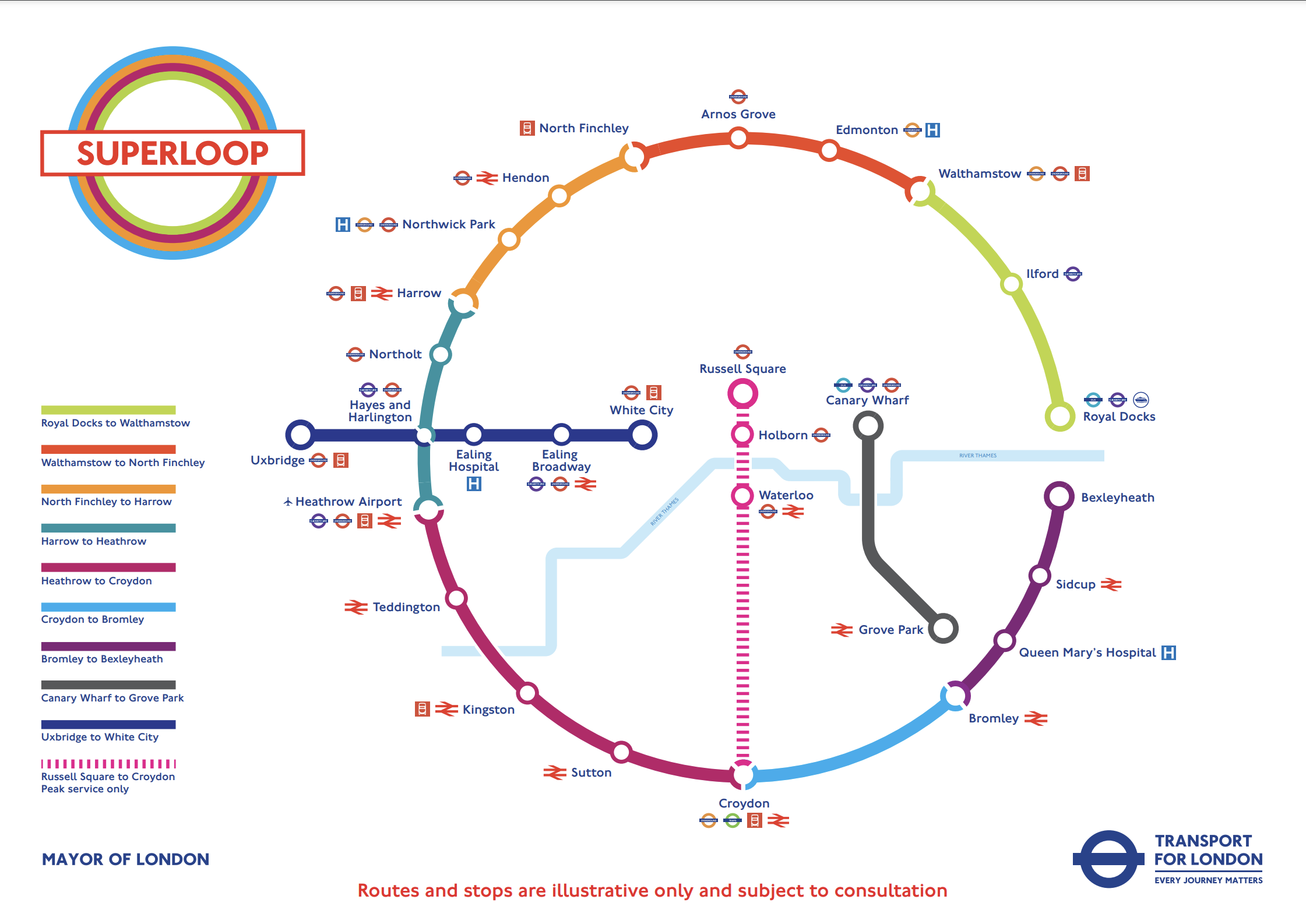
In the draft map, the following can be discerned.
- Arnos Grove station is in the North.
- West Croydon station is in the South.
- Royal Docks and Bexleyheath are in the East.
- Uxbridge and Hayes & Harlington stations are in the West.
- Elizabeth Line stations on the route include Ilford, Custom House, Heathrow Airport and Hayes & Harlington.
The plan may work well, as in the 1950s and 1960s, I used the 107 bus route very regularly, as it cut a circular path between Queensbury in the West and Enfield in the East.
I have some thoughts.
Royal Docks And Bexleyheath
This Google Map shows the Royal Docks.

Note.
- The dotted red line indicates the Royal Docks.
- The runway of the London City Airport can be seen.
- Custom House station on the Elizabeth Line is served by the Elizabeth Line and the Docklands Light Railway.
This second Google Map shows the Western end of the Royal Victoria Dock.

Note.
- Custom House station is in the North-East corner of the map.
- The Excel is on the East end of the map.
- London City Hall is at the Western end of the Royal Victoria Dock.
- The cable-car to Greenwich connects to the area.
I would suspect that the bus from Walthamstow will terminate close to City Hall and the cable-car.
This Google Map shows the Royal Docks and Bexleyheath.
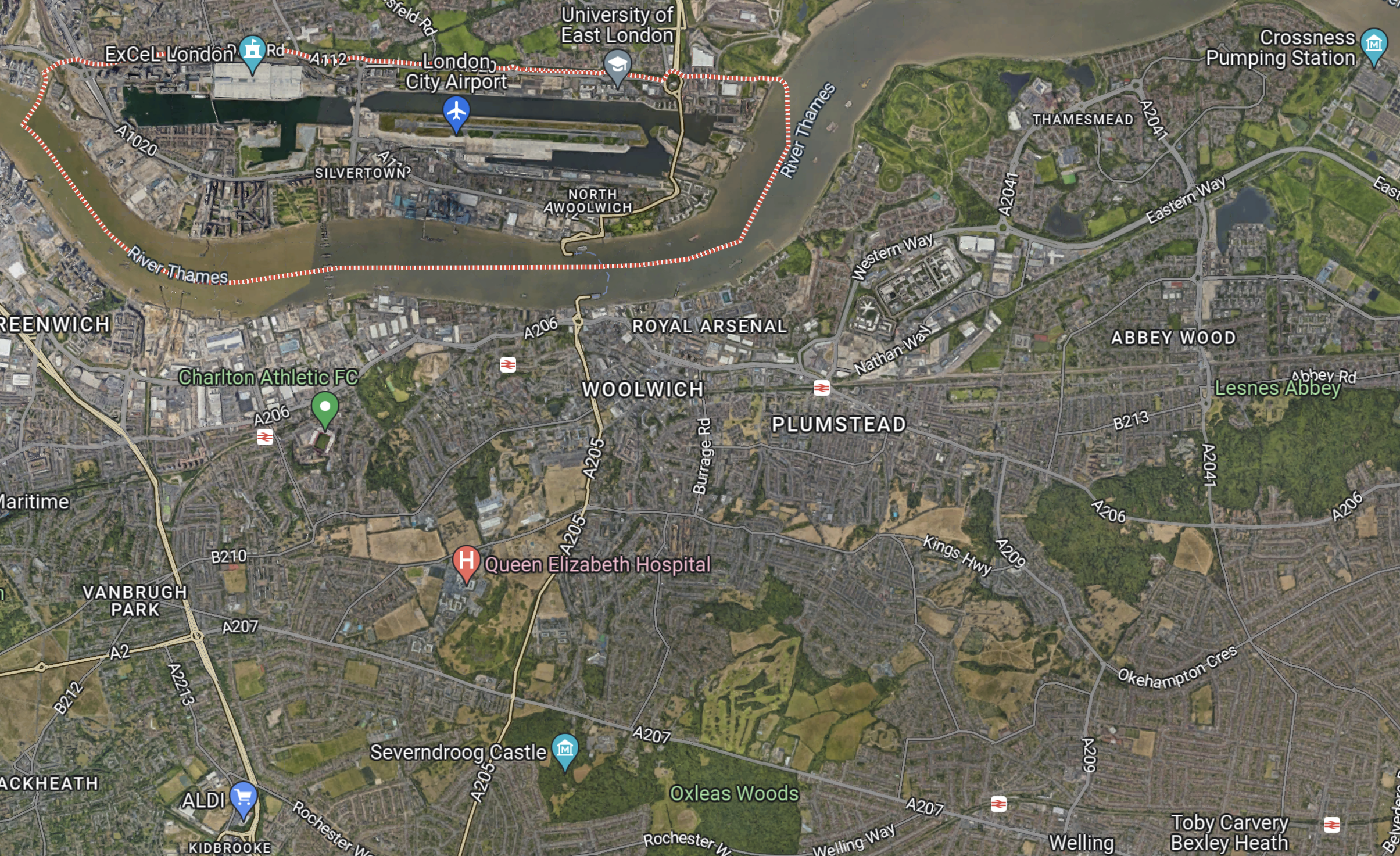
Note.
- The dotted red line indicates the Royal Docks.
- Bexleyheath station is in the South-East corner of the map.
I wouldn’t be surprised to see the Mayor organise a bus, through his new pet project; the Silvertown Tunnel.
Electric Or Hydrogen
Ideally, the buses will need to be zero-carbon; which means battery-electric or some form of hydrogen power.
Birmingham has a similar series of express routes, that run across the city, which I wrote about in Riding Birmingham’s New Hydrogen-Powered Buses.
I feel that long routes like some of these are should be run with hydrogen-powered buses, because of there longer range.
Cummins Launches Accelera By Cummins To Advance The Transition To A Zero-Emissions Future
The title of this post, is the same as that of this press release from Cummins.
These paragraphs outline the creation of the new brand.
Global power and technology leader Cummins Inc. (NYSE: CMI) today announced the launch of Accelera by Cummins, a new brand for its New Power business unit. Accelera provides a diverse portfolio of zero-emissions solutions for many of the world’s most vital industries empowering customers to accelerate their transition to a sustainable future.
The launch of Accelera is a significant step forward in Cummins’ efforts to achieve its Destination Zero strategy, focused on evolving Cummins technologies to reach zero emissions across its product portfolio. Cummins’ Destination Zero strategy is rooted in the understanding that multiple solutions are required to achieve industry-wide decarbonization across the diverse applications the company powers. Over the past several years, Cummins has invested more than $1.5 billion in research and technology, capital and acquisitions to build Accelera’s leadership and technological capabilities. Accelera is now a global leader in zero-emissions technologies, providing battery electric and fuel cell electric solutions across commercial and industrial applications with hundreds of electrolyzers generating hydrogen around the world today.
The press release then gives details of the zero-carbon products, that are in Accelera’s portfolio.
The press release finishes by announcing some zero-carbon projects. These are ones, thaat are new to me.
- Accelera by Cummins will supply a 90-megawatt proton exchange membrane electrolyzer system for Varennes Carbon Recycling’s plant in Quebec, Canada.
- Accelera and Blue Bird aim to power a new fleet of 1,000 electric school buses across the United States over the next 12-18 months.
- Cummins’ breakthrough technologies have reduced the company’s product emissions by more than 90% over the past 25 years, and Accelera will continue to advance the company’s path toward a zero-emissions future.
- Increasing global electrolyzer manufacturing capacity with gigawatt-scalable plants in Fridley, Minnesota – its first in the United States – and in Spain (now under construction).
- Powering the world’s first hydrogen refueling station for ships, cars, trucks and industrial customers in Antwerp, Belgium
- Powering the world’s first megawatt-scale demonstration plant for storing wind energy in the natural gas grid in Windgas Falkenhagen, Germany
- Deploying four hydrogen-fuel-cell-powered class 8 heavy-duty trucks with several marquis fleet customers in the United States.
- Powering refuse trucks with FAUN across Europe.
Cummins has arrived and will be a big player, as we more towards a zero-carbon world.
Only two people are mentioned in the press release.
- Jennifer Rumsey, Cummins President and Chief Executive Officer.
- Amy Davis, who has led the New Power business unit since 2020, will serve as President of Accelera.
Cummins has changed itself! Is it changing the world?
Wrightbus: Ballymena Company Gets Order For 117 Buses
The title of this post, is the same as that of this article on the BBC.
This is the sub-heading.
County Antrim firm Wrightbus has secured a £25.3m order to build 117 zero-emission buses for use in England
And this is the first paragraph.
Operated by First Bus, the vehicles will be used in Yorkshire, Norfolk, Portsmouth and Hampshire.
They don’t say, whether the buses are battery or hydrogen powered.
Should There Be Limits To The Type Of Vehicles Allowed In The Blackwall And Silvertown Tunnels?
When the Silvertown Tunnel opens in 2025, the tunnel and the nearby Blackwall Tunnel will be tolled.
But will there be any restrictions on the vehicles that can use the tunnels, other than those that apply to the Blackwall Tunnel at the present time, which are detailed in Wikipedia.
The tunnels are no longer open to pedestrians, cyclists or other non-motorised traffic, and the northbound tunnel has a 4.0-metre (13.1 ft) height limit.
Note.
- I suspect that pedestrians, cyclists or other non-motorised traffic will also be banned from the Silverton Tunnel.
- But the height limit will be relaxed for the Silverton Tunnel to allow large trucks and double-deck buses to use the tunnel.
According to this web page, which is entitled the Silvertown Tunnel Bus Network Proposals, the planned buses through the tunnel include.
- 108 – As now, with a minor route change.
- 129 – As now, but extended from North Greenwich station to Great Eastern Quay.
- X329 – An express bus from Grove Park station to Canary Wharf, which runs non-stop through the Silvertown Tunnel.
Note.
- The 108 goes through Blackwall and is a single decker bus.
- The 129 and the X329 will go through Silvertown and could be double decker buses.
- There appears to be no mention of any provision for cycles.
- I would assume wheelchairs, buggies and cases will be accommodated as they are on current London buses.
I also think, that the buses must be zero-carbon, which would mean battery-electric or hydrogen.
In Hydrogen-Powered Vehicles And Trains In Tunnels, I looked at the feasibility of running hydrogen buses through the tunnel and came to this conclusion.
I am confident, that we will achieve a safety regime, that allows hydrogen-powered vehicles and trains to be certified to pass through tunnels.
The great advantage of hydrogen buses on the three routes would be that they would probably only need to be filled up once a day, but electric buses might need constant charging.
Provision For Cycles
I think it is essential to have provision for cycles across the river.
- Folded cycles can be taken almost anywhere on London’s transport system.
- Non-folding cycles can be taken most places on London’s transport system, but the hours are restricted.
- There’s always the Woolwich Ferry.
- Given that the 108 bus seems to weave its way through the East End, I suspect that this bus couldn’t be longer to carry cycles.
I have seen double-deck buses, with provision for cycles at the back of the lower deck in Europe.
- Perhaps buses like these, could be used on the 129 and X329 routes.
- A search of the Internet found some buses in East Yorkshire with provision for two standard cycles.
- The 129 bus could ferry bikes between North Greenwich station and a convenient stop on the North side of the river.
- The X329 bus could ferry bikes over the non-stop section of the route between the Sun in the Sands and Leamouth roundabouts.
There could be shorter routes adding extra capacity between the stops, where bikes are loaded and unloaded.
Large Trucks Through The Tunnel
If buses become zero-carbon through the Blackwall and Silverton Tunnels, then why shouldn’t large trucks be zero-carbon?
I think this could be the carrot combined with free passage for zero-carbon vehicles that could clean up Central London’s polluted air.
Smaller Vehicles
Why not gradually reduce the size of vehicles going through the tunnels that must be zero-carbon?
Conclusion
The Silvertown and Blackwall Tunnels can be used as the drivers to clean up Central London’s air.
Equipmake Hybrid To Battery Powered LT11
The bus in this video from Public Transport UK, may look like any of the thousand New Routemasters on the streets of London.
But it’s not, as it’s been given a transmission transplant by Equipmake of Snetterton in Norfolk.
The observant amongst you will notice, it has a refurbished interior, as I wrote about in My First Ride In A Refurbished New Routemaster.
There is also this press release from Equipmake, which is entitled Equipmake Showcases Sector-Leading Repower Technology With Fully-Electric New Routemaster Bus.
Some points from the press release.
- Equipmake’s cutting-edge Zero Emission Drivetrain (ZED), uses a 95% British-built component content.
- With pre-service trials already started in London, operated by Metroline, the electric version of the New Routemaster will continue to be assessed over the next six months.
- The repowered New Routemaster, developed by Equipmake at its base in Snetterton, Norfolk, features a 400kWh battery enabling an expected in-service range of 150 miles – more than enough for a day’s running.
- The development of the all-electric New Routemaster has come about thanks to a programme part funded by the UK Advanced Propulsion Centre (APC).
- Over the coming months, Equipmake will be trialling additional repowered buses with other bus operators across the UK.
- Featuring an advanced water-glycol cooling circuit, the system has the added benefit of providing interior heating during cold conditions with captured thermal energy.
- When the battery is depleted at the end of a complete duty cycle, it can be recharged at the depot overnight via a CSS DC charging point.
But this is the bit I really like.
Under the skin, the New Routemaster also features Equipmake’s HTM 3500 electric motor. Seamlessly integrated into the prop shaft without the need for a separate transmission, the motor is precisely engineered to meet the demanding requirements of a fully-laden double-decker bus by producing 3,500Nm torque at a motor speed of just 1,000rpm and delivering 400kW maximum power.
It sounds a bit like a modern reincarnation of a TASC unit (torque and speed control unit), which was an industrial drive from the 1960s, used to precisely control industrial machines. I never used one, but I worked in a section at Enfield Rolling Mills, that did.
One car manufacturer of the time, was using them as an automatic transmission for a small car. It might have been Hillman.
A Comparison With The Wrightbus Streetdeck Electroliner BEV
The Wrightbus Streetdeck Electroliner BEV is the company’s latest electric double decker bus and a comparison can be made.
Seats
Equipmake LT11 – 87
Electroliner BEV – 96
Battery Size
Equipmake LT11 – 400 kWh
Electroliner BEV – 340 or 454 kWh
Range
Equipmake LT11 – 150 miles
Electroliner BEV – 200 miles with 454 kWh battery.
Conclusion
This New Routemaster, is certainly no ordinary electric bus.
With the batteries on hybrid buses needing to be replaced regularly, Eqipmake’s transmission transplant could also be scheduled, when a bus needs a new battery.
With Lotus just up the road, the engineering is certainly Normal for Norfolk!

