UK Steel Industry Backed By Major New Trade Measure And Strategy
The title of this post, is the same as that of this press release from UK Government.
These three bullet points act as sub-headings.
-
Landmark new Steel Strategy sets ambition for up to 50% of steel used in the UK to be made in the UK, boosting production from 30%.
-
UK will introduce new trade measure to support national security by preserving vital steel production for critical national infrastructure and defence.
-
Steel import quotas will be reduced with higher tariffs of 50% outside of quotas, ensuring the UK steel sector’s future in the face of global overcapacity.
These three paragraphs add details.
On a visit to Tata Steel Port Talbot to meet steelworkers and launch the Strategy, the Business and Trade Secretary Peter Kyle announced the Government’s ambition to boost domestic production so that it can meet up to 50% of our domestic demand for steel, and secure the industry’s role in supporting vital UK sectors like infrastructure, defence and clean energy.
Building on the direct financial support the government has made so far, the National Wealth Fund will be the government’s main mechanism for providing up to £2.5 billion of financing for investment in the steel sector this Parliament. The Steel Strategy forms a vital part of the Government’s activist and strategic approach to British industry, taking decisive action to give businesses the certainty and support they need in uncertain times and bolstering the UK’s resilience.
Today, the UK also announces that from 1 July 2026, overall quota levels for steel imports will be significantly reduced by 60% compared to current arrangements, and steel coming into the UK above these levels will be subject to a 50% tariff.
New British Steel Rail Stocking Facility Will Boost Network Rail Supply Chain
The title of this post, is the same as that of this article on RailUK.
These four paragraphs outline the new facility and how it will work.
British Steel is building a new £10 million rail stocking facility, the biggest of its kind in the country.
The facility, at the company’s Scunthorpe site, is scheduled to be completed this summer and will stock around 25,000 tonnes of 108-metre finished rail.
The investment is part of our British Steel’s strategy to support the supply of 56E1 and 60E2 section rails for Network Rail, ensuring there is rail stock readily available for its supply chain.
Rails stocked in the new facility will all have undergone the stringent testing and quality assurance checks required to meet the specification to allow immediate dispatch or welding into 216-metre lengths to the customer.
With all the gloom in the steel industry, It’s good to see someone investing in new facilities.
‘Czech Sphinx’ Power Plant Intended To Keep Lights On
The title of this post, is the same as that of this article on The Times.
This is the first paragraph.
The businessman known as the “Czech Sphinx” is set to expand his position in Britain’s energy market after securing subsidy contracts to build a new gas-fired power plant and battery storage project.
As I needed to find the answers to particular questions, I looked for and found the original press release on the EP Holdings web site, which is entitled EPH Will Build A New Gas-Fired Power Plant And Battery Storage Facility In The UK At A Cost Of More Than £1 billion.
These statements describe the project.
- It will be a 1700MW high efficiency H-class CCGT power project and a 299MW 2-hour battery storage project
- The power station will be built on the site of the former Eggborough coal station in East Yorkshire.
I find this to be the most significant paragraph.
The high efficiency H-class CCGT project will be the single largest flexible generation asset to be commissioned in the UK since 2012, whilst the battery project will also be one of the largest to be built in the UK to date. Given the site’s close proximity to existing National Grid infrastructure and a number of proposed CCUS and hydrogen pipeline routes, under EPUKI’s plans these projects will make a significant contribution to the UK’s energy transition and security for years to come.
This map from OpenRailwayMap, shows the relationship between the Eggborough site and the nearby Drax power station.

Note.
- The Eggborough power station site is in the South-West corner of the map and is identified by the rail loop. which was used to deliver the coal.
- The Drax power station site is in the North-East corner of the map and is similarly identified by a rail loop.
- There is a high voltage transmission line connecting the two power stations.
- As the crow flies is about eight miles between Eggborough and Drax.
This Google Map shows the Eggborough power station site.

Note.
- The remains of the eight cooling towers are visible at the North of the site.
- The large circular black area in the middle is the coal yard with its rail loop.
- It is a large site.
I have looked in detail at the cleared area in the North-West of the site and the pylons of the connection to Drax are still visible.
So it looks like there is still an electrical connection of some sort to the site.
According to Wikipedia, the original coal-fired power station had a nameplate capacity of 1960 MW, so I suspect that a modernised electricity connection to handle the maximum near 2,000 MW of the new station would be possible.
This map shows the Zero Carbon Humber pipeline layout.

Note.
- The orange line is a proposed carbon dioxide pipeline
- The black line alongside it, is a proposed hydrogen pipeline.
- Drax, Keadby and Saltend are power stations.
- Keadby and Saltend are gas-fired power stations.
- Easington gas terminal is connected to around twenty gas fields in the North Sea.
- The terminal imports natural gas from Norway using the Langeled pipeline.
- The Rough field has been converted to gas storage and can hold four days supply of natural gas for the UK.
- To the North of Hull is the Aldbrough Gas Storage site, which SSE plan to convert to hydrogen storage.
The Eggborough power station site is about eight miles to the South-West of Drax.
I don’t suspect that connecting the Eggborough site to the carbon dioxide, gas and hydrogen pipelines will not be the most challenging of tasks.
So when the press release says.
Given the site’s close proximity to existing National Grid infrastructure and a number of proposed CCUS and hydrogen pipeline routes, under EPUKI’s plans these projects will make a significant contribution to the UK’s energy transition and security for years to come.
The company is not exaggerating.
It appears that carbon dioxide, gas and hydrogen pipelines can be developed and National Grid connections can be reinstated.
Eggborough Will Not Be Alone
From the EP Holdings press release, it appears that the Eggborough power station will be fitted with carbon-capture and will be hydrogen-ready.
This will make it the second power-station in the area to be fitted out in this way, after SSE’s planned Keadby 3, which is described in this page on the SSE web site in this document, which is entitled Keadby 3 Carbon Capture Power Station.
They could also be joined by Keadby Hydrogen power station.
This would mean that zero-carbon power stations in the area could include.
- Eggborough Gas/Hydrogen – 1700 MW
- Eggborough Battery – 299 MW
- Keadby 3 Gas/Hydrogen – 910 MW
- Keadby Hydrogen – 1800 MW – According to this Equinor press release.
Note.
- The Eggborough Battery pushes the total zero-carbon capacity over 4500 MW or 4.5 GW.
- The various Dogger Bank wind farms are to have a total capacity of 8 GW within ten years.
- The various Hornsea wind farms are to have a total capacity of 5.5 GW in a few years.
I would expect that the zero-carbon power stations would make a good fist of making up the shortfall, when the wind isn’t blowing.
Drax, Keadby 1 And Keadby 2 Power Stations
Consider.
- Drax has a nameplate capacity of 3.9 GW, of which 2.6 GW is from biomass and the rest is from coal.
- Keadby 1 has a nameplate capacity of 734 MW.
- Keadby 2 has a nameplate capacity of 734 MW.
How much of this capacity will be fitted with carbon capture, to provide extra zero-carbon backup to the wind farms?
Green Hydrogen From Surplus Wind Power
At times, there will be an excess of renewable energy.
I suspect, an order for a large electrolyser will be placed soon, so that surplus renewable energy can be used to create green hydrogen.
This will be stored in the two storage facilities, that are being developed in the area; Aldbrough and Rough.
Controlling The Fleet
I am by training a Control Engineer and this fleet can be controlled to provide the electricity output required, so that the carbon-dioxide produced is minimised and the cost is at a level to the agreement of producers and users.
Conclusion
It looks like in excess of 20 GW of reliable zero-carbon energy could be available on Humberside.
I’m sure British Steel would like to by a lot of GWhs to make some green steel at Scunthorpe.
EDF Renewables Eyes 50MW Solar Farm To Power Green Hydrogen Development In Teesside
The title of this post, is the same as that of this article on Solar Power Portal.
These are the first two paragraphs.
EDF Renewables is looking to develop a 49.9MW solar farm to power a new green hydrogen production facility in Teesside.
Working together with Hynamics, a subsidiary of the EDF Group specialising in hydrogen, the companies are planning to develop a 30-50MW electrolyser, which will subsequently be scaled to over 500MW in line with emerging demand.
They are working with PD Ports and British Steel.
Teesside is certainly getting the green hydrogen it needs, as there is also a 400 MW hydrogen project on Teesside, that I wrote about in BP Plans To Turn Teesside Into First Green Hydrogen Hub.
Funding Award to Supply An 8MW Electrolyser
The title of this post, is the same as that of this Press Release from ITM Power.
This is the main body of the Press Release.
ITM Power, the energy storage and clean fuel company, is pleased to announce it has signed an agreement to supply an 8MW electrolyser in the UK. The agreement, including associated project costs, has a total value of £10m and funding will fall across FY2021 and FY2022. Further details will be announced in due course.
I bet they’re pleased!
To get a hold on what 8 MW looks like, these Class 90 locomotive each have a power output of just under 4 MW and are capable of hauling an eight-coach express train at 110 mph.
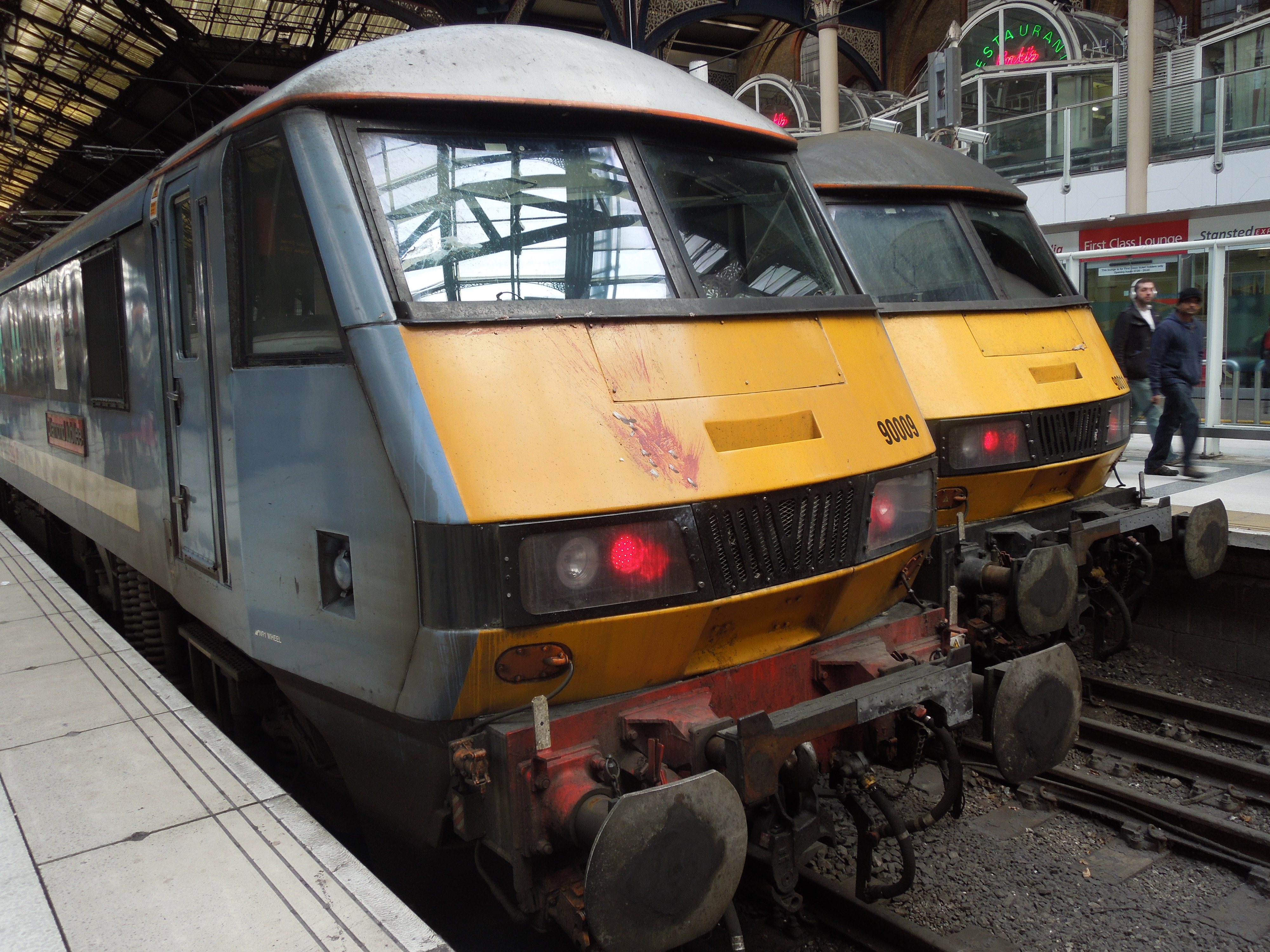
Working at full rate, the electrolyser will be able in a year to convert 70 GWh of electricity into hydrogen.
Why Would You Want An 8MW Electrolyser?
These are a few ideas.
Green Hydrogen For Humberside
This is a project described in this ITM Power Press Release.
This is the first three paragraphs.
ITM Power, the energy storage and clean fuel company, is pleased to announce that it has won, with partner Element Energy, a first stage deployment project in the UK Government’s Industrial Strategy Challenge Fund competition “Decarbonisation of Industrial Clusters” to assess the feasibility and scope of deploying green hydrogen with some major industrial partners in Humberside.
“Green Hydrogen for Humberside” will lead to the production of renewable hydrogen at the Gigawatt (GW) scale distributed to a mix of industrial energy users in Immingham, Humberside. Decarbonisation of this cluster is critical in reaching the UK’s legally binding 2050 net zero emission targets. Humberside, the UK’s largest cluster by industrial emissions, (12.4Mt of CO2 per year), contributes £18bn to the national economy each year and has access to a large renewable resource from offshore wind in the North Sea.
The project will work with customers in the region to establish the feasibility of switching to renewable hydrogen and justify a number of 100MW deployments of electrolysers. The project will cost the supply of hydrogen to these end users. This includes the electricity supply to the electrolyser, the hydrogen production facility, hydrogen distribution across the Humber and conversion of existing processes to use renewable hydrogen.
The study talks about a number of 100 MW deployments of electrolysers.
Will the 8MW electrolyser be a demonstrator for this project?
To Convert Surplus Renewable Energy Into Hydrogen Which Is Injected Into The Gas Grid
The Wikipedia entry for ITM Power has a section entitled Energy Storage Power To Gas. This is the first paragraph.
Power-to-Gas is a methodology of introducing such hydrogen to the natural gas network, essentially converting renewable electrical power to a clean gas that can be more conveniently stored using existing assets. There are two main Power-to-Gas mechanisms. The first involves metering pressurised hydrogen into the gas network directly. The second involves combining hydrogen with carbon dioxide via a methanation process to produce synthetic natural gas prior to introduction to the grid.
The electrolyser could be used to convert a lot of electricity into zero-carbon hydrogen for use in the UK gas network.
Improving The Resilience Of The UK Gas Network
This article on the BBC is entitled Major Power Failure Affects Homes And Transport and it describes a major power failure, when two generators failed in August 2019.
Could the 8MW electrolyser be part of the solution to make the UK power network more robust, if parts of the network fail?
To Create Feedstock For An Oil Refinery Or Petro-Chemical Plant
Hydrogen can be used as a feedstock for an oil refinery or petro-chemical plant.
This ITM Power Press Release, describes such a project, where wind power from the North Sea is used to create hydrogen for Phillips 66 Limited’s Humber Refinery.
As Part Of An Experimental Steel-Making Plant
This is pure speculation on my part, but steel-making creates lot of carbon-dioxide.
I do believe that using hydrogen to make steel is possible and ITM Power are based in the steel-city of Sheffield.
On the other hand look at the HYBRIT web site.
This is the introductory paragraph.
In 2016, SSAB, LKAB and Vattenfall joined forces to create HYBRIT – an initiative that endeavors to revolutionize steel-making. HYBRIT aims to replace coking coal, traditionally needed for ore-based steel making, with hydrogen. The result will be the world’s first fossil-free steel-making technology, with virtually no carbon footprint.
During 2018, work started on the construction of a pilot plant for fossil-free steel production in Luleå, Sweden. The goal is to have a solution for fossil-free steel by 2035. If successful, HYBRIT means that together we can reduce Sweden’s CO2 emissions by 10% and Finland’s by 7%.
This page on their web site is entitled Steel Making Today And Tomorrow. This image compares traditional blast furnace steelmaking with HYBRIT.
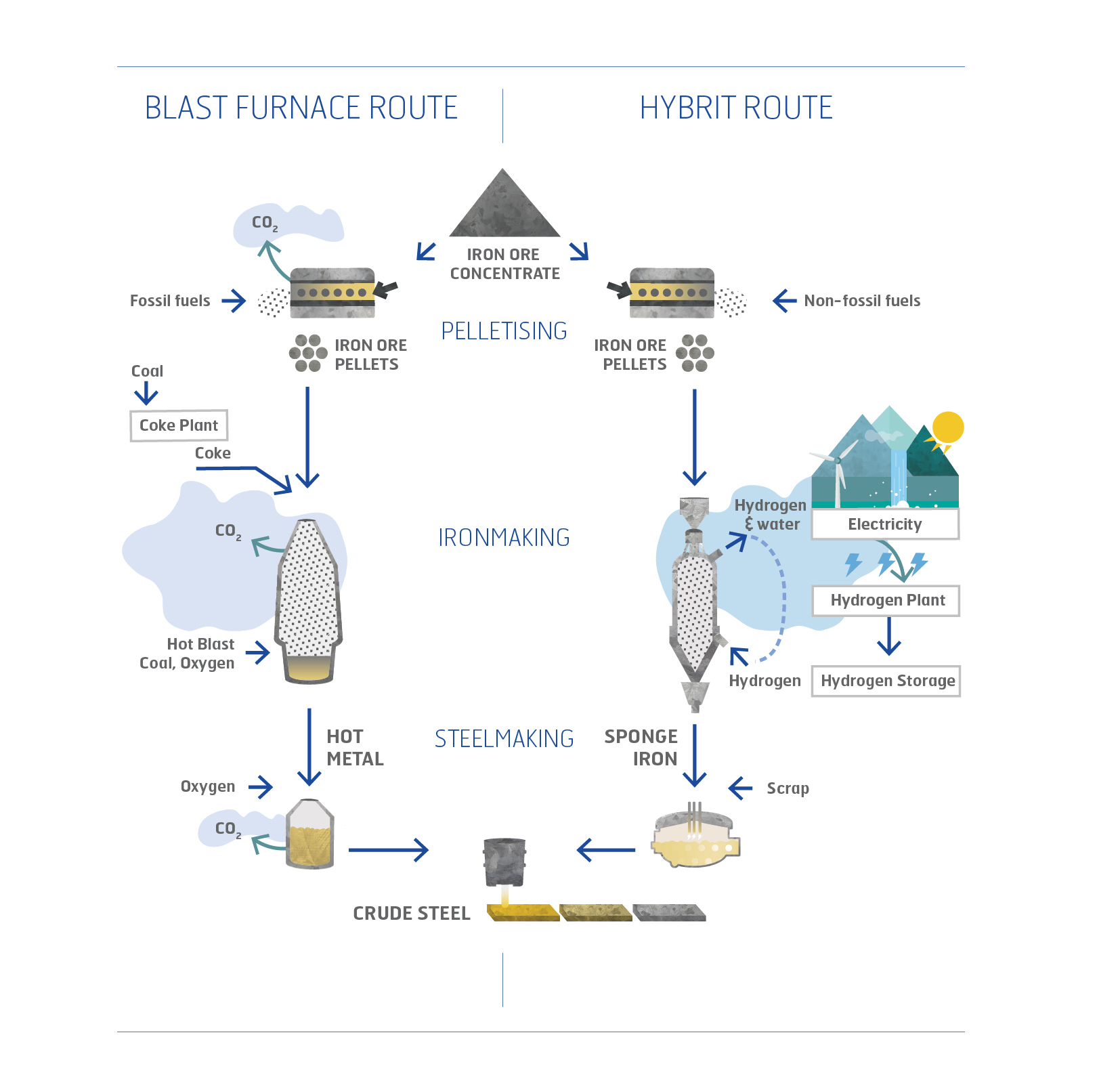
Note that at the heart of the process is the production of hydrogen from renewable electricity. This process will need a large electrolyser.
Could someone be doing something similar in Sheffield or more likely, Scunthorpe?
- British Steel may be owned by the Chinese, but it has a record of innovation.
- We will need a lot of long steel products, like railway rails and girders, in which British Steel specialise.
- In a few years, Humberside will have enough renewable electricity from North Sea wind to create an electro-magnetic gun to fire space capsules at Mars.
I will be watching out for hydrogen steelmaking.
Is Jim Ratcliffe Up To Something?
Jim Ratcliffe is a very rich man and the chairman and CEO of INEOS, which has a turnover of $83billion.
Consider.
- INEOS must know about hydrogen.
- I read some years ago, how they were using waste hydrogen to generate electricity on Teesside.
- I have a feeling that they have backed a hydrogen fuel-cell company.
- They own the hydrogen factory in Runcorn, where I worked in 1970.
- They have extensive interests in the North West, North East and Scotland.
- The company probably has an enormous carbon-footprint, that they’d probably like to reduce, by perhaps using hydrogen instead of natural gas as a feedstock for some processes, like production of ammonia.
But above all the cost of an 8MW electrolyser would be small change and probably cost a lot less, than running the cycling team.
The Fallback
It could of course be used to produce a large amount of hydrogen to power buses, cars and trains.
Network Rail Bids For Part Of British Steel
The title of this post, is the same as that of this article on the BBC.
This is the first paragraph.
Network Rail is looking to buy part of British Steel, as bidders have until the end of Sunday to put in offers for all or part of the troubled firm.
Many would say, why does the nationalised industry Network Rail, which let’s face it, has had its troubles in recent years, want to get involved with a bankrupt company?
You have to remember, how big companies work.
- They need to manage their cash flow.
- They need quality supplies, that will do what it says on the specification.
- They want supplies to be delivered as and where they need it.
But above all they need to be properly financed.
Making And Delivering Rails
This paragraph in the BBC article says a lot.
Network Rail owns and operates the UK’s railway network, including 20,000 miles of track, and buys 100,000 tonnes of rails from British Steel each year.
Suppose, you want to lay new rails urgently between Inverness and the Far North of Scotland. Getting it there will be a logistics problem, which will be made worse, if the source is halfway around the world.
And suppose, when it arrives in the UK, it fails the quality test! You can’t just give it back to the postman.
So for a reliable railway, Network Rail also needs a reliable supplier making rails, close enough for product to be delivered by special train.
From what I have read in the railway press, British Steel are good at the following.
- Manufacturing quality rail.
- Developing special products for rail companies.
- Delivering it on special trains.
To illustrate this, read British Steel Secures Major Contract From Deutsche Bahn.
I also think, that in addition to the Germans, British Steel sell rail to the Belgians, French and the Dutch, to name but three.
So certainly, British Steel seem to be on the ball with making and delivering rails.
But they appear to be seriously underfunded.
Acquiring British Steel
If I was a financier, thinking about taking over British Steel, one of the most important things would be to secure the sales and the resulting cash flow for the company.
I would be on the train to all of the major rail infrastructure companies, that could be reached by British Steel’s special trains from Scunthorpe.
Network Rail have already put a marker down, that they would buy British Steel’s Rail Products Division, but are other rail infrastructure companies also looking at securing quality product, by either buying the division themselves or pledging support alongside Network Rail.
Network Rail are also aware that their predecessor Railtrack, was brought down by the Hatfield Rail Crash, so they are probably and rightly so, paranoid about safety.
The very fact that Network Rail have put in a bid, suggests to me that they know their power in the negotiations to follow, as any purchaser, who doesn’t have the major customers onside, is probably doomed to fail.
On the other hand, if British Steel was bought by someone, that would increase the risk of dodgy product, Network Rail would go elsewhere.
But would they be able to get the same quality and service?
Conclusion
I am sure, that Network Rail, Deutsche Bahn and all the other rail infrastructure companies will play a large park in the fate of British Steel.
 The Anonymous Widower