New Mobile Rail Charging Facility For Long Marston
The title of this post, is the same as that of this article from Rail Technology Magazine.
This is the sub-heading.
Porterbrook has signed a £1.7 million deal with Siemens Mobility to purchase an innovative Rail Charging Converter (RCC) for its Long Marston Rail Innovation Centre. The cutting-edge technology will make battery charging and 25kV power supply possible in areas of the UK railway where overhead line equipment is not currently available.
This first paragraph describes the system.
The RCC is a modular and containerised system that uses power electronics to provide a fully compliant, standard connection between the modern three-wire electricity grid and the single-wire railway. It essentially reduces the electrification infrastructure needed by being able to plug into existing power cables and deliver the ideal power supply for trains.
These two paragraphs describe how the RCC was designed and funded, and how it will be used in the future.
The original development of the RCC was supported by the Department for Transport through Innovate UK’s First of a Kind programme. The team will install the novel charging solution at Long Marston, enabling the charging of trains with batteries, fed from existing standard local power supply cables.
Compatible with all overhead line equipment powered trains, the small, low-cost design of the RCC enables the removal of diesel passenger train operation on routes without continuous electrification.
I suspect we’ll see other manufacturers like Hitachi ABB Power Grids and Furrer+Frey launch similar products.
This page gives full details of the award to Siemens Mobility.
Project Title: 25kV Battery Train Charging Station Demonstration
Lead Organisation: Siemens Mobility Ltd.
Project Grant: £59,910
Public Description:
The UK rail industry is committed to decarbonisation, including the removal of diesel trains by 2040.
Replacing diesel trains with electric, hydrogen or battery bi-mode rolling stock provides faster, smoother and more reliable journeys, as well as eliminating local pollution and greatly reducing carbon dioxide.
To enable clean, green electric bi-mode operation without continuous electrification requires enhancement of the power supply to existing electrification and novel charging facilities to support bi-mode trains.
No small, low-cost solution is currently available for charging facilities that are compatible with standard UK trains and locally available power supplies and space.
Siemens Mobility, working with ROSCO, TOCs and Network Rail, will deliver a novel AC charging solution enabling simple installation of small, low-cost rapid charging facilities fed from existing standard local power supply cables.
Compatible with all OLE-powered trains, the novel design enables the removal of diesel passenger train operation on non-electrified routes across the UK, while minimising land requirements and modifications required to existing station structures.
£59,910 seems to be good value for the helping with the design of a universal charging system for 25 KVAC battery-electric trains in the UK.
I have a few thoughts.
Will The Rail Charging Converter (RCC) Charge Third Rail Trains?
As new third-rail systems are effectively systems non grata, I suspect that third-rail trains will be charged by fitting a pantograph and the appropriate electrical gubbins.
Most modern third-rail electrical multiple units have a roof that is ready for a pantograph and can be converted into dual-voltage trains.
What Trains Will Be Able To Be Charged Using An RCC?
I suspect it will be any train with a battery, a pantograph and the appropriate electrical gubbins.
Battery-electric trains that could have a pantograph include.
- Alstom Electrostar and Aventra
- CAF Civity
- Hitachi Class 385 train
- Hitachi Class 800 train
- Siemens Desiro and Mireo
- Stadler Class 777 train
- Stadler Flirt and Akku
- Vivarail Class 230 train
I suspect it could charge all trains in the UK, where batteries have been proposed to be added.
What Is Meant By Mobile?
I suspect transportable and temporary would be a better description.
This gallery show Felixstowe station and a Class 755 train, which can be fitted with batteries.
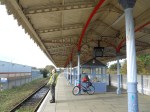
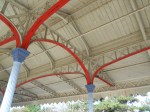
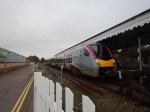

Suppose that testing was to be done at Felixstowe of a battery-electric Class 755 train.
- The containerised electrical system would be placed somewhere convenient.
- A short length of overhead wire would be erected in the platform.
- The system would then be connected together and to the electrical supply.
- After testing, it could be used to charge a train.
It would be very convenient for operation of the railway, if it could be installed and taken out overnight.
Conclusion
It looks a well-designed system.
Key Mainline Testing Undertaken In Bi Modal Hydrogen Train Project
The title of this post, is the same as that of this article on Rail Technology Magazine.
This is a key paragraph.
In the test, lithium-titanate batteries and the hydrogen fuel cells have been retro-fitted to a CAF Civia Class 463 commuter electric unit train. This then has the ability to create a hybrid powertrain which can run on electrified lines alongside standard lines.
This paragraph describes some of the testing.
The new power system has been integrated into the existing vehicle’s traction system and the current tests on the mainline follow closed track testing and static testing at CAF’s plant in Zaragoza. The mainline testing has taken place across lines in Zaragoza, Madrid and Galicia but the crucial test run for the new unit was on the Zaragoza-Canfranc line where it ran in both electric mode on the electrified line before switching to hybrid mode, combining the fuel from hydrogen fuel cells and batteries where needed.
It sounds like this is a better specified hydrogen-powered train than Alstom’s iLint.
Skeleton To Supply Ultracapacitors To CAF
The title of this post, is the same as that of this article on Electrive.
These two sentences are in the last paragraph.
In its German plant in Großröhrsdorf, Skeleton Technologies is working on so-called hybrid energy storage systems. In short, the advantages of lithium-ion batteries (high energy density) are to be combined with the advantages of ultracapacitors (high performance, long service life) in such hybrid storage systems
But I suggest you read the article as it indicates how supercapacitors could be used on battery-trams and trains.
If CAF use supercapacitors on their trains it will not be their first application on heavy rail in the UK. In Brush Traction Signs Contract With Skeleton Technologies For Modules For Class 769 Trains, I describe how supercapacitors are used to start the engines.
Thoughts On CAF’s Battery-Electric Class 331 Trains
I first wrote about CAF’s battery-electric trains in Northern’s Battery Plans, where I describe how CAF and Northern are planning to convert a number of three-car Class 331 trains into four-car battery-electric trains.
- The fourth car would contain batteries.
- Batteries would also be added to the PTS (pantograph) car.
I suspect that the battery range could be arranged so that all Northern’s routes suitable for battery-electric operation could be handled.
These are my thoughts.
How Much Would The Conversion Cost?
I will first make rough estimate of what the extra car would cost.
Northern placed a £500 million order for the following trains.
- 31 x three-car Class 331 trains
- 12 x four-car Class 331 trains
- 25 x two-car Class 195 trains
- 33 x three-car Class 195 trains
This is a total of 290 trains.
So on a rough estimate, each car will cost around £1.72 million.
As batteries would also be added to the pantograph car, the cost of updating a three-car train to a four-car battery-electric train would probably be around two million.
Why Are CAF Proposing A Four-Car Train With Two Battery Cars?
When I first read about CAF’s and Northern’s plans, I wondered, why CAF were also putting batteries in the pantograph car, as surely, with their extensive experience with battery-powered trains, CAF could fit enough batteries into one battery-car for a reasonable range, as Bombardier did seven years ago.
Having done all the calculations around Wigan and Bolton in Bolton-Wigan £78m Rail Electrification Project Announced, I suspect that CAF and Northern want a trans-Pennine range, so they can compete with TransPennine Express.
Two cars with batteries is probably needed for that.
Could The Three-Car Trains Be Converted To Three-Car Battery-Electric Trains?
But there is a collateral benefit of putting batteries in the pantograph car.
I suspect that in a four-car Class 331 trains have a trans-Pennine range, which between Manchester Victoria and Leeds stations is 50.2 miles and between Carlisle and Newcastle stations is 61.5 miles. So let’s say that the four-car Class 331 train with two battery packs has a range of 70 miles.
So what would be the range of a three-car train with one battery pack.
One battery pack would only take a four-car train 35 miles, so a single battery pack would contain 140 car-miles of electricity.
If a single-battery were to be fitted to the pantograph car of a three-car train, 140 car-miles would give a range of 46.7 miles.
My conclusion about the Bolton and Wigan electrification in Bolton-Wigan £78m Rail Electrification Project Announced, was as follows.
This electrification of just 6.5 miles of double-track between Lostock junction and Wigan Wallgate station seems to be one of the smaller electrification projects.
But on closer examination, when linked to a fleet of battery-electric trains with a range of perhaps forty miles, the electrification enables battery-electric trains to run these services.
- Southport And Alderley Edge
- Southport And Stalybridge
- Kirkby And Manchester Victoria
With a charging station in Blackburn station, then the Wigan Wallgate And Blackburn service can be added.
All these four services could be run by three-car battery-electric Class 331 trains. And if the services are to be run by six-car trains, a pair can be coupled up.
What Would Be The Range Of A Four-Car Battery-Electric Train With Only One Battery?
If I’m right that a four-car battery-electric Class with two batteries has a range of seventy miles across the Pennines, then a train with one battery should be able to manage 35 miles.
Conclusion
It sounds like the Spanish might have come up with a cunning plan, that might be able to convert both three- and four-car Class 331 trains to battery-electric operation.
By adding a battery to the pantograph car, this enables a four-car battery-electric train with a trans-Pennine range.
Summing up the various options gives the following ranges.
- Three-car battery-electric train with one battery pack – 46.7 miles
- Four-car battery-electric train with one battery pack – 35 miles
- Four-car battery-electric train with two battery packs – 70 miles
I’m impressed.
CAF Selected For Major Battery Train Order
The title of this post, is the same as that of this article on Railway Gazette International.
This is the first paragraph.
CAF has been named as preferred bidder for what it says is the largest order to date for battery trains. This covers the supply and maintenance of more than 60 electric multiple-units which will be able to operate on non-electrified sections of the Niederrhein-Münsterland network.
On reading the rest of the article, it sounds like the trains are to a high standard, with all the features one could expect.
As in Bolton-Wigan £78m Rail Electrification Project Announced, I predicted that CAF could sell a number of battery-electric trains to Northern in the UK, it looks like CAF could be building a substantial number of battery-electric trains.
There could even be the possibility of some of the German trains being assembled in the CAF factory in Newport, as the logistics might be easier.
Bolton-Wigan £78m Rail Electrification Project Announced
The title of this post, is the same as that of this article on the BBC.
This is a small electrification project compared to many, but it still includes.
- 13 miles of electrification.
- 450 new overhead line equipment stanchions.
- Modifications to 17 bridges and two level crossings.
- Platform extensions at Westhoughton, Hindley and Ince stations, so that they can handle six-car trains.
Completion is expected to be 2025.
The numbers indicate it could be be a small project with quite a bit of work.
I have a few specific thoughts.
How Far Will The Electrification Go?
This document on the Government web site is entitled Green Light Given For Wigan To Bolton Electrification.
These are two paragraphs.
The track between Wigan North Western station and Lostock Junction near Bolton will receive a £78 million upgrade, targeted to complete in 2024/2025.
Through electrifying almost 13 miles of infrastructure and lengthening platforms, this investment will ensure that CO2 emitting diesel trains are replaced by electric rolling stock. As longer trains with additional capacity, these will provide passengers with greener, more comfortable and more reliable journeys.
Note.
- Lostock junction is on the Manchester and Preston Line which was electrified in 2019.
- As is typical, the electrification continues for a short distance from Lostock junction towards the Wigan stations.
- Wigan North Western station is a fully-electrified station on the West Coast Main Line.
- Wigan Wallgate station is not electrified.
- The distance between Lostock junction and Wigan Wallgate station is 6.9 miles.
- Lostock junction and Wigan Wallgate station is double-track all the way.
- My Track Atlas shows crossovers that allow trains to and from Lostock junction to access some platforms at Wigan North Western.
These facts lead me to these conclusions.
- As thirteen files of electrification would be 6.5 miles of double-track electrification, the new electrification would create a fully-electrified line between Lostock junction and Wigan Wallgate station.
- By electrifying the crossovers at Wigan Station junction, electric trains would to able to access both Wigan stations.
But this does mean, that electric trains can’t run past Wigan Wallgate station, as the wires seem to stop there.
Electrification At Wigan Wallgate Station
Mark Clayton has made this comment to this post.
Yes there is a single track connecting from the track through Hindley to the WCML and vice versa, however at Wallgate there are buildings straddling the line and the station itself. Maybe the track could be lowered, but it could well be a major engineering project to get the wires under Wallgate.
The best picture, that I can get of the tracks under Wallgate is this 3D image from Google Maps.
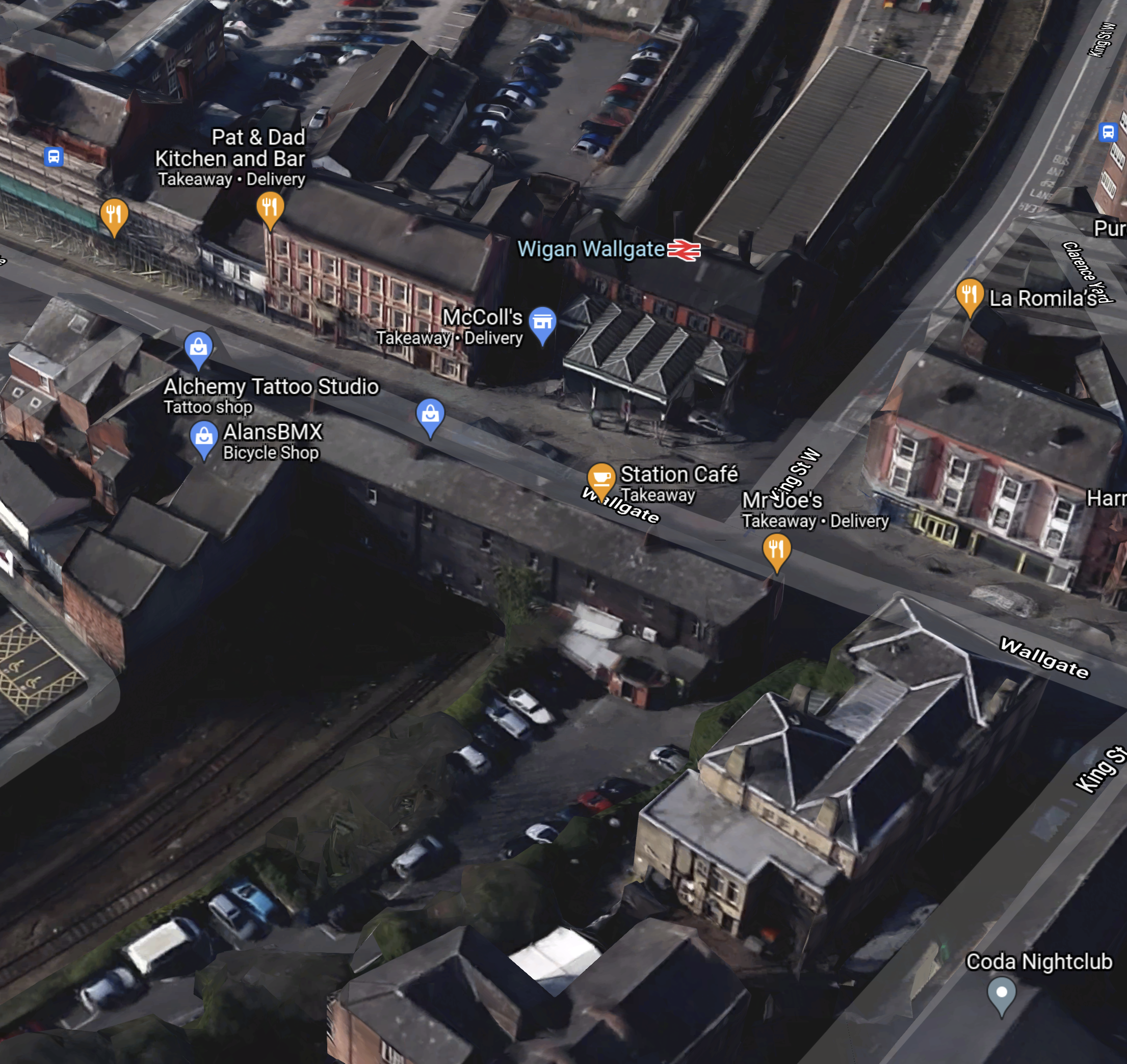
It does seem a bit tight in terms of height.
I have also looked at several videos of trains going trough the station and I suspect that the tracks may need lowering to get the wires through.
Or they could use some of the discontinuous tricks being used on the South Wales Metro.
It could be difficult, but I don’t think it will be impossible.
I do suspect though for operational reasons, Network Rail and the train operators would want the wires to extend to the station.
- Train operators probably prefer to raise and lower the pantograph in a station, in case anything goes wrong.
- If battery-electric trains should be used on the line, then if necessary, they could wait in the station to charge the batteries.
- If the station is wired, then the West-facing bay-platform can also be wired, so that it could be used for a battery-electric shuttle train to Kirkby or Southport.
It looks to me, that for lots of reasons, the engineers will have to find a way of getting the wires under the low bridge under Wallgate.
Services That Use All Or Part Of The Route Between Lostock Junction And Wigan
These services use all or part of the route.
- 1 tph – Southport and Alderley Edge via Ince (irregular), Hindley, Westhoughton and Bolton
- 1 tph – Southport and Stalybridge via Hindley, Westhoughton and Bolton
- 1 tph – Kirkby and Manchester Victoria via Ince (irregular), Hindley, Daisy Hill, Hag Fold, Atherton, Walkden, Moorside, Swinton and Salford Crescent.
- 1 tph – Wigan Wallgate and Blackburn via Hindley, Daisy Hill, Atherton, Walkden, Swinton and Salford Crescent.
- 1 tph – Wigan Wallgate and Leeds via Daisy Hill, Atherton, Walkden and Salford Crescent.
Note.
- tph is trains per hour.
- The two services that terminate at Wigan Wallgate sometimes terminate in Wigan North Western station.
- Wigan Wallgate station would appear to get up to five tph to Manchester, via a variety of routes.
I wonder how many of these services could be run by a battery-electric train, with a performance like the Hitachi Regional Battery Train, which is described in this Hitachi infographic.

Note 90 kilometres is 56 miles.
I will look at each route in detail.
Southport And Alderley Edge
The only section without electrification will be between Wigan Wallgate and Southport stations, which is a distance of 17.4 miles.
With a battery range of 56 miles, a battery-electric train should be able to run a return trip between Wigan Wallgate and Southport stations on battery power and have time for a leisurely turnround in Southport.
The batteries would be charged on the fully electrified section of the line between Wigan Wallgate and Alderley Edge stations.
Southport And Stalybridge
There are two sections without electrification.
- Wigan Wallgate and Southport stations – 17.4 miles
- Manchester Victoria and Stalybridge stations – 7.6 miles
With a battery range of 56 miles, a battery-electric train should be able to run a return trip on both sections without electrification.
The batteries would be charged on the fully electrified section of the line between Wigan Wallgate and Manchester Victoria stations.
Kirkby And Manchester Victoria
There are two sections without electrification.
- Wigan Wallgate and Kirkby stations – 12.1 miles
- Hindley and Salford Crescent stations – 13.4 miles
With a battery range of 56 miles, a battery-electric train should be able to run services on both sections without electrification.
The batteries would be charged on the two fully electrified sections of the line between Wigan Wallgate and Manchester Victoria stations.
Wigan Wallgate And Blackburn
There are two sections without electrification.
- Hindley and Salford Crescent stations – 13.4 miles
- Manchester Victoria and Blackburn stations – 39.4 miles
The first section could be easily run by a battery electric train, but the second section would need a charger at Blackburn station to return to Manchester Victoria station.
The batteries would be charged on the two fully electrified sections of the line between Wigan Wallgate and Manchester Victoria stations.
Wigan Wallgate And Leeds
There are two sections without electrification.
- Hindley and Salford Crescent stations – 13.4 miles
- Manchester Victoria and Leeds stations – 50.2 miles
The first section could be easily run by a battery electric train.
But the second section would be very much touch-and-go with a battery-electric train with a range of 56 miles, despite the fact that both Manchester Victoria and Leeds stations are electrified.
It should also be noted that Network Rail has plans in the TransPennine Upgrade to electrify the route between Leeds and Heaton Lodge junction between Mirfield and Brighouse stations. This would reduce the second section without electrification to a more manageable 37.1 miles.
I suspect that by the time the TransPennine Upgrade is complete, battery range would have improved to allow Manchester Victoria and Leeds stations to handle the route.
Battery-Electric Trains That Could Run The Services Through Wigan Wallgate Station
I have used the Hitachi Regional Battery Train as an example of a train that might run the services through Wigan Wallgate station.
- It has an operating speed of 100 mph.
- It could be based on a Class 385 train, which have three or four cars.
- It would have a battery range of 56 miles.
I suspect a demonstration train will run by 2025, which is the expected date of completion of the Lostock and Wigan electrification project.
But other manufacturers and rolling stock companies could also supply trains, with this specification.
- Alstom could create a battery-electric train based on an Electrostar, like a Class 379 or Class 387 train.
- CAF are developing a battery-electric train based on a Class 331 train.
- Porterbrook are developing a battery-electric train, based on a Class 350 train.
- Stadler could probably deliver a battery-electric Flirt based on a Class 755 train.
Competition would hopefully result in an excellent train, that would be suitable for many routes in the UK.
Northern’s Battery Plans And CAF
I suspect though that CAF could be the front runner as Northern already have forty-three Class 331 trains in service.
In Northern’s Battery Plans, I describe how CAF and Northern are planning to convert a number of three-car Class 331 trains into four-car battery-electric trains.
- The fourth car would contain batteries.
- Batteries would also be added to the PTS (pantograph) car.
I suspect that the battery range could be arranged so that all routes suitable for battery-electric operation could be handled.
In this article on Rail Magazine, which is entitled Northern Plans More New Trains After CAF Milestone, this is a paragraph.
A CAF source confirmed that a lot of work was ongoing with Northern, including the continued development of a battery EMU that is planned to be tested on the Oxenholme-Windermere route.
As the article dates from January 2021, things should be progressing.
Possible routes for battery-electric operation could be.
- Northumberland Line – Under construction
- Csrlisle and Newcastle – 61.5 miles between electrification at both ends
- Wigan Wallgate and Leeds via Dewsbury – 50.2 miles between electrification at both ends
- Manchester Victoria and Leeds via Hebden Bridge – 49.8 miles between electrification at both ends
- Leeds And Carlisle via Settle – 86.8 miles between electrification at both ends.
- Leeds and Morecambe – 37.8 miles between electrification.
- Manchester Airport and Barrow-in-Furness – 28.7 miles from electrification
- Manchester Airport and Windermere – 10.9 miles from electrification
Note.
- The distance is the longest section without electrification.
- Some routes have electrification at both ends.
- Some need an out-and-back journey at one end of the route.
I was surprised that the Settle and Carlisle Line could be included and as battery technology improves it certainly will be possible.
What a tourist attraction that line would be if worked by battery-electric trains.
Conclusion
This electrification of just 6.5 miles of double-track between Lostock junction and Wigan Wallgate station seems to be one of the smaller electrification projects.
But on closer examination, when linked to a fleet of battery-electric trains with a range of perhaps forty miles, the electrification enables battery-electric trains to run these services.
- Southport And Alderley Edge
- Southport And Stalybridge
- Kirkby And Manchester Victoria
With a charging station in Blackburn station, then the Wigan Wallgate And Blackburn service can be added.
It also looks that with the completion of the TransPennine Upgrade between Huddersfield and Leeds, that it might even be possible to run Wigan Wallgate and Leeds using battery-electric trains.
There will be a long list of stations, previously served by diesel trains, that will now only be served by electric or battery-electric trains.
- Appley Bridge
- Atherton
- Bescar Lane
- Burscough Bridge
- Daisy Hill
- Gathurst
- Hag Fold
- Hindley
- Hoscar
- Ince
- Kirkby
- Meols Cop
- Moorside
- New Lane
- Orrell
- Parbold
- Pemberton
- Rainford
- Southport
- Swinton
- Upholland
- Walkden
- Wigan Wallgate
- Westhoughton
That is a total of twenty-four stations.
Never in the field of railway engineering, has one small section of electrification delivered electric trains to so many stations.
Will Hitachi ABB Power Grids Technology Be Used At Headbolt Lane Station?
Today, I was sent a link to the North Cheshire Rail User Group’s Newsletter for Spring 2021.
Current Progress on Merseyrail’s Class 777 Trains
This is said in the newsletter about the progress of the new Class 777 trains.
At a recent meeting of the Liverpool City Region rail user groups hosted by Liam Robinson, Chair of
Merseytravel, a short presentation was given detailing progress in bringing the new Class 777 Stadler fleet into
operation. NCRUG has been keeping a keen watch on the introduction of this new fleet; later model Class 777’s
have the ability to leave the 3rd rail and operate under battery power for 20 miles or more with a full load thus
permitting expansion of the Merseyrail network beyond its current limits.Particularly of interest in our patch is the Ellesmere Port to Helsby line, although at one point in the meeting I
did raise the concept of ultimately having a complete Merseyrail service circling the Mersey Estuary on a metro
styled basis Ambitious certainly, but unrealistic as a long-term goal? There would be considerable work required
at Liverpool south Parkway to connect the Merseyrail line to the network, however the terrain is suitably flat and
the trains will be capable. This obvious evolution of the network did seem to take the meeting by surprise.Unfortunately the much anticipated introduction of the Class 777’s has been delayed for a number of factors,
not least of all the pandemic but border issues and storage also play a part. Trails are taking place on the Kirby
and Ormskirk lines, and full introduction might not be until as late as next year. The Liverpool City Region has a
clearly defined set of (deliverable) objectives for development of the rail network and the expansion has been
prioritised with a line to Skelmersdale being top of the list and the first step of that being a new station at Headbolt
Lane, Kirby – plans are already well developed for this. It is expected to be this line where proof of concept trails
will be conducted for the battery powered 777’s, although Merseyrail does have authorisation to use Ellesmere
Port–Helsby on account of the low traffic movements on that line! Network expansion is being considered to
Widnes via Hunts Cross and possibly as far as Warrington, but when the question of Ellesmere Port–Helsby
was raised, the route, although under consideration, was not high on the priority list. I suspect it will be at least
several years away and I’m sure the delayed introduction of the type will not only come as a disappointment for
NCRUG but also the Community Rail Partnership and CWaC Council, who have funded a basic feasibility study
into possible demand. Therefore we are left with the Northern Trains service for the foreseeable future – 3 return
trains daily on the current schedule.
After reading this extract, I am puzzled. The original priority was to use the battery capabilities of the new Class 777 trains to extend the Ellesmere Port service to Helsby.
- Ellesmere Port and Helsby stations are 5.2 miles apart.
- Ellesmere Port has a two trains per hour (tph) service to Birkenhead and Liverpool.
- Ellesmere Port and Helsby stations are linked by a three trains per day (tpd) service.
Helsby station has comprehensive connections to Chester, Leeds, Liverpool, Manchester and Warrington Bank Quay station.
Two tph between Ellesmere Port and Helsby stations would certainly improve train services in the area and probably explains the disappointment shown by the writer of the newsletter.
So why have Merseyrail switched the emphasis to battery trains to Headbolt Lane and Skelmersdale from Ellesmere Port and Helsby?
Headbolt Lane Station
Headbolt Lane station is a station of an unusual design, which I wrote about in Headbolt Lane Station Fly-Through.
- Two platforms appear to face West towards Liverpool.
- One platform appears to face East towards Wigan and Manchester.
- The platforms meet head-on and a walkway runs between them to allow passengers to access all platforms.
- There appears to be provision for a fourth platform to serve Skelmersdale. which is to the East of Headbolt Lane.
I think the design means that access to all platforms is level, passengers can enter from both sides of the railway and the station doesn’t need an expensive bridge.
Between Kirkby And Headbolt Lane Stations
Headbolt Lane and Kirkby stations are a couple of miles apart at most. So were Merseyrail hoping to extend the third-rail electrification to Headbolt Lane station, but the Office of Rail and Road has more or less said that no more third-rail electrification is allowed. See ORR’s Policy On Third Rail DC Electrification Systems.
So are Merseyrail having to use battery power between Kirkby and Headbolt Lane stations?
If they are then they have the trains.
As according to the extract from the Cheshire Rail User Group’s Newsletter, the Class 777 trains have a range of twenty miles on battery power, then this should be no problem.
The Skelmersdale Shuttle
The design of Headbolt Lane station does mean that there will be no through running between Liverpool and Skelmersdale.
So it looks to me, that to allow full step-free access to all platforms, the Skelmersdale service will be a battery-electric shuttle train.
- It could also be the only train on a single-track between Headbolt Lane and Skelmersdale, which would simplify signalling and operation.
- Two tph could be possible with a single train.
- The train would be charged in either termini using an appropriate charging system.
How many other simple branch lines could be run that way or built new?
Headbolt Lane And Manchester Victoria Via Wigan Wallgate
Consider.
- The distance between Headbolt Lane and Manchester Victoria stations is just under thirty miles, which is well within range of the average battery-electric trains currently under development.
- As the current Kirkby and Manchester Victoria stations is run by Northern Trains and they are likely to be acquiring some Class 331 trains with a battery capability, these will surely be an ideal train.
- The train would be charged in the East-facing platform at Headbolt Lane station using an appropriate charging system.
Headbolt Lane station would be a diesel-free station. As incidentally, so would Kirkby and Skelmersdale stations.
Charging Trains At Headbolt Lane Station
It would appear that both East-facing platforms at Headbolt Lane station will need to charge these trains.
- A Class 777 train with a third-rail capability and the ability in the future to access overhead electrification.
- A Class 331 train with no third-rail capability and the ability to access overhead electrification.
Class 777 trains from Liverpool would hopefully have enough power in their batteries to return to Kirkby.
It would appear that a short length of 25 KVAC overhead electrification in both platforms would be ideal for charging trains to and from Manchester and Skelmersdale.
If one of Hitachi ABB Power Grids’s containerised overhead electrification power systems could handle both platforms, it would surely be ideal.
A crossover to allow Manchester and Skelmersdale trains to use either East-facing platform, might be desirable, as it could improve reliability.
Conclusion
It looks like Hitachi ABB Power Grids can provide a sensible solution to handling battery-electric trains at Headbolt Lane station. Or for that matter at any station, where battery-electric trains interface with the UK rail network.
Headbolt Lane Station Fly-Through
I had to show this Merseytravel YouTube video, as I feel the new Headbolt Lane station uses some interesting ideas.
This Google Map shows Headbolt Lane and the railway.
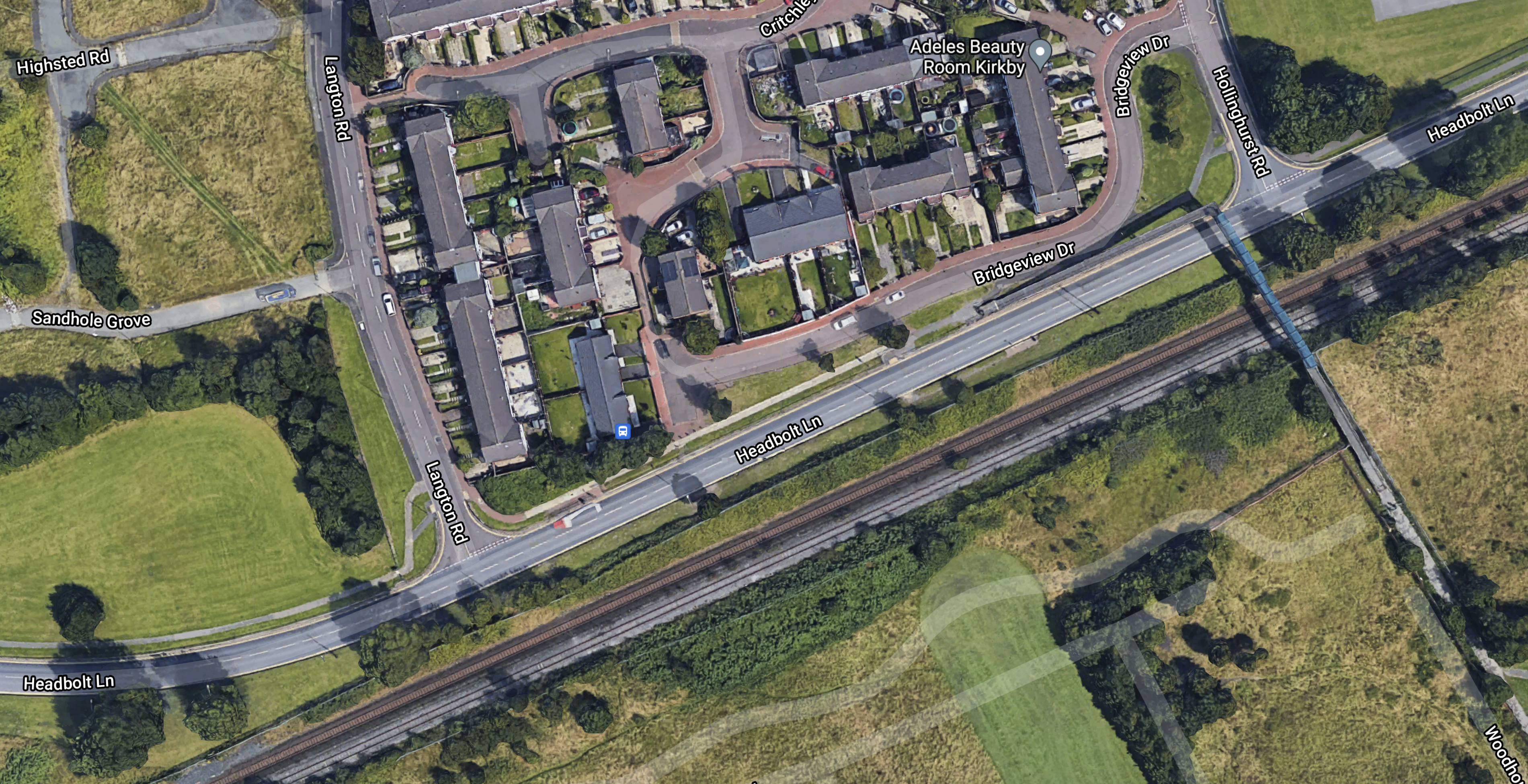
Note.
- The footbridge over the railway. I took the pictures from and around this bridge in Merseyrail To Skelmersdale – Headbolt Lane Station.
- The footbridge can’t be seen in the YouTube video.
Liverpool is to the West and Wigan is to the East.
These are my thoughts.
Is The Station North Or South Of The Railway?
As it is called Headbolt Lane, the station must have good access from that road, otherwise travellers will get rather confused.
So until proven otherwise, I will assume that the station must be to the North of the railway.
Which Way Is Liverpool In the Video?
If the station is North of the railway, then in the first part of the video, the visualisation approaches the station from the North and Liverpool is to the right and Wigan is to the left.
If that is right, then the yellow bus always points towards Liverpool.
How Many Platforms?
Wikipedia says that Headbolt Lane station will have three platforms.
From the video there will be two platforms for trains to and from Liverpool, although the current layout at Kirkby station makes do with just one platform.
There would also appear to be a single platform for trains to and from Wigan, Bolton and Manchester.
But there is a second Eastern track shown in the video, which possibly indicates provision has been made for a second platform for services in that direction.
Wot No Bridge?
It would appear that there is no bridge over or subway under the railway.
But it does appear that the platform layout shown allows passengers to walk between the ends of the tracks on the level to the platform or platforms on the side of the station away from the station building.
Will There Be A Second Entrance To The Station On The Other Side Of The Tracks?
The layout would allow this and it could be useful for those passengers living or working on that side of the railway.
Is The Platform Layout Unique?
I have travelled widely looked at railway stations all over the world.
But I can’t remember seeing a layout like this.
The layout does have advantages.
- An expensive bridge with lifts will not be needed.
- There is nothing mechanical or electrical to go wrong.
- Extra platforms can be added if required.
- It can also be used as a simple step-free way to cross the railway.
I suspect that the layout could be used in other places.
Train Frequencies To Liverpool
The current service between Kirkby station and Liverpool is four trains per hour (tph), which is handled on a single platform.
One platform at Headbolt Lane would surely be sufficient, but a second platform must surely allow extra services and provide more resilience in case of train failure.
Train Frequencies To Wigan, Bolton And Manchester
The current service between Kirkby station and Manchester is one tph, which is handled on a single platform.
One platform at Headbolt Lane would surely be sufficient and could easily handle two tph.
Are two platforms provided for Liverpool services, so that extra services could be run in the Peak or to provide more resilience, should a train fail in the station.
A Service To Skelmersdale
Consider.
- Skelmersdale is about five miles North of the line between Headbolt Lane and Wigan.
- One of Merseyrail’s current Class 507 trains covers the 5.5 miles between Kirkby and Sandhills station in twelve minutes.
- The proposed layout of Headbolt Lane station does not allow direct services between Liverpool and Skelmersdale.
These distances and timing would mean the following.
- A single shuttle train between Headbolt Lane and Skelmersdale could run a two tph service.
- A pair of shuttle trains between Headbolt Lane and Skelmersdale could run a four tph service.
Passengers would need to change trains at Headbolt Lane station.
This may seem less passenger-friendly than a direct service, but it could be the most affordable option.
And it could always be improved with modifications at Headbolt Lane station.
Is There A Role For Battery-Electric Trains?
Consider.
- For Health and Safety reasons, it is very unlikely that any new third-rail track will be laid in the UK.
- The distance between the current Kirkby station and the new Headbolt Lane station is about 1.5 miles.
- The distance between Headbolt Lane and Skelmersdale stations is less than eight miles.
- I suspect Headbolt Lane and Skelmersdale stations would both have good power supplies.
- Merseyrail’s new Class 777 trains have a battery capability.
Would this allow the following?
- Liverpool and Headbolt Lane services to use battery power between Kirkby and Headbolt Lane station. All charging would be done between Liverpool and Kirkby.
- The shuttle train between Headbolt Lane and Skelmersdale would work on battery power, with batteries charged at both ends of the route.
There is also the possibility, that the Headbolt Lane and Manchester Victoria service could be run using battery-electric Class 331 trains.
- Headbolt Lane and Manchester Victoria will be a 28.5 mile service with a couple of miles of electrification at the Manchester end.
- I estimate that the battery-electric Class 331 trains will have sufficient range to handle this route with charging at Headbolt Lane station.
- Currently, trains from Manchester Victoria take over ten minutes to turnround at Kirkby station.
- Provision for a charger could be built into Headbolt Lane station.
It would be a simple way to electrify the Kirkby and Manchester Victoria service.
In addition, battery-electric Class 331 trains are likely to have longer battery range than the Class 777 trains.
So might it be better if the Headbolt Lane and Skelmersdale shuttle was worked by battery-electric Class 331 trains.
If the two East-facing platforms at Headbolt Lane station were to be fitted with charging facilities, this would give an increased level of reliability.
Could Northern’s Manchester Victoria Service Terminate At Skelmersdale?
If both services were to be run by Northern’s battery-electric Class 331 trains, this could be a possibility.
- A reverse would be needed at Headbolt Lane station.
- I estimate that 2tph on the route would fit together well.
- Trains would be charged at Skelmersdale station.
- Chargers might not be needed at Headbolt Lane station.
In addition, a two tph service would fit in well with four or six tph to Liverpool.
Conclusion
It’s almost as if Headbolt Lane station could consist of three elements.
- The station facilities, bus interchange and car parking.
- A two-platform station for Merseyrail services to Liverpool
- A two-platform station with charging facilities for Northern services to Blackburn, Bolton, Manchester Victoria, Skelmersdale and Wigan.
All services from Headbolt Lane station will be run by battery-electric reains.
Costs have been saved by the following.
- Not having a bridge over the tracks.
- Maintaining the separation between Northern and Merseyrail services.
- Not electrifying between Kirkby and Headbolt Lane stations.
- Not electrifying the Skelmersdale Branch.
The whole station appears to have been designed on a single level.
Battery-Electric Class 331 Trains On The Radar
In the June 2021 Edition of Modern Railways, there is an article which is entitled Northern Looks To The Future.
This is a paragraph.
Also on the radar is the creation of hybrid Class 331 EMUs fitted with batteries. A proposal has been developed by CAF and owner Eversholt Rail to augment three-car ‘331s’ with a fourth vehicle containing batteries, which would see batteries also fitted to the existing centre car. The Manchester to Windermere route has been touted as a possible location for deployment, with trains switching to battery power on the non-electrified branch from Oxenholme, although the line’s user group still favours electrification of the branch.
I have a few thoughts.
Electrification at Oxenholme
In Surprising Electrification At Oxenholme, I detailed the electrification at Oxenholme station in May 2018.
Consider.
- Platform 3 used by the Windermere trains is fully electrified.
- The crossover South of the station used by trains going between the Windermere Branch Line and the West Coast Main Line is fully electrified.
- The electrification continues for perhaps a hundred metres along the Windermere branch.
I am fairly certain, that this electrification has been designed so that a bi-mode or battery-electric train can perform a reliable power changeover in Platform 3 at Oxenholme station.
What Will Be The Range Of A Four-Car Battery-Electric Class 331 Train?
This is very much a case of how long is a piece of string.
At least we know from the extract above that the train is designed to do a return trip between Oxenholme and Windermere stations, which is a distance of 20.4 miles and a six minute turnround.
We should also note that Hitachi are claiming a range of 56 miles for their Regional Battery Train, which is described in this Hitachi infographic.
As the Class 331 with batteries will compete with the Hitachi Reional Battery Train, I would suspect that the range on easy level ground would be at least fifty miles at a speed of over 80 mph, if not 100 mph.
A Selection Of Possible Routes
These are a selection of other Northern routes where the battery-electric Class 331 trains might be used.
Manchester Airport and Barrow-in-Furness
Consider.
- This is a sibling route to the Manchester Airport and Windermere route and currently has eleven services to Windermere’s four.
- This is a 103.7 mile route.
- All but 28.1 miles is electrified.
Battery-electric Class 331 trains with a charge at Barrow-in-Furness should be able to handle this route.
Lancaster and Barrow-in-Furness
Consider.
- This is a 34.8 mile route
- All but 28.1 miles is electrified.
- Lancaster is a fully electrified station.
Battery-electric Class 331 trains with a charge at Barrow-in-Furness should be able to handle this route.
Carlisle and Barrow-in-Furness
This is the 85.7 mile route of the Cumbrian Coast Line of which none is electrified.
Consider.
- Carnforth is a fully-electrified station.
- Barrow-in-Furness station could be electrified.
- It is a fairly level route along the coast.
- I suspect that electricity supplies are available at Barrow-in-Furness, Sellafield, Whitehaven and Workington to power electrification.
- Carlisle is a fully-electrified station.
- Barrow-in-Furness and Sellafield are only 35 miles apart.
- CAF have produced trams for Birmingham and Seville, that work with discontinuous electrification.
- There are parts of the route, where there would be those, who would object to the erection of electrification gantries.
I feel it would be possible to electrify the Cumbrian Coast Line using battery-electric Class 331 trains, with a range of at least fifty miles and some short sections of new electrification.
Surely, a battery-electric train along the Cumbrian Coast by the Lake District would be the ideal train for the area
Lancaster and Morecambe
Consider.
- This is a 4 mile route.
- None is electrified.
- Heysham is another four miles past Morecambe.
- Lancaster is a fully-electrified station.
This route might have been built for battery-electric trains.
This route might be possible with no extra infrastructure.
York and Blackpool North
Consider.
- This is a 105.5 mile route.
- In a few years about 62 miles will be without electrification.
- It goes through the picturesque Calder Valley.
As with the Cumbrian Coast Line, I believe that this service could be run using battery-electric Class 331 trains, with a range of at least fifty miles and some short sections of new electrification.
Preston and Colne
Consider.
- This is a 29 mile route.
- None is electrified.
- It is steeply uphill to Colne.
Battery-electric Class 331 trains with a charge at Colne should be able to handle this route.
Alternatively, they could use Newton’s friend to return down the hill.
This route might be possible with no extra infrastructure.
As with York and Blackpool North, this route would benefit with electrification between Preston and Blackburn.
Preston and Blackpool South
Consider.
- This is a 20 mile route.
- 7.7 miles is electrified.
Battery-electric Class 331 trains should be able to handle this route.
This route might be possible with no extra infrastructure.
In an ideal world, Preston and Blackburn would be electrified and trains would run between Colne and Blackpool South, as they used to do.
Liverpool Lime Street and Manchester Airport
Consider.
- This is a 45.5 mile route,
- 26.5 miles is not electrified.
- It is fully electrified at both ends.
Battery-electric Class 331 trains should be able to handle this route.
This route might be possible with no extra infrastructure.
Liverpool Lime Street and Manchester Oxford Road
Consider.
- This is a 34.2 mile route.
- 26.5 miles is not electrified.
- It is fully electrified at both ends.
Battery-electric Class 331 trains should be able to handle this route.
This route might be possible with no extra infrastructure.
Southport and Alderley Edge
- This is a 52 mile route,
- 27 miles is not electrified.
- It is fully electrified at the Southern end.
- There is third rail electrification at Southport.
Battery-electric Class 331 trains with a charge at Southport should be able to handle this route.
Could some Class 331 be fitted with third-rail equipment to charge on Merseyrail’s third-rail electrification?
Manchester Piccadilly and Chester
Consider.
- This is a 45 mile route.
- 38 miles is not electrified.
- It is fully electrified at Manchester end.
- There is third rail electrification at Chester.
Battery-electric Class 331 trains with a charge at Chester should be able to handle this route.
Could some Class 331 be fitted with third-rail equipment to charge on Merseyrail’s third-rail electrification?
Manchester Piccadilly and Buxton
Consider.
- This is a 25.5 mile route.
- 17.8 miles is not electrified.
- It is steeply uphill to Buxton.
Battery-electric Class 331 trains with a charge at Buxton should be able to handle this route.
Alternatively, they could use Newton’s friend to return down the hill.
This route might be possible with no extra infrastructure.
Manchester Piccadilly and Rose Hill Marple
Consider.
- This is a 13.3 mile route.
- 8.3 miles is not electrified.
- It is fully electrified at Manchester end.
Battery-electric Class 331 trains should be able to handle this route.
This route might be possible with no extra infrastructure.
Manchester Piccadilly and New Mills Central
Consider.
- This is a 13 mile route.
- Only 2 miles is electrified.
- It is fully electrified at Manchester end.
Battery-electric Class 331 trains should be able to handle this route.
This route might be possible with no extra infrastructure.
Manchester Piccadilly and Sheffield
Consider.
- This is a 42 mile route.
- Only 2 miles is electrified.
- It is fully electrified at Manchester end.
- It is a scenic route.
Battery-electric Class 331 trains with a fifty mile range and a charge at Sheffield should be able to handle this route.
Southport and Stalybridge
- This is a 45 mile route.
- 27 miles is not electrified.
- It will be fully electrified at the Southern end, when electrification between Manchester Victoria and Stalybridge is completed.
- There is third rail electrification at Southport.
Battery-electric Class 331 trains with a charge at Southport should be able to handle this route.
Could some Class 331 be fitted with third-rail equipment to charge on Merseyrail’s third-rail electrification?
Manchester Victoria And Kirkby
- The Kirkby end of this route will change to the new Headbolt Lane station in a couple of years.
- This is a 30 mile route.
- 28 miles is not electrified.
- It is fully electrified at the Southern end.
- There is third rail electrification at Kirkby or Headbolt Lane.
Battery-electric Class 331 trains with a charge at Kirkby or Headbolt Lane should be able to handle this route.
Could some Class 331 be fitted with third-rail equipment to charge on Merseyrail’s third-rail electrification?
I would hope that the new Headbolt Lane station is being designed with battery-electric trains from Manchester in mind!
Rochdale And Clitheroe
Consider.
- This is a 44.7 mile route.
- There is 10.7 miles of electrification between Bolton and Manchester Victoria.
- The Clitheroe end of the route has 23.7 miles of line without electrification.
- The Rochdale end of the route has 10.4 miles of line without electrification.
- It is steeply uphill to Clitheroe.
Battery-electric Class 331 trains should be able to handle the Rochdale end, but could struggle with the climb to Clitheroe.
But it appears that all services needing to climb the hills to Colne and Clitheroe now stop in Platform 2, which is different to Wikipedia, which says that services to Clitheroe stop in Platform 1.
- With charging in platform 2 and a fifty-mile range battery-electric Class 331 trains could reach Clitheroe (9.8 miles), Colne (17 miles), and possibly Leeds (50 miles).
- With charging in platform 4 and a fifty-mile range battery-electric Class 331 trains could reach Bolton (14 miles) and Preston (12 miles)
- Would a fully-charged train leaving Blackburn be able to go via Todmorden and reach the electrification at Manchester Victoria, which is a distance of 39.4 miles?
Note.
If necessary a few well-planned extra miles of electrification would ensure reliable battery-electric services in East Lancashire centred on Blackburn.
The closely-related Blackburn and Rochdale and Blackburn and Wigan Wallgate services would fit in well with an electrified Blackburn station, that could fully charge trains.
I certainly believe that electrifying Preston and Blackburn could give extra benefits.
- Battery-electric trains between Blackpool and Liverpool in the West and Colne, Hebden Bridge, Bradford, Leeds and York in the East.
- Direct electric services from Euston to Blackburn and Burnley.
- Fast freight paths across the Pennines.
In addition, it would probably allow battery-electric trains to run to Leeds via a reinstated Skipton and Colne link.
Wigan And Leeds
Consider.
- The route can terminate at either Wigan North Western or Wigan Wallgate station.
- This is a 68.2 mile route using Wigan North Western.
- Wigan North Western is a fully-electrified station.
- The 16 miles between Wigan North Western and Salford Crescent stations is not electrified.
- The 5 miles between Salford Crescent and Manchester Victoria stations is electrified.
- The 37.2 miles between Manchester Victoria and Mirfield stations is not electrified.
- The 12.2 miles between Mirfield and Leeds will be electrified in the next few years.
- Leeds is a fully-electrified station.
Battery-electric Class 331 trains with a fifty mile range should be able to handle this route.
Chester And Leeds
Consider.
- This is a 89.7 mile route.
- There is third rail electrification at Chester.
- The 18.1 miles between Chester and Warrington Bank Quay stations is not electrified.
- The 21.8 miles between Warrington Bank Quay and Manchester Victoria stations is electrified.
- The 40.3 miles between Manchester Victoria and Bradford Interchange stations is not electrified.
- The 9.4 miles between Bradford Interchange and Leeds stations is not electrified.
- Leeds is a fully-electrified station.
- There seems to be generous turnround times at Chester and Leeds.
It looks to me that the trains are going to need a full battery charge at Bradford Interchange or perhaps Leeds and Bradford Interchange needs to be fully electrified.
I also feel that it would help if the electrification through Manchester Victoria were to be extended towards Rochdale.
But I don’t think it will be impossible for battery-electric Class 331 trains to work the route between Leeds and Chester with some new electrification and/or charging at Bradford Interchange.
Manchester Victoria And Leeds
Consider.
- This is a shortened version of the Chester and Leeds route.
- This is a 49.8 mile route.
- Manchester Victoria is a fully-electrified station.
- The 40.3 miles between Manchester Victoria and Bradford Interchange stations is not electrified.
- The 9.4 miles between Bradford Interchange and Leeds stations is not electrified.
- Leeds is a fully-electrified station.
My comments would be similar to the Chester and Leeds route.
Leeds And York Via Harrogate And Knaresborough
Consider.
- This is a 38.8 mile route.
- Leeds is a fully-electrified station.
- The Harrogate Line is not electrified.
- York is a fully-electrified station.
Battery-electric Class 331 trains with a fifty mile range should be able to handle this route.
There are two other services on the Harrogate Line.
- Leeds and Harrogate – 18.3 miles
- Leeds and Knaresborough – 22.1 miles
I have a feeling that a fleet of battery-electric trains could electrify all services on the Harrogate Line with no extra infrastructure.
Summing Up The Possible Routes
I have assumed that the proposed battery-electric Class 331 train has a range of around fifty miles, which is not unlike that for the Hitachi Regional Battery Train.
It would appear that many of Northern’s routes can be run by a train with this range including some that are around a hundred miles.
There are also routes like the Harrogate Line, which would accept a battery-electric Class 331 train tomorrow, if it were available.
Will A Mix Of Four-Car Electric And Battery-Electric Trains Be Better Than A Mix Of Four-Car And Three-Car Electric Trains?
If the technology is right, I suspect that a four-car battery-electric Class 331 train will be able to substitute for one without batteries on a route that doesn’t need battery power.
This must surely have advantages when trains are in maintenance or otherwise unavailable, as nothing annoys passengers more than an overcrowded train.
Conclusion
The Modern Railways article also says this.
More widely, Northern has previously stated ambitions to acquire more trains, and work was underway last year to identify what this requirement might be.
From my simple analysis on some of their routes, I would look to acquire some four-car battery-electric Class 331 trains, once they have been oroven to work.
 The Anonymous Widower