West Ealing Station – 2nd September 2019
These pictures show West Ealing station.
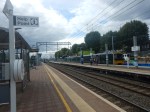

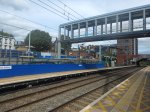
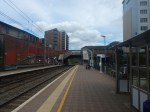
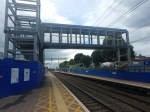
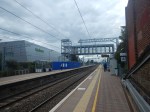

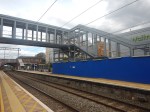
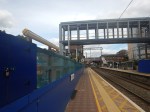
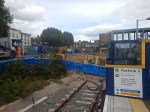
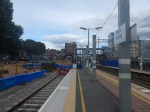
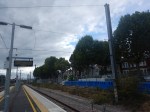
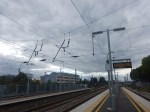
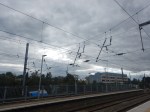
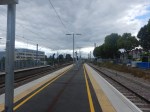
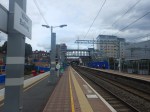
Some observations.
The Big Hole
A big hole is being dug on the North side of the station.
- This is the side where the entrance will be giving access from the road at the side of the station.
- There are no stairs or lift tower on this side.
- There looks to be foundations in the hole!
Could these support the stairs and lift and the entrance on this side of the station? I suspect the answer is an affirmative!
Bay Platform 5 Electrification
Platform 5 is not electrified, but two gantries are at the Western end of the platform and these could easily be fitted with wires.
Perhaps at the Eastern end, the wires will be fixed to the station building, as they have been at Abbey Wood station.
An electrified bay platform would be ideal for charging a battery-electric train, that was working the Greenford Branch.
- In How Much Power Is Needed To Run A Train At 125 mph?, I calculated that to overcome air resistance and keep a high speed train at 125 mph needs around three k|Wh per vehicle mile.
- I know that, trains on the Greenford Branch will be going a lot slower than 125 mph, so I will treat the three kWh figure as a maximum value.
- The maximum size of train will be two cars.
- The Greenford Branch is two-and-a-half miles long, so a round trip is five miles.
\Multiplying all the numbers together gives a maximum energy requirement for the cruise of thirty kWh.
I think that it should be possible to design a two-car battery-electric train with sufficient range to handle the Greenford Branch.
In Will The Class 230 Trains Be Coming Home?, I speculated that the Greenford Branch could be run by a small fleet of Class 230 trains.
Could this be right? Probably not!
But!
- The diesel version is already in service at Bedford.
- They are the right loading gauge and weight.
- Two cars would be an ideal length.
- They could have upwards of two hundred kWh of energy storage.
- They can be fitted with a pantograph for charging or a Vivarail fast charger could be used.in one or both stations.
If the battery version were to be thought too risky, the diesel version, as at Bedford could be used.
Judging by their performance at Bedford, they would probably do a quality job.
Vivarail Wins Environment Award For Class 230 Train
The title of this post, is the same as that of this article on Rail Advent.
This is the first two paragraphs.
Vivarail has announced that they have won the Environment award for their Class 230 battery train and fast charge system.
The awards are one of the industry’s top events.
The article also says this about the Class 230 trains.
- 60 miles range between charges
- 10 minute recharge time
- And can be fitted with range extenders (such as pantograph, genset or fuel cells)
Trains are getting more like houses.
After one useful life, someone comes along and gives them trains a makeover and they have a second useful life.
Hitachi Plans To Run ScotRail Class 385 EMUs Beyond The Wires
The title of this post is the same as that of this article on Rail Engineer.
This is the first paragraph.
Hitachi are in discussions with the Scottish Government to run a Class 385 variant with underfloor batteries that could either be charged whilst under the wires or whilst stationary at the end of the route.
The article makes these points, about adding batteries to Class 385 trains.
- It would be straightforward to add batteries to give a range of twenty miles on batteries.
- Sixty miles would be possible but more difficult.
- Experience gained with the DENCHA trains in Japan would be used.
The article concludes with this paragraph.
Hitachi’s proposal to operate battery trains in Scotland is at an early stage. However, with their use being recommended by the rail decarbonisation task force and the Scottish Government about to pass new climate change legislation, it may not be long before battery trains are operating in Scotland.
I think it should be noted that Hitachi’s order book is rather thin these days and it appears that innovative technology will sell new trains.
Alstom, Bombardier, CAF, Siemens, Stadler and Vivarail have all designed, demonstrated or sold trains, where batteries are used improve efficiency or extend range.
As Scotland has several routes, where battery trains could provide a service, perhaps Hitachi thought it was time to do some marketing, to make sure that they got any orders for battery trains.
Scotrail would probably prefer to have a battery train similar to their largest fleet of electric trains.
Electric Trains On The West Highland Line Between Glasgow And Mallaig/Oban
This might be considered as difficult as putting a London bus on the Moon.
But consider.
- The West Highland Line is electrified as far as Helensburgh Central station.
- Electrification to Helensburgh Upper station would probably not be a difficult project for Network Rail in Scotland.
- Heleburgh Upper to Mallaig is just under 140 miles.
- Hellensuburgh Upper to Oban is around 76 miles.
- Crianlarich station, where the two routes divide is under forty miles from Helensburgh Upper.
- Fort William station is around halfway between Mallaig and Crianlarich.
- Trains take several minutes to reverse at Fort William.
Vivarail have developed fast charging for battery trains, that I wrote about in Vivarail Unveils Fast Charging System For Class 230 Battery Trains.
If Hitachi can develop a Class 385 train with batteries, that has a range of perhaps sixty miles on a full battery, then I believe it would be possible to run an electric train service between Glasgow and Oban and Mallaig.
- Charging stations would need to be able to fully charge the batteries in perhaps six minutes.
- Trains would leave Hellensburgh Upper with a full battery and charging stations at Crianlarich and Fort William would top up the batteries.
- The longest stretch is between Crianlarich and Fort William and it would probably need an additional charging station at perhaps Tulluch.
What would battery-electric trains to Oban and Mallaig do for tourism in the area?
Hitachi would have one of the most scenic and iconic test tracks in the world!
Vivarail Unveils Fast Charging System For Class 230 Battery Trains
The title of this post is the same as that of this article on Railway Technology.
A few points from the article.
- Class 230 trains running on battery power have a range of sixty miles.
- Fully charging the train takes seven minutes.
- Short lengths of third and fourth-rail are used.
- Power is provided from a battery bank, which is trickle charged.
I feel this paragraph describes the key feature.
The automatic technique utilises a carbon ceramic shoe, which is capable of withstanding the significant amount of heat generated during the process.
The article finishes with a quote from Vivarail CEO Adrian Shooter.
I know how important it is to the public and the industry as a whole to phase out diesel units and our battery train is paving the way for that to take place today not tomorrow.
Consider.
- Alstom, Bombardier, Siemens and Stadler have built or are building third-rail powered trains for the UK.
- Bombardier, Porterbrook and Stadler are developing battery-powered trains for the UK.
- Trickle-charging of the secondary batteries could be performed by mains power or a local renewable source like wind or solar.
- Control electronics can make this a very safe system, with low risk of anybody being hurt from the electrical systems.
I’ve said it before, but I think that Vivarail may have some very important technology here.
If I have a worry, it is that unscrupulous companies and countries will probably find a way round any patent.
How Do Porterbrook’s Battery/FLEX Trains Compare With Eversholt’s Hydrogen-Powered Trains?
In the two green corners of this ultra-heavyweight fight to provide electric trains for rail routes without electrification, there are two ROSCOs or rolling stock operating companies.
Eversholt Rail Group
Eversholt Rail Group‘s product is the Class 321 Hydrogen, which is an upgrade of a Class 321 train with batteries and hydrogen-power.
Porterbrook
Porterbrook‘s product is the Class 350 Battery/FLEX, which is an upgrade of a Class 350 train with batteries.
How Do The Two Trains Compare?
I will list various areas and features in alphabetical order.
Age
The Class 350 trains date from 2008-2009 and others were introduced to the UK rail network as early as 2004.
The Class 321 trains date from the 1990s, but that shouldn’t be too much of a problem as they are based on the legendary Mark 3 Coach.
Scores: Porterbrook 4 – Eversholt 3
Batteries And Supercapacitors
This is an area, where the flow of development and innovation is very much in favour of both trains.
Currently, a 1000 kWh battery would weigh about a tonne. Expect the weight and volume to decrease substantially.
Scores: Porterbrook 5 – Eversholt 5
Battery Charging – From Electrification
No problem for either train.
Scores: Porterbrook 5 – Eversholt 5
Battery Charging – From Rapid Charging System
I believe that a third-rail based rapid charging system can be developed for battery/electric trains and I wrote about this in Charging Battery/Electric Trains En-Route.
No problem for either train.
Scores: Porterbrook 5 – Eversholt 5
Development And Engineering
Fitting batteries to rolling stock has now been done successfully several times and products are now appearing with 400 kWh and more energy storage either under the floor or on the roof of three and four-car electrical multiple units.
I feel that adding batteries, supercapacitors or a mixture of both to typical UK electric multiple units is now a well-defined process of engineering design and is likely to be achieved without too much heartache.
It should be noted, that the public test of the Class 379 BEMU train, was a rare rail project, where the serious issues found wouldn’t even fill a a thimble.
So I have no doubt that both trains will get their batteries sorted without too much trouble.
I do feel though, that adding hydrogen power to an existing UK train will be more difficult. It’s probably more a matter of space in the restricted UK loading gauge.
Scores: Porterbrook 5 – Eversholt 3
Electrification
Both types of train currently work on lines equipped with 25 KVAC overhead electrification, although other closely-related trains have the ability to work on 750 VDC third-rail electrification.
Both trains could be converted to work on both systems.
Scores: Porterbrook 5 – Eversholt 5
Interiors
The interior of both trains will need updating, as the interiors reflect the period, when the trains were designed and built.
Eversholt have already shown their hand with the Class 321 Renatus.
The interiors is a design and refurbishment issue, where train operating companies will order the trains and a complimentary interior they need, for the routes, where they intend to run the trains.
Scores: Porterbrook 5 – Eversholt 5
Operating Speed
Both trains in their current forms are 100 mph trains.
However some versions of the Class 350 trains have been upgraded to 110 mph, which allows them to work faster on busy main lines and not annoy 125 mph expresses.
I am pretty sure that all Class 350 trains can be 110 mph trains.
Scores: Porterbrook 5 – Eversholt 4
Public Perception
The public judge their trains mainly on the interiors and whether they are reliable and arrive on time.
I’ve talked to various people, who’ve used the two scheduled battery/electric services, that have run in the UK.
All reports were favourable and I heard no tales of difficulties.
In my two trips to Hamburg, I didn’t get a ride on the Coradia iLint hydrogen-powered train, but I did talk to passengers who had and their reactions were similar to those who travelled to and from Harwich in the UK.
I rode on the Harwich train myself and just like Vivarail’s Class 230 train, which I rode in Scotland, it was impressive.
I think we can say, that the concept and execution of battery/electric or hydrogen-powered trains in the UK, will be given a fair hearing by the general public.
Scores: Porterbrook 5 – Eversholt 5
Range Without Electrification
Alstom talk of ranges of hundreds of miles for hydrogen trains.and there is no reason to believe that the Class 321 Hydrogen trains will not be capable of this order of distance before refuelling.
Bombardier, Vivarail and others talk of battery ranges in the tens of miles before a recharge is needed.
The game-changer could be something like the technique for charging electric trains, I outlined in Charging Battery/Electric Trains En-Route.
This method could give battery trains a way of topping up the batteries at station stops.
Scores: Porterbrook 3 – Eversholt 5
Conclusion
The total scores are level at forty-seven.
All those, who say that I fiddled it, not to annoy anybody are wrong.
The level result surprised me!
I feel that it is going to be an interesting engineering, technical and commercial battle between the two ROSCOs, where the biggest winners could be the train operating companies and the general public.
I wouldn’t be surprised to see two fleets of superb trains.
Could Electric Trains Run On Long Scenic And Rural Routes?
In the UK we have some spectacular scenic rail routes and several long rural lines.
Basingstoke And Exeter
The West of England Main Line is an important rail route.
The section without electrification between Basingstoke and Exeter St. Davids stations has the following characteristics.
- It is just over one hundred and twenty miles long.
- There are thirteen intermediate stations, where the expresses call.
- The average distance between stations is around nine miles.
- The longest stretch between stations is the sixteen miles between Basingstoke and Andover stations.
- The average speed of trains on the line is around forty-four mph.
There is high quality 750 VDC third-rail electrification at the London end of the route.
Cumbrian Coast Line
The Cumbrian Coast Line encircles the Lake District on the West.
The section without electrification between Carnforth and Carlisle stations has the following characteristics.
- It is around a hundred and fourteen miles long.
- There are twenty-nine intermediate stations.
- The average distance between stations is around four miles.
- The longest stretch between stations is the thirteen miles between Millom and Silecroft stations.
- The average speed of trains on the line is around thirty-five mph.
There is also high standard 25 KVAC electrification at both ends of the line.
Far North Line
The Far North Line is one of the most iconic rail routes in the UK.
The line has the following characteristics.
- It is one-hundred-and-seventy-four miles long.
- There are twenty-three intermediate stations.
- The average distance between stations is around seven miles.
- The longest stretch between stations is the thirteen miles between Georgemas Junction and Wick stations.
- The average speed of trains on the line is around forty mph.
The line is without electrification and there is none nearby.
Glasgow To Oban
The West Highland Line is one of the most iconic rail routes in the UK.
The line is without electrification from Craigendoran Junction, which is two miles South of Helensburgh Upper station and the section to the North of the junction, has the following characteristics.
- It is seventy-eight miles long.
- There are ten intermediate stations.
- The average distance between stations is around eight miles.
- The longest stretch between stations is the twelve miles between Tyndrum Lower and Dalmally stations.
- The average speed of trains on the line is around thirty-three mph.
From Glasgow Queen Street to Craigendoran Junction is electrified with 25 KVAC overhead wires.
Glasgow To Mallaig
This is a second branch of the West Highland Line, which runs between Crianlarich and Mallaig stations.
- It is one hundred and five miles long.
- There are eighteen intermediate stations.
- The average distance between stations is around five miles.
- The longest stretch between stations is the twelve miles between Bridge Of Orchy and Rannoch stations.
- The average speed of trains on the line is around twenty-five mph.
Heart Of Wales Line
The Heart of Wales Line is one of the most iconic rail routes in the UK.
The line is without electrification and the section between Swansea and Shrewsbury stations, has the following characteristics.
- It is just over one hundred and twenty miles long.
- There are thirty-one intermediate stations.
- The average distance between stations is around four miles.
- The longest stretch between stations is the thirteen miles between Shrewsbury and Church Stretton stations.
- The average speed of trains on the line is just under forty mph.
There is also no electrification at either end of the line.
Settle And Carlisle
The Settle and Carlisle Line is one of the most iconic rail routes in the UK.
The section without electrification between Skipton and Carlisle stations has the following characteristics.
- It is just over eighty miles long.
- There are thirteen intermediate stations.
- The average distance between stations is around six miles.
- The longest stretch between stations is the sixteen miles between Gargrave and Hellifield stations.
- The average speed of trains on the line is around forty mph.
There is also high standard 25 KVAC electrification at both ends of the line.
Tyne Valley Line
The Tyne Valley Line is an important route between Carlisle and Newcastle stations.
The line is without electrification has the following characteristics.
- It is just over sixty miles long.
- There are ten intermediate stations.
- The average distance between stations is around six miles.
- The longest stretch between stations is the sixteen miles between Carlisle and Haltwhistle stations.
- The average speed of trains on the line is around mph.
There is also high standard 25 KVAC electrification at both ends of the line.
A Pattern Emerges
The routes seem to fit a pattern, with very similar characteristics.
Important Local Transport Links
All of these routes are probably important local transport links, that get children to school, many people to large towns for shopping and entertainment and passengers of all ages to see their friends and relatives.
Many would have been closed but for strong local opposition several decades ago.
Because of the overall rise in passengers in recent years, they are now relatively safe for a couple of decades.
Iconic Routes And Tourist Attractions
Several of these routes are some of the most iconic rail routes in the UK, Europe or even the world and are tourist attractions in their own right.
Some of these routes are also, very important in getting tourists to out-of-the-way-places.
Lots Of Stations Every Few Miles
The average distance between stations on all lines seems to be under ten miles in all cases.
This surprised me, but then all these lines were probably built over a hundred years ago to connect people to the expanding railway network.
The longest stretch between two stations appears to be sixteen miles.
Diesel Hauled
All trains seem to be powered by diesel.
This is surely very inappropriate considering that some of the routes go through some of our most peaceful and unspoilt countryside.
Inadequate Trains
Most services are run by trains, that are just too small.
I know to put a four-car train on, probably doubles the cost, but regularly as I explore these lines, I find that these two-car trains are crammed-full.
I once inadvertently took a two-car Class 150 train, that was on its way to Glastonbury for the Festival. There was no space for anything else and as I didn’t want to wait an hour for the next train, I just about got on.
Passengers need to be encouraged to take trains to rural events, rather than discouraged.
An Electric Train Service For Scenic And Rural Routes
What would be the characteristics of the ideal train for these routes?
A Four-Car Electric Train
Without doubt, the trains need to be four-car electric trains with the British Rail standard length of around eighty metres.
Dual Voltage
To broaden the applications, the trains should obviously be capable of running on both 25 KVAC overhead and 750 VDC third-rail electrification.
100 mph Capability
The trains should have at least a 100 mph capability, so they can run on main lines and not hold up other traffic.
No Large Scale Electrification
Unless there is another reason, like a freight terminal, quarry, mine or port, that needs the electrification, using these trains must be possible without any large scale electrification.
Battery, Diesel Or Hydrogen Power
Obviously, some form of power will be needed to power the trains.
Diesel is an obvious no-no but possibly could only be used in a small way as emergency power to get the trains to the next station, if the main power source failed.
I have not seen any calculations about the weight, size and power of hydrogen powered trains, although there have been some professional videos.
But what worries me about a hydrogen-powered train is that it still needs some sizeable batteries.
So do calculations indicate that a hydrogen-powered train is both a realisable train and that it can be produced at an acceptable cost?
Who knows? Until, I see the maths published in a respected publication, I will reserve my judgement.
Do Bombardier know anything?
In the July 2018 Edition of Modern Railways, there is an article entitled Bi-Mode Aventra Details Revealed.
A lot of the article takes the form of reporting an interview with Des McKeon, who is Bombardier’s Commercial Director and Global Head of Regional and Intercity.
This is a paragraph.
However, Mr McKeon said his view was that diesel engines ‘will be required for many years’ as other power sources do not yet have the required power or efficiency to support inter-city operation at high-speeds.
As Bombardier have recently launched the Talent 3 train with batteries that I wrote about in Bombardier Introduces Talent 3 Battery-Operated Train, I would suspect that if anybody knows the merits of hydrogen and battery power, it is Mr. McKeon.
So it looks like we’re left with battery power.
What could be a problem is that looking at all the example routes is that there is a need to be able to do station-to-station legs upwards of thirteen-sixteen miles.
So I will say that the train must be able to do twenty miles on battery power.
How Much Battery Capacity Should Be Provided On Each Train?
In Issue 864 of Rail Magazine, there is an article entitled Scotland High Among Vivarail’s Targets for Class 230 D-Trains, where this is said.
Vivarail’s two-car battery units contains four 100 kWh lithium-ion battery rafts, each weighing 1.2 tonnes.
If 200 kWh can be placed under the floor of each car of a rebuilt London Underground D78 Stock, then I think it is reasonable that up to 200 kWh can be placed under the floor of each car of the proposed train.
As it would be required that the train didn’t regularly run out of electricity, then I wouldn’t be surprised to see upwards of 800 kWh of battery installed in the train.
n an article in the October 2017 Edition of Modern Railways, which is entitled Celling England By The Pound, Ian Walmsley says this in relation to trains running on the Uckfield Branch, which is not very challenging.
A modern EMU needs between 3 and 5 kWh per vehicle mile for this sort of service.
So if we are aiming for a twenty mile range from a four-car train with an 800 kWh battery, this means that any energy consumption better than 10 kWh will achieve the required range.
Regular Charging At Each Station Stop
In the previous section, I showed that the proposed train with a full battery could handle a twenty mile leg between stations.
But surely, this means that at every stop, the electricity used on the previous leg must be replenished.
In Porterbrook Makes Case For Battery/Electric Bi-Mode Conversion, I calculated the kinetic energy of a four-car Class 350 train, with a full load of passengers, travelling at ninety mph, as 47.1 kWh.
So if the train is travelling at a line speed of ninety mph and it is fitted with regenerative braking with an efficiency of eighty percent, 9.4 kWh of energy will be needed for the train to regain line speed.
There will also be an energy consumption of between 3 kWh and 5 kWh per vehicle per mile.
For the proposed four-car train on a twenty mile trip, this will be between 240 and 400 kWh.
This will mean that between 240 and 400 kWh will need to be transferred to the train during a station stop, which will take one minute at most.
I covered en-route charging fully in Charging Battery/Electric Trains En-Route.
I came to this conclusion.
I believe it is possible to design a charging system using proven third-rail technology and batteries or supercapacitors to transfer at least 200 kWh into a train’s batteries at each stop.
This means that a substantial top up can be given to the train’s batteries at stations equipped with a fast charging system.
New Or Refurbished Trains?
New trains designed to meet the specification, could obviously be used.
But there are a several fleets of modern trains, which are due to be replaced. These trains will be looking for new homes and could be updated to the required battery/electric specification.
- Greater Anglia – 30 x Class 379 trains.
- Greater Anglia – 26 x Class 360 trains.
- London North Western Railway – 77 x Class 350 trains.
- TransPennine Express – 10 x Class 350 trains
In Porterbrook Makes Case For Battery/Electric Bi-Mode Conversion, I describe Porterbrook’s plans to convert a number of Class 350 trains to battery/electric trains.
These Class 350 Battery/FLEX trains should meet the specification needed to serve the scenic and rural routes.
Conclusion
I am led to the conclusion, that it will be possible to design a battery/electric train and charging system, that could introduce electric trains to scenic and rural routes all over the UK, with the exception of Northern Ireland.
But even on the island of Ireland, for use both North and South of the border, new trains could be designed and built, that would work on similar principles.
I should also say, that Porterbrook with their Class 350 Battery/FLEX train seem to have specfied a train that is needed. Pair it with the right charging system and there will be few no-go areas in mainland UK.
Charging Battery/Electric Trains En-Route
One big need with a battery/electric hybrid train, is the need to charge the batteries quickly at a station stop.
On my last trip to Sheffield, I timed the stops from brakes on to moving again of the Class 222 train.
Times in minutes:seconds were as follows.
- Leicester 1:30
- Louthborough 1:15
- East Midlands Parkway 1:06
- Long Eaton 1:08
- Derby 1:22
- Chesterfield 1:09
So it looks like there is only a minute to charge the batteries on a typical Inter-City service.
Would it be much longer on say a long rural service like Settle and Carlisle or Inverness to Wick?
I don’t think so!
So how could we top up the train in a station stop of less than a minute.
Plug The Train Into a Power Socket
This may work with electric cars, but if you think it would work with trains and charge them in a minute, then think again!
Using A Pantograph
This may seem to be the obvious way, but to raise the pantograph, get a reasonable charge into the train’s batteries and lower it again, is an awful lot of things to cram into a minute.
There’s also many things that can go wrong.
Vivarail’s Solution
In Issue 864 of Rail Magazine, there is an article entitled Scotland High Among Vivarail’s Targets for Class 230 D-Trains, Vivarail’s solution to charging a battery-powered Class 230 train is disclosed.
A prototype rapid charging facility at its Long Marston base would use short sections of third-rail to quickly recharge a Class 230’s batteries. He said that the third-rail shoegear fitted to the trains in their London Underground service could handle higher currents than simply plugging a cable into the train.
The rapid charging concept consists of a shipping container of batteries that are trickle charged from a mains supply. When a Class 230 sits over the short sections of third-rail, electricity can be quickly transferred to the train’s batteries. When the train is away, the power rails are earthed to ensure they pose no risk The concept provides for charging a Class 230 as it pauses at a terminus before making its return journey.
What surprises me, is the claim, that third-rail is such an effective way of charging the batteries.
But then a Class 92 locomotive has a power of 4,000 kW when running on 750 VDC third rail electrification, so it would appear third-rail systems can handle large amounts of power.
This would be the sequence, as a train performed a station stop.
- The driver would stop the train at the defined place in the platform, as thousands of train drivers do all over the world, millions of times every day.
- Once stopped, the contact shoes on the train would be in contact with the third rail, as they would be permanently down and ready to accept electricity at all times.
- The charging system would detect the stationary train and that the train was connected, and switch on the power supply. to the third-rail.
- Electricity would flow from the track to the batteries, just as if the train was on a standard third-rail electrified track.
- If the train’s battery should become full, the train’s system could stop the charging.
- When passengers had finished leaving and joining the train and it was safe to do so, the driver would start the train and drive it to the next station, after ascertaining, that there was enough power in the batteries.
- When the charging system determined that the train was moving or that the contact shoe was no longer connected to the third-rail, it would immediately cut the power to the rail and connect it to earth.
It is a brilliant system; simple, efficient and fail-safe.
- Regenerative braking will mean that stopping in the station will help to top-up the batteries.
- The battery on the train is being charged, as long as it is stationary in the station.
- Delays in the station have no effect on the charging, except to allow it for longer if the battery can accept more charge.
- The driver concentrates on driving the train and doesn’t have to do anything to start and stop the charging.
- As there is no cable to disconnect or pantograph to lower, disconnection from the charging system is automatic and absolute, when the train leaves.
- The charging system never exposes a live rail to passengers and staff.
As a Control and Electrical Engineer, I believe that developments of this system, could be able to put at least 200 kWh into the train’s batteries at each stop.
The system could also be independent of the driver, whose only actions would be to check on safety, that charging was proceeding as it should and that there was sufficient charge in the batteries before continuing.
Connection And Disconnection To The Third-Rail
These pictures taken at Blackfriars station, show how the ends of the third-rail is tapered, so that the shoe on the train connects and disconnects smoothly.
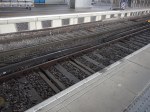
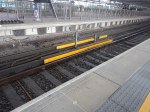
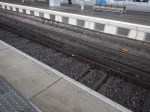
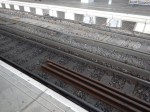
Note.
- The tapered ends of both rails on opposite side of the gaps.
- For safety, the electrified third-rail is on the other side of the track to the platform.
- One picture shows how yellow-painted wood is used for extra safety.
As a train is always on top of the third-rail, when the power to the rail is switched on in Vivarail’s charging system, I think that, the system should be very safe.
Battery-To-Battery Energy Transfer
Vivarail’s genius is to transfer the energy from trackside batteries to the batteries on the train. As batteries have a low impedance, large amounts of electricity can be passed quickly.
Batteries, Supercapacitors Or Both?
I believe that in a few years time for many applications, supercapacitors will be a viable alternative to batteries.
Energy densities are improving in supercapacitors and they have a similar low impedance, which will enable fast transfer of electricity.
So I wouldn’t be surprised to supercapacitors used on trains or in charging systems.
It may be that a mix of supercapacitors and batteries is the optimal solution.
Installing A Vivarail-Style Charging System
Installation of a Vivarail-style charging system would require.
- A length of third rail to be installed alongside the track or tracks in the station.
- The containerised batteries and control system to be installed in a suitable place.
- Electrical power to be connected to the batteries and control system.
- Appropriate-cabling between the rail and the container.
The great advantage is that to install a charging system in a station would not require any of the complicated and expensive works, often needed to install 25 KVAC overhead electrification.
Supplying Electricity To A Vivarail-Style Charging System
The Rail Magazine article talks of trickle charging the track-side batteries, using mains electricity, but I suspect some of the most cost-effective systems would use solar, wind or water power, backed up by a mains supply.
In a remote station, installing a Vivarail-style charging system powered by a sustainable power might be an opportunity to install modern low-energy lights and other equipment at the station, powered from the charging system.
A Vivarail-Style Charging System Could Be Built With No Visual Intrusion
Another advantage of using Vivarail-style charging systems, is that there is less visual intrusion than traditional continuous 25 KVAC overhead electrification.
Some visual intrusion would be down to the shipping container used to house the batteries.
But if necessary, the batteries could be housed in a classic Victorian outhouse or a modern sympathetically-designed structure.
Would A Vivarail-Style Charging System Need To Be In A Station?
Many, but not all charging systems would be in stations.
However, there are some very convenient places for charging systems, that may not be in stations.
Trains going to Bedwyn station wait for several minutes in a turnback siding to the West of the station, before returning to London. The route is not electrified and bi-mode Class 800 trains will be used on the route, because there is about thirteen miles between Bedwyn and Newbury without electrification.
If a Vivarail-style charging system were to be added to the turnback siding battery/electric trains could work the service to London. I’m sure Hitachi know how to convert a version of a Class 80x train to battery/electric operation.
There will be quite a few places, where for operational reasons, a charging system could or should be placed.
Would All Stations On A Route Need To Be fitted With A Vivarail-Style Charging System?
This would depend on the route and the need to run it reliably.
Detailed computer modelling would show, which stations wouldn’t need to be fitted with charging systems!
If a train was a limited-stop service or not required to stop at a particular station because of operational reasons or the timetable, the train would just pass through the station.
As it didn’t stop, it would not have caused the charging system to switch on power to the third-rail.
But if say due to delays caused by an incident meant a train was low on battery power, there is no reason, why the train can’t make a stop at any charging system to top-up the batteries.
Should The Driver Have Any Control?
Consider.
- It may be extra safety is needed, so the driver could give a signal to the charging system, that it is safe to start the charging process.
- Similarly, the driver should be able to pause or stop the process at any time.
But the driver would mainly be monitoring an automatic process.
Would The Charging System Be Linked To The Signalling?
I think this could be likely, as this could add another level of safety.
Conclusion
I believe it is possible to design a safe charging system using proven third-rail technology and batteries or supercapacitors to transfer at least 200 kWh into a train’s batteries at each stop.
Surely, this method of electrification could be used to allow electric trains to run through environmentally-sensitive areas and World Heritage sites like Bath, the Lake District and the Forth Bridge,
Could A 125 Mph Electric Train With Batteries Handle The Midland Main Line?
In Bombardier’s 125 Mph Electric Train With Batteries, I investigated a pure electric train based on Bombardier’s proposed 125 mph bi-mode Aventra with batteries.
It would have the following characteristics.
- Electric power on both 25 KVAC overhead and 750 VDC third-rail.
- Appropriately-sized batteries.
- 125 mph running, where possible on electrification and/or battery power.
- Regenerative braking using the batteries.
- Low energy interiors and systems.
It would be a train with efficiency levels higher than any train seen before.
It would also be zero-carbon at the point of delivery.
An Example 125 mph Train
I will use the same size and specification of train, that I used in Bombardier’s 125 Mph Electric Train With Batteries.
- The train is five cars, with say four motored cars.
- The empty train weighs close to 180 tonnes.
- There are 430 passengers, with an average weight of 90 Kg each, with baggage, bikes and buggies.
- This gives a total train weight of 218.7 tonnes.
- The train is travelling at 200 kph or 125 mph.
Travelling at 200 kph, the train has an energy of 94.9 kWh.
I will also assume.
- The train uses 15 kWh per mile to maintain the required line speed and power the train’s systems.
- Regenerative braking is eighty percent efficient.
I will now do a few calculations.
Kettering To Leicester
Suppose one of the proposed trains was running between St. Pancras and Leicester.
- I’m assuming there are no stops.
- In a year or two, it should be able to run as far as Kettering using the new and improved 25 KVAC overhead electrification.
- The train would leave the electrification at Kettering with a full charge in the batteries.
- The train would also pass Kettering as close to the line speed as possible.
- Hopefully, the twenty-nine miles without electrification between Kettering and Leicester will have been updated to have the highest possible line speed, with many sections capable of supporting 125 mph running.
I can do a rough-and-ready calculation, as to how much energy has been expended between Kettering and Leicester.
- Twenty-nine miles at 15 kWh per mile is 435 kWh.
- The train has a kinetic energy of 94.9 kWh at 125 mph and twenty percent will be lost in stopping at Leicester, which is 19 kWh.
This means that a battery of at least 454 kWh will be needed to propel the train to Leicester.
Kettering To Sheffield
If the train went all the way without stopping between Kettering and Sheffield, the energy used would be much higher.
One hundred-and-one miles at 15 kWh is 1515 kWh.
So given that the train will be slowing and accelerating, we’re probably talking of a battery capacity of around 2000 kWh.
In our five-car example train, this is 400 kWh per car.
Kettering To Sheffield With Stops
The previous calculation shows what can be achieved, but we need a practical train service.
When I last went to Sheffield, the train stopped at Leicester, Loughborough, East Midlands Parkway, Long Eaton, Derby and Chesterfield.
I have built an Excel spreadsheet, that models this route and it shows that if the train has a battery capacity of 2,000 kWh, the train will get to Sheffield with 371 kWh left in the battery.
- Increase the efficiency of the regenerative braking and the energy left is 425 kWh.
- Reduce the train’s energy consumption to 12 kWh per mile and the energy left is 674 kWh.
- Do both and the energy left is 728 kWh.
The message is clear; train manufacturers and their suppliers should use all efforts to improve the efficiencies of trains and all of their components.
- Aerodynamics
- \Weight savings
- Bogie dynamics
- Traction motors
- Battery capacity and energy density
- Low energy lighting and air-conditioning
No idea however wacky should be discarded.
Network Rail also has a part to play.
- The track should have as a high a line speed as is practical.
- Signalling and timetabling should be designed to minimise interactions with other services.
Adding all these together, I believe that in a few years, we could see a train, that will consume 10 kWh per mile and have a regenerative braking efficiency of ninety-five percent.
If this can be achieved then the train will have 960 kWh in the batteries when it arrives in Sheffield.
Sheffield To Kettering
There is no helpful stretch of electrification at the Sheffield end of the route, so I will assume that there is a method of charging the batteries at Sheffield.
Unsurprisingly, as the train is running the same total distance and making the same number of stops, if the train starts with a full battery at Sheffield, it arrives at Kettering with the same amount of energy in the battery, as on the Northbound-run to Sheffield.
An Interim Conclusion
I am led to the interim conclusion, that given the continued upward curve of technology and engineering, that it will be possible to run 125 mph electric trains with an appropriately-sized battery.
How Much Battery Capacity Can Be Installed In A Train?
In Issue 864 of Rail Magazine, there is an article entitled Scotland High Among Vivarail’s Targets for Class 230 D-Trains, where this is said.
Vivarail’s two-car battery units contains four 100 kWh lithium-ion battery rafts, each weighing 1.2 tonnes.
Consider.
- Vivarail’s cars are 18.37 metres long.
- Car length in a typical Aventra, like a Class 720 train, is 24 metres.
- Aventras have been designed for batteries and supercapacitors, whereas the D78 trains, used as a base for the Class 230 train,were not.
- Batteries and supercapacitors are getting better all the time.
- Batteries and supercapacitors can probably be built to fit in unusually-shaped spaces.
I wouldn’t be surprised to see Aventras being able to take double the capacity of a Class 230 train under each car.
I wouldn’t rule out 2,000 kWh energy storage capacity on a five-car train, that was designed for batteries.
The actual size installed would depend on operator, weight, performance and cost.
My Excel spreadsheet shows that for reliable operation between Kettering and Sheffield, a battery of at least 1200 kWh is needed, with a very efficient train.
Charging Trains En-Route
I covered en-route charging fully in Charging Battery/Electric Trains En-Route.
I came to this conclusion.
I believe it is possible to design a charging system using proven third-rail technology and batteries or supercapacitors to transfer at least 200 kWh into a train’s batteries at each stop.
This means that a substantial top up can be given to the train’s batteries at stations equipped with a fast charging system.
An Astonishing Set Of Results
I use astonishing lightly, but I am very surprised.
I assumed the following.
- The train uses 15 kWh per mile to maintain the required line speed and power the train’s systems.
- Regenerative braking is eighty percent efficient.
- The train is fitted with 600 kWh of energy storage.
- At each of the six stations up to 200 kWh of energy can be transferred to the train.
Going North the train arrives in Sheffield with 171 kWh in the energy storage.
Going South the train arrives at Kettering with 61 kWh in the energy storage.
Probably a bit tight for safety, but surprising nevertheless.
I then tried with the following.
- The train uses 12 kWh per mile to maintain the required line speed and power the train’s systems.
- Regenerative braking is ninety percent efficient.
- The train is fitted with 500 kWh of energy storage.
- At each of the six stations up to 200 kWh of energy can be transferred to the train.
Going North the train arrives in Sheffield with 258 kWh in the energy storage.
Going South the train arrives at Kettering with 114 kWh in the energy storage.
It would appear that increasing the efficiency of the train gives a lot of the improvement.
Finally, I put everything, at what I feel are the most efficient settings.
- The train uses 10 kWh per mile to maintain the required line speed and power the train’s systems.
- Regenerative braking is ninety-five percent efficient.
- The train is fitted with 500 kWh of energy storage.
- At each of the six stations up to 200 kWh of energy can be transferred to the train.
Going North the train arrives in Sheffield with 325 kWh in the energy storage.
Going South the train arrives at Kettering with 210 kWh in the energy storage.
These sets of figures prove to me, that it is possible to design a 125 mph battery/electric hybrid train and a set of charging stations, that will make St. Pancras to Sheffield by electric train, a viable possibility without any more electrification.
Should The Train Be Fitted With A Means Of Charging The Batteries?
Why not?
Wires do go down and rest assured, a couple of battery/electric hybrids would get stuck!
So a small diesel or hydrogen generator to allow a train to limp a few miles might not be a bad idea.
Electrification Between Sheffield And Clay Cross On The Midland Main Line
In The UK’s New High Speed Line Being Built By Stealth, there is a sub-section with the same title as this sub-section.
This is the first part of that sub-section.
This article on Rail Technology Magazine is entitled Grayling Asks HS2 To Prepare For Electrification Of 25km Midland Main Line Route.
If this electrification happens on the Midland Main Line between Sheffield and Clay Cross, it will be another project in turning the line into a high speed route with a 200 kph operating speed, between London and Sheffield.
Currently, the electrified section of the line South of Bedford is being upgraded and the electrification and quadruple tracks are being extended to Glendon Junction, where the branch to Corby leaves the main line.
The proposed electrification will probably involve the following.
- Upgrading the line to a higher speed of perhaps 225 kph, with provision to increase the speed of the line further.
- Rebuilding of Chesterfield station in readiness for High Speed Two.
- Full electrification between Sheffield and Clay Cross.
Clay Cross is significant, as it is where the Midland Main Line splits into two Southbound routes.
- The main route through the Derwent Valley Mills World Heritage Site and Derby station.
- The secondary route of the Erewash Valley Line to the East Midlands Hub station.
Note.
- Some of the tunnel portals in the Derwent Valley are Listed.
- Trying to electrify the line through the World Heritage Site will be a legal and engineering nightmare.
- Network Rail has spent or is spending £250million on upgrading the Erewash Valley Line.
- High Speed Two will reach The East Midlands Hub station in 2032.
When High Speed Two, is extended North from the East Midlands Hub station, it will take a route roughly following the M1. A spur will link High Speed Two to the Erewash Valley line in the Clay Cross area, to enable services to Chesterfield and Sheffield.
But until High Speed Two is built North of the East Midlands Hub station, the Erewash Valley Line looks from my helicopter to be capable of supporting 200 kph services.
If this electrification is performed, it will transform the prospects for battery/electric hybrid trains between London and Sheffield.
- Trains will have to run fifteen miles less on battery power.
- Trains will arrive in both St. Pancras and Sheffield with batteries that are at least three-quarters full.
- Returning the trains will fill them up on the electrification at the end of the line.
- There will probably not be a need for charging systems at St. Pancras, Chesterfield and Sheffield.
I also think, that as the train could arrive in Sheffield with a full battery, there is the possibility of extending services past Sheffield to Barnsley, Huddersfield and cLeeds, if the operator felt it was a worthwhile service.
Nottingham
Nottingham is just eight miles from East Midlands Parkway station, which is less distance than Derby.
So if the battery/electric hybrid trains can reach Derby from Kettering on Battery power, with some help from charging at Leicester and Loughborough, the trains can reach Nottingham, where charging would be installed.
Conclusion
From my calculations, I’m sure that an efficient battery/electric hybrid train can handle all current services on the Midland Main Line, with third-rail charging at intermediate stations.
I do think though, that if Sheffield to Clay Cross Junction is electrified in preparation for High Speed Two, that it makes the design easier and the economics a lot better.
It would also give Sheffield a genuine sub-two hour service to London, which would only get better.
Station Dwell Times On The London Overground
This afternoon, I had to go to Walthamstow for lunch, so on the way out, I checked how long it was between brakes on at James Street station and the Class 315 train was moving again.
The dwell time was a very respectable thirty seconds, which is probably more down to the driver and the signalling, than the nearly-forty-year-old train.
Coming back, I took the Gospel Oak to Barking Line to Gospel Oak station..
The driver gave a display of precision driving a Class 172 train, with the intermediate stops, all taking thirty seconds or less.
From Gospel Oak, I switched to the North London Line and took a Class 378 train to Canonbury station, from where I walked home.
The dwell times on this line were more variable, with two times at thirty seconds or less, two at nearly two minutes and the rest in-between.
From these small number of observations, it would appear that the minimum dwell time on the London Overground is thirty seconds.
Various factors will determine the actual dwell time.
- Trains must not leave early, as passengers don’t like this.
- Trains must not leave, before the driver has ascertained it is safe to do so.
- If a train arrives early, then the dwell time might be lengthened, even if the train leaves on time.
- Large numbers of passengers or a passenger in a wheelchair, who needs a ramp will lengthen the dwell time.
I should say that today, the trains were not full and there were plenty of empty seats.
Conclusions
If trains and drivers can handle thirty second dwell times, then everything else associated with a station stop, must be capable of the same fast response.
This thirty-second dwell time may have repercussions for rapid charging of battery/electric trains, that I wrote about in Charging A Battery-Powered Class 230 Train.
I think there are three options for charging a train at a station stop.
Plug the Train Into A Power Socket
Can you plug you mobile phone into the mains, give it a reasonable charge and then disconnect it and store all leads in thirty seconds?
Use a Pantograph To Connect To 25 KVAC Overhead Electrification
Even if a driver or automation is very fast at raising and lowering the pantograph, I don’t believe that in a total time of thirty seconds, enough electricity can be passed to the train.
This method might work well in longer stop at a terminal station, but it is unlikely, it could be used successfully at an intermediate stop.
Use 750 VDC Third-Rail Electrification
750 VDC third-rail electrification has a very big advantage, in that, trains can connect and disconnect to the electrification automatically, without any driver intervention.
Look at this picture of a train going over a level-crossing.

The ends of the third-rails on either side or the crossing are sloped so that the contact shoes on the train can disconnect and connect smoothly.
As you have to design the system for a possible thirty-second stop and don’t have the time available for the first two options, I am fairly certain, that the only way a worthwhile amount of electricity can be transferred to the train’s battery, is to use some form of system based on tried-and-tested 750 VDC third rail electrification.
There may also be advantages in using a longer length of third-rail, so that the connection time is increased and more than one contact shoe can connect at the same time.
Automation would control the power to the third-rail, so that no live rail is exposed to passengers and staff.
After all a train on top, is a pretty comprehensive safety guard.
.
Could A Class 450 Battery/FLEX Train Be Used Between Waterloo And Exeter?
When I wrote Porterbrook Makes Case For Battery/Electric Bi-Mode Conversion, Issue 864 of Rail Magazine hadn’t been published. The magazine contained details of Vivarail’s proposed rapid charging facility, which I wrote about in Charging A Battery-Powered Class 230 Train.
Consequently, at the time, I came to the conclusion that a Class 450 train with a Battery/FLEX conversion, similar to Porterbrook’s one for a Class 350 train, couldn’t stretch between Waterloo and Exeter, as it was just too far.
But Vivarail’s proposed rapid charging facility could change everything!
The West of England Main Line is electrified as far as Basingstoke station, from where the route is worked excursively by diesel Class 159 trains.
Between Basingstoke and Exeter St. Davids stations, the trains make fourteen stops.
- Most station stops,take up to a minute, but could take longer if say the train is busy or there’s a passenger in a wheelchair.
- The train stops at Salisbury for four minutes, possibly to allow loading and unloading of catering trolleys.
- The distances between stations range between a few and eighteen miles.
- In Porterbrook Makes Case For Battery/Electric Bi-Mode Conversion, I said that if a 400 kWh battery were to be fitted to a Class 350/2 train, that this would give a range between twenty and fifty miles.
- The Class 350 and South Western Railway’s Class 450 trains are the same basic Siemens Desiro train, although the Class 350 train uses 25 KVAC overhead electrification and the Class 450 train uses 750 VDC third-rail electrification.
It would appear that if the train could be charged at each station, it should be able to hop all the way between Basingstoke and Exeter St. Davids stations.
Using a traditional charger, where the train would have to be physically plugged into the charger, wouldn’t be possible in the short station stops on the route.
Even raising a pantograph to connect to a 25 KVAC overhead line would be slow and could distract the driver, whilst they were doing more important things.
But Vivarail’s proposed rapid charging facility, which I am sure is automatic would give the battery a top-up without any driver intervention.
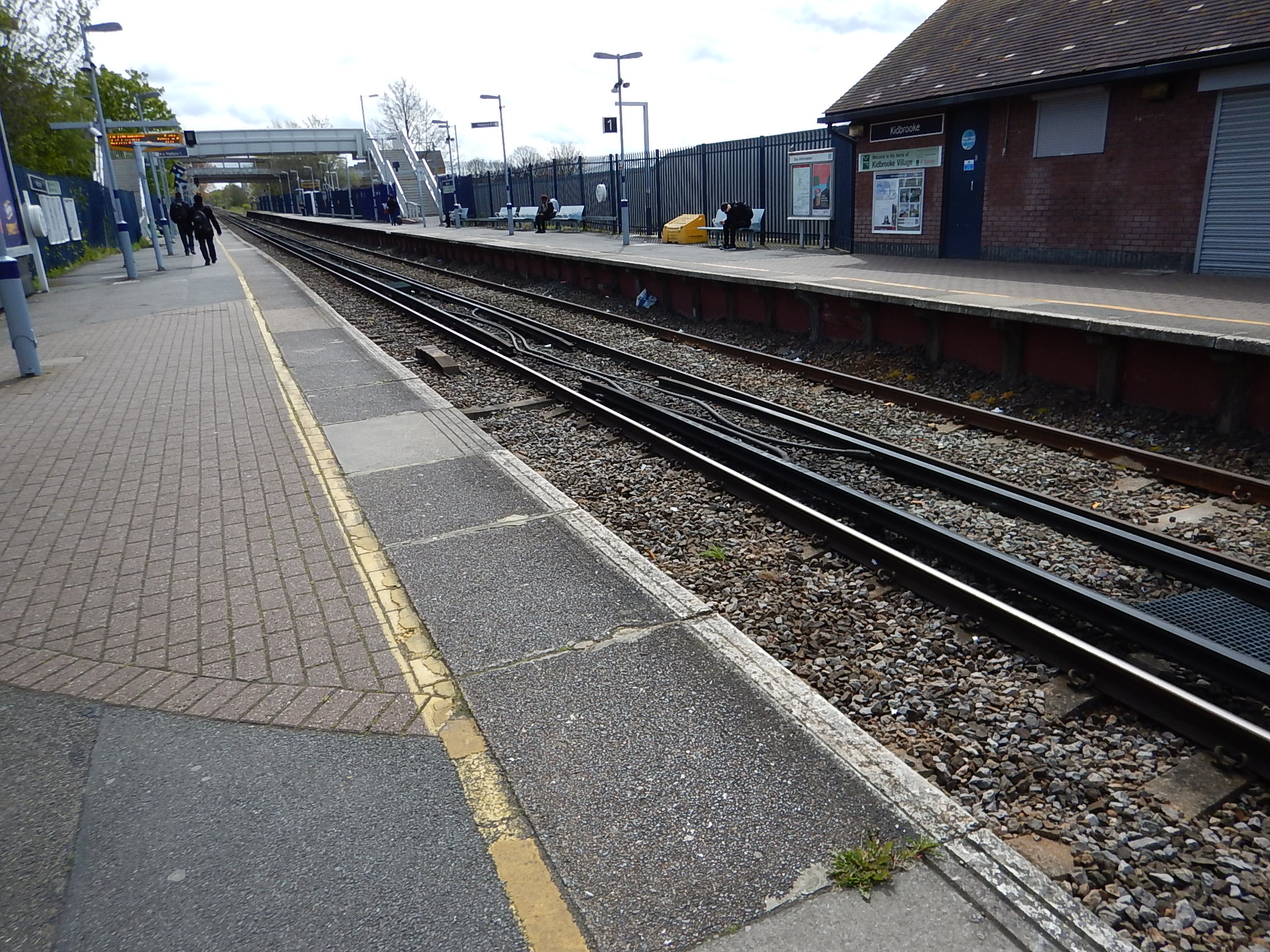
The charging system would have a third rail on the opposite side of the track to the platform, as in this picture of Kidbrooke station.
The third-rail would be.
- Short enough to be shielded by a train stopping on top.
- Long enough to connect to at least two contact shoes on the train.
- Automatically earthed, when no train is present and connected.
This would be the sequence, as a train stopped in a station.
- The driver would stop the train at the defined place in the platform, as thousands of train drivers do all over the world, millions of times every day.
- Once stopped, the contact shoes on the train would be in contact with the third rail, as they would be permanently down, as they are when running on third-rail electrification.
- The charging system would detect the stationary train and that the train was connected, and switch on the power supply. to the third-rail.
- Electricity would flow from the track to the batteries, just as if the train was on a standard third-rail electrified track.
- If the battery should become full, the train’s system could stop the charging.
- When passengers had finished leaving and joining the train and it was safe to do so, the driver would start the train and drive it to the next station.
- When the charging system determined that the train was moving or that the contact shoe was no longer connected to the third-rail, it would immediately cut the power to the rail and connect it to earth.
It is a brilliant system; simple, efficient and fail-safe.
- Regenerative braking will mean that stopping in the station will help to top-up the batteries.
- The battery on the train is being charged, as long as it is stationary in the station.
- Delays in the station have no effect on the charging, except to allow it for longer if the battery can accept more charge.
- The driver concentrates on driving the train and doesn’t have to do anything to start and stop the charging.
- The charging system never exposes a live rail to passengers and staff.
The charging system may also help recovery after an incident.
Suppose a fallen tree or a herd of cows has blocked the line and the electricity used to power the train’s systems has used a lot of battery power, so that when the train eventually gets to the next station, the battery needs a long charge before continuing.
The driver would just wait in the station, charging the battery, until there is enough energy to safely proceed.
A Look At The Mathematics
I shall now look at the mathematics of a leg between Basingstoke and Andover stations.
I will assume the following.
- The train will leave the electrification at Basingstoke with a full battery, containing 400 kWh of electricity, as it will have been charged on the way from Waterloo.
- The train is running at an operating speed of up to 90 mph between stations where possible, which means it has a kinetic energy of 47.1 kWh.
- For each mile, the train consumes 8 kWh of electricity, to power the trains services and maintain the required speed.
- Regenerative braking is eighty percent efficient.
As Basingstoke to Andover is eighteen miles, this means that energy consumption in the leg and the stop at Andover is as follows.
- 144 kWh is used to power the train and maintain speed.
- 9.42 kWh is lost in the braking and acceleration back to operating speed..
So the train will lose about 154 kWh on the eighteen mile leg.
I have built an Excel spreadsheet of the route and it looks that if a minimum of 100 kWh can be transferred to the train’s battery at each stop and the train uses no more than 8 kWh per mile, that it should be possible for the train to go from Basingstoke to Exeter on battery power.
Obviously, there are ways to make this journey more certain.
- Reduce the train’s energy consumption for items like lighting and air-conditioning..
- Improve the efficiency of regenerative braking.
- Improve the charging systems, so more electricity is transferred in the short stops.
- Improve the track, so that it is as smooth as possible with gentle curves.
- Fit a larger battery.
It requires different teams of engineers to optimise their own area, so all contribute to a more energy-efficient system.
Would Battery Power Work If The Line Speed Was Increased to 100 mph?
I have done this calculation assuming an operating speed of 100 mph, rather than the current 90 mph determined in part by the maximum speed of the Class 159 trains and it appears to be still possible.
Could 100 kWh Be Transferred To The Train In The Short Stops?
In Station Dwell Times On The London Overground, I showed that the London Overground regularly has station stops of under thirty seconds.
Even to me, as an trained Electrical Engineer, 100 kWh does seem a lot of power to transfer to the train in a stop that is that short.
In the related post, I postulated that a thirty-second dwell time, means that the only way to connect the train to the rapid charging system is to use third-rail electrification, as this connects and disconnects automatically.
This was said about Vivarail’s charging system in Issue 864 of Rail Magazine.
The rapid charging concept consists of a shipping container of batteries that are trickle charged from a mains supply. When a Class 230 sits over the short sections of third-rail, electricity can be quickly transferred to the train’s batteries. When the train is away, the power rails are earthed to ensure they pose no risk The concept provides for charging a Class 230 as it pauses at a terminus before making its return journey.
The key is the battery-to-battery transfer of electricity, as batteries have a low impedance and are designed to supply high electrical currents for a short time, as when starting a massive diesel engine in a truck.
This page shows a 12v 250Ah battery available for just over three hundred pounds.
- This battery alone has a capacity of 3 kWh.
- It is 518mm x 273mm x 240mm.
- It weighs 61 Kg.
You’d get a lot of these in a twenty-foot shipping container, which according to Wikipedia has a volume of 33.2 m³.
I estimate that a hundred of these batteries would fit easily into the container with all their control gear and electronics, which would mean a total capacity of 300 kWh.
Running my Excel spreadsheet with a 200 kWh transfer at each station, shows that the train can leave many stations with a full battery.
I have also run a more difficult scenario.
- For each mile, the train consumes 10 kWh of electricity instead of 8 kWh, to power the trains services and maintain the required speed.
- The rapid charging system can only transfer 80 kWh in thirty seconds.
The train still appears to get to its destination.
Obviously, Porterbrook, Siemens and Vivarail have better data than I have and will know what the actual performance of their trains and systems are.
How Much Power Can The Third-Rail Handle?
It should also be noted that a Class 450 train has eight x 250 kW traction motors, so the third-rail system of the train, must be capable of handling all of these at full power, when running on lines with third-rail electrification.
Would One Charging System Handle Both Tracks?
The route is double-track, with often platforms on either side of the tracs.
This Google Map shows Gillingham station, which appears to have a typical layout.
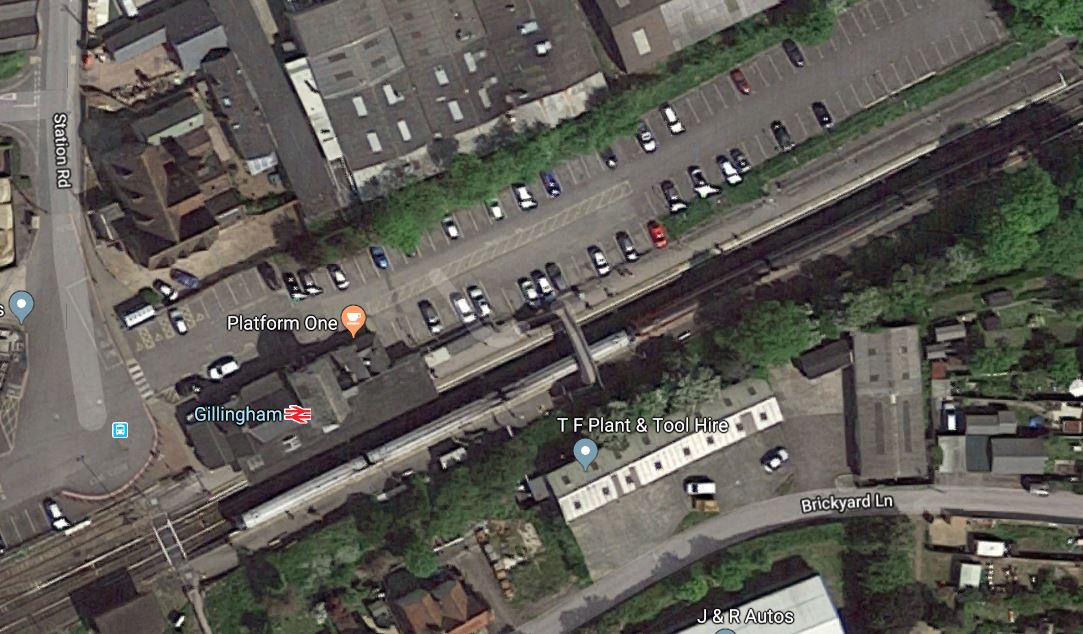
Note the three-car Class 159 train in the station.
If both tracks were to have a charging rail, I can’t see why one set of batteries shouldn’t be able to feed both tracks with separate control systems.
Although it does appear that several stations often use the same platforms for both directions.
Conclusion
This could be a very affordable way of electrifying a line with a lot of stations.
 The Anonymous Widower