Irlam Station To Go Step-Free
This document on the Government web site is entitled Access for All: 73 Stations Set To Benefit From Additional Funding.
Irlam station is on the list.
These pictures show the station and the current subway.

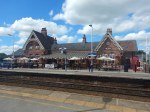

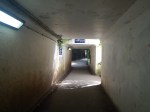

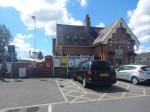
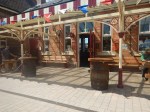

The station was a total surprise, with a large pub-cafe and a lot of visitors and/or travellers sitting in the sun.
I had an excellent coffee and a very welcoming gluten-free blueberry muffin!
This Google Map shows the station.
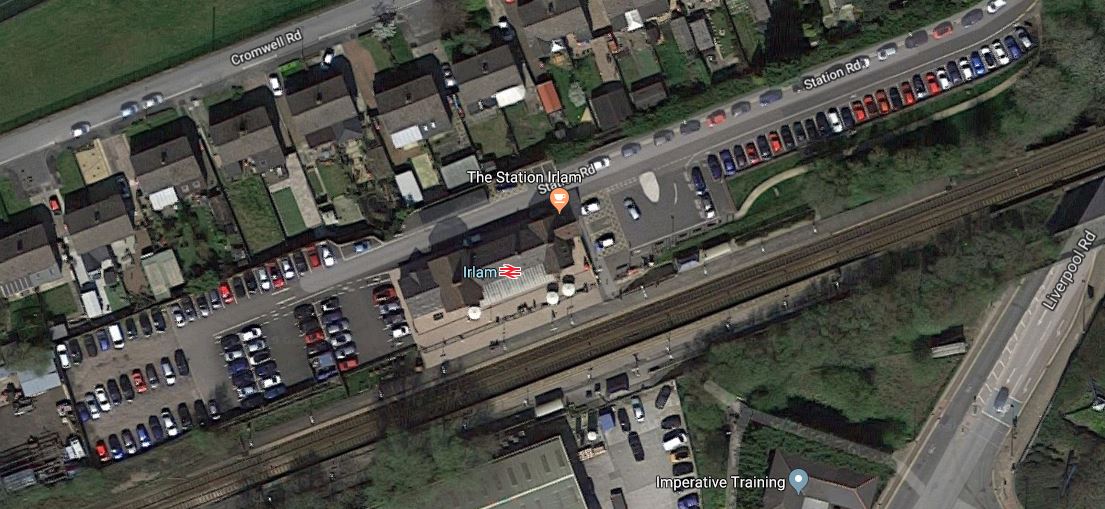
It is one of those stations where commuters have to cross the railway either on the way to work or coming home.
So a step-free method of crossing the railway is absolutely necessary.
The Current And Future Rail Service
As the station lies conveniently between Liverpool and Warrington to the West and Manchester and Manchester Airport to the East, it must be a station with tremendous potential for increasing the number of passengers.
At the moment the service is two trains per hour (tph) between Liverpool Lime Street and Manchester Oxford Road stations.
- Oxford Road is probably not the best terminus, as it is not on the Metrolink network.
- When I returned to Manchester, many passengers alighted at Deansgate for the Metrolink.
- On the other hand, Liverpool Lime Street is a much better-connected station and it is backed up by Liverpool South Parkway station, which has a connection to Merseyrail’s Northern Line.
- The current service doesn’t serve Manchester Piccadilly or Airport stations.
A guy in the cafe also told me that two tph are not enough and the trains are often too short.
Merseyrail work to the same principle as the London Overground and other cities of four tph at all times and the frequency certainly draws in passengers.
Whilst I was drinking my coffee, other trains past the station.
- One tph – Liverpool Lime Street and Manchester Airport
- One tph – Liverpool Lime Street and Norwich
Modern trains like Northern’s new Class 195 trains, should be able to execute stops at stations faster than the elderly diesel trains currently working the route.
So perhaps, after Irlam station becomes step-free, the Manchester Airport service should call as well.
As Liverpool Lime Street station has been remodelled, I can see a time in the not too distant future, when that station can support four tph, that all stop at Irlam station.
The Manchester end of the route could be a problem, as services terminating at Oxford Road have to cross the busy lines of the Castlefield Corridor.
So perhaps all services through Irlam, should go through Deansgate, Manchester Oxford Road and Manchester Piccadilly stations to terminate either at the Airport or perhaps Stockport or Hazel Grove stations.
But would this overload the Castlefield Corridor?
Battery/Electric Trains
If you look at the route between Liverpool Lime Street and Manchester Oxford Road stations, the following can be seen.
- Only about thirty miles between Deansgate and Liverpool South Parkway stations is not electrified.
- The section without electrification doesn’t appear to be particularly challenging, as it is along the River Mersey.
It is my view, that the route between Liverpool and Manchester via Irlam, would be an ideal route for a battery/electric train.
A train between Liverpool Lime Street and Manchester Airport stations would do the following.
- Run from Liverpool Lime Street station to Liverpool South Parkway station using the installed 25 KVAC overhead electrification.
- Drop the pantograph during the stop at Liverpool South Parkway station.
- Run from Liverpool South Parkway station to Deansgate station using battery power.
- Raise the pantograph during the stop at Deansgate station.
- Run from Deansgate station to Manchester Airport station, using the installed 25 KVAC overhead electrification.
The exact distance between Deansgate and Liverpool South Parkway stations is 28.2 miles or 45.3 kilometres.
In 2015, I was told by the engineer riding shotgun on the battery/electric Class 379 train, that that experimental train was capable of doing fifty kilometres on battery power.
There are at least four possible trains, that could handle this route efficiently.
- Porterbrook’s proposed batteryFLEX train based on a Class 350 train.
- A battery/electric train based on the seemingly unwanted Class 379 train.
- A battery/electric version of Stadler’s Class 755 train.
- I believe that Bombardier’s Aventra has been designed so that a battery/electric version can be created.
There are probably others and I haven’t talked about hydrogen-powered trains.
Battery power between Liverpool and Manchester via Irlam, appears to be very feasible.
Tram-Trains
As my train ran between Manchster and Irlam it ran alongside the Metrolink between Cornbrook and Pomona tram stops.
Manchester is very serious about tram-trains, which I wrote about in Could A Class 399 Tram-Train With Batteries Go Between Manchester Victoria And Rochdale/Bury Bolton Street/Rawtenstall Stations?.
Tram-trains are often best employed to go right across a city, so could the Bury tram-trains go to Irlam after joining the route in the Cornbrook area?
- Only about thirty miles between Deansgate and Liverpool South Parkway stations is not electrified.
- The route between Liverpool and Manchester via Irlam doesn’t look to be a very challenging line to electrify.
- The total distance bettween Liverpool Lime Street and Manchester Victoria station is only about forty miles, which is a short distance for a tram-train compared to some in Karlsruhe.
- Merseyrail’s Northern Line terminates at Hunts Cross station, which is going to be made step-free.
- There is an existing step-free interchange between the Liverpool and Manchester route via Irlam and Merseyrail’s Northern Line at Liverpool South Parkway station.
- Class 399 tram-trains will have a battery capability in South Wales.
- Class 399 tram-trains have an operating speed of 62 mph, which might be possible to increase.
- Stadler make Class 399 tram-trains and are building the new Class 777 trains for Merseyrail.
I think that Stadler’s engineers will find a totally feasible and affordable way to link Manchester’s Metrolink with Liverpool Lime Street station and Merseyrail’s Northern and Wirral Lines.
I can envisage the following train service running between Liverpool and Manchester via Irlam.
- An hourly service between Liverpool Lime Street and Nottingham, as has been proposed for the new East Midlands Franchise.
- A four tph service between Liverpool Lime Street and Manchester Airport via Manchester Piccadilly.
- A tram-train every ten minutes, linking Liverpool Central and Manchester’s St Peter’s Square.
- Tram-trains would extend to the North and East of Manchester as required.
- All services would stop much more comprehensively, than the current services.
- Several new stations would be built.
- In the future, the tram-trains could have an interchange with High Speed Two at Warrington.
Obviously, this is just my speculation, based on what I’ve seen of tram-train networks in Germany.
The possibilities for the use of tram trains are wide-ranging.
Installing Step-Free Access At Irlam Station
There would appear to be two ways of installing step-free access at Irlam station.
- Add lifts to the existing subway.
- Add a separate bridge with lifts.
These are my thoughts on each method.
Adding Lifts To The Existing Subway
Consider.
- The engineering would not be difficult.
- Installaton would probably take a number of weeks.
- There is good contractor access on both sides of the railway.
There are similar successful step-free installations around the UK
The problem is all about, how you deal with passengers, whilst the subway is closed for the installation of the lifts.
Adding A Separate Bridge With Lifts
Consider.
- There is a lot of space at both the Eastern and Western ends of the platform to install a new bridge.
- Adding a separate bridge has the big advantage, that during the installation of the bridge, passengers can use the existing subway.
- Once the bridge is installed, the subway can be refurbished to an appropriate standard.
Passengers will probably prefer the construction of a new bridge.
In Winner Announced In The Network Rail Footbridge Design Ideas Competition, I wrote how the competition was won by this bridge.
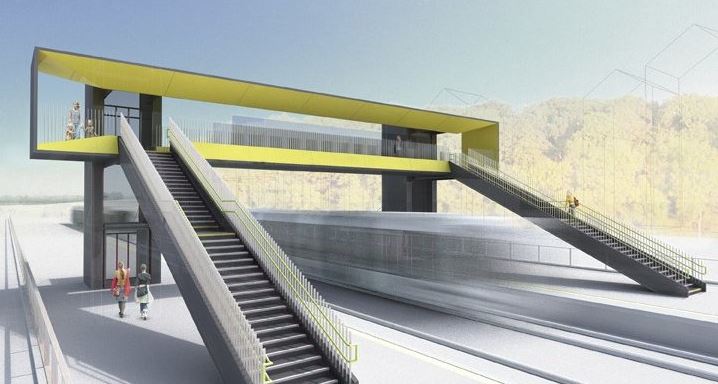
So could a factory-built bridge like this be installed at Irlam station?
There is certainly space at both ends of the platform to install such a bridge and the daily business of the station and its passengers would be able to continue unhindered, during the installation.
I’m also sure, that the cafe would be happy to provide the daily needs of the workforce.
Conclusion
From a station and project management point-of-view, adding a new factory-built bridge to Irlam station is the easiest and quickest way to make the station step-free.
It also appears, that Network Rail have made a wise choice in deciding to put Irlam station on their list of stations to be made step-free, as the station could be a major part in creating a new high-capacity route between Liverpool and Manchester.
This could also be one of the first stations to use an example of the new bridge.
- Installation would be quick and easy.
- There is no site access problems.
- There station can remain fully open during the installation.
- All stakeholders would probably be in favour.
But above all, it would be a superb demonstration site to bring those from stations, where Network Rail are proposing to erect similar bridges.
Battery Answer To Schleswig-Holstein’s Diesel Replacement Question
The title of this post, is the same as that of this article on Railway Gazette International.
It is a good explanation of why there is so much interest in battery-powered trains.
This paragraph from the article, describes how the trains will operate in Schleswig-Holstein.
They will have range of 150 km under optimal conditions, although the longest non-electrified route they will operate on is around 80 km. The batteries will be recharged from the existing 15 kV 16·7 Hz overhead electrification at Kiel, Neumünster, Flensburg, Lübeck and Lüneburg stations and on the Osterrönfeld – Jübek line. Charging facilities will also be provided in other locations, and there will be some extensions to the existing overhead power supply.
Consider.
- These trains can run on routes of up to eighty kilometres or around fifty miles.
- Greater Anglia and Transport for Wales will be running the UK versions of the Stadler Flirts, that will be used in Schleswig-Holstein.
- Transport for Wales will also be running a tri-mode Flirt with electric, diesel and battery power.
- The Continental loading gauge, probably allows more batteries than the smaller UK loading gauge.
I think it could be reasonable to assume, that a UK-sized battery-electric Stadler Flirt could have a range of forty miles on batteries.
These could be possible routes for Greater Anglia.
- Norwich and Sheringham – 30 miles
- Norwich and Lowestoft – 23.5 miles
- Norwich and Great Yarmouth – 18 miles
- Ipswich and Felixstowe – 16 miles
- Colchester Town and Sudbury – 20 miles
In addition some partially-electrified routes have gaps less than forty miles. Think Cambridge and Ipswich!
I would not be surprised to see battery trains, quietly gliding around East Anglia.
Would they attract passengers and tourists?
Perhaps Germany and Stadler will give us the Schleswig-Holstein Answer, which will be much more interesting than the Schleswig-Holstein Question.
Economics Of Battery Trains
The article also has this quote from the CEO of Stadler Germany about the economics of battery trains.
It makes us very proud that with the battery-powered Flirt we have not only managed to find an ecological and innovative solution, but have also enabled a clear economic improvement. If we consider the average life of a rail vehicle of around 30 years, battery-operated vehicles are more cost-effective than diesel’.
I think it can also be said, that battery technology will improve continuously in the next thirty years and we should see a corresponding improvement in range and performance.
You don’t get that with diesel.
Hydrogen Or Battery Power?
I would think that Alstom are not happy about this order for battery-powered trains.
- Only a hundred kilometres or so to the West, they are supplying Alstom Coradia iLint trains for a similar network.
- These trains are working well.
- They have teamed up with Linde to supply the hydrogen.
I wouldn’t have been surprised if Schleswig-Holstein had chosen hydrogen trains.
So why did Schleswig-Holstein, choose battery rather than hydrogen trains?
- Provided, the driver or a computer, raises and lowers the pantograph appropriately, there is no difference between an electric train and its battery-electric sibling.
- Systems to charge battery trains can be installed anywhere, there is an electricity supply.
- The electricity supply could be local wind or solar.
- Charging battery trains could be automatic and require no more action from the driver, than checking everything is as it should be and perhaps pushing a button or two. On a bleak miserable day, the driver would remain in the warm and comfortable cab.
- Hydrogen would need to be loaded on the train at a depot or another place with the necessary safety clearance.
- The iLint seats 160 and the Flirt Akku seats 124, so I suspect capacity isn’t much of a problem.
- The Flirt Akku is a train designed for battery-electric operation, whereas the iLint is a modified diesel train, with a noisy and harsh mechanical transmission. It’s like comparing Class 710 trains, with their predecessors on the Gospel Oak to Barking Line; the Class 172 trains.
- I suspect most Germans have talked to a relative or older person, who remembers the Hindenburg.
There is probably little to choose between the two trains, but I believe that the operation of the hydrogen-powered train will be more complicated.
I also don’t know the cost of each train.
As I said earlier, Stadler claim long-term ownership of battery-powered trains is more economic than diesel. Does the same apply to battery against hydrogen power.
Conclusion
I believe we’ll see lots more battery trains.
What More Could Passengers Want?
The latest Press Release on the Stadler web site about the new trains for Greater Anglia is entitled Milestone For The UK: First Stadler FLIRT train Receives Approval.
These are the last two paragraphs.
With 20 per cent more seats, which have been designed to be as comfortable as possible, trains will feature
low flooring to make them accessible for people in wheelchairs and with pushchairs. Windows will be bigger
and ‘picture style’ to improve the passenger experience and create a more airy and spacious feel.
Mobile phone reception will be better and plug and USB sockets will be installed at every seat. Wifi will be
free and faster than previously. All trains will be fully air-conditioned and have disabled toilets and bicycle
spaces.
What more could passengers want?
Transport for Wales Is Invading England
There is an article in the July 2019 Edition of Modern Railways, which is entitled TfW Targets Swansea To Bristol Services.
This is the first paragraph.
Transport for Wales Rail Services is aiming to start an open access service between Swansea and Bristol Temple Meads, commencing in December 2020.
These are characteristics of the proposed service.
- Hourly service
- Calls at Neath, Port Talbot Parkway, Bridgend, Cardiff Central, Newport, Severn Tunnel Junction and Filton Abbey Wood stations.
- Sixteen services per day will run Monday to Saturday in both directions, with twelve services on Sundays.
- Trains will be Class 170 or Class 175 diesel trains.
Looking at current times of sections of the route, I suspect that services could take a few minutes under two hours and would need four trains.
Reasons given for planning the service include.
- Long-term political pressure.
- Welsh ministers abandoning plans for the £1.6 billion M4 Relief Road around Newport.
- Cross-Severn road traffic has increased after abolition of tolls.
- Main roads on either side of the Severn are congested.
- Increased house sales in South Wales to people who work in the Bristol area.
Incidentally, before I read the article, if you asked me, I’d have thought there would be a direct service.
My only thought about the service, is that as there will be electrification between Bristol and Cardiff, why not run a proper fast bi-mode train like a Hitachi Class 800 train or a Stadler Class 755 train. The latter of which Transport for Wales have on order, for delivery in 2023.
The Class 755 train or its Welsh cousin, could be an interesting option.
- The distance without electrification between Cardiff and Swansea is 46 miles.
- Transport for Wales tri-mode version of the Class 755 train could have three batteries and a diesel engine in the four slots in the powrpack car.
Could it have the capability of jumping the gap.
Birmingham Services
The article also says that, Transport for Wales are also planning to extend their services that terminate at Birmingham to Coventry.
- Holyhead and Birmingham New Street takes three hours.
- Aberystwyth and Birmingham New Street takes three hours
- Pwllheli and Birmingham New Street takes five hours
As Birmingham and Coventry takes twenty minutes or perhaps a convenient hour to go to Coventry and return with a relaxed turnround, does the extension make these three long services simpler to operate?
Extra positioning services from Crewe to Coventry in the morning and return in the evening are also proposed.
These would also suggest that improving the ease of operation of these services is the reason for the extension to Coventry.
Liverpool Services
The article also says that these services to Liverpool will be added in 2022.
- An hourly service to Llandudno.
- A two-hourly service to Cardiff.
It isn’t said, if one of these services is an extension to the recently launched Liverpool and Chester service.
Conclusion
The Welsh are getting ambitious.
Future Stansted Airport Train Services
Currently, the following services go to Stansted Airport station, in trains per hour (tph)
- Four tph – Stansted Express – Liverpool Street
- One tph -CrossCountry – Birmingham New Street via Cambridge, Peterborough and Leicester
- One tph – Greater Anglia – Cambridge via Audley End and Whittlesford Parkway
Greater Anglia have plans to change the services.
- Extend the Norwich and Cambridge service to Stansted Airport.
- Reintroduction of a Stansted Express service between the Airport and Stratford is mentioned in Wikipedia.
With two very long and one shorter platform, the Airport station has plenty of capacity.
Stansted Express Journey Times And Trains Required
Currently, Stansted Express services run at a frequency of four tph, that take fifty minutes between London and the Airport.
If a turnround time of ten minutes is added, then it takes trains two hours to do a round trip between London and the Airport.
So this means that thse numbers of trains are needed for the following frequencies.
- One tph – Two trains
- Two tph – Four trains
- Four tph – Eight trains
As Greater Anglia have ordered ten Class 745/1 trains for Stansted Express, these would be able to provide a reliable service with eight in service, one as a spare and one in maintenance.
A Stansted Express service to Stratford would take the same time and would need similar numbers of trains.
Norwich and Stansted Airport Journey Times And Trains Required
The timing for the proposed service between Norwich and Stansted Airport, can be estimated by taking the timing of current services.
- Norwich and Cambridge – One hour 20 minutes
- Cambridge and Stansted Airport – 30 minutes
Both services are run by reasonably-modern 100 mph diesel trains.
Add in a ten minute turnround at both ends of the route and it should be possible to schedule a Stansted Airport and Norwich round trip in four hours.
Greater Anglia is introducing new bi-mode Class 755 trains on this route.
- The trains will be designed for fast stops.
- The trains will run on electricity on the nearly forty miles between Stansted Airport and Ely and around Norwich.
- The trains will run on diesel between Ely and Trouse Junction, just to the South of Norwich.
- The trains will probably be abe to achieve 100 mph on a good proportion of the route.
- The trains will probably be four-cars.
It would need four trains to run the proposed one tph service.
The current Norwich and Cambridge service probably needs three trains, so extending to Stansted Airport will need an extra train.
This seems to be good value for passengers, the Cities of Cambridge and Norwich, Stansted Airport and Greater Anglia.
Could There Be A Norwich And London Service Via The West Anglia Main Line?
I can remember seeing steam-hauled expresses thundering between Liverpool Street and Norwich in the 1950s, through places like Brimsdown.
They are long gone, but they gave places like Wymondham and Thetford a direct rail link to London.
Greater Anglia’s future plans will connect these towns and others directly to Stansted Airport, but could they go all the way to London?
What do the mathematics show?
The section timings of a Norwich and London service via Cambridge and Stansted Airport would be as follows.
- Norwich and Cambridge – One hour 20 minutes
- Cambridge and Stansted Airport – 30 minutes
- Stansted Airport and London – 50 minutes
This is just two hours and forty minutes.
Add in a few minutes for the reverse at Stansted Airport and the turnround at either end and I believe a round trip could be comfortably within six hours.
It would therefore mean that six trains would be needed to run an hourly service between London and Norwich.
- Stops could be Tottenham Hale, Broxbourne, Harlow Town, Bishops Stortford, Stansted Airport, Audley End, Whittlesford Parkway, Cambridge, Cambridge North, Ely and all stations to Norwich.
- The London terminal could be Liverpool Street or Stratford.
- If Stratford were to be used, trains could be turned round in the High Meads Loop.
- Trains would be Class 755 trains, which are bi-mode and capable of 100 mph running.
- Between London and Ely, the trains would take advantage of the electrification.
The service would give a lot of stations a direct connection to Stansted Airport, that would be complimentary to the Stansted Express.
It would require just two more trains, than the planned Norwich and Stansted Airport service.
The advantages of the service would be.
- Stations between Thetford and Norwich would get direct London and Stansted Airport services.
- Stratford would get a very useful direct service to Stansted Airport.
Greater Anglia would serve two markets with the extended service and just two extra trains, over the planned service.
If Greater Anglia say a London and Norwich via Stansted Airport service will never happen, they are being economical with the truth.
Could Class 755 Trains With Batteries Bridge The Electrification Gap,Between Ely And Trowse Junction?
The distance between the electrification at Ely station and Trowse Junction, South of Norwich, is just under fifty-three miles.
I believe that the tri-mode four-car Flirts for Trains for Wales are similar to Greater Anglia’s Class 755 trains, with three of the Deutz diesel engines replaced with 100-120 kWh batteries.
Would this be enough power to take the train across the electrification gap?
Consider.
- There is electrification at both ends and the batteries could be full, on entering the unelectrified section.
- The route is very gentle.
- There are a few stops, but the trains will have regenerative braking to charge the batteries.
- The trains could retain a single diesel-engine,, should livestock on the line cause the service to be suspended.
For these and other reasons, I suspect that in a couple of years, diesel will be relegated to emergency use only between Norwich and Stansted Airport.
The Herd Of Wannabe Unicorns In The Room
Other places have elephants, but the City of Cambridge has herds of wannabe unicorns.
For those of you, unfamiliar with the term, Wikipedia defines unicorn like this.
A unicorn is a privately held startup company valued at over $1 billion.
Cambridge is expanding at a fast rate and it needs public transport systems to bring in the workers, visitors and investors.
- A new Cambridge North station has been built.
- A guided busway linking Addenbrooke’s and Papworth Hospitals and the Cambridge Biomedical Campus to the City Centre has been built.
- A new Cambridge South station is being planned.
- The East-West Rail Link will connect Cambridge to Oxford.
Road travel in the local area is not an option.
Currently, most rail services radiate from Cambridge station, but like London and other cities are proving, Cambridge needs Cross-City services.
A high-frequency North-South route is being created across the City.
- To the North of the City is Ely station.
- North of Ely station, lines fan out to Peterborough, Kings Lynn and Norwich.
- From North to South across the City, there will be Waterbeach, Cambridge North, Cambridge and Cambridge South stations.
- South of Cambridge South station, lines will fan out to Bedford and Oxford, Royston, Hitchin and Kings Cross and Audley End, Stansted Airport and Livepool Street.
In addition routes to Bury St. Edmunds, Ipswich and Felixstowe reach out to the East.
The current North-South train services include.
- 1 tph – Birmingham New Street and Stansted Airport
- 1 tph – Kings Lynn and Kings Cross
- 1 tph – Cambridge and Norwich
- 2 tph – Cambridge and Brighton
- 2 tph – Cambridge and Liverpool Street
- 2 tph – Cambridge and Kings Cross
The number of these services will grow.
Will More Stations Be Built Or Reopened Between Stansted Airport And Norwich?
I know the route, South of Cambridge better than I know it to the North.
To the South of Cambridge, the current stations could be sufficient, with improved car and bicycle parking and provision for electric cars.
To the North, there appear to be new housing developments under consideration and surely, these will need good public transport to and from Cambridge.
Does The Norwich and Stansted Airport Service Need Two Trains Per Hour?
I have a feeling that Greater Anglia think, that East Anglia’s generally one tph services between major towns and cities is not enough.
Greater Anglia have said they will do the following.
- Increase the Ipswich and Norwich frequency from two to three tph.
- Run two tph between Ipswich and Kennett via Bury St. Edmunds.
I talked previously about Cambridge and its herd of wannabe unicorns.
I believe strongly, that the Cambridge Effect will in a couple of years, mean that the frequency between Norwich and Stansted Airport will need to be doubled.
But will Greater Anglia have enough trains?
Greater Anglia are purchasing a fleet of 38 Class 755 trains with a total of 138 carriages to replace 27 assorted trains with a total of 58 carriages.
- This is a forty percent increase in the number of trains.
- This is nearly two and a half times as many carriages.
- The average number of carriages per train is raised from 2.1 to 3.6.
That is a massive increase in train capacity.
There should be enough for either.
- Eight trains for two tph between Norwich and Stansted Airport.
- Twelve trains for two tph between Norwich and London via Stansted Airport.
These would be increases of four and eight trains respectively on Greater Anglia’s current plan for a one tph service between Norwich and Stansted Airport.
Conclusion
Greater Anglia have enough trains to run a two tph service between Norwich and London via Stansted Airport.
I believe that the Cambridge Effect will create enough demand to necessitate expansion of the proposed one tph service between Norwich and Stansted Airport into a Norwich and London via Stansted Airport service.
- Frequency will be two tph.
- New commuter-friendly stations could be built.
- The Southern terminal could be Stratford to give a second route to Stansted Airport from London.
Greater Anglia would be satisfying two markets with one train.
Mathematics Of A Stadler Flirt Akku Battery Train
In Stadler Receives First Flirt Akku Battery Train Order, I quoted this from as that of this article in Railway Gazette International.
Schleswig-Holstein transport authority NAH.SH has selected Stadler to supply 55 Flirt Akku battery multiple-units to operate regional services and provide 30 years of maintenance.
This is a substantial order for a large number of trains and many years of maintenance, and would appear to be structured similarly to deals in East Anglia, Glasgow and Liverpool in the UK.
Does The Train Have A Central Power-Pack Car?
Is the Flirt Akku, similar to Greater Anglia’s Class 755 trains and other of the companies products, in that it has a central power-pack car?
This picture shows a Class 755 train at Norwich.
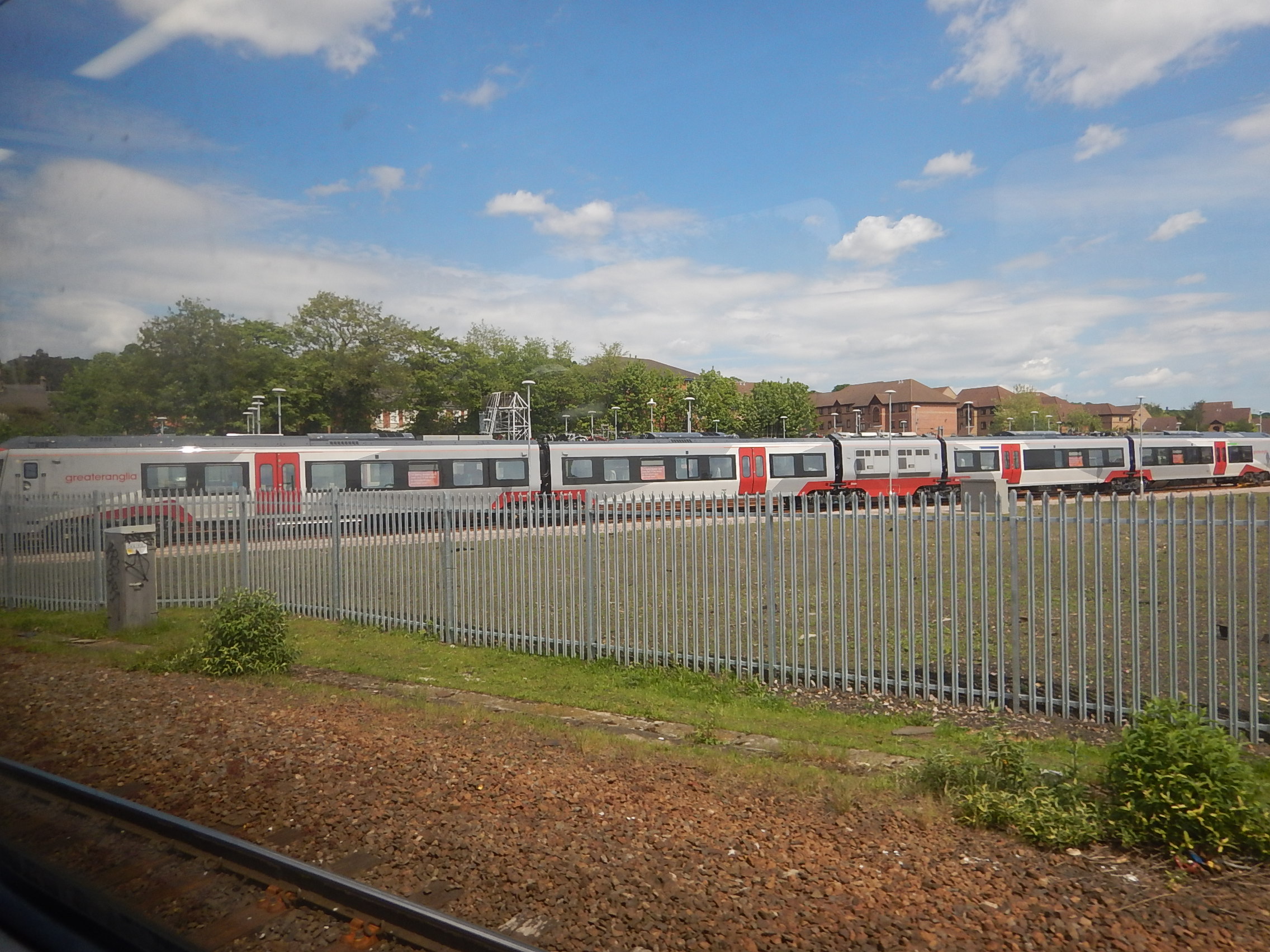
Note that this four-car train has four full-size cars and a shorter one, that doesn’t appear to have any doors or proper windows.
This is the power-pack car, which in these trains has the following properties.
- The power-pack car is 6.69 metres long.
- The power-pack car is identical in both the four-car and three-car versions of the Class 755 trains.
- The four-car trains have four diesel engines.
- The three-car trains have two diesel engines.
The number of engines possible, leads me to believe there are four slots for engines in the power-pack car.
Transport for Wales have ordered a number of Flirts, which are similar to those in use by Greater Anglia, but they are tri-mode trains, that can run on overhead 25 KVAC electrification, diesel or battery power.
I speculate that they have one diesel engine and three batteries in the four slots.
This is a picture of the Flirt Akku.
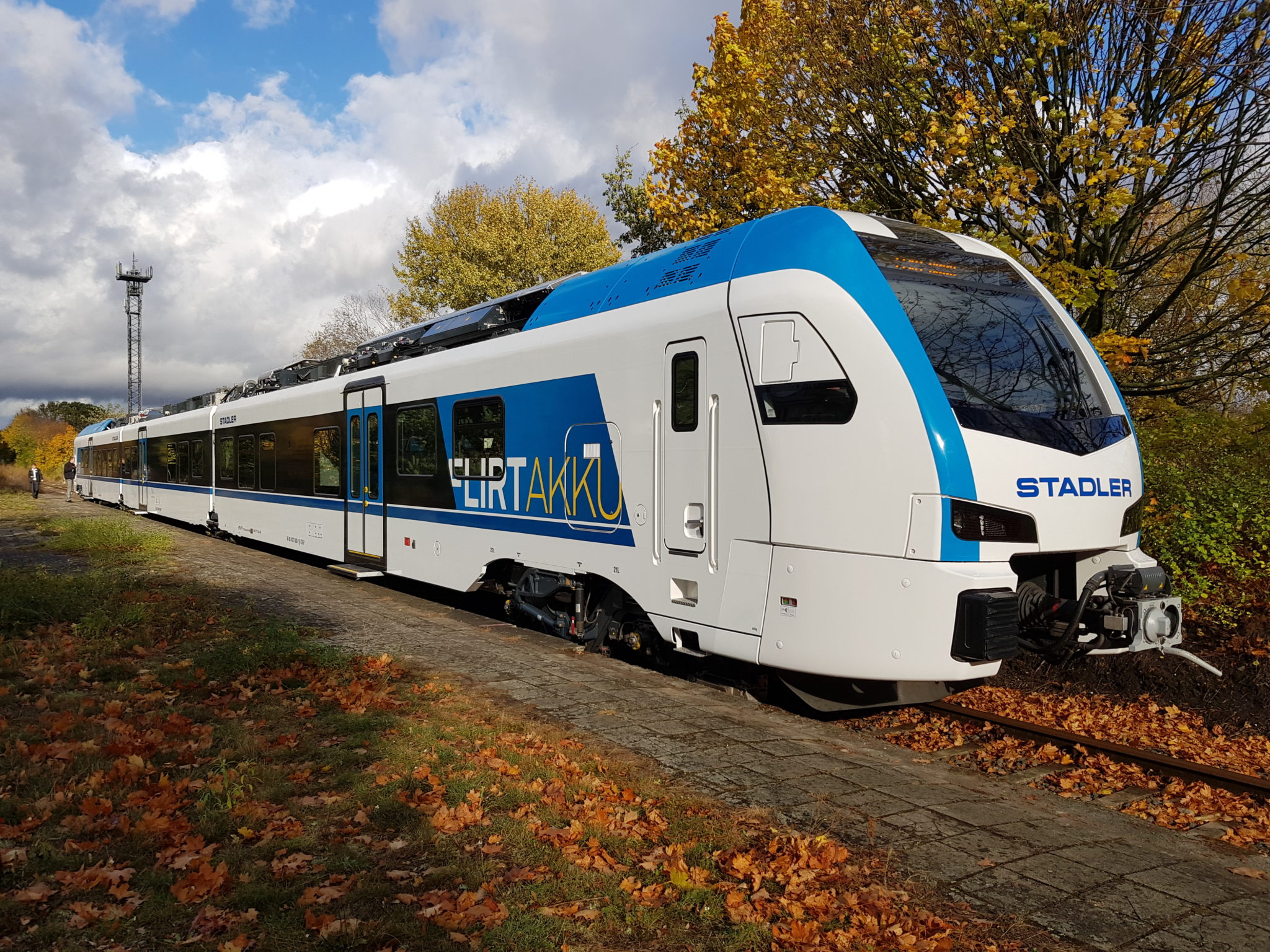
I have enlarged the image and it would appear that the trains do not have a central power-pack car, but they do seem to have a lot of electrical gubbins on the roof.
This video shows the Class 755 train being tested at Diss.
It looks to have a much smoother roof line.
Could this indicate that the batteries on the Akku are placed on the roof of the train, as there is certainly a lot of equipment up there?
Stadler Receives First Flirt Akku Battery Train Order
The title of this post, is the same as that of this article in Railway Gazette International.
This is said.
Schleswig-Holstein transport authority NAH.SH has selected Stadler to supply 55 Flirt Akku battery multiple-units to operate regional services and provide 30 years of maintenance.
Announcing its selection as preferred bidder on June 19, Stadler said that it will reveal more details when the contract is signed, which is expected after the 10-day standstill period. NAH.SH called tenders for zero-emission trains to run on non-electrified lines but did not specify the technology to be used.
NAH.SH becomes the launch customer for the Flirt Akku, which was officially unveiled last year at the Stadler Pankow factory in Berlin.
Information on the order is a bit short, but that doesn’t stop me speculating.
Do The Flirt Akku Trains Have A Power-Pack Like Greater Anglia’s Class 755 Trains?
Certainly, the Stadler Flirts for the South Wales Metro, do have both a power-pack and a battery, as Stadler use the same image for both trains and the trains have batteries.
These pictures show some of Greater Anglia’s Class 755 trains in the sidings at Crown Point Depot.
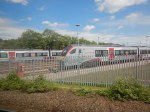
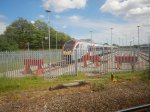
Note, these are four-car Class 755 trains with a power-pack in the middle.
In Importance Of Battery Range: Stadler’s FLIRT BMU For Greater Anglia, I referenced an article, that said that Greater Anglia’s network is too long for battery trains. But the article seemed to suggest, that Greater Anglia could go battery in the future.
Until, I get more details on the Flirt Akku, I will assume that they use a power-pack containing batteries instead of diesel engines.
As in South Wales, there could also be a mix of diesel engines and batteries in the power-pack of a Flirt Akku.
Importance Of Battery Range: Stadler’s FLIRT BMU For Greater Anglia
The title of this post is the same as a sub-section of this article on Railway News, which is entitled Stadler Presents New FLIRT Akku For The First Time.
This is said.
By contrast, Stadler recently unveiled its bi-mode (electric-diesel) FLIRT for Greater Anglia (U.K.) at InnoTrans 2018. When asked why Greater Anglia went for a diesel-electric option rather than a battery-electric option to bridge the non-electrified gaps in the network, Railway-News was told that the non-electrified distances in the U.K. are currently too great for battery-operated trains to cope with. As battery technology improves, this will hopefully change, making diesel and the need for electrification obsolete
Does this infer the following?
- Greater Anglia would have preferred to use battery-electric trains.
- It is possible to swap the diesel engines in the power-pack for battery modules.
- It could be possible to swap a diesel generator for a hydrogen fuel cell.
Option three might be difficult, as you need somewhere to put the hydrogen tank within the limited UK loading gauge.
Conclusion
I think it is highly likely that as battery technology improves and Stadler are able to package it better for the Class 755 trains, that Greater Anglia will change some of their Class 755 trains to battery-electric operation.
First Stadler FLIRT Train Receives Approval To Enter UK Service
The title of this post is the same as that of this article on Global Railway Review.
This is the first paragraph.
The British railway regulatory authority, the Office of Rail and Road (ORR), has granted Stadler approval for the 24 four-car bimodal FLIRT (BMU) for Greater Anglia. For Stadler, this is an important milestone in the project. It is the first FLIRT in the UK to receive an authorisation for placing the train into service (APIS). The test runs with the train for use in the UK only began at the beginning of 2019. Thanks to the excellent cooperation between Greater Anglia, Abellio, Rock Rail, Stadler and the authorities, the approval was obtained in record time.
It does make a change for a train to be able to enter service without too much trouble.
I do think that Stadler, Abellio and Greater Anglia have had a few advantages.
- These are the second fleet of Stadler bi-more FLIRTs, but could be the first to enter service.
- The electrified route between Norwich and Diss has been able to be used as a dedicated 100 mph test rtrack during the night, when no scheduled services are running.
- The trains are based at Crown Point depot, close to the Northern end of the test route.
- Abellio run fleets of FLIRTs in The Netherlands.
There also doesn’t appear to have been any major problems to delay the testing.
From reports in the local daily newspapers, it also appears that staff are fully behind these new trains and enthusiastic about their arrival.
Manchester Victoria To Chester
On Saturday, I went between Manchester Victoria and Chester on the new hourly Northern Connect service between Chester and Leeds.


Note.
- The train was a Class 158 train, with a Class 153 train acting as a capacity enhancer.
- The train was only doing 60 mph on the West Coast Main Line.
- The service was fairly busy.
- The route is electrified between Manchester Victoria and Warrington Bank Quay stations.
On this Saturday morning, it appeared to me that a better train is needed.
In Northern Connect Between Chester And Leeds To Start In May, I did report a rumour that Class 769 trains might be running between Chester and Leeds.
In my view Class 769 trains are ideal for the route between Chester and Leeds.
- They are four-car trains.
- They can do 100 mph, where electrification is available.
- They are 90 mph trains on diesel.
There main problem, is not their age, but since they were proposed, train interiors have moved on. Passengers and train operating companies want more tables and comfortable seats. Even some refurbishments of forty-year-old trains have tables. In What Train Is This?, I described a high class refurbishment of a Class 150 train. Here’s a picture.
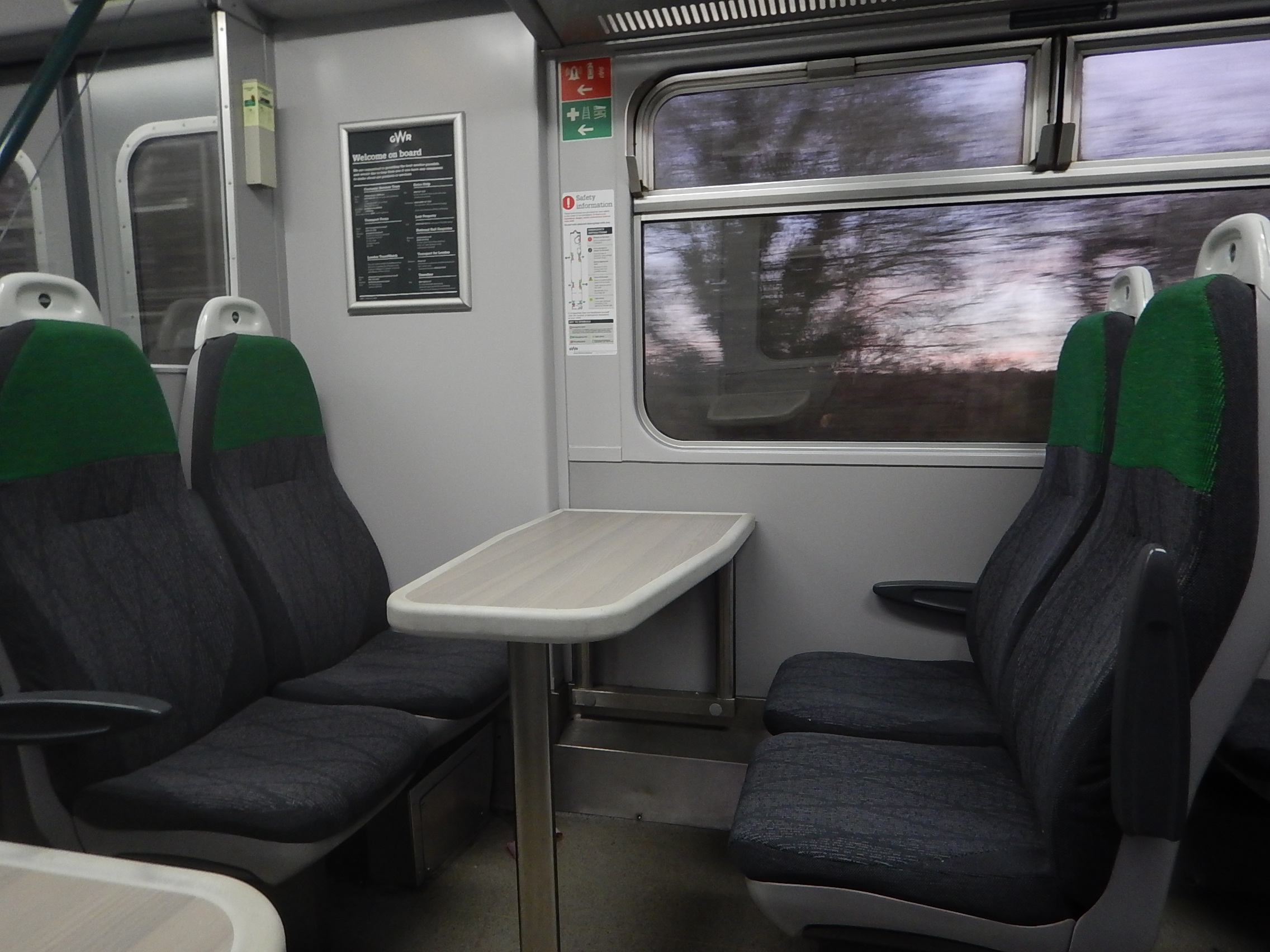
The Chester and Leeds route and probably many other routes in the UK need a train with the following characteristics.
- 100 mph using either 25 KVAC overhead or 750 VDC third-rail electrification.
- 100 mph on secondary power like diesel, battery or hydrogen.
- two hundred mile range without refuelling.
- Four or five cars.
- Comfortable interior with tables, wi-fi, power points and everything else passengers want.
Train operating companies would probably like a 125 mph version.
Hitachi already have a train with this specification in the Class 800 train. In Hitachi Plans To Run ScotRail Class 385 EMUs Beyond The Wires, I detail, Hitachi’s plans for Class 385 trains. Could these be stretched to perhaps do 100 miles on batteries.
Bombardier are offering a High Speed Bi-Mode Aventra with batteries and Stadler are introducing the Class 755 train for Greater Anglia.
Conclusion
It looks to me, that Northern need to get themselves some new 100 mph hybrid trains. The diesels they have on order are so Twentieth Century and late!
 The Anonymous Widower