Offshore Wind Farms Owned By CIP, JERA Nex BP Enter Lease With Crown Estate
The title of this post, is the same as that of this article on offshoreWIND.biz.
This is the sub-heading.
The 1.5 GW Mona offshore wind farm, owned by JERA Nex BP, and the 480 MW Morecambe, owned by Copehnagen Infrastructure Partners (CIP), have entered into lease with the Crown Estate.
It looks like the 1.5 GW Mona and the 480 MW Morecambe wind farms, which were both given development consent in 2025, will be going ahead, but the 1.5 GW Morgan wind farm is to be discontinued, despite having development consent.
Mona and Morecambe would appear to be planned to be commissioned around 2030.
So if all goes well, that would appear to be 2 GW in the oven.
In CIP’s UK Offshore Wind Project Granted Development Consent, there is a comprehensive map of all the wind farms in Morecambe Bay.
US Government Sends Stop Work Order To All Offshore Wind Projects Under Construction
The title of this post, is the same as that of this article on offshoreWIND.biz.
This is the sub-heading.
The US Department of Interior has paused the leases and suspended construction at all large-scale offshore wind projects currently under construction in the United States, citing ”national security risks identified by the Department of War in recently completed classified reports.”
The wind farms named are.
- Coastal Virginia Offshore Wind-Commercial – 2,600 GW
- Empire Wind 1 – 810 MW
- Revolution Wind – 704 MW
- Sunrise Wind – 924 MW
- Vineyard Wind 1 – 806 MW
Note.
- These five wind farms total 5,844 MW or 5.8 GW.
- The Empire Wind development is being led by Equinor, who are Norwegian.
- The Revolution Wind and Sunrise Wind developments are being led by Ørsted, who are Danish.
- The Vineyard Wind development is being led by Iberdrola, who are Spanish and Copenhagen Infrastructure Partners, who are Danish.
- Coastal Virginia Offshore Wind project uses 176 Siemens Gamesa SG 14-222 DD (Direct Drive) offshore wind turbines.
- Empire 1 Wind is using Vestas V236-15MW offshore wind turbines.
- Revolution Wind is using 65 Siemens Gamesa SG 11.0-200 DD offshore wind turbines.
- Sunrise Wind is using Siemens Gamesa wind turbines, specifically their 8.0 MW models (SG 8.0-167).
- Vineyard 1 Wind is using General Electric (GE) Haliade-X 13 MW offshore wind turbines.
- Some of the components for the Siemens wind turbines will be manufactured in Virginia.
- Coastal Virginia Offshore Wind has a budget of $11.2-3 billion.
- Empire 1 Wind has a budget of $5 billion.
- Resolution Wind has a budget of $4 billion.
- Sunrise Wind has a budget of $5.3 billion.
- Vineyard 1 Wind has a budget of $4 billion.
There will only be one winner in this new round of the ongoing spat between Trump and the wind industry, that he hates so much – the 1.3 million active lawyers in the United States,which is a figure from according to Google AI.
Danish CIP To Pour USD 3 Billion Into Philippines’ Offshore Wind Push
The title of this post, is the same as that of this article on offshoreWIND.biz.
This is the sub-heading.
Denmark’s Copenhagen Infrastructure Partners (CIP) will commit USD 3 billion (approximately EUR 2.6 billion) to build its first offshore wind farm in the Philippines.
This opening paragraph gives a few more details.
In a press briefing, Presidential Communications Office Undersecretary and Palace Press Officer Claire Castro said that the company is committed to investing in the Philippines through its partner, ACEN – Renewable Energy Solutions.
It does seem that the Philippines are putting out the red carpet for Copenhagen Infrastructure Partners and no wonder if you look at the first paragraph of the Danish firm’s Wikipedia entry.
Copenhagen Infrastructure Partners P/S (“CIP”) is a Danish investment firm specializing in infrastructure investments, particularly wind power.[1][2] CIP is one of the world’s largest dedicated renewables investment firms with €32 billion raised and a project pipeline of 120 GW.
But, are these two articles on offshoreWind.biz hinting at delay in the approval of UK projects?
- UK Delays Permit Decision for CIP’s Morecambe Offshore Wind Farm
- Permit Decision Delayed for 1.5 GW UK Offshore Wind Farm
Although the second project, which is the Outer Dowsing Wind Farm, is not a Copenhagen Infrastructure Partners project delaying decisions surely doesn’t give confidence to investors.
So have Copenhagen Infrastructure Partners decided to test the new virgin waters of the Philippines?
‘Europe’s Biggest Battery Farm’ Built On Coal Mine
The title of this post, is the same as that of this article on the BBC.
This is the sub-heading.
Work is under way to create what has been described as Europe’s largest battery storage project at Coalburn in South Lanarkshire.
These three paragraphs add a bit more detail.
Developers say the two huge neighbouring battery farms – one at the site of a former opencast coal mine – will store enough electricity to power three million homes.
Battery Energy Storage Systems (BESS) are being built across the UK to help balance the electricity grid, which is becoming increasingly powered by renewables.
Almost 90% of the electricity generated in Scotland last year was from low carbon sources like wind, solar or nuclear, according to figures from the Scottish government.
A search of the Internet found this paragraph describing the size of the battery.
The CIP BESS portfolio (Coalburn 1, Coalburn 2, and Devilla) will have total power capacity of 1.5GW and will be able to store and supply the grid with a total of 3GWh of electricity, equivalent to the electricity demand of over 4.5 million households, across a 2-hour period.
Note.
- CIP is Copenhagen Infrastructure Partners, who are a large developer of energy infrastructure.
- It appears there are three separate 500 MW/ 1 GWh batteries being developed together.
- The batteries can supply electricity for two hours.
This looks like a sensible project in an area, where there could be plenty of spare electricity.
Competition With Highview Power
Highview Power’s web site has a Projects section, where this is said.
Scotland And The North-East, UK
Highview Power’s next projects will be located in Scotland and the North East and each will be 200MW/2.5GWh capacity. These will be located on the national transmission network where the wind is being generated and therefore will enable these regions to unleash their untapped renewable energy potential and store excess wind power at scale.
I can see Highview Power’s 200MW/2.5GWh liquid air batteries and 500 MW/ 1 GWh Battery Energy Storage System (BESS) competing for the same projects.
However, it does appear at Trafford Energy Park, both types of battery appear to be being installed.
- Carlton Power Secures Planning Consent For World’s Largest Battery Energy Storage Scheme
- Centrica Invests In Renewable Energy Storage Capabilities To Boost UK’s Energy Security And Accelerate Transition To Net Zero
Perhaps the two together give the best response?
Slough Multifuel Energy-From-Waste Facility Begins Operations
The title of this post, is the same as that of this news item from SSE Thermal.
This is the sub-heading.
SSE Thermal and Copenhagen Infrastructure Partners (CIP), partners of a new energy-from-waste facility in Slough, have entered commercial operations ahead of schedule.
This section from the news item describes the operation of the plant.
Slough Multifuel will produce electricity and heat through burning waste-derived fuels made from various sources of:
- municipal solid waste
- commercial and industrial waste
- waste wood
The 55 MW facility will divert thousands of tonnes of waste away from landfill. It will convert it into a valuable source of energy. The facility is expected to process around 480,000 tonnes of residual waste each year. The station will support the UK Government’s strategy to reduce landfill waste and the export of waste.
Effectively, it is a sophisticated state-of-the-art incinerator, that has been built by Hitachi Zosen Inova.
In an ideal world, everything would be recycled and there would be no landfill or incineration.
But that would only be possible in a green fascist state.
Fashion Companies Pledge To Invest In Bangladesh First Offshore Wind Project
The title of this post, is the same as that of this article on offshoreWIND.biz.
This is the sub-heading.
Fashion companies, BESTSELLER and H&M Group have pledged to invest in the first utility-scale offshore wind project off the coast of Bangladesh, which is being developed by Copenhagen Infrastructure Partners (CIP) together with local partner Summit Power.
These four paragraphs give a lot more detail.
The announcement was made Tuesday at the ongoing COP28 in Dubai.
The 500 MW offshore wind project, which is in early-stage development, could significantly increase the availability of renewable energy in one of the fashion industry’s most important manufacturing countries, said the non-profit organisation Global Fashion Agenda (GFA).
More than 70 per cent of the fashion industry’s GHG emissions come from upstream activities and current operations predominantly rely on non-renewable energy sources, such as petroleum, gas, oil, and coal, said GFA.
To ensure and accelerate decarbonisation, GFA is advocating collective investments by fashion brands in new renewable energy generation.
This would appear to be one of those circular stories, where a lot of parties benefit.
- There will be less greenhouse gas emissions from manufacturing in Bangladesh.
- Jobs will be created in the renewable energy industry in Bangladesh.
- The fashion industry gets product with a smaller carbon footprint.
- The fashion industry gets a safe investment for its spare cash, that improves their product.
It might also create an industry in Bangladesh, that makes steel structures for the world’s offshore wind industry.
But consider.
- As of June 2022, Bangladesh had 25.7 GW of electricity generation.
- Much of Bangladesh’s electricity is generated by gas.
- Bangladesh is aiming for a 7 % growth rate so will need a lot more electricity.
500 MW is literally a drop in the ocean.
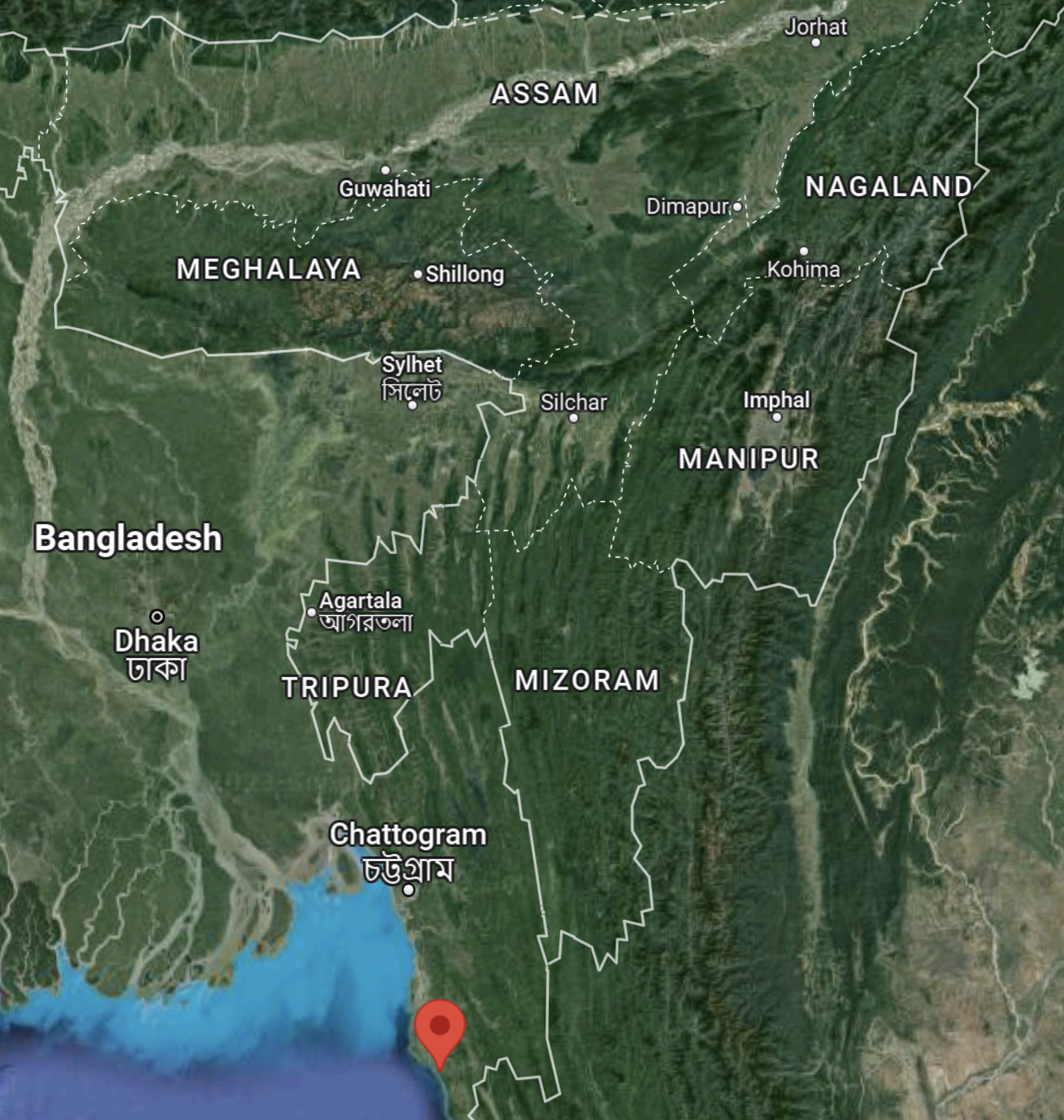
This Goggle Map shows most of Bangladesh and the location of the wind farm, by Cox’s Bazar, which is marked by a red arrow.
I shall be interesting to see how this and other similar projects develop.
CIP’s Flagship Fund On Track To Become World’s Largest Dedicated To Greenfield Renewable Energy Investments
The title of this post, is the same as that of this article on offshoreWIND.biz.
This is the sub-heading.
Copenhagen Infrastructure Partners (CIP) has reached the first close on its fifth flagship fund, Copenhagen Infrastructure V (CI V), at EUR 5.6 billion in capital commitments received. This puts the fund on track to reach its target size of EUR 12 billion, which would make this the world’s largest dedicated greenfield renewable energy fund, according to CIP
These three paragraphs give more details on the size and investments of the latest fund, which is named CI V.
The first close of the flagship fund saw a large group of leading institutional investors across continental Europe, the Nordics, the UK, North America, and the Asia-Pacific region.
CIP noted that there is a strong interest from additional investors already in process, so CI V is on the way to reaching its target fund size of EUR 12 billion.
The fund now has ownership of more than 40 renewable energy infrastructure projects with a total potential CI V commitment of approximately EUR 20 billion, corresponding to more than 150 per cent of the target fund size.
The CIP web site gives more details on the company, including this summary on the front page.
Founded in 2012, Copenhagen Infrastructure Partners P/S (CIP) today is the world’s largest dedicated fund manager within greenfield renewable energy investments and a global leader in offshore wind. The funds managed by CIP focuses on investments in offshore and onshore wind, solar PV, biomass and energy-from-waste, transmission and distribution, reserve capacity, storage, advanced bioenergy, and Power-to-X.
CIP manages 11 funds and has to date raised approximately EUR 25 billion for investments in energy and associated infrastructure from more than 150 international institutional investors.
In the UK, CIP are currently involved in the Ossian and Pentland floating wind farms.
Industry Calls For 10 GW Of Offshore Hydrogen In German National H2 Strategy
The title of this post, is the same as that of this article on offshoreWIND.biz.
This is the sub-heading.
Offshore wind and hydrogen developers and organisations in Germany have called on the federal government to set clear targets for offshore hydrogen in the update of the country’s National Hydrogen Strategy, with an additional 10 GW of offshore electrolysis capacity to be added by 2035.
These two paragraphs add detail the story and name those who are behind it.
On 26 May, several companies and industry organisations signed an appeal sent to the German Federal Government that highlights offshore hydrogen’s advantage of adding large-scale capacities and asks that a target of an additional 10 GW of offshore hydrogen by 2035 be added to both the country’s hydrogen strategy and the area development plan.
The parties that signed the appeal include the German offshore wind-to-hydrogen initiative AquaVentus, offshore wind and hydrogen players BP, Siemens Gamesa, Gasunie, Copenhagen Infrastructure Partners (CIP), EnBW, Equinor, and Lhyfe, as well as industry organisations WAB and the Federal Association of Offshore Wind Farm Operators (BWO), among others.
These two paragraphs describe an area to be developed for the first offshore hydrogen production.
As reported in January, in the country’s new area development plan for offshore wind, Germany’s Federal Maritime and Hydrographic Agency (BSH) also outlined the first offshore hydrogen area in the North Sea.
The area, SEN-1, spans over 100 square kilometres in the North Sea and will allow for an electrolysis capacity of up to 1 GW to be tested and connected with a hydrogen pipeline.
Note.
- 1 GW if electricity should create about 435 tonnes of hydrogen per day.
- That amount of hydrogen could be stored as liquid in a sphere with a radius of 11.35 metres.
Ireland Awards 3.1 GW Offshore Wind Capacity In First ORESS 1 Auction
The title of this post, is the same as that of this article on offshoreWIND.biz.
This is the sub-heading.
Ireland has selected four projects with a combined capacity of nearly 3,100 MW in the first offshore wind auction under the Renewable Electricity Support Scheme (ORESS 1).
The four wind farms are.
- The 1,300 MW Codling Wind Park owned and developed by a 50/50 joint venture of Fred Olsen Seawind and EDF Renewables.
- The 824 MW Dublin Array owned and developed by RWE.
- The 500 MW North Irish Sea Array (NISA), owned and developed by Copenhagen Infrastructure Partners (CIP) and Statkraft.
- The 450 MW Sceirde Rocks wind farm owned and developed by Fuinneamh Sceirde Teoranta (FST), a joint venture owned by Corio Generation, a portfolio company of Macquarie’s Green Investment Group, and global infrastructure investor, Ontario Teachers’ Pension Plan.
Note.
- That makes a total of 3074 MW.
- All wind farms already have web sites.
- Looking at the web sites, it appears all wind farms will have fixed foundations and some seem to be located on convenient sandbanks.
- This is equivalent to over a third of Ireland’s entire electricity consumption this year and over a quarter of projected 2030 electricity demand.
- This article on offshoreWIND.biz, which is entitled Fred. Olsen Seawind And EDF Renewables Win Big Offshore Ireland, gives more details of the first wind farm.
- This article on offshoreWIND.biz, which is entitled 500 MW for Statkraft And CIP In First Irish Offshore Wind Auction, gives more details of the third wind farm.
- Given SSE’s large presence in Ireland, I’m surprised they didn’t obtain a lease.
The auction results appear to have surpassed the expectations of the Irish government.
SSE, Marubeni & CIP’s Floating Wind Farm In Scotland Could Have 270 Turbines And 6 Offshore Substations
The title of this post, is the same as that of this article on offshoreWIND.biz.
This is the sub-heading.
SSE Renewables, Marubeni and Copenhagen Infrastructure Partners (CIP) have submitted the Environmental Impact Assessment (EIA) Scoping Report for the array area of their Ossian floating wind farm to Marine Scotland. According to the report, the wind farm could have up to 270 wind turbines and six offshore substations.
Ossian floating wind farm will be one of the world’s largest floating wind farms.
- If it sticks to 3.6 GW, 270 turbines will mean 13 MW turbines.
- 14 MW would be 3.8 GW and 15 MW would be 4 GW, with the same number of turbines.
- If they stick to 3.6 GW, this could be 257 x 14 MW or 240 x 15 MW turbines.
- Knowing ambitious engineers as I do and given that 15 MW turbines are on the way, I wouldn’t be surprised to see 15 MW turbines, to get the full 4 GW.
- According to this press release from Siemens Gamesa, they can make the turbine blades for their 15 MW turbines in Hull.
These two paragraphs outline the design possibilities.
For the floating wind turbine foundations, the consortium is considering either semi-submersible or Tension Leg Platform (TLP) structures and three mooring configurations; catenary, semi taut and taut mooring lines. Anchoring options currently under consideration include driven piles, and a number of different embedded anchor types, including suction piles, Drag Embedment Anchors (DEA) and VLA, with up to nine anchors required per foundation.
Floating foundations might not only be used for the wind turbines, but also for Ossian’s offshore substations.
When I look at a project like this, I also think of the project management possibilities.
- Will the six offshore sub-stations be positioned, so that as turbines are installed, they can be commissioned and start generating electricity?
- Is there software to optimise the order of installation?
- Has a specialist project management system been written for wind farms?
If you need a program to do analyse anything like that, buy me a drink and we’ll talk about it.
It’s about time, some of the algorithms in my brain were put to use.
The article also says this.
The 3.6 GW Ossian floating wind farm is planned to be up and running before the end of the decade.
My experience tells me, that if the right philosophy is used, that estimated date could be beaten.
It’s just that it is a project with so many complexities, that a proper mathematical model of its construction would yield benefits.
 The Anonymous Widower