Development Consent Decision On 3 GW Dogger Bank South Project Postponed
The title of this post, is the same as that of this article on offshoreWIND.biz.
This is the sub-heading.
The UK Secretary of State for Energy Security and Net Zero has set a new deadline for the decision on the Development Consent Order (DCO) for Dogger Bank South, a 3 GW offshore wind project developed by RWE, which the company owns in partnership with Masdar.
These two paragraphs add more detail to the project.
The statutory deadline for the decision on the project was 10 January 2026. This has now been moved to 30 April.
According to a statement from the Minister for Energy Consumers, Martin McCluskey, the extension will allow time to request further information that was not provided for consideration during the examination period and to give all interested parties the opportunity to review and comment on such information.
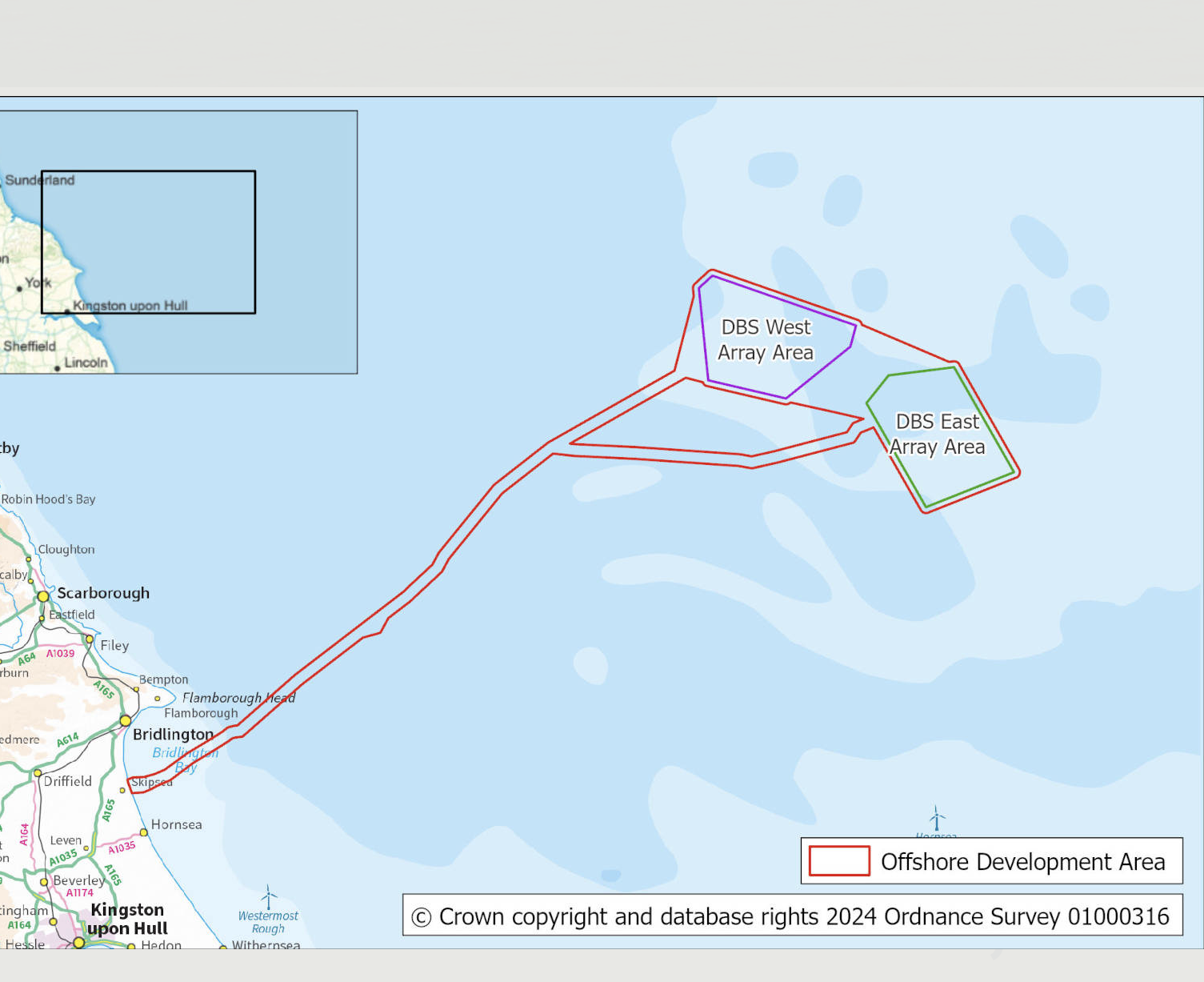
I clipped this map from the Dogger Bank South web site.
Note.
- Bridlington, Kingston-Upon-Hull and Scarborough can be picked out on the coast of East Yorkshire.
- The two wind farms and the route of the cables to the shore can be clearly seen.
I just wonder, whether the nature of the project is changing.
Consider.
- Three GW is a lot of power to move across Yorkshire to where it can be connected to the grid.
- In Consultation On Offshore Wind Reform: Hydrogen Sector Calls For Hybrid Connection Concepts And Warns Of Compensation Risks, German companies involved in the AquaVentus project are calling for more hydrogen to be produced offshore and piped to the shore.
- Could hydrogen produced in the Dogger Bank Wind farms be piped to the Northern end of the AquaVentus pipeline on the German sector of the Dogger Bank?
- A pipeline or cable could still bring energy to Yorkshire.
- The hydrogen could go to the hydrogen stores at Aldbrough and Rough.
- SSE and Centrica could play hydrogen-bankers to the Germans, as Germany is short of hydrogen storage.
- East Yorkshire is building two hydrogen power stations at Keadby and Ferrybridge.
- Support for the Dogger Bank South wind farms will probably be from RWE’S Grimsby hub.
Is this the Anglo-German co-operation, I talked about in UK And Germany Boost Offshore Renewables Ties at work?
I can see benefits for this arrangement for the UK.
- Hydrogen production is offshore.
- A lot of the onshore employment is in the UK.
- There will be a hydrogen pipeline between Germany and the vast hydrogen storage of Humberside via the German Dogger Bank and Dogger Bank South wind farms.
- Will there be a hydrogen pipeline between the North of Scotland and Humberside via the AquaVentus pipeline?
- There will also be a substantial cash flow to the UK Treasury because of all the hydrogen production in UK waters.
RWE may also be able to use a standard hydrogen production platform in German and UK waters.
This is the sort of plan, that the money men will like.
All Recyclable Blades Installed At RWE’s 1.4 GW UK Offshore Wind Farm
The title of this post, is the same as that of this article on offshoreWIND.biz.
This is the sub-heading.
All 150 recyclable blades have been installed at the 1.4 GW Sofia offshore wind farm, with more than half of the wind turbines now in place at the UK construction site.
These three paragraphs add more details.
All 150 recyclable blades are now installed, with each turbine utilising 50 sets of three blades, marking the UK’s first large-scale use of this technology at an offshore wind farm, RWE, the developer, said.
The recyclable rotor blades used at Sofia are manufactured by Siemens Gamesa at its Hull factory and use a unique resin that enables easy separation of component materials at the end of each blade’s operational life cycle.
In addition, 62 out of 100 Siemens Gamesa 14 MW turbines have now been installed at the site located 195 kilometres off the UK’s east coast. Each turbine features 108-metre blades and a 222-metre rotor diameter. Cadeler is responsible for the installation of the wind turbines.
Note.
- The Sofia wind farm has a hundred turbines, each with the customary three blades.
- Currently the 13 MW Siemens Gamesa turbines in Dogger Bank A and Dogger Bank B are the largest turbines in British waters.
- Sofia’s at 14 MW will be larger.
- But 15 MW monsters are on their way, with RWE’s Norfolk zone appearing to favour 15 MW Vesta turbines.
At the present time, turbine size seems to be creeping up. I would expect this to happen, as turbines become more affordable.
UK Economy To Reap GBP 6.1 Billion From 3.6 GW Dogger Bank Offshore Wind Farm
The title of this post, is the same as that of this article on offshoreWIND.biz.
This is the sub-heading.
The 3.6 GW Dogger Bank Wind Farm, which will become the world’s largest offshore wind farm once fully operational, will boost the UK economy by GBP 6.1 billion (approximately EUR 6.9 billion) during its lifetime and support thousands of UK jobs over the next decade, according to a report written by BVG Associates.
The first three phases of the Dogger Bank wind farm are scheduled to be delivered as follows.
- Dogger Bank A – 1235 MW – 2025
- Dogger Bank B – 1235 MW – 2026
- Dogger Bank C – 1218 MW – 2027
The planned dates in the North Sea are generally kept, because we’ve been building structures there since the days of World War Two.
These two paragraphs from the article add more detail.
The economic impact report was commissioned by Dogger Bank Wind Farm’s equity partners SSE, Equinor and Vårgrønn, who are currently constructing the offshore wind farm in three 1.2 GW phases at adjoining sites in the North Sea, more than 130 kilometres from the Yorkshire Coast.
Direct spend with companies in the Northeast of England and in the counties of North Yorkshire and the East Riding of Yorkshire is expected to total over GBP 3 billion, with hundreds of jobs supported in these regions.
But these three wind farms are just the hors d’oeuvre.
This article on offshoreWIND.biz is entitled SSE, Equinor Move Forward with 1.5 GW Dogger Bank D Project and it has this sub-heading.
SSE and Equinor have finalised a seabed lease with the Crown Estate to progress Dogger Bank D, the proposed fourth phase of the world’s largest offshore wind farm, the 3.6 GW Dogger Bank Wind Farm, currently under construction off the coast of England in the North Sea.
These two paragraphs from the article add more detail.
The lease allows Dogger Bank D shareholders to maximise renewable generation from the eastern part of the Dogger Bank C seabed area, located around 210 kilometres off the Yorkshire coast, with future potential to unlock an additional 1.5 GW.
SSE Renewables and Equinor previously established terms for the wind farm with the Crown Estate in July 2024. Implementation of these commercial terms was subject to the conclusion earlier this year of the plan-level Habitats Regulation Assessment (HRA) associated with the Crown Estate’s wider Capacity Increase Programme.
Note.
- The total capacity for the first four phases of the Dogger Bank Wind Farm are 5,188 MW.
- But if the Crown Estate’s wider Capacity Increase Programme is carried out, the total capacity will be 6,688 MW.
- Hinckley Point C is planned to be only 3,260 MW and is likely to be fully delivered between 2029 and 2031.
So if the Crown Estate, Equinor and SSE go for the full Dogger Bank D, I believe it is likely that we’ll get a wind farm with a capacity of two Hinckley Point Cs delivered before the nuclear power station.
.
UK Energy Grid Needs £60bn Upgrade To Hit Green Target, Plan Says
The title of this post, is the same as that of this article on the BBC.
This is the sub-heading.
The UK’s electricity network needs almost a further £60bn of upgrades to hit government decarbonisation targets by 2035, according to a new plan.
These five paragraphs explain the plan.
About 4,000 miles of undersea cables and 1,000 miles of onshore power lines are needed, said the National Grid’s Electricity Systems Operator (ESO).
The investment would add between £20 to £30 a year to customer bills, it said.
The government said the ESO’s plans were preliminary and yet to pass a “robust planning process”.
The plans were written up by the ESO, the organisation which runs the electricity network and would run the updated system it is calling for too. It is currently owned by National Grid but will transfer into government ownership later this year.
Its latest £58bn estimate is for work needed between 2030 and 2035 and comes on top of a previous £54bn estimate for work taking place between now and 2030.
These are my thoughts.
The Amount Of Undersea Cable
Edinburgh and London are roughly 400 miles apart as the train runs, so it looks like there could be the equivalent of ten underwater cables between the North of Scotland and England.
In Contracts Signed For Eastern Green Link 2 Cable And Converter Stations, I talked about the proposed 2 GW link between Peterhead in Scotland and Drax in England, which will be a double cable. So there’s the first two of these long cables.
It looks to me, that National Grid are proposing to use underwater cables wherever they can, so they avoid large expensive planning rows stirred up by Nimbies.
Monitoring The Undersea Cables
Last week Ofgem gave National Grid a £400,000 grant to develop new innovative technologies, which I wrote about in £400k For National Grid Innovation Projects As Part Of Ofgem Fund To Help Shape Britain’s Net Zero Transition.
One of the project is called HIRE – Hybrid-Network Improvement & Reliability Enhancement and will be used to check all these cables are performing as they should.
My electrical engineering experience tells me, that there must be some cunning way, that will detect that something is happening to the cable. The involvement of a technology company called Monitra in the project is a bit of a giveaway.
How Much Will It Cost Me?
Currently, UK consumers pay about £30 per year to have electricity delivered, so this will rise to between £50 and £60 per year.
That is just over a pound a week. I would pay about the same for a resident’s parking permit outside my house for an electric car and probably three times more for a petrol or diesel car.
Do We Have Enough Cable?
Two undersea cable factories are under development in Scotland and I suspect the 4,000 miles of undersea cables will be delivered on schedule and covered in saltires.
What About T-Pylons?
The latest onshore electricity transmission line between Hinckley Point C and Bristol, doesn’t use traditional pylons.
It uses T-pylons like these to connect the 3.26 GW nuclear power station.
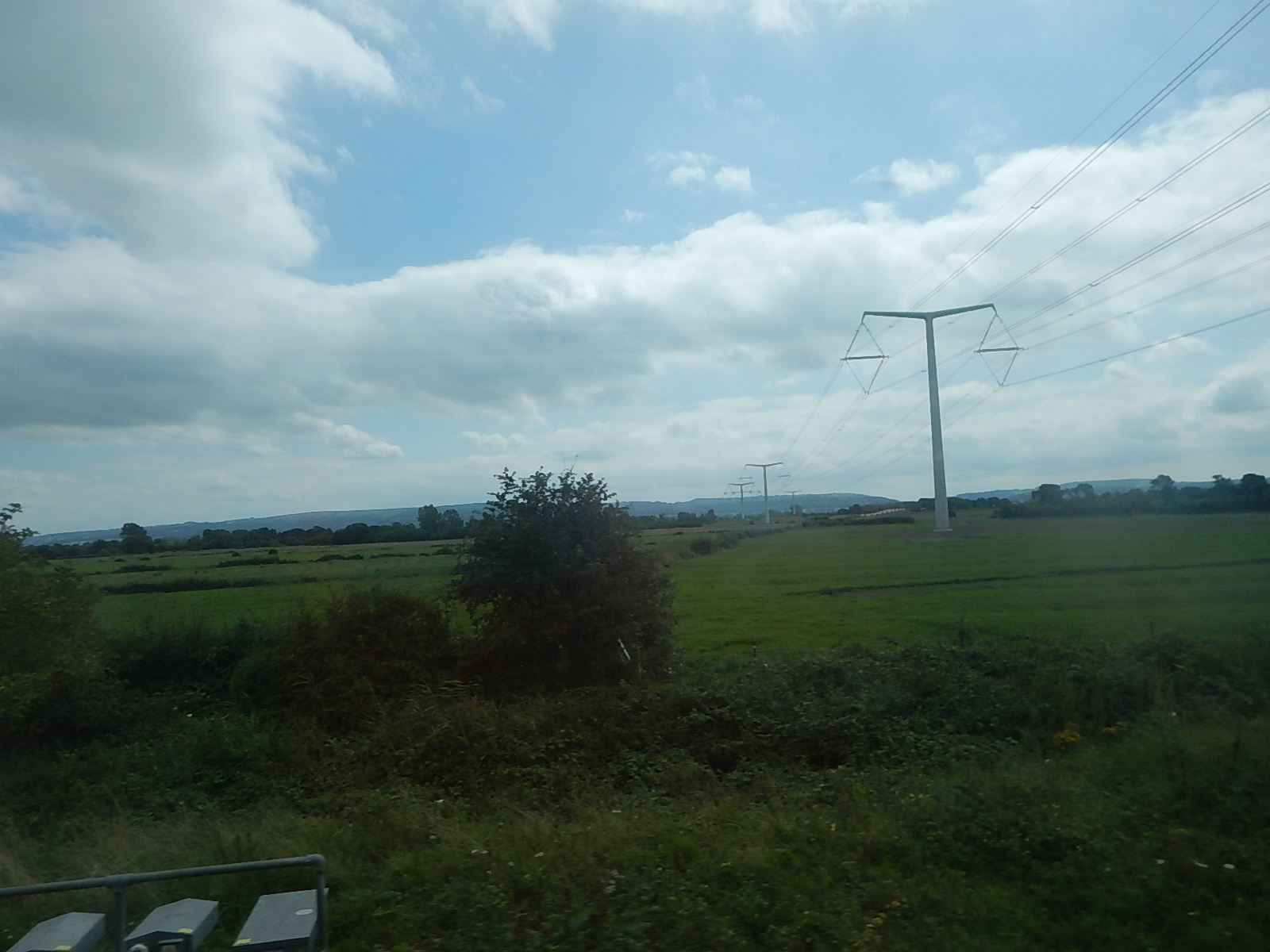
Note that they are shorter, designed to be less intrusive, have a smaller footprint and are made from only ten parts.
I suspect they will cost less to install and maintain.
There is more on T-pylons in National Grid Energise World’s First T-Pylons.
I wouldn’t be surprised that some of the oldest traditional pylons will be replaced by T-pylons.
I am surprised that T-pylons are not mentioned in the BBC article.
I like T-pylons. How do you feel about them?
Eastern Green Link 2
This press release from National Grid, describes Eastern Green Link 2 like this.
Eastern Green Link 2 (EGL2) is a 525kV, 2GW high voltage direct current (HVDC) subsea transmission cable from Peterhead in Scotland to Drax in England delivered as a joint venture by National Grid and SSEN Transmission.
This map from National Grid, shows the route of the Eastern Green Link 2.

The Northern landfall is at Sandford Bay and the Southern landfall is at Wilsthorpe Beach.
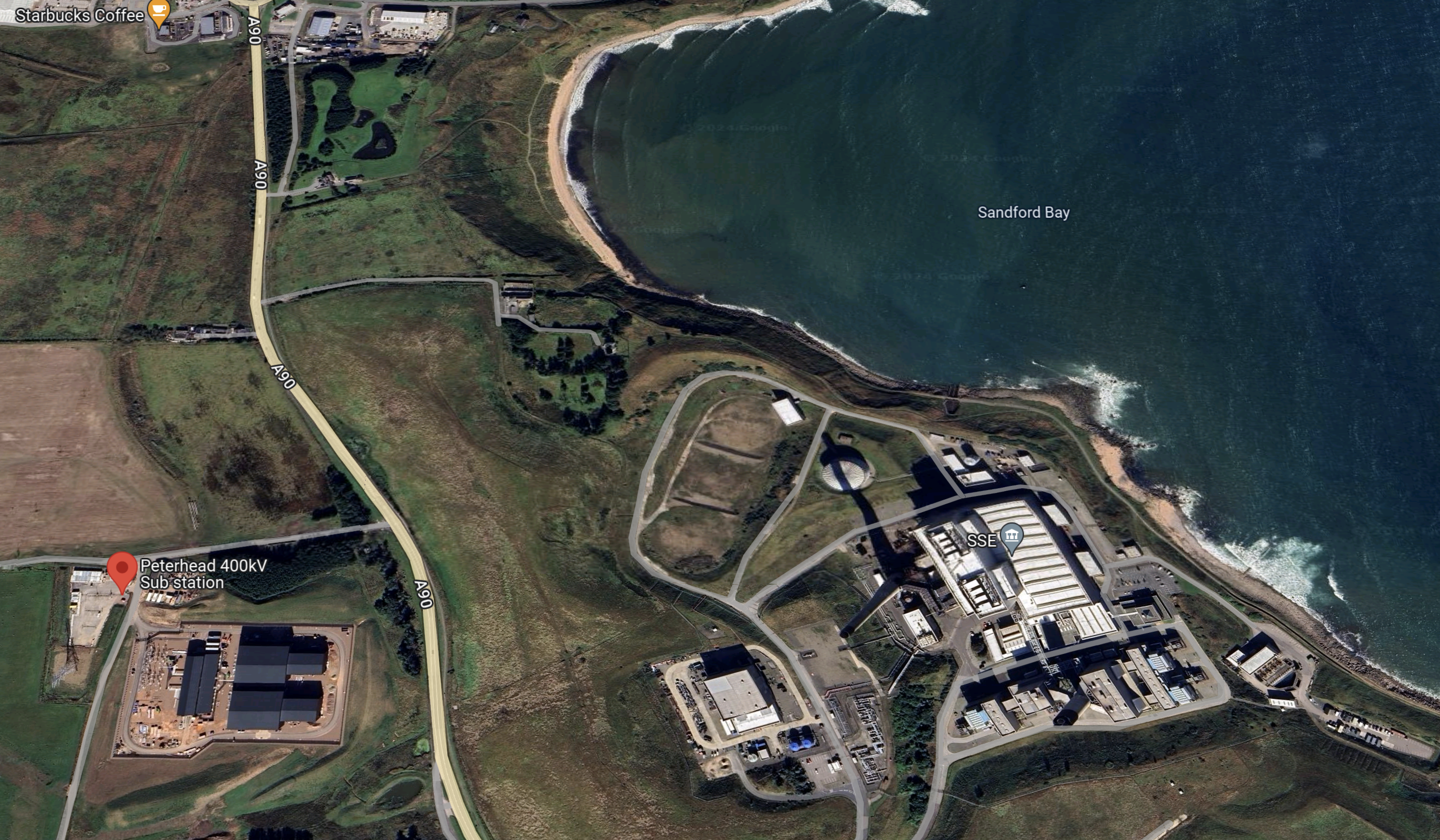
This Google Map shows Sandford Bay and Peterhead power station.
Note.
- Sandford Bay occupies the North-East corner of the map.
- The red arrow indicates the main 400kV sub-station at Peterhead.
- The 2177 MW gas-fired Peterhead power station is to the East of the sub-station marked as SSE.
This second Google Map shows the onshore route of the cable from Wilsthorpe to Drax.

Note.
- Flamborough Head is in the North-East corner of the map.
- Wilsthorpe Beach is at Bridlington a couple of miles South of Flamborough Head.
- The red arrow indicates Drax Power station.
- An onshore underground cable will be installed from landfall in Wilsthorpe to a new onshore converter station built in Drax.
The EGL2 HVDC cable connection from Scotland to England consists of 436km of submarine cable and 69km of onshore cable.
Both converter stations will be on existing power station sites and the major onshore works will be the underground cable between Wilsthorpe and Drax.
Where Does Drax Go From Here?
Currently, Drax power station is a 2595 MW biomass-fired power station.
There are now other large power sources that could replace some or all of the output of Drax power station.
- 2GW of Scottish wind power coming to Drax on Eastern Green Link 2.
- 6 GW of offshore wind is being developed at the Hornsea wind farms.
- 8 GW of offshore wind is being developed at the Dogger Bank wind farms.
- 2.5 GW from the three gas-fired power stations at Keadby, two of which are likely to be fitted with carbon capture.
- 1.8 GW from the proposed hydrogen-fired Keadby Hydrogen power station.
Given the bad feelings many have about Drax burning biomass, with 20.3 GW of electricity, you might think that shutting down Drax would be a simple solution.
But, according to Drax’s Wikipedia entry, it has a unique property.
Despite this intent for baseload operation, it was designed with a reasonable ability for load-following, being able to ramp up or down by 5% of full power per minute within the range of 50–100% of full power.
So Drax could be very useful in balancing the grid, by ramping up and down to fill the gap between production and need.
In addition, there is good biomass. This is from the Wikipedia entry.
A 100,000 tonne pa capacity straw pelletization facility was constructed at Capitol Park, Goole in 2008.
Drax are also promoting BECCS or Bioenergy carbon-capture and storage.
There is a Wikipedia entry for Bioenergy With Carbon Capture And Storage, of which this is the first couple of sentences.
Bioenergy with carbon capture and storage (BECCS) is the process of extracting bioenergy from biomass and capturing and storing the carbon, thereby removing it from the atmosphere. BECCS can theoretically be a “negative emissions technology” (NET).
I do feel that carbon capture and storage is a bit like sweeping the dust under the carpet, when you sweep the floor around it.
But carbon capture and use could be another matter.
This Google Map shows the Drax site.

Note how it is surrounded by agricultural land.
Could the power station be the source of pure carbon dioxide to be fed in greenhouses to flowers, herbs, salad vegetables, tomatoes and other plants?
I suspect there’s productive life left in Drax power station yet!
LionLink
LionLink, that is being developed by National Grid is a new type of interconnector, called a multi-purpose interconnector, that will connect Suffolk and The Netherlands via any convenient wind farms on the way. This means that the electricity generated can go where it is needed most.
I wrote about LionLink in World’s Largest-Of-Its-Kind Power Line To Deliver Clean Power To 1.8m UK Homes And Boost Energy Security.
Other Multi-Purpose Interconnectors
I can see other multi-purpose interconnectors like LionLink being built around the UK.
- There could be one across the Dogger Bank to link out 8 GW of Dogger Bank wind farms with those of the Dutch, Danes and Germans on their section of the bank.
- NorthConnect could be built between Scotland and Norway via some of the wind farms being developed to the North-East of Scotland.
- Could wind farms to the North of Ireland use a multi-purpose interconnector between Scotland and Northern Ireland.
- I can also see one or possibly two, being built across the Celtic Sea to link Devon, South Wales and Southern Ireland via the wind farms being developed in the area.
- Will we also see a Channel multi-purpose interconnector to transfer electricity along the South Coast of England?
Some of these multi-purpose interconnectors could be key to creating a revenue stream, by exporting electricity, to countries in Europe, that have a pressing need for it.
Conclusion
National Grid’s excellent plan will lead to the end of the practice of shutting down wind turbines. The spare electricity will be exported to Europe, which will surely create a good cash-flow for the UK. This in turn will encourage developers to create more wind farms in the seas around the UK’s coasts.
Dogger Bank D Welcomes Confirmation Of Grid Connection Location
The title of this post, is the same as that of this press release from SSE Renewables.
This is the sub-heading.
Project team now focusing full attention on electrical transmission system connection.
These four paragraphs describe the proposed connection to the National Grid.
SSE Renewables and Equinor have welcomed confirmation of a grid connection location from the Electricity System Operator (ESO) for a proposed fourth phase of the world’s largest offshore wind farm.
Dogger Bank D will now connect into Birkhill Wood, a proposed new 400kV substation located in the East Riding of Yorkshire which will be built as part of National Grid’s Great Grid Upgrade.
The announcement follows the publication of an impact assessment for the South Cluster by ESO, relating to energy projects which are due to be electrically connected off the east coast of England.
With the location of a grid connection confirmed, Dogger Bank D will now focus its full attention on connecting to the electrical transmission system.
This is a big change from December 2023, when I wrote Plans for Hydrogen Development At Dogger Bank D Gain Ground, which indicated that Dogger Bank D would be used to produce hydrogen, so the grid connection wouldn’t be needed.
Using A Offshore Hybrid Asset Between the UK And Another European Country
This is the next paragraph on the SSE Renewables press release.
The project is also exploring the future possibility of the development of Dogger Bank D to be coordinated with an Offshore Hybrid Asset between the UK and another European country’s electricity market to form a multi-purpose interconnector. This option would increase energy security for the UK and reduce the need to curtail offshore wind output in times of oversupply on the GB network.
Note that just over the boundary of the UK’s Exclusive Economic Zone are the Dutch and German Exclusive Economic Zones.
It is not unreasonable to believe that UK, Dutch and German grid could all be connected on the Dogger Bank.
Connecting Everything Up At Birkhill Wood
This is the next paragraph on the SSE Renewables press release.
The project team are undertaking a site selection process to identify potential cable corridors and where other onshore infrastructure associated with the grid connection at Birkhill Wood may be sited. Consultation will be held later this year to introduce the connection proposals to the local community.
At least now, with the connection to Birkhill Wood confirmed, SSE and Equinor will be able to supply any electricity generated at Dogger Bank D to the UK grid, up to limit of the connection.
The Value Of Electricity That Could Be Generated At Dogger Bank D
Consider.
- The wind farm has a capacity of 2 GW or 2,000 MW.
- There are 365 days in most years.
- There are 24 hours in the day.
- This means that 17, 520,000 MWh could be generated in a year.
- A large wind farm like Hornsea One has a twelve month rolling capacity factor of 46.6%.
- Applying this capacity factor says that 8,164,320 MWh will be generated in a year.
- The Contract for Difference Round 6 for this electricity will be £73/MWh.
Applying that figure gives a yearly turnover of £ 595,995,360 or £ 297,997,680 per installed GW.
It is not unreasonable to assume that half of this electricity were to be exported to power Germany industry.
It could be a nice little earner for the Treasury.
Plans for Hydrogen Development At Dogger Bank D Gain Ground
The title of this post, is the same as that of this article on offshoreWIND.biz.
This is the sub-heading.
Dogger Bank D, the potential fourth phase of the world’s largest offshore wind farm under construction, Dogger Bank Wind Farm, has awarded contracts to engineering consultants to support the feasibility and optimization of a large-scale green hydrogen development option on the project
These three paragraphs outline the project.
SSE Renewables and Equinor, the developers of the Dogger Bank wind farm in the UK, awarded contracts for green hydrogen concept and engineering and optimization studies to Genesis, H2GO Power, and Fichtner.
If progressed for delivery, Dogger Bank D would be located in the North Sea around 210 kilometers off the northeast coast of England. Subject to the successful outcome of further technical studies, the project could be capable of generating up to around 2 GW of renewable power.
The 2 GW offshore wind farm is currently planned to comprise 128 wind turbines and up to six offshore platforms.
Note.
According to the article, this would be one of the UK’s largest green hydrogen production facilities.
The partners said, that the project could contribute to the UK Government’s electrolytic hydrogen ambitions for 5 GW by 2030.
This is said about the studies.
Using AI machine learning and robust modeling, these studies will investigate the multitude of interdependent variables required to optimize a potential green hydrogen production facility, such as offshore wind farm sizing, electrolysis capacity, transport and storage capacity, water availability, and offtake optionality.
I was using robust modelling on projects such as these fifty years ago, both with Artemis and bespoke software.
To my mind, SSE Renewables and Equinor are doing the right thing. If anybody has a similar project with lots of variables, I’d love to give my opinion.
I have some thoughts.
How Much Hydrogen Will Be Produced?
Ryze Hydrogen are building the Herne Bay electrolyser.
- It will consume 23 MW of solar and wind power.
- It will produce ten tonnes of hydrogen per day.
The electrolyser will consume 552 MWh to produce ten tonnes of hydrogen, so creating one tonne of hydrogen needs 55.2 MWh of electricity.
This would mean that if the Japanese built one Herne Bay-size electrolyser, then it would produce around three hundred tonnes of hydrogen in an average month.
Consider.
- Dogger Bank D is likely to be a 2 GW wind farm.
- This document on the OFGEM web site, says that the Dogger Bank wind farms will have a capacity factor of 45 %.
- This means that Dogger Bank D wind farm will produce an average of 900 MW over a year.
- This works out at 7,884 GWh of electricity in a year.
As each tonne of hydrogen needs 55.2 MWh to be produced, this means if all the electricity produced by Dogger Bank D, is used to create green hydrogen, then 142,826.1 tonnes will be produced.
How Will The Hydrogen Be Brought Ashore?
142,826.1 tonnes is a lot of green hydrogen and the easiest ways to transfer it to the shore would be by a pipeline or a tanker.
I wouldn’t be surprised to see the use of tankers, as this would give more flexibility and allow the export of hydrogen to countries in need of hydrogen.
Will There Be Hydrogen Storage In The Dogger Bank D Wind Farm?
This would surely be a possibility, but there are security considerations.
Cost would also be a factor!
The Location Of The Dogger Bank D Wind Farm
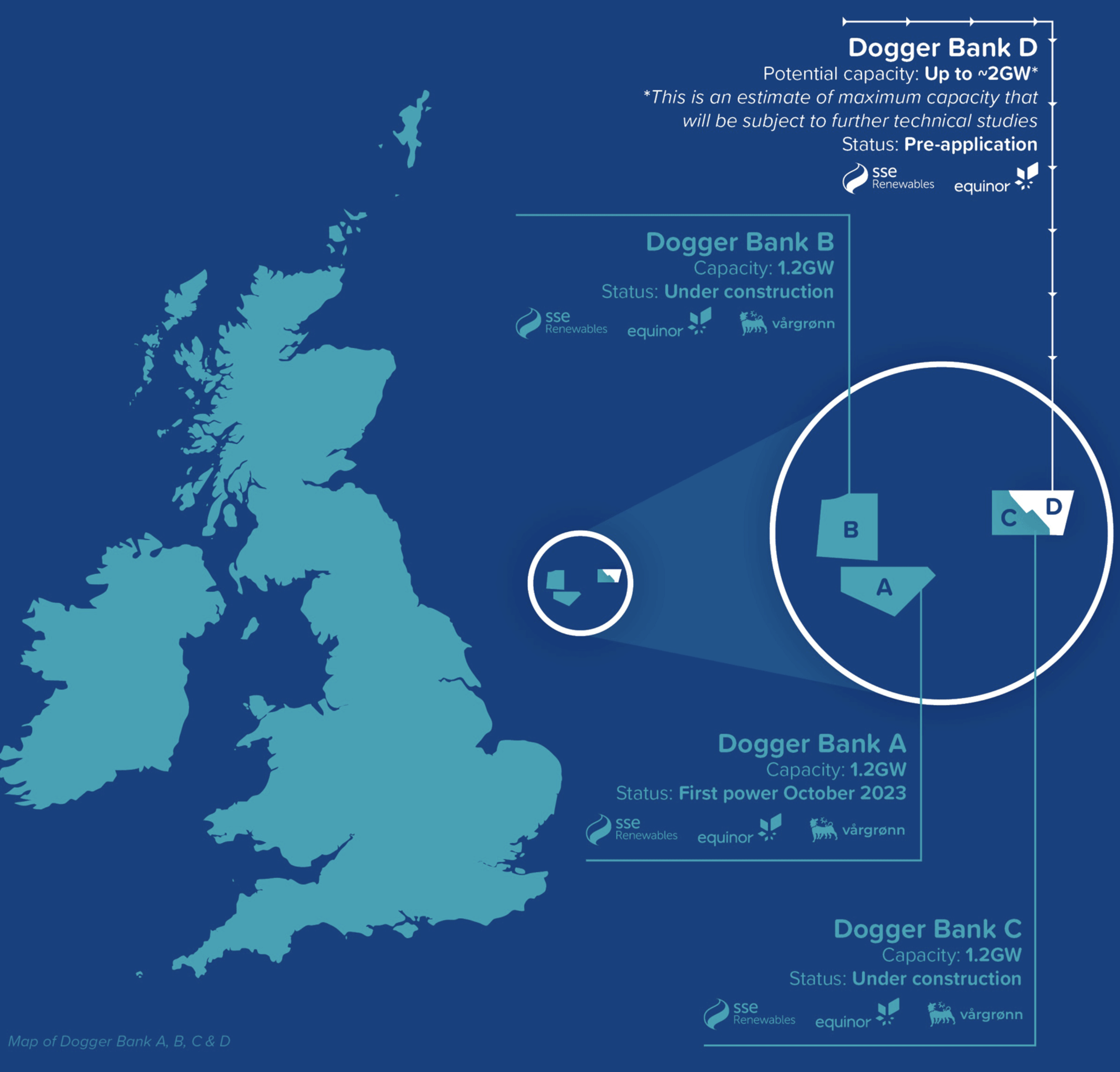
I clipped this map of Dogger Bank A, B, C and D wind farms from this page of the Dogger Bank D web site.
Note.
- RWE’s Dogger Bank South wind farm is not shown on the map.
- Dogger Bank D wind farm is the most Easterly of the four wind farms being developed by SSE Renewables and Equinor.
- Dogger Bank D wind farm must be the closest of the Dogger Bank wind farms to the Eastern border of the UK’s Exclusive Economic Zone or EEZ.
Dogger Bank D wind farm would appear to be ideally placed to supply hydrogen to a number of places, by either pipeline or tanker.
Could Dogger Bank South Wind Farm Also Produce Hydrogen?
In RWE Partners With Masdar For 3 GW Dogger Bank South Offshore Wind Projects, I talked about the change of ownership of the Dogger Bank South wind farm.
I would assume that the Dogger Bank South wind farm will be located to the South of the Dogger Bank A,B, C and D wind farms.
Whether it will produce hydrogen will be a matter for the owners and market conditions.
I do believe though, that it could share some facilities with the those that might be built for Dogger Bank D wind farm.
Conclusion
After this brief look, Dogger Bank D could be an ideal place to build a large hydrogen production facility.
Crown Estate Mulls Adding 4 GW Of Capacity From Existing Offshore Wind Projects
The title of this post, is the same as that of this article on offshoreWIND.biz.
This is the sub-heading.
The Crown Estate has revealed that it is taking steps to enable the generation of up to an additional 4 GW of electricity from several offshore wind projects in development, within the timeframe of the 50 GW 2030 target.
These are the first two paragraphs.
This follows requests from the developers of seven offshore wind farm projects who believe additional capacity can be generated from the areas of the seabed they hold existing rights for.
According to the Crown Estate, the technology has advanced and more capacity could be developed at projects that are already underway.
The seven wind farms are.
- Awel y Môr – Estimates 500 MW – Fixed – RWE
- Dogger Bank D – 1320 MW – Fixed – SSE Renewables, Equinor
- Dudgeon and Sheringham Shoal Extension – 719 MW – Fixed – Equinor
- Five Estuaries – TBD – Fixed – RWE
- North Falls – 504 MW – Fixed – SSE Renewables, RWE
- Rampion 2 – 1200 MW – Fixed – E-ON
Note.
- The Dudgeon and Sheringham Shoal Extensions seem to have been combined.
- One website connected to the wind farm, gives Five Estuaries as 353 MW.
- All are fixed wind farms.
- All are by large, established developers.
The total size is 4596 MW, using 500 MW for Awel y Môr and 353 MW for Five Estuaries.
Uprating by 8596/4596 could give these capacities.
- Awel y Môr – 935 MW
- Dogger Bank D – 2469 MW
- Dudgeon and Sheringham Shoal Extension – 1345 MW
- Five Estuaries – 660 MW
- North Falls – 943 MW
- Rampion 2 – 2244 MW
The total size is 8596 MW
Conclusion
This seems to be a sensible way to increase offshore wind capacity.
UK And Germany Boost Offshore Renewables Ties
The title of this post, is the same as that of this article on offshoreWIND.biz.
This is the sub-heading.
A new partnership between the UK and German governments has been agreed on 3 November to help secure safe, affordable, and clean energy for consumers in both nations for the long-term and bolster energy security. Both countries commit to strengthening cooperation in renewables, notably offshore wind and electricity interconnection.
These two paragraphs introduce the deal.
Under the new partnership signed in London by Energy Security Secretary Claire Coutinho and Germany’s Vice Chancellor, Robert Habeck, the UK and Germany have reaffirmed their shared ambition and commitment to net zero and progressing the energy transition.
Europe’s two largest economies have also doubled down on commitments made under the Paris Agreement to limit global warming to 1.5 degrees.
i think this could be a worthwhile follow-up to the relationship, that Boris Johnson and Olaf Scholz seemed to encourage after their high profile meeting in April 2022.
This press release from Downing Street is entitled PM meeting with German Chancellor Olaf Scholz: 8 April 2022 and this is the first two paragraphs.
The Prime Minister welcomed German Chancellor Olaf Scholz to Downing Street this afternoon to discuss the West’s response to Putin’s barbaric invasion of Ukraine.
The two leaders shared their disgust at the Russian regime’s onslaught and condemned Putin’s recent attacks.
I wrote Armoured Vehicles For Ukraine based on some of the things said in the press conference after what seemed to be a very wide discussion.
But it was these paragraphs in the press release that caught my eye.
They also agreed on the need to maximise the potential of renewable energy in the North Sea and collaborate on climate ambitions and green energy.
The Prime Minister said he wanted to further deepen the UK’s relationship with Germany, and intensify its cooperation across defence and security, innovation and science.
After Boris and Olaf’s meeting at Downing Street, I have been able to write these posts about the Anglo-German energy relationship and also make some other observations.
- Mona, Morgan And Morven
- UK-German Energy Link Reaches Financial Close
- RWE, Siemens and other German companies seem to be building a strong presence in the UK.
- Rolls-Royce are doing the same in Germany.
Claire Coutinho and Robert Habeck seem to be wanting to continue the co-operation, judging by this paragraph from the article on offshoreWIND,biz.
The energy and climate partnership sees both countries commit to enhancing cooperation in renewables, particularly in offshore wind and electricity interconnection, including offshore hybrid interconnection.
The most significant part of this paragraph is the mention of offshore hybrid interconnection.
If you want more details on their meeting, this document is the official UK Government declaration.
I have my thoughts.
What Is Meant By Offshore Hybrid Interconnection?
Type “Offshore Hybrid Interconnection” into Google and the first page is this page from National Grid, that is entitled Offshore Hybrid Assets, that has this sub-heading.
How the North Sea has the potential to become Europe’s green energy ‘powerhouse’
This is the introductory paragraph.
Now more than ever we need more renewable energy to make energy cleaner, more affordable, and more secure. The North Sea offers an incredible opportunity for the UK and our European neighbours to deliver huge increases in offshore wind. But delivering new offshore wind will require more infrastructure, which will have an impact on communities.
Hybrid is all-purpose comfort word like cashmere, platinum or puppies.
The page on the National Grid web site describes The Next Generation Interconnector with these paragraphs.
Interconnectors already provide a way to share electricity between countries safely and reliably. But what if they could do much more than that? What if interconnectors could become an offshore connection hub for green energy?
Instead of individual wind farms connecting one by one to the shore, offshore hybrid assets (OHAs) will allow clusters of offshore wind farms to connect all in one go, plugging into the energy systems of neighbouring countries.
And then there is this section entitled Tomorrow’s Solution: Offshore Wind And Interconnectors In Harmony, where this is said.
Today, offshore wind and interconnectors operate alongside each other, connecting to the shore individually. In the future, offshore hybrid assets could enable offshore wind and interconnection to work together as a combined asset.
We now call this type of infrastructure an offshore hybrid asset (OHA), but we used to refer to it as a multi-purpose interconnector (MPI). We changed it because we work so closely together with Europe, it made sense to use the same terminology.
The page on the National Grid web site also has an interactive graphic, which shows the benefit of the approach.
LionLink
National Grid are already developing LionLink, with Dutch grid operator; TenneT, which will be a multi-purpose interconnector linking the UK and the Netherlands.
LionLink is described on this page from National Grid, where this is the sub-heading.
We’re developing a first-of-its-kind electricity link to connect offshore wind between the UK and the Netherlands.
This is the introductory paragraph.
Designed together with our Dutch partners TenneT, LionLink (formerly known as EuroLink) is an electricity link that can supply around 1.8 gigawatts of clean electricity, enough to power approximately 1.8 million British homes. By connecting Dutch offshore wind to Dutch and British markets via subsea electricity cables called interconnectors, LionLink will strengthen our national energy security and support the UK’s climate and energy goals.
Will we be planning a similar electric handshake with the Germans?
How Much Offshore Wind Power Are We Talking About?
This is answered by the last two paragraphs of the article on offshoreWIND.biz.
Around 75 per cent of installed offshore wind capacity in the North Sea is in German and British waters. This is helping to drive the UK’s ambition for up to 50 GW of offshore wind, including up to 5 GW of floating wind, by 2030, the governments said.
Germany is aiming at installing 30 GW by 2030.
That is an Anglo-German starter for eighty GW.
Electrolysers In The Middle If The North Sea
Why Not?
This is a clip from National Grid’s graphic on the page that introduces Offshore Hybrid Assets,
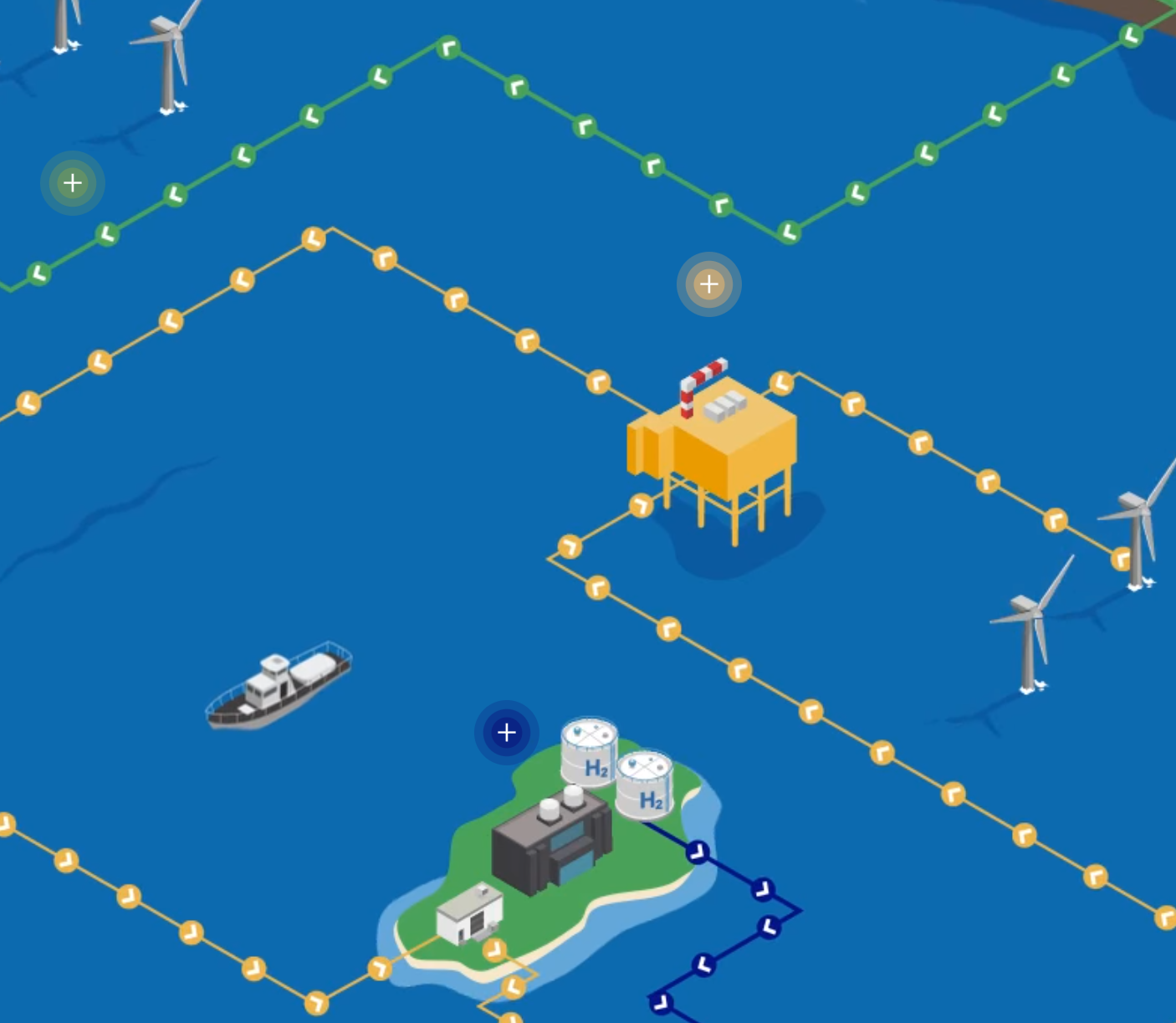
It shows an offshore hydrogen electrolyser.
- You could have an offshore hybrid asset that went between say Bacton in Norfolk and Hamburg via these assets.
- One or more wind farms in UK territorial waters.
- A mammoth offshore electrolyser, with hydrogen storage, possibly in a depleted gas field.
- One or more wind farms in German territorial waters.
Electricity will be able to go three ways; to the UK, to Germany or to the electrolyser.
The Involvement Of German Energy Companies In UK Territorial Waters
Wikipedia lists offshore fifteen wind farms, that have German owners in UK territorial waters, that total 12,960 MW.
This compares with.
- Equinor – 6 wind farms totalling 6466 MW.
- Ørsted – 15 wind farms totalling 9683 MW.
- Scottish Power – 2 wind farms totalling 5,000 MW.
- SSE Renewables – 15 wind farms totalling 15,591 MW.
- Vattenfall – 6 wind farms totalling 4384 MW.
As there is a number of partnerships, these figures only show the relative sizes of the investment by individual companies.
But at nearly 13 GW, the amount of total German investment in UK territorial waters is substantial.
Is This Solely An Anglo-German Club Or Can Others Join?
Consider.
- It seems to me, that because of the LionLink, the Dutch are already involved.
- TenneT is also a large electricity distributor in Germany.
- Countries with substantial shares of the water and winds of the North Sea in addition to Germany, the Netherlands and the UK, include Belgium, Denmark and Norway.
- The UK has interconnectors with Belgium, Denmark, France, Germany, Norway and the Netherlands.
It appears that the world’s largest multi-national power generator is evolving by stealth.
North Sea Wind Power Hub
This concept seems to have developed around 2017, by Danish, Dutch and German interests.
The Wikipedia entry introduces it like this.
North Sea Wind Power Hub is a proposed energy island complex to be built in the middle of the North Sea as part of a European system for sustainable electricity. One or more “Power Link” artificial islands will be created at the northeast end of the Dogger Bank, a relatively shallow area in the North Sea, just outside the continental shelf of the United Kingdom and near the point where the borders between the territorial waters of Netherlands, Germany, and Denmark come together. Dutch, German, and Danish electrical grid operators are cooperating in this project to help develop a cluster of offshore wind parks with a capacity of several gigawatts, with interconnections to the North Sea countries. Undersea cables will make international trade in electricity possible.
Currently, the UK is developing these wind farms on their portion of the Dogger Bank.
- Doggerbank A – 1235 MW – Started producing electricity in 2023.
- Doggerbank B – 1235 MW – Planned commissioning in 2024.
- Doggerbank C – 1218 MW – Planned commissioning in 2025.
- Doggerbank D – 1320 MW – Being planned.
- Doggerbank South – 3000 MW – Being planned.
Note.
- That’s a total of 8 GW.
- A, B, C and D are being developed by a consortium of SSE Renewables and Equinor.
- South is being developed by RWE.
- This web site is for Dogger Bank D.
- This web site is for Dogger Bank South.
This map from the European Atlas of the Seas, shows the various exclusive economic zones (EEZ) in the North Sea.

Note.
- The pinkish zone to the East of the UK, is the UK’s EEZ.
- The light blue zone at the top is Norway’s EEZ.
- The greenish zone in the North-East corner of the map is Denmark’s EEZ.
- The light blue zone below Denmark’s EEZ is Germany’s EEZ.
- Then we have the EEZs for The Netherlands, Belgium and France.
The Dogger Bank is situated where the British, Dutch, German and Norwegian EEZs meet.
All five Dogger Bank wind farms are in British waters.
The Wikipedia entry for the Dogger Bank says this about its size.
The bank extends over about 17,600 square kilometres (6,800 sq mi), and is about 260 by 100 kilometres (160 by 60 mi) in extent. The water depth ranges from 15 to 36 metres (50 to 120 ft), about 20 metres (65 ft) shallower than the surrounding sea.
This probably makes it easy to accommodate a large fixed-foundation wind farm.
Overlaying the map in the Wikipedia entry, with the EEZ map, I’m fairly sure that the northeast end of the Dogger Bank is close to where the EEZs meet.
Progress On The North Sea Wind Power Hub
The North Sea Wind Power Hub has a web site, but it seems to be more about thinking than doing.
It seems to have been hijacked by that august body; The Institute of Meetings Engineers.
This page on the web site, which is entitled Explore The Future Energy Highways, has a simple interactive map.
This shows its vision for 2030.
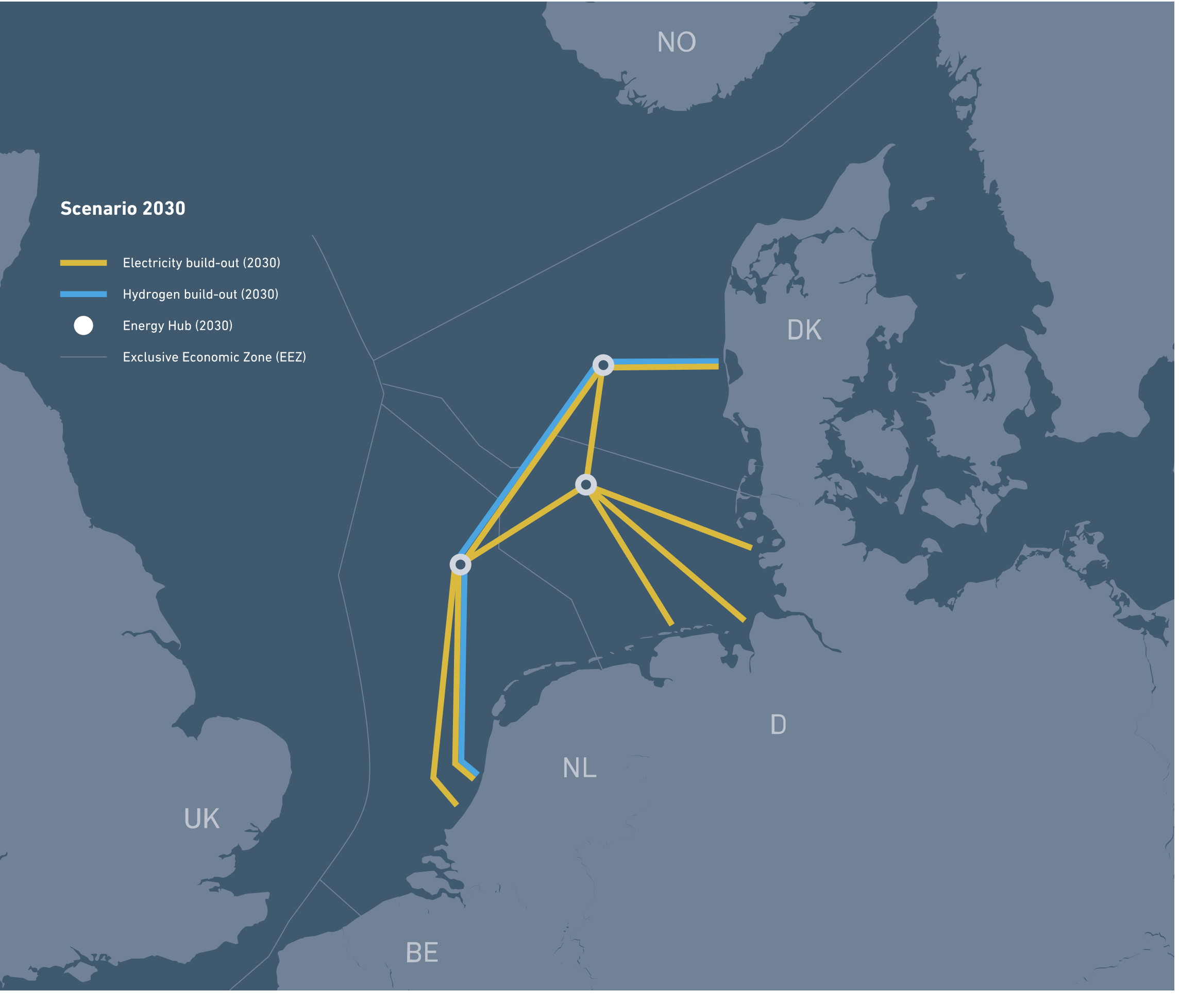
Note.
- Yellow is electricity links to be built before 2030.
- Blue is hydrogen links to be built before 2030.
- Feint lines indicate the EEZ boundaries.
There are two problems with this layout.
- It doesn’t connect to the Dogger Bank area, where the original plan as detailed in Wikipedia talked about “Power Link” artificial islands.
- No hydrogen is delivered direct to Germany.
This shows its vision for 2050.
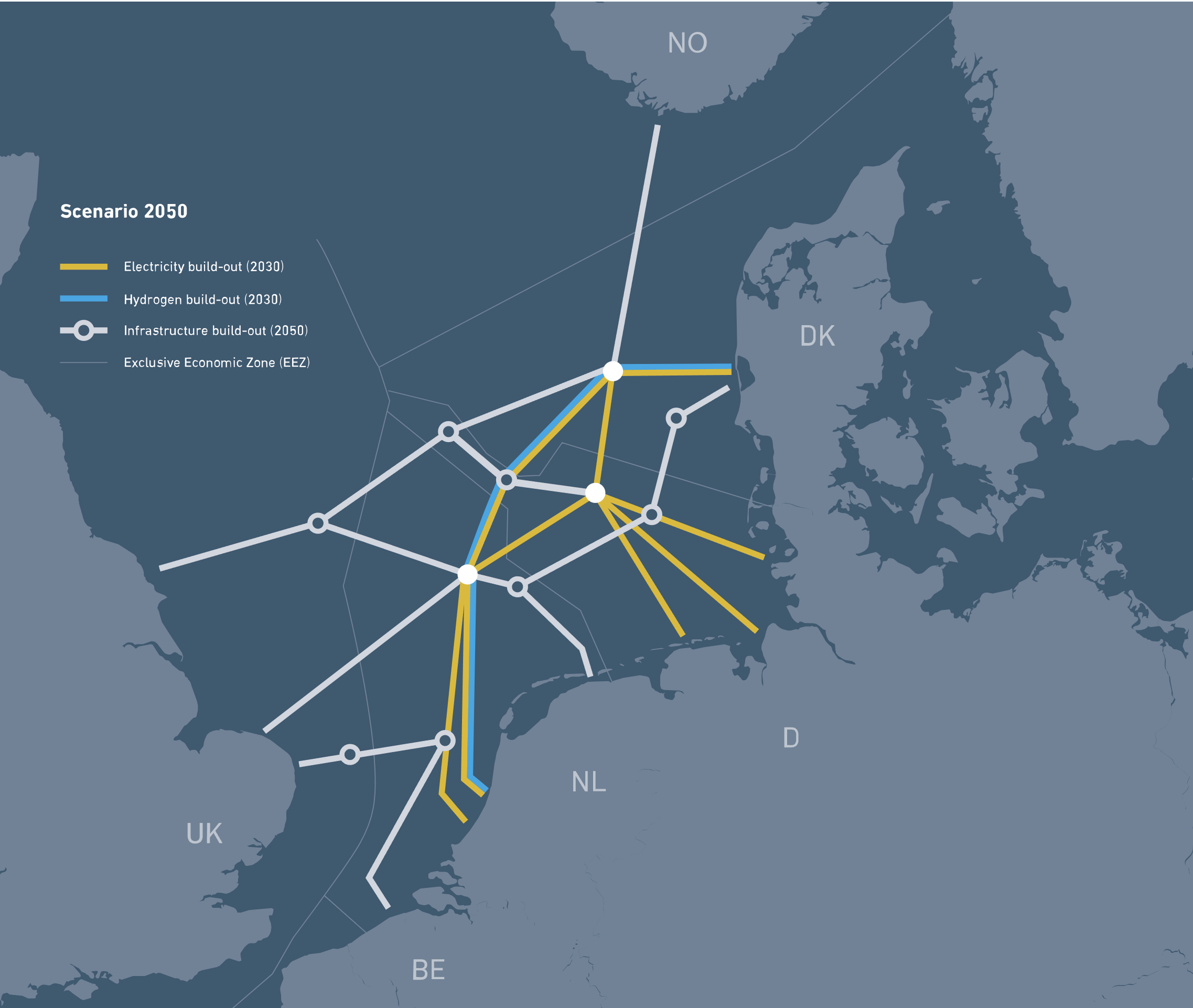
Note.
- Yellow, blue and feint lines are as before.
- White is electricity links to be built before 2050.
- There appears to be a node on the Dogger Bank in the German EEZ. This node could be connected to the “Power Link” artificial islands.
- The Southernmost connection to East Anglia could be Bacton.
- The other Norfolk connection could be where wind farms are already connected.
- The Northern connection could be Teesside, where some of the Dogger Bank wind farms connect.
- If the Northern connection to England is Teesside, then first node, which is in the British EEZ, could be one of the offshore sub-stations in the Dogger Bank wind farm complex.
This all seems a lot more feasible.
A New Offshore Hybrid Asset Between Teesside And Germany
Consider.
- A new offshore sub-station will be needed in the German EEZ to connect the “Power Link” artificial islands to the power network.
- The new offshore sub-station will eventually have three interconnectors to the German coast.
- Only the 1218 MW Dogger Bank C wind farm will be connected to the Teesside onshore substation.
- Germany has a power supply problem, after shutting down nuclear power stations and building more coal-fired power stations.
A new Offshore Hybrid Asset between Teesside and Germany could be created by building the following.
- A the new offshore sub-station in the German EEZ to connect the “Power Link” artificial islands to the power network.
- An interconnector between a sub-station of the Dogger Bank wind farm complex and the new sub-station
- A second interconnector to connect the new sub-station for the “Power Link” artificial islands to the German electricity grid.
All of the work would be done mainly in the German EEZ, with a small amount in the British EEZ.
Where Does Dogger Bank South Fit In?
Consider.
- Dogger Bank South is planned to be a 3 GW wind farm.
- It will need a 3 GW connection to the onshore electricity grid.
- Creyke Beck substation is the proposed location for the onshore connection.
- It is owned by German electricity company; RWE.
Could it be that some of the electricity produced by Dogger Bank South is going to be sent to Germany or to another node to produce hydrogen?
It certainly illustrates the value of an Offshore Hybrid Asset.
World’s Largest Offshore Wind Farm Produces Power For The First Time
The title of this post, is the same as that of this press release from SSE.
These bullet points sum up the press release.
- UK Prime Minister Rishi Sunak hails Dogger Bank’s role in bolstering energy security, creating jobs, lowering costs, and achieving Net Zero
- First power achieved at UK’s Dogger Bank as the first of 277 turbines installed 130km from UK coast
- Dogger Bank is now connected via HVDC technology to Britain’s national grid and providing renewable power to homes and businesses
- Each rotation of the first turbine’s 107m long Haliade-X blades can produce enough clean energy to power an average home for two days
- When complete Dogger Bank will deliver clean energy to six million homes annually
I will repeat a highlight of important paragraphs from the press release.
The Size Of The Dogger Bank Wind Farms
When fully complete, Dogger Bank’s world-record-beating 3.6GW capacity will comprise 277 giant offshore turbines capable of producing enough clean energy to power the equivalent of six million homes annually and deliver yearly CO2 savings equivalent to removing 1.5 million cars from the road.
Note.
- The first 1.2 GW section is scheduled for completion in the next few months.
- Two more sections of the Dogger Bank wind farm will eventually raise the capacity to 6 GW.
This cluster of wind farms certainly shows what can be achieved with British offshore wind power.
Innovative HVDC Technology
Dogger Bank also marks the first use of HVDC transmission technology to connect a British wind farm to National Grid’s UK energy network. This includes the installation of the world’s first unmanned offshore HVDC substation platform at the site, as well as first use of Hitachi Energy’s HVDC Light® transmission system which was successfully executed in record time of 38 months with the highest safety and quality standards.
Note.
- HVDC technology appears to be a more efficient way of transmitting energy under the sea and is now generally used for interconnectors.
- This page on the Hitachi Energy web site is entitled Dogger Bank HVDC Connection and gives a good description of the connection and its advantages.
The HVDC Technology and its installation looks like a real achievement, that can be applied to lots of other offshore wind farms.
XLCC seem to be doing the right thing in building an HVDC cable factory in Scotland. Check out their web site.
Fourth Phase Could Bring 2 GW More To World’s Already Largest Offshore Wind Farm Under Construction
The title of this post, is the same as that of this article on offshoreWIND.biz.
This is the sub-heading.
Dogger Bank D, the potential fourth phase of the Dogger Bank Wind Farm, whose first three phases totalling 3.6 GW are currently being built, is planned to have a generation capacity of around 2 GW. If built, the fourth phase would bring the total installed capacity of the UK project – already the world’s largest offshore wind farm under construction – to over 5.5 GW.
This is the introductory paragraph.
SSE Renewables and Equinor, which own the Dogger Bank A, B and C offshore wind farms through a consortium that also comprises Vårgrønn, have now launched a public consultation period on the Dogger Bank D proposals that runs until 7 November.
As RWE are developing the 3 GW Dogger Bank South, the Dogger Bank wind farm will be up to 8.5 GW in a few years.
 The Anonymous Widower