First Turbines Up At World’s Biggest Offshore Wind Farm
The title of this post, is the same as that of this article on offshoreWIND.biz.
This is the sub-heading.
The first two wind turbines have been installed at Dogger Bank A, the first of the three phases of the UK’s 3.6 GW Dogger Bank Wind Farm, the world’s biggest offshore wind farm under construction.
It is a good article that documents how a fixed-foundation wind farm is assembled.
The Dogger Bank wind farm will contain these separate wind farms.
- Dogger Bank A – 1235 MW – 95 x 13 MW – Under Construction – Commission in 2023
- Dogger Bank B – 1235 MW – 95 x 13 MW – Pre-Construction – Commission in 2024
- Dogger Bank C – 1218 MW – 87 x 14 MW – Pre-Construction – Commission in 2025
- Dogger Bank D – 1320 MW – Early Planning
- Dogger Bank South – 3000 MW – Early Planning
Note.
- The Dogger Bank wind farms are currently planned to be a shade over 8 GW.
- I have used data from Wikipedia’s List of offshore wind farms in the United Kingdom.
This family of wind farms could provide almost a third of our electricity or as I showed in The Mathematics Of Blending Twenty Percent Of Hydrogen Into The UK Gas Grid, it could provide enough hydrogen to blend 20 % of hydrogen into the UK gas grid.
Conclusion
Dogger Bank will have moved from a joke in the Shipping Forecast to one of our most important natural resources.
Able Seaton Port
Able Seaton Port has been in the news several time recently. So I looked it up on Google Maps.
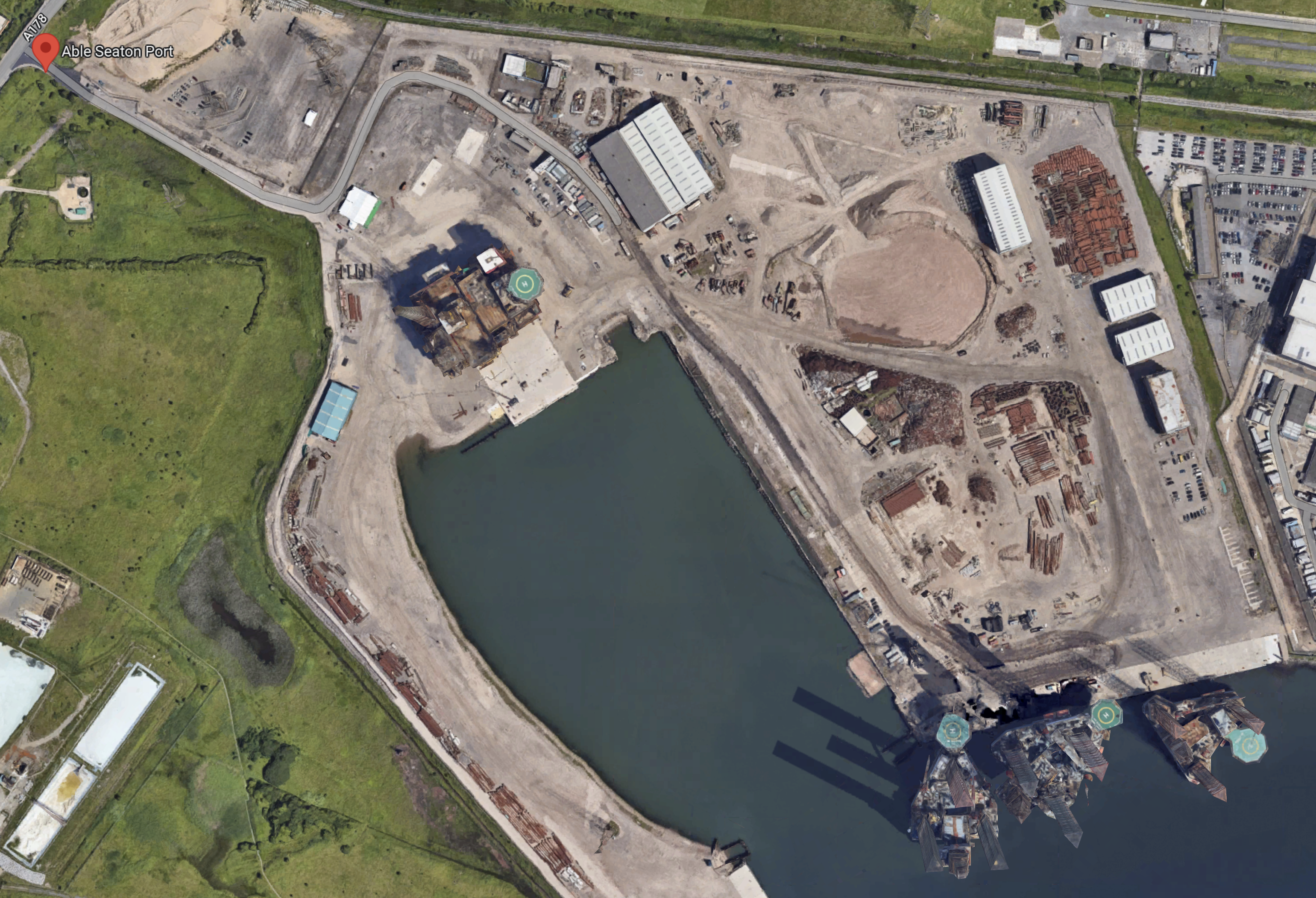
These four paragraphs on the Able Seaton Port website outline the capabilities of the port.
ABLE Seaton Port (ASP) is located in the centre of the UK on the North East Coast close to the mouth of the River Tees and covers 51 hectares (126 acres) including a 10 hectare (25 acre) dry dock (currently wet) – one of the world’s largest.
It is capable of handling all types of offshore construction vessels, has significant crane capacity and quays, which have been constructed particularly to suit the requirements of the heavy fabrication industry.
Quays 10 & 11 are some of the strongest in Europe at 306m long. They are dredged to -15m chart datum and are designed with a quay loading capacity of 40T/m² with a heavy load-out pad area capable of 60T/m².
Quay 6 is a new heavy-lift quay at the northern end of the wet dock. At 60T/m² this is one of the heaviest load out quays in Europe. It’s function is to service the Brent field decommissioning project which ABLE is undertaking with partners Shell and Allseas.
Note.
The four platforms with their helipads.
Is the platform at the Northern end of the dock concerned with the Brent field decommissioning project?
There seems to be lots of components around the dock ready to be assembled into assemblies like wind turbine foundations.
As Able say this is certainly a large facility.
This second Google Map is a 3D-visualisation of the Southern three platforms.
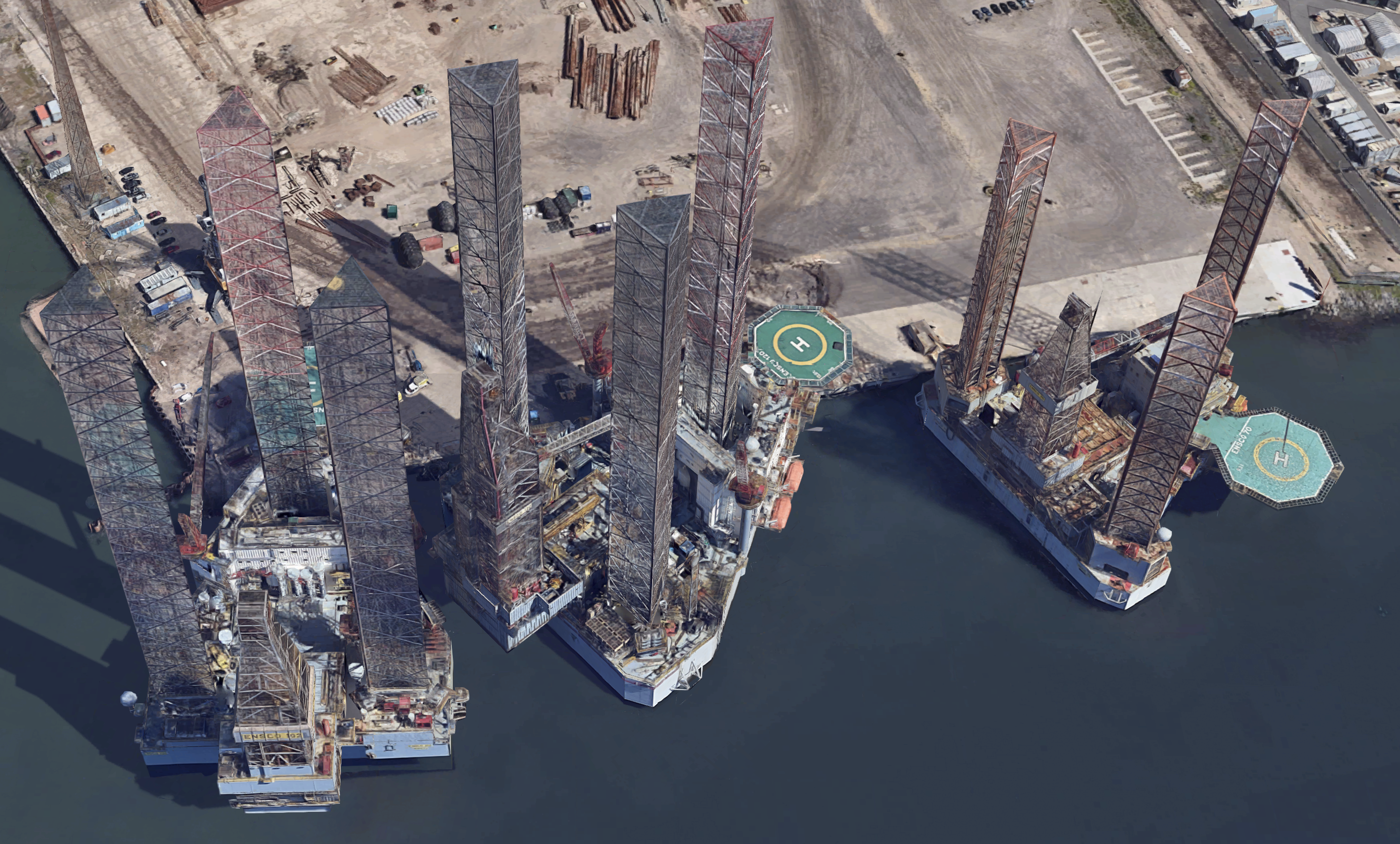
The view has all changed now according to this news item on the Able Seaton Port, which is entitled First Campaign To Install Turbines At World’s Largest Offshore Wind Farm Is Underway.
A new vessel called Voltaire will be used to install the turbines.
This page on the Dogger Bank Wind Farm web site, is entitled Largest Jack-Up Vessel Voltaire Arrives In The UK To Build Largest Wind Farm In The World.
These are the bullet points.
- Largest offshore jack-up vessel and first seaworthy ultra-low emission installation vessel Voltaire arrives in the UK for her very first assignment on Dogger Bank Wind Farm.
- The vessel will install turbines for all three Dogger Bank Wind Farm phases, a total of 277 units of GE Renewable Energy Haliade-X offshore wind turbines.
These three paragraphs describe the assembly of the wind farm.
The largest offshore jack-up installation vessel ever built, Voltaire, has just arrived in the UK port of Able Seaton ahead of its first campaign on Dogger Bank Wind Farm.
Voltaire of Jan De Nul Group was delivered in late 2022. Since then she has been undertaking final preparations for her very first assignment, the construction of the Dogger Bank Wind Farm phases A, B and C.
In total, the vessel will be responsible for installing 277 GE Renewable Energy Haliade-X turbines. Voltaire will sail out in early July to begin installation
As in an earlier life I was writing project management software for North Sea oil and gas, I can obviously say history is repeating itself. In the 1970s offshore work got easier as cranes got bigger and now fifty years later, it looks like larger lifting capacity, is enabling the installation of larger turbines.
Did I See The UK’s Hydrogen-Powered Future In Hull Today?
I went from London to Hull today on Hull Trains for £50.80 return (with my Senior Railcard) to see SSE’s presentation for their Aldbrough Pathfinder Hydrogen project, which will feature a 35 MW green hydrogen electrolyser and 320 GWh of hydrogen storage in the thick layers of salt under East Yorkshire.
- Green electricity would come mainly from the part-SSE owned 8 GW Dogger Bank wind farm complex.
- According to their web site, Meld Energy are planning a 100 MW electrolyser, which would produce 13,400 tonnes of hydrogen per year.
Every large helps!
- It should be noted that the thick layers of salt stretch all the way to Germany, and as drilling and storage technology improves, the amount of hydrogen storage available will increase.
- I was also impressed by the ambition, competence and enthusiasm, of the SSE engineers that I met.
- As has been pointed out, HiiROC, who have backing from Centrica, Hyundai, Kia and others, are also in Hull!
I believe, that I saw our hydrogen-powered future in Hull today!
We need more hydrogen mega-projects like these! Perhaps in Aberdeen, Clydeside, Freeport East, Isle of Grain, Merseyside, Milford Haven and Teesside?
Electron Beam Welded Foundation To Debut At Dogger Bank In Late 2023
The title of this post, is the same as that of this article on offshoreWIND.biz.
This is the sub-heading.
A collaboration between SSE Renewables, Sif Group, Cambridge Vacuum Engineering (CVE), and TWI, has resulted in the first-ever electron beam welded section to be incorporated in an offshore wind turbine monopile foundation.
This is the first paragraph.
The resulting can was incorporated into a monopile transition piece in January 2023 and is scheduled to be installed offshore as part of a foundation in the second phase of Dogger Bank Wind Farm, located more than 130 kilometres off the Northeast coast of England, in late 2023.
And this paragraph details the advantages.
The technology – developed by CVE – has been shown to weld monopiles at least 25 times faster than current methods, whilst using 90 per cent less energy, costing 88 per cent less, and producing 97 per cent less CO2 emissions than SAW methods, the partners said.
Everybody thinks of biotech and electronics, when they think of Cambridge, but this is two Cambridge companies; Cambridge Vacuum Engineering (CVE) and The Welding Institute (TWI) innovating at the heaviest end of mechanical engineering.
Note.
- Cambridge Vacuum Engineering has a comprehensive web site.
- The technology is called Ebflow and is described on this web page.
- The Welding Institute has a comprehensive web site.
When I lived near Cambridge, I used to play real tennis at the Cambridge University Real Tennis Club. One of the guys I played against was a cousin of JRR Tolkien and he sold vacuum engineering machines to the world. He had some fascinating tales about dealing with the Russians, where signed copies of his cousin’s books made excellent bribes.
World’s Largest-Of-Its-Kind Power Line To Deliver Clean Power To 1.8m UK Homes And Boost Energy Security
The title of this post, is the same as that as this press release from the UK Government.
These are the three bullet points of the press release.
- LionLink power line between UK and Netherlands will deliver enough electricity to power more homes than Manchester and Birmingham combined.
- Agreement made as Grant Shapps leads delegation of leading businesses to key North Sea Summit.
- Part of renewed Government drive to work with business to help grow the economy.
These three paragraphs outline the project.
The world’s largest multi-use electricity power line will be built under the North Sea, boosting UK energy supplies with enough to power 1.8 million homes – more than Birmingham and Manchester combined.
The new LionLink will connect the UK and the Netherlands with offshore wind farms, providing clean affordable and secure energy to Britain which will help cut household bills and drive Putin’s Russia further out of the energy market.
The cross-border electricity line will be only the second of its kind in the world, with the first having been built by Germany and Denmark. However, it will be able to carry more than four times the amount of electricity as its predecessor – making it the largest of its kind in terms of capacity anywhere in the world.
Note.
- I suspect the LionLink will go via the Dogger Bank, where Danish, Dutch, German and UK territorial waters meet an we are already building 8 GW of fixed foundation offshore wind. The other countries are also active in the area.
- The press release doesn’t mention, where the LionLink will make landfall in the UK.
- Much of the connection will probably use the cables being laid for the Dogger Bank wind farms.
- There is also no mention of the North Sea Wind Power Hub, which could be an artificial island on the Dogger Bank.
There is also a press release on the National Grid web site, which is entitled National Grid And TenneT Collaborate On Proposed First-Of-A-Kind Anglo-Dutch Electricity Link, which gives more details.
- The capacity is stated to be 2 GW.
- Like the current BritNed interconnector, the project will be a cooperation between National Grid And TenneT.
- TenneT is a limited liability company owned by the Dutch government, that is a transmission system operator in the Netherlands and in a large part of Germany.
There is also a diagram, showing how the LionLink will work, which includes these components.
- On the Dutch side, there is an offshore AC>DC Converter Station, which is connected to the Dutch electricity grid and one or more offshore wind farms.
- Across the border between the Dutch and UK Exclusive Economic Zones, there will be a HVDC cable.
- The HVDC cable will terminate in an onshore DC>AC Converter Station in the UK, which will be connected to the UK electricity grid.
No details of the two landfalls have been given.
More information is given in this article on offshoreWIND.biz, which is entitled UK And Netherlands Unveil Multi-Purpose Interconnector Plans.
- This shows a map of the North Sea with an interconnector running in a straight line between possibly Rotterdam and Bacton in Norfolk.
- A wind farm is shown connected to this interconnector.
This paragraph describes the windfarm and the interconnector.
LionLink, a multi-purpose interconnector that was announced today at the North Sea summit, could connect a Dutch offshore wind farm with a capacity of 2 GW to both countries via subsea interconnectors.
If the wind farm has a capacity of 2 GW, I would assume it can supply up to 2 GW to the UK and The Netherlands.
This is a classic system, that can be optimised by the application of sound principles.
All electricity generated by the wind farm must be used, stored or converted into green hydrogen.
Electricity will be distributed as to need.
Energy storage or electrolysers could be sited at either end or even in the wind farm.
I would suspect that more wind farms could be connected to the interconnector.
The team, that write the control system for the grid will have a lot of fun!
BritNed
I have a feeling that National Grid and TenneT have taken a long hard commercial look at the electrical and financial performance of BritNed over the last year and decided, that a second connection would be to the mutual benefit of both companies, their customers and the UK and The Netherlands in general.
It would also be twice as difficult for terrorists sponsored by Putin to cut two cables.
Conclusion
This is a great leap forward for wind power in the North Sea and Europe.
World’s First Unmanned HVDC Offshore Platform Installed At World’s Largest Offshore Wind Farm
The title of this post, is the same as that of this news item from the Dogger Bank wind farm web site.
These are the two bullet points.
- Dogger Bank Wind Farm will be first UK High Voltage Direct Current (HVDC) connected offshore wind farm
- 70% reduction in topside weight per MW for offshore platforms
These are my thoughts.
High Voltage Direct Current
Wikipedia has an excellent entry on high voltage direct current, which is commonly referred to as HVDC.
The news item says this about how the electricity is brought ashore from the Dogger Bank wind farm.
The innovative offshore platform has a lean design and is the first unmanned HVDC platform which will be operated from shore and accessed only by a Service Operations Vessel. The platform will receive 1.2GW of AC power from Dogger Bank A’s 95 offshore wind turbines and convert it to DC, which will then be sent ashore to an onshore convertor station near Beverley in East Riding of Yorkshire.
Fitted with Hitachi Energy’s latest generation HVDC converter technology, Dogger Bank will be the first offshore wind project in the UK to use this technology to transmit the electricity produced back to shore, ensuring that the electricity is transmitted efficiently over long distances while minimising losses.
Note.
- Wind turbines generate AC.
- There will be conversion to DC on the substation and conversion back to AC onshore.
- It should also be noted, that large undersea interconnectors are generally built around HVDC technology.
Wikipedia says this about the advantages of DC transmission.
A long-distance, point-to-point HVDC transmission scheme generally has lower overall investment cost and lower losses than an equivalent AC transmission scheme. HVDC conversion equipment at the terminal stations is costly, but the total DC transmission-line costs over long distances are lower than for an AC line of the same distance. HVDC requires less conductor per unit distance than an AC line, as there is no need to support three phases and there is no skin effect.
Depending on voltage level and construction details, HVDC transmission losses are quoted at 3.5% per 1,000 km (620 mi), about 50% less than AC (6.7%) lines at the same voltage. This is because direct current transfers only active power and thus causes lower losses than alternating current, which transfers both active and reactive power.
It looks like cost is a big factor.
My knowledge of grid systems and AC power is limited, as I was more of a Control Engineering and Electronics student at university.
But could HVDC-connected wind farms have advantages, when it comes to providing a reactive power capability to the grid, as I wrote about in Dogger Bank C In UK Offshore Wind First To Provide Reactive Power Capability.
Extra income is another good reason to choose something.
Lightweight Platforms
I’ve always been a fan of lightweight structures and it does seen that the engineers of the Dogger Bank Wind Farm have gone down that route.
This is a paragraph from the news item.
The platform will be controlled from shore and by removing the need for personnel to stay on the platform meant it has been possible to eliminate elements such as the living quarters, helideck and sewage systems, resulting in a 70% reduction in weight (per megawatt) of the topside compared to previous platforms installed, and cost savings of hundreds of millions of pounds.
Again costs are being reduced and profits increased.
We should never rule out the importance of the finances of a project. Once by simulating a chemical process on the computer for ICI, I knocked ten metres off the height of a chemical plant. I got a nice little bonus for that!
If they have made a substantial reduction in substation weight, this surely means that the supporting structure can probably be smaller and less costly.
Conclusion
I suspect, a lot more wind farms will follow the Dogger Bank example.
Dogger Bank Wind Farm Officially Celebrates Its Operations And Maintenance Base Opening
The title of this post is the same as that of this news item on the Dogger Bank wind farm web site.
These bullet points introduce the item.
- 150 guests and employees gathered to celebrate the official opening.
- The state-of-the-art base will be the hub for operations and monitor 5% of UK electricity from its control room.
- Over 400 long-term jobs have been created locally to support Operations and Maintenance from South Tyneside for the 35-year life of the wind farm.
- The world-class facility will be operated in line with the UK Green Building Council’s (UKGBC) Net Zero Carbon Buildings Framework
This Google Map shows the location of the base.
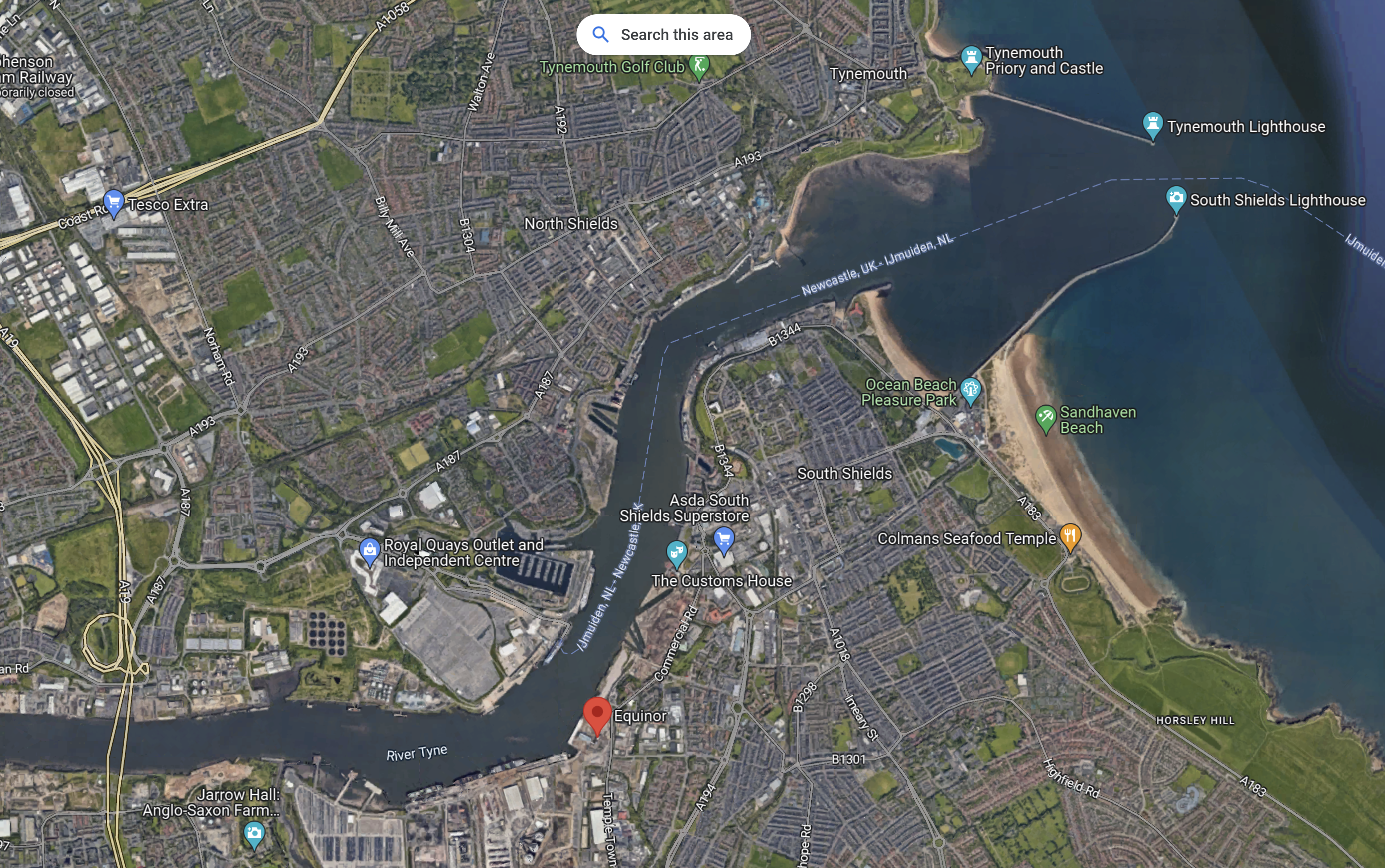
The red arrow indicates the base, which appears to be convenient for the North Sea.
This second Google Map shows a close up if the site.
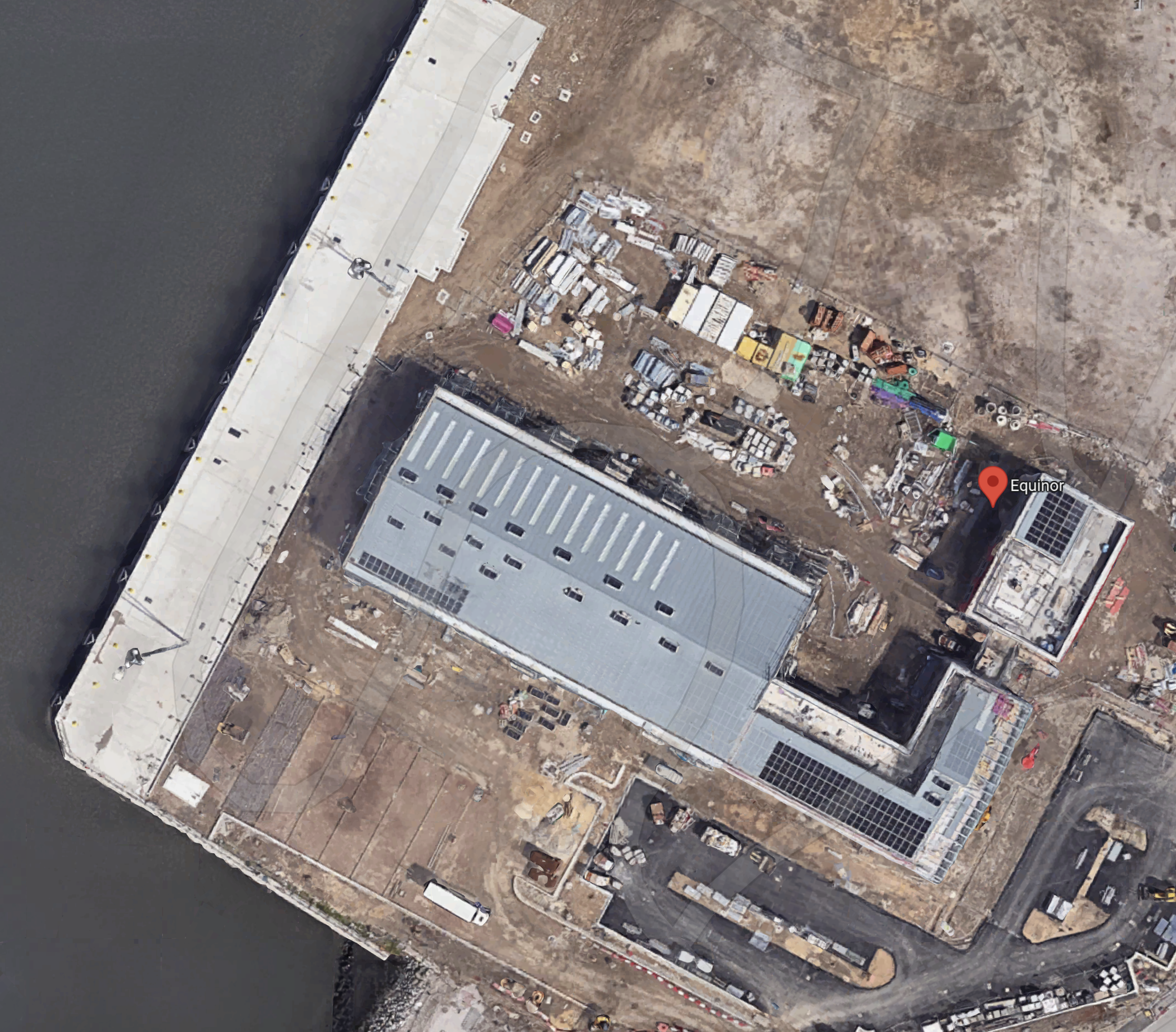
There is a nice long quayside, which in the future could be large enough to assemble floating turbines.
This third image is a Google Map 3D visualisation of the site from across the Tyne.
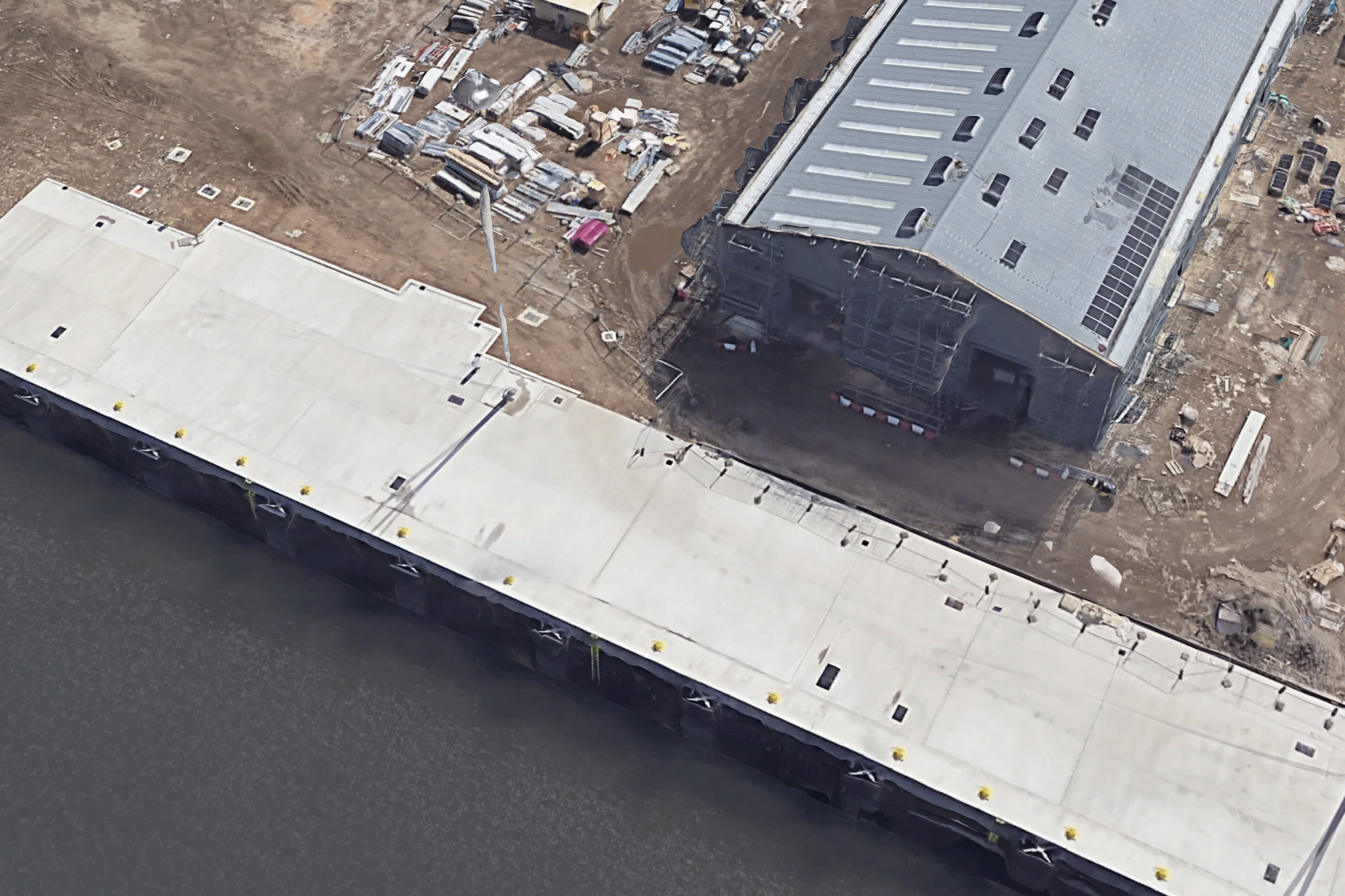
The news item says this about the ownership and operation of the Dogger Bank wind farm.
Dogger Bank Wind Farm is a joint venture between SSE Renewables (40%), Equinor (40%) and Vårgrønn (20%). SSE Renewables is lead operator for the development and construction of Dogger Bank Wind Farm. Equinor will be lead operator of the wind farm on completion for its expected operational life of around 35 years.
Initially, the Port of Tyne base will operate and maintain these wind farms.
- Dogger Bank A – 1235 MW
- Dogger Bank B – 1235 MW
- Dogger Bank C – 1218 MW
This gives a total of 3688 MW.
Note.
- SSE Renewables and Equinor are also developing the 1500 MW Dogger Bank D wind farm.
- This would bring the total up to 5188 MW.
- RWE are also developing the 3000 MW Dogger Bank South wind farm.
Leases were signed for both the Dogger Bank D and Dogger Bank South wind farms in January 2023.
I doubt all of these wind farms will be operated and maintained from the Port of Tyne base, due to the different ownership of Dogger Bank South.
But, I do hope that the facility can be expanded to handle Dogger Bank D.
‘Czech Sphinx’ Power Plant Intended To Keep Lights On
The title of this post, is the same as that of this article on The Times.
This is the first paragraph.
The businessman known as the “Czech Sphinx” is set to expand his position in Britain’s energy market after securing subsidy contracts to build a new gas-fired power plant and battery storage project.
As I needed to find the answers to particular questions, I looked for and found the original press release on the EP Holdings web site, which is entitled EPH Will Build A New Gas-Fired Power Plant And Battery Storage Facility In The UK At A Cost Of More Than £1 billion.
These statements describe the project.
- It will be a 1700MW high efficiency H-class CCGT power project and a 299MW 2-hour battery storage project
- The power station will be built on the site of the former Eggborough coal station in East Yorkshire.
I find this to be the most significant paragraph.
The high efficiency H-class CCGT project will be the single largest flexible generation asset to be commissioned in the UK since 2012, whilst the battery project will also be one of the largest to be built in the UK to date. Given the site’s close proximity to existing National Grid infrastructure and a number of proposed CCUS and hydrogen pipeline routes, under EPUKI’s plans these projects will make a significant contribution to the UK’s energy transition and security for years to come.
This map from OpenRailwayMap, shows the relationship between the Eggborough site and the nearby Drax power station.

Note.
- The Eggborough power station site is in the South-West corner of the map and is identified by the rail loop. which was used to deliver the coal.
- The Drax power station site is in the North-East corner of the map and is similarly identified by a rail loop.
- There is a high voltage transmission line connecting the two power stations.
- As the crow flies is about eight miles between Eggborough and Drax.
This Google Map shows the Eggborough power station site.

Note.
- The remains of the eight cooling towers are visible at the North of the site.
- The large circular black area in the middle is the coal yard with its rail loop.
- It is a large site.
I have looked in detail at the cleared area in the North-West of the site and the pylons of the connection to Drax are still visible.
So it looks like there is still an electrical connection of some sort to the site.
According to Wikipedia, the original coal-fired power station had a nameplate capacity of 1960 MW, so I suspect that a modernised electricity connection to handle the maximum near 2,000 MW of the new station would be possible.
This map shows the Zero Carbon Humber pipeline layout.

Note.
- The orange line is a proposed carbon dioxide pipeline
- The black line alongside it, is a proposed hydrogen pipeline.
- Drax, Keadby and Saltend are power stations.
- Keadby and Saltend are gas-fired power stations.
- Easington gas terminal is connected to around twenty gas fields in the North Sea.
- The terminal imports natural gas from Norway using the Langeled pipeline.
- The Rough field has been converted to gas storage and can hold four days supply of natural gas for the UK.
- To the North of Hull is the Aldbrough Gas Storage site, which SSE plan to convert to hydrogen storage.
The Eggborough power station site is about eight miles to the South-West of Drax.
I don’t suspect that connecting the Eggborough site to the carbon dioxide, gas and hydrogen pipelines will not be the most challenging of tasks.
So when the press release says.
Given the site’s close proximity to existing National Grid infrastructure and a number of proposed CCUS and hydrogen pipeline routes, under EPUKI’s plans these projects will make a significant contribution to the UK’s energy transition and security for years to come.
The company is not exaggerating.
It appears that carbon dioxide, gas and hydrogen pipelines can be developed and National Grid connections can be reinstated.
Eggborough Will Not Be Alone
From the EP Holdings press release, it appears that the Eggborough power station will be fitted with carbon-capture and will be hydrogen-ready.
This will make it the second power-station in the area to be fitted out in this way, after SSE’s planned Keadby 3, which is described in this page on the SSE web site in this document, which is entitled Keadby 3 Carbon Capture Power Station.
They could also be joined by Keadby Hydrogen power station.
This would mean that zero-carbon power stations in the area could include.
- Eggborough Gas/Hydrogen – 1700 MW
- Eggborough Battery – 299 MW
- Keadby 3 Gas/Hydrogen – 910 MW
- Keadby Hydrogen – 1800 MW – According to this Equinor press release.
Note.
- The Eggborough Battery pushes the total zero-carbon capacity over 4500 MW or 4.5 GW.
- The various Dogger Bank wind farms are to have a total capacity of 8 GW within ten years.
- The various Hornsea wind farms are to have a total capacity of 5.5 GW in a few years.
I would expect that the zero-carbon power stations would make a good fist of making up the shortfall, when the wind isn’t blowing.
Drax, Keadby 1 And Keadby 2 Power Stations
Consider.
- Drax has a nameplate capacity of 3.9 GW, of which 2.6 GW is from biomass and the rest is from coal.
- Keadby 1 has a nameplate capacity of 734 MW.
- Keadby 2 has a nameplate capacity of 734 MW.
How much of this capacity will be fitted with carbon capture, to provide extra zero-carbon backup to the wind farms?
Green Hydrogen From Surplus Wind Power
At times, there will be an excess of renewable energy.
I suspect, an order for a large electrolyser will be placed soon, so that surplus renewable energy can be used to create green hydrogen.
This will be stored in the two storage facilities, that are being developed in the area; Aldbrough and Rough.
Controlling The Fleet
I am by training a Control Engineer and this fleet can be controlled to provide the electricity output required, so that the carbon-dioxide produced is minimised and the cost is at a level to the agreement of producers and users.
Conclusion
It looks like in excess of 20 GW of reliable zero-carbon energy could be available on Humberside.
I’m sure British Steel would like to by a lot of GWhs to make some green steel at Scunthorpe.
Equinor And SSE Eye Green Hydrogen Production For 1.32 GW Dogger Bank D
The title of this post, is the same as that of this article on offshoreWIND.biz.
This is the sub-heading.
SSE Renewables and Equinor, the developers of the Dogger Bank Wind Farm in the UK, are exploring two options for Dogger Bank D, the fourth wind farm the partners are looking to build as part of the development. These include using Dogger Bank D for electricity that would feed into the UK grid and/or for green hydrogen production.
This says to me, that depending on need, electricity from the Dogger Bank Wind Farms and D in particular, can be distributed in the grid or converted into green hydrogen.
- The article says that the electrolyser could become the UK’s largest green hydrogen project
- There will be plenty of hydrogen storage in the salt caverns at Aldbrough, which can currently store the equivalent of 320 GWh of electricity, It is currently being expanded to be one of the largest hydrogen stores in the world according to this page on the SSE web site.
- There are currently two gas-fired power stations at Keadby and they will in a few years be joined by a third, that will be fitted with carbon-capture and a hydrogen-fueled power station.
The various wind farms, power stations and gas storage on Humberside are growing into a very large zero-carbon power cluster, with an output approaching six GW.
Any shortfall in wind output, could be made-up by using the Keadby 3 gas-fired power station with carbon capture or the Keadby hydrogen power station.
Conclusion
Humberside is getting a cluster of power stations and wind farms, that can produce almost twice the electricity of Hinckley Point C nuclear power station.
Scotland’s Renewable Energy Jackpot: Hydrogen Exports Alone Could Be worth £25 Billion A Year By 2045
The title of this post, is the same as that of this article on the Edinburgh News.
This is the sub-heading.
Scotland is a phenomenally energy rich country. For decades the largest oil-producing nation in the European Union, it is now set to trail-blaze as a leader in renewable energy.
The title and sub-heading say it all for Scotland.
But these words could equally well apply to Anglesey, Cornwall, Devon, East Anglia, Humberside, Liverpool and Morecambe Bays, the Severn Estuary and Pembrokeshire.
We also mustn’t forget the Dogger Bank!
 The Anonymous Widower