How Will Abellio East Midlands Railway Maximise Capacity On The Midland Main Line?
In this post, I will try and get a feel to how Abellio East Midlands Railway, will maximise capacity on the Midland Main Line.
The Current Service
There are currently two trains per hour (tph) to both Nottingham and Sheffield and one tph to Corby from London.
Ignoring the Corby service, which will be using electric trains, intermediate calls have these frequencies, from South to North.
- Bedford – One tph
- Wellingborough – One tph
- Kettering – One tph
- Market Harborough – Two tph
- Leicester – Four tph
- Loughborough – Two tph
- East Midlands Parkway – Two tph
- Long Eaton – One tph
- Beeston – One tph
- Derby – Two tph
- Chesterfield – Two tph
As the new bi-mode trains will be more modern, with probably shorter dwell times at each station, I suspect that when Abellio East Midlands Railway implement their ultimate timetable, there will be more stops, without degrading journey times.
These are fastest times.
- London and Nottingham is one hour forty minutes
- London and Sheffield is two hours
I feel that round trips to both destinations will be four hours with some speed increases and shorter station dwell times.
- The current two tph to Nottingham and Sheffield needs eight trains to each destination.
- This is a total of sixteen trains.
As each train could be two five-car trains working as a ten-car train, train numbers for the current service could be as high as thirty-two trains.
A first look seems to indicate that there .will be no overall increase in train frequency, although, as I said earlier, the performance of the new trains should allow extra station stops.
It also indicates to me, that any increases in frequency between London and Nottingham/Sheffield will need extra trains.
The Electrified High Speed Line South Of Kettering
Midland Main Line services South of Kettering are as follows.
- Two tph to London and Nottingham
- Two tph between London and Sheffield
- One tph between London and Corby.
From December 2021, there will be two tph between London and Corby.
The maximum number of services between London and Kettering on the electrified section currently envisaged is only six tph or one train every ten minutes.
As the Class 700 trains on Thameslink are capable of using digital signalling and all the new trains will also be similarly equipped, I wouldn’t be surprised that the theoretical capacity of the electrified fast lines could be higher than the proposed six tph. |Especially, when digital signalling is installed.
The number of trains in the fleet, is much more of a limit on services, than the capacity of the Midland Main Line.
If all trains were ten cars, the following numbers of trains would be needed.
- Current two tph – 32 trains
- Increase to three tph – 48 trains
- Increase to three tph – 64 trains
Are there enough passengers to fill all these trains?
Does St. Pancras Have Enough Capacity?
St. Pancras station has four platforms for Midland Main Line services.
- The platforms are long enough to take two five-car Class 222 trains,.
- They would surely accommodate a ten-car formation of the new Hitachi trains.
- Each platform can probably handle three or four tph, giving a total capacity of 12-16 tph.
As four tph to Nottingham and Sheffield and two tph to Corby is only a total of ten tph, there is enough platform capacity for several years to come.
If there is a problem, it is that the large numbers of passengers would overwhelm the stairs and escalators between the ground level of the station and the platforms.
I am certain, that just like the Eurostar platforms at St. Pancras, the Midland Main Line platforms will need better passenger access and facilities.
Will it even be enough, when up to six tph, all of which could be 240 metres long, start to arrive in December 2021?
What could be done to help solve the capacity problem at St. Pancras station in the future?
Better Access To The Midland Main Line Platforms
Consider.
- Space is limited to add extra escalators, lifts and places to wait
- St. Pancras is a Grade I Listed Building.
- As I don’t travel through the station in the Peak, the escalators seem to always be going the wrong way.
Improving the current access will be very difficult.
This Google Map shows the Northern End of the station.
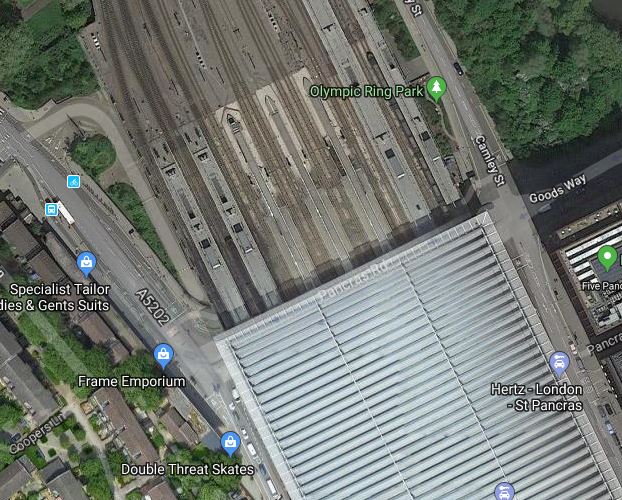
Note.
- The Midland Main Line platforms are the two island platforms on the left.
- The Southeastern HighSpeed platforms are the two island platforms on the right.
- The Eurostar platforms are the three island platforms in the middle.
Could a second entrance to some of the platforms be built here?
It would be very difficult, unless the extension was future-proofed when it was built.
Underground Improvements
Getting between the Midland Main Line platforms and the Underground is an obstable course.
As a Londoner, who’s had the operation to have the Underground Map implanted in my brain, I generally go to the Midland Main Line platforms at St. Pancras by taking one of the following.
A bus from close to my house to outside the station.
- A Metropolitan Line train from Moorgate
- A Northern Line train from Angel.
- A Piccadilly Line train from Manor House
- A Victoria Line train from Highbury & Islington
The last four need a bus to get to the Underground.
I usually come back home, by spending just over a tenner on a black cab!
Crossrail 2
Crossrail 2 should improve matters, but will it ever be built?
Will The New Brent Cross Thameslink Station Allow Cross Platform Interchange Between Midland Main Line and Thameslink Services?
Consider.
- The proposed Brent Cross Thameslink will be just North of Cricklewood station.
- Midland Main Line services through the station would be six tph.
- Thameslink services through the station would be fourteen tph
- The West London Orbital Railway could be built to connect the station to High Speed Two and Heathrow
Would it take the pressure off St. Pancras?
It might do, if a cross-platform interchange could be arranged.
Could Some Midland Main Line Services Use Thameslink?
Consider.
- The obvious service to go through Thameslink would be the two tph service between Corby and St. Pancras.
- Thameslink is currently setup to handle 24 tph, but it has been designed for 30 tph.
- The Corby service will stop at Kettering, Luton and Luton Airport Parkway, to the North of London.
- It could perhaps terminate at the soon-to-be-rebuilt Gatwick Airport station in the South.
It might work!
Especially, if Kettering station were to be rebuilt to have cross-platform interchange between Corby sewrvices and the bi-mode ones going further North.
Splitting And Joining Trains
In Rock Rail Wins Again!, I gave this simple example of how the splitting and joining capability of Hitachi AT-300 trains can be used.
A ten-car train might leave St. Pancras as two five-car units running as a pair. It could split at East Midlands Parkway station and one train could go to Nottingham and the other to Derby. Coming South the two trains would join at East Midlands Parkway.
I feel that Derby, East Midlands Parkway and Leicester are ideal stations on the Midland Main Line, where services could be split and joined.
- They have at least four platforms.
- The platforms are long and straight.
The two terminals at Nottingham and Sheffield could also probably be used to enable services to serve more destinations.
Shorter trains must have advantages on some routes.
- Capacity is better matched to demand.
- Platforms may not need to be extended.
- Services can be run by a driver and a conductor.
Will Abellio East Midlands Railway use splitting and joining to increase the coverage of their services?
Great Western Railway’s Class 800, 801 and 802 trains have the capability to split and join and the operator doesn’t seem to use it. Although, they do split and join Class 387 trains.
Extended Services To And From The North And East
The ability to split and join, that could be used to extend services to the North And East.
Serving Barnsley, South Yorkshire And Leeds
Consider.
- In Sheffield Region Transport Plan 2019 – A New Station At Barnsley Dearne Valley, I talked about a proposed new station at Barnsley Dearne Valley on the route between Sheffield and Leeds.
- The Sheffield Region Transport Plan 2019, also envisages a new Midland Main Line station at Rotherham.
- This report on the Transport for the North web site, is entitled At A Glance – Northern Powerhouse Rail.
- The report states that there will be a fast Sheffield and Leeds service at a frequency of four tph, that taqkes twenty-eight minutes.
- Currently, East Midlands services on this route take just over half-an-hour with only a stop at Wakefield Westgate.
I wonder if there are paths and need for a London and Sheffield service to split at Sheffield with, the two five-car trains going to different destinations.
- Leeds via Rotherham, Barnsley Dearne Valley and Wakefield Westgate, is one possibility.
- Could a service go to Huddersfield?
- Hull is probably too far.
One tph could terminate at Sheffield and one splitting and one tph could split and serve other destinations.
Advantages could include.
- Barnsley and Rotherham get a direct hourly service to London.
- South Yorkshire and Leeds have a direct hourly service to the East Midlands.
- Sheffield and Leeds have an hourly fast service.
I’m sure Abellio have a very workable plan to improve services North of Sheffield.
Serving Lincolnshire And Nottinghamshire
Consider.
- Splitting and joining at Nottingham may allow an increase in direct services to and from Lincoln.
- Perhaps parts of North Lincolnshire could be well-served by a fast train from Nottingham.
- Would Mansfield and Worksop benefit from a direct service from London on the Robin Hood Line, after a reverse at Nottingham.
The five-car trains give the flexibility to do the previously unthinkable.
Conclusion
There is a lot of developments that can or will happen with Midland Main Line services.
Rock Rail Wins Again!
This article on the Railway Gazette, is entitled Abellio Orders East Midlands Inter-City Fleet.
The order can be summarised as follows.
- The trains will be Hitachi AT-300 trains
- There will be thirty-three bi-mode trains of five cars.
- The trains will be 125 mph capable.
- Unlike the similar Class 802 trains, the trains will have 24 metre long cars, instead of 26 metres.
- They will have a slightly modified nose profile.
- The new trains will have an extra diesel engine.
- The new trains will cost a total of £400 million.
A few of my thoughts.
I shall constantly refer to an earlier post called Vere Promises East Midlands Bi-Modes In 2022.
Cost Of The Trains
In the earlier post, I calculated that the five five-car AT-300 all-electric trains, ordered by First Group for London and Edinburgh services cost four million pounds per car.
Thirty-three trains at this four million pounds per car, works out at £660 million, which is sixty-five percent higher than the price Abellio is quoted as paying.
Abellio are actually paying just £2.42 million per car or forty percent less than First Group.
So are Abellio buying a cut price special?
As Abellio East Midlands Railway will be competing up against LNER’s Azumas on some journeys, I can’t see that running a second class train would be a sound commercial decision.
I am left to the conclusion, that Abellio have got a very good deal from Hitachi.
What Diesel Power Is Used?
In a five-car Class 802 train, there are three MTU 12V 1600 R80L diesel engines, each of 700 kW , which gives a total power of 2,100 kW.
If the Abellio train needs this power, with four diesel engines, each must have 525 kW.
Not sure yet, but this could save a couple of tonnes in weight.
I doubt that Hitachi are dissatisfied with the performance of the MTU diesel engines in the current Class 800, 801 and 802 trains, as there are no media reports of any ongoing problems. So I feel that they could go with the same supplier for the trains for Abellio East Midlands Railway.
If you type “Class 800 regenerative braking” into Google, you will find this document on the Hitachi Rail web site, which is entitled Development of Class 800/801 High-speed Rolling Stock for UK Intercity Express Programme.
The only mention of the R-word is in this paragraph.
An RGS-compliant integrated on-train data recorder (OTDR) and juridical recording unit (JRU), and an EN-compliant energy
meter to record energy consumption and regeneration are fitted to the train.
If you search for brake in the document, you find this paragraph.
In addition to the GU, other components installed under the floor of drive cars include the traction converter, fuel tank, fire protection system, and brake system.
Note that GU stands for generator unit.
The document provides this schematic of the traction system.

Note BC which is described as battery charger.
Braking energy doesn’t appear to be re-used to power the train, but to provide hotel power for the train.
I talk about this in more detail in Do Class 800/801/802 Trains Use Batteries For Regenerative Braking?.
In my view, it is an outdated design compared to some of those seen in the latest road vehicles and trains from other manufacturers.
This is a sentence from the Railway Gazette article.
According to Hitachi, the EMR units will be an ‘evolution’ of the AT300 design supplied to other UK operators, with 24 m long vehicles rather than 26 m, and a slightly modified nose profile.
So does that evolution include regenerative braking to batteries on the train?
This could have advantages.
- improved acceleration and smoother braking
- Less electricity and diesel consumption.
- No running of diesel engines in stations.
I’m only speculating, but could the batteries or supercapacitors be under the car without a diesel engine? A balanced design might make this the middle car of the train
There must also be the possibility, that instead of using MTU diesel engines, the trains use MTU Hybrid PowerPacks.
Why shouldn’t Hitachi get their respected supplier to do as much of the hard work as possible?
Train Length
A five-car Class 222 train, which work the Midland Main Line now, consists of two 23.85 metre and three 22.82 metre cars. So it is 116.16 metres long.
The article says the cars in the new trains will be 24 metres long,, so a new train will be 120.0 metres long or 3.84 metres longer.
This will probably mean that there will be no need for costly and disruptive platform lengthening at a couple of stations.
Capacity
Abellio have stated that passengers like having a table and that they will be offering a catering service
So will we see most seats having a table?
Chiltern have proved it’s a philosophy that works for all stakeholders!
This means that capacity comparisons with the current trains will be difficult, as you’re comparing apples with oranges.
Hopefully, we’ll get more details soon!
Splitting And Joining
I would assume the new trains will have the ability to split and join an route like the other Hitachi trains.
This could be very useful in organising trains in the limited number of paths South of Kettering.
A ten-car train might leave St. Pancras as two five-car units running as a pair. It could split at East Midlands Parkway station and one train could go to Nottingham and the other to Derby. Coming South the two trains would join at East Midlands Parkway.
A Nose Job
I’m intrigued by the phrase “slightly different nose profile” in the extract I quoted earlier.
Have Hitachi’s champion origamists found a way of designing a train which can split and join with both an aerodynamic nose and a corridor connection?
After their experience with the Class 385 train and its curved windows, I suspect Hitachi have learned a lot. Could for instance one end of the five-car train have a Class 800-style nose and the other an improved Class 385-style front end?
Trains would mate blunt-to-blunt, so the Southern train would always point towards London and the Northern train would always point towards Sheffield.
I used to have a friend, who learned origami skills at Hiroshima in the 1950s, whilst doing National Service in the Army.
I don’t think my proposal is impossible, but I’ll admit it’s unusual!
- The blunt end might have a pair of doors, each with a flat window, thus giving the driver an uninterrupted view, when driving from that end.
- When the trains connected the doors would open and swing forward. The gang way would unfold probably from under the cab The driver’s desk would probably fold away, as the two cabs wouldn’t be needed in a ten-car train.
- Connect and disconnect would be totally automatic.
Effectively, two five-car trains would convert into a ten-car train.
The Number Of Trains
In my earlier post, I estimated that Abellio East Midlands Railway would buy 140 bi-mode carriages.
This works out as 35 trains, as against the thirty-three actually ordered.
This is close enough to say, that these new trains are only for main line services and will not be used on the electric services to Corby, which I estimate will be another seven 240 metre-long electric trains
A Complete Fleet Renewal
This is a paragraph from the Railway Gazette article.
Abellio UK Managing Director Dominic Booth said the new trains would ‘form the centrepiece of our ambitious plans for a complete replacement of all the trains on the East Midlands Railway’, representing ‘a more than £600m investment to really improve the region’s railway’.
When Abellio say renewal, they mean renewal.
So will Bombardier or another manufacturer receive a consolation prize of the seven high-capacity 240 metre long electric trains for the St. Pancras and Corby service?
A version of the Abellio part-owned, West Midlands Trains‘s, Class 730 train, would surely do just fine.
The Role Of Rock Rail
The trains will be leased from Rock Rail.
The Rock Rail web site gives this insight.
Rock Rail’s game changing approach to rolling stock funding has:
- Enabled long term institutional investors to invest directly into a new sector.
- Driven better value for government, operators and passengers.
- Extended the market for infrastructure finance.
Rock Rail works closely with the franchise train operators and manufactures to ensure a collaborative approach to design, manufacture and acceptance of the new state of the art trains on time and to budget as well as to manage the long-term residual value and releasing risks.
It’s obviously an approach that has worked, as they have been behind three rolling stock deals at they have funded trains for Moorgate services, Greater Anglia and South Western Railway in recent months.
The Abellio East Midlands Railway makes that a fourth major fleet.
Take a few minutes to explore their web site.
Rock Rail say their backers are institutional investors. So who are these faceless institutions with deep pockets.
I have seen Standard Life Aberdeen mentioned in connection with Rock Rail. This Scottish company has £670 billion of funds under management and it is the second largest such company in Europe.
Companies like these need secure long term investments, that last thirty to forty years, so that pension and insurance funds can be invested safely to perhaps see us through retirement. I know that some of my pension is invested in a product from Standard Life Aberdeen, so perhaps I might ultimately own a couple of threads in a seat cover on a train!
As the Government now insists everybody has a pension, there is more money looking for a safe mattress!
Rock Rail allows this money to be used to purchase new trains.
Rock Rail seem to be bringing together train operators, train manufacturers and money to give train operators, their staff and passengers what they want. I seem to remember that Abellio did a lot of research in East Anglia about the train service that is needed.
Conclusion
Abellio have made a very conservative decision to buy trains from Hitachi, but after my experiences of riding in Class 800, 801 and 802 trains in the last few months, it is a decision, that will satisfy everyone’s needs.
Unless of course, Hitachi make a horrendous mess of the new trains!
But the four fleets, they have introduced into the UK, have only suffered initial teething troubles and don’t seem to have any long term problems.
There are some small design faults, which hopefully will be sorted in the new trains.
- Step-free access between train and platform.
- The carriage of bicycles and other large luggage.
The second will be more difficult to solve as passengers seem to bring more and more with them every year.
Vere Promises East Midlands Bi-Modes In 2022
The title of this post is the saqme as that of this article on Rail Magazine.
This is the first paragraph.
East Midlands Railway will have its entire bi-mode fleet in traffic by December 2022, according to Baroness Vere, the Government’s transport spokesman in the House of Lords.
This statement means that whoever manufactures the trains has just over three years from today to design, build and test the trains.
This paragraph from the article talks about how Bombardier and Hitachi would design the trains.
It’s known that Bombardier and Hitachi are interested in the contract, but both will be supplying new designs, with the former offering a bi-mode Aventra while the latter will offer an AT300 (the Intercity Express Programme platform) but with shorter vehicles.
What do we know about these two trains?
Bombardier Bi-Mode Aventra
In the July 2018 Edition of Modern Railways, there is an article entitled Bi-Mode Aventra Details Revealed.
As is typical with Bombardier interviews, they give their objectives, rather than how they aim to achieve them.
In Bombardier Bi-Mode Aventra To Feature Battery Power, I said this.
The title of this post is the same as this article in Rail Magazine.
A few points from the article.
- Development has already started.
- Battery power could be used for Last-Mile applications.
- The bi-mode would have a maximum speed of 125 mph under both electric and diesel power.
- The trains will be built at Derby.
- Bombardier’s spokesman said that the ambience will be better, than other bi-modes.
- Export of trains is a possibility.
Bombardier’s spokesman also said, that they have offered the train to three new franchises. East Midlands, West Coast Partnership and CrossCountry.
Very little more can be gleaned from the later Modern Railways article.
Consider.
- Aventras are designed to a modular concept.
- Bombardier have finally got the software for the train working to a high standard.
- The trains are designed for ease of manufacture, at a high rate.
- Development of the bi-mode train must have started before June 2018.
- Christian Wolmar disclosed the objective of a 125 mph Aventra in February 2017.
- I have seem references to Aventras, being tested at 110 mph.
On the balance of probabilities, I think it is very possible that Bombardier can deliver a full fleet of 125 mph bi-mode trains with batteries before the end of 2022.
Hitachi AT-300
Consider.
- Class 802 trains are a version of the AT-300 train, which in turn are a member of Hitachi’s A-Train family.
- Class 802 trains are successfully in service on the Great Western Railway.
- Class 385, 395, 800 and 801 are all members of the A-train family and are closely related to the Class 802 train.
- The A-Train is a modular family.and different numbers of cars and car length, shouldn’t be a problem.
- Hull Trains ordered their fleet of five Class 802 trains in November 2016 and they will enter service around December 2019 or early in 2020.
- First Group ordered five AT-300 trains in March 2019 and they will enter service in Autumn 2021.
If the order has been placed in the last few months, there is every chance that Hitachi could deliver a fleet of new bi-mode trains for service in December 2022.
Stadler Flirt
These aren’t mentioned in the Rail Magazine article, but they were mentioned as a possibility for the order in an article by Roger Ford, which was entitled East Midlands IC125 Dilemma, in the June 2019 Edition of Modern Railways.
This is an extract from Roger’s article.
In theory, Stadler should be in pole position. Itis also supplying Abellio’s Greater Anglia franchise, where Flirt bi-modes are running on test.
As they haven’t had any serious problems yet, and they are Swiss, everyone thinks they are amazingly efficient and wonderful. Whjich may turn out to be the case.
In the end, Roger rates their chances as slim.
But Stadler certainly has the technical capability to produce a 125 mph bi-mode train.
Electric Trains To Corby
When the electrified St. Pancras and Corby service opens in December 2020, a round trip will take three hours.
This means that as few as three trains would be needed to provide the service.
The specification would be.
- Electric traction
- Twelve cars and 240 metres long.
- 125 mph capability.
- Three trains and a spare would probably be needed by December 2020, with a further three trains by December 2021.
Abellio would also probably like the trains to be very similar for drivers and staff.
Currently, it appears that the electric services to Corby, will be run initially by cascaded Class 360 trains.
- But with a bit of juggling of production, Bombardier, Hitachi and Stadler might be able to manufacture, the four trains needed to start the service in December 2020.
- Abellio also have Class 360 and Class 379 trains working on Greater Anglia, that are likely to be replaced before December 2020.
So they have a sensible back-stop.
How Many Trains Will Abellio Need?
The current service is two trains per hour to both Nottingham and Sheffield.
These are fastest times.
- London and Nottingham is one hour forty minutes
- London and Sheffield is two hours
Even if there is a bit of a speed increase, it looks like at least eight trains will be needed for both services.
As to train length, I doubt five cars will be enough on all trains.
- Some services are currently run by six and eight-car HSTs.
- Have Abellio promised more seats?
- Abellio will be extending some Sheffield services to Rotherham, Barnsley and Leeds.
- It has already been stated that the Corby trains will be 240 metres long
- So will we see a uniform fleet of longer trains?
There are some short platforms, so I suspect Abellio will buy a mixture of full-length 240 metre-long trains and half-length 120 metre-long trains, as several train companies have done.
I feel we could see something like eight full length trains and perhaps twelve half-length trains.
I have calculated that seven full-length trains are needed for Corby.
Adding this up gives the following.
- Eight full-length bi-mode trains of ten-cars.
- Seven full-length electric trains of ten-cars.
- Twelve half-length bi-mode trains of five-cars
This gives a total of 27 trains of a total of 210 cars, of which 140 are bi-mode and 70 are electric.
All of this is based on running the current service with new trains.
abellio Greater Anglia have not not just done this in East Anglia, but have purchsed extra trains to add new services and increase frequencies.
So I would feel, that these trains are a minimum order, if Abellio are not doing any expansion.
Daily Telegraph Report – 19th July 2019
A report in the Daily Telegraph on the 19th July 2019, which is entitled Blow For Bombardier’s Derby Plant As £600m Train Contract Goes To Hitachi, says the order has gone to Hitachi.
- Value is quoted at £600million.
- A formal announcement is expected next week.
Has next week already passed without an announcement from Abellio?
I do find it strange, that there has been no reference to the Telegraph report in local sources around Derby.
This article on Railway Gazette is entitled Trains Ordered For 2021 Launch Of ‘High-Quality, Low Fare’ London – Edinburgh Service.
FirstGroup have ordered AT-300 trains.
- All-electric.
- Five trains of five-cars.
- A total order value of £100 million.
- Order placed in March 2019
- Service starting in Autumn 2021
This works out at four million pounds per car.
Earlier, I calculated that Abellio needed to buy 140 bi-mode cars and seventy electric ones.
Assuming that Abellio run the Corby services with refurbished Class 360 trains, then 140 carriages will cost £560 million.
But this would mean the following.
- Abellio would be running two separate fleets on the Midland Main Line.
- The Corby services would run below the operating speed of the route.
- Expansion would mean the purchase of more trains.
This is very different to their philosophy in Abellio Greater Anglia.
- Class 745 and Class 755 trains are very similar to drivers and other staff.
- Both trains can operate at 100 mph on the Great Eastern Main Line.
- Abellio Greater Anglia have significantly increased the size of their train fleet.
I believe that Bombardier, Hitachi and Stadler can all met this schedule.
- Deliver four 125 mph electric trains by a date early enough for a December 2020 start for Corby services.
- Deliver another three 125 mph electric trains by December 2021 for two trains per hour to Corby.
- Deliver the fleet of 125 mph bi-mode electric trains by December 2022 for Derby,Nottingham, Sheffield and beyond.
At four million pounds for a car for a Hitachi train, this works out at £840 million.
So could it be, that Hitachi have thrown in a good discount to make sure of the order.
It will be very interesting, when Abellio announce their order.
Interim Trains
Baroness Vere also discussed the other trains on the Midland Main Line.
This was the final two paragraph from the article.
As it stands, the 12 High Speed Trains cannot operate in passenger traffic beyond December 31 2019 this year, as they will not meet new accessibility regulations.
When announcing the Abellio contract win in April, Government confirmed that four Class 180s would transfer from Hull Trains to EMR. There was also the possibility that the LNER HSTs could also transfer to the MML, although these do not meet the disability requirements either.
So what is going to happen?
It appears that the four Class 180 trains and the twenty-seven Class 222 trains of various lengths will have to manage.
But I do think, that Baroness Vere’s statement.
East Midlands Railway will have its entire bi-mode fleet in traffic by December 2022.
Is very welcome, as the HSTs will retire on the 31st December 2019 and there will be less than three years of a reduced fleet.
These points should also be noted.
- In December 2020, when the electrification goes live and new electric trains start running between London and Corby, there will be a few more Class 222 trains available.
- The Corby electric trains, will also add capacity between London and Kettering.
- I don’t think it unlikely, that some other trains are rustled up to fill the gaps using perhaps Mark 4 coaches and Class 43 locomotives.
I hope for Abellio’s and their passengers sake, that what Baroness Vere said, comes true!
Could Abellio Go For A Safety-First Solution?
Consider.
- Abellio Greater Anglia’s new Class 745, Class 755 and Class 720 trains are all running, if not years, but a few months late.
- There has been nothing serious and Greater Anglia only has one fleet that is not PRM-compliant; the London and Norwich expresses.
- Providing all goes reasonably well with the introduction of the new Class 745 trains, Greater Anglia’s fleet will be fully PRM-compliant, by the end of the year.
But if they had opted for off-the-shelf Hitachi Class 801 trains for London and Norwich, there might have been less worry. On the other hand, Hitachi way of making trains, by shipping the bodies from Japan probably doesn’t lead itself to high productio rates.
But for Midland Main Line services, Abellio East Midlands Railway aren’t looking at a large fleet of trains.
I estimate they could need.
- Eight full-length bi-mode trains of ten-cars.
- Seven full-length electric trains of ten-cars.
- Twelve half-length bi-mode trains of five-cars
Now that Hitachi’s big orders are coming to an end, Abellio can probably be sure, they will get the main line trains on time and with the minimum of fuss.
Going the safety-first route of buying a fleet of Hitachi trains could deliver the trains that are needed urgently.
- Four 125 mph electric trains by a date early enough for a December 2020 start for Corby services.
- Another three 125 mph electric trains by December 2021 for two trains per hour to Corby.
- A fleet of 125 mph bi-mode electric trains by December 2022 for Derby,Nottingham, Sheffield and beyond.
It might be a bit tight for the Corby electrics, but other trains that could work the route in the interim are available.
Abellio could do a lot worse than give Hitahi the order, if they could deliver early!
Conclusion
If any of the three train manufacturers can supply new trains for the St. Pancras and Corby service to the tight timetable, Abellio would surely be very pleased, as they would only have one train type to introduce on the route.
But I do think, that there is a possibility, that a good discount has won it for Hitachi!
Sheffield Region Transport Plan 2019 – A New Station At Barnsley Dearne Valley
This station will be to the East of Barnsley in the vicinity of the village of Goldthorpe.
In Changes Signalled For HS2 Route In North, I used this map of the proposed High Speed Two and Northern Powerhoiuse routes in East Yorkshire.
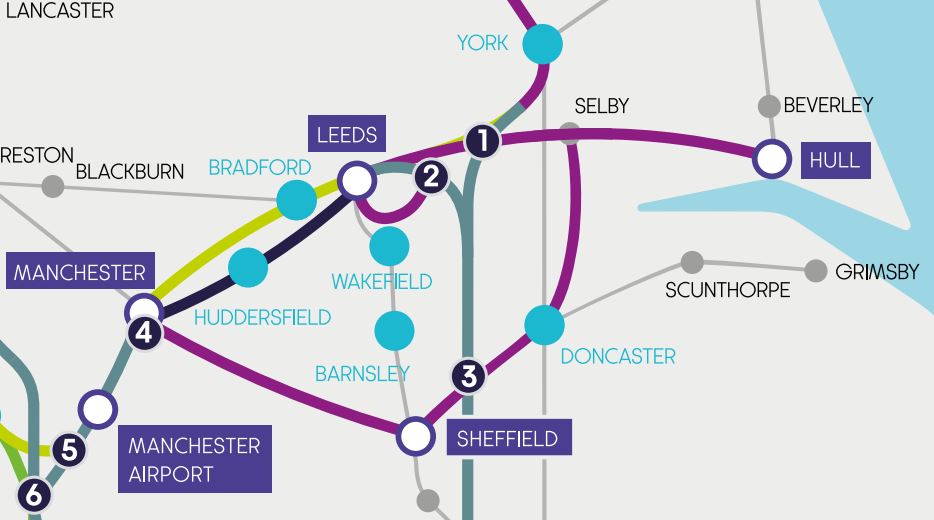
Note, these points about High Speed Two.
- It by-passes Sheffield and Barnsley and enters Leeds from the East, via Junction 2.
- It goes via Junction 1 to link up with the East Coast Main Line to York, Newcastle and Edinburgh.
- It links to the Leeds and Hull route at Junction 1.
- It has a Southern route via Chesterfield directly into Sheffield.
The current main route between Sheffield and Leeds is the Wakefield Line.
- It is thirty nine miles long.
- It is not electrified, except North of Wakefield Westgate station
- Trains stop at Meadowhall, Rotherhall Central, Swinton, Bolton-on-Dearne, Goldthorpe, Thurnscoe, Moorthorpe, Fitzwilliam, Sandal & Agbrigg, Wakefield Westgate and Outwood.
- Services take an hour and thirteen minutes
- The route is not very busy, with only, a total of around 4-6 trains per hour (tph) in both directions.
The Northern Powerhouse Rail improvements will see four tph between Sheffield and Leeds
- Journey times will be twenty-eight minutes.
- Some trains will extend past Sheffield to London St. Pancras.
- These fast services will probably stop less often.
- They will probably be backed up by stopping trains at perhaps two tph.
- I suspect the trains will be 125 mph bi-mode trains with batteries.
- I doubt there will be full electrification, as train developments will achieve the same objectives, in a more affordable manner.
- There will be full digital signalling to increase the capacity.
So where does the proposed Barnsley Dearne Valley station fit in?
- It will be on both the Wakefield Line and High Speed Two.
- It will have fast local trains between Leeds and Sheffield at four tph.
- It will have High Speed Two services between London and Leeds via East Midlands Hub at a frequency of at least two tph.
- It will have High Speed Two services between London and Newcastle via East Midlands Hub and York at a frequency of st least two tph.
- As I wouldn’t be surprised to see a Turn-Up-And-Go service on major legs of High Speed Two, will Barnsley Dearne Valley have four tph?
- Stopping trains to and from Sheffield could be at a frequency of four tph and be tram-trains.
The station would be a quality one, with ,lots of parking.
Barnsley would be welcomed to the Twenty-First Century.
I also believe, that the Wakefield Line could be improved, sooner rather than later.
I have flown my virtual helicopter along the route between Rohterham Central and Fitzwilliam stations.
- It is at least double-track all the way.
- It would appear to be fairly straight.
- There is plenty of room on either side, so third and possibly fourth tracks could be added.
- There are no level crossings and very few bridges.
- The stations are simple, but could be easily upgraded to full step-free access.
- Electrification could be a lot easier than some of the TransPennine routes.
So one way to give early benefits could be.
- Electrify between Sheffield and Fitzwilliam.
- Improve line speed to at least 100 mph and possibly 110-125 mph.
- Make all stations step-free.
- Build the Wakefield Line station at Barnsley Dearne Valley.
- East Midlands Railway could run two tph between Leeds and Sheffield using 125 mph bi-mode trains, with stops at Barnsley Dearne Valley, Swinton and Rotherham Central.
- Perhaps one tph could be between Leeds and London.
- Extend the Sheffield tram-train to Barnsley Dearne Valley.
I don’t think much of the engineering would be difficult and an opening date of 2023 would probably be possible.
The proposal would give these advantages.
- Twenty-eight minutes journeys between Leeds and Sheffield at a frequency of four tph.
- One or possible two tph between Leeds and London calling at Barnsley Dearne Valley and Rotherham Central.
- Extension of Leeds local electric trains to Barnsley Dearne Valley.
- A four tph tram-train service between Sheffield and Barnsley Dearne Valley.
- A direct service between Barnsley Dearne Valley and Doncaster is also a possibility.
The idea of a station at Barnsley Dearne Valley is a brilliant idea.
East Midlands Parkway Station – 11th July 2019
I took these pictures at East Midlands Parkway station.
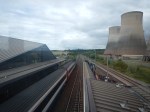
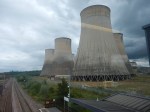
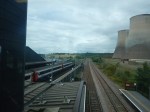
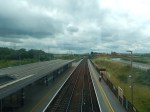
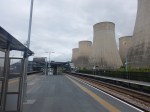
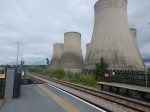
These are some of my thoughts.
Ratcliffe-on-Soar Power Station
The station is dominated by the coal-fired Ratcliffe-on-Spar power station, with its eight massive cooling towers.
When I was leaving Liverpool University in the late-1960s, I don’t think any of my fellow students thought coal had a future.
Several of my group of Electrical Engineers went into nuclear engineering, but many like me went into computing, electronics and instrumentation.
But still the Government ploughed on with mining coal and burning the filthy stuff to produce electricity.
Now the current government has decided, that they’ll all be gone by 2025!
And good riddance to them!
It has amazed me, they have survived this long.
I can remember reading in the Guardian in the 1980s of proposals by enlightened thinkers to retrain miners as insulation teams to insulate our terrible pre-war housing stock, which wastes vast amounts of energy.
But politicians of the left, including some who are still around today, glory in the honest toil of working in a coal mine.
I’m afraid, that I’ve met so many children of miners, whose major advice from their father, was to never go down a mine except as a tourist.
Burning coal, has been one of the worst cul-de-sacs of the human race.
An Inadequate Train Service
I have scarcely been to a station with such an inadequate train service.
Logic suggests, that it would have a service something like two or four trains per hour (tph) to major cities within half-an-hour.
But read what is said under Services in the Wikipedia entry for the station.
Here’s the first two paragraphs.
Fears were raised by various bodies, notably East Midlands Airport, about the service pattern proposed for the new station.
Donington Park motor racing circuit is nearby, and its owners have expressed their desire for spectators to use the station or coach services when travelling to the circuit. The owners are also in support of any future light rail transport to East Midlands Airport itself.
On my visit, I took a train from Leicester and then had to wait nearly an hour to get one back to where I started.
Abellio certainly have scope to improve the service.
In Leicester Station – 11th July 2019, I wrote that I felt that if Abellio apply similar logic to that which they are applying in East Anglia, that there could be a significant improvement in services on the Midland Main Line, to the North of Leicester.
- Three tph – Fast trains between Leicester and Sheffield via Derby and Chesterfield
- One tph – Stopping train between Leicester and Sheffield via Derby and Chesterfield
- Three tph – Fast trains between Leicester and Nottingham
- One tph – Stopping train between Leicester and Nottingham
- One tph – Stopping train between Leicester and Lincoln
As the new trains will have a better performance, more could stop at East Midlands Parkway to even out the terrible stopping pattern.
Station Usage
Wikipedia gives the station usage as just over 300,000 passengers per year.
This compares with Louthborough station, which is the next station to the South having a usage of 1,300,000 passengers per year.
Even the new Ilkeston station further North with only two platforms and of a much simpler design, had a usage of 250,000 passengers in its first year.
As this Google Map shows, the car parking has attracted a few takers.
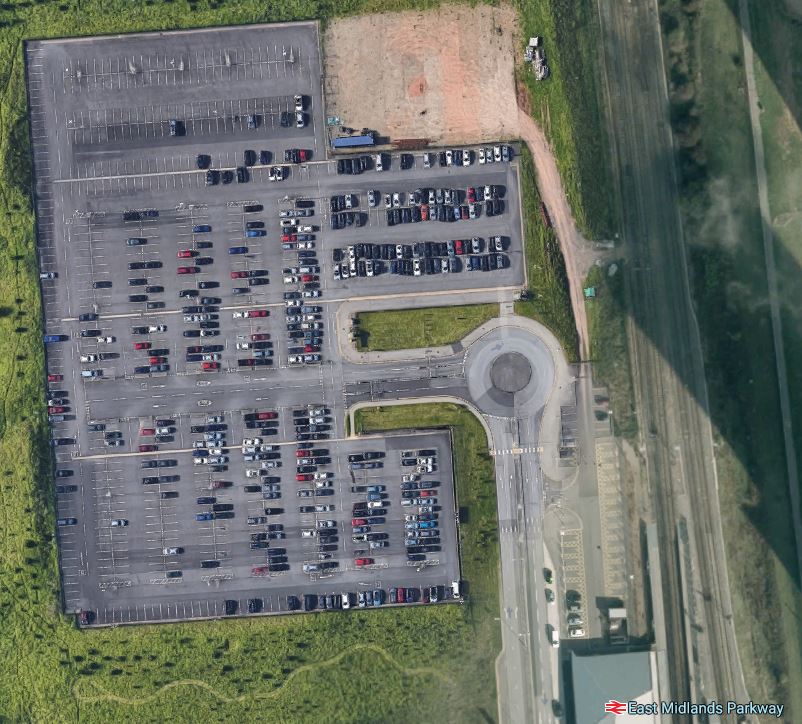
I do question though, if the station should ever have been built!
I hope Abellio have a plan to breathe some life into the station.
Megabus
Note the Stagecoach Megabus in the pictures.
This provides services all over Yprkshire and is decribed under Multi-Modal in the Wikipedia entry for the station.
This is the first paragraph.
From 30 March 2009, the station has been used as an interchange station for combined multi-modal journeys using Megabus-branded services run by Stagecoach (the operators of both East Midlands Trains and of Megabus). The MegabusPlus services transport passengers from cities in the north of England to East Midlands Parkway, where passengers transfer to rail for the service to London.
At a first glance, it looks like a crazy idea.
But Stagecoach wouldn’t run it, if it wasn’t needed or profitable.
Charging Battery Electric Trains
In The Mathematics Of Fast-Charging Battery Trains Using Third-Rail Electrification, I showed how a third-rail-based fast charging sstem, like that proposed by Vivarail could transfer several hundred kWh to the batteries of a train stopped in the station, for a few minutes.
East Midlands Parkway station with pairs of tracks between generously-spaced platforms with a gap between the tracks, would be an ideal location for such a charging system.
- The two third-rail would be laid together between the two tracks.
- The third-rails could be shielded, but as they would only be live with a train on the top, would it be necessary?
- The driver would only need to stop the train in the correct position, but they do that anyway.
- An adequate electricity supply shouldn’t be too much of a problem!
In a three minute contact between the train and the third-rail, I believe it would be possible to transfer up to 200 kWh to the batteries of the train.
Conclusion
This station has problems.
I’ll be interested to see how Abellio attract more passengers and use the station to passengers and their own benefit.
Leicester Station – 11th July 2019
I took these pictures at Leicester station today.
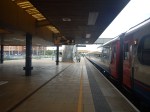
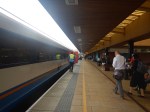
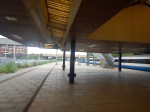

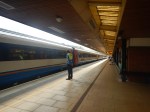
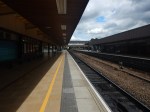
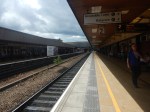
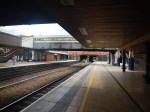


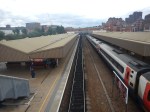
These are a few of my thoughts.
Long Straight Platforms
The two main platforms for trains to and from London are long and straight and can easily accommodate the longest trains that do or will use the station.
Wide Spacious Platforms
The two island platforms are wide and spacious.
In my time at the station, I didn’t see any trains use the outer platforms and I do wonder if the station is used to the maximum capacity allowed by the layout.
The Station Could Have More Trains And Be A Better Interchange
When you arrive at Ipswich station on a fast train from London, one of the half-hourly services has an easy connection to either Bury St. Edmunds and Cambridge, Felixstowe, Lowestoft and/or Peterborough. and staff and information screens are there to speed you on your way.
Leicester station doesn’t seem to welcome you to continue your journey elsewhere
Abellio And Ipswich Station
Abellio with their new trains and timetable, will be increasing frequencies, so that Suffolk’s County Town with a population of 133,000, will have the following services.
- Two trains per hour (tph) to Bury St. Edmunds. – Doubled from current.
- One tph to Cambridge – A second hourly service will be available with a change at Ely.
- One tph to Felixstowe – Might be doubled, now thst the Felixstowe branch has more capacity.
- Three-four tph to London – Faster and up from two expresses and a stopping train per hour.
- One tph to Lowestoft – Better timetable and faster.
- Three tph to Norwich – Up from two tph
- One tph to Peterborough – Doubled from current one train per two hours.
The creation of the East-West Rail Link will see a doubling of the service to Cambridge and one train per two hours to Oxford.
Applying Abellio’s East Anglian Rules To Leicester
Leicester is a city and County Town, with a population of 330,000.
These appear to be the current services.
- Two tph to Birmingham
- One tph to Cambridge, Peterborough and Stansted Airport
- Two tph to Derby
- One tph to Lincoln – Stopping train via Loughborough and East Midlands Parkway.
- Four tph to London
- Two tph to Nottingham
- Two tph to Sheffield
Leicester doesn’t seem to have the sort of train service the City deserves.
This is the London, Ipswich and Norwich philosophy as proposed by Abellio and in the process of being delivered.
- New maximum-length and maximum-speed high-capacity Class 745 trains will provide more seats on the route.
- A fifty per-cent increase in train frequency from two tph to three tph.
- Four express services per day, only stopping at Ipswich, have been introduced, giving a ninety minute service between London and Norwich.
- Four trains per day between Lowestoft and London.
What would a similar philosophy for London Midland Main Line, look like at Leicester?
- Three tph to Derby, Chesterfield and Sheffield.
- Six tph to London
- Three tph to Nottingham
- All trains would be maximum-length with a capacity at least similar to a 2+8 HST.
- Greater Anglia’s Class 745 trains will have 757 seats in two classes and a buffet. Expect a similar specification on the Midland Main Line.
- Services will be faster, with I suspect no trains taking longer than an hour from Leicester to London or Sheffield.
- Could there be a couple of non-stop trains every hour between London and Leicester?
This service would be a lot better and it only needs.
- An extra tph between London and Sheffield via Derby and Chesterfield
- An extra tph between London and Nottingham.
- Enough new maximum-length trains, which will probably be bi-mode trains, that are scheduled to arrive in 2022.
Four tph between London and Sheffield and London and Nottingham would surely be the ideal, but there just isn’t the capacity to the South of Kettering and in St. Pancras station.
So will we see extra services on the Midland Main Line to boost services North of Leicester?
- One tph between Leicester and Sheffield via Louthborough, East Midlands Parkway, Long Eaton, Derby and Chesterfield.
- One tph between Leicester and Sheffield via Louthborough, East Midlands Parkway, Ilkeston, Langley Mill, Alfreton and Chesterfield.
- One tph between Leicester and Nottingham via Louthborough, East Midlands Parkway and Beeston.
- The one tph Leicester to Lincoln service could also be included.
The services would be as follows.
- Trains would probably be shorter versions of the maximum-length bi-mode Midland Main Line trains.
- They would use the outer platforms at Leicester station to give cross-platform interchange with the frequent London trains.
- Services could possibly be extended past Sheffield to Leeds and past Nottinghm to Newark or Lincoln.
Leicester’s excellent platform design would see an increase in the number of trains and hopefully passengers.
Leicester And East-West Services
I also think, that there is sufficient capacity in Leicester station to add the following East-West services.
- Four tph to Birmingham
- Four tph to Cambridge
- Four tph to Peterborough
The following should be noted.
- Abellio has a substantial interest in all three stations and Leicester.
- The routes are often run by two-car Class 170 trains.
- The trains are often full.
- There is only short sections of lines that are electrified.
I believe that there should be the following service between Birmingham and Cambridge.
- Four tph
- At least four-car bi-mode trains.
- At least a 100 mph capability.
- Stops would include Coleshill Parkway, Nuneaton, Leicester, Melton Mowbray, Oakham, Stamford, Peterborough, March and Ely.
- At the Birmingham end, services could go via Birmingham International and Coventry.
- At the Cambridge end. perhaps two tph could be extended to Audley End and Stansted Airport.
- At Leicester there would be an easy interchange to London, the East Midlands and Sheffield.
- At Peterborough, there would be an easy interchange to London, Leeds, Newcastle and Scotland
It could be argued that if there is a need for a Cambridge and Oxford rail link, then Britain’s fastest growing high-technology hub, needs to have a high quality rail link to Birmingham via Leicester, Coventry and Birmingham International.
One overcrowded hourly two-car diesel train is not suitable for this important rail route.
Currently, trains take two hours forty-five minutes between Birmingham and Cambridge, which means with a fifteen minute turnround at either end, twenty-four trains would be needed for the service.
So it is probably not feasible, but I suspect it could be an aspiration for Abellio.
- I wouldn’t be surprised to see Abellio try to take over the Birmingham and Stansted Airport service from CrossCountry.
- Greater Anglia’s four-car Class 755 trains would double the capacity and be able to use electrification at both ends of the route.
- Greater Anglia have a few spare Class 755 trains, so is this takeover in their ambitions.
- Would the service be easier for Abellio to run, than CrossCountry?
This is a service to watch over the next couple of years.
Class 755 Trains In The East Midlands
I also suspect that Class 755 trains could be in Abellio’s plans for the East Midlands. Lincolnshire’s railways are little different to those of East Anglia.
The Bridges At The Southern End Of The Station
A trusted source told me, that one of the problems of electrifying through Leicester station with 25 KVAC overhead wires, is that the bridges at the Southern end of the station are a problem.
The general impression, I got was that the structure under the bridges is so complicated, that there would need to be a massive reconstruction of the railway.
To make matters worse a major sewer is in or under the bridges.
So if this meant that the railway had to be closed for a number of months, is this the reason for only electrifying as far as Market Harborough?
Surely, if the Midland Main Line is only to be partly-electrified, then Leicester would be a better changeover point.
Charging Battery Electric Trains
In The Mathematics Of Fast-Charging Battery Trains Using Third-Rail Electrification, I showed how a third-rail-based fast charging sstem, like that proposed by Vivarail could transfer several hundred kWh to the batteries of a train stopped in the station, for a few minutes.
Leicester station with the two tracks between widely-spaced platforms with a gap between the tracks, would be an ideal location for such a charging system.
- The two third-rail would be laid together between the two tracks.
- The third-rails could be shielded, but as they would only be live with a train on the top, would it be necessary?
- The driver would only need to stop the train in the correct position, but they do that anyway.
In a three minute contact between the train and the third-rail, I believe it would be possible to transfer up to 200 kWh to the batteries of the train.
Conclusion
Leicester station is a station, that suits the ambitions of the City.
But the unimaginative train service as provided by Stagecoach, is very fourth-rate and has left Abellio with a lot of scope to improve the train service throughout the East Midlands.
Stagecoach have only themselves to blame for losing the franchise.
East Midlands Railway’s New Look
The title of this post, is the same as a short article in Issue 882 of Rail Magazine.
What is interesting, is that it shows a visualisation of a Class 360 train in the new livery.
In Abellio East Midlands Railway’s Plans For London And Corby, I came to this conclusion.
I wouldn’t be surprised, if East Midlands Railway brought in Class 379 or Class 360 trains as a stop-gap and replaced them with electric versions of the bi-modes in 2022.
The best solution would be to obtain three twelve-car all-electric versions of the bi-modes by December 2020, to run the initial service.
Hitachi has a 125 mph electric Class 801 train and a 125 mph bi-mode Class 802 train.
Stadler has a 125 mph electric version of Greater Anglia’s Class 745 train and I suspect a compatible 125 mph bi-mode train.
Bombardier are working on a 125 mph bi-mode Aventra and have been quoted as saying Aventras can be stretched to 125 mph.It will be interesting to see what trains East Midlands Railway chooses.
By showing, a Class 360 train in their new livery, are they attempting to do one or all of the following.
- Get better terms for the nine interim trains they may need.
- Get better terms and earlier delivery for enough new twelve-car electric trains to run a 125 mph service between London and Corby.
- Trying to get better terms with the leasing companies to take back Class 379 and Class 360 trains, currently at Greater Anglia.
The Dutch can be tough negotiators.
Abellio’s Plans For Nottingham And Matlock Via Derby
This page on the Department for Transport web site is an interactive map of the Abellio’s promises for East Midlands Railway.
These are mentioned for services between Nottingham and Matlock via Derby..
Enhanced Sunday Service Providing An Hourly Service For Most Of The Day
Surely, this should be happening now!
Increased Community Rail Partnership Funding
Always a good thing!
Refurbished, Modern Trains
As with their plans for Nottingham to Norwich, they use the same words about the trains.
So will all these routes from around Nottingham be run using four-car Class 222 trains?
I can’t think what other suitable higher-capacity trains are available.
Except Class 170 trains and they are generally only two-cars, which probably isn’t large enough.
Brand-New Bi-Mode Trains For Long Term Use By Abellio East Midlands Railway
This page on the Department for Transport web site is an interactive map of the Abellio’s promises for East Midlands Railway.
These trains are proposed for working on several routes and some of their features are given.
In this section, I will try to ascertain, what they will be like.
These trains will replace the interim Mark 4 Coach/Class 43 locomotive sets on the Midland Main Line from April 2022.
They will also be used on the following services.
- London – Lincoln.
- London – Oakham – Melton Mowbray
- London – Leeds – York
Features include.
- More reliable service
- Improved comfort
- Passenger information system
- Free on-board Wi-Fi
- At-seat power sockets
- USB points
- Air conditioning
- Tables at all seats
- increased luggage space
- On-board cycle storage
I think it wouldn’t be speculating too much, to expect that shorter versions of these trains would also be used on other routes of the franchise.
I also think, that these trains will have other properties.
Ability To Run At 125 mph On Both Electric And Diesel Power
Bombardier, Hitachi and Stadler are proposing or have built fast bi-mode trains, which run at the same speed on both diesel and electric power.
- Bombardier are proposing a 125 mph Aventra with batteries.
- Hitachi’s 125 mph Class 800 trains are running at 125 mph on electric power, but can they achieve the 125 mph on diesel needed for the Midland Main Line?
- Stadler’s 100 mph Class 755 trains, will be running between London and Norwich at this speed from next month.
As parts of the Midland Main Line, that will not be electrified by 2022, to have a 125 mph operating speed, it is essential that the trains can do this speed on either power source.
Ability To Switch Power Source At Line Speed
Some trains do this, but others don’t!
To run as fast a timetable as possible, it is essential. Hitachi’s Class 800 trains can do it!
240 Metre Long Trains
Consider.
- The notes on the interactive map, says that Corby services will be this length in the Peak.
- 240 metre long platforms will be needed at St. Pancras for Corby services.
- Thameslink services are already this length.
These points lead me to the conclusion, that the new bi-mode trains can be up to 240 metres long.
Passenger Capacity
A seven-car Class 222 train has the following properties.
- 236 Standard Class seats.
- 106 First Class seats.
- 161.8 metres long
As the interiors of the existing and proposed trains seem similar with lots of tables and comfort, adjusting for the longer bi-mode train gives the following numbers of seats.
- 349 Standard Class seats.
- 157 First Class seats
There will be a large increase in the number of seats.
Step-Free Access Between Train And Platform
Stadler are the masters of this and are providing it on Merseyrail and on the Great Eastern Main Line.
Other companies will have to follow suit!
Hitachi in particular and surprisingly seem to design their trains with a big step.
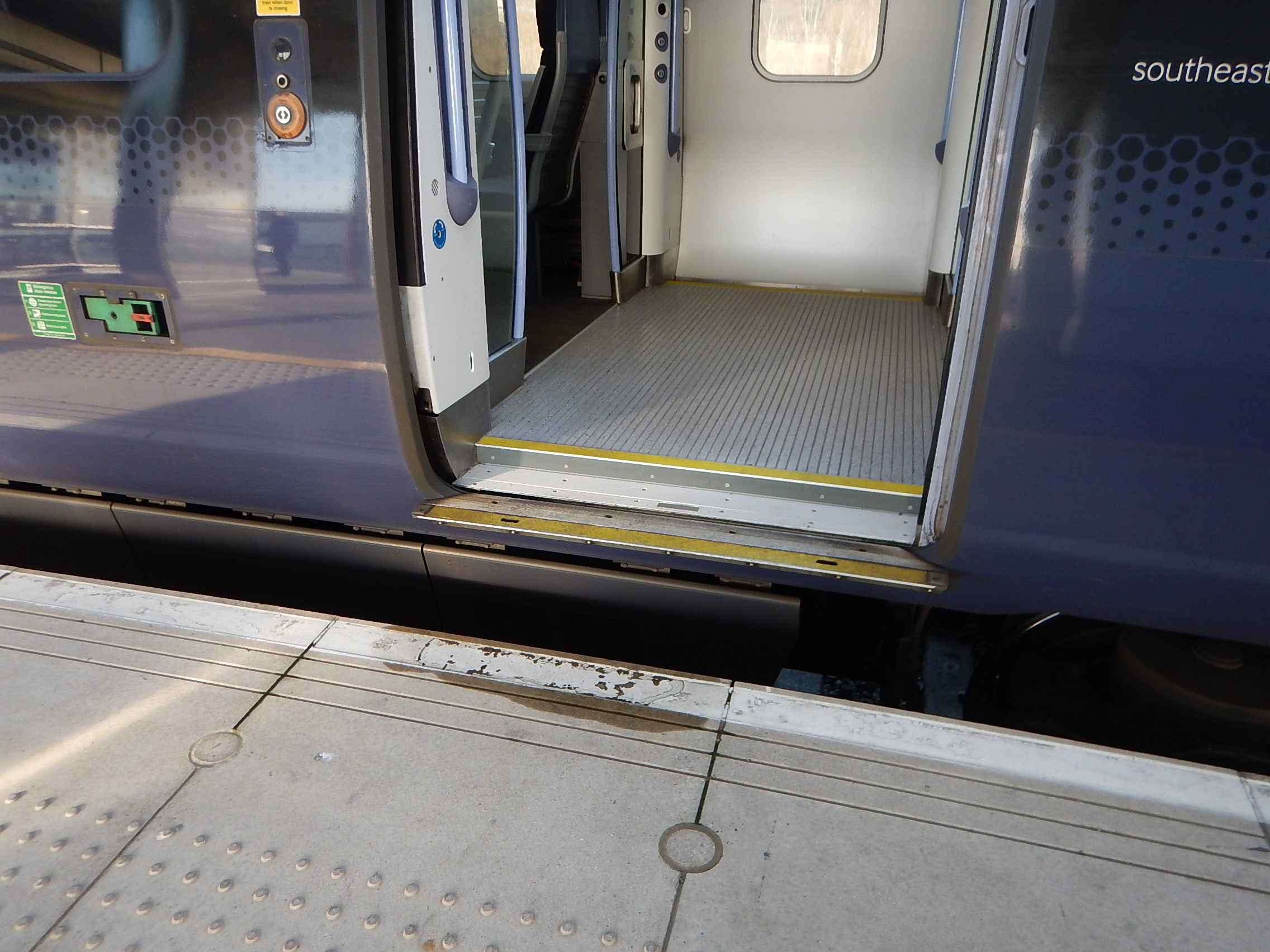
This picture shows the step up into a Class 395 train at St. Pancras station. It is unacceptable!
Step-free access improves the dwell time of trains at stations and is essential on any high-frequency service.
Digital Signalling
This will be essential to run the trains faster and closer together, so that more services can be run between London and the Midlands,
140 mph Running
IDigital signalling could even enable 140 mph running on sections of the route.
Improved Dwell Times
The performance of these trains and easy access, will mean that every station stop will be faster and will enable two pssenger benefits.
- Journeys will be faster by a few minutes.
- It will be possible to add extra station stops, with only a small penalty of overall journey times.
I doubt passengers will be unhappy.
High Speed Two Compatibility
High Speed Two should reach the East Midlands Hub station in 2032 and Sheffield station in 2034.
Between Clay Cross North Junction and Sheffield, High Speed Two and Midland Main Line services will use the same sixteen mile electrified railway.
Good project management probably says that this joint electrified line is created early, by say 2025. This would obtain maximum benefit to the City of Sheffield and the surrounding area.
As it is likely, that the new bi-mode trains will still be in service to past 2034, whatever is decided, these bi-modes must be able to run on High Speed Two infrastructure.
Conclusion
Even if, the current service pattern of two trains per hour to Derby, Chesterfield, Nottingham and Sheffield is maintained, there will be a large increase in capacity.
But if a fully-digital railway is created with 125 mph trains, I can see the Midland Main Line becoming one of the finest high speed railways in the world, that has been created by updating a classic rail line built in the Nineteenth Century.
Operating speed and capacity will be up there with the East Coast and West Coast Main Lines.
I can see Derby, Nottingham and Sheffield having a four trains per hour service from London in times of 75, 90 and 120 minutes respectively.
By comparison, High Speed Two is looking at a sub-ninrty ,minute time between London and Sheffield.
Luton Station To Go Step-Free
This document on the Government web site is entitled Access for All: 73 Stations Set To Benefit From Additional Funding.
Luton station is on the list.
These pictures show the station.






Without doubt, this is the worst station, I’ve found so far in an important town, that is to be made step-free.
There is nothing of any architectural merit at all in this station.
Will Abellio East Midlands Railway Improve Their Service To Luton?
Currently, Luton station has the following.
- Full electrification, which is being upgraded to a high standard for 125 mph running.
- Platforms long enough to accommodate Thameslink’s 242 metre long twelve-car Class 700 trains.
- The Class 700 trains are already fitted for working with digital signalling and this will be added to all trains.
It certainly treats trains better than it does passengers.
From December 2020, the following trains will run through Luton station.
- Two trains per hour (tph) to/from Corby, which will be 240 metre long twelve-car electric trains in the Peak. Why not in the Off Peak?
- Two tph to/from Leicester and Nottingham
- Two tph to/from Leicester, Derby, Chesterfield and Sheffield
At the present time, only the single Corby service stops at Luton.
From 2022, East Midlands Railway will be running new bi-mode trains through the station.
- For compatibility with the electric trains to Corby and to make full use of long platforms, I suspect that these trains could be up to 240 metres long.
- They will have a larger capacity, than the current Class 222 trains.
- They will effectively be electric trains between London and Market Harborough, where the electrification ends.
- They will have fast acceleration and smooth regenerative braking, because of the electric power.
- They could have step-across access between train and platform.
As Luton station is electrified and has long platforms, these trains will be able to stop at Luton (and Luton Airport Parkway) in minutes.
Network Rail intend to make Luton station step-free by 2024.
The improved access will give easier connections between the expresses and Thameslink, and entry/exit to the station.
I can see several trains per hour stopping at Luton.
Conclusion
If money was no object, this station should be totally rebuilt.
But money is an object, so the architects will be struggling.
But by 2024 at the latest and possibly a couple of years earlier Luton station could be sorted for passengers and handling well upwards of a dozen 240 metre long high capacity trains in every hour.
 The Anonymous Widower