North Sea Oil Group Equinor Scales Back Investment In Renewables
The title of this post, is the same as that of this article in The Times.
This is the sub-heading.
Equinor, which is attempting to develop one of the largest untapped oilfields in UK waters, also raised its fossil fuel production targets
This is the first paragraph.
The Norwegian state-backed oil company that is attempting to develop one of the largest untapped oil fields in UK waters, has dramatically scaled back its investment in renewables and raised its fossil fuel production targets, becoming the latest of the world’s energy giants to row back on the push towards green power.
A quiet revolution is happening that will change our use of natural gas very much for the better.
- In Rhodesia, which is a suburb of Worksop, a 24 MW Rolls-Royce mtu diesel peaker power plant, that runs on natural gas, but is also hydrogen-ready, has been installed to boost the electricity supply. The diesel engine is fitted with carbon capture and produces food-grade CO2, which is sold for food and engineering uses.
- Most of the excellent British tomatoes and soft fruit, we have been eating this winter, is grown in greenhouses, heated by natural gas-powered combined heat and power units, where the CO2 produced is captured and fed to the plants.
- HiiROC is a start-up from Hull, who are backed by Centrica, who use a plasma process to split any hydrocarbon gas including waste gas from a chemical plant, biomethane from a sewage works or natural gas into pure hydrogen and carbon black, which is needed to manufacture tyres and other products, and also to improve soil.
- In the last few months, a HiiROC device has been installed at Brigg power station, to generate zero-carbon electricity from natural gas.
- Imagine a housing or factory estate, a farm or perhaps a large country house, that wants to decarbonise. The gas feed to the property would be fitted with a HiiROC device and all gas appliances and boilers would be converted to hydrogen.
- I also believe that houses and other premises could have their own hydrogen pumps to fill up cars, ride-on mowers and other vehicles.
- Avnos is a company from the US, that captures CO2 from the air. What makes Avnos unique is that for every ton of CO2 it captures, it captures five tons of pure water.
More ideas like these are being developed.
What is wrong in using natural gas, to generate heat and electricity, if it doesn’t emit any CO2 into the atmosphere?
I suspect, that Equinor believe there will be a market for natural gas for years, as more and more clever ways to use it and turn it into hydrogen are developed.
Offshore Wind Innovation Hub in New York Opens Third Call For Applications
The title of this post, is the same as that of this article on offshoreWIND.biz.
This is the sub-heading.
The Offshore Wind Innovation Hub in New York, led by Equinor in collaboration with Urban Future Lab at NYU Tandon School of Engineering and National Offshore Wind Research & Development Consortium (NOWRDC), opened the 2025 application process on 15 January, issuing the third call for its accelerator programme since the Hub was officially launched in January 2023.
These two paragraphs describe the work of the innovation hub.
“We look forward to building on the strong foundation of the Innovation Hub and supporting the next round of entrepreneurs and emerging technologies”, said Molly Morris, President, Equinor Renewables Americas. “The solutions identified by the innovators will play a critical role in advancing the offshore energy industry, developing supply chains, and strengthening energy security for future generations of New Yorkers.”
Last year, six companies were selected to join the Hub’s accelerator programme and receive support to develop further their solutions that could help advance offshore wind in New York and the US: Boxkite Software, Claviate, Indeximate, Pliant Energy Systems, Sensatek, and Triton Anchor. Through the first call for applications in 2023, the Innovation Hub selected Benchmark Labs, Flucto, Heerema Engineering Solutions, RCAM Technologies, OSC, and VinciVR.
Note.
- Many countries have innovation hubs like these based on research institutions and universities.
- Molly Morris, with her Norwegian support, seems the sort of woman, who can keep Trumkopf under control.
- The Offshore Wind Innovation Innovation Hub certainly seems to spread their support around.
- I don’t think the Innovation Hub’s philosophy fits with Trump’s ‘Drill, Baby, Drill’
I can see Molly Morris, Equinor and The Innovation Hub really annoying Trump.
Let the battle commence!
Equinor Acquires Minority Stake In Ørsted, Becomes Second-Largest Shareholder
The title of this post, is the same as that of this article on offshoreWIND.biz.
This is the sub-heading.
Norway-headquartered Equinor has acquired a 9.8 per cent minority stake in Denmark’s Ørsted, making it the second-largest shareholder behind the Danish state, which holds a controlling stake in the company.
These are the first two paragraphs.
According to Equinor, the company is supportive of Ørsted’s strategy and management and is not seeking board representation.
“Equinor has a long-term perspective and will be a supportive owner in Ørsted. This is a counter-cyclical investment in a leading developer, and a premium portfolio of operating offshore wind assets”, said Anders Opedal, CEO of Equinor.
Could it also be two Scandinavian companies getting together to put up a stronger front to outside interests?
Are they frightened of the actions that might be taken by Great British Energy and by the Germans with their massive thirst for hydrogen?
RWE Goes For An Additional 10 GW Of Offshore Wind In UK Waters In 2030
This press release from RWE is entitled RWE And Masdar Join Forces To Develop 3 Gigawatts Of Offshore Wind Projects Off The UK Coast.
This is the last paragraph.
The UK plays a key role in RWE’s strategy to grow its offshore wind portfolio RWE is a leading partner in the delivery of the UK’s Net Zero ambitions and energy security, as well as in contributing to the UK build-out target for offshore wind of 50 GW by 2030. RWE already operates 10 offshore wind farms across the UK. Following completion of the acquisition of the three Norfolk offshore wind projects from Vattenfall announced at the end of 2023, RWE is developing nine offshore wind projects in the UK, representing a combined potential installed capacity of around 9.8 GW, with RWE’s pro rata share amounting to 7 GW. Furthermore, RWE is constructing the 1.4 GW Sofia offshore wind project in the North Sea off the UK’s east coast. RWE’s unparalleled track record of more than 20 years in offshore wind has resulted in 19 offshore wind farms in operation, with a goal to triple its global offshore wind capacity from 3.3 GW today to 10 GW in 2030.
Note.
- Nine offshore wind projects in the UK, representing a combined potential installed capacity of around 9.8 GW
- RWE are saying they intend to add 6.7 GW in 2030.
The eight offshore wind farms, that RWE are developing in UK waters would appear to be.
- Sofia – 1,400 MW
- Norfolk Boreas – 1380 MW
- Norfolk Vanguard East – 1380 MW
- Norfolk Vanguard West – 1380 MW
- Dogger Bank South – 3000 MW
- Awel y Môr – 500 MW
- Five Estuaries – 353 MW
- North Falls – 504 MW
This is a total of 9897 MW, which ties in well with RWE’s new capacity figure of 9.8 GW.
The Location Of RWE’s Offshore Wind Farms
RWE’s wind farms seem to fit in groups around the UK.
Dogger Bank
This wind farm is on the Dogger Bank.
- Dogger Bank South – 3000 MW – Planned
This wind farm would appear to be rather isolated in the middle of the North Sea.
RWE could have plans to extend it or even link it to other wind farms in the German area of the Dogger Bank.
Lincolnshire Coast
This wind farm is along the Lincolnshire Coast.
- Triton Knoll – 857 MW – 2022
As there probably isn’t much heavy industry, where Triton Knoll’s power comes ashore, this wind farm can provide the power needed in the area.
But any excess power in the area can be exported to Denmark through the Viking Link.
Norfolk Coast
These wind farms are along the Norfolk Coast.
- Norfolk Boreas – 1380 MW – Planned
- Norfolk Vanguard East – 1380 MW – Planned
- Norfolk Vanguard West – 1380 MW – Planned
These three wind farms will provide enough energy to provide the power for North-East Norfolk.
North Wales Coast
These wind farms are along the North Wales Coast.
- Awel y Môr – 500 MW – Planned
- Gwynt y Môr – 576 MW – 2015
- Rhyl Flats – 90 MW – 2009
- North Hoyle – 60 MW – 2003
These wind farms will provide enough energy for the North Wales Coast.
Any spare electricity can be stored in the 1.8 GW/9.1 GWh Dinorwig pumped storage hydroelectric power station.
Electric Mountain may have opened in 1984, but it is surely a Welsh giant decades ahead of its time.
Suffolk Coast
These wind farms are along the Suffolk Coast.
- Five Estuaries – 353 MW – Planned
- Galloper – 353 MW – 2018
- North Falls – 504 MW – Planned
These wind farms will provide enough energy for the Suffolk Coast, which except for the Haven Ports, probably doesn’t have many large electricity users.
But if the area is short of electricity, there will be Sizewell B nuclear power station to provide it.
Teesside
This wind farm is along the Teesside Coast
- Sofia – 1,400 MW – Planned
Teesside is a heavy user of electricity.
These six areas total as follows.
- Dogger Bank – 3,000 MW
- Lincolnshire Coast – 857 MW
- Norfolk Coast – 4140 MW
- North Wales Coast – 1226 MW
- Suffolk Coast – 1210 MW
- Teesside – 1,400 MW
Backup for these large clusters of wind farms for when the wind doesn’t blow will be provided as follows.
- Dogger Bank – Not provided
- Lincolnshire Coast- Interconnectors to Denmark and Scotland
- Norfolk Coast – Not provided
- North Wales Coast – Stored in Dinorwig pumped storage hydroelectric power station
- Suffolk Coast – Sizewell B and Sizewell C
- Teesside – Interconnectors to Norway and Scotland and Hartlepool nuclear power stations
Note.
- The interconnectors will typically have a 2 GW capacity.
- The 1.9 GW/9.1 GWh Dinorwig pumped storage hydroelectric power station must be one of the best wind farm backups in Europe.
There is a very solid level of integrated and connected assets that should provide a reliable power supply for millions of electricity users.
How Will Dogger Bank And The Norfolk Coast Wind Clusters Work Efficiently?
The Dogger Bank and the Norfolk Coast clusters will generate up to 3 and 4.14 GW respectively.
So what purpose is large amounts of electricity in the middle of the North Sea?
The only possible purpose will be to use giant offshore electrolysers to create hydrogen.
The hydrogen will then be transported to point of use by pipeline or tanker.
Feeding H2ercules
I described H2ercules in H2ercules.
H2ercules is an enormous project that will create the German hydrogen network.
The H2ercules web site, shows a very extensive project, as is shown by this map.

Note.
- Hydrogen appears to be sourced from Belgium, the Czech Republic, The Netherlands and Norway.
- RWE’s Dogger Bank South wind farm will be conveniently by the N of Norway.
- RWE’s Norfolk cluster of wind farms will be conveniently by the N of Netherlands.
- The Netherlands arrow points to the red circles of two hydrogen import terminals.
For Germany to regain its former industrial success, H2ercules will be needed to be fed with vast amounts of hydrogen.
And that hydrogen could be in large amounts from the UK sector of the North Sea.
Uniper’s Wilhelmshaven Hydrogen Hub
This page on the Uniper web site is entitled Green Wilhelmshaven: To New Horizons
This Uniper graphic shows a summary of gas and electricity flows in the Wilhelmshaven Hydrogen Hub.

Note.
- Ammonia can be imported, distributed by rail or ships, stored or cracked to provide hydrogen.
- Wilhelmshaven can handle the largest ships.
- Offshore wind energy can generate hydrogen by electrolysis.
- Hydrogen can be stored in underground salt caverns.
I suspect hydrogen could also be piped in from an electrolyser in the East of England or shipped in by a hydrogen tanker.
All of this is well-understood technology.
Sunak’s Magic Money Tree
Rishi Sunak promised a large giveaway of tax in his manifesto for the 2024 General Election.
As we are the only nation, who can provide the colossal amounts of hydrogen the Germans will need for H2ercules, I am sure we will be well paid for it.
A few days ago we celebrated D-Day, where along with the Americans and the Canadians, we invaded Europe.
Now eighty years later, our hydrogen is poised to invade Europe again, but this time for everybody’s benefit.
This document on the Policy Mogul web site is entitled Rishi Sunak – Conservative Party Manifesto Speech – Jun 11.
These are three paragraphs from the speech.
We don’t just need military and border security. As Putin’s invasion of Ukraine has shown, we need energy security too. It is only by having reliable, home-grown sources of energy that we can deny dictators the ability to send our bills soaring. So, in our approach to energy policy we will put security and your family finances ahead of unaffordable eco zealotry.
Unlike Labour we don’t believe that we will achieve that energy security via a state-controlled energy company that doesn’t in fact produce any energy. That will only increase costs, and as Penny said on Friday there’s only one thing that GB in Starmer and Miliband’s GB Energy stands for, and that’s giant bills.
Our clear plan is to achieve energy security through new gas-powered stations, trebling our offshore wind capacity and by having new fleets of small modular reactors. These will make the UK a net exporter of electricity, giving us greater energy independence and security from the aggressive actions of dictators . Now let me just reiterate that, with our plan, we will produce enough electricity to both meet our domestic needs and export to our neighbours. Look at that. A clear, Conservative plan not only generating security, but also prosperity for our country.
I believe that could be Rishi’s Magic Money Tree.
Especially, if the energy is exported through electricity interconnectors or hydrogen or ammonia pipelines and tankers.
Will This Be A Party Anyone Can Join?
Other wind farm clusters convenient for the H2ercules hydrogen import terminals on the North-West German coast include.
- Dogger Bank – SSE, Equinor – 5008 MW
- East Anglian – Iberdrola – 3786 MW
- Hornsea – Ørsted – 8056 MW
That totals to around 16.5 GW of wind power.
I can see offshore electrolysers producing hydrogen all around the coasts of the British Isles.
What Happens If Sunak Doesn’t Win The Election?
RWE and others have signed contracts to develop large wind farms around our shores.
They didn’t do that out of the goodness of their hearts, but to make money for themselves and their backers and shareholders.
Conclusion
I believe a virtuous circle will develop.
- Electricity will be generated in the UK.
- Some will be converted to hydrogen.
- Hydrogen and electricity will be exported to the highest bidders.
- European industry will, be powered by British electricity and hydrogen.
- Money will be paid to the UK and the energy suppliers for the energy.
The more energy we produce, the more we can export.
In the future more interconnectors, wind farms and electrolysers will be developed.
Everybody will benefit.
As the flows grow, this will certainly become a Magic Money Tree, for whoever wins the election.
Consultation On Plans For Keadby Hydrogen Power Station To Begin
The title of this post, is the same as that of this press release from SSE.
These four paragraphs outline the project
SSE and Equinor will consult on plans for a new hydrogen-fired power station in North Lincolnshire which would provide vital new reliable and flexible capacity to the electricity system.
Keadby Hydrogen Power Station is a proposed 900MW plant which could be operational from 2030 – bolstering security of supply and supporting the UK’s long-term decarbonisation by providing back-up low-carbon power to variable renewable generation.
The project will enter environmental scoping in April before SSE and Equinor launch a public consultation ahead of a full planning application being made in due course.
Under plans, the new power station will be designed to run on 100% hydrogen. The ambition is that this would be the case from inception, with Government already committed to deploying low-carbon infrastructure in the Humber – the UK’s most carbon intensive cluster.
Note.
- The hydrogen for this power station will be produced by electrolysis or one of the new turquoise methods.
- It will be stored in Aldborough or Rough gas storage.
- This will be the fourth power station at Keadby after Keadby 1 (734 MW), Keadby 2 (893 MW) and Keadby 3 (910 MW)
- Keadby 3 will be fitted with carbon capture.
- These total up to 3.4 GW.
The Keadby cluster of power stations will make good backup to the wind farms in the North Sea.
Dogger Bank D Welcomes Confirmation Of Grid Connection Location
The title of this post, is the same as that of this press release from SSE Renewables.
This is the sub-heading.
Project team now focusing full attention on electrical transmission system connection.
These four paragraphs describe the proposed connection to the National Grid.
SSE Renewables and Equinor have welcomed confirmation of a grid connection location from the Electricity System Operator (ESO) for a proposed fourth phase of the world’s largest offshore wind farm.
Dogger Bank D will now connect into Birkhill Wood, a proposed new 400kV substation located in the East Riding of Yorkshire which will be built as part of National Grid’s Great Grid Upgrade.
The announcement follows the publication of an impact assessment for the South Cluster by ESO, relating to energy projects which are due to be electrically connected off the east coast of England.
With the location of a grid connection confirmed, Dogger Bank D will now focus its full attention on connecting to the electrical transmission system.
This is a big change from December 2023, when I wrote Plans for Hydrogen Development At Dogger Bank D Gain Ground, which indicated that Dogger Bank D would be used to produce hydrogen, so the grid connection wouldn’t be needed.
Using A Offshore Hybrid Asset Between the UK And Another European Country
This is the next paragraph on the SSE Renewables press release.
The project is also exploring the future possibility of the development of Dogger Bank D to be coordinated with an Offshore Hybrid Asset between the UK and another European country’s electricity market to form a multi-purpose interconnector. This option would increase energy security for the UK and reduce the need to curtail offshore wind output in times of oversupply on the GB network.
Note that just over the boundary of the UK’s Exclusive Economic Zone are the Dutch and German Exclusive Economic Zones.
It is not unreasonable to believe that UK, Dutch and German grid could all be connected on the Dogger Bank.
Connecting Everything Up At Birkhill Wood
This is the next paragraph on the SSE Renewables press release.
The project team are undertaking a site selection process to identify potential cable corridors and where other onshore infrastructure associated with the grid connection at Birkhill Wood may be sited. Consultation will be held later this year to introduce the connection proposals to the local community.
At least now, with the connection to Birkhill Wood confirmed, SSE and Equinor will be able to supply any electricity generated at Dogger Bank D to the UK grid, up to limit of the connection.
The Value Of Electricity That Could Be Generated At Dogger Bank D
Consider.
- The wind farm has a capacity of 2 GW or 2,000 MW.
- There are 365 days in most years.
- There are 24 hours in the day.
- This means that 17, 520,000 MWh could be generated in a year.
- A large wind farm like Hornsea One has a twelve month rolling capacity factor of 46.6%.
- Applying this capacity factor says that 8,164,320 MWh will be generated in a year.
- The Contract for Difference Round 6 for this electricity will be £73/MWh.
Applying that figure gives a yearly turnover of £ 595,995,360 or £ 297,997,680 per installed GW.
It is not unreasonable to assume that half of this electricity were to be exported to power Germany industry.
It could be a nice little earner for the Treasury.
World’s First Floating Wind Farm To Undergo First Major Maintenance Campaign, Turbines To Be Towed To Norwegian Port
The title of this post, is the same as that of this article on offshoreWIND.biz.
This is the sub-heading.
The world’s first commercial-scale floating wind farm, the 30 MW Hywind Scotland, officially entered the operations and maintenance (O&M) phase in October 2017. After a little over six years of operation, the wind farm’s Siemens Gamesa wind turbines are now due for some major maintenance work.
And this is the first paragraph.
While offshore wind farms undergo turbine maintenance work more than once during their lifespans and tasks such as major component exchange are nothing uncommon, this is the first time a campaign of this kind will be done on a floating farm.
Hywind Scotland has a web site, where this is said on the home page.
The world’s first floating wind farm, the 30 MW Hywind Scotland pilot park, has been in operation since 2017, demonstrating the feasibility of floating wind farms that could be ten times larger.
Equinor and partner Masdar invested NOK 2 billion to realise Hywind Scotland, achieving a 60-70% cost reduction compared with the Hywind Demo project in Norway. Hywind Scotland started producing electricity in October 2017.
Each year since Hywind Scotland started production the floating wind farm has achieved the highest average capacity factor of all UK offshore windfarms, proving the potential of floating offshore wind farms.
This news item from Equinor is entitled Equinor Marks 5 Years Of Operations At World’s First Floating Wind Farm, says this about the capacity factor of Hywind Scotland.
Hywind Scotland, located off the coast of Peterhead, Scotland, is the world’s first floating offshore wind farm and the world’s best-performing offshore wind farm, achieving a capacity factor of 54% over its five years of operations. Importantly, Hywind Scotland has run to high safety standards, marking five years of no loss time injuries during its operation.
Any capacity factor over 50 % is excellent and is to be welcomed.
Maintaining A Floating Wind Farm
One of the supposed advantages of floating wind farms, is that the turbines can be towed into port for maintenance.
This first major maintenance of a floating wind farm, will test that theory and hopefully provide some spectacular pictures.
Plans for Hydrogen Development At Dogger Bank D Gain Ground
The title of this post, is the same as that of this article on offshoreWIND.biz.
This is the sub-heading.
Dogger Bank D, the potential fourth phase of the world’s largest offshore wind farm under construction, Dogger Bank Wind Farm, has awarded contracts to engineering consultants to support the feasibility and optimization of a large-scale green hydrogen development option on the project
These three paragraphs outline the project.
SSE Renewables and Equinor, the developers of the Dogger Bank wind farm in the UK, awarded contracts for green hydrogen concept and engineering and optimization studies to Genesis, H2GO Power, and Fichtner.
If progressed for delivery, Dogger Bank D would be located in the North Sea around 210 kilometers off the northeast coast of England. Subject to the successful outcome of further technical studies, the project could be capable of generating up to around 2 GW of renewable power.
The 2 GW offshore wind farm is currently planned to comprise 128 wind turbines and up to six offshore platforms.
Note.
According to the article, this would be one of the UK’s largest green hydrogen production facilities.
The partners said, that the project could contribute to the UK Government’s electrolytic hydrogen ambitions for 5 GW by 2030.
This is said about the studies.
Using AI machine learning and robust modeling, these studies will investigate the multitude of interdependent variables required to optimize a potential green hydrogen production facility, such as offshore wind farm sizing, electrolysis capacity, transport and storage capacity, water availability, and offtake optionality.
I was using robust modelling on projects such as these fifty years ago, both with Artemis and bespoke software.
To my mind, SSE Renewables and Equinor are doing the right thing. If anybody has a similar project with lots of variables, I’d love to give my opinion.
I have some thoughts.
How Much Hydrogen Will Be Produced?
Ryze Hydrogen are building the Herne Bay electrolyser.
- It will consume 23 MW of solar and wind power.
- It will produce ten tonnes of hydrogen per day.
The electrolyser will consume 552 MWh to produce ten tonnes of hydrogen, so creating one tonne of hydrogen needs 55.2 MWh of electricity.
This would mean that if the Japanese built one Herne Bay-size electrolyser, then it would produce around three hundred tonnes of hydrogen in an average month.
Consider.
- Dogger Bank D is likely to be a 2 GW wind farm.
- This document on the OFGEM web site, says that the Dogger Bank wind farms will have a capacity factor of 45 %.
- This means that Dogger Bank D wind farm will produce an average of 900 MW over a year.
- This works out at 7,884 GWh of electricity in a year.
As each tonne of hydrogen needs 55.2 MWh to be produced, this means if all the electricity produced by Dogger Bank D, is used to create green hydrogen, then 142,826.1 tonnes will be produced.
How Will The Hydrogen Be Brought Ashore?
142,826.1 tonnes is a lot of green hydrogen and the easiest ways to transfer it to the shore would be by a pipeline or a tanker.
I wouldn’t be surprised to see the use of tankers, as this would give more flexibility and allow the export of hydrogen to countries in need of hydrogen.
Will There Be Hydrogen Storage In The Dogger Bank D Wind Farm?
This would surely be a possibility, but there are security considerations.
Cost would also be a factor!
The Location Of The Dogger Bank D Wind Farm
I clipped this map of Dogger Bank A, B, C and D wind farms from this page of the Dogger Bank D web site.
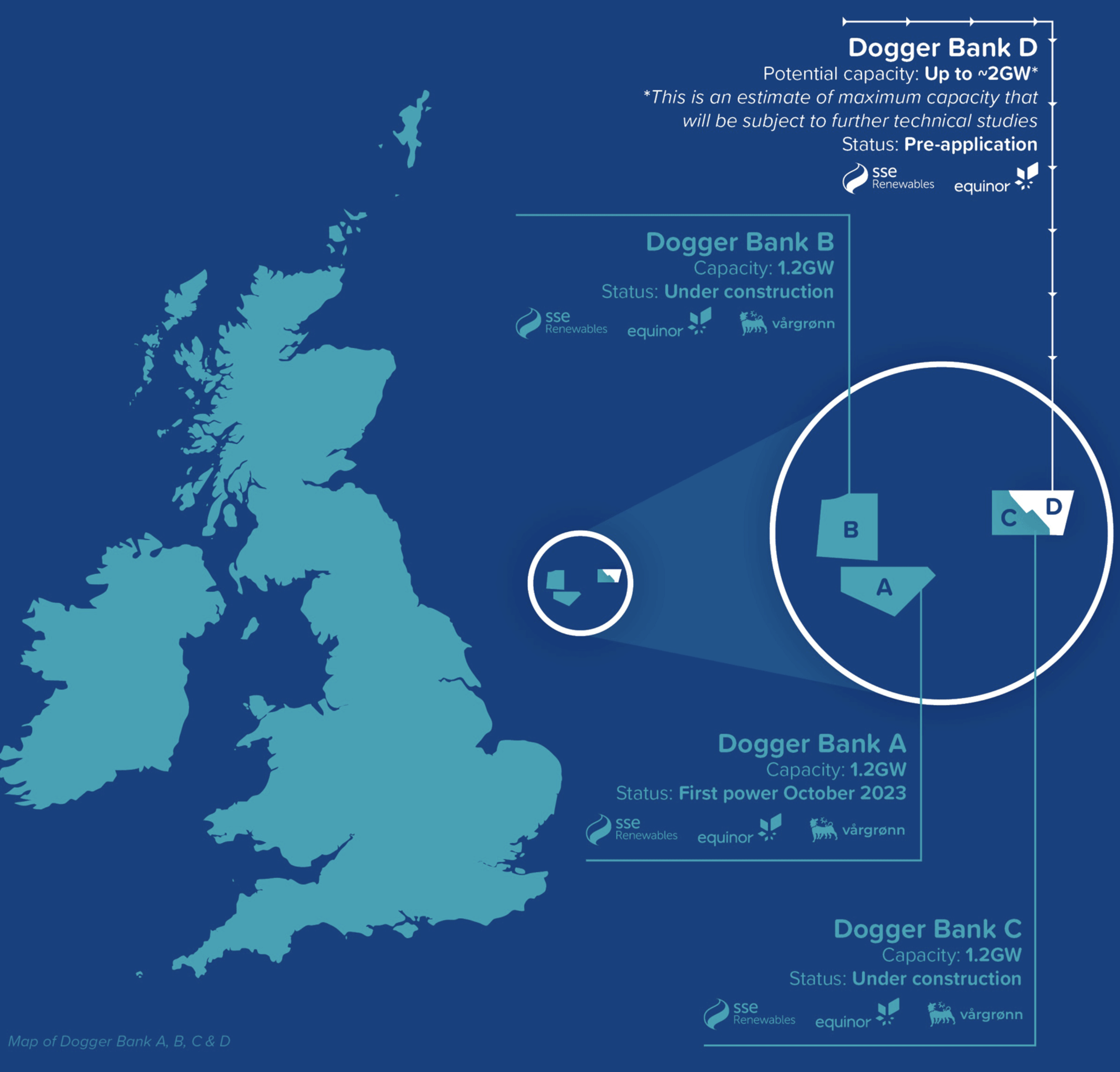
Note.
- RWE’s Dogger Bank South wind farm is not shown on the map.
- Dogger Bank D wind farm is the most Easterly of the four wind farms being developed by SSE Renewables and Equinor.
- Dogger Bank D wind farm must be the closest of the Dogger Bank wind farms to the Eastern border of the UK’s Exclusive Economic Zone or EEZ.
Dogger Bank D wind farm would appear to be ideally placed to supply hydrogen to a number of places, by either pipeline or tanker.
Could Dogger Bank South Wind Farm Also Produce Hydrogen?
In RWE Partners With Masdar For 3 GW Dogger Bank South Offshore Wind Projects, I talked about the change of ownership of the Dogger Bank South wind farm.
I would assume that the Dogger Bank South wind farm will be located to the South of the Dogger Bank A,B, C and D wind farms.
Whether it will produce hydrogen will be a matter for the owners and market conditions.
I do believe though, that it could share some facilities with the those that might be built for Dogger Bank D wind farm.
Conclusion
After this brief look, Dogger Bank D could be an ideal place to build a large hydrogen production facility.
Crown Estate Mulls Adding 4 GW Of Capacity From Existing Offshore Wind Projects
The title of this post, is the same as that of this article on offshoreWIND.biz.
This is the sub-heading.
The Crown Estate has revealed that it is taking steps to enable the generation of up to an additional 4 GW of electricity from several offshore wind projects in development, within the timeframe of the 50 GW 2030 target.
These are the first two paragraphs.
This follows requests from the developers of seven offshore wind farm projects who believe additional capacity can be generated from the areas of the seabed they hold existing rights for.
According to the Crown Estate, the technology has advanced and more capacity could be developed at projects that are already underway.
The seven wind farms are.
- Awel y Môr – Estimates 500 MW – Fixed – RWE
- Dogger Bank D – 1320 MW – Fixed – SSE Renewables, Equinor
- Dudgeon and Sheringham Shoal Extension – 719 MW – Fixed – Equinor
- Five Estuaries – TBD – Fixed – RWE
- North Falls – 504 MW – Fixed – SSE Renewables, RWE
- Rampion 2 – 1200 MW – Fixed – E-ON
Note.
- The Dudgeon and Sheringham Shoal Extensions seem to have been combined.
- One website connected to the wind farm, gives Five Estuaries as 353 MW.
- All are fixed wind farms.
- All are by large, established developers.
The total size is 4596 MW, using 500 MW for Awel y Môr and 353 MW for Five Estuaries.
Uprating by 8596/4596 could give these capacities.
- Awel y Môr – 935 MW
- Dogger Bank D – 2469 MW
- Dudgeon and Sheringham Shoal Extension – 1345 MW
- Five Estuaries – 660 MW
- North Falls – 943 MW
- Rampion 2 – 2244 MW
The total size is 8596 MW
Conclusion
This seems to be a sensible way to increase offshore wind capacity.
UK And Germany Boost Offshore Renewables Ties
The title of this post, is the same as that of this article on offshoreWIND.biz.
This is the sub-heading.
A new partnership between the UK and German governments has been agreed on 3 November to help secure safe, affordable, and clean energy for consumers in both nations for the long-term and bolster energy security. Both countries commit to strengthening cooperation in renewables, notably offshore wind and electricity interconnection.
These two paragraphs introduce the deal.
Under the new partnership signed in London by Energy Security Secretary Claire Coutinho and Germany’s Vice Chancellor, Robert Habeck, the UK and Germany have reaffirmed their shared ambition and commitment to net zero and progressing the energy transition.
Europe’s two largest economies have also doubled down on commitments made under the Paris Agreement to limit global warming to 1.5 degrees.
i think this could be a worthwhile follow-up to the relationship, that Boris Johnson and Olaf Scholz seemed to encourage after their high profile meeting in April 2022.
This press release from Downing Street is entitled PM meeting with German Chancellor Olaf Scholz: 8 April 2022 and this is the first two paragraphs.
The Prime Minister welcomed German Chancellor Olaf Scholz to Downing Street this afternoon to discuss the West’s response to Putin’s barbaric invasion of Ukraine.
The two leaders shared their disgust at the Russian regime’s onslaught and condemned Putin’s recent attacks.
I wrote Armoured Vehicles For Ukraine based on some of the things said in the press conference after what seemed to be a very wide discussion.
But it was these paragraphs in the press release that caught my eye.
They also agreed on the need to maximise the potential of renewable energy in the North Sea and collaborate on climate ambitions and green energy.
The Prime Minister said he wanted to further deepen the UK’s relationship with Germany, and intensify its cooperation across defence and security, innovation and science.
After Boris and Olaf’s meeting at Downing Street, I have been able to write these posts about the Anglo-German energy relationship and also make some other observations.
- Mona, Morgan And Morven
- UK-German Energy Link Reaches Financial Close
- RWE, Siemens and other German companies seem to be building a strong presence in the UK.
- Rolls-Royce are doing the same in Germany.
Claire Coutinho and Robert Habeck seem to be wanting to continue the co-operation, judging by this paragraph from the article on offshoreWIND,biz.
The energy and climate partnership sees both countries commit to enhancing cooperation in renewables, particularly in offshore wind and electricity interconnection, including offshore hybrid interconnection.
The most significant part of this paragraph is the mention of offshore hybrid interconnection.
If you want more details on their meeting, this document is the official UK Government declaration.
I have my thoughts.
What Is Meant By Offshore Hybrid Interconnection?
Type “Offshore Hybrid Interconnection” into Google and the first page is this page from National Grid, that is entitled Offshore Hybrid Assets, that has this sub-heading.
How the North Sea has the potential to become Europe’s green energy ‘powerhouse’
This is the introductory paragraph.
Now more than ever we need more renewable energy to make energy cleaner, more affordable, and more secure. The North Sea offers an incredible opportunity for the UK and our European neighbours to deliver huge increases in offshore wind. But delivering new offshore wind will require more infrastructure, which will have an impact on communities.
Hybrid is all-purpose comfort word like cashmere, platinum or puppies.
The page on the National Grid web site describes The Next Generation Interconnector with these paragraphs.
Interconnectors already provide a way to share electricity between countries safely and reliably. But what if they could do much more than that? What if interconnectors could become an offshore connection hub for green energy?
Instead of individual wind farms connecting one by one to the shore, offshore hybrid assets (OHAs) will allow clusters of offshore wind farms to connect all in one go, plugging into the energy systems of neighbouring countries.
And then there is this section entitled Tomorrow’s Solution: Offshore Wind And Interconnectors In Harmony, where this is said.
Today, offshore wind and interconnectors operate alongside each other, connecting to the shore individually. In the future, offshore hybrid assets could enable offshore wind and interconnection to work together as a combined asset.
We now call this type of infrastructure an offshore hybrid asset (OHA), but we used to refer to it as a multi-purpose interconnector (MPI). We changed it because we work so closely together with Europe, it made sense to use the same terminology.
The page on the National Grid web site also has an interactive graphic, which shows the benefit of the approach.
LionLink
National Grid are already developing LionLink, with Dutch grid operator; TenneT, which will be a multi-purpose interconnector linking the UK and the Netherlands.
LionLink is described on this page from National Grid, where this is the sub-heading.
We’re developing a first-of-its-kind electricity link to connect offshore wind between the UK and the Netherlands.
This is the introductory paragraph.
Designed together with our Dutch partners TenneT, LionLink (formerly known as EuroLink) is an electricity link that can supply around 1.8 gigawatts of clean electricity, enough to power approximately 1.8 million British homes. By connecting Dutch offshore wind to Dutch and British markets via subsea electricity cables called interconnectors, LionLink will strengthen our national energy security and support the UK’s climate and energy goals.
Will we be planning a similar electric handshake with the Germans?
How Much Offshore Wind Power Are We Talking About?
This is answered by the last two paragraphs of the article on offshoreWIND.biz.
Around 75 per cent of installed offshore wind capacity in the North Sea is in German and British waters. This is helping to drive the UK’s ambition for up to 50 GW of offshore wind, including up to 5 GW of floating wind, by 2030, the governments said.
Germany is aiming at installing 30 GW by 2030.
That is an Anglo-German starter for eighty GW.
Electrolysers In The Middle If The North Sea
Why Not?
This is a clip from National Grid’s graphic on the page that introduces Offshore Hybrid Assets,
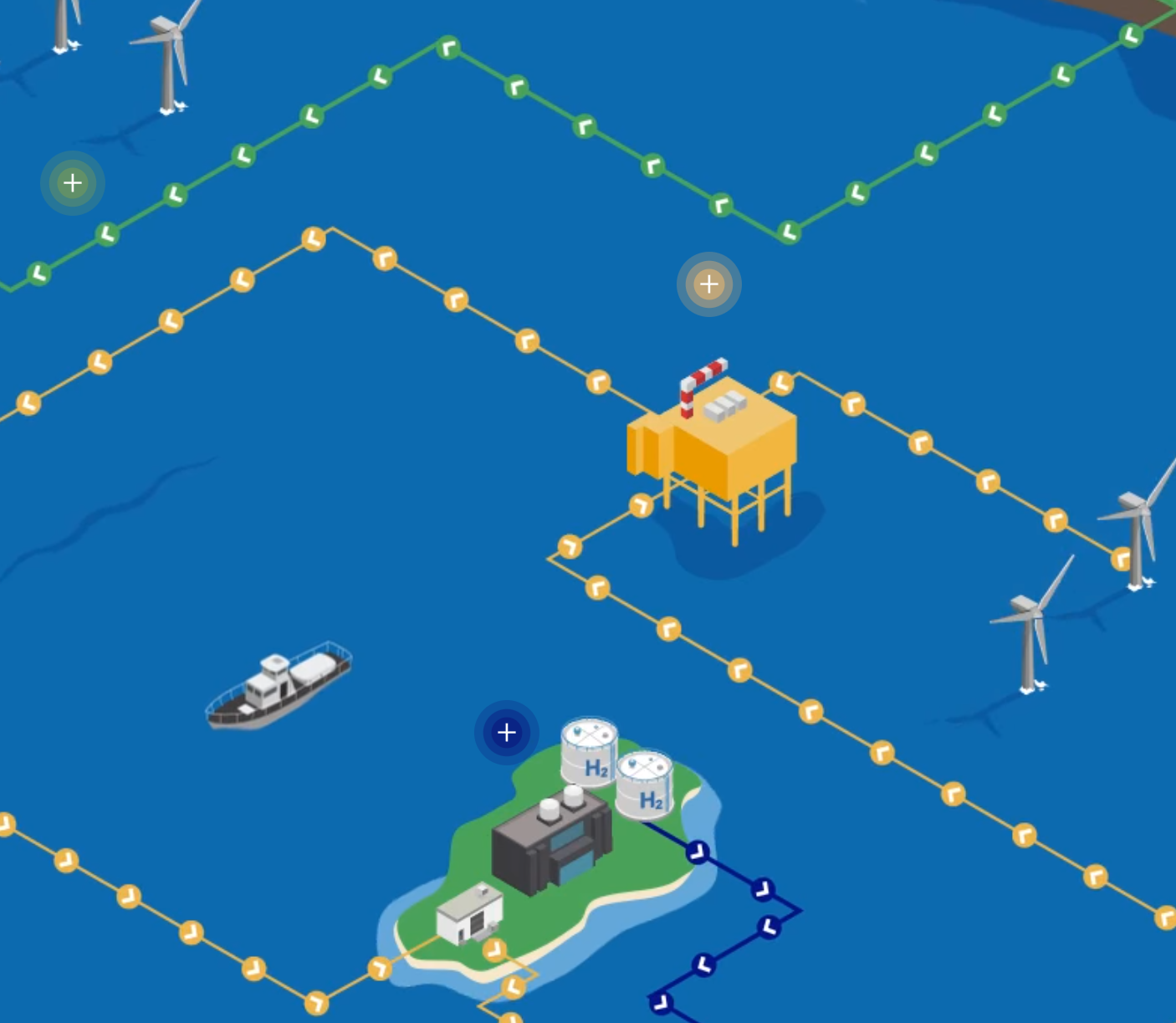
It shows an offshore hydrogen electrolyser.
- You could have an offshore hybrid asset that went between say Bacton in Norfolk and Hamburg via these assets.
- One or more wind farms in UK territorial waters.
- A mammoth offshore electrolyser, with hydrogen storage, possibly in a depleted gas field.
- One or more wind farms in German territorial waters.
Electricity will be able to go three ways; to the UK, to Germany or to the electrolyser.
The Involvement Of German Energy Companies In UK Territorial Waters
Wikipedia lists offshore fifteen wind farms, that have German owners in UK territorial waters, that total 12,960 MW.
This compares with.
- Equinor – 6 wind farms totalling 6466 MW.
- Ørsted – 15 wind farms totalling 9683 MW.
- Scottish Power – 2 wind farms totalling 5,000 MW.
- SSE Renewables – 15 wind farms totalling 15,591 MW.
- Vattenfall – 6 wind farms totalling 4384 MW.
As there is a number of partnerships, these figures only show the relative sizes of the investment by individual companies.
But at nearly 13 GW, the amount of total German investment in UK territorial waters is substantial.
Is This Solely An Anglo-German Club Or Can Others Join?
Consider.
- It seems to me, that because of the LionLink, the Dutch are already involved.
- TenneT is also a large electricity distributor in Germany.
- Countries with substantial shares of the water and winds of the North Sea in addition to Germany, the Netherlands and the UK, include Belgium, Denmark and Norway.
- The UK has interconnectors with Belgium, Denmark, France, Germany, Norway and the Netherlands.
It appears that the world’s largest multi-national power generator is evolving by stealth.
North Sea Wind Power Hub
This concept seems to have developed around 2017, by Danish, Dutch and German interests.
The Wikipedia entry introduces it like this.
North Sea Wind Power Hub is a proposed energy island complex to be built in the middle of the North Sea as part of a European system for sustainable electricity. One or more “Power Link” artificial islands will be created at the northeast end of the Dogger Bank, a relatively shallow area in the North Sea, just outside the continental shelf of the United Kingdom and near the point where the borders between the territorial waters of Netherlands, Germany, and Denmark come together. Dutch, German, and Danish electrical grid operators are cooperating in this project to help develop a cluster of offshore wind parks with a capacity of several gigawatts, with interconnections to the North Sea countries. Undersea cables will make international trade in electricity possible.
Currently, the UK is developing these wind farms on their portion of the Dogger Bank.
- Doggerbank A – 1235 MW – Started producing electricity in 2023.
- Doggerbank B – 1235 MW – Planned commissioning in 2024.
- Doggerbank C – 1218 MW – Planned commissioning in 2025.
- Doggerbank D – 1320 MW – Being planned.
- Doggerbank South – 3000 MW – Being planned.
Note.
- That’s a total of 8 GW.
- A, B, C and D are being developed by a consortium of SSE Renewables and Equinor.
- South is being developed by RWE.
- This web site is for Dogger Bank D.
- This web site is for Dogger Bank South.
This map from the European Atlas of the Seas, shows the various exclusive economic zones (EEZ) in the North Sea.

Note.
- The pinkish zone to the East of the UK, is the UK’s EEZ.
- The light blue zone at the top is Norway’s EEZ.
- The greenish zone in the North-East corner of the map is Denmark’s EEZ.
- The light blue zone below Denmark’s EEZ is Germany’s EEZ.
- Then we have the EEZs for The Netherlands, Belgium and France.
The Dogger Bank is situated where the British, Dutch, German and Norwegian EEZs meet.
All five Dogger Bank wind farms are in British waters.
The Wikipedia entry for the Dogger Bank says this about its size.
The bank extends over about 17,600 square kilometres (6,800 sq mi), and is about 260 by 100 kilometres (160 by 60 mi) in extent. The water depth ranges from 15 to 36 metres (50 to 120 ft), about 20 metres (65 ft) shallower than the surrounding sea.
This probably makes it easy to accommodate a large fixed-foundation wind farm.
Overlaying the map in the Wikipedia entry, with the EEZ map, I’m fairly sure that the northeast end of the Dogger Bank is close to where the EEZs meet.
Progress On The North Sea Wind Power Hub
The North Sea Wind Power Hub has a web site, but it seems to be more about thinking than doing.
It seems to have been hijacked by that august body; The Institute of Meetings Engineers.
This page on the web site, which is entitled Explore The Future Energy Highways, has a simple interactive map.
This shows its vision for 2030.
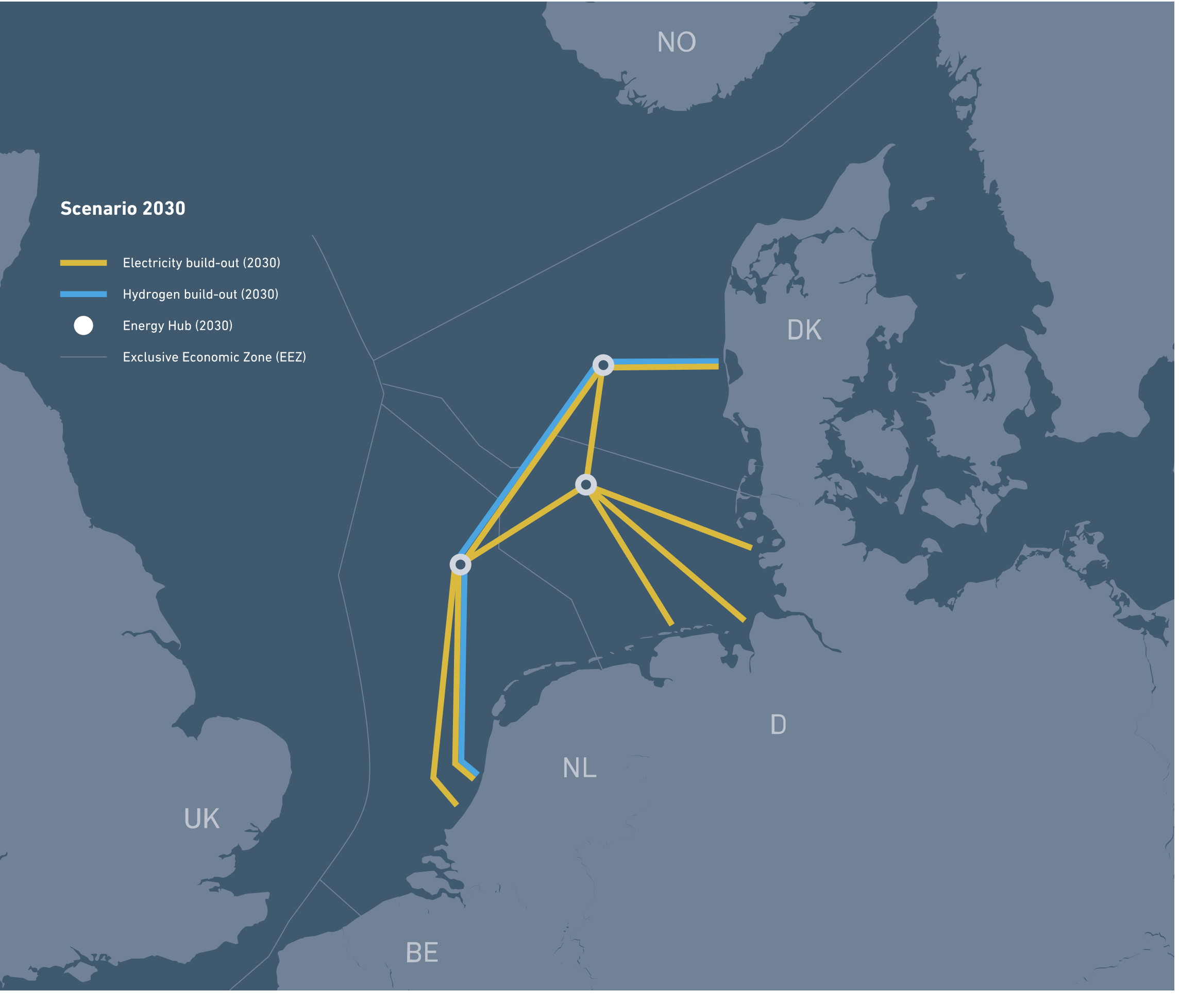
Note.
- Yellow is electricity links to be built before 2030.
- Blue is hydrogen links to be built before 2030.
- Feint lines indicate the EEZ boundaries.
There are two problems with this layout.
- It doesn’t connect to the Dogger Bank area, where the original plan as detailed in Wikipedia talked about “Power Link” artificial islands.
- No hydrogen is delivered direct to Germany.
This shows its vision for 2050.
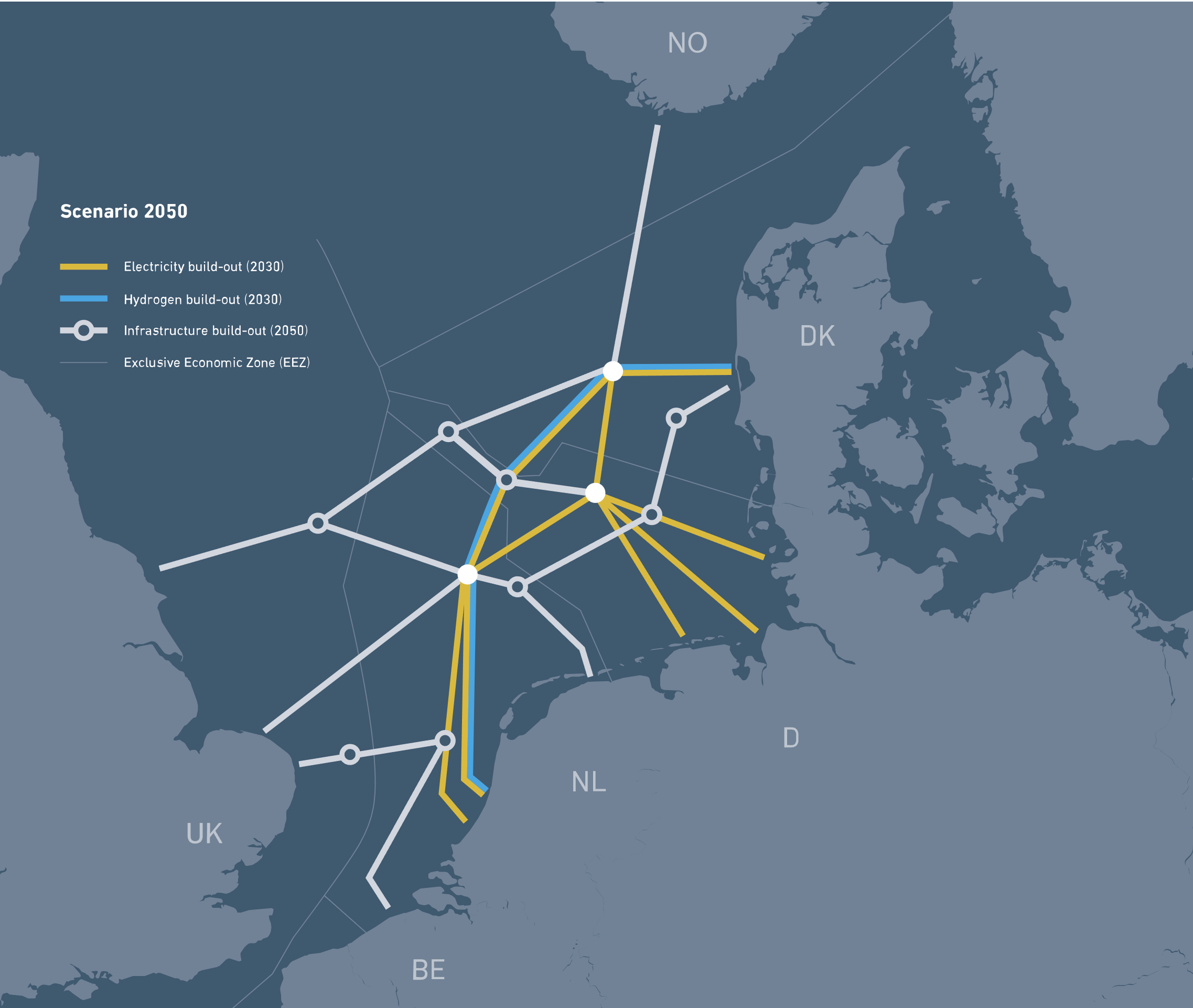
Note.
- Yellow, blue and feint lines are as before.
- White is electricity links to be built before 2050.
- There appears to be a node on the Dogger Bank in the German EEZ. This node could be connected to the “Power Link” artificial islands.
- The Southernmost connection to East Anglia could be Bacton.
- The other Norfolk connection could be where wind farms are already connected.
- The Northern connection could be Teesside, where some of the Dogger Bank wind farms connect.
- If the Northern connection to England is Teesside, then first node, which is in the British EEZ, could be one of the offshore sub-stations in the Dogger Bank wind farm complex.
This all seems a lot more feasible.
A New Offshore Hybrid Asset Between Teesside And Germany
Consider.
- A new offshore sub-station will be needed in the German EEZ to connect the “Power Link” artificial islands to the power network.
- The new offshore sub-station will eventually have three interconnectors to the German coast.
- Only the 1218 MW Dogger Bank C wind farm will be connected to the Teesside onshore substation.
- Germany has a power supply problem, after shutting down nuclear power stations and building more coal-fired power stations.
A new Offshore Hybrid Asset between Teesside and Germany could be created by building the following.
- A the new offshore sub-station in the German EEZ to connect the “Power Link” artificial islands to the power network.
- An interconnector between a sub-station of the Dogger Bank wind farm complex and the new sub-station
- A second interconnector to connect the new sub-station for the “Power Link” artificial islands to the German electricity grid.
All of the work would be done mainly in the German EEZ, with a small amount in the British EEZ.
Where Does Dogger Bank South Fit In?
Consider.
- Dogger Bank South is planned to be a 3 GW wind farm.
- It will need a 3 GW connection to the onshore electricity grid.
- Creyke Beck substation is the proposed location for the onshore connection.
- It is owned by German electricity company; RWE.
Could it be that some of the electricity produced by Dogger Bank South is going to be sent to Germany or to another node to produce hydrogen?
It certainly illustrates the value of an Offshore Hybrid Asset.
 The Anonymous Widower