What’s This Dirty Rotten Beast Doing On The GOBlin?
I photographed this dirty rotten beast at Blackhorse Road station on the Gospel Oak to Barking Line at 10:30 this morning.
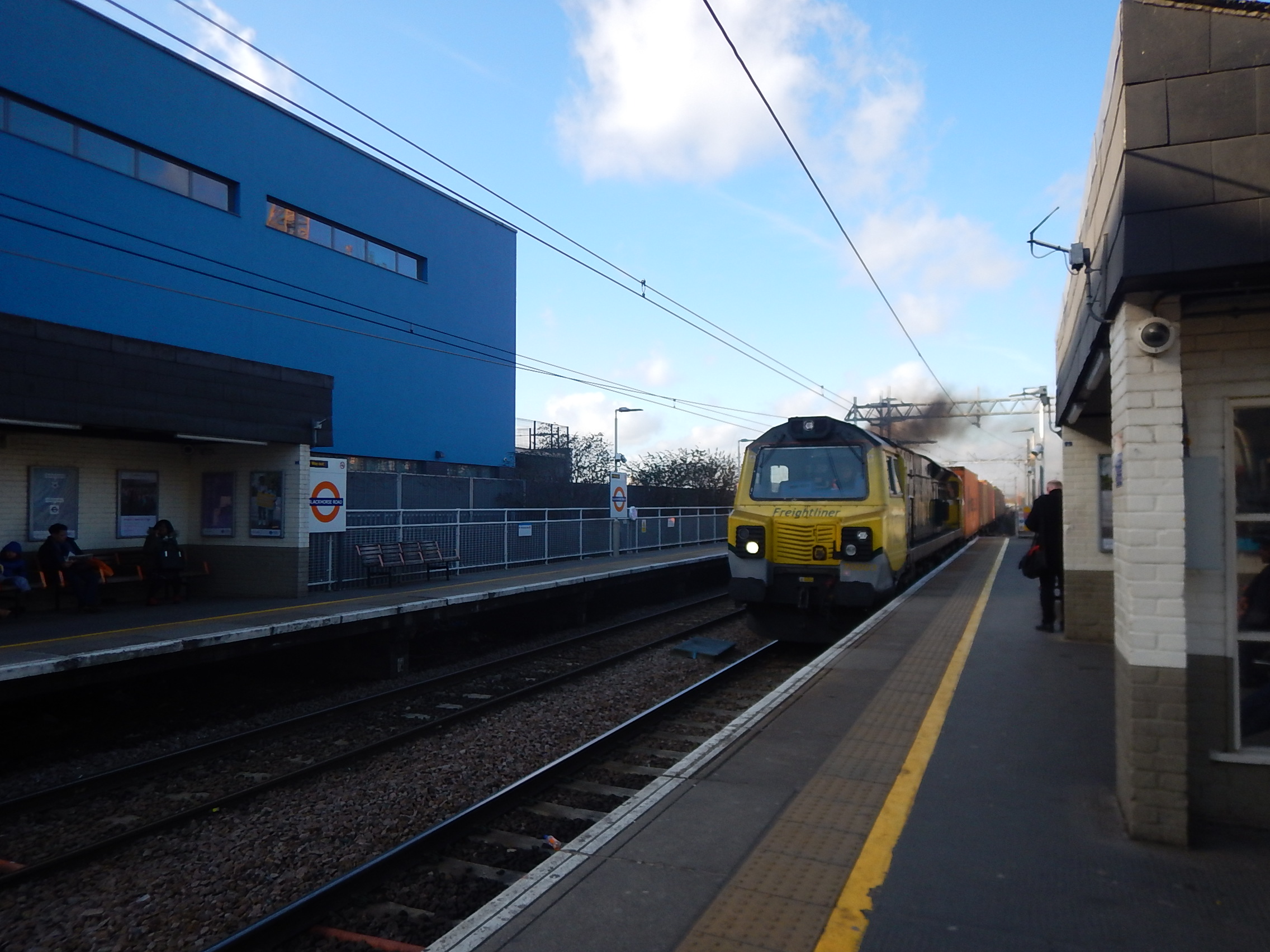
Isn’t this very much a load of pollution in the face of all those, who had to put up with all the disruption whilst the line was electrified.
By the way, it is exhaust smoke above the train and not a tree on the nearby Wetlands!
The Class 70 locomotive is supposed to meet EU Tier IIIa emission regulations.
Pull the other one!
The freight train was going from Garston F.L.T. to Lonfon Gateway Freightliner.
As neither of these terminals are electrified, the train has to be diesel-hauled.
But surely, the diesel shouldn’t be throwing out this level of pollution.
Spain – Luxembourg Rail Motorway Service Launched
The title of this post is the same as that of this article on Railway Gazette.
This is the first paragraph.
A ‘rail motorway’ service carrying unaccompanied lorry trailers 1 219 km between Barcelona and Luxembourg was launched on February 19.
This is the fifth such service to be operated across France and will be operated five times a week, with a sixth service to be added in April.
One of these services takes unaccompanied lorry trailers between Calais and a terminal near Perpignan, so you might wonder why this service doesn’t start in the UK.
The only place, that it could serve in the UK would be Barking, due to our antique loading gauge not being able to accept piggyback trailers.
So we can’t really link the UK to this freight network.
There is an excellent discussion on Rail Forums, which goes through the issues.
Barking
Barking is probably not the best place for a terminal for unaccompanied lorry trailers.
It is close to the heavily-congested M25, but surely trains of unaccompanied trailers could be assembled in other parts of the UK and taken to Barking.
But rail lines connecting Barking to the North include the North London and Gospel Oak to Barking Lines, both of which would need drastic gauge enhancement to take the traffic. As these routes are crowded London commuter routes, this work would go down like a whole squadron of lead balloons.
Specialist Freight
If you stood by the Gospel Oak To Barking Line for twenty-four hours, you would see some specialist freight trains going through, often carrying cars or vehicle components.
I think there will be growth in this sector, perhaps for high-value or perishable cargo, in purpose-built trains. But it would only take a few trucks off the roads.
There is also the problem, that a lot of specialist cargo is only one way.
- Minis go from Oxford to Europe.
- Ford cars and vans go from Europe to the UK.
- Perishable fruit and vegetables go from Southern Europe to the UK.
- Scotch whisky and seafood would go from Scotland to Europe.
I am certain, there is a profitable market niche here to pair compatible cargoes.
High Speed Parcel Traffic
Could we also see a network of overnight high speed parcel trains linking Europe’s major conurbations and commercial centres?
Conclusion
Neither specialist freight or high speed parcel trains will make much of a dent in the number of trucks, that will continue to clog the motorways to the Port of Dover.
Severn Toll Change
The title of this post is the same as that of a short article in the February 2019 Edition of Modern Railways.
This is the first paragraph.
There are concerns that the removal of toll charges on the M4 Severn Crossings on 17 December could result in a loss of rail freight traffic to road. The toll, for westbund vehicles only, was £16.70 per Heavy Goods Vehicle last year. It had been reduced from £20 in January 2018, when VAT ceased to be levied because the motorway bridges had passed from private to public ownership.
It now appears that it is now cheaper to get wine from Felixstowe to a warehouse in Avonmouth, by using a train to Cardiff and then using trucks, than by using a train to Bristol and a shorter truck journey.
Surely, the longer journeys by both diesel truck and probably diesel train, creates more carbon dioxide.
Obviously, the UK and Welsh Governments didn’t assess the carbon emission consequences of abolishing the tolls on the Severn Bridges.
I also wonder, if more people will now drive between South Wales and England, because of the incentive of a toll-free crossing, which will further increase carbon-dioxide emissions.
Rail Operations Group Gets Serious About Thunderbirds Etc.
The February 2019 Edition of Modern Railways has an article entitled Class 93 Tri-Oomph!, which has been written by Ian Walmsley.
This is the first paragraph.
Rail Operations Group has become known for the efficient haulage of EMUs around the country using very clever tranlation devices built into Europhenix converted Class 37 kicos. As I described in the March 2016 issue (“Lost in translation”) it looked at tens of millions of pounds worth of EMUs being dragged around unbraked, thought ‘this can’t be right’, and proceeded to make 50-year-old locomotives operate with state-of-the-art computer kit.
Rail Operations Group (ROG) had employed classicdisruptive innovation to create a new market, that was to everybody’s benefit.
As Ian reports, the company has grown a lot in the last few years and now does a lot more than just move new trains around.
- Old trains are also moved.
- Old trains are also stored safely.
- Operations are all planned as a consultancy.
The company is already planning their next operational niche.
A Move Into Logistics
ROG is moving into logistics.
Ian talks about the inefficiency and polluting distribution system using trucks, that add to traffic congestion.
He talks about rail being a better way and then says this.
The difference with ROG is that the company is going to invest in two Class 769 (bi-mode 319s’) converted for parcel use, and while these are not my favourite trains, parcels are a lot less fussy than me about how long they take to get to top speed.
Using 769s’ means that your hubs can be almost anywhere; not necessarily on a 25 KVAC electrified siding, just close to a road system interchange area.
So what happens, if they don’t get a customer? The Class 769 trains will be delivered with seats, so they could be sub-leased for passenger use.
I wrote The Go-Anywhere Express Parcel And Pallet Carrier (HSPT) in May 2017, where I discussed the uses for this type of parcel carrier. This was my conclusion.
There is definitely a market for a HSPT.
If it does come about, it will be yet another tribute to the magnificent Mark 3 design!
As to the secondary use of these trains as passenger trains, there is nothing wrong with that. After all, we’ve all had our fill of the dreaded Rail Replacement Buses.
In Gospel Oak-Barking Fleet Plan Remains Unclear, I talked about the problems caused by late delivery of the new Class 710 trains.
The problem would have been eased, if two Class 769 trains in good condition could have been called up at a couple of days notice.
Surely, there are other applications.
- I suspect that given the number of level-crossing accidents in the UK, they will find a lot of use.
- I don’t think Porterbrook will mind, if ROG effectively offered a try-before-buy service to train operators.
- There must also be a market for pop-up rail services to large sporting and cultural events.
Again, it appears ROG have found a niche and have invested in it.
Before leaving the subject of Class 769 trains, I must mention Brexit.
Could the trains find a use in a no-deal Brexit-world moving high-value freight from ports and airports to inland distribution centres?
Thoughts On The Class 93 Locomotive
These are some thoughts from the article.
Available Power
Ian starts by saying this about the operation of the Class 93 locomotive.
Apart from the obvious electric (4,000kW) and diesel (900kW), the third mode is a Lithium Titanate Oxide (LTO) battery (400kW), which can be used in conjunction with the diesel to give a power boost up to 1,300kW or 1,743hp in old money.
The extra oomph from the battery takes you from a Class 33 to a Class 37 in old locos but with minimal losses, and you don’t need full power for very long on most non-electrified routes.
I suspect there’s a clever control system, that optimises the use of the battery.
The Ultimate Thunderbird
The locomotive appears to have a unique feature of a variable height coupler, which enables it to haul rolling stock with all the five standard heights of coupler, that exist on UK railways.
How did this madness occur?
But as the locomotive can deal with them all, Ian argues that the Class 93 locomotive could be the ultimate Thunderbird or rescue locomotive.
Moving Trains In The Future
Ian argues that ROC’s collection of locomotives used for moving new and replaced trains is getting older and will soon be difficult to service.
The Class 93 locomotives would be ideal for this role.
But Ian sees this very much as a fallback position, if the locomotives do not find innovative new uses.
Ian finishes with this paragraph.
When we first saw Dr. Beeching’s new Freightliners(now ‘intermodal’) in the 1960s, they did 75 mph. They still do, but there are some really smart looking 100 mph flats available. Remember the path-ology. There are plenty of cross-country runs where a Class 37 equivalent is fine for the diesel bits, then pan up and 4,000kW is yours. Come on. Not excited by this? You must be in the wrong job.
As an example some freight trains go between Felixstowe and Birmingham, Liverpool or Manchester using the North London Line.
They are hauled all the way by a Class 66 diesel.
Put the containers on the smart looking 100 mph flats with a Class 93 locomotive on the front and the following happens.
- The locomotive uses diesel between Felixstowe and Ipswich, with possibly some battery boost.
- The locomotive uses electric power for most of the journey.
- The locomotive might use diesel power at the destination for a short distance.
- On the double-track 100 mph Great Eastern Main Line, the operating speed will not be far off the new Class 745 and Class 720 trains.
- On the North London Line, the train will pass through some of the smartest parts of North London with lower levels of noise, vibration and pollution.
- On the West Coast Main Line, the train will be able to mix it with the new Class 730 trains on the slow lines.
Greater Anglia have the trains to run more services between London and Ipswich.
How many more could they squeeze in, if all freight trains had a similar performance to their express services?
Consider now, freight trains taking the cross-country route from Felixstowe to the North and Midlands via Peterborough.
- With track improvements at Haughley and doubling of the line between Kennett and Ely, I suspect that timings on the flat lands of East Anglia using hybrid power would be approaching those of Class 66 locomotive-hauled stock.
- With a faster cruise on the East Coast Main Line, would the trains take the direct route on the slow lines, rather than the diversion through Lincoln?
The Class 93 locomotive could be the ultimate Felixstowe Flyer.
Could it also be the freight locomotive that passenger train operators want reight operators to use, as it keeps freight trains out of the way of passenger ones?
Rossendale Reopening Prospect
The title of this post is the same as that of an article in the February 2019 Edition of Modern Railways.
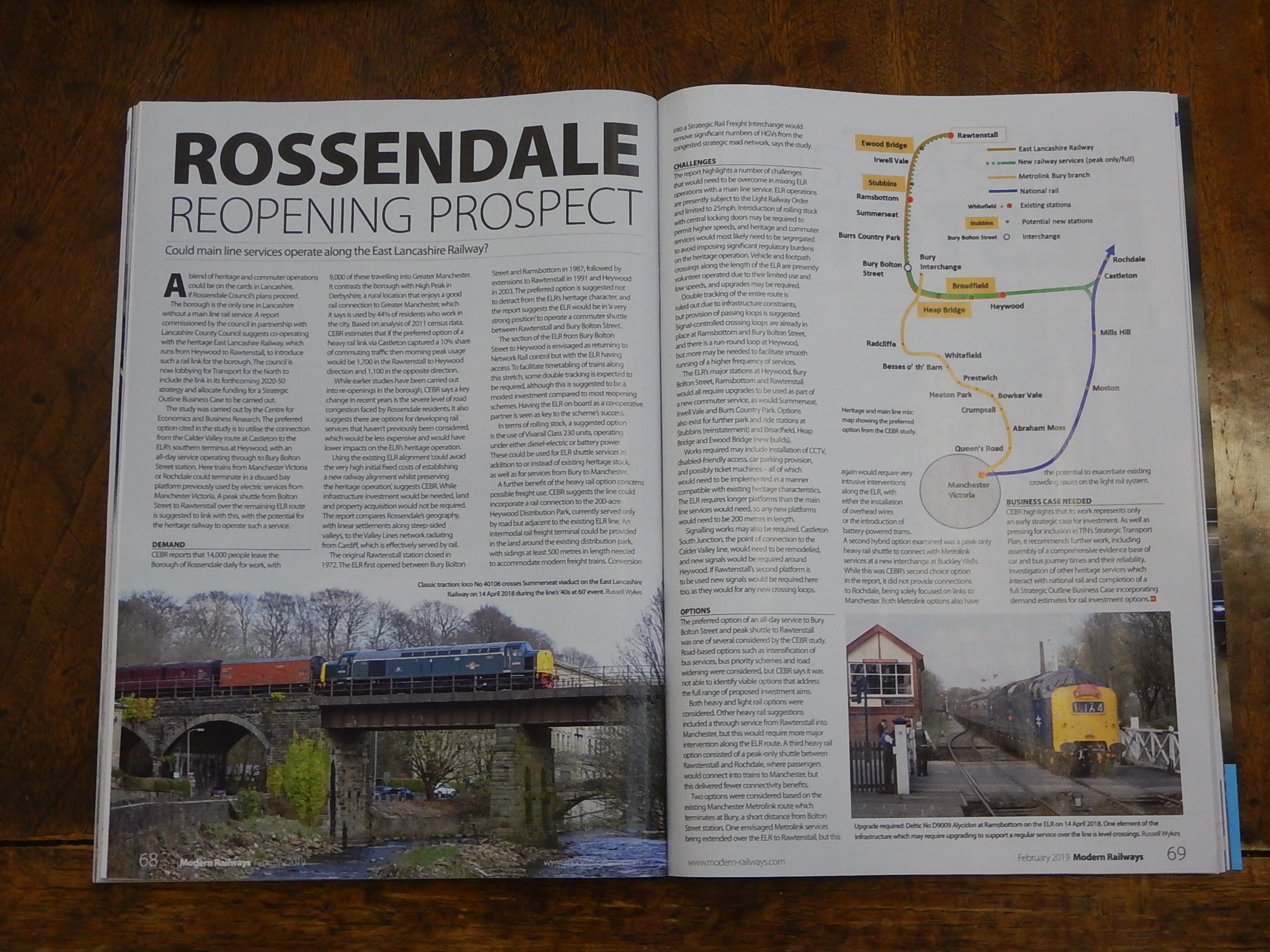
This is the opening two paragraphs.
A blend of heritage and commuter operations could be on the cards in Lancashire, if Rossendale Council’s plans proceed.
The borough is the only one in Lancashire without a main line rail service. A report commissioned by the council in partnership with Lancashire County Council suggests co-operating with the heritage East Lancashire Railway, which runs from Heywood to Rawstenstall, to introduce such a rail link for the borough.
Yesterday, I had a comment read out on the BBC, as I discussed in Wake Up To Money – New Stations.
Wake Up To Money yesterday was broadcast from Darwen, which is only a valley away from Rossendale.
- One of the complaints on the program was about crowded roads and bad transport links to Manchester and Manchester Airport.
- It looks to me, that the proposed Rossendale services will fulfil a similar need.
- The main objective appears to be to create good links to Manchester and Manchester Airport, with a secondary objective of creating a link across the Pennines to Leeds with a change at Rochdale.
The article gives more details of the proposal.
Track
The plan envisages reinstating the route between Rawtenstall and Castleton Junction on the Calder Valley Line.
The section between Rawtenstall and Heywood stations, via Bury Bolton Street station is the heritage line of the East Lancashire Railway (ELR). It is best described as predominately single-track with passing loops.
The article says this about improving the track.
The section of the ELR from Bury Bolton Street to Heywood is envisaged as returning to Network Rail control but with the ELR having access. To facilitate timetabling of trains along the stretch, some double-tracking is expected to be required, although this is suggested to be a modest investment compared to most reopening schemes. Having the ELR on board as a co-operative partner is seen as key to the scheme’s success.
Having flown my virtual helicopter along the line, it looks to me, that it could become another scenic route out of Manchester.
Castleton Junction
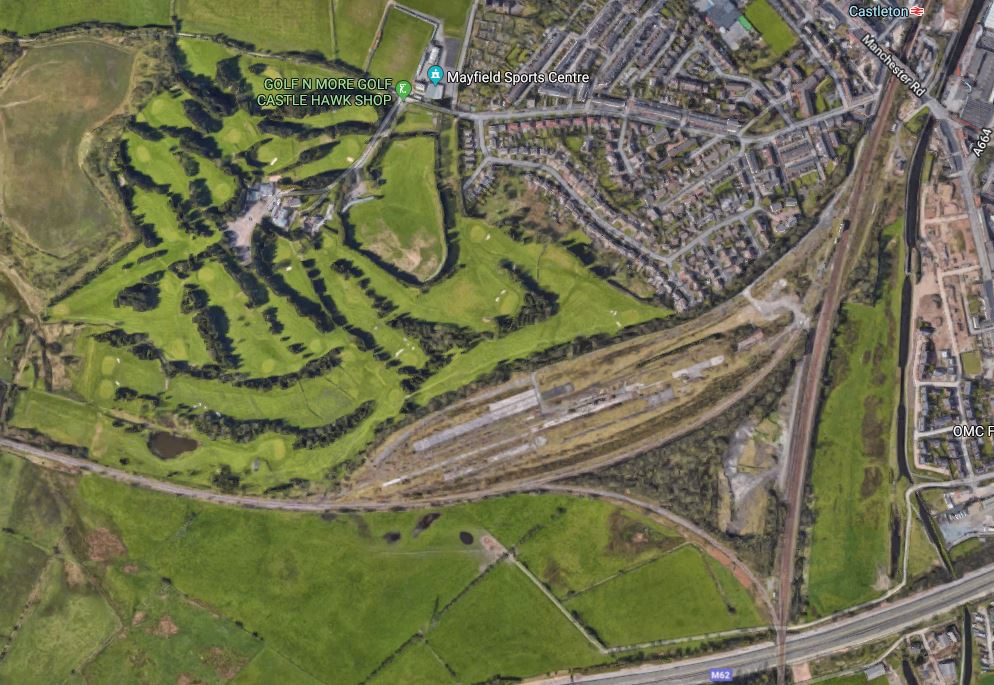
This Google Map shows Castleton Junction, where the East Lancashire Line meets the Calder Valley Line.
Note.
- The Calder Valley Line runs North-South.
- The ELR goes off to the West.
- Castleton station is in the North-East corner of the map.
What was or is the large site to the North-West of the junction?
The Junction will need to be upgraded and resignalled.
Electrification
It would be very unlikely, that the route will be electrified.
Although, I suppose there is a chance, that the Calder Valley Line might be electrified, to create an electrified route between Leeds and Manchester Victoria.
- If this were to happen, then there would be electrification between Manchester Victoria and Rochdale.
- Castleton Junction, where the new route would join the Calder Valley Line would be electrified.
This would make it easier and more likely for battery-electric trains to work the new route.
Possible Routes
Three routes are suggesting in the article.
- Manchester Victoria and Bury Bolton Street
- Bury Bolton Street and Rochdale
- Bury Bolton Street and Rawtenstall – Peak-Hour shuttle.
It is suggested that the third route would be run by the ELR.
Rolling Stock
The article says this about rolling stock.
In terms of rolling stock, a suggested option is the use of Vivarail Class 230 units, operating under either diesel-electric or battery power. These could be used for ELR shuttle services in addition to or instead of existing heritage stock, as well as for services from Bury to Manchester.
The Class 230 trains are an obvious choice, but I think that other trains could also be suitable.
These are my thoughts.
Class 230 Trains
I described a ride in a Class 230 train in Battery Class 230 Train Demonstration At Bo’ness And Kinneil Railway.
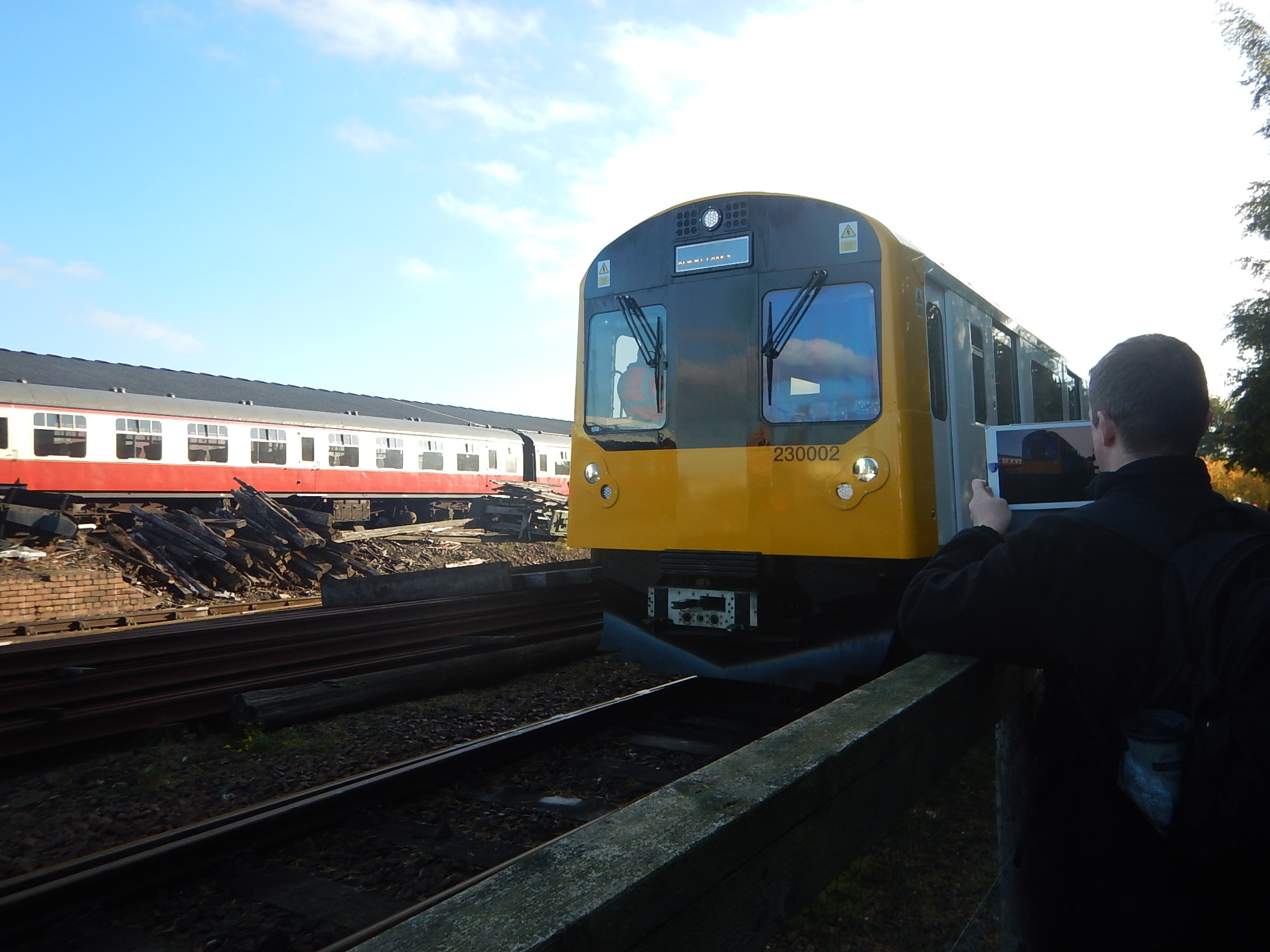
The Class 230 train would have these characteristics.
- The three-car train has a useful capacity of around 300 passengers.
- The range on battery power should enable a service between Bury Bolton Road and Manchester Victoria stations.
- The batteries can be charged in under ten minutes.
- The operating speed is 60 mph.
- The trains have been designed to be easy to service and this can be done on a remote basis.
- The trains are of an age, to fit in well on a heritage railway.
- I suspect the average competent heritage railway could do the servicing.
The trains also have the advantage of large windows for looking at the scenery.
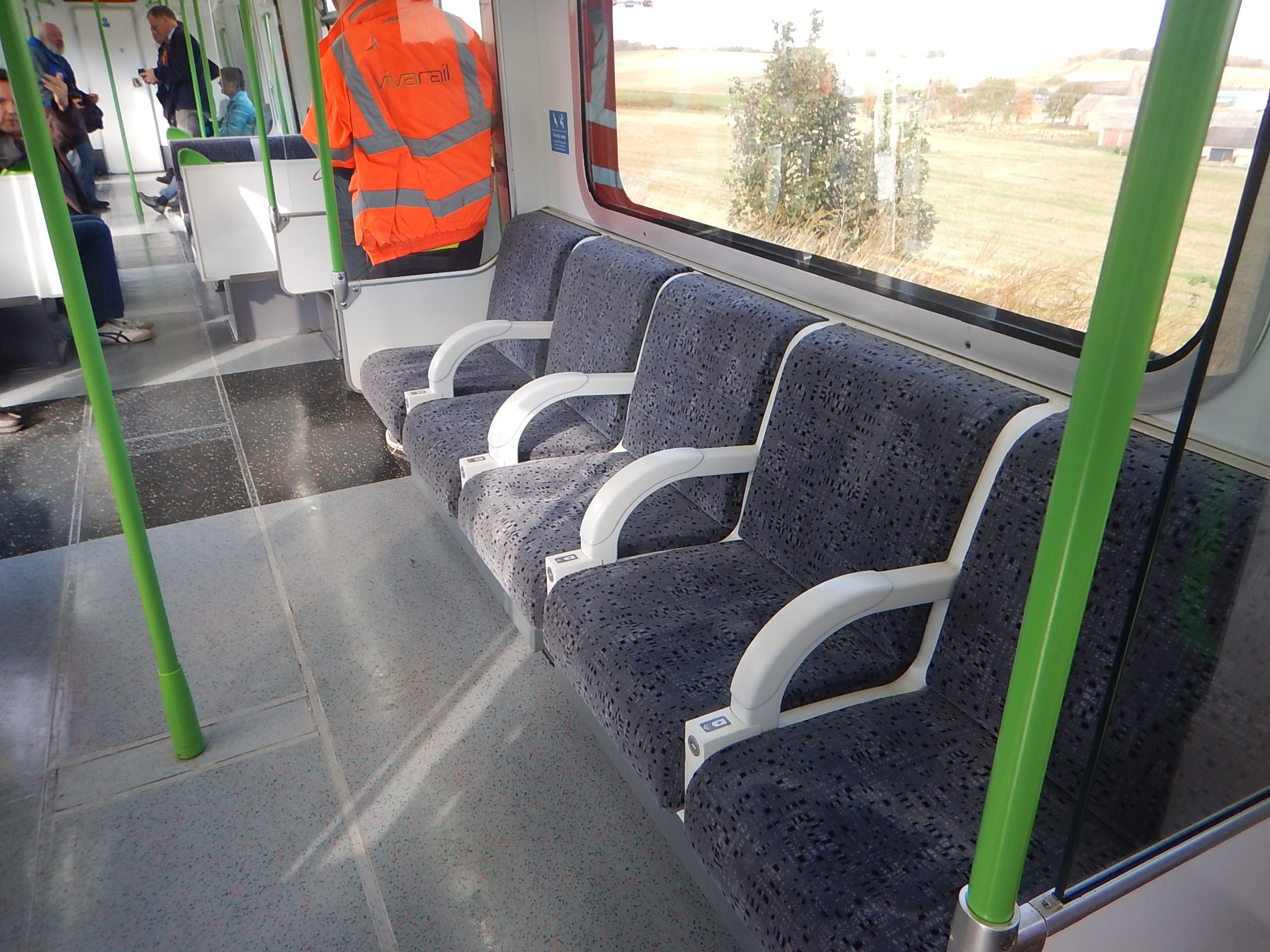
The trains would need to be charged at the end of the route and I suspect that Vivarail’s fast charging system would handle this in the terminal stations.
Class 769 Trains
Class 769 trains are electro-diesel trains, that use their diesel engines, where there is no 25 KVAC overhead electrification.
They are four-car trains with a passenger capacity of over 300 passengers.
They would have a very big advantage for the train operator.
Services across Manchester are often paired to give travellers the chance to do cross-city journeys without changing trains.
Using Class 769 trains would enable more services to be paired up.
Class 399 Tram-Trains
Class 399 tram-trains are under trial in Sheffield and they will also be used on the South Wales Metro.
The terrain in Rossendale involves a hundred metre or so climb from Bury Bolton Street to Rawtenstall. Rochdale is perhaps fifty metres higher than Bury Bolton Street.
Consider a Class 399 tram/train, working between Bury Bolton Street and Rawtenstall stsations.
- Wikipedia gives the weight of the vehicle as 66 tonnes.
- The altitude difference is 120 metres.
- I will assume 200 passengers at 90 Kg. each, which gives a weight of 12 tonnes.
This means that the train has a increase of potential energy of 25 kWh at Rawtenstall station. This would be easily stored in an appropriately-sized traction battery.
It would appear that tram-trains should be able to climb to Rawtenstall, provided they could get to Bury with a full battery.
I look at this in detail in Could A Class 399 Tram-Train With Batteries Go Between Manchester Victoria And Rochdale/Bury Bolton Street/Rawtenstall Stations?
Alstom Breeze Trains
Alston Breeze trains could be a possibility, if hydrogen trains are compatible with steam trains.
The trains would also be able to work across Manchester, as the Class 769 trains will be able to.
Battery-Electric Multiple Units
In Northern’s Battery Plans, I discuss CAF’s proposal to Northern to create battery-electric Class 331 trains.
These could be ideal.
Diesel Multiple Units
Northern have lots of better quality diesel multiple units including Class 156 and Class 170 trains. The company also has around sixty new Class 195 diesel multiple units on order.
These could obviously handle the route, but would it be better to use battery or more capable bi-mode trains on the route?
Diesel Use In Manchester
I suspect too, that train companies, their staff, passengers and all Mancunians would like to see Central Manchester’s railways become a diesel-free zone.
Train Timings
I obviously don’t have accurate figures, but I have a feeling that most of these trains could do a round trip in an hour between Manchester Victoria and Bury Bolton Street stations. The Class 230 trains would probably have time for a fast charge at each end of the route.
My Choice Of Train
It will be Class 230 or Class 769 trains.
Both trains could work the services to Bury Bolton Street station from Manchester Victoria and Rochdale stations.
The Class 769 has two advantages.
- It is the larger train.
- It could use its electric capability to cross Manchester.
Both trains wouldn’t look out of place running a shuttle between Bury Bolton Street and Rawtenstall stations, as they are rebuilt trains from a previous era.
Stations
A few points about the existing stations.
Bury Bolton Street Station
Bury Bolton Street station has four platforms and will be the interchange between the new services and those of the ELR.
The station has a bay platform that faces South East.
With modern signalling, I would expect that it could handle four trains per hour (tph).
Perhaps, these could be two tph from both Manchester Victoria and Rochdale stations.
Heywood Station
This Google Map shows Heywood station.
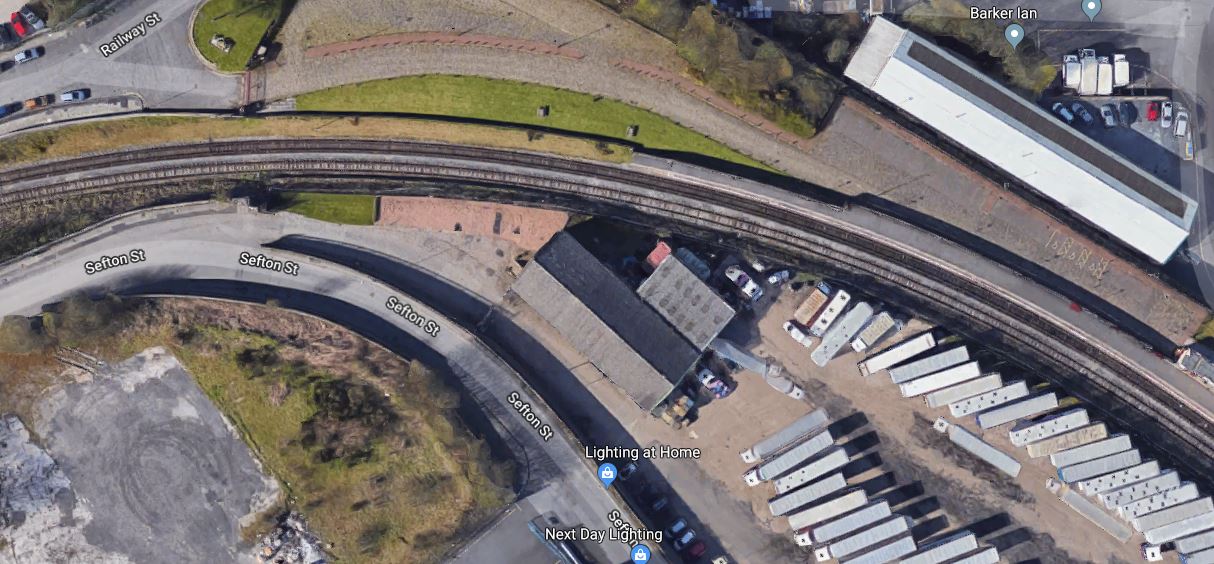
At present it has a long single curved platform.
I suspect to accommodate the new services, which could be four tph in both directions, the station would need a second platform.
Ramsbottom Station
This Google Map shows Ramsbottom station.
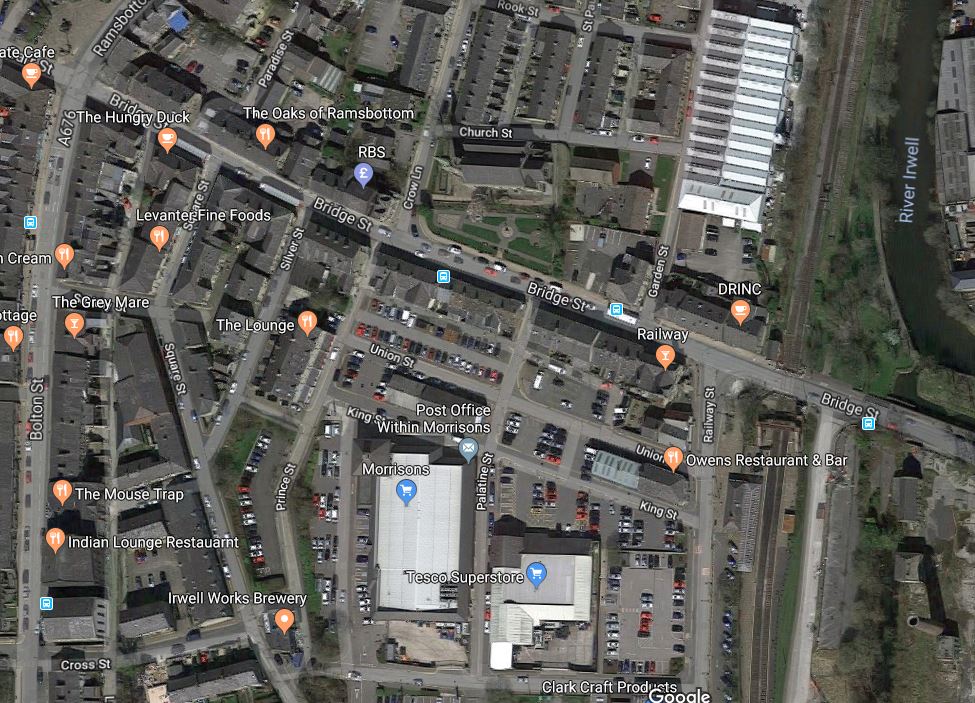
It is a two platform station, which appears to be close to the Town Centre and a Tesco Superstore and a Morrison’s.
Rawtenstall Station
This Google Map shows Rawtenstall station.
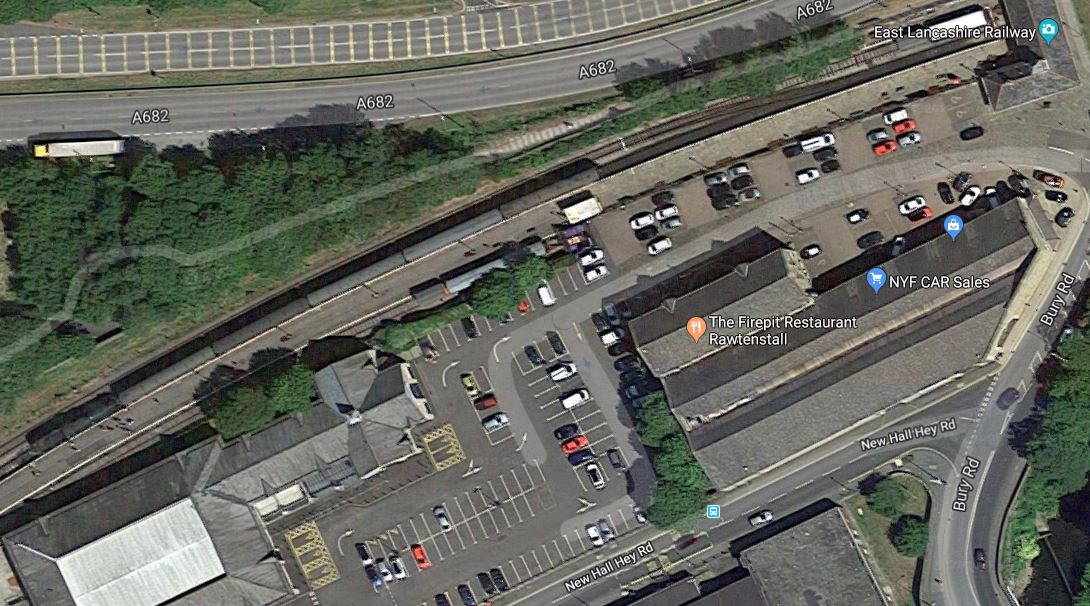
Note, the train in the single platform with a run round loop for a locomotive.
The article says it would be possible to create a second platform at the station.
It would appear that if Class 230 trains were to be used for the proposed.Peak Hour service to Rawtenstall station, then there would be space for installing a fast charger.
Rochdale Station
Rochdale station will be a terminus for services from Bury Bolton Street station.
This paragraph in the Wikipedia entry for Rochdale station describes the new bay platform at the station and how it is used.
In 2015, construction on a fourth railway platform began. It is located at the south end of the main island platform, with the southbound through line having been re-aligned slightly further east to accommodate the new terminating line.
This section of the Calder Valley Line appears to be very busy with a train every four minutes.
I wonder, if by diverting some services to Bury Bolton Street station, this helps ease traffic on the Calder Valley Line.
Could trains do the following triangular route?
- Manchester Victoria
- Heywood
- Bury Bolton Street
- Heywood
- Rochdale
- Manchester Victoria
Train timetablers with much more knowledge than myself, will have fun getting a workable timetable.
New Stations
About half-a-dozen new stations will need to be built.
Most will probably be fairly simple affairs and those North of Bury Bolton Street station could probably by just a single platform.
There is one possibly proposed station, that could be more complicated.
Buckley Wells station could be built where the Bury Line of the Manchester Metrolink and the East Lancashire Line cross by the A56.
Park-and-Ride stations are also suggested in the article at Broadfield, Ewood Bridge, Heap Bridge and Stubbins.
Freight
The article also raises the possibility of running freight trains between the Calder Valley Line and Heywood.
This is said.
,The line could incorporate a rail connection to the 200-acre Heywood Distribution Park, currently served only by road, but adjacent to the existing ELR line. An intermodal rail freight terminal could be provided in the land around the existing distribution park, with sidings at least 500 metres in length needed to accommodate modern freight trains. Conversion into a Strategic Freight Interchange would remove significant numbers of HGVs from the congested strategic road network.
Would the implementation of this plan for freight be popular with the residents of Rossendale?
Conclusion
The proposal is a comprehensive one, which could benefit several groups.
- The residents of Rossendale.
- Vsitors to the area
- Commuters to Manchester
- Travellers across the Pennines
- Travellers to Manchester Airport
- Freight companies.
The proposal needs further investigation to see whether there is a strong business case for implementation.
I also think, that this sort of project model, where a heritage line is integrated with the National Rail network, can be repeated elsewhere in the country.
We have some very well-managed heritage railways in the UK, some of which could be extended to the National Rail network to provide much needed passenger and freight services to new and existing developments and difficult to access towns.
The rules need to be developed, so that these projects can be developed.
Rail Company In Bid To Build Multi-Million-Pound Rail Depot Near Ipswich Station
The title of this post is the same as that of this article on Rail Technology Magazine.
This is the first two paragraphs.
Rail company Freightliner has revealed that it is hoping to build a new multi-million pound depot for its trains just outside Ipswich station.
Freightliner said it wants to build an extensive workshop to maintain its locomotives and wagons, with around 20 new full-time and part-time jobs created to help it carry out the maintenance currently carried out at other depots across the country.
This Google Map shows the current position of Freightliner’s yard at Ipswich station.
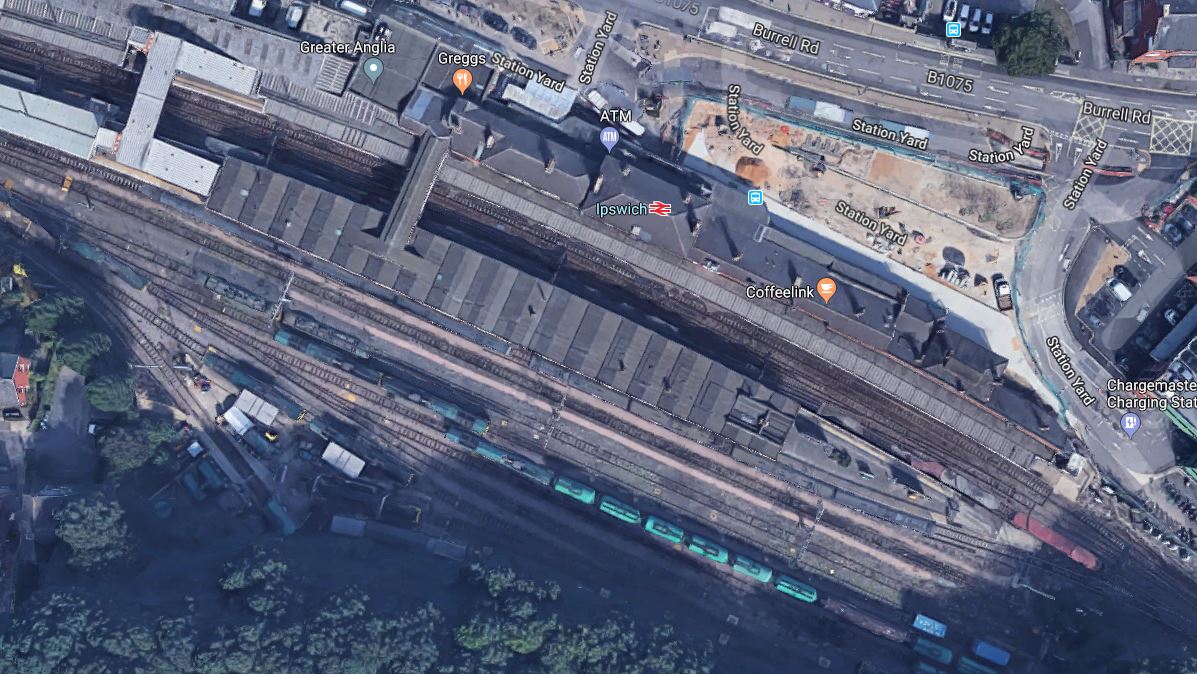
Note the yard tucked in to the South of the station. It looks like fuel is being delivered.
It is not very large and according to the article, its position means that to refuel, locomotives have to cross the Great Eastern Main Line.
Part of the yard could also become the site for additional platforms for Ipswich station.
This article in the Ipswich Star, says this about the position of the new depot.
It wants to build a massive new workshop to maintain its locomotives and wagons on land where there are currently little-used tracks beside Ranelagh Road.
This Google Map shows the position.
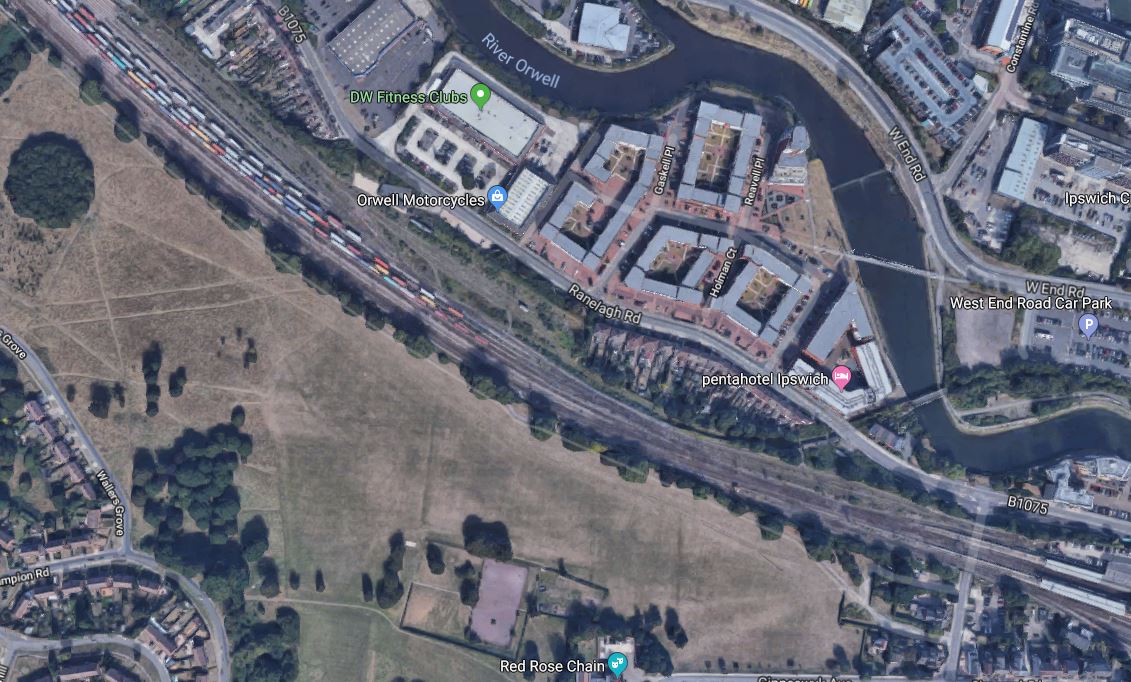
Several freight trains are visible in Ipswich Yard and just to the North are the little-used tracks, mentioned in the Ipswich Star. It looks like this will be the new location of the depot.
The new depot will be well out of the way of Ipswich station, which can just be seen in the bottom-right corner of the map.
As the new depot will create extra jobs and be able to handle wagon repairs, that currently need to go to Manchester or Southampton, it seems that Freightliner’s plan is a good one.
Poetic Return For The Night Train In The Era Of ECommerce
The title of this post is the same as that of a half-page article on Page 34 of the Business Section of today’s copy pf The Times.

As you can see The Times gave it the full treatment with stills from the classic documentary film; The Night Mail, which has a verse commentary written by W. H. Auden.
It’s an idea from the seemingly irrepressible Karl Watts, who is Chief Executive of Rail Operations (UK) Limited.
He plans to start test operations with two Class 769 trains leased from Porterbrook.
I wrote about this concept two years ago, in The Go-Anywhere Express Parcel And Pallet Carrier (HSPT).
The Future Class 93 Locomotive And The Port Of Felixstowe
This is the first paragraph of the Wikipedia entry for the Port of Felixstowe.
The Port of Felixstowe, in Felixstowe, Suffolk is the United Kingdom’s busiest container port, dealing with 42% of Britain’s containerised trade. In 2011, it was ranked as the 35th busiest container port in the world and Europe’s sixth busiest. The port handled 3.74 million twenty-foot equivalent units (TEU) of traffic in 2011.
The sleepy dock of my childhood has become a giant.
Many of the containers going through the port, travel by rail, with upwards of forty trains per day, travelling along the Felixstowe Branch Line, which is mainly single-track and not electrified.
Freight Routes From Felixstowe
There are three main routes for freight trains from Felixstowe to the rest of the country.
Trains from Felixstowe to London take the following route.
- Felixstowe to Ipswich – No electrification – Around an hour.
- Ipswich to London – Electrified and 100 mph line.
Freight trains from Felixstowe to Liverpool, Manchester or Glasgow usually take the following route.
- Felixstowe to Ipswich – No electrification – Around an hour.
- Ipswich to Haughley Junction – Electrified and 100 mph line.
- Haughley Junction to Peterborough – No electrification – Around two hours.
- Peterborough to Werrington Junction – Electrified and 125 mph line.
- Werrington Junction to Nuneaton – No electrification – Just under two hours.
- Nuneaton to Liverpool, Manchester or Glasgow – Electrified and 125 mph line.
Freight trains from Felixstowe to Doncaster, Leeds, Newcastle or Edinburgh usually take the following route.
- Felixstowe to Ipswich – No electrification – Around an hour.
- Ipswich to Haughley Junction – Electrified and 100 mph line.
- Haughley Junction to Peterborough – No electrification – Around two hours.
- Peterborough to Werrington Junction – Electrified and 125 mph line.
- Werrington Junction to Doncaster via Lincoln – No electrification – Around two hours.
- Doncaster to Leeds, Newcastle or Edinburgh – Electrified and 125 mph line.
In most cases they are hauled by a diesel locomotive all the way.
Although in some cases, London trains may change to electric haulage at Ipswich.
An Ideal Freight Locomotive
If you look at these routes, the following should be noted.
- All the electrified sections have an operating speed of 100 mph or more.
- No section without electrification is longer than two hours.
- None of the routes from Felixstowe have any serious gradients.
An ideal locomotive should be able to pull the heaviest freight train in both the following ways.
- Using electric power – At 100 mph on an electrified line, if the operating speed allows.
- Using diesel or hybrid power – For two hours on a line without electrification.
It looks to me that the specification of the Class 93 locomotive fits this specification.
Thoughts On A Battery/Electric Replacement For A Class 66 Locomotive
Many of the long freight routes from Felixstowe and Southampton are hauled by diesel locomotives like the environmentally-unfriendly Class 66 locomotive.
Electric haulage can’t be used because of significant gaps in the 25 KVAC overhead electrification. Gaps and a typical transit time of a Class 66-hauled heavy freight train include.
- Didcot and Birmingham – Around two-and-a-half hours
- Didcot and Coventry – Just under two hours
- Felixstowe and Ipswich – Around an hour
- Haughley Junction and Peterborough – Around two hours
- Southampton and Reading – Around one-and-a-half hours
- Werrington Junction and Doncaster via Lincoln – Around two hours
- Werrington Junction and Nuneaton – Just under two hours
Would it be possible to design a battery/electric hravy locomotive, that could bridge these gaps?
Consider the following.
- A Class 66 locomotive has a power output of around 2500 kW.
- To run for two hours on battery would require a battery of 5000 kWh.
- A 5000 kWh battery would weigh around fifty tonnes. But battery energy densities are getting higher, which would reduce the weight.
- A Class 70 locomotive is a heavy freight diesel Co-Co locomotive with a weight of 134 tonnes with a full tank of diesel.
- A Class 88 locomotive is an electro-diesel locomotive, that without the diesel engine weighs about 80 tonnes.
- A Class 88 locomotive has a power output of 4,000 kW on 25 KVAC overhead electrification
Putting this information together and I think it would be possible to design a battery/electric locomotive with the following specification.
- 4000 kW on 25 KVAC overhead electrification
- Ability to use 750 VDC third-rail electrification
- Ability to change between running on electrification and battery in under a minute and at line speed.
- A 5000 kWh battery.
- Ability to charge the battery, when connected to electrification.
- Ability to use a rapid charging system.
- Two hour range with 2500 kW on battery power.
- Regenerative braking to the battery.
- Co-Co configuration
- Dimensions, weight and axle loading similar to a Class 70 locomotive.
These are a few other thoughts.
Passing Loops With Charging Stations
Passing loops are often provided for freight trains, so that passenger trains can pass a slow freight train. So why not fit these loops with a charging station, so that trains can stop for say twenty minutes to charge or top up the batteries?
Electrification Islands
There are places, where it would be easy to create, what is best described as an electrification island.
I describe electrification islands in The Concept Of Electrification Islands.
Last Mile Applications
Ports and Container Terminals are often without electrification.
The proposed locomotive would be able to work in these environments.
A couple of yeas ago, I had a long talk with a crane operator at the Port of Felixstowe, who I met on a train going to football. He was of the opinion, that Health and Safety is paramount and he would not like 25 KVAC overhead electrification all over the place. Containers do get dropped!
So if freight locomotives used battery power inside the port, most would be pleased.
The only cost for ports and freight terminals would be installing some form of charging.
Maximum Power On Batteries
I suspect that the maximum power on battery would also be the same as the 4,000 kW using 25 KVAC overhead electrification, as the locomotive may have applications, where very heavy trains are moved on partially electrified lines.
Diesel-Free Operation
The proposed locomotive will not use any diesel and will essentially be an electric locomotive, with the ability to use stored onboard power.
Environmentally-Friendly Operation
Freight routes often pass through areas, where heavy diesel locomotives are not appreciated.
- The proposed locomotive will not be emitting any exhaust or noxious gases.
- Noise would be similar to an electric locomotive.
- They would be quieter using battery-power on lines without overhead electrification, as there would be no pantograph noise.
I think on balance, those living by freight routes will welcome the proposed locomotive.
Would Services Be Faster?
This would depend on the route, but consider a heavy freight train going from Felixstowe to Leeds.
- On the electrified East Coast Main Line, the proposed battery-electric locomotive would have a power of 4,000 kW, as opposed to the 2,500 kW of the Class 66 locomotive.
- On sections without electrification, the locomotive would have more power if required, although it would probably be used sparingly.
- The locomotive would have a Driver Assistance System to optimise power use to the train weight and other conditions.
I feel on balance, that services could be faster, as more power could be applied without lots of pollution and noise.
Creeping With Very Heavy Loads
I suspect they would be able to creep with very heavy loads, as does the Class 59 locomotive.
Class 59 Locomotive Replacement
The proposed locomotive may well be able to replace Class 59 locomotives in some applications.
Any Extra Electrification Will Be Greatly Appreciated
Some gaps in electrification are quite long.
For example, Didcot and Birmingham takes about two and a half hours.
- Didcot is on the electrified Great Western Main Line.
- Birmingham has a lot of electrified lines.
So perhaps there could be some extra electrification at both ends of busy freight routes.
Electrification between Didcot and Wolvercote Junction would be a possibility.
- It would be about twelve miles
- It is very busy with heavy freight trains.
- The natives complain about the railway.
- It would allow Great Western Railway to run electric trains to and from London.
- If Chiltern Railways were to run battery-electric trains to Oxford, it would provide electrification for charging at Oxford.
- Electrification could be extended to Oxford Parkway station to make sure battery-electric trains would get a good send-off to Cambridge
This simple example shows, why bi-mode and battery/electric trains don’t mean the end of electrification.
All vehicles; rail or road and especially electric ones, need to take on fuel!
I also think, that there is scope to electrify some passing loops, so that locomotives can top-up en route.
Conclusion
It would be a heavyweight locomotive with a performance to match.
I believe that such a locomotive would be a very useful addition to the UK’s fleet of freight locomotives.
GE To Partner BNSF On Battery Freight Locomotive Tests
The title of this post is the same as that of this article on Rail Engineer.
The article includes this image.
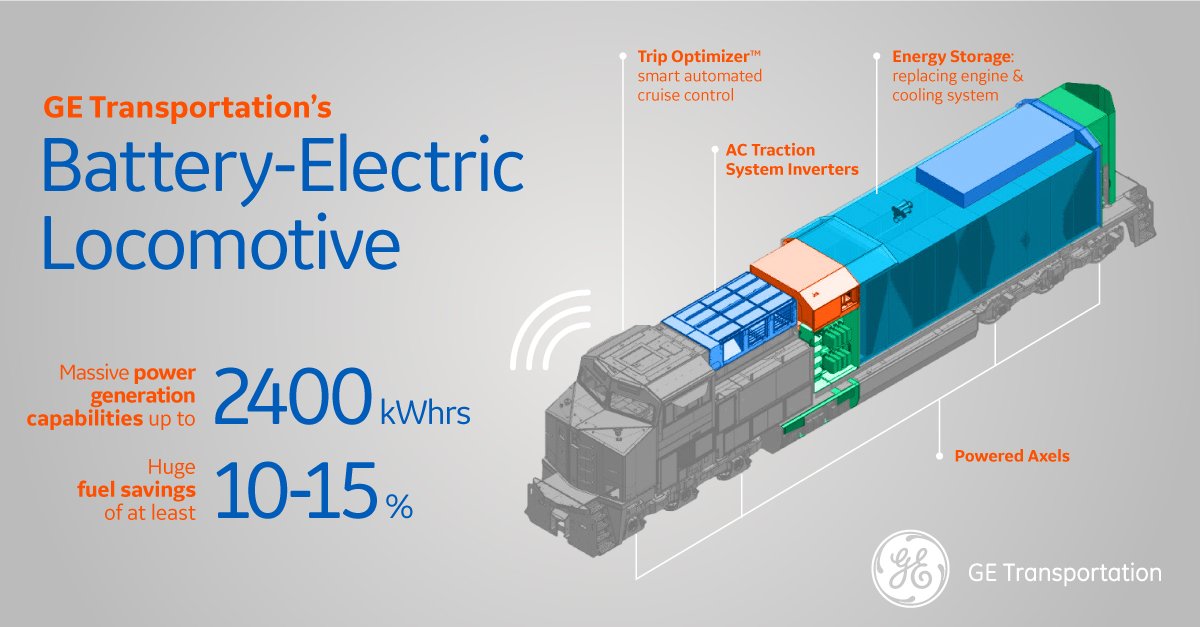
I think that there are some mixed up captions on the image.
It talks about Massive Power Generation Capabilities up to 2400 kWhrs.
kWhrs are a unit of total energy and could refer to the battery storage capability of the locomotive.
If you look at our much smaller ubiquitous UK diesel freight locomotive, the Class 66, this has a power output of 2,460 kW.
If the GE locomotive, which is experimental had a battery of 2400 kWh, then it could supply 2400 kW for an hour.
But the concept seems sound, where the battery electric locomotive would be paired with a diesel locomotive to haul a freight train. Fuel savings of ten percent are expected.
A Diesel/Electric/Battery Hybrid Locomotive For The UK
I could see a practical diesel/electric/battery locomotive being developed for the UK.
A Class 66 Replacement
Over four hundred of the these locomotives were built and they are currently used by these operators in the UK.
- Colas Rail – 5
- DB Cargo UK – 161
- Direct Rail Services – 19
- Freightliner – 127
- GB Railfreight – 88
Which adds up to a surprisingly precise four hundred locomotives.
- They have a power output of 2,460 kW – Call it 2500 kW for ease of calculation.
- They have a top speed of 75 mph, although some can only manage 65 mph.
- They weigh 68 tonnes.
- They are noisy, smelly and don’t meet the latest EU pollution regulations.
- Class 66 drivers, I’ve spoken to, are not keen on the working environment.
But they do various jobs for their operators competently and are not the most expensive of locomotives.
There are also other modern similar-sized diesel locomotives like the thirty Class 67 and thirty-seven Class 70, but these are not as unfriendly, to the environment and staff.
Many of the Class 66 locomotives pull heavy freight trains on routes that are fully or partly electrified like the East Coast Main Line, West Coast Main Line, Great Western Main Line, Midland Main Line and Great Eastern Main Line. The services are diesel-hauled because at the ends of the route, they need to use diesel power.
A specification for a locomotive to replace the long-haul Class 66 locomotives for working fully or partly-electrified routes could be something like.
- Power on electrification of upwards of 3000 kW.
- Ability to move a heavy freight train in and out freight terminals to and from electrification.
- Ability to do a small amount of shunting.
- Sufficient diesel or battery power to handle the train, away from electrification.
- Ability to switch between electric and diesel/battery power at line speed.
I’ve heard from those who work at the Port of Felixstowe, that port operators wouldn’t electrify the port, for both cost and Health and Safety reasons.
The Felixstowe Problem
The Port of Felixstowe is at the end of the twelve mile long Felixstowe Branch Line, which is not electrified.
Trains seem to be allocated up to just over an hour for the journey between the Great Eastern Main Line and the Port.
This would mean that any proposed locomotive must be capable of handling a branch line to a port or freight depot remote from the electrified network.
Similar problems exist at other ports and freight depots including Hull, Immingham, Liverpool, Southampton, Tilbury and Teesport.
The Southampton Problem
If anything, the Port of Southampton has the worst problem, in that it only has access to the third-rail electrification South of the Thames, until freight trains reach Reading, where there is 25 KVAC overhead electrification. It looks like that trains take about ninety minutes between the Port of Southampton and Reading.
Even, if a powerful dual-voltage locomotive were to be available, I doubt that the power supply to the electrification could provide enough power.
The proposed solution to the Southampton problem was the Electric Spine, which would have linked the port to Northern and Central England with a 25 KVAC overhead electrified route.
It has now been largely cancelled.
An alternative would be a locomotive, that could pull a heavy freight train between the Port of Southampton and Reading in an environmentally-friendly way.
One point to note is that a Class 92 locomotive is rated at 4000 kW on 750 VDC third-rail electrification.
Thoughts On A Battery Locomotive
Suppose an operator needed a battery locomotive to go between Southampton and Cardiff, that would be a straight replacement for a Class 66 locomotive.
The proposed battery locomotive would need to be able to supply the 2500 kW of the Class 66 locomotive for two hours to handle the route between Reading and Southampton.
So it would need a battery capacity of around 5000 kWh, which is twice the size of the American test locomotive. A battery this size would probably weigh around fifty tonnes.
I am probably being conservative here, as regenerative braking would probably reduce the amount of energy needed to move the train.
The electro-diesel Class 88 locomotive would probably weigh around eighty tonnes without the diesel engine. So would it be possible to design an electric locomotive incorporating a 5000 kWh battery, with a weight of perhaps one hundred and thirty tonnes.
- It would be about the weight of a Class 70 locomotive.
- It would probably need to be a Co-Co locomotive, to reduce the axle-loading, to that of a Class 70 locomotive.
- It might need to be longer than other comparable locomotives to have enough space for the battery.
- The battery would handle the energy generated by the regenerative braking.
- It could have the 4000 kW power of a Class 88 locomotive.
- It should probably be designed with a 100 mph top speed and the ability to haul passenger trains
- It would be able to use both 25 KVAC overhead and 750 VDC third-rail electrification.
If it is not possible now, as battery energy densities improve, it will be in a few years time.
Other countries other than the UK need a locomotive with a similar specification and I am certain at least one manufacturer in Europe will build a locomotive to this or a similar specification.
A Battery/Electric Locomotive And Felixstowe
Handling the Felixstowe Branch Line would entail the following.
- The locomotive must enter the branch with a battery containing enough energy for the sixty minute run to the Port.
- As the locomotive would probably have hauled a train from London or Haughley Junction using the existing electrification, a full enough battery probably wouldn’t be difficult.
- In the Port, there could be a charging station for the locomotive, where they would connect to a short length of 25 KVAC overhead electrification.
- On leaving the Port, the locomotive would start with a full battery, which would be enough power to reach the Great Eastern Main Line.
- Trains going South to London would run on electrification as far as they could and would arrive in London with a full battery.
- Trains going West to Peterborough, would hopefully be able to top up their battery between Ipswich and Haughley Junction, where they would enter the section without electrification to Peterborough, which takes between two and two-and-a half hours.
It should be noted that, freight trains often wait at Ely in a passing loop alongside the station, to keep out of the way of passenger trains. As Ely is electrified with 25 KVAC, this loop could be electrified, so that locomotives could sneak a top-up during the wait.
I am fairly certain, that a 4000 kW electric locomotive fitted with a 5000 kWh battery could handle all freight services to and from the Port of Felixstowe, at least as far as London and Peterborough.
A Battery/Electric Locomotive Between Peterborough And Nuneaton
How would a battery/electric locomotive handle this important route between Felixstowe and the Midlands and North?
Currently freight trains between Peterborough and Nuneaton have a timing on the section without electrification between Werrington Junction and Nuneaton of a few minutes under two hours.
This should be possible, given the battery range and power of the locomotive.
It would also mean that the battery/electric locomotive could haul a train between the West Coast Main Line and Felixstowe.
A Battery/Electric Locomotive And Southampton
Trains hauled by a battery/electric locomotive on this route, could probably take advantage of the third-rail electrification to top-up the battery as required, which would make it very likely that a 4000 kW electric locomotive fitted with a 5000 kWh battery could handle the route with ease.
A Battery/Electric Locomotive Between ReadingAnd The Midlands And The North
From Reading routes to Bristol, Cardiff and London are fairly easy, but the problems start, if trains need to go to Oxford, Birmingham or the Midlands and the North.
This is where the Electric Spine would have been useful
I have traced some trains from Southampton to the Midlands and the North.
- Southampton to Birch Coppice – There is a three hour section without electrification from Didcot to Birch Coppice.
- Southampton to Birmingham Freightliner Terminal – There is a two-and-a half hour section without electrification from Didcot to the terminal.
- Southampton to Castle Bromwich Jagiuar – There is a two-and-a-half-hour section without electrification from Didcot to Castle Bromwich Jaguar.
- Southampton to Liverpool – There is a two hour section without electrification from Didcot to Coventry.
All of these services are routed through Didcot, Oxford and Banbury. Extending the planned electrification between Didcot and Oxford to Banbury would probably reduce the amount of time on battery power by around thirty minutes.
TransPennine Passenger Services
TransPennine Express will soon be running services between Liverpool Lime Street and Newcastle using rakes of Mark 5 coaches, that will be hauled by a Class 68 diesel locomotive, which has a power of 2800 kW and a maximum speed of 100 mph.
On the TransPennine route, the current service takes seventy-one minutes between the electrified stations of Manchester Victoria and York.
The proposed battery/electric locomotive could handle this with ease to provide a flagship electrically-hauled service across the Pennines without any difficult electrification.
The locomotive would be charged on the current electrification between Liverpool and Manchester Victoria and along the East Coast Main Line.
Chiltern Main Line Passenger Services
Chiltern Main Line passenger services between London Marylebone and Birmingham, are another route, where a rake of coaches are hauled by a Class 68 locomotive.
The problem is that there is no electrification on this route and although a charging station could be provided at Marylebone and Moor Street, it is questionable, if enough power could be taken on during turnround.
But I said earlier, that to ease the passage of freight from Soiuthampton to the Midlands, that Didcot to Banbury should be electrified.
So could this electrification be continued all the way to Birmingham?
This would mean that the battery/electric locomotives would only need to be able to handle the hour-long journey to and from Marylebone, which would have 25 KVAC electrication over the platforms to top up the battery.
The solution is not as easy as TransPennine, but Chiltern Main Line to Birmingham would become an electric service.
The Stadler Class 88 Battery/Electric Locomotive
As Stadler seem to have a monopoly of new locomotives in the UK at present, I will look at their proven Class 88 locomotive.
- It has a power of 4,000 kW on electricity.
- It has a power of 700 kW using an onboard diesel.
- It has a top speed of 100 mph.
- The Caterpillar C27 diesel engine weighs around seven tonnes.
- The locomotive has regenerative braking.
The locomotive is certainly no weakling on electricity, although performance, when pulling a heavy freight train on diesel might be desired to be better. This article on Rail Magazine is entitled Inside Direct Rail Services. This is an extract about the pulling ability of the Class 88 locomotive.
Sample performances over the northern section of the West Coast Main Line (Preston –Carlisle–Mossend) demonstrate that Class 88 can operate the same train weight to the same schedule as Class 68 using 15% less energy. Alternatively, it offers a 45-minute time advantage over a ‘68’ and 80 minutes for Class 66. This gives a competitive edge because a significant proportion of movement costs are absorbed by fuel.
When hauling the maximum permitted load of 1,536 tonnes on the 1 in 75 banks on this route, Class 88 has a balancing speed of 34mph in electric mode or 5mph in diesel mode. Taken together, all these factors helped Class 88 win the Rail Freight Group ‘Rail Freight Project of the Year’ Award in the Innovation and Technical Development category this year.
The locomotive doesn’t appear to be a wimp.
But could the Class 88 locomotive be fitted with a battery?
Current energy storage technology seems to be able to store about 100Wh/kg. So on this basis a seven tonne battery would store about 700 kWh.
I think in a few years it would be possible to build a version of a Class 88 locomotive with no diesel engine and a battery with a 1000 kWh capacity.
But even so, the 1000 kWh battery may be too small.
Would it be able to handle these important routes with a full-length freight train?
- Haughley Junction to Peterborough
- Peterborough to Doncaster via Lincoln
- Peterborough to Nuneaton.
- Southampton to Reading
- Immingham to Doncaster
However, Stadler and Direct Rail Services will be able to extensively model the performance of a battery/electric Class 88 locomotive pulling various weights of freight train on different routes in the UK.
The modelling would show how much battery capacity would be needed for various routes.
Suppose though the battery capacity needed was say 2400 kWh, as I suspect has been specified by the Americans for their locomotive. This would be too heavy and large for the small Class 88 locomotive
But just as the Americans are using their battery/electric locomotive in combination with a diesel locomotive, why not run the battery-electric Class 88 locomotive as a pair with a standard electro-diesel Class 88 locomotive?
TransPennine Passenger Services With A Class 88 Battery/Electric Locomotive
Currently electrification is planned or very likely on the Liverpool to Newcastle route between.
- Manchester Victoria and Stalybridge
- Leeds and Colton Junction on the East Coast Main Line.
This would mean that only around forty minutes of the entire Liverpool to Newcastle route would be without electrification.
Would a battery/electric locomotive with a 1000 kWh battery be able to bridge the gap in the wires between Stalybridge and Leeds?
The battery would be fully charged, at both Stalybridge and Leeds, as the locomotive would have been running under the wires for some time.
It is a very interesting and in my view, a totally feasible possibility.
Conclusion
My modelling experience says that there is at least one solution in there.
- A new build battery/electric locomotive could be designed.
- A battery/electric version of the Class 88 locomotive must be possible and it could work alone or with the current electro-diesel Class 88 locomotive.
I am sure that Jo Johnson’s dream of removing diesel from UK railways will take a big step forward in the next decade, when a battery/electric locomotive with sufficient performance becomes available.
I also believe that short lengths of electrification like Oxford to Banbury, may usefully increase the range of an electric/battery locomotive.
 The Anonymous Widower