Lützerath: German Coal Mine Stand Off Amid Ukraine War Energy Crunch
The title of this post, is the same as that on this article on the BBC.
This is the sub-heading.
From her tiny wooden treehouse, which sways precariously in the winter wind, a young woman watches an enormous mechanical digger tear into the earth below, its jaws edging ever closer to the village which she’s determined to save.
And these two paragraphs outline the protest.
Lützerath, in western Germany, is on the verge – literally – of being swallowed up by the massive coal mine on its doorstep.
Around 200 climate change activists, who are now all that stand in the way of the diggers expanding the Garzweiler opencast mine, have been warned that if they don’t leave by Tuesday they’ll be forcibly evicted.
But this is not about coal or bituminous coal, as we know it in the UK, this mine will produce lignite or brown coal.
Read both Wikipedia entries linked to the previous sentence and you find some choice phrases.
For bituminous coal.
- Within the coal mining industry, this type of coal is known for releasing the largest amounts of firedamp, a dangerous mixture of gases that can cause underground explosions.
- Extraction of bituminous coal demands the highest safety procedures involving attentive gas monitoring, good ventilation and vigilant site management.
- The leading producer is China, with India and the United States a distant second and third.
For lignite.
- It has a carbon content around 25–35%. and is considered the lowest rank of coal due to its relatively low heat content.
- When removed from the ground, it contains a very high amount of moisture which partially explains its low carbon content.
- The combustion of lignite produces less heat for the amount of carbon dioxide and sulfur released than other ranks of coal. As a result, environmental advocates have characterized lignite as the most harmful coal to human health.
- Depending on the source, various toxic heavy metals, including naturally occurring radioactive materials may be present in lignite which are left over in the coal fly ash produced from its combustion, further increasing health risks.
- Lignite’s high moisture content and susceptibility to spontaneous combustion can cause problems in transportation and storage.
I don’t think, that we’ve ever burned lignite in the UK for electricity, as it is just too filthy.
This map shows the mine.

Note.
- The autobahn at the West of the map, is a six-land highway, so gives an idea of the scale.
- The village of Lützerath is towards the bottom of the map in the middle.
- What has been left after the mining, is going to take a lot of restoration.
It almost appears that some of the scenes of devastation, we are seeing in the Ukraine are also happening in Germany due to the frantic search for energy.
A 1960s-Educated Engineer’s Attitude To Coal
I was one of about four-hundred engineers in my year at Liverpool University in the 1960s.
- Quite a few of those engineers were from coal-mining areas and some were children of miners.
- I remember the graduate recruitment fair at the University in 1968, where the representative from the National Coal Board sat there alone, as if he’d got the 1960s version of Covid-19.
- Some went and talked to him, as they felt sorry for him.
- As far as I know, not one of us, went to work for the National Coal Board.
Engineers and other graduates of the 1960s, didn’t feel that coal was the future.
Had Aberfan and the other pit disasters of the era killed coal as a career, amongst my generation of the UK population?
What Should The Germans Do?
It is my view that whatever the Germans do, burning brown coal, should not be on the list. It’s just too polluting.
This article on euronews is entitled Germany And Poland Have A Dirty Big Secret – An Addiction To Brown Coal.
A few years ago, I was in Katowice on Poland and I have never seen such pollution in Europe, since the smogs of the 1950s.
The euronews article says this.
In eastern Germany some members of a little-known group claim they are being ethnically cleansed, not by militia groups, but by the coal mining industry.
Bulldozers have so far destroyed over 130 Sorb villages to make way for the mining of Europe’s dirtiest kind of fossil fuel – brown coal, or lignite as it is also known.
Brown coal mines are open cast and devour vast tracts of land. As well as whole villages farming and wildlife are destroyed.
The Penk family live in the village of Rohne. They feel their whole culture is also being destroyed.
Note that the Sorbs have a Wikipedia entry, which says there are 60,000 Sorbs in Germany.
One thing the Germans are doing is investing in the UK renewable energy industry.
- RWE own or part-own over 7 GW of offshore wind farms in the UK, some of which are under development.
- enBW and BP are developing 3 GW of offshore wind farms in the UK.
- Over twenty offshore wind farms use Siemens Gamesa turbines.
- The NeuConnect interconnector is being built between the Isle of Grain and Wilhelmshaven.
Would it not be better for the physical and mental health of German citizens, if they abandoned their dirty love of brown coal and spent the money in the North Sea?
Brown Seaweed Could Remove 550 Million Tons Of Carbon
The title of this post, is the same as that of this article on the Carbon Herald.
This may seem like a story that has arrived a few months early.
But the report does come from the respect Max Planck Institute for Marine Microbiology.
The research is detailed on this page on their web site, which is entitled Slime For The Climate, Delivered By Brown Algae.
It is introduced by this sub-heading.
In form of fucoidan, brown algae could remove up to 550 million tons of carbon dioxide from the atmosphere every year.
Which is followed by this paragraph.
Brown algae take up large amounts of carbon dioxide from the air and release parts of the carbon contained therein back into the environment in mucous form. This mucus is hard to break down for other ocean inhabitants, thus the carbon is removed from the atmosphere for a long time, as researchers at the Max Planck Institute for Marine Microbiology in Bremen now show. They reveal that the algal mucus called fucoidan is particularly responsible for this carbon removal and estimate that brown algae could thus remove up to 550 million tons of carbon dioxide from the air every year – almost the amount of Germany’s entire annual greenhouse gas emissions.
Note that fucoidan has a Wikipedia entry.
The page says this about brown algae.
Brown algae are true wonder plants when it comes to absorbing carbon dioxide from the air.
It does seem to me that the Germans are on to something.
Stadler Presents Mock-Up Of Tram-Trains For German And Austrian Operators
The title of this post, is the same as that of this article on Railway Gazette.
This is the first paragraph.
A mock-up of the Citylink tram-trains that Stadler is to supply to operators in Karlsruhe, Saarbrücken, Neckar-Alb, Oberösterreich and Salzburg was unveiled at the Betriebshof West depot in Karlsruhe on December 13.
This is the most interesting paragraph.
‘Maximum standardisation and the fact that the order was shared between different operating companies reduces the costs by to up to €1m per vehicle’, said Karlsruhe Mayor Frank Mentrup at the unveiling ceremony.
It shows the value of standardisation and large orders.
Gasunie Investigates Hydrogen Network In North Sea
The title of this post, is the same as that of this news article on the Gasunie web site.
Denny Bros Completes Solar Scheme At Bury St Edmunds Factory
The title of this post, is the same as that of this article on the East Anglian Daily Times.
This is the sub-title.
An energy-hungry manufacturer has completed a huge £0.5m solar array across its roofs – which on a good day can power the whole operation and more.
This Google Map from a few months ago, shows the incomplete array.
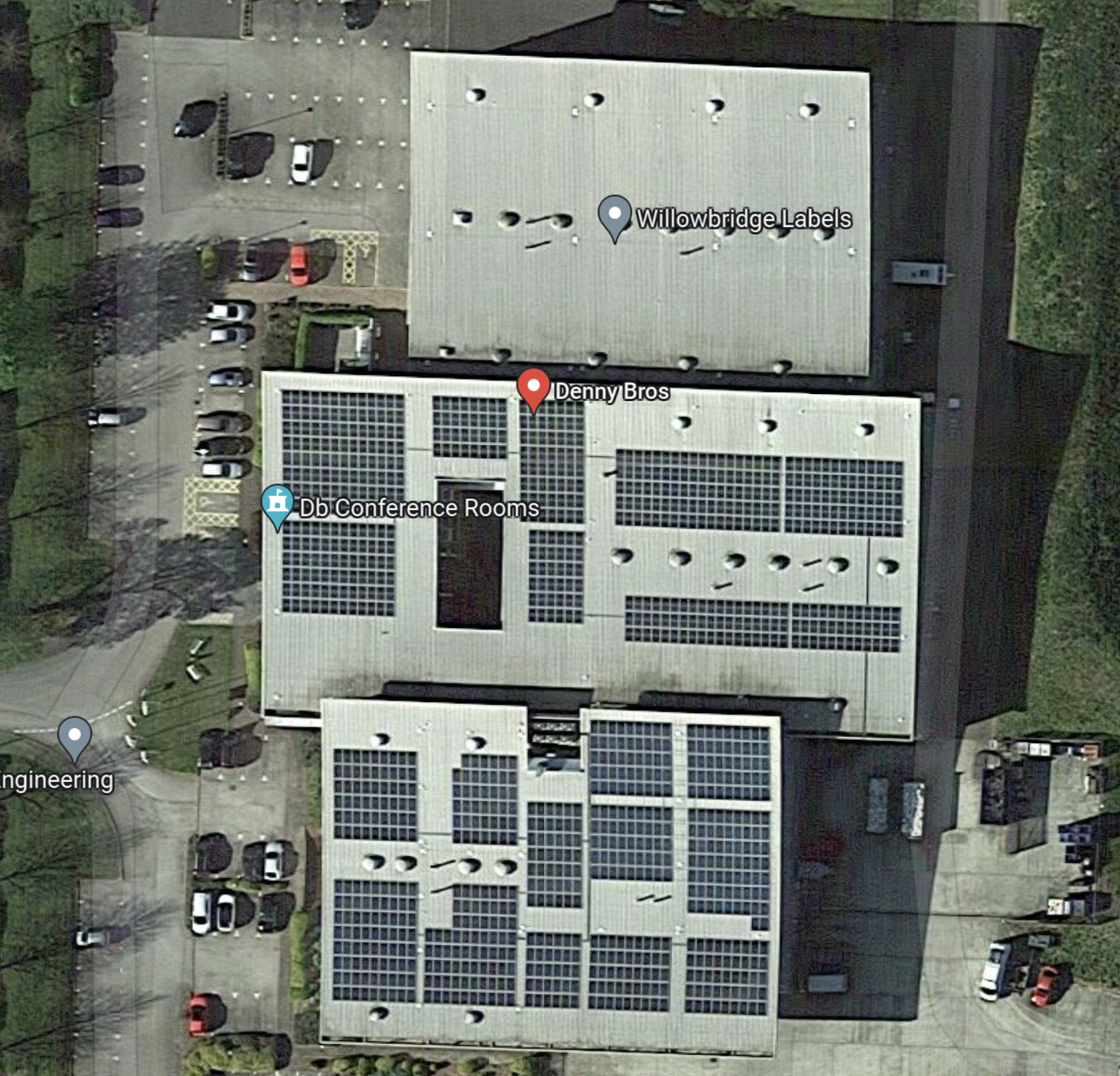
A more recent picture in the article, shows the top building with solar panels on the roof.
According to another report in the East Anglian Daily Times, the company turns over about eight millions.
As Denny Brothers appears to be a well-run company, that is partly employee-owned, the numbers must add up.
Incidentally, the article was displayed with two adverts; one for a solar panel company and the other for the well-known employee-owned company; John Lewis.
I suppose that’s the way the cookie rumbles!
I certainly don’t regret installing solar panels on my flat roof!
What About A Couple Of Wind Turbines?
I ask this question, as some MPs want to allow more onshore wind, providing the natives don’t mind.
I wrote about onshore wind in Chancellor Confirms England Onshore Wind Planning Reform and I think that in the right place they are acceptable.
I know the Government has changed since September, but if you look at the Google Map above, I suspect a couple of turbines could be squeezed in and they probably would be in Germany.
Dogger Bank – The Joke That Is Growing Up To Be A Wind Powerhouse
The Wikipedia entry for the Dogger Bank, describes it like this.
Dogger Bank is a large sandbank in a shallow area of the North Sea about 100 kilometres (62 mi) off the east coast of England.
But many of my generation remember it from its use in the Shipping Forecast and as a joke place like the Balls Pond Road, Knotty Ash and East Cheam, in radio and TV comedy from the 1950s and 1960s.
But now it is being turned into one of the largest wind powerhouses!
According to Wikipedia’s list of the UK’s offshore wind farms, these wind farms are being developed on the Dogger Bank.
- Sofia Offshore Wind Farm – 1400 MW – Under Construction – Commissioning in 2023/26 – £39.65/MWh – RWE
- Dogger Bank A – 1235 MW – Under Construction – Commissioning in 2023/24 – £39.65/MWh – SSE/Equinor
- Dogger Bank B – 1235 MW – Pre-Construction – Commissioning in 2024/25 – £41.61/MWh – SSE/Equinor
- Dogger Bank C – 1218 MW – Pre-Construction – Commissioning in 2024/25 – £41.61/MWh – SSE/Equinor
- Dogger Bank D – 1320 MW – Early Planning – SSE/Equinor
- Dogger Bank South – 3000 MW – Early Planning – RWE
Note.
- These total up to 9408 MW.
- The Dogger Bank wind farms have their own web site.
- The Sofia offshore wind farm has its own web site.
- The Dogger Bank South wind farms have their own web site.
- Dogger Bank A and Dogger Bank B will connect to the National Grid at Creyke Beck to the North of Hull.
- Sofia and Dogger Bank C will connect to the National Grid at Lazenby on Teesside.
But this is only the start on the British section of the Dogger Bank.
This map, which comes courtesy of Energy Network Magazine and 4C Offshore is entitled 2001 UK Offshore Windfarm Map shows all UK offshore wind farms and their status. It looks to my naive mind, that there could be space for more wind farms to the North and West of the cluster of Digger Bank wind farms.
The North Sea Wind Power Hub
The UK doesn’t have full territorial rights to the Dogger Bank we share the bank with the Danes, Dutch and Germans.
In the Wikipedia entry for the Dogger Bank wind farm, this is said about the North Sea Wind Power Hub.
Dutch, German, and Danish electrical grid operators are cooperating in a project to build a North Sea Wind Power Hub complex on one or more artificial islands to be constructed on Dogger Bank as part of a European system for sustainable electricity. The power hub would interconnect the three national power grids with each other and with the Dogger Bank Wind Farm.
A study commissioned by Dutch electrical grid operator TenneT reported in February 2017 that as much as 110 gigawatts of wind energy generating capacity could ultimately be developed at the Dogger Bank location.
Note.
- 110 GW shared equally would be 27.5 GW.
- As we already have 9.4 GW of wind power, under construction or in planning around the Dogger Bank, could we find space for the other 18.1 GW?
- I suspect we could squeeze it in.
If we can and the Danes, Dutch and Germans can generate their share, the four countries would each have a 27.5 GW wind farm.
What would put the icing on the cake, would be if there could be a massive battery on the Dogger Bank. It wouldn’t be possible now and many would consider it a joke. But who knows what the capacity of an underwater battery based on concrete, steel, seawater and masses of ingenuity will be in a few years time.
Where Does Norway Fit In To The North Sea Wind Power Hub?
It could be argued that Norway could also connect to the North Sea Wind Power Hub.
- 110 GW shared equally would be 22 GW.
- Norway can build massive pumped storage hydroelectric power stations close to the landfall of an interconnector to the North Sea Wind Power Hub.
- the British, Danes, Dutch and Germans can’t do that, as they don’t have any handy mountains.
- Norway is a richer country the others involved in the project.
I can see Norway signing up to the North Sea Wind Power Hub.
The North Sea Link
The Wikipedia entry for the North Sea Link, introduces it like this.
The North Sea Link is a 1,400 MW high-voltage direct current submarine power cable between Norway and the United Kingdom.
At 720 km (450 mi) it is the longest subsea interconnector in the world. The cable became operational on 1 October 2021.
It runs between Kvilldal in Norway and Blyth in Northumberland.
I wouldn’t be surprised to see that the North Sea Link is modified, so that it has a connection to the North Sea Wind Power Hub.
German Startup EVIA AERO Commits To Hydrogen-Powered Britten-Norman Islanders
The title of this post, is the same as that of this article on Simple Flying.
These two paragraphs outline the deal.
EVIA AERO has signed a letter of intent with Cranfield Aerospace Solutions (CAeS) to increase its order for hydrogen modification kits and aircraft. As part of the agreement, the startup airline expects to receive five additional hydrogen modification kits and ten 19-seat aircraft.
The hydrogen modification kits are designed to power the nine-seat Britten-Norman Islander aircraft and come in addition to a previous order with CAeS for 10 kits.
I can remember seeing the Islander prototype at a Farnborough Air Show in the mid-1960s on the BBC with commentary from the iconic Raymond Baxter.
BP To Open Offshore Wind Office In Germany, Starts Recruitment Drive
The title of this post, is the same as that of this article on offshoreWIND.biz.
This is the first paragraph, which adds a bit more information.
Global energy major bp plans to open an office in Hamburg, Germany dedicated to the development of offshore wind projects and is in the process of seeking employees for the new office.
These are other points from the article.
- The topic of wind power is being promoted particularly in Hamburg.
- BP said that the company has already achieved a number of milestones in the field of wind energy.
- In cooperation with EnBW, bp is currently developing several wind farms in the Irish and Scottish Seas.
- Similar plans already exist for the Netherlands.
- The energy major would also like to supply charging stations for electric vehicles with green electricity.
- In Germany, wind and solar energy should account for 80 per cent of electricity generation by 2030, compared to today’s 42 per cent.
- Offshore wind energy is planned to grow seven times by 2045.
I believe that BP’s project expertise and management, backed by billions of German euros could be a complimentary dream team.
RWE Looking for Innovators To Boost UK’s Offshore Wind Supply Chain
The title of this post, is the same as that of this article on offshoreWIND.biz.
RWE appear to be looking for innovators in three areas.
- Autonomous solutions and the best way to integrate them into wind farm site investigations, construction, and operations and maintenance (O&M) is the first challenge for which RWE is looking for responses.
- The second challenge is about solutions to measure and reduce the environmental impacts of offshore wind farm construction and operations on birds.
- The last challenge focuses on ideas and innovations in cable monitoring and protection, aiming to secure a reduction in offshore wind farm cable failures.
As sums of around £25,000 are talked about in the article, it could be worth applying, if you have a relevant idea.
Is it slightly flattering to the UK’s skills, that a German company is backing British innovation?
But then I was involved in a British invention, which was also backed by the Germans and made me a reasonable amount of money.
National Grid’s North Sea Link Strengthens Electricity Supply And Repays Its Carbon Cost In Just Six Months
The title of this post, is the same as that of this press release from National Grid.
These are three bullet points from the press release.
- World’s longest subsea electricity cable has been in operation since Oct 2021.
- 5.7 terawatt (TWh) hours of clean power have been shared between GB and Norway, strengthening security of supply for consumers in both countries.
- It has saved 800,000 tonnes of carbon in the first year, paying off its carbon cost after only six months of operation.
This must surely be considered a good start.
These two paragraphs describe the operation in the first year.
During its first year of operation, the link has imported 4.6 TWh of clean electricity – enough to power 1.5 million British homes for a year.
North Sea Link has also exported 1.1 TWh to Norway, demonstrating the vital role that interconnectors play in strengthening energy security and maximising the benefits of clean energy sources for consumers across the UK and Europe.
In The Monster In The Mountains That Could Save Europe’s Winter, I describe what makes the North Sea Link so important.
It gives the UK access to the Norwegian Bank Of Electricity or Ulla-Førre, which is a complex of five hydroelectric power stations and a massive lake in the Norwegian mountains to the East of Stavanger.
- The power stations have a total generating capacity of 2.1 GW.
- Lake Blåsjø is able to hold enough water to generate 7800 GWh of electricity.
- Ulla-Førre can also supply electricity to Germany, through the 1.4 GW NordLink.
If Ulla-Førre has a problem, it is that if Norwegian weather is dry, the filling of Lake Blåsjø could be difficult, which is where the interconnector comes into its own, as excess UK wind power or the 1,185 MW Hartlepool nuclear power station, can be used to send electricity to Norway for storage.
In An Update To Will We Run Out Of Power This Winter?, I predicted we will add the following capacity to our renewable generation in the next three years.
- 2023 – 2925 MW
- 3024 – 3726 MW
- 2025 – 6476 MW
This is a total of 13,127 MW.
As a Control Engineer, I can see the following happening.
- Several of the UK’s gas-fired power stations will be mothballed.
- Some of the UK’s gas-fired power stations will be fitted with advanced control systems so they can supply more precise amounts of electricity.
- Some UK electricity is stored in Ulla-Førre for onward sale to Germany.
- Some UK electricity is stored in Ulla-Førre for withdrawal back to the UK, when needed.
One of Ulla-Førre’s main tasks could be to ensure that no UK electricity is wasted.
Conclusion
With all these wind generated electricity and electricity transfers, the Crown Estate, National Grid and the Treasury should be coining it.
The Germans are already building the 1.4 GW NeuConnect between the Isle of Grain and Wilhelmshaven to import more electricity.
But I do believe that another interconnector will be needed.
 The Anonymous Widower