Europe Installs Record-Breaking 4.2 GW Of Offshore Wind In 2023
The title of this post, is the same as that of this article on offshoreWIND.biz.
This is the sub-heading.
Europe’s offshore wind industry brought online a record 4.2 GW of new capacity in 2023 and is expected to build around 5 GW of offshore wind annually over the next three years, according to WindEurope data. However, this is still not enough to meet the continent’s 2030 climate and energy security targets, WindEurope added.
These are the first two paragraphs.
The overall offshore wind capacity installed in 2023 was 40 per cent higher than in 2022. Of the 4.2 GW of new capacity, 3 GW was in the EU, an increase of 2.1 GW year on year, WindEurope said.
The Netherlands, France, and the UK installed the most new capacity, including the 1.5 GW Hollandse Kust Zuid offshore wind project in the Netherlands, according to the organisation.
But where are the Germans?
They’ve got plenty of steel and sea, Siemens make a lot of wind turbines and they certainly need the electricity.
In 2023, Germany generated their electricity as follows.
- Brown coal (17.7%)
- Hard coal (8.3%)
- Natural gas (10.5%)
- Wind (32.0%)
- Solar (12.2%)
- Biomass (9.7%)
- Nuclear (1.5%)
- Hydro (4.5%)
- Oil (0.7%)
- Other (2.9%)
By comparison the UK’s figures were.
- Coal (1%)
- Natural gas (32%)
- Wind (29.4%)
- Solar (4.9%)
- Biomass (5%)
- Nuclear (14.2%)
- Hydro (1.8%)
- Storage (1%)
- Imports (10.7%)
Note.
- The Germans use a lot of coal.
- The UK uses a lot more natural gas.
- Despite the much-criticised Drax, the Germans use twice as much biomass as we do.
- The UK uses tens times more nuclear.
The Wikipedia entries for German and UK wind power make interesting reading.
First German Zero-Subsidy Offshore Wind Farm Starts Taking Shape
The title of this post, is the same as that of this article on offshoreWIND.biz.
This is the sub-heading.
Offshore installation work has started at the 913 MW Borkum Riffgrund 3, the first subsidy-free offshore wind farm in Germany to reach this development phase, Ørsted, the developer of the project, said.
These two paragraphs introduce the project.
The first of the 83 monopile foundations have now been installed at the site some 53 kilometres off the island of Borkum in the German North Sea by Jan De Nul’s Lez Alizés.
The installation directly follows the foundation work in the adjacent 253 MW Gode Wind 3 project, which is being built in parallel by Ørsted in the North Sea.
Ørsted’s web site gives this history of Borkum Riffgrund 3.
Borkum Riffgrund 3 is expected to be fully commissioned in 2025. It comprises three offshore wind projects which were originally awarded to Ørsted in auctions in 2017 and 2018 under the names of Borkum Riffgrund West 1, Borkum Riffgrund West 2 and OWP West. The three projects were renamed in September 2019 and will be built as one joint project under the name of Borkum Riffgrund 3.
Borkum Riffgrund 3 was awarded without subsidies to Ørsted. A number of companies across IT, retail and the chemicals industry have signed corporate power purchase agreements for Borkum Riffgrund 3.
If Ørsted is doing this in Germany, how come, we are not seeing more subsidy-free wind farms in Europe?
These two paragraphs from the article give a partial explanation.
After commissioning in 2025, a large part of the electricity generated by the wind farm will be used for the decarbonization of the industry – through the so-called Corporate Power Purchase Agreements (CPPAs). For the project, long-term power purchase agreements were concluded with the companies Covestro, Amazon, the Energie-Handels-Gesellschaft/REWE Group, as well as BASF and Google.
Shares for Borkum Riffgrund 3 were also sold to an institutional investor well before construction. In October 2021, Nuveen signed an agreement with Glennmont Partners to sell 50 percent of the shares in Borkum Riffgrund 3.
The article also states that Borkum Riffgrund 3 will be the largest offshore wind farm in Germany to date.
This Google Map shows the location of the German Borkum island to the North of the Dutch city of Groningen.
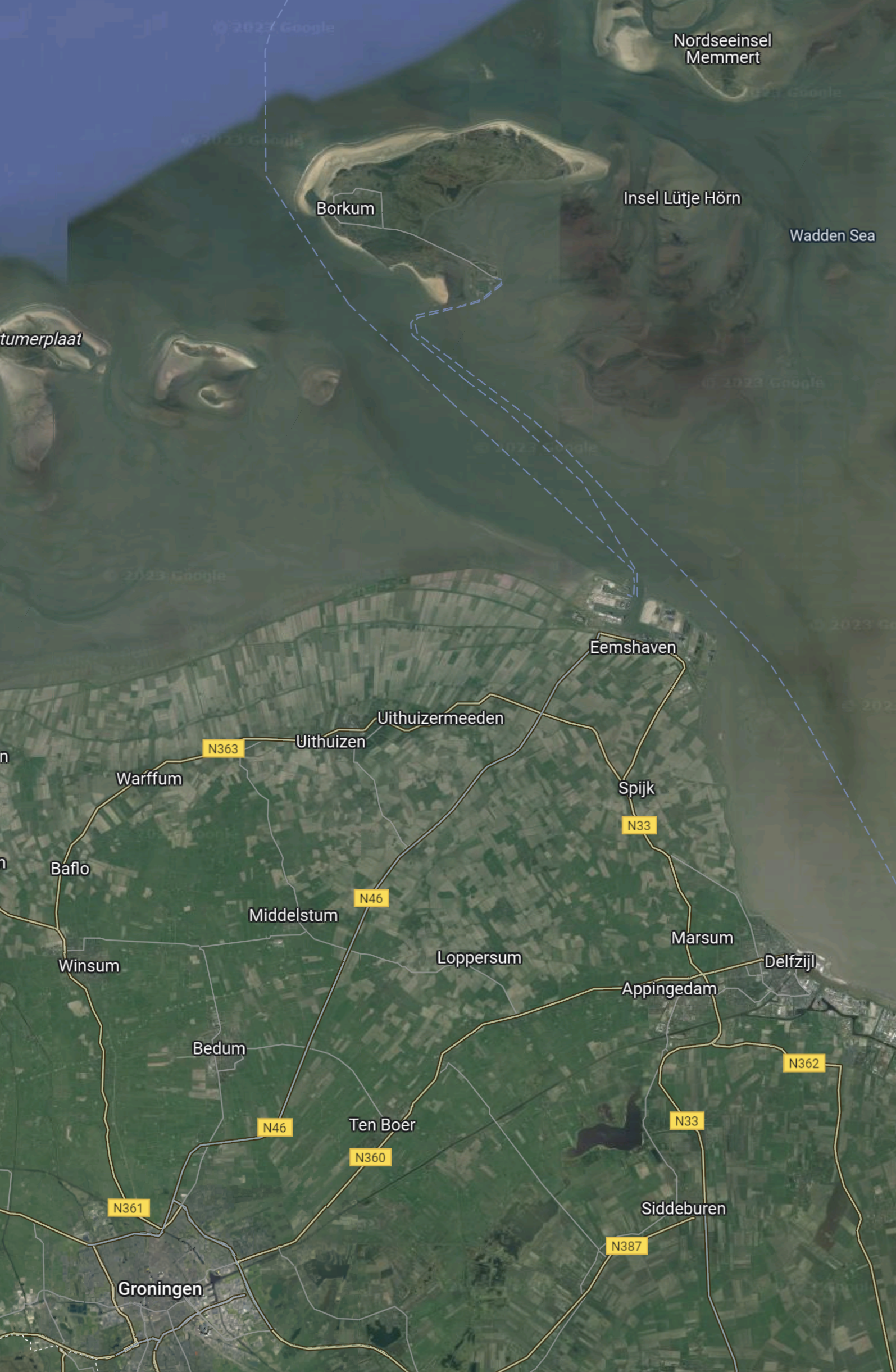
Note.
- Groningen is the city in the South-West corner of the map.
- Borkum is the horseshoe-shaped island at the top of the map.
There are a cluster of wind farms to the North of Borkum, which includes Borkum Riffgrund 1, 2 and 3.
German Company To Build XXL Monopile Factory in Denmark
The title of this post, is the same as that of this article on offshoreWIND.biz.
This is the sub-heading.
German-based Baltic Structures Company (BSC) has revealed that it will build an XXL monopile production factory in Esbjerg, Denmark
These are the first three paragraphs that outline the project.
BSC will build “Europe’s biggest” foundation fabrication site in the Esbjerg Port where it will be able to offer various foundations structures with a more than 100,000-square-metre production area under the roof and an output of up to 200 XXL monopiles per year.
The German company said that the focus of the plant is on structures with dimensions of up to 15 metres in diameter, up to 130 metres in length, and single unit weights of up to 4,000 tonnes.
In addition to monopiles, transition pieces, pin piles, and components for jackets, floating foundations will also be offered, said BSC.
These last three paragraphs sum up, where we are at the moment with European wind turbine foundation manufacture.
In September 2022, Esbjerg Port (Denmark), Oostende Port (Belgium), Groningen Seaports/Eemshaven (the Netherlands), Niedersachsen Port/Cuxhaven (Germany), Nantes-Saint Nazaire Port (France), and Humber (the UK) signed a partnership agreement with an aim to minimise capacity issues.
At the beginning of this year, the six largest European wind ports also signed a mutual declaration to collaborate on an operational and practical level to help bring the new offshore wind capacities across Europe as smoothly as possible.
In January, the Port of Esbjerg, together with US-based Moffatt & Nichol, deployed digital twin technology which could triple the port’s offshore wind capacity.
I also wrote UK And South Korea Help Secure Millions For World’s Largest Monopile Factory, this morning about a new monopole factory on Teesside.
- The Teesside factory is described as the world’s largest.
- On the other hand the Esbjerg Port facility is described as Europe’s biggest foundation fabrication site.
I suspect the Germans and the Koreans are using different engineering dictionaries.
European Offshore Wind Power Targets
Out of curiosity, I looked up the offshore wind capacity, the UK and neighbouring countries are planning before 2030.
- UK – 50 GW
- Germany – 30 GW
- Norway – 30 GW
- The Netherlands – 21 GW
- France – 18 GW
- Denmark – 13 GW
- Italy – 10 GW
- Portugal – 10 GW
- Belgium – 5.4-5.8 GW
- Republic of Ireland – 5 GW
- Spain – 3 GW
Note.
- Norway’s figure relates to 2040.
- Northern Ireland have a target of 1 GW, which I assume is included in the UK total.
- The total is between 195.4 and 195.8 GW.
Given that we could be producing over a quarter of Western Europe’s offshore wind power, the Gods of the Winds must have been British.
South Korea, UK Strengthen Offshore Wind Ties
The title of this post, is the same as that of this article on offshoreWIND.biz.
This is the sub-heading.
The Republic of Korea (ROK) and the UK have signed a memorandum of understanding (MoU) concerning cooperation on offshore wind energy
These three paragraphs outline the MoU.
The UK and ROK already have a proven relationship in offshore wind, with large-scale investments in the UK’s supply chain and in the development of ROK’s offshore wind sector.
This MoU emphasises the will to build on this existing cooperation to accelerate deployment, address barriers to trade, and encourage mutual economic development through regular government-to-government dialogue and business-to-business cooperation, according to the partners.
The participants will support the UK and ROK’s offshore wind deployment by sharing experience and expertise from their respective sectors.
These are my thoughts.
The British And The Koreans Have A Long Record Of Industrial Co-operation
My own experience of this, goes back to the last century, where one of the biggest export markets for Artemis; the project management system, that I wrote was South Korea.
We had started with Hyundai in Saudi Arabia, where the Korean company was providing labour for large projects.
I can remember modifying Artemis, so that it handled the Korean won, which in those days, came with lots of noughts.
The Korean, who managed their Saudi projects returned home and luckily for us, wanted a system in Korea.
Paul, who was our salesman for Korea, used to tell a story about selling in Korea.
Our Korean friend from Hyundai had setup a demonstration of Artemis with all the major corporations or chaebols in Korea.
Paul finished the demonstration and then asked if there were any questions.
There was only one question and it was translated as “Can we see the contract?”
So Paul handed out perhaps a dozen contracts.
Immediately, after a quick read, the attendees at the meeting, started to sign the contracts and give them back.
Paul asked our friendly Korean, what was going on and got the reply. “If it’s good enough for Hyundai, it’s good enough for my company!”
The King Played His Part
King Charles, London and the UK government certainly laid on a first class state visit and by his references in his speech the King certainly said the right things.
I always wonder, how much the Royal Family is worth to business deals, but I suspect in some countries it helps a lot.
With Artemis, we won two Queen’s Awards for Industry. Every year the monarch puts on a reception to which each company or organisation can send three representatives. I recounted my visit in The Day I Met the Queen.
For the second award, I suggested that we send Pat, who was the highest American, in the company.
Later in his career with the company, when he was running our US operations, Pat. found talking about the time, he met the Queen and Prince Philip, very good for doing business.
I wonder how many business and cooperation deals between the UK and Korea, will be revealed in the coming months.
This Deal Is Not Just About The UK And Korea
This paragraph widens out the deal.
In addition, participants accept to promote business activities and facilitate opportunities for UK and ROK companies to collaborate in ROK and the UK, as well as joint offshore wind projects in third countries, according to the press release from the UK Government.
An approach to some countries without the usual bullies of this world may offer advantages.
Has One Secondary Deal Already Been Signed?
This paragraph talks about a recent deal between BP, Dutch company; Corio and the South Koreans.
The news follows the recent announcement from South Korea’s Ministry of Trade, Industry and Energy that two UK companies, Corio Generation and BP, submitted investment plans for offshore wind projects in South Korea totalling about EUR 1.06 billion.
This deal was apparently signed during the state visit.
There’s A Lot Of Wind Power To Be Harvested
These last two paragraphs summarise the wind potentials of the UK and Korea.
The UK has the world’s second-largest installed offshore wind capacity, with a government target to more than triple this capacity by 2030 to 50 GW, including 5 GW of floating offshore wind.
Back in 2018, the South Korean Government set a 2030 offshore wind target of 12 GW in its Renewable Energy 3020 Implementation Plan, which was reaffirmed by the now-former South Korea’s president Moon Jae-in in 2020. Since 2022, it has been reported that the country has a target of reaching 14.3 GW of offshore wind power by 2030.
Note that the UK’s population is almost exactly 30 % bigger than Korea’s.
So why will the UK by 2030, be generating three-and-half times the offshore wind power, than Korea?
Twenty days ago, I wrote UK And Germany Boost Offshore Renewables Ties, where I believe the sub-plot is about long-term power and energy security for the UK and Germany.
Long term, the numbers tell me, that UK and Irish seas will be Europe’s major powerhouse.
Australia’s Offshore Wind Market Could Significantly Benefit from Collaboration with UK Suppliers, Study Says
The title of this section, is the same as that of this article on offshoreWIND.biz.
This is the sub-heading.
A new study has been launched that highlights significant opportunities for the UK to share its wind farm expertise with Australia’s emerging offshore wind market
These three paragraphs outline the study.
The Australian Offshore Wind Market Study, conducted by Arup, evaluates potential Australian offshore wind markets and analyses the strengths, weaknesses, and opportunities for UK support.
Key findings indicate that the Australian offshore wind market could “substantially” benefit from collaboration with the UK suppliers, given the UK’s 23 years of experience and its status as the second largest offshore wind market globally, boasting 13.9 GW of installed capacity as of 2023, according to the UK Government.
Currently, Australia has over 40 offshore wind projects proposed for development.
I believe that the Australians could be a partner in the deal between the UK and Korea, as all three countries have similar objectives.
Conclusion
The Korean and German deals. and a possible Australian deal should be considered together.
Each country have their strengths and together with a few friends, they can help change the world’s power generation for the better.
- Just as the UK can be Europe’s powerhouse, Australia can do a similar job for South-East Asia.
- Any country with lots of energy can supply the green steel needed for wind turbine floats and foundations.
I would have felt the Dutch would have been next to join, as their electricity network is solidly connected to the UK and Germany. But after this week’s Dutch election, who knows what the Dutch will do?
Set Back As Badgers Undermine 11 km Of Railway
The title of this post, is the same as that of this article on Railway Gazette International.
These four paragraphs outline the problems.
Deutsche Bahn reports that burrowing badgers have undermined about 11 km of embankment on the Fröndenberg – Unna railway, and repairs are likely to be very expensive and take a long time as the damage is more extensive than expected.
In some places the repairs will be equivalent to new construction, and DB says the planning and approval phase alone could take several years as the route passes through protected environments. Local media reports that the financial viability of reopening is being questioned.
DB first discovered the damage in 2022, and initiated repairs using a concrete spraying process. It also began to examine the rest of the route and 140 sett entrances have now been discovered, leading to an extensive tunnel system which is believed to have a total length of around 1 500 m spread over the entire length of the embankment.
The line runs through a nature reserve, so investigations had to be suspended over the summer until a special permit was obtained. Trees and bushes also needed to be cut back. Regional train service RB54 remains suspended between Unna and Fröndenberg and replaced by buses, extending journey times by 7 min.
Note.
- The railway appears to be only single-track from Google Maps.
- Unna station is the Easternmost station of the Rhine-Ruhr S-Bahn.
- The RB 54 – Hönnetal-Bahn runs between Fröndenberg and Unna.
I wouldn’t be surprised that this serious problem will be resolved by either closing the railway permanently or by using an expensive rebuild.
How Network Rail Deal With Badgers
I did find this document on the Network Rail web site, which appears to be part of a Safety Course.
There is this page on the Network Rail web site, which is entitled Badgers Sett To Keep Their Homes As Railway Works Around.
Unfortunately for the Germans, they seem to have whole armies of badgers, whereas we seem to have just a couple of families in the second document.
It does look like in the video in the second example, that a certain amopunt of psychology is used to persuade the badgers to do, what Network Rail wants them to do.
Sheep And The M62
When I was at Liverpool University in the 1960s, the Veterinary Department had a contract to design fencing to keep the hardy Pennine sheep off the motorway.
They found that the sheep had little difficulty climbing over a six foot high wire mesh fence.
Perhaps DB should ask Liverpool, if they have any tips!
UK And Germany Boost Offshore Renewables Ties
The title of this post, is the same as that of this article on offshoreWIND.biz.
This is the sub-heading.
A new partnership between the UK and German governments has been agreed on 3 November to help secure safe, affordable, and clean energy for consumers in both nations for the long-term and bolster energy security. Both countries commit to strengthening cooperation in renewables, notably offshore wind and electricity interconnection.
These two paragraphs introduce the deal.
Under the new partnership signed in London by Energy Security Secretary Claire Coutinho and Germany’s Vice Chancellor, Robert Habeck, the UK and Germany have reaffirmed their shared ambition and commitment to net zero and progressing the energy transition.
Europe’s two largest economies have also doubled down on commitments made under the Paris Agreement to limit global warming to 1.5 degrees.
i think this could be a worthwhile follow-up to the relationship, that Boris Johnson and Olaf Scholz seemed to encourage after their high profile meeting in April 2022.
This press release from Downing Street is entitled PM meeting with German Chancellor Olaf Scholz: 8 April 2022 and this is the first two paragraphs.
The Prime Minister welcomed German Chancellor Olaf Scholz to Downing Street this afternoon to discuss the West’s response to Putin’s barbaric invasion of Ukraine.
The two leaders shared their disgust at the Russian regime’s onslaught and condemned Putin’s recent attacks.
I wrote Armoured Vehicles For Ukraine based on some of the things said in the press conference after what seemed to be a very wide discussion.
But it was these paragraphs in the press release that caught my eye.
They also agreed on the need to maximise the potential of renewable energy in the North Sea and collaborate on climate ambitions and green energy.
The Prime Minister said he wanted to further deepen the UK’s relationship with Germany, and intensify its cooperation across defence and security, innovation and science.
After Boris and Olaf’s meeting at Downing Street, I have been able to write these posts about the Anglo-German energy relationship and also make some other observations.
- Mona, Morgan And Morven
- UK-German Energy Link Reaches Financial Close
- RWE, Siemens and other German companies seem to be building a strong presence in the UK.
- Rolls-Royce are doing the same in Germany.
Claire Coutinho and Robert Habeck seem to be wanting to continue the co-operation, judging by this paragraph from the article on offshoreWIND,biz.
The energy and climate partnership sees both countries commit to enhancing cooperation in renewables, particularly in offshore wind and electricity interconnection, including offshore hybrid interconnection.
The most significant part of this paragraph is the mention of offshore hybrid interconnection.
If you want more details on their meeting, this document is the official UK Government declaration.
I have my thoughts.
What Is Meant By Offshore Hybrid Interconnection?
Type “Offshore Hybrid Interconnection” into Google and the first page is this page from National Grid, that is entitled Offshore Hybrid Assets, that has this sub-heading.
How the North Sea has the potential to become Europe’s green energy ‘powerhouse’
This is the introductory paragraph.
Now more than ever we need more renewable energy to make energy cleaner, more affordable, and more secure. The North Sea offers an incredible opportunity for the UK and our European neighbours to deliver huge increases in offshore wind. But delivering new offshore wind will require more infrastructure, which will have an impact on communities.
Hybrid is all-purpose comfort word like cashmere, platinum or puppies.
The page on the National Grid web site describes The Next Generation Interconnector with these paragraphs.
Interconnectors already provide a way to share electricity between countries safely and reliably. But what if they could do much more than that? What if interconnectors could become an offshore connection hub for green energy?
Instead of individual wind farms connecting one by one to the shore, offshore hybrid assets (OHAs) will allow clusters of offshore wind farms to connect all in one go, plugging into the energy systems of neighbouring countries.
And then there is this section entitled Tomorrow’s Solution: Offshore Wind And Interconnectors In Harmony, where this is said.
Today, offshore wind and interconnectors operate alongside each other, connecting to the shore individually. In the future, offshore hybrid assets could enable offshore wind and interconnection to work together as a combined asset.
We now call this type of infrastructure an offshore hybrid asset (OHA), but we used to refer to it as a multi-purpose interconnector (MPI). We changed it because we work so closely together with Europe, it made sense to use the same terminology.
The page on the National Grid web site also has an interactive graphic, which shows the benefit of the approach.
LionLink
National Grid are already developing LionLink, with Dutch grid operator; TenneT, which will be a multi-purpose interconnector linking the UK and the Netherlands.
LionLink is described on this page from National Grid, where this is the sub-heading.
We’re developing a first-of-its-kind electricity link to connect offshore wind between the UK and the Netherlands.
This is the introductory paragraph.
Designed together with our Dutch partners TenneT, LionLink (formerly known as EuroLink) is an electricity link that can supply around 1.8 gigawatts of clean electricity, enough to power approximately 1.8 million British homes. By connecting Dutch offshore wind to Dutch and British markets via subsea electricity cables called interconnectors, LionLink will strengthen our national energy security and support the UK’s climate and energy goals.
Will we be planning a similar electric handshake with the Germans?
How Much Offshore Wind Power Are We Talking About?
This is answered by the last two paragraphs of the article on offshoreWIND.biz.
Around 75 per cent of installed offshore wind capacity in the North Sea is in German and British waters. This is helping to drive the UK’s ambition for up to 50 GW of offshore wind, including up to 5 GW of floating wind, by 2030, the governments said.
Germany is aiming at installing 30 GW by 2030.
That is an Anglo-German starter for eighty GW.
Electrolysers In The Middle If The North Sea
Why Not?
This is a clip from National Grid’s graphic on the page that introduces Offshore Hybrid Assets,
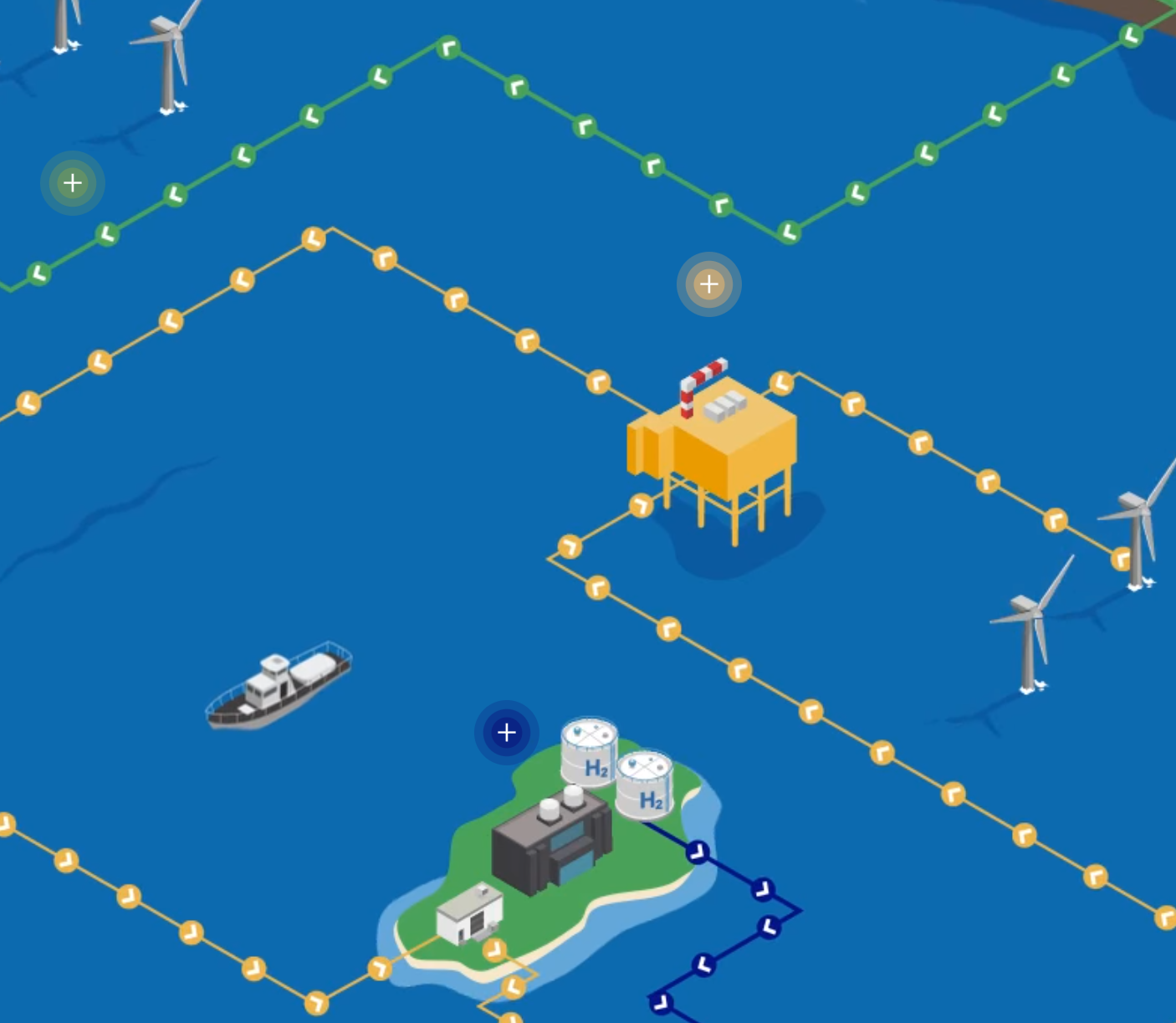
It shows an offshore hydrogen electrolyser.
- You could have an offshore hybrid asset that went between say Bacton in Norfolk and Hamburg via these assets.
- One or more wind farms in UK territorial waters.
- A mammoth offshore electrolyser, with hydrogen storage, possibly in a depleted gas field.
- One or more wind farms in German territorial waters.
Electricity will be able to go three ways; to the UK, to Germany or to the electrolyser.
The Involvement Of German Energy Companies In UK Territorial Waters
Wikipedia lists offshore fifteen wind farms, that have German owners in UK territorial waters, that total 12,960 MW.
This compares with.
- Equinor – 6 wind farms totalling 6466 MW.
- Ørsted – 15 wind farms totalling 9683 MW.
- Scottish Power – 2 wind farms totalling 5,000 MW.
- SSE Renewables – 15 wind farms totalling 15,591 MW.
- Vattenfall – 6 wind farms totalling 4384 MW.
As there is a number of partnerships, these figures only show the relative sizes of the investment by individual companies.
But at nearly 13 GW, the amount of total German investment in UK territorial waters is substantial.
Is This Solely An Anglo-German Club Or Can Others Join?
Consider.
- It seems to me, that because of the LionLink, the Dutch are already involved.
- TenneT is also a large electricity distributor in Germany.
- Countries with substantial shares of the water and winds of the North Sea in addition to Germany, the Netherlands and the UK, include Belgium, Denmark and Norway.
- The UK has interconnectors with Belgium, Denmark, France, Germany, Norway and the Netherlands.
It appears that the world’s largest multi-national power generator is evolving by stealth.
North Sea Wind Power Hub
This concept seems to have developed around 2017, by Danish, Dutch and German interests.
The Wikipedia entry introduces it like this.
North Sea Wind Power Hub is a proposed energy island complex to be built in the middle of the North Sea as part of a European system for sustainable electricity. One or more “Power Link” artificial islands will be created at the northeast end of the Dogger Bank, a relatively shallow area in the North Sea, just outside the continental shelf of the United Kingdom and near the point where the borders between the territorial waters of Netherlands, Germany, and Denmark come together. Dutch, German, and Danish electrical grid operators are cooperating in this project to help develop a cluster of offshore wind parks with a capacity of several gigawatts, with interconnections to the North Sea countries. Undersea cables will make international trade in electricity possible.
Currently, the UK is developing these wind farms on their portion of the Dogger Bank.
- Doggerbank A – 1235 MW – Started producing electricity in 2023.
- Doggerbank B – 1235 MW – Planned commissioning in 2024.
- Doggerbank C – 1218 MW – Planned commissioning in 2025.
- Doggerbank D – 1320 MW – Being planned.
- Doggerbank South – 3000 MW – Being planned.
Note.
- That’s a total of 8 GW.
- A, B, C and D are being developed by a consortium of SSE Renewables and Equinor.
- South is being developed by RWE.
- This web site is for Dogger Bank D.
- This web site is for Dogger Bank South.
This map from the European Atlas of the Seas, shows the various exclusive economic zones (EEZ) in the North Sea.

Note.
- The pinkish zone to the East of the UK, is the UK’s EEZ.
- The light blue zone at the top is Norway’s EEZ.
- The greenish zone in the North-East corner of the map is Denmark’s EEZ.
- The light blue zone below Denmark’s EEZ is Germany’s EEZ.
- Then we have the EEZs for The Netherlands, Belgium and France.
The Dogger Bank is situated where the British, Dutch, German and Norwegian EEZs meet.
All five Dogger Bank wind farms are in British waters.
The Wikipedia entry for the Dogger Bank says this about its size.
The bank extends over about 17,600 square kilometres (6,800 sq mi), and is about 260 by 100 kilometres (160 by 60 mi) in extent. The water depth ranges from 15 to 36 metres (50 to 120 ft), about 20 metres (65 ft) shallower than the surrounding sea.
This probably makes it easy to accommodate a large fixed-foundation wind farm.
Overlaying the map in the Wikipedia entry, with the EEZ map, I’m fairly sure that the northeast end of the Dogger Bank is close to where the EEZs meet.
Progress On The North Sea Wind Power Hub
The North Sea Wind Power Hub has a web site, but it seems to be more about thinking than doing.
It seems to have been hijacked by that august body; The Institute of Meetings Engineers.
This page on the web site, which is entitled Explore The Future Energy Highways, has a simple interactive map.
This shows its vision for 2030.
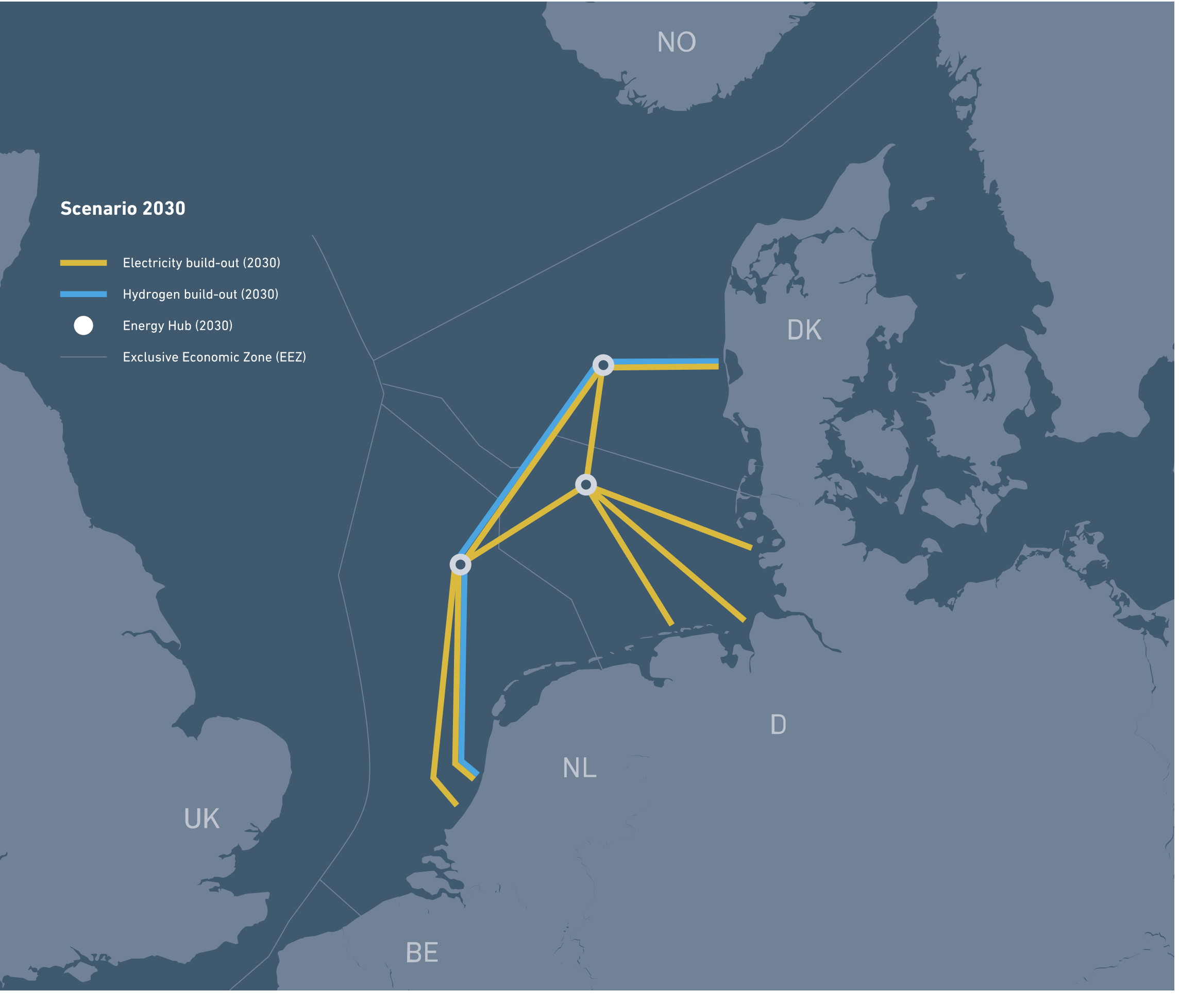
Note.
- Yellow is electricity links to be built before 2030.
- Blue is hydrogen links to be built before 2030.
- Feint lines indicate the EEZ boundaries.
There are two problems with this layout.
- It doesn’t connect to the Dogger Bank area, where the original plan as detailed in Wikipedia talked about “Power Link” artificial islands.
- No hydrogen is delivered direct to Germany.
This shows its vision for 2050.
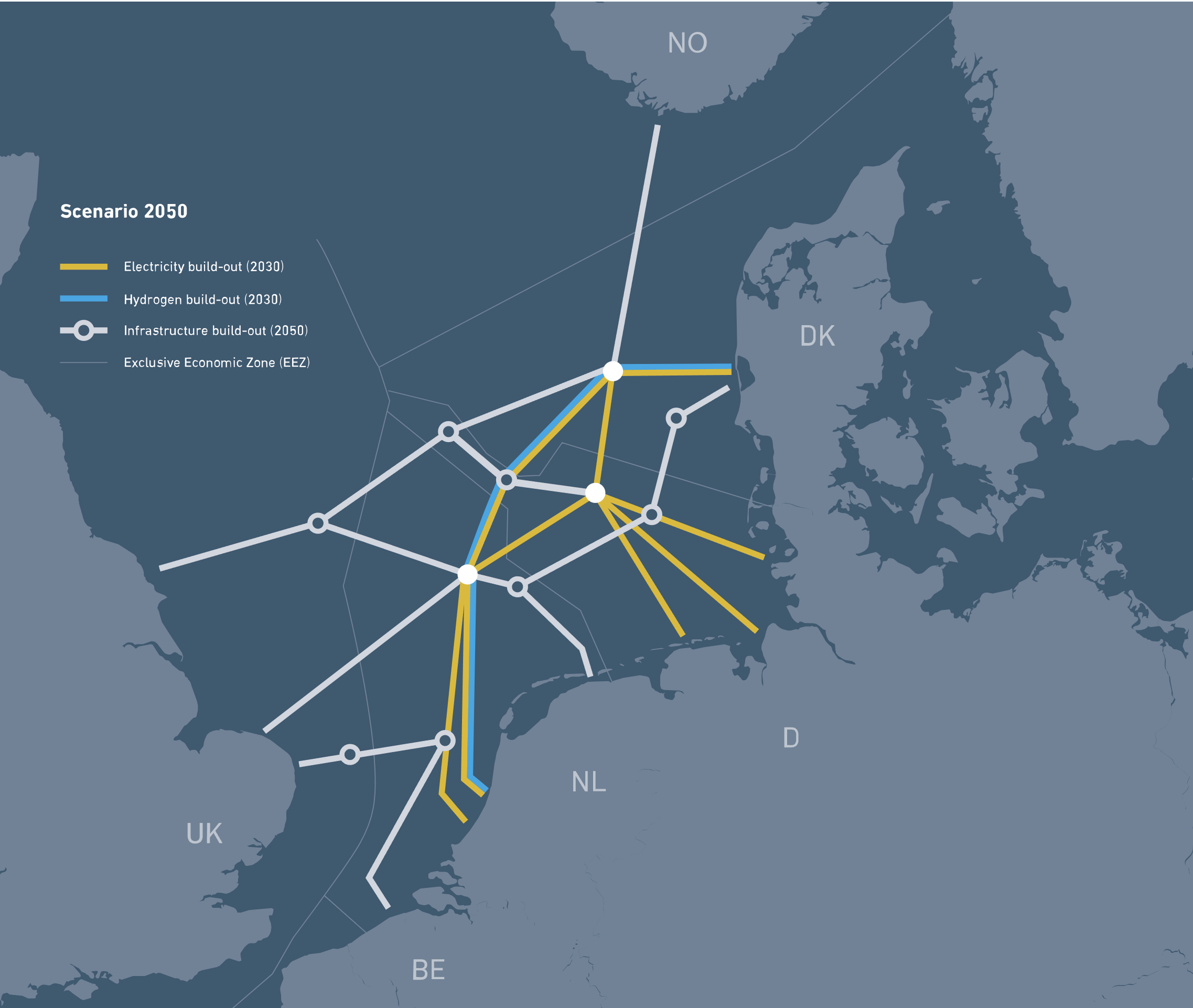
Note.
- Yellow, blue and feint lines are as before.
- White is electricity links to be built before 2050.
- There appears to be a node on the Dogger Bank in the German EEZ. This node could be connected to the “Power Link” artificial islands.
- The Southernmost connection to East Anglia could be Bacton.
- The other Norfolk connection could be where wind farms are already connected.
- The Northern connection could be Teesside, where some of the Dogger Bank wind farms connect.
- If the Northern connection to England is Teesside, then first node, which is in the British EEZ, could be one of the offshore sub-stations in the Dogger Bank wind farm complex.
This all seems a lot more feasible.
A New Offshore Hybrid Asset Between Teesside And Germany
Consider.
- A new offshore sub-station will be needed in the German EEZ to connect the “Power Link” artificial islands to the power network.
- The new offshore sub-station will eventually have three interconnectors to the German coast.
- Only the 1218 MW Dogger Bank C wind farm will be connected to the Teesside onshore substation.
- Germany has a power supply problem, after shutting down nuclear power stations and building more coal-fired power stations.
A new Offshore Hybrid Asset between Teesside and Germany could be created by building the following.
- A the new offshore sub-station in the German EEZ to connect the “Power Link” artificial islands to the power network.
- An interconnector between a sub-station of the Dogger Bank wind farm complex and the new sub-station
- A second interconnector to connect the new sub-station for the “Power Link” artificial islands to the German electricity grid.
All of the work would be done mainly in the German EEZ, with a small amount in the British EEZ.
Where Does Dogger Bank South Fit In?
Consider.
- Dogger Bank South is planned to be a 3 GW wind farm.
- It will need a 3 GW connection to the onshore electricity grid.
- Creyke Beck substation is the proposed location for the onshore connection.
- It is owned by German electricity company; RWE.
Could it be that some of the electricity produced by Dogger Bank South is going to be sent to Germany or to another node to produce hydrogen?
It certainly illustrates the value of an Offshore Hybrid Asset.
German Police Probe ‘Political Motive’ In Railway Fires
The title of this post, is the same as that of this article on DW.com.
This is the sub-heading.
A series of fires hit rail infrastructure on the main line between Hamburg and Berlin overnight, leading to widespread train disruptions. Police say they suspect a politically motivated act of sabotage.
This is the first two paragraphs.
German police are investigating a suspected political motive behind an alleged act of sabotage targeting a major train route connecting the port city of Hamburg to the capital, Berlin.
Fire broke out overnight at three locations in the northern Hamburg region, affecting shafts holding railway cables.
This paragraph describes a claim for responsibility.
An anonymous letter published on the far-left website Indymedia claimed responsibility for the incident, describing it as an act of “sabotage.” The letter said it was a protest against “neo-colonial exploitation and earth destroying extraction of raw materials.”
I don’t think we want anything like this in the UK.
On Track For A Low Carbon Energy Future – Centrica Signs Corporate Power Deal With Deutsche Bahn
The title of this post, is the same as that of this press release from Centrica.
These two paragraphs outline the deal.
Centrica Energy Trading has signed a two-year corporate power purchase agreement (PPA) with Deutsche Bahn, Germany’s national railway company.
Starting January 2024, Centrica will offtake power from three onshore wind farms with an installed capacity of 60.7 MW. The sites, developed by Prokon AG in Germany, have a total of 45 turbines and will provide approximately 70GWh of renewable electricity annually to Deutsche Bahn.
Sounds like good business to me! You buy electricity from three German onshore wind farms and flog it to a large German company and probably get an appropriate commission in Euros.
Amprion Reveals Energy Corridor Project To Bring 8 GW of Offshore Wind To North Rhine-Westphalia
The title of this post, is the same as that of this article on offshoreWIND.biz.
This is the sub-heading.
Amprion Offshore has started working on an energy corridor project that would bring electricity produced by up to 8 GW of offshore wind farms in the North Sea directly to the German state of North Rhine-Westphalia.
This is the first paragraph.
Named Windader West, the energy corridor involves building four offshore grid connection systems that would use the new-generation 2 GW offshore grid technology. Each of the four connections (NOR-15-1, NOR-17-1, NOR-19-1 and NOR-21-1) would have a transmission capacity of 2 GW and, together, the grid connections would transmit enough electricity to cover the energy needs of eight million households in North Rhine-Westphalia.
The linked article has an excellent large scale map.
What Are The UK Doing?
There is a Wikipedia entry for Eastern HVDC, where these are the opening paragraphs.
Eastern HVDC and Eastern HVDC projects are the names used by Ofgem for two planned HVDC submarine power cables from the East coast of Scotland to Northeast England to strengthen the National Grid. The two links combined will deliver 4 GW of renewable energy from Scottish wind farms to England.
Ofgem state that “At an estimated cost of £3.4 billion for the two links, the Eastern HVDC projects would be the largest electricity transmission investment project in the recent history of Great Britain.”
The two links are called.
Note.
- SEGL1 will run from Torness in Southeast Scotland to Hawthorn Pit substation in Northeast England.
- EGL2 will run from Sandford Bay, at Peterhead in Scotland, to the Drax Power Station in Yorkshire, England.
- Both links have a capacity of 2 MW and the DC voltage will be +/-525 kV.
National Grid are also developing Eastern Green Links 3 and 4 and this is the web site.
These paragraphs describe EGL3 and EGL4.
The EGL 3 project will be a new offshore High Voltage Direct Current (HVDC) electrical link from Peterhead to the south Lincolnshire area.
EGL4 will be a new offshore HVDC electrical link from east Scotland, also to the south Lincolnshire area.
Where offshore projects such as these connect with the land, we also have to build onshore infrastructure to enable the clean energy to be transported, to homes and businesses. The onshore infrastructure required for each of these projects will include new converter stations and substations (in both Scotland and England), as well as underground cables to connect everything together.
Together, these projects will transfer 4GW of electricity between Scotland and England. This means that once operational, these projects will provide enough energy to power around 3 million homes.
Note.
- As with the German cables, each carries 2 MW.
- Consultation for EGL3 and EGL4 starts in early 2024.
- Both cables terminate in South Lincolnshire.
In The Lincolnshire Wind Powerhouse, I publish this map of the wind farms in the South of Lincolnshire.
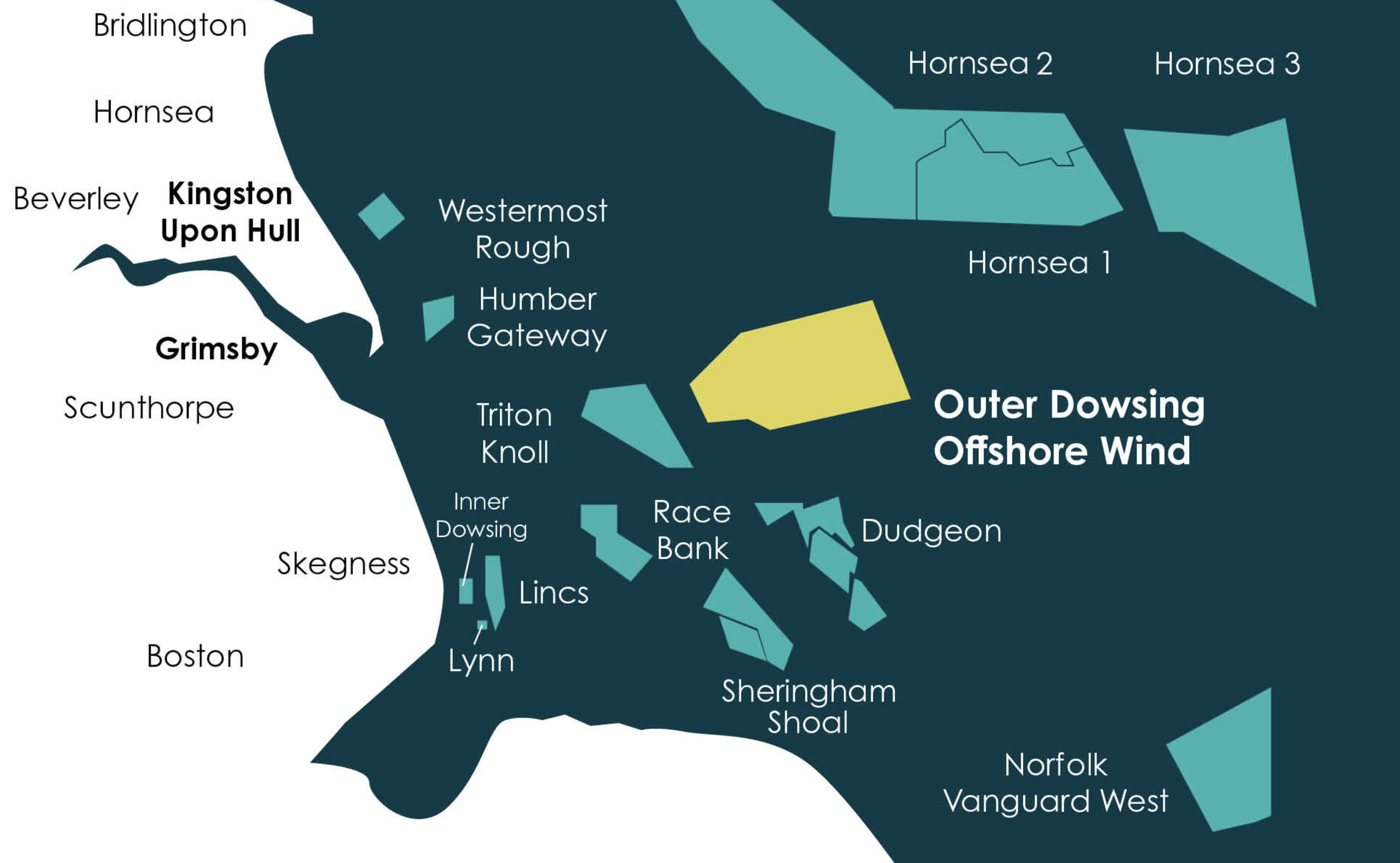
Note.
- The completed Hornsea wind farm will be over 6 MW.
- The future of Norfolk Vanguard is uncertain.
- These wind farms total up to 13524 MW, but without Norfolk Vanguard the total is 11724 MW.
- According to Wikipedia, the Viking Link to Denmark will open on the 1st of January 2024.
I wrote about the Viking Link in Work Begins On New Substation For World’s Longest Electricity Cable Between Denmark and Lincolnshire.
The German And UK Cables Compared
Consider.
- Both have 4 x 2 MW capacity.
- SEGL1 and EGL2 have a cost of £3.4 billion.
- The four German cables are quoted at a total of €16-18 billion here.
- The first two UK cables have planned completion dates of 2027 and 2029.
- German completion dates are given as 2032-2036.
This leads me to this conclusion.
Building interconnectors in the sea is quicker and more affordable than building them on land.
Alstom And VMS Present New Battery-Powered Train
The title of this post, is the same as that of this article on Rail Technology Magazine.
This is the sub-heading.
Alstom and the Central Saxony transport authority, Verkehrsverbund Mittelsachsen (VMS) in Germany have unveiled a new battery-powered train developed by Alstom.
These first four paragraphs are very information rich.
A total of eleven Coradia Continental battery-electric trains have been ordered by VMS. These trains will enter service in 2024 on the Chemnitz-Leipzig line.
The Coradia Continental battery-electric train has a range of up to 120 kilometres and can be operated under catenary as well as on non-electrified sections of line. The three-car trains are 56 metres long and can seat up to 150.
The new train can also reach maximum speeds of 160 km/h in battery mode. The capacity of the high-performance lithium-ion batteries is calculated to guarantee catenary-free operation on the Chemnitz-Leipzig line without sacrificing performance.
Müslüm Yakisan, president of Alstom Region DACH, said: “Alstom’s ambition is to be the global leader in sustainable mobility, reducing emissions and pollution in catenary-free operation. The presentation of the first battery-powered train developed by Alstom is an important step in this direction.
These seem to be a very useful battery-electric train.
- Battery or catenary operation
- Three-cars of 19 metres
- Fifty seats per car
- 100 miles per hour
A three-car Class 730 train has the following characteristics.
- three cars of 20 metres
- 199 seats.
- 90 miles per hour
Can we have a battery version soon? Please!
 The Anonymous Widower