Highview Power Keeping Up Momentum
The title of this post is the same as that of this article on Gas World.
This is the introductory paragraph.
It’s full steam ahead for Highview Power as the energy storage provider’s CEO and President today updated on operations.
It does look thatHighview are optimistic since their partnership with Sumitomo Heavy Industries was announced, that I wrote about in Japanese Giant Sumitomo Heavy Invests In Liquid-Air Energy Storage Pioneer.
I am optimistic too!
- Highview’s system uses no difficult technology or rare materials.
- The system can provide large amounts of storage, which we are going to need with all the wind farms we are developing.
- From my Control Engineering and mathematical modelling experience, I believe, these systems can be used to boost power, where it is needed, in the same way gas-fired power stations do.
But above all, Highview Power has created a standalone energy storage system for the Twenty-First Century, that catches the needs and moods of the Age!
Our energy system is changing and it not expressed any better, than in this article on Physics World, which is entitled Does The UK Need 40 GW Of Firm Capacity?
This is the opening sentence.
Whether it comes from nuclear plants or fossil fuel-fired power stations with carbon capture and storage (CCS), the UK will need 30-40 GW of new “firm” low-carbon baseload generation by 2050 to meet the net-zero emissions target, Greg Clark reportedly said.
I don’t think that the country will allow any Government of the UK to build that much nuclear capacity and I have my doubts about the feasibility of large scale CCS. I also don’t think, the public will allow the building of large coal-fired power stations, even with CCS. And they don’t like nuclear either!
On Wikipedia, Wind Power in the UK, says this about the current Round 3 of proposals for wind farms.
Following on from the Offshore wind SEA announced by the Government in December 2007, the Crown Estate launched a third round of site allocations in June 2008. Following the success of Rounds 1 and 2, and important lessons were learnt – Round 3 was on a much bigger scale than either of its predecessors combined (Rounds 1 and 2 allocated 8 GW of sites, while Round 3 alone could identify up to 25 GW).
If you think UK politics is a lot of wind and bluster, that is pussy-cat’s behaviour compared to the roaring lions around our shores.
Wikipedia then lists nine fields, with a total power of 26.7 GW, but some are not being built because of planning.
But we ain’t seen noting yet!
Wikipedia says this about Round 4.
Round 4 was announced in 2019 and represented the first large scale new leasing round in a decade. This offers the opportunity for up to 7GW of new offshore capacity to be developed in the waters around England and Wales.
The Agreements for Lease will be announced in 2021.
Wikipedia then makes these points.
- Nuclear power stations have funding and technical problems.
- Since the Fukushima nuclear disaster public support for new nuclear has fallen
- The UK government increased its previous commitment for 40 GW of Offshore wind capacity by 2030, in the Queen’s Speech in December 2019.
- In 2020, this represents a 355% increase in ten years.
- It is expected the Crown Estate will announce multiple new leasing Rounds and increases to existing bidding areas throughout the 2020-2030 period to achieve the governments aim of 40 GW.
- The Scottish Government has plans to chip in 6 GW.
I will add these feelings of my own
- I have ignored the contribution, that better wind-power technology will make to get more GW for each billion pounds of investment.
- I can see a day, in the not too distant future, when on a day in the summer, no electricity in the UK comes from fossil fuel.
- There will be a merging between wind power and hydrogen generation, as I described in ITM Power and Ørsted: Wind Turbine Electrolyser Integration.
- Traditional nuclear is dead, although there may be applications for small nuclear reactors in the future.
- In parallel to the growth of wind power, there will be a massive growth of solar power.
But we will need to store some of this energy for times when the wind isn’t blowing and the sun isn’t shining.
- Pumped storage hydroelectric schemes, as at Electric Mountain in Snowdonia may have a part to play as I described in The New Generation Of Pumped Storage Systems. But sadly, the UK doesn’t have the terrain for another 9.1 GWh scheme.
- A lot of electricity will be converted to hydrogen to power industrial processes and augment and possibly replace natural gas in the UK’s gas network.
- Some electricity will be stored in batteries in houses and vehicles, when it is most affordable and used, when it is more expensive.
- Companies and funds, like Gresham House Energy Storage Fund will fund and build storage facilities around the UK.
- Traditional lithium-ion batteries require a lot of expensive raw materials controlled by the Chinese!
- But if we develop all these options, and generate tens of GWs using renewables, the UK will still need a substantial amount of GW-scale affordable energy storage systems.
It is my belief, that Highview Power is the only practical GW-scale affordable energy storage system.
My only worry about their system, is that the idea could be ripped off, by an unscrupulous country with a solid process plant industry!
Proudly South African Hydrogen Breakthrough With Shell’s Backing
The title of this post, is the same as that of this article on Creamer Media’s Mining Weekly.
This is the introductory paragraph.
At this time of huge coronavirus uncertainty, the chests of a group of engineers here must surely be bulging with pride following their major Proudly South African world breakthrough that could speed up the global deployment of hydrogen as a competitive universal and environment-friendly energy carrier.
I think it got a bit jumbled in the typing.
Reading the article it does seem that various developments are coming together in South Africa.
- A much simple electrolyser to produce hydrogen.
- South Africa’s platinum for catalysts.
- Large amounts of renewable energy.
The aim is to produce hydrogen at a comparable price with petrol.
This paragraph stands out.
South Africa has the combined solar and wind potential to produce competitive hydrogen, which can meet the world’s new environmental requirements.
The article talks about exporting hydrogen to Japan.
Conclusion
South Africa is a country that needs all the good news it can get.
This looks like it could be some of the best.
But how many other hot countries can take advantage of what looks like a breakthrough in the electrolysis of water to produce hydrogen for a fuel?
Consultation On The Cambridge Autonomous Metro
Issue 900 of Rail Magazine has an article called Have Your Say On Plans For Cambridge Metro Network.
These are the introductory paragraphs.
The Cambridge and Peterborough Combined Authority has launched a public consultation into outline plans for the Cambridge Autonomous Metro (CAM)
Under current proposals the CAM network would comprise a tunnelled section beneath Cambridge city centre, and four regional routes, radiating out towards St. Neots, Alconbury, Mildenhall and Haverhill.
This is a map clipped from the proposals.
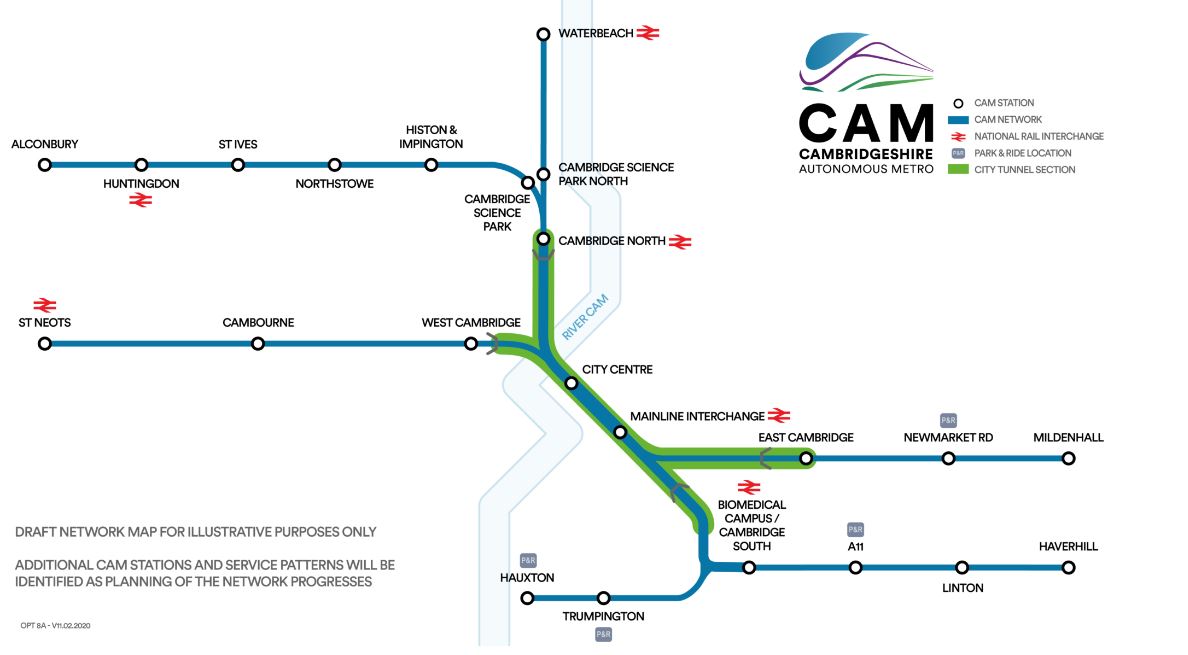
Note.
Sections shown in green are tunnelled.
Sections shown in blue are on the surface.
Some sections would appear to reuse parts of the Cambridgeshire Guided Busway.
These are a few of my thoughts.
Rolling Stock
This picture from the consultation, shows possible rolling stock.
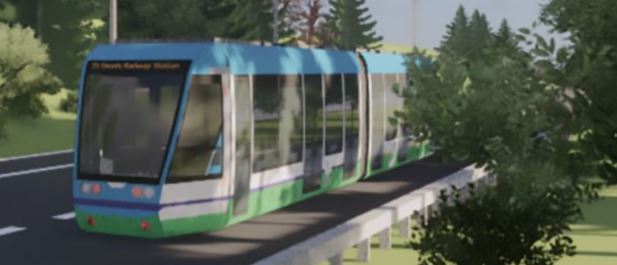
It could be a version of Van Hool’s ExquiCity BRT tram-bus, which is used is Belfast, Geneva, Metz and Parma – To name just four!
A hydrogen-powered version has also recently been introduced in Pau in France.
Could this be the version, that will be preferred for Cambridge?
- It would be carbon and pollution free.
- It could use exclusively green hydrogen, created from renewable electricity. Pau uses a hydrogen-generation system from ITM Power.
- Would hydrogen-power encourage passengers to use the system?
- It might borrow ideas from the Glider system in Belfast, which is diesel-electric powered.
- Each Belfast Glider vehicle can hold 105 passengers.
A hydrogen-powered system would surely be ideal for working in the tunnels under Cambridge.
Tunnels
This article on the BBC is entitled Cambridge Metro: Engineer Says Underground Will Work.
In the article, Professor John Miles of Cambridge University says.
Britain was a world leader in boring small tunnels
It will be tight in the cramped city, but it should be possible.
Conclusion
Oxford will want one!
I Design A Hydrogen Aventra
This article on Rail News is entitled Alstom Moves Ahead With Bombardier Takeover.
This is a paragraph in the report, which is dated the eighteenth of last month.
n a statement issued last night, Alstom said it had ‘signed a Memorandum of Understanding with Bombardier Inc. and Caisse de dépôt et placement du Québec in view of the acquisition of Bombardier Transportation. Post-transaction, Alstom will have a backlog of around €75bn and revenues around €15.5bn. The price for the acquisition of 100 per cent of Bombardier Transportation shares will be €5.8bn to €6.2bn, which will be paid via a mix of cash and new Alstom shares.’
That sounds pretty definite to me.
In the UK, Alstom will take over a company with the following projects.
- A large order book for building Aventras in the Litchurch Lane factory at Derby.
- Several support projects for existing train fleets.
- A joint design project with Hitachi to bid for the trains for High Speed Two. Alstom are also bidding for High Speed Two, as are CAF, Siemens and Talgo.
- Design and build the cars for the Cairo monorail.
- Bombardier have been offering train operating companies a bi-mode Aventra.
There are also rumours, that Bombardier are in the running for a large order for Southeastern.
What are Bombardier’s strengths in the UK?
- The Aventra is without doubt an excellent train, but with some software teething troubles.
- The company has the ability to turn out finished trains at a formidable rate.
- The company can make the carriage bodies in a high-tech plant.
- Could the bodies be built in a larger size?
- Or even a smaller size for a country like Australia, New Zealand, Nigeria or South Africa that uses a narrow gauge?
- The company has the ability to design complete trains to the UK’s smaller standards.
- The company can make trains in both European-sizes in Europe and UK-sizes in Derby.
- The company builds bogies for other train manufacturing companies.
On the other hand, Bombardier has the following weaknesses.
- It doesn’t make any diesel-powered trains, although it has successfully trialled battery-powered trains.
- It has dismissed hydrogen-powered trains.
- But above all the finances of the parent company are a basket case.
It appears to me that Alstom might bring much needed technology and finance to Bombardier UK. In return, they will acquire a modern design, that can be used in the UK and other countries, that use a smaller loading gauge.
Obviously, if the takeover goes through, more information should be forthcoming in the near to mid future.
The Future For Hydrogen Trains In The UK
I would suspect, that Alstom have designed a train in the Class 321 Breeze, that fits their view of what will work well in the UK train market.
- It is a sixty metre long train, for a couple, where most platforms are at least eighty metres long.
- It has a capacity similar to that of a modern two-car diesel multiple unit.
- The Renatus version of the Class 321 train has a modern and reliable AC-based traction package. Or that’s what a Greater Anglia driver told me!
- Eversholt Rail Group have already devised a good interior.
- I said I was impressed with the interior of the train in A Class 321 Renatus.
- The train can operate at 100 mph on a suitably electrified line, when running using the electrification.
- Adding an extra trailer car or two could be a simple way of increasing capacity.
I should say, that I think it will be a quieter train, than the Coradia iLint, which has a rather noisy mechanical transmission.
I feel that a Class 321 Breeze train could be a good seller to routes that will not be electrified, either because of difficulty, expence or politics.
With a 100 mph operating speed on electrification and perhaps 90 mph on hydrogen power, it may have enough performance to work a lot of routes fast, profitably and reliably.
I think, that the Alston Class 321 Breeze will prove whether there is a market for hydrogen-powered trains in the UK.
I would think, that use of these trains could be a big application.
Replacement Of Two-And Three-Car Diesel Multiple Units
There are a lot of these still in service in the UK, which include.
- 3 x three-car Class 150 trains
- 134 x two-car Class 150 trains
- 114 x two-car Class 156 trains
- 15 x three-car Class 158 trains
- 155 x two-car Class 158 trains
- 30 x three-car Class 159 trains
All of these are currently running services all over Great Britain and I have ignored those trains run by Chiltern Railways as they will logically be replaced by a dedicated batch of new trains, with possible full- or part-electrification of the route. Or they could be custom-designed hydrogen trains.
As there are only 105 Class 321 trains that can be converted, some other trains will be needed.
I suppose classes of trains like Class 365 trains and others can be converted, but there must come a point, when it will be better to build new hydrogen trains from scratch.
Components For Hydrogen Trains
This article on Rail Business is entitled Breeze Hydrogen Multiple-Unit Order Expected Soon.
It says this about the design of the Alstom Breeze train.
The converted HMUs would have three roof-mounted banks of fuel cells on each of the two driving vehicles, producing around 50% more power than the iLint. Two passenger seating bays and one door vestibule behind each cab would be replaced by storage tanks. The fuel cells would feed underfloor battery packs which would also store regenerated braking energy. The current DC traction package on the centre car would be replaced by new AC drives and a sophisticated energy management system. Despite the loss of some seating space, each set of three 20 m vehicles would provide slightly more capacity than a two-car DMU with 23 m cars which it would typically replace.
The following components will be needed for hydrogen trains.
One Or More Hydrogen Tanks
This picture shows the proposed design of the Alstom Class 321 Breeze.
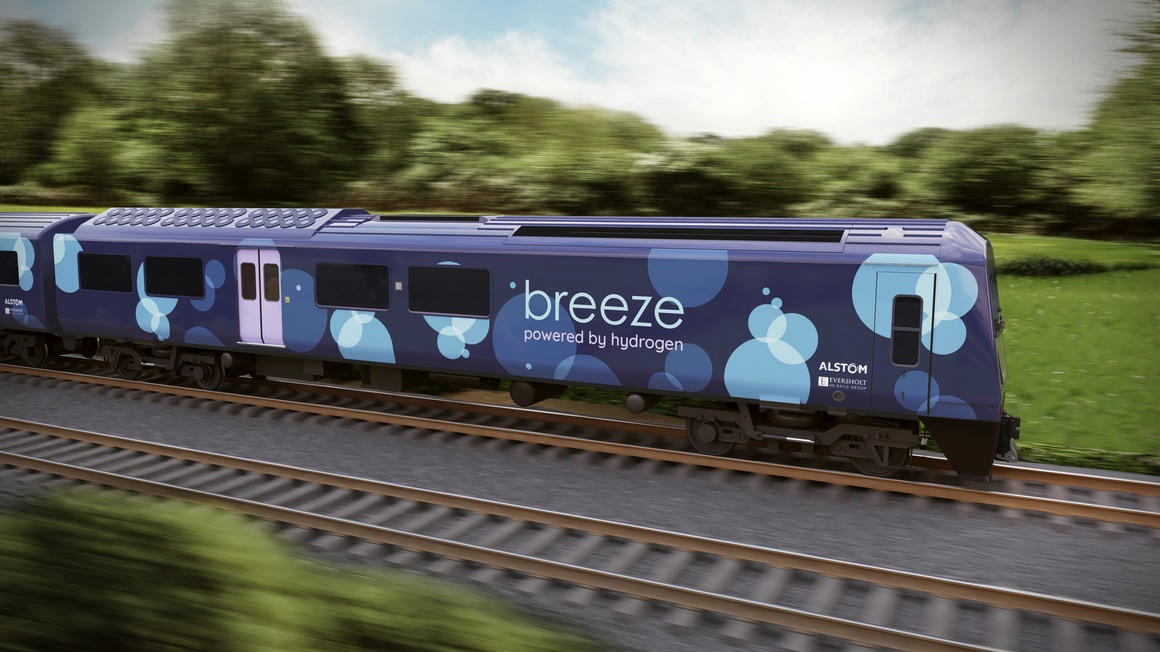
Note how half the side of the front car of the train is blocked in because it is full of the hydrogen tank. As this Driver Car is twenty metres long, each hydrogen tank must be almost seven metres long. If it was one larger tank, then it could be longer and perhaps up to fourteen metres long.
Batteries
As the Rail Business article said, that the batteries are underfloor, I wouldn’t be surprised to see all cars having a battery pack.
I favour this layout, as if cars all are motored, it must cut the length of cabling and reduce electrical losses.
Effectively, it creates a train with the following.
- Faster acceleration
- Smooth, fast deceleration.
- Efficient braking
- Low energy losses.
It should also add up to a train with good weight distribution and high efficiency.
Hydrogen Fuel Cells
In the Class 321 Breeze, Alstom are quoted as having three banks of fuel cell on the roof of each driver car.
This would distribute the power derived from hydrogen to both ends of the train
Hydrogen For Hydrogen Trains
Alstom’s Coradia iLint trains do not have a custom-design of hydrogen system, but over the last few years green hydrogen systems have started to be supplied by companies including ITM Power from Rotherham. Recently, they have supplied the hydrogen system for the hydrogen-powered Van Hool Exqui-City tram-buses in Pau in France. A similar system could be used to refuel a fleet of Breeze trains.
It looks like we have a limited number of hydrogen-powered trains and their fuel could be made available, but not enough to replace all of the UK’s small diesel trains, if we rely on Class 321 Breeze trains.
So there will be a need to build some more.
My Design Of Hydrogen Train
I would start with the Aventra design.
- It is very much Plug-and-Play, where different types of cars can be connected together.
- Cars can be any convenient length.
- Some Aventras, like the Class 345 trains for Crossrail are even two half-trains.
- There are various styles of interior.
- The Aventra appears to be a very efficient train, with good aerodynamics and a very modern traction system with regenerative braking.
- Driver, pantograph, trailer and motor cars and third-rail equipment are available.
- Battery cars have probably been designed.
- For good performance, Aventras tend to have a high proportion of motored cars.
- Aventras have been designed, so that power components can be distributed around the train, so that as much space as possible is available for passengers.
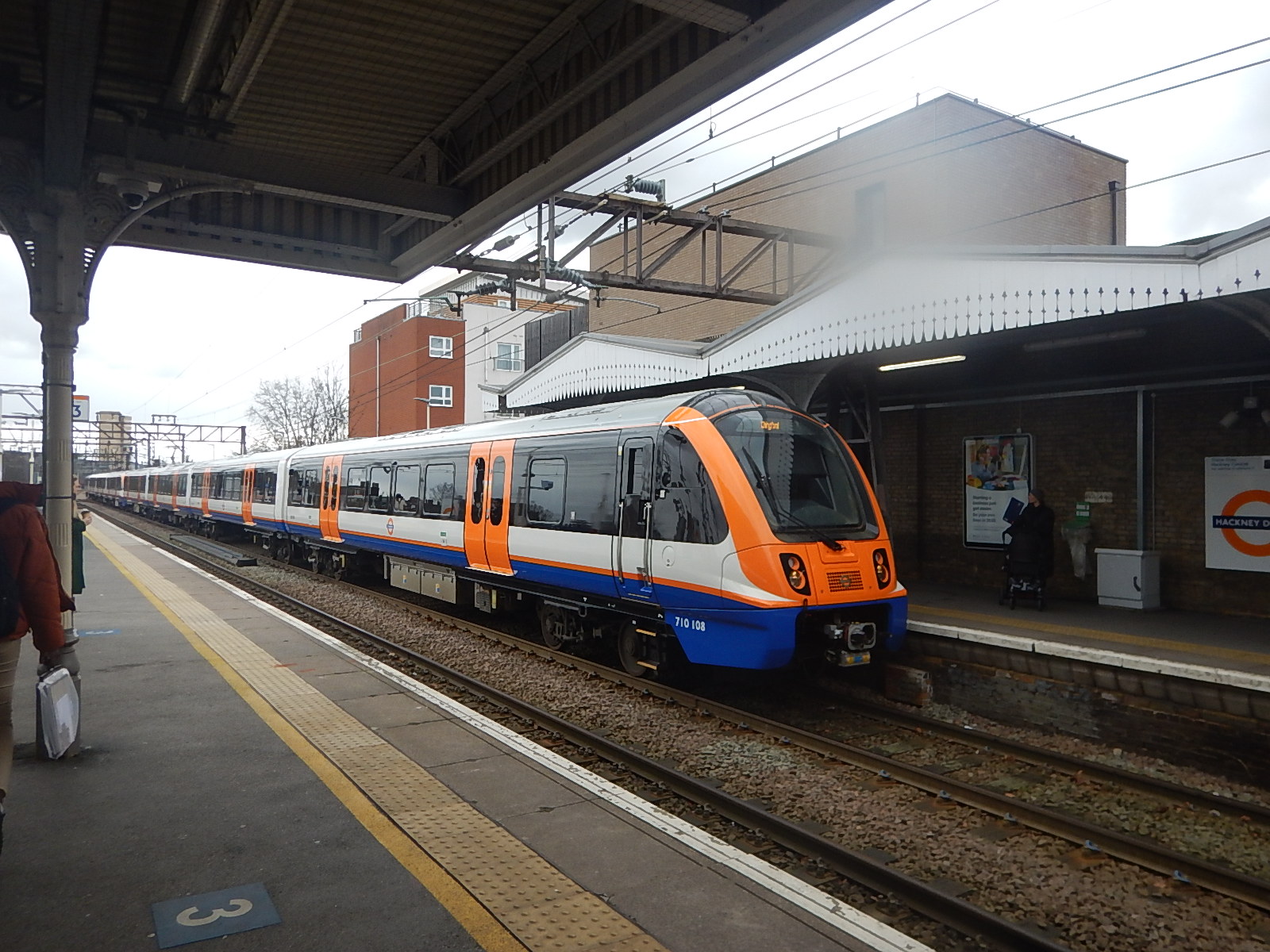
This picture shows a four-car Class 710 train, which is an Aventra.
In the next sub-sections I will fill out the design.
Train Layout
Perhaps, a hydrogen-powered train could be five cars and consist of these cars.
- Driver Motor Car
- Trailer or Motor Car
- Hydrogen Tank Car
- Trailer or Motor Car
- Driver Motor Car
Equipment would be arranged as followed.
- I would put the hydrogen tank in the middle car. Stadler have been very successful in putting a power car in the middle and it could be the ideal car for some of the important equipment.
- As I said earlier, I would put batteries under all cars.
- Regenerative braking and electrification would be used to charge the batteries.
- I think, I would put the hydrogen fuel cells in Alstom’s position on the rear part of the roof of the driver cars.
- There would also be a need to add a pantograph, so that could go on any convenient car!
- I do wonder, if the middle-car could be developed into a mini-locomotive with a walkway through, like the PowerCar in a Stadler Class 755 train.
There’s certainly a lot of possibilities on how to layout the various components.
Passenger Capacity
The five-car hydrogen-powered Aventra, I have detailed is effectively a four-car Aventra like a Class 710 train, with a fifth hydrogen tank car in the middle.
So the passenger capacity will be the same as a four-car Aventra.
The Class 710 trains have longitudinal seating, as these pictures of the interior show.
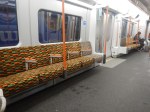

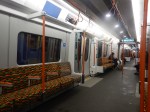
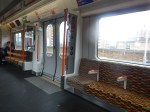
They have a capacity of 189 sitting and 489 standing passengers or a total capacity of 678.
Greater Anglia’s Class 720 trains have transverse seating and a five-car train holds 540 sitting and 145 standing passengers.
Multiplying by 0.8 to adjust for the hydrogen car and the capacity would be 432 sitting and116 standing passengers or a total capacity of 548.
Seats in various UK four-car electric multiple units are as follows.
- Class 319 – 319
- Class 321 – 309
- Class 375 – 236
- Class 379 – 209
- Class 380 – 265
- Class 385 – 273
- Class 450 – 264
It would appear that a five-car hydrogen-powered Aventra, with one car taken up by a hydrogen tank and other electrical equipment can carry a more than adequate number of passengers.
Extra Passenger Capacity
Suppose to eliminate diesel on a route, a five-car Class 802 train were to be replaced with a six-car hydrogen-powered Aventra, which contained five passenger cars
- The capacity of the Class 802 train is 326 seats, which still compares well with the five-car hydrogen-powered Aventra.
- The extra car would increase the passenger capacity.
As Aventras are of a Plug-and-Play design, extra cars would be added as needed.
Maximum Length
Aventras tend to have lots of powered axles, as this improves accelerations and braking, so I suspect that trains with four or five cars on either side of the hydrogen car would be possible.
Nine-car trains could be ideal for replacing trains like Class 800 bi-mode trains to reduce the number of diesel trains. The Class 800 trains would then be converted to Class 801 electric trains or a new battery/electric version.
A Walkway Through The Hydrogen Car
These pictures show the walkway through the PowerCar in a Stadler Class 755 train.


I’m sure that an elegant design of walkway can be created.
In-Cab Digital Signalling
It goes without saying, that the train would be capable of being fitted with in-cab digital signalling.
Performance On Electrification
Bombardier have stated that they have a design for a 125 mph bi-mode Aventra. They might even have designed the trains to achieve 140 mph running on routes with full in-cab digital signalling.
These electrified lines are likely to be able to support 140 mph running with full in-cab digital signalling.
- East Coast Main Line
- Great Western Main Line
- Midland Main Line
- West Coast Main Line
As these hydrogen-powered Aventras may need to run on these high speed electrified lines, I would design the trains so that they could achieve the design speed of these lines, when using the electrification.
This would enable the trains to keep out of the way of the numerous 140 mph electric expresses.
Performance On Batteries And Hydrogen
Hydrogen-powered trains are essentially battery-electric trains, which have the ability to top up the batteries using hydrogen power.
I would suspect that a well-designed hydrogen/battery/electric train should have the same maximum speed on all modes of power, subject to the capabilities of the track and having sufficient power in the batteries to accelerate as required.
The Complete Package
As Hydrogen filling stations from companies like ITM Power and others, that can refuel hydrogen-powered trains are a reality, I’m certain, that it would be possible to create a package solution for a railway company that needed the complete solution.
Different Gauges
If you take a country like Malawi, Malawi Railways looks to need improvement.
They have a three-foot six-inch gauge railway, so could a package of narrower hydrogen-powered Aventras and a solar-powered hydrogen-generator be put together to improve Malawi’s railways?
In When Do Mark 2 Coaches Accept The Inevitable?, I discuss how British Rail Mark 2 coaches were converted from UK loading gauge to one that would work with New Zealand’s 1067 mm. gauge.
So I suspect that a design related to trains built for the UK could be modified for running on the narrow gauge lines of Africa, Australia and New Zealand.
Conclusion
I think it would be possible to design a hydrogen/battery/electric train based on an Aventra with the following characteristics.
- Up to eleven cars
- A hydrogen car with a hydrogen tank in the middle of the train.
- Ability to use 25 KVAC overhead or 750 VDC third-rail electrification.
- In-cab digital signalling
- 140 mph running where the route allows.
- Regenerative braking to batteries.
- Sufficient range on hydrogen power.
- Sophisticated computer control, that swaps mode automatically.
The train would be possible to run the following routes, if configured appropriately.
- Kings Cross and Aberdeen
- Kings Cross and Inverness
- Kings Cross and Cleethorpes via Lincoln and Grimsby
- Kings Cross and Redcar via Middlesbrough
- Kings Cross and Norwich via Cambridge
- Paddington and Penzance
- Paddington and Swansea
- Waterloo and Exeter via Basingstoke
Some routes might need a section of fill-in electrification, but most routes should be possible with a hydrogen fill-up at both ends.
Alstom Coradia iLint Passes Tests
The title of this post is the same as that of this article on Railway Age.
This is the first paragraph.
Alstom has performed 10 days of tests of the Coradia iLint hydrogen fuel cell train—the world’s first passenger train powered by hydrogen fuel cells—on the 65-kilometer line between Groningen and Leeuwarden to the north of the Netherlands.
These details of the tests were given.
- No passengers were carried.
- The tests were done at night.
- A mobile filling station was used.
- The train ran up to a speed of 140 kph.
As green hydrogen was used, the tests were zero carbon.
The Test Route
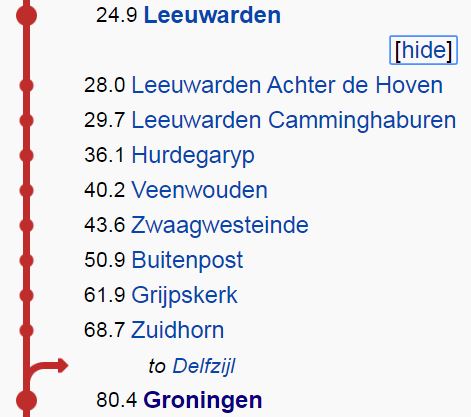
This map clipped from Wikipedia, shows the Groningen and Leeuwarden route, used for the tests.
Note.
- It appears to be only single-track.
- It is roughly 65 kilometres long.
- There are eight intermediate stops.
Checking the timetable, the service seems to be two or three trains per hour (tph)
Hydrogen Trains Could Go All The Way To Germany
In From Groningen To Leer By Train, I took a train and a bus from Groningen in The Netherlands to Leer in Germany and eventually on to Bremen Hbf. The route is not complete at the moment, as a freighter demolished the rail bridge.
Once the bridge is rebuilt, a hydrogen-powered train, which could also use the catenary in the area could travel from West of Leeuwarden to possibly as far as Bremen and Hamburg.
It is interesting to note, that Alstom’s hydrogen-powered trains for the UK, which are called Breeze and are currently being converted from British Rail-era Class 321 electric trains, will not lose their ability to use the overhead electrification.
A train with that dual capability would be ideal for the Dutch and German rail network in this area, which is partially electrified.l
Offshore Wind to Hydrogen Project Secures GBP 7.5 Million Funding
The title of this post is the same as that of this article on Offshore Wind.
This is the first two paragraphs.
The next phase of Gigastack, a renewable hydrogen project, has secured GBP 7.5 million funding as part of the UK’s Department for Business, Energy and Industrial Strategy (BEIS) Hydrogen Supply Competition.
The Gigastack project, led by ITM Power, Ørsted, Phillips 66 Limited, and Element Energy, will show how renewable hydrogen derived from offshore wind can support the UK’s 2050 net-zero greenhouse gas emission target.
Points from the article.
- A 100 MW system will be designed.
- Modules with a capacity of 20 MW will be used.
- Energy will be delivered directly from Ørsted’s Hornsea Two wind farm.
- Some of the hydrogen produced will be used in Phillips 66 Humber Refinery.
- ITM Power will trial their new electolyser and automatic manufacturing.
This seems an ambitious project.
World’s Largest Green Hydrogen Plant Begins Operation In Austria
The title of this post is the same as that of this article on Recharge.
This is the subtitle, which says it all.
The 6MW facility in Linz, running Siemens electrolysers, will provide clean H2 for steel production.
Steel-making is a large source of carbon-dioxide emissions and this is said about how hydrogen can be used in the process.
In light of global climate targets, Voestalpine is currently investigating the practicality of a hybrid technology to bridge between the existing coke/coal-based blast furnace route and electric arc furnaces powered with green electricity partly generated using green hydrogen,” says Voestalpine. “If economically feasible, from today’s perspective this option would reduce the group’s CO2 emissions by around a third sometime between 2030 and 2035.
I wouldn’t be surprised to see steel-makers beat that target, especially as renewable energy production and hydrogen electrolyser capacity increases.
The article also details two other large green hydrogen production electrolysers.
A 10MW PEM electrolysis plant, REFHYNE, is under construction at Shell’s Rheinland refinery in Wesseling, Germany, and is due to be completed in the second half of 2020, while a 30MW pilot — part of a 700MW project — is expected to be up and running in northwest Germany by 2025.
There’s more about REFHYNE on their web site.
This is the introduction on the web site.
The REFHYNE project is at the forefront of the effort to supply Clean Refinery Hydrogen for Europe. The project is funded by the European Commission’s Fuel Cells and Hydrogen Joint Undertaking (FCH JU) and will install and operate the world’s largest hydrogen electrolyser the Shell Rhineland Refinery in Wesseling, Germany.
The plant will be operated by Shell and manufactured by ITM Power. The electrolyser has a peak capacity of 10 MW (megawatts) and will be able to produce approximately 1,300 tonnes of hydrogen per year. This decarbonised hydrogen can be fully integrated into refinery processes including the desulphurisation of conventional fuels
Hydrogen is coming.
It could be coming in a big way to the UK, as we have the capability to generate gigawatts of off-shore wind power and ITM Power have the world’s largest PEM electrolyser factory in Rotherham.
Green Hydrogen ‘Cheaper Than Unabated Fossil-Fuel H2 by 2030’: Hydrogen Council
The title of this post is the same as this article on Recharge.
This is the introductory paragraph.
Clean hydrogen derived from renewable energy will be cost-competitive with highly polluting grey hydrogen within 5-10 years, says new report.
Points about or contained in the article.
- The report is by respected consultants; McKinsey.
- Currently grey hydrogen produced by steam reforming produces 9-12 tonnes of carbon dioxide for every tonne of hydrogen produced, at a cost of $1.5 per Kg.
- Green hydrogen produced by electrolysis using renewable energy, has a cost of $6 per Kg.
- In certain parts of the world, like Chile, Australia and Saudi Arabia, with strong winds and sunshine, prices for green hydrogen could drop to $1.20 per Kg.
- The article also talks about blue hydrogen, where the carbon dioxide is capyured and stored.
I suggest you read the article.
If you can’t be bothered just digest this paragraph.
The report adds that the blue and green hydrogen will be the cheapest options for many types of transport by 2030 — outperforming fossil fuels and battery power. These include long-distance buses, heavy- and medium-duty trucks, taxi fleets, regional trains and large passenger vehicles such as SUVs.
I can also envisage hydrogen being shipped around the world from the three countries named and others to countries like Germany,China and Japan, that need to decarbonise, in massive ships. Powered by hydrogen of course.
Artificial Photosynthesis Offers Clean Source Of Hydrogen
The title of this post, is the same as that of this article on The Engineer.
This is the first paragraph.
Devices made using conventional semiconductor technologies could make hydrogen using just fresh or saltwater and sunlight.
It would appear to be an interesting concept, but after reading the article, there is still a lot of research and development to be done before it is an affordable proposition.
But I do feel, it could be one of those technologies that are commonplace in a few decades.

