Opportunity For Communities To Have Their Say On National Grid Proposals For Norwich To Tilbury Project
The title of this post is the same as that of this press release from National Grid.
These three bullet points are sub-headings.
- National Grid is consulting communities for 10 weeks, between Wednesday 10 April to Tuesday 18 June, on its infrastructure proposals to connect new clean energy sources into the East Anglian electricity network.
- Norwich to Tilbury will enable National Grid to connect the sources of power generated from offshore wind to homes and businesses across Britain, helping to reduce our reliance on fossil fuels and bring the cost of energy bills down.
- The project will help the UK achieve its aim of generating 50GW of energy from offshore wind by 2030 and reach net zero by 2050.
This page on the National Grid web site has an interactive map of the route.

This paragraph invites people to comment.
National Grid is encouraging communities in East Anglia to comment on proposals to upgrade the high voltage power network in England as part of a 10-week consultation process which runs between Wednesday 10 April and Tuesday 18 June.
National Grid have also announced dates of when public information events are being held.
- Wednesday 24 April 2024 – 12pm – 5pm – Towngate Theatre, St Martin’s Square, Basildon, Essex SS14 1DL
- Thursday 25 April 2024 – 2pm – 7pm – The Brentwood Centre, Doddinghurst Road, Pilgrims Hatch, Brentwood, CM15 9NN
- Saturday 27 April 202 – 11am – 4pm – Chelmsford City Racecourse, Chelmsford, CM3 1QP
- Tuesday 30 April 2024 – 12pm – 5pm – Gislingham Village Hall, Mill Street, Gislingham, IP23 8JT
- Wednesday 1 May 2024 – 11am – 4pm – Copdock Village Hall, Old London Road, Copdock, IP8 3JN
- Friday 3 May 2024 – 1pm – 6pm – Needham Market Community Centre, School St, Needham Market, Ipswich IP6 8BB
- Saturday 4 May 2024 – 11am – 4pm – Lawford Venture Centre 2000, Bromley Road, Lawford, Manningtree CO11 2JE
- Wednesday 8 May 2024 – 4pm – 7pm – The Civic Hall, Blackshots Lane, Grays, RM16 2JU
- Thursday 9 May 2024 – 1pm – 6pm- Thorpe Hall, Ashwell Thorpe and Fundenhall Community Centre, Muskett Road, Ashwellthorpe, NR16 1FD
- Friday 10 May 2024 – 1pm – 6pm – Tibenham Community Hall, Pristow Green Lane, Tibenham, Norwich NR16 1PX
- Tuesday 14 May 2024 – 11am – 4pm – Witham Public Hall, Collingwood Road, Witham, CM8 2DY
- Wednesday 15 May 2024 – pm – 6pm – Diss Town Football Club, Diss, IP22 4QP
- Thursday 16 May 2024 – 2pm – 7pm – Langham Community Centre, School Road, Langham, Colchester, CO4 5PA
- Friday 17 May 2024 – 1pm – 6pm – Great Bromley Village Hall, Parsons Hill, Great Bromley, Colchester, CO7 7JA
I shall be going to the Brentwood and Needham Market meetings.
I have some thoughts.
T-Pylons
There is a chance that this route will not use conventional pylons.
These pictures show the T-pylons, that have been used in Somerset to connect Hinckley Point C power station to the National Grid.


Note.
- They are a Danish design.
- They are shorter than current pylons.
- They have a smaller footprint on the ground.
- The design won a National Grid-RIBA design competition.
- We will probably see them around the country in the next few years.
They are certainly better than the standard ones that connect the Sizewell site to the National Grid, that passed by my first house in Suffolk.
Network Rail Prepares To Send Four Trains A Night Through Suffolk To Sizewell
The title of this post, is the same as that of this article on the East Anglian Daily Times.
These are the first two paragraphs.
There will be improvements to the East Suffolk Line between Ipswich and Saxmundham and to the little-used Leiston branch line which will become busier with up to four trains a night carrying construction materials to the Sizewell C site.
However there are no plans at present to create a new passing loop at Wickham Market which would be needed to allow construction trains to travel by day so most of these trains will have to use the line at night.
Note.
- Trains access the Sizewell site from Saxmundham junction on the East Suffolk Line.
- Between Saxmundham and Halesworth stations is double track.
- With the exception of a passing loop at Beccles station between Halesworth and Lowestoft stations is single track.
- Saxmundham junction and Lowestoft station is 26.2 miles.
- Between Saxmundham and Woodbridge stations is mainly single track.
- Between Woodbridge and Ipswich stations is double track.
- Saxmundham junction and Ipswich station is 22.8 miles.
It is a classic line, that was partly singled by British Rail to try and cut operating costs.
A passing loop at Wickham Market could make operation of the line easier.
- The last train in the evening leaves Saxmundham station at around 23:00 for Lowestoft.
- The first train in the morning leaves Saxmundham station at around 06:00 for Ipswich and Harwich International.
This would give a seven hour window in which to move four trains out of the Sizewell site and four trains in.
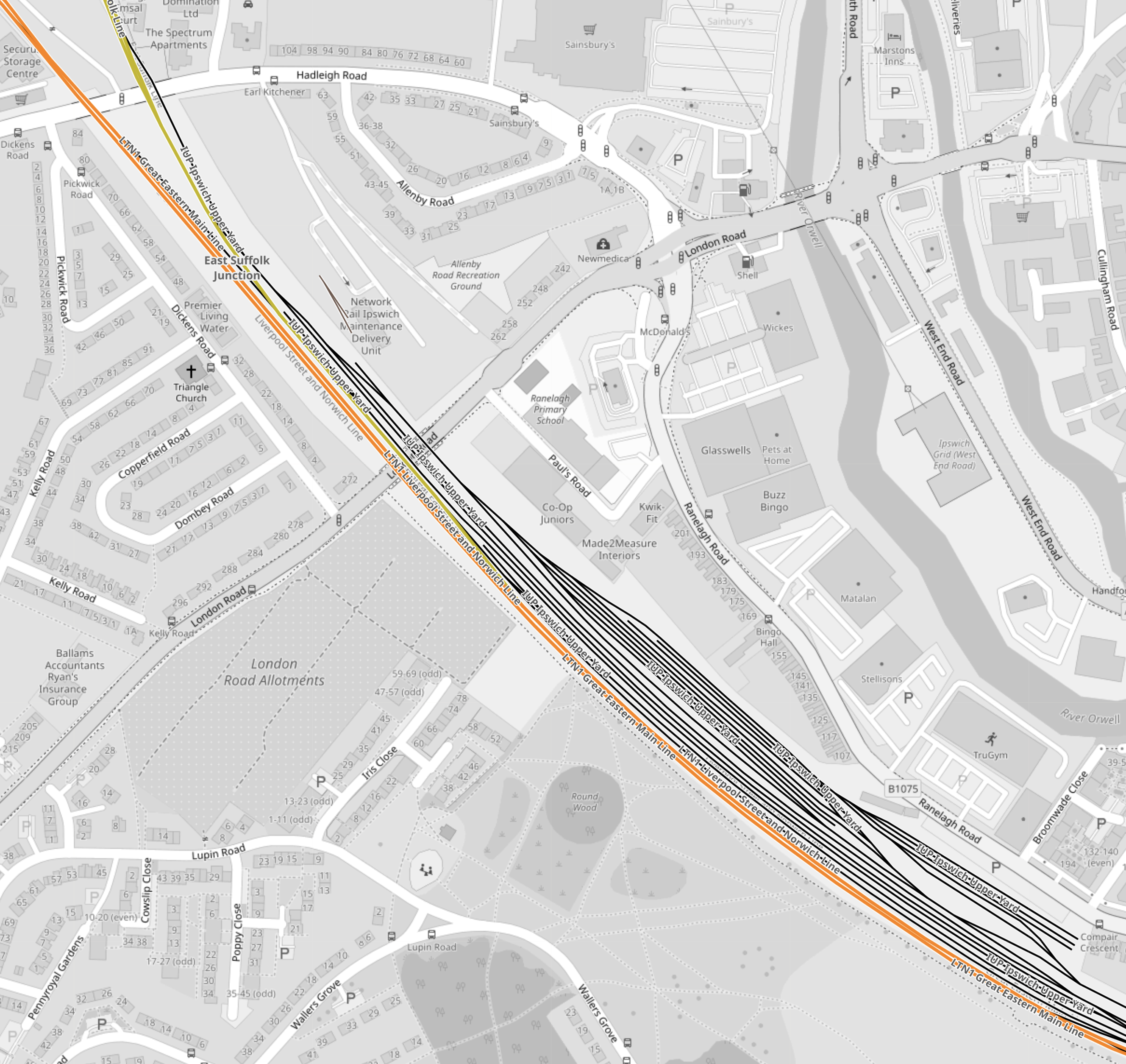
This OpenRailwayMap shows Ipswich Yard which is a set of freight sidings to the North of Ipswich station.
Note.
- The orange tracks are the Great Eastern Main Line.
- Ipswich station is just off the map to the South-East.
- The yellow track in the North-West corner is the East Suffolk Line to Saxmundham and Sizewell.
- The black lines diagonally across the map is Ipswich Yard, where wait if required, when coming out or going into the Port of Felixstowe.
I would expect that trains destined for Sizewell will wait in Ipswich Yard before being moved in at night.
These are my further thoughts.
Moving Trains Into And Out Of The Sizewell C Site
A map of the proposed rail layout in the Sizewell C site was published in the February 2019 Edition of Modern Railways showed at least four sidings in the site.
- We can assume that at the beginning of each night, there are.
- Up to four trains in the Sizewell C site, that need to come out of the site.
- Up to four trains in Ipswich Yard, that need to enter the site.
- As each train leaves the Sizewell C site, it creates a free siding for the next incoming train.
The process could be started by the four trains in the Sizewell C site, leaving nose-to-tail like a herd of elephants, but perhaps five minutes apart.
The outgoing trains would then park-up in Ipswich Yard or position themselves to get ready to bring in the next load.
Once all the outgoing trains, were clear of the Sizewell site, the four incoming trains, could trundle into the site.
Note.
- Effectively, there would be a night-time single-track railway exclusively handling freight trains into and out of the Sizewell C site, between the site and Ipswich Yard.
- With more sidings on the Sizewell C site, the limit could be higher than the currently proposed four trains per night in each direction.
- The number of and length of the trains could be adjusted, so that the deliveries of materials to the site, were in an optimal manner, which hopefully would increase the efficiency of the construction.
- There are twenty level crossings between Ipswich and Saxmundham junction and another five between Saxmundham junction.
Did poor delivery performance contribute to cost and time overruns at the more difficult-to-support, rail-isolated Hinckley Point C power station?
Conclusion
I am fairly certain, that it is possible to move four freight trains in and out of the Sizewell site during the night, without doing any major works to the East Suffolk Line between Ipswich and Saxmundham junction.
- Adding extra track at Wickham Market would probably cause major disruption.
- Some level crossings will probably be improved.
But without a full double track between Ipswich and Saxmundham junction, I doubt there could be any increase in passenger services.
UK Energy Grid Needs £60bn Upgrade To Hit Green Target, Plan Says
The title of this post, is the same as that of this article on the BBC.
This is the sub-heading.
The UK’s electricity network needs almost a further £60bn of upgrades to hit government decarbonisation targets by 2035, according to a new plan.
These five paragraphs explain the plan.
About 4,000 miles of undersea cables and 1,000 miles of onshore power lines are needed, said the National Grid’s Electricity Systems Operator (ESO).
The investment would add between £20 to £30 a year to customer bills, it said.
The government said the ESO’s plans were preliminary and yet to pass a “robust planning process”.
The plans were written up by the ESO, the organisation which runs the electricity network and would run the updated system it is calling for too. It is currently owned by National Grid but will transfer into government ownership later this year.
Its latest £58bn estimate is for work needed between 2030 and 2035 and comes on top of a previous £54bn estimate for work taking place between now and 2030.
These are my thoughts.
The Amount Of Undersea Cable
Edinburgh and London are roughly 400 miles apart as the train runs, so it looks like there could be the equivalent of ten underwater cables between the North of Scotland and England.
In Contracts Signed For Eastern Green Link 2 Cable And Converter Stations, I talked about the proposed 2 GW link between Peterhead in Scotland and Drax in England, which will be a double cable. So there’s the first two of these long cables.
It looks to me, that National Grid are proposing to use underwater cables wherever they can, so they avoid large expensive planning rows stirred up by Nimbies.
Monitoring The Undersea Cables
Last week Ofgem gave National Grid a £400,000 grant to develop new innovative technologies, which I wrote about in £400k For National Grid Innovation Projects As Part Of Ofgem Fund To Help Shape Britain’s Net Zero Transition.
One of the project is called HIRE – Hybrid-Network Improvement & Reliability Enhancement and will be used to check all these cables are performing as they should.
My electrical engineering experience tells me, that there must be some cunning way, that will detect that something is happening to the cable. The involvement of a technology company called Monitra in the project is a bit of a giveaway.
How Much Will It Cost Me?
Currently, UK consumers pay about £30 per year to have electricity delivered, so this will rise to between £50 and £60 per year.
That is just over a pound a week. I would pay about the same for a resident’s parking permit outside my house for an electric car and probably three times more for a petrol or diesel car.
Do We Have Enough Cable?
Two undersea cable factories are under development in Scotland and I suspect the 4,000 miles of undersea cables will be delivered on schedule and covered in saltires.
What About T-Pylons?
The latest onshore electricity transmission line between Hinckley Point C and Bristol, doesn’t use traditional pylons.
It uses T-pylons like these to connect the 3.26 GW nuclear power station.
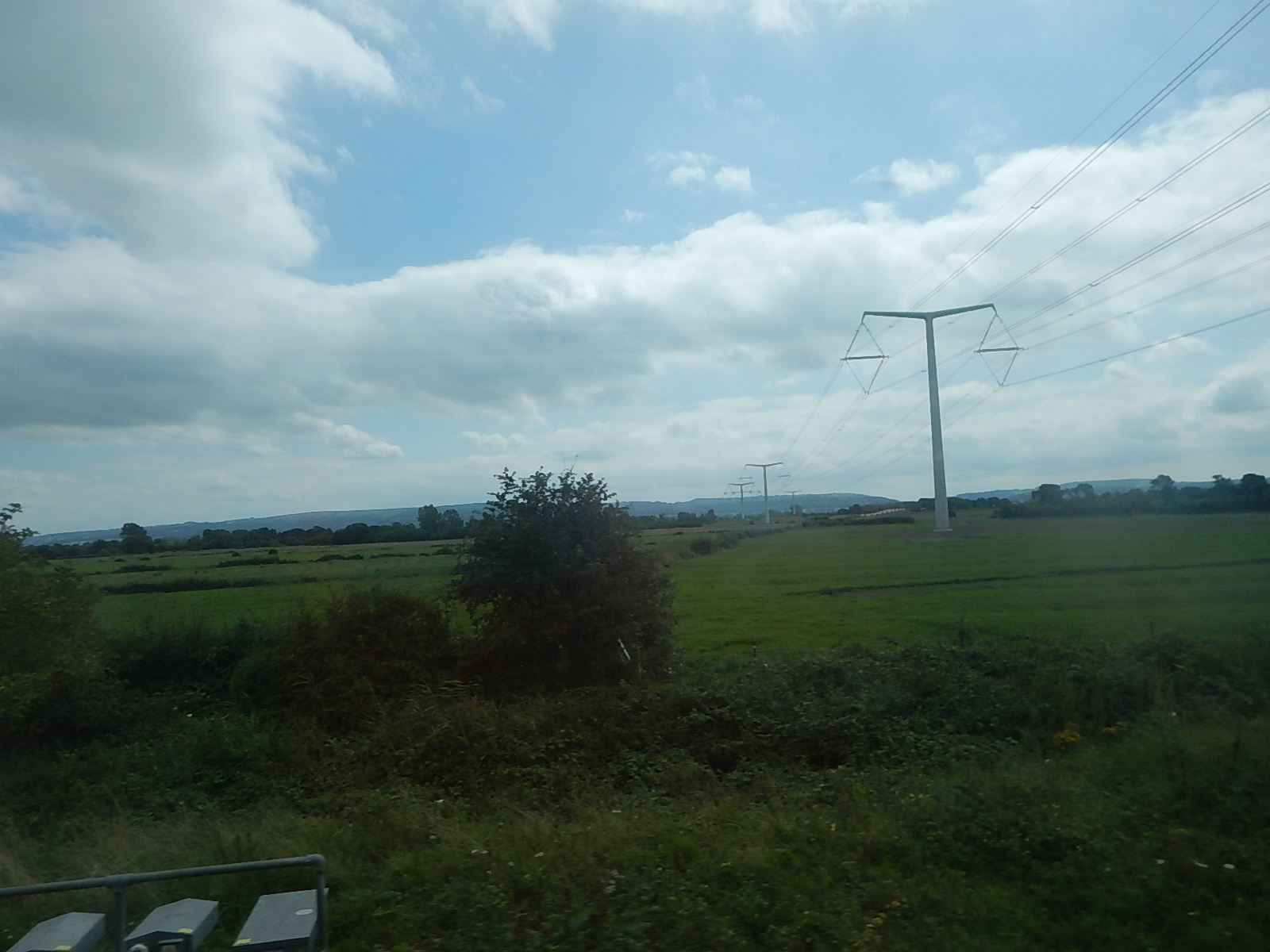
Note that they are shorter, designed to be less intrusive, have a smaller footprint and are made from only ten parts.
I suspect they will cost less to install and maintain.
There is more on T-pylons in National Grid Energise World’s First T-Pylons.
I wouldn’t be surprised that some of the oldest traditional pylons will be replaced by T-pylons.
I am surprised that T-pylons are not mentioned in the BBC article.
I like T-pylons. How do you feel about them?
Eastern Green Link 2
This press release from National Grid, describes Eastern Green Link 2 like this.
Eastern Green Link 2 (EGL2) is a 525kV, 2GW high voltage direct current (HVDC) subsea transmission cable from Peterhead in Scotland to Drax in England delivered as a joint venture by National Grid and SSEN Transmission.
This map from National Grid, shows the route of the Eastern Green Link 2.

The Northern landfall is at Sandford Bay and the Southern landfall is at Wilsthorpe Beach.
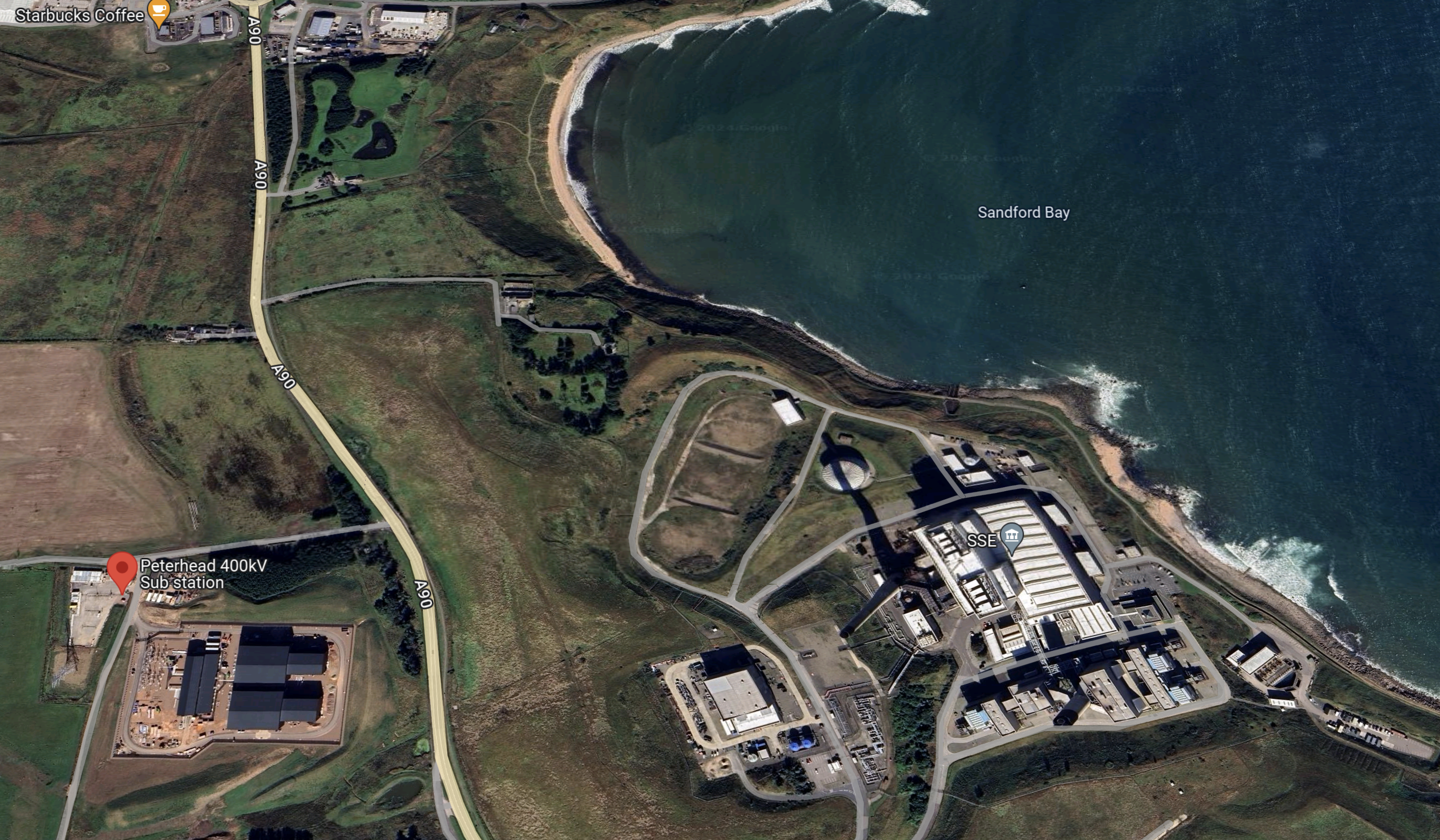
This Google Map shows Sandford Bay and Peterhead power station.
Note.
- Sandford Bay occupies the North-East corner of the map.
- The red arrow indicates the main 400kV sub-station at Peterhead.
- The 2177 MW gas-fired Peterhead power station is to the East of the sub-station marked as SSE.
This second Google Map shows the onshore route of the cable from Wilsthorpe to Drax.

Note.
- Flamborough Head is in the North-East corner of the map.
- Wilsthorpe Beach is at Bridlington a couple of miles South of Flamborough Head.
- The red arrow indicates Drax Power station.
- An onshore underground cable will be installed from landfall in Wilsthorpe to a new onshore converter station built in Drax.
The EGL2 HVDC cable connection from Scotland to England consists of 436km of submarine cable and 69km of onshore cable.
Both converter stations will be on existing power station sites and the major onshore works will be the underground cable between Wilsthorpe and Drax.
Where Does Drax Go From Here?
Currently, Drax power station is a 2595 MW biomass-fired power station.
There are now other large power sources that could replace some or all of the output of Drax power station.
- 2GW of Scottish wind power coming to Drax on Eastern Green Link 2.
- 6 GW of offshore wind is being developed at the Hornsea wind farms.
- 8 GW of offshore wind is being developed at the Dogger Bank wind farms.
- 2.5 GW from the three gas-fired power stations at Keadby, two of which are likely to be fitted with carbon capture.
- 1.8 GW from the proposed hydrogen-fired Keadby Hydrogen power station.
Given the bad feelings many have about Drax burning biomass, with 20.3 GW of electricity, you might think that shutting down Drax would be a simple solution.
But, according to Drax’s Wikipedia entry, it has a unique property.
Despite this intent for baseload operation, it was designed with a reasonable ability for load-following, being able to ramp up or down by 5% of full power per minute within the range of 50–100% of full power.
So Drax could be very useful in balancing the grid, by ramping up and down to fill the gap between production and need.
In addition, there is good biomass. This is from the Wikipedia entry.
A 100,000 tonne pa capacity straw pelletization facility was constructed at Capitol Park, Goole in 2008.
Drax are also promoting BECCS or Bioenergy carbon-capture and storage.
There is a Wikipedia entry for Bioenergy With Carbon Capture And Storage, of which this is the first couple of sentences.
Bioenergy with carbon capture and storage (BECCS) is the process of extracting bioenergy from biomass and capturing and storing the carbon, thereby removing it from the atmosphere. BECCS can theoretically be a “negative emissions technology” (NET).
I do feel that carbon capture and storage is a bit like sweeping the dust under the carpet, when you sweep the floor around it.
But carbon capture and use could be another matter.
This Google Map shows the Drax site.

Note how it is surrounded by agricultural land.
Could the power station be the source of pure carbon dioxide to be fed in greenhouses to flowers, herbs, salad vegetables, tomatoes and other plants?
I suspect there’s productive life left in Drax power station yet!
LionLink
LionLink, that is being developed by National Grid is a new type of interconnector, called a multi-purpose interconnector, that will connect Suffolk and The Netherlands via any convenient wind farms on the way. This means that the electricity generated can go where it is needed most.
I wrote about LionLink in World’s Largest-Of-Its-Kind Power Line To Deliver Clean Power To 1.8m UK Homes And Boost Energy Security.
Other Multi-Purpose Interconnectors
I can see other multi-purpose interconnectors like LionLink being built around the UK.
- There could be one across the Dogger Bank to link out 8 GW of Dogger Bank wind farms with those of the Dutch, Danes and Germans on their section of the bank.
- NorthConnect could be built between Scotland and Norway via some of the wind farms being developed to the North-East of Scotland.
- Could wind farms to the North of Ireland use a multi-purpose interconnector between Scotland and Northern Ireland.
- I can also see one or possibly two, being built across the Celtic Sea to link Devon, South Wales and Southern Ireland via the wind farms being developed in the area.
- Will we also see a Channel multi-purpose interconnector to transfer electricity along the South Coast of England?
Some of these multi-purpose interconnectors could be key to creating a revenue stream, by exporting electricity, to countries in Europe, that have a pressing need for it.
Conclusion
National Grid’s excellent plan will lead to the end of the practice of shutting down wind turbines. The spare electricity will be exported to Europe, which will surely create a good cash-flow for the UK. This in turn will encourage developers to create more wind farms in the seas around the UK’s coasts.
UK Onshore Wind Capacity Hits 15GW
The title of this post, is the same as that of this article on reNEWS.BIZ.
This is the sub-heading.
Milestone reached after 30MW West Benhar project entered operations.
These are the first three paragraphs.
RenewableUK has revealed the UK has installed 15,000MW of operational onshore wind capacity.
The project which enabled the UK to cross the threshold was EDF Renewables UK’s 30.1MW West Benhar onshore wind farm in North Lanarkshire, consisting of seven turbines.
The UK now has 2631 operating onshore wind schemes.
These are my thoughts.
I Am Surprised At The Total Of Onshore Wind
The title says it all.
But 15 GW is almost the same power as five big nuclear power stations, the size of the running-late Hinckley Point C.
Should Some Strategically-Placed Battery Energy Storage Systems (BESS) Be Added?
Some wind farms have been built with wind farms and I very much feel, that with some mathematical modelling some excellent BESS sites could be found.
We should also use batteries, so that no wind farm is ever shut down, because too much wind is being generated.
Where Is West Benhar?
West Benhar wind farm has a web site, where this is the sub-heading.
West Benhar is a 7 turbine wind farm capable of powering up to 18,000 homes located near Shotts in North Lanarkshire.
It was opened on 28 February 2024.
This Google Map shows the location of West Benhar between Edinburgh and Glasgow.
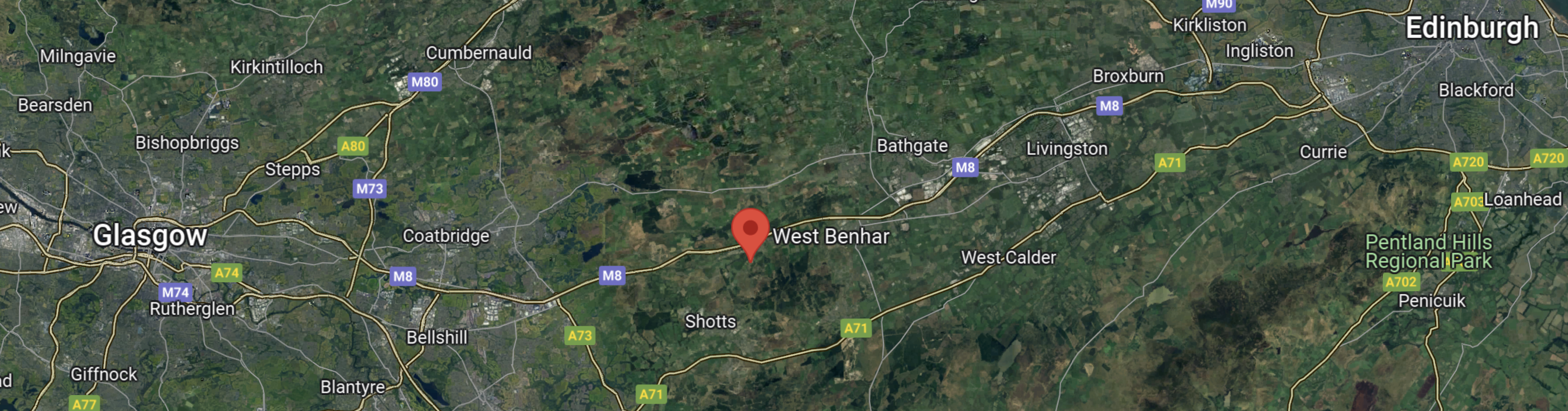
West Benhar is North-East of Shotts and just South of the M8.
There’s More Onshore Wind To Come
These onshore wind farms appear to have Contracts for Difference, but have not been completed.
- Arecleoch Wind Farm Extension – 72.8 MW – Completion 2024/25
- Broken Cross – 48 MW – Completion 2024/25
- Chirmorie – 81.6 MW – Completion 2024/25
- Cumberhead West – 126 MW – + 40 MW BESS – Completion 2024/25
- Douglas West Extension – 78 MW – Completion 2024/25
- High Constellation – 50 MW – Completion 2024/25
- Kilgallioch Windfarm Extension – 51.3 MW – Completion 2024/25
- North Kyle – 206 MW – Completion 2024/25
- Stornoway – 200 MW – Completion 2024/25
- Stranoch – 84 MW – Completion 2024/25
- Viking – 443 MW – Completion 2024
All of these are in Scotland.
But that’s another 1,440.7 MW of onshore wind.
Community Wind Funds
Scotland seems to be continuing to build onshore wind farms.
Could it be that communities have seen the benefits of Community Wind Funds?
This is said about the fund at Stronach.
When operational, EDF Renewables will provide a community benefit fund in line with the Scottish Government Good Practice Principles for Community Benefits from Onshore Renewable Energy Developments. The fund value for the community benefit fund would be £5,000 per megawatt for the lifetime of the wind farm. In the coming months we will begin to form a Community Liaison Group with local interested parties to decide how the funds will be disseminated once the wind farm becomes operational.
If the fund is yearly, then £420,000 is not money to be sneezed at!
Conclusion
It looks like in Scotland that Community Wind Funds promote the building of onshore wind.
LionLink: Proposed Windfarm Cabling Sites In Suffolk Are Revealed
The title of this post, is the same as that of this article on the BBC.
This is the sub-heading.
National Grid has revealed where it wants to build energy infrastructure for cabling between the UK and the Netherlands.
These four paragraphs describe the project.
The power line, called LionLink, would connect offshore wind farms in the North Sea.
The energy company wants the cables to reach land at either Walberswick or Southwold, both in Suffolk.
A converter station would be built on the outskirts of nearby Saxmundham and could cover a six-hectare area.
That would then connect to a substation being built at the village of Friston, also in Suffolk, as part of the offshore wind plans.
But the plans have brought the Nimbies out in force.
This Google Map shows the Suffolk Coast, to the South of Southwold.
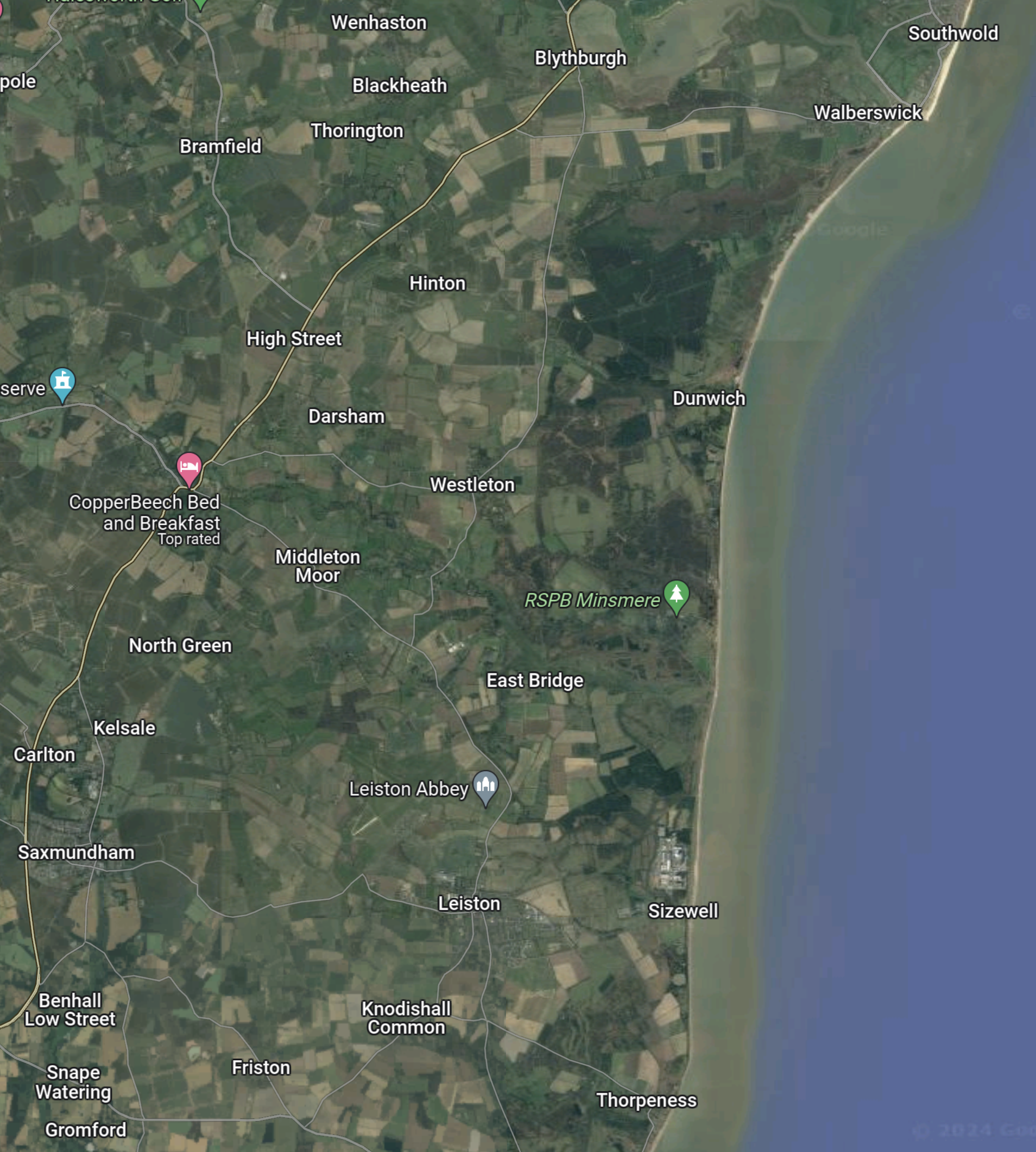
Note.
- Southwold and Walberswick in the North-East corner of the map.
- Saxmundham is just up from the South-West corner of the map, with Friston to its East.
- Sizewell with the 1.2 GW Sizewell B nuclear power station is on the coast directly East of Saxmundham.
- Sizewell B is planned to be joined by the 3.2 GW Sizewell C nuclear power station.
- LionLink is likely to have a capacity of 2 GW.
- I also believe that at least another GW of offshore wind power will be squeezed in along this section of coast.
The Sizewell site is connected to the National Grid at Bullen Lane substation to the West of Ipswich.
These pictures show the pylons that were built in the 1960s to connect Sizewell A to the National Grid.





I doubt, they would be allowed to be erected today.
One alternative would be to use T-pylons, like these built to connect Hinckley Point C to the National Grid.

There is more on T-pylons in this press release from National Grid, which is entitled National Grid Energise World’s First T-Pylons.
This Google Map shows the area between Ipswich and the coast.
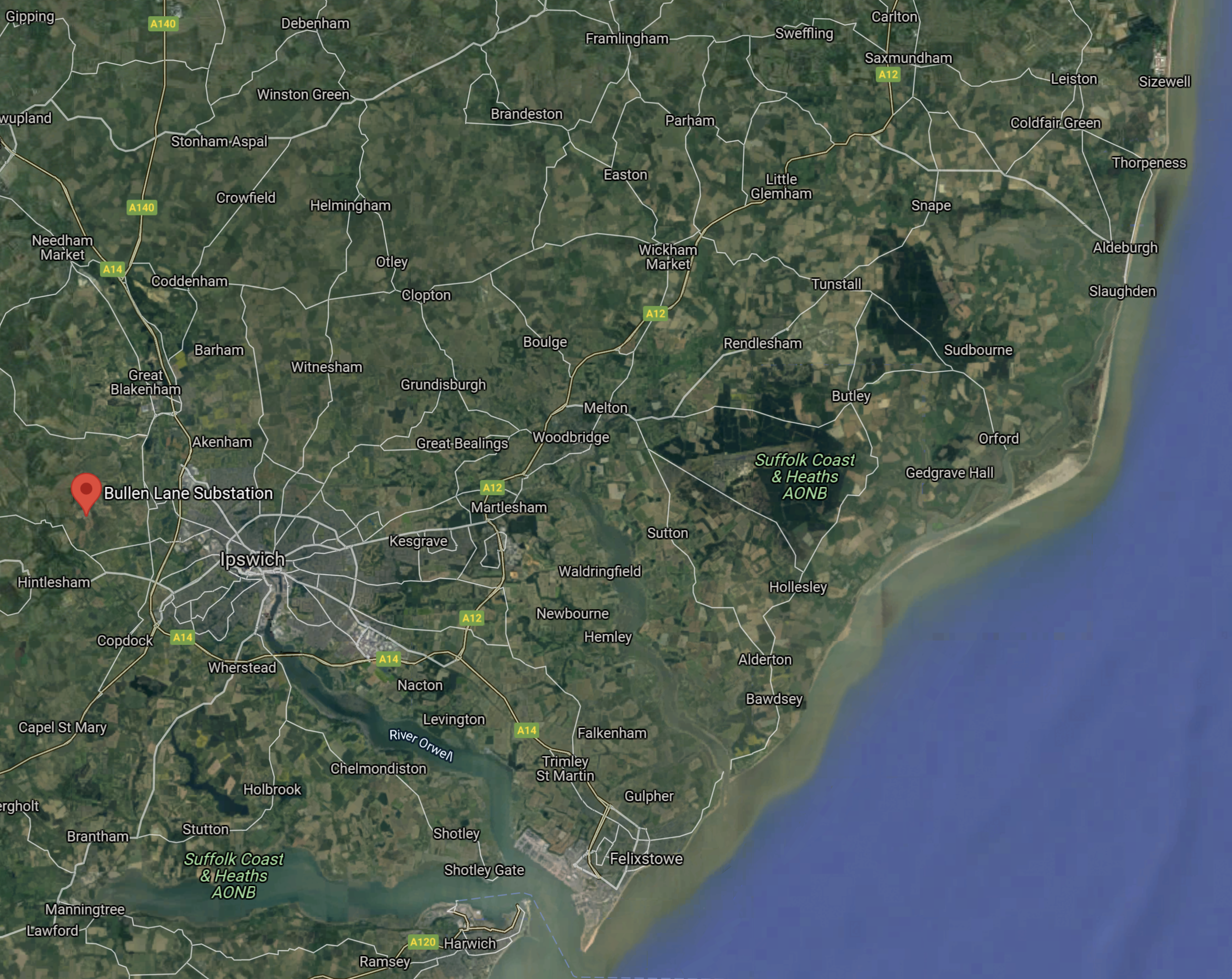
Note.
- Sizewell is in the North-East corner of the map.
- Felixstowe, Harwich and Freeport East are at the mouth of the rivers Orwell and Stour.
- The Bullen Lane substation is to the West of Ipswich and shown by the red arrow.
Looking at maximum power flows in Suffolk and Somerset, we get.
- North-East Suffolk to the National Grid at Bullen Lane – 7.4 GW.
- Hinckley Point C to the National Grid – 3.26 GW.
I am led to the conclusion, that there need to be a doubling of the pylons between North-East Suffolk and Bullens Lane.
I can understand why the Nimbies have been aroused.
I believe that National Grid will have to take the undersea route along the coast of Essex and Suffolk, to get the electricity to its markets.
UK’s Green Power Industry Receives Surprise £10bn Pledge
The title of this post, is the same as that of this article in the Guardian.
This is the sub-heading.
Potential investment by NatPower would create largest portfolio of battery storage projects in Britain
These five paragraphs outline the proposed investment.
Britain’s under-pressure green power industry has received a surprise fillip after a renewables developer pledged to plough £10bn into what would become the largest portfolio of battery storage projects in the country.
NatPower, a UK startup that is part of a larger European energy group, is poised to submit planning applications for three “gigaparks”, with a further 10 to follow next year.
Battery storage projects are seen as a key part of the jigsaw to decarbonise Britain’s power grid, allowing electricity generated by wind turbines and solar panels to be stored for use when weather conditions are still or not sunny.
The NatPower investment would lead to the construction of 60 gigawatt hours of battery storage, with solar and wind projects also in the pipeline.
The two gigaparks would be located in the north of England, with a further site in the west of the country planned later this year. The projects would be built on industrial land, and also through leasing deals with farmers.
Note.
- To gauge the scale of this development; the largest energy storage development in the UK at present is SSE Renewable’s massive Coire Glas pumped storage hydro in the Highlands of Scotland, which is a 1.5 GW/30 GWh monster, that is budgeted to cost £1.5 billion.
- NatPower has a web site, which has an opening video, which is all landscape, sun, water and wind, that would be worthy of an epic from Hollywood or by Eisenstein.
- NatPower’s investment of £10 billion, buys them 60 GWh of storage and if it’s a proportionate amount of capacity to Coire Glas, perhaps around 3GW or around the capacity of Hinckley Point C.
I have a few thoughts.
Is It All A Hoax?
Those who were alive and sober in 1977, may well remember the April Fools’ Day Hoax of the Guardian of that year, which concerned a fake supplement in the paper promoting the island of San Serriffe.
The story has its own Wikipedia entry.
The web site; http://www.sanserriffe.com, doesn’t seem to be accessible.
Today’s story seems genuine, although some will smell a rat.
Hinkley Point C Fish Protection Plans Attacked By Environmental Organisations
The title of this post, is the same as that of this article on New Civil Engineer.
This is the sub-heading.
Revised plans to protect fish from water intake tubes for the Hinkley Point C nuclear power plant on the Severn Estuary have come under fresh criticism from environmental organisations.
These three paragraphs outline the story.
EDF recenrly proposed plans to create a saltmarsh at the Somerset nuclear plant site as an alternative to an acoustic fish deterrent. This followed the Environment Secretary having ruled in 2021, in line with Environment Agency recommendations, that the plant should install an acoustic fish deterrent.
The plant is scheduled to circulate 120,000l of water per second from the Bristol Channel to the nuclear power station through 8km underground tunnels to provide cooling for the power station’s systems.
A group of environmental non-governmental organisations (eNGOs) issued a statement coordinated by Somerset Wildlife Trust saying Hinkley Point C “will have a significant impact on marine and migratory fish including already vulnerable Atlantic salmon, twaite shad and European eel over its lifetime”.
This Google Map shows Lake Michigan, which was where I came across another tale of fish and nuclear power.
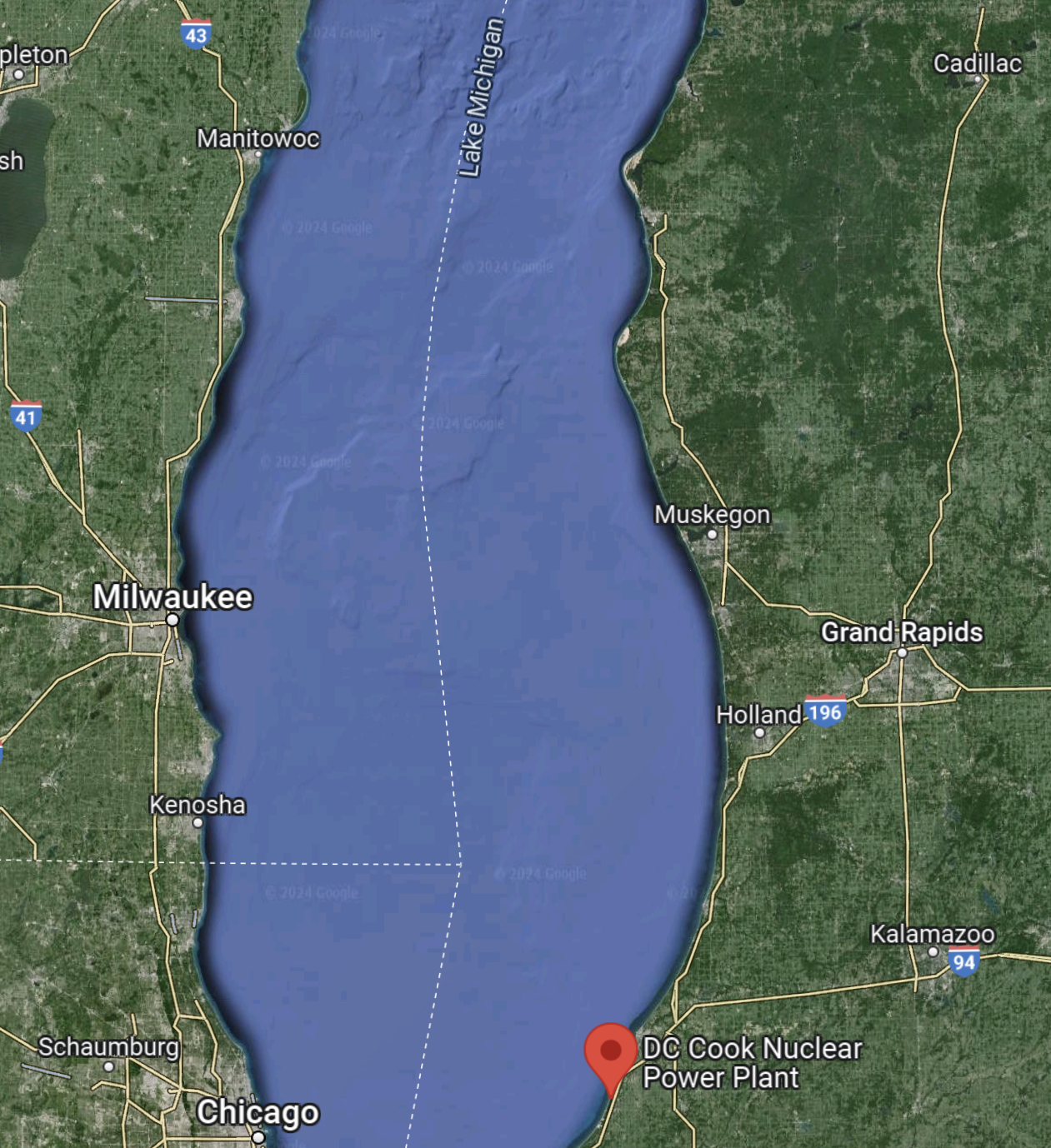
Note the red arrow, which marks the DC Cook Nuclear Power Plant.
This second Google Map shows a close-up of the plant.
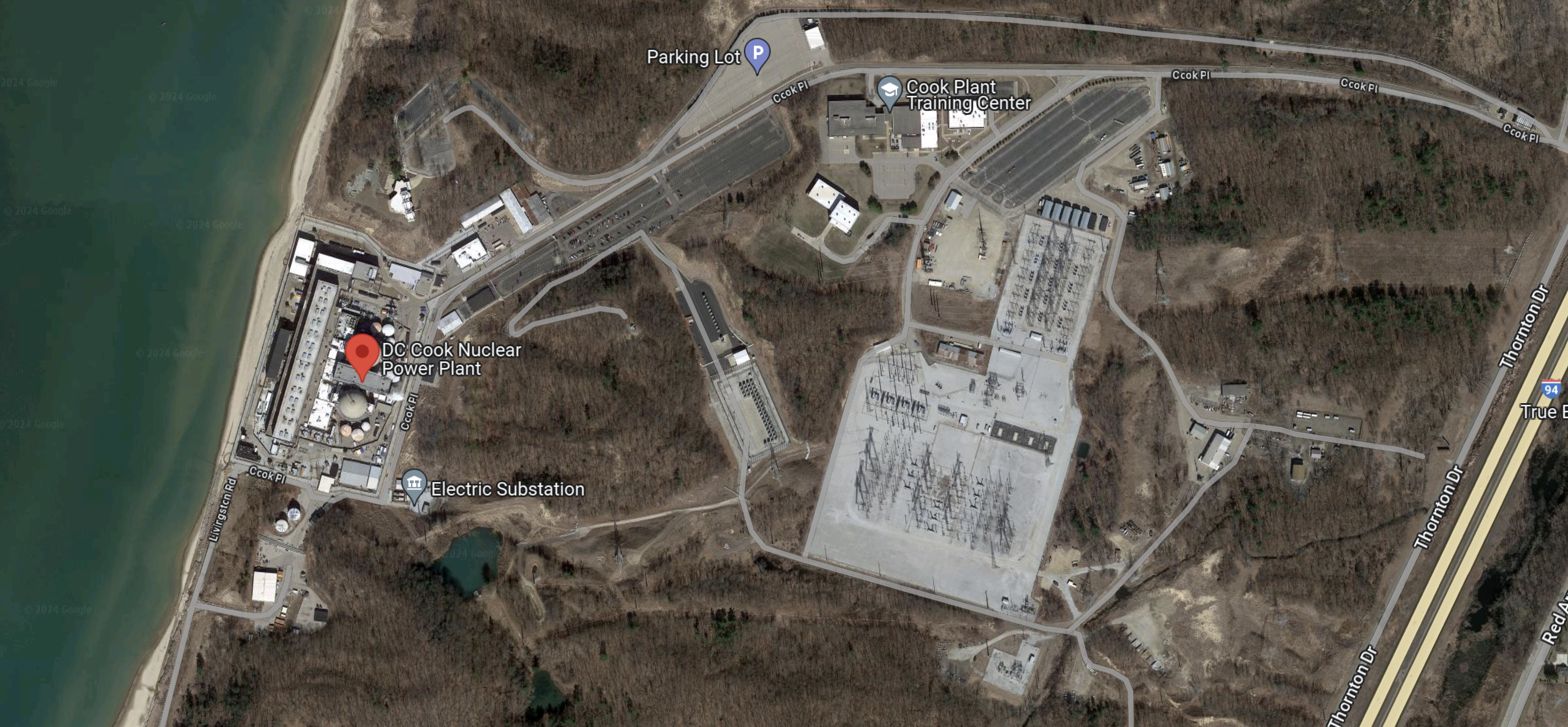
The power plant sits on the shores of Lake Michigan, from which it gets its cooling water.
In the early 1980s, after the Three Mile Island accident in 1979, I was given a tour of two nuclear power stations of which this plant was one and Shippingport or Beaver Valley was the other. Both were Artemis customers and one of the projects they were using the software on, was to plan and document all the Three Mile Island modifications or TMIs.
But it’s the Cook power plant that I remember.
- I’d turned up at Benton Harbor Airport on a very cold, snowy evening and I remember that the Hertz representation had got all the cars running so customers could drive away in the warm.
- DC Cook was impressive and very well run, and it was a very good customer visit.
- The fishy tale, I heard there was that the warm water from the power station attracted the fish and that some locals in the winter took to fishing through the ice of Lake Michigan. Occasionally, they fell through the ice.
- I was told, that some locals felt that the plant should be shut because of this, but it’s still running forty years after my visit.
- Lunch was interesting, as we went to a Michigan version of the famous Rook restaurant in the Two Ronnies. Except that every dish on the menu had something to do with beans, as that is the area of the US, where navy (baked) beans are grown. They even had a bean savoury for afters!
This article from the Huron Daily Tribune is entitled Fish Force Michigan Nuke Plant Shut Down, where these are the first two paragraphs.
Officials shut down a nuclear power plant on the eastern shore of Lake Michigan on Thursday after a large number of fish swam into the plant’s cooling-water system.
The two reactors at Donald C. Cook Nuclear Plant were idled as workers removed the fish and monitored the cooling system. It wasn’t clear when the reactor would be restarted, owner and operator American Electric Power Co. Inc. said in a statement.
It does appear that Cook was suffering from fish in the system.
I hope this doesn’t predict more delays for Hinckley Point C.
Teesside Private SMR Nuclear Power Station To Be Built
The title of this post, is the same as that of this article on the BBC.
This is the sub-heading.
An agreement has been reached to build a privately financed nuclear power station in Teesside.
These are the first three paragraphs.
Community Nuclear Power (CNP) has announced plans to install four small modular reactors (SMRs) in North Tees.
CNP said it aims to be up and running in ten years’ time and will supply “roughly a gigawatt of energy”.
With other similar power stations planned, hundreds of jobs are expected to be created in the north-east of England.
A CNP spokesperson said the four North Tees reactors will generate clean, always-on energy which will be used to help develop a green energy and chemical hub, also within the North Tees Group Estate, on the north bank of the River Tees near Stockton.
These are my thoughts.
The Westinghouse AP300™ SMR
This SMR has its own web page.
This is the sub-heading.
Only SMR based on Licensed, Operating & Advanced Reactor Technology
These paragraphs introduce the reactor.
The Westinghouse AP300™ Small Modular Reactor is the most advanced, proven and readily deployable SMR solution. Westinghouse proudly brings 70+ years of experience developing and implementing new nuclear technologies that enable reliable, clean, safe and economical sources of energy for generations to come.
Our AP1000® reactor is already proving itself every day around the globe. Currently, four units utilizing AP1000 technology are operating in China, setting performance records. Six more are under construction in China and one AP1000 reactor is operating at Plant Vogtle in Georgia while a second nears completion.
Our AP300 SMR leverages that operating experience, as well as tens of millions of hours on AP1000 reactor development.
Gain the benefits of the record-setting Westinghouse AP1000 PWR technology in a smaller power output to augment the backbone of your community energy system.
The AP300 SMR complements the AP1000 reactor for a cleaner energy mix, energy security, and grid flexibility and stabilization.
Westinghouse seem to have taken a very professional and scientifically correct approach and downsized something that works well.
Where Will The Reactors Be Built?
This is a paragraph from the BBC article.
Small reactors, built in a factory by the American power giant Westinghouse, will be transported to Seal Sands near Billingham, coming on stream in the early 2030s and going some way to providing part of the big rise in nuclear capacity the UK government wants to see by 2050.
This Google Map shows the mouth of the River Tees.
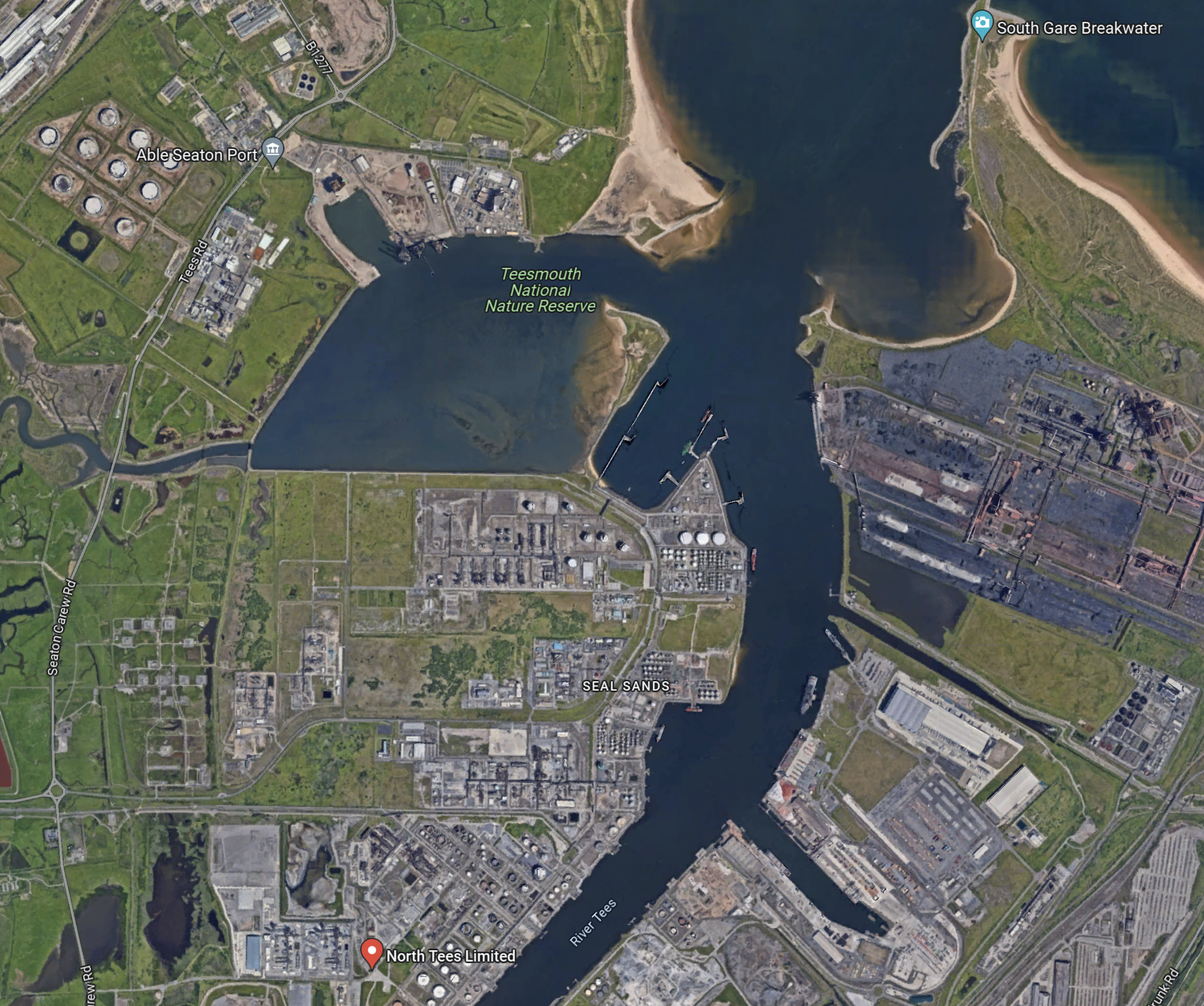
Note.
- The red arrow at the bottom of the map indicates the location of North Tees Group Estate.
- Follow the river to the North and a capitalised label indicating the position of Seal Sands can be seen.
This second Google Map shows the Seal Sands area in a larger scale.
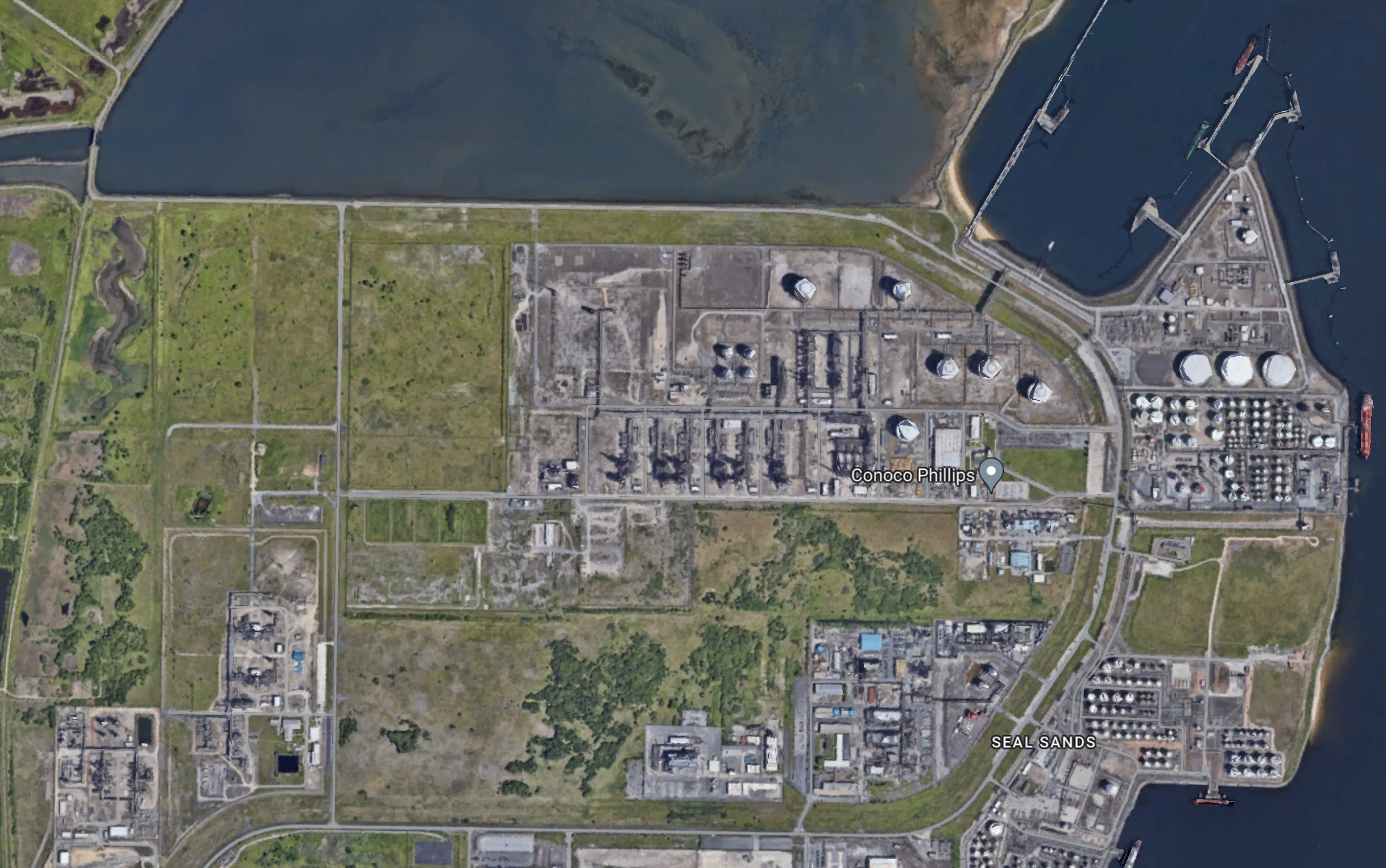
There seems to be several spaces, where the reactors could be located.
Would It Be Safe To Locate A Nuclear Reactor Or Reactors In a Cluster Of Oil Refineries And/Or Chemical Plants?
Consider.
- In the 1970s, when I worked at ICI, there were companies like Westinghouse advocating nuclear steelmaking.
- We did discuss the concept a couple of times over coffee but no one, I worked with, ever looked at it officially or seriously, as far as I know.
- In addition to requiring large amounts of electricity, oil refineries and chemical plants often use a lot of steam.
- Nuclear reactors generate steam to produce electricity, so some could be diverted to oil refineries or chemical plants
- To decarbonise some processes might switch to hydrogen.
- In Westinghouse And Bloom Energy To Team Up For Pink Hydrogen, I talk about how to use a nuclear reactor to efficiently produce pink hydrogen.
It looks like for efficiency, building the various plant close together could be a good thing.
But is it safe?
I suspect the level of safety will be that of the least safe plant.
So provided all plants are designed to the highest standards, it should be OK, as nuclear plants, oil refineries and chemical plant don’t regularly explode.
The Donald C Cook Nuclear Plant
The Donald C Cook Nuclear Plant in Michigan is a 2.2 GW nuclear plant, that was built by Westinghouse and commissioned in the mid-1970s.
They were clients for Artemis, the project management system that I wrote.
Soon after the Three Mile Island accident on March 28th, 1979, I visited the Donald C Cook Nuclear Plant to see how they were coping with the aftermath of the accident.
I remember being told by the operators of the plant, who were American Electric Power, that as it was their only nuclear plant, they were going to do everything by the book and Artemis was helping them to do that.
Reading about the plant, which is now licenced to operate until 2034 for one reactor and 2037 for the other, it seems to have performed impeccably so far for nearly fifty years.
It is a credit to both Westinghouse, who built it and American Electric Power who own it.
Now that is what I call high-class engineering and I’d be happy to have a cluster of SMRs to the same standard in my back yard.
Sizewell B
I used to live a few miles from Sizewell B, which is another Westinghouse reactor.
- This is the Wikipedia entry for the power station.
- Sizewell B was based on a proven Westinghouse design.
- It seems to have performed well since it was commissioned in 1995.
It looks like it will be operating until 2055, which will make its working life similar to those of the reactors at the Donald C Cook Nuclear Plant.
Westinghouse And Hinckley Point C Compared
Consider.
- Sizewell B was built in approximately seven years.
- This compares well with the two units at the Donald C Cook Nuclear Plant, which took six and nine years respectively
- It looks like Hinckley Point C will take between twelve and fourteen years to build.
- Sizewell B and the two units at Donald C Cook Nuclear Plant seem to be looking at a sixty year operating lifetime.
- Sizewell has a rail connection and Hinckley Point does not.
- Sizewell B seems to have been signed off, when John Major was Prime Minister.
- Hinckley Pont C seems to have resulted from a government white paper when Gordon Brown was Prime Minister.
Westinghouse seem to design nuclear power stations, that can operate for a long period and can be built within a decade.
Westinghouse And Rolls-Royce
Consider.
- Rolls-Royce also have an SMR design.
- Rolls-Royce and Westinghouse are both world-class companies.
- Rolls-Royce have the advantage they are British.
- I also suspect, that both Westinghouse and Rolls-Royce will use the same subcontractors and sub-assembly manufacturers.
- The Rolls-Royce SMR has a power output of 470 MW.
- The Westinghouse SMR has a power output of 300 MW.
I suspect the choice between the two, will be like choosing between top-of-the-range British and American products.
Conclusion
I wonder why we ended up with an unproven new French design at Hinckley Point, when sitting in Suffolk was a traditional Westinghouse design, that was performing to its design specification?
But for the SMR, we need to buy the reactors, which are financially best for Britain. If Westinghouse choose to manufacture large sections in the UK, they could be the better bet, as I suspect, if SMRs are successful, we’ll be seeing exports from the UK.
Pension Power Backing For New Battery Energy Storage Plant
The title of this post, is the same as that of this article on Nation.Cymru.
These paragraphs outline the project,
A new battery energy storage plant at the site of a decommissioned power station will be funded by Welsh pensioners.
The plan for the facility at the former Uskmouth B Power Station at the Gwent Wetlands on the edge of Newport, was approved by the city council’s planning committee this January.
The batteries will store excess power during times of “excess supply” and then put that electricity back into the grid when demand is higher.
The Greater Gwent Pension Fund, which manages the retirement savings of more than 65,000 members from Blaenau Gwent, Caerphilly, Monmouthshire Newport and Torfaen councils as well as 52 other active employers in the Gwent region, has revealed it is investing in the project.
According to their Wikipedia entry, the Uskmouth power stations have had rather a chequered history and both appear to be currently non-productive.
- The original coal-fired Uskmouth A has been demolished and the site is now occupied by an 832 MW gas-fired CCGT power station. Currently, it is in a ‘dormant’ state, after its owner entered administration.
- The original coal-fired Uskmouth B has been converted and now can generate 363 MW on a mixture of biomass and waste plastic. Uskmouth B is currently being demolished.
This press release from Quinbrook Infrastructure Partners is entitled Quinbrook To Build Large-Scale Battery Storage Project At Uskmouth, South Wales.
This is the sub-heading.
Uskmouth will be one of the largest storage projects in the UK and will directly support the UK’s energy transition.
These first two paragraphs outline the project.
Quinbrook Infrastructure Partners (“Quinbrook”), a specialist investment manager focused on renewables, storage and grid support infrastructure has acquired the exclusive development rights for one of the UK’s largest battery storage projects to date.
The planned 230MW / 460MWh Battery Energy Storage System (“BESS”), will be located at the site of the former Uskmouth coal fired power station in south Wales (“Project Uskmouth”) and will seek to utilise existing power transmission infrastructure and provide a new lease of life to the area. Uskmouth was acquired from Simec Atlantis Energy Limited (“SAE”). Quinbrook has partnered with Energy Optimisation Solutions Limited (“EOS”) in the origination and development of Project Uskmouth, which represents a major anchoring project in the planned re-development and regeneration of the Uskmouth site into a Sustainable Energy Park that will support innovative future industry. Quinbrook considers these types of regeneration projects as key to making meaningful contributions to delivery of the Government’s Levelling Up ambitions.
Note.
- The battery can supply 230 MW for two hours.
- It looks like the battery will replace the older of the two power stations and work with the relatively-modern 832 MW gas-fired CCGT power station.
- Will they act as backup to renewables?
As there are very few renewables in the area, will this work with the wind farms being developed in the Celtic Sea or are Quinbrook anticipating wind farms South of Newport in the Bristol Channel?
I have a few thoughts.
Will Uskmouth Work With Hinckley Point C?
This Google Map shows the relative locations of Uskmouth and Hinckley Point C.

Note.
- Uskmouth is just South of Newport, in the North-East corner of the map.
- I estimate that Uskmouth and Hinckley Point C are 24.7 miles apart.
A cable across the Bristol Channel would surely increase the energy security of South Wales.
Will There Be Wind Farms In The Bristol Channel?
I feel that this is inevitable.
This document on the Welsh Government web site is entitled Future Potential For Offshore Wind In Wales, was written by The Carbon Trust.
This paragraph is the document’s assessment of wind farms in the Bristol Channel.
Despite high energy demand and good infrastructure, environmental conditions in the Bristol Channel
makes this area challenging for offshore wind development. In addition to lower average wind speeds,
the Bristol Channel has complex seabed, including areas of hard rock, and is exposed to strong tidal
currents from the Severn Estuary. Seabed conditions and tidal currents were the main drivers behind
cancellation of the Atlantic Array project and it is considered unlikely that a developer would look to
revive this site in the near-term, particularly given competition with other more favourable UK sites.
That doesn’t seem very promising.
But this is the document’s assessment of wind farms in the Pembrokeshire Atlantic area.
Exposure to the prevailing south-westerly Atlantic wind and swells means that the waters off
Pembrokeshire have excellent wind speeds, often exceeding 10 m/s, but also a harsher wave
environment than elsewhere in Wales. Significantly, water depths quickly increase to over 50m,
suggesting that floating foundations are likely to be required, particularly if projects are located
further from shore, which is likely given constraints from environmental impact and seascape near to
the Pembrokeshire Coast National Park.Grid infrastructure is constrained for thermal generation but should not be a barrier to new
renewables. The Greenlink interconnector could also support the addition of new capacity. The region
has good port infrastructure at Milford Haven and Pembroke Dock, which is already actively pursuing
upgrades to future proof the port for potential offshore wind deployment.
That is a lot more promising.
- Some demonstration wind farms are under development.
- Hopefully, the steel would be available at Port Talbot.
- I can see this area, having almost 50 GW of floating wind.
I do feel though, that once the sea off Pembrokeshire is full of wind farms, that developers will turn their attention to the more difficult waters of the Bristol Channel.
Is The Uskmouth BESS A Good Investment?
The Nation.Cymru article discusses this and what they say is well worth reading.
My feelings are that the BESS will be very busy balancing electricity on the South Wales Coast and to and from Ireland using the 500 MW Greenlink Interconnector, which opens this year.
These electrical systems are relatively easy to model and I suspect Quinbrook wouldn’t be investing, if the BESS was not going to generate a substantial income.
Q4 2023 Sees Largest Quarterly Increase In Battery Energy Storage
The title of this post, is the same as that of this article on Solar Power Portal.
These three paragraphs outline the story.
Energy research consultancy Modo Energy has confirmed that Q4 2023 saw 420MW of new battery energy storage capacity become commercially operational.
This new capacity represents a 13% increase on the previous quarter and, in doing so, becomes the largest ever quarterly increase in operating battery capacity in GB. The previous record was set in Q2 2023 when 413MW was added.
It is worth noting that the additional capacity now means that GB’s operational grid-scale battery energy storage capacity has now reached 4.6GWh. Modo also confirmed that 1.5GW of battery storage was added across 2023 – a record for a one-year period.
Note.
- Modo Energy has a web site.
- Hinckley Point C has a nameplate capacity 3.26 GW.
- The article also says that the average duration of battery storage in GB is now 1.3 hours.
Strangely, this gives a BESS total storage capacity of 4.55 GWh, which is half the capacity of Electric Mountain.
 The Anonymous Widower