Will We See Class 43 Power Cars Converted To Hydrogen?
To say that the Class 43 power cars of the InterCity 125 trains are iconic is rather an understatement.
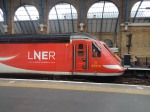


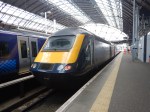
Note.
They were built by British Rail in the late 1970s and early 1980s.
- They have an operating speed of 125 mph.
- They are now powered by a modern MTU 16V4000 R41R diesel engine after being re-engined earlier this century.
- They have an electric transmission.
According to Wikipedia, there are over a hundred and twenty in service.
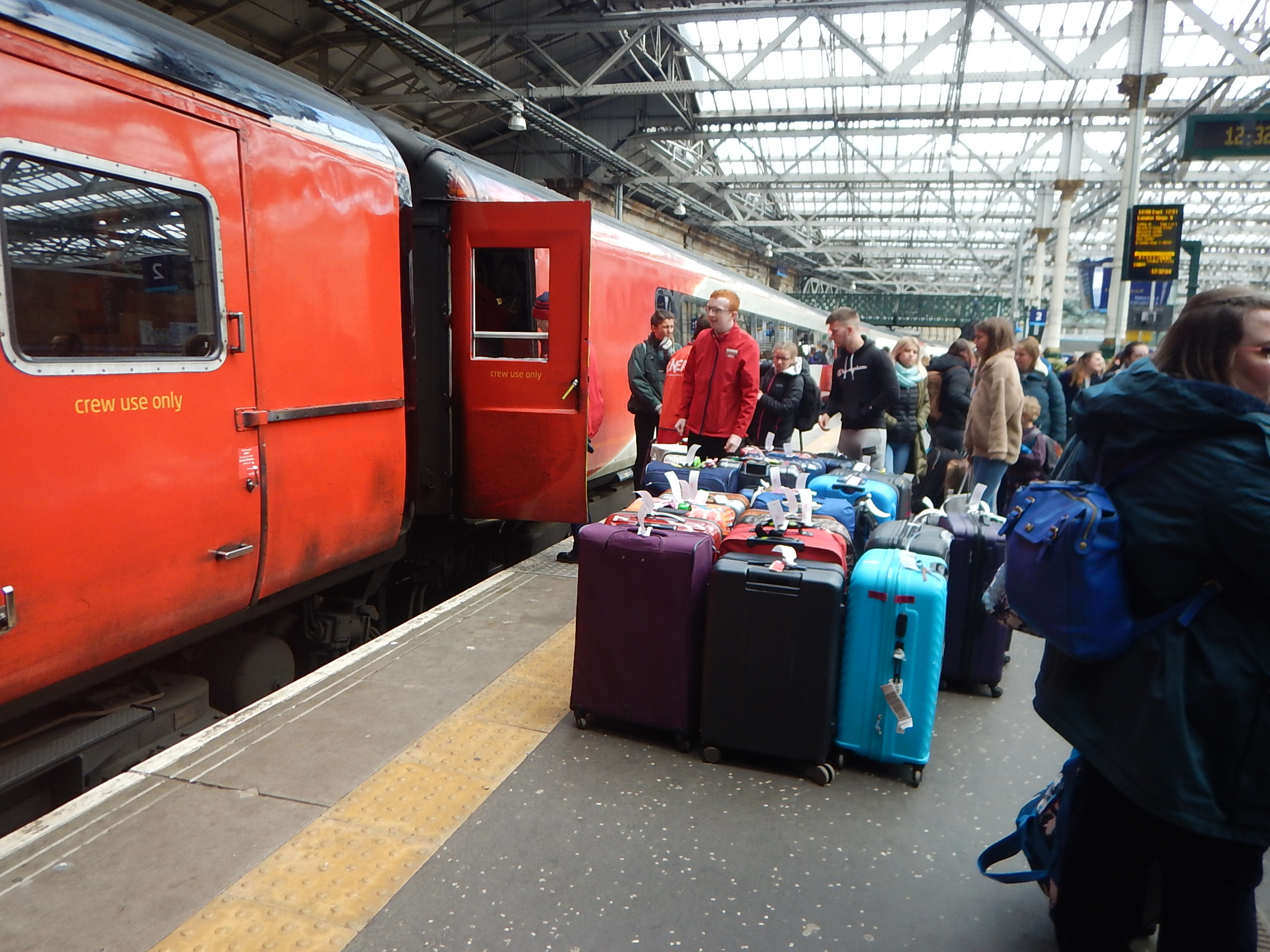
At the back of the power car there is a lot of space, as this picture shows.
This press release from Rolls-Royce is entitled Rolls-Royce Launches mtu Hydrogen Solutions For Power Generation.
These are the introductory bullet points to the press release.
- From 2022 mtu Series 500 and Series 4000 ready for 25% hydrogen
- From 2023 mtu engines and conversion kits available for 100% hydrogen
And what engine is there in a Class 43 power car? – It’s an MTU 16V4000 R41R diesel engine.
Is it an mtu Series 4000 engine?
If it is, there is space in the back of the power car for the hydrogen tank and the diesel engine can be converted to run on hydrogen, Rolls-Royce have everything they need break the speed record for hydrogen-powered trains. After all power cars; 43102 and 43159 hold the diesel-train speed record at 148 mph.
It would be the ultimate Roller.
Anglo American And Aurizon Look To Hydrogen-Powered Trains
The title of this post, is the same as that of this article on World Coal.
This is the first paragraph.
Australia’s largest rail freight operator, Aurizon, and leading global mining company, Anglo American, have agreed to work together on a feasibility study to assess the introduction of hydrogen-powered trains for bulk freight in Queensland.
I find it interesting and very ironic, that this partnership has been formed, partly to transport the product, with the most polluting of end uses; coal.
The article also says this about Anglo American’s policy on decarbonisation of their mines.
As part of its commitment to carbon neutral mines by 2040, Anglo American has taken a global lead in the development of green hydrogen solutions for its ultra-class 290 t payload mine haul trucking fleet. Anglo American’s unique combination of powertrain technologies, designed to operate safely and effectively in real-world mine conditions, will displace the use of the majority of diesel at its mining operations, with an advanced trial of the prototype truck at its Mogalakwena platinum group metals mine in South Africa.
It does appear that the partnership are starting from a proven base of hydrogen technology.
Conclusion
This looks like a sound real-world project to produce a hydrogen-powered zero-carbon locomotive.
Hydrogen Freight Locomotive Demonstration Planned
The title of this post, is the same as that, of this article on Railway Gazette.
The first two paragraphs explain the project.
Progress Rail, BNSF and Chevron have signed a memorandum of understanding to develop a fuel cell demonstrator locomotive to assess the viability of using hydrogen as an alternative to diesel for main line freight operations.
Progress Rail plans to design and build a prototype fuel cell locomotive, with Chevron developing the hydrogen fuelling infrastructure. BNSF would then operate the locomotive for a period of time.
It can’t be long before we start to see large-scale hydrogen locomotive projects in the UK and Europe.
Hydrogen Fuel Cell Locomotive From Canadian Pacific To Roll Out Before 2022
The title of this post, is the same as that of this article on Hydrogen Fuel News.
This is said.
The hydrogen fuel cell locomotive consists of an SD40-2F, which was converted to run on H2 power and is therefore nicknamed the H2 0EL. The company is calling it a “hydrogen zero-emissions locomotive”, and it will be operating under its own power before the end of this month, according to Canadian Pacific CEO Keith Creel.
Note that the SD40 locomotive is a diesel-electric locomotive of which 1286 were built around 1970.
Canadian Pacific have made this video, which was kindly pointed out by Alan.
The video seems to indicate that the converted locomotive will be able to continue to do the same duties as the original diesels, which have a power output of 2,240 kW.
Interestingly, power output seems to be of the same order as that of a Class 66 locomotive, so could a similar conversion by used with these locomotives?
Fortescue Making Plans To Test ‘Green’ Locomotives At Rail Operations In 2022
The title of this post, is the same as that of this article on International Mining.
This is the first two paragraphs.
The decarbonisation of Fortescue Metals Group’s (Fortescue) locomotive fleet is ramping up with the arrival of two additional locomotives at Fortescue Future Industries’ (FFI) research and development facility in Perth, Western Australia.
The two four-stroke locomotives will undergo further testing on the new fuel system, joining the first two-stroke locomotive which underwent testing earlier this year.
FFI aim to test the locomotives in 2022.
Reading the International Mining article reveals an interesting philosophy for decarbonisation.
FFI have set up a Green Team and it appears that they have a free rein to stick their noses into any decarbonisation issue in Fortescue Metals Group’s business.
I know it is a technique that works from personal experience.
When I worked for ICI Plastics Division in the early 1970s, I was in their Computer Techniques Section. The section had been setup by the Divisional Board to see if these new-fangled computers had a use in the running and development of the business outside of the company’s billing and accountancy.
We had a right to stick our noses anywhere.
It certainly gave me a wonderful apprenticeship into how to apply computers to diverse and difficult problems.
Is There A Case For A Round-The-Wash Service Between Doncaster And Ipswich/Norwich?
I suggested this service in The Integrated Rail Plan For The North And Midlands And The East Coast Main Line.
Effectively, it would join East Midlands Railway’s Doncaster and Peterborough service with Greater Anglia’s Cambridge and Ipswich service.
- The service could go via Scunthorpe, Grimsby Town, Cleethorpes, Grimsby Town, Market Rasen, Lincoln, Sleaford, Spalding, Peterborough, March, Ely, Cambridge North, Cambridge, Newmarket, Bury St. Edmunds and Stowmarket.
- There would be reverses at Cleethorpes and Cambridge.
- There may be extra stops in Lincolnshire and across Suffolk.
- The service would not use the East Coast Main Line, but would use the new Werrington Dive-Under and the Great Northern and Great Eastern Joint Line to the East of the East Coast Main Line.
- The frequency would be one train per two hours (1tp2h).
- Ideal trains could be Class 755 trains, perhaps running on batteries or hydrogen.
It would be paired with a new Doncaster and Norwich service, that could partly replace East Midlands Railway’s Liverpool and Norwich service.
- The service could go via Scunthorpe, Grimsby Town, Cleethorpes, Grimsby Town, Market Rasen, Lincoln, Sleaford, Spalding, Peterborough, March, Ely, Cambridge North, Cambridge, Cambridge North, Ely, Thetford, Attleborough and Wymondham.
- There would be reverses at Cleethorpes and Cambridge.
- There may be extra stops in Lincolnshire and across Norfolk.
As with the Ipswich train it would not use the East Coast Main Line and have a frequency of 1tp2h.
The Objectives Of The Service
I believe this service could have several objectives.
Remove Slower Trains From The East Coast Main Line Between Peterborough And Doncaster
There aren’t many except freight, but this plan could provide a better solution to the Liverpool and Norwich service.
Providing Better Connections To The Biggest Growth Point In The UK – Cambridge
Cambridge needs better connections, so that it can bring in the staff and workers, that the high-tech capital of the UK needs.
Better Connection Of East Anglia And Lincolnshire To Northern England And Scotland
In Peterborough and Doncaster the route has two main interchanges to bring about these connections.
Promoting Tourism
For a start the route has five cathedrals; Bury St. Edmunds, Ely, Lincoln, Norwich and Peterborough and the historic city of Cambridge.
But I do believe that there are numerous places, where tourists might stay on the route and use it to explore the East of the country.
A Few Questions
These are a few questions.
Would The Route Be Electrified?
I don’t believe it will be fully electrified for two reasons.
Freight locomotives will increasingly become hydrogen-powered and also be able to use electrification, where it exists.
Plans by the likes of Hitachi ABB Power Grids and Furrer and Frey are likely to enable discontinuous and battery-electric trains to be able to work the route.
This philosophy would avoid all the disruption and reconstruction of structures of electrification and probably be much more affordable.
Would York Or Leeds Make A Better Northern Terminal For The Route?
Both have possibilities.
- York would need running on the East Coast Main Line.
- Leeds would probably need trains capable of 125 mph running.
On the other hand both Leeds and York would have superb connectivity.
Conclusion
I feel this would be a very valuable new service and it could be created without building any new infrastructure other than perhaps some strategic stations.
Canadian National Buys Battery Locomotive
The title of this post, is the same as that of this article on Railway Gazette.
This is the first paragraph.
Canadian National’s Bessemer & Lake Erie Railroad has purchased a Wabtec FLXdrive battery-electric freight locomotive, with financial support from the Pennsylvania Department of Environmental Protection’s Marine & Rail Freight Movers grant programme.
The locomotive is intended to work in multiple with diesel locomotives and this cuts fuel consumption, pollution and noise.
I described the locomotive in FLXdrive ‘Electrifies’ Pittsburgh and the more I learn about this locomotive the more I like it.
The locomotive numbered 3000, which appears in all Wabtec pictures is an example an ES44AC from the GE Evolution Series and was converted from a standard locomotive, that was in the test fleet.
Interestingly, Canadian National own several hundred of these locomotives, so they won’t be short of one to convert.
The diesel version would appear to be a 3.3 MW diesel locomotive.
In addition, this page on the Wabtec web site gives some details of the battery-electric locomotive.
- The locomotive is powered by lithium-ion batteries.
- There are around 20,000 battery cells
- The batteries have their own air-conditioning
- There is a sophisticated battery-management system.
- The total battery size is 2.4 MWh
- Power output is 4400 HP or 3.24 MW
- Locomotive will run for 30-40 minutes at full power.
- The locomotive has regenerative braking.
- Operating speed is 75 mph
Note that running at 75 mph for 40 minutes would cover fifty miles.
It does look as if, the diesel-electric and the battery-electric conversion have similar power outputs. Could this be, as the traction system on both locomotives are identical? It’s just that one uses a diesel generator and the other uses batteries.
Although there must be differences in the traction systems, as the battery-electric locomotive has regenerative braking.
The battery-electric locomotive is designed to work in conjunction with one or two diesel locomotives, where a sophisticated computer system decides which engines power the train.
- Wabtec are claiming a thirty percent reduction in fuel and emissions compared to an all-diesel setup.
- Electric power will also be used in depots and sensitive areas.
I do think though, that this is a pragmatic solution to cut the carbon footprint of heavy-freight in North America.
But it could be a half-way solution, as Wabtec have hinted that they are working on hydrogen-powered locomotives.
I also feel it might be possible to convert some of the UK’s Class 66 locomotives into battery-electric locomotives for lighter freight duties or working in a pair with a Class 66 locomotive to reduce fuel consumption and emissions.
I discuss this in Could Class 66 Locomotives Be Converted Into Battery-Electric Locomotives?
Have CN Bought The Prototype?
There is also this article on the Green Car Congress, which is entitled CN Purchases Wabtec’s Battery-Electric Locomotive.
The article seems fairly certain they have.
So perhaps, they want to get on with the job and see what the locomotive can do?
Hydrogen Fuel Cell Locomotives Ready To Take Over Freight Rail Systems
The title of this post, is the same as that of this article on autoevolution.
The article describes how Canadian Pacific are developing hydrogen-powered freight locomotives.
They are converting a couple of locomotives to run on hydrogen and also building two hydrogen plants; one for green hydrogen and one for blue.
It does look that the Canadians are determined to get it right, so are looking at everything they can.
The article is certainly worth reading.
Railfreight Goes Back To Diesel As Electricity Costs Soar
The title of this post, is the same as that of this article on Railnews.
This is the first paragraph.
Some rail freight operators have abandoned electric traction, at least for now, because the price of electricity has been rising sharply. The electricity tariffs include a 40 per cent renewable energy tax, and following the latest rises diesel traction is now cheaper. The drivers’ union ASLEF is calling for the government to intervene, but Freightliner has already taken action.
This quote from the article is from ASLEF General Secretary; Mick Whelan.
Moving freight by rail rather than road is, inherently, a carbon-efficient mode of transport and an environmentally-friendly way of doing business. Electric-hauled freight services reduce emissions by 99 per cent; even moving goods by diesel traction reduces emissions by 76 per cent.
It looks to me, that a reputable and trusted environmental economist could come up with a compromise price and possibly a solution to improve the situation.
Possible solutions could include.
- Use of Biodiesel or Hydrotreated Vegetable Oil
- More energy storage.
Surely, though, the long term solution is hydrogen-powered locomotives. or dual-fuel locomotives, as I wrote about in Freightliner Secures Government Funding For Dual-Fuel Project.
 The Anonymous Widower