The Innovation Must Go On
This is a snippet I found on this news round-up on Rail Business UK.
Network Rail has issued a request for information on innovative techniques for undertaking tunnel renewals and enlargement while minimising blockades. NR said it manages 693 tunnels that are typically 150 years old; these require different and increasing levels of maintenance and renewal, but the growth of traffic means there is less access for maintenance.
Someone in Network Rail has got the engineering envelopes out again and is doing their thinking at home under lockdown, rather than in a real ale hostelry.
Companies and other organisations, should use COVID-19 as an opportunity to innovate.
Imagine the unthinkable and the downright bonkers, so long as it’s legal!
Think loony! You know it makes sense!
The New Generation Of Pumped Storage Systems
This excellent article on GreenTechMedia is entitled The 5 Most Promising Long-Duration Storage Technologies Left Standing.
One of the technologies the article discusses is pumped storage, which in the UK is used at the massive Electric Mountain in Snowdonia, which can hold 9.1 GWh of electricity and supply up to 1,800 MW of electricity when needed. That’s not bad for 1970s engineering!
The GreenTechMedia article introduces pumped storage like this.
Midcentury modern design is hot again, so why not midcentury storage technology? This gravity-based concept physically moves water from a low to a high reservoir, from which the water descends, when needed, to generate electricity. This dates from way before lithium-ion’s heyday and still provides some 95 percent of U.S. grid storage, according to the U.S. Department of Energy.
The largest pumped storage system in the US is Bath County Pumped Storage Station, which is described as the biggest battery in the world. With a storage capacity of 24 GWh of electricity and a generating capacity of 3,003 MW, it dwarfs Electric Mountain. But then the Americans have bigger mountains.
Pumped storage is a good partner for intermittent renewables like wind and solar, but in a country like the UK, the US and other countries with strong planning laws getting permission to build a large pumped storage system is not easy. We tried to build one on Exmoor, but that was abandoned.
Note that the country building the most new pumped storage systems is China, where they have mountains and planning laws, that would not be acceptable anywhere else.
But engineers have come up with a new design, described in this paragraph from the GreenTechMedia article.
The new school of pumped hydro focuses on isolated reservoirs that don’t disrupt river ecosystems; this simplifies permitting, but projects still face a decade-long development timeline and billion-dollar price tags.
It then gives two examples of proposed systems.
Gordon Butte Pumped Storage Project
The operation of the Gordon Butte Pumped Storage Project is described like this in Wikipedia.
Gordon Butte will be located on a 177 acres (0.72 km2) site, and will have access to water from Cottonwood Creek, a tributary of the Musselshell River. The facility will operate as a closed system, without actively drawing or discharging water into the watershed. It will have a 4,000 acre-foot capacity reservoir, located 1,000 feet (300 m) above the base, with a power generation capacity of about 400 MW
The smaller size must make it easier to get it built.
How much energy will Gordon Butte hold in GWh?
- A 4,000 acre-foot reservoir has a capacity of 4,933,927.42128 cubic metres.
- As a cubic metre of water weighs a tonne, the reservoir can hold 4,933,927.42128 tonnes of water at an altitude of 300 metres.
- Using Omni’s Potential Energy Calculator, this gives a potential energy of 4,032,108 KWh.
This is just over 4 GWh.
Ths facility could supply 400 MW for ten hours or 4 MW for a thousand hours!
It should be noted that Electric Mountain has an efficiency of 74-76%.
Eagle Mountain Pumped Storage Facility
Eagle Mountain Pumped Storage Facility is introduced like this on its web site.
The pumped storage hydropower project at Eagle Mountain, CA will transform a scarred brownfield site into a 1,300 Megawatt generator of green electricity that can light one million homes. The site is in a remote part of the Mojave Desert, more than 50 miles from the nearest city, Blythe, CA, and more than 60 miles from Palm Springs and the Coachella Valley. The construction of the project will create thousands of jobs and add millions of dollars to the local economy while adhering to the most rigorous environmental standards.
Note that it is turning an eyesore of the worst kind into a pumped storage facility. It’s surely better than using it for landfill!
Conclusion
Systems like these may have applications in the UK!
Could some of those massive quarries in the Peak District be converted into pumped storage systems, using the technology of my two examples?
This Google Map shows the quarries surrounding the town of Buxton.
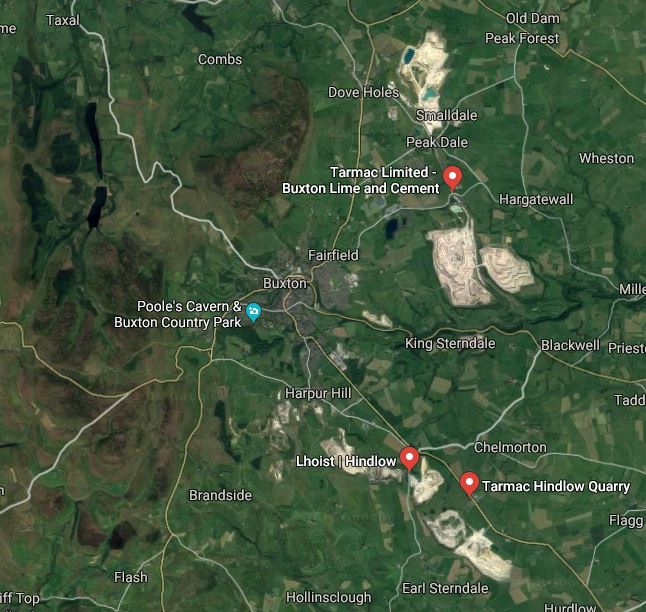
Note.
- The white areas looking almost like clouds are quarries.
- Buxton has an altitude of three hundred metres, which is the altitude of the Gordon Butte Storage Project.
- The vast Tunstead Quarry, which is four kilometres East of Buxton has an area of over one square mile.
- Tunstead Quarry has a red arrow above it marked Buxton Lime and Cement.
Could we not extract as much limestone as is possible from Tunstead and then convert it into a pumped storage system like Gordon Butte? It could have an area of 2.5 square kilometres and an altitude of nearly a thousand feet. A rough estimate, based on Gordon Butte, indicates it could store over 10 GWh.
Hopefully, better hydro-electric power engineers than myself, are looking at the quarries in the Peak District, with eyes flashing like cash registers.
There is one pumped storage project under development in the UK at the present time; Snowdonia Pumped Hydro, which obtained planning permission in 2017.
These are some characteristics.
- Situated in Snowdonia in old slate quarries at Glyn Rhonwy.
- 99.9 MW of power
- 700 MWh of storage capacity.
- 2 reversible turbines
- Start to full power in 12 seconds
- Cycle efficiency of around 81%
- Project lifespan of 125 years
- Estimated carbon saving of 50,000 tonnes per year
It is under a tenth the size to Electric Mountain, but every little helps.
I would also feel that with a 125 year life, it could be the sort of investment, that would appeal to a Pension Fund.
Ventilators On Click
Click, the BBC’s technology program has just shown an item about ventilator development.
They showed a picture of the dyson machine and video of several others.
- One created its own oxygen.
- One was designed for developing countries.
- One was designed to be a minimal size.
- One was designed to be 3D printed.
- One cost around five hundred euros.
Developments were also from several countries in addition to the UK, including Canada, France and Spain,
I think the world is on a path to get enough ventilators.
The program will be repeated in BBC Breakfast tomorrow!
History And Future Of The Compressed Air Economy
A reader in Canada has sent me a link to this article on Low Tech Magazine, which has the same title as this post.
This is the introductory sub-title.
Historical compressed air systems hold the key to the design of a low-tech, low-cost, robust, sustainable and relatively energy efficient energy storage medium.
As regular readers of this blog, will have noticed, I regularly post about a company called Highview Power.
This is the introduction from the Wikipedia entry for Highview Power.
Highview Power is a long-duration energy storage pioneer, specialising in cryogenic energy storage. It is based in the United Kingdom and the United States. It has permission for a commercial-scale 50 Megawatt/250 Megawatt-hour plant in England, building upon its earlier 5 Megawatt and 350 Kilowatt pilot plants. It plans to develop a 50MW plant/400MWh (eight hours of storage) in Vermont.
It has over 30 patents developed in partnership with British universities and has won technology funding from the British Government.
In February 2020 Sumitomo Heavy Industries invested $46m in the company.
The article on Low Tech Magazine gives the history of compressed air energy storage (CAES) and is a good background to the subject.
Australia’s New Community Solar, Solar-Storage, ‘Solar Hydro’ And Solar Hydrogen Projects
The title of this post is the same as that of this article on Energy Storage News.
This is the introductory paragraph.
In the past couple of weeks, national and state government organisations in Australia have announced various stages of consideration for solar projects with a range of advanced and innovative storage solutions attached.
The article then goes on to describe some projects.
RayGen’s PV Ultra System
This paragraph describes the PV Ultra system.
The fully dispatchable power plant would use RayGen’s own technology PV Ultra, which is a combination of photovoltaic (PV) solar generation with the more expensive and engineering-intensive concentrated solar technology using angled mirror towers (heliostats). The PV Ultra system would generate both electricity and heat.
It’s obviously using what Australia has a lot of; sun to advantage.
RayGen’s Innovative Thermal Storage
This paragraph outlines the principle of RayGen’s thermal method of storage.
This generation technology would in turn be co-located and connected to a ‘Thermal Hydro’ energy storage facility, with 17 hours of storage, which again is based on a technology RayGen is developing. Unlike pumped hydro energy storage which uses two reservoirs at different heights, relying on gravity to drive turbines, the Thermal Hydro plant would use a hot reservoir and a cold reservoir, linked together.
The principle of operation is described in this second paragraph.
The PV Ultra solution will therefore cool one reservoir using photovoltaic power and grid power when needed, while also heating the other reservoir using the heliostats. The difference in temperature would then generate electricity, via an Organic Rankine Cycle engine, a device which uses thermodynamic cycles to convert steam into mechanical energy and is widely used for biomass, waste incinerators and other existing generation types.
The article states that an Organic Rankine cycle engine has an efficiency of about seventy percent. I have linked to Wikipedia, which gives a good explanation of the Organic Rankine cycle, which is typically used in waste heat recovery and biomass power plants.
RayGen’s Flagship Project
RayGen’s flagship project will be rated at 4 MW, with a storage capacity of 50 MWh. It will be used to provide power in the West Murray region.
New South Wales Community Projects
The article then describes a group of community projects that are being set up in New South Wales.
This is the introductory paragraph
Elsewhere in Australia, the government of New South Wales approved grants earlier this month to assist the development of seven solar projects, all but one of which will include energy storage. Notably, five out of the seven will also be community distributed energy projects, including one standalone shared battery energy storage site.
Some points from the article include.
- The total solar power is rated at 17.2 MW.
- The energy storage is rated at 39.2 MWh
- One site is co-located with hydrogen electrolysis and storage,
New South Wales has certainly launched an ambitious plan.
Conclusion
I like RayGen’s system and the New South Wales initiative.
I also think, that both projects could find applications in some of the hotter places in the world.
Could solar power systems like these solve power supply problems in Africa, India and other sun-rich places>
Carry On Blogging
At seventy-two and after recovering from a serious stroke ten years ago, I could be considered to be in a relatively high-risk category from COVID-19.
I also live alone and am a coeliac.
But.
- I have reasonable supplies of ready-meals, tea, milk, beer and packaged foods to last for a week.
- I test my INR and on Friday it was 2.5.
- I weigh about 61 Kg.
- I exercise regularly and can easily walk a couple of miles briskly.
- I have plenty of INR testing strips, with probably enough to last until August.
- I have about two months of drugs, but there is supposed to be a system lunched this week to get drugs to people like me.
- I have an on-line subscription to The Times, so I can read their news in detail and get access to all their puzzles.
- I can walk round the corner to a shop, where I can get milk and other daily supplies.
- I can easily walk to my GP’s surgery and the local Marks and Spencer Simply Food.
- I have a son, who can put shopping on the door-step, ring the bell and run!
- I have enough cash to pay for goods that neighbours or others might deliver.
I also have the great advantage, that my front door almost opens onto the street, so I can receive deliveries without meeting the courier, by just leaning out the window and telling them to put them on the step.
I very much feel, that I can set myself up to just carry on blogging.
Others can help here by doing the following.
- Suggest topics, where they would like my comments.
- Sending me stories, that I might like to read on topics like battery-power, branch line reopening, design, energy storage, hydrogen-power, innovation, extreme science, humour and life in general.
- Sending me positive stories about COVID-19.
It’s probably best, if you don’t send me stories from the BBC and The Times as I read them extensively.
I shall always reply, if I can. Hopefully, I will try and treat subjects in a light-hearted manner to ease the burden of these serious times.
We must all carry on!
Let’s Get Innovating!
I liked this paragraph from a story in The Times about getting enough ventilators.
Rural hospitals in Canada are using techniques normally reserved for mass shootings. By installing separate tubes, one ventilator can treat up to nine patients, as long as they have the same infection and equal lung capacity.
I never thought, I’d see a benefit from mass shootings.
But it does show the benefits of top class innovation!
Next Stop, Hydrogen-Powered Trains
The title of this post is the same as that as this article on the BBC’s Future Platet web site.
This is the introductory paragraph.
As old diesel trains are phased out of rail networks around the world, the UK is about to test a new type of engine that could help to decarbonise railways – hydrogen-powered trains.
The article then goes on to summarise the current developments in hydrogen grains.
Charging Battery Trains
In Sparking A Revolution, I talked about Hitachi’s plans to develop battery versions of their Class 800 trains.
The article also gives the specification of a Hitachi battery train.
- Range – 55-65 miles
- Performance – 90-100 mph
- Recharge – 10 minutes when static
- Routes – Suburban near electrified lines
- Battery Life – 8-10 years
These figures are credited to Hitachi.
Methods Of Charging
I can envisage two main methods of changing battery trains.
- Static charging in a station, depot or siding.
- Dynamic charging, whilst the train is on the move.
I am not covering other possible methods like battery swapping in this post.
Static Charging
Hitachi only mention static charging in their specification and they give a charge time of ten minutes.
This is a very convenient time, when you consider quite a few trains take around 10-15 minutes to turn round at a terminus.
Two companies have stated that they have products that can charge battery trains in around this time.
- Vivarail offers a system based on well-proven third-rail electrification technology.
- Furrer + Frey offers a system based on overhead electrification technology.
I suspect that other companies are developing systems.
Dynamic Charging
With dynamic charging, the batteries are charged as the trains run along standard electrified routes.
In the UK, this means one of two systems.
- 750 VDC third rail electrification
- 25 KVAC overhead electrification
Both systems can be used to charge the batteries.
Note that in the BEMU Trial in 2015, the Class 379 train used for the trial charged the batteries from the 25 KVAC overhead electrification.
A Mixture Of Dynamic And Static Charging
Many routes will be handled by a mixture of both methods.
As an example London Paddington and Cheltenham is electrified except for the 42 miles between Swindon and Cheltenham.
A round trip between London Paddington and Cheltenham could be handled as follows.
- London Paddington to Swindon using electrification – Dynamic charging battery at the same time!
- Swindon to Cheltenham using battery power
- Turnround at Cheltenham – Static charging battery at the same time!
- Cheltenham to Swindon using battery power
- Swindon to London Paddington using electrification
Note the following.
- Two legs of the round-trip are run using electrification power.
- Two legs of the round-trip are run using battery power.
- There is one dynamic charge and one static charge of the batteries.
No diesel power would be used on the journey and I suspect journey times would be identical to the current timetable.
I suspect that many routes run by battery electric trains will employ a mixture of both dynamic and static charging.
Here’s a few examples.
- London Kings Cross and Lincoln
- London Kings Cross and Harrogate
- London St Pancras and Melton Mowbray
- London Euston and Chester
- London Paddington and Bedwyn
There are probably many more.
Intermediate Charging On A Long Route
South Western Railway has a fleet that is nearly all-electric.
But they do have forty diesel trains, which are mainly used for services between London Waterloo and Exeter.
These don’t fit with any decarbonising strategy.
There is also the problem that the route between London Waterloo and Exeter, is only electrified as far as Basingstoke, leaving a long 124 miles of route without electrification.
This means that a battery train needs to charge the batteries at least twice en route.
Charging At A Longer Stop
The obvious approach to providing en route charging would be to perform a ten minute stop, where the batteries are fast charged.
Looking at Real Time Trains, the stop at Salisbury is often five minutes or more, as trains can join and split and change crews at the station.
But two stops like this could slow the train by fifteen minutes or so.
Charging At A An Electrification Island
On the section of the route, West of Salisbury, there are a series of fairly close-together stations.
- Tisbury – 7 miles
- Gillingham – 16 miles
- Templecombe – 18 miles
- Sherborne – 23 miles
- Yeovil Junction – 39 miles
- Crewkerne – 48 miles
- Axminster – 61 miles
Note,
The distances are from Salisbury.
- Much of this nearly ninety mile section of the West of England Line between Salisbury and Exeter is single track.
- The Heart of Wessex Line between Westbury and Weymouth crosses at Yeovil Junction.
- There are three sections of double track and four passing loops.
- There is a passing loop at Axminster.
It strikes me that the optimal way of charging battery trains on this secondary route might be to electrify both the West of England and Heart of Wessex Lines around Yeovil Junction station.
The power for the electrification island, could come from local renewable sources, as proposed by Riding Sunbeams.
Distances from Yeovil Junction station are.
- Bath Spa – 50 miles
- Castle Cary – 12 miles
- Exeter St. Davids – 49 miles
- Salisbury – 39 miles
- Weymouth – 30 miles
With a battery-electric train with a 55-65 mile range, as proposed in Hitachi’s draft specification, SWR’s London Waterloo and Exeter service would certainly be possible. Charging would be at Salisbury and in the Yeovil area.
On Summer Saturdays, SWR also run a London Waterloo and Weymouth service via Salisbury and Yeovil Junction. This would appear to be within the range of a battery-electric train.
As Weymouth is electrified with third-rail, I suspect that arranging charging of a battery-electric train at the station, will not be an impossible task.
The other service through the area is Great Western Railway‘s service between Gloucester and Weymouth, that runs every two hours.
It would appear that in some point in the future, it will be possible to run this service using a Hitachi battery-electric train.
Third-Rail Or Overhead?
The previous example of an electrification island would probably use 750 VDC third-rail electrification, but there is no reason, why 25 KVAC overhead electrification couldn’t be used.
Note that these trains have been talked about as possibilities for running under battery power.
- Greater Anglia’s Class 379 trains, built by Bombardier
- Greater Anglia’s Class 755 trains, built by Stadler.
- Merseyrail’s Class 777 trains, built by Stadler.
- Scotrail’s Class 385 trains, built my Hitachi
- Several companies’ Class 800 trains, built by Hitachi
- Suthern’s Class 377 trains, built by Bombardier
All the manufacturers named have experience of both dual-voltage trains and battery operation.
I would suspect that any future battery-electric trains in the UK will be built to work on both of our electrification systems.
When talking about battery-electric trains, 750 VDC third-rail electrification may have advantages.
- It can be easily powered by local renewable sources, as Riding Sunbeams are proposing.
- It is compatible with Vivarail’s Fast-Charge system.
- Connection and disconnection is totally automatic and has been since Southern Railway started using third-rail electrification.
- Is is more affordable and less disruptive to install?
- Third-rail electrification can be installed in visually-sensitive areas with less objections.
Developments in third-rail technology will improve safety, by only switching the power on, when a train is connected.
More Electrification Islands
These are a few examples of where an electrification island could enable a battery-electric train to decarbonise a service.
London Euston and Holyhead
In Are Hitachi Designing the Ultimate Battery Train?, I looked at running Hitachi’s proposed battery-electric trains between London Euston and Holyhead.
I proposed electrifying the fourteen miles between Rhyl and Llandudno Junction stations, which would leave two sections of the route between London Euston and Holyhead without electrification.
- Rhyl and Crewe is fifty-one miles.
- Llandudno Junction and Holyhead is forty-one miles.
Both sections should be within the battery range of Hitachi’s proposed battery-electric trains, with their 55-65 mile range.
The following should be noted.
- The time between arriving at Rhyl station and leaving Llandudno Junction station is nineteen minutes. This should be time enough to charge the batteries.
- Either 25 KVAC overhead or 750 VDC third-rail electrification could be used.
- There could be arguments for third-rail, as the weather can be severe.
- The railway is squeezed between the sea and the M55 Expressway and large numbers of caravans.
The performance of the new trains will be such, that they should be able to run between London Euston and Holyhead in a similar time. Using High Speed Two could reduce this to just under three hours.
Edinburgh And Aberdeen
I’m sure Scotland would like to electrify between Edinburgh and Aberdeen.
But it would be a difficult project due to the number of bridges on the route.
Distances from Edinburgh are as follows.
- Leuchars – 50 miles
- Dundee – 59 miles
- Arbroath – 76 miles
- Montrose – 90 miles
- Stonehaven – 114 miles
- Aberdeen – 130 miles
A quick look at these distances indicate that Hitachi’s proposed battery-electric trains with a 55-65 mile range could cover the following sections.
- Edinburgh and Dundee – 59 miles
- Arbroath and Aberdeen – 56 miles
Would it be possible to electrify the seventeen miles between Dundee and Arbroath?
I have just flown my helicopter along the route and observed the following.
- Dundee station is new and appears to be cleared for overhead wires.
- Many of the bridges in Dundee are new and likely to be cleared for overhead wires.
- There is a level crossing at Broughty Ferry station.
- Much of the route between Broughty Ferry and Arbroath stations is on the landward side of golf links, with numerous level crossings.
- Between Arbroath and Montrose stations, the route appears to be running through farmland using gentle curves.
- There is a single track bridge across the River South Esk to the South of Montrose station.
- According to Wikipedia, the operating speed is 100 mph.
Montrose might be a better Northern end to the electrification.
- It has a North-facing bay platform, that could be used for service recovery and for charging trains turning back to Aberdeen.
- Montrose and Aberdeen is only forty miles.
- It might be possible to run the service between Montrose and Inverurie, which is just 57 miles on battery power.
The problem would be electrifying the bridge.
Operationally, I can see trains running like this between Edinburgh and Aberdeen.
- Trains would leave the electrification, just to the North of Edinburgh with a full battery.
- Battery power would be used over the Forth Bridge and through Fife and over the Tay Bridge to Dundee.
- Electrification would take the train to Arbroath and possibly on to Montrose. The battery would also be charged on this section.
- Battery power would take trains all the way to Aberdeen.
Trains would change between battery and electrification in Dundee and Arbroath or Montrose stations.
My one question, is would it be a good idea to electrify through Aberdeen, so that trains returning South could be charged?
I believe that four or five-car versions of Hitachi’s proposed battery-electric trains would be able to run the route.
Glasgow And Aberdeen
This builds on the work that would be done to enable battery-electric trains go between Edinburgh and Aberdeen.
The route between Glasgow and Dundee is partially-electrified with only a forty-nine mile section between Dundee and Dunblane without wires.
I believe that four or five-car versions of Hitachi’s proposed battery-electric trains would be able to run the route.
To Be Continued…
Conclusion
I don’t think it will be a problem to provide an affordable charging infrastructure for battery trains.
I also think, that innovation is the key, as Vivarail have already shown.
Innolith Claims It’s On Path To 1,000 Wh/kg Battery Energy Density
The title of this post is the same as that of this article on InsideEVS.
This is the introductory paragraph.
Innolith, the Switzerland-based company with labs in Germany, announced that it is developing the world’s first rechargeable battery with an energy density of 1,000 Wh/kg (or simply 1 kWh per kg of weight). Such high energy would easily enable the production of electric cars with a range of 1,000 km (620 miles).
If they achieve their aim, a one MWh battery will weigh a tonne.
I am sceptical but read this second article on CleanTechnica, which is entitled Swiss Startup Innolith Claims 1000 Wh/kg Battery.
Innolith has a working battery at Haggerstown, Virginia, but say full production is probably 3 to 5 years away.
The CleanTechnica article, also says this about Tesla’s batteries.
Let’s put that into perspective. It is widely believed that Tesla’s latest 2170 lithium ion battery cells produced at its factory in Nevada can store about 250 Wh/kg. The company plans to increase that to 330 Wh/kg as it pursues its goal of being a world leader in battery technology. 1000 Wh/kg batteries would theoretically allow an electric car to travel 600 miles or more on a single charge.
So it would appear that Tesla already has an power density of 250 Wh/Kg.
Conclusion
I am led to believe these statements are true.
- Tesla already has an energy density of 250 Wh/Kg.
- Tesla will increase this figure.
- By 2025, the energy density of lithium-ion batteries will be much closer to 1 KWh/Kg.
- Innolith might achieve this figure. But they are only one of several companies aiming to meet this magic figure.
These figures will revolutionise the use of lithium-ion batteries.
 The Anonymous Widower