New Baltic Sea Interconnector On Horizon As Lithuania, Latvia, and Germany Plan Cross-Border Link
The title of this post, is the same as that of this article on offshoreWIND.biz.
This is the sub-heading.
Lithuania, Latvia, and Germany are planning a joint offshore interconnector that would enable electricity trading between the Baltic countries and Germany and allow for the integration of up to 2 GW of offshore wind capacity in Lithuania and Latvia
These first two paragraphs add more detail to the article.
The energy ministers of the three countries signed a joint declaration of intent on 18 February, paving the way for the development of the Baltic-German PowerLink interconnector, which would, in addition to electricity trading and offshore wind capacity integration, also enable the expansion of onshore renewable energy capacity.
The Lithuanian, Latvian, and German transmission system operators (TSOs) – Litgrid, Augstsprieguma tīkls and 50Hertz – agreed to assess the feasibility of the hybrid electricity interconnection.
As Germany, has the following connections under development in the West.
- AquaVentus to Aberdeen, Humberside, Denmark, Norway and The Netherlands.
- NeuConnect to the Isle of Grain In England.
- GriffinLink, which is an offshore link to England.
The Germans seem to be putting themselves at the centre of an energy distribution system, that has the capability to stabilise European and UK electricity for thousands of years. Especially, if the network grows to include more countries.
This paragraph says this about the Baltic-German PowerLink project.
The Baltic-German PowerLink project concept developed by Litgrid, Augstsprieguma tīkls, and 50Hertz includes a 2 GW, approximately 600 kilometres long hybrid offshore connection, with the connection point in the Baltic States planned to be on the border between Lithuania and Latvia. The exact location is to be determined after technical studies.
Note.
- The interconnectors may be long, but they are not longer than anything built successfully before in European waters.
- The UK and the Island of Ireland are well-linked.
- There would appear to be no need for challenging projects like the Morocco-UK Power Project
I suspect that Germany will get the energy it needs and the British Isles will get a nice little earner.
If Europe is generating large amounts of wind and solar energy with its variable output it will need lots of energy storage.
What Countries Have The Terrain For Pumped Storage Hydro In Europe?
I asked Google AI and received this answer.
Key countries with ideal, high-elevation terrain and significant existing or planned capacity include:
Alpine Region (The Heart of European Pumped Storage):
Switzerland: Extremely high capacity due to steep, mountainous landscapes and significant water sources, hosting the world’s oldest working pumped storage plant.
Austria: Heavily mountainous, it is a major player in PSH expansion and modernization.
France: Home to one of Europe’s largest, the Grand Maison hydroelectric power station.
Italy: Holds high capacity with numerous planned projects.
Germany: Strong existing infrastructure.
Southern Europe:
Spain: Features some of Europe’s largest plants (e.g., La Muela/Cortes-La Muela).
Portugal: Significant recent investment in large-scale projects like the Tâmega complex.
Other Potential Areas:
Norway: High potential due to its mountainous, water-rich terrain.
United Kingdom: High project volume currently under construction.
Balkans & Central Europe:
Countries like Bulgaria, Romania, and the Czech Republic have suitable terrain for further development.
These countries benefit from significant hydraulic head (steep drop) and natural or artificial reservoir potential, making them ideal for storing energy for peak consumption hours.
Note.
- As expected, the Alpine region is Top of the League.
- The UK is holding its own despite its small mountains.
- There is a lot of potential to be developed.
But then Electric Mountain in Snowdonia is certainly at the top table of pumped storage systems despite being built in the 1980s.
What Countries Have The Terrain For Hydrogen Storage In Europe?
I asked Google AI and received this answer.
Key European countries with suitable geological terrain—specifically salt caverns and depleted gas fields—for large-scale, underground hydrogen storage include Germany, the Netherlands, Denmark, the United Kingdom, and France. Other significant regions for storage potential include Spain, Hungary, and Austria, which are developing porous storage facilities.
Key Regions & Terrain Types:
Salt Caverns (North-Western Europe): Germany, the Netherlands, Denmark, France, and the UK have substantial salt deposits suitable for creating caverns, identified as cost-efficient for large-scale storage.
Depleted Gas Fields (Porous Rock): The Netherlands, Germany, and parts of Central/Southern Europe (Spain, Hungary) have significant capacity in existing porous storage, particularly in the North Sea region.
Specific Projects: Germany (Uniper’s Krummhörn project), Netherlands (HyStock), and France (HYPSTER at Etrez) are active, with Spain and Denmark emerging as major hydrogen hubs.
Capacity Potential: The Netherlands, for instance, holds massive potential (35-60 TWh) due to its offshore and onshore depleted fields.
Salt cavern projects, which offer high-deliverability storage, are heavily concentrated in the North-Western European industrial corridor.
I was lucky enough have a tour of ICI’s salt mine in Cheshire, when I worked there in the 1960s and I remember these facts from those days.
- There was enough salt in the ground under Cheshire to last several thousand years.
- Most salt was extracted from boreholes, for making chlorine using electrolysis and the Castner-Kellner process.
- Hydrogen was a by-product and much of it was mixed with coal gas to raise steam for the works.
The same technique used to make boreholes to extract the salt, is used to hollow caverns in the salt to store gases like hydrogen.
Once, when they were digging salt out of the salt mine at Winsford, a worker broke into an unmarked borehole and ICI nearly lost the mine because of the water rushing in.
Two stories stand out from the rescue of the mine.
- There was a need for dry clothes for all the workers, so ICI took a truck to Marks & Spencer in Northwich and emptied it of anything they might need. I was told the story enriched with plagues of locusts.
- A Ford Transit was found to have travelled a few thousand miles underground in axle deep salt slurry. Rather, than scrap it and buy another, it was offered back to Ford, who were delighted to swap it for a new one. I heard that Ford said, that the accelerated corrosion research would have taken many years, if done on the roads.
Always think out of the box.
The Three Baltic Countries Sign The Largest Railway Electrification Agreement In History
The title of this post, is the same as that as this news item on the LTG Group web site.
This is the sub-heading.
Today in Vilnius, the institutions of the three Baltic countries responsible for implementing the Rail Baltica project signed a historic agreement on railway electrification. The contract, valued at €1.77 billion (excluding VAT), has been awarded to COBELEC Rail Baltica – a consortium formed by the Spanish companies Cobra Instalaciones y Servicios S.A. and Elecnor Servicios y Proyectos S.A.U.
These three paragraphs add more detail.
The electrification of the Rail Baltica European railway is considered the largest cross-border railway electrification initiative in Europe, implemented as a single, joint project.
“Rail Baltica is more than just infrastructure – it is an economic and security link to the West. This contract is particularly important for our integration into the European railway network, enabling smooth passenger and freight transport while strengthening the resilience of the Baltic region. It is our strategic pathway to the future,” said Eugenijus Sabutis, Acting Minister of Transport and Communications of Lithuania.
One of the largest contracts in the history of the Baltic States was signed by the institutions responsible for implementing the project: LTG Infra, the infrastructure company of the LTG Group; Eiropas Dzelzceļa Līnijas in Latvia; and Rail Baltic Estonia in Estonia. Representatives from the ministries of transport and communications of all three countries also gathered in Vilnius for the occasion.
Note.
- The electrification will be to the European standard of 25 KVAC overhead.
- There will be a total of 2,400 km. of electrification.
- High-speed passenger and freight trains will operate on the full length of the route.
- It is planned that the electricity used will be generated from renewable energy sources.
- I feel everybody will be pleased except Putin.
The Russian dictator and war-monger won’t like it, as the railway will not be built to Russian standards.
Rolls-Royce Supplies mtu Large-Scale Battery Storage To Secure The Latvian National Grid
The title of this post, is the same as that of this press release from Rolls-Royce.
These four bullet points, act as sub-headings.
- Latvia synchronizes its electricity grid with the European grid in 2025
- Large-scale battery storage system from Rolls-Royce ensures stability of the power grid in Latvia
- Transmission system operator AST orders 160MWh mtu EnergyPack
- Facility will be one of the largest battery storage systems in the EU
This is the first paragraph.
Rolls-Royce has received an order from the Latvian transmission system operator Augstsprieguma tikls (AST) to supply an mtu large-scale battery storage system to secure the Latvian power grid. In 2025, Latvia, together with the other Baltic states, will synchronize its energy supply system with the continental European power grid.
Note.
- This is a Rolls-Royce press release, not a Rolls-Royce mtu press release.
- Recently, Rolls-Royce mtu supplied the generators for Redditch power station, which I wrote about in Centrica Completes Work On 20MW Hydrogen-Ready Peaker In Redditch.
- In The Modern Way To Grow Tomatoes, I describe how a Rolls-Royce mtu Combined Heat and Power unit (CHP), is used in the growing of tomatoes.
Could it be that using the Rolls-Royce name prominently, makes sales easier?
Iarnród Éireann And Latvia’s DIGAS To Trial Europe’s First Retrofitted Hydrogen Freight Locomotive
The title of this post, is the same as that of this press release from Irish Rail.
This is the sub-heading.
Cleaner, cheaper and practical initiative towards decarbonisation goals
These are the first three sections.
Cleaner
Iarnród Éireann Irish Rail is providing a locomotive and will test a retrofitted hydrogen locomotive using a cleaner burning renewable fuel.
Cheaper
DIGAS will provide a cost-effective way how to introduce a hydrogen in the fleet of existing diesel locomotives by retrofitting diesel locomotives with a specialised internal combustion engine (ICE) hydrogen system.
Practical
The collaboration will demonstrate a practical path towards complete decarbonisation of the diesel locomotive fleet.
Note.
- The eighteen 071 Class locomotives were built in Canada by General Motors.
- Some date from as early as 1976.
- In the UK, there is a similar project to convert Class 66 locomotives to dual fuel, which I wrote about in Clean Air Power Adds Hydrogen To Class 66 Fuel Mix.
It does look that the technology is being developed to convert freight locomotives to hydrogen.
Lithuanian Gas Pipeline Hit By Large Explosion
The title of this post, is the same as that of this article on the BBC.
This is the sub heading.
A large blast has hit a gas pipeline in the Pasvalys region of northern Lithuania, near the Latvian border.
This Google Map shows the location of the explosion.
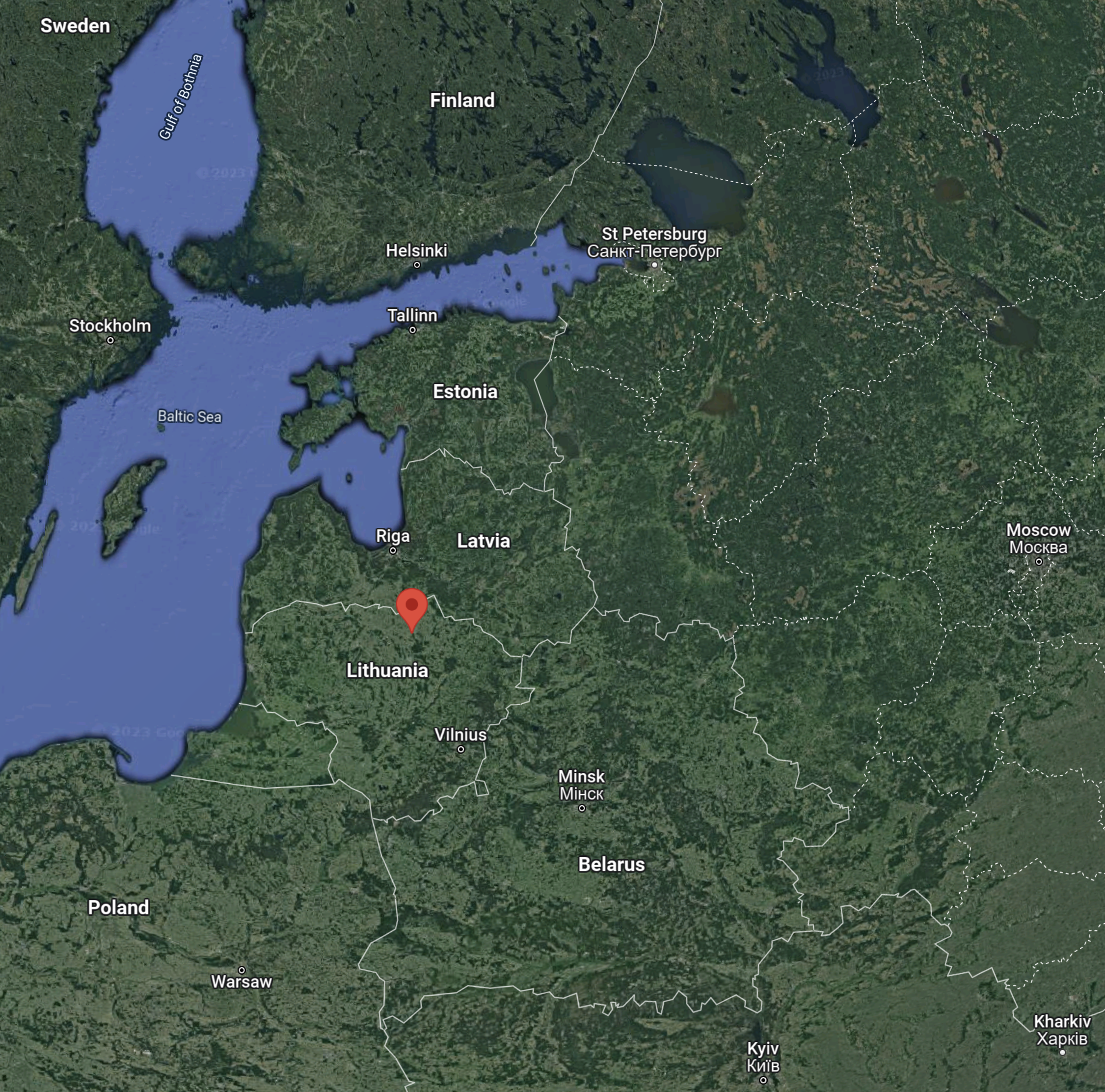
Note.
- Country borders are marked as white lines.
- The site of the explosion at Pasvalis Vienkiemii, is marked with a red arrow.
- Pasvalis Vienkiemii is about a hundred miles from Vilnius.
- About a hundred miles to the East of Pasvalis Vienkiemii, is the point, where Belarus, Latvia and Lithuania meet.
- Russian territory is about a hundred miles further to the East.
I have experience of the quality of borders in that area.
South-West of Lithuania and lying between that country and Poland, there is the small Russian enclave of Kaliningrad.
These pictures show the border between Poland and the Kaliningrad enclave of Russia.





If the borders between Belarus, Latvia and Lithuania are as secure as this, they are almost an open invitation to saboteurs to enter and do damage.
Rail Baltica Electrification Procurement Begins
The title of this post, is the same as that of this article on Railway Gazette.
These two paragraphs define the project.
Rail Baltica project promoter RB Rail has begun procurement of the electrification systems for the future standard gauge line between Poland, Lithuania, Latvia and Estonia, saying it will be the largest railway electrification scheme in Europe to be implemented as a single project.
The energy subsystem contract covers 870 km of double track line from the Polish border to Tallinn including the line from Kaunas to Vilnius, and includes design and construction of substations, connections to the public high voltage grids, control systems and more than 2 000 track-km of overhead equipment.
It looks like the procurement process will be finished by 2023.
Hopefully, Vlad the Mad won’t object to this standard gauge line going too close to lines with his beloved Russian gauge.
Will Rail Baltica Annoy Putin?
Rail Baltica is described like this in Wikipedia.
Rail Baltica (also known as Rail Baltic in Estonia) is an ongoing greenfield railway infrastructure project to link Finland (via ferry or an undersea tunnel), Estonia, Latvia, Lithuania with Poland and through this with the European standard gauge rail line network. Its purpose is to provide passenger and freight service between participating countries and improve rail connections between Central and Northern Europe, specifically the area in the Southeast of the Baltic sea. Furthermore, it is intended to be a catalyst for building the economic corridor in Northeastern Europe. The project envisages a continuous rail link from Tallinn (Estonia) to Warsaw (Poland). It consists of links via Riga (Latvia), Kaunas and Vilnius (Lithuania). Rail Baltica is one of the priority projects of the European Union.
These are a few more details.
- It will be a double-track railway or four tracks if it handles freight.
- Passenger trains will run at up to 250 kph (155 mph)
- Electrification will be either 25 KVAC or 3 KVDC overhead.
- It will be a standard gauge line.
- There will be no level crossings.
- It is planned to open around 2026.
The biggest problem could be that some of the route is shared with the Russian gauge line, that connect Kaliningrad to Vilnius and then from there to the main part of Russia.
This map from OpenRailwayMap shows the railways between Kaliningrad and Vilnius.
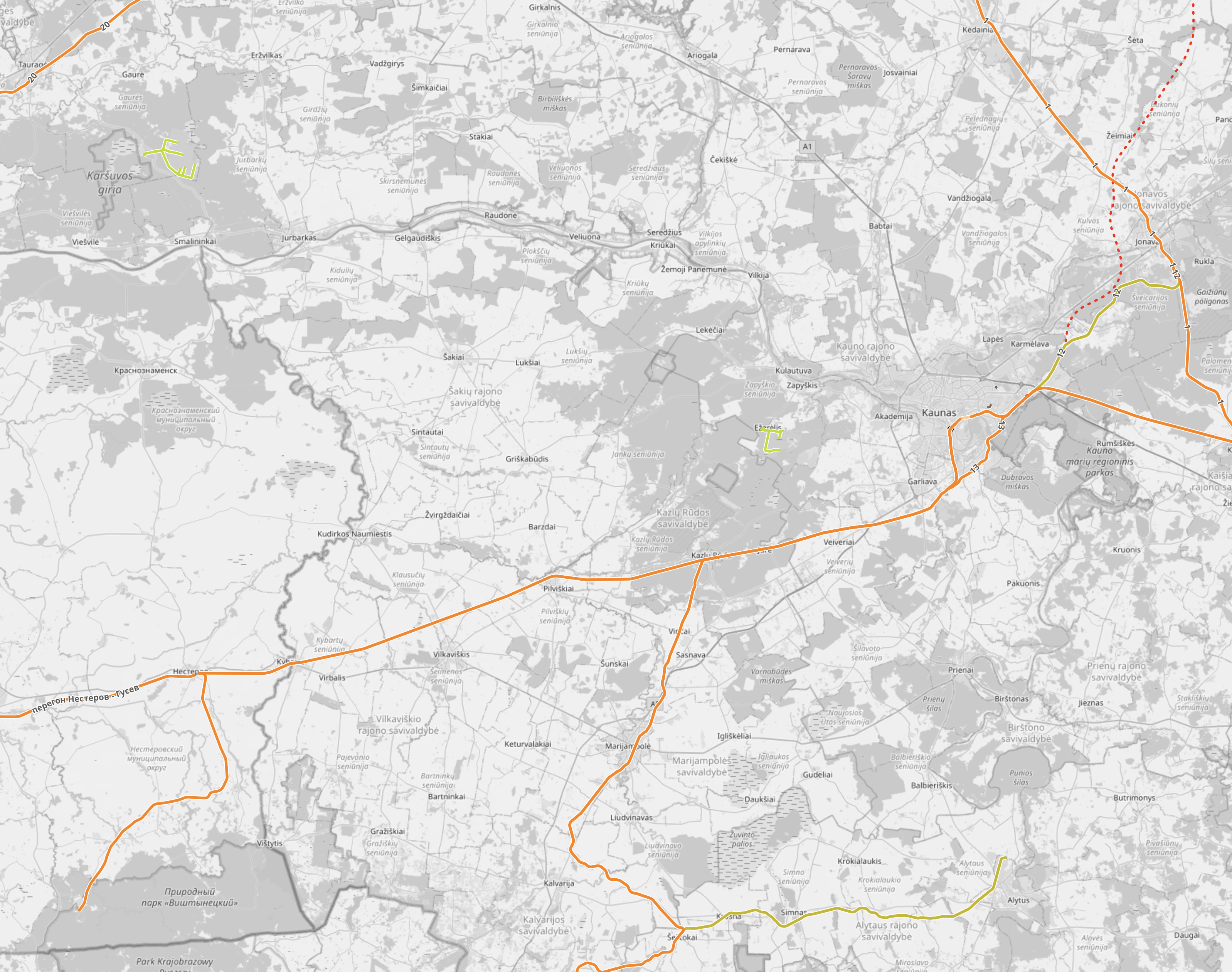
Note.
- The orange lines are main lines.
- The yellow lines are secondary lines.
- The orange line going West goes to Kaliningrad.
- The dark grey line crossing the railway is the border of the Kaliningrad enclave, which was annexed by the Soviet Union in 1945.
- The orange line going South goes to Bialystok, Warsaw and all places to the West.
- The loop in the line is at Kaunus, where there will be an interchange between the two lines.
- The orange lines going East go to Vilnius.
- The dotted red line in the North-East corner of the map, will be new track for Rail Baltica.
The new railway will effectively squeeze itself between Kaliningrad and Kaunus.
Railway Gauges In Poland and the Baltic States
Consider.
- Most, if not all of the railways in the Baltic States are Russian gauge.
- The line between Kaliningrad and Kaunus is Russian gauge.
- Most of the railway lines in Poland are standard gauge.
- The EU likes all new high speed lines like Rail Baltica to be built to standard gauge and have 25 KVAC overhead electrification.
- Kaunus is in Lithuania, so NATO control access to Kaliningrad in sensitive times.
I can’t believe that Vlad likes the current situation and would probably prefer Rail Baltica to be built to Russian gauge, as it would enable the Russian Army to easily move tanks into the Baltic States.
Conclusion
There’s a chance that Vlad will make trouble.
Rail Baltica Concept Trains Inspired By Sun, Sea And Sand
The title of this post, is the same as that of this article on Railway Gazette.
The article shows concept images and I suspect that any of Europe’s train makers could make trains like these.
Rail Baltica will have following route and specification.
- It will eventually run between Helsinki and Warsaw, via Estonia, Latvia and Lithuania.
- There will be a tunnel between Helsinki and Tallinn.
- It will carry both passengers and freight.
- Freight trains will have a maximum length of 1050 metres, as opposed to 775 metres in the UK.
- It will be mainly double-track.
- It will be a standard gauge track with right-hand running, as all countries in the area use right-hand running.
- There will be no level crossings.
- It will have 25 KVAC overhead electrification.
- There will be ERTMS signalling.
- Passenger trains will run at 249 kph (161 mph)
- It is intended to be completed in mid-2026
The specification is similar to High Speed Two, with these exceptions.
- High Speed Two is faster at 205 mph.
- High Speed Two runs on the left.
- High Speed Two will not carry freight.
Phases 1 and 2a of High Speed Two should complete in 2029-2033, with Phase 2b following in 2035.
The bidders to build High Speed Two’s rolling stock include.
- Alstom Transport
- Bombardier Transportation (acquired by Alstom Transport on 29 January 2021) and Hitachi Rail Europe consortium
- Construcciones y Auxiliar de Ferrocarriles
- Patentes Talgo
- Siemens Mobility
I wouldn’t be surprised to see a similar list of companies tendering to build the trains for Rail Baltica.
- Stadler, who have factories in Poland may be added to the list.
- As the trains are being designed at the same time as High Speed Two trains, I wouldn’t be surprised to be similarities.
- They would also have to be designed for both left and right hand running, if there was any chance of a service between Paris and Helsinki.
- Although, they will run under 25 KVAC electrification on Rail Baltica,they may need to be able to run on other voltages.
I very much feel that Rail Baltica will be offered a selection of excellent trains.
Where Will The Trains Be Built?
Consider
- This obviously depends, where winning bidder has factories.
- But there is also the problem of getting trains between the factory and the Baltic.
- This could be difficult for factories in Spain, as there would need to be a gauge change.
- It would be easier, if the route were standard gauge all the way, as it would be from France, Germany, Italy and the UK
- If a Spanish company got the contract, could it build the trains in the UK, as delivery could be easier.
- I puzzle, why Talgo are building a factory in Scotland without any UK orders. But it would be easier to deliver trains to Russia and Eastern Europe by sea from Longannet than Spain.
There are a lot of factors that will define where the trains will be built.
Pärnu – Latvian Border Rail Baltica Contract Awarded
The title of this post, is the same as that of this article on Railway Gazette.
This is the introductory paragraph.
Rail Baltica project promoter RB Rail has awarded a consortium of Indra subsidiary Protec and Obermeyer Planen + Beraten a €10·8m contract to provide design and construction supervision services for the 93·5 km section of the double-track route between Pärnu and the border with Latvia.
In my view, Rail Baltica is one of the most important rail projects in Europe, if not the World.
It will connect the Baltic States to Poland and Germany, and hopefully will play a large part in reducing road traffic in the area.
Latvia, A Disappearing Nation
Thw title of this post is the same as that of this article on Politico.
This is the first two paragraphs.
Atis Sjanits has an unusual remit for an ambassador. The Latvian diplomat is not responsible for relations with another nation — but with his own country’s diaspora.
Sjanits’ job is to respond to the exodus triggered by Latvia’s accession to the EU. Since joining the bloc, nearly a fifth of the nation has left to work in more affluent EU nations: The U.K., Ireland, Germany.
The article gives population statistics for the three countries in Eastern Europe.
In 2000, Latvia’s population stood at 2.38 million. At the start of this year, it was 1.95 million. No other country has had a more precipitous fall in population — 18.2 percent according to U.N. statistics. Only Latvia’s similarly fast-shriveling neighbor, Lithuania, with a 17.5 percent decrease, and Georgia, with a 17.2 percent drop, come close.
Estonia is not mentioned. So could this be, that their advanced digital economy? I’m no expert, but surely if you have a good Internet, it must open up opportunities.
I could say, that the bright and the innovative have always left the Baltic States, as my great-great-great-grandfather, did around 1800! His reasons were also slightly different, as there was a lack of opportunities for Jews in East Prussia.
The article quotes Atis Sjanits as there will not be enough future soldiers or taxpayers to pay for them.
The EU has big plans for a railway called Rail Baltica to eventually link Helsinki and Warsaw, via the three Baltic States.
The railway is to be built to a high standard.
- 155 mph running.
- 25 KVAC electrification.
- ERTMS signalling.
- No level crossings.
- Ability to handle freight trains of 1050 metres.
Vladimir Putin does like the fact that the new railway will be standard gauge rather than Russian.
The main reason is to move freight from road to rail, but I can certainly see tourists using the railway to tour the Baltic.
 The Anonymous Widower