Southeastern Keen On Battery EMUs
The title of this post, is the same as that of a small section in the August 2023 Edition of Modern Railways.
This is said.
Southeastern is to seek pre-qualification interest from manufacturers and leasing companies for a replacement fleet for the Networker Class 465 and 466 inner-suburban stock, now over 30 years old. The company intends to compare the price of new and cascaded stock.
Southeastern MD Steve White told Modern Railways his preference is for a bi-mode EMU, capable of working off both the third rail supply and batteries. Battery EMUs were originally proposed for the Networker replacements so they could work through services to the unelectrified Isle of Grain branch, after Medway Council put forward plans to restore passenger services on the Hoo peninsular to serve new housing there.
Despite the extension of services to Sharnal Street on the Isle of Grain having since been put on hold by Medway Council on cost grounds (p13, May issue).
Southeastern is still pursuing battery EMUs, even though the company’s existing network is all electrified on the third rail system.
Merseyrail is already adopting battery EMU technology, with seven of the new fleet of 53×4-car Class 777 units being equipped with batteries to enable them to serve the unelectrified extension to Headbolt Lane (p82, July 2022 issue).
Mr. White says there are a number of reasons battery EMUs are attractive.
-
- Increasing levels of mental health issues in society have led to trespass being a major issue the railway: battery EMUs would make it feasible to keep trains moving at slow speed when the current supply has to be switched off to protect a trespasser.
- Battery EMUs would be able to keep moving on occasions when the third rail supply fails, due to technical failures or ice on the conductor rail. This would avoid the compounding of problems, as when delayed passengers got out on the track at Lewisham in March 2018 when the third rail iced up, forcing Network Rail to cut the electricity supply and making it more difficult to get trains moving again.
- Battery EMUs would make it feasible to remove third rail from depots, making them safer places in which to work. A train cleaner was electrocuted and died at West Marina depot in St. Leonards in May 2014, and the Office of Road and Rail has well-publicised concerns on safety grounds about any extensions to the third rail system.
- Battery EMUs would be able to cater for service extensions on unelectrified lines, such as the Isle of Grain.
Mt. White says the trespass issue is the major driver, and if the principle of battery EMUs becomes established it might prove feasible to remove the third rail from platform areas at inner-suburban stations with a persistent trespass problem. He points out this approach might unlock extension of third rail to routes such as the Uckfield line, allowing station areas to be left unelectrified. Replacement of DMUs by electric stock on the Uckfield branch would eliminate diesel working at London Bridge, with air-quality and carbon removal benefits for the capital.
There are a 5-star hotel and a major hospital close to the diesel-worked plstform at London Bridge.
I will now look at some of the issues in detail.
Range Of A Battery EMU
I discuss range of battery EMUs in these posts.
- Stadler FLIRT Akku Battery Train Demonstrates 185km Range
- New Merseyrail Train Runs 135km On Battery
Note.
- Both trains are built by Stadler.
- 135 km. is 84 miles.
- A Bombardier engineer told me eight years ago, that the prototype battery-electric Class 379 train had a range of sixty miles.
I feel it is reasonable to assume that a 100 mph battery-electric train, designed to replace Southeastern’s Networkers could have a range of at least sixty miles.
Distances Of Cannon Street Metro Services
These are distances of services from Cannon Street.
- Erith Loop via Greenwich, Woolwich Arsenal and Bexleyheath – 28.5 miles
- Gravesend – 24.5 miles
- Orpington – 12.6 miles
- Grove Park – 7.1 miles
- Slade Green – 14.5 miles
Note.
- The Erith Loop services start and finish at Cannon Street station.
- The Gravesend service terminates in an electrified bay platform.
- The Orpington service terminates in an electrified bay platform.
- Grove Park and Slade Green are depots.
If trains could be fully charged at Cannon Street station, all services out of the station could be worked by a battery EMU with a range of forty miles.
Charging At Cannon Street
Consider.
- All Cannon Street services arrive at the station via London Bridge station.
- All Cannon Street services leave the station via London Bridge station.
- Trains typically take 4-5 minutes between Cannon Street and London Bridge station.
- Trains typically wait at least 7 minutes in Cannon Street station before leaving.
- Typically, a battery EMU takes fifteen minutes to charge.
A train running from London Bridge to London Bridge would probably take a minimum of fifteen minutes, which should be enough to charge the train.
The track between London Bridge and Cannon Street would need a strong level of protection from trespassers.
I suspect that with some slight timetable adjustments, all Cannon Street services could be run using battery EMUs.
Distances Of Charing Cross Metro Services
These are distances of services from Charing Cross.
- Maidstone East – 38.9 miles
- Dartford – 17.1 miles
- Gravesend – 23.8 miles
- Hayes – 14.3 miles
- Sevenoaks – 22.2 miles
- Grove Park – 8 miles
Note.
- The Gravesend service terminates in an electrified bay platform, which could be used to charge the train before return.
- The Maidstone East service terminates in an electrified platform.
- Grove Park is a depot.
If trains could be fully charged at Charing Cross station, all services out of the station could be worked by a battery EMU with a range of fifty miles.
Charging At Charing Cross
Consider.
- All Charing Cross services arrive at the station via London Bridge station.
- All Charing Cross services leave the station via London Bridge station.
- Trains typically take 10 minutes between Charing Cross and London Bridge station.
- Trains typically wait at least 7 minutes in Charing Cross station before leaving.
- Typically, a battery EMU takes fifteen minutes to charge.
A train running from London Bridge to London Bridge would probably take a minimum of twenty minutes, which should be enough to charge the train.
The track between London Bridge and Charing Cross would need a strong level of protection from trespassers.
I suspect that with some slight timetable adjustments, all Charing Cross services could be run using battery EMUs.
Distances Of Victoria Metro Services
These are distances of services from Victoria.
- Gillingham – 37.2 miles
- Orpington – 14.7 miles
- Dartford – 18.9 miles
Note.
- The Orpington service terminates in an electrified bay platform.
- The Gillingham service terminates in an electrified bay platform.
- The Dartford service terminates in an electrified platform.
If trains could be fully charged at Victoria station, all services out of the station could be worked by a battery EMU with a range of fifty miles.
Charging At Victoria
Consider.
- All Victoria services arrive at the station via Shepherds Lane junction.
- All Victoria services leave the station via Shepherds Lane junction.
- Trains typically take five minutes between Victoria and Shepherds Lane junction.
- Trains typically wait at least 7 minutes in Victoria station before leaving.
- Typically, a battery EMU takes fifteen minutes to charge.
A train running from Shepherds Lane junction to Shepherds Lane junction would probably take a minimum of seventeen minutes, which should be enough to charge the train.
The track between Shepherds Lane junction and Victoria would need a strong level of protection from trespassers.
Conclusion
It certainly appears that if the Networker Class 465 and Class 466 trains were replaced by new trains with the following specification.
- 100 mph operating speed.
- Range of fifty miles on battery power.
- Ability to charge batteries in fifteen minutes.
- Third-rail operation
- It might be an idea to add a pantograph, so the trains could use 25 KVAC overhead wires where necessary and charge batteries on a short length of overhead electrification.
Then a substantial part of the Southeastern Metro network could be made safer, by selective removal of third rail at trespassing hot spots.
Silvertown Tunnel Bus Network Proposals
This web page is the Silvertown Tunnel Bus Network Proposals.
These proposals are made.
- A new high frequency, limited stop service between Grove Park and Canary Wharf referred to in this consultation as route X239
- To extend route 129 (Lewisham – North Greenwich) north across the river to Great Eastern Quay via the Royal Docks development zone
- A minor change to route 108 so that it uses the new Millennium Way slip road to exit the Blackwall Tunnel southbound
- We are also seeking your views on route options for three sections of routes 129 and X239.
It looks like route 108 will continue to use the current stop.
The proposals include this map.

I copied this map from the TfL web site, as they don’t provide one for people who want or need to use it.
These are my observations.
The 108 Bus
The 108 seems to be more or less as now and will be continue to be run by a single-decker bus, as double-decker buses can’t use the Blackwall Tunnel.
North of the Thames, the 108 calls at these stations.
- Stratford International for DLR and National Rail.
- Stratford for DLR, Central, Elizabeth and Jubilee Lines, and National Rail.
- Bow Church for DLR
- Devons Road for DLR
- Langdon Park for the DLR
- Bazely Street (All Saints) for DLR
South of the Thames, the 108 calls at these stations.
- North Greenwich for the Jubilee Line.
- Westcombe Park for National Rail
- Blackheath for National Rail
- Lewisham for DLR and National Rail
Note.
- It is possible to go between Lewisham and Stratford on the DLR with a change at Canary Wharf.
- It is possible to go between North Greenwich and Stratford on the Jubilee Line.
- Westcombe Park station is on the Greenwich Line.
I would wonder, if many people use this bus route for long distances.
The 129 Bus
Note.
- The 129 appears to connect Lewisham and Greenwich to the City Airport and the Becton branch of the DLR.
- Many journeys on the 129 bus, might be easier using the DLR, with a change at Westferry or Poplar, which is probably what travellers do now.
- The 129 bus is shown on the map with a stop at Silvertown. Does that mean that it could connect with a Silvertown station on the Elizabeth Line?
- As the 129 bus will pass through the larger Silvertown Tunnel, it could be a double-decker route, instead of the current single-decker.
North of the Thames, the 129 calls at these stations.
- Gallions Reach for the DLR
- Beckton for the DLR
- Royal Albert for the DLR
- London City Airport for the DLR
- Silvertown
- Pontoon Dock for the DLR
- West Silvertown for the DLR
South of the Thames, the 129 calls at these stations.
- North Greenwich for the Jubilee Line.
- Cutty Sark for DLR
- Greenwich for DLR and National Rail
- Lewisham for DLR and National Rail
Would improvements and a frequency increase to the DLR and the building of Silvertown station, mean that changes to the 129 bus route, would not be so important?
The X329 Bus
Note.
- Canary Wharf must be served and starting at Westferry Circus is probably a good choice.
- But is Grove Park station, the ideal Southern terminal?
- Not stopping the X329 bus at North Greenwich is probably correct, as North Greenwich station is a large Jubilee Line and bus interchange close to the O2.
North of the Thames, the X329 calls at these stations.
- Canary Wharf for DLR and Elizabeth and Jubilee Lines
South of the Thames, the X329 calls at these stations.
- Blackheath for National Rail
- Lee for National Rail
- Grove Park for National Rail
Note.
- Blackheath station is on the Bexleyheath and North Kent Lines.
- Lee station is on the Dartford Loop Line.
- Grove Park station is on the South Eastern Man Line.
- Grove Park has a bus station, where there could be space for a battery charger for electric buses.
The X329 seems to have been partly designed on the premise, that an express bus should be run through the Silvertown Tunnel. But it does connect four of the rail lines going into London terminals to Canary Wharf.
Silvertown Station For London City Airport
Silvertown station would more than double the number of stations with easy routes to the London City Airport.
The Elizabeth Line would enable the direct connection that is needed to Canary Wharf, the City of London, Heathrow, Liverpool Street and Paddington stations and the West End.
- A single change at Abbey Wood, would give access to much of Kent.
- A single change at Farringdon, would give access to Thameslink services and Gatwick and Luton airports.
- Around 2030, a single change at Old Oak Common, would give access to High Speed Two services.
- A single change at Paddington, would give access to Wales and West services.
- A single change at Whitechapel, would give access to the great circle of the London Overground.
I believe the case for a Silvertown station with at least a good walking route to the London City Airport is strong, and the station would be a marvellous asset for Silvertown and the Airport.
Improving The Wood Green And Moorgate Public Transport Corridor
This morning I went for coffee with an old school friend from Minchenden Grammar School at Southgate station.
Southgate is not a bad place to meet someone.
- There are a couple of good coffee shops.
- There are plenty of buses.
- It has a couple of the better chain restaurants including a Pizza Express.
- The area also has a lot of memories for me.
It also has one of London’s most iconic Underground stations.


It may look familiar, as it regularly crops up in film and television dramas.
- One station guy told me, that the ticket barriers have been designed to be easy to remove, so filming of an historic drama is possible.
- It was used in The End Of The Affair to portray a Central London station.
- As the escalators have the same bronze fittings as Moscow, they could be used in a story set in Russia.
As the Piccadilly Line doesn’t go anywhere near my house, to get to Southgate, I take a 141 bus to and from a convenient Piccadilly Line station.
- Going North, I changed at Manor House station.
- Coming South, I changed at Turnpike Lane station.
- I could have also have changed at Wood Green station.
The journey home had four major problems.
- The bus stop at Turnpike Lane station, is a few hundred yards from the station.
- I waited fifteen minutes for a 141 bus.
- When it did arrive, it was so packed, it didn’t have space for a miniature dachshund to squeeze in between the feet of the standing passengers.
- The traffic was very heavy, so the journey was slow.
How can this bus route cope in the Peak, if it can’t cope on a Sunday morning?
Various issues and actions and will make these capacity issues worse.
The Victoria Line Has No Direct Connection With The Elizabeth Line
In my view, this was a mistake, although not that serious, as the young or energetic can probably walk between Oxford Circus and the Hanover Square entrance to Bond Street station on the Elizabeth Line.
Will this connection develop with coffee and snack shops to ease passenger interchanges?
When and if Oxford Circus station is ever made step-free, I can imagine a tunnel, perhaps with a moving walkway being built between Oxford Circus station and he Hanover Square entrance to Bond Street station.
There is also the cross-platform interchange at Highbury & Islington station with the Northern City Line that links with Moorgate and the City of London.
The Piccadilly Line Has No Direct Connection With The Elizabeth Line
To get between the Northern stations on the Piccadilly Line and the Elizabeth Line is either a double-change at Finsbury Park and Highbury & Islington stations or a ride on the 141 bus.
I wrote about these issues in Extending The Elizabeth Line – Improving The Northern City Line.
The Elizabeth Line Will Attract Travellers To Moorgate
I notice that my own travelling patterns have changed from using the Central, Circle, District, Hammersmith & City and Metropolitan Lines to using the Elizabeth Line since it opened and I suspect, when the Elizabeth Line is fully joined up, that more passengers will travel to Moorgate to access the Elizabeth Line.
Transport for London and the Mayor Are Rerouting The 21 Bus
The 21 bus duplicates the 141 bus between Newington Green and Moorgate station.
But it is being rerouted next year, which will increase the loading on the 141 bus.
The 141 Bus Used To Be The 641 Trolleybus
When I was a child, London’s trolleybus network was extensive and to get between Wood Green and Moorgate, you would have used the 641 trolleybus.
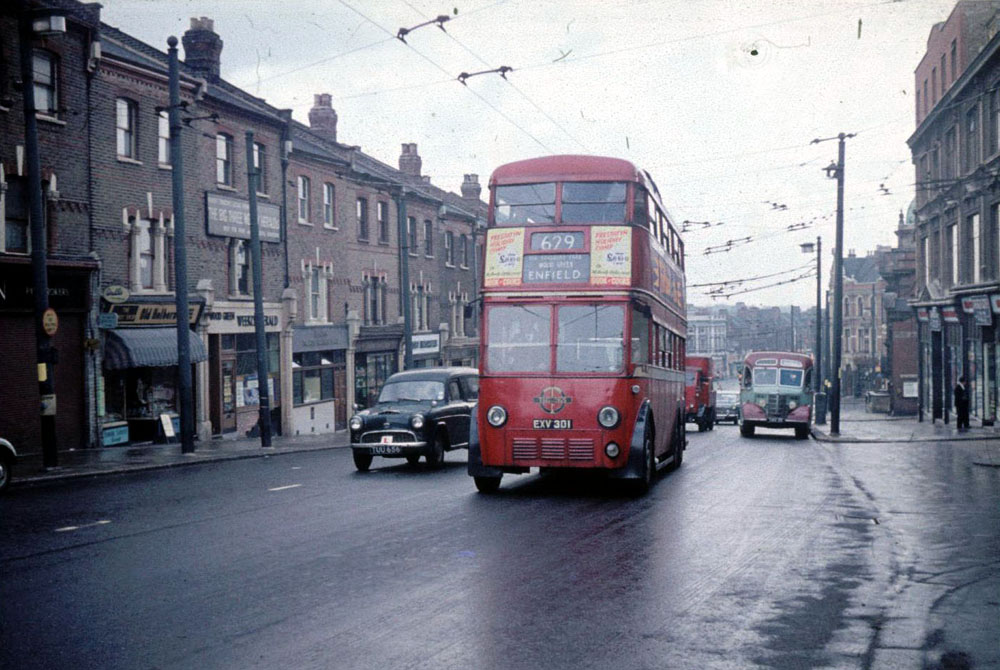
Trolleybus Ascending Jolly Butchers Hill in Wood Green
Many like me, look back on trolleybuses with affection.
Does this historical connection encourage passengers to use the 141 bus, which is the 641 trolleybus’s successor on the route?
My parents certainly had lots of trolleybus stories.
So What Could Be Done?
There are a variety of actions that could be taken to strengthen public transport between Moorgate and Wood Green stations.
Improve The 141 Bus Route
In Does London Need High Capacity Bus Routes To Extend Crossrail?, I put forward ideas for using buses to link to the Elizabeth Line.
This was my suggestion.
I suspect any route seen as an extension of Crossrail needs to have the following characteristics.
- High frequency of perhaps a bus every ten minutes.
- Interior finish on a par with the Class 345 trains.
- Wi-fi and phone charging.
I would also hope the buses were carbon-free. Given that some of these routes could be quite long, I would suspect hydrogen with its longer range could be better.
I feel that a high-quality 141 bus running every ten minutes between London Bridge station and Palmers Green, would be just what the passengers would order.
- Palmers Green bus garage is at the Northern end of the route, so could be used for refuelling or recharging.
- London Bridge station is at the Southern end of the route and was designed with an efficient bus station.
- The 141 route connects London Bridge, Bank, Moorgate and Old Street stations in the City of London.
With the right buses, this could be a route with real quality and usefulness.
Increase The Frequency On The Northern City Line
The Northern City Line may have new Class 717 trains, but it still has a pathetic frequency of eight trains per hour (tph)
- I am sure it could be increased to at least 12 tph between Moorgate and Alexandra Palace stations.
- Something like six tph would go to Welwyn Garden City, four tph to Hertford East station and two to Stevenage.
- Large areas of the Northern suburbs would get a much better connection to the Elizabeth Line.
Once the digital signalling is installed and commissioned, no new infrastructure will be needed.
I am sure, that this would be the easiest way to improve public transport in North London.
Add Step-Free Access To As Many Stations As Possible
Moorgate, Finsbury Park, Oakwood and Cockfosters are step-free with lifts.
As many stations as budgetary constraints allow, should be made step-free.
London Bridge Station – 16th September 2022
I went to London Bridge station, to see how the queue was going.


At the time, it was reaching all the way to Southwark Park and it was taking about 15 hours to go through.
When I went through overnight on Wednesday night it took me about eight hours.
Bermondsey To London Bridge – 17th September 2022
I took these pictures as I travelled from Bermondsey To London Bridge on the lower deck of a 381 bus.


Note.
- It was busy in Bermondsey station.
- Dome of the bus information was poor.
- The queue for the lying-in state was going slowly.
It looks like the lying-in state may be called off. I’m not surprised.
Every Station Should Have One!
I took these pictures at London Bridge station, today.


How many other stations in the world, have a proper organ?
London Bridge And Dalston Junction With A Reverse At New Cross
This may seem to be a strange route to go to my home from London Bridge station, but it’s a route I regularly use as it is step-free and it avoids the vagaries of the 141 bus route which can mean waiting longer than necessary at the bus station at London Bridge.
- I went to Platform 1 at London Bridge and got the first train to New Cross, which was waiting in the station.
- On arrival at New Cross, I walked across the platform and waited perhaps three minutes for the London Overground train for Dalston Junction to arrive.
- I then went two stops from Dalston Junction to outside my house.
I took these pictures along the route.


Note.
Network Rail Uses Tree Planting Initiative To Combat Graffiti Hotspot
The title of this post, is the same as that of this article on Rail Technology Magazine.
These two paragraphs introduce the article.
Network Rail has planted 35 trees, as part of its many sustainability initiatives, at a graffiti hotspot location in London with the hopes of acting as a vandalising deterrent whilst also improving the natural habitats within the area.
This action marks the first time that Network Rail have used ecological measures such as these to prevent graffiti and vandalism. The tree planting at the Bermondsey Dive Under – a junction where one set of rail lines tunnel under another – will not only create nicer visual stimulants for passengers and local residents but will also contribute to significant cleaning cost savings. It is estimated that the graffiti at the South-East London hotspot has cost taxpayers £150,000 in cleaning and rejuvenation works over the last 2 years.
I would expect that £150,000 buys a lot more than 35 trees.
These pictures show the trees from a train going Between East Croydon and London Bridge stations.


I also wonder whether those that are caught for painting the graffiti, should be sentenced to a community service order to plant new trees to stop the vandalism.
Design Contract Awarded To Extend Railway Arches Low Line Concept
The title of this post is the same as that of this article on Ian Visits.
These are the first two paragraphs.
Plans to revamp the railway arches running through Wandsworth and Lambeth to create an extension of Southwark’s “low line” have taken a step forward after a contract was awarded to a design agency.
The extension would create a continuous walking and cycling route from Battersea to London Bridge, to connect communities with the creation of new spaces alongside the viaduct.
It looks to be an interesting concept with lots of possibilities.
Alstom Hydrogen Aventras And The Uckfield Branch
In Alstom And Eversholt Rail Sign An Agreement For The UK’s First Ever Brand-New Hydrogen Train Fleet, I give my thoughts on Alstom’s new hydrogen train, which I have called the Alstom Hydrogen Aventra.
One possible route for the trains could be the Uckfield Branch, which has an hourly service from London Bridge via East Croydon and Oxted stations?
- The route is forty-six miles long, with the Northernmost twenty-one miles electrified with 750 VDC third-rail electrification.
- On each trip, the train would need to run for fifty miles without electrification.
- There are seven stops on the route.
- The platforms on the Uckfield Branch can handle a 240 metre train.
- Trains take around three hours for the round trip.
- Each train probably does around five round trips per day.
So would Alstom Hydrogen Aventras be able to work the route?
- The length of a three-car Alstom Hydrogen Aventra is probably around 72 metres.
- Three Alstom Hydrogen Aventras working together would be 216 metres.
- Aventras can be configured to work on 750 VDC third rail electrification.
- The capacity of a nine-car formation of Alstom Hydrogen Aventra would be similar to that of a ten-car Electrostar, which has shorter cars.
Three Alstom Hydrogen Aventra trains working together could seem to be a possible solution for the route.
These are my thoughts.
The Required Range
If each train has to do five round trips, with each needing fifty miles on hydrogen, the trains would need a range in excess of 250 miles, whilst running on hydrogen.
Refuelling With Hydrogen
This would probably be done at a depot setup to service the hydrogen trains, where they would be stabled at night.
I doubt that London Bridge or Uckfield stations would be suitable places to refuel
The Number Of Trains
In Battery Electrostars And The Uckfield Branch, I estimated that three ten- or twelve-car trains would be needed to run an hourly service. Running half-hourly would need six trains.
As each nine-car train would need three Alstom Hydrogen Aventras, an hourly service would need a total of nine and a half-hourly service would need eighteen individual trains.
I suspect that this would not be a cost effective way of using the trains, as a lot of trains would need to refuelled every day.
Conclusion
I am not saying that Alstom Hydrogen Aventras couldn’t work the Uckfield Branch, but I’m sure there are are better ways to decarbonise the route.