Piccadilly Capacity Study Commissioned
The title of this post is the same as that of an article in the October 2018 Edition of Modern Railways.
This is the first paragraph.
New NR Chief Executive Andrew Haines has commissioned work to understand options for capacity through platforms 13 and 14 at Manchester Piccadilly.
It was originally planned to build two extra tracks, with additional platforms between Manchester Piccadilly and Deansgate stations, to improve the capacity over the Ordsall Chord.
But various engineers and politicians have suggested that Digital Signalling may be an alternative solution.
Speaking to the House of Commons Transport Committee, Mr. Haines said.
We might be better off replacing some of those fleets of trains with trains which have more doors.
Boarding is slow all across the North and I suspect Mr. Haines has studied the problem.
He also added.
He had commissioned work to understand if 15 trains per hour could be delivered through platforms 13 and 14 without major infrastructure works.
I don’t think that Network Rail would waste money on a study, if they didn’t think that 15 trains per hour (tph) were not possible.
Consider.
- Thameslink and Crossrail will soon be running 24 tph through Central London in four directions.
- The East London Line currently runs 16 tph in a tunnel that was opened only thirteen years after the Liverpool and Manchester Railway.
- Trains designed for short dwell times and easy boarding and unloading, as suggested by Mr. Haines would obviously help.
Platforms and the related access at Manchester Piccadilly, Manchester Oxford Road and Deansgate stations would need to be improved.
But that would be a smaller number of affordable projects.
Conclusion
I do think Andrew Haines has a mind that doesn’t believe in boxes, so his ideas won’t go down well with those with big-spending conservative ideas like most rail union leaders, some rail company bosses and the Mayor of Manchester.
How To Build A Station In Nine Months
This document on the Network Rail web site is entitled Highlights Of The Great North Rail Project.
There is this section which is entitled We Build A Railway Station In Just Nine Months.
It’s about the building of Maghull North station.
This is said.
Network Rail undertook the scheme on behalf of Merseytravel, appointing contractor Buckingham Group.
How did we deliver the station so quickly and carry out most of the works while keeping the railway line open? A head start, line access and a tight summer deadline.
Robert Grey, a project manager of infrastructure projects at Network Rail, said: “Nine months is quite short for a station… The restricting factor is the access. We had quite a bit of flexibility there. We had access for long weekends and a 12-day possession of the line after Christmas… Without those we’d still be there now.”
I also put it down to the Liverpudlian attitude, which in my experience seems to accept disruption to their lives without complaining too much and then joke about it, when it’s all over.
I was in Liverpool during the bus strike of 1968. where Liverpudlians just walked.
Some of this attitude would be of great help in sorting the problem of the Steventon Bridge in Oxfordshire. I wrote about this bridge at the end of The Stone Arch Railway Bridges Of Scotland.
Network Rail Is Open For Business
Network Rail has published this document, which is entitled Open For Business.
The document is subtitled.
Opportunities for third parties to fund, finance or deliver improvements on Britain’s railways September 2018.
The improvements are listed by area.
Anglia – 5 Projects
- Trowse Swingbridge
- Loop north of Witham and associated works
- Haughley Junction doubling
- Ely Area service improvements
- Road vehicle incursion mitigation (various sites)
London And North Eastern and East Midlands – 8 Projects
- Leeds Station
- Ashington Blyth & Tyne
- East Coast Main Line (ECML) South Digital Railway
- West Yorkshire Combined Authority (WYCA) new stations
- Meadowhall Station
- Pontefract Monkhill Station
- Signalling
- Level Crossing Lighting
London North Western – 9 Projects
- Cumbrian Coast Line Upgrade
- Birmingham Airport Connectivity
- University Station, Birmingham
- Watford Junction
- Carlisle Station Masterplan
- Snow Hill Station
- Hest Bank Coastal Defence (CGJ7 W21470) in Lancashire
- Leven Viaduct Major Structure (CBC1 34) in Cumbria.
- CP6 Mining remediation programme
Scotland – 2 Projects
- Perth Station Refurbishment
- CP6 Building Fabric Renewal Programme
South East – 5 Projects
- Stations Capacity Programme (Lewisham, Peckham Rye and Denmark Hill)
- Victoria Station redevelopment
- Thanet Parkway Station
- Marshlink Enhancement
- Cannon St river bridge repair and refurbishment
Wales – 8 Projects
- Cardiff Central Station
- Footbridge (various locations)
- Sea Defence – Sudbrook
- River bank protection
- Ebbw Junction MDU
- Port Talbot MDU
- Shrewsbury MDU
- Cardiff Canton LMD
This totals up to 37 projects.
The Stunning New Public Space Under The Ordsall Chord Might Not Open To The Public For Years
The title of this post is the same as that of this article in the Manchester Evening News.
As I understand it, the new Orsall Chord in Manchester has been designed to open up a public space by the River Irwell.
The headline says it all and there appears to be no-one who knows when it will open.
For one time too, it doesn’t seem that Network Rail is the villain of the piece.
I suppose the trouble is that this development has nothing to do with football!
Come on Manchester, get your act together!
Now That’s What I Call A Footbridge!
This article on Global Rail News is entitled Network Rail Launches Footbridge Design Competition.
This is the first two paragraphs.
A competition for new footbridge design ideas has been launched by Network Rail and the Royal Institute of British Architects (RIBA).
Entrants are asked to design fully accessible footbridges that can be used across Britain’s rail network and that further improve the legacy of rail pioneers.
Hopefully, something better than some of those on Britain’s rail network will be designed.
I was in Wales last week on the Ffestiniog Railway and saw this bridge.
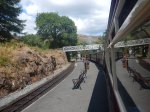
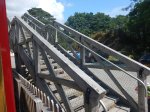


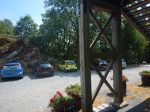
Surely, someone can come up with something like this, that meets all the regulations and looks a lot better, than Network Rail’s standard offering in green-painted steel.
My father used to build structures like this with timber and bolts to create extra floors and storage in his print works in Wood Green. From about the age of seven, I was his little helper.
Perhaps, thirty years later, I had a barn built at a house I owned. The architect had the building designed in a similar manner.
Someone, ought to enter Network Rail’s competition with a similar design.
OLE Upgrades Complete At Anglia As Part Of £46m Transformation
The title of this article, is the same as that of this article on Rail Technology Magazine.
I hope this is actually the case.
- I’ve had enough of rail replacement buses, when trying to get to football at Ipswich on a Saturday.
- For at least the last three years, I’ve probably seen more away matches, than those at Portman Road.
- Three hours each way to Ipswich, effectively means, the only pleasurable thing you do is see the match.
- This work has probably hit attendances at both Norwich and Ipswich.
- I’ve renewed my season ticket fort next season, but if it is as thin on home matches as this one has been, it will be my last season of travel.
What puzzles me, is why can’t Network Rail adjust their work schedule, so that at least important matches like the two Derbies have trains?
But then you wouldn’t rate Network Rail highly for Project Management!
High-Speed Handbacks Could Save NR £250,000 A Week
The title of this post is the same as that, of this article on Rail Technology Magazine.
The article described how by using a more sophisticated tamping machine, Network Rail are able to hand the track back faster after maintenance.
Many businesses, as Network Rail do here, use outdated processes to do regular tasks.
Often by using an improved procedure, companies can save money.
In this instance, Network Rail are saving enough in a year to perhaps build a small station.
Can you be sure, you use the best processes in your business?
Hitachi Battery Trains On The Great Western Railway
The slow pace of the electrification on the Great Western Main Line has become a big stick with which to beat Network Rail.
But are rolling stock engineers going to pull Network Rail out of their hole?
On page 79 of the January 2018 Edition of Modern Railways, Nick Hughes, who is the Sales Director of Hitachi Rail Europe outlines how the manufacturer is embracing the development of battery technology.
He is remarkably open.
I discuss what he says in detail in Hitachi’s Thoughts On Battery Trains.
But here’s an extract.
Nick Hughes follows his description of the DENCHA; a Japanese battery train, with this prediction.
I can picture a future when these sorts of trains are carrying out similar types of journeys in the UK, perhaps by installing battery technology in our Class 395s to connect to Hastings via the non-electrified Marshlink Line from Ashford for example.
This would massively slice the journey time and heklp overcome the issue of electrification and infrastructure cases not stacking up. There are a large number of similar routes like this all across the country.
It is a prediction, with which I could agree.
I conclude the post with this conclusion.
It is the most positive article about battery trains, that I have read so far!
As it comes direct from one of the train manufacturers in a respected journal, I would rate it high on quality reporting.
Hitachi Battery Train Technology And Their UK-Built Trains
The section without electrification on the Marshlink Line between Ashford International and Ore stations has the following characteristics.
- It is under twenty-five miles long.
- It is a mixture of double and single-track railway.
- It has nine stations.
- It has a sixty mph operating speed.
As the line is across the flat terrain of Romney Marsh, I don’t think that the power requirements would be excessive.
In the Modern Railway article, Nick Hughes suggests that battery technology could be installed in Class 395 trains.
The Class 395 train is part of a family of trains, Hitachi calls A-trains. The family includes.
- Class 800 trains as ordered by GWR and Virgin Trains East Coast.
- Class 801 trains as ordered by GWR and Virgin Trains East Coast
- Class 802 trains as ordered by GWR, Hull Trains and TransPennine Express
- Class 385 trains as ordered by ScotRail.
In Japan, another member of the family is the BEC819, which is the DENCHA, that is mentioned in the Modern Railways article.
As a time-expired electrical engineer, I would think, that if Hitachi’s engineers have done their jobs to a reasonable standard, that it would not be impossible to fit batteries to all of the A-train family of trains, which would include all train types, built at Newton Aycliffe for the UK.
In Japan the DENCHAs run on the Chikuhō Main Line, which has three sections.
- Wakamatsu Line – Wakamatsu–Orio, 10.8 km
- Fukuhoku Yutaka Line – Orio–Keisen, 34.5 km
- Haruda Line – Keisen–Haruda, 20.8 km
Only the middle section is electrified.
It looks to me, that the Japanese have chosen a very simple route, where they can run on electrification for a lot of the way and just use batteries at each end.
Bombardier used a similar low-risk test in their BEMU Trial with a Class 379 train in 2015.
So How Will Battery Trains Be used On the Great Western?
On the Great Western Main Line, all long distance trains and some shorter-distance ones will be Class 80x trains.
The size of battery in the DENCHA can be estimated using a rule, given by Ian Walmsley.
In an article in the October 2017 Edition of Modern Railways, which is entitled Celling England By The Pound, Ian Walmsley says this in relation to trains running on the Uckfield Branch.
A modern EMU needs between 3 and 5 kWh per vehicle mile for this sort of service.
So the energy needed to power the DENCHA, which is a two-car battery train on the just under twenty miles without electrification of the Chikuhō Main Line in a one way trip would be between 112 and 187 kWh.
A Battery-Powered Class 801 Train
The Class 801 train is Hitachi’s all-electric train, of which Great Western Railway have ordered thirty-six of the closely-related five-car Class 800 train and twenty-one of the nine-car units.
The difference between the two classes of train, is only the number of generator units fitted.
- Trains can be converted from Class 800 to Class 801 by removing generator units.
- Bi-mode Class 800 trains have a generator unit for each powered car.
- The all-electric Class 801 train has a single generator unit, in case of electrical power failure.
- When trains couple and uncouple, the train’s computer system determines the formation of the new train and drives and manages the train accordingly.
If I was designing the train, I would design a battery module, that replaced a generator unit
This leads me to think, that a five-car Class 801 train, could have one generator unit and up to four battery modules.
- The computer would decide what it’s got and control the train accordingly.
- The generator unit and battery power could be used together to accelerate the train or at other times where high power is needed.
- If the batteries failed, the generator unit would limp the train to a safe place.
- The number of battery units would depend on the needs of the route.
It would be a true tri-mode train; electric, diesel and battery.
I will now look at some routes, that could see possible applications of a battery version of Class 80x trains.
Cardiff To Swansea
I’ll start with the most controversial and political of the cutbacks in electrification.
At present plans exist to take the electrification on the Great Western as far as Cardiff Central station, by the end of 2018.
The distance between Cardiff Central and Swansea stations is forty-six miles, so applying the Ian Walmsley formula and assuming the train is five-cars, we have an energy usage for a one-way trip between the two cities of between 690 and 1150 kWh.
As the Class 80x trains are a modern efficient design, I suspect that a figure towards the lower end of the range will apply.
But various techniques can be used to stretch the range of the train on battery power.
- From London to Cardiff, the line will be fully-electrified, so on arrival in the Welsh capital, the batteries could be fully charged.
- The electrification can be continued for a few miles past Cardiff Central station, so that acceleration to line speed can be achieved using overhead wires.
- Electrification could also be installed on the short stretch of track between Swansea station and the South Wales Main Line.
- There are three stops between Cardiff and Swansea and regenerative braking can be used to charge the batteries.
- The single generator unit could be used to help accelerate the train if necessary.
- There are only two tph on the route, so efficient driving and signalling could probably smooth the path and save energy.
- Less necessary equipment can be switched off, when running on batteries.
Note. that the power/weight and power/size ratios of batteries will also increase, as engineers find better ways to build batteries.
The trains would need to be charged at Swansea, but Hitachi are building a depot in the city, which is shown in these pictures.


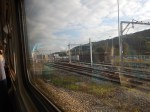
It looks like they are electrifying the depot.
Surely, enough electrification can be put up at Swansea to charge the trains and help them back to the South Wales Main Line..
The mathematics show what is possible.
Suppose the following.
- Hitachi can reduce the train’s average energy consumption to 2 kWh per carriage-mile, when running on battery power.
- Electrification at Cardiff and Swansea reduces the length of battery use to forty miles.
This would reduce the battery size needed to 400 kWh, which could mean that on a five-car train with four battery modules, each battery module would be just 100 kWh. This compares well with the 75 kWh battery in a New Routemaster bus.
Will it happen?
We are probably not talking about any serious risk to passengers, as the worst that can happen to any train, is that it breaks down or runs out of power in the middle of nowhere. But then using the single generator unit, the train will limp to the nearest station.
But think of all the wonderful publicity for Hitachi and everybody involved, if the world’s first battery high speed train, runs twice an hour between Paddington and Swansea.
Surely, that is an example of the Can-Do attitude of Isambard Kingdom Brunel?
Paddington To Oxford
The route between Paddington and Oxford stations is electrified as far as Didcot Parkway station.
The distance between Didcot Parkway and Oxford stations is about ten miles, so applying the Ian Walmsley formula and assuming the train is five-cars, we have an energy usage for the return trip to Oxford from Didcot of between 300 and 500 kWh.
If the five-car train has one generator unit,four battery modules and has an energy usage to the low end, then each battery module would need to handle under 100 kWh.
There are plans to develop a South-facing bay platform at Oxford station and to save wasting energy reversing the train by running up and down to sidings North of the station, I suspect that this platform must be built before battery trains can be introduced to Oxford.
If it’s not, the train could use the diesel generator to change platforms.
The platform could also be fitted with a system to charge the battery during turnround.
Paddington To Bedwyn
The route between Paddington and Bedwyn is electrified as far as Reading station, but there are plans to electrify as far as Newbury station.
The distance between Newbury and Bedwyn stations is about thirteen miles, so applying the Ian Walmsley formula and assuming the train is five-cars, we have an energy usage for the return trip to Bedwyn from Newbury of between 390 and 520 kWh.
As with Paddington to Oxford, the required battery size wouldn’t be excessive.
Paddington To Henley-on-Thames
The route between Paddington and Henley-on-Thames station is probably one of those routes, where electric trains must be run for political reasons.
The Henley Branch Line is only four miles long.
It would probably only require one battery module and would be a superb test route for the new train.
Paddington To Weston-super-Mare
Some Paddington to Bristol trains extend to Weston-super-Mare station.
Weston-super-Mare to the soon-to-be-electrified Bristol Temple Meads station is less than twenty miles, so if Swansea can be reached on battery power, then I’m certain that Weston can be reached in a similar way.
Other Routes
Most of the other routes don’t have enough electrification to benefit from trains with a battery capability.
One possibility though is Paddington to Cheltenham and Gloucester along the Golden Valley Line. The length of the section without electrification is forty-two miles, but unless a means to charge the train quickly at Cheltenham station is found, it is probably not feasible.
It could be possible though to create a real tri-mode train with a mix of diesel generator units and battery modules.
This train might have the following characteristics.
- Five cars.
- A mix of generator units and battery modules.
- Enough generator units to power the train on the stiffest lines without electrification.
- Ability to collect power from 25 KVAC overhead electrification
- Ability to collect power from 750 VDC third-rail electrification.
Note.
- The battery modules would be used for regenerative braking in all power modes.
- The ability to use third rail electrification would be useful when running to Brighton, Exeter, Portsmouth and Weymouth.
The train could also have a sophisticated computer system, that would choose power source according to route,timetable, train loading, traffic conditions and battery energy level.
The objective would be to run routes like Paddington to Cheltenham, Gloucester to Weymouth and Cardiff to Portsmouth Harbour, as efficiently as possible.
Collateral Advantages
Several of the routes out of Paddington could easily be worked using bi-mode Class 800 trains.
- But using battery trains to places like Bedwyn, Henley, Oxford and Weston-super-Mare is obviously better for the environment and probably for ticket sales too!
- If places like Bedwyn, Henley and Oxford are served by Class 801 trains with a battery option, it could mean that they could just join the throng of 125 mph trains going in and out of London.
- Battery trains would save money on electrification.
I also suspect, that the running costs of a battery train are less than those of using a bi-mode or diesel trains.
Conclusion
Hitachi seem to have the technology, whereby their A-train family can be fitted with batteries, as they have done it in Japan and their Sales Director in the UK, has said it can be done on a Class 395 train to use the Marshlink Line.
We may not see Hitachi trains using batteries for a couple of years, but it certainly isn’t fantasy.
Great Western Railway certainly need them!
This Year’s Engineers Christmas Party Is At Highbury And Islington Station
Three year’s ago, I wrote VolkerFitzpatrick Are Having A Christmas Party At South Tottenham.
This year’s Engineers Chrismas Party is at Highbury and Islington station, where they are replacing the bridge on the Holloway Road over the North London Line.
These pictures were taken on the 20th of December.
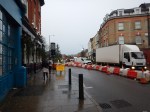
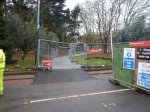
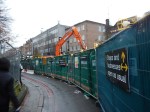
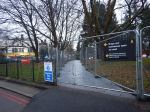

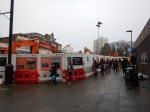
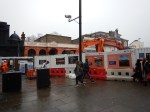
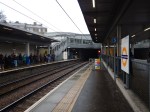
The first action of the rebuilding of the bridge was the shutting of the Post Office outside the station, which I wrote about in Highbury And Islington Post Office Is Now Shut.
That post dates from July 2014 and signs around the station say the bridge will be replaced by Summer 2018.
Four years to rebuild a bridge. Are Network Rail looking for an entry in the Guinness Book Of Records?
But then Network Rail has form with bridges in North London.
On the Gospel Oak to Barking Line, they forgot to rebuild the bridges at Wightman Road and Crouch Hill.
These pictures were taken on the 22nd of December.
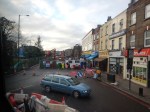
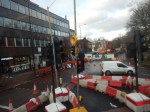
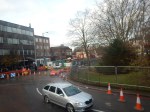

These pictures were taken on the 28th of December.

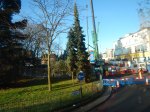


These pictures were taken on the 31st of December.
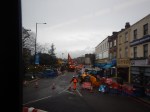

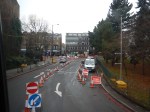

The large cranes have gone.
The 8th of January marked the reopening of the roads.

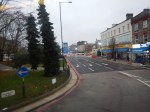
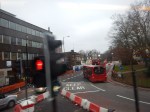
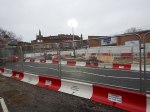
I think the bridge will be fully completed in the Summer.

