Taunton To Exeter St. Davids – 4th July 2023
I took these pictures as I travelled from Taunton station to Exeter St.Davids station.




























































This Google Map shows a section of the M5 North of Collumpton.
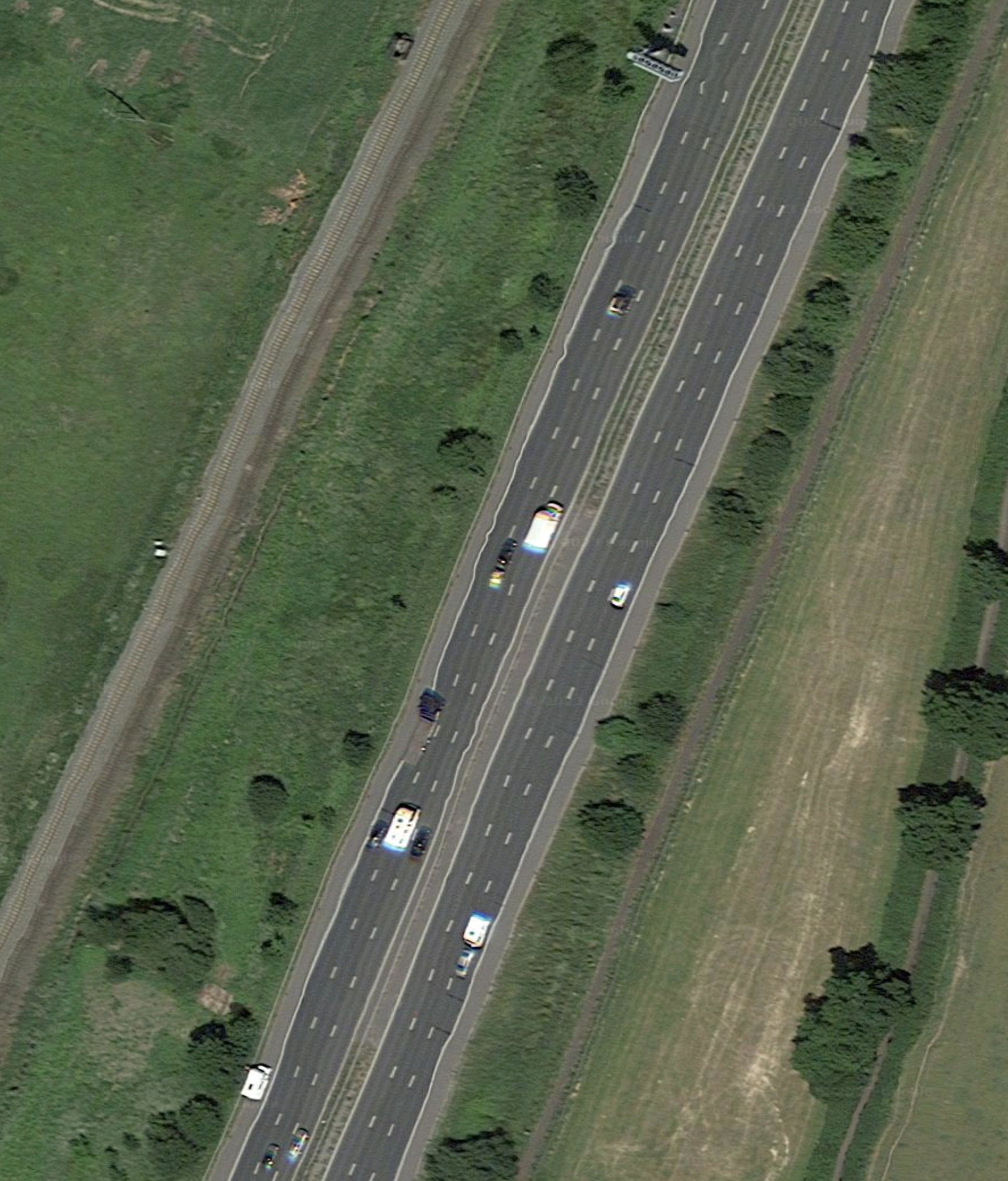
Note.
- The proximity of the M5 motorway to the railway, in some pictures and the map.
- There is space to plant large numbers of trees between the motorway and the railway.
- There are high voltage overhead electrical cables running along the same corridor.
- Collumpton services are also placed between the motorway and the railway.
I believe that with good landscaping, it would be possible to improve the motorway and railway corridor, between Taunton and South of Collumpton.
This OpenRailwayMap shows the track between Wellington and Collumpton, between Taunton and Exeter.
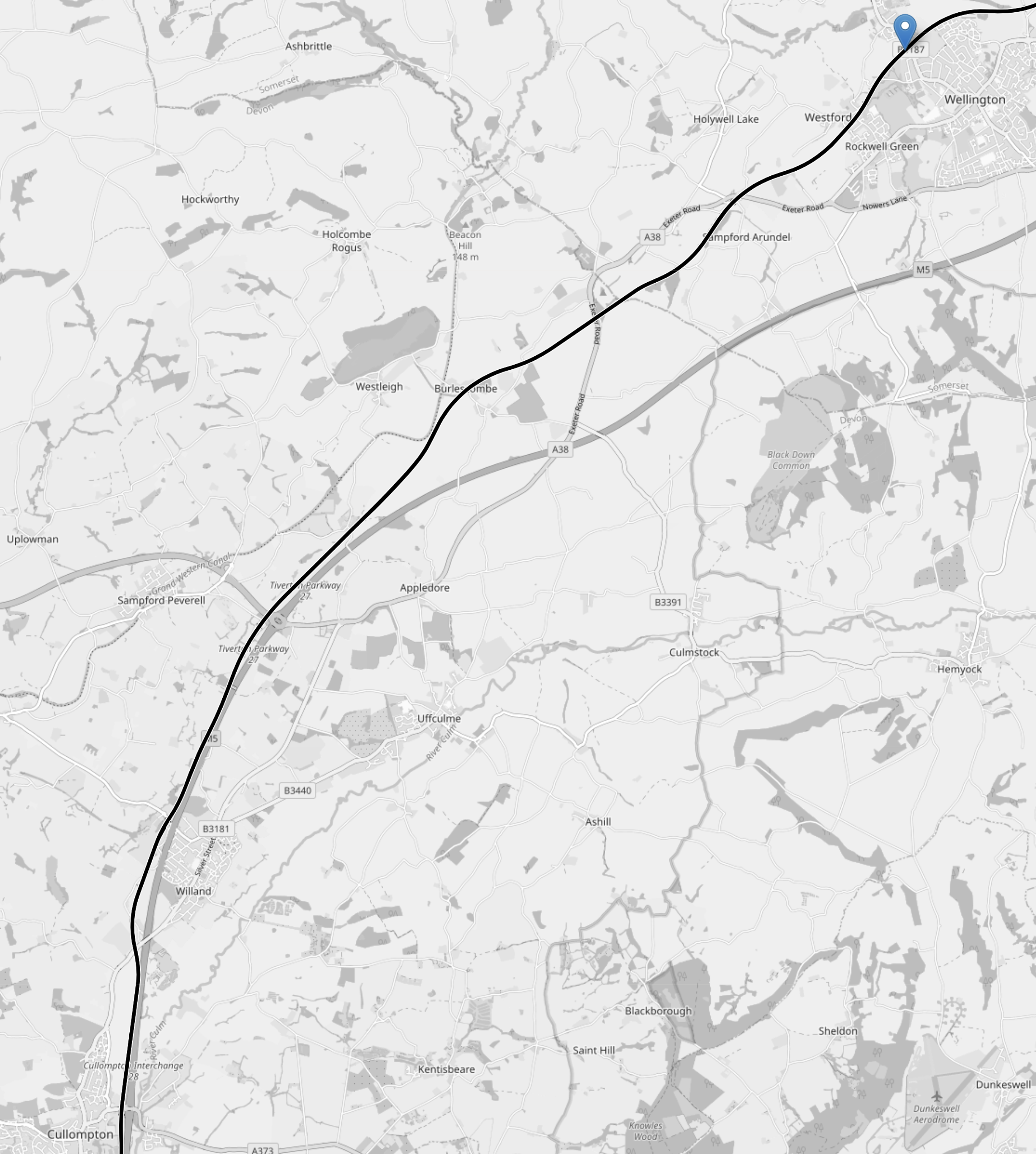
Note.
- The black line is the railway between Taunton and Exeter.
- The blue arrow in the North-East corner of the map indicates the position of the proposed Wellington station.
- Collumpton is in the South-West corner of the map and has also been put forward for a new Collumpton station.
- I talked about the reopening of these two stations in Reopening Of Wellington and Cullompton Stations.
- The M5 to the North of Collumpton runs closely alongside the railway.
- According to Real Time Trains, it takes just under ten minutes to go the thirteen miles between Wellington and Cullompton.
I believe that by using partial electrification, good engineering and innovative landscaping, that sufficient electrification can be erected between Taunton and South of Collumpton, that would ensure the following.
- Trains would leave Taunton going East with enough charge to travel the 89.6 miles to Newbury.
- Trains would leave Taunton going North with enough charge to travel the 51.7 miles to Patchway via Western-super-Mare and Bristol Temple Meads.
- Trains would leave Cullompton going South with enough charge to travel the 32.9 miles to Okehampton.
- Trains would leave Cullompton going South with enough charge to travel the 36.6 miles to Paignton.
- Trains would leave Cullompton going South with enough charge to travel the 60.4 miles to Plymouth.
Note.
- I’ve added Okehampton, as I feel that if Dawlish had another encounter with Poseidon, Okehampton with its proposed Parkway station on the A30 could be the terminus for coaches to and from Cornwall.
- Charging could be needed at Okehampton and Paignton.
- Charging at Okehampton and Paignton, wouldn’t be needed, if the battery-electric trains had enough range to do the return trip.
Electrification of Plymouth and Penzance stations, as I outlined in Thoughts About Electrification Through Devon And Cornwall, would enable battery-electric trains to bridge the gap of 79.5 miles, between these two stations.
Conclusion
It looks like some miles of sympathetic electrification and landscaping between Taunton and South of Cullompton, is the key to running battery-electric train to Devon and Cornwall.
Thoughts About Electrification Through Devon And Cornwall
Distances
I’ll start by looking at a few distances.
- Penzance and Taunton – 162.3 miles
- Penzance and Exeter St. David’s – 131.5 miles
- Penzance and Plymouth – 79.5 miles
- Taunton and Exeter St. David’s – 30.7 miles
- Plymouth and Exeter St. David’s – 52 miles
- Taunton and Newbury – 89.6 miles
- Plymouth and Taunton – 82.8 miles
- Taunton and Paignton – 59 miles
- Taunton and Patchway – 51.7 miles
Note.
- Patchway and Newbury are already electrified to Cardiff Central and London Paddington respectively.
- Bombardier’s engineer told me eight years ago, that the battery-electric Class 379 had a range of sixty miles.
- Stadler’s FLIRT Akku has a Guinness world record of 139 miles on one battery charge. See this page on the Stadler web site.
- Even Stadler’s Class 777 trains for Merseyrail have a range of 84 miles on battery power. See New Merseyrail Train Runs 135km On Battery.
The rail distances in Devon and Cornwall are getting closer to being within the capability of trains fitted with batteries.
Station Stop Times
These are typical times that trains stop in the more important stations between Taunton and Penzance.
- Taunton – < 2 mins
- Tiverton Parkway – < 2 mins
- Exeter St. Davids – 2 mins
- Newton Abbot – < 2 mins
- Totnes – < 2 mins
- Plymouth – 11 minutes
- Devonport – < 2 mins
- Saltash – < 2 mins
- Menheniot – < 2 mins
- Liskeard – < 3 mins
- Bodmin Parkway – 2 mins
- Lostwithiel – 2 mins
- Par – 2 mins
- St. Austell – 2 mins.
- Truro – 2 mins
- Redruth – 2 mins
- Camborne – 2 mins
Note.
- The timings were for today.
- The Cardiff and Penzance services were being run by five-car Class 802 trains.
- Most station stops are around two minutes or less, but Plymouth on this train was eleven minutes.
I find it interesting that the Plymouth stop takes so much longer.
Train Stops At Plymouth
I looked at about twenty trains stopping at Plymouth, that included these services.
- London Paddington and Penzance
- Penzance and London Paddington
- Cardiff Central and Penzance
- Penzance and Cardiff Central
Note.
- I found an average time of eight minutes.
- Eleven minutes was a common stop.
- Eight minutes could be enough time for the rail equivalent of a Formula One splash and dash.
- CrossCountry services were going through the station in three minutes.
I am led to believe that the timetable used by the GWR trains would allow a quick battery charge at Plymouth station.
This OpenRailwayMap shows the platforms at Plymouth station.
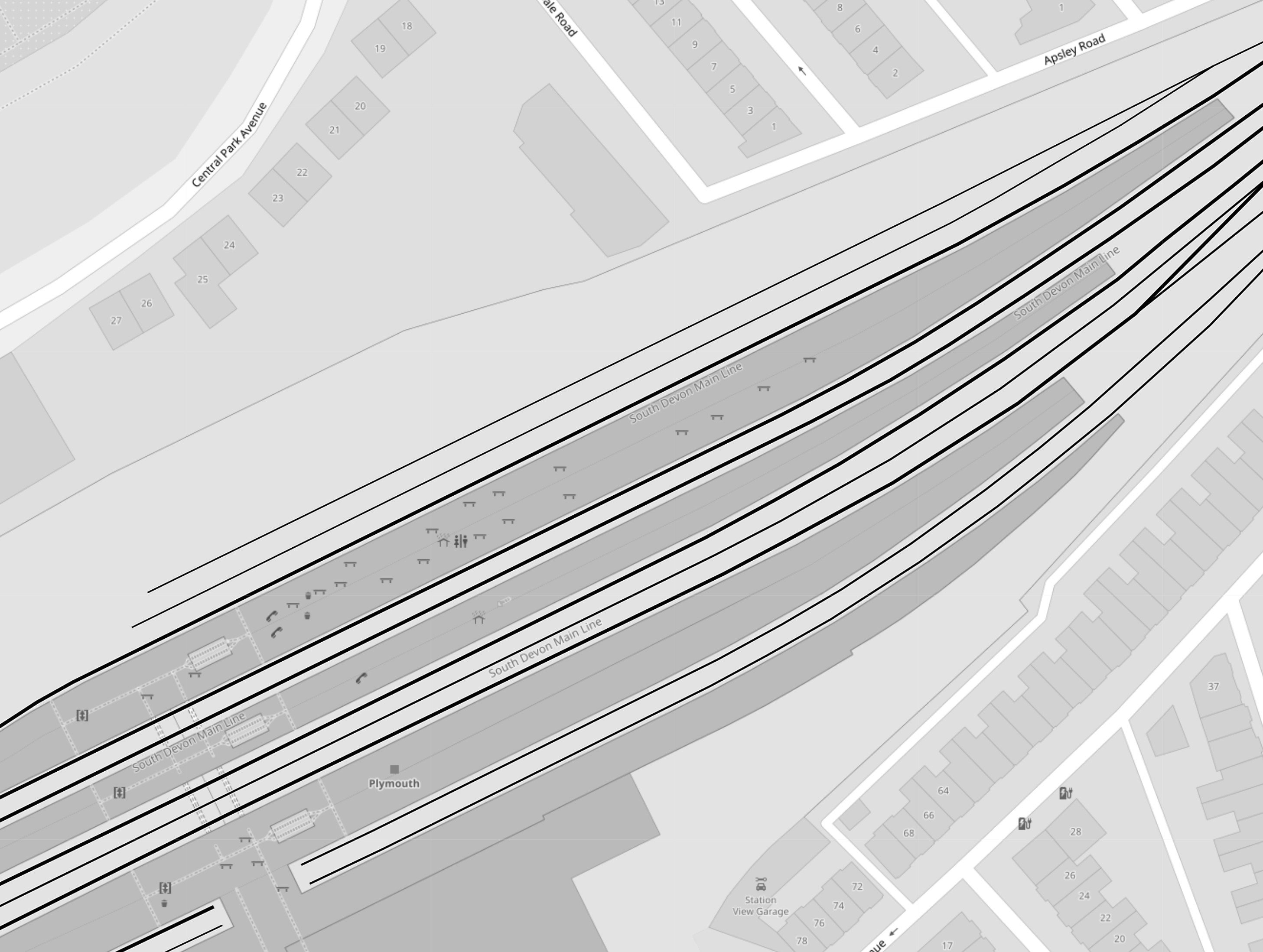
Note.
- London is to the East and Penzance is to the West.
- Platform numbers increase from South to North.
- The two East-facing bay platforms are Platforms 1 and 2.
- The West-facing bay platform in the South-West corner is Platform 3.
- Platform 4 shares the island with the bay platforms 1, 2 and 3.
- Most trains going to Penzance use Platform 4.
- Platforms 5 and 6 share the centre island platform.
- Platforms 7 and 8 share the Northernmost island platform.
- Most trains going towards London use Platform 7.
- Wikipedia indicates that the track layout is comprehensive and allows a lot of operational flexibility.
Although the station was completed around forty years ago, it could have been designed for handling modern battery-electric trains.
- There are three bay platforms numbered 1 to 3, to charge local services and send them on their way.
- Trains can arrive and depart in the five through platforms, numbered 4 to 8, from either direction.
- Two days ago, a nine-car London Paddington to Plymouth train terminated in Platform 7. After waiting an hour it returned to London. An hour would be enough time to fully-charge a train.
- As many platforms as needed could be electrified.
I am fairly sure, that most battery-electric trains could be timetabled to leave Plymouth station with full batteries.
Turnround At Penzance
I have found these turnrounds.
- 802113 arrived from Paddington at 1142 and left for London at 1215
- 802022 arrived from Paddington at 1307 and left for London at 1415
- 802103 arrived from Paddington at 1500 and left for London at 1615
This OpenRailwayMap shows the platforms at Penzance station.
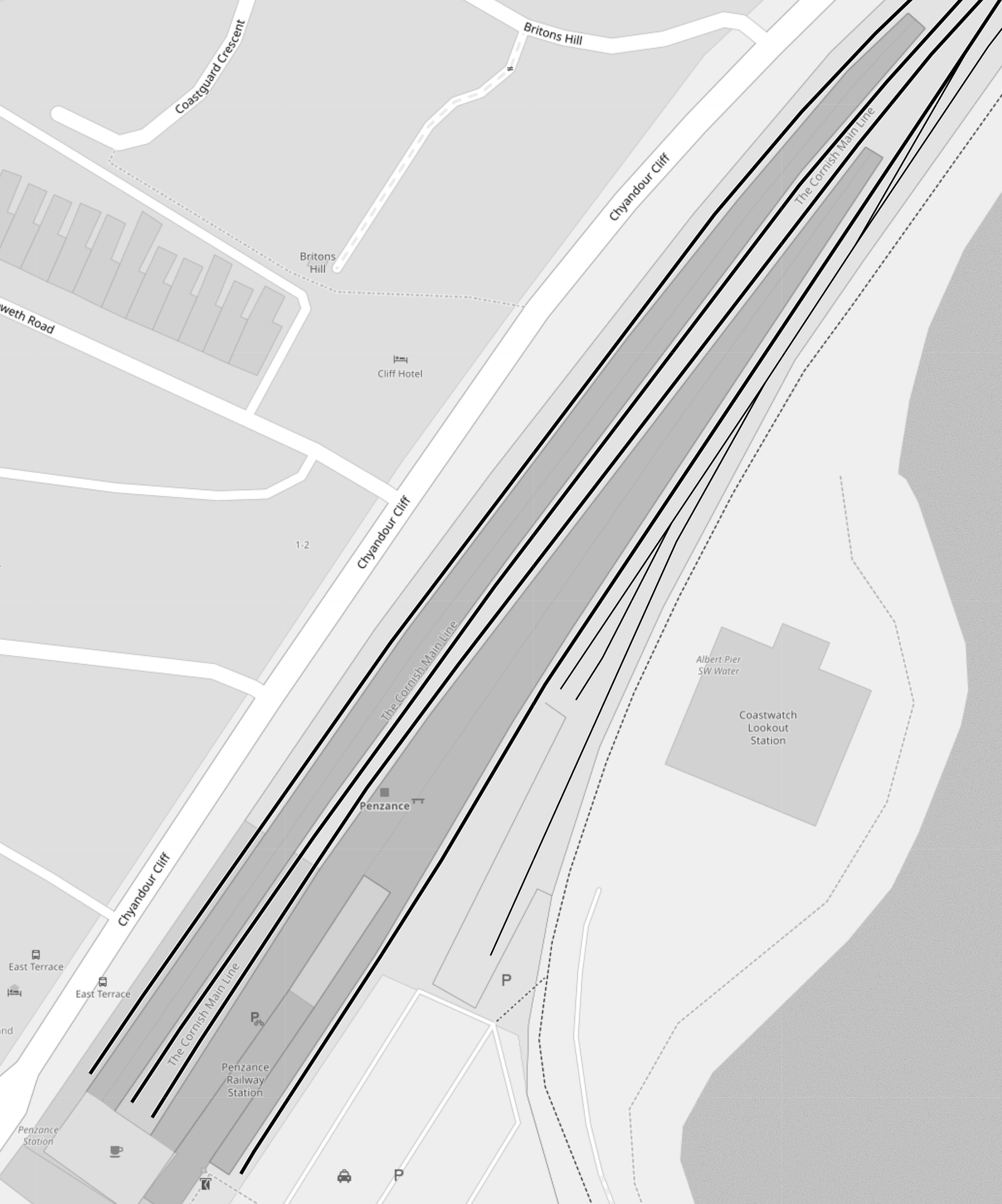
Note.
- The three example trains used Platform 1.
- Platform 1 is the long platform on the landward side of the station.
- Platforms are numbered 1 to 4 from left to right.
- An appropriate number of platforms would be electrified to charge trains terminating at Penzance.
Trains would appear to have plenty enough time to recharge, so they would start their return journey with full batteries.
Engineering Ambition
Several times in my life, I’ve got fired up about engineering or software projects and I like to think, I’ve produced the best and fastest solution.
For this reason, I believe that Hyperdrive Innovation, who are now part of Turntide Technologies, and Hitachi will set themselves three objectives with the design of the the battery packs for the Class 802 train.
- The battery-electric Class 802 will outperform the Stadler FLIRT Akku in terms of speed and distance.
- The battery packs will be plug-compatible with the diesel engines, so there will only be minor software modification to the trains.
- The train will be able to be handle all Great Western Railway’s routes without using diesel.
- I wouldn’t be surprised that on many routes the train will cruise at over 110 mph on batteries.
I also suspect they want the Akku’s Guinness world record, which will mean the range will be in excess of 139 miles.
Battery Range Needed For Routes
These are routes that need to be covered by battery-electric Class 802 trains or similar.
- Avanti West Coast – Crewe and Chester – 22.2 miles
- Avanti West Coast – Crewe and Holyhead – 105.5 miles
- Avanti West Coast – Crewe and Llandudno Junction – 65.5 miles
- Avanti West Coast – Crewe and Wrexham – 34.4 miles
- Avanti West Coast – Shrewsbury and Wolverhampton – 29.7 miles
- Great Western Railway – Penzance and Plymouth – 79.5 miles
- Great Western Railway – Plymouth and Taunton – 82.8 miles
- Great Western Railway – Taunton and Patchway – 51.7 miles
- Great Western Railway – Newbury and Taunton – 89.6 miles
- Great Western Railway – Taunton and Paignton – 59.0 miles
- Great Western Railway – Weston-super-Mare and Chippenham – 43.5 miles
- Great Western Railway – Oxford and Great Malvern – 65.6 miles
- Great Western Railway – Oxford and Hereford – 86.3 miles
- Great Western Railway – Oxford and Worcester Foregate Street – 57.6 miles
- Great Western Railway – Oxford and Worcester Shrub Hill – 57.2 miles
- Great Western Railway – Cheltenham Spa and Swindon – 43.2 miles
- Great Western Railway – Cardiff Central and Carmarthen – 77.4 miles
- Great Western Railway – Cardiff Central and Pembroke Dock – 118.9 miles
- Great Western Railway – Cardiff Central and Swansea – 45.7 miles
- Hull Trains – Beverley and Temple Hirst Junction – 44.3 miles
- Hull Trains – Hull and Temple Hirst Junction – 36.1 miles
- LNER – Hull and Temple Hirst Junction – 36.1 miles
- LNER – Middlesbrough and Longlands Junction – 22.2 miles
- LNER – Sunderland and Longlands Junction – 48.5 miles
- LNER – Lincoln Central and Newark Northgate – 16.6 miles
- LNER – Leeds and Bradford – 13 miles
- LNER – Leeds and Harrogate – 18 miles
- LNER – Leeds and Huddersfield – 17 miles
- LNER – Stirling and Inverness – 146 miles
- LNER – Edinburgh Haymarket and Aberdeen – 130 miles
- LNER – Peterborough and Doncaster via Great Northern and Great Eastern Joint Line – 93.7 miles
- South Western Railway – Basingstoke and Exeter St. David’s – 124.5 miles
- TransPennine – Hull and Micklefield – 42 miles
- TransPennine – Longlands Junction and Saltburn – 34.7 miles
- TransPennine – York and Scarborough – 42 miles
- TransPennine – Doncaster and Cleethorpes – 52.1 miles
- TransPennine – Stockport and Doncaster – 55.4 miles
- TransPennine – Stockport and Cleethorpes – 107.5 miles
Note.
- Stirling and Inverness and Edinburgh Haymarket and Aberdeen could be shortened by up to thirty miles, by planned electrification in Scotland.
- I have assumed that the TransPennine Upgrade has been completed.
- It looks like a battery-electric Class 802 train could use the Great Northern and Great Eastern Joint Line diversion via Lincoln.
- I am slightly surprised, that the longest stretch of line without electrification and with a passenger service is Basingstoke and Exeter St. David’s.
Charging will be needed at some places to charge the battery-electric trains. Stations fitted with chargers could include Aberdeen, Carmarthen, Cleethorpes, Exeter St. David’s, Hereford, Holyhead, Hull, Inverness, Paignton, Penzance, Pembroke Dock, Plymouth, Swansea, Taunton, Weston-super-Mare, Worcester.
Most chargers would be a length of electrification in the platform, where the battery-electric trains terminated or passed through.
More On LNER’s Ten New Bi-Modes
I wrote about these trains in LNER Seeks 10 More Bi-Modes.
This was my conclusion.
There is a lot of scope to develop LNER’s services.
I think it is likely that the order will go to Hitachi.
But as I indicated, I do believe that there is scope for a manufacturer to design a zero-carbon train, that was able to serve Aberdeen and Inverness.
-
- I suspect a fleet of ten trains would be sufficient.
- Trains would use the 25 KVAC overhead electrification, where it exists and hydrogen or battery power North of the wires.
The trains would also be capable of being upgraded to higher speeds, should the East Coast Main Line be turned into a High Speed Line.
I also think, that whatever trains are bought, there will be a large upgrading of the existing Hitachi fleet, which will add batteries to a lot of trains.
In the July 2023 Edition of Modern Railways, there is an article, which is entitled LNER Embraces Pioneering Spirit, which takes the form of an interview with LNER’s Managing Director; David Horne.
In a section, which is entitled ‘225’ Replacement, this is said.
Meanwhile, Mr Horne is looking to what might replace the InterCity 225 fleet, now smartly repainted in a scheme which pays homage to the original ‘Swallow’ livery. While there were fears this fleet may be withdrawn as an economy measure, the ‘225s’ are now on lease until at least next summer.
But Mr Horne says obsolescence issues are a real challenge and LNER will struggle to maintain the fleet beyond 2025, and from the May 2023 timetable change the number of daily diagrams was reduced from five to four to conserve the fleet’s mileage. Much of the heavy maintenance work had previously been carried out at Wabtec’s Doncaster site, but this facility is no longer available, and while a recent reliability improvement programme is bearing fruit, the challenges remain. The crunch point comes with the transition to ETCS at the southern end of the ECML as part of the East Coast Digital Programme – Mr Horne says LNER does not want to fit cab signalling on the ‘225s’.
The solution to this issue is to procure additional trains to run alongside the 65 Azumas, and LNER went out to tender in October 2020 for a fleet of 10 trains with self-power capability.
While a preferred bidder has been identified, the business case to proceed with the procurement is awaiting approval, but Mr Horne is still hopeful this project can be progressed.
The current plan envisages the new trains broadly replacing the ‘225s’ on Leeds and York diagrams, but a major benefit with the new fleet would be during engineering work – at present LNER has to withdraw services to places such as Harrogate and Hull to concentrate its bi-mode Azumas on services using non-electrified diversionary routes, and having more stock with self-power capability would ease the issue.
Currently, LNER has these Azumas and InterCity 225s in its fleet.
- Five-car bi-mode Class 800 trains – 10
- Nine-car bi-mode Class 800 trains – 13
- Five-car electric Class 801 trains – 12
- Nine-car electric Class 801 trains – 30
- Nine-car electric ImterCity 225 trains – 8
Note.
- There are 23 bi-mode trains and 50 electric trains.
- There are 167 bi-mode carriages and 302 electric carriages.
- Currently 31.5 % of the trains are bi-mode.
- With ten new bi-mode trains and no InterCity 225 trains, 44 % of the fleet will be bi-mode.
Is this increase in the percentage of the fleet, that are bi-mode acceptable?
I wonder, if there is a more affordable and flexible way to increase the fleet size.
In the Wikipedia entry for the Class 800 train, there is a section, which is entitled Traction And Generator Units, where this is said.
The Class 800 and Class 802 bi-mode are equipped with three GU per five-car set and five GU per nine-car set; a five-car set has a GU situated under vehicles 2/3/4 and a nine-car set has a GU situated under vehicles 2/3/5/7/8. In comparison, the electric-orientated Class 801 features a single GU for a five to nine-car set, which provides emergency power for limited traction and auxiliaries if the power supply from the overhead line fails. By adding or removing GUs, a Class 800 can be converted into a Class 801 and vice versa.
Let’s look at LNER’s needs, which are actually two separate sub-needs.
- There is a need for ten new trains to replace the InterCity 225 trains.
- There is a need to increase the size of the bi-mode fleet to be able to use the Great Northern and Great Eastern Joint Line and other non-electrified routes to by-pass engineering works.
Note.
- I suspect that as Mr Horne explained, there are only five or possibly four InterCity 225s diagrammed on a particular day, then perhaps ten five-car bi-mode Class 800 trains, might be able to cover for the retirement of the InterCity 225s.
- These trains would work as pairs to Leeds and York to replace the InterCity 225 capacity.
- If required they could split and join at Leeds and York to serve other destinations.
- The diversion route of the Great Eastern Joint Line has an unelectrified distance of 93.7 miles and the route is electrified at both ends.
- Would a battery-electric Class 800 train handle this distance? I suspect if Stadler can do it, then Hitachi and Turntide Technology will be able to do it too!
LNER will have replaced the InterCity 225s and acquired ten new five-car blockade runners.
As an order for ten new five-car battery-electric trains, is not to be sneezed at, I suspect Hitachi will make sure that their new battery-electric variants have enough range.
So this would mean that the range of a five cat battery-electric Class 800 train, should be in excess of 93.7 miles.
It should be noted that the five-car Class 800 and Class 802 trains have specific advantages when it comes to converting them to battery-electric trains.
- They are modern trains, that are still in production, every bit of information about the train is known down to the last nut, bolt and plastic clip.
- Like most modern trains, hey have a sophisticated computer system controlling the train.
- They have spaces for three, four or maybe even five diesel engines under the floor, which could be used for a battery-pack in every car designed to hold a diesel engine.
- The train has an electric bus between nose and tail.
- As is shown, when the trains change between diesel and electric, the pantograph can go up and down with all the alacrity of a whore’s drawers.
- The trains can be converted between bi-mode and electric, by adding or removing diesel packs. I doubt this feature will be removed, as batteries replace diesels.
With my Electrical and Control Engineer’s hard hat on, I doubt there is anything to stop a Class 800 or Class 802 train being fitted with three or more batteries to create a 125 mph train, with a range approaching two hundred miles on battery power.
The initial name of these Hitachi trains was the Hitachi Super Express. Is this train the Hitachi Super Battery Express?
But it would appear, that for their initial needs, LNER, just need a range to handle the near hundred miles of the Great Northern and Great Eastern Joint Line.
Inverness and Aberdeen will come later.
Hull Trains
This page on the Lumo web site is entitled Greener Travel Between Edinburgh And London.
These are the first three paragraphs.
A new, 100% electric rail service is to start running between London and Edinburgh with fares for as little as £14.90 in a bid to encourage greener and more affordable travel between the capitals.
Called Lumo, it will provide low-carbon, affordable long-distance travel for over 1 million passengers per year. Over 74,500 passengers currently fly between Edinburgh and London each month3.
And with single tickets between the capitals starting from just £14.90, Lumo will be a comfortable, convenient alternative to flying that is affordable for all. Some 60% of all single fares will be available at a cost of £30 or less.
I’m sure Hull Trains, who are owned by First Group like Lumo would like to position themselves in the 100 % electric low-carbon box too!
Currently, Hull Trains’s five-car Class 802 trains, run 88.6 and 72.2 miles using diesel on round-trips to Beverley and Hull respectively from London.
If batteries were fitted to their trains to give a battery range of around a hundred miles, Hull Trains could call themselves 100 % electric.
No new infrastructure would be required, but a short length of overhead electrification in a convenient platform at Hull station would ensure the train left for London and Beverley with a full battery.





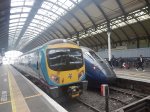
The pictures show Hull Trains’s Class 802 train in Platform 7 at Hull station.
Penzance And Taunton
This to me is the key section as if you can run a battery-electric train between these two stations it allows so many of the services to be run using zero-carbon traction.
These are distances from Taunton.
- Exeter St. David’s – 30.7 miles
- Newbury – 89.6 miles
- Okehampton – 55.3 miles
- Paignton – 59.0 miles
- Patchway – 51.7 miles
- Plymouth – 82.8 miles
Note.
- I’ve added Okehampton, as I feel that if Dawlish had another encounter with Poseidon, Okehampton with its proposed Parkway station on the A30 could be the terminus for coaches to and from Cornwall.
- All would be possible with a battery-electric train, with a hundred-mile range, leaving Taunton with a full battery.
- Charging could be needed at Okehampton and Paignton.
What is needed is some form of charging in the Taunton area.
This OpenRailwayMap shows Taunton station.

Note.
- The station has four through platforms.
- All Great Western Railway services to and from Devon and Cornwall stop in the station.
- I feel it would be possible to electrify the station, so that all stopping trains could charge the batteries.
But the problem would be, that as typically trains only stop for a couple of minutes at Taunton, there may not be enough time to take enough charge on board.
This OpenRailwayMap shows the track between Wellington and Collumpton, between Taunton and Exeter.
Note.
- The black line is the railway between Taunton and Exeter.
- The blue arrow in the North-East corner of the map indicates the position of the proposed Wellington station.
- Collumpton is in the South-West corner of the map and has also been put forward for a new Collumpton station.
- I talked about the reopening of these two stations in Reopening Of Wellington and Cullompton Stations.
- The M5 to the North of Collumpton runs closely alongside the railway.
- According to Real Time Trains, it takes just under ten minutes to go the thirteen miles between Wellington and Collumpton.
This Google Map shows a section of the M5 North of Collumpton.
And this Google Map shows Tiverton Parkway station.
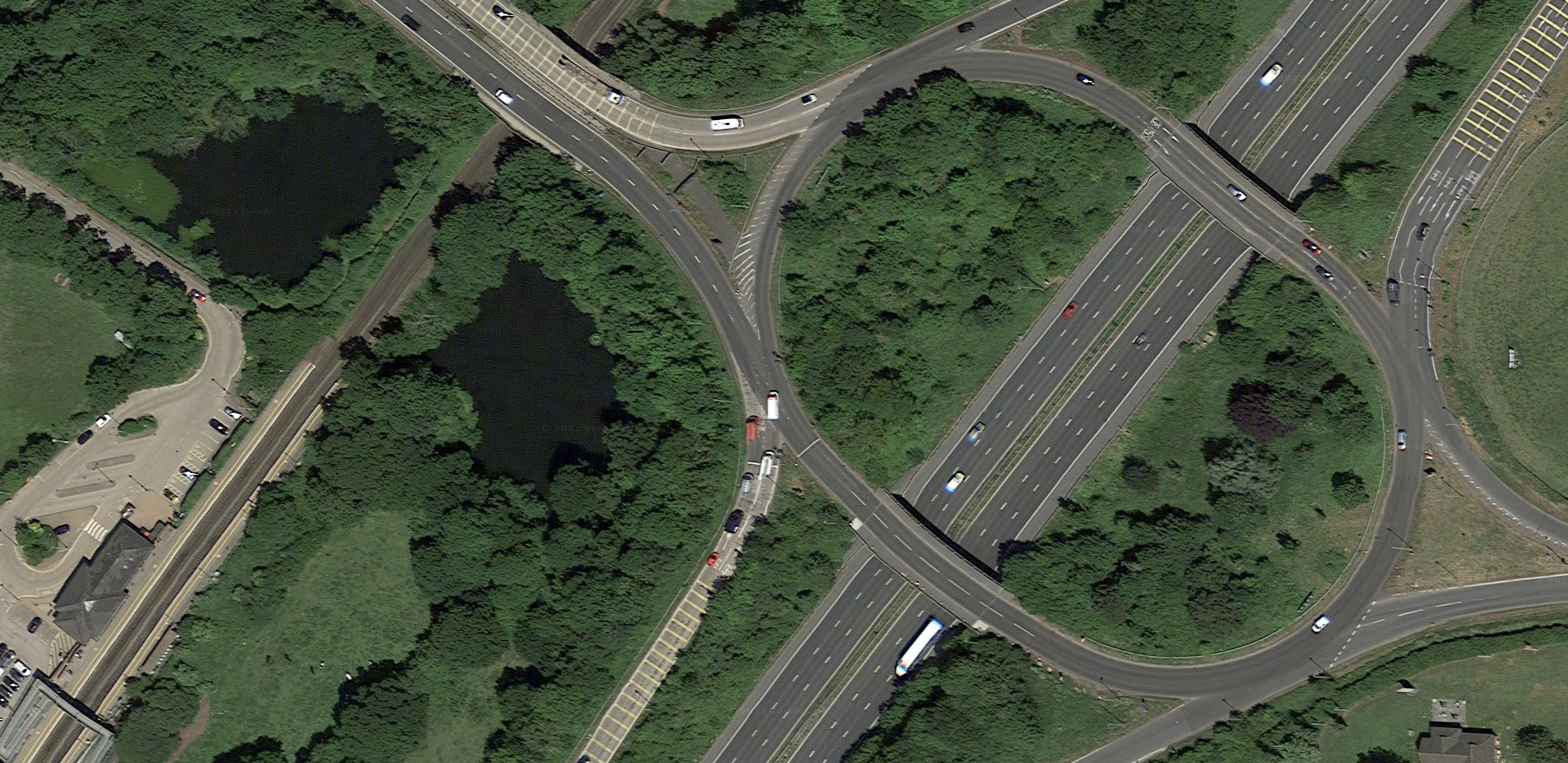
Note how the railway runs alongside the M5 to the West.
I feel that if the two new stations of Wellington and Collumpton are built between Taunton and Exeter St. David’s, then why not partially electrify the route, so that all trains would leave or pass through Taunton and Collumpton stations with full batteries.
- Going West the trains would reach Exeter St. David’s, Okehampton or Plymouth.
- Going East trains would reach Newbury for Reading and Paddington, and Patchway for Cardiff.
I believe that a battery-electric solution is possible, that would enable the decarbonisation of the Great Western Main Line all the way to Penzance.
Strategic Outline Business Case Submitted For Reopening Tavistock To Plymouth Rail Line
The title of this post, is the same as that of this news topic on the Devon County Council web site.
This is the sub-heading for the news item.
The Strategic Outline Business Case for the reopening of the Tavistock to Plymouth rail line has been submitted.
These three paragraphs outline the proposal.
Our submission to the Government’s Restoring Your Railway programme sets out the rationale for reopening the line between Bere Alston and Tavistock.
The scheme would reinstate approximately five miles of track and deliver a new single platform station at Tavistock, which would serve around 21,000 residents of Tavistock, Horrabridge, Lamerton, and Mary Tavy.
An hourly Tavistock-Plymouth service would stop at Bere Alston, Bere Ferrers and the west Plymouth stations, while maintaining the existing two-hourly service between Plymouth and Gunnislake.
I have a few thoughts.
The Connection At Bere Alston Station
This OpenRailwayMap shows the track layout at Bere Alston station.
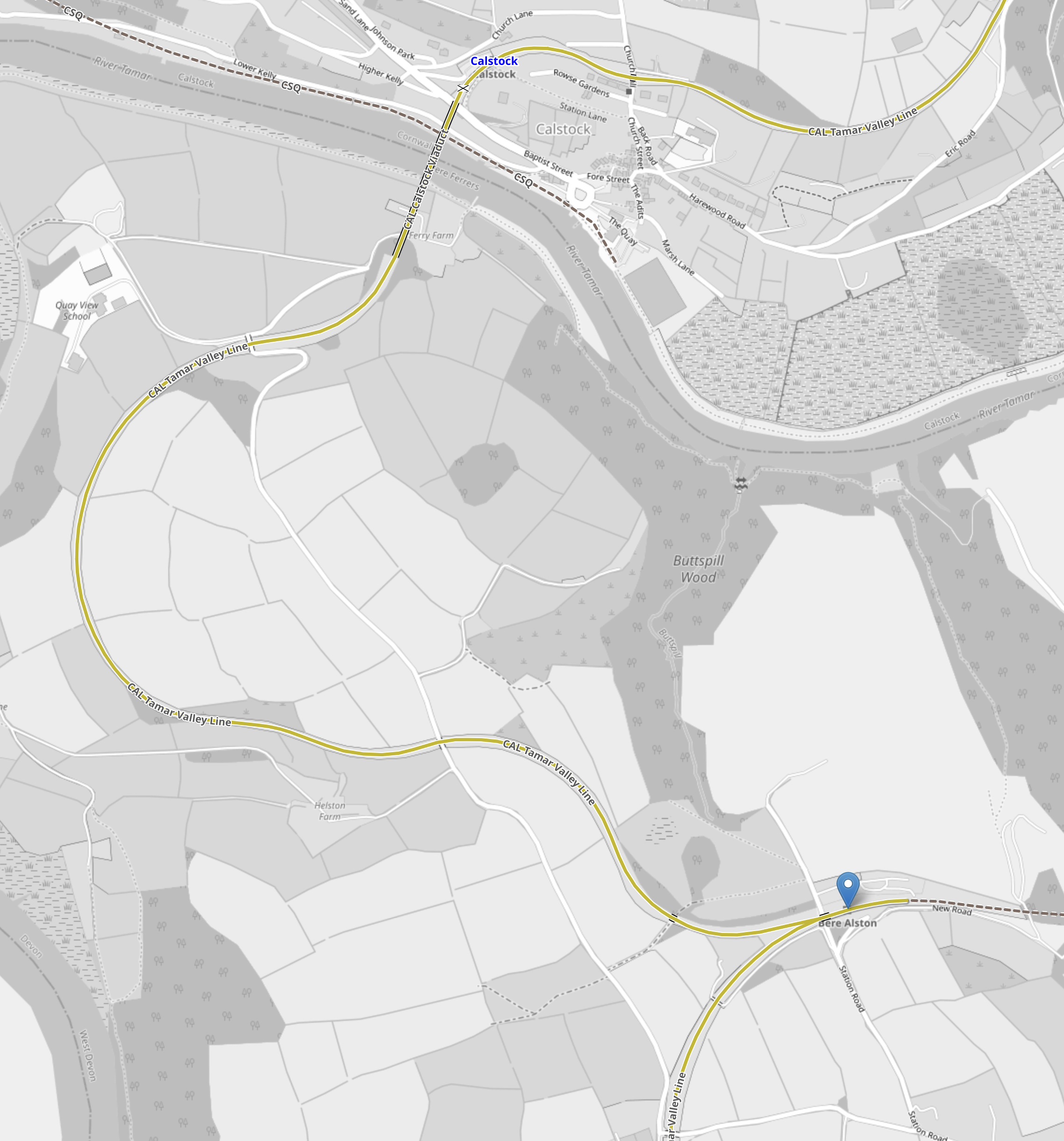
Note.
- Bere Alston station is indicated by the blue arrow.
- The line between Bere Alston and Tavistock goes East from Bere Alston station and is shown as a black dotted line.
- The single-track Tamar Valley Line between Plymouth and Gunnislake stations, is shown in yellow.
- Tamar Line trains reverse in Bere Alston stations.
- Plymouth is to the South.
- Gunnislake is to the North.
It would appear to be a simple connection.
The Route Between Bere Alston Station And Tavistock
This OpenRailwayMap shows the route between Bere Alston Station And Tavistock.
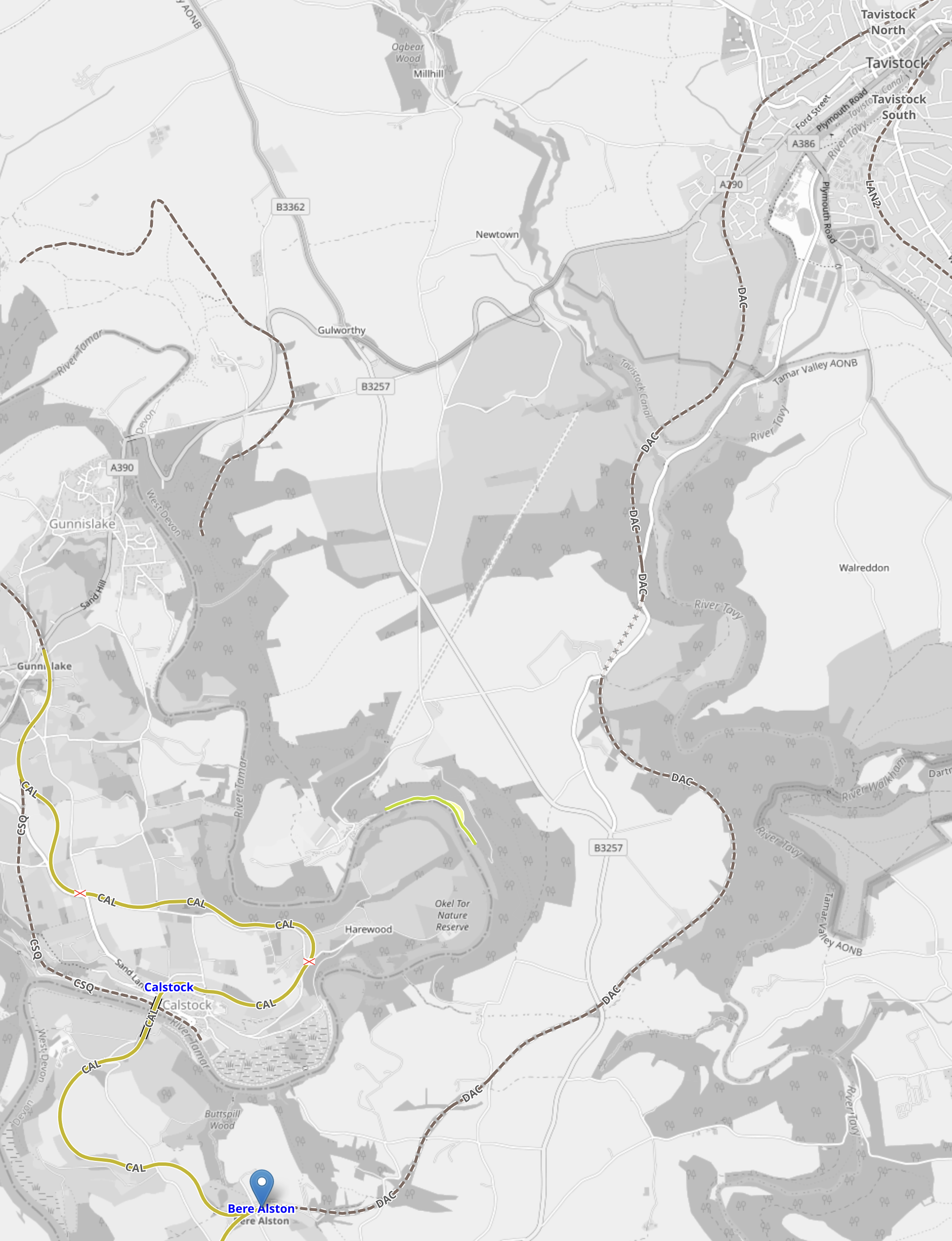
Note.
- Bere Alston station is indicated by the blue arrow.
- The single-track Tamar Valley Line between Plymouth and Gunnislake stations, is shown in yellow.
- Tavistock is in the North-East corner of the map.
- The dotted line between Bere Alston and Tavistock shows the route of the proposed reopened railway.
The new railway follows the route of a railway that closed in 1968.
These two paragraphs from the Wikipedia entry for Tavistock North station, describe the state of the railway between Tavistock North and Bere Alston stations.
The station building has been restored and converted into three self-catering cottages. The stationmaster’s house is being restored as a private dwelling, while the goods yard, now known as Kilworthy Park, houses the offices of West Devon Borough Council. The track bed for about one mile (1.6 km) south of Tavistock North station is open to the public as a footpath and nature reserve, and it is possible to walk across the viaducts that overlook the town.
The rest of the track bed south of Tavistock is almost intact to Bere Alston, where it joins the present-day Tamar Valley Line. There has been discussion regarding the re-opening of a rail link for a number of years. Engineering assessment has shown that the track bed, and structures such as bridges and tunnels, are in sound condition.
It doesn’t appear that restoring the track will be the most challenging of tasks.
But it does appear that extending the railway to the former Tavistock North station, would be a very challenging task indeed.
The Proposed Station At Tavistock
This OpenRailwayMap shows the track as it runs through Tavistock to the former Tavistock North station.
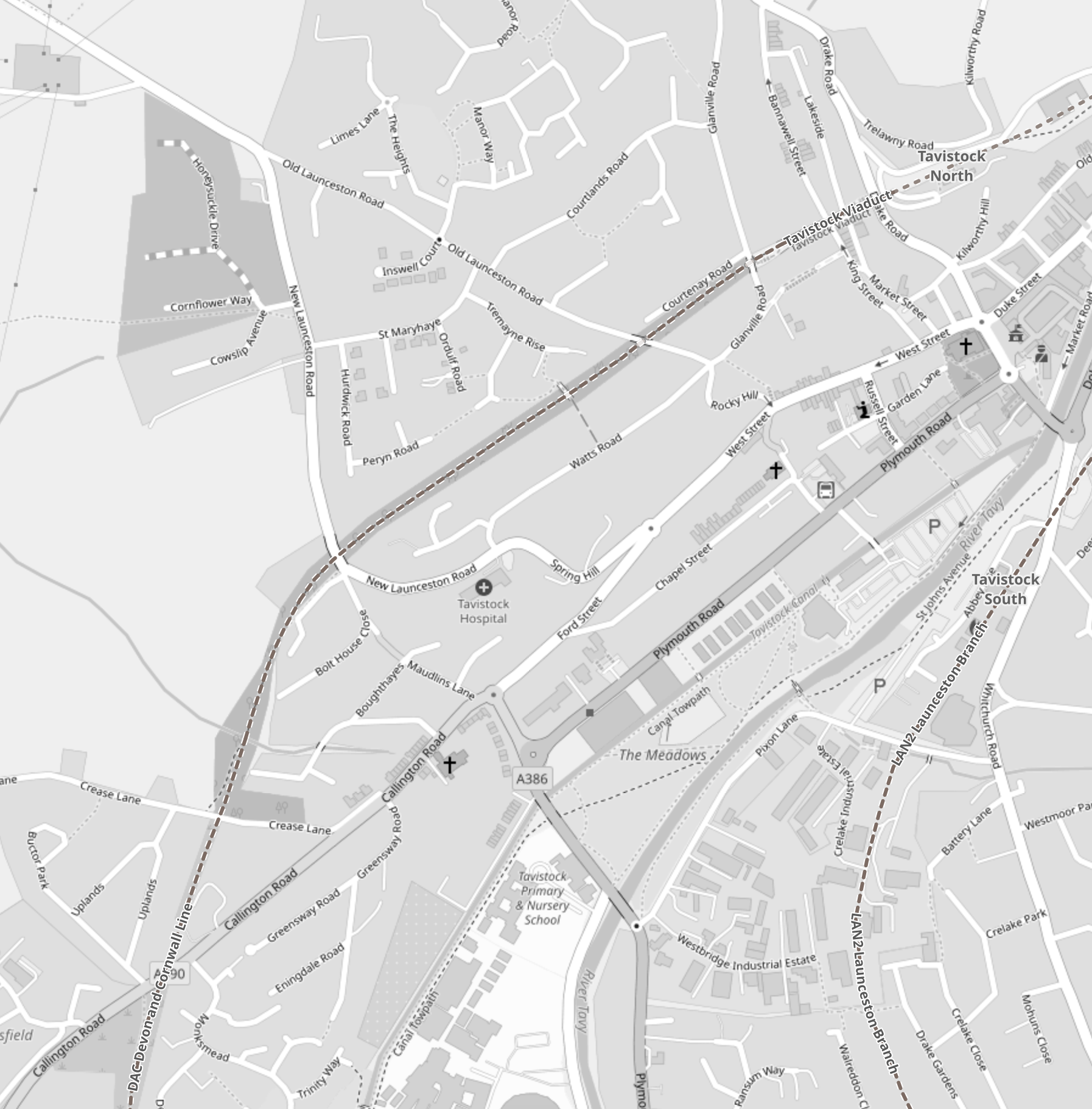
Note.
- The former railway is shown as a dotted line running diagonally SW-NE across the map.
- The former Tavistock North station is shown in the North-East corner of the map.
- This railway turns South as it leaves the town.
- The single-platform station will be built, where the railway crosses the A390.
- Another former railway passes through the town to the South-East, that passes through the former Tavistock South. station.
Between the former Tavistock North station and the A390 is now the Tavistock Viaduct Walk, which is about a mile long.
This Google Map shows where the track-bed of the old railway approaches the A390.
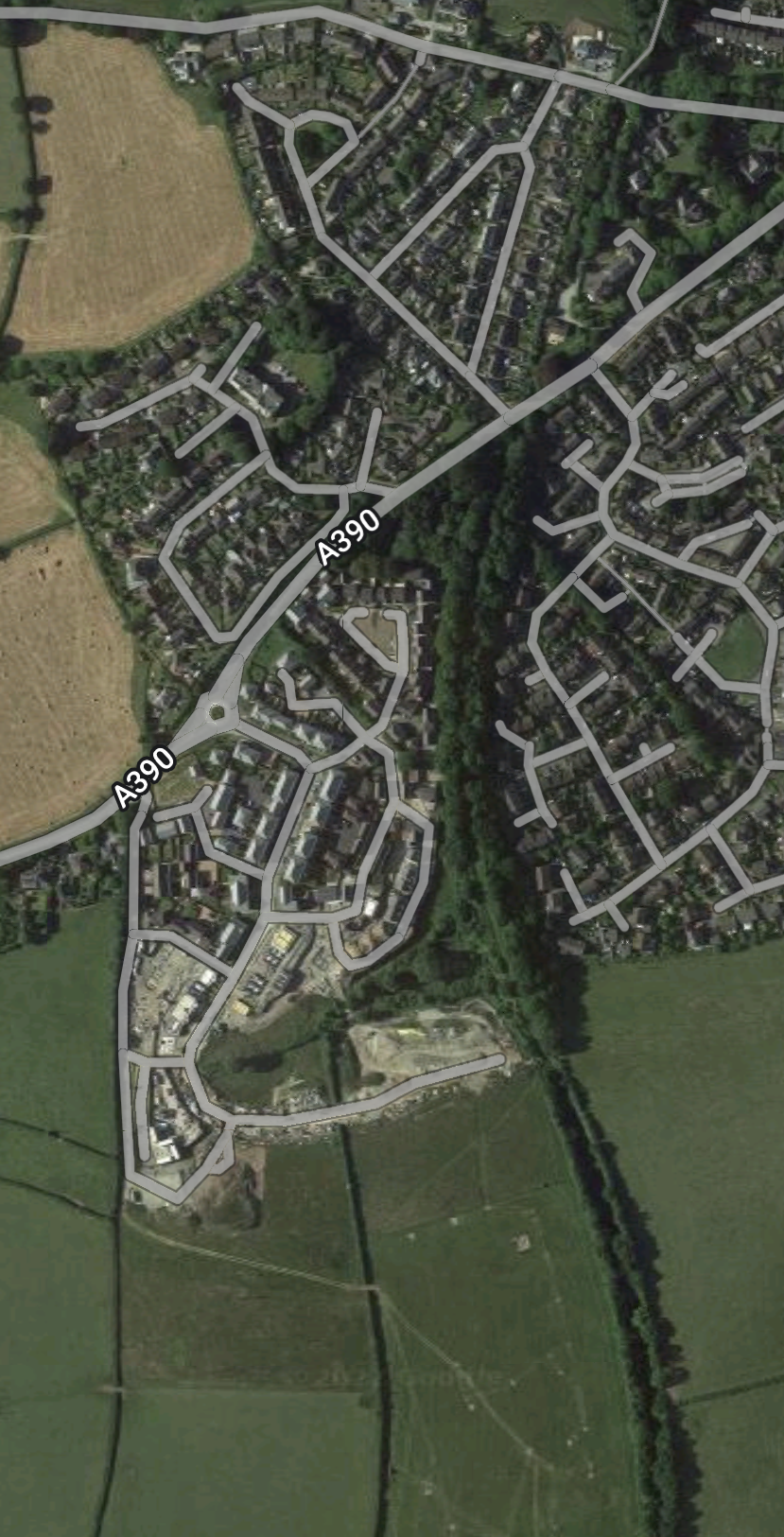
Note.
- The green scar of the former railway approaching from the South.
- The A390 running diagonally across the map.
- The plans only include a one-platform station, which I suspect is all that will fit.
Could this be a station without car-parking?
There’s not much space to put it!
Will It Be Possible To Extend From Tavistock To Okehampton?
The Line between Bere Alston and Tavistock North stations used to extend to Okehampton and train operators and Local Authorities are keen to provide a new link, in case the railway gets washed away again at Dawlish.
It’s not so much for passengers, as coaches can be used between Okehampton and Bodmin Parkway stations along the A30.
But an alternative route for freight is needed.
I would hope that the new Tavistock station will be capable of being modified, so that trains can run between Plymouth and Okehampton stations.
What Class Of Train Will Be Used Between Plymouth And Tavistock?
As a Class 150 train is used from Plymouth to Gunnislake, I suspect a Class 150 train will be used.
But the station will probably be long enough for a five-car Class 802 train.
Dartmoor Line Passes 250,000 Journeys On Its First Anniversary, As Rail Minister Visits To Mark Official Opening Of The Station Building
The title of this post, is the same as that of this press release from Network Rail.
These three paragraphs talk about the Dartmoor Line’s reopening.
Just over a year after the Dartmoor Line reopened to regular passenger trains, journey numbers on the line have passed 250,000 this Monday morning [28 November], with the arrival of an extra special visitor, Rail Minister, Huw Merriman MP, to officially open the renovated station building.
The line reopened on 20 November 2021, restoring a regular, year-round service for the first time in almost 50 years following more than £40m of Government investment.
The previously mothballed rail line, which runs between Okehampton and Exeter, was restored in just nine months and delivered £10m under budget, becoming the first former line to reopen under the Government’s £500m Restoring Your Railway programme.
I have a few thoughts.
A Well-Managed Project
It does appear that Network Rail upped a gear or two to fulfil this project. The press release puts it like this.
Reinstatement of the Dartmoor Line was made possible by Network Rail’s team of engineers who worked tirelessly to deliver a huge programme of work including laying 11 miles of new track and installing 24,000 concrete sleepers and 29,000 tonnes of ballast in a record-breaking 20-day period.
But it does appear that over recent months Network Rail seems to do things a lot better and quicker.
I do wonder, if on the construction side, Network Rail have been able to bring in new working practices, that they are still trying to get lots of their other workers to accept.
A Quarter Of A Million Journeys
The press release says this about passenger numbers.
In the same week as it celebrated its one-year anniversary, the Dartmoor Line also saw its 250,000th journey, showing an incredible patronage on the line and more than double the demand originally forecast.
But they still can’t get the forecasts right.
Passenger Numbers Are Still Rising
The press release says this about rising passenger numbers
Since Great Western Railway (GWR) increased services to hourly in May 2022, passenger use has continued to rise, with over 500 journeys starting at Okehampton every day and a further 300 travelling into the town from across the rail network.
Is There Still Growth To Come?
There are several zero-carbon trains under development, so why not have a civilised shoot out, with each manufacturer given say four weeks in which to show off their products in passenger service.
This would hopefully indicate, if there was more growth to come and what would be the best trains to use.
Conclusion
The Dartmoor Line has been shown to be a success so lets repeat the dose.
Safety Message Clear As Leven Work Ramps Up
The title of this post, is the same as that if this press release from Network Rail.
The press release has a positive tone and indicates.
- Track is starting to be laid at the Thornton end and this track will be used to help build the Levenmouth Rail Link.
- The connection to the main line at Thornton is complete.
- Safety is emphasised.
- Planning permission for the two stations should be submitted this year.
- The programme is scheduled to complete in Spring 2024.
As it is not much larger than the Okehampton scheme, which Network Rail delivered so well, I would feel that date is feasible.
Rivalry With The Northumberland Line
The Wikipedia entry for the Northumberland Line says this about the line.
The Northumberland Line is a planned passenger rail route connecting the city of Newcastle upon Tyne with Ashington, Blyth and south-east Northumberland. The route of the line uses part of the larger Blyth and Tyne Railway, a network of lines that cover south-east Northumberland. Construction of stations is planned for the summer of 2022, with the opening of the line for passenger services planned for December 2023.
Note, that both projects are planned to be completed within a few months.
Will there be an Anglo-Scottish rivalry, perhaps with pipers on both sides?
Success For The Dartmoor Line
This article on Railnews is entitled Railway Braces For Weekend Changes.
The article flags up that rail timetables will change to the summer timetable and uses the Dartmoor Line where services will go hourly, as an example.
The article says this about the changes to the Dartmoor Line and the success of the restored service to Okehampton station.
One of the many changes includes the doubling of service frequencies on the recently-reopened Dartmoor Line between Exeter and Okehampton, where scheduled passenger trains were restored last November. From Sunday trains will be running every hour, and rail minister Wendy Morton visited Okehampton yesterday to celebrate the improvements.
The reopening is part of the government’s promise to ‘Restore your railways’, and the Okehampton line is the first practical example of this in action. The line was upgraded for £10 million less than the £40.5 million budgeted, and Network Rail said the route has proved ‘hugely popular’, because passenger numbers have been more than double than predicted, reaching an average of over 2,500 a week during the first 20 weeks. The number of passengers at nearby Crediton, where the Dartmoor Line joins services on the Tarka Line from Barnstaple, is also 39 per cent higher than it was before the pandemic.
I have some thoughts.
Reopening Of The Line
Network Rail can build projects on time and on budget, if they get the project management right.
Passenger Numbers Between Exeter And Okehampton
If 2,500 passengers per week can use the line in the winter, when there is only one train per two hours (tp2h), how many passengers will use the train, when there is an hourly service?
2,500 passengers per week, throughout the year would be 125,000 passengers per year and as surely the summer will be busier, I don’t think it will be an unreasonable figure.
Okehampton station car park appears to have around 300 spaces, so at 2,500 passengers per week, there might be a not too distant day, when it fills up.
Passenger Numbers At Crediton
I am not surprised that traffic at Crediton is up by 39 percent.
Consider.
- Pre-pandemic, Crediton station had one train per hour (tph) to and from Exeter.
- Post-pandemic, Crediton has three trains per two hours to and from Exeter.
It looks like the train frequency has been increased by 50 % and the number of passengers has increased by 39 %.
That surely is not surprising and passenger numbers might increase further when one tph are running between Exeter and both Barnstaple and Okehampton, if there are more possible passengers to attract.
Car parking at Crediton station may also be a problem, as there appears to be less than a hundred spaces.
Okehampton Parkway Station
Okehampton Parkway Station is likely to be built to the East of Okehampton. Wikipedia says this about the station.
Okehampton Parkway is a proposed railway station in Okehampton on the Dartmoor Line. The station would be part of the Devon Metro and has been described as a priority station. The station is to be sited at the A30 junction at Stockley Hamlet and would be sited at the Business Park at Okehampton as well as serving a further 900 homes close to the site.
Wikipedia, also says that Devon County Council has bought the site.
This must be one of the best sites to build a parkway station in the UK.
- It’s on the dual-carriageway A 30, between London and Cornwall.
- The good people of Devon seem to like to use trains given the passenger numbers at Okehampton and Crediton stations.
- Housing is being built nearby.
This Google Map shows Devon and Cornwall to the West of Okehampton and Barnstaple.
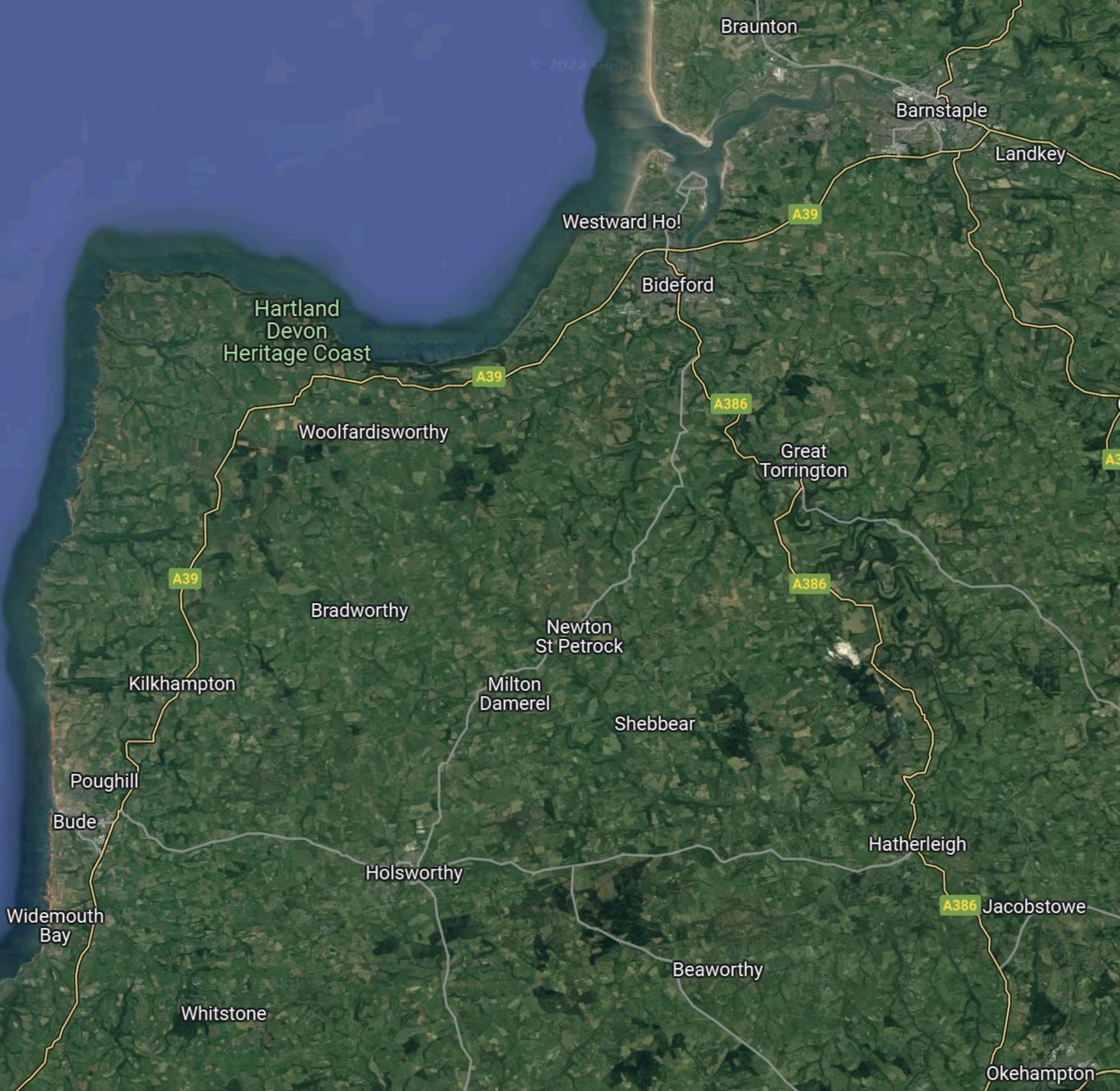
Note.
- Okehampton with two stations is in the South-East corner of the map.
- Barnstaple, which has a station, is in the North-East corner of the map.
- There are well-visited holiday resorts all along the cost including Ilfracombe, Westward Ho! and Bude.
It strikes me that if Devon put together a network of zero-carbon buses, it would be well-used and they could sell the area for zero-carbon holidays.
Rolling Stock
Currently, the Okehampton and Barnstaple services are operated by Class 150 trains.
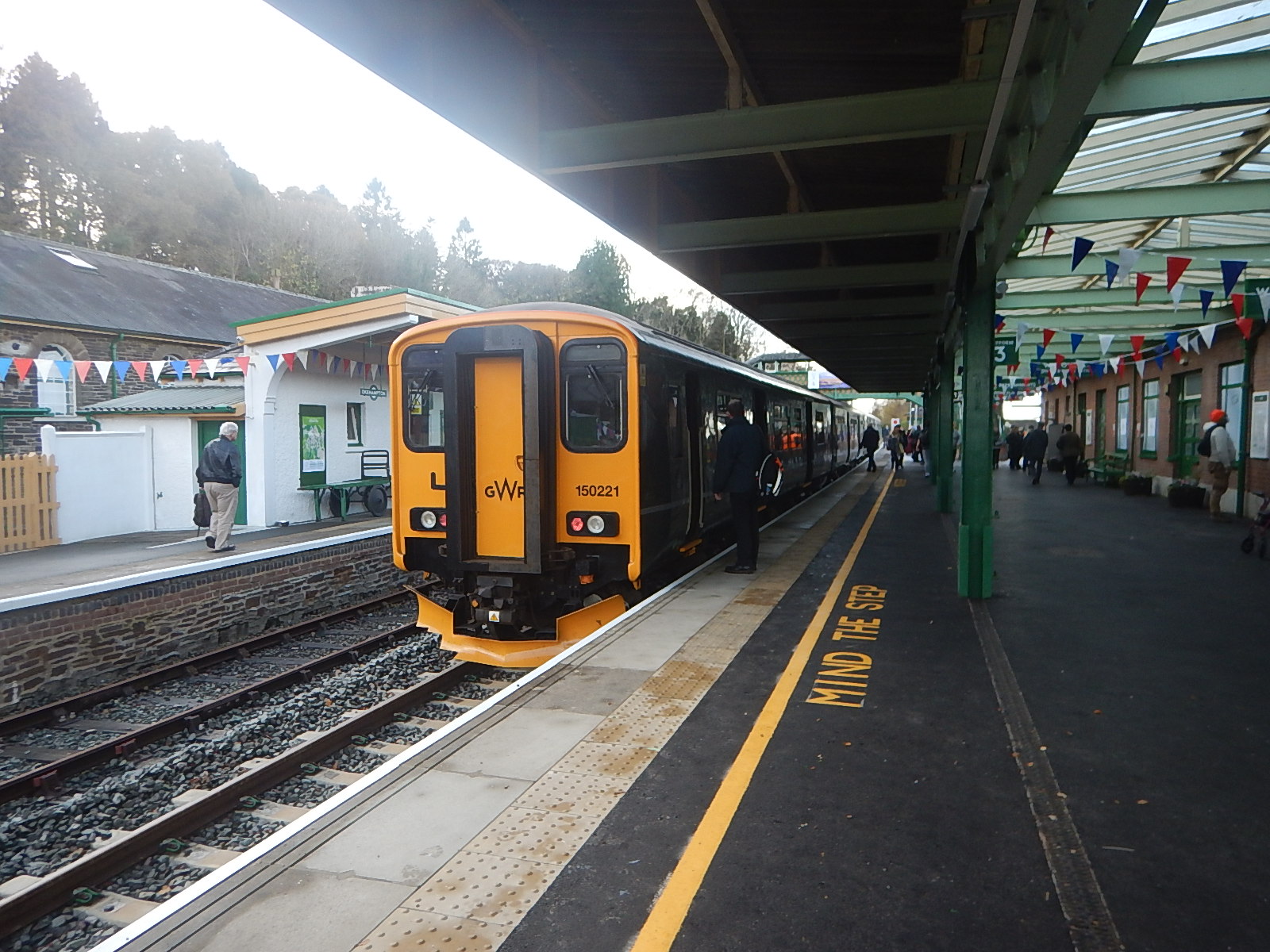
These are definitely not good enough, due to their age and diesel power.
The distances of the two services are as follows.
- Exeter and Barnstable – 39.5 miles
- Exeter and Okehampton – 25.5 miles
I feel that these routes could be handled by a battery-electric train like the Hitachi Regional Battery Train, which is shown in this Hitachi infographic.

Note.
- For these routes, the trains would probably be based on four-car Class 385 trains, with a top speed of 90 mph.
- Charging would be in Exeter.
- Charging may not be needed at Barnstaple and Okehampton as the routes are downhill.
If battery-electric trains can’t handle the routes, I’m sure hydrogen-powered trains could.
Effort To Contain Costs For Hoo Reopening
The title of this post, is the same as that of an article in the April 2022 Edition of Modern Railways.
This is the first paragraph.
Medway Council is working with Network Rail and other industry players in an effort to make restoration of a passenger service to Hoo on the Isle of Grain branch feasible. The Council was awarded £170 million from the Housing Infrastructure Fund in 2020 to support schemes to facilitate building of 12,000 new houses in the area, with £63 million of the HIF money for reinstatement of services on the Hoo Branch.
The article mentions, this new infrastructure.
- A new station South of the former Sharnal Street station.
- Works to level crossings, of which there are six between Gravesend station and proposed site of the new Hoo station.
- A passing place at Hoo Junction, where the branch joins the North Kent Line.
- A passing place at Cooling Street.
Note.
- The single-platform Bow Street station cost £8 million.
- The single-platform Soham station cost nearly £22 million, but it has a bridge.
- Reopening the Okehampton branch and refurbishing Okehampton station cost £40 million.
I think costs will be very tight.
Possible Train Services
This is said in the article about the train service on the branch.
While third rail electrification was originally proposed, this idea has been discarded in favour of self-powered trains on the branch, such as battery-operated trains. Possible destinations include Gravesend, Northfleet or Ebbsfleet for interchange with trains going to London, or extension of London to Dartford or Gravesend services over the branch, using hybrid third-rail/battery trains.
Consider.
- Merseyrail will be using battery-electric trains to provide services to the new Headbolt Lane station, as permission was not available for extending the existing third-rail track.
- Electrification would probably cost more than providing a charging system at Hoo station.
- Turning the trains at Gravesend, Northfleet or Ebbsfleet could be difficult and a new bay platform would probably break the budget.
- Both Dartford and Gravesend have two trains per hour (tph), that could be extended to the new Hoo station.
- Hoo junction to Hoo station is no more than five or six miles.
- There are also half-a-dozen level crossings on the route, which I doubt the anti-thord rail brigade would not want to be electrified.
- The Dartford services have a possible advantage in that they stop at Abbey Wood station for Crossrail.
- It may be easier to run services through Gravesend station, if the terminating service from Charing Cross were to be extended to Hoo station.
- A two tph service between London Charing Cross and Hoo stations, with intermediate stops at at least London Bridge, Lewisham, Abbey Wood and Dartford would probably be desirable.
I feel that the most affordable way to run trains to Hoo station will probably be to use battery-electric trains, which are extended from Gravesend.
It may even be possible to run trains to Hoo station without the need of a charging system at the station, which would further reduce the cost of infrastructure.
Possible Trains
Consider.
- According to Wikipedia, stopping Gravesend services are now run by Class 376, Class 465, Class 466 and Class 707 trains.
- Real Time Trains indicate that Gravesend services are run by pathed for 90 mph trains.
- Class 376, Class 465 and Class 466 trains are only 75 mph trains.
- Class 707 trains are 100 mph trains and only entered service in 2017.
I wonder, if Siemens designed these trains to be able to run on battery power, as several of their other trains can use batteries, as can their New Tube for London.
In Thoughts On The Power System For The New Tube for London, I said this.
This article on Rail Engineer is entitled London Underground Deep Tube Upgrade.
This is an extract.
More speculatively, there might be a means to independently power a train to the next station, possibly using the auxiliary battery, in the event of traction power loss.
Batteries in the New Tube for London would have other applications.
- Handling regenerative braking.
- Moving trains in sidings and depots with no electrification.
It should be born in mind, that battery capacity for a given weight of battery will increase before the first New Tube for London runs on the Piccadilly line around 2023.
A battery-electric train with a range of fifteen miles and regenerative braking to battery would probably be able to handle a return trip to Hoo station.
An Update In The July 2022 Edition Of Modern Railways
This is said on page 75.
More positive is the outlook for restoration of passenger services on the Hoo branch, where 12,000 new houses are proposed and Medway Council is looking to build a new station halfway down the branch to serve them. As the branch is unelectrified, one idea that has been looked at is a shuttle with a Vivarail battery train or similar, turning round at Gravesend or another station on the main line.
Steve White worries that this could mean spending a lot of money on infrastructure work and ending up with what would be a sub-optimal solution. ‘Do people really want to sit on a train for 10 minutes before having to get out and change onto another train? I don’t think so. Ideally what you want is through trains to London, by extending the Gravesend terminators to Hoo.’
That would require a battery/third rail hybrid unit, but Mr. White thinks that is far from an outlandish proposal; with Networker replacement on the horizon, a small bi-mode sub-fleet could dovetail neatly with a stock renewal programme. Medway Council and rail industry representatives are working on coming up with a solution for Hoo that could do what it does best; facilitating economic regeneration in a local area.
Note that Steve White is Managing Director of Southeastern.
I’ll go along with what he says!
Conclusion
I believe that a well-designed simple station and branch line could be possible within the budget.
A battery-electric upgrade to Class 707 trains could be a solution.
But the trains could be very similar to those needed for Uckfield and to extend electric services in Scotland.
Over 10,000 People Use Reopened Dartmoor Line In First Two Weeks
The title of this post, is the same as that of this press release from the Dartmoor Line.
These are the first three paragraphs of the press release.
More than 10,000 people have travelled on the Dartmoor Line in the first two weeks since its reopening.
The line reopened for regular year-round, all-week passenger services on Saturday 20 November and demand for the trains linking Okehampton and Exeter has continued to remain high.
The reopening of the Dartmoor Line is the first of the Government’s Restoring Your Railway schemes, made possible thanks to over £40 million Government investment.
All concerned must be very pleased, especially as it was delivered £10 million under budget and within nine months, ahead of time.
I described my first use of the new route to Okehampton in A Few Hours In Okehampton, where I came to this conclusion.
Exeter and Okehampton is a well-thought out reopening, that will be welcomed in the South West of England.
It would appear the passenger numbers confirm my conclusion.
Since my visit to Okehampton, I have wondered, whether the apparent success of the Okehampton reopening, would have any other effects.
In the December 2021 Edition of Modern Railways, there is an article, which is entitled South West Seeks More Reopenings, with a sub-title of Okehampton Service Could Be A Precursor.
The article details a number of projects.
Marsh Barton Station
A new Marsh Barton station is under construction and has a December 2022 opening date.
Edginswell Station
A new Edginswell station is being planned to serve Torbay Hospital on the Riviera Line, with a possible opening of 2025.
Collumpton And Wellington Stations
The last budget chipped in five million, so that preferred options and a full business case can be developed for these two new stations.
- Collumpton station will probably be developed at the site of the old station, which is close to Collumpton Services on the M5.
- Wellington station will probably be on a new site at Longworth Farm, where five hundred houses are being developed.
The Modern Railways article also says this about housing.
Thousands of houses are expected to be built in both towns in the next decade, making provision of railway stations highly desirable to avoid soaring road congestion.
Network Rail and Great Western Railway also seem to be experimenting with different service patterns through the two stations.
- Both hourly and two-hourly services have been tested.
- In the December 2021 timetable there is now a two-hourly GWR Castle service over the Taunton and Exeter stretch, that will call at the two new stations, when they open.
- To have an hourly service there will also be a Taunton and Exeter shuttle.
This service would provide access to education and employment in Exeter, Taunton and Bristol.
The cost benefit ratio is above the Government’s limit for backing of two.
Opening of the two new stations is pencilled in for 2025.
Barnstaple And Axminster
The Modern Railways article also says this.
As part of the Devon Metro concept, Devon County Council aspires to extend further eastwards the hourly Barnstaple services that currently terminate at Exeter Central, perhaps as far as Axminster.
This would need track improvements East of Pinhoe station.
The current timings of the two sections are as follows.
- Exeter Central and Axminster – 37 minutes
- Exeter Central and Barnstaple – 74 minutes
These timings probably mean that a round trip between Axminster and Barnstaple can be done in a convenient four hours, so an hourly service would need four trains.
From sometime next year, when the frequency of the Exeter Central and Okehampton service becomes hourly, the services along the route will be as follows.
- Exeter St. Davids and Axminster – Hourly
- Exeter Central and Barnstaple – Hourly
- Exeter Central and Okehampton – Hourly
There is also a service, that runs every thirty minutes between Exmouth and Paignton via Exeter Central and Exeter St. Davids, Newton Abbot and Torquay.
The frequencies on the various sections would be as follows.
- Barnstaple and Crediton – One tph
- Okehampton and Crediton – One tph
- Crediton and Exeter St. Davids – Two tph
- Paignton and Exeter St. Davids – At least two tph
- Exeter St. Davids and Exeter Central – Five tph
- Exeter Central and Axminster – One tph
- Exeter Central and Exmouth – Two tph
Note.
- tph is trains per hour.
- Other services run between Exeter St. Davids and Paignton stations.
- In recent years a new station at Cranbrook has opened between Exeter Central and Axminster.
Extending the Barnstaple and Exeter Central service to Axminster would double the frequency on the Exeter Central and Axminster section.
Axminster station is shown in this Google Map.
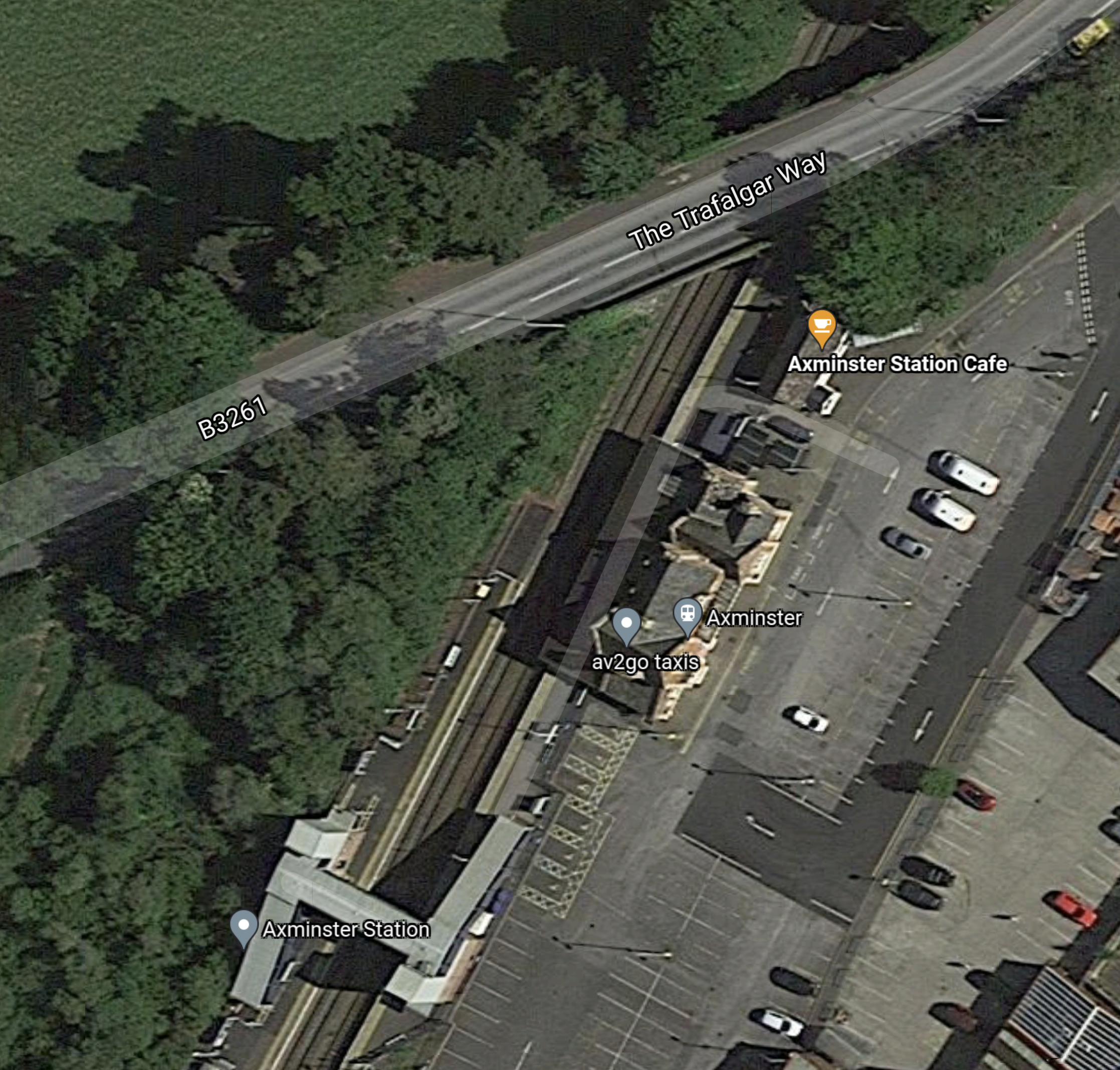
Note.
- The station has two platforms.
- The station appears to have a bridge with lifts.
- The station has a good road connection and the parking could probably be extended.
Axminster station could certainly handle a fast train between London and Exeter, a stopping train to Barnstaple and all the passengers.
Devon Metro
It does appear that the services of the Devon Metro are coming together.
- Paignton and Exmouth is already running.
- Barnstaple and Exeter Central is already running.
- Okehampton and Exeter Central has just started.
- Exeter St. Davids and Taunton via new stations at Collumpton and Wellington is being planned.
- Barnstaple and Exeter Central needs to be extended to Axminster.
How many other cities in the UK could benefit from a metro of this quality?
Bere Alston And Tavistock
The Modern Railways article also says this.
Meanwhile, further west on the former Southern network, restoration of services from Bere Alston to Tavistock has long been proposed, giving Tavistock a rail link to Plymouth. Christian Irwin, Network Rail’s Industry Programme Manager (South West), who oversaw the Okehampton reopening that came in early and underbudget, says he is keen to repeat the trick on the Tavistock route.
It is probably more difficult than at Okehampton.
- The trackbed is mainly intact, but the track has been lifted.
- The track to be laid is shorter than at Okehampton.
- Two structures at the Southern end need to be replaced.
- A new station needs to be built at Tavistock.
Devon County Council seems to be in control of the land needed.
Proposed services seem to be as follows.
- Plymouth and Gunnislake via Bere Alston – One train per two hours (tp2h)
- Plymouth and Tavistock via Bere Alston – One tph
Overall it looks like the Tavistock project will be more expensive than that at Okehampton, but there would appear to be more contributions from developers.
Devon County Council are hoping that the Tavistock link could be build in the next decade.
Tavistock And Okehampton
After the reconnection of Tavistock to the National Rail network, the council would hope to complete the link between Tavistock and Okehampton.
This would give the following benefits.
- Improved public transport connectivity in West Devon and North Cornwall.
- Improve revenue potential at Okehampton and Tavistock stations.
- Create an easier freight route.
- Create an alternative route, if the coastal route is closed.
It is a challenging project, but I feel it will be possible by perhaps 2035.
Headbolt Lane Station Tipped For Go-Ahead
The title of this post, is the same as that of this article on Place North West.
This is the first paragraph.
Knowsley Council’s December planning committee is expected to approve Network Rail’s plans for a new station in Kirkby.
The article also says that the station could open by Spring 2023.
I wonder, if Liverpudlians will create Headbolt Lane station in record time, as they did a few miles down the line at Maghull North station, which I wrote about in How To Build A Station In Nine Months.
If they do open in early 2023, it is likely to be the first new rail line in the UK, that has been designed to be run by battery-electric trains.
As Liverpudlians like to be first, I would expect that this station will open by Spring 2023. Judging by Network Rail’s performance on bringing the Dartmoor Line to Okehampton station back into service, I don’t suspect it is an impossible dream.
 The Anonymous Widower