Travelling Between Heathrow Airport And Staines Station
Staines Station and Heathrow Airport are not far apart, as this OpenRailwayMap shows.
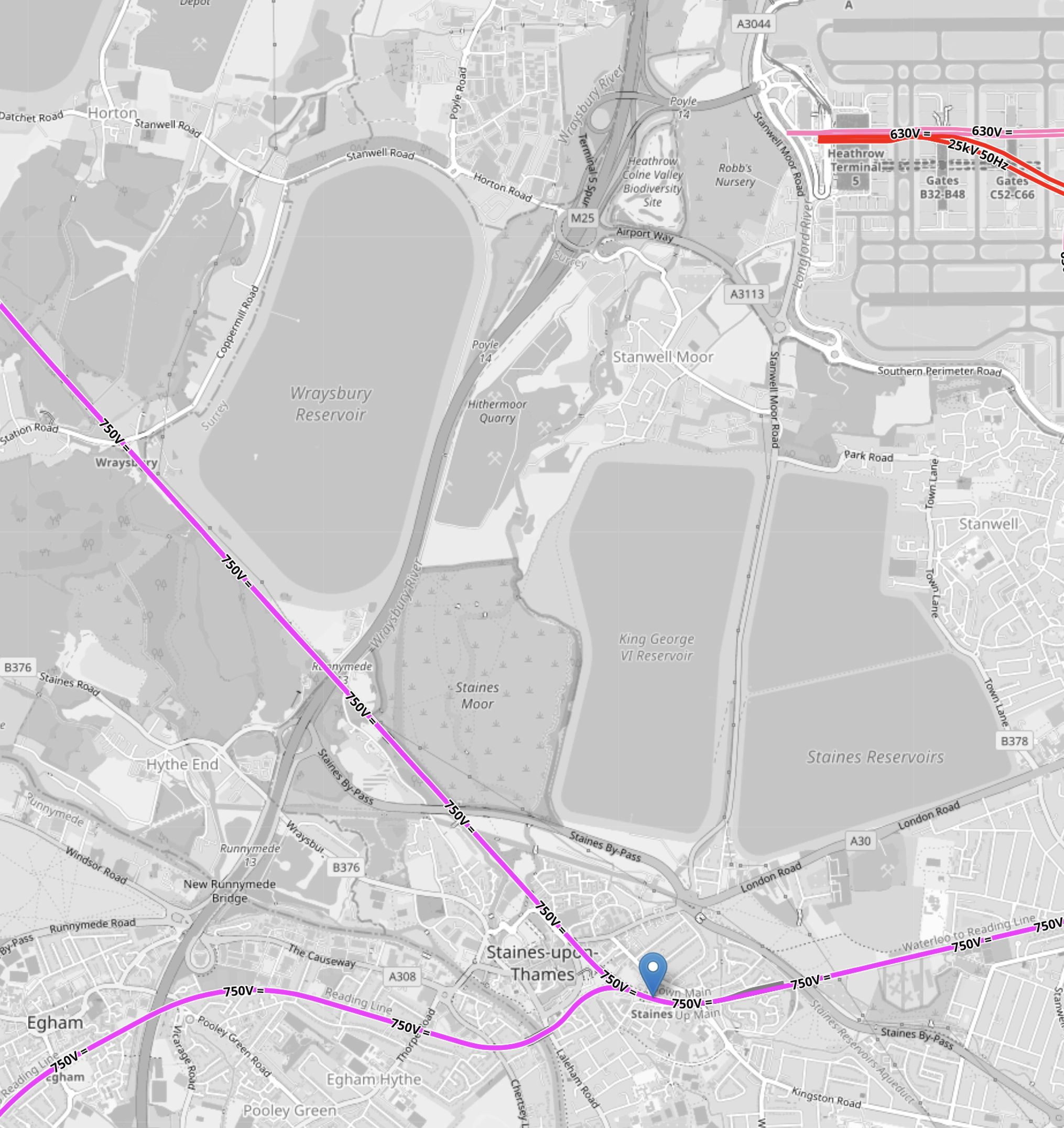
Note.
- The mauve lines in the bottom half of the map are South West Trains services out of Waterloo.
- Waterloo via Feltham, Twickenham and Richmond to name but three stations , is to the East.
- Reading is to the South-West
- Windsor is to the North-West.
- The blue arrow indicates Staines station.
- Heathrow Terminal 5 is in the North-East corner of the map.
- The pink tracks are the Piccadilly Lines
- The red tracks are for the Elizabeth Line and Heathrow Express.
- This OpenRailwayMap shows Terminal 5 to a larger scale.

Note.
- The pink tracks are the Piccadilly Line.
- The red tracks are for the Elizabeth Line and Heathrow Express.
- In front of the red tracks is what looks like a circular walkway or emergency exit, with a rectangular block to its West.
- The rectangular block is the lift tower to get from the railway station to the Departures and Arrivals floors of Terminal 5.
I asked Google AI if it would it be possible in the future to extend the Elizabeth Line to the West out of the Western end of Terminal 5 and received this reply.
Extending the Elizabeth line west from Terminal 5 is technically possible and has been proposed, notably as part of a potential westward rail link to Staines or to support airport expansion, but it is not currently funded. Terminal 5 was designed with future expansion in mind, potentially allowing a connection to Staines to create a “southern rail link” for better connections.
Perhaps there are two tunnels under the lift shafts?
How many trains per hour (tph) terminate in those two platforms?
- 4 tph – Heathrow Express
- 2 tph – Elizabeth Line to Shenfield.
Note.
- Only six trains in two platforms is easily managed.
- Because, Heathrow Express services appear to use both platforms, when I visited yesterday, the system seems to confuse passengers.
- The services surely need to be evened up, so that there are four tph of each service, with each service having a dedicated platform.
- But terminating eight trains in two platforms could be troublesome.
- Platforms are numbered 1 to 6 from the South.
- Platforms 1 and 2 have not been built yet.
Although four tph for Heathrow Express in one platform, should be easy with digital signalling, as you see it every day in London, it may be difficult on two platforms, at the same time.
In Is More Capacity Between Heathrow Airport And Central London, Needed On The Elizabeth Line?, I said this.
Currently, the Elizabeth line provides up to 12 trains per hour (including Elizabeth line and Heathrow Express) on the relief lines, making it nearly at capacity.
Note.
- When I use the Elizabeth Line, I deliberately avoid trains going to and from Heathrow, unless I’m going that way, as they are too crowded with passengers and their oversized cases.
- High Speed Two, the West London Orbital Railway and the North London Line will bring passengers for Heathrow Airport to Old Oak Common station.
- Surely, as Heathrow Airport gets bigger and increases its passenger numbers. the Elizabeth Line will need to be increased in capacity.
I believe Elizabeth Line capacity needs to be increased soon.
The only feasible plan I’ve seen is Heathrow Southern Railways plan, which included.
- Construction of a bay platform 0 at Staines alongside the Staines to Windsor line.
- A step-free bridge across the tracks.
- Construction of a single-track railway with 25 KVAC overhead electrification and a passing looop, between the new platform 0 at Staines and Platform 3 at Heathrow Terminal 5 station.
- Run four trains per hour in both directions between Heathrow Terminal 5 and Staines stations.
- This plan would would add two trains per hour through the Central Tunnel.
Various Journeys Would Be As Follows
This OpenRailwayMap shows Staines junction and the positions of the three platforms.
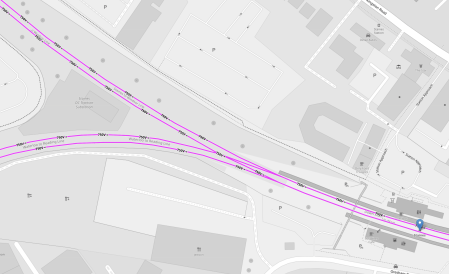
Note.
- The Windsor Line goes North-West.
- The Reading Line goes West.
- The Waterloo Line Goes East.
- Platform 1 is on the North side of the tracks.
- Platform 2 is on the South side of the tracks.
- The bay platform, which I’ve numbered 0, will be on the North side of the tracks towards Windsor.
- I suspect the step-free bridge will be over the tracks and replace the current rickety structure.
- The bridge would be a short walk from all three platforms.
Interchanges would be as follows.
- Windsor to Heathrow – Walk between Platforms 1 and 0.
- Reading to Heathrow – Walk between Platforms 1 and 0.
- Heathrow to Windsor – Cross the bridge between Platforms 0 and 2.
- Heathrow to Reading – Cross the bridge between Platforms 0 and 2.
- Waterloo to Heathrow – Cross the bridge between Platforms 2 and 0.
- Heathrow to Waterloo – Walk between Platforms 0 and 1.
Note.
- All trains to or from Heathrow use Platform 0.
- All trains to Waterloo use Platform 1.
- All trains going away from Waterloo use Platform 2.
- Reading and Heathrow gain a step-free route at 2 tph.
- All interchanges at Staines station would be step-free.
- A train like London Crosslink, which used to go between Feltham and Woking, would use Platform 1 going towards Feltham and Platform 2 going towards Woking.
Staines station would gain step-free access to all Heathrow terminals, all Elizabeth Line and High Speed Two stations.
Could Anglia Railways’ London Crosslink Be Recreated As Part Of The London Overground?
I like the idea of the London Crosslink service, that ran for a few years between East Anglia and Hampshire via the North London Line and Staines.
My arguments for its restoration are described in Could Anglia Railways’ London Crosslink Be Recreated As Part Of The London Overground?
At various times in my life, it would have been very useful.
Today, as I live about fifteen minutes from Highbury and Islington station, I could use London Crosslink for the following reasons.
- Visiting friends and family in Hampshire.
- Going to Heathrow Airport, especially Terminal 5.
- Visiting friends in East Anglia.
- Going to football at Ipswich.
- Exploring new parts of England.
- I would wait at home and time my departure to catch a booked train at a fully step-free station.
Conclusions
Extending the Elizabeth Line to Staines gives these advantages.
- Staff at Heathrow, who live in the Staines area get easy access to the airport.
- Buses and coaches between Heathrow and the local area may be reviewed.
- Less cars will be used to get to and from the airport.
- Reading and Heathrow gain a step-free route at 2 tph.
- A lot of stations would gain a step-free route to all terminals at Heathrow, and all Elizabeth Line and High Speed Two stations.
There may well be other advantages.
Is More Capacity Between Heathrow Airport And Central London, Needed On The Elizabeth Line?
I asked Google AI, the title of this post and received this answer.
Yes, additional capacity on the Elizabeth line between Heathrow Airport and Central London is needed to manage high demand, despite it being a major upgrade. While the line has greatly improved connectivity, studies suggest that rising passenger demand, particularly from potential airport expansion, may require increasing services from 6 to 8 trains per hour to prevent future overcrowding.
Key Considerations Regarding Capacity:
High Demand: Passenger demand grew by ~40% between June 2022 and October 2023, with further growth expected.
Infrastructure Constraints: Increasing services beyond 6 trains per hour is challenging due to the need for signaling upgrades and potential platform length limitations.
Alternative Solutions: Experts suggest the Western Rail Link to Heathrow could relieve pressure by allowing direct access from the west, rather than requiring travel into central London first.
Future Upgrades: Further improvements, including enhanced signalling on the Piccadilly line and other rail links, are seen as necessary to handle future passenger surges.
Currently, the Elizabeth line provides up to 12 trains per hour (including Elizabeth line and Heathrow Express) on the relief lines, making it nearly at capacity.
Note.
- When I use the Elizabeth Line, I deliberately avoid trains going to and from Heathrow, unless I’m going that way, as they are too crowded with passengers and oversized cases.
- High Speed Two, the West London Orbital Railway and the North London Line will bring passengers for Heathrow Airport to Old Oak Common station.
- Surely, as Heathrow gets bigger and increases its passenger numbers. the Elizabeth Line will need to be increased in capacity.
I believe Elizabeth Line capacity needs to be increased soon.
Is There A Plan To Increase The Capacity Of the Elizabeth Line?
On Sunday, when I came back from West Ealing station to Moorgate station on Sunday after taking the pictures, that I used in West Ealing Station – 1st February 2026, I was at the wrong end of the train for getting out at Moorgate.
So I had to walk from one end to the other of one of the most crowded Elizabeth Line trains, I’ve ever been on.
If it was as crowded as that on a Sunday morning, then it would appear, that the capacity of the line needs to be increased.
So I asked Google AI, the title of this post and received this reply.
Yes, there is a firm plan to increase the capacity of the Elizabeth line, driven by high demand and to support the future opening of the HS2 station at Old Oak Common. Transport for London is producing 10 new Class 345 trains to boost service, with expected delivery in 2026-2028.
But is 2026-2028 going to be early enough?
Nigel Farage Speech: Persistent Offenders Would Face Life Sentences
The title of this post, is the same as that of this article in The Times.
This is the sub-heading.
The Reform UK leader pledged more prison spaces, deportation of criminals and zero-tolerance policing as part of a six-week Lawless Britain campaign drive.
These three paragraphs give more detail about what criminals can expect and how much it will cost.
Every shoplifter would be prosecuted and stop and search powers used to “saturation point” under Nigel Farage’s pledge to make Reform UK the “toughest party on law and order this country has ever seen”.
He said that a Reform government would crack down on prolific offending by imposing life sentences on those who commit three or more offences.
The Reform leader set out plans to spend £17.4 billion to cut crime by half in the first five years if the party wins the next general election — an annual cost of £3.5 billion.
At least hanging and flogging aren’t mentioned. But he does suggest sending one of our worst child murderers to El Salvador and that Britain would leave the European Convention on Human Rights.
This paragraph says how he will pay for this law and order policy.
Farage said Reform would pay for the £17.4 billion law and order crackdown by ditching HS2 and net zero policies — money which has also been pledged for other policies.
I have just done a little calculation about how much offshore wind power should be commissioned by January 2029, which will likely be before the expected 2029 General Election.
- In October 2023, there was 15,581 MW of operational offshore wind.
- Currently there are 10,842 MW under construction, that should be commissioned by January 2029.
- There is also 2,860 MW of smaller wind farms, which have yet to be started that should be commissioned by January 2029.
- That all totals up to 29, 285 MW or 29.3 GW.
- Another 12 GW of offshore wind is scheduled to be commissioned in 2029 and 2030.
Currently, as I write this we are generating 29.3 GW from all sources.
I asked Google AI how much solar energy we will have in January 2029 and got this answer.
In January 2029, the UK is projected to have a significant amount of solar energy capacity, with the government aiming for 45-47 GW of total solar power by 2030.
Let’s assume the sun only shine half the time and say 20 GW on average.
We’ll also have 4.4 GW from Hinckley Point C and Sizewell B, as all other nuclear will have been switched off.
I asked Google AI how much energy storage we’ll have by January 2029 and got this answer.
In January 2029, the UK is projected to have around 120 GWh of battery energy storage capacity, according to a European report. This is part of a broader goal to reach 400 GWh by 2029 for the EU-27, with the UK contributing significantly to this total.
If there’s say another Great Storm, the dozens of interconnectors between the UK and Europe should keep us all going.
It looks to me that by January 2029, we’ll be substantially on the way to being powered by renewables.
Most of the net zero money will have been spent and we’ll be almost at net zero.
Phase One of High Speed Two has a target date of 2030, and I suspect that the engineers working on the project will get trains running between Old Oak Common and Birmingham Curzon Street stations before the General Election, just because if NF’s going to cancel the project, they might as well do their best to get him to lose the election.
So at best he might get a year’s savings from stopping High Speed Two, but an unfinished High Speed Two, will be a joke on NF and make him look a complete laughing stock!
Is Wigan North Western Station Ready For High Speed Two?
This diagram shows High Speed Two services, as they were originally envisaged before Phase 2 was discontinued.
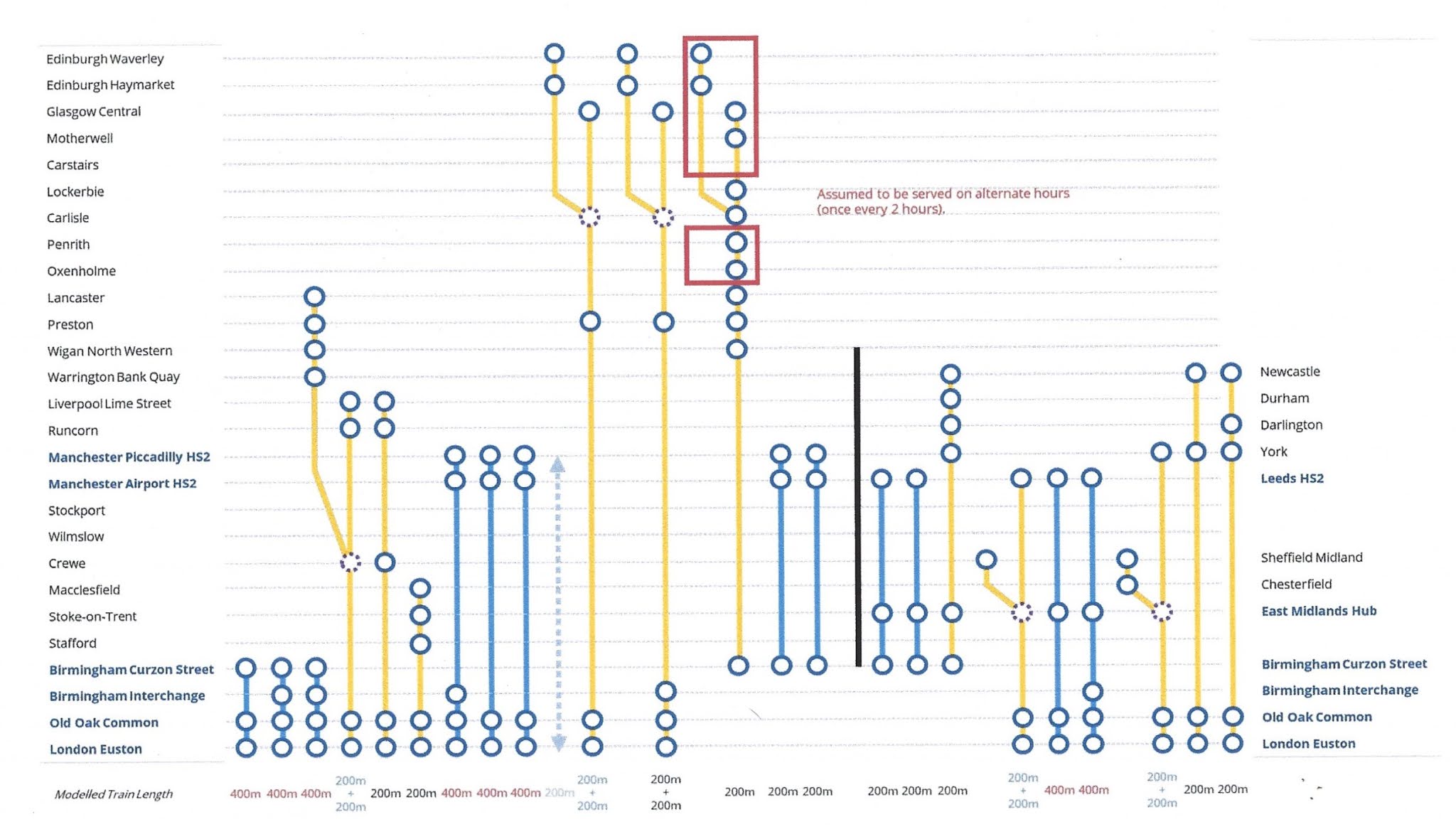
Note.
- Trains to the left of the vertical black line are Phase 1 and those to the right are Phase 2.
- Full-Size trains are shown in blue.
- Classic-Compatible trains are shown in yellow.
- Blue circles are shown, where trains stop.
- The dotted circles are where trains split and join.
- In the red boxes routes alternate every hour.
- Was Lancaster chosen as it’s close to the new Eden Project Morecambe?
Click on the diagram to enlarge it.
It would appear if High Speed Two sticks to this original pattern of services, then the following trains will go through Wigan North Western station.
- 200 metre single train – London Euston and Lancaster, which stops at Old Oak Common, Crewe, Warrington Bank Quay, Wigan North Western and Preston.
- 400 metre pair of trains – London Euston and Edinburgh Haymarket/Edinburgh Waverley/Glasgow Central, which stops at Old Oak Common, Preston, Carlisle.
- 400 metre pair of trains – London Euston and Edinburgh Haymarket/Edinburgh Waverley/Glasgow Central, which stops at Old Oak Common, Birmingham Interchange, Preston, Carlisle.
- 200 metre single train – Birmingham Curzon Street and Edinburgh Haymarket/Edinburgh Waverley or Motherwell/Glasgow Central, which stops at Wigan North Western, Preston, Lancaster, Carlisle and Lockerby and every two hours at Oxenholme and Penrith.
Note.
- Only single High Speed Two classic-compatible trains, stop in Wigan North Western station and they are only two hundred metres long.
- One train per hour (tph) terminates at Lancaster and a second tph terminates alternatively at Edinburgh Haymarket/Edinburgh Waverley or Glasgow Central.
- Four hundred metre long pairs of trains go through North Western station without stopping.
Currently Wigan North Western has 14 trains per day (tpd) stopping at the station, eleven of which go to Scotland and three to Blackpool.
This Google Map shows Wigan North Western station.
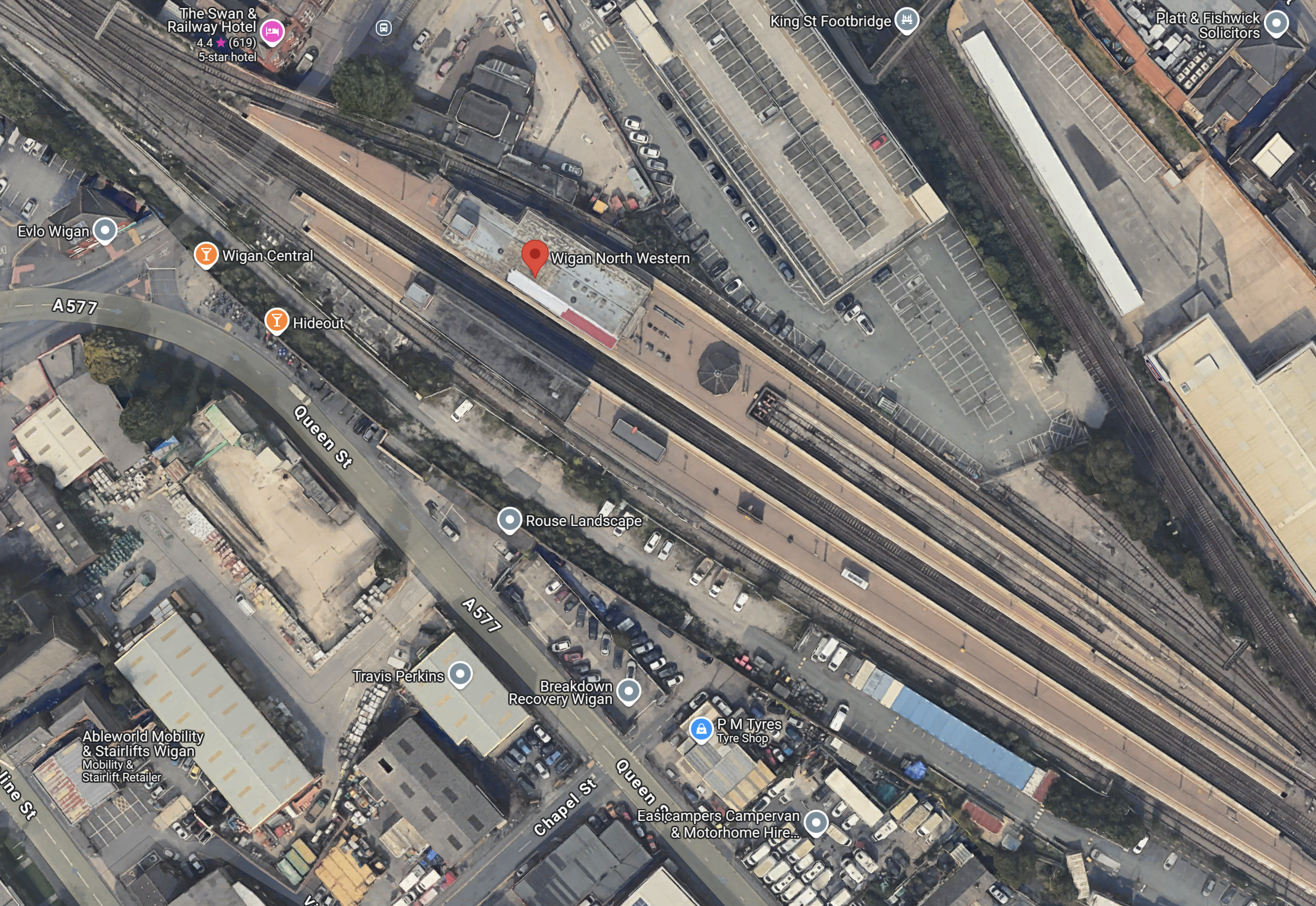
Note.
- The two long platforms in the middle of the station, where the Avanti trains stop.
- A long platform on the Southern side of the station used by local services to and from Liverpool and Blackpool.
- Three bay platforms on the Northern side of the station, one of which is unused, that handle local services to Manchester and beyond.
As the 265.3 metre long Class 390 trains can use the central platforms, High Speed Two classic-compatible trains will be able to use these platforms.
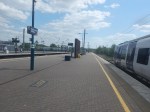
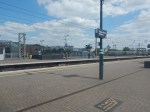
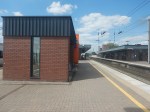
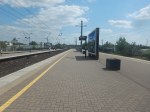
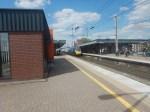
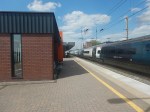
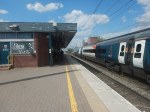
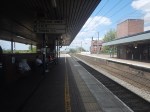
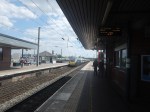
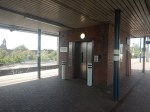
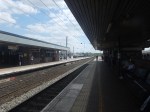
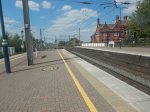
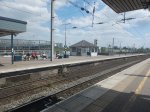
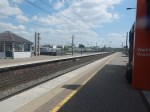
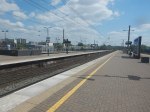
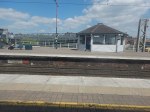
On my brief visit to the station yesterday, I took these pictures.
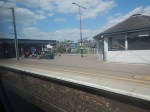
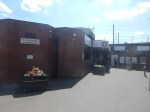

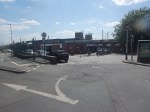
Note.
- All Class 390 trains are longer than High Speed Two classic-compatible trains, so the train in the pictures indicates that the High Speed Two trains will be able to stop at Wigan North Western station.
- The platforms are long and wide.
- The station is well-equipped with lifts, cafes, waiting rooms and some of the best toilets in a station in the North of England.
- Wigan Wallgate station is only a short walk away, with a selection of local services to Blackburn, Headbolt Lane, Manchester, Southport and a large proportion of Lancashire.
- The last two pictures were taken looking at the two stations from halfway.
- The shops between the two stations are a good selection and include a Morrisons Local.
I had been intending to go on to Preston, Lancaster and Morecambe, but a points failure at Preston meant that no trains were running.
Conclusion
The two Wigan stations and the buses that serve them, could be a good interchange for passengers to catch High Speed Two.
I feel that most of the work needed to be done at Wigan North Western to get the station ready for High Speed Two will mainly be cosmetic or technical upgrades like signalling. I can’t see any expensive or disruptive upgrades like platform lengthening being needed.
Extending The Elizabeth Line – Adding Ladbroke Grove Station To The Elizabeth Line
There is a Wikipedia entry for Ladbroke Grove railway station, which starts with this paragraph.
Ladbroke Grove is a proposed railway station in London, England on the Crossrail Route between Old Oak Common and Paddington. This is not part of the internal route and would be added at a later stage. Locals want the station to be called Portobello Central to serve the nearby Portobello Market. It was originally called Kensal.
The Wikipedia entry also gives these details of two proposals for a Ladbroke Grove station on the Elizabeth Line.
Kensington and Chelsea Council has been pushing for a station at North Kensington / Kensal, just to the east of the Old Oak Common railway station site, off Ladbroke Grove and Canal Way, as a turn-back facility will have to be built in the area anyway. Siting it at Kensal Rise, rather than next to Paddington itself, would provide a new station to regenerate the area. Amongst the general public there is a huge amount of support for the project and then-mayor of London Boris Johnson stated that a station would be added if it did not increase Crossrail’s overall cost; in response, Kensington and Chelsea Council agreed to underwrite the projected £33 million cost of a Crossrail station, which was received very well by the residents of the borough. Transport for London (TfL) is conducting a feasibility study on the station and the project is backed by National Grid, retailers Sainsbury’s and Cath Kidston, and Jenny Jones (Green Party member of the London Assembly).
The plans were resurrected by Boris Johnson in 2016.
In March 2017, it was announced that TfL was considering a Crossrail station in Kensal Green, on the site of a former gasworks, and it would be between Old Oak Common and Paddington.
This map from cartometro.com shows the railway lines to the West of Paddington.
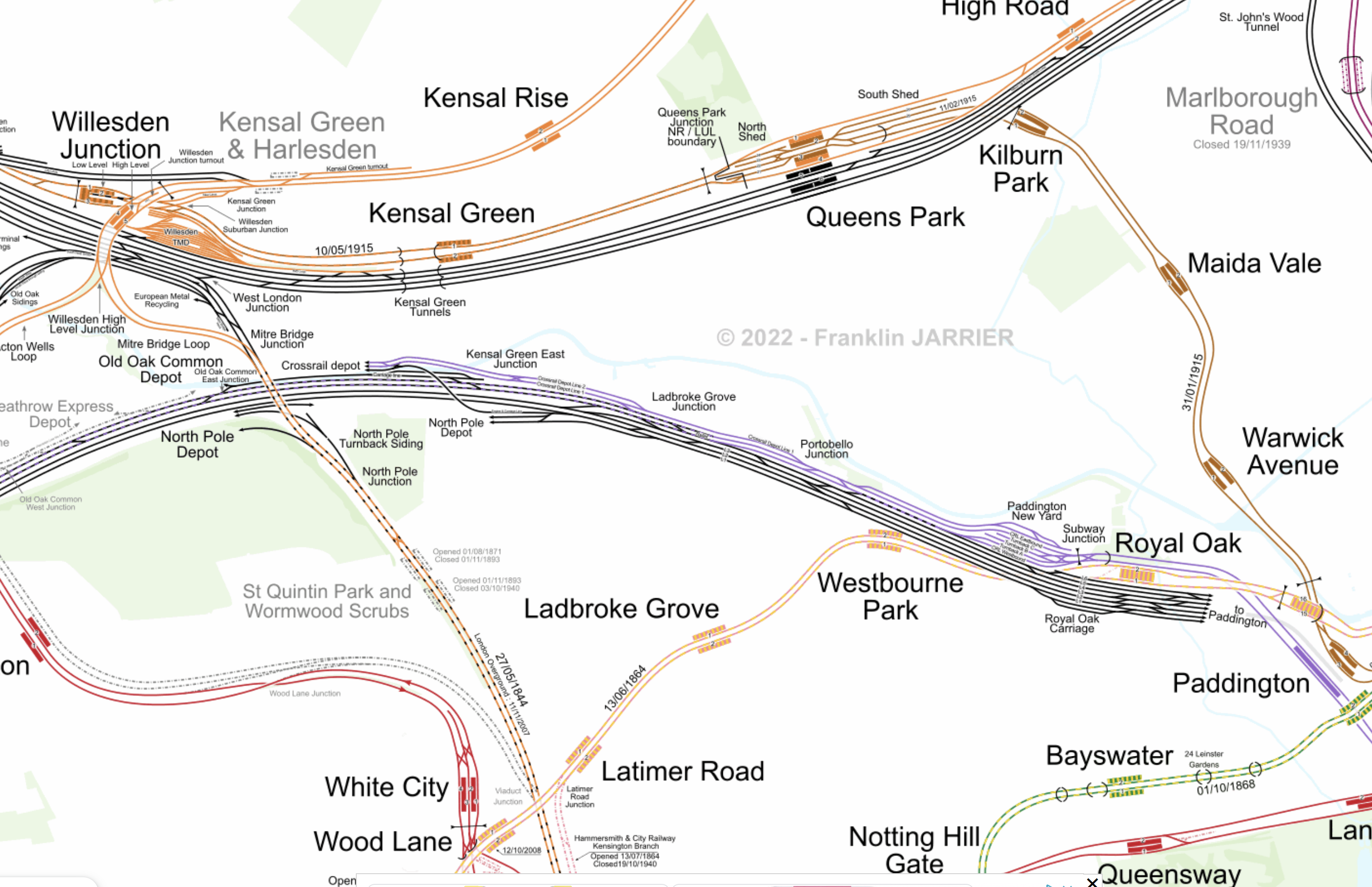
Note.
- The Elizabeth Line is shown in purple.
- Ladbroke Grove rube station is not close to the Elizabeth Line.
- Kensal Green tube station is not close to the Elizabeth Line.
But we do know this about the future Old Oak Common station.
- It will be served by Elizabeth Line services between Central London and Heathrow Airport.
- It will be served by High Speed Two services between London Euston and the North of England and Scotland.
- It will be served by Great Western services between London Paddington and the West of England and Wales.
- It will be served by North London Line services betweeen Stratford and Richmond.
- It will be served by Heathrow Express services between London Paddington and Heathrow Airport.
From the map, it looks unlikely that the Hammersmith & City Line will be able to serve Old Oak Common station.
However, it might be possible that Euston and Old Oak Common could be served by Watford DC Line services, which called at either Old Oak Common or Kensal Greeen.
A link between Euston and Old Oak Common, would give all stations on the line access to High Speed Two and Heathrow with a change at Old Oak Common.
Some Euston suburban services could stop at Old Oak Common for access to High Speed Two and Heathrow.
The Watford DC Line which is very self-contained could become a comprehensive feeder line for High Speed Two and Heathrow.
Kensal Green Station
I took a trip to Kensal Green station and took these pictures.
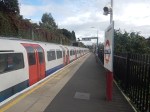
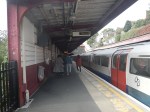

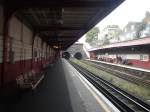
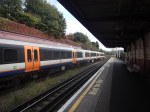
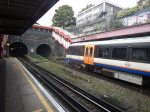
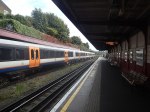
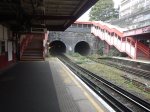
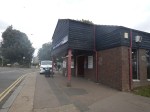
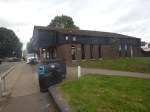


Note.
The station handles two heights of trains on single-height platforms.
Some of the stairs are not the best.
There is no step-free access.
There are six lines through the station and there may be scope for more platforms.
If ever there was a station that needed a makeover it is Kensal Green.
Conclusion
I doubt that the Hammersmith & City Line could be connected to the Elizabeth Line to the West of Paddingt9n.
But I do feel that the Watford DC Line could be developed into a comprehensive link between Euston and Old Oak Common satiations.
Why The Elizabeth Line Must Be Extended To Ebbsfleet International
There are various plans to link the Elizabeth Line to Ebbsfleet International.
In Elizabeth Line To Ebbsfleet Extension Could Cost £3.2 Billion, I showed this map from the Abbeywood2Ebbsfleet consultation.
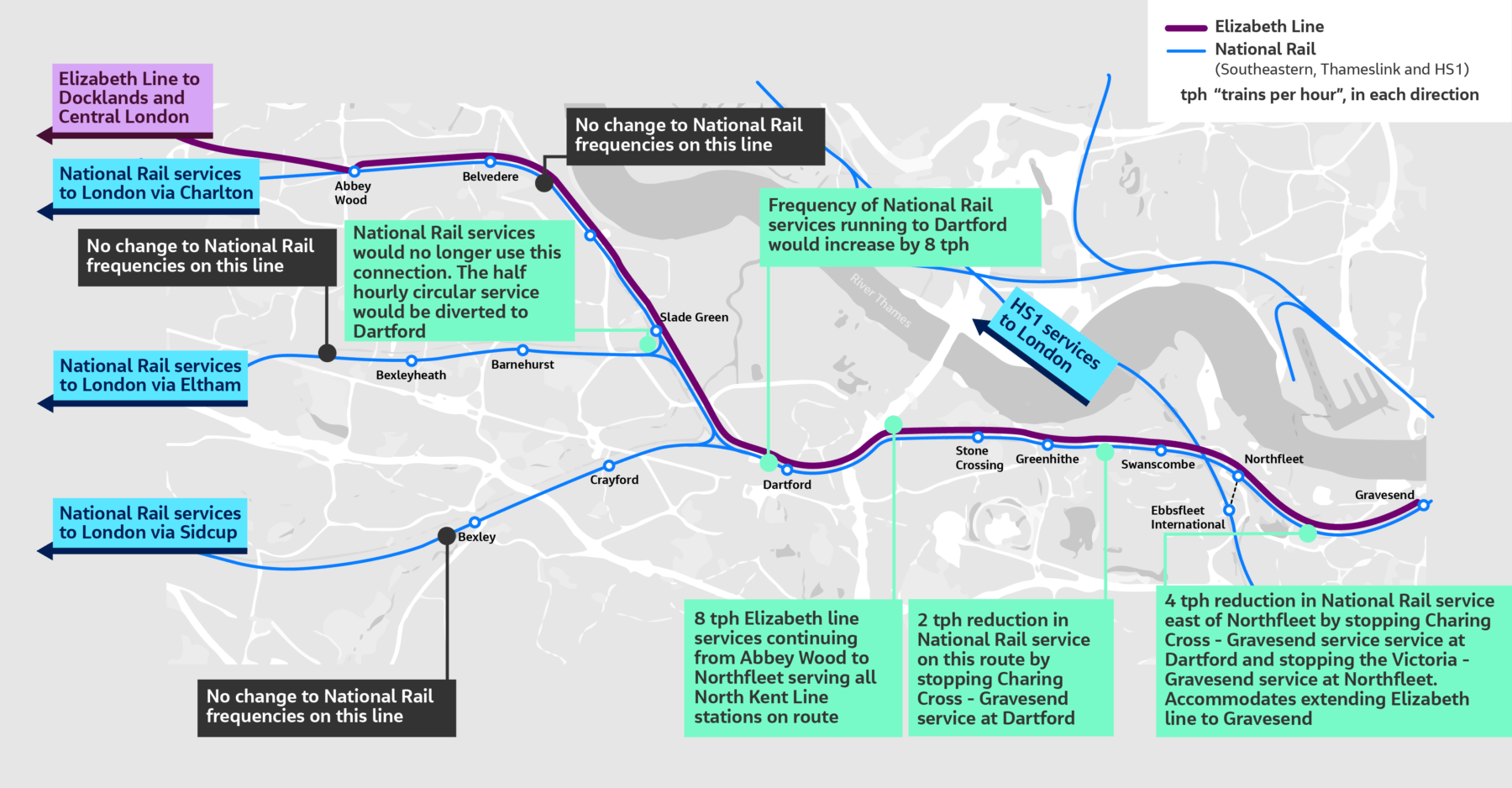
There doesn’t appear to be too much new infrastructure, except for a proper connection between Northfleet and Ebbsfleet stations. References on the Internet, say that the similar-sized Luton DART connection at Luton Airport, cost around £225 million.
The Elizabeth Line connects to the following.
- Bond Street
- Canary Wharf
- City of London
- Farringdon for Thameslink
- Heathrow Airport
- Old Oak Common for High Speed Two
- Liverpool Street station
- Oxford Street
- Paddington station
- Slough for Windsor
- Tottenham Court Road for the British Museum, Oxford Street, Soho, Theatreland and the Underground.
- West End of London
- Whitechapel for the Overground and Underground
For many people like me, the Elizabeth Line at Ebbsfleet will provide one of the quickest ways to get to and from European trains.
High Speed Two Services
This diagram shows High Speed Two services, as they were originally envisaged before Phase 2 was discontinued.
Note.
- Trains to the left of the vertical black line are Phase 1 and those to the right are Phase 2.
- Full-Size trains are shown in blue.
- Classic-Compatible trains are shown in yellow.
- The dotted circles are where trains split and join.
- In the red boxes routes alternate every hour.
- Was Lancaster chosen as it’s close to the new Eden Project Morecambe?
Click on the diagram to enlarge it.
Destinations served by the current foreshortened High Speed Two or High Speed Two Lite will be.
- Birmingham Curzon Street
- Birmingham Interchange
- Carlisle
- Carstairs
- Crewe
- Edinburgh Haymarket
- Edinburgh Waverley
- Glasgow Central
- Lancaster
- Liverpool Lime Street
- Lockerbie
- Macclesfield
- Manchester Airport
- Manchester Piccadilly
- Motherwell
- Oxenholme
- Penrith
- Preston
- Runcorn
- Stafford
- Srockport
- Stoke-on-Trent
- Warrington Bank Quay
- Wigan North Western
- Wilmslow
That is twenty-five stations.
I would add these extra stations.
- Bangor
- Blackpool
- Chester
- Holyhead
- Llandudno Junction
- Wrexham
Note.
- These extra six stations would make High Speed Two, a line for more of the people.
- Because the Eastern leg is cancelled, the paths that would have served that leg can be used to provide services for the West of the country.
The East of the country could be served by updating the East Coast Main Line.
The Development Of Eurostar
Consider.
- Eurostar and Thalys have now merged and I can see them providing extra direct services between London and Europe.
- Bordeaux, Cologne, Frankfurt and Geneva have been mentioned as possible destinations.
- Most of the new destinations, will be served by extending current services from Amsterdam, Brussels and Paris appropriately.
But to cope with the extra numbers of passengers, there will have to be extra passenger capacity at St. Pancras and/or Ebbsfleet International.
High Speed Two And Continental Services
Currently, if you want to go from the North of England or Scotland to the Continent, you do one of the following.
- Take a train to King’s Cross and walk across to St. Pancras International.
- Take a train to St. Pancras and walk to the International section of the station.
- Take a train to Euston and walk or take a bus, taxi or Underground to St. Pancras International.
Note.
- Passengers from North Wales take the Euston route.
- Some passengers will take an Elizabeth Line train to Farringdon and then take Thameslink to St. Pancras International.
- Passengers arriving at Paddington on Heathrow Express will probably take a taxi to St. Pancras International.
- Passengers arriving at Paddington on a budget will probably take the Underground to St. Pancras International.
For Londoners and those travellers, who know London well, the routes to St. Pancras International, are not to bad but they could be better.
If the current foreshortened High Speed Two or High Speed Two Lite finishes at Old Oak Common station, passengers will have to use the following routes for their onward journey.
- Elizabeth Line
- Great Western Railway – local services.
- Heathrow Express
- North London Line of the London Overground, or whatever the Mayor at the time calls it.
If the full High Speed Two or High Speed Two Lite finishes at Euston station, passengers will have to use the following routes for their onward journey.
- Avanti West Coast
- Circle, Hammersmith & City and Metropolitan Lines
- London North Western – local services
- Northern Line
- Victoria Line
- Watford DC Line of the London Overground, or whatever the Mayor at the time calls it.
These routes will be in addition to those at Old Oak Common station.
There will be two routes between High Speed Two and St. Pancras International station.
- Passengers arriving at Old Oak Common will take an Elizabeth Line train to Farringdon and then take Thameslink to St. Pancras International.
- Passengers arriving at Euston will walk or take a bus, taxi or Underground to St. Pancras International.
I am not sure that either route will have enough capacity, if High Speed Two attracts a large number of passengers.
Extend High Speed Two To Euston
I believe that this is essential, as it improves the connectivity greatly, at the bottom end of High Speed Two, as several Underground Lines will be connected to High Speed Two.
Extend The Elizabeth Line from Old Oak Common To Ebbsfleet International
I believe this too is essential, as it gives the North of England and Scotland, the connection to the Continent that they need.
There could be cross-platform connections at both Old Oak Common and Ebbsfleet International between the Elizabeth Line and the high speed lines.
Conclusion
Politicians should stop the dithering and act to give the UK, the rail connection it needs up and down the country and to the Continent.
Is Six Platforms Enough At Euston For High Speed Two?
In this article in The Times, which is entitled What Is The New HS2 Route? The UK’s High-Speed Rail Network Mapped, this is said.
Sunak said a new six-platform station at Euston would save £6.5 billion compared with HS2’s vision of an 11-platform scheme.
But would it be possible to operate a full service with just six platforms?
This graphic shows High Speed Two services, as proposed by HS2 after Phase 2b opens.
Note.
- Services shown in blue are run by High Speed Two Full Size trains.
- Services shown in yellow are run by High Speed Two Classic-Compatible trains.
- Each service will run once an hour.
- There are seventeen services that terminate at Euston in every hour.
- Eight are High Speed Two Full Size trains, which are 400 metres long.
- Four are single High Speed Two Classic-Compatible trains, which are 200 metres long.
- Five are pairs of High Speed Two Classic-Compatible trains, which are 400 metres long.
I have a few thoughts.
The Capacity of High Speed Two
High Speed Two has been designed to have a capacity of eighteen trains per hour (tph).
That means it should be able to handle the seventeen tph to and from Euston.
Six Platforms Would Mean That Each Platform Would Handle Three tph
That is just simple arithmetic.
But could each platform handle three tph?
There are several places in the UK, where a single platform handles three or even four tph.
But these are generally smaller stations handling smaller trains.
I believe that with passenger entry to the platforms from both ends, as there is at King’s Cross, London Bridge and Manchester Piccadilly, that twenty minutes between trains should be possible.
What Happens If It Goes Wrong?
Occasionally trains fail, platforms get blocked or something more serious happens, which in the case of the HS2 Euston station would reduce the number of platforms available to five.
One of these actions could be taken.
Some Trains Can Terminate At Old Oak Common Station
Old Oak Common station is proposed to have six high speed platforms, so four platforms could be used to terminate trains in cases of trouble.
Two Services Run Using Single High Speed Two Classic-Compatible Trains Could Share A Platform
This would work as the platforms are designed to accept a pair of these trains.
Platforms 17 And 18 At The Current Euston Station Could Be Used In An Emergency?
This map from OpenRailwayMap shows the tracks and platforms at Euston station.
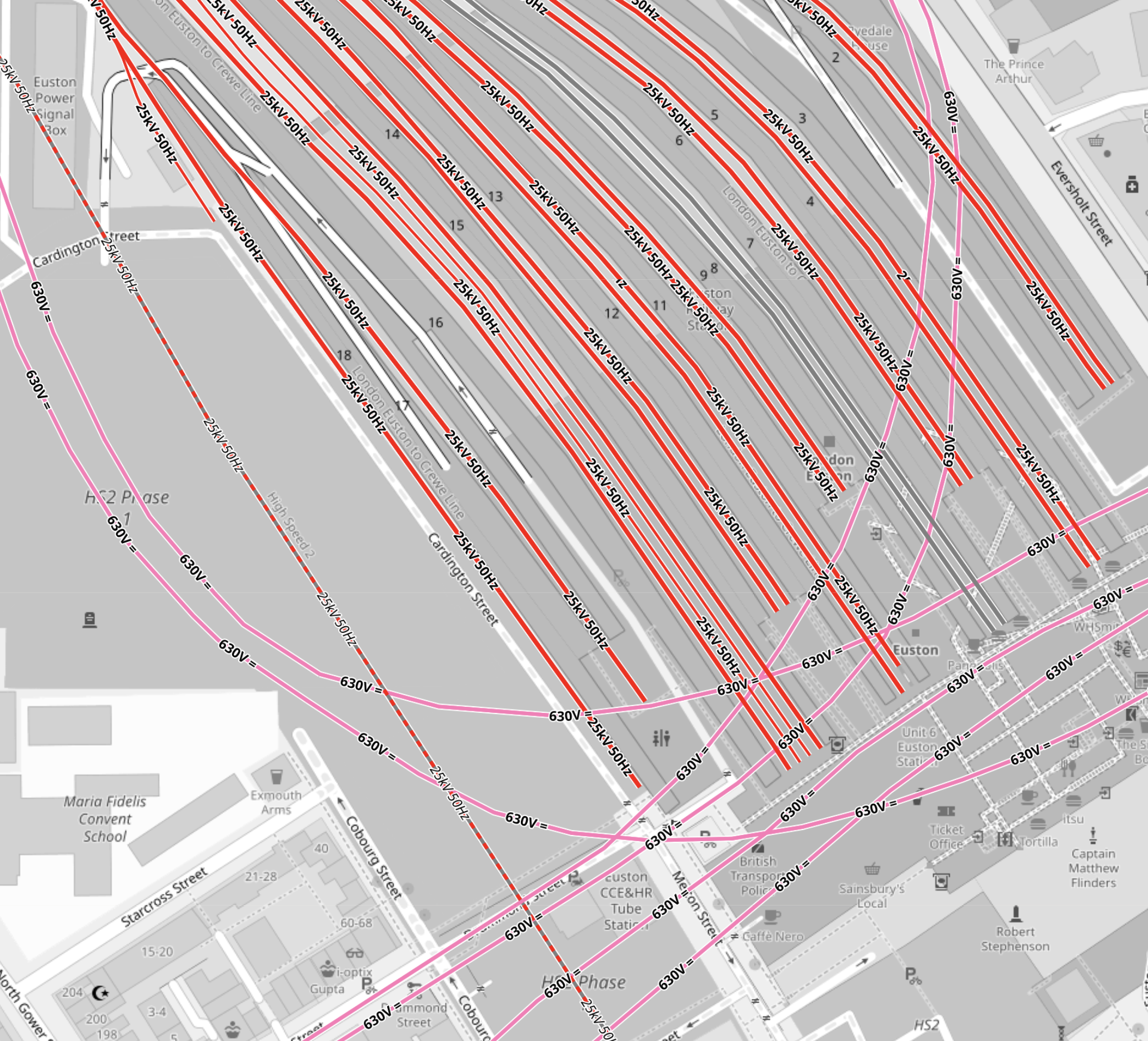
Note.
- Each red track is an electrified platform, with its number alongside.
- Platforms 17 and 18 are on the Western side.
- The pink tracks are London Underground lines.
- The dotted red and grey track down the Western side is the High Speed Two tracks.
Would it be possible to connect the High Speed Two tracks to Platforms 17 and 18 for use in an emergency?
I think it would be.
Conclusion
I believe that it’s possible to design a six-platform station to handle all the High Speed Two traffic at Euston.
Elizabeth Line Takes Fliers Away From Heathrow Express
The title of this post, is the same as that of this article on The Times.
These three paragraphs add details to the story.
The opening of the Elizabeth Line has eaten into the revenues of Heathrow Express, the country’s most expensive railway service per mile travelled.
Filings reveal that Heathrow Express, which offers a 15-minute service between London Paddington and Heathrow, has failed to recover to pre-pandemic levels despite flight volumes at the airport returning to near-normal. Heathrow said revenues from Heathrow Express in the first three months of the year were £22 million.
While that is 50 per cent more than in the same period last year, when Covid-19 travel restrictions were beginning to be relaxed, it is almost a third down on the £31 million of revenues in the first quarter of 2019.
Considering how air travel is on the upturn, Heathrow Express would not appear to be performing as the airport expects.
Remember, that First Group are paid by Heathrow Airport to run the service, which is owned by the airport.
In So Many Cases On A Train!, I wrote about a trip from West Ealing to Moorgate station. These were my opening sentences.
This afternoon about three, I went to West Ealing station to see what it was like to transfer between the Elizabeth Line Central Tunnel and the Western Branch at Paddington.
Coming back, I took an Elizabeth Line service that had started from Heathrow Airport and it was one of the busiest Lizzies, I’d ever ridden!
To get on the train at West Ealing station, I got in to probably coach 4 of 9, as that was in the dry and the back end of the train I needed for Moorgate station was certainly in the wet.
I then had to walk half the length of the train to get to the back of the train.
It was not easy, as the train was full of scores of passengers with large wheelie cases.
It certainly got me thinking about how passengers were getting to and from Heathrow and I came to this conclusion.
Lizzie will start a revolution in travel to and from Heathrow.
Judging by the title of the article in The Times, the revolution has already started.
Consider these reasons.
- Heathrow Express is overpriced.
- It doesn’t go where many passengers want to go.
- It’s not the best way to get workers to and from the airport.
- The ULEZ will discourage passengers and staff from driving to the airport.
In Effects Of The ULEZ In West London, I said this about journeys to and from the airport.
Heathrow Airport is one of the world’s busiest airports and 76,000 people work at the airport, with many more employed nearby.
The airport handled 61.6 million passengers in 2022, which is a few short of 170,000 per day.
If you consider that those that work at the airport do two trips per day and passengers generally do one, that means there are 322,000 trips per day to or from the airport.
But as it now so easy to get to the Airport using the Elizabeth Line will more people use the new line to meet and greet and say goodbye to loved ones or business associates. Since the Elizabeth Line opened, I’ve met a couple of friends at Heathrow, who were passing through.
I wonder, if that daily journey total of 322,000 could be nearer to 350,000 or even 400,000.
If the ULEZ charge makes some passengers and staff switch from their car to using a bus or train, this probably means that public transport to and from the airport, will need to be boosted by a substantial amount.
I can see airport workers lobbying for free tickets on Heathrow Express, but they probably live closer to the airport than Paddington or perhaps even in the Eastern areas of London served by the Elizabeth Line.
The Elizabeth Line Is Showing Signs Of Running Out Of Capacity
In the last few weeks, I’ve been on some very full Elizabeth Line trains.
Articles, like this one on Rail Advent, which is entitled Transport for London Looks Into Funding For Additional Elizabeth Line Trains, are also starting to appear.
These three paragraphs explain the problem.
Transport for London has announced that they are looking for confirmation from the Government regarding funding so that they can look into the possibility of purchasing additional Elizabeth Line trains.
The news from TfL comes after the recent announcement of delays to HS2 terminating at London Euston.
TfL says that without the extra trains, there is insufficient capacity on the Elizabeth Line (until HS2 is extended to Euston in the 2040s) for passengers looking to use HS2 and the Elizabeth Line to get into Central London.
Alstom also appear to want the space in the factory to build other trains.
So it appears that Transport for London must act soon.
Heathrow Express Needs To Be Repurposed
In Extending The Elizabeth Line – High Speed Trains On The Elizabeth Line, I talked about running faster trains through the Central Tunnel of the Elizabeth Line.
As any train would have to be compatible with the platform-edge doors in the central tunnel of the Elizabeth Line, the trains would have to be dimensionally identical to the current Class 345 trains.
- Nine cars
- Possibility of lengthening to ten cars.
- 204.73 metres long.
- 6 sets of doors per carriage
- Ability to run under full digital signalling.
- The trains would be designed for a higher speed of at least 110 or 125 mph, to enable running on the fast lines of the Great Western Main Line.
- The trains would have Heathrow Express branding and interior.
Services could be as follows.
- Heathrow Terminal 4 and Southend Victoria via Bond Street and Liverpool Street for the City and Stratford.
- Heathrow Terminal 5 and Ebbsfleet International via Bond Street and Liverpool Street for the City and Canary Wharf.
Note.
- Both services would be two trains per hour (tph)
- Traffic would determine, which Eastern terminal is paired with which Western terminal.
- Each route would also have two Elizabeth Line tph on the same route.
The Heathrow Express services would run as follows.
- Between Heathrow Airport and Paddington, they would run as now.
- I believe that by using the power of the digital signalling, they could be slotted into the queue of Elizabeth Line trains taking the Central Tunnel.
- They would run through the Central Tunnel, as just another Elizabeth Line train, stopping at all stations.
- Southend Victoria trains would stop at Stratford, take the fast lines to Shenfield, after which they would stop at all stations to Southend Victoria.
- Ebbsfleet International trains would stop at all stations from Abbey Wood to Ebbsfleet International.
Note.
- Trains would stop at Old Oak Common after it opened for High Speed Two and GWR.
- All ticketing would be contactless.
- Passengers using Heathrow Express to the West of Paddington, would pay an extra fee, but nothing like today’s price.
These Heathrow Express routes would have advantages.
- Southend Airport and Southend Victoria would get a direct fast train to Central London and High Speed Two.
- Heathrow would have a direct connection with Continental train services at Ebbsfleet International.
- Capacity could be increased by going to ten-car trains.
- Heathrow Express could release their platforms at Paddington.
- There would be two fast tph between Heathrow and Stratford.
- There would be two fast tph between Heathrow and Canary Wharf.
- There would be four fast tph between Heathrow and Bond Street for the shopping and Liverpool Street for the City of London.
- There would be four fast tph between Heathrow and Farringdon for Thameslink, Gatwick and Luton Airports.
Heathrow Express trains will be fifteen minutes faster to all destinations.
I don’t think there would be any major disadvantages.
Is There Progress On The West London Orbital Railway?
This short news item is being shown on Railnews under a sub-heading of Overground Plan.
The Mayor of London Sadiq Khan is reported to have predicted that a new London Overground route in west London could be open by the early 2030s. The link had been proposed by the Mayor in his 2018 Transport Strategy. It would run from Hounslow to Acton Central and the new HS2 station at Old Oak Common. From there it would continue to Acton Wells Junction and then along the Dudding Hill line, which is presently used only for freight, via the existing stations on the Euston-Watford Overground route at Harlesden and the Jubilee Line station at Neasden. Trains would continue from Neasden along the Midland Main Line in both directions to West Hampstead Thameslink and Hendon. It is understood that engineering consultants are being chosen to develop a detailed design.
So is there progress at last on what I feel is a much-needed and affordable addition to London’s railway network?
The West London Orbital Railway
In TfL Advances Plans For DLR And Overground Extensions, I said the following about the West London Orbital Railway.
I have written extensively about this railway and you can see my posts here.
This map from the Mayor’s Transport Strategy shows the route.
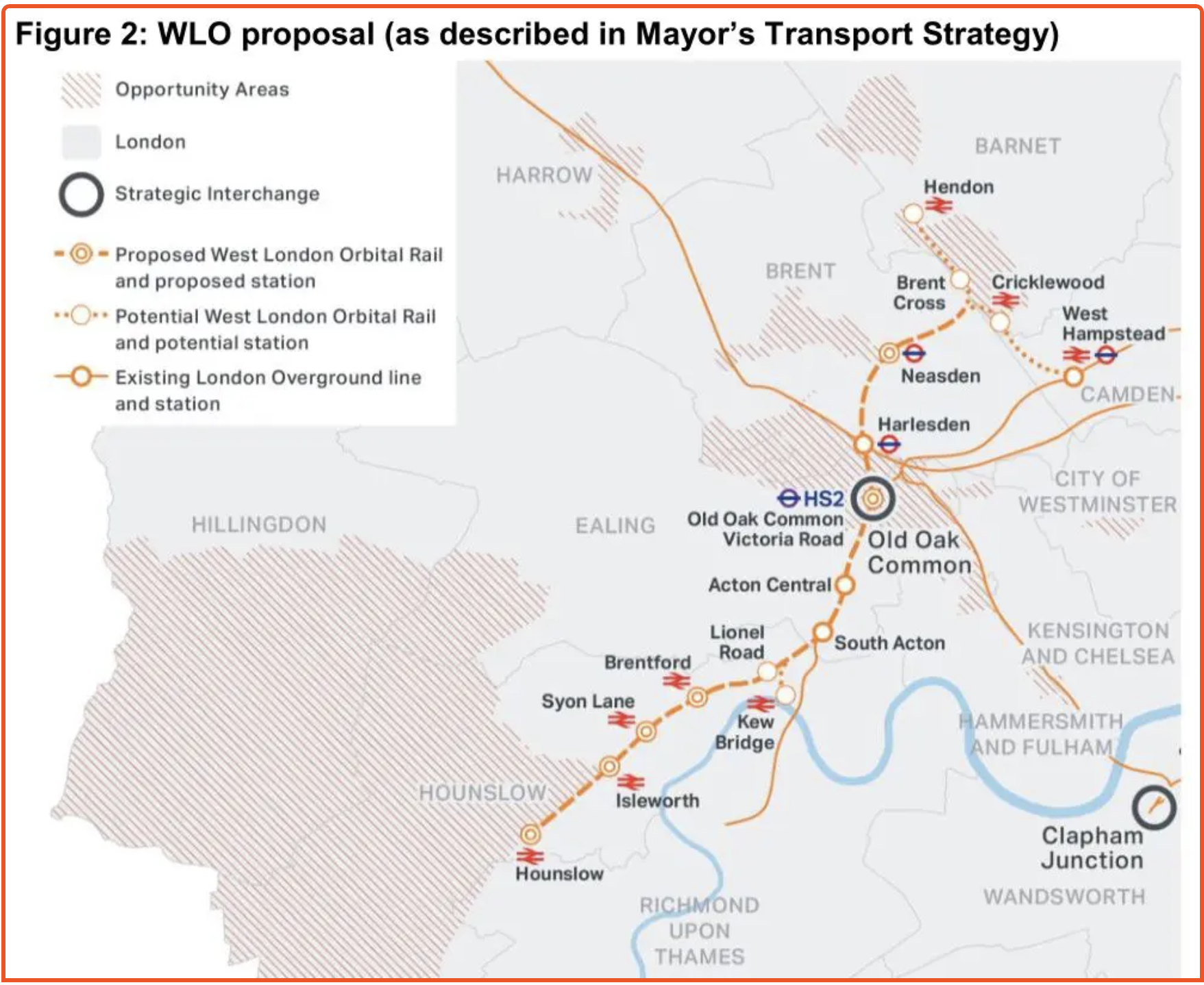
I believe this railway could do the following.
- Level-up much of North-West London.
- Provide better access to Heathrow.
- Link West London to High Speed Two and the Elizabeth Line.
It would also provide better links to Brentford’s new stadium.
The New Civil Engineer says this about funding.
TfL now confirms that the West London Alliance has commissioned feasibility work for the scheme. Meanwhile, TfL is considering options for a Borough Community Infrastructure Levy to help pay for it and has been investigating development opportunities on the route that could unlock funds via Section 106 planning obligations and Carbon Offset funding.
Conclusion
It does appear there are ways and means to fund these schemes, without expecting the rest of the UK to fund London’s transport network.
 The Anonymous Widower