Funding Announced For First-In-Class Low-Carbon Installation Vessel For Floating Offshore Wind
The title of this post, is the same as that of this news item from Morek Engineering.
These two paragraphs outline the project.
The UK Government has awarded funding to a consortium led by Morek Engineering to design a new class of low-carbon installation vessel for the floating offshore wind market.
The consortium has won the funding through the UK Government’s Clean Maritime Demonstration Competition based on their proven track record in innovative vessel design and delivery of complex offshore operations. The consortium includes Morek Engineering, Solis Marine Engineering, Tope Ocean, First Marine Solutions and Celtic Sea Power.
Note.
- The design of the ship certainly seems to tick all the boxes.
- This is Morek’s web site.
Because of my experience of writing project management systems, I often wonder, whether some of my discarded ideas of the 1980s could be used in the deployment of floating offshore wind.
Plans for Hydrogen Development At Dogger Bank D Gain Ground
The title of this post, is the same as that of this article on offshoreWIND.biz.
This is the sub-heading.
Dogger Bank D, the potential fourth phase of the world’s largest offshore wind farm under construction, Dogger Bank Wind Farm, has awarded contracts to engineering consultants to support the feasibility and optimization of a large-scale green hydrogen development option on the project
These three paragraphs outline the project.
SSE Renewables and Equinor, the developers of the Dogger Bank wind farm in the UK, awarded contracts for green hydrogen concept and engineering and optimization studies to Genesis, H2GO Power, and Fichtner.
If progressed for delivery, Dogger Bank D would be located in the North Sea around 210 kilometers off the northeast coast of England. Subject to the successful outcome of further technical studies, the project could be capable of generating up to around 2 GW of renewable power.
The 2 GW offshore wind farm is currently planned to comprise 128 wind turbines and up to six offshore platforms.
Note.
According to the article, this would be one of the UK’s largest green hydrogen production facilities.
The partners said, that the project could contribute to the UK Government’s electrolytic hydrogen ambitions for 5 GW by 2030.
This is said about the studies.
Using AI machine learning and robust modeling, these studies will investigate the multitude of interdependent variables required to optimize a potential green hydrogen production facility, such as offshore wind farm sizing, electrolysis capacity, transport and storage capacity, water availability, and offtake optionality.
I was using robust modelling on projects such as these fifty years ago, both with Artemis and bespoke software.
To my mind, SSE Renewables and Equinor are doing the right thing. If anybody has a similar project with lots of variables, I’d love to give my opinion.
I have some thoughts.
How Much Hydrogen Will Be Produced?
Ryze Hydrogen are building the Herne Bay electrolyser.
- It will consume 23 MW of solar and wind power.
- It will produce ten tonnes of hydrogen per day.
The electrolyser will consume 552 MWh to produce ten tonnes of hydrogen, so creating one tonne of hydrogen needs 55.2 MWh of electricity.
This would mean that if the Japanese built one Herne Bay-size electrolyser, then it would produce around three hundred tonnes of hydrogen in an average month.
Consider.
- Dogger Bank D is likely to be a 2 GW wind farm.
- This document on the OFGEM web site, says that the Dogger Bank wind farms will have a capacity factor of 45 %.
- This means that Dogger Bank D wind farm will produce an average of 900 MW over a year.
- This works out at 7,884 GWh of electricity in a year.
As each tonne of hydrogen needs 55.2 MWh to be produced, this means if all the electricity produced by Dogger Bank D, is used to create green hydrogen, then 142,826.1 tonnes will be produced.
How Will The Hydrogen Be Brought Ashore?
142,826.1 tonnes is a lot of green hydrogen and the easiest ways to transfer it to the shore would be by a pipeline or a tanker.
I wouldn’t be surprised to see the use of tankers, as this would give more flexibility and allow the export of hydrogen to countries in need of hydrogen.
Will There Be Hydrogen Storage In The Dogger Bank D Wind Farm?
This would surely be a possibility, but there are security considerations.
Cost would also be a factor!
The Location Of The Dogger Bank D Wind Farm
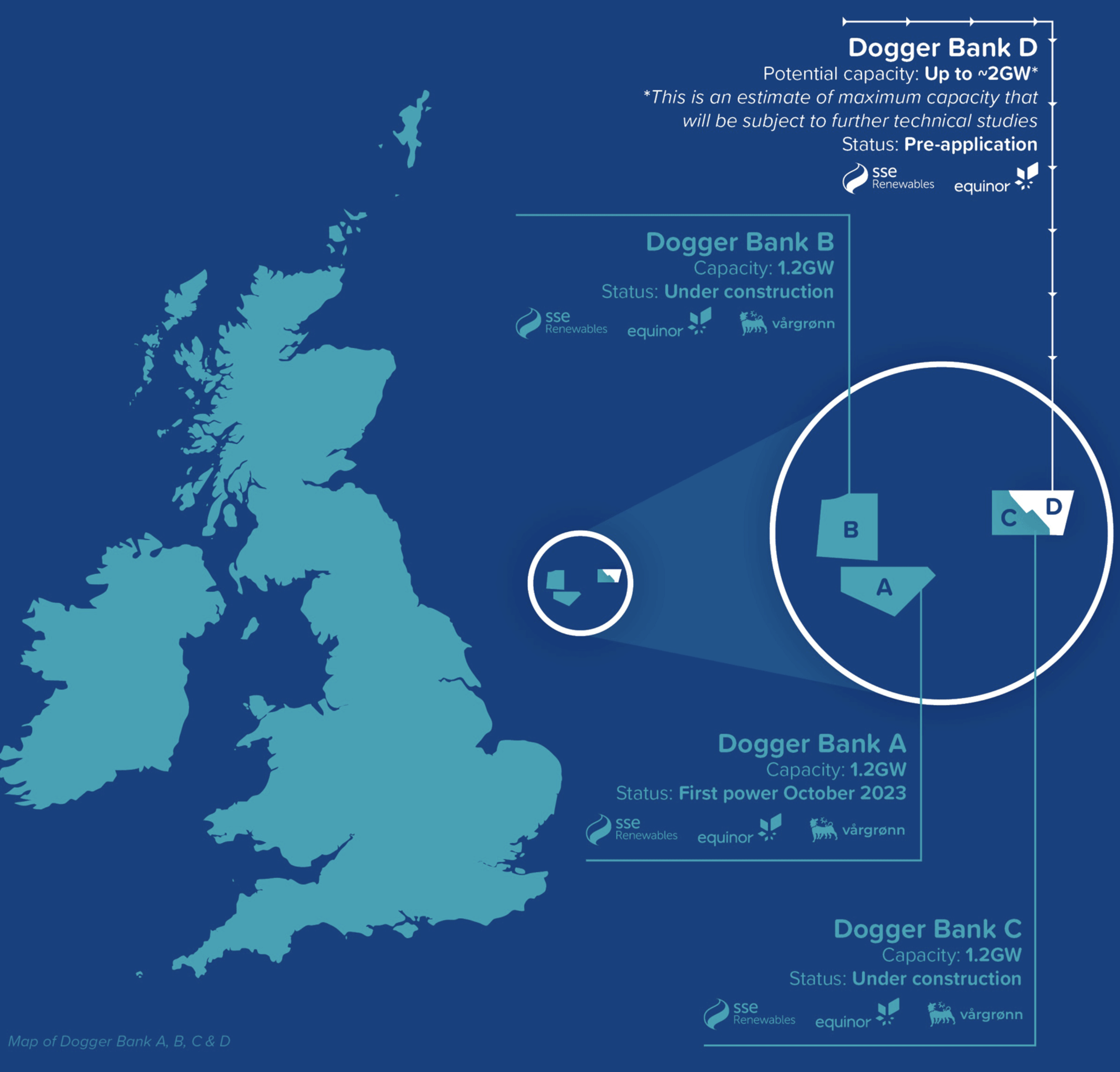
I clipped this map of Dogger Bank A, B, C and D wind farms from this page of the Dogger Bank D web site.
Note.
- RWE’s Dogger Bank South wind farm is not shown on the map.
- Dogger Bank D wind farm is the most Easterly of the four wind farms being developed by SSE Renewables and Equinor.
- Dogger Bank D wind farm must be the closest of the Dogger Bank wind farms to the Eastern border of the UK’s Exclusive Economic Zone or EEZ.
Dogger Bank D wind farm would appear to be ideally placed to supply hydrogen to a number of places, by either pipeline or tanker.
Could Dogger Bank South Wind Farm Also Produce Hydrogen?
In RWE Partners With Masdar For 3 GW Dogger Bank South Offshore Wind Projects, I talked about the change of ownership of the Dogger Bank South wind farm.
I would assume that the Dogger Bank South wind farm will be located to the South of the Dogger Bank A,B, C and D wind farms.
Whether it will produce hydrogen will be a matter for the owners and market conditions.
I do believe though, that it could share some facilities with the those that might be built for Dogger Bank D wind farm.
Conclusion
After this brief look, Dogger Bank D could be an ideal place to build a large hydrogen production facility.
New Plan To Lay Out Path For UK Offshore Wind Growth Expected In Early 2024
The title of this post, is the same as that of this article on offshoreWIND.biz.
This is the sub-heading.
RenewableUK, the Offshore Wind Industry Council (OWIC), the Crown Estate, and Crown Estate Scotland are developing a new Industrial Growth Plan (IGP) to boost the long-term growth of the UK offshore wind sector.
These two paragraphs outline the plan.
The industry players have appointed KPMG to support the development of the IGP which is expected to be published early next year.
The IGP will build on the recent Supply Chain Capability Analysis which outlined a GBP 92 billion opportunity for the country if it can develop its capacity and expertise in a number of key areas, according to RenewableUK.
When plans like this are announced, I wish I was still involved in writing project management software.
South Korea, UK Strengthen Offshore Wind Ties
The title of this post, is the same as that of this article on offshoreWIND.biz.
This is the sub-heading.
The Republic of Korea (ROK) and the UK have signed a memorandum of understanding (MoU) concerning cooperation on offshore wind energy
These three paragraphs outline the MoU.
The UK and ROK already have a proven relationship in offshore wind, with large-scale investments in the UK’s supply chain and in the development of ROK’s offshore wind sector.
This MoU emphasises the will to build on this existing cooperation to accelerate deployment, address barriers to trade, and encourage mutual economic development through regular government-to-government dialogue and business-to-business cooperation, according to the partners.
The participants will support the UK and ROK’s offshore wind deployment by sharing experience and expertise from their respective sectors.
These are my thoughts.
The British And The Koreans Have A Long Record Of Industrial Co-operation
My own experience of this, goes back to the last century, where one of the biggest export markets for Artemis; the project management system, that I wrote was South Korea.
We had started with Hyundai in Saudi Arabia, where the Korean company was providing labour for large projects.
I can remember modifying Artemis, so that it handled the Korean won, which in those days, came with lots of noughts.
The Korean, who managed their Saudi projects returned home and luckily for us, wanted a system in Korea.
Paul, who was our salesman for Korea, used to tell a story about selling in Korea.
Our Korean friend from Hyundai had setup a demonstration of Artemis with all the major corporations or chaebols in Korea.
Paul finished the demonstration and then asked if there were any questions.
There was only one question and it was translated as “Can we see the contract?”
So Paul handed out perhaps a dozen contracts.
Immediately, after a quick read, the attendees at the meeting, started to sign the contracts and give them back.
Paul asked our friendly Korean, what was going on and got the reply. “If it’s good enough for Hyundai, it’s good enough for my company!”
The King Played His Part
King Charles, London and the UK government certainly laid on a first class state visit and by his references in his speech the King certainly said the right things.
I always wonder, how much the Royal Family is worth to business deals, but I suspect in some countries it helps a lot.
With Artemis, we won two Queen’s Awards for Industry. Every year the monarch puts on a reception to which each company or organisation can send three representatives. I recounted my visit in The Day I Met the Queen.
For the second award, I suggested that we send Pat, who was the highest American, in the company.
Later in his career with the company, when he was running our US operations, Pat. found talking about the time, he met the Queen and Prince Philip, very good for doing business.
I wonder how many business and cooperation deals between the UK and Korea, will be revealed in the coming months.
This Deal Is Not Just About The UK And Korea
This paragraph widens out the deal.
In addition, participants accept to promote business activities and facilitate opportunities for UK and ROK companies to collaborate in ROK and the UK, as well as joint offshore wind projects in third countries, according to the press release from the UK Government.
An approach to some countries without the usual bullies of this world may offer advantages.
Has One Secondary Deal Already Been Signed?
This paragraph talks about a recent deal between BP, Dutch company; Corio and the South Koreans.
The news follows the recent announcement from South Korea’s Ministry of Trade, Industry and Energy that two UK companies, Corio Generation and BP, submitted investment plans for offshore wind projects in South Korea totalling about EUR 1.06 billion.
This deal was apparently signed during the state visit.
There’s A Lot Of Wind Power To Be Harvested
These last two paragraphs summarise the wind potentials of the UK and Korea.
The UK has the world’s second-largest installed offshore wind capacity, with a government target to more than triple this capacity by 2030 to 50 GW, including 5 GW of floating offshore wind.
Back in 2018, the South Korean Government set a 2030 offshore wind target of 12 GW in its Renewable Energy 3020 Implementation Plan, which was reaffirmed by the now-former South Korea’s president Moon Jae-in in 2020. Since 2022, it has been reported that the country has a target of reaching 14.3 GW of offshore wind power by 2030.
Note that the UK’s population is almost exactly 30 % bigger than Korea’s.
So why will the UK by 2030, be generating three-and-half times the offshore wind power, than Korea?
Twenty days ago, I wrote UK And Germany Boost Offshore Renewables Ties, where I believe the sub-plot is about long-term power and energy security for the UK and Germany.
Long term, the numbers tell me, that UK and Irish seas will be Europe’s major powerhouse.
Australia’s Offshore Wind Market Could Significantly Benefit from Collaboration with UK Suppliers, Study Says
The title of this section, is the same as that of this article on offshoreWIND.biz.
This is the sub-heading.
A new study has been launched that highlights significant opportunities for the UK to share its wind farm expertise with Australia’s emerging offshore wind market
These three paragraphs outline the study.
The Australian Offshore Wind Market Study, conducted by Arup, evaluates potential Australian offshore wind markets and analyses the strengths, weaknesses, and opportunities for UK support.
Key findings indicate that the Australian offshore wind market could “substantially” benefit from collaboration with the UK suppliers, given the UK’s 23 years of experience and its status as the second largest offshore wind market globally, boasting 13.9 GW of installed capacity as of 2023, according to the UK Government.
Currently, Australia has over 40 offshore wind projects proposed for development.
I believe that the Australians could be a partner in the deal between the UK and Korea, as all three countries have similar objectives.
Conclusion
The Korean and German deals. and a possible Australian deal should be considered together.
Each country have their strengths and together with a few friends, they can help change the world’s power generation for the better.
- Just as the UK can be Europe’s powerhouse, Australia can do a similar job for South-East Asia.
- Any country with lots of energy can supply the green steel needed for wind turbine floats and foundations.
I would have felt the Dutch would have been next to join, as their electricity network is solidly connected to the UK and Germany. But after this week’s Dutch election, who knows what the Dutch will do?
‘Phantom’ Power Projects Are Holding Back The UK’s Energy Security – Centrica Report
The title of this post, is the same as that of this press release from Centrica.
These are the three bullet points.
- New report shows queue for new energy projects is blocked by developers that may not even have land rights and haven’t applied for planning consents
- Estimated size of these power projects in the queue is 62GW, roughly one fifth of all power in the queue
- Centrica CEO argues such ‘phantom’ projects should have Construction Agreements terminated if developers miss key milestones – and urges Ofgem to give National Grid ESO the power to remove projects from the existing grid queue
This is the first two paragraphs.
A new independent report, commissioned by Centrica, has revealed the extent of the power projects holding back the UK’s energy security and creating risk around hitting net zero.
The report examined the UK’s existing queue for Transmission Entry Capacity (TEC) – the queue for connecting new projects to the transmission grid – and discovered that it is up to four times oversubscribed. Not only that, but this oversubscription has become significantly worse in the last few years.
The report found these three totals.
- There are currently 371GW of projects in the queue, enough to significantly improve the UK’s energy security.
- Around 114GW worth of projects have listed their connection date as before 2029.
- But around 62GW of these projects are only in the scoping phase and developers may not even have secured land rights or applied for planning consent.
This is both good and bad news!
Here Is The Good News!
Currently, the UK is using 37 GW of electricity, of which 32 GW are generated in the UK, 5 GW is being imported through interconnectors and around 6 GW are coming from renewables.
So this means that when we build all the 371 GW in the queue, we’ll have around eleven times the electricity we are using today.
Of the 114 GW of projects listed for connection before 2029, it looks like 62 GW won’t be delivered, as they haven’t secured land rights or applied for planning consent.
But that still means that as much as 52 GW could be delivered by 2029.
Even this reduced level of new projects still increases the amount of electricity that can be generated by nearly 150 %.
If I’m being ultra pessimistic, I would say that the average capacity factor of the extra capacity was 50 %, so we’d only be adding 26 GW, so the electricity, that can be generated would only rise by around 70 %.
I suspect all in the UK can live with these paltry increases.
Here Is The Bad News!
This is a paragraph from the report.
The report suggests that the oversubscribed queue, and longer wait for connections. has a damaging effect on the investments that could drive the UK’s energy transition and energy security.
Developers and investors will decamp to countries, where they be sure of getting a return on their time and money.
Think of having two supermarkets close to you live, where one is professional and one is chaotic. Where would you shop?
The congestion caused by phantom projects must be solved.
Ofgem’s Solution
This is the solution in the press release.
Ofgem is exploring rule changes (CMP376) to address queue issues and is expected to decide these before 10 November. These rule changes would grant the ESO the ability to remove projects from the queue if they miss key milestones. Ofgem is currently considering whether to apply this rule change to just new projects entering the queue, or whether the rule change should also be applied to projects already in the queue.
They can probably come up with a solution.
An Alternative Method From My Past
In 1969, I worked for ICI, where one of my jobs was building specialist instruments for chemical plants.
Most instruments, that were designed by the group I belonged to, included a chassis on which the components and electronics were mounted. So we had a workshop and about seven or eight staff at our disposal to build the chassis and the parts outside of our skills. As they were used by several groups in the building, where we were all based, the workshop was very busy and everything was delivered late.
Eventually, a manager decided to get a grip on the situation.
He insisted, that the workshop would not do what you wanted if your delivery date was as soon as possible, rather than a date agreed by both parties.
The results were amazing and everything was delivered on the agreed date.
With the renewable energy connection queue, I am sure, that if a procedure was developed, that only allowed fully-planned projects with an agreed completion date to enter the queue, then the problems of phantom projects would be solved.
It might also reduce the cost of developing these renewable projects.
Lights And Signs In Old Street Roundabout
London’s slowest construction project seems to have been making a bit of progress as more traffic lights are working and signs have been erected.


















Note.
- There’s still a fair bit to do in the middle of the roundabout.
- There is a notice saying it will be finished in early 2024.
- I suspect, that if the bus stops are placed for the benefit of passengers, it will add more passengers to the 141 buses.
But I can’t wait for it to be finished, as it will ease my journeys to the Elizabeth Line. But only because the bus I take gets stuck in all the traffic at the roundabout.
Two days after I took the first pictures, I took these, as I used the Northern Line to go from Old Street station to King’s Cross St. Pancras station.












Note.
- The tunnel and lift need to be completed.
- The walk wasn’t difficult except for the rubbish outside the fast-food shops.
- But then the streets of Islington are paved with rubbish.
- I’m now more convinced that this route opens fully, it’ll increase passengers on the 141 buses.
- But then what does SadIQ Khan and his useful idiots know about mathematical modelling?
Scotland’s Largest Offshore Wind Farm Is Now Operational
The title of this post, is the same as that of this press release from Seagreen Wind Energy.
These three bullet points, act as sub-headings.
-
First Minister Humza Yousaf says Seagreen milestone takes Scotland a step closer to net zero
-
UK’s newest offshore wind farm is generating enough renewable energy to power almost 1.6m homes annually
-
Seagreen is now Scotland’s largest and the world’s deepest fixed-bottom offshore wind farm
These two paragraphs outline the current state of the project.
SSE Renewables, part of SSE plc, and its partner TotalEnergies have announced all 114 Vestas V164-10.0 MW turbines at the 1.1GW Seagreen Offshore Wind Farm off the coast of Scotland are now fully operational and are generating clean, renewable energy to Britain’s power grid.
Situated 27km off the Angus coast in the North Sea’s Firth of Forth, Seagreen is now Scotland’s largest wind farm as well as the world’s deepest fixed-bottom offshore wind farm, with its deepest foundation installed at a record 58.7 metres below sea level^. Seagreen is operated from a dedicated onshore Operations and Maintenance Base at Montrose Port.
Note.
- The capacity of the wind farm is 1,075MW.
- First power was in August 2022.
- It looks like that the original completion date was in 2024, but it was moved forward to October 2023, which has been met.
It seems that the project management was planned well.
UK’s Nuclear Fusion Site Ends Experiments After 40 Years
The title of this post, is the same as that of this article on the BBC.
I have followed fusion research since ZETA at Harwell was started up in 1957.
These first few paragraphs from the BBC article, sum up up fusion research.
For the next four decades, the European project pursued nuclear fusion and the promise of near-limitless clean energy.
But on Saturday the world’s most successful reactor will end its last test.
Nuclear fusion was “discovered” in the 1920s and the subsequent years of research focused on developing fusion for nuclear weapons.
In 1958, when the United States’ war research on fusion was declassified, it sent Russia, UK, Europe, Japan and the US on a race to develop fusion reactions for energy provision.
Fusion is considered the holy grail of energy production as it releases a lot of energy without any greenhouse gas emissions.
It is the process that powers the Sun and other stars. It works by taking pairs of light atoms and forcing them together – the opposite of nuclear fission, where heavy atoms are split apart.
Four decades of research, loads of money and some of the best brains in the world have produced very little, except about knowing what doesn’t work.
It doesn’t seem that anybody is getting any value from fusion research any more.
It’s almost as if, we’ve hit a brick wall and we can’t go any farther.
It must be terribly demoralising for everybody involved.
Would the scientists and engineers be better employed on other research?
I wouldn’t totally abandon fusion research, but put it more on a watching brief, so that if anything positive happens elsewhere, the UK might be able to take advantage.
Could we even do what we have recently done with High Speed Two and scrap it, before using the money on other energy projects?
My priorities would be.
Floating Wind Research
Because we are surrounded by sea, offshore floating wind is likely to be our major energy source by the end of the decade.
Energy Network Control Research
Our energy network will be getting more complex and we need better algorithms to control it.
Storage Research
We need lots of energy storage, that is affordable to install, that can be placed everywhere in the UK.
Project Management Research
I believe that some of the energy ideas will need advanced project management techniques, that may or may not have been invented yet.
Small Modular Reactor Research
SMRs are one way to go, but is the backup research in place?
Tidal Research
Places in the UK have high tidal ranges and we should exploit them.
The Government And Research
The government is funding a lot of energy research.
Much of the funding is going for short term projects, which is good in that we have an urgent need for improvement in our energy performance, but is bad in that it ignores the future.
Diamond 2
The Diamond Light Source has been an unqualified success. I am convinced that we need Diamond 2 in the North, which I wrote about in Blackpool Needs A Diamond.
30 MW Offshore Wind Turbines Being Considered For New Project In Sweden
The title of this post, is the same as that of this article on offshoreWIND.biz.
This is the sub-heading.
Freja Offshore, a joint venture between Hexicon and Mainstream Renewable Power, has submitted an application for an offshore wind farm in Sweden that could have an installed capacity of between 2 GW and 2.5 GW and, according to the project’s consultation document, could feature wind turbines of up to 30 MW per unit.
This paragraph, indicates how turbines have grown over the last two decades.
The wind turbines in the future will probably be taller, the rotor diameter larger and the turbines more powerful, the joint venture says in the consultation document, and compares the largest wind turbines launched in 2011, which have a rotor diameter of 164 metres and an installed capacity of 8 MW, with those launched 10 years later, featuring a rotor diameter of 236 metres and an output of 15 MW.
Moving on a few years to 2030 and it doesn’t seem unreasonable that turbine size will double again to 30 MW.
I could see them becoming the standard turbine, providing they aren’t too heavy for the fixed foundations or floats.
It would be an interesting exercise to model the costs of wind farms, as the turbines get bigger.
With North Sea oil and gas, I was told several times, by Artemis users, that as cranes got larger, which allowed bigger lifts, the costs of offshore infrastructure decreased.
Note.
SSE Renewables Calls For More Use Of Non-Price Criteria In Offshore Wind Auctions
The title of this post, is the same as that of this article on offshoreWIND.biz.
This is the sub-heading.
SSE Renewables is calling on European governments and regulators and internationally to make greater use of non-price criteria (NPC) in offshore wind energy auctions, whether for seabed or for contracts for difference (CfD).
This is the first paragraph.
The renewable energy company said that the use of non-price criteria in auctions for new offshore wind can help support a sustainable renewable energy sector that delivers long-term value for society.
This document on the SSE Renewables web site is entitled Non-Price Criteria In Renewables Auctions and these are the points from the Executive Summary from the document.
- Use of non-price criteria (NPC) in auctions is important to deliver renewables projects which are deliverable, on time and on budget, and provide long term value to society and the environment.
- NPC must be well-designed, carefully implemented, with transparent assessment and monitoring of commitments to avoid overcomplication and risk of legal challenges.
- Seabed leasing auctions for offshore wind are best suited for use of NPC, as it is early enough in the development stage for commitments to be delivered; and avoids having to rely on purely financial bidding which risks adding to the cost of offshore wind.
- The most appropriate NPC are track record and deliverability of projects. Beyond that, criteria related to sustainability (circularity; workforce and skills); ecological protection and enhancement; and supply chain development.
- NPC in new offshore wind markets should be focused on deliverability and track record, and included as a pre-requisite to participate, rather than a point of competition.
- More diverse non-price criteria are best suited to mature offshore wind markets where there will generally be more competition from developers to build a project.
- It is more complicated to apply non-price criteria into offtake (CfD) auctions, with re-ranking of bidders the best approach to properly incentivise the right behaviour.
- It is important that there is transparency of how successful bidders were scored against NPC; what commitments have been made and how they will be held accountable for delivery at different milestones.
Note.
- It is good to see phrases like “track record and deliverability of projects” being embedded in this list of points.
- As a designer of successful project management software, I know the importance of this.
- I believe, that SSE Renewables are right to desire wider criteria for offshore wind energy auctions.
I suspect too, that there are software ideas in my past, that would make the development of offshore wind easier and more predictable.
 The Anonymous Widower