Klaipėda – Kyiv Rail Freight Plan
The title of this post, is the same as that of this article on Railway Gazette.
These two paragraphs give more details.
Lithuania’s national train operator LTG Group and Ukrainian Railways have signed a memorandum of understanding to develop an intermodal freight service from the Baltic port of Klaipėda to Kyiv via Poland.
Test runs are planned for this year, ahead of regular services.
I have some thoughts.
The Route
This Google Map shows the route.
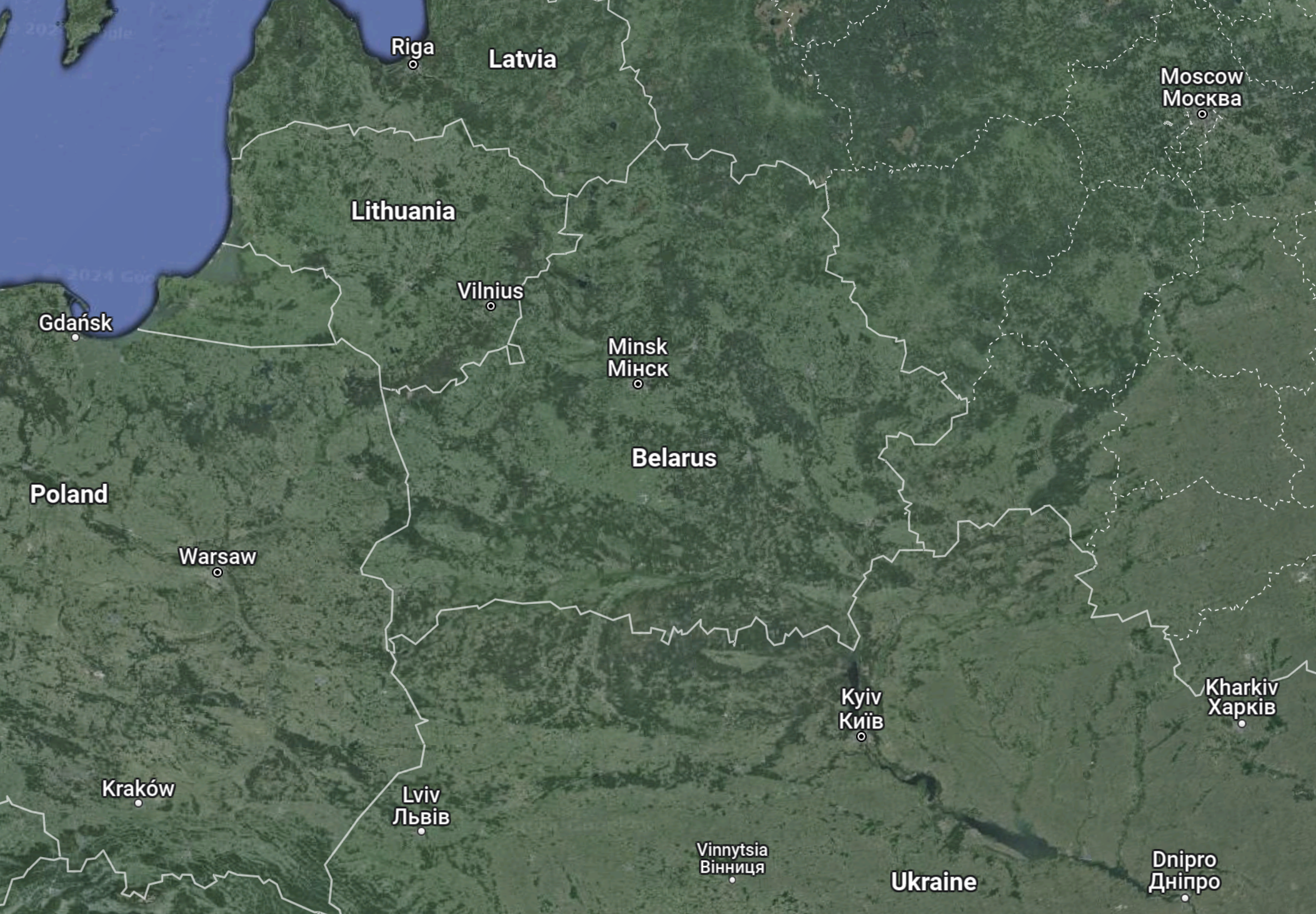
Note.
- Russia is in the North-East corner of the map, with Moscow clearly marked.
- Lithuania is in the North-West corner of the map.
- Klaipėda is on the Lithuanian coast.
- South-West of Lithuania is the Kaliningrad enclave, which is part of Russia.
- South of the Kaliningrad enclave is Poland, where Gdansk, Warsaw and Krakow are clearly marked.
- Belarus is in the middle of the map, with Minsk clearly marked.
- Ukraine is South of Russia and Belarus and East of Poland.
- Dnipro, Kharkiv, Kyiv and Lyiv in Ukraine are clearly marked.
It looks to me, that a possible route would be along the Eastern Polish Border avoiding both Belarus and the Kaliningrad enclave.
The Gauges
This Google Map shows the gauges between Klaipėda and Kyiv.
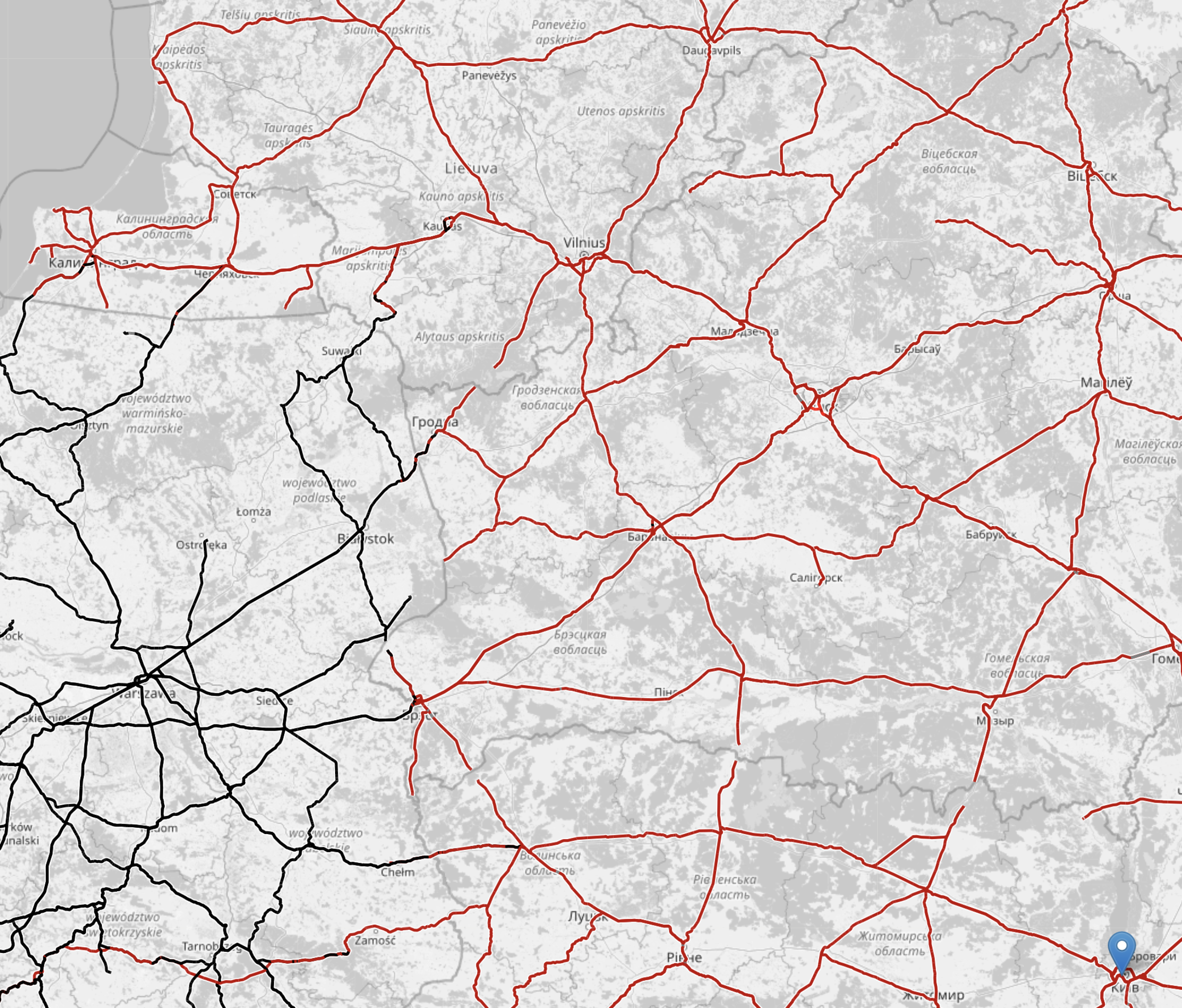
Note.
- Black tracks are Standard gauge of 1435 mm.
- Red tracks are Russian gauge of 1520 mm.
- Klaipėda is on the Lithuanian coast in the North-West corner of the map.
- Kviv is in the South-East corner of the map.
It looks to me, that although Lithuania and Ukraine are Russian gauge, the routes through Poland could be standard gauge.
So there may be a need for some rolling stock, that can run on both Russian and Polish gauges.
This article on Railway Gazette is entitled Ukrainian Railways Produces Cross-Border Grain Wagon.
These two paragraphs describe the wagons.
National railway Ukrzaliznytsia has used mostly domestic components to produce a grain hopper wagon which can operate on both the former USSR’s 1 520 mm broad gauge and the 1 435 mm standard gauge of neighbouring EU countries.
The Type 19-8005-U wagon has a capacity of 70 tonnes and 104 m3, with five loading and six unloading hatches. It is designed for operation at up to 120 km/h.
The wagon certainly looks professional in the pictures.
I don’t think that dual-gauge wagons for containers will be a serious engineering problem for the Ukrainians.
Rail Baltica
The Wikipedia entry for Rail Baltica has this introduction.
Rail Baltica is an under-construction rail infrastructure project that is intended to integrate the Baltic states in the European rail network. Its purpose is to provide passenger and freight service between participating countries and improve rail connections between Central and Northern Europe, specifically the area southeast of the Baltic Sea.
Note.
- As it is an EU-funded project, it is being built as standard gauge.
- It is being built with operating speeds of 145 mph for passengers and 75 mph for freight trains.
- There will be comprehensive connections to airports, freight terminals and major conurbations.
This page on the Rail Baltica web site has an interactive map of Rail Baltica.
It is thought that Putin is not pleased about Rail Baltica, as his extensive fleet of rail transporters for tanks and other military vehicles, are now built for the wrong gauge to invade the Baltic States.
Putin And Dual-Gauge Tracks And Wagons
As they could be used to bring war-related imports to Kyiv, I suspect Vlad the Genocider is against them.
How Will Ukraine Protect The Trains?
Consider.
- Being West of Kyiv will help.
- I suspect the UK have a few ideas for camouflage.
- Will a few brave Ukrainians ride the trains, with a sophisticated train protection missile?
- Drones probably won’t be as effective as ground attack aircraft at attacking trains.
I do suspect though that the Ukrainians have a plan.
Conclusion
This is going to be an interesting development.
North Sea, Baltic Sea Countries Enter Pacts To Protect Offshore Energy Infrastructure Amid Concerns Over Russian Sabotage
The title of this post, is the same as that of this article on offshoreWIND.biz.
This is the sub-heading.
Eight Baltic Sea countries signed a joint declaration on collaborating closer to secure critical offshore energy infrastructure in the region on 10 April, only a day after six North Sea countries entered into a similar agreement. Both are a result of security concerns arising from the Russian invasion of Ukraine and reports of possible sabotage of offshore and subsea energy infrastructure in the North and Baltic Seas.
These are the first two paragraphs.
Concerns over Russia sabotaging offshore energy assets came into the spotlight after four gas leaks were found in September 2022 on the twin Nord Stream pipeline system in the Baltic Sea.
Following national investigations into the incident initiated by Germany, Sweden and Denmark, and studies by the Norwegian and Swedish seismic institutes, European authorities said that the incident could have been the result of “deliberate actions”.
Hopefully, mutual defence will see off, the Evil Vlad!
Three Players Pursuing Floating Offshore Wind Opportunities At Barents Sea Oil Field
The title of this post, is the same as that of this article on offshoreWIND.biz.
This is the sub-heading.
Norwegian oil and gas company Vår Energi has entered into a collaboration with a consortium consisting of Odfjell Oceanwind and Source Galileo to explore opportunities for floating offshore wind through a pilot project at a field located in the Barents Sea off Norway.
The article mentions the Goliat oil field, which is located 85 kilometres (53 mi) northwest of Hammerfest.
This Google Map shows the location of Hammerfest.

Note.
- Hammerfest is marked by the red arrow.
- Hammerfest is the northernmost town in the world with more than 10,000 inhabitants.
- The furthest North, I’ve been in Europe is to Trondheim, which is in the South-West corner of the map.
- To the East of Hammerfest Norway and Russia have a common border and beyond that is the Russian port of Murmansk.
Many years ago, my first visits to Ipswich Town were courtesy of the Official Receiver for Ipswich; John Richardson, who was my parents’ next door neighbour in Felixstowe.
John was an interesting guy, who during the Second World War had been on the Arctic convoys to Murmansk and Archangel. The Wikipedia entry for Arctic Convoys Of World War Two, gives some details.
His descriptions of the weather in the area were horrendous and it makes me wonder why the Norwegians want to extract oil in those conditions. And now generate wind power.
This is the first sentence of the article.
Vår Energi disclosed the deal on Wednesday, 26 April 2023, explaining that the project, called GoliatVind, was a pilot project to demonstrate new, Norwegian offshore wind technology.
So is it all about new technology?
A Trip To Kyiv Road
This article on the BBC is entitled Ukraine War: Road Outside Russian Embassy Renamed ‘Kyiv Road’.
This is the sub-heading.
Under a picture of a guy holding the new Kyiv Road sign, there are these three paragraphs.
The new address will cover a stretch of Bayswater Road that is only a short distance from the Russian embassy.
It comes after protest group Led by Donkeys turned the same street blue and yellow on Thursday.
The Kyiv Road sign will be installed on Friday afternoon by Westminster City Council.
I just had to go and take a few pictures before the Russians, some vandals or some political sympathisers cover it in paint.




















Note.
- The road had been painted blue and yellow by pro-Ukraine protestors a couple of days ago.
- There were two groups of protestors; Ukrainians and Russians opposed to Putin.
- The Ukrainian protestors have Ukrainian flags.
- The anti-Putin protestors have white-blue-white flags, which are the Russian flag, with the red replaced by white.
It was all very light-hearted and the main job of the Police was to gently urge protestors out of the way of traffic.
Lithuanian Gas Pipeline Hit By Large Explosion
The title of this post, is the same as that of this article on the BBC.
This is the sub heading.
A large blast has hit a gas pipeline in the Pasvalys region of northern Lithuania, near the Latvian border.
This Google Map shows the location of the explosion.
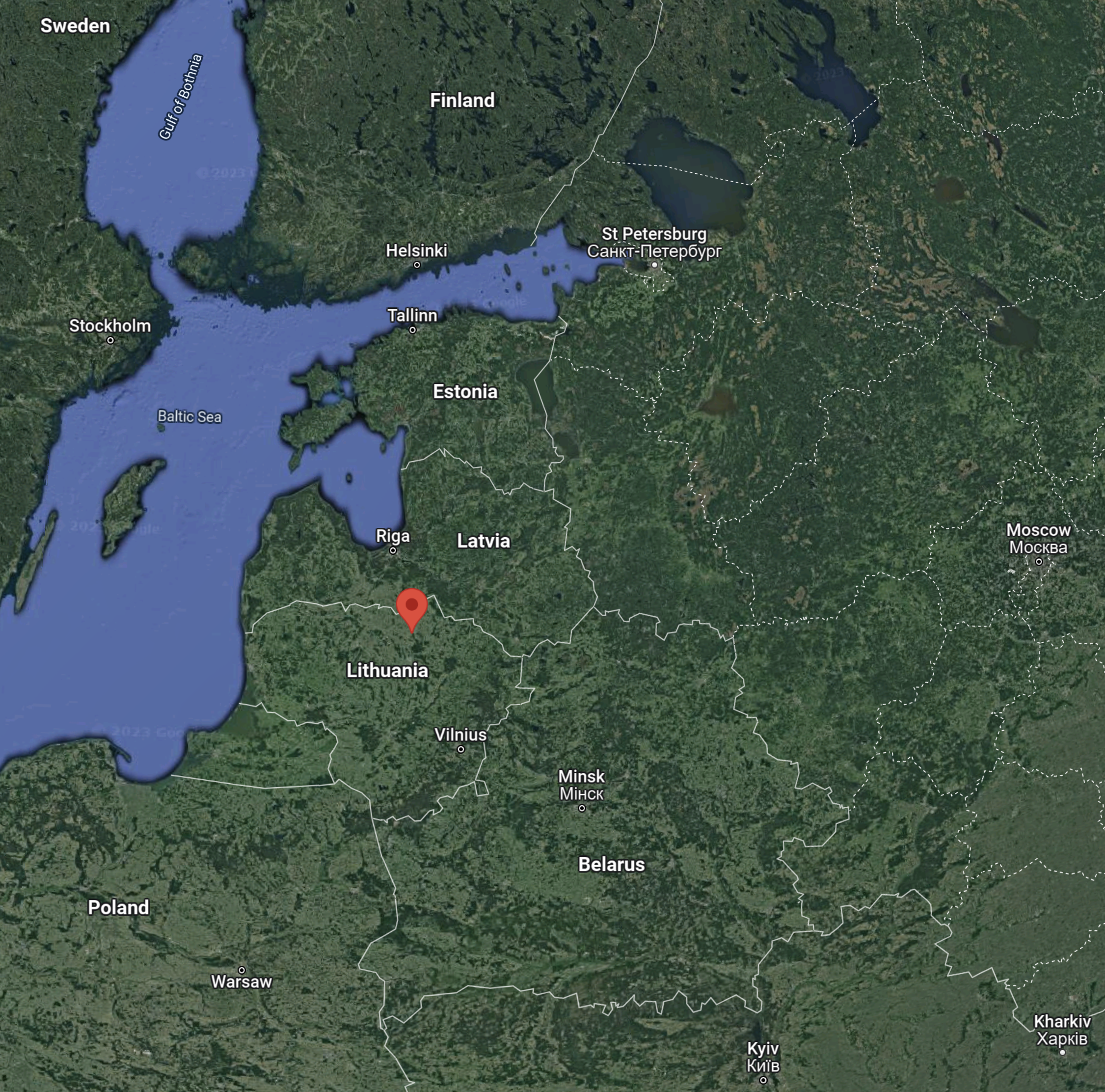
Note.
- Country borders are marked as white lines.
- The site of the explosion at Pasvalis Vienkiemii, is marked with a red arrow.
- Pasvalis Vienkiemii is about a hundred miles from Vilnius.
- About a hundred miles to the East of Pasvalis Vienkiemii, is the point, where Belarus, Latvia and Lithuania meet.
- Russian territory is about a hundred miles further to the East.
I have experience of the quality of borders in that area.
South-West of Lithuania and lying between that country and Poland, there is the small Russian enclave of Kaliningrad.
These pictures show the border between Poland and the Kaliningrad enclave of Russia.




If the borders between Belarus, Latvia and Lithuania are as secure as this, they are almost an open invitation to saboteurs to enter and do damage.
Lützerath: German Coal Mine Stand Off Amid Ukraine War Energy Crunch
The title of this post, is the same as that on this article on the BBC.
This is the sub-heading.
From her tiny wooden treehouse, which sways precariously in the winter wind, a young woman watches an enormous mechanical digger tear into the earth below, its jaws edging ever closer to the village which she’s determined to save.
And these two paragraphs outline the protest.
Lützerath, in western Germany, is on the verge – literally – of being swallowed up by the massive coal mine on its doorstep.
Around 200 climate change activists, who are now all that stand in the way of the diggers expanding the Garzweiler opencast mine, have been warned that if they don’t leave by Tuesday they’ll be forcibly evicted.
But this is not about coal or bituminous coal, as we know it in the UK, this mine will produce lignite or brown coal.
Read both Wikipedia entries linked to the previous sentence and you find some choice phrases.
For bituminous coal.
- Within the coal mining industry, this type of coal is known for releasing the largest amounts of firedamp, a dangerous mixture of gases that can cause underground explosions.
- Extraction of bituminous coal demands the highest safety procedures involving attentive gas monitoring, good ventilation and vigilant site management.
- The leading producer is China, with India and the United States a distant second and third.
For lignite.
- It has a carbon content around 25–35%. and is considered the lowest rank of coal due to its relatively low heat content.
- When removed from the ground, it contains a very high amount of moisture which partially explains its low carbon content.
- The combustion of lignite produces less heat for the amount of carbon dioxide and sulfur released than other ranks of coal. As a result, environmental advocates have characterized lignite as the most harmful coal to human health.
- Depending on the source, various toxic heavy metals, including naturally occurring radioactive materials may be present in lignite which are left over in the coal fly ash produced from its combustion, further increasing health risks.
- Lignite’s high moisture content and susceptibility to spontaneous combustion can cause problems in transportation and storage.
I don’t think, that we’ve ever burned lignite in the UK for electricity, as it is just too filthy.
This map shows the mine.

Note.
- The autobahn at the West of the map, is a six-land highway, so gives an idea of the scale.
- The village of Lützerath is towards the bottom of the map in the middle.
- What has been left after the mining, is going to take a lot of restoration.
It almost appears that some of the scenes of devastation, we are seeing in the Ukraine are also happening in Germany due to the frantic search for energy.
A 1960s-Educated Engineer’s Attitude To Coal
I was one of about four-hundred engineers in my year at Liverpool University in the 1960s.
- Quite a few of those engineers were from coal-mining areas and some were children of miners.
- I remember the graduate recruitment fair at the University in 1968, where the representative from the National Coal Board sat there alone, as if he’d got the 1960s version of Covid-19.
- Some went and talked to him, as they felt sorry for him.
- As far as I know, not one of us, went to work for the National Coal Board.
Engineers and other graduates of the 1960s, didn’t feel that coal was the future.
Had Aberfan and the other pit disasters of the era killed coal as a career, amongst my generation of the UK population?
What Should The Germans Do?
It is my view that whatever the Germans do, burning brown coal, should not be on the list. It’s just too polluting.
This article on euronews is entitled Germany And Poland Have A Dirty Big Secret – An Addiction To Brown Coal.
A few years ago, I was in Katowice on Poland and I have never seen such pollution in Europe, since the smogs of the 1950s.
The euronews article says this.
In eastern Germany some members of a little-known group claim they are being ethnically cleansed, not by militia groups, but by the coal mining industry.
Bulldozers have so far destroyed over 130 Sorb villages to make way for the mining of Europe’s dirtiest kind of fossil fuel – brown coal, or lignite as it is also known.
Brown coal mines are open cast and devour vast tracts of land. As well as whole villages farming and wildlife are destroyed.
The Penk family live in the village of Rohne. They feel their whole culture is also being destroyed.
Note that the Sorbs have a Wikipedia entry, which says there are 60,000 Sorbs in Germany.
One thing the Germans are doing is investing in the UK renewable energy industry.
- RWE own or part-own over 7 GW of offshore wind farms in the UK, some of which are under development.
- enBW and BP are developing 3 GW of offshore wind farms in the UK.
- Over twenty offshore wind farms use Siemens Gamesa turbines.
- The NeuConnect interconnector is being built between the Isle of Grain and Wilhelmshaven.
Would it not be better for the physical and mental health of German citizens, if they abandoned their dirty love of brown coal and spent the money in the North Sea?
UK Space Agency And NNL Work On World’s First Space Battery Powered By British Fuel
The title of this post, is the same as that of this press release from the UK Government.
This is the sub-title.
The UK Space Agency and the National Nuclear Laboratory (NNL) are to collaborate on the world’s first space battery powered by Americium-241.
And these three paragraphs outline the project.
This work, commissioned and funded by the UK Space Agency from NNL, will be delivered in a new £19 million laboratory in Cumbria equipped with next-generation equipment and technology. It will deliver a sovereign supply of fuel for space batteries in the context of a global shortage, enabling the UK and its partners to pursue new space science and exploration missions.
Creating new highly-skilled jobs in the North West of England, it will drive innovation in radiochemistry and separations science and open a new market for the UK space sector.
Atomic space batteries, also known as Radioisotope Power Systems (RPSs), release heat as the radioactivity within them decays. The heat can be used directly to prevent spacecraft from freezing and it can be converted into electricity to power onboard systems. The batteries go on working for decades, without need for maintenance over the many years in which a spacecraft could be travelling.
These two paragraphs explain, why there is a need for a new type of atomic space batteries.
Considered ‘mission critical technologies’ by space agencies in the UK and around the world, all the Apollo missions had an atomic battery in tow, as has every rover that has gone to Mars. Until now, these have been powered by Plutonium-238, a radioisotope produced only in the US, where supply is limited, and Russia, so an alternative is urgently needed.
NNL, the UK’s national laboratory for nuclear fission, has been working on this endeavor since 2009, when its researchers first discovered that Americium-241, an alternative to Plutonium-238, is produced during the radioactive decay of used fuel from nuclear reactors and that it emits power for over 400 years.
With the supply plentiful – the new laboratory is being opened at NNL’s flagship Central Laboratory on the Sellafield site, home to the largest resource of Americium-241 available for extraction in the world – the new collaboration will turn a proven scientific concept into a fully-realised technology. It will be operational within the next four years and is expected to be first used on the European Space Agency’s Argonaut mission to the Moon and for future missions into deep space.
It would appear that Americium-241 has several advantages over Plutonium-238.
- Plutonium-238 has supply problems
- Who in their right mind, would buy a product like this from Russia or China?
- The batteries have a life of 400 years.
- There is plenty of suitable nuclear waste at Sellafield, from which Americium-241 can be extracted.
It looks like the first batteries could also be available in four years.
Aunt Margery
My late wife; C’s Aunt Margery was a lady, who needed a pacemaker. I seem to remember that after several of her pacemakers had run out of power and were replaced, and eventually she was fitted with a nuclear-powered pacemaker in the 1970s or 1980s.
This page on the Stanford University web site is entitled The History Of Nuclear Powered Pacemakers. It was written by Matthew DeGraw.
Many of these pacemakers in the 1960s and 1970s, were powered by Plutonium-238.
The last paragraph is entitled The Rise Of Lithium Battery Pacemakers And Fall Of Nuclear Pacemakers, where this is said.
Despite the often longer life-expectancies, nuclear pacemakers quickly became a part of the past when lithium batteries were developed. Not only did the technology improve, allowing for lighter, smaller, and programmable pacemakers, but doctors began to realize that this excessive longevity of nuclear pacemakers was excessive. Lithium pacemakers often last 10-15 years allowing for doctors to check in on their patients and replace either the batteries or the pacemakers themselves with new and improved technology as it is develops in those 10-15 year spans. While there are still several remaining patients with nuclear-powered pacemakers functioning in their bodies, it is likely that in the next few decades as these patients pass away, so will the once promising nuclear pacemakers.
Would the use of Americium-241 to power a nuclear pacemaker transform the economics of these devices?
I wonder, if there’s a cardiologist out there, who by chance reads this blog, who could answer my question!
Ukraine Tender Would Pair Hydroelectric Plants With Large-Scale Battery Storage
The title of this post, is the same as that of this article on Energy Storage News.
This is a must-read article, as it outlines the damage that Russia is doing to Ukraine’s energy generation.
It also reports how the World Bank is trying to help.
How Did The Ukrainians Attack The Crimea Bridge?
No-one seems to know what happened on the Crimea Bridge, which appeared to catch fire.
- Was it the Ukranians?
- Was it some of Putin’s enemies in Russia?
- Was it an accident?
- Did a battery in an electric car explode?
- Was it a suicide bomber?
- Was it a drone strike?
- Was it a drunken lorry-driver, who hit something?
We just get more and more questions.
But here’s two questions, that can be answered.
Was the train going from Russia? For my theory to be feasible, it must have been going from Russia into Crimea.
Did more than one part of the train catch fire? Someone said it did.
The Track Layout
I have been looking at the track layout over the bridge on OpenRailwayMap, which shows everything. It appears a couple of kilometres. to the South (Russian) side of the bridge there is a set of sidings and/or freight loops.
This OpenRailwayMap shows the sidings in relation to the bridge.
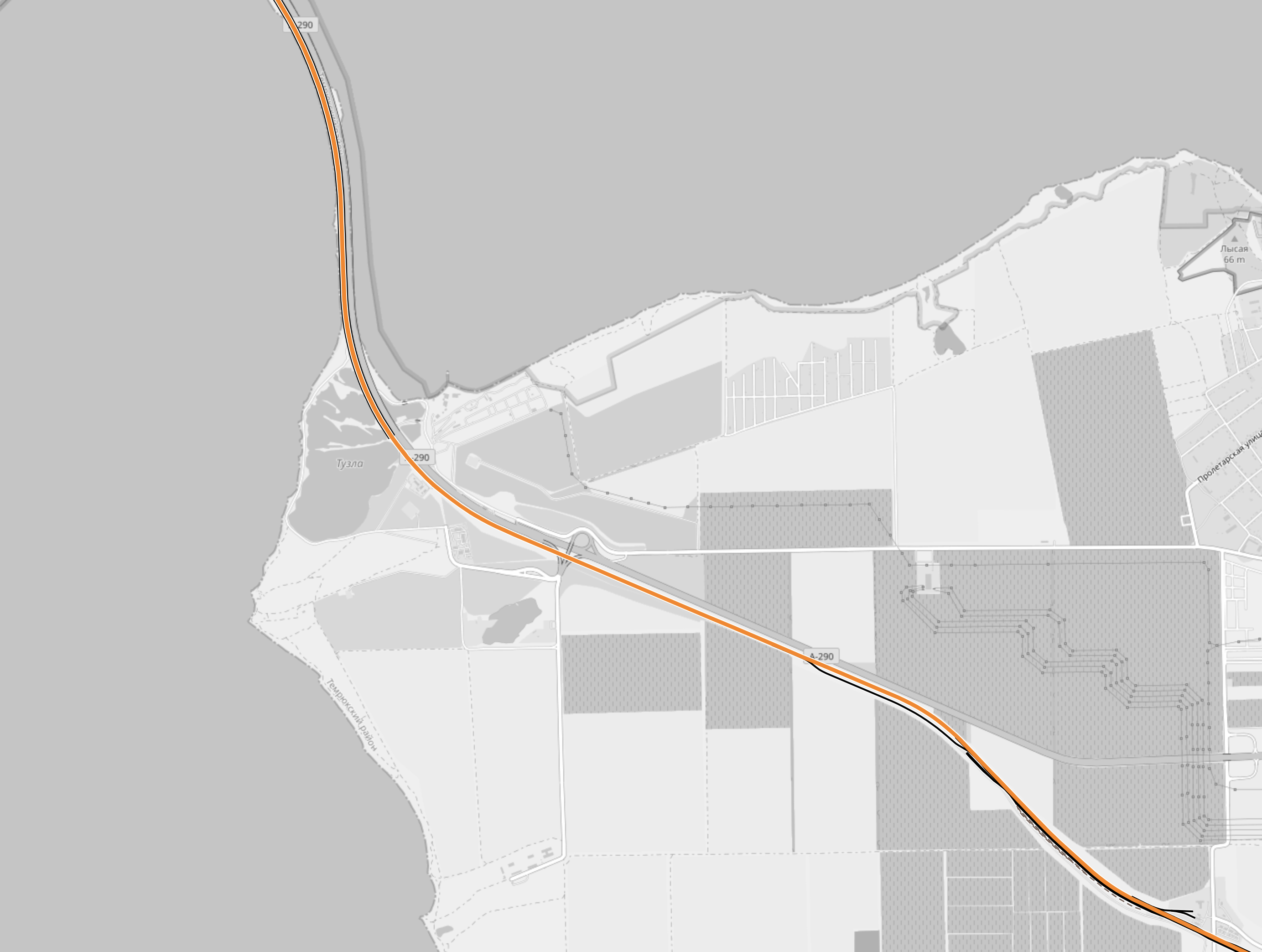
Note.
- The main line is shown in orange.
- The bridge is in the North-West corner of the map.
- The sidings are shown in black alongside the main line in the South-East corner of the map.
This second map shows the loops and sidings in more detail.

Note.
- Trains in Russia run on the right track, whereas the UK runs on the left.
- There are actually two sets of loops; one has extra sidings and the other doesn’t.
- Both loops can be accessed from both tracks and directions.
Unfortunately, the Google Map of the area shows the construction phase.
Did the freight train stop overnight in these sidings and proceed at first light? After all it might be going a long way and drivers needed time for sleep, some food, vodka and a few ciggies.
Whilst it was stopped did Ukrainian saboteurs sneak in and fix bombs with timers to the train? After all kids sneak into our sidings at night and graffiti the trains.
The timers could even have been fitted with GPS, so they went off on the most vulnerable part of the bridge.
This could explain the timing and how the train appeared to have been hit more than once!
For a raid, it would be much easier than say what the Norwegians did in WW2 to blow up the heavy water plant at Telemark, where they didn’t lose a man.
A Picture Of The Train Fire
This picture shows the train fire.
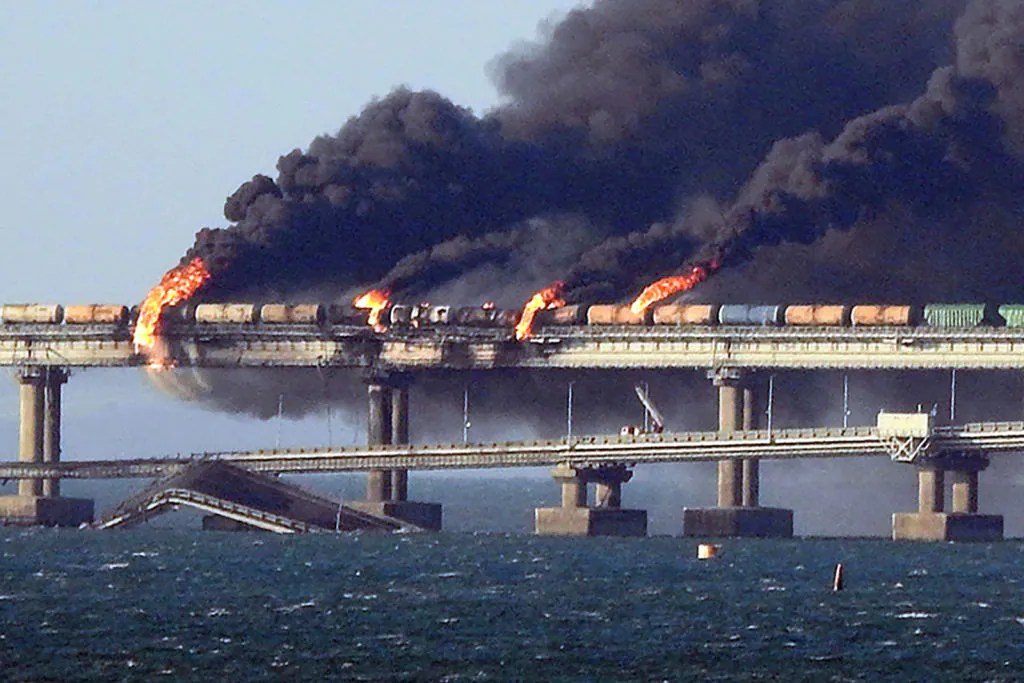
Note.
- It appears that the carriageway nearest to the camera has collapsed.
- If we assume, the break point is now lying on the seabed, it points to the pier with the light-coloured rectangle on top being the failure point of the road bridge.
- According to OpenRailwayMap, who handily show carriageway directions, that is the carriageway to Crimea.
- The rail bridge is double-track and appears to be reasonably intact.
- The train also appears to be intact, except for some fire damage.
- If the train was going to Crimea, it would be on the track nearest to the camera.
I do think, that if it was explosions on the train that caused the bridge collapse, there would be more damage on the other carriageway and on the railway.
The Collapse Of The Crimea-Bound Carriageway
This reminds me very much of the collapse of the Cleddau Bridge in Wales, during construction in 1970.
Wikipedia says this about that collapse.
Errors in the box girder design caused the collapse during construction in 1970. The bridge became operational during 1975.
If I remember correctly, during construction, the bridge was effectively overloaded. I can certainly remember lots of discussion about the failure in the office, where I worked in ICI at Runcorn.
I am not suggesting, that there were errors in the Russian calculations, but that something happened to take the bridge outside of its safety limits.
Suppose, there was a large explosion near the pier, where the break occurred, could it have caused the bolts holding the sections of the bridge to shear and allow the bridge to fall, as the pictures show.
It is certainly looking that a major truck bomb, is the cause.
CCTV pictures have been shown, that purport to see a truck exploding.
Was It A Suicide Attack?
I don’t think that the type of traditional suicide attacks, as practiced by the Islamic State and others would be carried out by either Ukraine or Russia. Although Chechens did use suicide attacks in their war against Russia.
But I do think it would be possible for a driver to stop a truck, put out warning triangles or whatever is the law in Russia and then be picked up by a friendly driver.
Alternatively, they could wait until the truck exploded and then make a getaway under cover of the fire. They could even jump into the water and be picked up by a boat.
If the Russians were behind it, they would have the ability to use a hired driver from perhaps a local agency.
Suppose, a hired driver were to be told to take a truck load of watermelons to Sebastopol and bring the truck back. A quick look would confirm the watermelons, but I doubt, the driver would find the bomb underneath.
If the driver was killed would the Russians mind.
The Ukrainians might not either, but they’d have the problem of getting the truck deep into Russian territory, without being detected.
The Truck On The Bridge According To The BBC
This article on the BBC is entitled Crimean Bridge: Who – Or What – Caused The Explosion?.
The article says this about the truck.
Security camera footage released on social media showed a truck – allegedly from the Russian city of Krasnodar, an hour’s drive from the crossing – moving west across the bridge at the time of the explosion.
Russian officials named a 25-year old Krasnodar man, Samir Yusubov, as the owner of the truck, and said an older relative, Makhir Yusubov, was the driver.
But close examination of the footage seems to show that the truck had nothing to do with the explosion.
Note.
- If the truck was going West it was going from Russia to Crimea, this meant it was on the carriageway furthest from the railway.
- The truck was on the carriageway that collapsed.
Does that rule out a truck bomb?
The View Of A British Army Explosives Expert
The BBC article also says this.
“I’ve seen plenty of large vehicle-borne IEDs [improvised explosive devices] in my time,” a former British army explosives expert told me. “This does not look like one.”
A more plausible explanation, he said, is a massive explosion below the bridge – probably delivered using some kind of clandestine maritime drone.
“Bridges are generally designed to resist downwards loads on the deck and a certain amount of side loading from the wind,” he said. “They are not generally engineered to resist upward loads. I think this fact was exploited in the Ukrainian attack.”
That sounds feasible to me, but the BBC article also has this paragraph.
If this is how Ukraine managed to attack the Kerch Bridge, hundreds of miles from Ukrainian-controlled territory, then it’s one of Kyiv’s most ambitious operations so far.
If that is true, it certainly is an ambitious operation, that ranks alongside the St Nazaire Raid in World War II.
A Structural Engineer’s Thoughts
This article on New Civil Engineer is entitled How The Crimean Bridge Explosion Caused Multiple Spans To Collapse.
It is the thoughts of Andrew Barr at the University of Sheffield and it well worth a read.
Conclusion
We’re still a long way from the truth.
‘A Gift For Putin’: Czech E-shop Sells Tanks And Grenades To Support Ukrainian Army
The title of this post, is the same as that of this story on expats_cz.
This is the introductory paragraph.
The Czech Republic has been among the most active countries in supporting the Ukrainian military with donations and sales of weapons and ammunition, including shipments of Soviet-era tanks, multiple rocket launchers, howitzers, infantry fighting vehicles, and anti-aircraft weapons.
I hope the gift, will calm Vlad the Mad.

