Off To Scotland
I’m off to Edinburgh today by train to see an old friend. Then it’s over to Glasgow and on Saturday down to Bolton to see Ipswich play.
I’ll be having a good breakfast at Leon in Kings Cross, as it would appear that gluten-free food on East Coast is a bit thin. I may be wrong, but we will see!
Scotland Score 12 Out Of 15
Kate Muir is a fan of three films about Scotland released this week; Sunshine on Leith, FIlth and For Those In Peril.
All scored four out of five in her reviews in The Times.
Electrification At Eccles
I got off the train at Eccles station and took these pictures of the electrification.
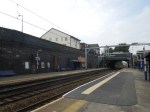
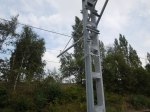
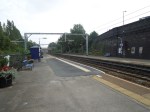
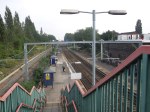
It’s all coming on at a pace faster than I had expected. And it looks a lot more robust than I’m used to seeing on railways in the UK. More details on the electrification of this line are given here in Wikipedia.
The first benefit for rail users will be Manchester to Scotland services by Trans Pennine using new Class 350 electric trains,, which are scheduled to start at the end of this year. Liverpool to Manchester services should start in a year or two, using refurbished Class 319 trains.
A Dilemma For Alex Salmond
I didn’t know that Scotland had a dark sky park and a gold tier one at that in the Galloway Forest Park.
It was funded by the Scottish government and as an amateur astronomer, who recently saw the wonderful skies in Sweden, I think that these dark sky reserves and parks are a very good idea.
But now Alex Salmond has a dilemma, as outlined by the BBC in this report. As a big supporter of wind turbines, does he give planning permissions for these around the park. As they are lit at night, they wouldn’t make the Scottish Dark Sky Observatory any better.
The Astronomer Royal for Scotland is not amused and has said this.
Installing any large structures that require illumination (whether visible or infra-red) would be akin to putting a factory in Glen Coe or electricity pylons along the Cuillin Ridge.
I have no direct interest as I live in London, but knowing the pleasure I get from observing the skies when I can, I think we need more dark sky parks. We also need one that is very easily accessible. Obviously, a road through such an area to an observatory would be a generator of light pollution, but surely there must be somewhere in the UK, where a train station is in a dark sky area, that could be used to take visitors in and out, without making too much light pollution.
A Cause For Complaint In The Scottish Capital
I was checking a Carluccio’s restaurant for lunch today in London and not that they now have two in Scotland; Glasgow and Aberdeen.
I wonder if they’ve had any complaints signed Disgusted in Morningside.
It Was Another Win Last Night For Ipswich Town
Last night, I went to see Ipswich Town play there home match against Yeovil. They won 2-1, although they made a bit of heavy weather of it.
Still a win is a win and they’re now up to 11th in the Championship.
A question that will go in an Ipswich pub quiz has turned up this season and we mused it over at half time..
With Christophe Berra‘s goal against Birmingham a few weeks ago, who was the previous Scot to score for the team?
I thought it could be John Wark, but searching showed that it was Alex Mathie. Last night, someone said it was Tommy Miller, but although he scored a lot for Ipswich, he never got into a Scottish team and was not born north of the border.
How you frame the question could give a range of answers.
But it has been a long time coming.
How Many Good Paintings Have Gone In Skips?
This story about how Robin Darvell found a painting by John Constable in a job lot in an auction, is in The Telegraph.
The painting, bought at an auction in Canterbury ten years ago, has remained in a drawer ever since after the canny buyer spotted a faint signature on the corner.
It has now been revealed as a Constable painting, believed to have been completed near to his home in Suffolk, after being examined by experts on television programme Treasure Detectives.
It now looks like it’s worth about £250,000.
On my wall I have a painting by Arthur Perigal. He wasn’t in Constable’s class, but he is a well-known Scottish artist.
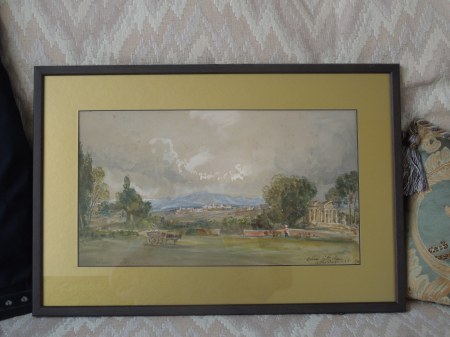
Villa Albani by Arthur Perigal
The painting of the Villa Albani, nearly went in the skip when I moved back to London, as it was in a broken frame and just thrown in the loft. It is signed Arthur Perigal RSA and dated 1872.
It’s not worth a lot, but then it would be worth nothing, if it was in the skip.
How my mother-in-law acquired the painting, can’t be determined now. But she did work for his son, Walter, who was the local doctor in New Barnet. The doctor was an amateur painter and she was given some of his paintings, when she left his employment. Or that’s the story C told. But knowing C’s father, I suspect he got them for perhaps doing a favour for the doctor.
Anybody, who knows the truth, died many years ago.
When Was The Last Time A Scot Scored For Ipswich?
Ipswich drew one each with Birmingham yesterday.
Yet again, Town lost points from bad luck, as it was a deflected shot that beat Dean Gerken.
Ipswich’s goal was scored by Christophe Berra, who is a Scottish international.
So who was the last Scot who scored for Ipswich? I think it was probably John Wark or Alex Mathie. Checking the records, it would appear that Alex Mathie scored some in the early 1998-99 season.
How Much Beer Was Drunk In Trafalgar Square Yesterday?
Accordiung to this report on the BBC web site, Westminster’s team of cleaners, picked up about two tonnes of empty beer cans in Trafalgar Square yesterday.
if we assume that a can weighs about 20 grams, that means about 100,000 cans of beer were drunk in the square yesterday. Reportedly 25,000 Scots came down to see the match.
But at least little untoward happened!
The same story was reported in The Scotsman and a reader added this comment.
If we can organize this maybe we can handle being independent. Put a deposit on beer cans and the homeless will benefit.
Although, their estimate of the number of cans was a lot lower.
The Germans who came for the Champion League Final didn’t seem to drink much at all.
Does Jam Count As One Of Your Five-A-Day?
Apparently, according to this article in the Daily Mail, one in five Scots do!
but then I admit, that I do like Dundee lamb chops. But then they are gluten-free!
 The Anonymous Widower