Chile Wants To Export Solar Energy To Asia Via 15,000km Submarine Cable
The title of this post, is the same as that of this article on pv magazine.
You can’t fault the Chileans for ambition, especially as the Atacama Desert is the sunniest area in the world.
But I do think, that it might be cheaper to build a giant electrolyser in Chile and export the hydrogen by ship to Japan and South Korea.
I do wonder, if Chile is a country, that needs to talk to Andrew Forrest of Fortescue Future Industries.
‘Unique’ Solar-Storage Solution Providers Plot 300MW / 3.6GWh Australia Project
The title of this post, is the same as that of this article on Energy Storage News.
The first two paragraphs outline the system.
A 1,200 hectare site in South Australia has been secured by a developer hoping to use it to build a 300MW solar power site with 3.6GWh of energy storage, based on a novel technology solution.
Europe-headquartered renewables company Photon Energy is working to roll out the technology created by Australian company RayGen. It combines a kind of concentrating solar power (CSP) + solar photovoltaics (PV) hybrid that RayGen calls ‘PV Ultra’, paired to a long-duration energy storage tech dubbed ‘thermal hydro’.
Thermal hydro appears to be an interesting concept, which uses hot and cold water reservoirs to store energy. Electricity is retrieved using a Rankin cycle engine and the claimed roundtrip efficiency is seventy percent.
This power plant might seem to be very futuristic, but a 4MW solar with 3MW / 50MWh of energy storage project is already under construction and should go on-line in the middle of next year.
The developer; Photon Energy hopes to get the giga-plant ready-to-build by the end of 2023.
This concept could be a very useful one, where there is enough sun for concentrating solar power.
Andrew Forrest’s Fortescue Future Industries Inks Deal With Kingdom of Jordan For Green Hydrogen Study
The title of this post, is the same as that of this article on The West Australian.
I can’t read the contents without subscribing, but I assume the title says it all.
However, I have a few thoughts.
This Google Map shows the Kingdom of Jordan.
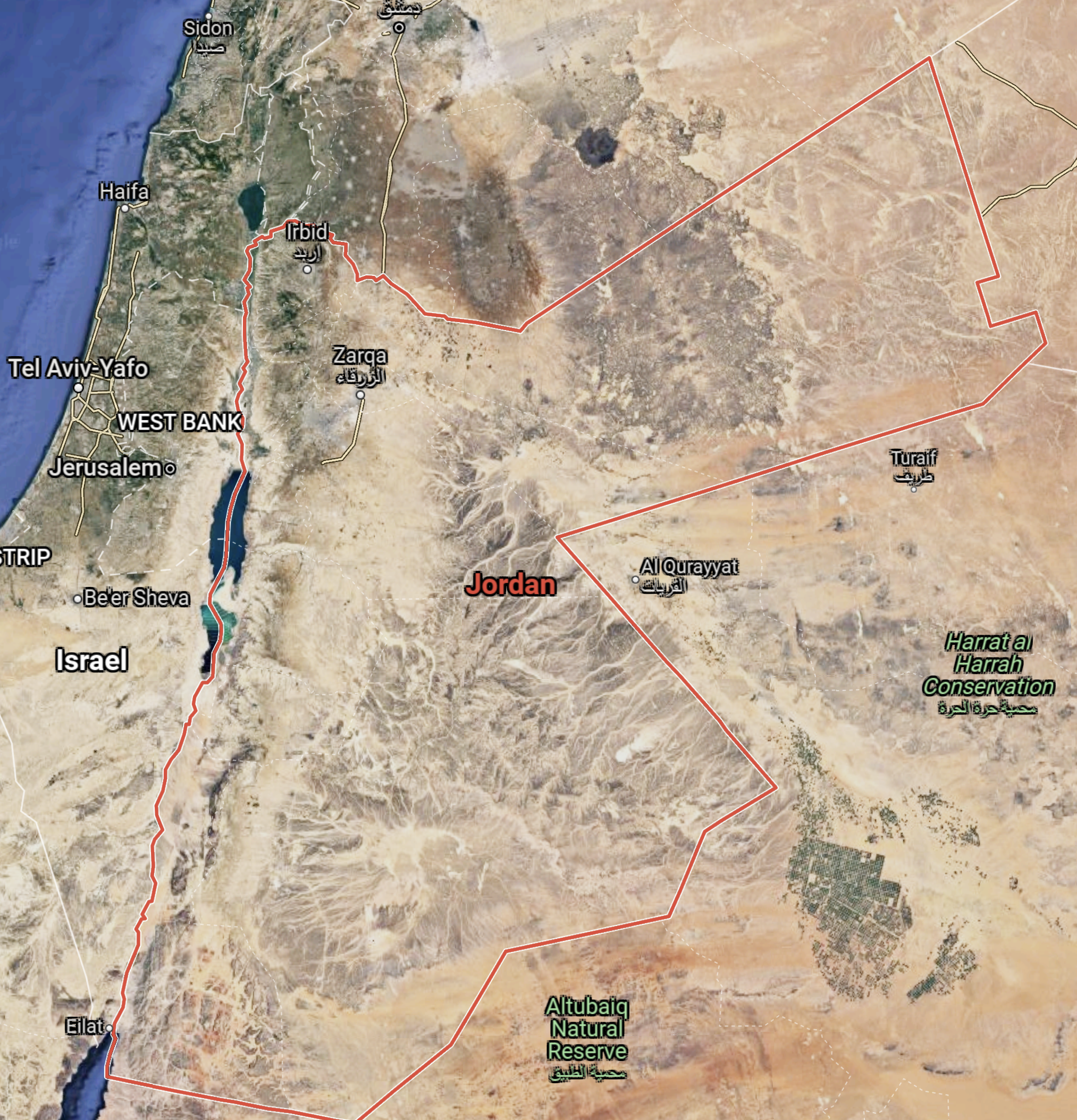
Jordan is outlined in red.
The map suggests how hydrogen could be produced.
- I would assume that there is plenty of sun in Jordan and there appears to be plenty of space for solar panels.
- What is the potential for wind energy in the desert?
- It would appear to me, that there are two routes to export the hydrogen. By pipeline across Israel to the Mediterranean Sea or by tanker from a port on the Red Sea, which just creeps onto the map in the South-West corner.
- Perhaps, a giant electrolyser and export terminal could be built near Aqaba, which is Jordan’s only seaport.
What I like about this plan, is that to the North-East and South-East of Jordan, lie the deserts of Iraq and Saudi Arabia. Could these in future be carpeted with solar panels, where the electricity is fed to Aqaba to create more green hydrogen?
Andrew Forrest is a busy man and seems to be organising a one man project to provide the world with green hydrogen.
- I wrote about his deal with Argentina in Australia’s FFI Plans $8.4 Billion Green Hydrogen Project In Argentina.
- I wrote about his deal with JCB in JCB Signs Green Hydrogen Deal Worth Billions.
He is the second richest Australian according to Wikipedia.
I wouldn’t be surprised to see some more hydrogen deals at COP26, where Andrew Forrest is involved.
Sun Cable’s Australia-Asia PowerLink
Two weeks ago, in How Clean Energy And Jobs Can Flow From Morocco to The UK, I talked about a plan to generate electricity using solar arrays in Southern Morocco and use an underwater interconnector to bring it to the UK.
If you think that project was ambitious and distinctly bonkers, then that project is outshone by Sun Cable‘s Australia-Asia PowerLink, which is shown in this SunCable graphic.
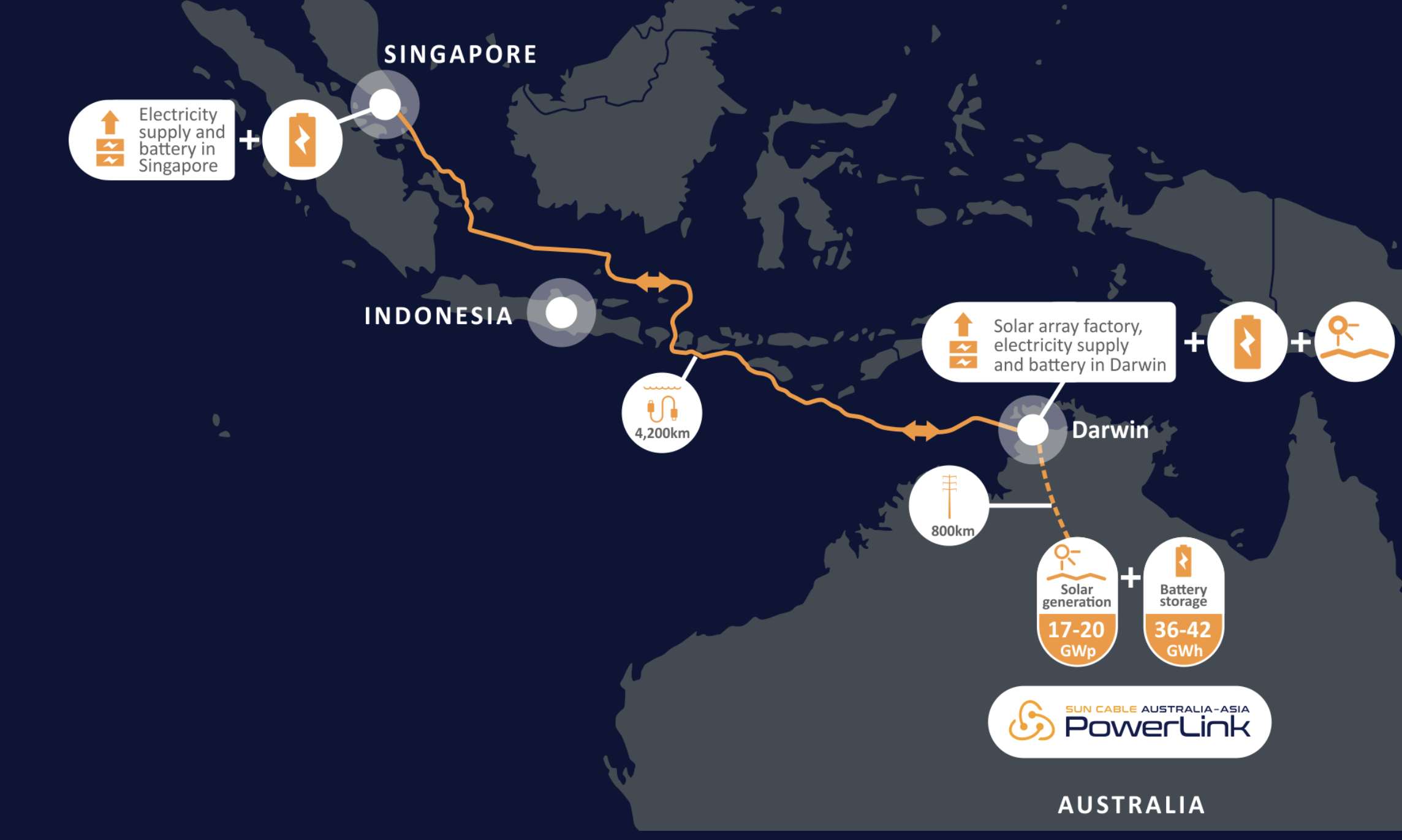
These are a few facts about the project.
- Electricity will be generated by solar panels in the Northern Territories of Australia.
- There will be 12,000 hectares of solar panels in Australia, which will create 3.2 GW of electricity for distribution.
- There will be a 36-42 GWh battery in Australia.
- There will be 4,200 km of submarine HVDC cable to deliver the electricity to Singapore and Indonesia.
- It looks like there will be batteries in Darwin and Singapore.
- The link could supply up to fifteen percent of Singapore’s electricity.
It is certainly an ambitious project, that will contain the world’s largest solar array, the world’s largest battery, and the world’s longest submarine power cable.
Note.
- Currently, the largest solar park in the world is Bhadia Solar Park in India, which is half the size of the solar array proposed.
- At 720 km, the North Sea Link is the largest undersea HVDC is operation.
- The largest battery in the UK is Electric Mountain in Snowdonia, which is only 9.1 GWh.
- A Tesla Megapack battery of the required size would probably cost at least ten billion dollars.
This is certainly, a project that is dealing in superlatives.
Is The Australia-Asia PowerLink Possible?
I shall look at the various elements.
The Solar Panels
I have flown a Piper Arrow from Adelaide to Cairns.
- My route was via Coober Pedy, Yulara, Alice Springs and Mount Isa.
- There didn’t seem to be much evidence of rain.
- The circle from South to East took four days of almost continuous flying, as Australia is not a small country.
- It left me with the impression of a flat featureless and hot country.
Having seen solar panels on flat areas in the UK, the Australian Outback could be ideal for solar farms.
Sun Cable are talking about 10,000 hectares of solar panels, which is roughly 38.6 square miles or a 6.2 mile square.
Given enough money to source the solar panels and install them, I would expect that the required solar farm could be realised.
The Cable
Consider.
- The North Sea Link is a 1.4 GW cable that is 720 km. long.
- I would size it as 10008 GW-km, by multiplying the units together.
- The Australia-Asia PowerLink will be 4200 km or nearly six times as long.
- But at 3.2 GW as opposed to 1.4 GW, it will have 2.3 times the capacity.
- I would size it as 13,400 GW-km.
Whichever way you look at it, the amount of cable needed will be massive.
The Battery
Currently, the largest battery in the world is the Bath County Pumped Storage Station, which has these characteristics.
- Peak power of 3 GW
- Storage capacity of 24 GWh.
Sun Cable’s 36-42 GWh battery will be the largest in the world, by a long way.
But I don’t think pumped storage will be suitable in the usually dry climate of Northern Australia.
The largest lithium-ion battery in the world is the Hornsdale Power Reserve in South Australia, which is only 150 MW/194 MWh, so something else will have to be used.
As Highview Power are building a CRYOBattery for the Atacama region in Chile, which I wrote about in The Power Of Solar With A Large Battery, I wonder, if a cluster of these could provide sufficient storage.
Could The Morocco-UK Power Project Be Developed Into A Western Europe And Africa Interconnector?
This page on the Xlinks web site, describes the Morocco-UK Power Project, which is proposed to generate solar and wind power in Morocco and deliver it to the UK.
- The plan envisages 10.5 GW of electricity being generated.
- There will be a 5GW/20GWh battery in Morocco.
- They will export 3.6 GW of electricity to the UK for at least twenty hours per day.
- The electricity will be exported to the UK by an Interconnector that skirts to the West of Spain, Portugal and France.
- The interconnector will be 3,800 kilometres long.
I described the project in detail in Moroccan Solar-Plus-Wind To Be Linked To GB In ‘Ground-Breaking’ Xlinks Project.
This Google Map shows Western Europe And North Africa.

Note.
- The light blue of the Continental Shelf
- The darker blue of deeper water.
- The Southern end of the Morocco and the UK interconnector will at Guelmim Oued Noun in the South of Morocco, which is indicated by the red arrow.
- The UK end of the cable will be at Alverdiscott between Barnstaple and Bideford in North Devon.
- Southern Morocco and Algeria look to be mainly in the Sahara Desert.
If we look at the route of the cable, it connects a lot of possible renewable energy sources.
- Morocco – Solar and wind
- Spain – Solar and wind
- Portugal – Solar and wind
- France – Nuclear, tidal and wind
- UK – Nuclear and wind.
Could the UK and Morocco interconnector be developed into a bigger power project?
- Solar and wind power from Algeria could be added.
- Tidal power from a Severn Barrage could be added.
- Connections could be added to Gibraltar, the Irish Republic and Wales.
I believe that there could be a large amount of electricity developed on the Western costs of Europe and Africa.
An interconnector would move it to where it is needed.
Quinbrook To Build The UKs Largest Consented Solar + Battery Storage Project
The title of this post, is the same as that article on Financial Buzz.
This is the first paragraph.
Quinbrook Infrastructure Partners (“Quinbrook”), a specialist global investment manager focused exclusively on renewables, storage and grid support infrastructure investment, today announced that it has acquired a consented 350MW Solar + Battery storage project, located in Kent, UK (“Project Fortress”). Quinbrook expects to commence construction of the project in the first half of 2022.
I have also read about Quinbrook on their web site.
A section on the site is entitled Our Industry Pedigree, where this is said.
Quinbrook is led and managed by a senior team of power industry professionals who have collectively invested over US$ 8.2 billion in energy infrastructure assets since the early 1990’s, representing over 19.5GW of power supply capacity. Our team brings an industrial perspective to investing in low carbon and renewables infrastructure.
Could companies like this be one of the keys to get more renewable power sources delivered?
Moroccan Solar-Plus-Wind To Be Linked To GB In ‘Ground-Breaking’ Xlinks Project
The title of this post, is the same as that of this article on Current News.
This is the first paragraph.
New solar and wind under development in Morocco is to be linked with Britain, with developer Xlinks also seeking to develop a cable manufacturing industry.
It looks to be a very challenging project.
- The HVDC cable will be 3,800 km long.
- The plan envisages 10.5 GW of electricity being generated.
- There will be a 5GW/20GWh battery in Morocco.
- They will export 3.6 GW of electricity to the UK for at least twenty hours per day.
- The electricity will be exported to the UK by a cable that skirts to the West of Spain, Portugal and France.
- The UK end of the cable will be at Alverdiscott in Devon.
All except the last are pushing current technology to the limit.
There is more information on the Morocco-UK Power Project page on the Xlinks web site.
- The company claims, that it can supply renewable energy, that acts like baseload power.
- When complete, it could supply eight percent of the UK’s energy needs.
These are my thoughts.
The 3,800 km. HVDC Link
This paragraph on the project web page describes the HVDC link.
Four cables, each 3,800km long form the twin 1.8GW HVDC subsea cable systems that will follow the shallow water route from the Moroccan site to a grid location in Great Britain, passing Spain, Portugal, and France.
It appears that would be 15200 kilometres of cable.
The longest HVDC link in the world is 2375 km. It’s overland and it’s in Brazil.
I can’t think otherwise, than that this will be a very challenging part of the project.
This Google map shows the area of Morocco, where the energy will be generated.
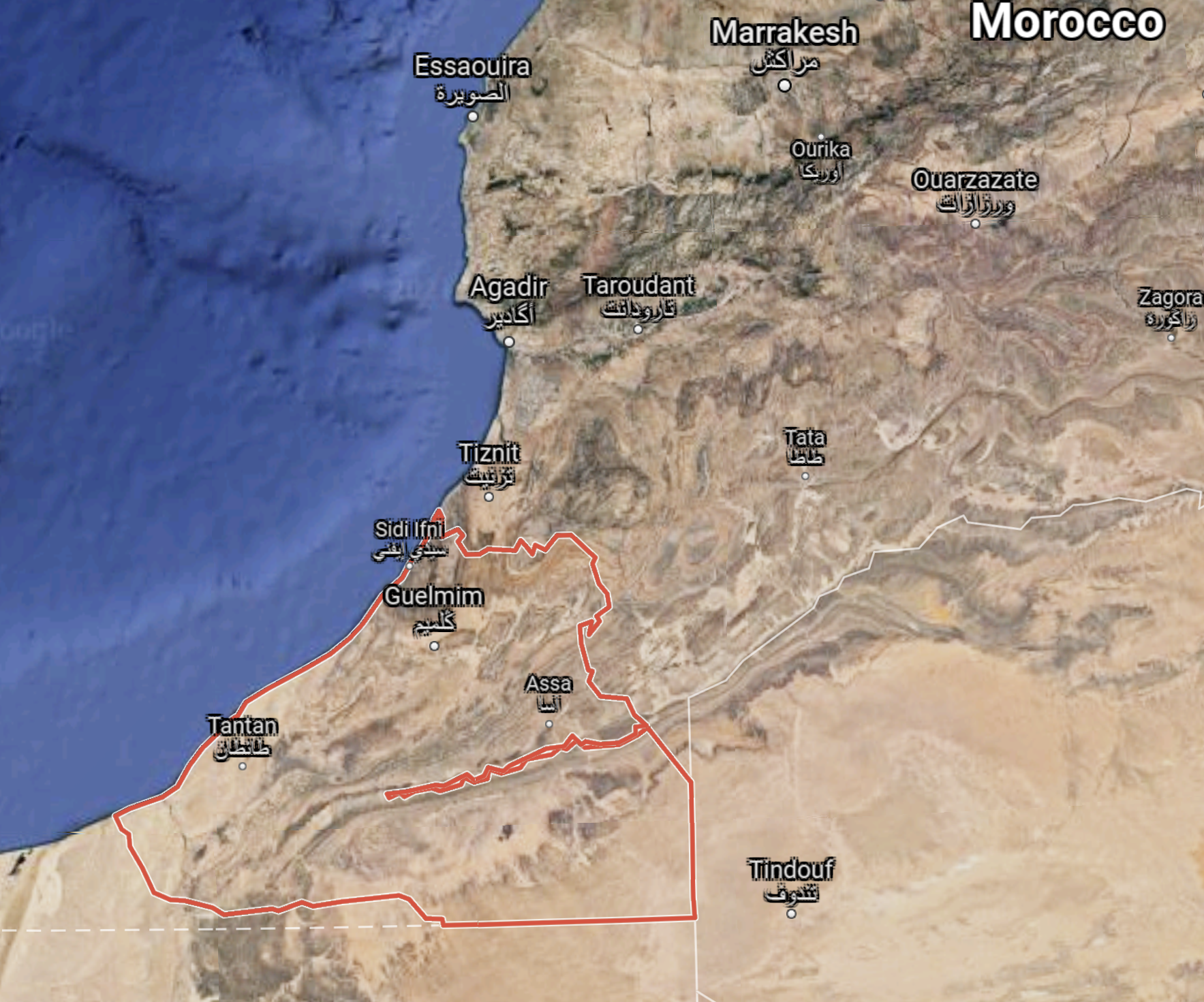
Note.
- Guelmim Oued Noun is outlined in red.
- The Canary Islands are just off the map to the West.
At least the project will be able to have convenient access to the sea.
This second Google Map shows the <Moroccan, Portuguese and Spanish coasts from Guelmim Oued Noun to the Bay of Biscay.

Note.
- The light blue of the Continental Shelf
- The darker blue of deeper water.
- Guelmim Oued Noun is outlined in red.
- The Canary Islands in the Atlantic Ocean to the West of Guelmim Oued Noun.
- Could the cable bring power to Gibraltar?
- There are other large cities on the route in Morocco, Portugal and Spain.
This third Google Map shows the Bay of Biscay.
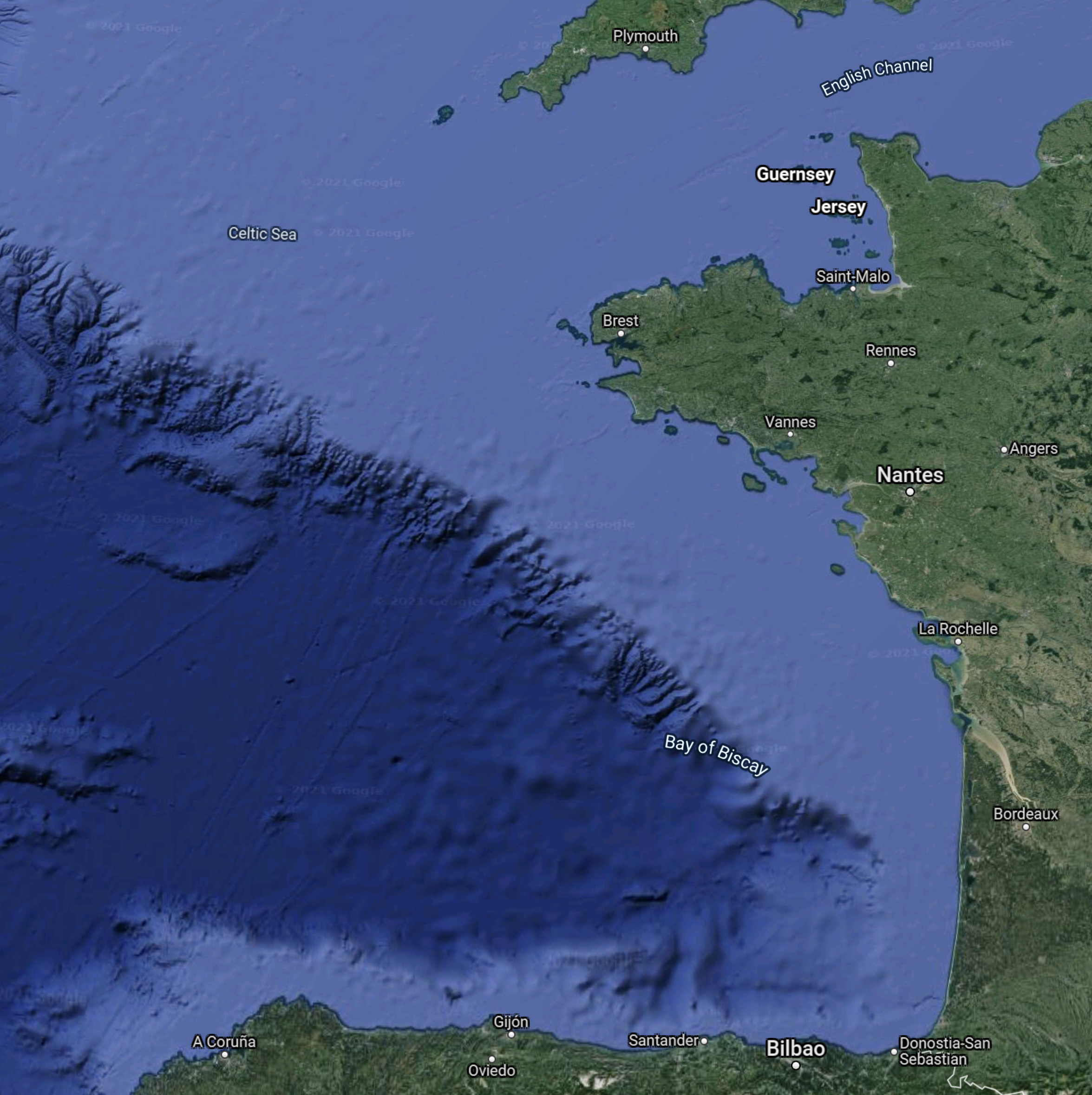
Note.
- The light blue of the Continental Shelf
- The darker blue of deeper water.
- There are a series of islands off the Spanish and French coasts.
- Could these islands be used as stepping stones for the cable?
This fourth Google Map shows the Western Approaches to the UK.
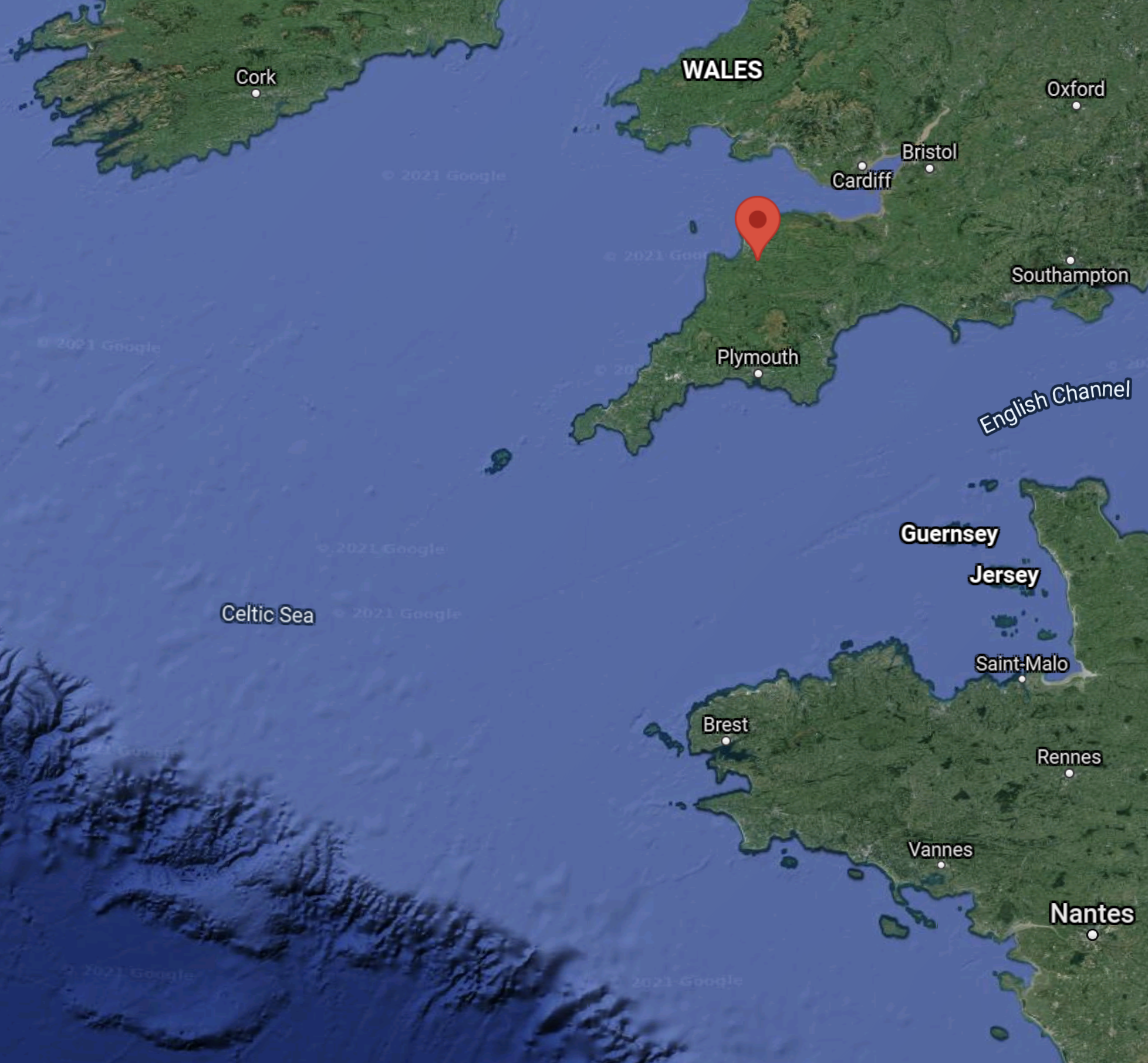
Note that the prominent red arrow indicates Alverdiscott, where cable connects to the UK National Grid.
This fifth Google Map shows Alverdiscott to Lundy Island.
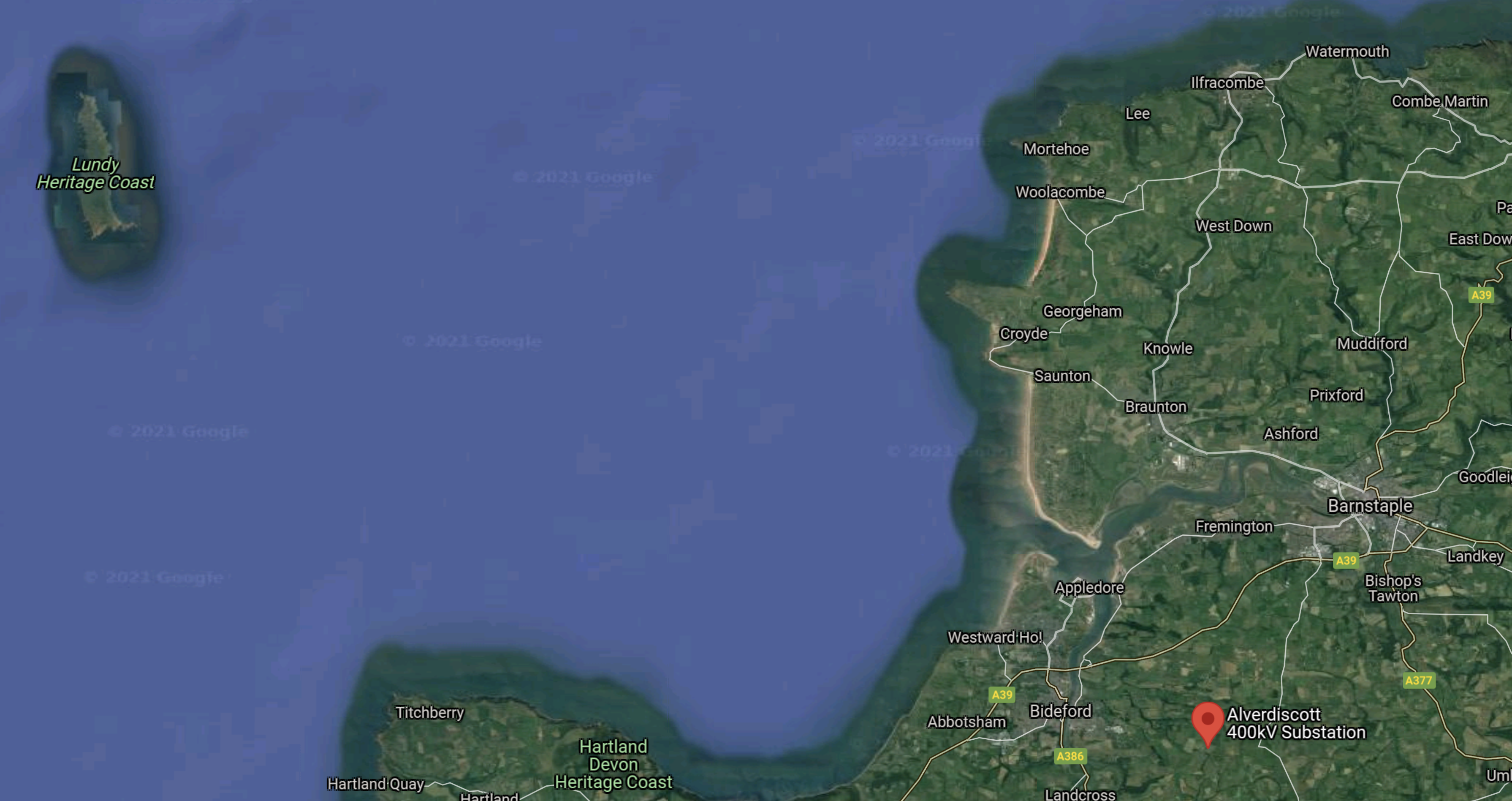
Alverdiscott substation is indicated by the red arrow.
This sixth Google Map shows the Alverdiscott substation in relation to the town of Bideford.
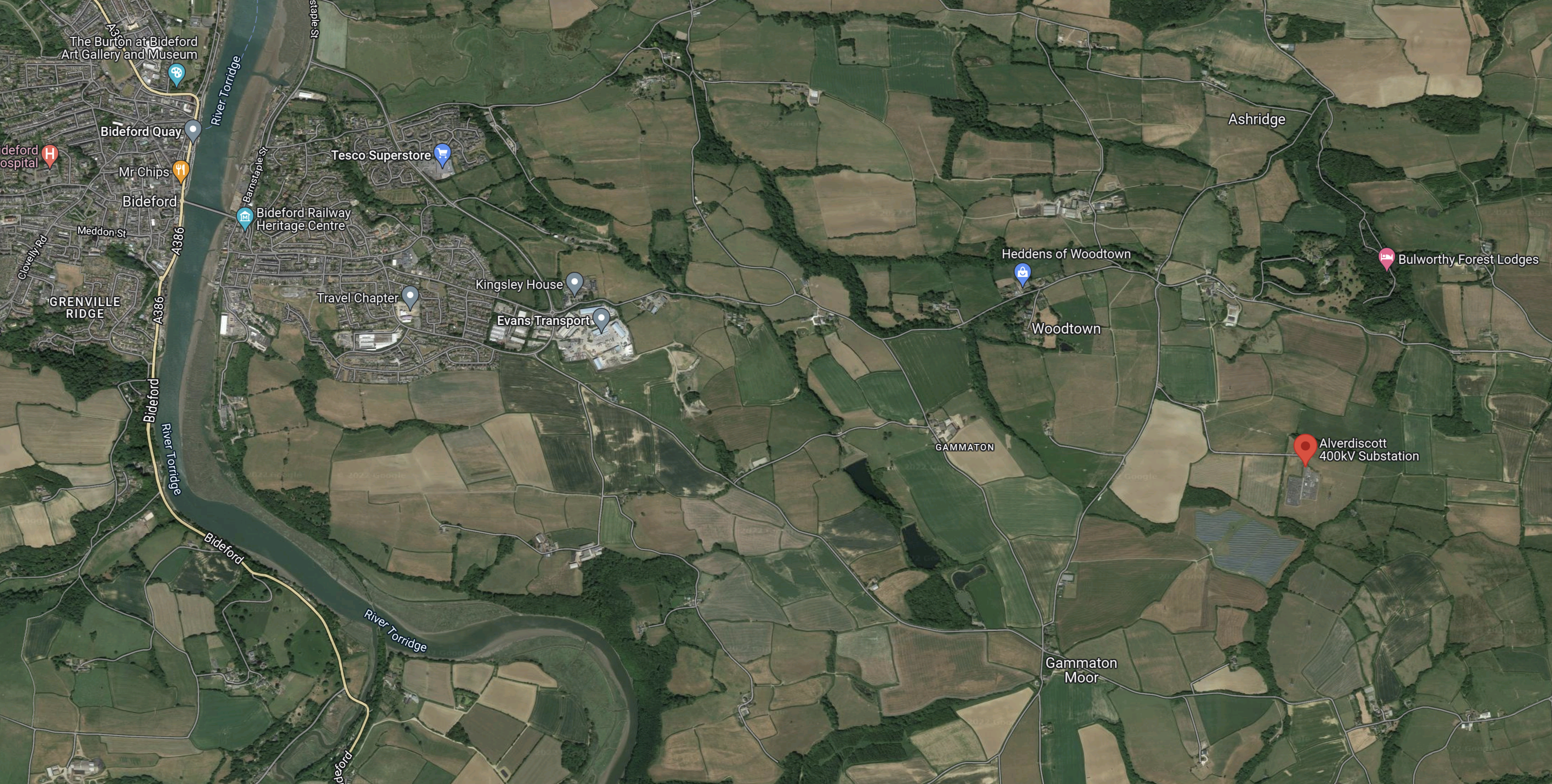
Note.
- Bideford is in the North-West corner of the map.
- The red arrow indicates the Alverdiscott substation.
- The River Torridge runs through the town of Bideford.
Could the river be used to bring the cables from Morocco to the substation?
This seventh Google Map shows the Alverdiscott substation
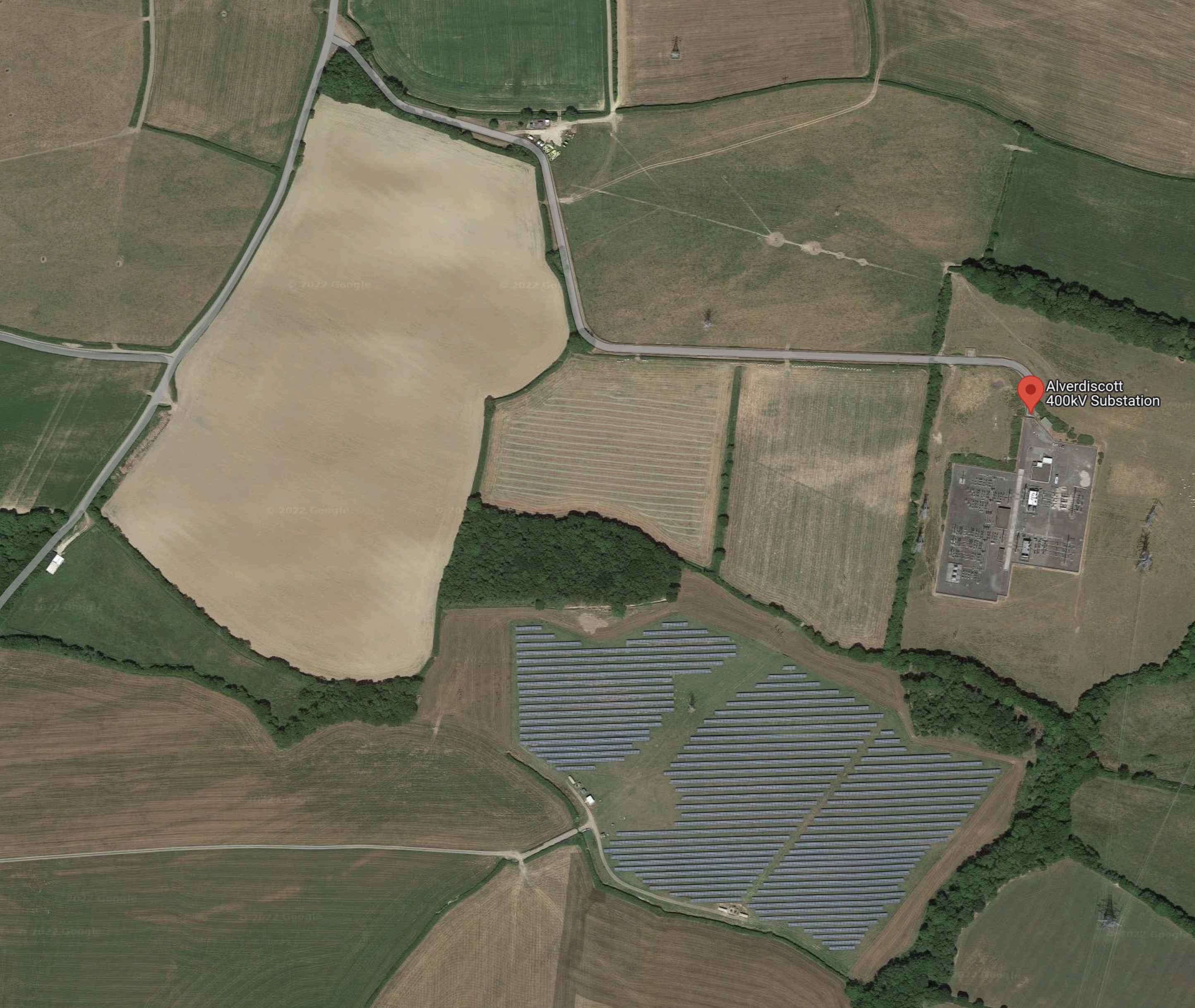
Note the solar farm to the South of the substation.
HVDC Cable
The article also says that they may be building their own cable-manufacturing facility. Does this indicate that there is a shortage of HVDC cable?
Judging by the number of proposed interconnectors proposed for UK waters, it might be a prudent move to improve cable-manufacturing capacity.
10.5 GW Of Zero-Carbon Electricity
This sentence on the project web page describes the power generation.
This “first of a kind” project will generate 10.5GW of zero carbon electricity from the sun and wind to deliver 3.6GW of reliable energy for an average of 20+ hours a day.
It appears that they will be providing a baseload of 3.6 GW to the UK for over twenty hours per day.
Consider.
- Hinckley Point C has an output of 3.2 GW.
- As I write this around midnight, the UK is generating 22.2 GW of electricity.
This paragraph from their web site describes the advantages of Morocco.
Most importantly, Morocco benefits from ideal solar and wind resources, required to develop renewable projects that could guarantee suitable power production throughout the year. It has the third highest Global Horizontal Irradiance (GHI) in North Africa, which is 20% greater than Spain’s GHI and over twice that of the UK. Furthermore, the shortest winter day still offers more than 10 hours of sunlight. This helps in providing production profiles that address the needs of the UK power market, especially during periods of low offshore wind production.
It is not a small power station in the wrong place.
The 5GW/20GWh Battery
That is a massive battery.
The world’s largest lithium-ion battery is Gateway Energy Storage in California. It has a capacity of 250 megawatts for one hour.
The proposed battery in Morocco is eighty times as large.
If I was choosing a battery for this application, I believe the only one that has been demonstrated and might work is Highview Power’s CRYOBattery.
I wrote about Highview’s similar type of application to Morocco in Chile in The Power Of Solar With A Large Battery.
But that installation only will only have storage of half a GWh.
But I believe Highview and their partner; MAN Energy Solutions can do it.
Conclusion
I wish the company well, but I have a feeling that there’s a chance, that this will join the large pile of dead mega-projects.
But I do feel that the solar and wind power station in Morocco will be developed.
And like the project in Chile it will have a large Highview CRYOBattery.
Denmark Hill Station – 4th September 2021
The article on Rail Technology Magazine is entitled Denmark Hill Station First To Use Innovative Solar Technology In Europe.
The first two paragraphs describe the technology.
Denmark Hill station has become the first train station in Europe to have BIPVco’s Flextron thin film technology installed, on top of other upgrades, following a £7.5m extension.
The sophisticated and flexible solar panels are different from traditional ‘glass like’ panels, requiring no additional weight support, and will be used across other stations going forward.
Note.
- In the application of the technology at Denmark Hill station, a surplus of electricity is returned to the grid.
- BIPVco is a company based in South Wales, that evolved from research by Tata Steel and Swansea University, with the backing of the Welsh Government.
- The panels are lightweight, flexible, durable and self-cleaning.
Many years ago, I put up a barn based on timber beams, which had a sheet steel roof. These panels would be ideal for many agricultural buildings, like the one I commissioned.
These are pictures I took at Denmark Hill station, this morning.


Note.
- The original station was designed by Charles Henry Driver.
- The new entrance displays a high degree of craftsmanship, especially in the brickwork.
- The coffee and gluten-free cake I had in FCB Coffee were excellent.
- The station has its own pub; The Phoenix.
According to Network Rail, it has already been nominated for two architectural awards.
Namibia Is Building A Reputation For The Cheapest Green Hydrogen
The title of this post, is the same as that of this article on Hydrogen Fuel News.
This paragraph explains the deal that Germany and Namibia have done.
Germany, the largest economy in Europe, has just closed a partnership with Namibia, for a supply of the cheapest green hydrogen. The Southern African country is aiming to produce its H2, made with renewable energy, for prices as low as $1.8/kg. The European nation intends to import massive volumes of what it believes will be the most affordable renewable H2 in the world. It has signed a deal with Namibia that steps up the worldwide scramble to secure the best options for H2 supply connected with substantial renewable installations.
Note.
- Namibia has the ability to produce large amounts of solar and wind energy.
- I suspect the hydrogen will be converted to liquid ammonia for shipment to Germany.
The Gremans are building a large hydrogen terminal at Wilhelmshaven, which I wrote about in Uniper To Make Wilhelmshaven German Hub For Green Hydrogen; Green Ammonia Import Terminal.
Although, Namibia has now been an independent country since 1990, from 1884 to 1915 it was the German colony of German South West Africa.
Hopefully, this deal will work out to the benefit of both Germany and Namibia.
The Immense Potential Of Solar Panels Floating On Dams
The title of this post, is the same as that of this article on the Anthropocene.
The article reviews the practice of floating solar panels on ponds, lakes and reservoirs.
I like the practice, as the two technologies are compatible.
- The panels reduce evaporation and help to curb algae growth.
- Floating panels are cooled by the environment and more efficient.
- Solar and hydro power can share electricity transmission systems.
But best of all. they use land twice.
The article claims that as much as forty percent of the world’s power can be generated this way.
The article is certainly an interesting read.
 The Anonymous Widower