Hydrogen-Powered Trains To Be Introduced In Northern Italy
The title of this post, is the same as that of this article on Fuel Cell Works.
These three paragraphs introduce the project.
Residents and visitors to Valcamonica, an Alpine region in northern Italy, will be able to ride hydrogen-powered trains from next year.
The pioneering project, the first of its kind in Italy and supported by an investment of 367 million euros ($396 million), marks a significant adoption of hydrogen fuel for a rail line, despite the high production and operational costs.
The region currently uses polluting diesel trains, which will be replaced by 14 zero-emission hydrogen-powered trains made in Italy by a unit of French group Alstom
The trains will run on the Brescia–Edolo railway, which has this Wikipedia entry.
This OpenRailwayMap shows the Northern part of the railway.
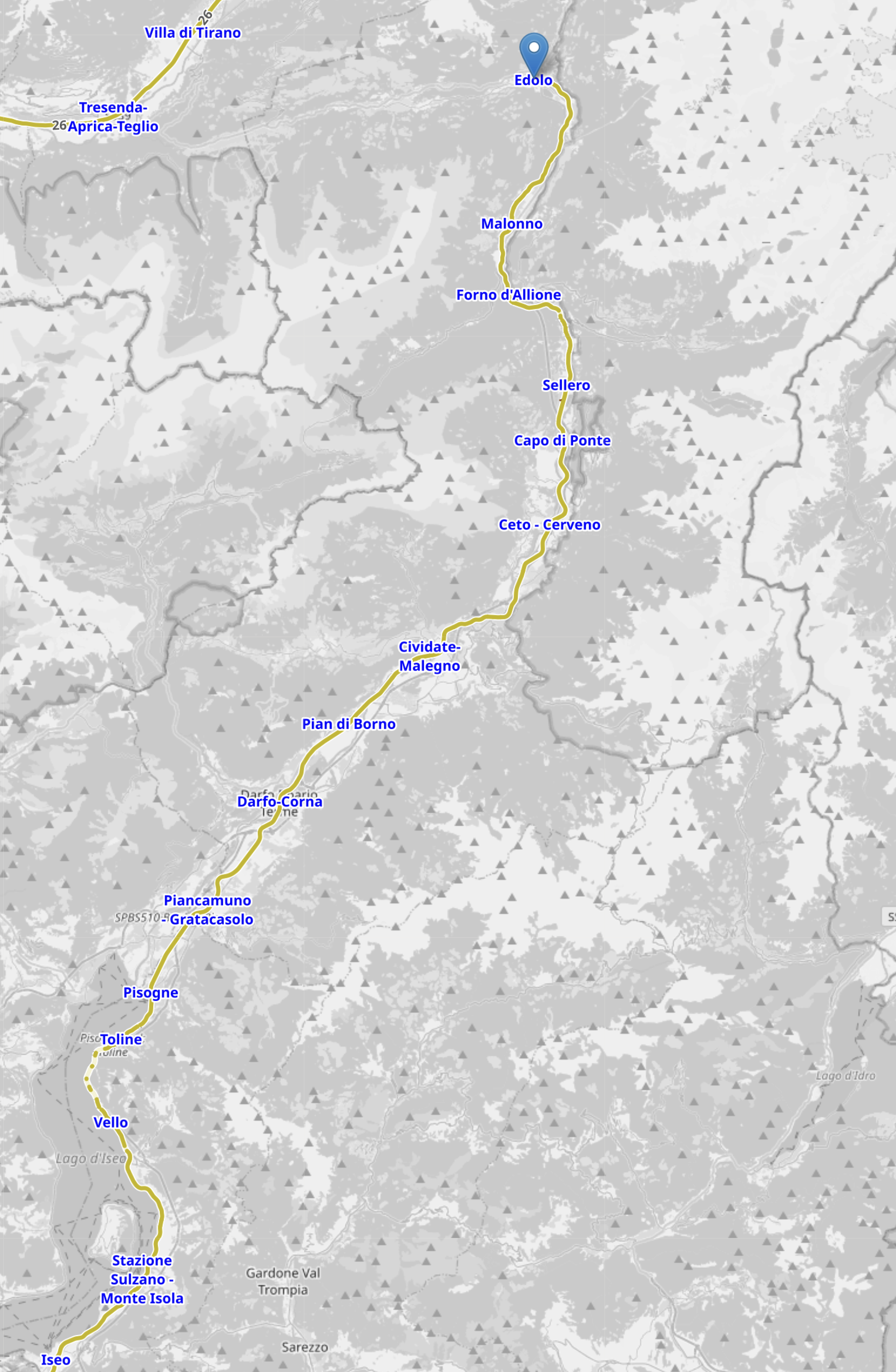
Note.
- Edolo station is indicated by the blue arrow at the top of the map.
- The Brescia–Edolo railway is indicated by the yellow line.
- Stations are indicated by blue lettering.
- Iseo is the station in the South-West corner of the map.
- Click the map to show it to a larger scale.
This second OpenRailwayMap shows the Southern part of the railway to the same scale.
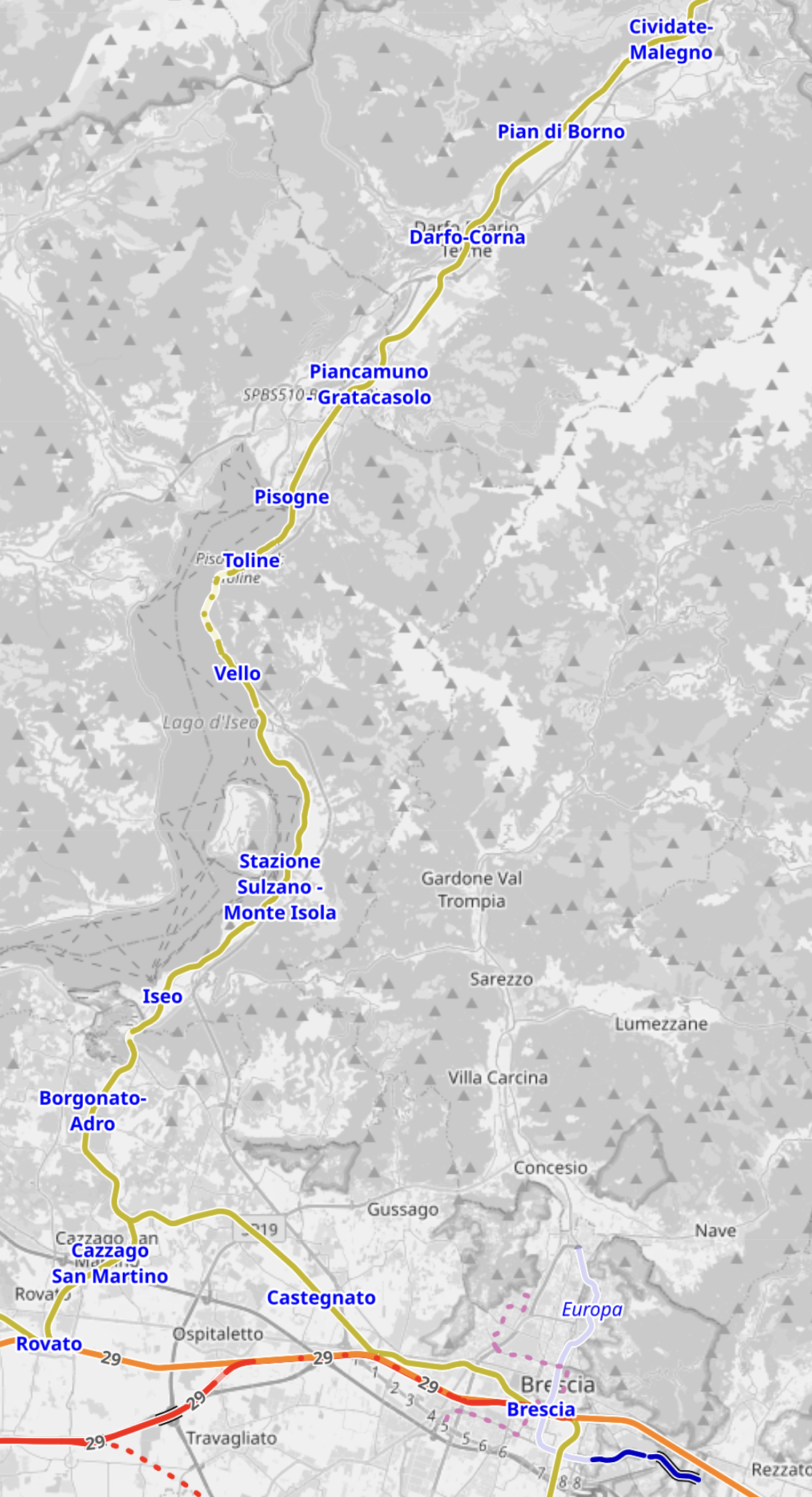
Note.
- The Brescia–Edolo railway is indicated by the yellow line.
- The Venice-Milan railway is indiated by the orange line across the bottom of the map.
- Stations are indicated by blue lettering.
- Iseo station is in the South-West corner of the map.
- Brescia station is in the South-East corner of the map on the Venice-Milan railway.
- Click the map to show it to a larger scale.
It looks to me, that the Brescia–Edolo railway could be a day-out if you were having a holiday in Milan, Venice or Verona.
- The railway is a single track railway.
- It appears to go through the mountains.
- Currently, it is diesel powered, but I suspect running hydrogen trains on the route will turn it into a major tourist attraction.
Could other rail routes attract visitors, by going for zero-carbon traction using hydrogen?
In the UK, these are surely six of many possibilities.
- Settle and Carlisle
- Marshlink Line
- Mid-Cornwall Metro
- Norwich and Sheringham
- Sheffield and Huddersfield
- Mid-Cornwall Metro
- Uckfield Branch
Infrastructure costs would just need a hydrogen supply to be arranged.
Conclusion
You can always trust the Italians to use a stylish solution.
Third Rail Or Batteries Could Replace Southern Diesel Trains
The title of this post, is the same as that of this article on Railway Gazette International.
I first wrote about the Uckfield Branch eight years ago, in Future-Proofing The Uckfield Branch.
Since then I have written about this branch several times and I have also read several articles in the railway press.
These are some of my posts.
- Discontinuous Electrification Using IPEMUs – April 30th, 2016
- Will Innovative Electrification Be Used On The Uckfield Line? – August 24th, 1917
- Battery Trains On The Uckfield Branch – August 26th, 2018
- Battery Electrostars And The Uckfield Branch – September 30th, 2019
- Alstom Hydrogen Aventras And The Uckfield Branch – November 12th, 2021
- Electroflex Battery EMU Plan To End Southern Diesel Operation – January 22nd, 2020
- Uckfield Third Rail Is NR Priority – May 2nd, 2022
- Southeastern Keen On Battery EMUs – August 12th. 2023
It is an utter disgrace that no decision has been made in eight years about how to decarbonise to Uckfield.
The Railway Gazette article says this about third-rail electrification.
GTR is one of two operators participating in a Rail Safety & Standards Board project reviewing the safety, legal and regulatory issues around third rail electrification infill projects. This is looking at whole transport system safety, project and economic risks.
Bi-monthly South of England Diesel Replacement Programme meetings are held by DfT, Network Rail and GTR to review progress and options for third rail electrification of the Uckfield line or battery train trials. This includes reviewing the lessons learned from the use of bi-mode trains by GWR and LNER, and the failed attempt to deploy tri-mode Class 769 units on GWR’s North Downs services.
Could it just be that there is such fear that there will be a major incident, where several people are killed, that third-rail electrification is always turned down, by the Office of Road and Rail?
The Railway Gazette article also says this about battery trains, under a heading of Batteries Viable.
In the absence of electrification, GTR says battery powered trains are also a viable option for its diesel routes. Batteries can be charged while trains are running on electrified lines or through a rapid recharging facility at a terminus, although additional infrastructure and electrical upgrades may be needed.
I suspect that after a few teething troubles, Merseyrail would agree.
Hydrogen is also dismissed with this paragraph.
GTR has considered hydrogen but says it can only be considered a net zero-compliant fuel if it is produced from low or zero-carbon energy sources. It is also relatively inefficient with studies indicating an efficiency rate of around 35% to 40%.
It looks to me, that battery-electric trains are a viable solution.
So would it not be a good idea to take the decision to create a battery-electric prototype from a four-car Electrostar or a Class 350 train, so that the final decision can be taken after everybody on the committee has have a ride first?
Better still, why not stage a competition, where manufacturers, leasing companies or remanufacturers can build a four-car train and enter.
Allow the public to ride in them and then see what is best against a range of criteria.
The King could even get involved, as he’s probably one of the few people left, who rode the original British Rail BEMU between Aberdeen and Ballater, to get to Balmoral.
Smart Train Lease Aims ‘To Make Renting Trains As Easy And Simple As Renting A Car’
The title of this post, is the same as that of this article on Railway Gazette International.
These four paragraphs outline the scheme.
Siemens Mobility has established a leasing subsidiary that would enable train operators to use its Mireo Smart battery, hydrogen and electric multiple-units without needing to make long-term investment commitments.
Smart Train Lease GmbH would make available at short notice multiple-units already approved for operation. These could be short or medium-term leases, with services such as maintenance available as part of the package. The aim is to provide operators with an economical way to quickly and flexibly expand their fleets and try out more sustainable traction technologies.
‘We want to make renting trains as easy and simple as renting a car, and thus help accelerate the mobility transition’, the leasing company’s CEO Benjamin Dobernecker explained on February 14.
Smart Train Lease will initially operate in Germany, although it plans to expand throughout Europe in the medium term.
I like this idea and I think it will work.
Metier Management Systems And Artemis
When four of us started Metier Management Systems in 1977 to sell our mini-computer-based project management system; Artemis, we generally rented or leased our systems, although we did sell some as the years progressed.
- For a fixed fee per month, a company got a project management computer and all the software.
- The fixed fee included installation, first line support, training and software updates.
- We could also supply extra training and project management consultancy at appropriate rates.
- The only extra costs to the client were the electricity to power the hardware and the paper to put in the printer.
- We also allowed clients to convert leases into outright sales.
This simple sales model appealed to a lot of our clients.
- The cost of the system was easy to budget.
- Many of our clients were happy with leasing or renting computer equipment.
- As the system was desk-sized, it easily fitted the average office.
But the leasing model was very advantageous to us.
- Most of our clients were large high-value quality organisations like big oil companies, nationalised industries and engineering consultancies.
- Our Finance Director and our Bank Manager at Lloyds Bank devised a plan, whereby we bundled a number of high-quality leases together and sold the bundle to Lloyds Bank’s leasing company.
The money we received gave us a healthy cash flow.
- The cash flow was then used to fund Research and Development and to finance more sales.
- If say someone like BP or Shell should phone up or send a fax, wanting a system immediately, we were generally able to fulfil their request.
I am sure that Siemens Mobility will be using a similar model.
They will aim to have trains in stock to fulfil clients needs.
So if Deutsche Bahn phone up saying have you got a three-car battery-electric train that works with 15 KVAC and has a range of 100 kilometres for next Monday, Siemens Mobility can generally say yes.
What helps is that the modular Mireo Smart multiple unit comes in battery, hydrogen and electric versions.
Extras could include full servicing a driver.
So Siemens Mobility will plug the train together and deliver it.
How Would Siemens Use The Leasing Model In Great Britain?
Consider.
- There are a lot of routes that need to be decarbonised in Great Britain.
- Many of these routes have electrification at one or both ends.
- Often these routes terminate in a bay platform.
- On most of these routes a two-, three-, four- or five-car train will be sufficient capacity.
- In the Desiro City, Siemens have a train, that is acceptable to Great Britain.
- If routes in Great Britain are to be electrified, they must be electrified with 25 KVAC overhead wires.
- Trains would be 100 mph, so they wouldn’t be limited as to routes.
- A Mireo-B has a range of between 80-100 kilometres or 49.7-74.6 miles.
I am sure Siemens Desiro City or its European equivalent; Mireo can be developed into a family of trains suitable for GB!
- The basic train would be two driving cars.
- Length would be increased by coupling trailer cars between the two driving cars.
- Hydrogen power would be in one of the trailers.
- Batteries would be under an appropriate number of cars.
Battery trains would be able to use a simple automatic charger, similar to the one, that I described in GWR Trialling Transformative Ultra-Rapid Charging Train Battery.
An Example – Mid-Cornwall Metro
This map shows the Mid-Cornwall Metro.

Consider.
- Newquay and Par is 20.8 miles.
- Falmouth Docks and Par is 30.8 miles.
- Newquay and Falmouth Docks is 51.6 miles.
- The maximum speed between Par and Newquay is around 30 mph
- The maximum speed between Par and Falmouth Docks is around 50-70 mph
- There are twelve intermediate stations.
- There is a reverse at Par station.
- Charging would be easy to install at Falmouth Docks, Newquay and Par.
- In Par Station – 10th February 2024, I suggested that Par station could be fully-electrified, so that expresses could have a Splash-and-Dash on their way to London and Penzance. If all platforms at Par were electrified the Mid-Cornwall Metro trains could charge from the electrification, as they reversed.
There are two main ways that the Mid-Cornwall Metro might operate.
- There would be chargers at Newquay and Falmouth Docks and trains would shuttle the 51.6 miles between the two stations.
- There would only be charging at Par and trains would after charging at Par go alternatively to Newquay and Falmouth Docks.
The first might need smaller batteries and the second would only need one charger.
An Example – Uckfield Branch
The Uckfield branch is in Southern England.
- It is not electrified between Hurst Green Junction and Uckfield, which is 24.7 miles.
- There are eight intermediate stations.
- The line can accommodate ten-car trains.
There is space at Uckfield station for a charger.

Charging would be at Uckfield station and North of Hurst Green Junction, where it will use the existing electrification.
Conclusions
This leasing/rental model will surely encourage train operators to replace diesels with appropriate zero-carbon alternatives on routes that need to be decarbonised.
Southeastern Keen On Battery EMUs
The title of this post, is the same as that of a small section in the August 2023 Edition of Modern Railways.
This is said.
Southeastern is to seek pre-qualification interest from manufacturers and leasing companies for a replacement fleet for the Networker Class 465 and 466 inner-suburban stock, now over 30 years old. The company intends to compare the price of new and cascaded stock.
Southeastern MD Steve White told Modern Railways his preference is for a bi-mode EMU, capable of working off both the third rail supply and batteries. Battery EMUs were originally proposed for the Networker replacements so they could work through services to the unelectrified Isle of Grain branch, after Medway Council put forward plans to restore passenger services on the Hoo peninsular to serve new housing there.
Despite the extension of services to Sharnal Street on the Isle of Grain having since been put on hold by Medway Council on cost grounds (p13, May issue).
Southeastern is still pursuing battery EMUs, even though the company’s existing network is all electrified on the third rail system.
Merseyrail is already adopting battery EMU technology, with seven of the new fleet of 53×4-car Class 777 units being equipped with batteries to enable them to serve the unelectrified extension to Headbolt Lane (p82, July 2022 issue).
Mr. White says there are a number of reasons battery EMUs are attractive.
-
- Increasing levels of mental health issues in society have led to trespass being a major issue the railway: battery EMUs would make it feasible to keep trains moving at slow speed when the current supply has to be switched off to protect a trespasser.
- Battery EMUs would be able to keep moving on occasions when the third rail supply fails, due to technical failures or ice on the conductor rail. This would avoid the compounding of problems, as when delayed passengers got out on the track at Lewisham in March 2018 when the third rail iced up, forcing Network Rail to cut the electricity supply and making it more difficult to get trains moving again.
- Battery EMUs would make it feasible to remove third rail from depots, making them safer places in which to work. A train cleaner was electrocuted and died at West Marina depot in St. Leonards in May 2014, and the Office of Road and Rail has well-publicised concerns on safety grounds about any extensions to the third rail system.
- Battery EMUs would be able to cater for service extensions on unelectrified lines, such as the Isle of Grain.
Mt. White says the trespass issue is the major driver, and if the principle of battery EMUs becomes established it might prove feasible to remove the third rail from platform areas at inner-suburban stations with a persistent trespass problem. He points out this approach might unlock extension of third rail to routes such as the Uckfield line, allowing station areas to be left unelectrified. Replacement of DMUs by electric stock on the Uckfield branch would eliminate diesel working at London Bridge, with air-quality and carbon removal benefits for the capital.
There are a 5-star hotel and a major hospital close to the diesel-worked plstform at London Bridge.
I will now look at some of the issues in detail.
Range Of A Battery EMU
I discuss range of battery EMUs in these posts.
- Stadler FLIRT Akku Battery Train Demonstrates 185km Range
- New Merseyrail Train Runs 135km On Battery
Note.
- Both trains are built by Stadler.
- 135 km. is 84 miles.
- A Bombardier engineer told me eight years ago, that the prototype battery-electric Class 379 train had a range of sixty miles.
I feel it is reasonable to assume that a 100 mph battery-electric train, designed to replace Southeastern’s Networkers could have a range of at least sixty miles.
Distances Of Cannon Street Metro Services
These are distances of services from Cannon Street.
- Erith Loop via Greenwich, Woolwich Arsenal and Bexleyheath – 28.5 miles
- Gravesend – 24.5 miles
- Orpington – 12.6 miles
- Grove Park – 7.1 miles
- Slade Green – 14.5 miles
Note.
- The Erith Loop services start and finish at Cannon Street station.
- The Gravesend service terminates in an electrified bay platform.
- The Orpington service terminates in an electrified bay platform.
- Grove Park and Slade Green are depots.
If trains could be fully charged at Cannon Street station, all services out of the station could be worked by a battery EMU with a range of forty miles.
Charging At Cannon Street
Consider.
- All Cannon Street services arrive at the station via London Bridge station.
- All Cannon Street services leave the station via London Bridge station.
- Trains typically take 4-5 minutes between Cannon Street and London Bridge station.
- Trains typically wait at least 7 minutes in Cannon Street station before leaving.
- Typically, a battery EMU takes fifteen minutes to charge.
A train running from London Bridge to London Bridge would probably take a minimum of fifteen minutes, which should be enough to charge the train.
The track between London Bridge and Cannon Street would need a strong level of protection from trespassers.
I suspect that with some slight timetable adjustments, all Cannon Street services could be run using battery EMUs.
Distances Of Charing Cross Metro Services
These are distances of services from Charing Cross.
- Maidstone East – 38.9 miles
- Dartford – 17.1 miles
- Gravesend – 23.8 miles
- Hayes – 14.3 miles
- Sevenoaks – 22.2 miles
- Grove Park – 8 miles
Note.
- The Gravesend service terminates in an electrified bay platform, which could be used to charge the train before return.
- The Maidstone East service terminates in an electrified platform.
- Grove Park is a depot.
If trains could be fully charged at Charing Cross station, all services out of the station could be worked by a battery EMU with a range of fifty miles.
Charging At Charing Cross
Consider.
- All Charing Cross services arrive at the station via London Bridge station.
- All Charing Cross services leave the station via London Bridge station.
- Trains typically take 10 minutes between Charing Cross and London Bridge station.
- Trains typically wait at least 7 minutes in Charing Cross station before leaving.
- Typically, a battery EMU takes fifteen minutes to charge.
A train running from London Bridge to London Bridge would probably take a minimum of twenty minutes, which should be enough to charge the train.
The track between London Bridge and Charing Cross would need a strong level of protection from trespassers.
I suspect that with some slight timetable adjustments, all Charing Cross services could be run using battery EMUs.
Distances Of Victoria Metro Services
These are distances of services from Victoria.
- Gillingham – 37.2 miles
- Orpington – 14.7 miles
- Dartford – 18.9 miles
Note.
- The Orpington service terminates in an electrified bay platform.
- The Gillingham service terminates in an electrified bay platform.
- The Dartford service terminates in an electrified platform.
If trains could be fully charged at Victoria station, all services out of the station could be worked by a battery EMU with a range of fifty miles.
Charging At Victoria
Consider.
- All Victoria services arrive at the station via Shepherds Lane junction.
- All Victoria services leave the station via Shepherds Lane junction.
- Trains typically take five minutes between Victoria and Shepherds Lane junction.
- Trains typically wait at least 7 minutes in Victoria station before leaving.
- Typically, a battery EMU takes fifteen minutes to charge.
A train running from Shepherds Lane junction to Shepherds Lane junction would probably take a minimum of seventeen minutes, which should be enough to charge the train.
The track between Shepherds Lane junction and Victoria would need a strong level of protection from trespassers.
Conclusion
It certainly appears that if the Networker Class 465 and Class 466 trains were replaced by new trains with the following specification.
- 100 mph operating speed.
- Range of fifty miles on battery power.
- Ability to charge batteries in fifteen minutes.
- Third-rail operation
- It might be an idea to add a pantograph, so the trains could use 25 KVAC overhead wires where necessary and charge batteries on a short length of overhead electrification.
Then a substantial part of the Southeastern Metro network could be made safer, by selective removal of third rail at trespassing hot spots.
Govia Thameslink Railway Issues a Prior Information Notice For New Trains
This article on Railway Gazette is entitled UK Railway News Round-Up and contains this section.
Govia Thameslink Railway has issued a prior information notice seeking the provision of between 21 and 30 four-car 25 kV 50 Hz 160 km/h through-gangwayed EMUs with air-conditioning and toilets for use on existing and/or additional Great Northern services from May 2024. Maintenance would be undertaken in-house at Hornsey depot, supported by a Technical Support & Spares Supply Agreement.
I find this all a bit puzzling.
- The trains that need replacing are surely the eighteen Class 313 trains, that run on the West Coastway Line, as they are some of the oldest trains on the UK network.
- If Govia Thameslink Railway were serious about decarbonisation, they would also replace the Class 171 diesel trains, that work the Marshlink Line and the Uckfield branch, with electric trains with a range of thirty miles on batteries.
How many trains would be needed to replace the Class 313 and Class 171 trains?
- The eighteen three-car Class 313 trains could be replaced with an equal number of new four-car trains and this might result in a rise in passenger numbers.
- I would assume the eighteen trains includes allowances for trains in maintenance and spare trains for when a train fails.
- It may be possible to replace the six four-car Class 171 trains used on the Marshfield Line with three new four-car trains, which have a range of thirty miles on batteries.
- The eleven two-car Class 171 trains used on the Uckfield branch could be replaced with three new four-car trains, which have a range of thirty miles on batteries and would run as four-car trains.
- If eight-car trains were needed on the Uckfield branch, there would be a need for six new four-car trains.
- If twelve-car trains were needed on the Uckfield branch, there would be a need for nine new four-car trains.
Note.
- If four-car trains are needed on the Uckfield branch, this means a total of 18+3+3 or 24 trains.
- If eight-car trains are needed on the Uckfield branch, this means a total of 18+3+6 or 27 trains.
- If twelve-car trains are needed on the Uckfield branch, this means a total of 18+3+9 or 30 trains.
Trains on these Southern routes wouldn’t be stabled at Hornsey depot, but could be moved to Hornsey for maintenance using Thameslink.
But the puzzling bit is that the prior information notice says that the trains will be.
Four-car 25 kV 50 Hz 160 km/h through-gangwayed EMUs with air-conditioning and toilets for use on existing and/or additional Great Northern services from May 2024.
Note.
- There is no mention of the trains being able to run on 750 VDC third-rail infrastructure.
- The trains will run on Great Northern services and the Class 313 and Class 171 trains run on Southern routes.
- The only Great Northern services, that have not been moved to Thameslink are Kings Cross and Cambridge, Ely and King’s Lynn and services to Moorgate.
- The Moorgate services have their own dual-voltage Class 717 trains.
- Govia Thameslink Railway have ambitions to double the frequency of trains to King’s Lynn.
- Two eight-car trains per hour (tph) between King’s Cross and King’s Lynn would need sixteen operational four-car trains.
- Two twelve-car trains per hour (tph) between King’s Cross and King’s Lynn would need twenty-four operational four-car trains.
If Govia Thameslink Railway are thinking of thirty new trains, they must have other destinations in mind.
Could we be seeing a double swap?
- An appropriate number of new trains are procured to run Great Northern services between Kings Cross and Cambridge, Ely and King’s Lynn.
- The Class 387 trains released will be moved to the South to replace the Class 313 and Class 171 trains.
- Some or all of the transferred Class 387 trains will be fitted with batteries to give a range of thirty miles without electrification.
Note.
- Could the new trains be Siemens Desiro City trains like the Class 700 and Class 717 trains, which are already maintained at Hornsey depot? It would surely be more efficient and save money.
- Class 387 trains are dual voltage and would need little or no modification to replace the Class 313 trains.
- Uckfield and Hurst Green junction is 24.7 miles.
- Ashford International and Ore is 25.4 miles
- Adding a battery to a Class 387 train has not been done, but Bombardier converted a near-identical Class 379 train to battery-electric operation over eight years ago.
- Converting a Class 387 train gives a dual-voltage battery-electric train.
- I suspect a charger would be needed at Uckfield. Could it be a short length of 25 KVAC overhead electrification?
Could all the Class 387 trains, that will replace the Class 313 and Class 171 trains be identical to ease the problems, when a train develops a fault?
Conclusion
It looks a good plan.
It also opens up the following possibilities.
- Deployment of 750 VDC battery-electric trains on other routes.
- Deployment of 25 KVAC overhead battery-electric trains on other routes.
- Deployment of tri-mode battery-electric trains on other routes.
- Charging of battery-electric trains using a short length of 25 KVAC overhead electrification.
- Fitting of batteries to Class 379 trains to create a 25 KVAC overhead battery-electric train.
It might be possible to convert other Electrostars to battery-electric operation.
Ignoring Class 387 trains on dedicated services like Heathrow and Gatwick Express, these trains are available for conversion.
- Class 379 trains – Stored – 30 trains
- Class 387 trains – Govia Thameslink Railway – 40 trains
- Class 387 trains – Great Western Railway – 33 trains
Note.
- This gives 103 trains.
- They all have good interiors.
- They are all 100/110 mph trains.
- All trains could be updated to 110 mph.
- All trains can use 25 KVAC overhead electrification.
- The Class 387 trains can also use 750 VDC third-rail electrification.
- The Class 379 trains were built in 2010-2011.
- The Class 387 trains were built from 2014.
I believe both classes will make excellent battery-electric trains.
Where will they be deployed?
These are a selection of routes starting in the South-East of England.
- Ashford International and Eastbourne.
- Gravesend and Hoo.
- London Bridge and Uckfield.
- London Paddington and Bedwyn.
- London Paddington and Oxford.
- Reading and Basingstoke.
- Reading and Gatwick.
- Reading and Redhill.
- Slough and Windsor & Eton Central.
- Twyford and Henley-on-Thames
I’ve only added routes which are less than thirty miles.
Battery EMUs Envisaged In Southeastern Fleet Procurement
The title of this post, is the same as that of this article on Railway Gazette.
This is the first paragraph.
Southeastern has invited expressions of interest for the supply of new electric multiple-units with an optional battery capability for operation away from the 750 V DC third-rail network.
This article on bidstats is entitled Supply Of And Maintenance Support For New Rolling Stock For Southeastern, and gives more details.
These are my thoughts.
Southeastern HighSpeed Services
There would appear to be no changes in this contract to the Class 395 trains, that work on High Speed One, as this is said in the bidstats article.
Full compatibility with Southeastern infrastructure (excluding High Speed 1 infrastructure)
which appears to rule out running on High Speed One.
In addition, this article on Rail Magazine is entitled Southeastern’s Class 395 Javelin Train Sets Are To Receive A £27 million Facelift.
Southeastern Have Both 75 and 100 mph Trains
In addition to their Class 395 trains, Southeastern have the following trains in their fleet.
- Class 375 trains – 100 mph – 10 x 3 cars
- Class 375 trains – 100 mph – 102 x 4 cars
- Class 376 trains – 75 mph – 36 x 5 cars
- Class 465 trains – 75 mph – 129 x 4 cars
- Class 466 trains – 75 mph – 36 x 2 cars
- Class 707 trains – 100 mph – 18 x 5 cars
Note.
- Running a mixed fleet of 75 and 100 mph trains can’t be very efficient.
- The Class 465 and 466 trains are the oldest trains and date from 1991-1994.
- They are often to be seen in ten-car formations of 2 x 465 trains and a Class 466 train.
- Another twelve Class 707 trains are planned to join Southeastern.
I would expect the Class 465 and Class 466 trains to be replaced first.
What Length Will The New Trains Be?
If you look at the new suburban electric trains, they have the following lengths.
- c2c – Class 720 trains – 5 cars
- Greater Anglia – Class 720 trains – 5 cars
- Northern – Class 331 trains – 3 and 4 cars
- Southeastern – Class 707 trains – 5 cars
- South Western Railway – Class 701 trains – 5 and 10 cars
- West Midlands Trains – Class 730 trains – 3 and 5 cars
Note.
- Southeastern already run five-car trains as pairs.
- A significant proportion of existing suburban trains are five-car trains.
- Great Western, Hull Trains, LNER, Lumo and TransPennine Express run five-car Hitachi trains, with more companies to follow.
- A pair of five-car trains make a pair of a convenient length for most platforms.
I would be fairly confident, that the new trains will be five-car trains, with the ability to run as pairs.
What Will Be The Operating Speed Of The New Trains?
To match the speed of the Class 375 and Class 707 trains, I would expect them to be 100 mph trains.
The Quietness Of Battery-Electric Trains
All of the battery-electric trains I have ridden, have been mouse-quiet, with none of the clunking you get for a lot of electric trains.
This is said in the bidstats article says this about the interiors
Interiors suitable for metro & mainline operation.
I wouldn’t be surprised to see a lot of these trains on commuter routes to attract passengers.
Battery Power
This is said in the bidstats article about battery power.
Inclusion of options for traction batteries with capability for operation in depots and sidings without the need for external power supply, and with the capability to operate on the main line where power supply is not available due to isolations or incidents, or for non-electrified line sections of up to 20 miles.
Although Merseyrail’s new Class 777 trains are not in service yet, I find it interesting that the proposed Southeastern trains will be similarly-fitted with a small battery for depot and siding operation.
The twenty mile battery range is specific and I wonder if it will be used innovatively. I suspect it could be a bit longer in the future, as battery technology improves.
Possible Electrified Routes Using Battery Power
These are a few possibilities.
The Hoo Branch
In Effort To Contain Costs For Hoo Reopening, I discussed running electric trains to a proposed Hoo station.
I made these two points.
- Hoo junction to Hoo station is no more than five or six miles.
- There are also half-a-dozen level crossings on the route, which I doubt the anti-third rail brigade would not want to be electrified.
It would appear that a battery-electric train with a range of twenty miles would handle this route easily.
- Charging would be on the nearly thirty miles between Hoo junction and Charing Cross station.
- No charging would be needed at Hoo station.
There may be other possibilities for new routes locally to open up new housing developments.
The Sheerness Line
The Sheerness Line has the following characteristics.
- It is double-track
- It is electrified
- It is less than eight miles long.
- For most of the day, the service is one train per hour (tph)
- There are two tph in the Peak.
- Would two tph attract more passengers to the line?
- Does the power supply on the Sheerness Line limit the size and power of trains that can be run on the line?
- Is there a need for one train per day to London in the morning and a return in the evening?
- Could the Sheerness Line be run more economically with battery trains. providing a two tph service all day?
The Isle of Sheppey needs levelling up, perhaps 100 mph trains to London using battery power on the Sheerness Line, might just make a difference.
The Medway Valley Line
The Medway Valley Line has the following characteristics.
- It is double-track
- It is electrified
- It is less than twenty-six and a half miles long.
- For most of the day, the service is two tph.
- In the Peak there are HighSpeed services between Maidstone West and St.Pancras International stations.
If electrification was removed between Paddock Wood and Maidstone West stations, the HighSpeed services could still be run and battery-electric trains with a twenty mile range could still run the Tonbridge and Strood service.
The Marshlink Line
The Marshlink Line has the following characteristics.
- It is mainly single-track with a passing loop at Rye station.
- It is not electrified
- It is 25.4 miles between the electrified Ashford International and Ore stations.
- Services are irregular and less than one tph.
If the proposed battery-electric train had a range of thirty miles, it should be able to handle the Marshlink Line.
The service between Eastbourne and Ashford International stations would need to be moved between the Southern and Southeastern operations.
The Uckfield Branch
The Uckfield Branch has the following characteristics.
- It is a mixture of single- and double-track.
- It is not electrified South of Hurst Green Junction.
- It is 24.7 miles between the electrified Hurst Green Junction and Uckfield station
- Services are one tph.
If the proposed battery-electric train had a range of thirty-miles, it should be able to handle the Uckfield Branch, with a charging system at Uckfield station.
Will Battery-Electric Trains Allow Some Lines To Have Their Electrification Removed?
There are several reasons, why electrification might be removed.
- It is on a line, where the electrification needs upgrading.
- It is on a line, where there are lots of trespassers.
- Possibly at a level-crossing or a stretch of track with several.
- Possibly in a tunnel, with a large inflow if water.
- It is a depot or siding, where safety is important to protect the workforce.
Obviously, the electrification would not be removed unless battery-electric trains can handle all possible services.
These are surely some possibilities for electrification removal.
The Hayes Line
The Hayes Line has the following characteristics.
- It is double-track
- It is electrified
- It is less than eight miles to Ladywell Junction, where the branch joins the main line at Lewisham.
- It is currently run by Class 465 and Class 466 trains, which will likely be changed for the new trains with a battery capability.
- Services are four tph.
If the proposed battery-electric train had a range of twenty-miles, it would be able to handle the route between Ladywell junction and Hayes station.
Erith Loop, Crayford Spur and Slade Green Depot
This map from Cartometro.com shows the Erith Loop, the Crayford Spur and the Slade Green Depot.

Note.
Not many trains take the Erith Loop or the Crayford Spur.
- The distance between Slade Green and Barnehurst is less than a mile-and-a-half.
- Dartford station is off the South-East corner of the map.
- The distance between Barnehurst and Dartford is less than three miles.
- The distance between Slade Green and Crayford is less than two miles-and-a-half.
- The distance between Crayford and Dartford is less than two miles.
- The main line through Slade Green would need to remain electrified, as electric freight trains use the line.
I suspect, that quite a lot of electrification could be removed here, much to the disgust of the copper thieves.
It might even be possible to build on top of the depot.
Extending The Elizabeth Line – Linking To The Oxted Line
I believe that everybody in the South East of England needs the best access possible to the Elizabeth Line, by train from where they live.
- The Elizabeth Line serves the important places like Brick Lane, Canary Wharf, the City of London, Heathrow Airport, Liverpool Street station, the Olympic Park, Oxford Street and Paddington station directly.
- Because of its connection to Thameslink, the Elizabeth Line also serves important places like Bedford, Brighton, Cambridge, Gatwick Airport, Luton Airport and Tate Modern with a single change at Farringdon station.
- Using the Elizabeth Line, Thameslink and perhaps a bus, it is possible to get to most important places in Central London.
- The more passengers that use the Elizabeth Line and Thameslink, the more London’s businesses will thrive creating employment and tax revenues.
- It should also be remembered, that using a train to visit central London, probably cuts your carbon footprint.
- The Elizabeth Line also cost a fortune, so perhaps by using it, you will be getting some of your portion of what it cost you back.
This post is the first of several, where I discuss how to bring more passengers into the Elizabeth Line network.
The Oxted Line
The Oxted Line is a line with two branches; East Grinstead and Uckfield, which runs South from East Croydon station.
- The branch to East Grinstead is electrified, but the branch to Uckfield is not and is still run by diesel trains.
- Plans exist to run battery-electric trains on the Uckfield branch, but they always seem to be awaited,
- Network Rail are now saying that they will electrify the Uckfield branch with third-rail.
- All platforms on both branches can take ten-car trains, if not twelve.
- A reasonable amount of money has been spent on the Uckfield branch to improve it.
- Services on both branches are one train per hour (tph).
- London terminals of trains are London Bridge and Victoria, both of which have no easy connection to the Elizabeth Line.
The major faults of the current services are as follows.
- One tph is not enough.
- Victoria is an overcrowded terminal with no connection to the Elizabeth Line or Thameslink
- At London Bridge and East Croydon, there are tortuous step-free change to Thameslink.
- From London Bridge you can use the Northern Line to transfer to the Elizabeth Line, but it wouldn’t be the best route when taking a heavy case to Heathrow.
- From Victoria, you can use the Circle and District lines to the Elizabeth Line at Paddington.
The Oxted Line service needs to be improved.
I would do the following.
Move Uckfield Branch Services To Thameslink
This would mean that Uckfield services would call at East Croydon, London Bridge, Blackfriars, City Thameslink, Farringdon, St. Pancras and then terminate somewhere to the North.
- There would be a step-free change to the Elizabeth Line at Farringdon.
- East Croydon and London Bridge are still served.
- There are connections to the Circle, District, Hammersmith & City, Jubilee, Metropolitan, Northern, Piccadilly and Victoria Lines of the Underground.
- There will be no need for a terminal platform at London Bridge.
I believe that this gives much better connectivity.
Electrify To Uckfield
This is a long-debated question.
But as Thameslink trains are Class 700 trains, which are dual voltage, I’d electrify the Uckfield branch with 25 KVAC overhead electrification between Hurst Green and Uckfield.
Lightweight catenary could be used to reduce visual intrusion.
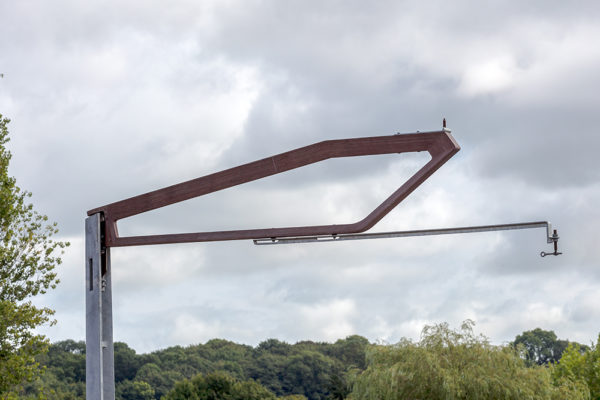
Note.
- The curved beam at the top of this overhead electrification gantry is laminated wood.
- Power changeover would take place at Hurst Green station.
Hopefully, the electric trains would offset any anger at overhead wires.
Run Two tph To Uckfield
I am fairly certain that when Network Rail lengthened the platforms on the Uckfield branch, that they arranged the track and signalling, so that two tph could use the branch.
Run An Hourly Shuttle Between Oxted And East Grinstead
This service would be as follows.
- It would terminate in the bay platform at Oxted station.
- This would give 2 tph on this route.
The existing hourly service between East Grinstead and Victoria would continue.
Conclusion
I believe that this simple scheme could give very good benefits to all stakeholders.
Kent Railway Viaduct Set For £3.5m Makeover
The title of this post, is the same as that of this article on Rail Advent.
This 3D image from Google Maps, shows Ashurst station.
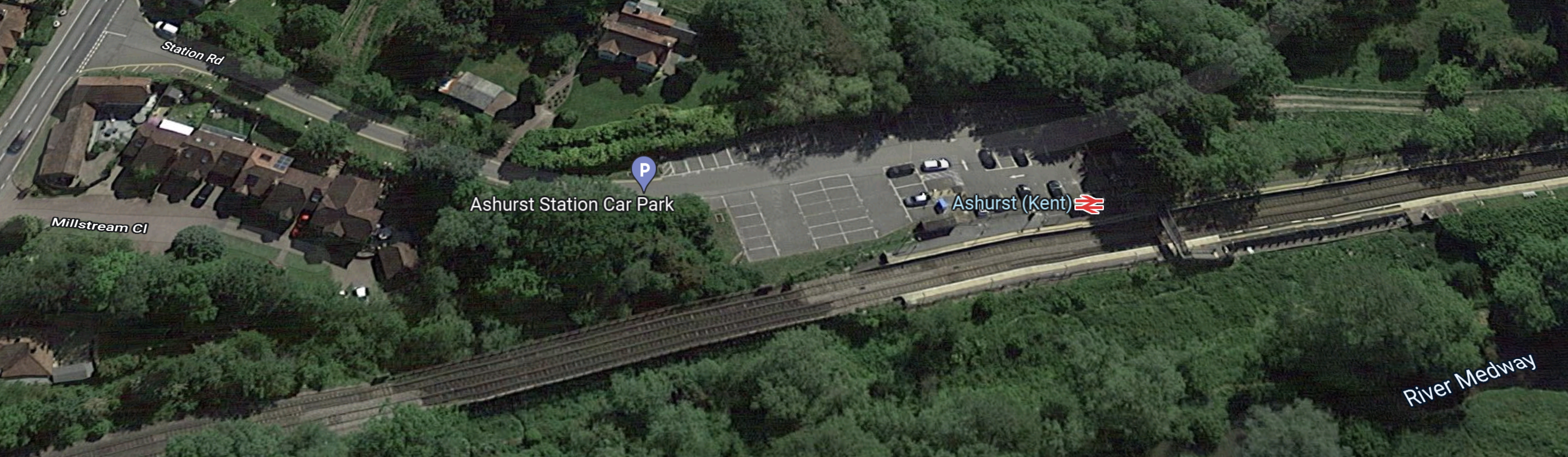
I think that the viaduct is to the left of the station.
This is a description of the work from Katie Frost, Network Rail’s route director for Sussex.
Our railway has a host of Victorian structures that underpin the millions of journeys passengers take with us every year and we have to take good care of them. Mill Stream Viaduct is made of metal, and we need to give it a thorough refurbishment to keep it strong for the future, blasting the old paint off, repainting and repairing the metal sections, replacing the decking, the track and the timbers that support the track too.
Certainly, £3.5 million would seem a lot, if it was just a simple repainting.
What About The Electrification?
Network Rail have been faffing about, deciding how they will get twelve car electric services to Uckfield.
However, in the April 2022 Edition of Modern Railways, there was a short article, which was entitled Uckfield Third Rail is NR Priority, where this was said.
Electrification of the line between Hurst Green and Uckfield in East Sussex and remodelling of East Croydon are the top Network Rail investment priorities south of the river, according to Southern Region Managing Director John Halsall. He told Modern Railways that third rail is now the preferred option for the Uckfield line, as it would allow the route to use the pool of third-rail EMUs in the area. This is in preference to the plan involving overhead electrification and use of dual-voltage units put forward by then-Network Rail Director Chris Gibb in his 2017 report.
NR has put forward options for mitigating the safety risk involved with the third-rail system, including switching off the power in station areas when no trains are present and section isolation systems to protect track workers. ‘The Office of Rail and Road hasn’t yet concerned third rail would be acceptable, but we ark working out ways in which it could be’ Mr Halsall told Modern Railways. He added that bi-mode trains with batteries were not a feasible option on this line, as the 10-car trains in use on the route would not be able to draw sufficient charge between London and Hurst Green to power the train over the 25 miles to Uckfield.
I feel that whatever method is used to get electric trains to Uckfield, there may well be some extra weight on the Millstream Viaduct at Ashurst. So giving the viaduct a makeover, is probably prudent.
I get the impression from the last few Editions of Modern Railways, that there will be a need for battery-electric multiple units in Kent and Sussex.
- Ashford and Ore is 25.4 miles – Electrified at both ends – Maximum trip – 25.4 miles.
- Oxted and Uckfield is 25 miles – Electrified at one end – Maximum trip – 50 miles.
- Hoo and Hoo Juncton is less than 10 miles – Electrified at one end – Maximum trip – 20 miles.
It would appear that the Uckfield trip will need bigger batteries or some form of charging at Uckfield.
Suppose though the following were to be done.
- Create a third-rail battery-electric multiple unit, with a range of thirty miles.
- These would be ideal for Ashford and Ore and the Hoo Branch.
- Install charging stations at Ashurst on both platforms and at Uckfield on the single platform. These would either work through a pantograph or third rail.
Operation of the service during a round trip between London Bridge and Uckfield would be as follows.
- London Bridge and Hurst Green – Uses electrification and charges batteries
- Hurst Green and Ashurst – Uses batteries for 11 miles
- Ashurst station – Tops up the batteries
- Ashurst and Uckfield – Uses batteries for 14 miles
- Uckfield station – Tops up the batteries
- Uckfield and Ashurst – Uses batteries for 14 miles
- Ashurst station – Tops up the batteries
- Ashurst and Hurst Green – Uses batteries for 11 miles
- Hurst Green and London Bridge – Uses electrification and charges batteries
Network Rail may use a different combination of chargers and battery size.
Are Finally Battery-Electric Trains Going To Enter Service?
In the April 2022 Edition of Modern Railways, there are three articles about battery-electric trains on four different routes.
- Effort To Contain Costs For Hoo Reopening talks about the reopening of the Hoo Branch in Kent.
- Uckfield Third Rail Is NR Priority talks about running battery-electric trains on the Uckfield Branch and the Marshlink Line.
- Vivarail’s Battery ‘230’ For Greenford Branch, talks about the Class 230 train, that will be running on the Greenford branch.
The technology has been a long-term arriving, as I had my first ride in a battery-electric train in February 2015, which I wrote about in Is The Battery Electric Multiple Unit (BEMU) A Big Innovation In Train Design?.
What kept it so long?
 The Anonymous Widower