Birds And Offshore Renewable Energy
I have worried about this for some time, as die-hard wind farm opponents use birds being scythed to pieces in wind farms as an emotional reason for not building wind farms.
I searched the Internet and found this academic report from the University of Rhode Island, which is entitled How Are Birds Affected by the Block Island Wind Farm and How Do They Interact With the Wind Turbines?.
Note.
- Block Island Wind Farm is a mildly controversial 30 MW wind farm off the coast of Rhode Island.
- Block Island wind farm is the first commercial offshore wind farm in the United States.
The report gives three ways about how birds interact with wind farms.
Birds Fly Out Of The Way
First, many birds do not experience any interaction with the turbines at all as they fly either at a higher altitude or closer to the shore than the turbines’ locations.
Wind Farms Become A Food Source
The second interaction between birds and offshore wind turbines is a positive one that has been documented throughout Europe; but, with only the Block Island Wind Farm, it is too early to document in the United States. Researchers have found that the base of a wind turbine can create artificial reefs that act as an attractive site to both fish and shellfish. These artificial reefs provide a feeding ground for certain species of birds as the turbines essentially become a central habitat for many bird species’ prey.
Displacement Of The Birds
The final interaction that birds have with offshore wind turbines is displacement. This primary negative effect is experienced when wind turbines are constructed in areas that birds would naturally like to be; but, due to the structures, no longer have access to. To put it simply, he says, “if you put the turbines where the birds want to be, you take away these areas from the birds”.
Conclusion
It appears to me, that if you are putting up wind farms, whether they are offshore or onshore, that it is essential you do your research.
As in this case, experts from the local university are often a good resource to call upon.
Blue Gem Wind
Principle Power are the designers of the WindFloat.
The Projects page of the Principle Power web site led me to a project called Erebus. This is Principle Power’s description of the project.
The Celtic Sea, located between the United Kingdom and Ireland, holds an estimated 50 GW of offshore wind resource. The 96 MW Erebus project, located offshore Pembrokeshire, Wales, is a flagship project planned by Blue Gem Wind, a joint venture between Total and Simply Blue Energy, to unlock the potential of this region.
The project will feature between 7 and 10 turbines on WindFloat® floating platforms located approximately 44 km southwest of the Pembrokeshire coastline.
The Erebus project will see the deployment of a fully industrialized WindFloat® and represents a stepping stone that will allow the local supply chain to build capabilities for the delivery of larger projects under development in the Celtic sea region.
Note.
- Developing 50 GW of offshore wind in the Celtic Sea is not a small amount of wind power.
- The 96 MW Erebus project would appear to be the first project in the Celtic Sea.
- The turbines would be between 9.5 and 14 MW.
- The Principle Power website states that the water depth of the Erebus wind farm is seventy metres.
- The deployment of a fully industrialized WindFloat.
- The Erebus wind farm is being developed by Blue Gem Wind.
It would be larger than the current world’s largest floating wind farm, which is the Kincardine Wind Farm.
Who Are Blue Gem Wind?
Blue Gem Wind have a web site, with a picture of three turbines riding on WindFloats and a couple of support boats and this mission statement.
Floating Offshore Wind
A new generation of energy in the Celtic Sea
The Our Projects page shows a good picture and says this.
Floating wind is set to become a key technology in the fight against climate change with over 80% of the worlds wind resource in water deeper than 60 metres. Independent studies have suggested there could be as much as 50GW of electricity capacity available in the Celtic Sea waters of the UK and Ireland. This renewable energy resource could play a key role in the UK meeting the 2050 Net-Zero target required to mitigate climate change. Floating wind will provide new low carbon supply chain opportunities, support coastal communities and create long-term benefits for the region.
A header indicates a stepping-stones approach to assist the local supply chain and says this.
We believe that a stepping stone approach to the development of floating wind in the Celtic Sea brings a number of benefits. Starting with smaller demonstration and early-commercial projects, increasing in size, will help to capture the highest local supply chain content. It will also maximise knowledge transfer and facilitate a sustainable transfer to a low carbon economy.
Because of this focus on stepping stone projects we have proposed Erebus, a 96MW test and demonstration project followed by Valorous, a 300MW early-commercial project.
These links give more details of the two projects.
- Erebus – 100MW Test & Demonstration project in the Celtic Sea
- Valorous – A 300MW Early Commercial project in the Celtic Sea
It appears that the company is taking a sensible approach.
- They are starting small and building up deployment.
- They are using proven WindFloat technology.
- They are developing a local supply chain.
This Google Map shows the area of the two wind farms.
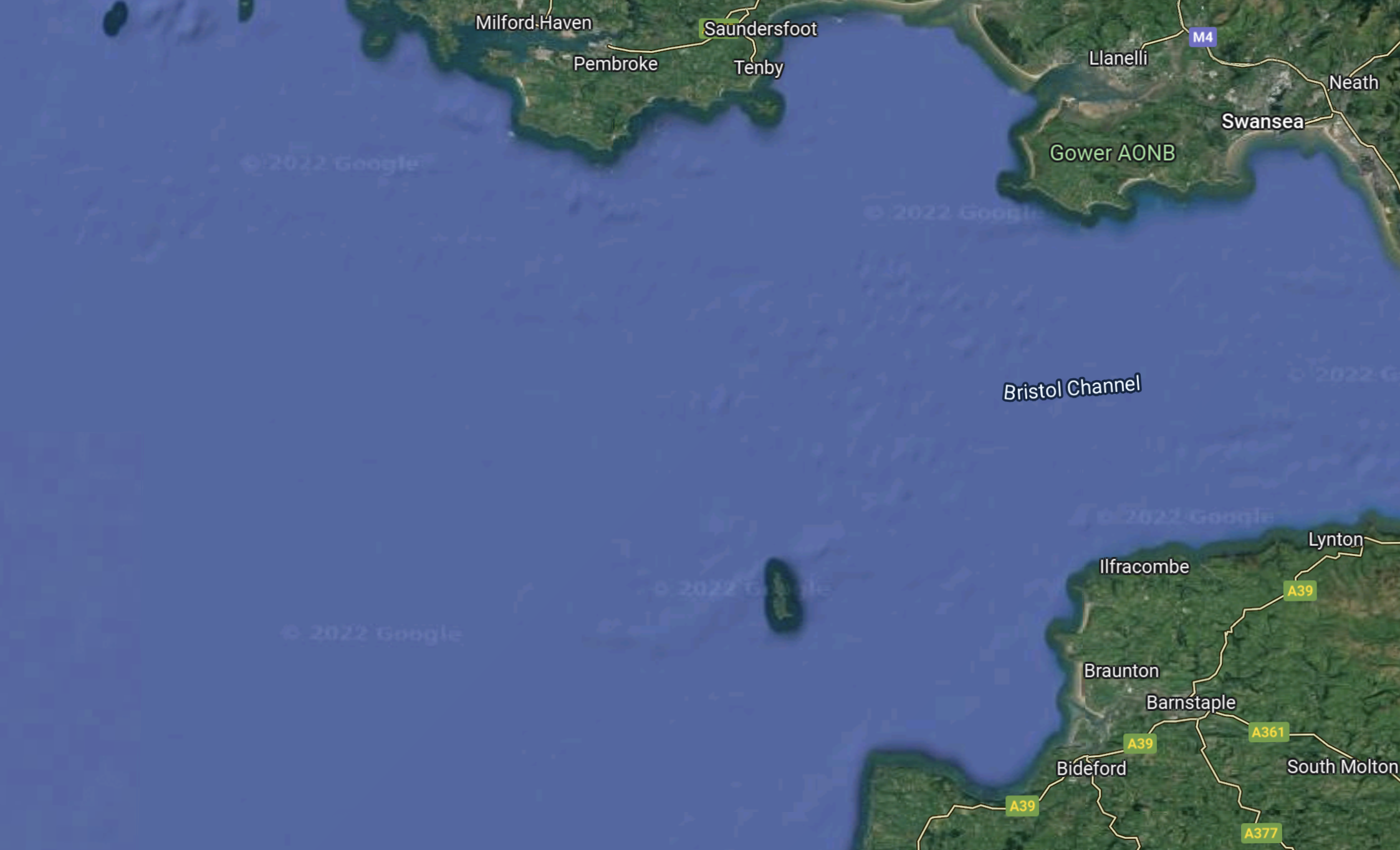
Note.
- Pembroke in the middle at the top of the map.
- Barnstaple and Bideford in Devon in the South-East corner of the map.
- Lundy Island off the Devon coast.
I estimate that the two wind farms will be about the Western edge of this map, with Erebus to the North of Valorous. They wouldn’t want to be too far to the West, as that would put them in the shipping lanes between Ireland and France.
Will The Turbines Be Assembled In The Milford Haven Waterway?
This Google Map shows the Milford Haven Waterway.
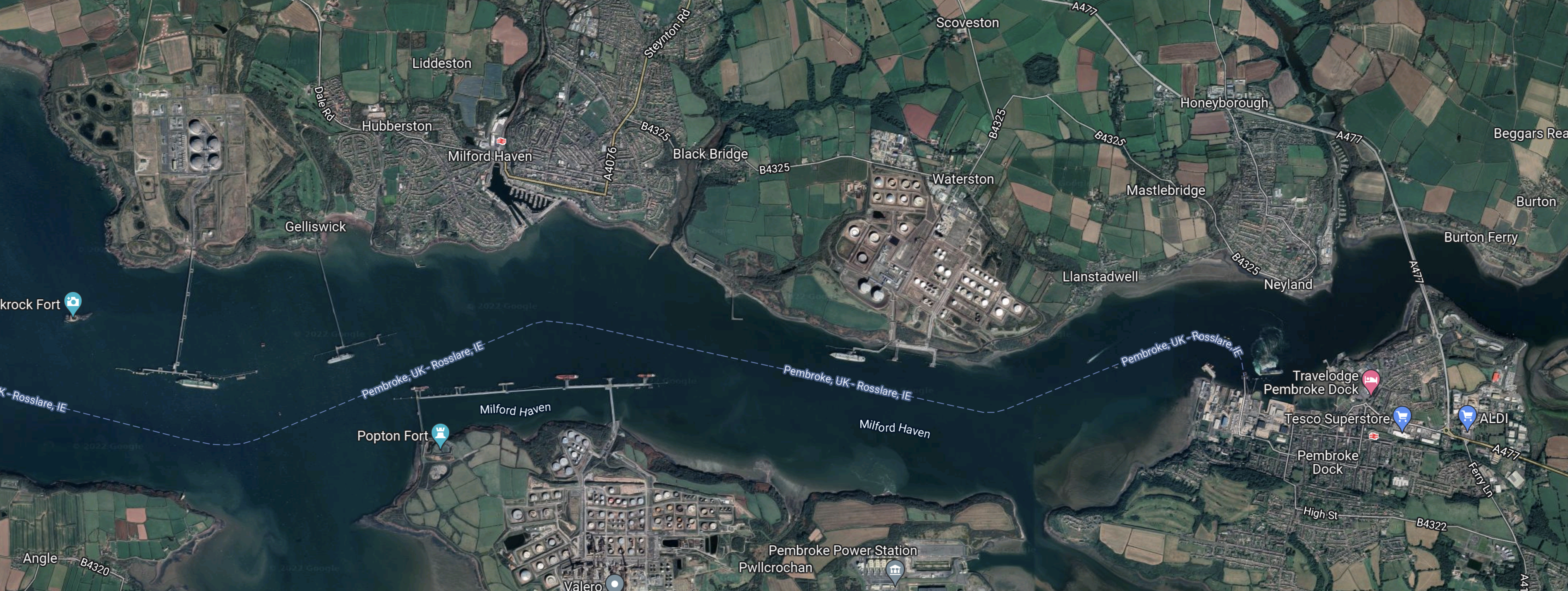
Note.
- Pembroke Dock, where Blue Gem Wind has its offices, is at the Eastern end of the map.
- The oil refineries and LNG terminals.
- Milford Haven on the North side of the waterway.
- The 2.2 GW gas-fired Pembroke power station on the South side of the waterway.
- The ferry route between Rosslare and Pembroke Dock.
But as the waterway is one of the deepest natural harbours in the world, I wouldn’t be surprised to find, that the turbines will be lifted on to the WindFloats in this waterway.
The turbines would be brought in by sea and the WindFloats would be towed in from their manufacturing site.
Where Will The WindFloats And Turbines Be Built?
There could be enough space to build the WindFloats in the Milford Haven Waterway, but I suspect they will be built in a shipyard, which is close to a supply of steel. South Wales is an obvious possibility.
I estimate that for the two wind farms between twenty-eight and forty turbines would be needed and these would probably be brought in by sea and then lifted onto the WindFloats somewhere in the Milford Haven Waterway.
It could be a very efficient process.
Will Pembroke Power Station Have A Future Role?
Consider.
- Pembroke power station is the largest gas-fired power station in Europe.
- It has a capacity of 2.2 GW.
- It was only completed in 2012, so it has many years of life yet!
- It is also probably young enough, to be able to be converted to run on hydrogen.
- It obviously will have a very good connection to the National Grid.
I would suspect that initially, the power cable from Erebus and Valorous, would use the same grid connection as the power station.
But in the future there must be some interesting ways that the wind farms and the power station can work together.
- A large electrolyser could be built to create hydrogen for heavy transport and industrial uses, from excess electricity.
- Could the oxygen from the electrolyser be used for steelmaking in South Wales?
- As natural gas is phased out the power station could be converted to hydrogen power.
- In times of low wind, the power station could make up the shortfall.
- The wind farms could be used as the primary electricity source, with the power station adding the extra power needed to meet demand.
There are certainly ways, the wind farms and the power station can work together.
Conclusion
These two related wind farms seems a good way to start wind developments between the UK and the island of Ireland.
ScotWind N3 Offshore Wind Farm
I introduced this wind farm in ScotWind Offshore Wind Leasing Delivers Major Boost To Scotland’s Net Zero Aspirations as Lease 15 – The Odd Bid Out.
I said this.
In any design competition, there is usually at least one design, that is not look like any of the others.
In the successful bids for the ScotWind leases, the bid from Magnora ASA stands out.
- The company has an unusual home page on its offshore wind web site.
- This page on their web site outlines their project.
- It will be technology agnostic, with 15MW turbines and a total capacity of 500MW
- It will use floating offshore wind with a concrete floater
- It is estimated, that it will have a capacity factor of 56 %.
- The water depth will be an astonishing 106-125m
- The construction and operation will use local facilities at Stornoway and Kishorn Ports.
- The floater will have local and Scottish content.
- The project will use UK operated vessels.
- Hydrogen is mentioned.
- Consent is planned for 2026, with construction starting in 2028 and completion in 2030.
This project could serve as a model for wind farms all round the world with a 500 MW power station, hydrogen production and local involvement and construction.
I have some thoughts.
The Location Of The Windfarm
This Google Map shows the area between Stornaway and Kishorn.
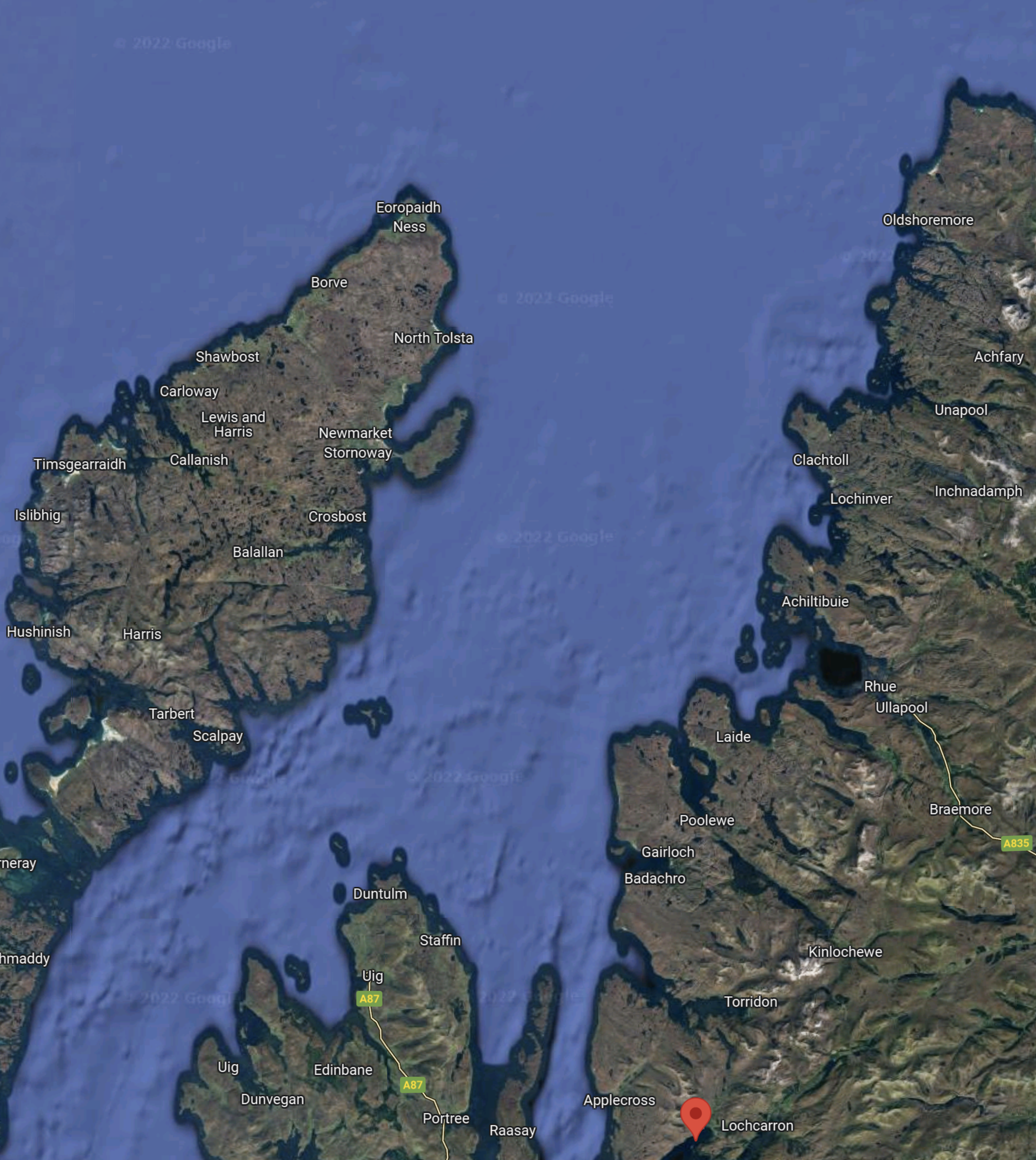
Note.
- The island in the North-West of the map is Lewis and Harris.
- The windfarm will be to the North-West of the island.
- Stornaway is on the isthmus, that connects the small peninsular on the East of the island.
- The port of Stornaway is on the South side of the isthmus.
- The port of Kishorn is shown by the red arrow.
This second Google Map shows the town of Stornaway.
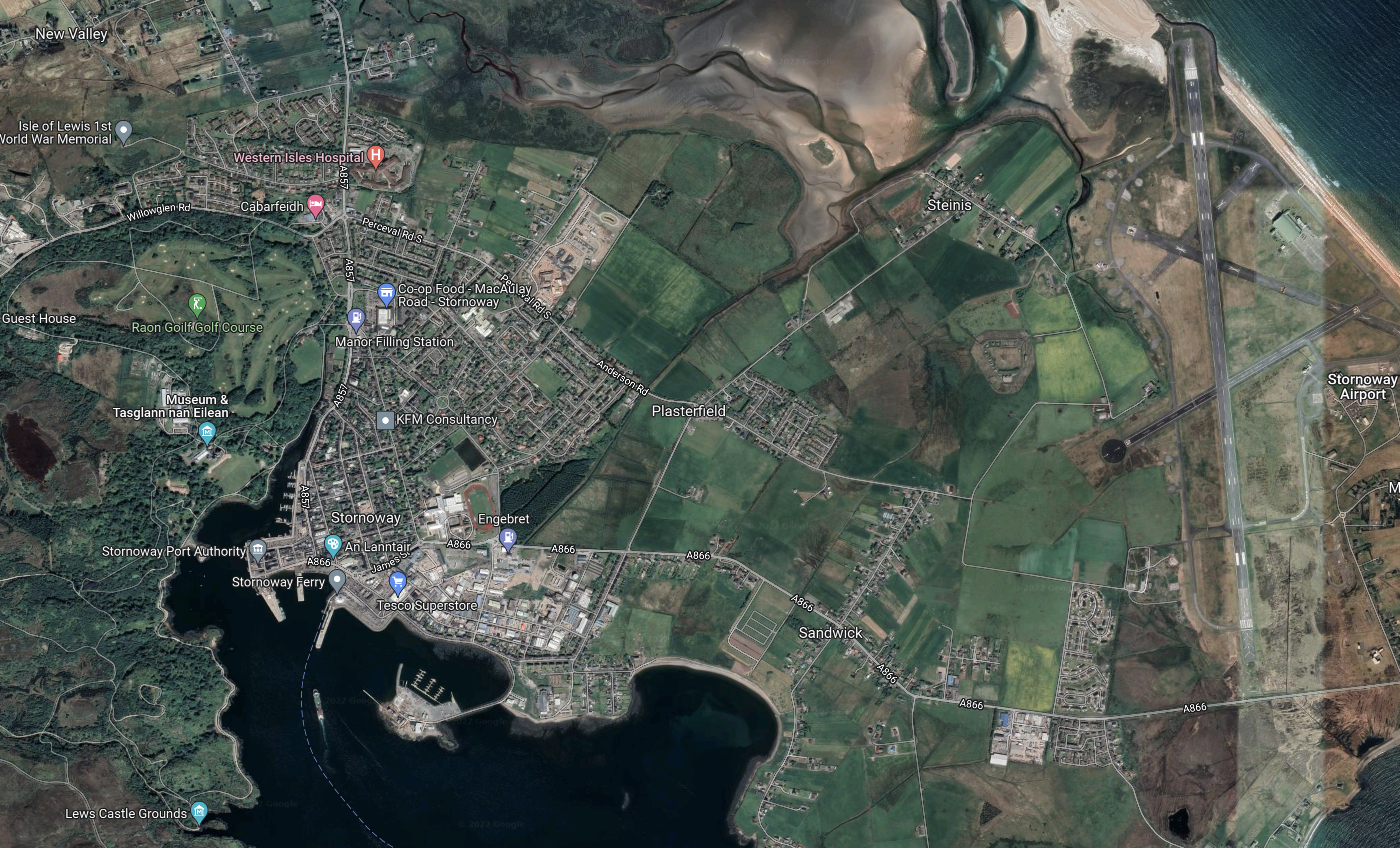
Note that Stornaway has a substantial airport in the East and a large port.
This third Google Map shows Loch Kishorn in more detail.
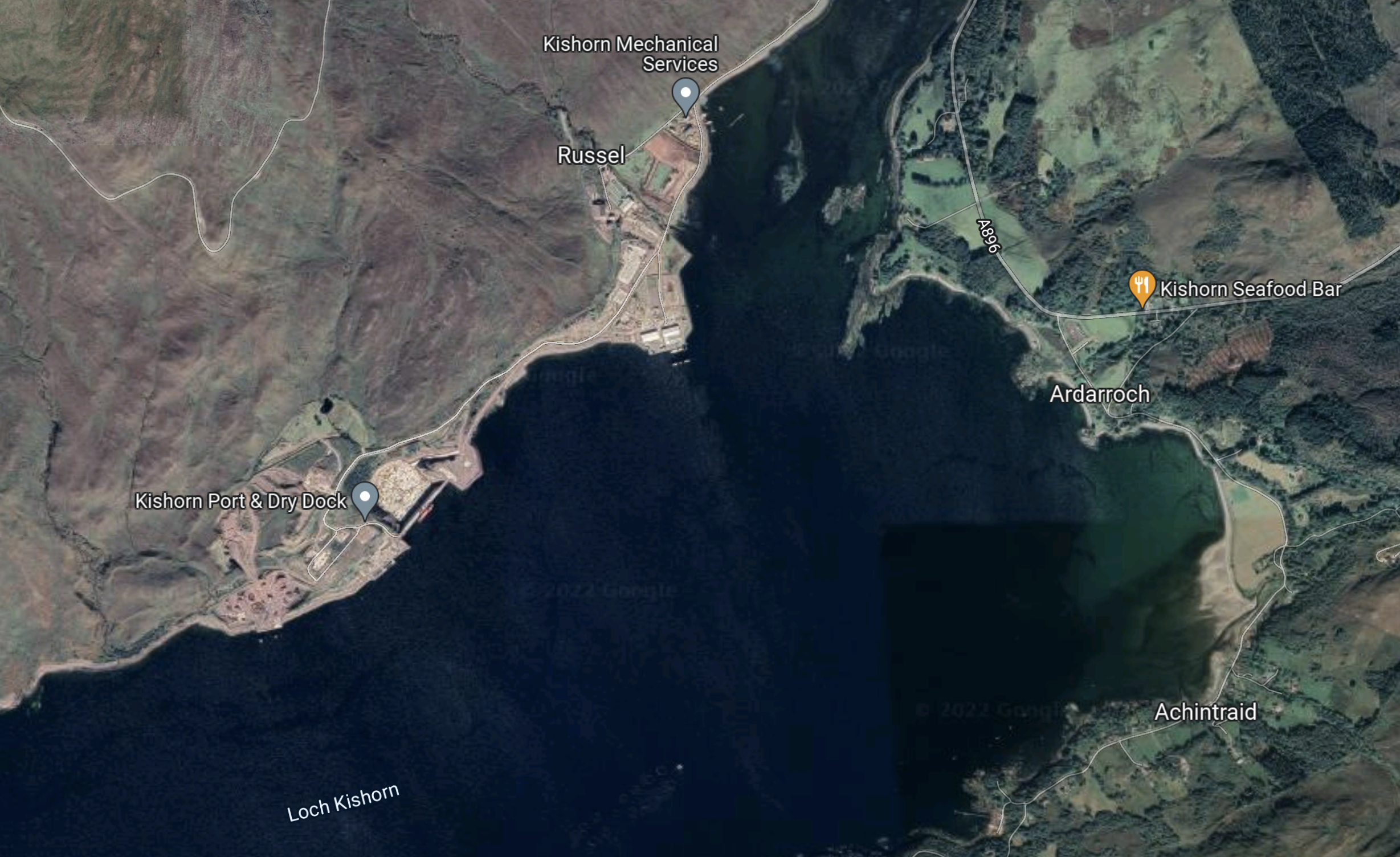
Kishorn Yard at the Kishorn Port was originally built to create the large structures in steel and concrete for the development of North Sea Oil. This is an extract from the Wikipedia entry.
The yard was therefore well suited to build the 600,000-tonne concrete Ninian Central Platform, which was built in 1978. Material was supplied by sea and when complete the platform needed seven tugs to tow it to its operating position in the North Sea. The Ninian Central Platform still holds the record as the largest movable object ever created by man.
If the yard could build the Ninian Central Platform, I’m sure that Magnora ASA intend to build the concrete floater in Loch Kishorn.
The Floating Wind Turbines
In visualisations on the site, the floating wind turbines are shown as sitting on floating three-pointed star structures.
As Technip UK are partners in the project and I suspect they are a subsidiary of TechnipFMC, who are a well-known company described like this in Wikipedia.
TechnipFMC plc is a French-American, UK-domiciled global oil and gas company that provides complete project life cycle services for the energy industry.
The company would certainly have the expertise to design a floating platform for a wind farm.
Like the WindFloat, it could be based on semi-submersible offshore platform technology.
The Magnora web site, say that 15 MW wind turbines will be used, so these will probably be some of the largest wind turbines in the world.
Currently, the largest floating wind turbines are the 9.5 MW units at the Kincardine Wind Farm in Scotland.
33 x 15 MW wind turbines would give a capacity of 495 MW.
I suspect the turbines would be towed to Stornaway or Kishorn for major servicing.
What Will The Concrete Floater Do?
There are a variety of tasks that the concrete floater could handle.
- It could collect the electricity from the wind turbines. I suspect this would give advantages in the connection and disconnection of individual turbines into the windfarm.
- Any electricity conversion necessary would be handled on the floater.
- The floater would handle the seaward end of the connection to the shore.
- There could be a battery or energy storage device on the floater.
- Could a Gravitricity battery or something similar be built into the floater?
- Magnora mention hydrogen on their web site. Could an electrolyser be built on the floater and the hydrogen distributed to Lewis and Harris by pipeline?
Some oil and gas platforms are very comprehensive and there is no reason why there can’t be substantial processing done on the floater.
The Concrete Floater
According to Wikipedia, offshore concrete structures have been in use successfully for about 50 years. Nearly fifty are in use in the oil and gas industry.
Wikipedia introduces its section on floating concrete structures like this.
Since concrete is quite resistant to corrosion from salt water and keeps maintenance costs low, floating concrete structures have become increasingly attractive to the oil and gas industry in the last two decades.
I also wonder if a floating concrete structure would make a good hydrogen storage tank, if there is electrolysis on the floater on the to turn electricity into hydrogen.
Conclusion
My original conclusion after reading about this wind farm was.
This project could serve as a model for wind farms all round the world with a 500 MW power station, hydrogen production and local involvement and construction.
I have no reason to change my mind and feel that the concept may have even more possibilities.
World’s Largest Floating Offshore Wind Farm Fully Operational
The title of this post, is the same as that of this article on offshoreWIND.biz.
This is the first paragraph.
Located 15 kilometres off the coast of Aberdeenshire, Scotland, in water depths ranging from 60 metres to 80 metres, Kincardine is the largest operating floating wind farm.
Note.
- Wikipedia has a comprehensive section on floating wind turbines.
- Kincardine Wind Farm has a capacity of 50 MW.
- Its turbines are mounted on WindFloats, which were designed by Principle Power, who have this page on their web site, which describes advantages of the technology.
- The Kincardine wind farm appears to have been developed by Spanish company; Cobra and there are pictures on this page on their web site.
The WindFloats are triangular floating structures, which are based on semi-submersible offshore platform technology, that has been used in the offshore oil and gas industry since the early 1960s.
Semi-submersibles have good ship stability and seakeeping, so they would seem to be an ideal way to create a fixed structure in deep water on which to mount a wind turbine.
- The hull structure can be well below the surface of the sea, so they are not affected by waves.
- If they have a problem, it is handling changes of load on the platform. But this is an advantage with with wind turbines, as the load will be constant.
- Standard wind turbines can be used.
- All platform construction can be onshore rather than in the middle of a ferocious ocean.
- The platforms can be towed into position and moved into sheltered waters for servicing.
In Are Floating Wind Farms The Future?, which I wrote in 2020, I laid out my experience and views about floating wind farms.
I came to this conclusion.
It is my view, that floating wind farms are the future.
But then I’ve done the mathematics of these structures!
Did Boris’s advisors, as I doubt he knows the mathematics of oblique cylinders and how to solve simultaneous differential equations, do the mathematics or just read the brochures?
I will predict, that today’s structures will look primitive to some of those developed before 2030.
WindFloats seem to have fulfilled my predication and it’s only 2022.
How Big Can Floating Wind Turbines Get?
Platforms like WindFloat would appear to create a stable island that is as secure a mounting, as say a solid hill.
So I suspect that platforms can be created for the world’s largest wind turbines.
This article on offshoreWIND.biz is entitled World’s Largest, Most Powerful Wind Turbine Stands Complete.
This is the first paragraph.
With the final blade in place, the SG 14-222 DD prototype has become the world’s largest and most powerful turbine to be installed, taking the mantle from GE Haliade-X 14 MW prototype operating in the Port of Rotterdam, the Netherlands.
Note.
- This is a 14 MW turbine, that can be boosted to 15 MW.
- Kincardine Wind Farm has 5 x 9.5 MW and 1 x 2 MW turbines.
- Northern Horizons is talking about a 10 GW floating wind farm to the North-East of the Shetlands, that will use 20 MW turbines. The turbine visualisation on their web site, looks like it could be a WindFloat or similar technology.
How many 20 MW turbines does it need to carpet the seas around the UK?
Conclusion
Kincardine Wind Farm may be the world’s largest floating wind farm, but this won’t hold true for long.
- I can see various designs of semi-submersible platforms being developed, that will be able to support the world’s largest wind turbines.
- They will also be able to operate in the world’s deepest waters far out to sea.
- Northern Horizons talk of 20 MW turbines may sound ambitious, but I suspect that turbine engineers are already thinking bigger.
Offshore wind and its turbines will both have a huge future.
Mona, Morgan And Morven
The title of this post, may sound like a high-class firm of Welsh solicitors, but it is actually the names of three wind farms to be constructed by BP Alternative Energy Investments Ltd and Energie Baden-Württemberg AG.
Mona And Morgan
This EnBW-BP infographic describes the project.

Mona and Morgan do seem to have web page, which gives a simple map and a rather jargon-filled timeline.
Morven
This EnBW-BP infographic describes the project.

Morven does seem to have a web page, which gives a simple map and this statement.
The Morven wind farm is named after a mountain situated in the beautiful hills of Aberdeenshire, Scotland. The name derives from the Scottish Gaelic terms “Mhor” and “bheinn” meaning ‘big’ and ‘peak’, symbolic of the scale of opportunity represented by bp’s latest offshore wind project.
This article on Offshore Engineer is entitled ScotWind: BP, EnBW Win Bid to Build 2.9GW Morven Offshore Wind Farm.
This paragraph described the Morven wind farm.
The approximately 860km2 lease is located around 60km off the coast of Aberdeen. The E1 lease is in an advantaged area, allowing the partners to develop it as a fixed-bottom offshore wind project with a total generating capacity of around 2.9 gigawatts (GW), sufficient to power more than three million homes.
And this paragraph, described what BP will do with the energy.
“Along with the offshore wind development, these investments include significant expansion of electric vehicle charging infrastructure in Scotland and green hydrogen production. Together, these represent up to £10 billion of investment in support of offshore wind and Scotland’s energy transition,” BP added.
These are two large projects, but so far there is little else on the Internet, except for this press release.
Conclusion
Wind farms can be controversial and for this and other reasons, the general public need more information.
BP and EnBW can do much better.
Shell And ScottishPower Win Bids To Develop 5 GW Of Floating Wind Power In The UK
The title of this post, is the same as that of this press release from Shell.
This is three paragraphs from the press release.
Shell and ScottishPower have secured joint offers for seabed rights to develop large-scale floating wind farms as part of Crown Estate Scotland’s ScotWind leasing. The partners have won two sites representing a total of 5 gigawatts (GW) off the east and north-east coast of Scotland.
The new wind farms will be delivered through two joint ventures called MarramWind and CampionWind. They bring together ScottishPower’s and Shell’s decades of experience working offshore and significant presence in Scotland, as well as their strong innovation capabilities for delivering world-class offshore energy projects.
The development, construction and operation of ScotWind projects is set to bring new skilled jobs and manufacturing opportunities and boost local supply chains.
ScottishPower are actually involved in three large ScotWind projects; one by themselves and two in partnership with Shell.
MacHairWind
MachairWind is a project that Scottish Power is developing alone.
- It has its own page on the ScottishPower Renewables web site.
- It will be a 2 GW wind farm to the North-West of Islay.
- The turbines will be on fixed foundations.
I wrote about this project in MacHairWind Wind Farm.
MarramWind And CampionWind
These two wind farms are being developed in partnership with Shell.
They both have their own web sites.
MarramWind’s web site has this introduction.
ScottishPower and Shell have joined forces to develop the MarramWind offshore windfarm following success in the recent ScotWind auction process by Crown Estate Scotland.
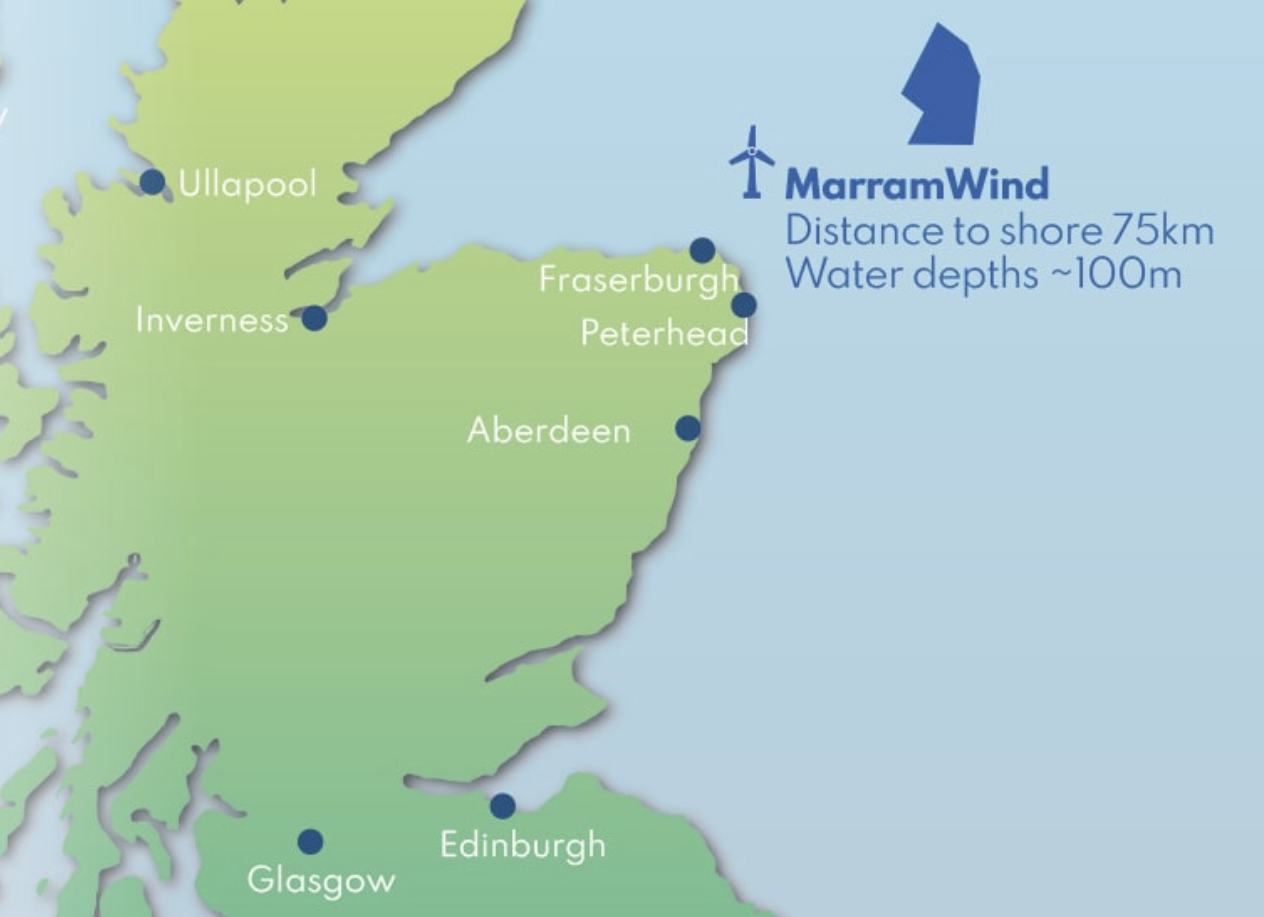
Located 75 kilometres off the North East coast of Scotland in water depths averaging 100 metres, the proposed MarramWind floating offshore windfarm could deliver up to 3 gigawatts (GW) of cleaner renewable energy.
This map clipped from the MarramWind web site, shows the location of the wind farm.
CampionWind’s web site has this introduction.
ScottishPower and Shell have joined forces to develop the CampionWind offshore windfarm following success in the recent ScotWind auction process by Crown Estate Scotland.
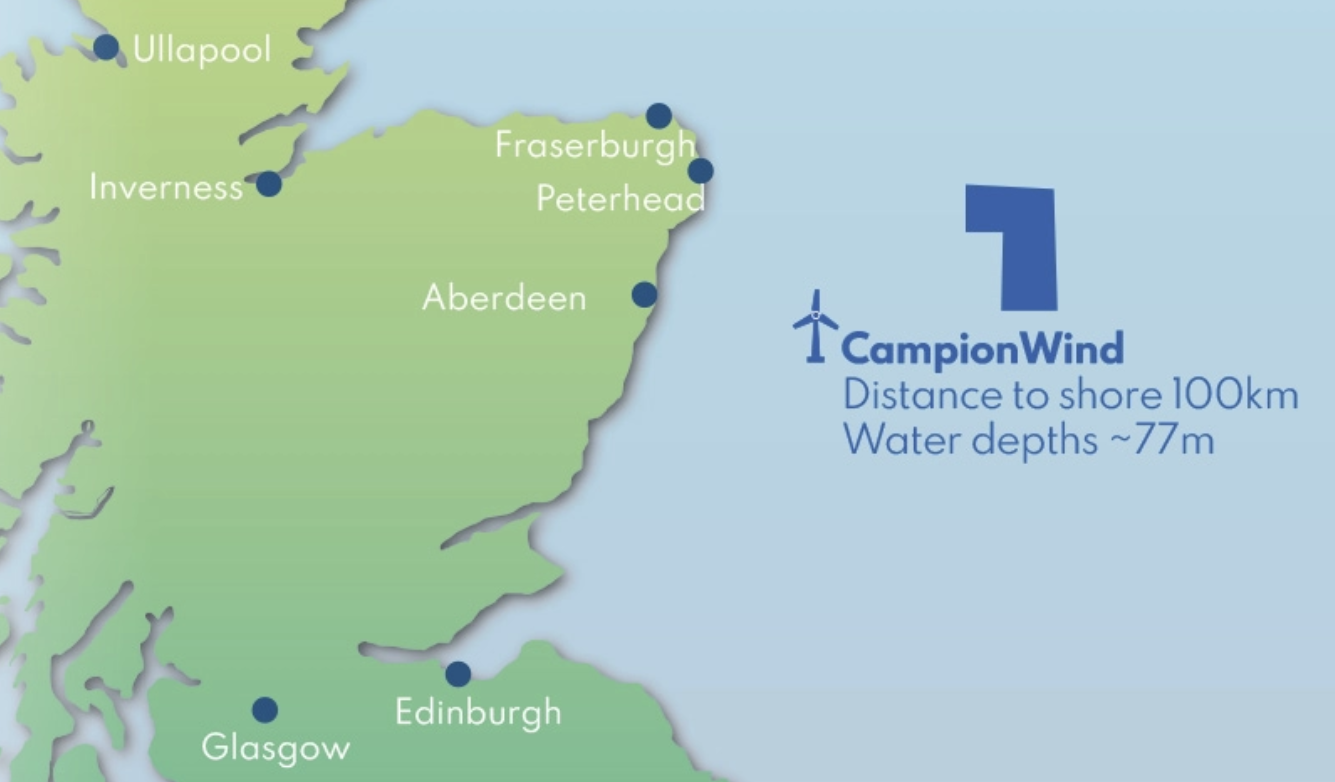
Located 100 kilometres from the east coast of Scotland, in water depths averaging 77 metres, the proposed CampionWind floating offshore windfarm could deliver up to 2 gigawatts (GW) of cleaner renewable energy.
This map clipped from the CampionWind web site, shows the location of the wind farm.
Note.
- The two wind farms will be within a few miles of each other.
- Both wind farms will use floating wind turbines.
- The water is a bit deeper at MarramWind, but this surely doesn’t bother a floating turbine.
- MarramWind and CampionWind will have a total capacity of 5 GW.
- Hywind Scotland is the world’s first commercial wind farm using floating wind turbines, situated 29 kilometres off Peterhead. This wind farm is only 30 MW, but in its first years of operation has achieved a capacity factor of over 50 %.
- The proposed turbines at Northern Horizons‘ 10 GW wind farm, which is 130 kilometres to the North-East of Shetland will be 20 MW giants and nearly as tall as The Shard in London.
So will Scottish Power and Shell design and build a combined field, similar in concept to Northern Horizons’ wind farm, using an armada of 250 floating wind turbines?
- The wind turbines might be moored around a fixed or floating mother platform or structure, that will collect the electricity and deliver it to the shore.
- Turbines could be serviced in situ or moved into port, as needed.
- Extending the wind farm could just be a matter of mooring the extra turbines in position and then connecting them to the mother platform.
- Is there a convenient disused oil or gas platform, that could be repurposed as the mother platform?
It certainly would appear to be a way of building large offshore fields in deep waters.
Where Would The Combined MarramWind And CampionWind Rank In Terms of UK Wind Farms?
Consider.
- MarramWind and CampionWind will have a total capacity of 5 GW.
- Phase one of the Hornsea Wind Farm is the largest offshore wind farm in the world, with a capacity of just over 1.2 GW and when complete it will have a capacity of 6 GW.
- Northern Horizons is planned to be 10 GW.
- The East Anglian Array could be as large as 7.2 GW.
- The Dogger Bank Wind Farm is planned to be as large as 4.8 MW.
- Norfolk Vanguard and Norfolk Boreas are a pair of 1.8 GW wind farms.
- MacHairWind will be a 2 GW wind farm.
Note.
- This is not a complete list of large wind farms in the development pipeline.
- BP have obtained leases, but have not published their plans.
- Most farms under development are at least one GW.
- These farms are a total of 38.6 GW.
The Combined MarramWind and CampionWind would be one of several large wind farms around 5 GW.
There Is A Desperate Need For Energy Storage
If we are generating upwards of 40 GW of wind and solar energy in the UK, there will be a desperate need for energy storage to cover for the times, when the wind doesn’t blow and the sun doesn’t shine.
Scotland should be OK, as there are various energy storage projects in development.
- The 1.5 GW/ 30 GWh Coire Glas project is according to SSE shovel-ready and has planning permission.
- The 450 MW/2.8 GWh Red John project is being constructed.
- Drax, ILI Group and SSE have several other projects under development.
So what would happen in the South?
The government appears to be on the case as I wrote in Ministerial Roundtable Seeks To Unlock Investment In UK Energy Storage.
But there is also the possibility of using hydrogen.
- Hydrogen could be created by a series of giant electrolysers.
- It could be blended with natural gas to eke out our natural gas and save carbon. According to HyDeploy, it appears that up to 20 % can be added, without needing to change boilers and appliances.
- It can be stored in depleted offshore gas fields.
- It can be used to power heavy transport like buses, trucks, trains and ships.
- It can be burned in gas-fired power stations to generate electricity.
Hydrogen can also be used as a feedstock or green energy source for the making of chemicals, concrete and steel.
Conclusion
We are approaching the end of the first phase of the development of renewable energy in the UK.
Massive floating wind farms using armadas of floating wind farms, a large expansion of pumped storage hydro and a huge expansion of the use of hydrogen will see us through to a carbon-free future.
MacHairWind Wind Farm
MachairWind wind farm has its own page on the ScottishPower Renewables web site.
These are the two introductory paragraphs.
The MacHairWind project off the coast of Islay, which could deliver 2GW of cleaner renewable energy, will make a significant contribution to tackling climate change and achieving Net Zero, with the potential to generate enough clean electricity to power over 2 million homes in Scotland.
It will also build on ScottishPower’s long-standing presence and positive track record of investing in and working with local communities and businesses across Argyll & Bute to realise the benefits of renewable energy developments.
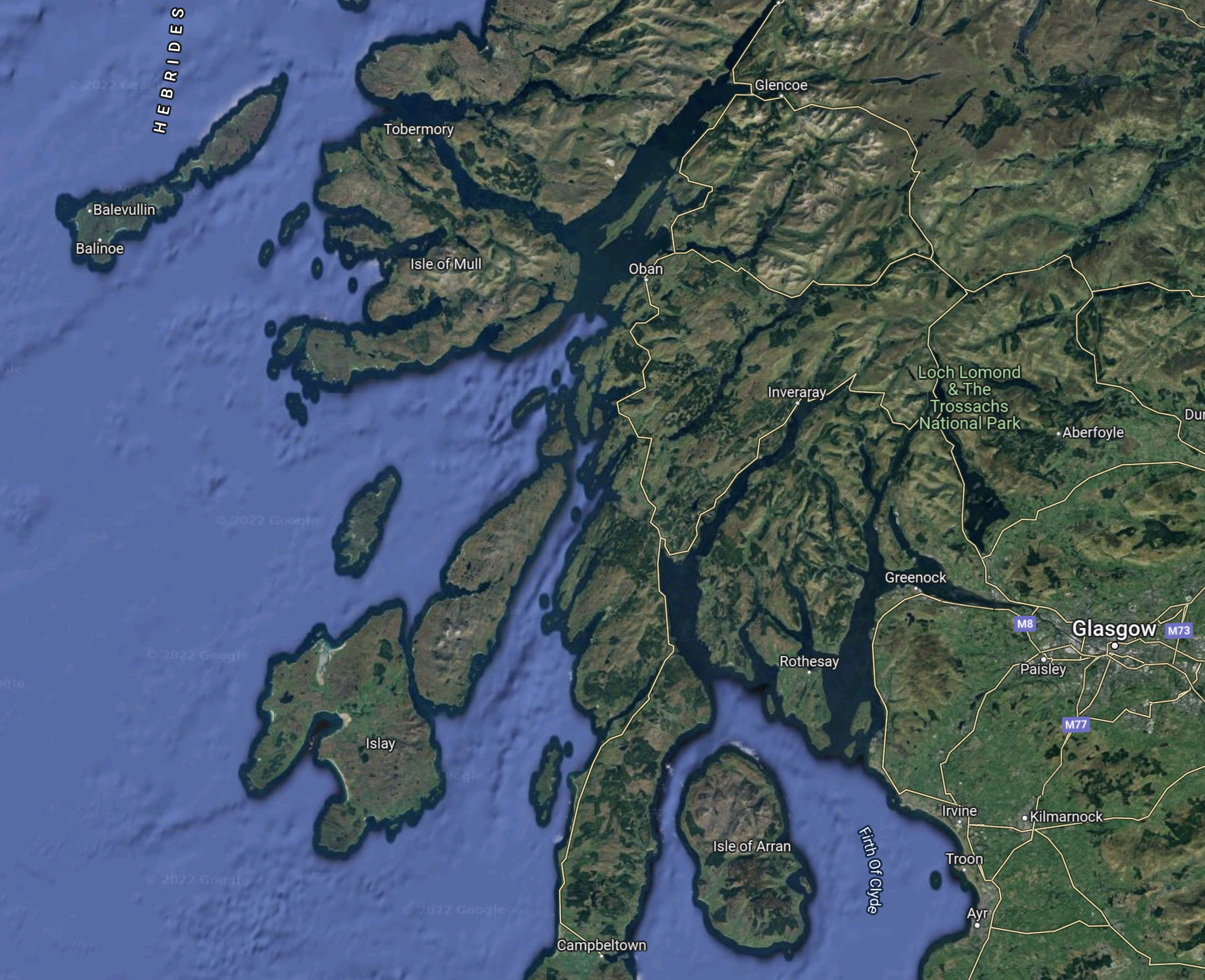
This Google Map shows the area of the wind farm, which is to the North West of the island of Islay.
Note.
- There certainly is a large space of empty sea to the North-West of Islay.
- Glasgow is not far away.
This second Google Map shows the area to the North-East of Islay.
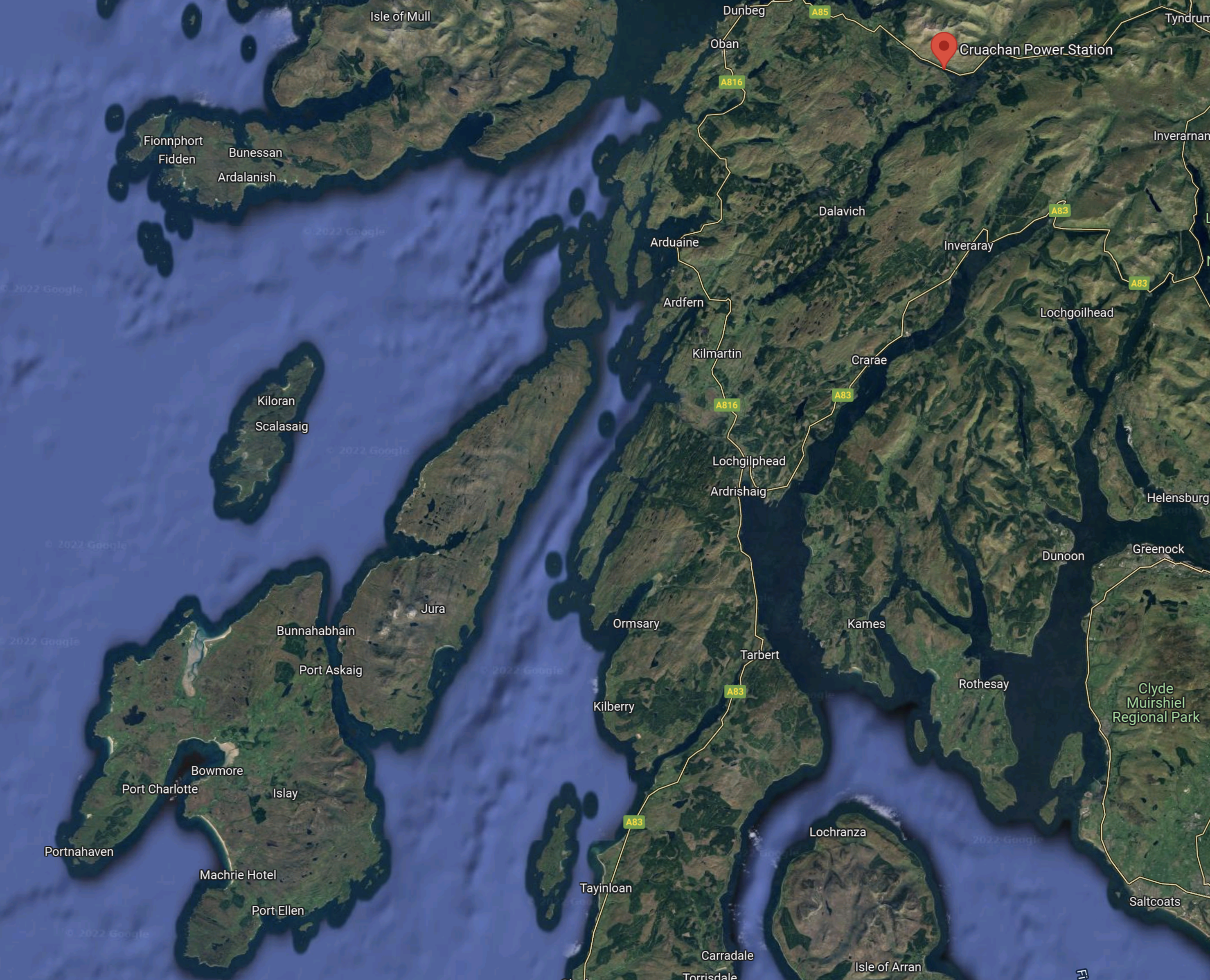
Note.
- Islay is in the South-West corner of the map.
- Colonsay is the smaller island to the North.
- In the North-East corner of the map the red arrow indicate Cruachan pumped hydro power station.
- In the South-East corner of the map is the Clyde Estuary, where the two nuclear power stations at Hunterston were located.
- Hunterston is also the Northern end of Western HVDC Link to North Wales.
Wikipedia says this about the relationship of the Cruachan power station and Hunterston’s nuclear stations.
Construction began in 1959 to coincide with the Hunterston A nuclear power station in Ayrshire. Cruachan uses cheap off-peak electricity generated at night to pump water to the higher reservoir, which can then be released during the day to provide power as necessary.
Now that the two nuclear stations are being decommissioned, will the MacHairWind wind farm be used to pump water to Cruachan’s higher reservoir?
Conclusion
The MacHairWind wind farm seems a well-positioned wind farm.
- It is close to Glasgow.
- It can be used in tandem with the Cruachan pumped hydro power station.
- It will have access to the Western HVDC Link to send power to the North-West of England.
Is Scotland replacing the 1.2 GW Hunterston B nuclear power station with a 2 GW wind farm, with help from Cruachan and other proposed pumped storage hydro schemes to the North of Glasgow?
It also looks like increasing the power at Cruachan from the current 440 MW to a GW, by the building of Cruachan 2 would give the area even more energy security.
Shetland’s Viking Wind Farm
I was listening to SSE’s Chief Executive; Alistair Phillips-Davies, on the radio this morning, when he mentioned the Viking wind farm on Shetland.
- The wind farm is being developed by Viking Energy, a partnership between Shetland Islands Council and SSE plc.
- It will have 103 turbines and a nameplate capacity of 370 MW.
- Construction started in September 2020 and should be complete by 2024.
- The wind farm will be connected to the National grid via the Shetland HVDC Connection.
- There’s more on the Viking Energy web site.
Note.
- According to Wikipedia, wind farms in the Shetlands can have capacity factors of over 50 %.
- Viking Energy hope that the Viking wind farm will become one of the most productive onshore wind farms in the world.
- Is it unusual, that the wind farm is developed by a partnership between a local authority and a large utility company?
It also appears that together the Viking wind farm and the Shetland HVDC Connection will allow the 66 MW diesel-powered Lerwick power station to be closed.
Does The Electricity System On Shetland Need Energy Storage?
As an Electrical Engineer, who specialised in Control Engineering, I am surprised that to ensure energy security, that there is no energy storage on Shetland.
In the Wikipedia entry for Lerwick power station, there is a section entitled Load Balancing, where this is said.
The growth of output from wind turbines in Shetland has increased instability in the local grid (which is not connected to the national grid on mainland Scotland). SSE installed a 1 MW sodium–sulfur battery in a nearby building to ameliorate the peak loads. However due to safety concerns, the sodium-sulfur battery was removed prior to commissioning and the energy storage building was reconfigured to accommodate 3MWh of advanced lead-acid batteries.
A combination of the new Shetland HVDC Connection and the lead-acid batteries must be enough to ensure energy security for the Shetlands.
Germany Weighs Norway Hydrogen Pipeline To Avoid Russian Energy
The title of this post, is the same as that of this article on Hydrogen Central.
This the introductory paragraphs.
Germany and Norway are considering building a hydrogen pipeline linking the two nations to reduce Europe’s dependence on Russian energy supplies.
The countries plan to soon conduct a feasibility study on the project that would eventually transport green hydrogen from Norway to Germany, they said after a meeting between German Economy Minister Robert Habeck and Norwegian Prime Minister Jonas Gahr Store.
There is a joint statement that gives more details.
Developments like this and lots of wind power in the North Sea and around the UK, are the sort of actions, that could seriously reduce the size of Russia’s oil and gas industry and the money it pays to that group of war criminals like Vlad the Mad and his friends.
Shell Resurrects Plans For Rejected North Sea Gasfield
The title of this post, is the same as that of this article on The Times.
This is the first two paragraphs.
Shell has submitted a revised plan for a North Sea gasfield that was rejected by regulators on environmental grounds last year.
The oil and gas major is seeking to develop the Jackdaw field, about 155 miles east of Aberdeen, which it says could produce 6.5 per cent of UK domestic gas output at peak — enough to heat 1.4 million homes. It hopes to start production in 2025 at the field, which would keep producing until 2033.
Other points in the article include.
- The platform would be unmanned.
- One of the problems with the field is that the gas naturally contains a lot of carbon dioxide.
- Shell plans to capture and store this carbon dioxide.
- The gas would be brought to shore using a nineteen mile pipeline to the Shearwater platform.
Surprisingly, the Shearwater platform is connected by the 295 mile SEAL pipeline to the Bacton terminal in Norfolk. But then Bacton is connected by the BBL pipeline to the Netherlands.
- There are depleted gas fields connected to Bacton, that can be used to store the carbon dioxide from the Jackdaw gas field.
- Shell manage the BBL pipeline.
- Shell are sitting in the middle with gas, that can be sold to the highest bidder.
It could be good for Shell without a great deal of expenditure on infrastructure.
In the short term, Jackdaw could make up our gas shortage, but as we start to blend wind-produced hydrogen into the gas network, we can export the surplus gas to the Continent. Shell might have plans for other gas fields to participate in the export of British gas to Germany, that has been replaced by wind-produced hydrogen.
It would be an interesting point, as to who would be responsible for the carbon dioxide produced by Jackdaw’s gas, that is burned in Germany. I suspect it will be the Germans.
In the long-term, when Shearwater and Jackdaw have given up all their gas, I wonder if Shell’s plans could be.
- Surround the platforms serving these fields with floating wind farms.
- Put a giant electrolyser on the Shearwater platform and bring hydrogen to the shore in the SEAL pipeline.
- Distribute the hydrogen from Bacton to the UK or through the BBL pipeline to the Continent.
I feel that Shell could do very nicely thank you out of the Jackdaw gas-field.
But it is also a plan, that produces a lot of energy, without emitting vast amounts of carbon dioxide.
 The Anonymous Widower