Amp Wins Consent For 800MW Scots Battery Complex
The title of this post, is the same as that of this article on renews.biz.
These are the first two paragraphs.
Canadian storage player Amp Energy has revealed that its 800MW battery portfolio in Scotland has secured planning consent.
The portfolio is due to be operational in April 2024 and will comprise two 400MW battery facilities, each providing 800 megawatt-hours of energy storage capacity.
Some other points from the article.
- The two facilities will be located at Hunterston and Kincardine.
- They will be the two largest grid-connected battery storage facilities in Europe.
- The two batteries will be optimised by Amp Energy‘s proprietary software.
This Google Map shows the Hunterston area.
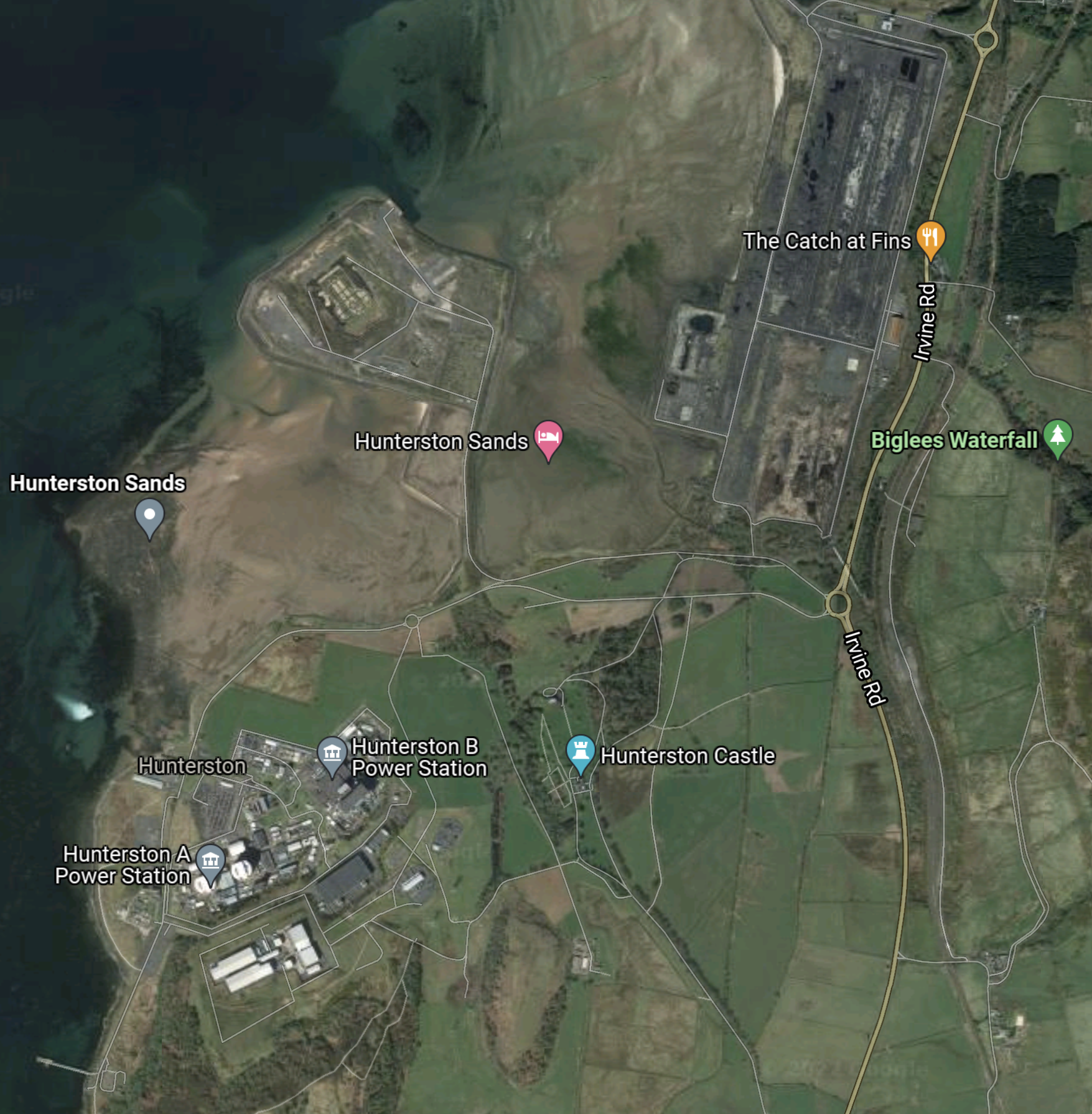
Note.
- The Hunterston A and Hunterston B nuclear power stations, which are both being decommissioned.
- Hunterston B only shut down on the 7th of January, this year.
- There is also a large brownfield site in the North-East corner of the map.
This second Google Map shows the South-East corner of the nuclear power station site.
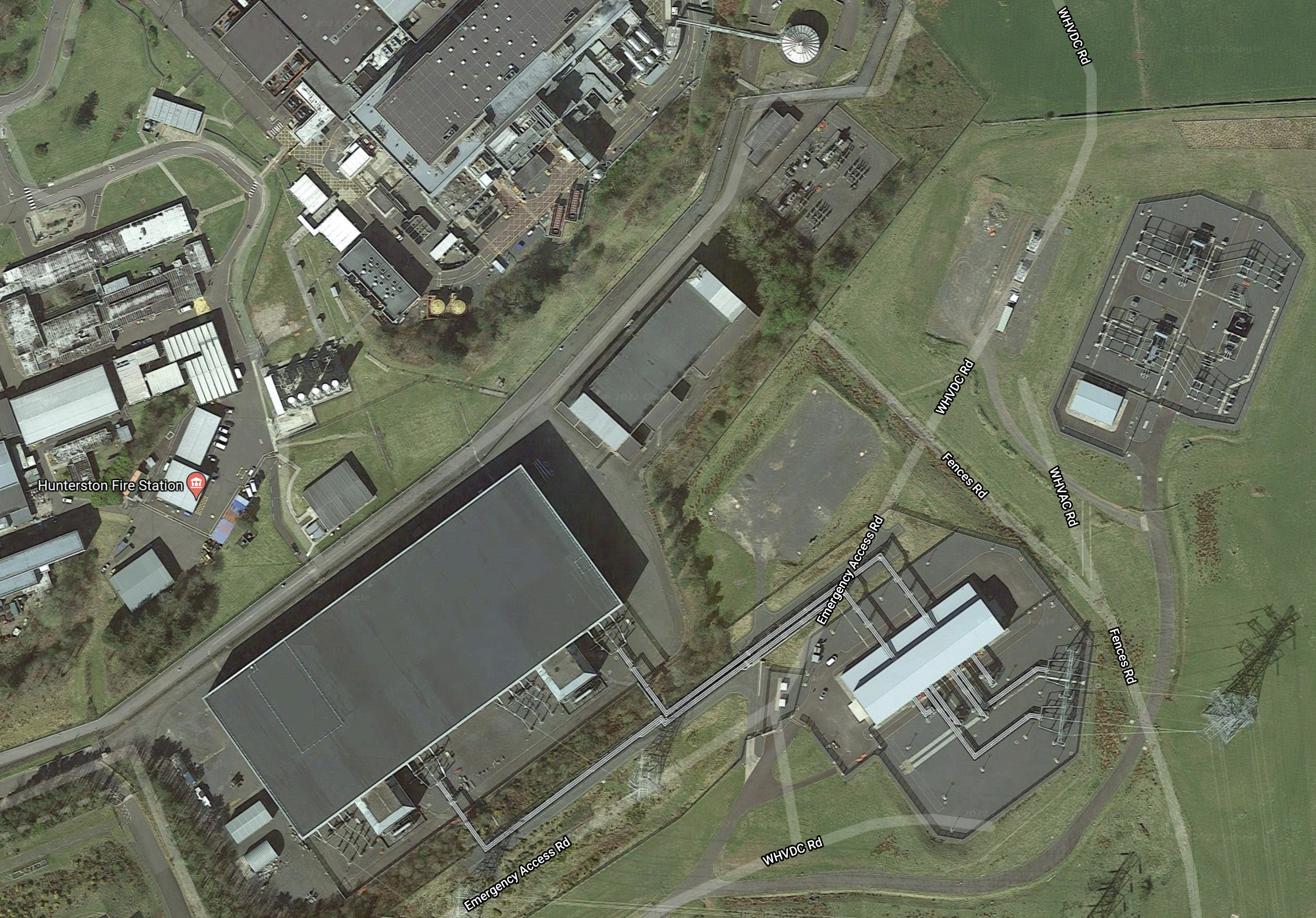
It’s certainly got a good grid connection.
But then it had to support.
- The Hunterston A nuclear power station rated at 360 MW.
- The Hunterston B nuclear power station rated at 1.2 GW.
- The Western HVDC Link, which is an interconnector to Connah’s Quay in North Wales, that is rated at 2.2 GW.
I’m sure that National Grid has a suitable socket for a 400 MW battery.
This Google Map shows the Kincardine area.
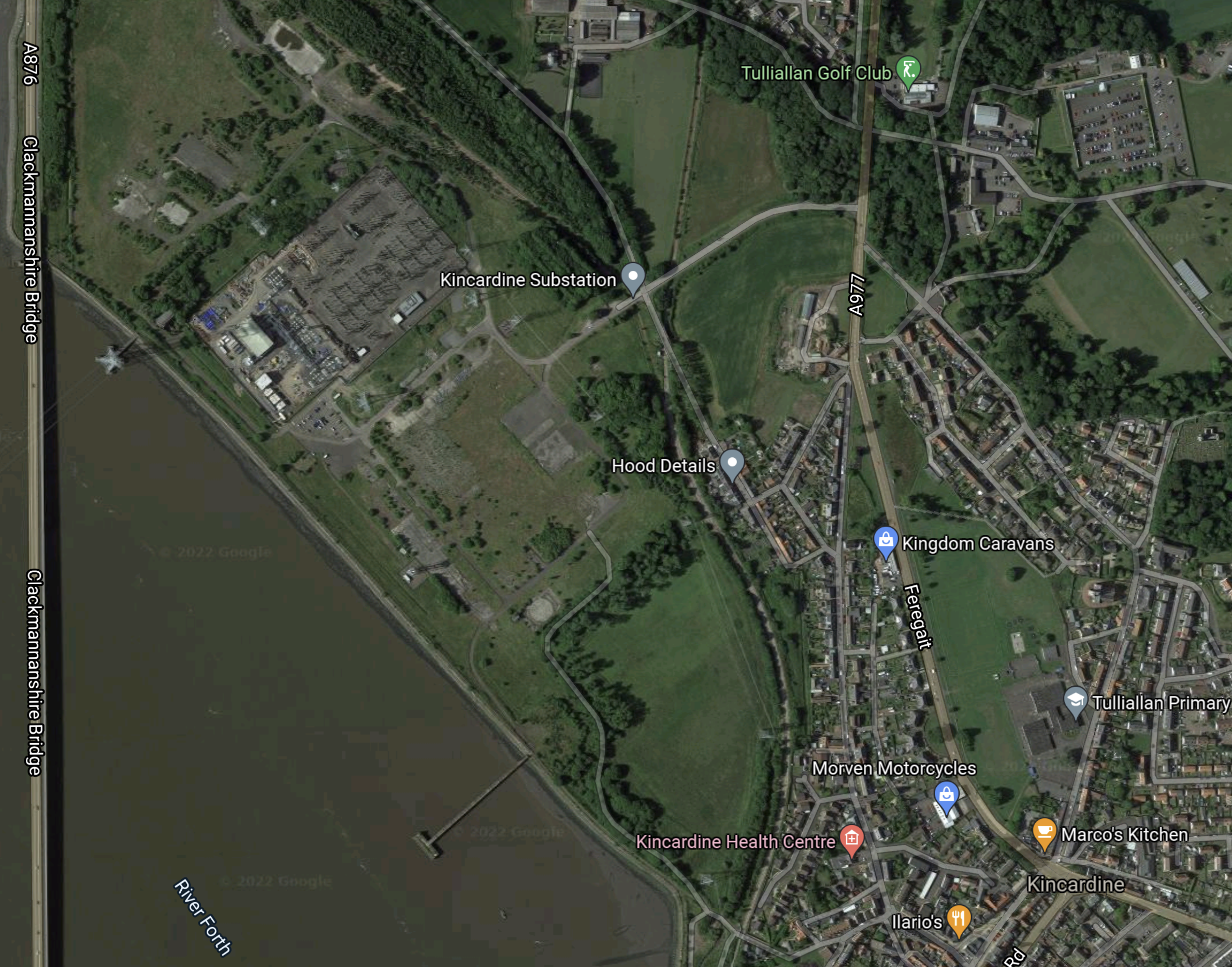
Note.
- The Clackmannanshire Bridge down the Western side of the map.
- The Kincardine Substation to the East of the bridge close to the shore of the River Forth.
- The 760 MW Kincardine power station used to be by the substation, but was demolished by 2001.
As at Hunterston, I’m sure that National Grid could find a suitable socket for a 400 MW battery.
Amp Energy’s Philosophy
As a trained Control Engineer I like it.
- Find a well-connected site, that can handle upwards of 400 MW in and out.
- Put in a 800 MWh battery, that can handle 400 MW in and out.
- Optimise the battery, so that it stores and supplies electricity as appropriate.
- Throw in a bit of artificial intelligence.
Old power station sites would seem an ideal place to site a battery. Especially, as many demolished coal, gas and nuclear stations are around 400-600 MW.
It should be noted that Highview Power are building a 50 MW/400 MWh CRYOBattery on an old coal-fired power station site in Vermont.
The Western HVDC Link
I mentioned earlier that the Northern end of the Western HVDC Link, is at Hunterston.
The Wikipedia entry for the Western HVDC Link, says this about the link.
The Western HVDC Link is a high-voltage direct current (HVDC) undersea electrical link in the United Kingdom, between Hunterston in Western Scotland and Flintshire Bridge (Connah’s Quay) in North Wales, routed to the west of the Isle of Man.[2] It has a transmission capacity of 2,250 MW and became fully operational in 2019.
The link is 262 miles long.
This Google Map shows the Connah’s Quay area in North Wales.
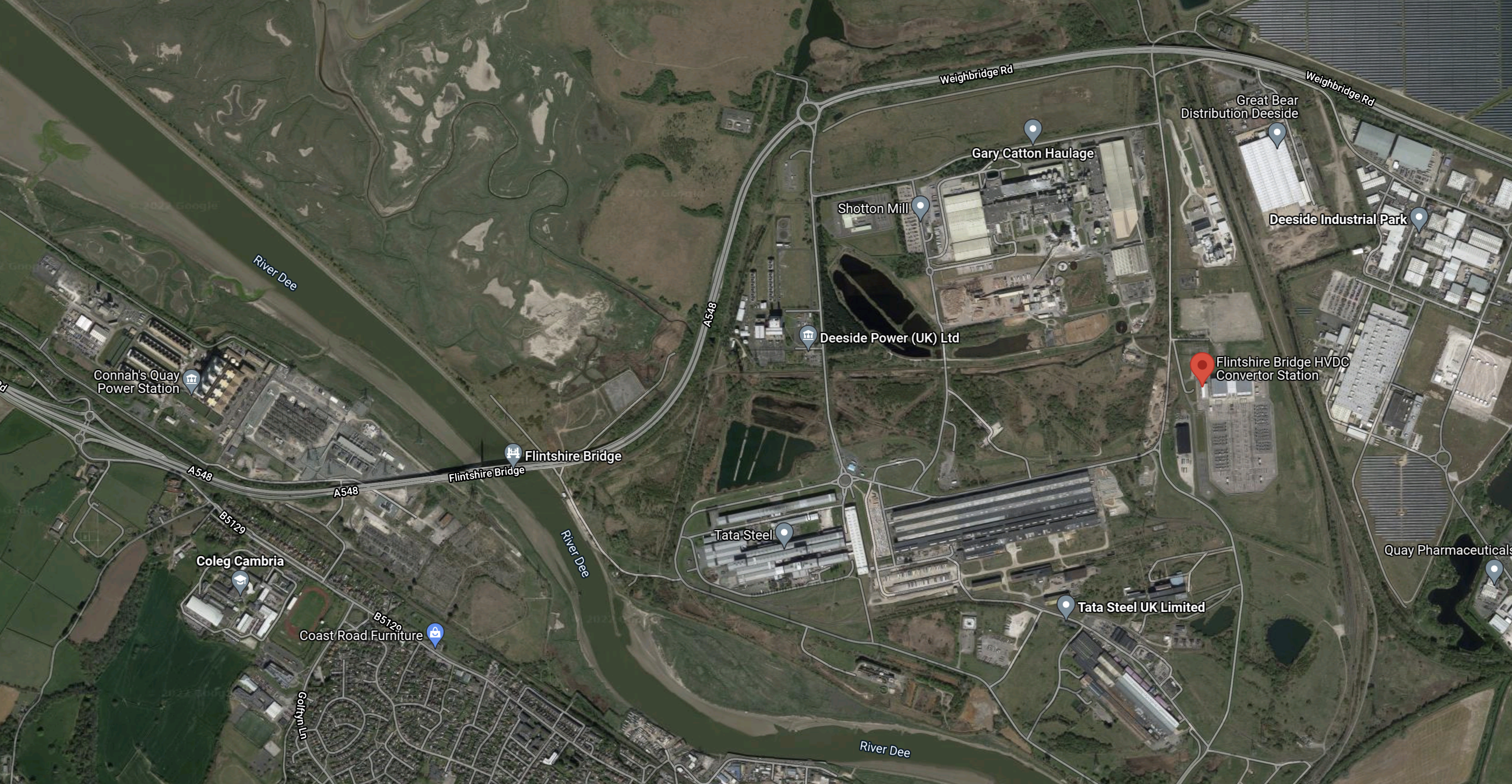
Note.
- The red arrow indicates the Flintshire Bridge HVDC converter station, which is the Southern end of the Western HVDC Link.
- The Borderlands Line between Liverpool and Chester, runs North-South to the East of the convertor station.
- To the East of the railway are two solar farms. The Northern one is Shotwick Solar Park, which at 72 MW is the largest solar farm in the UK.
- To the West of the converter station, just to the East of the A 548 road, is the 498 MW Deeside power station.
- Follow the A548 road to the West and over the River Dee, the road passes South of the 1420 MW Connah’s Quay Power station.
- The two power stations burn gas from Liverpool Bay.
- There are a lot of wind turbines along the North Wales Coast and Liverpool Bay.
The map also shows a lot of high electricity users like Tata Steel.
I can certainly see why the Western HVDC Link was built to connect Scotland and North Wales.
- There is a lot of renewable energy generation at both ends.
- There are heavy electricity users at both ends.
- The Scottish Central Belt is at the North.
- Greater Merseyside is at the South.
The Western HVDC Link is an electricity by-pass, that must have avoided expensive and controversial construction on land.
I wouldn’t be surprised to see another 400 MW/800 MWh battery at the Southern end.
Conclusion
The Canadians seem to have bagged two of the best battery sites in Europe.
- Both sites would appear to be able to handle 400 MW, based on past capabilities.
- There is lots of space and extra and/or bigger batteries can probably be connected.
- Scotland is developing several GW of wind power.
I can see Amp Energy building a series of these 400 MW sites in the UK and around Europe.
This is the big news of the day!
Oman And BP Sign Renewable Hydrogen Partnership On Mega-Gigawatt Scale
The title of this post, is the same as that of this article on Hydrogen Fuel News.
This is the introductory paragraph.
Oman has announced that it has entered into an agreement with BP, in which the energy giant will support the country’s development of mega-gigawatts of renewable hydrogen and energy by 2030.
Wind and solar power will be developed on 8,000 square kilometres of land.
Drax’s Plans For Cruachan
Cruachan Power Station is a pumped-storage hydroelectric power station in Argyll and Bute, Scotland.
- It can generate 440 MW of power.
- It has a storage capacity of 7.1 GWh.
- The power station is owned by Drax.
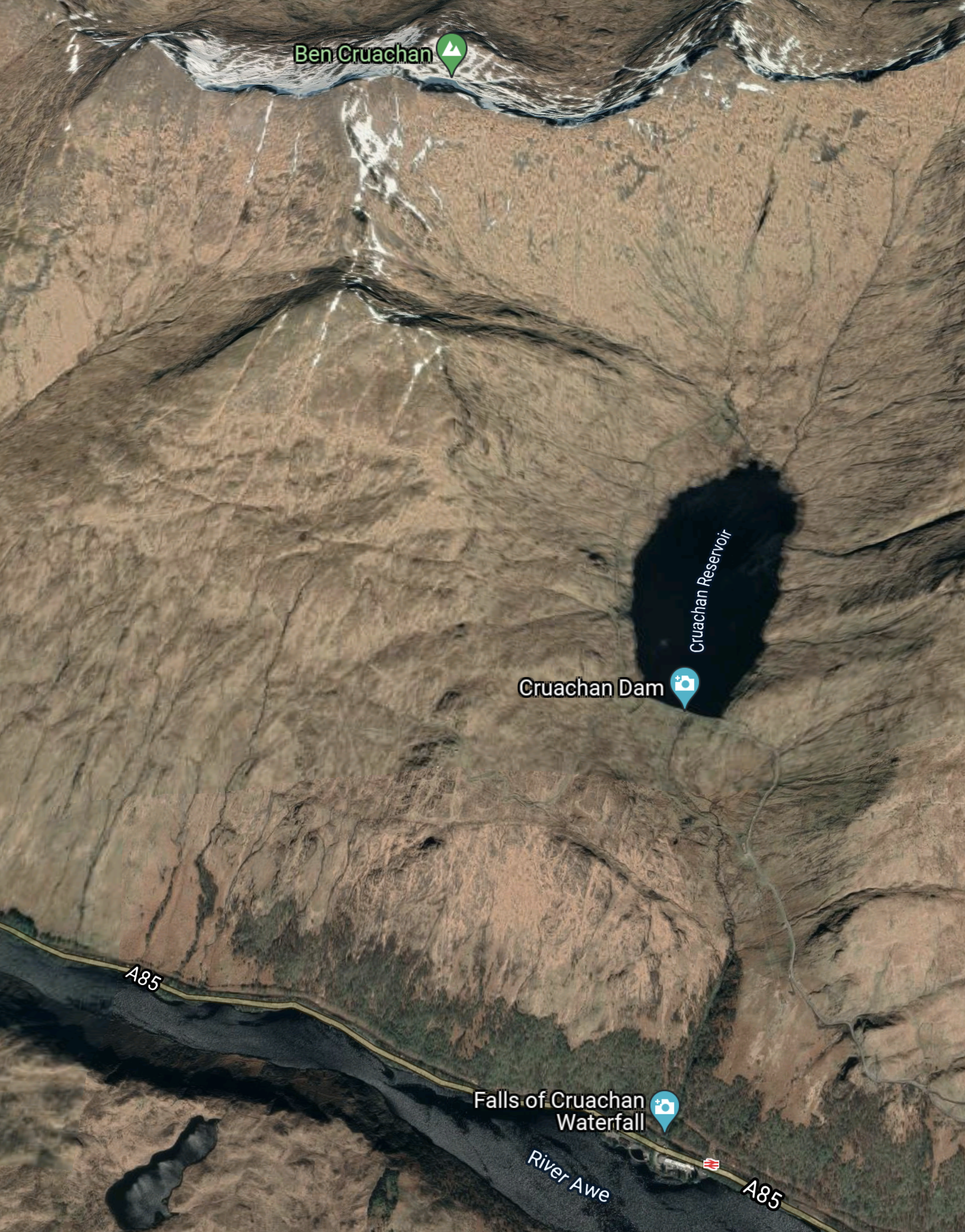
This Google Map shows the area around the power station.
Note.
- Cruachan Reservoir is the upper reservoir for the power station.
- The River Awe is the lower reservoir.
- The turbines for the power station are in a hollowed-out Ben Cruachan.
- There is a visitor centre, which is two-hundred metres from the Falls of Cruachan station, that can be seen on the map, by the river.
More information on visiting can be found at the Visit Cruachan web site.
This second map shows the Southern part of the Cruachan Reservoir to a larger scale.
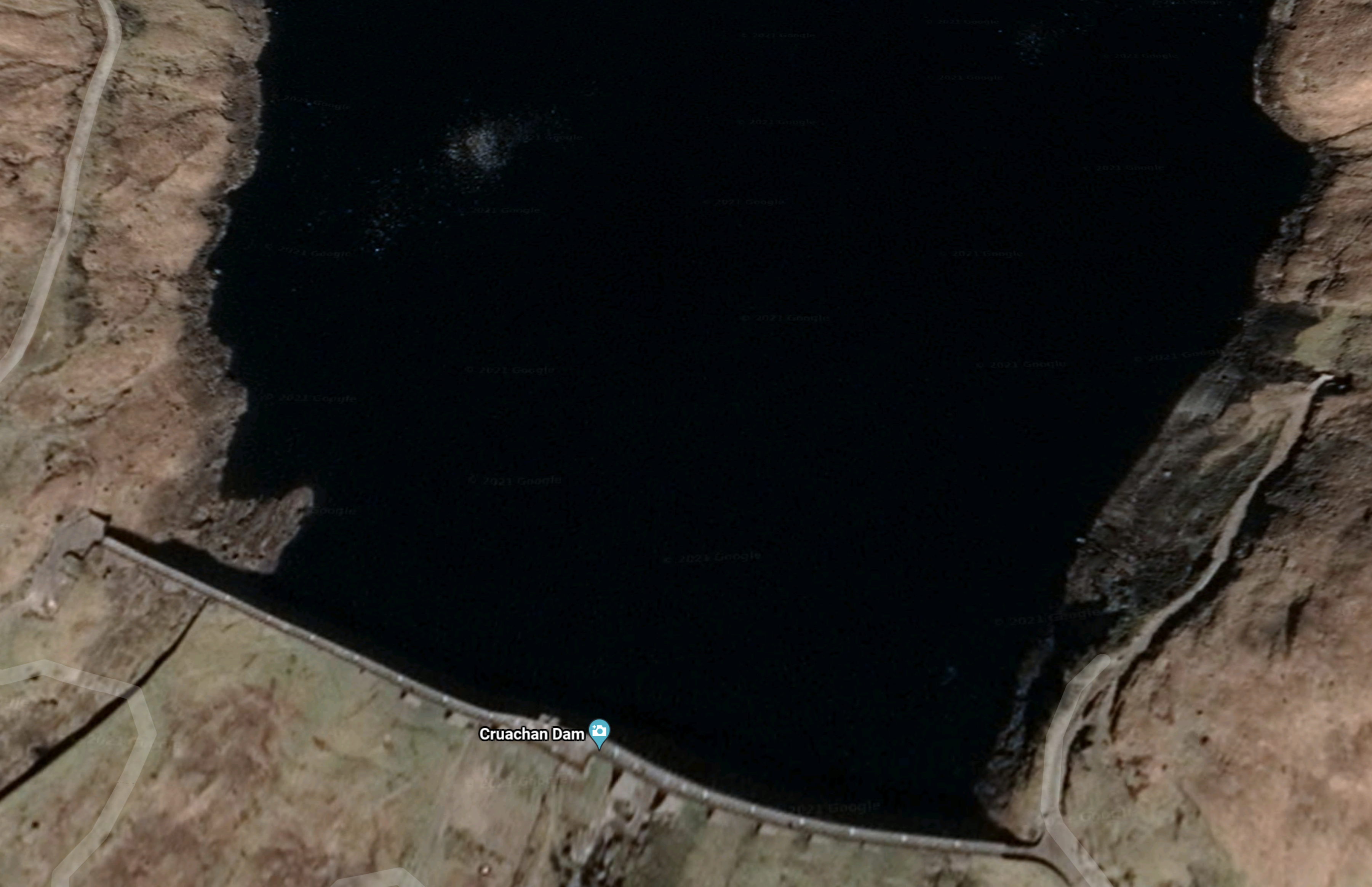
Note the strength of the dam.
The Operation Of Cruachan Power Station
Wikipedia says this about the operation of Cruachan power station.
The station is capable of generating 440 megawatts (590,000 hp) of electricity from four turbines, two of 100 megawatts (130,000 hp) and two of 120 megawatts (160,000 hp) capacity, after two units were upgraded in 2005. It can go from standby to full production in two minutes, or thirty seconds if compressed air is used to start the turbines spinning. When the top reservoir is full, Cruachan can operate for 22 hours before the supply of water is exhausted. At full power, the turbines can pump at 167 cubic metres (5,900 cu ft) per second and generate at 200 cubic metres (7,100 cu ft) per second.
What I find surprising, is that they only upgraded two turbines to 120 MW. I would suspect that there was some other factor that stopped all turbines from being upgraded.
So I would be very surprised if Drax upgraded the power of the existing station.
The Wikipedia extract claims that the Cruachan power station can provide power for 22 hours, if the reservoir, which has a capacity of 7.1 GWh is full. A simple calculation gives an average output in 323 MW. Does that indicate an efficiency of 73.4 %, by dividing 323 by 440.
But no pumped storage system of the 1950s is 100 % efficient. The Ffestiniog Power Station, which opened two years before Cruachan has an efficiency of 73 %. , which appears to be in line with the figures for Cruachan.
Cruachan Power Station And Nuclear Power
Wikipedia says this about Cruachan power station and Hunterston A nuclear power station.
Construction began in 1959 to coincide with the Hunterston A nuclear power station in Ayrshire. Cruachan uses cheap off-peak electricity generated at night to pump water to the higher reservoir, which can then be released during the day to provide power as necessary.
Note.
- Hunterston A power station closed in 1990.
- Hunterston B power station closed a few days ago.
- Scotland now only has one nuclear station at Torness.
It looks like the method of operation will have to change.
Cruachan Power Station And Wind Power
The obvious replacement source of energy at night to replace the nuclear power is wind power.
As I write this the UK is generating 8.5 GW of power from wind turbines.
Surely, enough can be diverted to Cruachan to fill the Cruachan Reservoir.
Cruachan 2
Drax’s plans for Cruachan are based around the building of a second underground power station, which is not surprisingly called Cruachan 2. This page on the Drax web site describes Cruachan 2.
- It will be a 600 MW power station.
- It will be to the East of the current power station.
- More than a million tonnes of rock would be excavated to build the power station.
The existing upper reservoir, which can hold 2.4 billion gallons of water, has the capacity to serve both power stations.
I think it is reasonable to assume the following about Cruachan 2.
- Design of the turbines will have improved in the sixty years since the Francis turbines for the original power station were ordered and designed.
- The turbines will now be precisely computer-controlled to optimise the operation of the power station.
- The turbines will have a faster response, than even that of Cruachan 1, which will help to match output to demand.
But most importantly, I suspect that the efficiency will be higher due to improved turbine design.
I can do a simple calculation, where I will assume the following figures for the two power stations.
- Cruachan 1 – 440 MW – Efficiency – 73 % – Full Power – 323 MW
- Cruachan 2 – 600 MW – Efficiency – 80 % – Full Power – 480 MW
It looks to me that 1040 MW can be used to store water in the reservoir and at this rate it would take 6.8 hours to fill the reservoir. With just Cruachan 1 in operation, filling the reservoir would take sixteen hours.
It looks like with moderate winds generating sensible amounts of electricity, it should be possible to fill the reservoir overnight using both Cruachan 1 and Cruachan 2.
When running flat-out, the combined station can generate 803 MW. At that rate it will generate the power for just under nine hours.
The Wikipedia entry for Francis turbines says this.
Francis turbines are the most common water turbine in use today, and can achieve over 95% efficiency.
Applying 95 % Efficiency to Cruachan 2 would give the following.
- An output of 570 MW for Cruachan 2.
- A total output of 1010 MW for the combined station.
- This would mean the combined station could deliver 1.01 GW for just over seven hours.
Modern control technology would probably be used to ensure that the output of the combined Cruachan station filled in the gaps between demand and supply.
Could The Size Of Cruachan Reservoir Be Increased?
This would increase the amount of energy stored.
I suspect that it probably can’t be increased, as any increases would have been done by now.
Conclusion
It looks like very good engineering to me.
- There is a good chance, that on most nights, the reservoir will be filled using wind energy
- The maximum output of the Cruachan power station has been more than tripled from 323 to 1010 MW.
- There has been no increase in the size of the Cruachan reservoir.
Scotland will now have a GW-sized hydro-electric power station.
Why Use A Hydrogen Pipeline Rather Than A Electricity Cable To Bring Electricity Ashore From A Windfarm?
A comment to the post entitled Siemens Gamesa Partners On Offshore Wind-to-Hydrogen, was as follows.
Trying to get my head around this concept. Build an electrolysis plant in the North Sea and run a hydrogen pipeline to shore, rather than generating electricity and transferring the power by undersea cable to a shore based electrolysis plant. Can it really be better technically and economically? Someone convince me.
The reasons probably all come down to saving money and hassle.
Reusing Existing Infrastructure
Supposing, you have an offshore gas field, which is on the point of being worked out.
- It has a well-maintained platform on top.
- It has a pipe to an onshore terminal that handles the natural gas and distributes it to end-users.
Supposing the following are possible.
- Building a large wind farm in the vicinity of the platform.
- Using the gas field for hydrogen storage.
- Converting the gas terminal from natural gas to hydrogen.
- The end-users can convert to hydrogen.
In some cases the end-users might even prefer hydrogen to natural gas, to help their own decarbonisation.
I would suspect that there will be a sound economic case to use hydrogen, where wind farms are developed, in the same areas as worked-out gas fields.
- Platform demolition costs are deferred.
- No HVDC link is needed, with an expensive converter station at the shore end.
- The new system comes with energy storage.
The only extra cost might be that an offshore electrolyser is more expensive than an onshore one.
Engineering Resources
The engineering resources needed for a gas pipeline are different to those needed for an electrical system.
But because gas pipelines are a declining industry, they will be readily available.
Less Planning Hassle
There have been some objections to the development of wind farm terminals by Nimbies.
If a terminal is converted from natural gas to hydrogen, I suspect there will be fewer objections.
Better Control Of Wind Farms
There have been stories of wind farms having to be switched off because there is no-one to buy the electricity.
If some form of offshore hydrogen storage is possible, then the electricity can be used to generate hydrogen, which can be piped ashore, when it is needed.
It Won’t Be One Type Fits All
I suspect we’ll see some hybrid systems and other innovative engineering.
Conclusion
I believe that in a drive to cut costs, we’ll see a lot of energy brought ashore as hydrogen gas.
I
Future Offshore Wind Power Capacity In The UK
I am building this table, so that I can get a feel for the electricity needs of the UK.
According to Wikipedia, on February 2020, there were thirty six offshore wind farms consisting of 2180 turbines with a combined capacity of 8113 megawatts or 8.113 gigawatts.
Currently, these offshore wind farms are under construction, proposed or are in an exploratory phase.
- Triton Knoll – 857 MW – 2021 – Under Construction
- Hornsea Two – 1386 MW – 2022 – Under Construction
- Moray East – 960 MW – 2022 – Under Construction
- Neart Na Gaoithe – 450 MW – 2023 – Under Construction
- Seagreen Phase 1 – 1075 MW – 2023 – Under Construction
- Dogger Bank A – 1200 MW – 2023/24 – Proposed
- Dogger Bank B – 1200 MW – 2024/25 – Proposed
- Dogger Bank C – 1200 MW – 2024/25 – Proposed
- Moray West – 1200 MW – 2024/25 – Exploratory
- Hornsea Three – 2400 MW – 2025 – Proposed
- East Anglia One North 800 MW – 2026 – Exploratory
- East Anglia Two – 900 MW – 2026 – Exploratory
- East Anglia Three – 1400 MW – 2026 – Exploratory
- Sofia Offshore Wind Farm Phase 1 – 1400 MW – 2023/2026 – Under Construction
- Hornsea Four – 1000 MW (?) – 2027 – Exploratory
- Rampion Two Extension – 1200 MW – Exploratory
- Norfolk Vanguard – 1800 MW – Exploratory
- Norfolk Boreas – 1800 MW – Exploratory
Note.
- The date is the possible final commissioning date.
- I have no commissioning dates for the last three wind farms.
- Wikipedia says that the Hornsea Four capacity is unknown by Ørsted due to the ever increasing size of available wind turbines for the project.
I can total up these wind farms by commissioning date.
- 2021 – 857 MW
- 2022 – 2346 MW
- 2023 – 1525 MW
- 2024 – 1200 MW
- 2025 – 6000 MW
- 2026 – 4500 MW
- Others – 5800 MW
I can draw these conclusions.
- Total wind farm capacity commissioned each year is increasing.
- It looks like there will be a capacity to install up to 5000 or 6000 MW every year from about 2025.
- If we add my figures for 2021-2026 to the 8113 MW currently installed we get 24541 MW.
- Adding in 6000 MW for each of the four years from 2027-2030 gives a total of 48541 MW or 48.5 GW.
As I write this on a Sunday afternoon, wind power (onshore and offshore) is supplying 13 GW or forty-four percent of our electricity needs.
I have further thoughts.
Parallels With North Sea Oil And Gas
I was very much involved in the development of North Sea oil and gas, as my software was used on a large number of the projects. I had many discussions with those managing these projects and what was crucial in shortening project times was the increasing availability of bigger rigs, platforms and equipment.
Big certainly was better.
I believe that as we get more experienced, we’ll see bigger and better equipment speeding the building of offshore wind farms.
Reuse of Redundant North Sea Oil And Gas Platforms
Don’t underestimate the ability of engineers to repurpose redundant oil and gas platforms for use with windfarms.
Electrolysers on the platforms can convert the electricity into hydrogen and use redundant gas pipes to bring it ashore.
Some processes like steelmaking could use a lot of hydrogen.
Platforms can be used as sub-stations to collect electricity from windfarms and distribute it to the various countries around the North Sea.
Hydrogen
Some processes like steelmaking could use a lot of hydrogen. And I don’t think steelmakers would be happy, if the supply was intermittent.
So why not produce it with giant electrolysers on redundant oil and gas platforms and store it in redundant gas fields under the sea?
A large store of hydrogen under the sea could have the following uses.
- Steelmaking.
- Feedstock for chemical manufacture.
- Transport
- Power generation in a gas-fired power station, that can run on hydrogen.
It would just need a large enough hydrogen store.
Energy Storage
This large amount of wind power will need a large amount of energy storage to cover for when the wind doesn’t blow.
Some of this storage may even be provided by using hydrogen, as I indicated previously.
But ideas for energy storage are coming thick and fast.
The North Sea Link To Norway
The North Sea Link is much more important than an interconnector between Blyth in Northumberland and Norway.
- At the Norwegian end the link is connected to a vast pumped storage energy system in the mountains of Norway.
- This pumped storage system is filled in two ways; Norwegian rain and snow and UK wind power through the interconnector.
- In times of need, we can draw electricity through the interconnector from Norway.
- It has a capacity of 1.4 GW.
- It was delivered on time for a cost of around €2 billion.
It can almost be thought of as an international bank of electricity and is probably one of the most significant pieces of European infrastructure built in recent years.
There are also plans to build NorthConnect, that would connect Peterhead in Scotland to Norway.
Conclusion
It looks like we’ll be able to reap the wind. And possibly 50 GW of it!
The African Nation Aiming To Be A Hydrogen Superpower
The title of this post, is the same as that as this article on the BBC.
It is a fascinating tale of how Namibia aims to modernise its economy, by becoming a major producer of hydrogen using electricity generated by wind and solar power.
Conclusion
Could other countries follow Namibia’s lead?
When Will Energy Storage Funds Take The Leap To New Technology?
This article on the Motley Fool is entitled 3 UK Dividend Shares To Buy Yielding 6%.
This is a paragraph from the article.
The first company on my list is the Gore Street Energy Storage Fund (LSE: GSF). With a dividend yield of just over 6%, at the time of writing, I think this company looks incredibly attractive as an income investment. It is also an excellent way for me to build exposure to the green energy industry.
Just as everybody has a fridge in their house to stop food being wasted, electricity networks with a lot of intermittent resources like wind and solar, needs a device to store electricity, so that it isn’t wasted.
Gore Street Energy Storage Fund is being very safe and conservative at the current time, often using batteries from one of Elon Musk’s companies.
You can’t fault that, but they are only barely making a dent in the amount of batteries that will be needed.
If we are generating tens of GW of wind energy, then we need batteries at the GWh level, whereas at the moment a typical battery in Gore Street’s portfolio has only an output of a few megawatts. They don’t state the capacity in MWh.
There is this statement on their web site, about the technology they use.
Although the projects comprising the Seed Portfolio utilise lithium-ion batteries and much of the pipeline of investments identified by the Company are also expected to utilise lithium-ion batteries, the Company is generally agnostic about which technology it utilises in its energy storage projects. The Company does not presently see any energy storage technology which is a viable alternative to lithium-ion batteries. However, there are a number of technologies which are being researched which if successfully commercialised, could prove over time more favourable and the Company will closely monitor such developing technologies.
They say they are agnostic about technology and are looking around, but they are sticking with lithium-ion technology.
That technology works, is safe and gives a good return.
But they are at least thinking about moving to new technology.
In the rail industry, it is common for rail leasing companies to get together with train manufacturers or remanufacturers to develop new trains.
As an example, Eversholt Rail and Alstom formed a partnership to develop a hydrogen-powered train for the UK, which I wrote about in Alstom And Eversholt Rail Sign An Agreement For The UK’s First Ever Brand-New Hydrogen Train Fleet.
Worldwide, there are probably upwards of a dozen very promising energy storage technologies, so I am very surprised that energy storage funds, like Gore Street and Gresham House have not announced any development deals.
Conclusion
Energy storage funds could benefit from using some of the financing methods used by rolling stock leasing companies.
Siemens Gamesa Partners On Offshore Wind-to-Hydrogen
The title of this post, is the same as that of this article on renews.biz.
This is the first three paragraphs.
Siemens Gamesa has signed a memorandum of understanding with Strohm to collaborate on the development of offshore wind-to-hydrogen infrastructure.
The partnership will focus on the advancement of hydrogen transfer solutions that will look to improve the decentralized green hydrogen concept, whereby green hydrogen is generated in each turbine generator and transported to shore by a subsea pipe.
In this concept power cables are replaced by a pipe infrastructure used for storing and transferring hydrogen.
Thermoplastic composite pipe (TCP) will be used.
Singapore-Based Enterprize To Build $10bn Wind Farm Off Irish Coast
The title of this post, is the same as that of this article on the Irish Times.
This is the first paragraph.
A Singapore-based offshore wind developer has signed an agreement to build a huge $10 billion (€8.88 billion) wind farm off the coast of Ireland to power a green hydrogen facility.
This is certainly a large investment.
- The windfarm will have a capacity of 4 GW.
- Hydrogen will be produced for the Irish market and some will be converted to ammonia for export.
- The hydrogen will be produced at the Green Marlin hydrogen facility at Bantry Bay.
- I’ve not heard of Enterprize before, but the company is also developing a 3.4 gigawatt offshore wind farm in Vietnam and is looking at Brazil.
Enterprize Energy are obviously very ambitious.
This article on Fuel Cell Works, which is entitled Zenith Energy And EI-H2 Announce Joint Venture For Green Facility At Bantry Bay, gives more details of the Green Marlin project.
Conclusion
There are some big companies investing billions of pounds, dollars and euros in hydrogen.
Whitelee Green Hydrogen Facility To Power Public Transport
The title of this post, is the same as that of this article on the BBC.
Some points from the article.
- It will be the country’s largest electrolyser. Is that Scotland or the UK?
- The facility is being built by Scottish Power, ITM Power and BOC.
- Friends of the Earth think it’s wrong and the electricity should be used immediately.
In ScottishPower’s Green Hydrogen Project Looks To Build UK’s Largest Electrolyser, the title says that the Whitelee project will be the UK’s largest electrolyser.

