New HS2 Pilot Project Swaps Steel For Retired Wind Turbine Blades To Reinforce Concrete
The title of this post, is the same as that of this press release from High Speed Two.
These are the first three paragraphs.
Worn-out wind turbine blades destined for the incinerator will instead be used to create carbon-friendly reinforced concrete on Britain’s new high speed rail network, HS2 Ltd has said today (12.03.21).
The innovative project will swap steel rebar, traditionally used to reinforce concrete, with sections of glass fibre reinforced polymer turbine blades that have reached the end of their operational lives generating low carbon electricity.
By 2023, around 15,000 turbine blades will have been decommissioned across the UK and EU. Until now, expired blades have either been ground down to be used as building materials or sent to energy-from-waste incinerators.
Replacing reinforcing steel with sections of retired wind turbine blades is claimed to cut up to 90 % of the carbon generated by steel reinforcement.
It would appear to me, that this is a worthwhile process.
- In 2018, 295,000 metric tons of steel reinforcing bars were produced in the UK.
- Retired blades don’t end up in landfill or incinerators.
- Could we export them as eco-friendly reinforcing bars, to countries with smaller wind industries.
As we have more wind farms, than most other countries, we will probably have more blades to recycle, so perhaps we should research other secondary uses for these blades.
Wind Farms On The East Coast Of Scotland
This map shows the proposed wind farms off the East coast of Scotland.
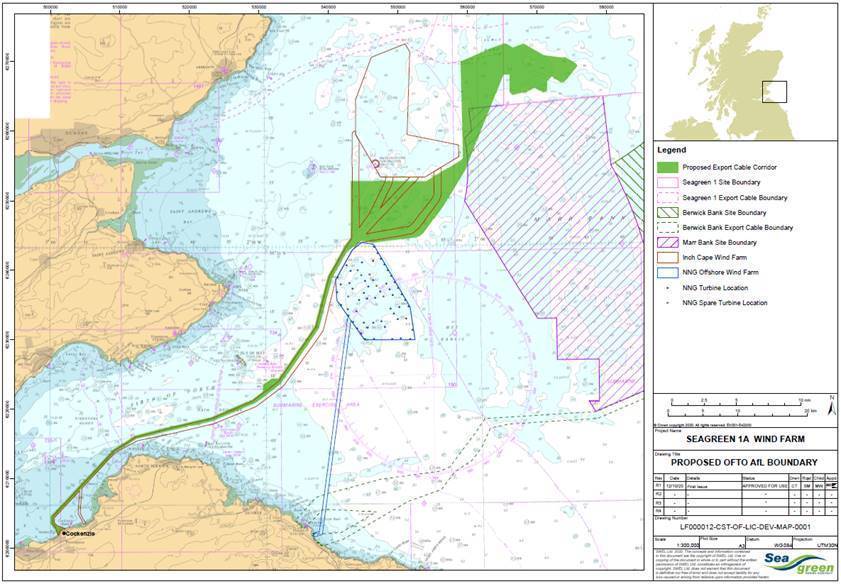
There are five wind farms in the map.
- The green area is the cable corridor for Seagreen 1a
- Inch Cape is the odd-shaped wind farm to the North and West of the green area
- Seagreen at the top of the map, to the North of Inch Cape.
- Marr Bank with the pink NE-SW hatching
- Berwick Bank with the green NW-SE hatching
- Neart Na Gaoithe is edged in blue to the South of the green area.
Berwick Bank and Marr Bank are both owned by SSE and appear to have been combined.
These are some more details on each of the now four wind farms.
Seagreen
These are details of the Seagreen wind farm.
- Seagreen will be Scotland’s largest and the world’s deepest offshore wind farm when complete.
- The first phase will have 114 turbines and a capacity of 1075 MW.
- It will connect to the grid at a new substation at Tealing near Dundee.
- The cables will run to the North of the Inch Cape wind farm.
- It will be completed in 2023.
- The second phase (1a), will have 36 turbines.
- It may have larger turbines.
- The cables will run in the green area to Cockenzie in East Lothian.
This press release from SSE is entitled Another Milestone For Scotland’s Largest Offshore Wind Farm As 4,800 Tonnes Offshore Platform Completed.
This is the first paragraph.
The topside forms the backbone of the offshore wind farm. At 40 metres long, 45 metres wide and 15 metres high, the heavyweight superstructure’s role is to collect and manage 1,075MW of power generated by the 114 Vestas wind turbines before transferring it ashore via around 60km of offshore subsea cabling.
This platform is used to connect the 114 turbines to the shore.
Inch Cape
This paragraph from the home page of the Inch Cape web site, describes the wind farm.
The Inch Cape Offshore Wind Farm, currently in late stage development, will see up to 72 turbines located 15 km off the Angus Coast and connect to the National Grid at Cockenzie, East Lothian. Once complete, it will be one of Scotland’s largest single sources of renewable energy and power up to 1 million homes with clean electricity.
The home page says it will generate up to 1 GW of electricity.
Neart Na Gaoithe
This sentence for the Wikipedia entry for the Neart Na Gaoithe web site describes the wind farm.
It is being developed by Mainstream Renewable Power at a cost of £1.4bn. Offshore work began in 2020, with completion planned for 2023.
The Wikipedia entry says it will generate up to 450 MW of electricity.
Berwick Bank
These two paragraphs from the project page of the Berwick Bank web site describes the wind farm.
Located in the North Sea, in the outer Firth of Forth, Berwick Bank Offshore Wind Farm has the potential to deliver up to 4.1 GW of installed capacity, making it one of the largest offshore opportunities in the world.
Berwick Bank Wind Farm is in the development stage and previously the project was comprised of two separate proposals, Berwick Bank Wind Farm and Marr Bank Wind Farm. Following initial rounds of consultation, it has been decided to combine our proposals into one single opportunity – Berwick Bank Wind Farm.
At 4.1 GW, Berwick Bank is a big wind farm.
The capacity of the four farms can be summarised as follows.
- Seagreen – 1075 MW
- Neart Na Gaoithe – 450 MW
- Inch Cape – 1000 MW
- Berwick Bank – 4100 MW
This gives a total of 6625 MW.
Scotland’s Energy Storage
I have been using the web sites of Drax Group, SSE Renewables and ILI Group, and this page from Strathclyde University to look at various hydro-electric schemes to store energy using the tried-and-tested method of pumped hydro.
I have analysed these schemes.
Affric/Beauly
The scheme is now owned by SSE Renewables and has a page on their web site, which introduces the scheme like this.
Situated about 16 kilometres to the west of Inverness, Beauly is the gateway to the Affric/Beauly hydro electric scheme.
Currently, it generates a maximum power of 100.3 MW.
My analysis in Repurposing The Affric/Beauly Hydro-Electric Scheme, showed the following.
- Research from Strathclyde University, says that the Affric/Beauly scheme could support 78 GWh of pumped storage in one scheme at Fasnakyle.
- Adding pumped storage facilities to the Affric/Beauly hydro-electric scheme, with a capacity of upwards of a conservative 50 GWh, should be possible.
Generating capacity and system operation could be improved by replacing some or all of the 1950s and 1960s turbines with modern units and using modern control systems.
The Affric/Beauly hydro-electric scheme could be augmented by upwards of 50 GWh of storage.
Balliemeanoch
This new scheme is being developed by the ILI Group.
From what is published in the press. it appears to be a giant 1.5 GW/45 GWh project.
In Thoughts On The Balliemeanoch Pumped-Hydro Scheme, I analyse the plan.
The Balliemeanoch hydro-electric scheme could add 45 GWh of storage.
Balmacaan
This new scheme is being developed by SSE Renewables.
My searches in A Possible Balmacaan Pumped Storage System, showed the following.
It has a 600 MW generating capacity and I suspect would have about 15-20 GWh of storage.
The Balmacaan hydro-electric scheme could conservatively add upwards of 15 GWh of storage.
Breadalbane
The scheme is now owned by SSE Renewables and has a page on their web site, which introduces the scheme like this.
The Breadalbane scheme is set in the mountainous region around Loch Lyon, Loch Tay and Loch Earn in Perthshire.
Currently, it generates a maximum power of 168.4 MW.
My analysis in Repurposing The Breadalbane Hydro-Electric Scheme, showed the following.
- Research from Strathclyde University, says that the Breadalbane scheme could support 12 GWh of pumped storage in one scheme at Ben Lawers.
- I believe a similar scheme could be built South of Loch Tay to add a similar amount of pumped storage capacity.
As with the Beauly/Affric scheme, generating capacity and system operation could be improved by replacing some or all of the 1950s and 1960s turbines with modern units and using modern control systems.
The Breadalbane hydro-electric scheme could be augmented by upwards of 12 GWh of storage.
Coire Glass
This new scheme is being developed by SSE Renewables and the project has its own web site, which introduces the scheme like this.
Coire Glas is a hydro pumped storage scheme with a potential capacity of up to 1500MW. Coire Glas is an excellent pumped storage site with a large lower reservoir (Loch Lochy) and a significant elevation of more than 500m between the lower and the new upper reservoir site over a relatively short distance.
It is planned to generate a maximum power of up to 1.5 GW for twenty hours, which indicates an energy storage capacity of 30 GWh.
In SSE Renewables Launches 1.5GW Coire Glas Construction Tender, I talk about the current status of the project.
The Coire Glas hydro-electric scheme could add 30 GWh of storage.
Conon
The scheme is now owned by SSE Renewables and has a page on their web site, which introduces the scheme like this.
The Conon scheme lies within the northwest Highlands, broadly between Inverness and Ullapool. Electricity generation started here when the Ross-shire Electricity Supply Company built the small Falls of Conon hydro electric power station in the 1920s.
Currently, it generates a maximum power of 107.2 MW.
My analysis in Repurposing The Conon Hydro-Electric Scheme, showed the following.
- Research from Strathclyde University, says that the Conon scheme could support up to 131 GWh of pumped storage.
- Adding pumped storage facilities to the Conon hydro-electric scheme, with a capacity of upwards of a conservative 30-40 GWh, should be possible.
As with other schemes, generating capacity and system operation could be improved by replacing some or all of the 1950s turbines with modern units and using modern control systems.
The Conon hydro-electric scheme could be augmented by upwards of 30 GWh of storage.
Corrievarkie
This new scheme is being developed by the ILI Group.
From the planning application it appears to be a 600 MW/14.5 GWh project.
In Corrievarkie Pumped Storage Hydro Project, I analyse the plan.
The Corrievarkie hydro-electric scheme could add 14.5 GWh of storage.
Cruachan
Cruachan is a pumped-storage power station, that is owned by Drax, which have a comprehensive web site for the power station.
- It has an output of 440 MW.
- It has an energy storage capacity of 7.1 GWh
- It can can reach full generating capacity in less than 30 seconds.
In Drax’s Plans For Cruachan, I analyse Drax’s plans, which they call Cruachan 2.
- It will be a 600 MW power station.
- It will be to the East of the current power station.
- More than a million tonnes of rock would be excavated to build the power station.
The existing upper reservoir, which can hold 2.4 billion gallons of water, has the capacity to serve both power stations.
These was my conclusions.
It looks like very good engineering to me.
- There is a good chance, that on most nights, the reservoir will be filled using wind energy
- The maximum output of the Cruachan power station has been more than tripled from 323 to 1010 MW.
- There has been no increase in the size of the Cruachan reservoir.
Scotland will now have a GW-sized hydro-electric power station.
It will not be very much smaller than Sizewell B nuclear station.
Foyers
The scheme is now owned by SSE Renewables and has a page on their web site, which introduces the scheme like this.
The current Foyers Power Station operates quite differently to conventional hydro electric power stations. Foyers hydro scheme consists of one pumped hydro power station and one hydro power station and one major dam..
Currently, it generates a maximum power of 305 MW.
My research and analysis in The Development Of The Foyers Pumped Storage Scheme, showed the following.
- Foyers is a modern pumped-hydro scheme with a capacity of 10 GWh.
- The updating of the original 1896 hydro-power station to a modern pumped-storage system in 1974 is a superb example of hydro-power engineering.
The development of Foyers power station is an example, that shows what can be done in other hydro-electric schemes around Scotland and the rest of the world.
Galloway
Galloway is a hydroelectric scheme, that is owned by Drax, which have a comprehensive web site for their two hydroelectric schemes in Scotland; Galloway and Lanark.
- Galloway has a total output of 109 MW.
- It has six power stations at Drumjohn, Kendoon, Carsfad, Earlstoun, Glenlee and Tongland.
- There is no energy storage
- It is what is known as a run-of-the-river scheme.
The scheme opened in the 1930s.
Glendoe
The scheme is now owned by SSE Renewables and has a page on their web site, which introduces the scheme like this.
In 2009, the first major hydro electric power station to be built in Scotland for almost 30 years, Glendoe on the eastern shore of Loch Ness, began generating electricity.
Currently, it generates a maximum power of 106.5 MW.
My analysis in Glendoe Hydro Power Station, led me to conclude, that engineers will look at this scheme built in the early years of this century to convert it to a pumped storage facility. It might even have been designed for conversion to a pumped storage station, as it was built after the successful conversion of Foyers power station. Comparing the size of the upper lake to Foyers and other schemes, I would estimate it could easily provide in excess of 15 GWh of storage.
The Glendoe hydro-electric scheme could be augmented by upwards of 15 GWh of storage.
Glenmuckloch
This is a small scheme promoted by Buccleuch, that generates 4 MW and stores 1.6 GWh in a disused opencast coal mine.
My analysis in The Glenmuckloch Pumped Storage Scheme, led me to this conclusion.
This project appears to have stalled, but I do like the idea of using a disused mine to store energy and the engineering behind the project.
I will ignore it in my conclusions of this post.
Great Glen
The scheme is now owned by SSE Renewables and has a page on their web site, which introduces the scheme like this.
The Great Glen runs for more than 100 kilometres from Inverness in the northeast, to Fort William in the southwest, following a geological fault line that divides north and south Scotland.
Currently, it generates a maximum power of 112.7 MW.
My analysis in Repurposing The Great Glen Hydro-Electric Scheme, showed the following.
- Research from Strathclyde University, says that the Great Glen scheme could support up to 90 GWh of pumped storage.
- Adding pumped storage facilities to the Great Glen hydro-electric scheme, with a capacity of upwards of a conservative 30 GWh, should be possible.
As with other schemes, generating capacity and system operation could be improved by replacing some or all of the 1950s and 1960s turbines with modern units and using modern control systems.
The Great Glen hydro-electric scheme could be augmented by upwards of 30 GWh of storage.
Lanark
Lanark is a hydroelectric scheme, that is owned by Drax, which have a comprehensive web site for their two hydroelectric schemes in Scotland; Galloway and Lanark.
- Lanark has a total output of 17 MW.
- It has two power stations at Bonnington and Stonebyres.
- There is no energy storage
- It is what is known as a run-of-the-river scheme.
The scheme opened in the 1920s.
Red John
This new scheme is being developed by ILI Group and the project has its own web site, which introduces the scheme like this.
Between 2007 and 2015, the total installed capacity of renewables electricity in Scotland has more than doubled. Due to its intermittent nature, the rise in renewable generation has resulted in increased demand for flexible capacity to help meet energy balancing requirements for the national grid system.
Pumped storage hydro is considered by the Directors to be the most developed and largest capacity form of grid energy storage that currently exists. This can help reduce renewable energy curtailment and therefore promote grid stability.
The web site says this about the project.
- The scheme has an output of 450 MW.
- The storage capacity is 2.8 GWh.
- The scheme has planning consent.
- The project is budgeted to cost £550 million.
- The construction program indicates that the scheme will be completed by the end of 2025.
It also has very detailed maps.
I wrote about the project in Red John Pumped Storage Hydro Project, where I came to these conclusions.
- This scheme has the output of a large gas-fired power station for just over six hours.
- The finances must add up, as no-one would back a scheme like this if they didn’t get an adequate return on their money.
It may only be a small scheme, that is a quarter of the size of the existing nearby Foyers pumped-storage scheme, but as it is shovel-ready, we should start digging.
The Red John hydro-electric scheme would add 2.8 GWh of storage.
Shin
The scheme is now owned by SSE Renewables and has a page on their web site, which introduces the scheme like this.
Shin is Scotland’s most northerly hydro electric scheme. It utilises water from a 650 square kilometre catchment area in Sutherland, including Loch Shin, and water from the River Cassley and River Brora.
Currently, it generates a maximum power of 32.1 MW.
My analysis in Shin Hydro Power Scheme, showed the following.
- I would be very surprised if any pumped storage were to be added to this scheme.
- This 1950s scheme has been partially updated.
Perhaps some more updating would be worthwhile.
Sloy/Awe
The scheme is now owned by SSE Renewables and has a page on their web site, which introduces the scheme like this.
With the exception of Cruachan Power Station which was commissioned in 1965, major work on the Sloy/Awe scheme was completed by 1963, the year the Beatles had their first No 1 hit with From Me To You – and a world away from the immediate post-war austerity being experienced when Sloy Power Station was commissioned just 14 years earlier.
Currently, it generates a maximum power of 261.9 MW.
My analysis in Repurposing The Sloy/Awe Hydro-Electric Scheme, showed the following.
- Research from Strathclyde University, says that the Sloy/Awe scheme could support up to 68 GWh of pumped storage.
- Adding pumped storage facilities to the Sloy/Awe hydro-electric scheme, with a capacity of upwards of a conservative 40 GWh, should be possible.
As with other schemes, generating capacity and system operation could be improved by replacing some or all of the 1930s and 1950s turbines with modern units and using modern control systems.
The Sloy/Awe hydro-electric scheme could be augmented by upwards of 40 GWh of storage.
Tummel Valley
The scheme is now owned by SSE Renewables and has a page on their web site, which introduces the scheme like this.
The Tummel scheme stretches from Dalwhinnie, famous for its whisky distillery, in the north, to the remote Rannoch Station in the west, and the highly-popular tourist town of Pitlochry in the east.
Currently, it generates a maximum power of 309.2 MW.
My analysis in Repurposing The Tummel Hydro-Electric Scheme, showed the following.
- Research from Strathclyde University, says that the Tummel Valley scheme could support up to 135 GWh of pumped storage.
- Adding pumped storage facilities to the Tummel Valley hydro-electric scheme, with a capacity of upwards of a conservative 40-60 GWh, should be possible.
As with other schemes, generating capacity and system operation could be improved by replacing some or all of the 1930s and 1950s turbines with modern units and using modern control systems.
The Tummel Valley hydro-electric scheme could be augmented by upwards of 40 GWh of storage.
A Simple Summary
These are deliberately conservative figures from my analysis.
- Affric/Beauly – 50 GWh
- Balliemeanoch – 45 GWh
- Balmacaan – 15 GWh
- Breadalbane – 12 GWh
- Coire Glas – 30 GWh
- Conon – 30 GWh
- Corrievarkie – 14.5 GWh
- Glendoe – 15 GWh
- Great Glen – 30 GWh
- Red John – 2.8 GWh
- Sloy/Awe – 40 GWh
- Tummel Valley – 40 GWh
Note.
- With new storage like Balliemeanoch, Balmacaan, Coire Glas, Corrievarkie and Red John, I am using published figures where they are available.
- With figures from existing schemes,I am being deliberately very conservative.
That is a total of 324.3 GWh with 107.3 GWh down to new storage
Strathclyde University’s Prediction
This page on the Strathclyde University web site, gives these figures for the possible amounts of pumped-storage that can be added to existing schemes.
- Errochty – 16
- Glasgarnock – 23
- Luichart – 38
- Clunie – 40
- Fannich – 70
- Rannoch – 41
- Fasnakyle – 78
- Tummel – 38
- Ben Lawers – 12
- Nant – 48
- Invermoriston – 22
- Invergarry – 41
- Quoich – 27
- Sloy – 20
That is a total of 514 GWh or 621.3 GWh if you include new storage.
Conclusion
Scotland and the UK, has been left a superb legacy for the future by the pioneering work of Scottish engineers and the North of Scotland Hydroelectric Board.
Most of these assets are now in the hands of two groups; Scottish and Southern Energy (SSE) and Drax Group.
Having seen several of the schemes detailed in this post, in the last few weeks, on Michael Portillo’s; Great Coastal Railway Journeys, it does seem that both groups are looking after their assets.
SSE and Drax also seem to be doing their best to publicise the success of one of the UK’s high-value, but low-profile engineering assets.
I believe that we should do a survey that would identify the following.
- What needs to be done to allow each aqueduct, dam, power station and tunnel to continue to function until a given date in the future.
- Which of the individual schemes can be updated to larger schemes or pumped storage systems.
We would then be able to device a long term plan to create a world-class hydro-electric power scheme for Scotland.
Scotland should be able to provide upwards of 400 GWh of pumped-storage.
This article on Current News is entitled Up To 24GW Of Long Duration Storage Needed For 2035 Net Zero Electricity System – Aurora.
These are the first three paragraphs.
Deploying large quantities of long duration electricity storage (LDES) could reduce system costs and reliance on gas, but greater policy support is needed to enable this, Aurora Energy Research has found.
In a new report, Aurora detailed how up to 24GW of LDES – defined as that with a duration of four hours or above – could be needed to effectively manage the intermittency of renewable generation in line with goals of operating a net zero electricity system by 2035. This is equivalent to eight times the current installed capacity.
Additionally, introducing large quantities of LDES in the UK could reduce system costs by £1.13 billion a year in 2035, cutting household bills by £26 – a hot topic with energy bills on the rise as a result of high wholesale power prices.
The report also says that long duration storage could cut carbon emissions by ten million tonnes of carbon dioxide per year.
It appears to me, Scotland can provide more than enough energy storage for the UK and the Island of Ireland, even if the seas around the British Isles were almost completed covered by wind turbines.
In addition, to the works in Scotland to update the various hydroelectric schemes, there would need to be more interconnectors around the UK and probably to close countries like Belgium, Denmark, France, Germany, the Netherlands and Norway.
There could even be an interconnector between Iceland and Scotland, so Iceland’s abundance of zero-carbon electricity could be exported to Europe.
Wind Turbines On A Train
I was searching for something else and found this video.
I wonder, if we’ll ever see wind-turbine blades transferred by rail in the UK!
Probably not, as our railway gauge is too small.
Onshore And Offshore Wind Energy Capacity Predicted To Increase By 230% By 2030
The title of this post, is the same as that of this article on insider.
The report was commissioned by Scottish Renewables to assess the effects on the supply chain in Scotland.
But it does show that Scotland is on the way to be able to supply a lot of its electricity from wind farms, which would be backed up by some of another of pumped storage schemes under development.
Norfolk Wind Farms Offer ‘Significant Benefit’ For Local Economy
The title of this post, is the same as that of this article on the BBC.
This is a comprehensive article, which looks at the benefits of the huge Norfolk Boreas and Norfolk Vanguard wind farms will have to the economy of Norfolk.
The last section is devoted to Norfolk Nimby; Raymond Pearce.
This is the section.
Following the re-approval of the decision by the government, Mr Pearce says he is considering a new appeal over what he calls “a very poor decision”.
He is also sceptical of claims the two new wind farms will bring the economic gains promised by Vattenfall.
“It’s renewable energy at any cost and the cost here is to the environment in Norfolk,” he says.
“I don’t blame them for being positive about it, it’s their industry but they’re not looking at it holistically.”
He says he is not against renewable energy but thinks a better plan is needed to connect the offshore windfarms and minimise the number of cables and substations onshore.
It’s his money if he appeals, but we do need more wind, solar and other zero-carbon energy to combat global warming and its effects like the encroachment of the sea around Norfolk.
I believe, that building wind farms off the coast of Essex, Suffolk and Norfolk is a good move, as in the future, if we have spare electricity, it will be easy to export energy to Europe, through existing interconnectors.
But I do agree with him, that a better plan is needed to connect the offshore windfarms and minimise the number of cables and substations onshore.
A Norfolk Powerhouse
This map from Vattenfall, the developer of the two wind farms, shows the position of the farms and the route of the cable to the shore.
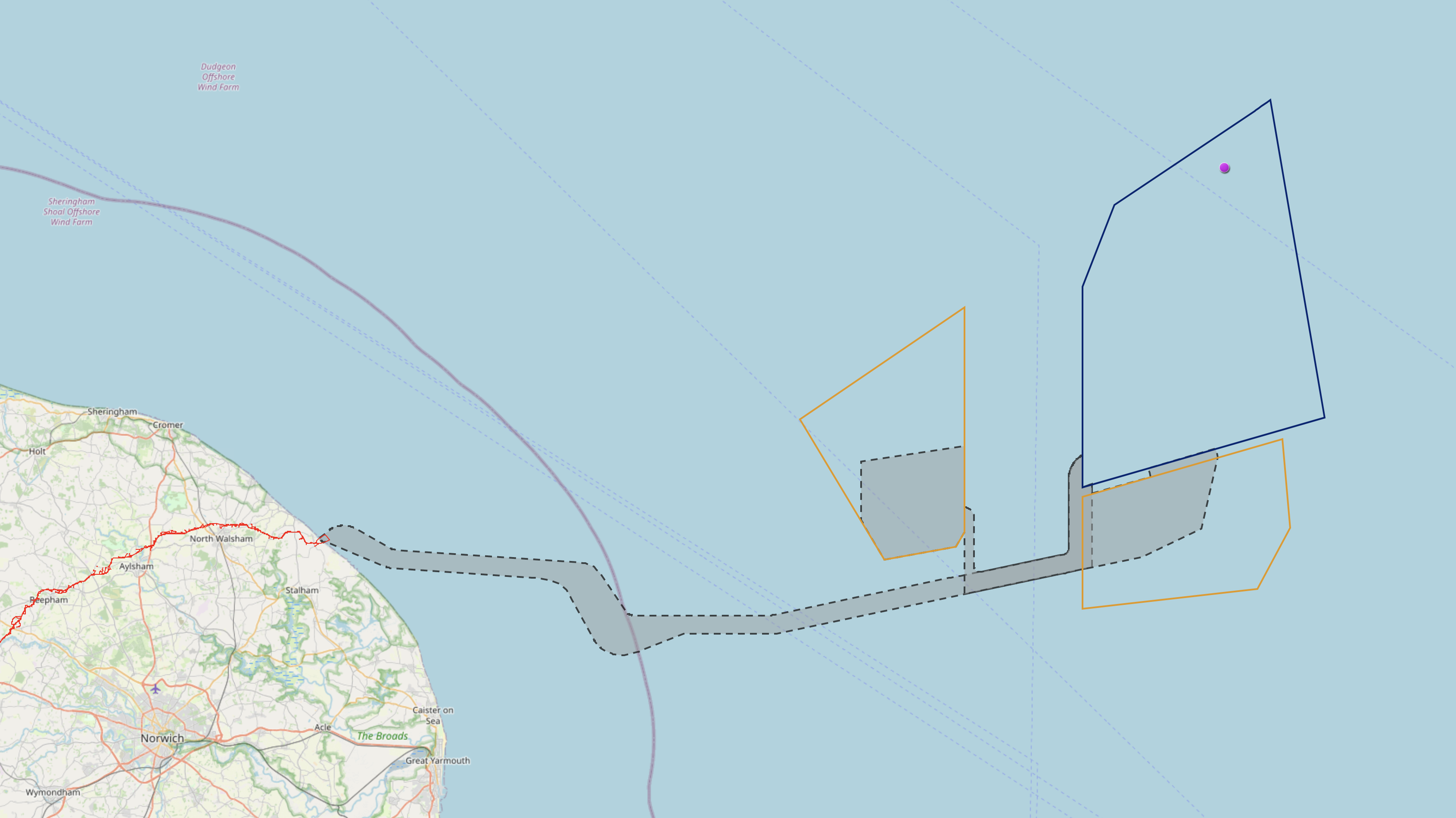
Note.
- The purple line appears to be the UK’s ten mile limit.
- Norfolk Boreas is outlined in blue.
- Norfolk Vanguard is outlined in orange.
- Cables will be run in the grey areas.
- Both wind farms are planned to have a capacity of 1.8 GW
Landfall will be just a few miles to the South of the Bacton gas terminal.
Bacton Gas Terminal
Bacton gas terminal is much more than a simple gas terminal.
- It is a complex of six gas terminals on four sites.
- There is a National Grid terminal, that odourises and blends the gas before distributing it into the National Transmission System via five outgoing 36-inch feeders to much of Southern England.
- There is a gas interconnector to Belgium.
- There is a gas interconnector to The Netherlands.
- There is coastal erosion in the area.
With the need to decarbonise, I can’t help feeling that the Bacton gas terminal is very much on the decline and the site will need to be repurposed in the next few years.
Blending Hydrogen With Natural Gas
If you blend a proportion of hydrogen into natural gas, this has two beneficial effects.
- Gas used in domestic and industrial situations will emit less carbon dioxide.
- In the near future we will be replacing imported natural gas with hydrogen.
The hydrogen could be produced by a giant electrolyser at Bacton powered by the electricity from the two Norfolk wind farms.
At the present time, a research project call HyDeploy is underway, which is investigating the blending of hydrogen into the natural gas supply.
- Partners include Cadent, Northern Gas Networks, the Health and Safety Executive, Keele University and ITM Power and Progessive Energy.
- A first trial at Keele University has been hailed as a success.
- It showed up to twenty percent of hydrogen by volume can be added to the gas network without the need to change any appliances or boilers.
Larger trials are now underway.
A Giant Electrolyser At Bacton
If hydrogen were to be produced at Bacton by a giant electrolyser, it could be used or distributed in one of the following ways.
- Blended with natural gas for gas customers in Southern England.
- Stored in a depleted gas field off the coast at Bacton. Both Baird and Deborah gas fields have been or are being converted to gas storage facilities, connected to Bacton.
- Distributed by truck to hydrogen filling stations and bus and truck garages.
- Greater Anglia might like a hydrogen feed to convert their Class 755 trains to hydrogen power.
- Sent by a short pipeline to the Port of Great Yarmouth and possibly the Port of Lowestoft.
- Exported to Europe, through one of the interconnectors.
Note.
- If the electrolyser were to be able to handle the 3.6 GW of the two wind farms, it would be the largest in the world.
- The size of the electrolyser could be increased over a few years to match the output of the wind farms as more turbines are installed offshore.
- There is no reason, why the electrical connection between Bacton and the landfall of the wind farm cable couldn’t be offshore.
If ITM Power were to supply the electrolyser, it would be built in the largest electrolyser factory in the World, which is in Sheffield in Yorkshire.
A Rail Connection To The Bacton Gas Terminal
This Google Map shows the area between North Walsham and the coast.
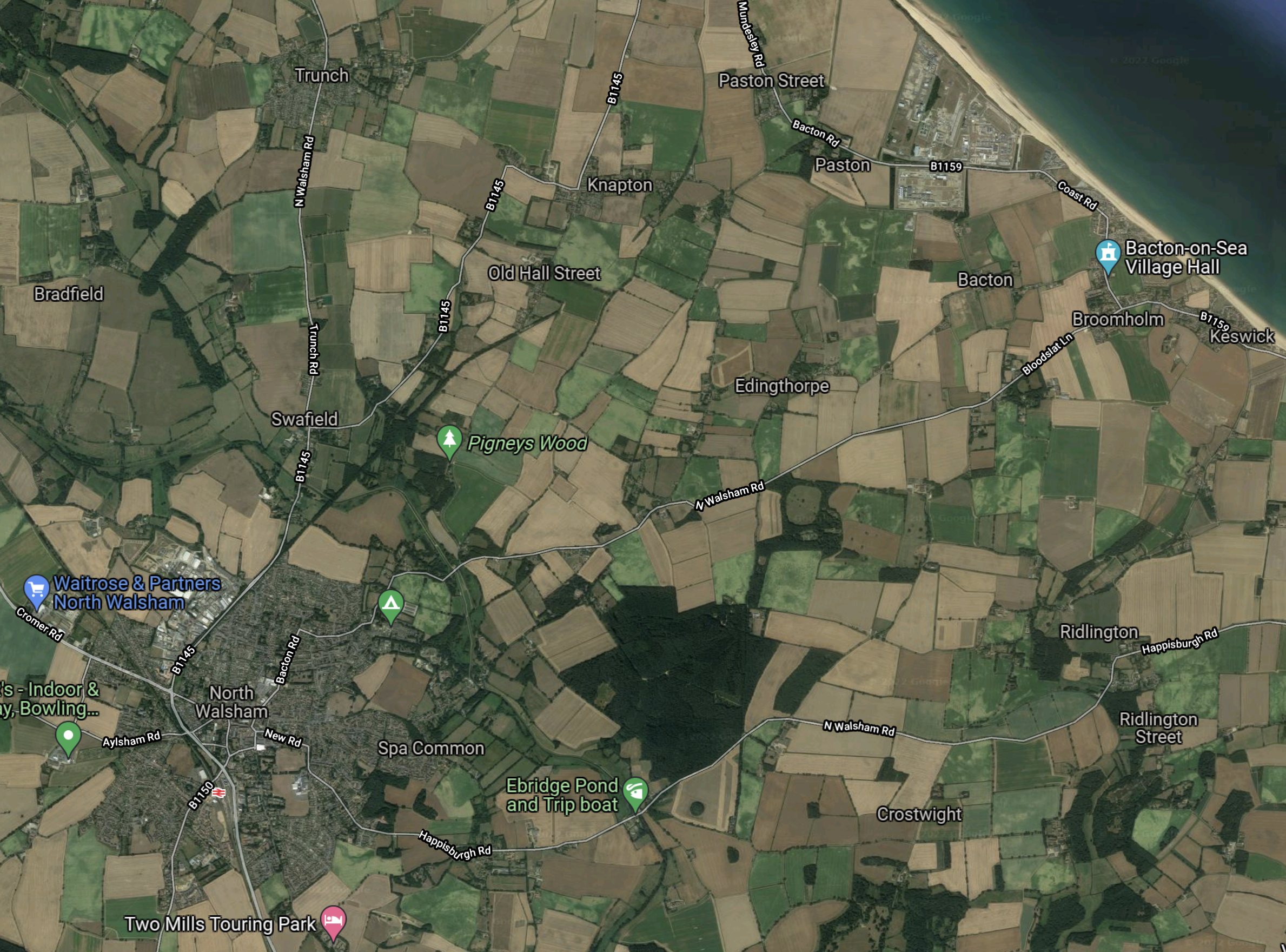
Note.
- North Walsham is in the South-Western corner of the map.
- North Walsham station on the Bittern Line is indicated by the red icon.
- The Bacton gas terminal is the trapezoidal-shaped area on the coast, at the top of the map.
I believe it would be possible to build a small rail terminal in the area with a short pipeline connection to Bacton, so that hydrogen could be distributed by train.
How Much Hydrogen Could Be Created By The Norfolk Wind Farms?
In The Mathematics Of Blending Twenty Percent Of Hydrogen Into The UK Gas Grid, I said the following.
Ryze Hydrogen are building the Herne Bay electrolyser.
- It will consume 23 MW of solar and wind power.
- It will produce ten tonnes of hydrogen per day.
The electrolyser will consume 552 MWh to produce ten tonnes of hydrogen, so creating one tonne of hydrogen needs 55.2 MWh of electricity.
Each of the Norfolk wind farms, if they were working flat out would produce 43.2 GWh of electricity in a day.
Dividing the two figures gives a daily production rate of 782.6 tonnes of hydrogen per day.
But what happens if the wind doesn’t blow?
This is where the gas storage in the Baird, Deborah and other depleted gas fields comes in.In times of maximum wind, hydrogen is stored for use when the wind doesn’t blow.
Conclusion
I believe a plan like this, would be much better for Norfolk, the UK and the whole planet.
Using the existing gas network to carry the energy away from Norfolk, could mean that the electricity connection across Norfolk could be scaled back.
A Lower-Cost Pumped Hydro Storage System
Whilst writing some of the posts recently about pumped storage I came across the Loch Sloy Hydro-Electric Scheme.
This is the introductory sentence in Wikipedia.
The Sloy/Awe Hydro-Electric Scheme is a hydro-electric facility situated between Loch Sloy and Inveruglas on the west bank of Loch Lomond in Scotland.
This page on the Greenage web site gives comprehensive details of the power station and is well worth a read.
This Google Map shows the Lochs Sloy and Lomond.
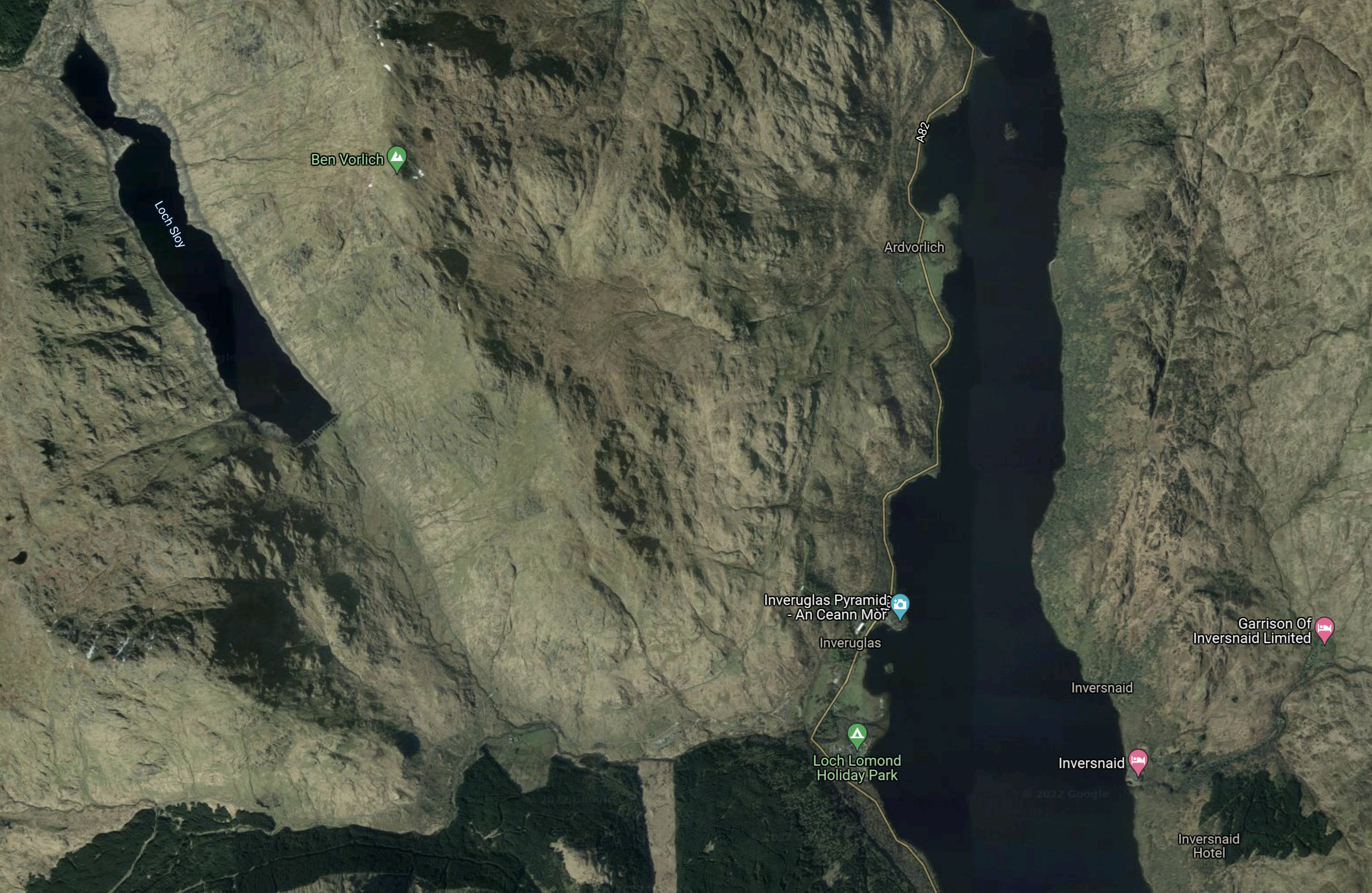
Note.
- Loch Sloy is in the North-West corner of the map.
- The page on Greenage says that Loch Sloy can store 14 GWh of electricity
- Loch Lomond is the body of water towards the Eastern side of the map.
- Inverglas is on the West bank of Loch Lomond to the North of the Loch Lomond Holiday Park, which is indicated by the green arrow with a tent.
This second Google Map shows the power station and Inverglas.
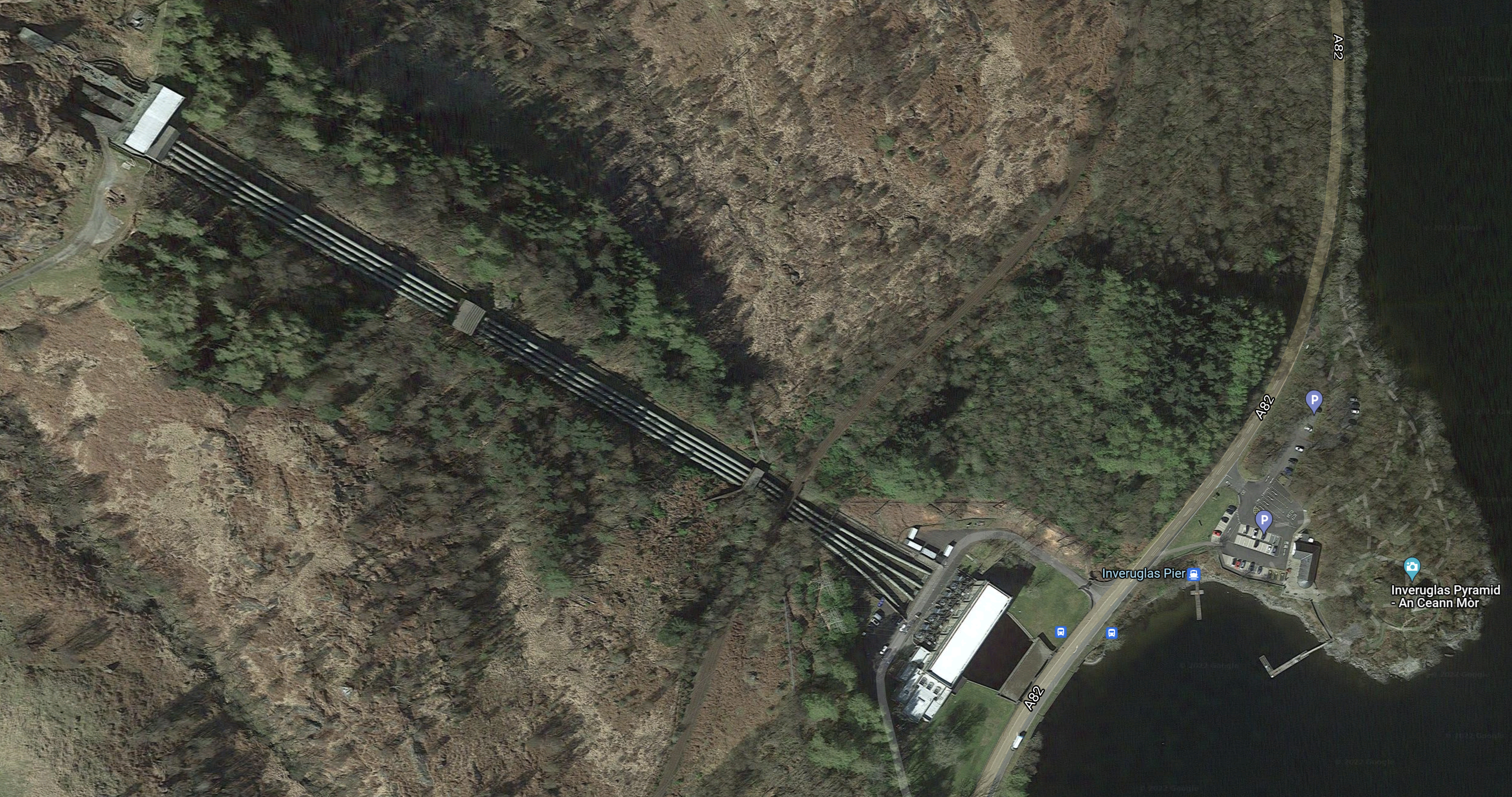
Note.
- It is a classic layout for a hydro-electric power station.
- In the North West corner of the map is the valve house, which is connected to Loch Sloy by a three kilometre tunnel.
- The valve house controls the water flows to the power station by Loch Lomond.
- There are four two-metre pipes running down the hill, one for each of the four turbines.
- According to the page on Greenage, the power station has three 40 MW turbines and one 32 MW turbine, which gives a total output of 152 MW.
- The water discharges into Loch Lomond after doing its work in the power station.
Loch Sloy is the largest conventional hydroelectric power plant in the UK.
Extending The Loch Sloy Hydro-Electric Scheme
This page on Hydro Review, which is dated the 10th of November 2010, is entitled SSE Gets Government Consent For Sloy Pumped-Storage Hydropower Project.
These are the first paragraph.
SSE Generation Ltd., the wholly owned generation business of Scottish and Southern Energy, has received consent from the Scottish Government to develop a 60-MW pumped-storage hydro project at its existing Sloy hydropower station at Loch Lomond, SSE reported.
Note.
- Two 30 MW pumps will be added to the power station to pump water up the hill from Loch Lomond to Loch Sloy.
- According to the page on Greenage, if the two pumps worked together for six hours, they would transfer 432,000 m3 of water. Note that a cubic metre of water weighs a tonne.
- Water would be transferred, when there was a surplus of energy being generated over the demand.
It would appear to be a simple scheme, as it is just adding two pumps to pump the water up the hill.
- As pumps rather than pump/turbines as at Foyers are used, there is no corresponding increase in generating capacity.
- Water also appears to be pumped up to the valve house in the existing pipes.
- Loch Sloy and Loch Lomond would not need major works to enable the scheme..
The page on Greenage gives the cost at just £40 million.
Originally, the project was supposed to have started in 2012, but as there are environmental problems with the fish, the work has not started.
These problems are detailed on the page on Greenage.
Conclusion
For £40 million, 14 GWh of pumped storage can be created at Sloy.
- But it could be bigger than 14 GWh, as this page on the Strathclyde University web site, says 20.4 GWh is possible.
- This would surely, be a project that could be first in the queue, once the environmental problems are solved.
20 GWh of pumped storage would be nice to have reasonably quickly.
New Electricity ‘Superhighways’ Needed To Cope With Surge In Wind Power
The title of this post, is the same as that of this article on the Telegraph.
This is the first two paragraphs.
Energy companies are pushing for the rapid approval of new electricity “superhighways” between Scotland and England amid fears that a lack of capacity will set back the country’s wind power revolution.
Businesses including SSE and Scottish Power are calling on the industry regulator Ofgem to approve a series of major new north-south power cables in a bid to ease congestion on the existing electricity network.
These points are mentioned in the article.
- Current capacity is 6 GW, which even now is not enough.
- Another 17 GW of capacity will be needed by 2033.
- Wind farms in Scotland have been switched off and replaced by gas-fired power stations because of a lack of grid capacity.
- Another 25 GW of wind farms could be built after leases were awarded last month.
Two North-South interconnectors are being planned.
Peterhead And Drax
This is being proposed by SSE and National Grid.
- It will be an undersea cable.
- It will be two cables, each with a capacity of 2 GW.
- Peterhead and Drax power station are four hundred miles apart by road and 279 miles as the seagull flies, as a lot of the route would be over the sea. So an undersea connection would appear to be sensible.
- Peterhead is on the coast, so connecting an undersea interconnector shouldn’t be too challenging or disruptive to the locals.
- Drax power station is a 4 GW power station and the largest in the UK, so it must have good grid connections.
This Google Map shows the location of Drax power station in relation to Hull, Scunthorpe and the rivers in the area.
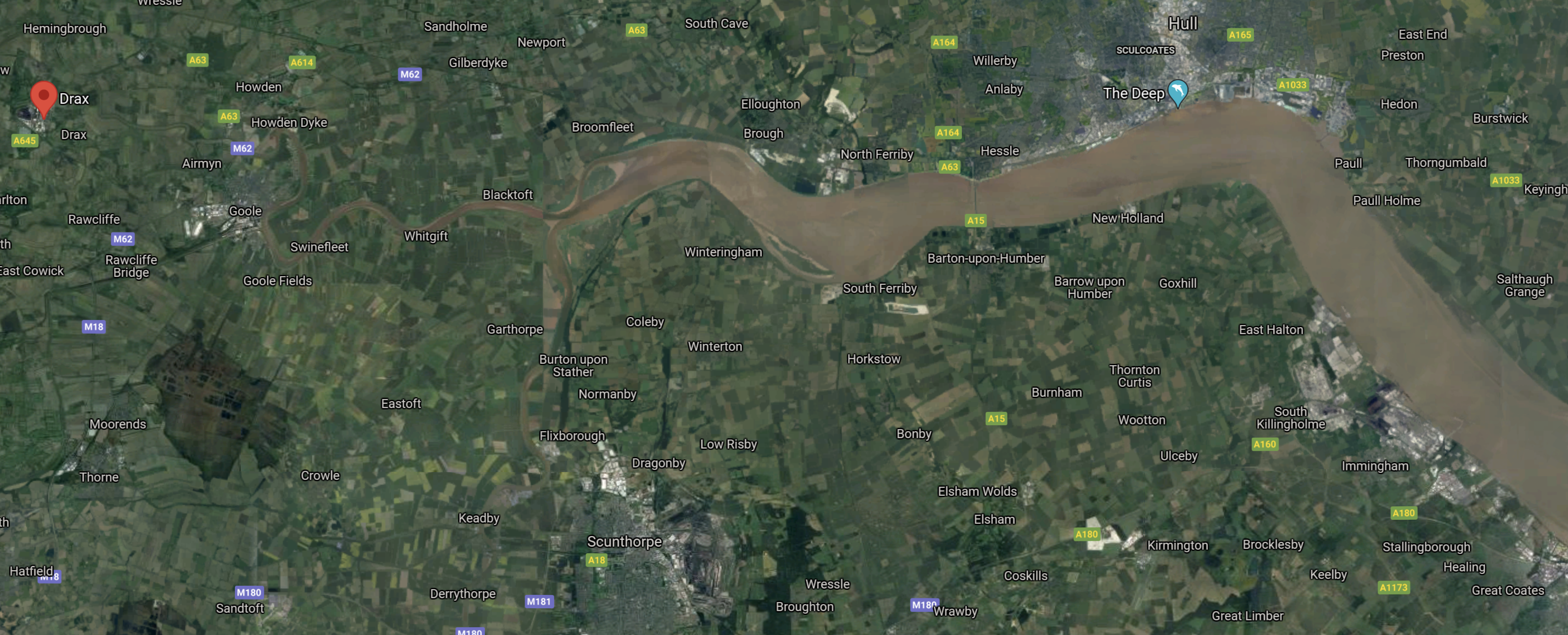
Note.
- Drax is marked by the red arrow in the West of the map.
- The large body of water in the East is the Humber Estuary.
- Hull is on the North Bank of the Humber.
- Scunthorpe, which is famous for its steel industry is South of the Humber in the middle of the map.
- To the West of Scunthorpe the Humber splits into the Trent and the Ouse.
- The Ouse leads all the way to Drax power station.
I suspect an undersea cable could go up the Humber and Ouse to Drax power station.
Is it a coincidence that both Drax power station and the proposed link to Peterhead are both around 4 GW?
Consider.
- Drax is a biomass power station, so it is not a zero carbon power station.
- Drax produces around six percent of the UK’s electricity.
- Most of the biomass comes by ship from North America.
- Protest groups regularly have protests at Drax because of its carbon emissions.
- Drax Group are experimenting with carbon capture.
- Drax is a big site and a large energy storage system could be built there.
- Wind is often criticised by opponents, saying wind is useless when the wind doesn’t blow.
- The Scots would be unlikely to send power to England, if they were short.
This is also said about Drax in Wikipedia.
Despite this intent for baseload operation, it was designed with a reasonable ability for load-following, being able to ramp up or down by 5% of full power per minute within the range of 50–100% of full power.
I take this it means it can be used to top up electricity generation to meet demand. Add in energy storage and it could be a superb load-follower.
So could the similar size of the interconnector and Drax power station be deliberate to guarantee England a 4 GW feed at all states of the wind?
I don’t think it is a coincidence.
Torness And Hawthorn Pit And Torness and South Humberside
These two cables are being proposed by Scottish Power.
- Each will be two GW.
- Torness is the site of the 1.36 GW Torness nuclear power station, which is likely to be decommissioned before 2030.
- Torness will have good grid connections and it is close to the sea.
- Hawthorn Pit is a large closed coal mine to the North of Newcastle, with a large substation close to the site. I suspect it will be an ideal place to feed power into the grid for Newcastle and it is close to the sea.
- Just South of Hawthorn Pit are the 1.32 GW Hartlepool nuclear power station, which will be decommissioned in 2024 and the landfall of the cables to the massive Dogger Bank wind farm.
- As I showed earlier with Drax, the Humber would be an ideal estuary to bring underwater power cables into the surrounding area. So perhaps the cable will go to Scunthorpe for the steelworks.
- As at Drax, there is backup in South Humberside, but here it is from the two Keadby gas-fired power stations.
The article in the Telegraph only gives the briefest of details of Scottish Power’s plans, but I suspect, that given the locations of the ends of the interconnectors, I suspect the cables will be underwater.
Conclusion
It strikes me that all three interconnectors have been well thought thought and they serve a variety of objectives.
- Bring Scottish wind power, South to England.
- Connect wind farms to the two nuclear power station sites at Hartlepool and Torness, that will close at the end of the decade.
- Allow the big 4 GW biomass-fired station at Drax to back up wind farms and step in when needed.
- Cut carbon emissions at Drax.
- Use underwater cables as much as possible to transfer the power, to avoid the disruption of digging in underground cables.
It looks to be a good plan.
Norfolk Vanguard Offshore Wind Farm Re-approved By Government
The title of this post, is the same as that of this article on the BBC.
These are the two introductory paragraphs.
An offshore wind farm capable of generating electricity for nearly two million homes has been re-approved by government after consent was previously overturned by a High Court judge.
Vattenfall’s 1.8-gigawatt Norfolk Vanguard project had been granted consent by the Department for Business, Energy and Industrial Strategy (BEIS).
Note.
- Norfolk Boreas and Norfolk Vanguard are a pair of 1.8 GW offshore wind farms to be developed 72 and 47 kilometres off the Norfolk coast by Swedish company; Vattenfall.
- Hinckley Point C will have a capacity of 3.25 GW.
This map shows the two fields in relation to the coast.
Note.
- The purple line appears to be the UK’s ten mile limit.
- Norfolk Boreas is outlined in blue.
- Norfolk Vsnguard is outlined in orange.
- Cables will be run in the grey areas.
This second map shows the onshore cable.
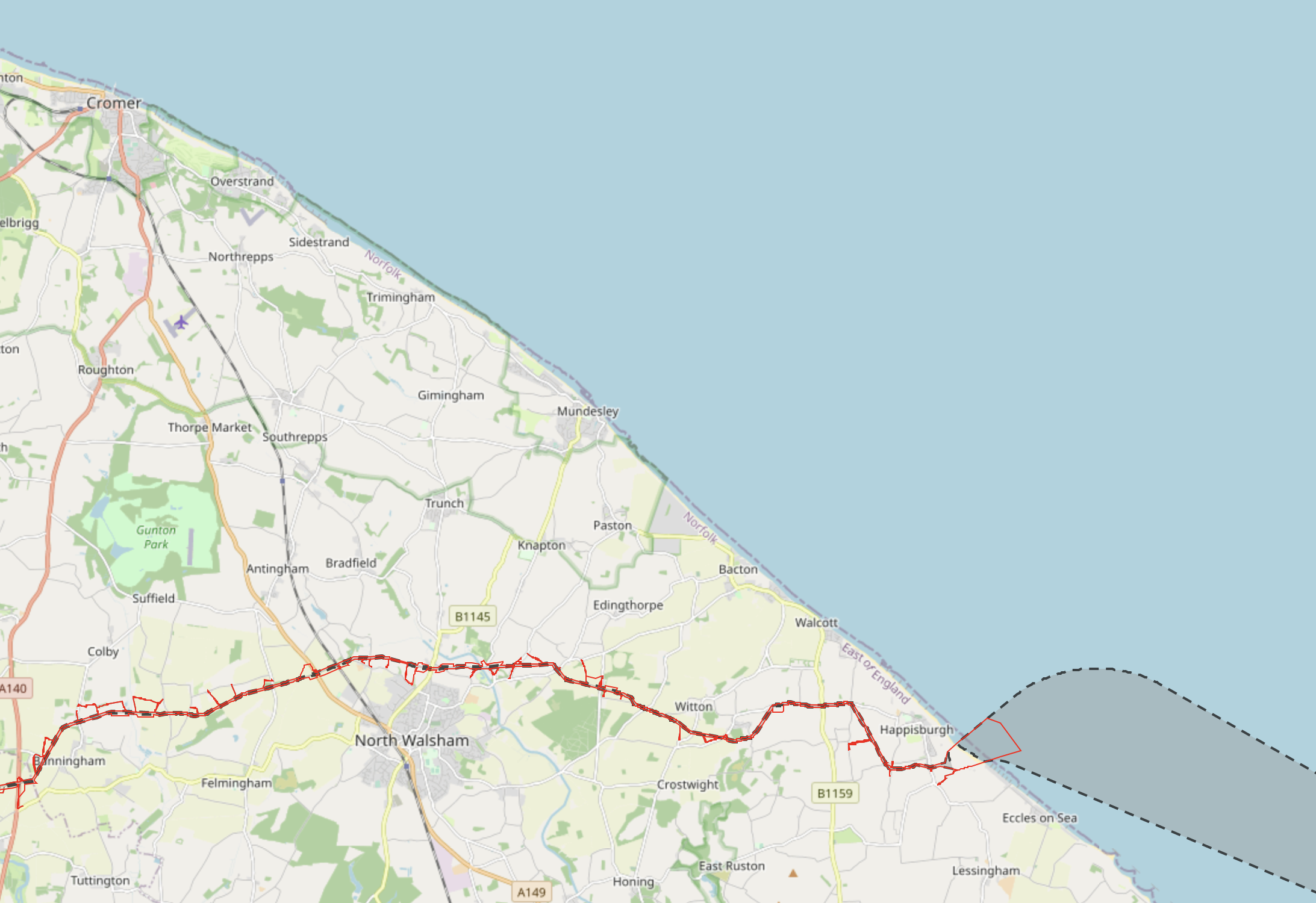
Note.
- The cables are planned to come ashore between Happisburgh and Eccles-on-Sea.
- Bacton is only a short distance up the coast.
- The onshore cable is planned to go from here across Norfolk to the Necton substation.
But the planning permission was overturned by a legal ruling.
This article on the BBC is entitled Norfolk Vanguard: Ministers Wrong Over Wind Farm Go-Ahead, Says Judge.
These are the first four paragraphs.
A High Court judge has quashed permission for one of the world’s largest offshore wind farms to be built off the east coast of England.
The Norfolk Vanguard Offshore Wind Farm was granted development consent in July by the Secretary of State for Business, Energy and Industrial Strategy (BEIS).
But Mr Justice Holgate overturned the decision following legal action from a man living near a planned cable route.
A Department for BEIS spokeswoman said it was “disappointed by the outcome”.
This is a paragraph in today’s BBC article.
Kwasi Kwarteng, Secretary of State at the Department of Business, Energy and Industrial Strategy, granted development consent for the wind farm, having re-determined the application.
So will we be back to the Law Courts?
In Is There A Need For A Norfolk-Suffolk Interconnector?, I said this.
But seriously, is it a good idea to dig an underground cable all the way across Norfolk or in these times build a massive overhead cable either?
Perhaps the solution is to connect the Norfolk Boreas And Norfolk Vanguard wind farms to a giant electrolyser at Bacton, which creates hydrogen.
- The underground electricity cable across Norfolk would not be needed.
- Bacton gas terminal is only a few miles up the coast from the cable’s landfall.
- The UK gets another supply of gas.
- The hydrogen is blended with natural gas for consumption in the UK or Europe.
- A pure hydrogen feed can be used to supply hydrogen buses, trucks and other vehicles, either by tanker or pipeline.
- Excess hydrogen could be stored in depleted gas fields.
Thye main benefit though, would be that it would transform Bacton gas terminal from a declining asset into Norfolk’s Hydrogen Powerhouse.
For more information on blending hydrogen into our natural gas supply see HyDeploy.
Dogger Bank C In UK Offshore Wind First To Provide Reactive Power Capability
The title of this post, is the same as that of this press release from the Dogger Bank wind farm.
This paragraph gives an explanation.
Dogger Bank Wind Farm has secured a UK power first by becoming the first offshore wind farm project to win a tender from National Grid ESO to provide reactive power capability. The sector-first contract will help deliver a greener grid, maintain a stable voltage power supply, and help drive down UK consumer costs by millions of pounds.
Note that the three Dogger Bank wind farms; A, B and C will each have a capacity of 1.2 GW and that Hartlepool nuclear power station has a capacity of 1.32 GW. The latter is due to be decommissioned in 2024.
So the wind farms will effectively replace the nuclear power station.
This paragraph describes the contract.
Under new £22.5m Pennines Voltage Pathfinder contracts announced today, National Grid ESO has awarded a 10-year power contract to Dogger Bank C that will see its onshore converter station at Lazenby in the North-East of England provide 200 MVAr* of reactive power capability between 2024 and 2034. This marks the first time that an offshore wind transmission asset has been awarded a contract through a reactive power tender by National Grid ESO.
I suspect that there will need to be some form of energy storage added to the system somewhere, either at Lazenby or could we see a system like one of Highview Power’s CRYOBattery installed offshore?
It should be noted that CRYOBatteries are no more complicated, than some of the equipment installed on offshore gas and oil platforms.
The Lackenby Substation
It does seem that there has been a mix-up between the two nearby villages of Lazenby and Lackenby.
I can’t find a Lazenby substation, but I can find one at Lackenby.
This Google Map shows that the location of the Lackenby substation.
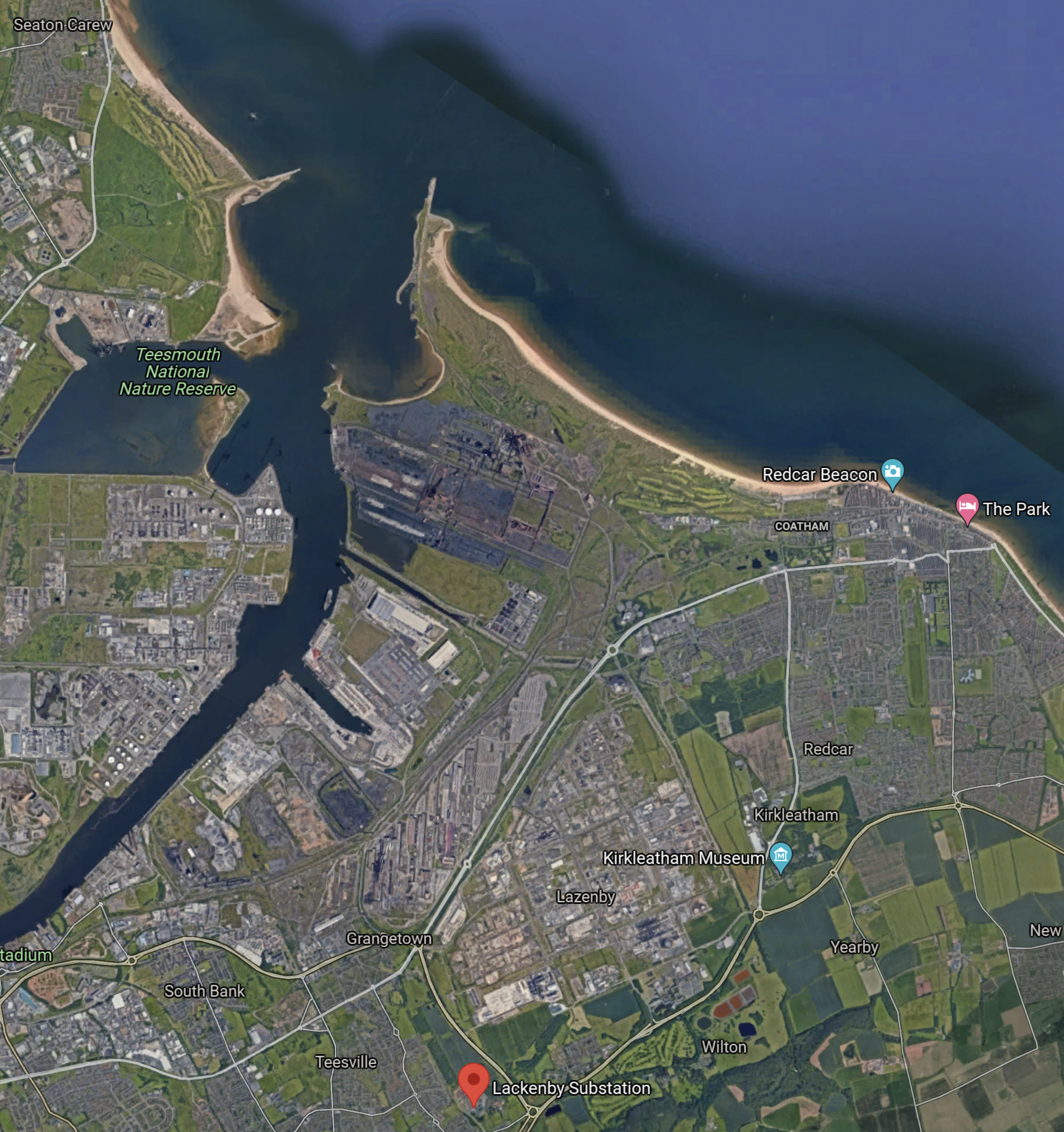
This second map shows the substation in more detail.
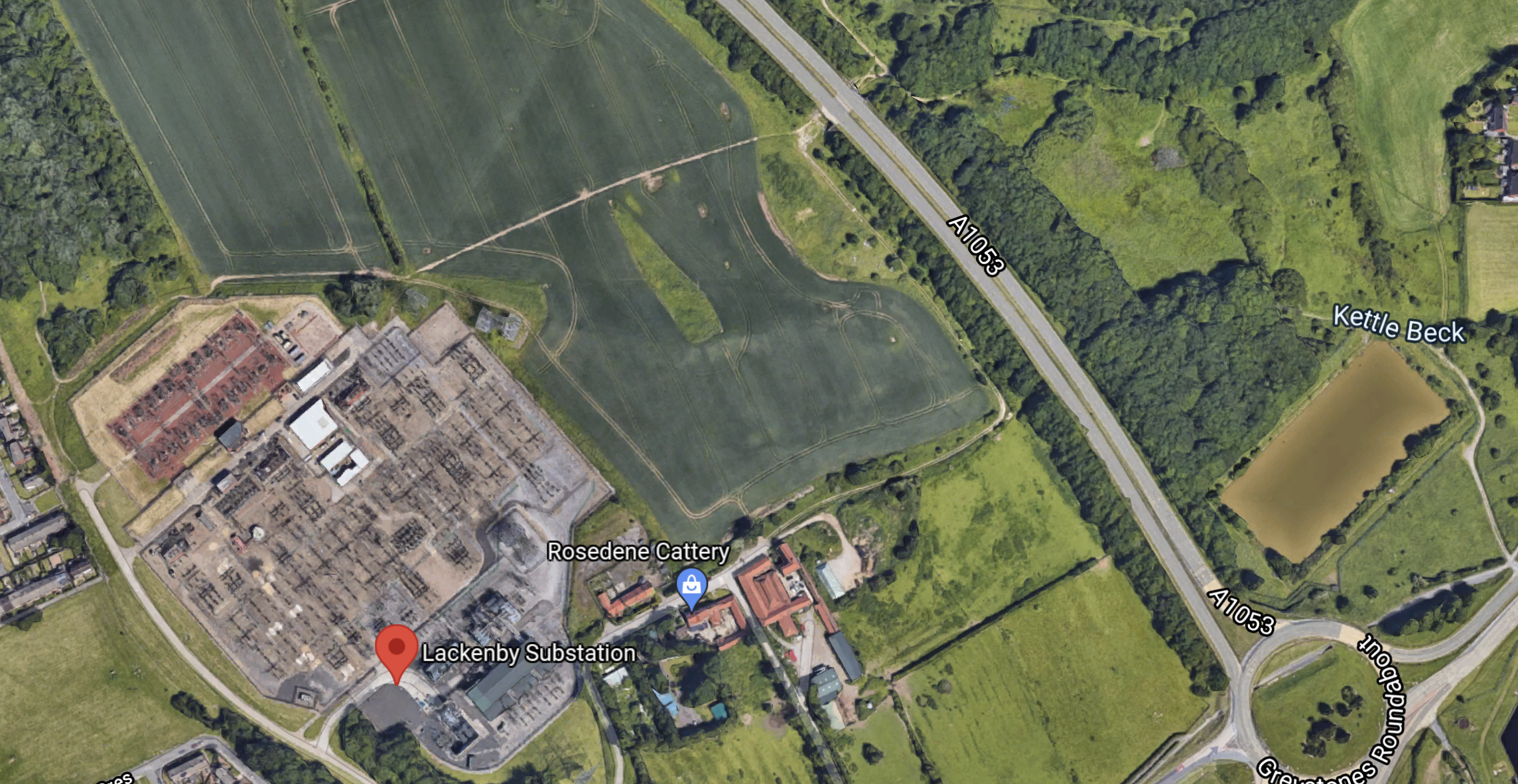
Note.
- There are a lot of large chemical works on both banks of the Tees.
- I can find nothing on the route of the cable from Dogger Bank C to Lackenby substation.
- Perhaps, it’s planned to go up the River Tees or it could come ashore South of the mouth of the River Tees.
Plans must be published soon, so that the substation can be updated before the wind farm is commissioned.

