The Cambridge Re-signalling, Relock and Recontrol Project
This project is Network Rail’s big signalling project in the Cambridge area and it is fully described in this document on the Network Rail web site.
The project is called the C3R Project for short and its scope is described in this Network Rail infographic.

Note.
- 125 miles of track are to be resignalled.
- Seventeen stations are likely to be resignalled.
- Eight level-crossings are to be upgraded.
Network Rail’s document splits the project into five sections.
- Cambridge Power Signal Box – This will be upgraded.
- Safety Interlocking Equipment – This will be upgraded with a computer-based system.
- Closure Of Three Signal Boxes – Control will be relocated to Cambridge Power Signal Box.
- Seven Level Crossing Upgrades – These will be upgraded to full barrier crossings.
- Land Acquisition – As necessary to complete the works.
Upon completion the project will have replaced around 690 signalling assets.
Network Rail also say that the outline design contract to Alstom and it is expected to be completed in the last quarter of 2021.
Network Rail also says this about completion.
Subject to obtaining the necessary consents and design approvals, the detailed design and delivery of the signalling upgrade could begin by end of 2021 and be complete around the end of 2024.
My experience of project management and the railways of East Anglia, says that subject to one caveat, that this is a reasonable timescale.
The Level Crossing Problem
The problem could be the level crossings, as local interests are very protective of their supposed right to cross unhindered.
I particularly remember the Little Cornard Derailment, because a solicitor, who regularly instructed my late wife, was seriously injured in the derailment.
This is the first paragraph of the Wikipedia entry.
The Little Cornard derailment occurred on 17 August 2010 when a passenger train collided with a road vehicle on a level crossing on the Gainsborough Line near Little Cornard, Suffolk, and partly derailed. The vehicle, a tanker lorry, had begun crossing over the track when the Class 156 train from Sudbury destined for Marks Tey struck it whilst travelling at a speed of approximately 40 miles per hour (64 km/h)
Note.
Although, my late wife had died in 2007, one of her barrister colleagues told me of the link.
East Anglia and other rural parts of the UK suffer regularly from this type of accident.
This Google Map shows a 3D visualization of the site of the derailment.
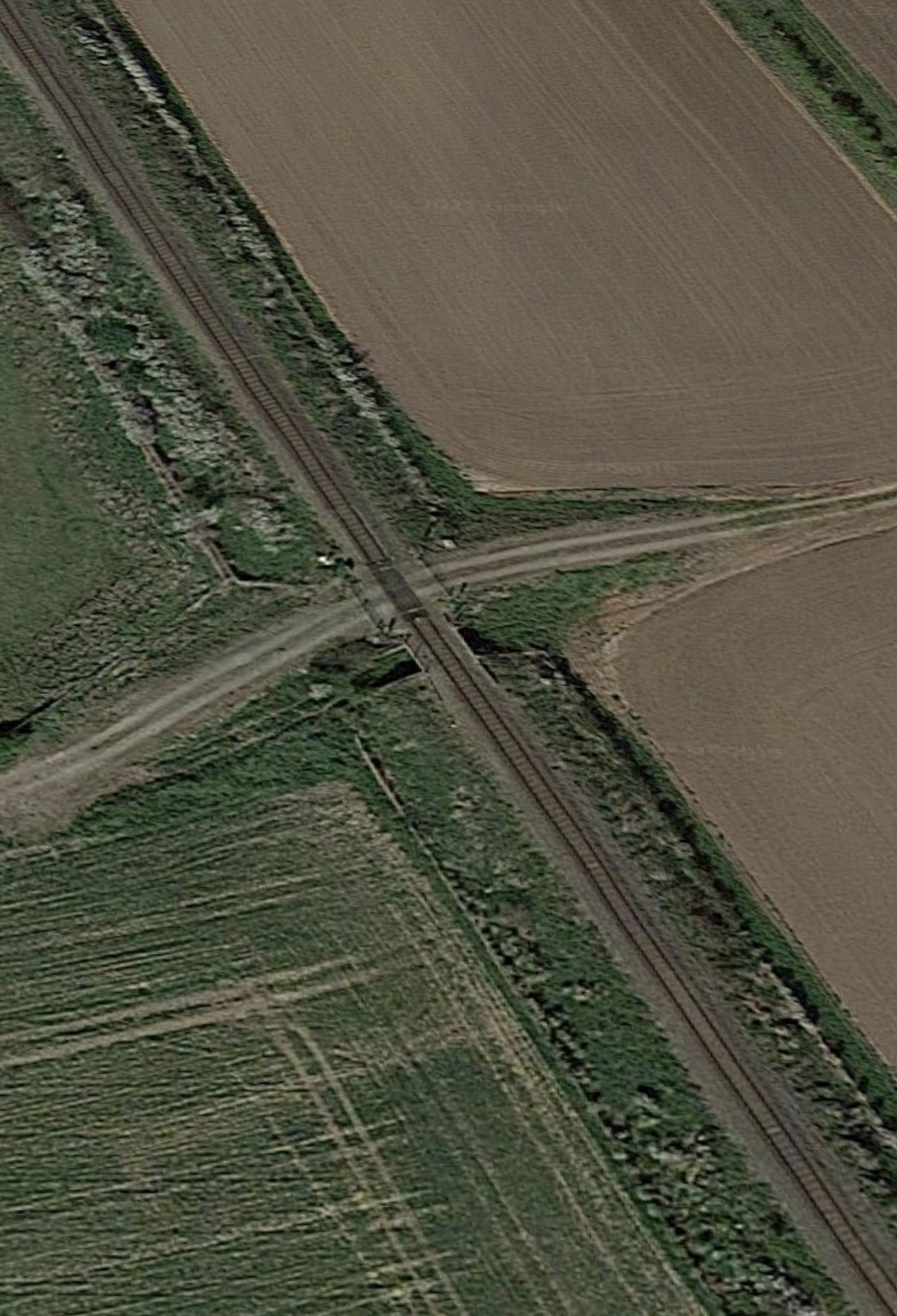
It appears to be rather remote.
I am totally appalled that there was such primitive safety equipment on this crossing.
- I have worked in seriously dangerous chemical plants, where Health and Safety rules forbade anyone entering the plant without full training.
- As a sixteen-year-old in 1963, I was designing and installing systems on industrial guillotines, so that workers didn’t lose their hands.
- A proportion of work, I did whilst working for ICI was about Health and Safety.
- I have travelled extensively in tour buses in Eastern Europe and seen some appealing driving at level crossings.
- According to a Hungarian friend, if you want to see bad driving at level crossings try Russia. He put it down to the local firewater.
This experience leeds me to believe that one of two things should be done with all level crossings on the railway.
- There should be a strong safety system on the crossing.
- The level crossing should be closed.
Will Network Rail be allowed by local interests to upgrade all the crossings they need?
The Level Crossings Network Rail Propose To Upgrade
These are the crossings Network Rail propose to upgrade.
Meldreth Road Level Crossing
This Google Map shows the Meldreth Road level crossing.
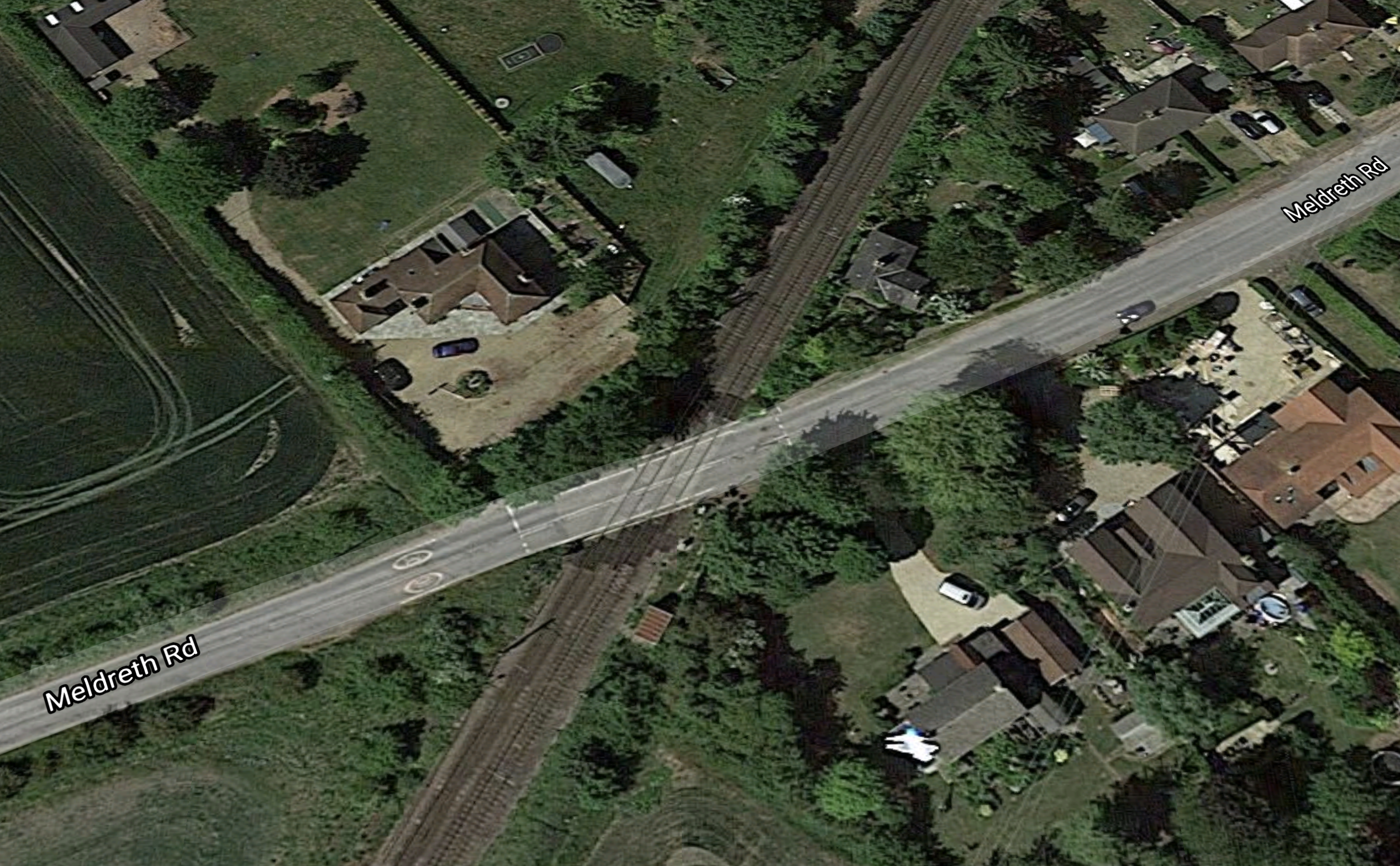
Note.
- Meldreth Road is the A10 between Cambridge and Royston.
- The double-track rail is the Cambridge Line between Cambridge and the East Coast Main Line.
- The line has a maximum speed of 90 mph.
- In every hour there are up to 10-12 passenger trains per hour (tph) through the level crossing.
- There are perhaps ten other trains per day, or less than one tph.
The ABC Railway Guide gives a line speed of 90 mph and adds these risk factors.
- Sun Glare
- Frequent Trains
It is very much a classic case of a busy railway crossing a busy road.
I also think that Network Rail has another problem here.
Pressure from train operators and passengers, could lead to more and faster trains through this level crossing.
In my view, the best solution to that problem would be to drop the railway into a cutting and put the road on a bridge over the top.
But this would be a very expensive and disruptive solution, which might mean that the road and/or railway were to be closed for several months.
The only other solution would be to run all trains between Royston and Cambridge under the control of digital signalling and Automatic Train Operation.
Trains would be timed so, that trains in opposite directions crossed on the level crossing, when the full barriers were down to stop traffic.
If this could be done, it could have various effects.
- This would halve the number of level crossing closures in every hour.
- The timekeeping might even impress drivers.
- It might even train drivers to expect two trains, so if one was a minute or so late, they might be more prepared to wait.
This technique would give whole new meaning to a double cross.
This page on the My Councillor web site, gives details of opposition to the project by Councillor Susan van der Ven.
Six Mile Bottom Level Crossing
This Google Map shows the Six Mile Bottom level crossing.
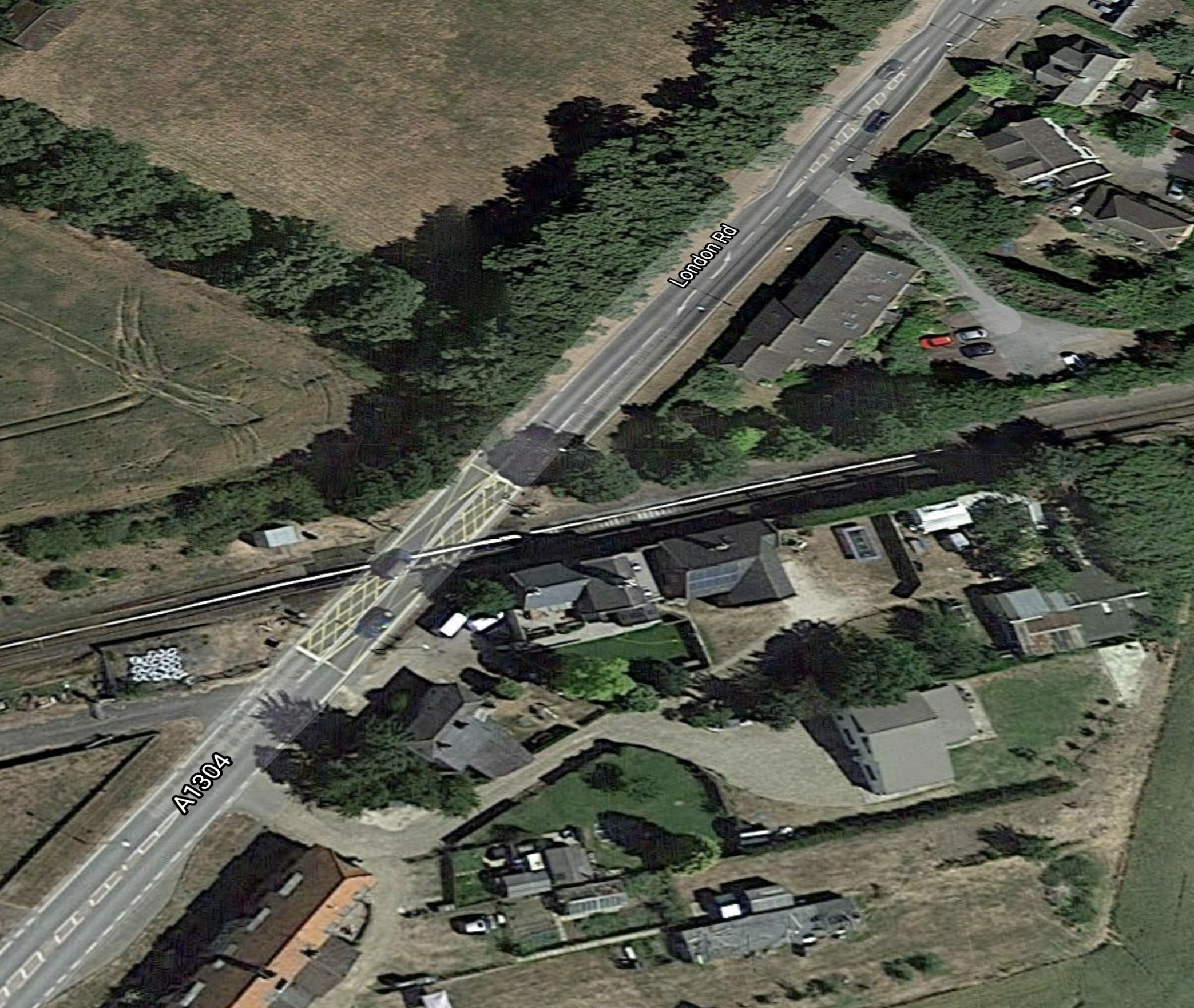
Note.
- The road is the A1304 which is the main link between Newmarket and the South.
- The road can get very busy, when there is a big race meeting.
- The rail track is only single track.
- The line has a maximum speed of up to 75 mph.
- In every hour there are no more than one passenger tph in both directions.
- There are some occasional freight trains over the crossing.
The ABC Railway Guide gives a line speed of 60 mph and adds these risk factors.
- Large Numbers Of Users
- Sun Glare
I used to drive across this level crossing regularly, when I lived in the area and the trouble is that it is on a straight road, that encourages high speed.
Legend has it, that this was one of public roads used by Vincent to test their high performance motorcycles.
In the time I lived near the crossing, I can remember a serious accident between a car and a train, at the crossing.
It would appear that a partial solution has been applied.
This video shows how much brighter LED lights have been fitted to the crossing.
Let’s hope this encourages drivers to slow down, when the crossing is closed.
How many other level crossings would be improved with bright LED lights like these?
Dullingham Level Crossing
This Google Map shows the Dullingham level crossing.
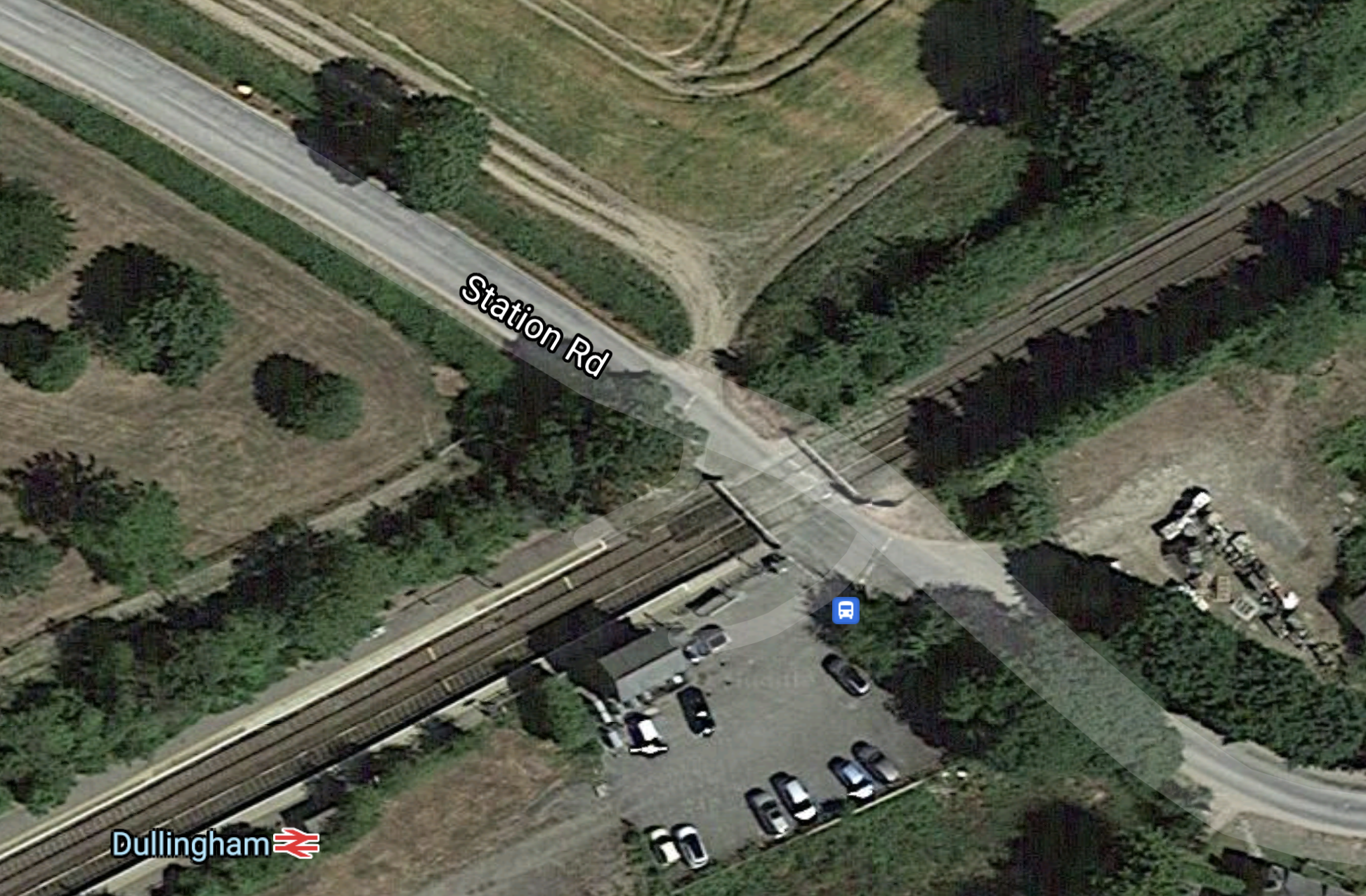
Note.
- The current barriers are operated manually by the signalman in Dullingham signal box.
- The road is a local road and the small amount of traffic could probably be easily handled by an automatic crossing with full barriers.
- The rail line is the same at that at Six Mile Bottom, but is double-track.
The ABC Railway Guide gives a line speed of 60 mph and adds these risk factors.
- Poor Visibility for Approaching Road Vehicles
- Crossing is Near a Station
- Crossing Approach
- Sun Glare
From my local experience, I suspect that an automatic crossing with full barriers might even cause less delay to road traffic.
Milton Fen Level Crossing
This Google Map shows the Milton Fen level crossing.
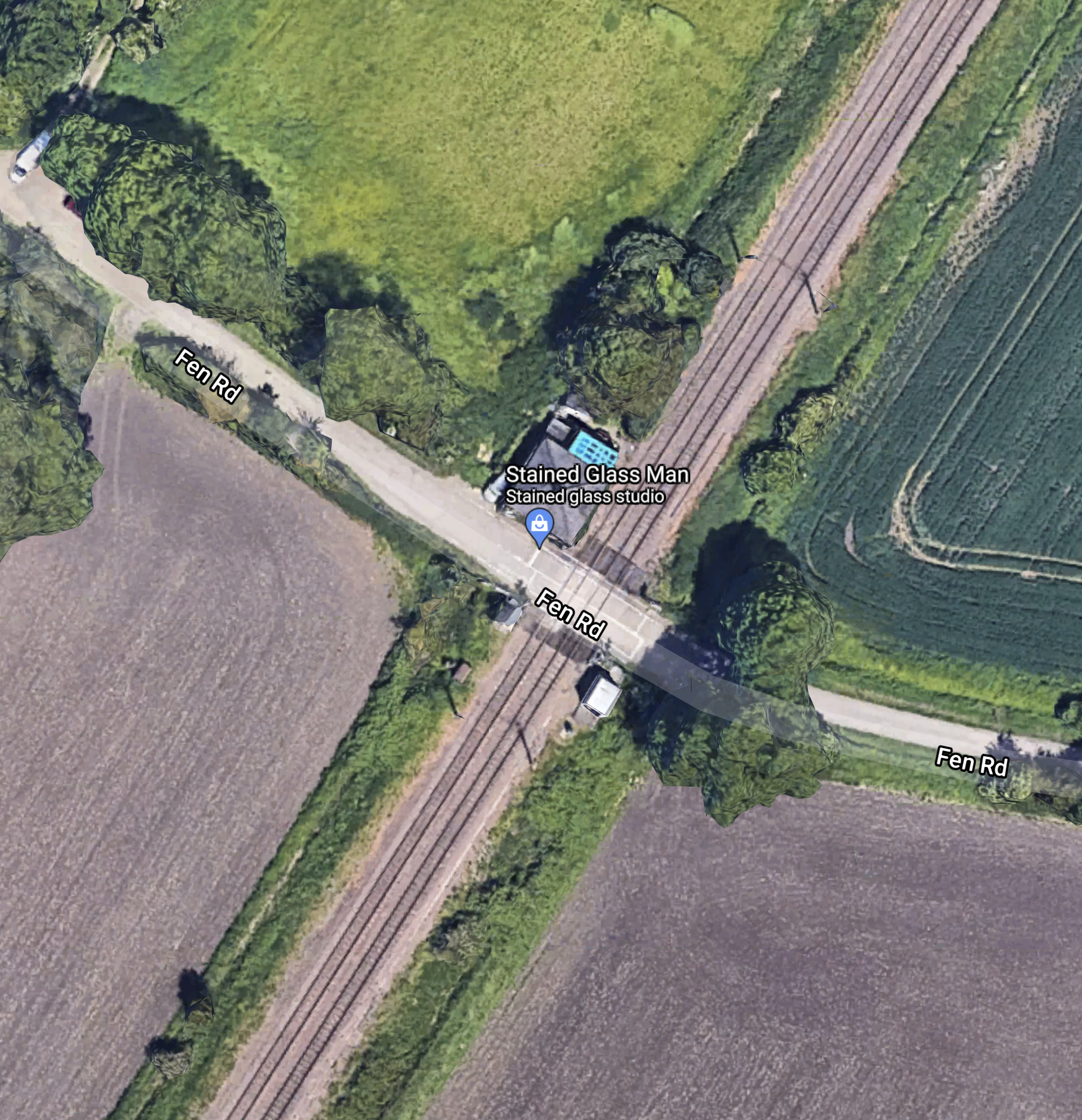
Note.
- The road is a local road and the small amount of traffic could probably be easily handled by an automatic crossing with full barriers.
- The railway is the Fen Line between Cambridge and Ely.
- It looks like there are three passenger tph and the occasional freight trains through this crossing.
- The line speed of the rail line is 75 mph.
The ABC Railway Guide gives a line speed of 75 mph and adds these risk factors.
- Sun Glare
- Frequent Trains
It should also be noted that I can find reports of serious accidents and deaths on this crossing.
It looks to me, that an automatic crossing with full barriers could work well on this level crossing.
Waterbeach Level Crossing
This Google Map shows the Waterbeach level crossing.
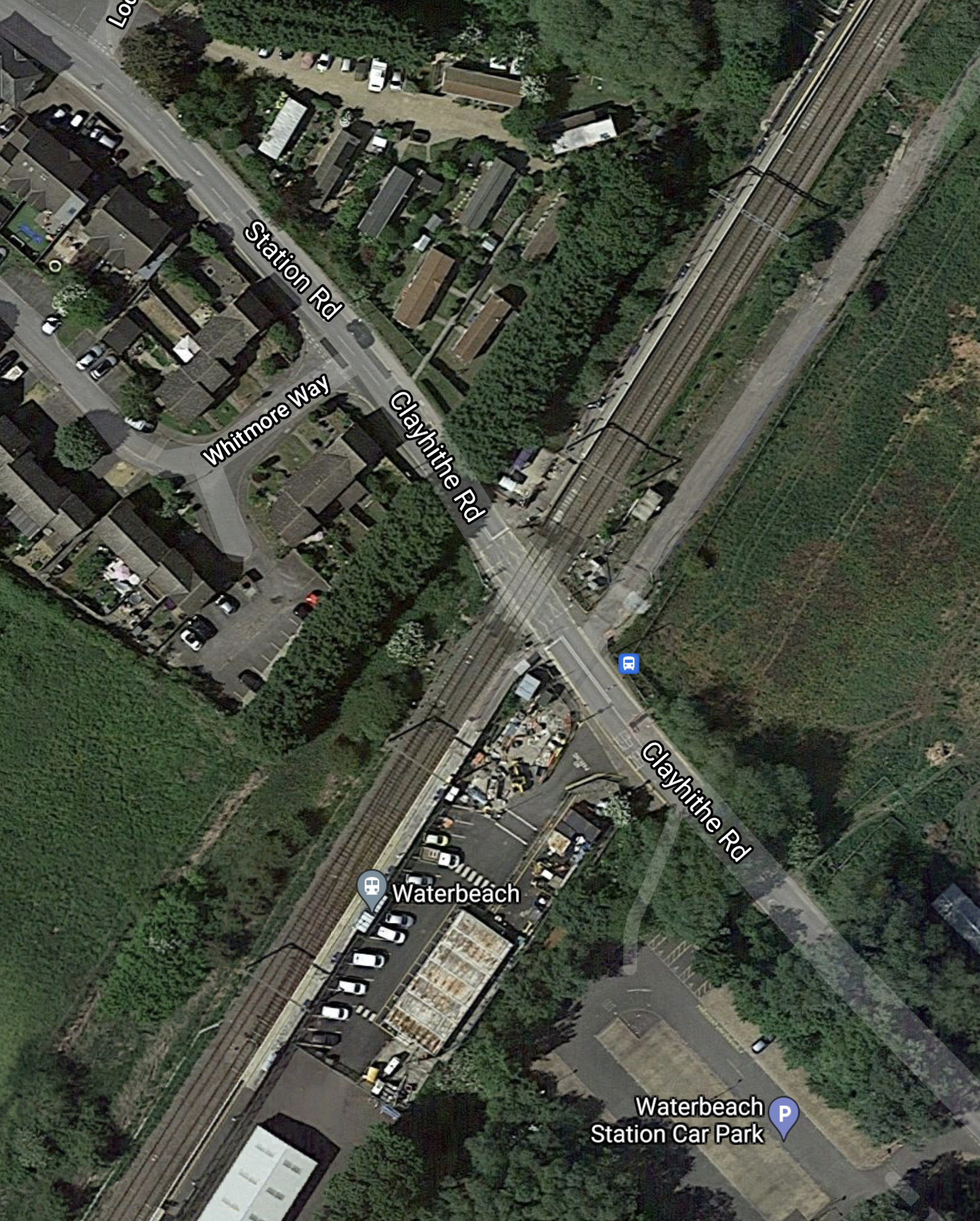
Note.
- The road is a local road, but could the traffic be easily handled by an automatic crossing with full barriers?
- The railway is the Fen Line between Cambridge and Ely.
- It looks like there are three passenger tph and the occasional freight trains through this crossing.
- The line speed of the rail line is 75 mph.
- Waterbeach station is split with one platform either side of the level crossing, which is used by passengers to cross the line.
The ABC Railway Guide gives a line speed of 75 mph and adds these risk factors.
- Poor Visibility for Approaching Road Vehicles
- Crossing is Near a Station
- Crossing Approach
- Large Numbers of Users
- Blocking Back
- Frequent Trains
It should also be noted that Network Rail rate this crossing as high risk.
There is probably a long-term solution for this level crossing
Under Future Plans in the Wikipedia entry for Waterbeach station, this is said.
Plans to develop a New Town of 8,000 to 9,000 homes on the former Waterbeach Barracks site have been outlined by South Cambridgeshire District Council. As part of the proposal, there are plans to relocate the station to a new site and extend the platforms to accommodate 12 car trains.
Surely, a well-designed transport network to serve all these houses would see the level crossing closed and a new station built at a convenient location.
Dimmocks Cote Level Crossing
This Google Map shows the Dimmocks Cote level crossing.

Note.
- The road is the A1123, so could the traffic be easily handled by an automatic crossing with full barriers?
- The railway is the Fen Line between Cambridge and Ely.
- It looks like there are three passenger tph and the occasional freight trains through this crossing.
- The line speed of the rail line is 75 mph.
The ABC Railway Guide gives a line speed of 75 mph and adds these risk factors.
- Infrequent Trains
- Deliberate Misuse or User Error
It should also be noted that Network Rail rate this crossing as high risk.
Croxton Level Crossing
This Google Map shows the Croxton level crossing.
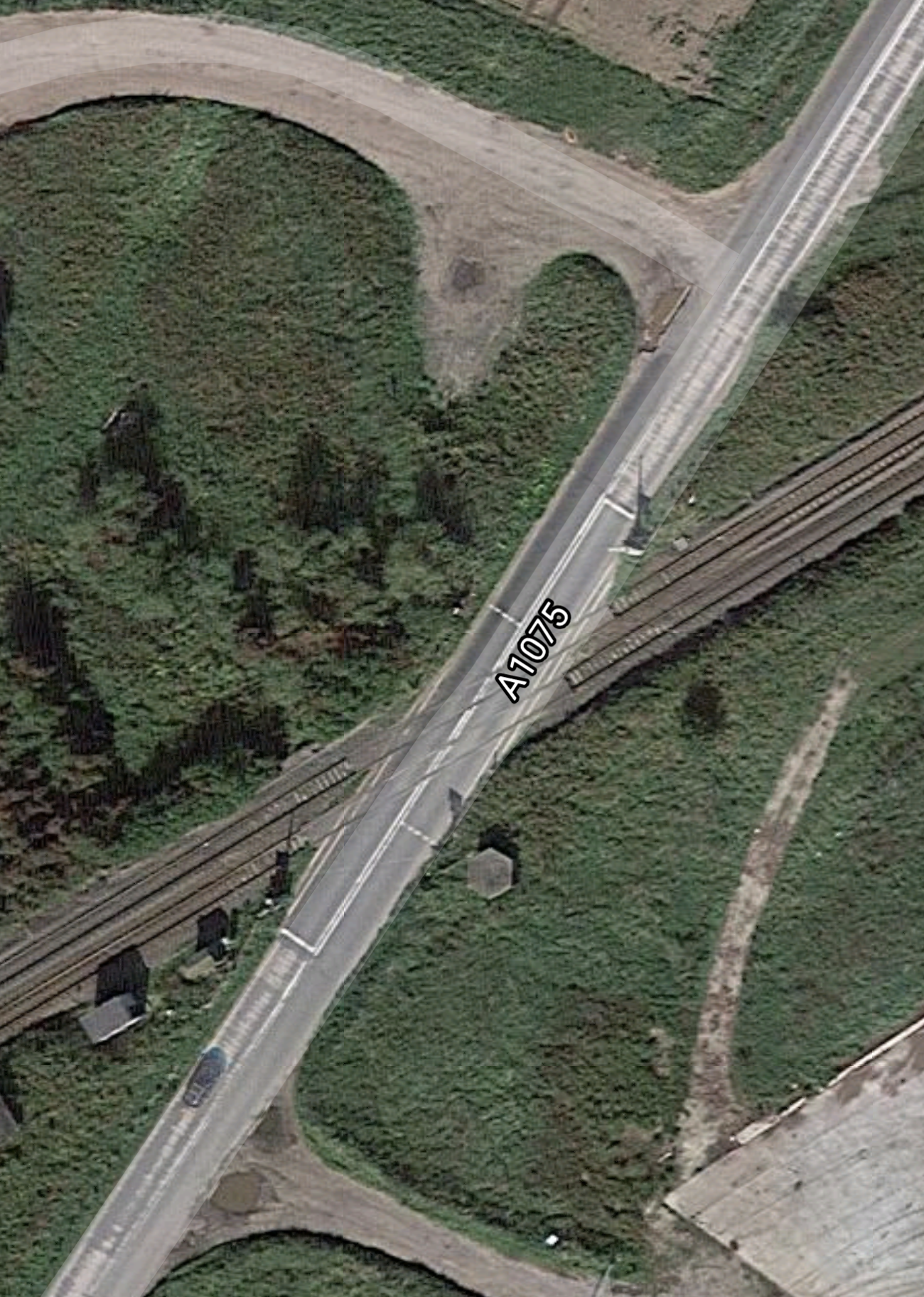
Note.
- The road is the A1075, so could the traffic be easily handled by an automatic crossing with full barriers?
- The railway is the Breckland Line between Norwich and Ely.
- It looks like there are two passenger tph and the occasional freight trains through this crossing.
- The line speed of the rail line is 75-90 mph.
It should also be noted that Network Rail rate this crossing as high risk.
The ABC Railway Guide gives the line speed as 40 mph and adds these risk factors.
- Poor Visibility for Approaching Road Vehicles
- Crossing Approach
- Large Numbers of Users
- Sun Glare
- Deliberate Misuse or User Error
This crossing sounds like it could be an accident waiting to happen.
Although, I would feel that installing similar lights to those at Six Mile Bottom could be a big help!
Summarising The Proposed Level Crossing Upgrades
I can split these by topic.
Full Barrier installation
It would appear that all barriers can probably be replaced with the latest full barrier technology.
Improved Lighting
The video from Six Mile Bottom was impressive and probably shows how fairly simple improvements can increase safety.
Local Opposition
On this brief summary of all the level crossings, that Network Rail propose to upgrade to automatic crossing with full barriers, it would appear that only the Meldreth Road crossing is seeing opposition from local interests. Although, I do have doubts, that the development of all those houses at Waterbeach will ever happen because of local opposition.
Major Construction Works
It would appear that only two upgrades could require major works.
Meldreth Road – But only if it was felt that a substantial solution was needed.
Waterbeach – If a new station were to be built to cater for future housing development.
The others would only need barrier replacement and other appropriate improvements.
I would also feel that most of the work could be carried out without major disruption to train services or road traffic.
Modern Digital Signalling With Automatic Train Operation
Modern digital signalling with in-cab displays and a measure of automatic train operation offers three main gains to train operators and passengers.
- More services can be squeezed safely into the existing network, without building controversial and expensive new lines.
- Trains can run at higher average speeds.
- Trains can run to timetable easier.
It should be noted that South of Doncaster the East Coast Main Line is being converted to this type of signalling and this will allow the Azumas and other trains to run at 140 mph, where the track allows, to speed up services between King’s Cross and the North.
Services Between King’s Cross and Cambridge
South of Hitchin, some services between King’s Cross and Cambridge share the lines with the expresses to and from the North.
For that reason the 100 mph Class 700 trains and the 110 mph Class 387 trains, would be out of their speed range like Morris Minors on the M1.
In 2018, I wrote Call For ETCS On King’s Lynn Route, based on an article in Rail Magazine, which called for 125 mph trains to Cambridge and King’s Lynn, so they wouldn’t slow the expresses.
It does appear to me that the digital signalling part of the C3R Project will enable 125 mph trains to run between King’s Cross and King’s Lynn via Cambridge.
- Oxford has 125 mph non-stop local trains to London, so why not Cambridge?
- A nine-car Class 800 train has a similar seating capacity to a twelve-car Class 700 train, but the seats are better and the train can travel at 125 mph.
- These trains would significantly reduce the fifty minute journey time between King’s Cross and Cambridge.
This would be a real Cambridge Express.
Developing Services Around Cambridge
Just as full digital signalling is helping London to expand its railways with Crossrail and Thameslink. I believe that the C3R Project will help to squeeze more trains through Cambridge.
In a few years time, I believe Cambridge will have a core route consisting of Cambridge North, Cambridge and Cambridge South stations with much expanded services to Bury St. Edmunds, Ely, Ipswich, Kings Lynn, London, Norwich, Peterborough, Stansted Airport, Stevenage and Wisbech.
Ten years ago, I was told by one of Cambridge’s eminent thinkers, that Cambridge needed the connectivity to bring in the people that the economy needs.
The pandemic has changed things, but not Cambridge’s desire to create more businesses expand.
A Connection To Peterborough
Peterborough is the other half of Cambridgeshire’s area and shares the Cambridgeshire & Peterborough Combined Authority with Cambridge.
Peterborough station is well connected to the North and Midlands.
- LNER’s connect the station to most stations on the East Coast Main Line.
- It has hourly services to Birmingham, Leicester, Liverpool, Manchester and Nottingham.
But the connection between Cambridge and Peterborough is not of the quality and frequency that the two cities need.
A Connection To Stevenage
Stevenage is an important manufacturing and technology centre, with a strong presence in aerospace.
Stevenage station is well connected to the North and South.
- LNER and other services connect the station to most stations South of Leeds and York on the East Coast Main Line.
- The new service from East Coast Trains will provide a direct service to Newcastle and Edinburgh with a frequency of seven trains per day (tpd).
- It has a direct suburban line to King’s Cross.
- It has a direct suburban line to Moorgate.
Stevenage seems to be acquiring more long distance services as time progresses.
But the connection between Cambridge and Stevenage is currently poor, at just two tph, which stop everywhere.
Improve the connection between Cambridge and Stevenage and have more calls of services to and from the North at Stevenage and Cambridge and \stevenage would benefit.
Currently, the fast Cambridge services take 27 minutes to do the 30.3 miles between Cambridge and Stevenage, which is an average speed of 67.3 mph.
A Connection To Wisbech
Progress seems to be being made on a service between Cambridge and Wisbech, which I wrote about in Hope For Wisbech Line Revival.
This was the conclusion of that post.
I very much feel that the Cambridgeshire & Peterborough Combined Authority and Network Rail can create a very useful branch line to Wisbech.
There is not much infrastructure to be built and upgraded.
-
- A new station will be built at Wisbech, which I feel is likely to be a Park-and-Ride on the A47.
- A bay platform will probably need to be reopened at March station.
- March station will need to be step-free.
- There may be a station and a passing loop at Coldham.
- Track and signalling will need to be replaced.
But the big project needed is the remodelling at Ely, which will have to be done to increase capacity, through the bottleneck.
Greater Anglia’s Class 755 trains would appear to be ideal for the branch and could operate on battery power.
This connection could be a very valuable connection.
It certainly looks like there are better plans to connect Wisbech to Cambridge, than there are to improve the connections between Cambridge and Peterborough and Stevenage.
Conclusion
The C3R Project will give the Cambridge compatible signalling with the East Coast Main Line and I feel increasingly Cambridge could be treated as a series of stations just off the East Coast Main Line and we might see some services develop, that seem strange to today’s travellers.
A simple example could be a Regional Metro running between Peterborough and Stevenage.
- It would call at March, Ely, Waterbeach, Cambridge North, Cambridge, Cambridge South, Royston and Hitchin.
- It would run at a frequency upwards of two tph.
- It could even connect to Lincoln.
Other North-South services through Cambridge like Thameslink and Norwich and Stansted would combine to give perhaps six tph through the three main Cambridge stations.
The C3R Project will open up lots of possibilities.
Heidelberg Plans Net-Zero Cement Plant For Sweden
The title of this post, is the same as that of this article on The Times.
Making cement creates about ten percent of man-made carbon emissions. See Wikipedia for CO2 Emissions From Cement.
Making cement needs a lot of energy and I suspect most comes from natural gas these days.
But I suspect there are ways to simply cut the carbon emissions.
- Making cement is a continuous process and I suspect adding carbon capture would be easier than with other industrial processes like steelmaking.
- Hydrogen rather than natural gas could be used to provide energy.
There also may be other ways of making cement. See Ecological Cement on Wikipedia.
What Would Be The Ultimate Range Of A Nine-Car Class 800 Train?
In Thoughts On Batteries On A Hitachi Intercity Tri-Mode Battery Train, I had a section, which was called The Ultimate Battery Train.
I said this.
I think it would be possible to put together a nine car battery-electric train with a long range.
- It would be based based on Hitachi Intercity Tri-Mode Battery Train technology, which would be applied to a Class 800 or Class 802 train.
- It would have two driver cars without batteries.
- It would have seven intermediate cars with 600 kWh batteries.
- It would have a total battery capacity of 4200 kWh.
- The train would be optimised for 100 mph running.
- My estimate in How Much Power Is Needed To Run A Train At 125 Or 100 mph?, said it would need 2.19 kWh per vehicle mile to cruise at 100 mph.
That would give a range of over 200 miles.
If the batteries were only 500 kWh, the range would be 178 miles.
Aberdeen, Inverness, Penzance and Swansea here we come.
Note that I have ignored energy lost in the station stops.
Energy Use And Recovery In A Station Stop
The station stop will be handled something like this.
The train will be happily trundling along at 100 mph.
At the right moment, the driver will apply the brakes and the train will stop in the station.
With trains like these Hitachi trains and many others, braking is performed by turning the traction motors into generators and the kinetic energy of the train will be turned into electricity.
Normally with this regenerative braking, the electricity is returned to the track, but these trains are not running on electrified track, so the electricity will be stored in the traction batteries on the train. This is often done in battery-electric road vehicles.
After the stop, the train will use battery power to accelerate back to 100 mph.
What kinetic energy will a Class 800 train have at 100 mph?
- The basic weight of a nine-car Class 800 train is 438 tonnes.
- I am assuming that the batteries are no heavier than the diesel engines they replace.
- The trains hold 611 passengers.
- I will assume each weighs 80 Kg with baggage, bikes and buggies, which gives a weight of 48.9 tonnes.
- This gives a total train weight of 486.9 tonnes.
Using Omni’s Kinetic Energy Calculator, gives a kinetic energy of 135.145 kWh.
When I first saw figures like this, I felt I had something wrong, but after checking time and time again, they still appear.
At each stop a proportion of the train’s kinetic energy will not be recovered.
These figures show the extra energy needed at each stop with different regenerative braking efficiencies.
- 100 % – 0 kWh
- 90 % – 13.51 kWh
- 80 % – 27.03 kWh
- 70 % – 40.54 kWh
- 60 % – 54.06 kWh
Obviously, the more efficient the regenerative braking, the less energy that needs to be added at each stop.
Edinburgh And Aberdeen
I am using Edinburgh and Aberdeen as an example.
Consider.
- I am assuming the train is cruising at 100 mph along the route.
- There are seven stations to the North of Haymarket station.
- If I assume 60 % regenerative braking efficiency, then each stop will need 54.06 kWh of electricity from the batteries.
- This gives a total of 378.4 kWh for the stops. Let’s call it 400 kWh.
- This effectively reduces the usable battery size to 3800 kWh
- Take off 200 kWh to make sure there’s always space for regenerative braking energy and useable battery size is 3600 kWh.
This can then be divided by the number of cars and 2.19 kWh per vehicle mile, to get the range.
This gives a range of over 180 miles.
With 500 kWh batteries the distance is just under 180 miles.
It certainly appears that a battery-electric train with seven 500-600 kWh batteries should be able to run between Edinburgh and Aberdeen.
Obviously, charging would be needed at Aberdeen.
What Would Be The Ultimate Range Of A Five-Car Class 800 Train?
What kinetic energy will a five-car Class 800 train have at 100 mph?
- The basic weight of a five-car Class 800 train is 243 tonnes.
- I am assuming that the batteries are no heavier than the diesel engines they replace.
- The trains hold 302 passengers.
- I will assume each weighs 80 Kg with baggage, bikes and buggies, which gives a weight of 25.6 tonnes.
- This gives a total train weight of 268.6 tonnes.
Using Omni’s Kinetic Energy Calculator, gives a kinetic energy of 74.6 kWh.
I will now use Edinburgh and Aberdeen as an example.
Consider.
- I am assuming the train is cruising at 100 mph along the route.
- I am assuming that the three intermediate cars have 600 kWh batteries.
- There are seven stations to the North of Haymarket station.
- If I assume 60 % regenerative braking efficiency, then each stop will need 29.84 kWh of electricity from the batteries.
- This gives a total of 208.9 kWh for the stops. Let’s call it 210 kWh.
- This effectively reduces the usable battery size to 1590 kWh
- Take off 100 kWh to make sure there’s always space for regenerative braking energy and useable battery size is 1490 kWh.
This can then be divided by the number of cars and 2.19 kWh per vehicle mile, to get the range.
This gives a range of over 136 miles.
With 500 kWh batteries the distance is around 110 miles.
It looks to me, that from these calculations that a nine-car train with battery packs in all the intermediate cars has a longer range than a five-car train with battery packs in all the intermediate cars.
What Would Be The Range Of a Five-Car Class 803 Train Equipped With Batteries?
What kinetic energy will a five-car Class 803 train have at 100 mph?
- The basic weight of a five-car Class 803 train is 228.5 tonnes.
- Three 600 kWh batteries could add 18 tonnes
- The trains hold 400 passengers.
- I will assume each weighs 80 Kg with baggage, bikes and buggies, which gives a weight of 32 tonnes.
- This gives a total train weight of 278.5 tonnes.
Using Omni’s Kinetic Energy Calculator, gives a kinetic energy of 77.3 kWh.
As before, I will now use Edinburgh and Aberdeen as an example.
Consider.
- I am assuming the train is cruising at 100 mph along the route.
- I am assuming that the three intermediate cars have 600 kWh batteries.
- There are seven stations to the North of Haymarket station.
- If I assume 60 % regenerative braking efficiency, then each stop will need 30.92 kWh of electricity from the batteries.
- This gives a total of 216.4 kWh for the stops. Let’s call it 220 kWh.
- This effectively reduces the usable battery size to 1580 kWh
- Take off 100 kWh to make sure there’s always space for regenerative braking energy and useable battery size is 1480 kWh.
This can then be divided by the number of cars and 2.19 kWh per vehicle mile, to get the range.
This gives a range of over 135 miles.
With 500 kWh batteries the distance is around 110 miles.
Catching The Blue Train
I’m off this morning to try to catch one of East Coast Trains‘ Class 803 trains, as it comes South through Oakleigh Park station around 13:30 today.
I managed to get these pictures.

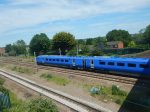
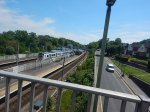
Note.
- I’m afraid the train caught me a bit by surprise.
- The train is currently under test, prior to starting services in October this year.
It must be nearly 65 years since I first watched the trains at Oakleigh Park station.
All You Want To Know About Highview Power
This article on Power is entitled Market Prospects Heating Up for Cryogenic Energy Storage.
It talks in detail about the technology, financing and market prospects for Highview Power and their CRYOBattery.
- Their batteries store energy by liquifying air and storing it in large tanks.
- To recover the energy, the air is encouraged to go to a gaseous phase and put through an air turbine.
- Their first commercial system is being built at Carrington near Manchester.
- The Carrington system will have an output of 50 MW and be able to store up to 250 MWh.
- Other systems are under development for Vermont and Spain.
- The systems are built like Leho from readily available components from the oil and gas industry.
One of my regrets in life, is that I missed the crowdfunding for this company!
Read the article as you might find one of Highview Power’s CRYOBatteries coming to a site near you.
Power’s article is the best yet on describing the technology.
Thoughts On Batteries On A Hitachi Regional Battery Train
This article is a repeat of Thoughts On Batteries On A Hitachi Intercity Tri-Mode Battery Train, but for their other train with batteries; the Hitachi Regional Battery Train.
This Hitachi infographic describes a Hitachi Regional Battery Train.

Hitachi are creating the first of these battery trains, by replacing one of the diesel power-packs in a Class 802 train with a battery-pack from Hyperdrive Innovation of Sunderland.
The Class 802 train has the following characteristics.
- Five cars.
- Three diesel power-packs, each with a power output of 700 kW.
- 125 mph top speed on electricity.
- I believe all intermediate cars are wired for diesel power-packs, so can all intermediate cars have a battery?
In How Much Power Is Needed To Run A Train At 125 Or 100 mph?, I estimated that the trains need the following amounts of energy to keep them at a constant speed.
- Class 801 train – 125 mph 3.42 kWh per vehicle mile
- Class 801 train – 100 mph 2.19 kWh per vehicle mile
The figures are my best estimates.
We also know that according to Hitachi, the battery train has a range of 90 kilometres or 56 miles at a speed of 100 mph.
So applying the formula for energy needed gives that the battery size to cover 56 miles at a constant 100 mph will be.
56 * 2.19 * 5 = 613.2 kWh.
In the calculation for the Hitachi Intercity Tri-Mofr Battery Train, I had assumed that a 600 kWh battery was feasible, as it would lay less than the diesel engine it replaced.
I can also apply the formula for a four-car train.
56 * 2.19 * 4 = 490.6 kWh.
That too, would be very feasible.
Conclusion
I can’t wait to ride in one of Hitachi’s two proposed battery-electric trains.
What Does Novak Djorkovic Tell Us About The Covids?
If you search the Internet for “coeliac disease and Novac Djokovic, you get a lot of posts linking to gluten-free diet and some to coeliac disease.
Some say he is coeliac and others say he is just gluten-free.
There are also reports on the Internet of Novac Djokovic having Covid-19.
So does that tell us anything about gluten-free diets, coeliac disease and Covid-19?
As there are no reports of him spending a long time in hospital, it doesn’t disprove my theory, that coeliacs on a gluten-free diet don’t get serious doses of the Covids!
I’d love to hear more stories of coeliacs on a gluten-free diet, who have caught Covid-19.
Nestlé’s Glass Train Shifts More Cargo From Road To Rail
The title of this post, is the same as that of this article on RailFreight.com.
This is the first paragraph.
In France, Nestlé Water is bringing more trains to the rails for the transport of reusable water bottles to and from the production site. The Glass Train project, as it is called, is also getting two more destinations; Arles in Southern France and Merrey in the country’s East. The 25 new trains will help the company remove up to 1,000 trucks off the road and save approximately 500 tons in CO2 emissions.
Nestlé is expanding the project to Vittel and Pellegrino.
Conclusion
We need more projects like this!
Are Kraft Heinz Up To Something?
This article on The Times, is entitled Ketchup On Its Way Back To Britain As Kraft Heinz Invests In UK Site.
This is the first two paragraphs.
Heinz tomato ketchup will be made in Britain again after its owner announced plans for a £140 million upgrade of a site on the outskirts of Wigan.
Europe’s largest food manufacturing facility is set to start making the sauces of Kraft Heinz, which also include mayonnaise and salad cream, in a move designed to meet demand in the UK.
I wrote about Kraft recently in Kraft Heinz And Freight Innovation, where they were experimenting with Network Rail to get goods to their Wigan site faster and with less carbon emissions.
I think the two stories might fit together.
have just looked at my 435 gram bottle of Heinz tomato ketchup. It states on the bottle that every 100 grams of the sauce is made from 174 grams of tomatoes. I suspect leaving in the pips and the skins would make a rather lumpy sauce!
But this means that for every tonne of sauce, there is a need for 1.74 tonnes of tomatoes.
Could this be a reason why Kraft Heinz ran an experiment a couple of months ago with bringing in goods to the site at Wigan by rail?
There could be TomatoLiner trains all the way from Spain or Italy.
Or perhaps, they could link Wigan to Lincolnshire or South Yorkshire, where tomatoes could be grown in large automated greenhouses, heated by the waste heat from all the power stations. Carbon dioxide from gas-fired power stations could also be used to make the tomatoes grow big and strong.
Why shouldn’t we eat the carbon dioxide we produce?
The more I look at Google Maps of Lincolnshire and South Yorkshire, the more I think that cost-competitive UK-produced tomatoes could be one of the reasons for this move.
I have found companies like Yorkshire Grown Produce, who grow the speciality varieties of tomatoes for supermarkets. and CambridgeHOK, who design and build the automated greenhouses.
But the problem, all growers of fruit and vegetables face, is the lack of people to do the harvesting, at an affordable price.
- As a Control Engineer, who has worked on automation, it is my view that robot or automatic harvesting is needed.
- After all robots don’t get drunk at the weekend and not turn up on Mondays.
I haven’t found a robot that would pick tomatoes yet, but I suspect there’s a company out there working on it.
Yorkshire Grown Produce are in Brough, a few files to the South-West of Hull. and say they can provide quality tomatoes from March to November.
So could a company provide affordable tomatoes to Kraft Heinz’s specification for 9-10 months of the year?
- Looking at bottles of Ketchup, it appears they have a shelf life of at least a year, so the month’s without tomatoes could be bridged by a warehouse.
- I also suspect that automated greenhouses could turn out guaranteed Organic tomatoes.
- The tomatoes would arrive in Wigan the day they are picked.
- It probably wouldn’t be a large train every day and the line at Wigan is not electrified, so it wouldn’t necessarily be a zero-carbon trip across the Pennines.
I can see an efficient system for the production of tomato ketchup, which could be labelled organic and 100 % British.
How many tonnes of carbon emissions would be saved? Probably not many! But it’s the thought that counts.
If this isn’t technology-aided marketing, I don’t know what is?
Conclusion
How many other production and delivery processes can be simplified by the use of rail?
 The Anonymous Widower