Waterbeach Station To Be Relocated
The title of this post, is the same as that of this article on Railway Gazette.
These three paragraphs, outline the project.
Cambridgeshire County Council has called tenders for an estimated £35m design and build contract for the relocation of Waterbeach station to a new site further to the north.
This would support the Waterbeach New Town development of 4 500 homes. Opening is now envisaged for 2026.
The replacement station would have two platforms, an accessible footbridge, a 200-space car park, taxi and bus drop-off, cycle storage and a new access road from Cody Road. The 24-month scheme would include the demolition of the existing station.
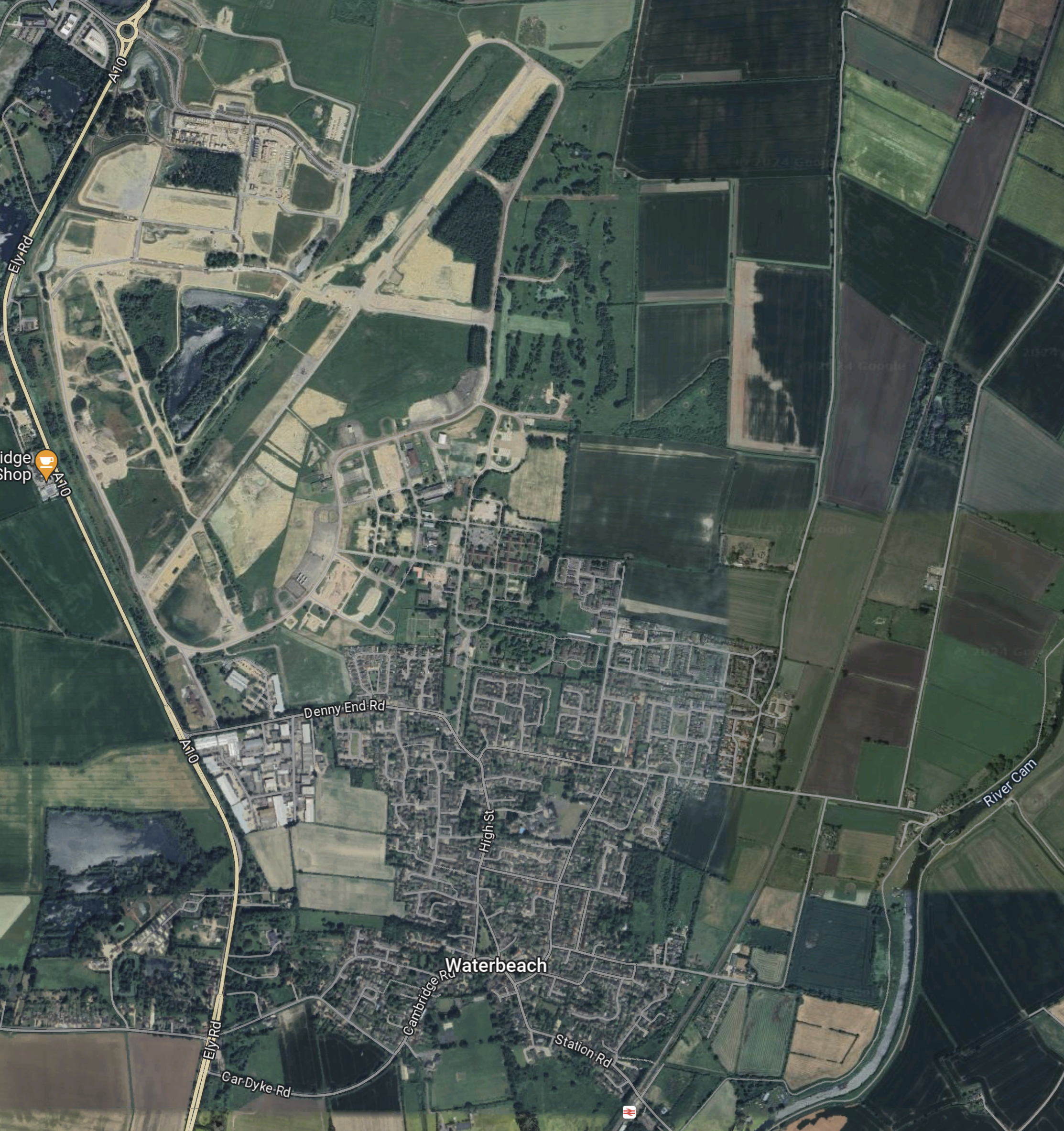
This Google Map shows the current station and the location of Waterbeach New Town.
Note.
Waterbeach station is at the bottom of the map, just to the right of centre.
- The station is on the Breckland Line between Cambridge and Norwich via Ely.
- The Breckland Line continues North-East to the North-East corner of the map.
- The village of Waterbeach is to the North of the station.
- North of Waterbeach is the old Waterbeach Airfield, which will be covered in the housing of the New Town.
Moving the station nearer the New Town would seem to be a sensible action.
I have some further thoughts.
The Remodelling Of Ely
Ely station is a railway bottleneck and in Are The Trains In Ely Finally To Be Sorted?, I discussed what needed to be done.
Would it help, if Waterbeach station were to be rebuilt first?
A Cambridge Metro
Once Waterbeach station has been rebuilt and Cambridge South station has been built, there will be a run of stations through Cambridge.
- Ely
- Waterbeach
- Cambridge North
- Cambridge
- Cambridge South
Perhaps, extra trains could be added to create a frequent rail route across Cambridge.
East West Railway
Will the trains of the East West Railway stop at Waterbeach station?
Conclusion
Waterbeach could be a very useful and busy station.
I Was Kathleened At The Weekend
Saturday
At 0200 on Saturday morning, I couldn’t sleep.
So in the end, I got up, made myself a mug of tea and did Saturday’s puzzles in The Times.
I had no trouble doing them, so my brain function was normal.
But my left hand wasn’t working that well.
I had breakfast in Leon and had a bit of trouble with their sauce containers, but otherwise I was fine.
I did a bit of shopping in M & S on Moorgate and came home.
I wasn’t having any problems.
For the rest of the day, I watched television and listened to the radio.
Sunday
I got up late, as I was probably catching up the sleep from the night before.
I had lunch in Gordon Ramsey’s Street Burger about one.
My left hand wasn’t working that well and I was making a bit of a mess.
After, I got home, I watched television and listened to the radio.
Monday
I slept in late, but as my left hand wasn’t being very co-operative, I had a small bit of trouble dressing, due to an uncooperative left hand.
My INR was 2.0, so I took 5 mg. of Warfarin.
I had breakfast in Leon, where I made a mess with the sauce container.
I then went looking for a book, which I couldn’t find.
Tuesday
Everything seems better today.
My INR was 2.1, so I took 5 mg. of Warfarin.
I did my usual Monday morning trip, of visit to Marks & Spencer for about three days of food and then had breakfast in Leon.
Conclusion
This seems to be a pattern.
- A storm goes through, I can’t sleep and after some drinks of tea or zero alcohol beer, I feel a bit better.
- My left hand often stops co-operating and won’t do simple things.
- But it does seem to clear up, when the storm passes.
This is probably the third time, that it’s happened.
Note.
- My left humerus was broken by the school bully.
- I had a stroke in 2011, which affected my left arm.
- If I carry shopping in my left hand, the pulling action on my humerus seems to help.
Any ideas will be gratefully received.
Fortescue Officially Opens Gladstone Electrolyser Facility
The title of this post, is the same as that of this press release from Fortescue.
This is the sub-heading.
Fortescue has today officially opened its world-leading electrolyser manufacturing facility in Gladstone, Queensland, Australia – one of the first globally to house an automated assembly line.
The first two paragraphs add more detail.
Fortescue has today officially opened its world-leading electrolyser manufacturing facility in Gladstone, Queensland, Australia – one of the first globally to house an automated assembly line.
The 15,000sqm advanced manufacturing facility, constructed and fully commissioned in just over 2 years, will have capacity to produce over 2GW of Proton Exchange Membrane (PEM) electrolyser stacks annually.
This is a very large increase in electrolyser production.
With Wind Turbines Is It Bigger Are Better?
The offshoreWIND.biz web site has two stories today, with a similar theme.
- Scots Greenlight Slimmed-Down Turbine Plan For 100 MW Pentland Floating Offshore Wind Farm, which described how the Pentland wind farm is reducing the number of turbines from ten to seven, but increasing their size from 10 to 14 MW, to produce the same power output.
- Fred. Olsen Seawind, EDF Slash Turbine Count For Codling Wind Park, described how in the Irish wind farm; Codling wind farm, the number of turbines are being reduced from hundred to seventy-five.
There are also some wind farms, where capacity has the potential to be increased.
- Ossian Floating Wind Farm Could Have Capacity Of 3.6 GW
- Crown Estate Mulls Adding 4 GW Of Capacity From Existing Offshore Wind Projects
Note.
- With the exception of the floating Pentland wind farm, all wind farms have fixed foundations.
- It certainly does look, that larger turbines may have reasons to be used.
- Perhaps installing a large turbine is very much the same as a small turbine.
It looks like a victory for the accountants.
Sizewell C – South Park And Ride
This document on the Planning Inspectorate web site, is a description of the Southern Park and Ride for the Sizewell C Project.
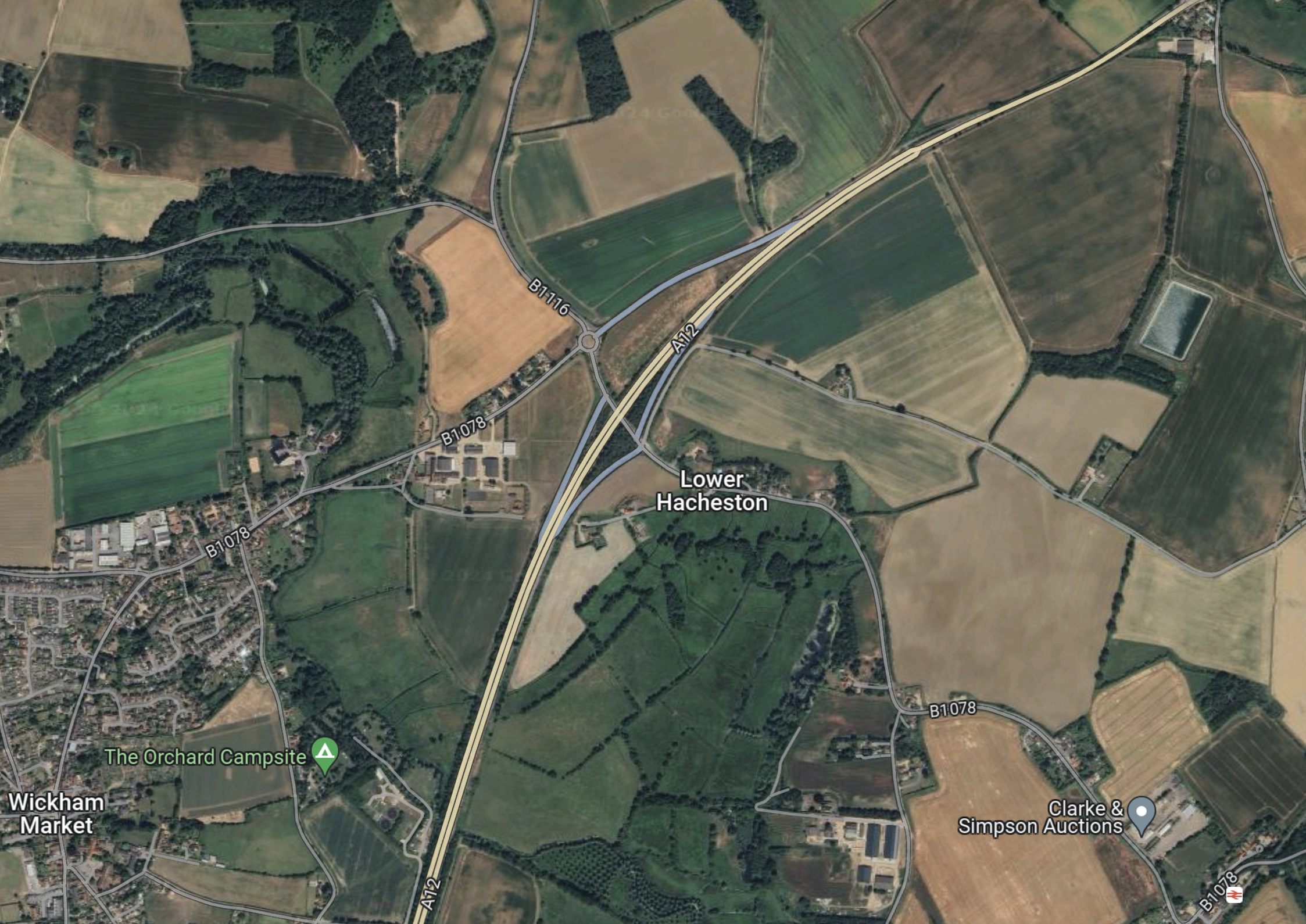
This Google Map shows the area of the Park-and-Ride site.
Note.
- Wickham Market is in the South-West corner of the map.
- The dual-carriageway is the Wickham Markey by-pass, which is part of the A12 between Ipswich and Lowestoft.
- Close to Lower Hacheston is the Northern junction of the by-pass which connects the B1116 and B 1078 roads to the A 12.
- If my memory serves me correctly, there is a small roundabout to the North of the A12, where the B 1116 and B 1078 cross, which is referred to as Fiveways Roundabout in some of the documentation.
- Wickham Market station is in the South-East corner of the map.
I know the area well, as I used to live less than ten miles to the West of Fiveways roundabout.
This shows the area to the North of Fiveways roundabout to a large scale.
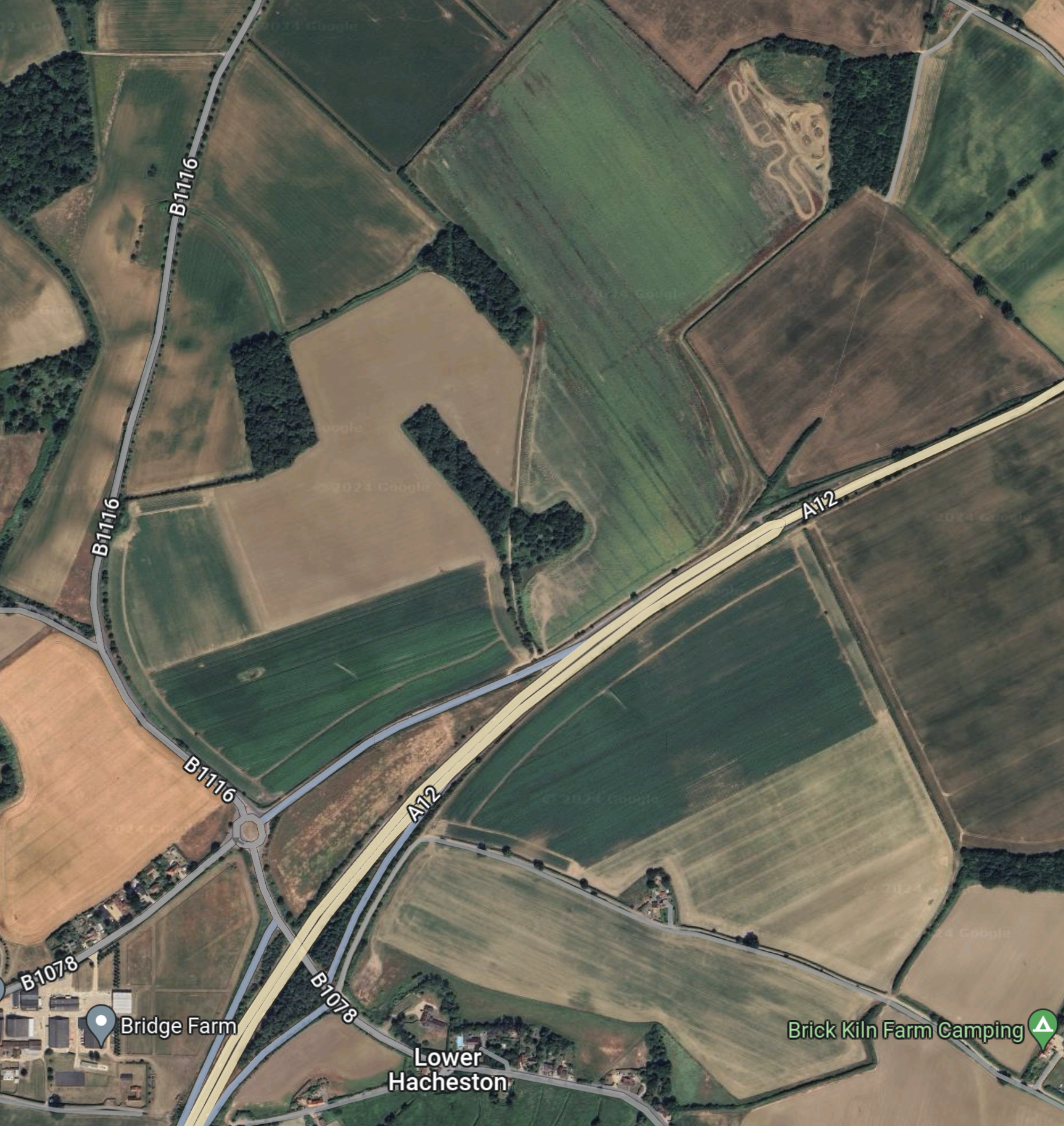
The document on the Planning Inspectorate says this about the site.
The site comprises approximately 26.4 hectares (ha) of predominantly
agricultural land and highway land located north-east of Wickham Market.
The part of the site which would contain the parking and buildings, postal
consolidation building and Traffic Incident Management Area (TIMA) is
approximately 18ha in size, and located to the east of the B1078/B1116, to
the north of the A12. The remainder of the site encompasses a section of
the A12, and an associated slip road where highway improvements are
proposed to form the site access, and associated signage and road
markings, see Chapter 1, Figure 1.1 of this volume.
These are my thoughts.
There Is No Rail Connection
I wrote about the Northern Park-and-Ride in Sizewell C – North Park And Ride and there is one big difference.
The Northern Park-and-Ride is an easy walk from Darsham station.
- Darsham station has an hourly four-car train to Lowestoft and Ipswich.
- Some or all trains could be doubled in capacity as Greater Anglia has enough stock to do this.
- If required, trains could be run to and from London and intermediate stations.
- In the past, Network Rail have developed plans to extend the service as far as Yarmouth.
I believe that a rail connection at the Southern Park-and-Ride could have added flexibility for workers in Ipswich travelling to the Sizewell site.
Bus Routes
The frequency and timing of park and ride buses would depend on the
working patterns adopted during construction of the Sizewell C main
development site, and the number of workers to be moved during the shift
changeover periods. More frequent services would operate during staff
changeover and shift start/end periods. It is anticipated that there would be
three to nine buses from the proposed development per hour during shift
changeover period, and an hourly service outside shift changeover periods.There would be a maximum of 100 daily bus arrivals and 100 daily bus
departures from the proposed development to the Sizewell C main
development site. These buses would use the A12, two village bypass and
Sizewell link road once operational to travel to and from the Sizewell C main development site.
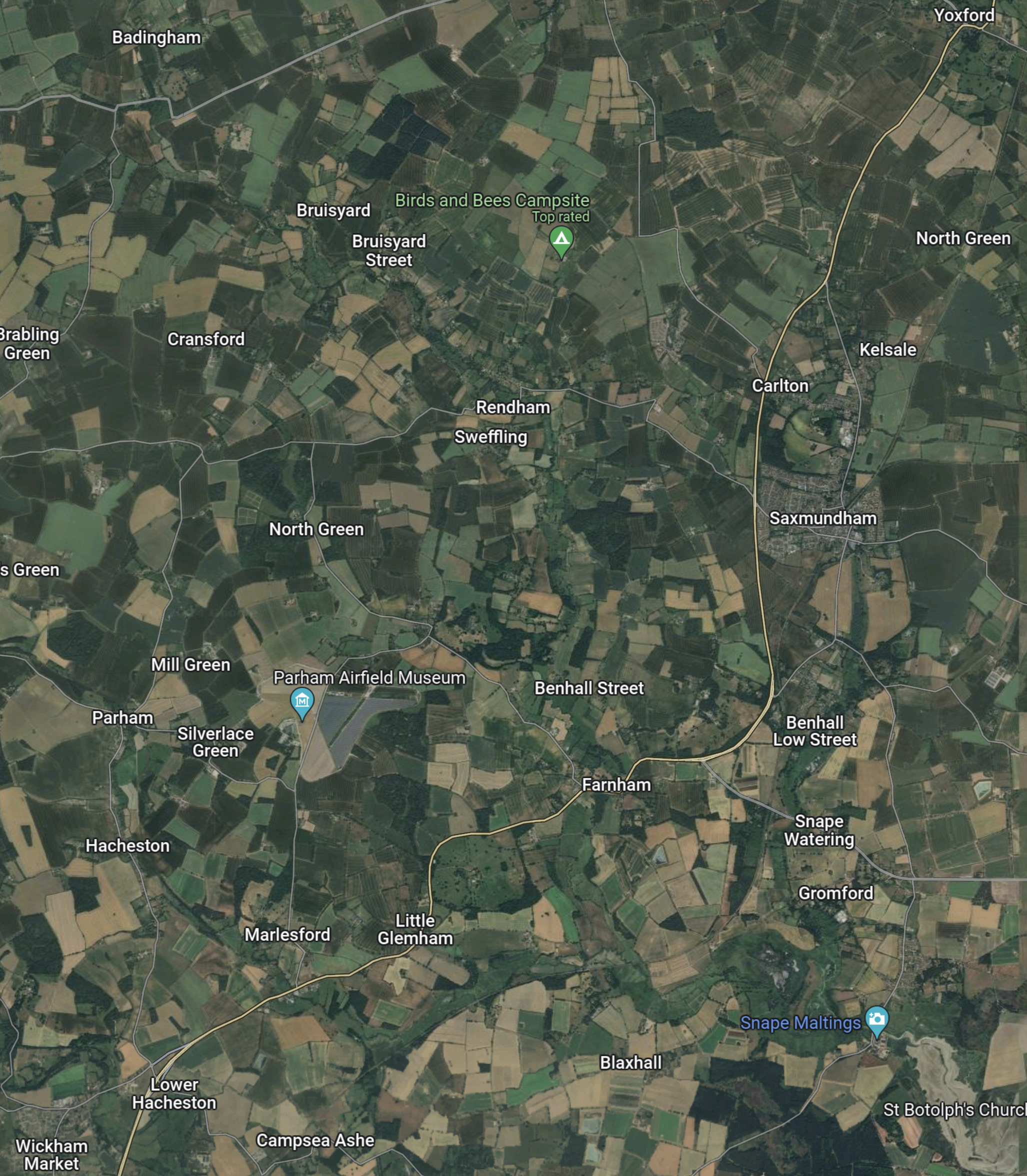
This Google Map shows the A 12 between the South Park-and-Ride site and Yoxford.
Note.
- Yoxford is in the North-East corner of the map.
- Wickham Market is in the South-West corner of the map.
- The A 12 is the cream road linking the two villages.
- The Southern Park-and-Ride will be to the North-East of Wickham Market.
- The Northern Park-and-Ride is a couple of miles North of Yoxford.
- Yoxford and Wickham Market are 11.8 miles apart.
This third Google Map shows the route between Yoxford and Sizewell.
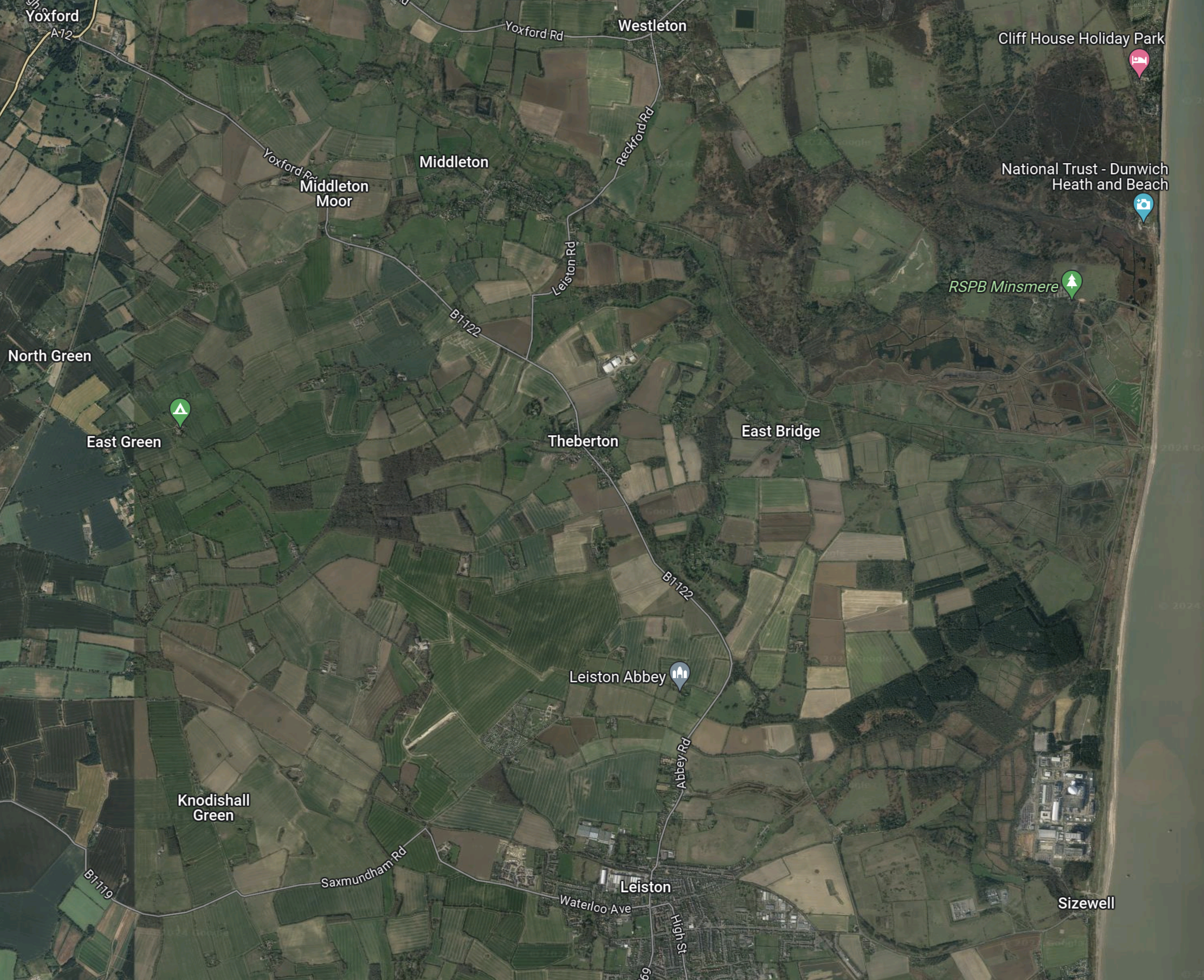
Note.
- Yoxford is in the North-West corner of the map.
- Sizewell is in the South-East corner of the map.
- Leiston Abbey is indicated by the arrow to the North of Leiston.
The B 1122 can be picked out through Middleton Moor and Theberton and then as it skirts Leiston Abbey.
It appears that both Park-and-Ride sites, use the same connection between the A 12 and Sizewell C.
Objections To The Park-and-Ride
This petition on change.org is entitled Stop Sizewell C Park and Ride at Wickham Market.
The petitioner is objecting on the following grounds.
- The size of the site.
- Spoiling of views.
- Disturbance to walkers and horse riders.
- Terrestrial ecology and ornithology will be affected by the site.
- Increase in traffic.
This was the petitioner’s conclusion.
In conclusion I oppose the Sizewell C southern park and ride site at Wickham Market and believe it should be sited further south on the A12 away from residential areas and near the A14.
The Ipswich Northern By-Pass
There is another large project scheduled for Ipswich in the next few years; the Ipswich Northern By-Pass.
This map clipped from the Ipswich Borough Council web site shows possible routes.

Note.
- Wickham Market is in the North-East corner of the map.
- One of the aims of the Northern by-pass is to open up land for housing.
- The railway between Ipswich and Darsham stations goes via Westerfield, Wiidbridge, Melton andWickham Market.
- Perhaps by phasing the developments, an area could be used for a Park-and-Ride, which has a road connection to the A 12.
- When the need for Park-and-Ride for Sizewell has decreased, the site could be handed over to housing.
It would certainly help, if the route of the Northern by-pass was settled soon.
Sizewell C – Where Will The Workers Live?
I have now written about, where the two Park-and-Ride sites are to be built.
- The Northern Park-and-Ride is proposed for Darsham.
- The Southern Park-and-Ride is proposed for Wickham Market.
I can now write about where the workers could be billeted.
I suspect there could be a Bibby Stockholm solution, where accommodation barges are used.
This Google Map shows the centre of Ipswich.
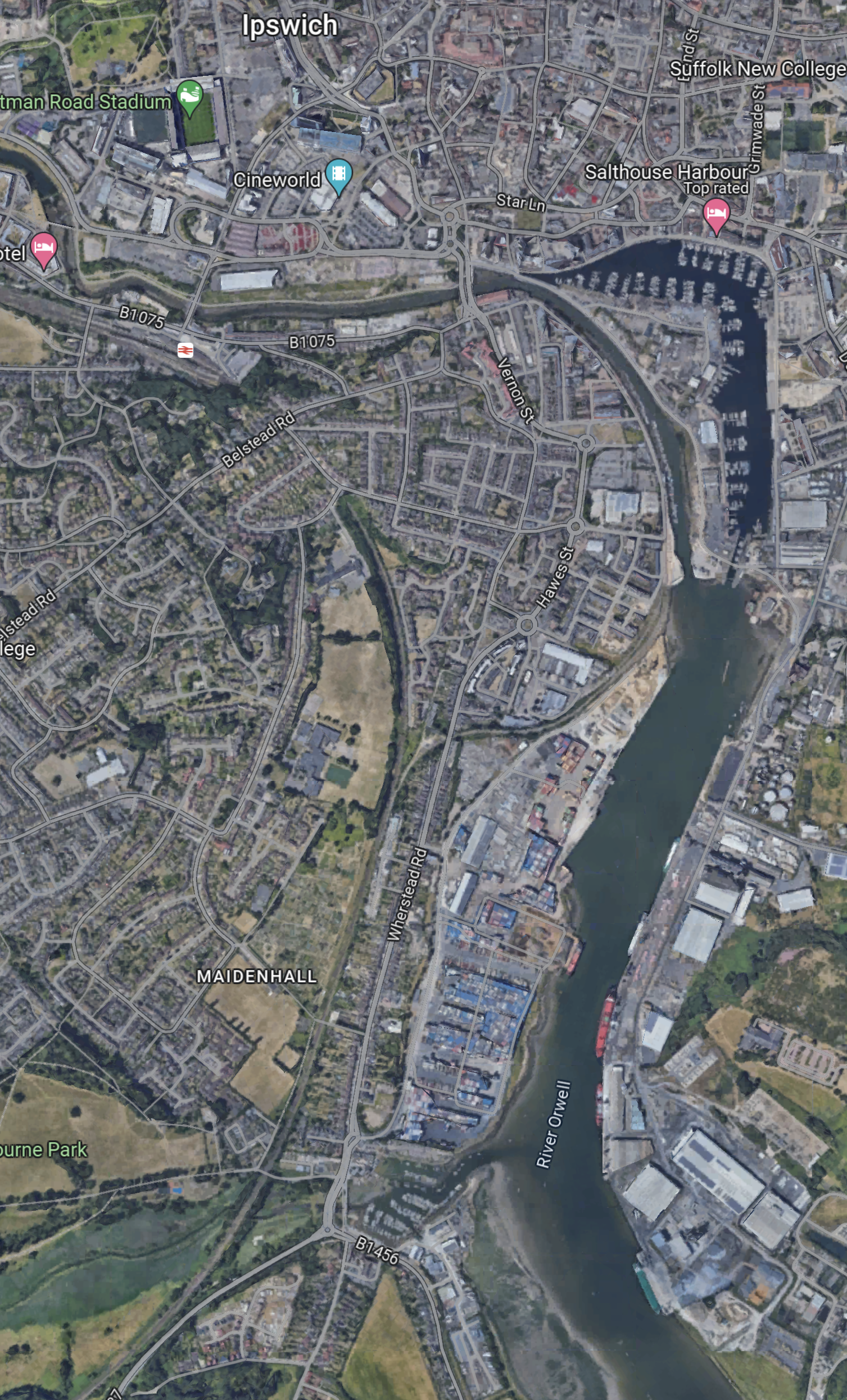
Note.
- There is a lot of space on the River Orwell.
- Ipswich station is in the North-West corner of the map.
- There could be a shuttle bus between the barge and the station.
- Trains could take workers to Darsham for buses to Sizewell.
There could even be direct buses to Sizewell.
This Google Map shows the centre of Lowestoft.
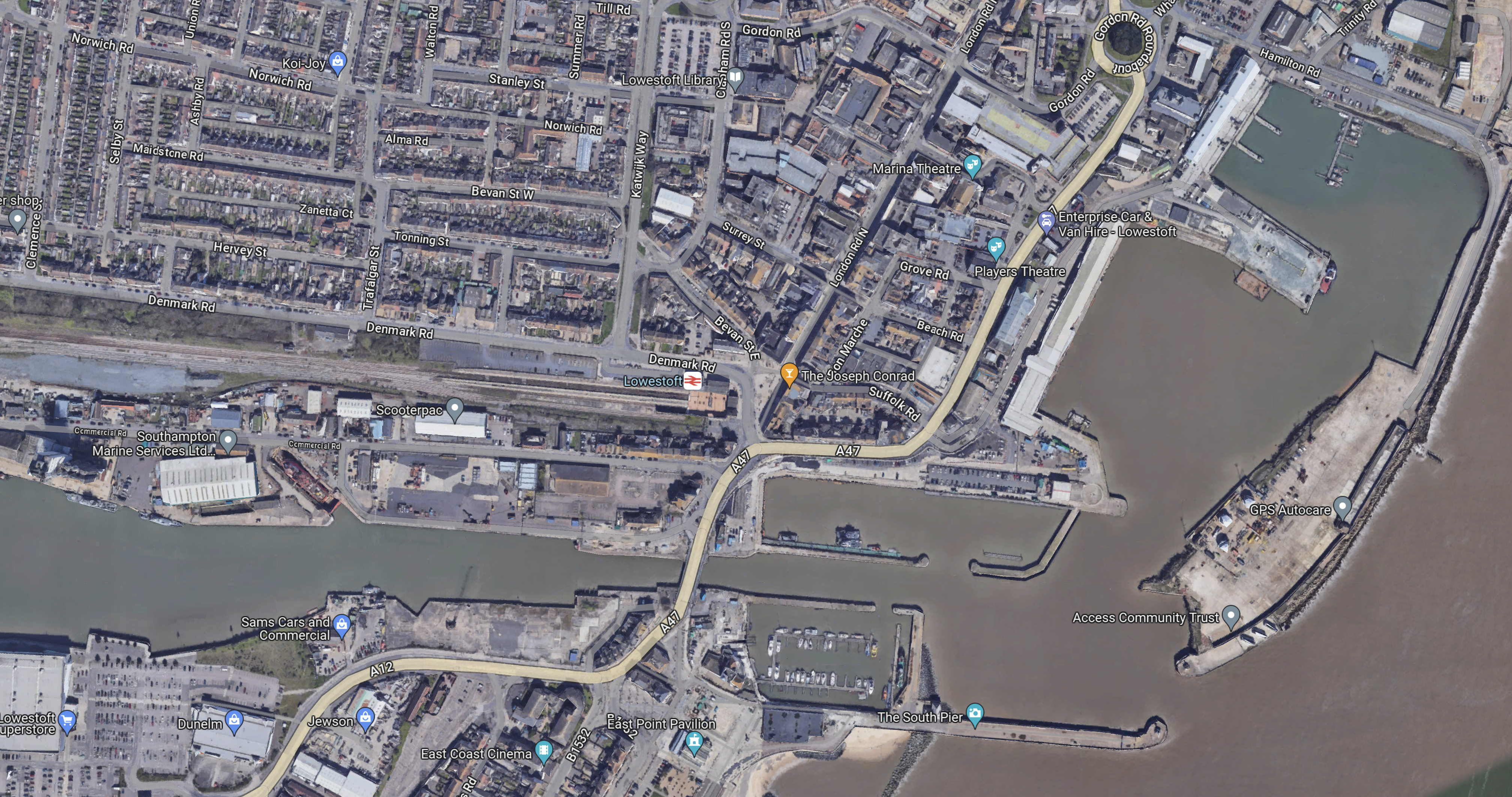
Note.
- The Bibby Stockholm is 100 metres long with a beam of 30 metres.
- Lowestoft station is close to the port.
Workers could take the train direct to the Northern Park-and-Ride for Sizewell C.
Sizewell C – North Park And Ride
This document on the Planning Inspectorate web site, is a description of the Northern Park-and-Ride for the Sizewell C Project.
This Google Map shows the area of the Park-and-Ride site.
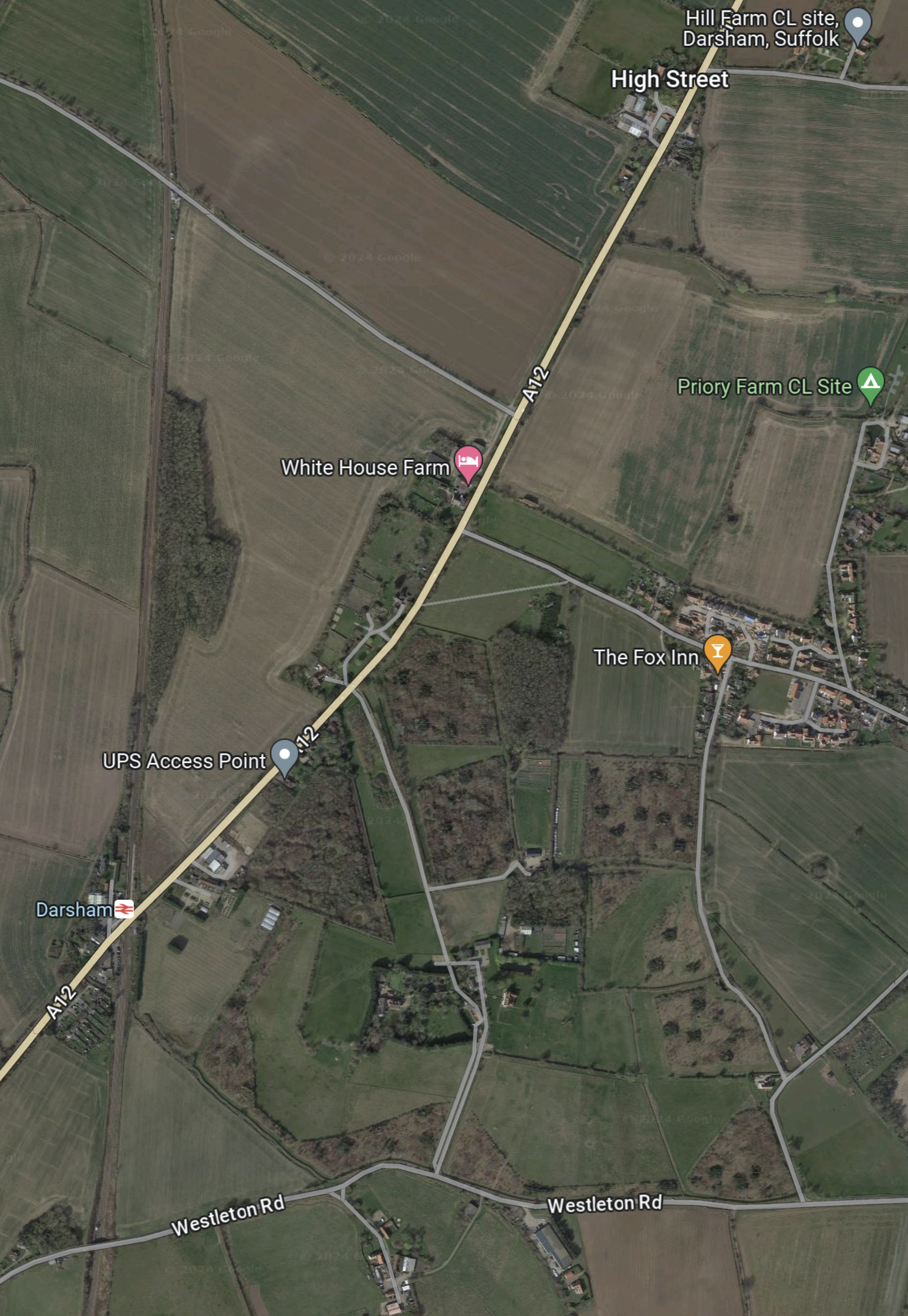
Note.
- The main road running SW-NE is the A 12 between Ipswich, Felixstowe and Woodbridge in the South and Lowestoft and Great Yarmouth in the North.
- The East Suffolk Line runs North-South at the West side of the map.
- Darsham station, which is indicated by the red logo on a white background is situated, where road and railway cross.
- The Fox Inn is in the village of Darsham and indicated by an orange arrow.
- The pink arrow to the North-West of the Fox Inn indicates White House Farm.
- The lane going North-West from the A 12 to the North of the farm is Willow Marsh Lane.
The document on the Planning Inspectorate says this about the site.
The site comprises approximately 27.9 hectares (ha) of predominantly
agricultural land but also includes sections of the A12 and Willow Marsh Lane
towards the north of the site. It is located west of the village of Darsham and
west of the A12, to the east of the East Suffolk line, and to the north of
Darsham railway station (see Chapter 1, Figure 1.1 of this volume). Further
detail on the site and the environmental baseline is provided in Chapters 1
and 4 to 12 of this volume of the Environmental Statement.
This second Google Map shows Darsham station.
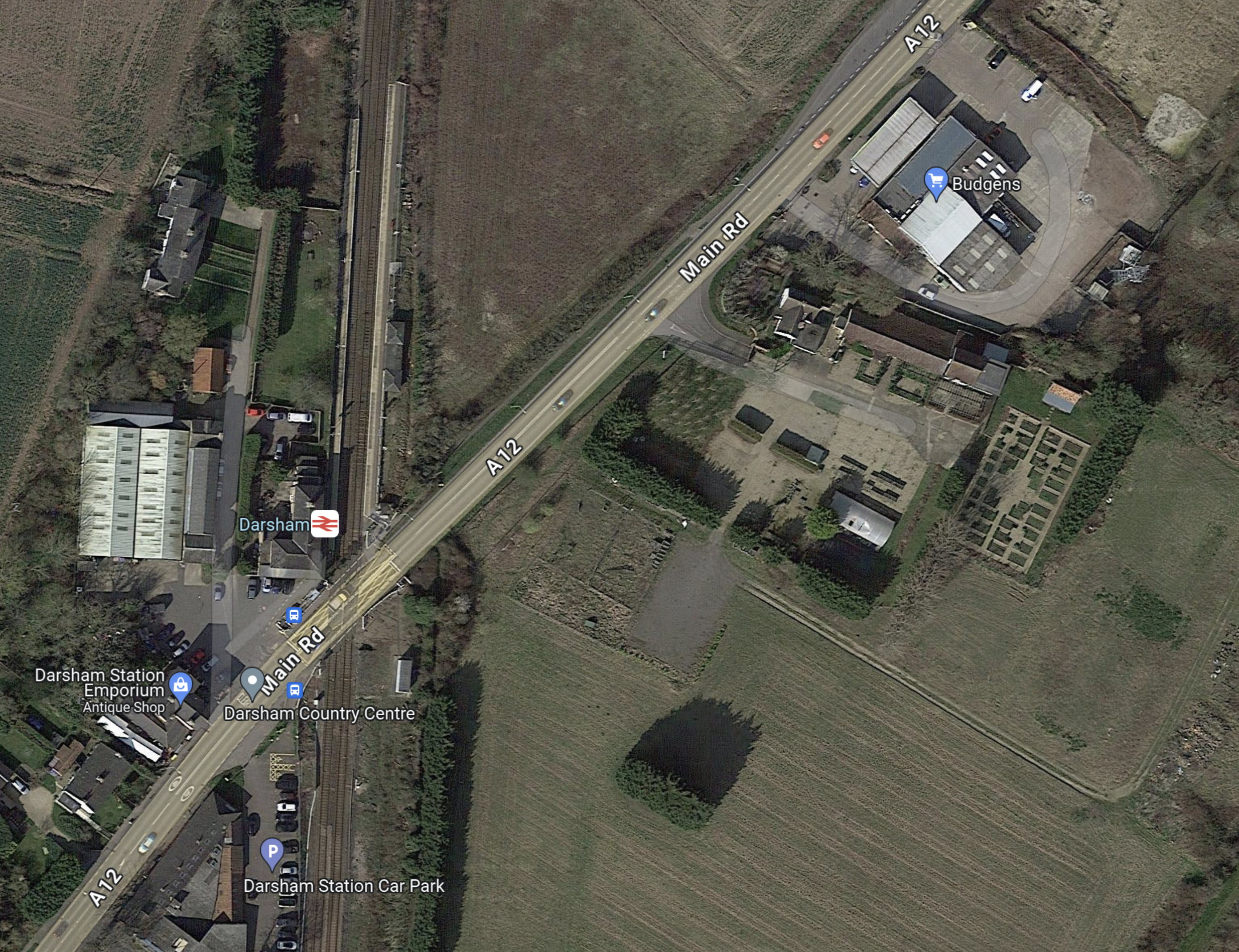
Note.
- Darsham station has long platforms.
- Crossing the line is by means of the level crossing.
- The Budgens store, which is indicated by the blue arrow also sells fuel.
- The station has a bus service.
- The Southern end of the Park-and-Ride site lies between the railway and the road at the North of the map.
The document on the Planning Inspectorate says this about walking between the Park-and-Ride site and the station.
There would be a pedestrian route from Darsham railway station along the
footway on the A12 to the south-east of the site. Pedestrians accessing the
site would leave the A12 and enter through a security gate provided in the
security fencing. Further details of access measures (such as key fobs,
CCTV, intercom system) would be agreed at the detailed design stage.
I could probably manage that at 76.
These are further thoughts.
The Current Rail Service
Currently, the rail service is as follows.
- One train per hour (tph) in both directions.
- |Trains are Class 755 trains, built by Stadler in Switzerland a few years ago.
- Each train can carry up to 229 passengers.
- Up to three trains can run together.
- Trains going to and from Lowestoft in the North call at Oulton Broad South, Beccles, Brampton and Halesworth.
- Trains going to and from Ipswich in the South call at Saxmundham, Wickham Market, Melton and Woodbridge.
- Travellers for London Liverpool Street change at Ipswich.
- The first train from London Liverpool Street would get you to Darsham at 11:00.
- This is not a bad train service but it could be improved.
Direct Trains Between London Liverpool Street And Lowestoft
In 2016, I wrote Making Sense Of The New East Anglia Franchise.
I wrote the following about Greater Anglia’s plans to run four trains per day between London Liverpool Street and Lowestoft.
There are going to be four direct services between London and Lowestoft each day. This probably initially means two trains to London in the morning peak and two trains back in the evening one.
When, I first moved back to Suffolk in the 1970s, I regularly caught a diesel-hauled train from Wickham Market to London for the day.
This is all motherhood and apple pie for those in Lowestoft wanting to go to London, but I suspect it isn’t the easiest service for a train operator to schedule efficiently and make money.
Would a train operator really want to start a full train at Lowestoft at say six in the morning and then have it wait around all day in London before returning in the evening?
The East Suffolk Line from Ipswich to Lowestoft has the following characteristics.
- It is fifty miles long.
- It is not electrified.
- It has a speed limit of 40-55 mph.
- There are nine intermediate stations. Many are just a single platform, and car parking is fairly limited.
- It has enough double-track and a passing loop at Beccles station to run a train in both directions at the same time.
- As it ran long trains in the past, I suspect, that most of the stations have platforms that can handle at least six-carriage trains.
- Trains would appear to take around ninety minutes for the whole journey
But the most important characteristic, is that every time the line is improved, more passengers come rushing out of the woodwork.
There would certainly be no problem with running bi-mode Flirts on this route, as London-Lowestoft is just the type of route for which they are designed.
- They would use their on-board diesel engines on the East Suffolk Line.
- As some would work along the busy lines to London, I suspect their top speed under electric power would be the same as the EMUs.
- Services to and from London, once on the Great Eastern Main Line, would join the high-speed race to and from the capital.
- At the start and finish of the day, the trains could use the electrified main line to position between Ipswich and Crown Point depot at around 100 mph.
- Abellio could use either a single three- or four-car train or perhaps two trains coupled together.
This service would pass through Darsham station, so it could provide a direct link between London and the Park-and-Ride.
It might also stop at stations like Manningtree, Colchester, Chelmsford and Stratford.
I am fairly certain, that a London Liverpool Street and Lowestoft services, that stopped at Darsham station, would improve labour availability and construction efficiency at Sizewell C.
A Connection To Yarmouth
There used to be a direct Yarmouth to Lowestoft Line, but now it is possible to use the Wherry Lines, with a reverse at Reedham station.
So will we be seeing the direct London-Lowestoft trains being extended to Yarmouth?
As Yarmouth hasn’t had a direct connection to London for years and there are lots of fast, capable new trains, I wouldn’t be surprised.
Especially, as Network Rail are talking about reinstating the Reedham Chord to create a more direct route between East Anglia’s largest North-Eastern towns. This is said about the Reedham Chord in Direct Yarmouth Services in the Wikipedia entry for Lowestoft station.
In January 2015, a Network Rail study proposed the reintroduction of direct services between Lowestoft and Yarmouth by reinstating a spur at Reedham. Services could once again travel between two East Coast towns, with an estimated journey time of 33 minutes, via a reconstructed 34-chain (680 m) north-to-south arm of the former triangular junction at Reedham, which had been removed in c. 1880. The plans also involve relocating Reedham station nearer the junction, an idea which attracted criticism.
If we take these current approximate timings.
- Ipswich to Lowestoft takes 90 minutes.
- Lowestoft to Reedham takes 27 minutes.
- Reedham to Yarmouth takes 16 minutes.
That means the service today would take 133 minutes, with a train reverse at Reedham station.
Note.
- Modern three-car bi-mode Flirt trains, with better speed, acceleration and braking than the current Class 170 trains.
- The short-cut along the Reedham Chord, which could save as much as ten minutes.
- A few selective improvements to save a minute here and there.
- Lowestoft station is redeveloped forty metres to the West and eighty metres to the South, as detailed in Wikipedia under Relocation Of The Station.
- I think it would be possible for an Ipswich-Yarmouth service to do the trip in around two hours.
The service would have the following characteristics.
- It would be timetabled for under the all-important two hours.
- Trains would turnround efficiently in a few minutes at either end of the line.
- It could be hourly with four trains or two-hourly with just two, used to run the service.
- All stops would be at the same minutes past each hour at each station.
- Trains would always leave Ipswich and Yarmouth at the same number of minutes past the hour.
- Lowestoft and Yarmouth get a regular hourly direct train service in just thirty-three minutes.
- Intriguingly if the trains left Ipswich and Yarmouth at the same time, they would pass each other at Beccles station, which incorporates a passing loop.
- As Beccles and its passing loop, fits so well into this schedule, I suspect that it was designed with the Reedham Chord and this type of service in mind.
- There would be no prizes for guessing the beer, that should be served on a train on this route.
I don’t think any better than an hourly service, could be run, without some extra passing loops or double-track.
This extension would make commuting between Sizewell and Yarmouth easier.
Bus Route Between Darsham And Sizewell
The document on the Planning Inspectorate says this about the buses and the route.
There would be a maximum of 100 daily bus arrivals and 100 daily bus
departures from the proposed development to the Sizewell C main
development site.Bus services between the proposed development and the Sizewell C main
development site would travel south on the A12 and use the new A12/B1122
roundabout (Yoxford Roundabout – see Volume 7 of the ES) to access the
B1122 and the Sizewell link road (once operational – see Volume 6 of the
ES) towards the Sizewell C main development site.
This Google Map shows Darsham station and the Sizewell site, as it exists today.
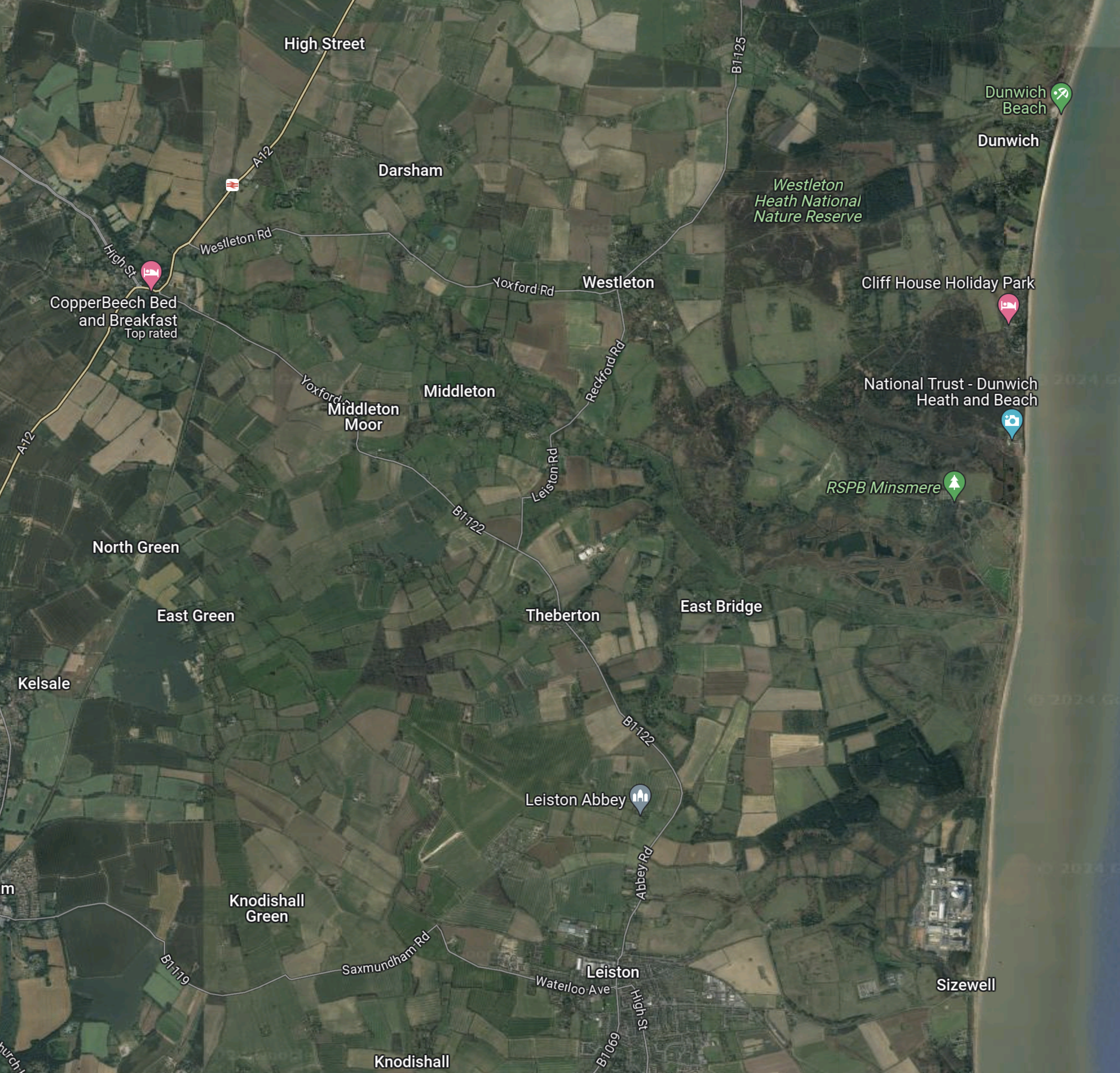
Note.
- The Sizewell site is in the South-East corner of the map.
- Darsham station is in the North-West corner of the map.
This second Google Map shows the A 12 between Darsham station and Yoxford.

Note.
- Darsham station is at the top of the map on the A 12.
- The village of Yoxford is on an S-bend of the A 12.
- A B& B is marked by a pink arrow.
The B 1122 connects Yoxford to the South-East corner of the map.
This third Google Map shows the route between Yoxford and Sizewell.
Note.
- Yoxford is in the North-West corner of the map.
- Sizewell is in the South-East corner of the map.
- Leiston Abbey is indicated by the arrow to the North of Leiston.
The B 1122 can be picked out through Middleton Moor and Theberton and then as it skirts Leiston Abbey.
Sizewell C seem to have made a good effort to get the workers to the site.
Why Isn’t A Passenger Train Run Between Ipswich And The Sizewell Site?
In Network Rail Prepares To Send Four Trains A Night Through Suffolk To Sizewell, I came to this conclusion.
I am fairly certain, that it is possible to move four freight trains in and out of the Sizewell site during the night, without doing any major works to the East Suffolk Line between Ipswich and Saxmundham junction.
- Adding extra track at Wickham Market would probably cause major disruption.
- Some level crossings will probably be improved.
But without a full double track between Ipswich and Saxmundham junction, I doubt there could be any increase in passenger services.
But with those track works, it might be possible to run an hourly service between Ipswich and Aldeburgh with calls at Westerfield, Woodbridge, Wickham Market, Saxmundham, Sizewell and Leiston.
This would give a two tph service between Saxmundham and Ipswich.
Objections To The Park-and-Ride
This document from Darsham Parish Council is entitled Consultation Response To Sizewell C.
This is the first paragraph.
Darsham Parish Council (Darsham PC) continues to oppose the proposed location of the Northern Park and Ride (NPR). We believe its location on an already busy single carriageway section of the A12 just north of the level crossing at Darsham Station, coupled with proposed roundabouts at Willow Marsh Lane and the A1120 junction in Yoxford are a recipe for traffic chaos extending northwards up the A12. We have no confidence in the traffic estimates submitted by EDF, which we believe underestimate the amount of local, through, agricultural and tourist traffic. This will be exacerbated by the proposed motel and further proposed development south of the station. We believe that traffic congestion on this main artery into Suffolk will adversely impact tourism throughout the AONB, which generates more than £360 million pa to the local economy (2018 figure). Further, we believe these volumes of traffic will generate excessive noise, vibration and pollution with serious negative impacts on those living alongside or close to the A12. Most significantly, Darsham PC has been advised that location of the NPR on this site could pose a significant flood risk to the railway (see below).
The Parish Council is also worried about flood risk to the railway.
The site of the NPR slopes down from Willow Marsh Lane towards the railway. A consulting engineer has advised us that the heavy clay soil here could pose a drainage and flood risk problem when compacted during the construction period. An appropriate sustainable semi-permeable surface could be utilised for car parking spaces to reduce run-off, with suitable drainage and reservoir capacity at the southern end to protect the railway from flooding. We submitted this evidence to EDF during the consultation period, but it has been ignored.
I suspect as with the opposition to Sizewell B, the opposition is led by second home owners, worried about the value of their investment.
Network Rail Prepares To Send Four Trains A Night Through Suffolk To Sizewell
The title of this post, is the same as that of this article on the East Anglian Daily Times.
These are the first two paragraphs.
There will be improvements to the East Suffolk Line between Ipswich and Saxmundham and to the little-used Leiston branch line which will become busier with up to four trains a night carrying construction materials to the Sizewell C site.
However there are no plans at present to create a new passing loop at Wickham Market which would be needed to allow construction trains to travel by day so most of these trains will have to use the line at night.
Note.
- Trains access the Sizewell site from Saxmundham junction on the East Suffolk Line.
- Between Saxmundham and Halesworth stations is double track.
- With the exception of a passing loop at Beccles station between Halesworth and Lowestoft stations is single track.
- Saxmundham junction and Lowestoft station is 26.2 miles.
- Between Saxmundham and Woodbridge stations is mainly single track.
- Between Woodbridge and Ipswich stations is double track.
- Saxmundham junction and Ipswich station is 22.8 miles.
It is a classic line, that was partly singled by British Rail to try and cut operating costs.
A passing loop at Wickham Market could make operation of the line easier.
- The last train in the evening leaves Saxmundham station at around 23:00 for Lowestoft.
- The first train in the morning leaves Saxmundham station at around 06:00 for Ipswich and Harwich International.
This would give a seven hour window in which to move four trains out of the Sizewell site and four trains in.
This OpenRailwayMap shows Ipswich Yard which is a set of freight sidings to the North of Ipswich station.
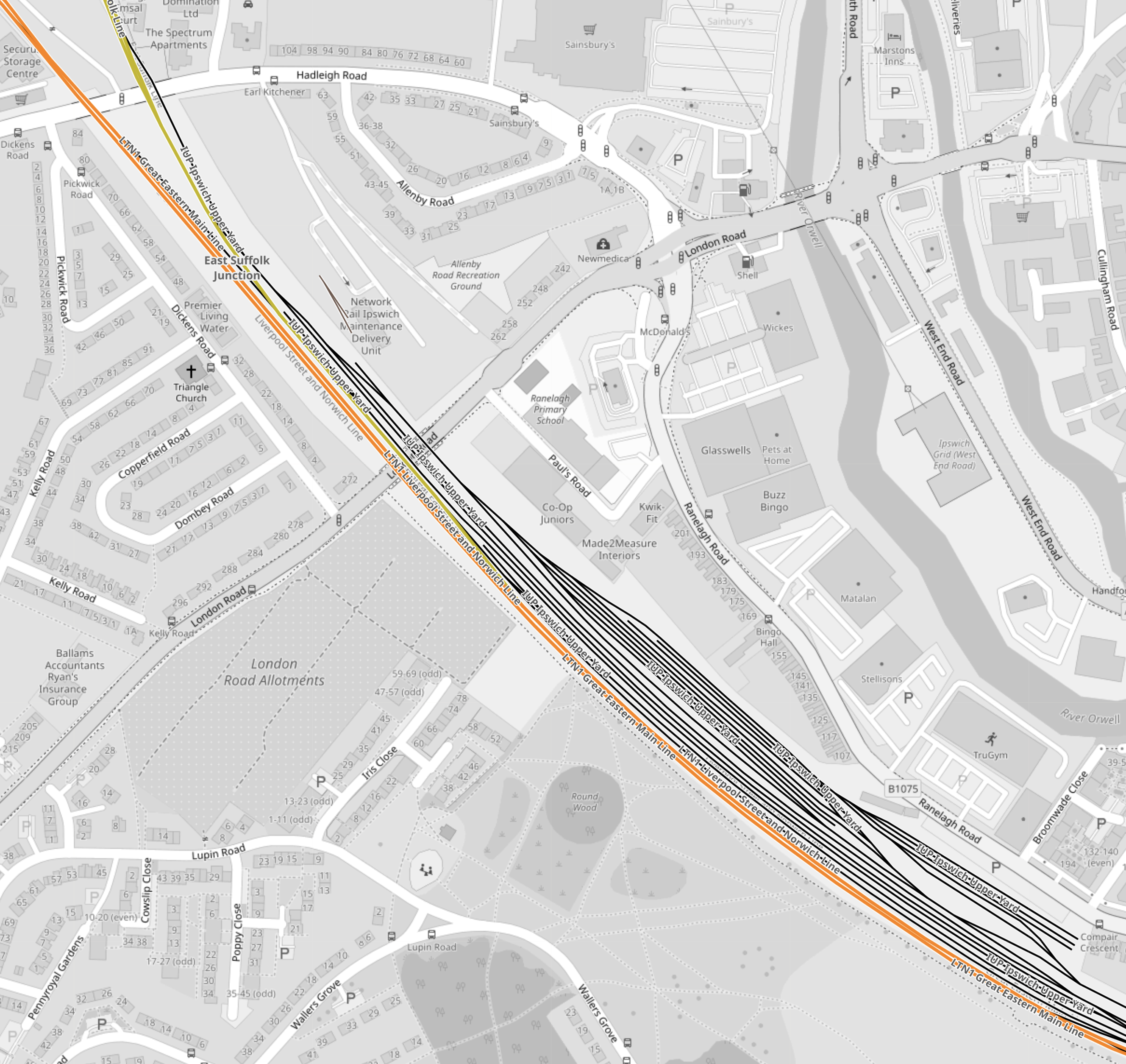
Note.
- The orange tracks are the Great Eastern Main Line.
- Ipswich station is just off the map to the South-East.
- The yellow track in the North-West corner is the East Suffolk Line to Saxmundham and Sizewell.
- The black lines diagonally across the map is Ipswich Yard, where wait if required, when coming out or going into the Port of Felixstowe.
I would expect that trains destined for Sizewell will wait in Ipswich Yard before being moved in at night.
These are my further thoughts.
Moving Trains Into And Out Of The Sizewell C Site
A map of the proposed rail layout in the Sizewell C site was published in the February 2019 Edition of Modern Railways showed at least four sidings in the site.
- We can assume that at the beginning of each night, there are.
- Up to four trains in the Sizewell C site, that need to come out of the site.
- Up to four trains in Ipswich Yard, that need to enter the site.
- As each train leaves the Sizewell C site, it creates a free siding for the next incoming train.
The process could be started by the four trains in the Sizewell C site, leaving nose-to-tail like a herd of elephants, but perhaps five minutes apart.
The outgoing trains would then park-up in Ipswich Yard or position themselves to get ready to bring in the next load.
Once all the outgoing trains, were clear of the Sizewell site, the four incoming trains, could trundle into the site.
Note.
- Effectively, there would be a night-time single-track railway exclusively handling freight trains into and out of the Sizewell C site, between the site and Ipswich Yard.
- With more sidings on the Sizewell C site, the limit could be higher than the currently proposed four trains per night in each direction.
- The number of and length of the trains could be adjusted, so that the deliveries of materials to the site, were in an optimal manner, which hopefully would increase the efficiency of the construction.
- There are twenty level crossings between Ipswich and Saxmundham junction and another five between Saxmundham junction.
Did poor delivery performance contribute to cost and time overruns at the more difficult-to-support, rail-isolated Hinckley Point C power station?
Conclusion
I am fairly certain, that it is possible to move four freight trains in and out of the Sizewell site during the night, without doing any major works to the East Suffolk Line between Ipswich and Saxmundham junction.
- Adding extra track at Wickham Market would probably cause major disruption.
- Some level crossings will probably be improved.
But without a full double track between Ipswich and Saxmundham junction, I doubt there could be any increase in passenger services.
Freightliner Partners With Zero To Decarbonise Critical Transport Operations
The title of this post, is the same as that of this news item from Freightliner.
This is the sub-heading.
Today, Freightliner and Zero, a breakthrough energy company that develops and manufactures whole-blend synthetic, non-biological fuels, announced a partnership to achieve a fossil-free locomotive operation by 2040 and overall Net Zero by 2050, representing a major evolution for one of the world’s oldest, safest and most reliable forms of freight transport. To successfully meet these ambitious emissions targets, Freightliner is exploring alternatives to diesel, such as Zero’s carbon-neutral synthetic diesel, which will eliminate fossil-carbon emissions and improve air quality and environmental wellbeing.
These are my thoughts.
Freightliner
Freightliner is a rail-freight company, that you see regularly hauling freight trains all over the UK.

The picture shows two of their Class 90 electric locomotives in their latest livery.
These posts talk about the company and lower or zero carbon operation.
- Clean Air Power Adds Hydrogen To Class 66 Fuel Mix
- Freightliner Continue Trials On New Low Carbon Fuel
- Freightliner Secures Government Funding For Dual-Fuel Project
- The Ultimate Bi-Mode
The current post fits that pattern.
Zero Petroleum
Zero Petroleum is one of those companies that gives Elon Musk nightmares.
But when you have backers like Babcock, Boeing, Intertek, Rolls-Royce and the Royal Air Force, you must be doing something right.
The Wikipedia entry for the company has this first paragraph.
Zero is a manufacturer of non-biological carbon-neutral synthetic fuel (also known as e-fuel) co-founded by former Formula One engineer Paddy Lowe. Its product has been developed as an alternative to fossil-based fuels and a more scalable sustainable alternative to waste and bio-fuels. The Royal Air Force used its fuel in November 2021 to achieve a World Record first flight powered by synthetic fuel. In July 2022, Zero entered a new partnership with the Royal Air Force to move towards mass production of sustainable aviation fuel.
The company is often known as just Zero.
These two and a half paragraphs from the Wikipedia entry describe the technology.
Zero uses Direct FT (a proprietary and specialised version of Fischer-Tropsch) to directly manufacture target fuels (gasoline, kerosene and diesel) at high yield and with no need for refinery upgrading.
When manufactured using renewable energy, synthetic fuel can be used as a carbon neutral or carbon negative direct drop-in replacement for fossil fuels, particularly for operations that require high energy densities – such as air travel, shipping and farming – and to ensure the continued use of legacy vehicles. It can also be used as a raw material to produce various forms of plastic.
It is manufactured using a process known as petrosynthesis, in which carbon dioxide and hydrogen are combined to create hydrocarbons. The process involves direct air capture of carbon dioxide from the atmosphere and the electrolysis of water to obtain hydrogen.
The Fischer-Tropsch process, despite its association in the past with dodgy regimes, seems to be at the heart of things, as it is with Velocys.
I describe the Velocys process and its link to Fischer-Tropsch in Grant Shapps Announcement On Friday.
Surely, the carbon-neutral fuel produced by Zero, are the ideal stop-gap fuel until true full zero-carbon fuels are available.
But Zero’s fuels will always be available for heritage and legacy trains, planes and automobiles and for applications, where older technology must be used.
As an example of older technology still being used on UK’s railways, Network Rail operate, the New Measurement Train to check all tracks in Great Britain.

The train may have been manufactured in the 1970s, but it has modern engines and is the ideal train to carry the wide variety of sophisticated equipment to ensure the safety of Britain’s railways.
Synthetic diesel like that produced by Zero could keep the New Measurement Train running for some years yet.
Freightliner Have Made A Pragmatic Decision
I believe that Freightliner have made a pragmatic decision, that allows them to go carbon neutral without without taking risks or spending millions on new equipment, that is not fully-developed.
As new zero-carbon technology is developed, like say hydrogen-electric hybrid locomotives, these may take over certain tasks, which will reduce some of the need for synthetic diesel.
But synthetic diesel from Zero will always be there as a fuel of last resort.
Application Of Control Engineering Principles To The Calculation Of Pharmaceutical Drug Doses
Today, I was asked by an eminent cardiologist to give my opinion on this scientific paper in the Journal of the American Heart Association, which was entitled Personalized Antihypertensive Treatment Optimization With Smartphone‐Enabled Remote Precision Dosing of Amlodipine During the COVID‐19 Pandemic (PERSONAL‐CovidBP Trial).
This was the background to the study.
The objective of the PERSONAL‐CovidBP (Personalised Electronic Record Supported Optimisation When Alone for Patients With Hypertension: Pilot Study for Remote Medical Management of Hypertension During the COVID‐19 Pandemic) trial was to assess the efficacy and safety of smartphone‐enabled remote precision dosing of amlodipine to control blood pressure (BP) in participants with primary hypertension during the COVID‐19 pandemic.
These were the methods and the results.
This was an open‐label, remote, dose titration trial using daily home self‐monitoring of BP, drug dose, and side effects with linked smartphone app and telemonitoring. Participants aged ≥18 years with uncontrolled hypertension (5–7 day baseline mean ≥135 mm Hg systolic BP or ≥85 mm Hg diastolic BP) received personalized amlodipine dose titration using novel (1, 2, 3, 4, 6, 7, 8, 9 mg) and standard (5 and 10 mg) doses daily over 14 weeks. The primary outcome of the trial was mean change in systolic BP from baseline to end of treatment. A total of 205 participants were enrolled and mean BP fell from 142/87 (systolic BP/diastolic BP) to 131/81 mm Hg (a reduction of 11 (95% CI, 10–12)/7 (95% CI, 6–7) mm Hg, P<0.001). The majority of participants achieved BP control on novel doses (84%); of those participants, 35% were controlled by 1 mg daily. The majority (88%) controlled on novel doses had no peripheral edema. Adherence to BP recording and reported adherence to medication was 84% and 94%, respectively. Patient retention was 96% (196/205). Treatment was well tolerated with no withdrawals from adverse events.
These were the conclusions.
Personalized dose titration with amlodipine was safe, well tolerated, and efficacious in treating primary hypertension. The majority of participants achieved BP control on novel doses, and with personalization of dose there were no trial discontinuations due to drug intolerance. App‐assisted remote clinician dose titration may better balance BP control and adverse effects and help optimize long‐term care.
About Myself
I am a Graduate Control Engineer, who graduated from the University of Liverpool in 1968.
I then worked at ICI in Runcorn for eighteen months, before moving to ICI Plastics Division, because of the untimely death of my father-in-law.
One of my tasks at Welwyn, was to look at control algorithms for chemical plants. For this I often used a PACE 231-R analogue computer.

Note.
- These computers could solve up to a hundred simultaneous differential equations at one time.
- They were programmed by wiring the various amplifiers and potentiometers together to simulate the equations.
- There were only a few transistors in these powerful machines, as all electronics were thermionic valves.
- Two of these machines wired together, were used to calculate the trajectories of the Apollo missions.
They were the unsung heroes of bringing Jim Lovell and Apollo 13 home safely.
Determining Control Algorithms
In a typical problem, I would model the a section of a chemical plant and the control system around it.
This would then lead to recommendations, as to the design and operation of the plant, so that it performed as required.
It could be argued that the body of an animal, is a very complicated integrated chemical plant, with a sophisticated control system.
For instance, if sensors around the body, say you are slightly low on fluids, your brain determines you should have a drink.
Many control loops on a chemical plant are controlled by proportional–integral–derivative controllers, which are commonly known as three-term controllers.
This is the first two paragraphs of the Wikipedia entry for three-term controllers.
A proportional–integral–derivative controller (PID controller or three-term controller) is a control loop mechanism employing feedback that is widely used in industrial control systems and a variety of other applications requiring continuously modulated control. A PID controller continuously calculates an error value
PID systems automatically apply accurate and responsive correction to a control function. An everyday example is the cruise control on a car, where ascending a hill would lower speed if constant engine power were applied. The controller’s PID algorithm restores the measured speed to the desired speed with minimal delay and overshoot by increasing the power output of the engine in a controlled manner.
I wouldn’t be surprised that the app in the smartphone used in the PERSONAL‐CovidBP Trial contained a form of three-term controller.
These are some points about three-term control algorithms.
Changing Of External Factors
One that was the villain in a problem, I dealt with, also affects my body – the weather.
I was asked to look at the problem of a chemical reaction, that overheated in hot weather. But the plant operators solved it by better insulation and ventilation of the plant and the standard three-term controller adjusted itself automatically to the new conditions.
After my stroke, I am on Warfarin for life. I test my own INR with a Roche meter and I have noticed that atmospheric pressure affects my INR. I change my deose accordingly, using a simple algorithm, of my own design.
The More You Test The More Precise The Control
If you take the cruise control example used by Wikipedia, speed is monitored continuously, as I hope, it would be if you were driving yourself.
But obviously, in many systems, where you are using an input with discrete values to control a system, you can’t be as precise as the data you collect.
When my son was dying from pancreatic cancer, he was fitted with a morphine pump, that he could adjust himself to dull the immense pain he was enduring.
- His nerves and his brain ascertained the pain level.
- He then adjusted the morphine level.
- He could get very precise control of his pain, because he was measuring it continuously.
But he was only using simple one-term control (proportional).
Derivative Control Can Be Difficult To Get Right And Can Even Go Unstable
Derivative control is mainly to stop overshoot, but sometimes you will find that it can go unstable, so two-term(proportional+integral) controllers will be used.
How I Control My INR
As I said earlier, I am on Warfarin for life and test my INR with a Roche meter.
The NHS typically tests patients about once every six weeks, which in my opinion as a Control Engineer is too infrequent.
I usually test myself a couple of times a week.
But every so often, I evaluate what daily dose gives me an equilibrium INR level of 2.5.
For the last three years, I have found a dose of 3.75 mg keeps me more or less on 2.5.
- As Warfarin comes in 1, 3, 5 and 10 mg. tablets, I alternate 3.5 and 4 mg.
- Warfarin tablets are easily cut in half using a sharp knife.
- I record INR and dose in a spreadsheet.
I have been doing this now for over ten years.
Is This A Unique Property Of Warfarin?
In this time, I have had five medical procedures, where surgeons were worried, that as I was on Warfarin, I might bleed too much.
For the first, which was to remove a lump from my mouth, the private surgeon wanted to charge extra for an anaesthetist. In the end, I asked what INR he wanted and he said 2.1 should be OK!
- So I reduced the Warfarin level and tested every day.
- I judged it correctly and had an INR of 2.1 on the day of the operation.
- The operation went incredibly well and I went home on public transport.
- The lump turned out to be benign.
- I’ve not had another lump.
After the operation, I increased the Warfarin level and tested every day, until it regained a level of 2.5.
On analysing my doses through the date of the operation, I found that the total amount of Warfarin, I didn’t take to reduce my INR to 2.1, was the same as I took to bring it back up again to 2.5.
Is this a unique property of Warfarin?
Since then I’ve had two cataract operations performed in a private hospital, where the NHS paid. Interestingly, they wouldn’t trust my own INR readings, so I had to get my GP to take the measurement.
I’ve also had gallstones removed by endoscopy at the local Homerton NHS hospital.
- For cases like mine, the hospital hire in a surgeon from the posh Wellington private hospital for one day a week, who brings the specialist tools needed.
- I wrote about this in Goodbye To My Gallstones.
- As it was a more serious procedure, I reduced my INR to a requested 1.0.
Interestingly, I still have my gall bladder, but the surgeon put it on notice to behave.
Conclusion
I would totally agree with the conclusion given in the PERSONAL‐CovidBP Trial.
Personalized dose titration with amlodipine was safe, well tolerated, and efficacious in treating primary hypertension. The majority of participants achieved BP control on novel doses, and with personalization of dose there were no trial discontinuations due to drug intolerance. App‐assisted remote clinician dose titration may better balance BP control and adverse effects and help optimize long‐term care.
I would add some conclusions of my own.
- The app used in the PERSONAL‐CovidBP Trial, seems to have had a good algorithm.
- I suspect the app could also be Internet-based.
These are some general conclusions.
- If you are on Warfarin and have access to a Roche meter, it is possible to lower your INR to the value required by a surgeon for an operation or a procedure.
- Since starting to take Warfarin, I have had four operations or procedures, where others would have had anaesthetic or a sedative.
- In those four operations, I was able to go home on public transport. If I still drove a car, I could have driven home afterwards.
- Private hospitals like to use an anesthetist, as it pumps up the bill.
- Avoiding anaesthesia must save hospitals money.
Well designed apps, based on Control Engineering principles, that help the patient take the best dose of a drug will become more common.
 The Anonymous Widower