SSE Thermal Charts Path To Green Hydrogen Future With First-Of-A-Kind Project
The title of this post, is the same as that of this press release from SSE Thermal.
This is the sub-heading.
SSE Thermal is developing a first-of-a-kind project in the Humber which would unite hydrogen production, storage and power generation in one location by the middle of this decade.
These paragraphs explain the project.
The Aldbrough Hydrogen Pathfinder project will support the evidence base for wider deployment of flexible hydrogen power in the UK’s net zero journey and is a major enabler of SSE Thermal’s wider Humber ambitions.
Located at SSE Thermal and Equinor’s existing Aldbrough Gas Storage site on the East Yorkshire coast, the project is designed to demonstrate the interactions between hydrogen electrolysis, hydrogen cavern storage and 100% hydrogen dispatchable power.
The concept would see green power sourced from grid through Renewable PPAs, in compliance with the Low Carbon Hydrogen Standard. Hydrogen would then be produced via a 35MW electrolyser before being stored in a converted salt cavern and then used in a 100% hydrogen-fired turbine, exporting flexible green power back to grid at times of system need. In future, hydrogen storage will also benefit offtakers in other sectors, for example in industry, heat or transport.
Note.
- The Aldbrough Gas Storage site currently can store the equivalent of 320 GWh of electricity, It is currently being expanded to be one of the largest hydrogen stores in the world according to this page on the SSE web site.
- SSE Thermal are proposing to build a hydrogen-powered power station at Keadby to the South of the Humber. The press release says this power station could have a peak demand of 1,800MW of hydrogen.
- Aldbrough at its current size could keep the Keadby hydrogen-powered power station going for a week. But Aldbrough will be a lot bigger than the current 320 GWh.
- The Hornsea and Dogger Bank wind farms off the coast of East Yorkshire will have a capacity of at least 13.5 GW.
- A 35 MW electrolyser will produce 15.2 tonnes of hydrogen per day.
SSE and Equinor hope to be storing hydrogen by 2025.
Conclusion
It is an enormous project and it will surely grow with more electrolysers and hydrogen-powered power stations.
Where Have All The Party Poppers Gone?
Every Christmas, about ten of us get together for Christmas lunch.
I usually provide a bag of small useful things for everyone.
Each bag usually contains a few party poppers like these.

But this year there weren’t any to be found.
Eventually, my son bought some from mumdadandbaby.co.uk.
Vattenfall Boosts Capacity For Norfolk Offshore Wind Zone
The title of this post, is the same as that of this article on offshoreWIND.biz.
This is the sub-heading.
Vattenfall is increasing the capacity for the Norfolk Offshore Wind Zone off the UK from 3.6 GW to over 4.2 GW, meaning that an additional 700,000 homes will be powered by the zone, the energy company said.
This is a sixteen percent increase in capacity.
In this article in the Eastern Daily Press, this is said.
Rob Anderson, project director of Vattenfall’s Norfolk Zones, said that the increase is due to the project using “innovative” technology and being “able to maximise its design”.
Moving from 12 MW to 14 MW turbines would give the planned increase.
This article on offshoreWIND.biz, is entitled Siemens Gamesa Ships Out First Set Of 115-Metre Wind Turbine Blades.
This is said about the two Norfolk Zone wind farms.
The SG 14-236 DD model will be commercially available in 2024 and has so far been selected as a preferred option for the Norfolk Vanguard and Boreas wind farms offshore the UK, as well as for the MFW Bałtyk II and MFW Bałtyk III wind farms in the Polish Baltic Sea.
It looks to me that Siemens Gamesa have got a success in the making.
It should be noted that the offshore floating wind farm named Ossian could increase from 2.6 GW to 3.6 GW, which I wrote about in Ossian Floating Wind Farm Could Have Capacity Of 3.6 GW.
A similar effect of size increases happened in North Sea Oil and Gas in the 1970s, as the cranes got larger and the techniques got better.
Is history repeating itself?
Ramboll To Develop Offshore Wind-To-Hydrogen Concept
The title of this post, is the same as that of this article on offshoreWIND.biz.
This is the sub-heading.
Ramboll has been selected to investigate the feasibility of producing hydrogen offshore at a multi-gigawatt scale with NortH2 in the Dutch part of the North Sea.
Note.
- NortH2 has a web site.
- There is a very rich About NortH2 page.
- NortH2 is a consortium made up of Equinor, Eneco, Gasunie, Groningen Seaports, RWE and Shell Netherlands.
- The consortium aims to use 4 GW to produce hydrogen by 2030 and 10 GW by 2040.
The world needs more ambitious projects like this.
World’s First Net Zero Transatlantic Flight To Fly From London in 2023, Powered By The Rolls-Royce Trent 1000
The title of this post, is the same as that of this press release from Rolls-Royce.
These are the three main bullet points.
- World first as Virgin Atlantic wins UK government funding to operate historic London – New York flight
- Rolls-Royce, Boeing, Imperial College London, University of Sheffield, Rocky Mountain Institute (RMI) and ICF also form part of an iconic British-led consortium
- Heralds future of low carbon aviation, with the wider sustainable aviation fuel (SAF) industry potentially creating thousands of UK jobs while supporting delivery of net zero aviation emissions by 2050
Note.
- The flight will take place next year.
- The aircraft will be one of Virgin Atlantic’s flagship Boeing 787s, which are powered by a pair of Rolls-Royce Trent 1000 engines.
- When fully replacing kerosene, SAF can slash lifecycle carbon emissions by more than 70% compared to conventional fossil jet fuel.
- This flight is expected to be fuelled by SAF made primarily from waste oils and fats, such as used cooking oil.
- SAF could create a UK industry with an annual turnover of £2.4bn by 2040, and which supports up to 5,200 UK jobs by 2035.
The flight could be made net zero, if it used 100 % SAF and offset any carbon dioxide produced.
What Is Sustainable Aviation Fuel?
It is also known as Aviation biofuel, which has a comprehensive Wikipedia entry, which has this first paragraph.
An aviation biofuel or bio-jet fuel or bio-aviation fuel (BAF) is a biofuel used to power aircraft and is said to be a sustainable aviation fuel (SAF). The International Air Transport Association (IATA) considers it a key element to reducing the carbon footprint within the environmental impact of aviation. Aviation biofuel could help decarbonize medium- and long-haul air travel generating most emissions, and could extend the life of older aircraft types by lowering their carbon footprint.
Sustainable Aviation Fuel (SAF) can be made in a variety of ways, which are described in the Wikipedia entry.
Could A Plane Run On Kerosene One Flight And SAF The Next?
I suspect that the practicalities of airline operation and schedules and the production and distribution of aviation fuel, will mean that if an airliner can run on both kerosene and SAF would be a great advantage.
This is a paragraph from the press release.
It comes hot off the heels of the world’s first sustainable fuel military transporter flight using 100% SAF, completed by the RAF last month using the iconic Voyager aircraft.
Note.
- The Voyager is an RAF military transport/tanker aircraft based on the Airbus 330 and fitted with Rolls-Royce Trent 772B-B-60 engines.
- Rolls-Royce Trent engines power both the Dreamliner and the Voyager.
- I’m sure that for operational reasons, the RAF would mandate a dual fuel capability.
This press release on the RAF web site, which is entitled Royal Air Force Completes World-First Sustainable Fuel Military Transporter Flight, gives more details of the RAF flight.
KPF Unveils Plans For Old Street Skyscraper
The title of this post, is the same as that of this article on the Architects’ Journal.
This is the sub-heading.
Kohn Pedersen Fox Associates (KPF) has unveiled early plans for a 160m office tower by Old Street roundabout in East London
These three paragraphs describe the development.
The site at 99 City Road is currently occupied by a 10-storey postmodern office block developed in the late 1980s as headquarters for satellite telecommunications company Inmarsat. However, Inmarsat relocated last year and developer Endurance Land bought the site in spring for £150 million.
The new owner now wants to demolish 37 per cent of the existing building, before vertically extending it to create an approximately 37-storey tower providing an additional 45,000m2 of office space, according to early plans published for consultation.
The tower scheme would feature improved public realm around the building, as well as active frontages, café space and 510m2 of flexible community space – including a triple-height ‘great room’, which could hold markets, exhibitions, and performances.
I took these pictures these morning as I passed the site at the front of the top-deck of a 21 bus.




















Note.
- I showed the approach to the station, to show the number of high rises in the area.
- The Inmarsat Headquarters at 99 City Road is on the South-East corner of the roundabout, with a new station entrance alongside.
- Unusually it has Inmarsat shown vertically on the front.
- The double-fronted curved building is the Bezier Apartments, which made the short-list for the Carbuncle Cup in 2010.
- The building on the South-West corner is the White Collar Factory.
The construction of the new Old Street station seems as slow as ever.
I have some thoughts.
Will The Building Fit In?
The architects’ Journal article says this.
Consultation documents said the tower’s design is ‘rooted in the distinct history of the local areas’, its appearance ‘tak[ing] inspiration from the Victorian buildings in the neighbouring conservation areas of Bunhill Fields, Finsbury Square and South Shoreditch’.
I can see some arguments as at 37 stories, it’s two higher than the Barbican towers.
Will Access Between The New Building And Old Street Station Be Good?
This map from Transport for London shows the future layout of Old Street Roundabout.
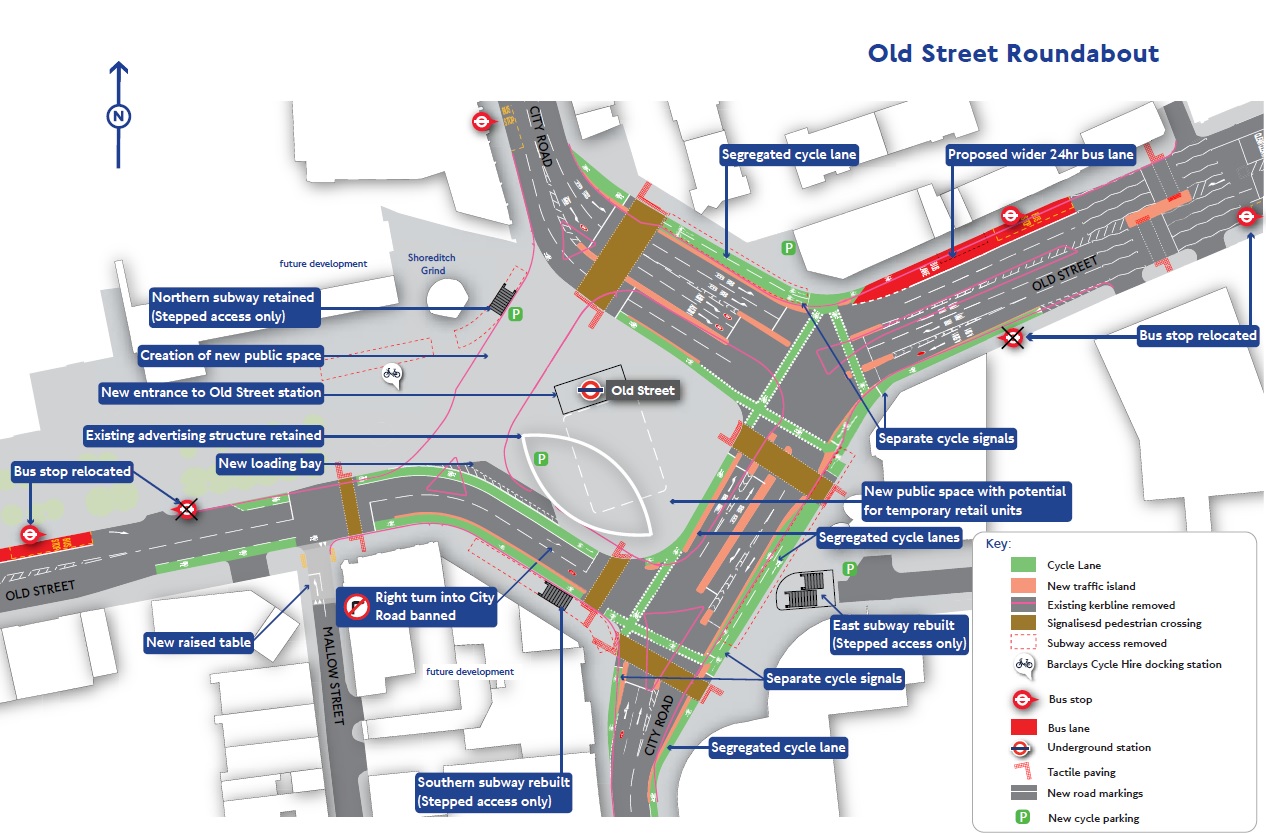
Note.
- The Inmarsat Headquarters is in the South-East corner of the roundabout.
- There is a new entrance to the station between the building and the Bezier apartments.
- The new main entrance to the station in the middle of the roundabout.
- Original plans showed a lift to the main station entrance from the surface, but two may have been built.
There appears to be a subway and two light-controlled pedestrian crossings between the new development and the station.
This Google Map shows the current state of Old Street Roundabout and the front of the Inmarsat Headquarters.

It can’t be long before developers build on the other two sides of the roundabout.
Who Will Be The Tenants?
This article on the Hackney Gazette, is entitled New 36-Storey Office Tower Proposed For Old Street.
It says this about the tenants.
The new site would contain approximately 4,000 sqm of new affordable workspaces that would be accessible to local businesses and organisations.
I suspect that these offices will be much better than some of the dumps Metier worked out of in the 1970s and 1980s.
Just promising to show the view could get a few visitors and some possible sales
Will The Building Have An Observation Platform?
At 160 metres tall, this building will be 150 metres shorter than The Shard, but it will be 27 metres than the Barbican towers.
So why not have an observation platform?
I suspect that from there, you will be able to see Hackney Mashes, as there are few buildings in between.
Offshore Wind Turbines Need To Be Standardised, Energy Transition Industrialised To Reach Targets, Says Siemens Energy VP For Western Europe
The title of this post, is the same as that of this article on offshoreWIND.biz.
This is the sub-heading.
Governments need to move from talking about policies to implementation, the offshore wind industry needs to employ standardisation, and clear rules and regulations need to be set for green hydrogen in order to move faster with large-scale deployment and achieve meaningful progress in limiting global warming to 1.5 degrees Celsius.
The guy has a point, as mass production of anything is generally more efficient and creates more units in a given time.
But can a diverse group of politicians, agree on a standard for turbines, fixed foundations, floaters, cables and sub-stations and then make sure all are identical and clip together like Lego? I doubt it!
And how would you fit innovative designs like TwinHub into a standard.
This image shows one of their TwinHub turbine installations being towed into place.
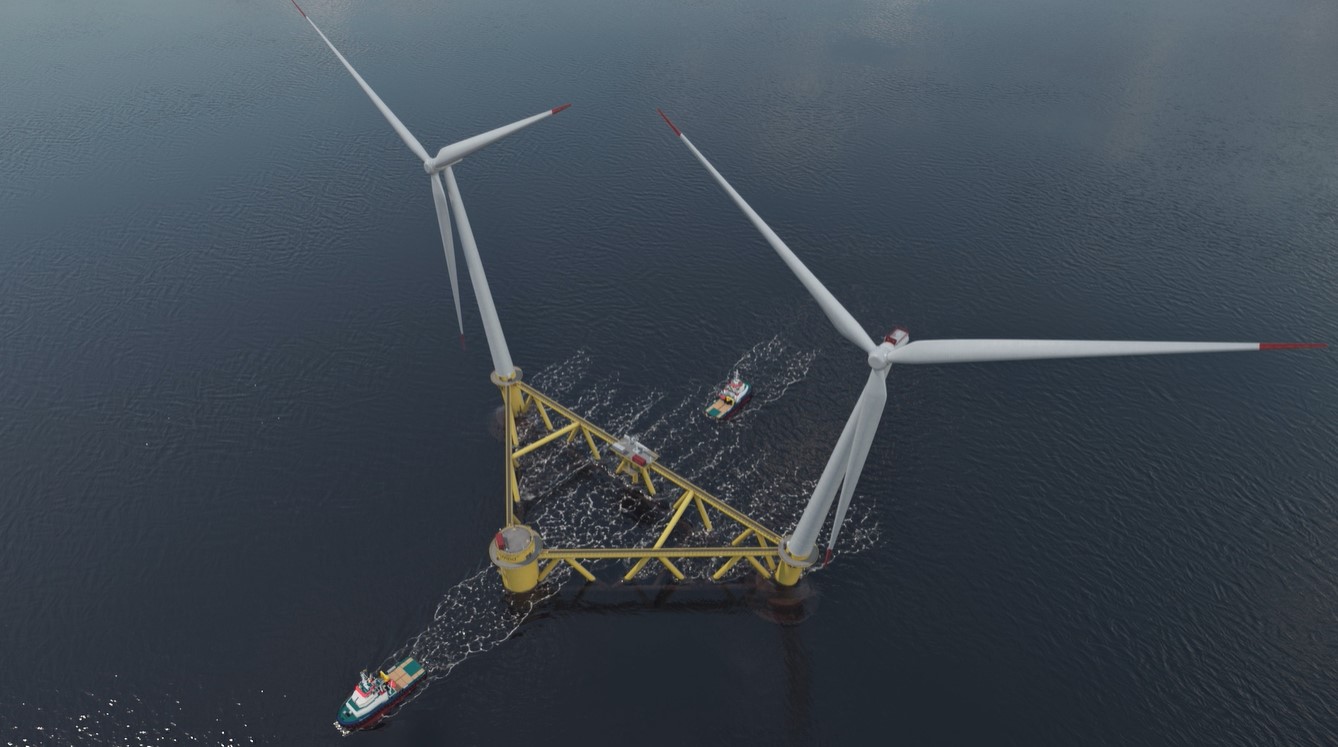
At least it could be built to hold two standard turbines.
Crown Estate Accelerates Celtic Sea Floating Offshore Wind Surveys
The title of this post, is the same as that of this article on offshoreWIND.biz.
This is the sub-heading.
The Crown Estate has announced the awarding of the first contracts for its first major investment in surveys to help with the construction of floating offshore wind farms in the Celtic Sea.
These two paragraphs describe the contracts.
Contracts have now been signed for the initial phase of metocean surveys, which look at wind, wave, and current patterns, to begin in Spring 2023. The Crown Estate is progressing the procurement of the remaining surveys over the coming weeks and months, subject to further commercial discussions.
By investing in these surveys at an early stage and making the data freely available to successful bidders, the Crown Estate is aiming to accelerate the delivery of the projects, making it easier for developers to take early decisions and manage risk while supporting future project-level Environmental Impact Assessments (EIAs) as part of the planning process.
It looks like a good idea to me, as it could make the bidding process much quicker and bidders with special expertise may be able to get contracts more suited to their expertise.
Rolls-Royce And Gulfstream Give Wings To Sustainable Business Aviation
The title of this post, is the same as that of this press release from Rolls-Royce.
These are the first two paragraphs of the press release.
Rolls-Royce and Gulfstream Aerospace Corp. are leading the way towards sustainable business aviation by conducting the first original equipment manufacturer test flight of an ultralong-range business jet powered by 100% Sustainable Aviation Fuel (SAF). The test took place on the BR725-powered Gulfstream G650 twin-jet over Gulfstream’s headquarters in Savannah, Georgia.
Demonstrating that current Rolls-Royce engines for business jet and large civil applications can operate with 100% SAF as a full “drop-in” option, this test lays the groundwork for moving this type of fuel towards certification. At present, SAF is only certified for blends of up to 50% with conventional jet fuel and can be used on all current Rolls-Royce engines.
Note.
- The BR725 is described in this Wikipedia entry.
- The Gulfstream G650 is described in this Wikipedia entry.
- All current Rolls-Royce engines can run with blends of up to 50 % SAF and conventional jet fuel.
The BR725 or other engines in the family have other applications.
- It is used in the Bombardier Global Express.
- It was used in the Boeing 717 airliner.
- The military version of the BR725 will be used to re-engine the USAF’s Boeing B52-H Stratofortresses.
- The Dassault Falcon 10X will be powered by a development of the BR725.
I can certainly see, the owners of business jets being very interested in operating a sustainable business jet.
But would the USAF be interested in running a seventy-year-old bomber on 100% Sustainable Aviation Fuel?
The Fuel Used In The Test
This paragraph of the press release describes the fuel.
The SAF that was used in the test consists of two components: HEFA (Hydroprocessed Esters and Fatty Acids), produced from waste fat and waste plant oils by low-carbon fuel specialist World Energy in Paramount, California, and (SAK) Synthesised Aromatic Kerosene made from waste plant-based sugars by Wisconsin-based Virent Inc. This innovative and fully sustainable fuel in development eliminates the need for the addition of further petroleum-based components and enables a 100% drop-in SAF that can be used in existing jet engines and infrastructure without any modifications. This sustainable fuel has the potential to reduce net CO2 lifecycle emissions by about 80% compared to conventional jet fuel, with the possibility of further reductions in future.
That sounds impressive.
A Sustainable Airliner
The Boeing 717 is a hundred seat airliner, with about a hundred still in service. They appear to have a good safety record.
One of the operators is Hawaiian Airlines and might be the sort of airline, that would like to decarbonise their flights.
So might we see some airlines using the Boeing 717 on SAF to attract passengers?
I wouldn’t rule it out and after certifying the engine on the Gulfstream, certification on another type wouldn’t be the most demanding of certifications.
I also think, it is quite likely, that an aircraft manufacturer could use engines in the BR 725 family to create a hundred seat sustainable airliner.
UK and NSEC Strengthen Offshore Renewables Ties
The title of this post, is the same as that of this article on offshoreWIND.biz.
This is the sub-heading.
Members of the North Seas Energy Cooperation (NSEC), the UK, and the European Commission have signed a memorandum of understanding (MoU) to strengthen their cooperation for the development of offshore renewable energy.
The article is based on this article on the European Commission web site, which is entitled North Seas Energy Cooperation And UK Establish Cooperation Framework To Facilitate The Development Of Offshore Renewable Energy.
The full signed text is also in this document on the web site, which is entitled Memorandum of Understanding on offshore renewable energy cooperation.
I have read the MoU and it seems a sensible document for one with eleven signatures.
It lists the following areas of cooperation.
- Hybrid and joint projects
- Maritime and spacial planning
- Support framework and finance
- Best practice in respect of onshore and offshore grid practice
- Sharing of information on new technologies
- Exchange of best practices in relation to the relevant rules, regulations and technical standards
The MoU expects any problems to be resolved by consultations in good faith.
 The Anonymous Widower